BANK OF FINLAND
DISCUSSION PAPERS
13
•
2004
Timo Iivarinen
Financial Markets Department
21.9.2004
Large value payment systems
– principles and
recent and future
developments
Suomen Pankin keskustelualoitteita Finlands Banks diskussionsunderlag
Suomen Pankki Bank of Finland P.O.Box 160 FIN-00101 HELSINKI Finland + 358 9 1831 http://www.bof.fi
BANK OF FINLAND
DISCUSSION PAPERS
13
•
2004
Timo Iivarinen
Financial Markets Department
21.9.2004
Large value payment systems –
principles and
recent and future developments
The views expressed are those of the author and do not necessarily reflect the views of the Bank of Finland.
I am grateful for comments from my many colleagues at the Bank of Finland’s Financial Markets Department. Especially I want to thank Heikki Koskenkylä, Kari Korhonen and Jarmo Pesola for their useful comments and Kati Salminen for helping me to create the tables and figures in this paper.
Suomen Pankin keskustelualoitteita Finlands Banks diskussionsunderlag
http://www.bof.fi ISBN 952-462-144-4 ISSN 0785-3572 (print) ISBN 952-462-145-2 ISSN 1456-6184 (online) Multiprint Oy Helsinki 2004
Large value payment systems – principles and
recent and future developments
Bank of Finland Discussion Papers 13/2004
Timo Iivarinen
Financial Markets Department
Abstract
The present European large-value payment systems are on the verge of notable changes. Since they comprise the backbone or basic infrastructure of the whole economy, it is important that the changes are monitored and carried out in a very prudent manner. This paper attempts to analyse this change and provide an understanding of where we stand today and outline some possible prospects. The large-value payment systems are described and analysed in general terms. For the sake of comparison some important large-value payment systems outside of Europe are also examined.
It seems that there will be significant changes in the payment systems industry in the near future. Options for many areas are still open but some trends are visible. These trends are: economic integration, increasing pressure from the EU and the regulators to form a single domestic market across the whole EU area, rapidly changing regulatory environment, rapid development of IT, outsourcing of the payment system value chain, increasing emphasis on customer point of view and efficiency. Furthermore, the border line between large- and small value payments could become blurred, TARGET2 brings considerable changes to the present situation, the scope of CLS should be extended, SWIFT system will become industry standard both in cross-border and domestic payments. These developments in the EU might mean, from the Finnish point of view, that the development in several places could go backwards.
Suuria maksuja välittävien maksujärjestelmien
toiminta ja tulevaisuus
Suomen Pankin keskustelualoitteita 13/2004
Timo Iivarinen
Rahoitusmarkkinaosasto
Tiivistelmä
Eurooppalaiset suurten maksujen järjestelmät ovat mittavien muutosten edessä. Koska nämä järjestelmät muodostavat koko talouden selkärangan ja perus-infrastruktuurin, on tärkeää, että muutokset tehdään huolella ja että niiden vaiku-tuksia seurataan tarkasti. Tässä keskustelualoitteessa tarkastellaan tätä muutosta ja pyritään antamaan käsitys tämänhetkisestä tilanteesta. Vertailun vuoksi työssä on suppeasti tarkasteltu myös joitakin tärkeitä Euroopan ulkopuolisia suurten maksu-jen järjestelmiä. Lopuksi on pyritty hahmottelemaan suurten maksumaksu-jen järjestel-mien tulevaisuutta.
Suurten maksujen järjestelmät tulevat kokemaan lähivuosina merkittäviä muutoksia. Monessa suhteessa vaihtoehdot ovat vielä avoimia, mutta selkeitä trendejä on jo nähtävissä. Näitä trendejä ovat seuraavat: taloudellinen integraatio, viranomaisten ja Euroopan komission lisääntyvät vaatimukset yhteisen raha-markkina-alueen luomiseksi, sääntelyn suuret muutokset, tekniikan nopea kehitys, uusien jäsenmaiden liittyminen EU:hun, maksujärjestelmiin liittyvien arvo-ketjujen ulkoistaminen, asiakkaiden tarpeiden ja tehokkuuden korostuminen, suuria ja pieniä maksuja välittävien maksujärjestelmien rajojen hämärtyminen, uudesta TARGET 2 -järjestelmästä seuraavat merkittävät muutokset, CLS-järjes-telmän toiminta-alan laajeneminen, SWIFT-järjesCLS-järjes-telmän tuleminen toimialan standardiksi sekä koti- että ulkomaisisa maksuissa. Euroopassa tapahtuva kehitys saattaa olla Suomen kannalta epäedullista.
Avainsanat: maksujärjestelmät, trendit, RTGS-järjestelmät, suurten maksujen jär-jestelmät
Contents
Abstract...3
Tiivistelmä ...4
1 Introduction ...7
2 General principles of large-value payment systems ...8
2.1 General features ...8
2.2 Payment processing...10
2.3 Risk control measures ...13
2.4 Recent trends in large-value payment systems ...15
2.4.1 Design ...15
2.4.2 Efficiency and pricing ...16
3 Principles and recent developments in central bank large-value payment systems ...18
3.1 TARGET...18
3.1.1 TARGET payments...19
3.1.2 National components of TARGET ...21
3.2 Other RTGS systems operated by central banks...31
3.2.1 FEDWIRE USA...31
3.2.2 BOJ-Net Japan ...33
3.2.3 Swiss Interbank Clearing Switzerland...34
3.2.4 Basic statistics for the systems ...36
4 Principles and recent developments in large-value payment systems operated by the private sector...37
4.1 EURO 1...38
4.2 Paris Net Settlement system (PNS) ...39
4.3 Spanish large-value payment system SPI (Spanish Interbank Payment Service)...40
4.4 Finnish large-value payment system, POPS ...41
5 CLS system...44
6 Prospects for the future...46
References...53
1 Introduction
The purpose of this paper is to provide some insight into the principles and recent developments of large value payment systems from the European point of view and to indicate what might lie ahead for the future development of these payment systems. For the sake of comparison some important large-value payment systems outside of Europe are also examined. The present large value payment systems are on the verge of notable changes and, since they comprise the backbone or basic infrastructure of the whole economy, it is important that the changes be monitored and carried out in a very prudent manner. This paper attempts to monitor this change and provide an understanding of where we stand today.
The main driver for the coming changes in large value payment systems, and in other payment systems as well, is the economic integration of the EU area and the effort to improve the efficiency of these systems. Economic integration is vigorously backed by the European Union and regulators in the area. Although the options for the change in many fields are still open, some trends are already apparent. The integration process will continue at least for the rest of the decade and will inevitably draw both large- and small- value payments into more consolidated payment systems in the area. This means that there will be fewer payment systems but that the number and value of processed payments in these systems will be huge, so that oversight and supervision will become even more important. The distinction between large- and small- value payments will eventually diminish and as a result payments are likely to be categorised more often by payment type, as the payment systems become more specialised (eg interbank payments in TARGET2, FX-deals in CLS and customer payments in PEACH).
In the reform of large value payment systems, there will be more emphasis on efficiency and practicality or user friendliness, than earlier on, when reduction of systemic risk was the focus of attention. In today’s society and in an area where fewer payment systems will be in place risk reduction will however not be downgraded vis-à-vis the new payment systems. But efficiency, cost recovery and practicality will clearly receive more attention than before.
One trend is the emergence of new cross-border systems. The design of new payment systems will be difficult, as the remaining payment systems have to fulfil the needs of many countries. This represents new challenges for the system designers because needs sometimes vary significantly across countries. All these challenges lie ahead also for the designers of the new TARGET2 system.
This paper presents first, in general terms, the common features, types of payment processing, risk control measures and recent trends in the large-value payment systems. After that, various important large-value payment systems will
be described and their development analysed. Finally, the possible prospects for the future will be outlined.
2
General principles of large-value payment
systems
Large-value payment systems in different countries differ greatly. This is due historical reasons and to differences in financial structures and the roles of central banks. Whatever the reasons, however, there are some common basic features that characterise the large value payment systems. The key features of large-value payment systems can be defined in terms of general organisation, payment processing and risk control measures.
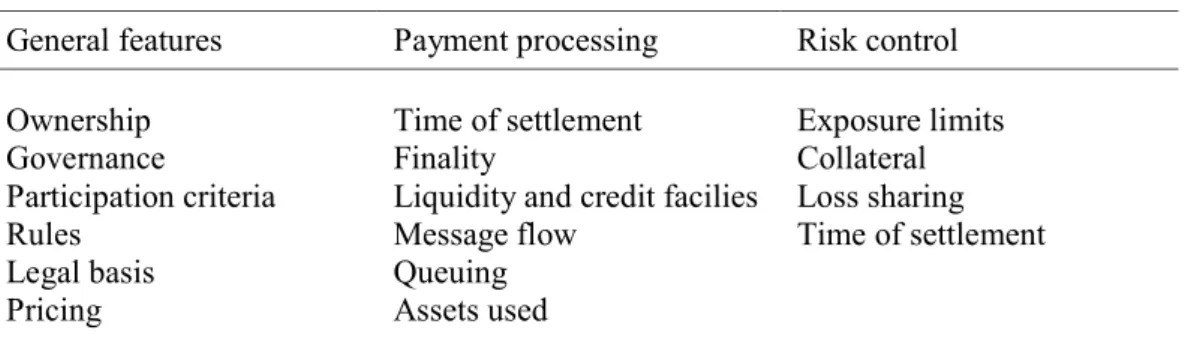
Table 1. General principles of large value payment systems
General features Payment processing Risk control Ownership Governance Participation criteria Rules Legal basis Pricing Time of settlement Finality
Liquidity and credit facilies Message flow Queuing Assets used Exposure limits Collateral Loss sharing Time of settlement
Table 1 provides an outline on the analytical structure of this section. General features are covered in section 2.1. Particularities of processing of payments are described in 2.2. Section 2.3 covers risk management issues and the last section identifies some visible trends in the development of large-value payment systems.
2.1 General
features
The general features of large-value payment systems concern matters such as system ownership, governance, criteria for participation, rules and legal basis of the system and pricing. As for system ownership, the central bank, a group of commercial banks or a banking association may own the system. They are all possible options, but as regards credit and settlement risk they pose a different level of risk.
Governance consists of the relationships between the payment system’s management and its governing body, its owners and stakeholders. Governance is important because it determines how the whole payment system is managed and how the objectives for the whole system are set. Similarly it has an impact on the handling of crisis situations. From the overseer’s point of view and due to the ever-changing payment system landscape in the EU, this topic may be important in the future. This follows from the fact that often owners, different users and society have different interests in a payment system. The question is how should a payment system be governed so as to achieve the optimum result for different interest groups.
The criteria for participation in a payment system also differ between countries. In principle these criteria may range from a closed club of participants to free participation, but in practice most systems use publicly disclosed criteria which have to be met by any entity prior to participation in the system. Preferably these criteria are balanced in a way that protects the present participants from any potential risk caused by new applicants, and on the other hand, fosters fair competition between parties in a given market.
The legal basis of the payment system is important because participants must be able to predict consequences of their actions. Also the risks of participation can be more easily assessed if it is clear under which jurisdiction the rules and procedures of a system are interpreted. Presently there are several possibilities. The legal basis, for instance, can be a general law on payment system matters, under which all the different aspects of the payment system are covered, or the legal basis can be based on a central bank law or regulation. Instead of a single payment systems law or central bank law/regulation, the legal basis could be based on contractual agreements between the users themselves. This means that there are a number of separate laws regulating various areas of payment systems. In this case it is important that the set of separate laws form a solid basis free of contradictions.
Pricing in different payment systems varies. But nowadays both private
payment systems and central bank systems strive for full cost recovery. In privately run payment systems this is a fairly straightforward matter, but in systems run by central banks things get somewhat blurred due to difficulties of allocating fixed costs to banks’ service prices.
When the pricing of systems run by central banks is discussed, it is necessary to consider the public good factor. The public-good factor, in this context is usually understood to be the systemic risk factor, which central banks try to minimise by running the most essential parts of the local payment system themselves. Systemic risk is that a failure by one participant to meet an obligation will cause difficulties for other participant to meet their obligations.1 Calculation
of the systemic-risk factor is very difficult for payment systems because the monetary value of systemic risk is difficult to allocate. There may also be other immaterial factors that complicate the calculation.
2.2 Payment
processing
There are several ways to process large-value payments. In many large-value payment systems, settlement and exchange of payment information are done simultaneously. In other systems these take place at different times. Usually settlement takes place at the central bank whereas payment information is transferred directly to the receiving bank. However, the main features of payment processing are time of settlement, time of settlement finality, liquidity and credit facilities, message flow in the system, the nature of queuing (if any), and the assets used for the settlement.
The time of settlement is the point in time when the settlement actually occurs. There can be a lag between the time when the payment is accepted for settlement and when it is actually settled. The choice as to when the settlement takes place depends mainly on how much credit and liquidity risk is accepted in the payment system. Present arrangements vary from RTGS (real time gross settlement) where settlement takes place in real time, to settlement at the end of the day or the next day. There are also systems that are intermediate to these, in which settlement takes place at designated intervals during the day. In these systems the payments are net and only netted amounts of funds are actually settled. The time of settlement finality is closely related to the time of settlement, because in an RTGS system payments are settled in gross amounts and clearing and settlement take place simultaneously. In RTGS systems, payments are final in real time, whereas in netting systems they are final only after settlement, which takes place at a later point in time. Both systems have their pros and cons. The main technical concern in choosing the suitable solution is the cost of building the system compared to the number of payments the system is supposed to process. Also the needs of users have to be born in mind when designing a system.
Liquidity and credit facilities for the banks using a payment system are a
primary concern in an RTGS system, where – due to the gross settlement – more liquidity is needed to settle payments, as compared to netting systems, which require liquidity only for netted amounts. As far as liquidity is concerned, this is the main advantage of a netting system. As for a gross system, the main disadvantage is the risk of a gridlock situation, where the payments are waiting for enough liquidity to start the settlement process.2 At present, many RTGS systems
2 For more information on gridlock resolution, see Morten L. Bech – Kimmo Soramäki, Gridlock
offer some kind of intraday liquidity facility, which is very rare in netting systems. This extended need for liquidity in RTGS systems has been addressed in various payment systems through the establishment of a central bank intraday credit service. There are differences in how this service is set up in practice. Also the fees and costs for this service vary considerably between countries.
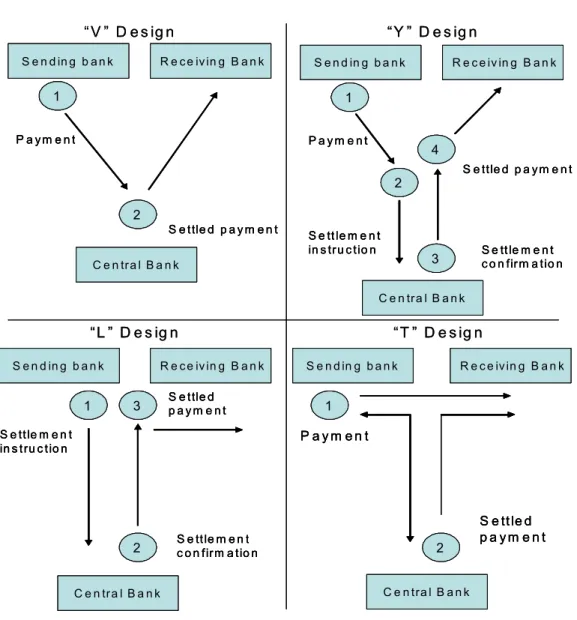
Figure 1. Message flow types
C e n tra l B a n k P a y m e n t S e ttle d p a y m e n t R e c e iv in g B a n k S e n d in g b a n k 2 1 P a y m e n t S e ttle d p a y m e n t S e tt le m e n t in s tru c tio n S e tt le m e n t c o n firm a tio n S e n d in g b a n k R e c e iv in g B a n k 1 2 4 3 C e n tra l B a n k S e ttle d p a y m e n t S e ttle m e n t in s t ru c t io n S e tt le m e n t c o n firm a tio n S e n d in g b a n k R e c e iv in g B a n k 1 C e n tra l B a n k 3 2 P a y m e n t S e ttle d p a y m e n t S e n d in g b a n k R e c e iv in g B a n k 2 1 C e n tra l B a n k “ V ” D e s ig n “Y ” D e s ig n “L ” D e s ig n “T ” D e s ig n C e n tra l B a n k P a y m e n t S e ttle d p a y m e n t R e c e iv in g B a n k S e n d in g b a n k 2 1 C e n tra l B a n k P a y m e n t S e ttle d p a y m e n t R e c e iv in g B a n k S e n d in g b a n k 2 1 P a y m e n t S e ttle d p a y m e n t S e tt le m e n t in s tru c tio n S e tt le m e n t c o n firm a tio n S e n d in g b a n k R e c e iv in g B a n k 1 2 4 3 C e n tra l B a n k P a y m e n t S e ttle d p a y m e n t S e tt le m e n t in s tru c tio n S e tt le m e n t c o n firm a tio n S e n d in g b a n k R e c e iv in g B a n k 1 2 4 3 C e n tra l B a n k S e ttle d p a y m e n t S e ttle m e n t in s t ru c t io n S e tt le m e n t c o n firm a tio n S e n d in g b a n k R e c e iv in g B a n k 1 C e n tra l B a n k 3 2 S e ttle d p a y m e n t S e ttle m e n t in s t ru c t io n S e tt le m e n t c o n firm a tio n S e n d in g b a n k R e c e iv in g B a n k 1 C e n tra l B a n k 3 2 P a y m e n t S e ttle d p a y m e n t S e n d in g b a n k R e c e iv in g B a n k 2 1 C e n tra l B a n k P a y m e n t S e ttle d p a y m e n t S e n d in g b a n k R e c e iv in g B a n k 2 1 C e n tra l B a n k “ V ” D e s ig n “Y ” D e s ig n “L ” D e s ig n “T ” D e s ig n
Types of message flows also vary considerably. There are basically four message
flow types: V-shaped, Y-shaped, L-shaped, T-shaped. In RTGS systems and in other real time-based large-value payment systems, actually only three of these are used. In RTGS systems the most widely used message structure is the
V-shaped message flow structure, in which all the payment information is first
passed to the central bank for interbank settlement. After settlement, the payment information is sent to the receiving bank.
Another widely used message flow structure is the Y-shaped structure (especially for systems that use the SWIFT network), where the original information contained in the message is split into two parts by the SWIFT network. The information necessary for settlement is sent by the SWIFT network to the central bank for settlement. If there are sufficient funds in the account of the sending bank, the central bank settles the payment. Once settled, the full payment message with the information about the settlement is sent to the receiving bank. These two types of message flow designs differ in the amount of information that is sent to the central bank. In the latter case, the central bank does not receive the business information contained in the payment message.
The L-shaped structure is actually quite similar to the Y-shaped structure. Only the place where the original payment information is kept during the settlement process differs with the L-shaped structure, the payment message is held at the sending bank’s processor and the information necessary for settlement is sent to the central bank. After settlement of the payment, the central bank sends information about the settlement back to the sending bank’s processor, which automatically sends the complete payment information to the receiving bank. In all three structures the receiving bank receives the complete payment message with settlement information only after the settlement has actually taken place.
The last alternative message flow format is the T-shaped structure, where the sending bank sends simultaneously the same payment message to the receiving bank and to the central bank for settlement. After settlement of the payment at the central bank, the central bank sends a confirmation message on settlement of the payment to the receiving bank. This structure entails liquidity risk because the receiving bank can act in the information of the payment message before it is actually final. This is considered undesirable in an RTGS system and therefore it is not presently used.
The nature of queuing is also a prominent factor in large-value payment systems, although some systems do not offer this feature at all. Basically queuing can be arranged in two different ways. Either a payment system has it’s own central queuing mechanism or the queuing is carried out in the individual banks by their own systems. Some banks might even use both methods simultaneously. Another aspect is the management of the queue, which also can be either centralised or decentralised. In the first case the processor of the payments handles the queue, while in the latter payments are managed by the individual banks. In the centrally located and managed systems banks usually can attach priority codes to their payments to express how urgently payments should be settled. Payments carrying the same priority code will usually be settled by the FIFO method (first in, first out). In many systems payments can also be rearranged in the queue by the central processor or individual banks. Another approach is to use optimisation routines (pre-set procedures or algorithms) to effectively settle payments in the queue. In this case payments are settled
simultaneously at pre-set intervals or if gridlock occurs. This method may be more effective, as it provides more options for processing the payments besides the strict sequencing of payments. This of course depends on what kind of optimisation routine, is used. In order to better understand the consequences of any optimatisation routine different methods of queuing can be simulated to determine the best option in any specific payment system.3
In principle the agent used for settlement could be either the central bank or some other financial institution. But in practice all RTGS systems settle with central bank money and most large-value payment systems that co-exist with an RTGS system settle through the national RTGS system.
2.3
Risk control measures
It is crucial to financial stability that large-value payment systems are robust. There are many payment system risks that participants may face.4 Figure 1 gives the different types of risk that are usually associated with large-value payment systems.
Table 2. Risks in large-value payment systems
Risks in large value payment systems Credit risk Liquidity risk Operational risk Settlement risk Systemic risk Environmental risk
Credit risk is the risk that at some point a counterpart will not meet its
obligations to another participant at any point. Liquidity risk means that a counterpart may not settle an obligation when due but rather at some unspecified time thereafter. This may in turn hamper the payee’s liquidity management
3 See more about simulation in Leinonen Harry – Soramäki Kimmo, Simulating interbank payment
and securities settlement mechanisms with the BoF-PSS2 simulator, Bank of Finland Discussion Papers, 23/2003.
4 See Bank of Finland Series A:106 (2003): Regulation and control of payment system risks –
because the obligation is not been settled as expected and the payee might be forced to seek other (possibly more expensive ) funding, if such is available.5
Operational risk is the risk of errors in the information system,
administration or organisation of a payment system. Such risk is very closely associated with IT systems, which are the backbone of every modern payment system. Typical administrative errors are associated with bank’s operating methods, division of responsibilities, employees’ expertise, backup systems etc. There is for example operational risk if in an RTGS system all auxiliary systems settle at the same point in time.6 With increasing technical complexity of payment systems, more and more expertise is required from the personnel, which renders the systems more vulnerable to operational risks. Also crime risks fall into this category of risks. Criminals may learn about system weaknesses and succeed in exploiting them.
Settlement risk usually refers to the risk that the whole settlement operation
of an interbank funds transfer system is disturbed so that some (typically all) payments cannot be settled. Another risk of this type is systemic risk. Systemic risk usually refers to the chain reaction that can take place when the failure of a participant to meet an obligation leads to problems for other participants’ in meeting their obligations. This domino effect can lead to broader financial difficulties and may even jeopardise the stability of the whole financial system.
There are also environmental risks that are not inherent in the payment system or it’s participants. These are risks of loss due to profound changes in the operating environment. A constantly changing environment – such as that of the present, increases this risk considerably. The main environmental risks are associated with changes in market practices, legislation or technology or with catastrophes.
The risks mentioned above can be avoided, or the scale of losses minimised, in several ways. The credit and liquidity risks can be avoided by using exposure limits (debit and credit caps). These can be used between any two participants of a payment system or multilaterally. Usually these are designed so that that a debit cap is the maximum debit that a participant can have towards the participants of the same system. By credit cap is usually meant the maximum credit a participant is willing to give to another participant in the system.
Another way to reduce risks associated with payment systems is to require collateral for the settlement of the payments. In case a participant cannot meet its obligations, payments will be settled by using this collateral, which is at the disposal of the settlement agent. Usually the collateral is in the form of securities,
5 See also Leinonen Harry, Interbank funds transfer systems: liquidity needs, counterparty risks
and collateral, Bank of Finland Discussion Papers, 16/1998.
6 See Bank of Finland Bulletin, Financial stability, Special issue 2003, page 52, Chart 32, Critical
which are deposited at the local securities depository. Loss-sharing arrangements can reduce these risks even more. These kinds of arrangements are usually set up to protect the system in case where the collateral deposited by a participant is not sufficient to cover its liabilities. Losses are allocated among the other participants of the system.
In large value-payment systems, time lags in the settlement process can also be a source of risk. This settlement lag is the time lag between execution of a transaction and final crediting of the receiving participant’s account. When a participant has knowledge of incoming payments before they are actually credited to its account, it might then use the funds (credit them to customer accounts). This can lead to a situation where the participant does not get the funds if the settlement for some reason is not completed. This is a credit risk. Lags in settlement can also cause liquidity risk. This is because liquidity management is difficult if a participant cannot be sure of the magnitude of the payments it is receiving. The best way to reduce these risks is to reduce the time lags. For these reasons, same-day settlement has become popular for large-value payment systems. As a matter of fact, in many payment systems the time lags have been reduced to a minimum by introducing RTGS systems, in which the transfer payment information and settlement take place simultaneously. In some systems introducing procedures whereby clearing and settlement are carried out several times during the day has reduced these risks.7
2.4
Recent trends in large-value payment systems
2.4.1 Design
Large-value payment systems have changed remarkably over the last twenty years. The first large-value payment system design was the deferred net settlement system (DNS). In this design participants send each other payments during the day. Settlement takes place at a pre-set time, usually at the end of the day. In these systems settlement can be realised either bilaterally or multilaterally. In a bilateral arrangement, participants pay each other. In a multilateral arrangement each participant pays its net obligation to a settlement agent, which in turn pays the receiving participants. National central banks often act as settlement agents. This payment system design is vulnerable to many risks associated with the design of the system. As mentioned before, a system with a deferred settlement gives rise to potential problems if the receiving bank does not get the funds it is expecting. This might lead also to other problems within the system if the receiving party cannot meet it’s own obligations. DNS systems have over the years been
improved with various risk reducing elements such as limits, collateral requirements, and reducing the settlement time lag by having several settlement runs during the day, when ever the limits are reached. Such systems are usually called protected DNS systems.
Increasing values and volumes underlined the pitfalls of DNS systems. For this reason central banks have preferred to design new payment systems so as to eliminate the risks associated with DNS systems. The outcome of this development was the birth of RTGS (real time gross settlement). This system design has become very widely used since the 1990s. For example all EU countries have one and there are now more than 70 RTGS systems world-wide. Moreover all EU-accession countries already have their RTGS systems or are in the process of establishing them. In an RTGS system the sending of payment information and settlement are carried out simultaneously. Payments are settled gross, without netting. These features eliminate the risks of DNS systems and participants can be sure of receiving cover for payments. There are, however, some other drawbacks associated with this design. Liquidity needs are greater in a system where payments are settled gross, compared to a netting system. For this reason most central banks offer participants extra liquidity. This is done by granting collaterised intraday credit.
New kinds of payment systems have evolved in recent years. These new systems attempt to combine the advantages of DNS and RTGS systems. In other words they try to combine the safety of RTGS systems with the liquidity saving features of netting systems. One such design is called continued net settlement (CNS), which has evolved from the DNS design. One example of these systems is the large-value payment system of France (PNS, Paris Net Settlement). Here, payments are processed one by one on a continuous basis. Each payment which meets certain criteria is settled immediately. Others are put in a queue. The queue is scanned continuously and two optimisation mechanisms are used to settle payments in the queue (see section 4.2 for more details).
Another way to combine the advantages of RTGS and netting systems is that used in Germany’s new RTGSplus system. This system is an enhanced RTGS system. It is basically an RTGS system with liquidity saving features and efficient liquidity management (see section 3.1.1 for further details).
2.4.2 Efficiency and pricing
In designing new large-value payment systems there is an increasing need to pay more attention to the social efficiency of the system. So far, the other side of the coin – risk reduction - has been the guiding principle in designing large-value payment systems. Social efficiency here means that payment systems should offer
efficient means of making payments. The term also incorporates the idea that a system should be practical for its users.
Due to the integration process in the EU area national indicators of efficiency are no longer sufficient to reflect the efficiency of any payment system. The efficiency of a payment system should be measured from the perspective of whole EU area or even globally. This is one of the reasons why the CLS system is described in this paper.8
Efficiency and practicality mean that not always is the most versatile the most appropriate in a given environment. Special features which are not often used by participants should not be incorporated in an efficient and practical system. Special features mean only high costs of running and maintaining the system. The system should also be practical to its users in affording them advantages that other payment systems cannot offer, thus giving users a reason for using the system. These aspects are not always kept in mind when designing new payment systems. When new features are added to a system, the historical reasons or lack of focus on efficiency can be reasons for forgetting these aspects. The renewal of the whole TARGET system the TARGET2-project, which started in January 2003, will in the first stage in dealing with these matters.
At present the method of pricing varies widely across different payment systems. For instance in TARGET the price is determined differently in cross-border payments vs. domestic payments. Cross-cross-border payments are priced similarly in all national components of TARGET while domestic prices are determined at national level by the respective national central banks. Hence fees have been harmonised only partially. There can also be additional costs related to extra service or upkeep of connections between the banks. The cross-border fee is based on the quantity of payments. The scale is degressive, meaning that the more payments are transferred the cheaper it becomes. The price structures for domestic payments sent through the different national components of the TARGET range from quantity related prices, with possible entry and annual fees added, to flat transaction fees. Some systems set their price scales with the aim of promoting the sending of payments as early as possible, by making earlier ones cheaper. Sometimes large-value payments are priced lower than smaller payments, to give preference to the processing of critical payments. In some other large-value RTGS systems the principles for pricing seem to be quite similar. For some large value payments the fees range from a flat entry fee, without transaction fee (POPS-system), to price structures similar to those of national components of the TARGET system.
Despite the differences in pricing structures in the current payment systems the present trend in new designs seems to be towards more efficient payment
8 The CLS-system (continuous linked settlement) is designed for the safe settlement of foreign
systems where the customer point of view is taken into consideration. A major force behind this trend is the possibility of using new technology to lower production costs of new payment systems. Another driving force is the ongoing integration process. At present with integration proceeding at all levels, in both small- and large value systems, the remaining new payment systems must meet the needs of different users from many countries. This represents new challenges for system designers because the needs of different countries sometimes vary significantly.
3
Principles and recent developments in central
bank large-value payment systems
3.1 TARGET
TARGET (Trans-European Automated Real-time Gross settlement Express Transfer system) is an EU-wide, automated real-time gross settlement system for euro-denominated payments within the European Union. It started operations in 1999. Members of the European Union can use this system to send euro-dominated payments. Because some members of the European Union still have their own currencies (not members of the Economic and Monetary Union, EMU), such as the United Kingdom, Denmark and Sweden, they use TARGET only for their euro payments. When the accession countries join the EMU they will start to use the TARGET system.
TARGET was created with a view to meeting three main objectives: – To serve the needs of Eurosystem monetary policy
– To increase the efficiency of intra-European cross-border payments
– To provide a reliable and safe mechanism for settlement of cross-border payments
TARGET consists of fifteen national RTGS systems and ECB’s payment mechanism, which are interlinked so as to provide a uniform platform for the processing of payments throughout the EU area. TARGET provides the means for more than 5,000 EU credit institutions to make cross-border payments through their own national RTGS systems.
Different national RTGS systems differ remarkably having been originally developed for domestic use. Cross-border TARGET payments are processed via national RTGS systems. These systems send payments directly to the receiving RTGS systems. Even though the different national RTGS systems differ from
each other an interlinking component makes it possible for systems of different designs to communicate. The only features that have been harmonised are operating time, pricing of cross-border payments and provision of intraday credit.
3.1.1 TARGET
payments
Figure 2. TARGET: Value and number of domestic and cross-border payments in the EU area,
daily average 0 200 400 600 800 1 000 1 200 1 400 1 600 1 800 2 000 1999 2000 2001 2002 2003 EUR billion 0 50 000 100 000 150 000 200 000 250 000 Number of payments
Cross-border payments, value (LHS) Domestic payments, value (LHS) Domestic payments, number (RHS) Cross-border payments, number (RHS) Source: European Central Bank.
The monthly value of all TARGET payments fluctuated last year between 1,500 and 1,800 billion euro. An all-time high was reached in December 2002 when the daily average of all payments was 1,800 billion euro. The increase in daily value is more or less due to the increase in domestic payments. About two-thirds of the payments were domestic payments. The same trend can be seen in the number of payments. The volume of cross-border payments has been fairly stable, whereas that of domestic payments has risen since 1999.
A significant increase took place in domestic TARGET payments in November 2001 in both value and number. This stems from the fact that in Germany the new RTGSplus was introduced on 5 November 2001. This new
system replaced two German large-value payment systems, Euro Link System (ELS) and Euro Access Frankfurt (EAF). ELS was the old RTGS system and national component of TARGET; EAF was the other German domestic large value payment system outside of TARGET. Payments from the ELS system were rerouted through the national TARGET component, RTGSplus, in November 2001.
The rerouting of ELS payments to RTGSplus explains the increase in the domestic payment component of TARGET payments.
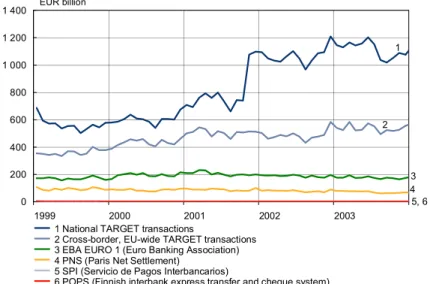
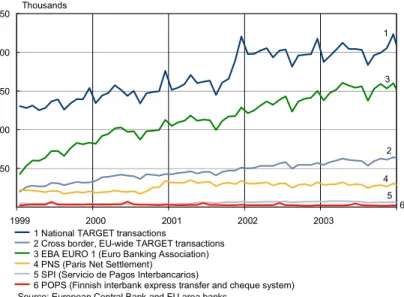
The TARGET system handles the largest value of payments of all the large value payment systems in the EU. In cross-border payments TARGET is almost twice as large as the EURO 1 system of the EBA9. In terms of number of payments, the situation is the reverse. More than twice as many payments flow through the EURO 1 system as through TARGET. This characterises well the nature of TARGET, which is clearly a system for interbank payments, whereas EURO 1 is used more for processing customer payments.
Figure 3. Value of transactions in EU area payment systems,
daily average 1 2 3 4 5, 6 0 200 400 600 800 1 000 1 200 1 400 1999 2000 2001 2002 2003 EUR billion
1 National TARGET transactions
2 Cross-border, EU-wide TARGET transactions 3 EBA EURO 1 (Euro Banking Association) 4 PNS (Paris Net Settlement)
5 SPI (Servicio de Pagos Interbancarios)
6 POPS (Finnish interbank express transfer and cheque system) Source: European Central Bank and EU area banks.
9 Euro Banking Association: cooperative body for large European banks for the transmission of
Figure 4. Number of transactions in EU area payment systems, daily average
1 2 3 4 5 6 50 100 150 200 250 1999 2000 2001 2002 2003 Thousands
1 National TARGET transactions
2 Cross border, EU-wide TARGET transactions 3 EBA EURO 1 (Euro Banking Association) 4 PNS (Paris Net Settlement)
5 SPI (Servicio de Pagos Interbancarios)
6 POPS (Finnish interbank express transfer and cheque system) Source: European Central Bank and EU area banks.
In figures 2 and 3 the rise in values and numbers of domestic payments is due to the start of RTGSplus. The increase for number of transactions in EURO 1 is quite clearly illustrated in figure 4. In EURO 1 the value of transactions have , by contrast, been quite stable. Large-value payment systems, excluding TARGET and EURO 1, play a smaller role in the processing of large-value payments. They are usually used domestically, and the values and numbers can be domestically significant but in the EU area context their role is rather small.
3.1.2 National components of TARGET
National RTGS systems in the European Union countries form a crucial part of the TARGET. Many of them have a pre-euro history. This means that they have existed as national large-value payment systems before the TARGET system went live in 1999. Although central banks have attempted to harmonise the functioning of national components, they still differ from each other. The reason for this is that when the EMU started there was a need to build rapidly and cost-effectively a trans-European payment system. This was achieved by harmonising only the crucial features of the systems, namely the features that concerned the implementation of ECB monetary policy and the level playing field for credit institutions.
Another unique feature of TARGET is that it operates over a larger area than the present 12 EMU countries. EU countries that have not yet adopted the euro also participate in the TARGET system. This stems from the fact that the time to
set up a system was limited and the countries were not certain of their adoption of euro before being forced to invest money to TARGET.
At present there are 15 countries participating in the TARGET. The names of each system and the payment flows are presented in table 3. This table also indicates the magnitude and relative importance of each individual system. For instance in Luxembourg the annual payment system turnover is 209 times greater than the annual GDP. In other words it takes only one day to process a value equal to Luxembourg’s annual GDP in the country’s national RTGS.
Table 3. Payment flows and GDP in EU countries, 2003
Country Name of system Ratio of RTGS system turnover to GDP Annual turnover in RTGS system, EUR bn Number of days to turn over annual GDP Luxembourg LIPS-Gross 206 4755 1 Spain SLBE 95 70208 3 France TBF 62 96327 4 Germany RTGSplus 60 128544 4 Belgium ELLIPS 51 13558 5 Netherlands TOP 47 21365 5 Ireland IRIS 41 5502 6 Finland BoF-RTGS 25 3645 10 Portugal SPGT 25 3255 10 Austria ARTIS 23 5177 11 Greece HERMES 22 3343 12
Great Britain CHAPS Euro 20 31180 13
Italy BI-REL 19 24761 13
Denmark KRONOS 17 3208 15
Sweden Euro RIX 7 1897 36
Figure 5. Share of domestic and cross-border payments value by EU country, 2003 UK 7 % IT 6 % NL 5 % BE 3 % OTHERS 7 % DE 31 % ES 17 % FR 23 % DE FR ES UK IT NL BE OTHERS
Figure 5 shows market shares of the European RTGS systems by value at the end 2003. About two-thirds of payments are made by three countries Germany, France and Spain. At 31%, Germany’s RTGSplus system is by far the biggest in Europe. The figure also shows how split the market is. The seven systems whose processed value was the greatest are specified, while the rest are included in the others, slice, which represents only 7% of the total.
Figure 6 shows the market shares by number of transactions. Again two-thirds of the payments are made by three countries, but except for the same leading country, the other top three places are held by other national components than in figure 5. This emphasises the strong concentration of the figures in terms of transactions because almost half of the payments are made via national components of the German RTGSplus system (49%). In the second place is Italy (14%) and in the third is the Netherlands (7%).
Figure 6. Share of number of domestic and cross-border payments by EU country, 2003 DE 49 % IT 14 % NL 7 % UK 6 % OTHERS 6 % FR 6 % ES 5 % BE 3 % AT 4 % DE IT NL UK FR ES AT BE OTHERS
Source: European Central Bank.
Figures 5 and 6 show only the magnitudes of euro-denominated payments sent through different national RTGS payment systems. These figures do not include the dual systems in the OUTS countries, where there is side by side a euro RTGS system and a national-currency RTGS system. Especially in the case of the United Kingdom, if the sterling RTGS system (CHAPS Sterling) were included, it would be the third biggest system after France in terms of value. The other OUT countries, Sweden and Denmark, do not play such a significant role.
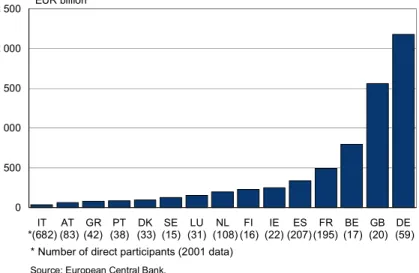
Figure 7. Value of RTGS transactions per direct participant, 2003 0 500 1 000 1 500 2 000 2 500 IT AT GR PT DK SE LU NL FI IE ES FR BE GB DE EUR billion
Source: European Central Bank.
*(682) (83) (42) (38) (33) (15) (31) (108) (16) (22) (207) (195) (17) (20) (59) * Number of direct participants (2001 data)
Figure 7 shows the RTGS transactions with direct participants in each country. It also shows how different the local RTGS systems are in this respect. In Italy there are so many direct participants (682) that the RTGS transactions per direct participant are the lowest (EUR 36 billion) although the annual turnover per se is much higher than in many other countries. In countries where the number of participants is relatively low and turnover high, the transactions per direct participant are quite different. The biggest country in this respect is Germany where the figure is about 2178 billion euro. Of course also the OUTS countries, especially the UK, would show much bigger ratios if the flows of the national currency RTGS systems were incorporated in this same figure.
An interesting case for comparison is Belgium. The transactions are three times that of Finland although these two countries have practically the same number of participants. This is explained by the location of Euroclear Bank, the international central securities depository. Some Belgian banks are also known to have centralised their liquidity management, which could generate transactions in the local RTGS system.
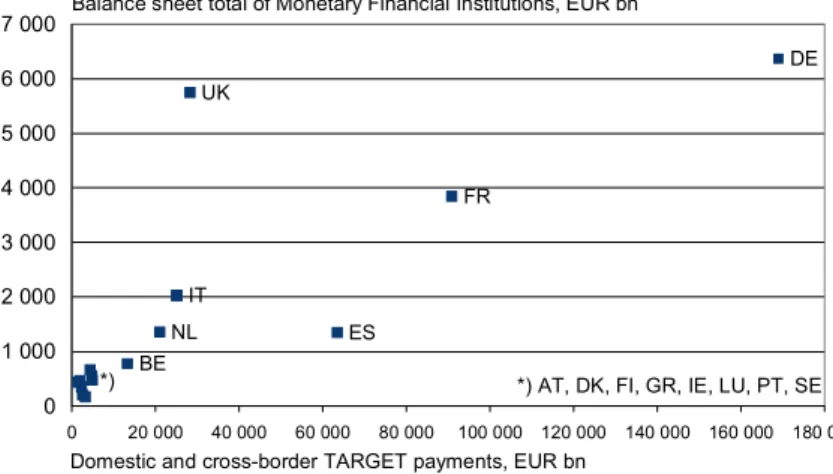
Figure 8. TARGET payments vs balance sheet total for MFIs in the EU area
BE ES UK IT FR DE NL *) 0 1 000 2 000 3 000 4 000 5 000 6 000 7 000 0 20 000 40 000 60 000 80 000 100 000 120 000 140 000 160 000 180 000
Balance sheet total of Monetary Financial Institutions, EUR bn
Domestic and cross-border TARGET payments, EUR bn Source: European Central Bank.
*) AT, DK, FI, GR, IE, LU, PT, SE
Figure 8 compares the total TARGET payments of the EU countries to the balance sheet totals of the respective monetary financial institutions. This comparison shows again how different these payment systems are. More than half of the countries (marked with asterisks), are situated in the same cluster close to the lower left hand corner of the figure. They are the countries with the lowest values of payments and low balance sheet totals. In this figure especially Germany, United Kingdom and France stand out from the crowd as the biggest countries in this respect. These are traditionally the main financial centres of Europe. The United Kingdom would be much farther to the right if the payments of the domestic RTGS in sterling were included. Spain is also interesting because it generates comparatively more large-value payments, despite a relatively small banking sector, in terms of assets.
Despite harmonisation efforts the statistics on domestic payments of national components of TARGET are not in all cases comparable. This stems from the fact that the different national central banks still have different practices in compiling their domestic statistics. Some central banks include transactions related to intraday credit, liquidity transfers, monetary policy operations, and the settlement of ancillary systems, while some others do not. Therefore statistics on domestic payments are not always comparable across countries. Figures for cross-border payments are more consistent across countries. They can be divided into customer and interbank payments. Both volumes and values are reported here. These payments are considered in the next paragraphs.
Table 4. Importance of cross border payments by country, 2003 Value of domestic paymentss (EUR bn) Value of cross-border payments (EUR bn)
Total (EUR bn) Share of cross-border payments value in total value, % Belgium 3 331 10 227 13 558 75.4 Luxembourg 1 513 3 242 4 755 68.2 Portugal 1 280 1 975 3 255 60.7 Netherlands 9 494 11 871 21 365 55.6 Austria 2 374 2 803 5 177 54.1 Greece 1 724 1 620 3 343 48.4 Finland 2 142 1 503 3 645 41.2 Ireland 3 360 2 142 5 502 38.9 Italy 16 303 8 458 24 761 34.2 Germany 92 711 35 833 128 544 27.9 France 77 081 19 246 96 327 20.0 Spain 65 081 5 128 70 208 7.3 United Kingdom 7 362 23 818 31 180 76.4 Sweden 73 1 824 1 897 96.1 Denmark 42 3 166 3 208 98.7
Table 4 shows the distribution of TARGET payments between domestic and cross-border payments. The importance of cross-border payments varies significantly between countries. The smaller countries seem to have relatively more cross border payments than the countries whose total turnover is high.
Especially in Belgium, Luxembourg and Portugal the percentage of cross-border payments is high. Of the IN countries two-thirds of the payments of Belgium and Luxembourg are also cross border payments. The opposite is the case for Spain, where domestic payments form the main part of total value of RTGS system. Also in France only 20% of the payments are cross-border payments. In Finland about 40% of the payments are cross-border payments.
The figures of the so-called OUTS countries (UK, Sweden and Denmark) cannot be compared with figures of IN countries because in the former the domestic payments are transferred in separate RTGS systems. The figure shows that more than three fourths of their payments go across the border.
Figure 9. Daily average of cross-border TARGET payments in EU area 0 100 200 300 400 500 600 700 1999 2000 2001 2002 2003 EUR billion 0 6 12 18 24 30 36 42
Interbank payments, value (LHS) Customer payments, value (LHS) Interbank payments, volume (RHS) Customer payments, volume (RHS) Source: European Central Bank.
Number in thousands
As can be seen from figure 9 the numbers and values of payments between different RTGS systems as a whole have been rising since the beginning of TARGET operations. The highest value was reached in December 2002. If the numbers and values of interbank and customer payments are compared, it can be seen that the numbers of customer payments have been rising steadily since the start of 1999. In terms of value, customer payments play a much lesser role and their value has remained fairly stable over the years. This trend of increasing values and numbers might change in the future due to the start of the CLS bank, although no such trend is yet visible. In principle the number of settlements for foreign exchange deals should decrease in TARGET because they are increasingly settled through the CLS system. Moreover, the revamping of the TARGET system (TARGET2) might lead to changes in numbers and values.
The German RTGSplus system clearly processes the most payments in the EU in terms of value and transactions. This is the case for both domestic and cross-border payments. The RTGSplus belongs to the category of new hybrid systems. It started operations in 2001. The RTGSplus is designed to contain the good features of an RTGS system, and to incorporate effective liquidity saving features that used to be found only in netting systems. The liquidity saving elements of the RTGSplus are three fold. First, mutual cover dependencies are taken into account in the entry management procedure for incoming payments. There is also an ongoing resolution of offsetting positions in queue. In this offsetting process the payments are settled gross although the effect of offsetting resembles the liquidity saving elements of netting because the offsetting gross payments are self-collateralising. There is also an event-oriented optimisation of the payments in the express queue.
The RTGSplus offers additional features, which are quite new to RTGS systems. There are control options by which participants can effectively control their liquidity flows. The RTGSplus allows participants to choose their own individual combinations of control options as needed. Each participant can choose a total limit, bilateral sender limit, or multilateral sender limit. The total limit means that the liquidity above this pre-set limit is solely meant for express payments. Bilateral and multilateral sender limits are designed for more precise control of liquidity. The bilateral sender limit means that it can determine the payment amount a participant is willing to send to another participant. This sender limit can also be a multilateral limit, meaning that the limit applies to all other participants. In this way the sending party can effectively control its liquidity flows.
The payment flows of the RTGSplus system are large compared to other payment systems in Europe. In terms of transactions the RTGSplus accounts for about half of the transactions in TARGET. The annual turnover of the system is almost twice that of the next biggest (French) RTGS-system. Compared to other large value payment systems in Europe (transactions, both national and cross border payments), the RTGSplus system has a share of 31% of the payments.
Figure 10. Outgoing TARGET payments from Germany, daily average per month
month 0 20 40 60 80 100 120 140 160 180 1999 2000 2001 2002 2003 EUR billion 0 5 000 10 000 15 000 20 000 25 000 Number of payments Value of payments (LHS) Number of payments (RHS) Source: European Central Bank.
The volumes and values of the outgoing TARGET payments from Germany are shown in figure 10. The next largest RTGS systems in Europe are those of France and Spain. They are both traditional RTGS systems. Despite the differences in design vs. the German system, the statistics for each system suggest similar usage and trends. It seems that in these systems interbank payments account for the great
majority of payments in terms of value but in terms of transactions customer payments are increasing rapidly.
As for numbers of customer payments, the Spanish system and the two next biggest RTGS systems, of United Kingdom and Italy, there are more customer payments than interbank payments. This trend is very clear in all three systems. Of the smaller RTGS systems, those of Portugal and Greece, show very high ratios of customer payments.
This trend of increasing numbers of customer payments in RTGS systems is not consistent because there are several smaller RTGS systems where this is not the case. For example, for the Scandinavian countries including Finland, there are very stable numbers of customer payments. Transactions in the European RTGS systems show more similar patterns. In every system, in terms of value, the transmission of interbank payments is far greater than customer payments.
Figure 11. Outgoing TARGET payments from Finland, daily average per month
0 1 2 3 4 5 6 7 8 1999 2000 2001 2002 2003 EUR billion 0 50 100 150 200 250 300 350 400 450 Number of payments
Interbank payments, value (LHS) Customer payments, value (LHS)
Customer payments, volume (RHS) Interbank payments, volume (RHS)
Source: European Central Bank.
The Finnish RTGS system (BoF-RTGS) is the 10th biggest RTGS system in Europe. As figure 11 shows about 42% of the value of payments is in cross-border payments, whereas in the Swedish and Danish systems almost all payments are cross-border payments. This is due to the fact that the OUT countries have other RTGS systems for their own currencies. In BoF-RTGS, the division between customer and interbank payments is clear. Over the years, the number of customer payments has slowly increased. There has also been a slight increase in the value of these payments.
The average increases in number of customer and interbank payments between 2002 and 2003 are shown in table 5. The table figures compare the
monthly figures for 2003 and 2002. The average numbers of customer payments have risen significantly in many countries. Especially in Sweden, Spain and United Kingdom, the increase in customer payments sent through the respective RTGS systems is remarkable. Also in many other countries the increase is significant. Only Austria, Denmark and Belgium show very modest growth figures. In this same period the growth rates for interbank payments have been more stable. Only Spain, Greece, United Kingdom and Ireland show two-digit growth rates.
This indicates that there is an increasing need for a fast real time payment system in Europe for customer payments even if the fee is higher than in many other cross-border payment systems.
Table 5. Average increase in number of customer and interbank payments, 2003-2002
(compared on monthly basis to previous year)
Customer payments, % payments, % Interbank
Sweden 146.0 3.1 Spain 65.7 20.1 United Kingdom 61.8 16.5 Netherlands 50.5 -1.0 Finland 43.4 4.6 Ireland 34.5 12.7 France 32.8 2.5 Portugal 31.1 7.1 Luxembourg 28.2 4.6 Greece 27.2 23.8 Italy 23.8 0.1 Germany 21.4 4.8 Austria 7.3 7.5 Denmark 5.6 -3.4 Belgium -1.5 1.4
In this section various aspects of RTGS systems in the EU have been examined. The main finding is the great differences that mark the present systems, in terms of numbers and values, as well as in how the systems are used (domestic or cross-border payments). The market is also polarised in the sense that there are a few big players in the market and the rest are fairly small.
The designs of the systems, on the other hand, are basically the same. This is due to the fact that the TARGET Guideline requires all RTGS systems to provide similar services to all participants. These kinds of features are queuing, intraday credit, immediate finality, and use of collateral. Another similarity is that most of them use the Y-shaped message flow, although in some countries the V-shaped
design is used. The German RTGSplus system differs from the others in the sense that there are also liquidity saving features such as bilateral and multilateral limits.
3.2
Other RTGS systems operated by central banks
3.2.1 Fedwire and CHIPS USA
Fedwire system is the RTGS system in the USA. It is owned and operated by the 12 regional Federal Reserve Banks of the Federal Reserve System. In the early 1990s the Federal Reserve banks consolidated many aspects of the Fedwire system that had been separated and to operate and manage the payment services nationwide. Fedwire is mainly used for large-value, time-critical payments (such as securities transactions, loans, settlement of real estate transactions etc).
The system actually consists of three parts: Funds transfer-system, Book-Entry Securities System and Net settlement. The Funds transfer-system is the system in which payments are transferred, while the Book-Entry Securities System is for electronic storage of securities records in custody accounts and for the transfer of securities between the counterparties.10 Net settlement allows participants in private clearing arrangements – such as national ACH networks, credit card processors, ATM-networks, and securities transfer networks - to exchange and settle transactions on a net basis through reserve or clearing accounts. At present there are about 70 settlement arrangements using this facility. Net settlement includes three types of settlement service.11 which vary operationally and by timing of finality.
Fedwire enables users to obtain intraday credit in the form of daylight overdrafts. An institution using this facility is required to establish a maximum for daylight overdrafts (net debit cap), which are granted at the discretion of the Federal Reserve Banks. Usually the central bank does not require institutions to pledge collateral to secure daylight overdrafts, but in some cases additional intraday credit beyond the net debit cap will require the pledge of collateral for this specific purpose. In order to use daylight overdrafts participants are required to pay a fee for the use of the facility. The fee is believed to encourage participants to reduce and continue to control daylight overdrafts and thus reduce the overall credit risk of the central bank.
More than 9,500 participants are currently able to transfer funds via Fedwire. In an average of 460,000 payments a day, valued at USD 1,700 billion, were transferred via Fedwire. The Fedwire securities service system processed daily
10 Usually the transfer is carried out in DvP-mode (delivery versus payment) where the securities
are transferred simultaneously with the payment for the securities.
about 59,800 securities transfers, with a total value of USD 846 billion. The National Settlement Service12 processes ninety settlements per day with a total value of USD 30 billion.
Fedwire is mainly geared for domestic payments. Cross-border payments are mainly processed in CHIPS (Clearing House Interbank Payment System). Actually 95% of the dollar payments moving between countries worldwide are handled in this system, which is owned by the banks. The system also transmits interbank payments and customer payments. Domestic payments are also transferred trough this system.
CHIPS is a new hybrid payment system, a so-called CNS system (continuous net settlement), which has evolved from the DNS system. In this system multilateral netting takes place continually and usually most of the payments are settled already during the morning hours. This is possible because cover for payments must be present in a participant’s account when transfers are made. The payments are final when the payment has been processed by the system. The system transfers on average 250,000 transactions daily, valued at USD 1.2 trillion. Figure 12. Fedwire, number and value of payment
transactions, daily average
0 500 1 000 1 500 2 000 2 500 1999 2000 2001 2002 EUR billion 0 110 220 330 440 550 Thousands Value of payments Number of payments
Source: Federal Reserve System.
12 Net Settlement Service offers finality equal to Fedwire funds transfer system and provides an
Figure 13. CHIPS, number and value of payment
transactions, daily average
0 350 700 1 050 1 400 1999 2000 2001 2002 EUR billion 0 65 130 195 260 Value of payments Number of payments
Source: Clearing House Interbank Payment System.
Number of payments
3.2.2 BOJ-Net
Japan
The BOJ-NET (Bank of Japan Financial Network System) is the RTGS system used in Japan. The system was introduced in 1988 and provided DNS and RTGS mode for settlement. Because of the risks associated with DNS, it was abolished and a new RTGS system was introduced at the start of 2001. The BOJ-NET comprises two systems: one for funds transfers (BOJ-NET Funds Transfer System) and one for the settlement of Japanese government securities (BOJ-NET JGB Services). Typically, the payments processed are connected with interbank money market and securities transactions, settlement of net positions of privately owned clearing systems, and fund transfers between banks and the central bank, and payments between the accounts in the institution.
Almost all payments are processed on an RTGS basis. Some of the payments between participants and the central bank are netted on a bilateral basis between the participants and the central bank. These settlements occur simultaneously at designated times during the day and is final once the payments are processed.
When the new RTGS system commenced operations at the start of 2001 the Bank of Japan also initiated an intraday overdraft facility to ensure the smooth operation of the new system. This facility is offered to all participants without charge and is fully collateralised. Intraday overdrafts are also available as part of the simultaneous DVP processing and the collateralisation (SPDC) scheme. Using SPDC a participant in BOJ-NET JGB Services can send or receive securities traded in DVP transactions as collateral to obtain or repay intraday funds needed for payments in the transactions concerned.
The daily average value of transactions settled in the BOJ-NET Funds Transfer System was JPY 77 trillion (EUR 0,571 trillion) in 2001. The total value
of payments in 2000 was JPY 142,7 trillion (1,116 trillion EUR), and the number of transactions was 19013. The reason for the significant decrease in value of payments at the beginning of 2001 was the changeover to the new RTGS-system. At present, call money transactions are settled directly between lender and borrower without money market dealers as intermediaries. Prior the changeover these transactions were settled via these ‘tanshi’ money market dealers.
Figure 14. BOJ-NET, number and value of transactions,
daily average 0 200 400 600 800 1 000 1 200 2000 2001 2002 EUR billion 0 4 8 12 16 20 24 Thousands Value of payments Number of payments
Source: Bank of Japan.
3.2.3 Swiss Interbank Clearing Switzerland
The Swiss Interbank Clearing System (SIC) is one of the oldest RTGS systems. It started operations in 1987. The participants process large-value payment transactions as well as part of their bulk payments via SIC. The system transmits customer payments, settlement payments between participants, cash legs of securities transactions, and payments related to correspondent banking activities. The system is operated by a separate operator.
The system was originally designed according to three principles: no intraday overdrafts, queuing mechanism, and FIFO (first in, first out) payment processing and settlement. The FIFO rule was relaxed in early 1990 so that banks were able to assign different priorities to their payments.
Also the prohibition of intraday overdrafts (intraday credit) was dropped in 1999 when the Swiss central bank began to offer SIC participants interest-free intraday liquidity via intraday repos. The reason for the change was the increase in time-critical payments, with special attention being given to CLS-payments.
The account structure of the SIC is somewhat special. Each participant has two accounts, one of which is called the master account and the other the SIC account. Transferring funds to the SIC account (which is for the settlement of
payments), starts the settlement cycle. A participant can freely transfer funds between the accounts. At the end of the day the balances in the SIC accounts are transferred to the master accounts.
The SIC system is an online system that operates around the clock on all working days. A payment order can be entered five days prior to its value date. Settlement is carried out during a 22-hour cycle. When payments are executed by the system they are final and irrevocable. If there is not enough cover for a payment it is automatically held pending. Attempts to settle payments in a queue are automatic. It is also possible to cancel the payments in a queue. In addition to queuing, there is a bilateral offsetting function in the system. If there is not sufficient cover for a payment the system checks whether there is a corresponding offsetting payment from the beneficiary to the sender at the top of its queue. If there is a payment going in the other direction, the two payments are offset.
The pricing structure of SIC system is progressive. This method is applied in order to prevent gridlock situations. The structure is designed so that the fees increase during the day. This induces banks to settle their payments as early as possible during the day. There are also different fees for small- and large-value payments. The threshold is CHF 100,000.
The size of the payments transferred through the system varies greatly. Almost all payments (more than 90%) are for les than CHF 100,000 limit. The majority of payments are in fact much smaller, ie less than the CHF 5,000 threshold. In the value terms, the situation is quite different. Almost the entire turnover accounted for by a small number of payments that exceed CHF 1 million.
By payment type (customer payments, payments to SIC participants, cover payments, cash legs of securities transactions and correspondent banking payments), most of the payments are customer payments. About two-thirds of value of the payments is in those related to cross-border payments, which indicates the importance of foreign exchange transactions in the SIC.
To the Swiss banks the euro is in many ways a very important currency; hence the need for an easy access to TARGET. The Swiss banks have set up a special clearing bank in Frankfurt, the Swiss Euro Clearing Bank (SECB), which offers euro clearing services to Swiss banks. The SECB runs the euroSIC, through which many Swiss banks execute their euro payments. The transaction volume of euroSIC was EUR 1.5 billion 2001.
In 2001 the average daily number of transactions in SIC was 644,000. and the average daily value was CHF 182 billion (EUR 122,4 billion). In recent years the processing of interbank services for retail payment transactions has been incorporated in the system. Because SIC processes nearly all interbank settlements, from large-value payments to retail payments, it is the major system in Switzerland.
Figure 15. SIC, number and value of payment transactions, daily average 0 25 50 75 100 125 150 1999 2000 2001 2002 EUR billion 0 125 250 375 500 625 750 Thousands Value of payments Number of payments
Source: Swiss National Bank.
3.2.4 Basic statistics for the systems
Figure 16. SIC, Fedwire, TARGET, CHIPS, BOJ-NET: number of payment transactions,
daily average per year
0 100 200 300 400 500 600 700 800
SIC Fedwire TARGET CHIPS BOJ-NET
Thousands
1999 2000 2001 2002
Figure 17. Fedwire, TARGET, CHIPS, BOJ-NET, SIC: value of payment transactions,
daily average per year
0 500 1 000 1 500 2 000 2 500
Fedwire TARGET CHIPS BOJ-NET SIC
EUR billion
1999 2000 2001 2002 Source: National central banks.
The statistics for systems in the USA, Japan and Switzerland show clearly how differently the main payment systems are used in different countries. SIC system has the highest average number of transactions and the lowest average value of payments. The high number of transactions in SIC reflects its use for low-value payments such as customer-related payments, whose value is usually under EUR 3,400. Fedwire is used mainly to process domestic large-value time-critical payments. The size of the US economy is r