NBER WORKING PAPER SERIES
QUANTIFYING THE IMPACT OF FINANCIAL DEVELOPMENT ON ECONOMIC DEVELOPMENT Jeremy Greenwood Juan M. Sanchez Cheng Wang Working Paper 15893 http://www.nber.org/papers/w15893
NATIONAL BUREAU OF ECONOMIC RESEARCH 1050 Massachusetts Avenue
Cambridge, MA 02138 April 2010
The views expressed herein are those of the authors and do not necessarily reflect the views of the National Bureau of Economic Research.
NBER working papers are circulated for discussion and comment purposes. They have not been peer-reviewed or been subject to the review by the NBER Board of Directors that accompanies official NBER publications.
© 2010 by Jeremy Greenwood, Juan M. Sanchez, and Cheng Wang. All rights reserved. Short sections of text, not to exceed two paragraphs, may be quoted without explicit permission provided that full credit, including © notice, is given to the source.
Quantifying the Impact of Financial Development on Economic Development Jeremy Greenwood, Juan M. Sanchez, and Cheng Wang
NBER Working Paper No. 15893 April 2010
JEL No. E13,O11,O16,O4
ABSTRACT
How important is financial development for economic development? A costly state verification model of financial intermediation is presented to address this question. The model is calibrated to match facts about the U.S. economy, such as intermediation spreads and the firm-size distribution for the years 1974 and 2004. It is then used to study the international data, using cross-country interest-rate spreads and per-capita GDP. The analysis suggests a country like Uganda could increase its output by 140 to 180% if it could adopt the world's best practice in the financial sector. Still, this amounts to only 34 to 40% of the gap between Uganda's potential and actual output.
Jeremy Greenwood Department of Economics University of Pennsylvania 3718 Locust Walk McNeil Building, Rm 160 Philadelphia, PA 19104-6297 and NBER [email protected] Juan M. Sanchez Research Department
Federal Reserve Bank of Richmond P.O. Box 27622
Richmond, VA 23261 [email protected]
Cheng Wang
Department of Economics Iowa State University Ames, IA 50011 [email protected]
1
Introduction
How important is …nancial development for economic development? Ever since Raymond W. Goldsmith’s (1969) classic book, economists have been developing theories and searching for empirical evidence connecting …nancial and economic development. Goldsmith emphasized the role that intermediaries play in steering funds to the highest valued users in the economy. First, intermediaries collect and analyze information before they invest in businesses. Based upon this information, they determine whether or not to commit savers’ funds. If they proceed, then they must decide how much to invest and on what terms. Second, after allocating funds intermediaries must monitor …rms to ensure that savers’best interests are protected. Increases in the e¢ ciency of …nancial intermediation, due to improved information production, are likely to reduce the spread between the internal rate of return on investment in …rms and the rate of return on savings received by savers. The spread between these returns re‡ects the costs of intermediation. This wedge will include the costs of gathering ex-ante information about investment projects, the ex-post information costs of policing investments, and the costs of misappropriation of savers’s funds by management, unions, etc., that arise in a world with imperfect information. An improvement in …nancial intermediation will not necessarily a¤ect the rate of return earned by savers. Aggregate savings may adjust in equilibrium so that this return always equals savers’rate of time preference.
Figure 1, left panel, plots the intermediation wedge for the U.S. economy over time. (All data de…nitions are presented in the Appendix.) The United States is a developed economy with a sophisticated …nancial system. The wedge falls only slightly. At the same time, it is hard to detect an upward trend in the capital-to-output ratio. Contrast this with Taiwan, shown in the right panel. Here, there is a dramatic drop in the interest-rate spread. As the cost of capital falls one would expect to see a rise in investment. Indeed, the capital-to-output ratio for Taiwan shows signi…cant increase. The observation that there is only a small drop in the U.S. interest-rate spread does not imply that there has not been any technological advance in the U.S. …nancial sector. Rather, it may re‡ect the fact that e¢ ciency in the U.S. …nancial sector has grown in tandem with the rest of the economy, while for Taiwan it
has outpaced it. For without technological advance in the …nancial sector, banks would face a losing battle with the rising labor costs that are inevitable in a growing economy. The intermediation spread would then have to rise to cover costs. More on this later.
1970 1980 1990 2000 2010 1 2 3 4 5 6 7 0.8 1.2 1.6 2.0 2.4 1970 1980 1990 2000 2010 1 2 3 4 5 6 7 0.8 1.2 1.6 2.0 2.4 capital/output (right axis) spreads (left axis) Taiwan Years capital/output (right axis) spreads (left axis) United States
Figure 1: Interest-rate spreads and capital-to-output ratios for the United States and Taiwan, 1970-2005.
Now, in Goldsmithian fashion, consider the scatter plots presented for a sample of coun-tries in Figures 2 and 3. Take Figure 2 …rst. The left panel shows that councoun-tries with lower interest-rate spreads tend to have higher capital-to-output ratios. The right panel illustrates that a higher capital-to-output ratio is associated with a greater level of GDP. Dub this the capital-deepening e¤ect of …nancial intermediation. Next, turn to the left panel in Figure 3. Observe that lower interest-rate spreads are also linked with higher levels of total factor productivity, TFP. This would happen when better intermediation tends to redirect funds to the more e¢ cient …rms. The right panel displays how higher levels of TFP are connected
with larger GDP. Call this the reallocation e¤ect arising from …nancial intermediation. The capital deepening and reallocation e¤ects from improved intermediation will play an impor-tant role in what follows. While the above facts are stylized, to be sure, it will be noted that empirical researchers have used increasingly sophisticated methods to tease out the relation-ship between …nancial intermediation and growth. This literature is surveyed masterfully by Levine (2005). The upshot is that …nancial development has a causal e¤ect on economic development; speci…cally, …nancial development leads to higher rates of growth in income and productivity. ARG AUS AUT BEL BOL BRA CAN COL CRI DNK EGY SLV ETH FIN FRA GTM HND IND IRL ISR ITA JPN KEN LUX MUS MEX MAR NLD NZL NIC NGA NOR PAK PAN PER PHL PRT ZAF ESP LKA SWE CHE THA TTO TUR UGA GBR USA URY VEN 0 1 2 3 4 K-to-G DP r a tio 0 .05 .1 .15 Interest-rate spread ARG AUSAUT BEL BOL BRA CAN COL CRI DNK EGYSLV ETH FIN FRA GTM HND IND IRL ISRITA JPN KEN LUX MUS MEX MAR NLD NZL NIC NGA NOR PAK PAN PER PHL PRT ZAF ESP LKA SWE CHE THA TTO TUR UGA GBR USA URY VEN 0 10 00 0 20 00 0 30 00 0 40 00 0 50 00 0 G DP pe r c api ta 0 1 2 3 4 K-to-GDP ratio
Figure 2: The cross-country relationship between interest-rate spreads, capital-to-output ratios and GDP.
The impact that …nancial development has on economic development is investigated here, quantitatively, using a costly state veri…cation model that is developed, theoretically,
ARG AUS AUT BEL BOL BRA CAN COL CRI DNK EGY SLV ETH FIN FRA GTM HND IND IRL ISRITA JPN KEN LUX MUS MEX MAR NLD NZL NIC NGA NOR PAK PAN PER PHL PRT ZAF ESP LKA SWE CHE THA TTO TUR UGA GBR USA URY VEN 0 5 00 10 00 15 00 T FP 0 .05 .1 .15 Interest-rate spread ARG AUSAUT BEL BOL BRA CAN COL CRI DNK EGY SLV ETH FIN FRA GTM HNDIND IRL ISR ITA JPN KEN LUX MUS MEX MAR NLD NZL NIC NGA NOR PAK PAN PER PHL PRT ZAF ESP LKA SWE CHE THA TTO TUR UGA GBR USA URY VEN 0 10 00 0 20 00 0 30 00 0 40 00 0 50 00 0 G DP pe r c api ta 0 500 1000 1500 TFP
in Greenwood et al. (forthcoming). The source of inspiration for the framework is classic work by Diamond (1984), Townsend (1979), and Williamson (1986). It has two novel twists, however. First, the e¢ ciency of monitoring the use of funds by …rms depends upon both the amount of resources devoted to this activity and the state of technology in the …nancial sector. Second, …rms have ex-ante di¤erences in the structure of returns that they o¤er. A …nancial theory of …rm size emerges. At any point in time, …rms o¤ering high expected returns are underfunded (relative to a world without informational frictions), while others yielding low expected ones are overfunded. This results from diminishing returns in infor-mation production. As the e¢ ciency of the …nancial sector rises (relative to the rest of the economy) funds are redirected away from less productive …rms in the economy toward the more productive ones. Furthermore, as the interest-rate spread declines, and the cost of borrowing falls, there will be capital deepening in the economy.
The model is calibrated to match some stylized facts for the U.S. economy, speci…cally the …rm-size distributions and interest-rate spreads for the years 1974 and 2004. It does an excellent job replicating these facts. The improvement in …nancial sector productivity required to duplicate these facts also appears to be reasonable. It does this with little change in capital-to-output ratio. In the model, improvements in …nancial intermediation account for 30% of U.S. growth. The framework also is capable of mimicking the dramatic decline in the Taiwanese interest-rate spread. At the same time, it predicts a signi…cant rise in capital-to-output ratio. It is estimated that dramatic improvements in Taiwan’s …nancial sector accounted for 50% of growth.
The calibrated model is then taken to the cross-country data. It also does a reasonable job predicting the di¤erences in cross-country capital-to-output ratios. Similarly, it does a good job matching the empirical relationship between …nancial development and average …rm size. Financial intermediation turns out to be important quantitatively. For example, in the baseline model Uganda would increase its GDP by 140% if it could somehow adopt Luxembourg’s …nancial system. World output would rise by 65% if all countries adopted Luxembourg’s …nancial practice. Still, the bulk (or 64%) of cross-country variation in GDP
cannot be accounted for by variation in …nancial systems.
There are other recent investigations of the relationship between …nance and develop-ment that use quantitative models. The frameworks used, and the questions addressed, di¤er from the current analysis. For example, Townsend and Ueda (2006) estimate a version of the Greenwood and Jovanovic (1990) model to examine the Thai …nancial reform. Their analysis stresses the role that …nancial intermediaries play in producing ex-ante information about the state of the economy at the aggregate level. Financial intermediaries o¤er savers higher and safer returns. They …nd that Thai welfare increased about 15% due to …nan-cial liberalization. Buera et al. (2009) focus on the importance of borrowing constraints in distorting the allocation of entrepreneurial talent in the economy. This helps explain TFP di¤erentials across nations.1 Limited investor protection is emphasized by Castro et al. (2009). They build a two-sector model to explain the positive cross-country correlation between investment and GDP. They note that the capital-goods sector is risky. This makes capital goods expensive to produce in poor countries with limited investor production, be-cause of the high costs of …nance. An implication of their framework is that the correlation between investment and GDP is weaker when measured at domestic vis à vis international prices. This is true in the data.
2
The Economy
The analysis focuses on two types of agents; to wit, …rms and …nancial intermediaries. Firms produce output using capital and labor. Their production processes are subject to idiosyncratic productivity shocks. The realized value of the productivity shock is a …rm’s private information. All funding for capital must be raised from …nancial intermediaries. This is done before the technology shock is observed. After seeing its shock, a …rm hires labor on a spot market. When …nancing its capital a …rm enters into a …nancial contract
1 Erosa and Cabrillana (2008) also investigate the interplay between …nancial market frictions and the
allocation of managerial talent for explaining cross-country productivity di¤erences, albeit with more of a theoretical emphasis.
with the intermediary. This contract speci…es the state-contingent payment that a …rm must make to an intermediary upon completing production. Hidden in the background are consumer/workers. They supply a …xed amount of labor to the economy. They also deposit funds with an intermediary that earn a …xed rate of return. Given the focus here on comparative steady states, an analysis of the consumer/worker can be safely suppressed. The behavior of …rms and intermediaries will now be described in more detail.
3
Firms
Firms hire capital, k, and labor, l, to produce output, o, in line with the constant-returns-to-scale production function
o=x k l1 :
The productivity level of a …rm’s production process is represented byx . It is the product of two components: an aggregate one,x, and an idiosyncratic one, . The idiosyncratic level of productivity is a random. Speci…cally, the realized value of is drawn from the two-point set =f 1; 2g, with 1 < 2. The set di¤ers across …rms. Call this the …rm’s type. Let
Pr( = 1) = 1 andPr( = 2) = 2 = 1 1. The probabilities for the low and high states (1 and 2, respectively) are the same across …rms. The realized value of 2 is a …rm’s private information. For now take the aggregate level of productivity, x, to be some known constant.
Suppose that a type- …rm has raised k units of capital. It then draws the productivity shock i. It must now decide how much labor, li, to hire at the wage ratew. In other words,
the …rm will solve the maximization problem shown below.
R( i; w)k max li f
x ik li1 wlig: P(1)
Denote the amount of labor that a type- …rm will hire in state i by li( ) = li( 1; 2). Substituting the implied solution forli into the maximand and solving yields the unit return
function, R( i; w), or
Think aboutri( ) =R( i; w)as giving the gross rate of return on a unit of capital invested
in a type- …rm, given that state i occurs.
4
Financial Intermediaries
Intermediation is competitive. Intermediaries raise funds from consumers and lend them to …rms. Even though an intermediary knows a …rm’s type, , it cannot observe the state of a …rm’s business either costlessly or perfectly.2 That is, the intermediary cannot costlessly observe , o and l. Suppose a …rm’s true productivity in a period is i. It reports to
the intermediary that its productivity is j, which may di¤er from i. The intermediary
can audit this report. It seems reasonable to presume that the odds of detecting fraud are increasing the amount of labor devoted to verifying the claim,lmj, decreasing in the size of
the loan, k— because there will be more activity to monitor— and rising in the productivity of the monitoring technology, z. Let Pij(lmj; k; z) denote the probability that the …rm is
caught cheating conditional on the following: (1) the true realization of productivity is i;
(2) the …rm makes a report of j; (3) the intermediary allocateslmj units of labor to monitor
the claim; (4) the size of loan isk (which represents the scale of the project); (5) the level of productivity in the monitoring activity is z. The function Pij(lmj; k; z) is increasing in lmj
and z, and decreasing in k. Additionally, let Pij(lmj; k; z) = 0 if the …rm truthfully reports 2 Recall that the intermediary knows the …rm’s type, . One could think about this as representing the
activity, industry or sector that a …rm operates within. For instance, Castro et al. (2009, Figure 3) present data suggesting that the capital-goods sector is riskier than the consumption goods one. It would be possible to have a screening stage where the intermediary veri…es the initial type of a …rm. The easiest way to do this would be to have them pay a cost that varies with loan size to discover . If the …rm’s type can’t be undercovered perfectly, as in the classic work of Boyd and Prescott (1986), then it may be possible to design the contract to reveal it.
that its type is i (i.e., when j =i). A convenient formulation for Pij(lmj; k; z) is3 Pij(lmj; k; z) = 8 > > > < > > > : 1 (z=k)1(l mj) <1; with 0< ; <1; for a report j 6= i; 0; for a report j = i: (2)
The intermediary makes a …rm a loan of size k. In exchange for the loan the …rm will make some speci…ed state-contingent payment to the intermediary. The rents that accrue to a …rm will depend upon the true state of its technology, i, the state that it reports, j,
plus the outcome of any monitoring that is done. Clearly, a …rm will have no incentive to misreport when the bad state, 1, occurs. Likewise, the intermediary will never monitor a good report, j = 2. It will just audit bad ones, j = 1. If it …nds malfeasance, then the intermediary should exert maximal punishment, which amounts to seizing everything or
r2k. If it doesn’t, then it should take all of the bad state returns, or r1k. These latter two features help to create, in a least-cost manner, an incentive for the …rm to tell the truth. The above features are embedded into the contracting problem presented below. A more formal, step-by-step analysis is presented in Greenwood et al. (forthcoming).
Turn now to the contracting problem. Intermediation is competitive. Therefore, an intermediary must choose the details of the …nancial contract to maximize the expected rents for a …rm. Competition implies that all intermediaries will earn zero pro…ts on their lending activity. Suppose that intermediaries can raise funds from savers at the interest rate br. If the depreciation rate on physical capital is , then the cost of supplying capital is
e
r=br+ . The intermediary’s optimization problem can be expressed as4
v max
k;lm1f
2[1 P21(lm1; k; z)][r2( ) r1( )]kg; P(2)
3 To guarantee that P
ij(lmj ; k; z) 0, this speci…cation requires that some minimal level of labor must
be devoted to monitoring; i.e.,lmj > 1= (k=z) = . Note that this minimal labor requirement for monitoring can be made arbitrarily small by picking a large enough value for". The choice of" can be thought of as normalization relative to the level of productivity in the production of monitoring services— see Greenwood et al. (forthcoming) for more detail.
subject to
[ 1r1( ) + 1r2( )]k 2[1 P21(lm1; k; z)][r2( ) r1( )]k 1wlm1 =erk: (3)
The objective function P(2) gives the expected rents for a …rm. These rents accrue from the fact that the …rm has private information about its state. Suppose that the …rm lies about being in the good state. When it doesn’t get caught it can pocket the amount[r2( ) r1( )]k. The odds of not getting caught are1 P21(lm1; k; z). The good state occurs with probability 2. An incentive compatible contract o¤ers the …rm the same amount from telling the truth that it can get from lying.5 Equation (3) is the intermediary’s zero-pro…t condition. The expected return from the project is[ 1r1( ) + 1r2( )]k. Out of this the intermediary must give the …rm 2[1 P21(lm1; k; z)][r2( ) r1( )]k. The expected cost of monitoring low-state returns is 1wlm1. Represent the amount of labor required to monitor a type- …rm in state 1 by lm1( ) =lm1( 1; 2). The contract presumes that the intermediary is committed to monitoring all reports of a bad state. Last, for some types of …rms a loan may entail a loss. The intermediary will not lend to these …rms.
5
Stationary Equilibrium
The focus of the analysis is on stationary equilibria. Firms di¤er by type, = ( 1; 2) with 1 < 2. Denote the space of types by T R2+. Suppose that …rms are distributed over
5 Letp
2 represent the payment that a …rm makes to the intermediary in the good state. The incentive
constraint for the contract will read
[1 P21(lm1; k; z)][r2( ) r1( )]k r2( )k p2:
The left-hand side represents what the …rm will get by lying, while the right-hand side shows what it will receive when it tells the truth. The latter must dominate, in a weak sense, the former. (Recall that upon the declaration of a bad state the …rm must turn overr1( )kto the intermediary. So, it will make nothing
when it truthfully reports a bad state. If the …rm gets caught cheating, then it must make the payment
r2( )k, so it will also earn zero rents here.) The incentive constraint will bind. Thus, P(2) maximizes the
…rm’s expected rents, 2[r2( )k p2], subject to the zero-pro…t constraint. As in Townsend (1979), it can be shown that the revelation principle holds, so the focus here on incentive compatible contracts is without loss of generality.
productivities in accordance with the distribution function
F(x; y) = Pr( 1 x; 2 y).
For all …rms …x the odds of drawing stateiatPr( = 1) = i. This distributionF can then
be thought of as specifying the mean, 1 1 + 2 2, and variance, 1 2( 1 2)2, of project returns across …rms. So, which …rms will receive funding in equilibrium?
To answer this question, focus on the zero pro…t condition for intermediaries (3). Now, consider a …rm of type . Clearly, if 1r1( )k+ 1r2( )k < 0, then the intermediary will incur a loss on any loan of size k > 0. Likewise, if 1r1k + 1r2k > 0, then it will be possible to make non-negative pro…ts, albeit the loan may have to be very small. Therefore, a necessary and su¢ cient condition to obtain funding is that lies in the set A(w) T
de…ned by
A(w) f : 1r1( ) + 2r2( ) er >0g: (4) This set shrinks with the wage, w, because ri( ) is decreasing in w; as wages rise a …rm
becomes less pro…table.
Firms with 2 A(w) will demand li( 1; 2)units of labor in state i. Should one of these …rms declare that it is in state 1, then the intermediary will sendlm1( 1; 2) units of labor over to audit it. Recall that labor is in …xed supply. Suppose that there is one unit in aggregate. The labor-market-clearing condition will then appear as
Z
A(w)
[ 1l1( 1; 2) + 2l2( 1; 2) + 1lm1( 1; 2)]dF( 1; 2) = 1. (5)
It is now time to take stock of the situation thus far by presenting a de…nition of the equilibrium under study.
De…nition 1 Set the steady-state cost of capital at re. A stationary competitive equilibrium
is described by a set of labor allocations, li and lm1, a set of active …rms, A(w), together
with a loan size, k, and a value, v, for each …rm, and …nally a wage rate, w, such that:
1. The loan, k, o¤ered by the intermediary maximizes the value of a …rm, v, in line with
P(2), given the prices er and w. The intermediary hires labor for monitoring in the
2. A …rm is o¤ered a loan if and only if it lies in the active set, A(w), as de…ned by (4).
3. Firms hire labor li, so as to maximize its pro…ts in accordance with P(1), given wages,
w, and the size of the loan, k, o¤ered by the intermediary.
4. The wage rate, w, is determined so that the labor market clears, in accordance with
(5).
6
Discussion
The analysis focuses on the role that intermediaries play in producing information. Before an investment opportunity is funded, intermediaries assess its risk and return. In the current setting, this amounts to knowing a project’s type, . This can be costlessly discovered in the model here. It would be easy to add a variable cost for a loan that is a function of z. Doing so would have little bene…t, however. Intermediaries need to put systems in place to monitor cash ‡ows, or face the prospect of lower-than-promised returns. In yesteryear, banks required borrowers to keep their funds in an account with them. This way transactions could be monitored. Now, even a privately funded …rm needs to be monitored, unless the scale is so small that the owner can operate it himself. Managers and workers tend to siphon o¤ funds from the providers of capital, whether they are banks, bondholders, private owners, share holders, or venture capitalists. At the micro level, this is what a shirking worker in a fast food restaurant is doing. And, there is computer surveillance software available for $200 a month, called HyperActive Bob, designed to catch such a person.6
E¢ ciency of monitoring,z, is likely to depend on the state of technology in the …nancial sector, both in terms of human and physical capital. Better information technologies al-low for greater quantities of …nancial information to be collected, exchanged, processed and analyzed. Indeed, the most IT-intensive industry in the United States is Depository and Nondepository Financial Institutions. Computer equipment and software services accounted for 10% of value added over the period 1995 to 2000, as opposed to 5% in Industrial Machin-ery and Equipment, or 2.6% in Radio and Television Broadcasting. Berger (2003) discusses
the importance of IT in accounting for productivity gains in the U.S. banking sector. This is re‡ected in the growth of ATM machines, Internet banking, electronic payment technologies, and information exchanges that permit the use of economic models to undertake credit scor-ing for small businesses, develop investment strategies, create new exotic …nancial products, etc. Similarly, a more talented work force allows for higher-quality information workers: ac-countants, …nancial analysts, and lawyers. Last, the e¢ ciency of monitoring will depend on the legal environment, which speci…es what information can, must, or must not be produced. This is separate from regulating the terms of payments, especially in bankruptcy (herep1 or
p12) as analyzed in Castro et al. (2004).
Before proceeding on to the quantitative analysis, some mechanics of the above framework will now be inspected in a heuristic manner. For a more formal analysis see Greenwood et al. (forthcoming). The presence of diminishing returns to information production leads to a …nancial theory of …rm size, as will be discussed. In fact, they can be thought of as providing a microfoundation for the Lucas (1978) span of control model. The framework also speci…es a link between the state of …nancial development and the state of economic development.
(1) A …rm’s production is governed by constant returns to scale. In the absence of …nan-cial market frictions, no rents would be earned on production. Additionally, in a frictionless world only …rms o¤ering the highest expected return would be funded. In this situation,
max [ 1r1( ) + 2r2( )] =re— cf (4). With …nancial market frictions, 1r1( ) + 2r2( )>re for all funded projects 2 A(w), a fact easily gleaned from (3). Thus, deserving projects— those 2 B(w) fx: maxx2T[ 1r1(x) + 2r2(x)]g— will be underfunded, while undeserving projects— 2 B= (w)— are simultaneously overfunded. Funded …rms will earn rents, v, as given by P(2).
(2) What determines the size of a …rm’s loan? By eyeballing the left-hand side of (3), which details the intermediary’s pro…ts, it looks likely that the …rm’s loan will be increasing in the project’s expected return, 1r1( ) + 1r2( ), ceteris paribus. This is true. Recall that the odds of detecting fraud, P21(lm1; k; z), decrease in loan size, k. Therefore, more labor must be allocated to monitoring the project in response to an increase in loan size.
Since there are diminishing returns to information production, the size of the loan, k, is uniquely determined as function of expected return. Similarly, it appears that a …rm’s loan will decrease in the project’s risk, as measured byr2( ) r1( ). This is also true. When the spread between the high and low states widens, there is more of an incentive for the …rm to misreport its returns. Recall that the gain from lying is given by the objective function in P(2). To counter this the intermediary must devote more labor to monitoring. The diminishing returns to information production imply that loan size is uniquely speci…ed as a function of risk.
(3) Imagine that aggregate productivity, x, grows over time at the constant rate g1= . Will there be balanced growth? Conjecture that along a balanced growth path thek’s, o’s, andw, will all grow at rateg. Also guess thatA(w)and theli’s,lm1 ’s, andri( )’s will remain
constant. It is easy to see from the isoelastic forms of P(1) and (1) that the conjectured solution for balanced growth solution will be satis…ed for theli’s,l1m’s, andri( )’s. Since the ri( )’s remain constant so does the active set, A(w), that is spelled out in (4). Since the li’s
and lm1 ’s remain …xed, if the labor-market clearing condition (5) holds at one point along the balanced path it will hold at all others. So, the hypothesized solution forwis consistent with this. What aboutk? The solution guessed fork is consistent with P(2), if P12 does not change along a balanced growth path. From (2) it is clear that the odds of getting caught cheating, P21, will change over time, however, unless z grows at precisely the rate g. If this happens, then balanced growth occurs.
(4) Consider the case wherexgrows at a di¤erent rate thanz. Speci…cally, for illustrative purposes, take the extreme situation wherez rises whilexremains …xed. Thus, there is only …nancial innovation in the economy. By inspecting (2) the odds of detecting fraud will rise, other things equal. The rents that …rms can make will drop, a fact that is evident from the objective function in P(2). This makes it feasible for …nancial intermediaries to o¤er …rms larger loans, ceteris paribus, as can be gleaned from (3). The implied increase in the economy’s aggregate capital stock will then drive up wages. Thus, ine¢ cient …rms will have their funding cut, as (4) makes clear. Therefore, …nancial innovation operates to weed out
unproductive …rms. The active set of …rms, A(w), thus shrinks. Average …rm size in the economy is the total stock of labor (one) divided by the number of …rms (or the measure of the active set). Therefore, average …rm size increases. If z increases without bound, then the economy will enter into a frictionless world where only …rms o¤ering the highest expected return, max [ 1r1( ) + 2r2( )], are funded. These …rms will earn no rents; i.e.,
max [ 1r1( ) + 2r2( )] =re.
7
The United States and Taiwan
7.1
Fitting the Model to the U.S. Economy
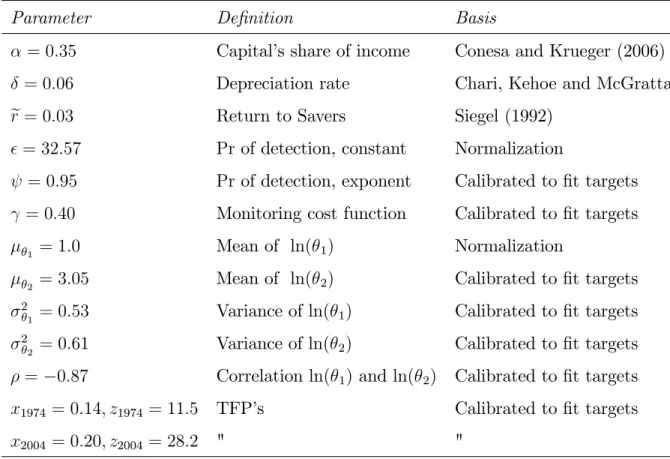
The quantitative analysis will now begin. To simulate the model, values must be assigned to its parameters. This will be done by calibrating the framework to match some stylized facts. Some parameters are standard. They are given conventional values. Capital’s share of income, , is chosen to be 0:35, a very standard number.7 Likewise, the depreciation rate, , is set to0:06, another very common …gure.8 The chosen value for return on savings through an intermediary is er = 0:03.9
Nothing is known about the appropriate choice for parameters governing the interme-diary’s monitoring technology and . Similarly, little is known about the distribution of returns facing …rms. Let 1 be the meanacross …rms for the logarithm of low shock, 1; i.e.,
1
R
ln( 1)dF( 1; 2). Analogously, 2
R
ln( 2)dF( 1; 2). Likewise, 2j will denote the variance over …rms for the low shock; i.e., 2j R[ln( j) j]
2dF, for j = 1;2. In a similar vein, will represent the correlation between the low and high shocks, ln( 1) and
ln( 2), in the type distribution for …rms. Assume that these means and variances of …rm-level
7 Conesa and Krueger (2006) and Domeij and Heathcote (2004) use a capital share of 0.36, close to the
number imposed here.
8 The same number is used, for instance, by Chari et al. (1997).
9 For the period 1800 to 1990, Siegel (1992) estimates the real return on bonds, with a maturity ranging
from 2 to 20 years, to be between 3.36% (geometric mean) and 3.71% (arithmetic mean). He also estimates the real return on 90 day commercial paper to be between 2.95% (geometric mean) and 3.13% (arithmetic mean).
ln(TFP) are distributed according to a bivariate truncated normal, N( 1; 2; 21; 22; ). Normalize 1 to be 1. Of course, values for the parameters determining the productivities of the technologies used in the production and …nancial sectors,x and z, are also needed.
LetTargetsj represent thej-th component of an-vector of observations that the model
should match. Similarly,M(param)denotes the model’s prediction for this vector. The cali-bration procedure will minimize the distance between the vectorsTargetsandM(param):
The key, then, is to choose targets that will be tightly connected to the model’s parameters. The technological parameters,xandz, are very important for determining the e¢ ciencies of the production and …nancial sectors. In particular, the model provides a mapping between the aggregate level of output (per person), o, and the interest-rate spread, s, on the one hand, and the state of technology in its production and …nancial sectors, x and z, on the other. Represent this mapping by(o;s) = O(x; z;p);wherep= ( ; ; ; 2; 2
1;
2
2; ),
rep-resents the remaining 7 parameters inparam (where 1 is normalized to one and hence is omitted). Now, while the states of the technologies in these sectors are unobservable directly, this mapping can be used to make an inference about (x; z), given an observation on(o;s), by using the relationship
(x; z) =O 1(o;s;p): (6) Given the importance of these two parameters, this condition will be used as a constraint in the minimization of the distance between Targets and M(param). Equation (6) will also play an important role in the cross-country analysis.
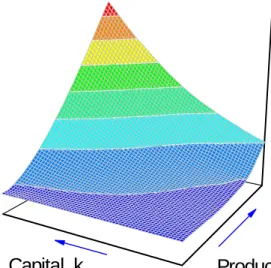
The distribution of returns across …rms will be integrally related to the distribution of employment across them. Firms with high returns will have high employment, other things equal. Figure 4 illustrates a …rm’s employment, l, as a function of its capital stock, k, and the realized value of the technological shock, . A …rm that receives a bigger loan,k, will hire more labor, l, other things equal. Recall that the size of the loan is determined before the technology shock is realized. Given the size of its loan, a …rm will hire more labor the higher is the realized state of its technology shock. Given this relationship, the size distributions of …rms for the years 1974 and 2004 are chosen as data targets to determine the remaining 8
parameters. Seven points on the distribution for each year are picked. As it is well known, the size distribution of …rms is highly skewed to the right; that is, there are many small …rms, employing a relatively small amount of labor in total, and a few large ones, hiring a lot. For instance, in 1974, the smallest 60% of establishments employed only 7.5% of the total number of workers, while the largest 5% of establishments hired around 60% of workers. Using only one target for the size distribution would be insu¢ cient to capture this fact. It is important that the largest 12% of establishments employ 75% of the workers, but it is equally important that the truncated distribution inside of the largest 12% of establishments is also very skewed— remember that the largest 5% of establishments employed about 60% of workers. Therefore, it is useful to consider the share of employment in the smallest 60, 75, 87, 95, 98, 99.3, and 99.7% of establishments. Thus, there are 7 targets for each of the two years. Denote the jth percentile target for the year t by eU S
j;t and let Mj xU St ; ztU S; p
give the model’s prediction for this statistic (all for j = 60;75;87;95;98;99:3;99:7 and
t= 1974;2004).
The mathematical transliteration of the above calibration procedure is
min p ( X j wj 2 [e U S j;74 Mj xU S74 ; z U S 74 ; p ] 2+X j wj 2 [e U S j;04 Mj xU S04 ; z U S 04 ; p ] 2 ) ; P(3) subject to (xU S74 ; z74U S) =O 1(oU S74 ;sU S74 ;p); (7) and (xU S04 ; z04U S) =O 1(oU S04 ;sU S04 ;p): (8) Thus, following this strategy, 18 targets (including theoU S’s andsU S’s) are used to calibrate
11 parameters (including thexU S’s and zU S’s).
The upshot of the above …tting procedure is now discussed. First, there exists a set of technology parameters for the production and …nancial sectors,(xU S
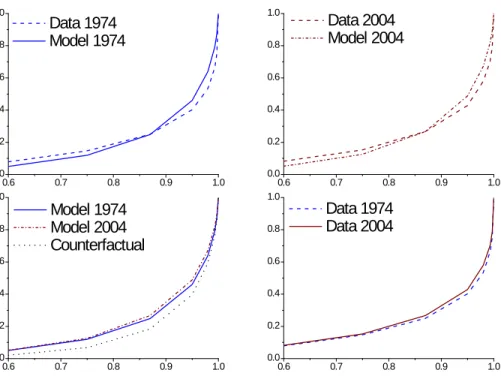
74 ; z74U S; xU S04 ; z04U S), so that the model can match exactly interest-rate spreads and per-capita GDP for the years 1974 and 2004. Second, the model does a very good job matching the 1974 and 2004 …rm-size distributions— see the upper two panels. Across time the size distribution shifts slightly to
Labor, l
Capital, k
Productivity,
θ
Figure 4: Employment, l, as a function of capital, k, and the realized value of the techno-logical shock, –model
0.6 0.7 0.8 0.9 1.0 0.0 0.2 0.4 0.6 0.8 1.0 0.6 0.7 0.8 0.9 1.0 0.0 0.2 0.4 0.6 0.8 1.0 0.6 0.7 0.8 0.9 1.0 0.0 0.2 0.4 0.6 0.8 1.0 0.6 0.7 0.8 0.9 1.0 0.0 0.2 0.4 0.6 0.8 1.0 Data 1974 Model 1974 Data 2004 Model 2004 E m pl oym ent , Cum ul at ive S har e Model 1974 Model 2004 Counterfactual Establishments, Percentile Data 1974 Data 2004
Figure 5: Firm-size distribution, 1974 and 2004–data and model
the left, as the lower right panel of Figure 5 makes clear. The largest …rms account for a little less of employment. Last, the parameters obtained from the …tting procedure are presented in Table 1.
Table 1: Parameter Values
Parameter De…nition Basis
= 0:35 Capital’s share of income Conesa and Krueger (2006)
= 0:06 Depreciation rate Chari, Kehoe and McGrattan (1997)
e
r= 0:03 Return to Savers Siegel (1992)
= 32:57 Pr of detection, constant Normalization
= 0:95 Pr of detection, exponent Calibrated to …t targets
= 0:40 Monitoring cost function Calibrated to …t targets
1 = 1:0 Mean of ln( 1) Normalization
2 = 3:05 Mean of ln( 2) Calibrated to …t targets
2
1 = 0:53 Variance of ln( 1) Calibrated to …t targets
2
2 = 0:61 Variance of ln( 2) Calibrated to …t targets
= 0:87 Correlation ln( 1)and ln( 2) Calibrated to …t targets
x1974 = 0:14; z1974 = 11:5 TFP’s Calibrated to …t targets
x2004 = 0:20; z2004 = 28:2 " "
7.2
The United States, Balanced Growth
It would not be unreasonable to argue, for the purposes of the current analysis, that the U.S. economy is characterized by a situation of balanced growth. First, there is only a small shift in the U.S. …rm-size distribution between 1974 and 2004, as was shown in Figure 5 (bottom right panel). Second, the economy’s interest-rate spread shows only a modest decline— recall Figure 1. Third, the capital-to-output ratio displays a small increase— again Figure 1.
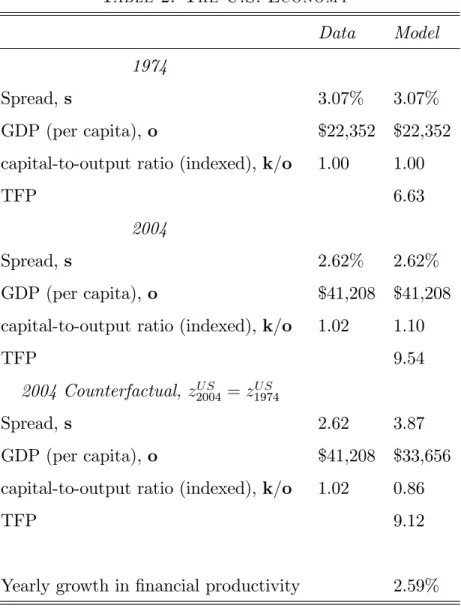
Finance is important in the model. This can be gauged by undertaking the following counterfactual question: By how much would GDP have risen between 1974 and 2004 if there had been no technological progress in the …nancial sector? As can be seen from the third panel of Table 2, output would have risen from $22,352 to $33,656 or by about 1.4% a year (when continuously compounded). This compares with the increase of 2.0% ($22,352 to $41,208) that occurs whenzrises to its 2004 level. Thus, about 30% of the increase in growth
is due to innovation in the …nancial sector. Likewise, the model predicts that about 12% of TFP growth was due to improvement in …nancial intermediation. The …nancial system actually becomes a drag on development whenz is not allowed to increase. Wages rise as the rest of the economy develops. This makes monitoring more expensive. Therefore, less will be done. As a consequence, interest rates rise and the economy’s capital-to-output ratio drops. Without an improvement in the …nancial system, the …rm-size distribution actually moves over time in a direction (rightward) that is opposite to that shown in the data (leftward), as can be seen by comparing the lower two panels of Figure 5. When there is no technological progress in the …nancial sector there will be a larger number of small ine¢ cient …rms around. Therefore, the smallest …rms in the economy (or the left tail) will now account for a smaller fraction for the work force— see the lower left panel.
Now, monitoring and the provision of …nancial services are abstract goods, so it is di¢ cult to know what a reasonable change in z should be. One could think about measuring pro-ductivity in the …nancial sector, as is often done, byk=lm, where kis the aggregate amount
of credit extended by …nancial sector and lm is the aggregate labor that it employs. By
this traditional measure, productivity in the …nancial sector rose by 2.59% annually between 1974 and 2004. Berger (2003, Table 5) estimates that productivity in the commercial bank-ing sector increased by 2.2% a year over this same period (which includes the troublesome productivity slowdown) and by 3.2% from 1982 to 2000.
Table 2: The U.S. Economy
Data Model
1974
Spread, s 3.07% 3.07%
GDP (per capita), o $22,352 $22,352
capital-to-output ratio (indexed), k=o 1.00 1.00
TFP 6.63
2004
Spread, s 2.62% 2.62%
GDP (per capita), o $41,208 $41,208
capital-to-output ratio (indexed), k=o 1.02 1.10
TFP 9.54
2004 Counterfactual, z2004U S =z1974U S
Spread, s 2.62 3.87
GDP (per capita), o $41,208 $33,656
capital-to-output ratio (indexed), k=o 1.02 0.86
TFP 9.12
Yearly growth in …nancial productivity 2.59%
7.3
Taiwan, Unbalanced Growth
Return to Taiwan, as shown in Figure 1. In Taiwan there was a large drop in the interest-rate spread between 1974 and 2004. This was accompanied by a signi…cant increase in the economy’s capital-to-output ratio. This is clearly a situation of unbalanced growth. Recall that model provides a mapping between the state of technologies in the production and …nancial sectors on the one hand, x and z, and output and interest-rate spreads, o and
s, on the other. This mapping can be inverted to infer x and z using observations on o
was calibrated/estimated for the U.S. economy and use the Taiwanese data on per-capita GDPs and interest-rate spreads for the years 1974 and 2004, (oT
1974;sT1974;oT2004;sT2004), to get the imputed Taiwanese technology vector(xT1974; z1974T ; xT2004; zT2004). The results of the …tting exercise for Taiwan are shown below.
So, how important was …nancial development for Taiwan’s economic development? To answer this question, compute the model’s solution for 2004 assuming that there had been no …nancial development; i.e., setz2004T =z1974T . Almost 50% of Taiwan’s 6.1% annual rate of growth between 1974 and 2004 can be attributed to …nancial development. It also accounts for 20% of the growth in Taiwanese TFP. Taiwan had almost a 10% annual increase in the productivity of its …nancial sector, as is conventionally measured.
Table 3: The Taiwan Economy Data Model 1974 Productivity, industrial x1974 =0.0383 Productivity, …nancial z1974 =0.4214 Spread, s 5.41% 5.41% GDP (per capita), o $2,211 $2,211 capital-to-output(indexed), k=o 1.00 1.00 TFP 1.68 2004 Productivity, industrial x2004 =0.0897 Productivity, …nancial z2004 =16.267 Spread, s 1.96% 1.96% GDP (per capita), o $13,924 $13,924 capital-to-output(indexed), k=o 1.847 1.905 TFP 4.46 2004 Counterfactual, z2004T =z1974T Spread, s 1.96% 9.66% GDP (per capita), o $13,924 $5,676 capital-to-output(indexed), k=o 1.847 0.630 TFP 3.66
Yearly growth in …nancial productivity 9.89%
8
Cross-Country Analysis
Move on now to some cross-country analysis. In particular, a sample of 45 countries, the intersection of all the nations in the Penn World Tables and the Beck, Demirguc-Kunt
and Levine (2000, 2001) dataset, will be studied. For each country j, a technology vector
(xj; zj) will be backed out using data on output and interest-rate spreads (oj;sj), given
the procedure implied by (6) while setting p to the calibrated parameter vector for the U.S. economy. Erosa (2001) uses interest-rate spreads to quantify the e¤ects of …nancial intermediation on occupational choice. It is not a foregone conclusion that this can always be done; i.e., that a set of technology parameters can be found such that (6) always holds.10 The results are reported in Table 9 in the Appendix. By construction the model explains all the variation in output and interest-rate spreads across countries.11 Still, one could ask how well the measure of the state of technology in the …nancial sector that is backed out using the model correlates with independent measures of …nancial intermediation. Here, take the ratio of private credit by deposit banks and other …nancial institutions to GDP as a measure of …nancial intermediation, as reported by Beck et al. (2000, 2001). (Other measures produce similar results but reduce the sample size too much.) Additionally, one could examine how well the model explains cross-country di¤erences in capital-to-output ratios.
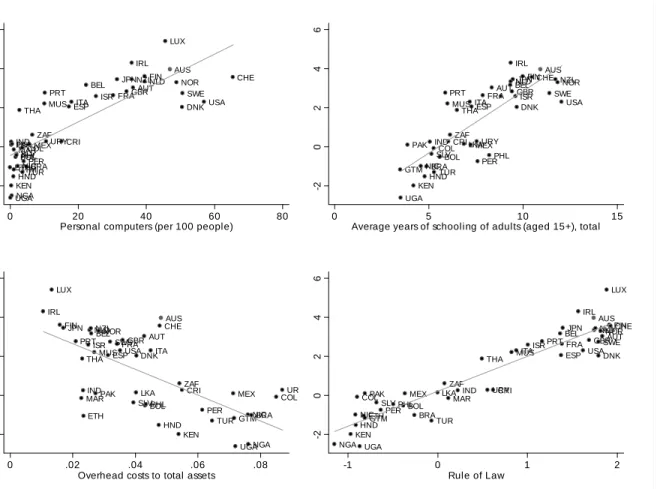
Table 4 reports the …ndings. The correlation between the imputed state of technology in the …nancial sector and the independent Beck et al. (2000, 2001) measure of …nancial intermediation is quite high— see Table 4 and Figure 6. Thus, it appears reasonable to use
10 Theoretically speaking, there is a maximum interest-rate spread that the model can match. When the
…nancial sector becomes too ine¢ cient, it no longer pays to monitor loans. As z falls (relative to x) the aggregate volume of lending declines. The wage rate will decline along with the economy’s capital stock. As this happens, the r1’s rise–see (1). Take the …rms with the highest value of r1 and denote this by r1. By
de…nition,r1=r1( ), where = arg max 2Tfr1( )g. Eventually,r1 will hiter. At this point, a Williamson
(1986)-style credit-rationing equilibrium emerges. In the credit-rationing equilibrium,r1=er. Here
type-…rms will pay the …xed interest rater1. They will not be monitored. Becauser2>er for these …rms, they
would demand as big a loan as possible. Thus, their credit must be rationed. The interest-rate spread on these loans will be zero. Note thatr1 can never exceed er, because in…nite pro…t opportunities would then
emerge in the economy. Thus, the interest rate spread is a\-shaped function ofz. (The interest-rate spread also approaches zero as z ! 1, or when economy asymptotes to the frictionless competitive equilibrium. As z ! 0 the fraction of loans that are not monitored will eventually approach one, implying that the interest-rate spread will drop to zero.) The peak of the\function is the maximum permissible interest-rate spread allowed by the model.
11 The model predicts a positive association between a country’s rate of investment and its GDP. Castro
et al. (2009, Figure 1) show that this is true. As was mentioned, it is stronger when investment spending is measured at international prices, as opposed to domestic ones. This puzzle could be resolved here by adopting aspects of Castro et al.’s (2009) two-sector analysis.
the constructed values of z for investigating the relationship between output and …nancial development. Now, the backed-out measure for the e¢ ciency of the …nancial sector correlates well with a country’s adoption of information technologies, as is shown in Figure 6 (upper left panel). It also is strongly associated with a country’s human capital (upper right) and the maturity of its legal system (lower right). These three factors should make intermediation more e¢ cient, for the reasons discussed in Section 6. Indeed, Figure 6 (lower left panel) also illustrates how the ratio of overhead cost to assets, a measure of e¢ ciency, declines with constructed ln(z).
As can be seen, the capital-to-output ratios predicted by the model are positively associ-ated with those in the data. The correlation is reasonably large. That these two correlations aren’t perfect, should be expected. There are other factors, such as the big di¤erences in public policies discussed in Parente and Prescott (2000), which may explain a large part of the cross-country di¤erences in capital-to-output ratios. Di¤erences in monetary policies across nations may in‡uence cross-country interest-rate spreads. Additionally, there is noise in these numbers given the manner of their construction— see the Appendix.
Table 4: Cross-Country Evidence
k=o lnz with Beck et al (2000, 2001) k=lm with Beck et al (2000, 2001)
Corr(model, data) 0.62 0.81 0.82
Interestingly, Sri Lanka and the United States both have an interest-rate spread of about 4.2%. The model predicts the United States’z is about 250% higher (whenlndi¤erenced or continuously compounded) than Sri Lanka’s— the former’sln(z)is 2.28, compared with 0.013 for the latter; again, see Table 9 in the Appendix. But, recall that the units for ln(z) are meaningless, since monitoring is abstract good. If one measures productivity in the …nancial sector by the amount of credit extended relative to the amount of labor employed in the …nancial sector, as was discussed earlier, then the analysis suggests that intermediation in the United States is about 214% (continuously compounded) more e¢ cient than in Sri Lanka. Why? The United States has a much higher level of income per worker and hence TFP than
AUS AUT BEL BOL BRA COL CRI DNK SLV ETH FIN FRA GTM HND IND IRL ISR ITA JPN KEN LUX MUS MEX MAR NLD NZL NIC NGA NOR PAK PER PHL PRT ZAF ESP LKA SWE CHE THA TUR UGA GBR USA URY -2 0 2 4 6 Effi c ie n cy i n m o n ito ri n g ( ln z) 0 20 40 60 80
Personal computers (per 100 people)
AUS AUT BEL BOL BRA COLCRI DNK SLV FIN FRA GTM HND IND IRL ISR ITA JPN KEN MUS MEX NLD NZL NIC NOR PAK PERPHL PRT ZAF ESP LKA SWE CHE THA TUR UGA GBR USA URY -2 0 2 4 6 0 5 10 15
Average years of schooling of adults (aged 15+), total
AUS AUT BEL BOL BRA COL CRI DNK SLV ETH FIN FRA GTM HND IND IRL ISR ITA JPN KEN LUX MUS MEX MAR NLDNZL NIC NGA NOR PAK PER PHL PRT ZAF ESP LKA SWE CHE THA TUR UGA GBR USA URY -2 0 2 4 6 Effi c ie n cy i n m o n ito ri n g ( ln z) 0 .02 .04 .06 .08
Overhead costs to total assets
AUS AUT BEL BOL BRA COL CRI DNK SLV ETH FIN FRA GTM HND IND IRL ISR ITA JPN KEN LUX MUS MEX MAR NLDNZL NIC NGA NOR PAK PERPHL PRT ZAF ESP LKA SWE CHE THA TUR UGA GBR USA URY -2 0 2 4 6 -1 0 1 2 Rule of Law
Figure 6: The relationship between imputed ln(z) on the one hand, and measures of in-formation technology, human capital, overhead costs to assets and the rule of law, on the other
does Sri Lanka ($33,524 versus $3,967). Therefore, given the higher wages, monitoring will be more expensive in the United States. To give the same interest-rate spread, e¢ ciency in the U.S.’s …nancial sector must be higher. Before proceeding on to a discussion of the importance of …nancial development for economic development, note that the …ndings in the next section do not change much if the model is matched up with overhead costs, perhaps a more direct measure (see Figure 6), instead of the Beck et al. (2000, 2001) interest-rate spreads.
8.1
The Importance of Financial Development for Economic
De-velopment
It is now possible to gauge how important e¢ ciency in the …nancial sector is for economic development, at least in the model. To this end, let the best industrial and …nancial practices in the world be denoted by x maxfxigand z maxfzig, respectively. Represent country i’s output, as a function of the e¢ ciency in its industrial and …nancial sectors, by oi = O(xi; zi)— this is really just the …rst component of the mappingO(x; z; p). If countryicould
somehow adopt the best …nancial practice in the world it would produceO(xi; z). Similarly,
if country i used the best practice in both sectors it would attain the output level O(x; z). The shortfall in output from the inability to attain best practice isO(x; z) O(xi; zi). The
United States turns out to have the highest value for x, and Luxembourg for z.
The percentage gain in output for country iby moving to best …nancial practice is given by100 [lnO(xi; z) lnO(xi; zi)]. The results for this experiment are plotted in Figure 7.
As can be seen, the gains are quite sizeable. On average, a country could increase its GDP by 31%, and TFP by 10%. The country with the worst …nancial system, Uganda, would experience a 140% rise in output. Its TFP would increase by 30%. While sizeable, these gains in GDP are small relative to the increase that is needed to move a country onto the frontier for income,O(x; z). The percentage of the gap that is closed by a movement to best …nancial practice is measured by 100 [O(xi; z) O(xi; zi)]=[O(x; z) O(xi; zi)] 100 G(xi; zi).
in this gap is only 17%. For most countries the shortfall in output is accounted for by a low level of total factor productivity in the non-…nancial sector.
Therefore, the importance of …nancial intermediation for economic development depends on how you look at it. World output would rise by 65% by moving all countries to the best …nancial practice— see Table 5. This is a sizeable gain. Still, it would only close 36% of the gap between actual and potential world output. Dispersion in cross-country output would fall by about 19 percentage points from 77% to 58%. Financial development explains about 27% of cross-country dispersion in output by this metric.
Table 5: World-Wide Move to Best Financial Practice, z
Increase in world output (per worker) 65%
Reduction in gap between actual and potential world output 35.6%
Increase in world TFP 17.4%
Fall in dispersion ofln(output) across countries 27.2% (' 111.4% - 84.2%) Fall in (pop-wghtd) mean of (cap-wghtd) distortion 20.8% (' 23.4% - 2.6%) Fall in (pop-wghtd) mean dispersion of (cap-wghtd) distortion 13.5% (' 14.6% - 1.1%) Restuccia and Rogerson (2008) started a literature about the importance of idiosyncratic distortions that create heterogeneity in the prices faced by individual producers. Although they do not identify the sources of those distortions, they show they can generate di¤erences in TFP in the range of 30 to 50%. Guner et al. (2008) analyze the impact that size-dependent policies, such as the restrictions on retailing in Japan favoring small stores, can have in an economy. Here, the presence of informational frictions causes the expected marginal product of capital, 1r1+ 2r2, to deviate from its user cost, er. The distortion is modelled endogenously. De…ne the induced distortion in investment by d = 1r1 + 2r2 re. For a country such as Uganda these deviations are fairly large. Figure 8 plots the distribution of the distortion across plants for Luxembourg and Uganda. As can be seen, both mean level of the distortion and its dispersion are much larger in Uganda than they are in Luxembourg. The (capital-weighted) mean level of this distortion is 49.8% (4.6%) for Uganda (Luxembourg).
0 20 40 60 80 100 120
140 GDP per worker, % change
0 20 40 60 80
100 reduction in the gap to the frontier, %
T u rkey Uga nd a B ra zil Ni ge ri a G u at em al a Ho nd ur a s Kenya Ni ca ra gua Peru El Sal vador Ur ugua y M exi co Co lo m bi a Phi lippi ne s B o livia C ost a R ica M orocco Sout h Af ri ca Sr i La nka E th io p ia Pak ist an In d ia De nm a rk U n ite d S ta te s S p a in Ita ly M a ur iti us Ic el an d Fran ce Thai la nd Is rael Sw eden Uni te d Ki ngd o m Port u g al A u str ia N or w ay Be lgi um Ne the rl a nd s Japan S w itz e rla n d Ne w Ze a la nd Fi nl a nd A u str a lia Ir el an d L ux e m bo ur g 0 5 10 15 20 25 30 TFP, % change
Figure 7: Cross-country results: The impact of a move to …nancial best practice on GDP, the output gap and TFP
Uganda Luxembourg 0 5 10 15 De nsi ty 0 .2 .4 .6 .8 1 1.2 Distortion
Figure 8: The distribution of distortions across establishments for the Luxembourg and Uganda–the model
It varies across plants a lot, as indicated by a coe¢ cient of variation of 32.7% (1.94%). If Uganda adopted Luxembourgian …nancial practices the average size of this distortion would drop to 1.4%. Its standard deviation across plants collapses from 9% to just 0.3%. The elimination of this distortion results in capital deepening among the active plants. Average TFP would rise by 26% in the model, as ine¢ cient plants are culled. For the world at large, the average size of the distortion is 23.4%, with an average coe¢ cient of variation of 14.6%. The mean distortion drops to 2.6% with a world-wide movement to best …nancial practice. The average standard deviation across plants falls from 14.6% to a mere 1.1%.
Finally, the model predicts that larger …rms should be found in countries with more developed …nancial systems. It is hard to come up with a comparable dataset for many countries. Beck et al. (2006) argue that the best available alternative is to use the size of
the largest 100 companies. They …nd that there exists a positive relationship between the development of a country’s …nancial system and …rm size, after controlling for the size of the economy, income per capita and several …rm and industry characteristics. As an example, their estimation implies that if Turkey had the same level of development in the …nancial sector as Korea (a country with a more developed …nancial system), the average size of the largest …rms in Turkey would more than double.
On this, imagine running a regression of the following form for both the data and the model:
ln(size) =constant+ spread+ controls:
Firm size in the data is measured by average annual sales per …rm (in $U.S.) for the top 100 …rms, as taken from Beck et al. (2006). For the analogue in the model, simply use a country’s GDP divided by the measure of active set A to obtain output per …rm. Once again the data for interest-rate spreads are obtained from Beck et al. (2000, 2001). Controls are added for a country’s GDP and population in the regression for the data, while for the model they are just added for GDP.12 The same list of countries is used for both the data and model.
The upshot of the analysis is shown in Table 6. A negative relationship is found in the cross-country data between the interest-rate spread and average …rm size. The model also produces a negative relationship between these variables. The similarity between the size of interest-rate spread coe¢ cient, , for the data and model is reassuring. Additionally, the data estimate of = 0:16 implies that if a country with an interest-rate spread of 10 percentage points (which is among the worst 5% of nations in terms of …nancial development) could reduce its spread to just 1 percentage point (which would place it in the upper 5% of countries), then the average size of its top 100 …rms would increase by 144%. This is roughly
12 The idea here is that larger countries, as measured by income or population, would tend to have larger
…rms. In a frictionless world …rms could locate anywhere, so there would be no need for such a connection to hold. Nontraded goods, productivity di¤erences across countries, restrictions on trade, transportations costs, etc., would all lead to a positive association between average …rm size on the one hand and income or population on the other.
in accord with the Beck et al. (2006) …nding discussed above, given that Turkey had one of the worst …nancial systems while Korea had one of the best.
Table 6: Cross-Country Firm-Size Regressions
Data Model
Interest-rate spread coe¢ cient, -0.16 -0.19
Standard error for 0.07 0.03
Number of country observations 29 29
R2 0.51 0.93
9
Robustness Analysis
9.1
Intangible Investments and Capital’s Share of Income
Suppose part of investment spending is undertaken in the form of intangible capital. As a result, measured investment may lie below true investment. This will lead to measured income, GDP, falling short of true output, o. This injects an upward (a downward) bias in the measurement of labor’s (capital’s) share of income. Speci…cally, in context of the standard neoclassical model, with a Cobb-Douglas production function, measured labor’s share of income,LSI, will appear as
LSI= o
GDP (1 )>(1 ):
Corrado et al. (2007) estimate the amount of intangible investment that was excluded from measured GDP from 1950 to 2003. They show that when output is adjusted to include these unrecognized intangibles, true output, o, is 12% higher than measured output, GDP, for the period 2000-2003. As a consequence, it is easy to calculate that
= 1 GDP
o LSI= 1
1
1:12(1 0:33) = 0:41:
How does this larger estimate for capital’s share of income a¤ect the analysis?
The calibration procedure described by P(3) is redone for the case where = 0:41. The results are in accord with those obtained earlier. The model again …ts the U.S. data well.
In particular, it matches the …rm-size distributions for 1974 and 2004 extremely well. With no …nancial innovation, U.S. GDP would have risen by about 1.77% a year, compared with its actual rise of 2.0%. Hence, …nancial development accounts for about 40% of the growth in GDP. For Taiwan about 60% of growth is due to …nancial development.
Financial intermediation is now more important for economic development. World output would increase by 88%, as opposed to the 65% found earlier, if all countries moved to the best …nancial practice. There is also a bigger impact on TFP. As a result, suboptimal …nancial practices now make up a larger fraction of the output gap. A more detailed breakdown of the results is displayed in the Appendix, Figure 9.
Table 7: World-Wide move to best financial practice, z
= 0:41(intangible capital)
Increase in world output (per worker) 88.2% Reduction in gap between actual and potential world output 43.5%
Increase in world TFP 33.1%
Fall in dispersion ofln(output) across countries 34.4% ( '111.4% - 77.0%)
9.2
Varying the Degree of Substitutability between Capital and
Labor
Let output be produced according to a CES production function of the form
o= [ k + (1 )(x l) ]1; with 1.
This production function will have implications for how labor’s share of income,LSI, will vary across countries. To see this, think about the one-sector growth model. Here labor’s share of income can be written asLSI= (w=l)=(w=l+rk) = 1=[1 + (r=w)(k=l)]: Therefore, labor’s share will rise whenever(r=w)(k=l)falls. With the above production function, = 1=(1 )
represents the elasticity of substitution between capital and labor. Hence, in response to a shock in some exogenous variable,z, it will happen thatdln(r=w)=dz = (1= )dln(k=l)=dz.
If the shock induces capital deepening [dln(k=l)=dz > 0] then labor’s share will rise or fall depending on whether the elasticity of substitution is smaller or bigger than one.13 In the cross-country data, labor’s share either rises slightly or remains constant with per-capita income. This suggests that for the quantitative analysis, should be restricted so that
1=(1 ) < 1, which implies < 0; i.e., capital and labor are less substitutable than Cobb-Douglas.
Let = 0:38, roughly in line with Pessoa et al. (2005). The calibration procedure described above is redone for this value for . The CES framework does not …t the U.S. …rm-size distributions for 1974 and 2004 nearly as well as the Cobb-Douglas case. In fact, if one allowed for 0 to be freely chosen in the calibration procedure, then a value close to zero (Cobb-Douglas) would be picked. For the U.S. economy, the CES speci…cation predicts a rise in labor’s share from 69.5 to 70.2% as the economy grows. The model with a CES production function has a di¢ cult time matching the observed large variation in cross-country rate spreads. Speci…cally, it cannot match the very high interest-rate spreads observed for some countries.14 All in all, both the U.S. and cross-country data prefer the Cobb-Douglas speci…cation. With a CES production structure world output would increase by 32%, if all countries move to best …nancial practice. This is lower than the Cobb-Douglas case for two reasons. First, the model cannot match the high interest-rate spreads for some nations. This limited the gain that these countries could realize by a move to best …nancial practice. Second, the potential for capital deepening is more limited the higher the degree of complementarity between capital, which is reproducible, and labor, which is …xed, in production.
13 That is, r=w will decrease by more (less) than k=l rises when the elasticity of substitution is smaller
(greater) than one.
10
Conclusions
So, how important is …nancial development for economic development? To address this question, a costly state veri…cation model is taken to both U.S. and cross-country data. The model has two unique features. First, …nancial intermediaries choose how much resources to devote to monitoring their loan activity. The odds of detecting malfeasance are a function of this. They also depend upon the technology used in …nancial sector. Second, each …rm faces a distribution of returns. Furthermore, there is an economy-wide distribution across …rms over these …rm-speci…c distributions. These two features lead to a …nancial theory of …rm size. The framework is calibrated to …t the U.S. …rm-size distributions for 1974 and 2004, as well as the observed intermediation spreads on loans.
The analysis suggests that …nancial intermediation is important for economic develop-ment. In particular, about 30% of U.S. growth can be attributed to technological improve-ment in …nancial intermediation. Since there was little change in the U.S. interest-rate spread, it appears that technological progress in the …nancial sector was in balance with technological advance in the rest of the economy. Roughly 50% of Taiwanese growth could be attributed to …nancial innovation. Given the dramatic decline in the Taiwanese interest-rate spread, technological progress in the …nancial sector may have outpaced that elsewhere. The model’s predictions for the e¢ ciency of …nancial intermediation in a cross-section of 45 countries matches up well with independent measures. It does a reasonable job mimicking cross-country capital-output ratios. The average measured distortion in the world between the expected marginal product of capital and its user cost falls somewhere between 17 and 21 percentage points. The average coe¢ cient of variation in the distortion within a country is 28 to 29%. World output could increase somwhere between 65 and 88% if all countries adopted the best …nancial practice in the world. Adopting this practice leads to funds being redirected away from ine¢ cient …rms toward more productive ones. This reallocation e¤ect is re‡ected by a rise in world TFP by 17 to 33%. Still, this only accounts for 36 to 45% of the gap between actual and potential world output. This happens because the bulk of the di¤erences in cross-country GDP are explained by the huge di¤erences in the productivity
of the non-…nancial sector.
11
Data Appendix
Figure 1: For the United States, the spread is computed along the lines of Mehra et
al. (2009). Speci…cally, the spread is de…ned to be “Intermediation Services associated with household borrowing and lending”divided by “Total Amount Intermediated”(see de…nitions of these below). The “Intermediation Services associated with household borrowing and lending”is computed as “Interest Paid”minus “Interest Received”mi-nus “Services Furnished by …nancial intermediaries without payment Interest Paid.” These numbers are taken from the National Income and Product Accounts [NIPA, Tables 7.11 (lines 4 and 28) and 2.4.5 (lines 89 and 108)]. The “Total Amount In-termediated” is taken from the Flow of Funds account (2000, Table B.100b.e.) This number is Assets (line 1) minus Tangible Assets (line 2). For Taiwan, the spread is obtained from Lu (2008). The initial capital-to-output ratio in each country was normalized to one (to control for di¤erent de…nitions of the capital stock).
Figure 2, Figure 3and Section 8: The cross-country data for the interest-rate spreads
are taken from the Financial Structure Dataset, assembled by Beck et al. (2000, 2001) and revised in January 2009. It is de…ned as the accounting value of banks’net interest as a share of their interest-bearing (total earning) assets averaged over 1997 to 2003. The numbers for the …nancial development measure are obtained from the same dataset. They represent demand, time and saving deposits in deposit money banks as a share of GDP, and are also averaged over 1997 to 2003. The other numbers derive from the Penn World Tables (PWT), Version 6.2— see Heston et al. (2002). The capital stock for a country,k, is computed for the period 1955-2003 sample period. The starting value is computed using the formulak=i=(g+ ), where iis gross investment (rgdpl*pop*ki in the PWT’s notation), g is the growth rate in investment, and is rate of depreciation. The depreciation is taken to be 0.06. For the starting value, i
and g are the average over the …rst …ve years available for each country (in general 1950 to 1954). From there on, a time series is constructed for each country using
kt = kt 1(1 ) +it: Again, the numbers used correspond to the average over 1997
to 2003. A country’s total factor productivity,T F P, was computed using the formula
T F P = (y=l)=(k=l) , wherey is GDP, l is aggregate labor, and is capital’s share of income. A value of 0.35 was picked for .
Figure 5 (Firm size): The data are for establishments. They come from County
Business Patterns (CBP), which is released by the U.S. Census Bureau annually. Due to a signi…cant shift in the methodology employment by the Census from 1974 on, data are only used for this time period. The horizontal axis orders establishments (from the smallest to highest) by the percentile that they lie in for employment. The vertical axis shows the cumulative contribution of this size of establishment to the employment in the U.S. economy. Some data are shown below.