Automatic Learning and Recognition
of Irish Sign Language
by
Daniel Kelly BSc.
A thesis presented in fulfilment of the requirements for the Degree of Doctor of Philosophy
Supervisor: Dr. Charles Markham, Mr. John Mc Donald
Department of Computer Science National University of Ireland, Maynooth
Maynooth, Co.Kildare, Ireland
This thesis has not been submitted in whole or in part to this
or any other university for any other degree and is, except
where otherwise stated, the original work of the author.
Signed:
It is a pleasure to thank those who made this thesis possible. I would like to thank my supervisors Dr Charles Markham and John Mc Donald for their continued support throughout my years working on this thesis. I would also like to thank my fellow colleagues in the computer science department and particularly Jane and Ron for their help on this thesis.
The biggest thanks has to go to my parents and Ramona. Without the support of my parents, this work leading to this thesis would not have even begun. Without Ramona’s support, encouragement and patience, this thesis would not have been completed.
This thesis would not have been possible without the financial support of the Embark Initiative of the Irish Research Council for Science, Engineering, and Technology.
1 Introduction 33
1.1 Publications . . . 36
1.2 Outline of the thesis . . . 40
2 Sign Language Recognition 43 2.1 Sign Language Overview . . . 43
2.1.1 Applications of Sign Language Recognition . . . 47
2.2 State of the Art on Sign Language Recognition. . . 49
2.2.1 Gesture Data Acquisition . . . 50
2.2.2 Spatiotemporal Gesture Recognition . . . 58
2.2.3 Hand Posture Recognition . . . 69
2.2.4 System Training. . . 74
2.3 Conclusion . . . 77
3 Hand Posture Recognition 79 3.1 Introduction . . . 79
3.2 Hand Features . . . 80
3.3.2 Hu Moments . . . 84
3.3.3 Size Functions . . . 84
3.3.4 Eigenspace Size Functions . . . 89
3.4 Data Sets for Experimentation . . . 91
3.4.1 Jochen Triesch Static Hand Posture database . . . 91
3.4.2 ISL data set . . . 92
3.5 Evaluation of Discriminatory Properties . . . 96
3.5.1 Size Functions and PCA performance . . . 96
3.5.2 Hu Moments Performance . . . 100
3.5.3 Combining Size Function and Hu Moments . . . 100
3.5.4 Size Function Parameters . . . 103
3.6 Recognition Framework. . . 105
3.6.1 Support Vector Machines . . . 106
3.6.2 Training . . . 106 3.6.3 Posture Classification . . . 107 3.6.4 Experiments . . . 108 3.6.5 Continuous Recognition . . . 111 3.7 Conclusion . . . 112 4 Spatiotemporal Gesture Recognition 115 4.1 Introduction . . . 115 4.1.1 Chapter Outline. . . 116
4.2.2 Types of HMMs . . . 120
4.3 Threshold HMM Model. . . 121
4.4 GT-HMM Framework. . . 124
4.4.1 GT-HMM Training . . . 124
4.4.2 GT-HMM for Gesture Recognition . . . 133
4.5 Experiments . . . 141
4.5.1 Conditional Random Fields . . . 142
4.5.2 Feature Extraction . . . 147
4.5.3 Evaluation of Techniques on Isolated Gestures . . . 149
4.5.4 Continuous Gesture Recognition Experiments . . . 168
4.5.5 Multimodal Recognition Examples . . . 180
4.6 Conclusion . . . 182
5 Weakly Supervised Training 187 5.1 Introduction . . . 187
5.1.1 System Overview . . . 188
5.2 Feature Extraction . . . 188
5.3 Gesture Similarity Functions . . . 189
5.3.1 Temporal Gesture similarity Function . . . 190
5.3.2 Hand Posture Similarity Function . . . 192
5.4 Automatic Sign Extraction . . . 192
5.4.1 MIL Density Matrix . . . 195
5.4.2 Automatic Sign Labeling . . . 202
5.5.2 Hand Posture Training . . . 212
5.6 Extended Continuous Recognition . . . 218
5.7 Experiments . . . 221
5.7.1 Sign Recognition Experiments . . . 221
5.8 Sample Application: Sign Language Teaching Environment . . 235
5.8.1 System Overview . . . 236
5.8.2 Performance . . . 236
5.9 Conclusion . . . 238
6 Conclusions and Future Directions 241 6.1 Contributions . . . 241
6.1.1 User Independent Hand Posture Measurement using the Eigenspace Size Function . . . 242
6.1.2 Spatiotemporal Gesture Recognition with Movement Epenthesis Detection . . . 245
6.1.3 Weakly Supervised Training using Multiple Instance Learning Density Matrices . . . 249
6.2 Discussion . . . 250
6.3 Future Work. . . 253
6.3.1 Real World Corpus . . . 253
6.3.2 Natural Gesture Interfaces . . . 254
6.3.3 Full Body Motion Analysis . . . 254
A.1.1 Forward Backward Algorithm . . . 258
A.1.2 Viterbi Algorithm . . . 260
A.1.3 Baum-Welch Algorithm . . . 261
A.2 Support Vector Machines . . . 263
A.2.1 SVM Kernals . . . 267
A.2.2 Probability Computation . . . 269
B Performance Measures 271 B.1 ROC Analysis . . . 271
2.1 Examples of signs with similar hand posture. Signs must be distinguished using motion. . . 46 2.2 Examples of signs with similar motion. Signs must be
distin-guished using hand posture. . . 47 2.3 Examples of signs with similar location of articulation. Signs
must be distinguished using hand posture. . . 48 2.4 Sensor Placement for Bi-Channel recognition system proposed
by Kim et al. [KWRA08] . . . 51 2.5 Left: Flock of Birds 3D motion tracker, Right: CyberGlove . . 52 2.6 The Acceleglove . . . 52 2.7 Head mounted camera and accelerometer data collection
im-plemented by Brashear et al [BSLJ03]. . . 53 2.8 Gloves used by Wang et al. [WCZ+07] . . . 53
2.9 Examples of hand segmentation results from [HLO05b] . . . . 54 2.10 Examples of hand segmentation results from [CB07] . . . 55 2.11 Examples of hand segmentation results from [AKE+04] . . . . 55
2.14 Examples of hand segmentation results from [BZE09] . . . 57
2.15 Examples of hand segmentation results from [LE09] . . . 57
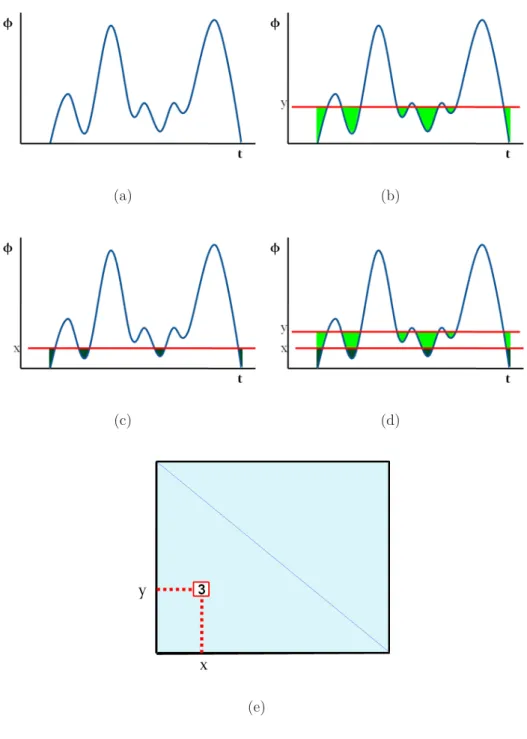
3.1 (a)Graph of some measuring function ϕ (b)Shaded region ≡ ϕ ≤y. (c)Shaded region ≡ϕ ≤x. (d)Graph depicting ϕ≤ y and ϕ ≤x. (e)Graph of Size Function lϕ with current lϕ(x, y) = 3. . . 87
3.2 θ rotation applied to hand contour . . . 88
3.3 Measuring function ϕθ applied to hand contour . . . 88
3.4 Size Function ℓϕθ generated . . . 88
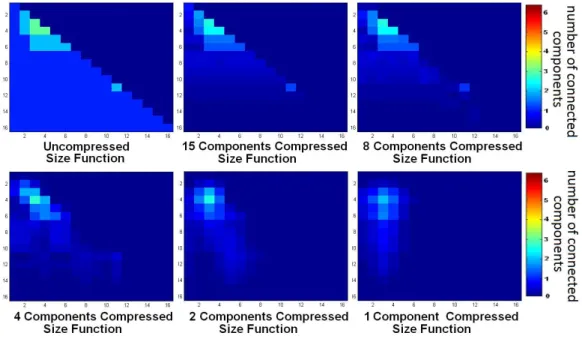
3.5 Size Functions Reconstructed with varying numbers of Com-ponents . . . 91
3.6 The ten postures of the Triesch data set, performed by one subject against uniform light background . . . 92
3.7 Example of Contour Extraction from ’Y’ and ’C’ hand pos-tures from Triesch data set . . . 93
3.8 23 Static Letters of the ISL Alphabet (The signs for “j”, “x” and “z” cannot be performed statically and were not further considered) . . . 93
3.9 Example of variation in performance of the ’D’ sign . . . 94
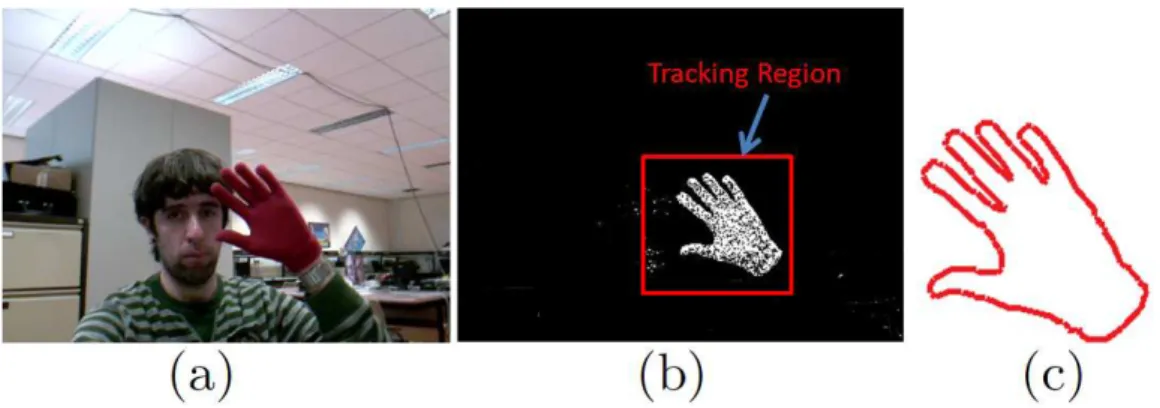
3.10 Feature Extraction from Image (a)Original Image (b)Back Pro-jection Image (c)Extracted Contour . . . 95
3.11 Example of Noisy Back Projection Images and Corresponding Noisy Contours . . . 96
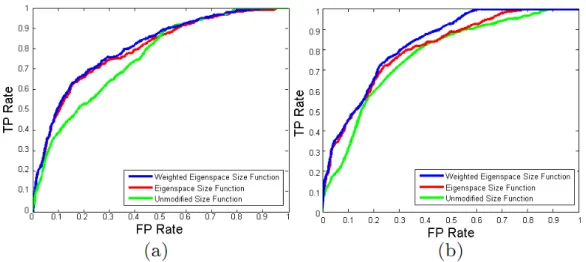
Size Function and unmodified Size Function representations for (a) ISL data set and (b) Triesch data set . . . 99 3.13 ROC graph of combined features for (a) ISL data set and (b)
Triesch data set . . . 103 3.14 Feature Extraction for Continuous Recognition Experiment
(a) Original Image (b) Skin Colour Segmentation using Mean Shift Algorithm (c) Edge Detected Hand Region (d) Extracted Contour . . . 112 3.15 Recognition probabilities for Continuous Video Stream. For
each frame, the classifier which outputs the maximum likeli-hood is denoted as the grey area. For each classifier output we denote the blue plot as the likelihood output of that clas-sifier, while the red plot denotes the difference between the classifier output and the likelihood of the classifier with the second highest likelihood (Thus, for the red plot, values above 0 denotes the maximum likelihood, values equal to 0 denotes the second highest likelihood and values below 0 denotes all other likelihoods). . . 113
4.1 HMM Model Types . . . 120 4.2 (a) Dedicated Gesture Models (b) Threshold Model (S- Start
State, E- End State) . . . 123 4.3 Visualisation of Isolated Examples of “Alot” sign Extracted
“Alot” being Segmented into S= 3 sub-gestures . . . 128
4.5 Visualisation of Principal Components of Sign Data for Left Hand (Left) 2 Dimensions, of the 5 dimensional feature vec-tor, representing the x and y trajectories of the hand (Right) Principal component computed from the 5 dimensional feature vectors . . . 130
4.6 Iterative clustering steps. Each plot represents a clustering step with a different time scaling factor ΓT. (pc1 - Principal
Component) . . . 131
4.7 Temporal clustering results after final iteration . . . 132 4.8 Initialisation: Mean vector µ and the covariance matrix Σ
calculated for each HMM state. . . 133 4.9 HMM Initialisation and Training Procedure . . . 134
4.10 Likelihood evolution of “Lost” gesture model and associated threshold model . . . 138 4.11 HMM Gesture Models And Corresponding HMM Threshold
Model Likelihood Difference . . . 140
4.12 Candidate Gestures, Υ, after first candidate selection step . . 140 4.13 Candidate Gestures, Υ. Candidates marked in Red (Dashed)
denote gestures which are removed by the second candidate selection step. Candidates in Green (Solid) denote the final recognised gestures . . . 141
circles denoted observed symbols. . . 145
4.15 Extracted Features from Image . . . 147
4.16 (a) sample ASM which was fitted to each image (b) sample of an un-occluded image (c) example of an occluded image. . . . 149
4.17 Example of the eight different signs the system was tested on (performed by Signer 1): (a) Newspaper, (b) A lot, (c) Bike, (d) Clean, (e) Paint, (f) Plate, (g) Lost, (h) Gone . . . 152
4.18 Example of the three different head movement gestures the system was tested on (a) Right Movement (b) Left Movement (c) Left Forward Movement . . . 157
4.19 Example of subject performing a raised brow gestures (left) and a lowered brow gesture (right). a and b represent the angles φL and φR respectively . . . 161
4.20 Top: example of images from a gesture sequence from the point of view of the left camera (on the left) and from the point of view of the right camera (on the right). Bottom: 3D coordinates of the centre of each blob (head, torso, left hand and right hand) for a fly gesture. The z-axis is the vertical axis of the person. . . 165
4.21 Example of the eight different performed by Signer 2 (a) News-paper, (b) A lot, (c) Bike, (d) Clean, (e) Paint, (f) Plate, (g) Lost, (h) Gone . . . 176
preter vs. our recognition system (Dotted Arrows Represent Hand Labeled Gestures while solid arrows represent labels gen-erated by our system). . . 181
5.1 Flowchart of our proposed automatic sign training and recog-nition framework (A) System Training, (B) Sign Classifiers, (C) Sign Recognition . . . 189 5.2 Extracted Features from Image (a) Feature Positions (b) Hand
Contour . . . 190 5.3 Visual representation of the calculation of the spatiotemporal
gesture comparison matrix Gij . . . 196
5.4 Visualisation of comparison matrices Gij and calculation of
summed comparison vectors g1 and g
′
5 . . . 200
5.5 Visualisation of density matrix Φ(G1, G5) . . . 201
5.6 Visual representation of comparison matricesGij (Gesture
Se-quences G1 and G2 where not labeled to contain the target
word as they where deemed to have translation ambiguities where the text translation contained the target word “Play” but the corresponding sign did not occur in the video) . . . . 203 5.7 Vector fΨi and Automatically Labeled target signs “Play” . . . 207
5.7 (cont.) VectorfΨi and Automatically Labeled target signs “Play”208
5.7 (cont.) VectorfΨi and Automatically Labeled target signs “Play”209
5.7 (cont.) VectorfΨi and Automatically Labeled target signs “Play”210
5.9 Example of computing overall sign probability by combining spatiotemporal segment probability and the best fit hand pos-ture probability . . . 220 5.10 Candidate Gestures, Υ. Candidates marked in Red (Dashed)
denote gestures which are removed by the second candidate selection step. Candidates in Green (Solid) denote the final recognised gestures . . . 221 5.11 Performance of Automatic Sign Labeling and Effect of
Trans-lation Ambiguities . . . 226 5.12 Example of automatically extracted key hand postures
“Air-port” - “Cruise” (4 samples hand postures shows for each sign)228 5.13 Example of automatically extracted key hand postures “Eat”
- “Rain” (4 samples hand postures shows for each sign) . . . . 229 5.14 Example of automatically extracted key hand postures “School”
- “Cold” (4 samples hand postures shows for each sign) . . . . 230 5.15 Virtual Sign Language Teacher. . . 235 5.16 Architecture of the Sign Teaching Environment . . . 237 5.17 User Interface of Sign Language Teaching Application . . . 237
A.1 Example of SVM showing maximum margin hyperplane and margins . . . 265
3.1 Best True:False Ratios . . . 102
3.2 Parameter Combination AUC . . . 104
3.3 Classification AUC Performance . . . 110
3.4 Recognition Performance . . . 111
4.1 Manual Signs: AUC Measurements for Different Models . . . . 155
4.2 Non-Manual Signals: AUC Measurements for Different Models 159 4.3 Non-Manual Eye Brow Signals: AUC Measurements for Dif-ferent Models . . . 162
4.4 InteractPlay Database Performance Results . . . 167
4.5 Continuous GT-HMM Performance Results. . . 172
4.6 Continuous LDCRF Performance Results . . . 173
4.7 User Independent Continuous GT-HMM Performance Results 178 4.8 User Independent Continuous LDCRF Performance Results. . 179
5.1 Start and End Frame Error . . . 227
5.2 Continuous Spotter and Classifier Performance . . . 234
6.3 Continuous Temporal Classification Results Overview . . . 248
AAM Active Appearance Models. 65
ASL American Sign Language. 58,61, 64, 65,71,159
ASM Active Shape Models. 148
AUC Area Under the Curve. 97,99–101,104,105,109, 114, 153–155,157– 160, 162,165,182,243,265
CRF Conditional Random Field. 40, 65, 116, 141, 142, 144–146, 149–155, 157–160,162,167,181,182, 244,245
CSL Chinese Sign Language. 63
EMG Electromyogram. 50, 60
GT-HMM Gesture Threshold Hidden Markov Model. 116, 124, 135–137, 141, 146, 150, 152–155, 157–159, 162, 163, 165–170, 173, 174, 176, 181–183,185,206,212,231, 232,239,244, 245
153, 155, 166, 167, 181, 182, 244
HMM Hidden Markov Model. 35,40,58,60,62–64,66–68,71,74,116–121, 123–128,133–136,139,141,142,144,149–155,157, 159,160,162,163, 166, 167, 181–183, 212, 233, 244, 245, 249,251,253
IOHMM Input/Output Hidden Markov Model. 163
ISL Irish Sign Language. 33,92,93,96, 97,99–101,104,105,108,109,114, 147, 184, 188, 222, 238, 243
LDCRF Latent Dynamic Conditional Random Field. 40, 116, 144–146, 149,150,152–155,158,159,161,162,165–170,173,174, 181–183,244, 245
MIL Multiple Instance Learning. 35,41, 74, 76, 187,193–195,223,240
MSER Maximally Stable Extremal Region. 55
PCA Principal Component Analysis. 54,69, 89, 90,129
PDF Probability Density Function. 119
RBF Radial Basis Function. 106, 107, 243,260
ROC Receiver Operating Characteristics. 97, 99, 100, 102–104, 108, 109, 114, 153, 157, 160, 165, 168, 243, 263–265
243, 255,259,261
T-HMM Threshold Hidden Markov Model. 150, 152–155, 157, 159, 162, 165–167,244
Notation
Chapter 3: Hand Posture Recognition Glossary
C Contour extracted from binary image of hand. 85, 97–99, 101, 105, 107, 108, 189, 192, 219
ℓϕθ Size Function generated from measuring functionϕθ. 86, 89
Γϕ Set of Size Functions Γϕ ={ℓϕ1, ℓϕ2, ..., ℓϕNΘ}. 86,97
Gϕ≤y Subgraph of Gdetermined by points with ϕ(p)≤y. 85,103
I Set of Hu MomentsI ={I1, I2, I3, I4, I5, I6, I7}. 84,105–108,218,
219
Mθ EigenVector Matrix representing an ordered set of eigenvectors
calculated from size function ℓϕθ. 90, 97
NΘ Total number of rotations used in the family of measuring function
indexed by θ. 86,103–105
N Width and Height of Size Function. 89, 90,97, 103–105 P Number of Principal Components. 97,98, 103–105
of gravity by an angle ofθ and measures the distance between the horizontal axis and each point p. 86
Wθ EigenValue Matrix representing an ordered set of eigenvalues
cal-culated from size function ℓϕθ. 90, 98
Xθ Matrix notation for Size function ℓϕθ. 89
Y Set of hand posture classes Y ={α1, α2, ..., αY}. 105
αy Hand posture class y. 105, 107, 219
cvhu
y Cross Validation Accuracy achieved by SV Myhu. 107
cvsf
y Cross Validation Accuracy achieved by SV Mysf. 107
dHu Distance Function to calculate Hu Moment distance between two
hand contours. 192
dSF Distance Function to calculate weighted eigenspace size function
distance between two hand contours. 99,192
ℓϕ Size Function induced by Measuring function ϕ. 85
µhu
y Hu Moment classifier weight. 107,109
µsfy Weighted Eigenspace size function classifier weight. 107, 109
SV Mhu
y Support Vector Machine which classifies Hu Moments for posture
class y. 105,107,218 SV Msf
y Support Vector Machine which classifies Size Functions for
pos-ture class y. 105,107,218 ϕ Measuring function. 85
̟θ Weighting factor for each individual eigenvector associated with
Size Function indexed byθ. 98
ζθ Weighted Eigenspace size function calculated from size function
ℓϕθ. 98
ζ Set of Weighted Eigenspace size functions calculated from the set of size functions Γϕ. 105–108, 218,220
Chapter 4: Spatiotemporal Gesture Recognition Glossary
∆y Set of Isolated samples of a sign class y. 126, 128, 130, 151–153,
156, 157, 159
ΓT Temporal Clustering time scaling factor. 128
G Observation sequences G = {f1,f2, ...,fT}. 117, 119, 126–128,
134–139, 146, 147, 151, 156, 159, 168,169,174,219,220 M Dimension of observation vector ft. 117–119, 135
Ω Pre-defined threshold value for CRF likelihoods. 146, 153, 168 R State Reach: The number of states that it is possible to transition
to from the current state. 126, 133
Σj Covariance matrix used to calculate probability distribution
func-tion for state sj. 119,125,130
S Set of Hidden Markov Model States S = {s1, s2, ...., sN}. 118,
126–128, 130, 133, 143, 150
bj Observation probability distribution in state sj. 118,119
βy Likelihood of gesture y relative to the movement epenthesis
like-lihood. 138,139
κe Candidate Gesture End Point. 137, 138, 219
κp Candidate Gesture Likelihood. 139, 140, 168
κs Candidate Gesture Start Point. 137,138, 219
κ Candidate Gesture. 137, 139, 168, 219, 220
Λ Set of Gesture HMMs and Threshold HMM Λ = {λ1, λ2, ..., λY, λ}.
134
λ Threshold Hidden Markov Model. 123, 133, 134, 136, 212 λ Hidden Markov Model. 118, 119, 127, 130, 133–137,139, 212 µj Mean vector used to calculate probability distribution function
for state sj. 119, 125, 130
ωLy Variance weight for Left hand HMM. 135, 136, 146
ωRy Variance weight for Right hand HMM. 135,136,146
s Individual Hidden Markov Model state. 118,123, 133
τy Movement Epenthesis likelihood threshold for gesturey. 134,137,
139
Chapter 5: Weakly Supervised Training Glossary
Bi Bag representing a sequence of features for each frame Bi =
{Bi[0], ..., Bi[NBi]}. 194, 197–199, 201
B+ Set of positive bags B+={B0, ..., BNB}. 194,198,199,223 DG() Similarity function used to calculate similarity between
spatiotem-poral gesture frames. 191,195,197
DH() Similarity function used to calculate similarity between hand
frame Gi ={fi[0], ...,fi[NBi]}. 195–197, 199, 202, 205
G+ Set of positive bags for spatiotemporal featuresB+ ={B0, ..., BNB}. 195
Hi Bag representing a sequence of hand posture features for each
frame Hi ={Ci[0], ..., Ci[NBi]}. 195–197,205,213,215,219,220
H+ Set of positive bags for hand posture featuresB+ ={B
0, ..., BNB}. 195, 213
L(ξw) total number of hand postures in ξw. 213,214,216,218
NBi Number of frames in bagBi. 195,196,198, 199
Nw
B Number of bags in the set of bagsBw+ whereBw+ is the set of bags
for target word w. 215
Ψi Overall density vector calculated from i’th hand posture and
spa-tiotemporal density vectors. 202, 204, 213
Ψ Set of all density vectors Ψ ={Ψ1, ...,ΨNB}. 204
Ψ(Bi) Function to compute the density vector for the i’th hand posture
or spatiotemporal bag. 201, 213
Sw Measure of dissimilarity for cluster ξw. 214–216
Ξ Set of all key hand posture clusters Ξ = {ξ0, ..., ξW}. 213, 216,
218
Bij Comparision matrix used to compared bags Bi and Bj. 197, 198
Gij Comparision matrix used to compared temporal bagsGi and Gj.
195, 197, 199, 202
bij Transposed comparison vector used to compared bagsBi and Bj.
198
bij Comparision vector used to compared bags Bi and Bj. 197, 198
b′j NBj-dimensional column vector storing the summation of
trans-posed comparison vectors bkj
′
. 199
bi NBi-dimensional row vector storing the summation of comparison
vectors bij. 199, 201
Φ(Bi, Bj)NBi×NBj Density Matrix which measures the interaction between
the pair of bags Bi and Bj. 201
sw[t] Measure of dissimilarity for t’th hand posture in cluster ξw. 214–
216 tM ax
i Frame index ofBi with maximum density. 204
c
Gi Subsequence of spatiotemporal gesture bagGi which corresponds
to the target word: Gci ={Gi[tsi], ...Gi[tei]} where tsi and tei
corre-spond to the start and end index of the target word. 205, 212, 213
c
Hi Subsequence of hand posture bag Hi which corresponds to the
target word: Hci ={Hi[tsi], ...Hi[tei]} wheretsi andtei correspond to
the start and end index of the target word. 205,212,213
This thesis presents a framework for the automatic recognition of Sign Lan-guage sentences. In previous sign lanLan-guage recognition works, the issues of; user independent recognition, movement epenthesis modeling and automatic or weakly supervised training have not been fully addressed in a single recog-nition framework. This work presents three main contributions in order to address these issues.
The first contribution is a technique for user independent hand posture recognition. We present a novel eigenspace Size Function feature which is implemented to perform user independent recognition of sign language hand postures.
The second contribution is a framework for the classification and spotting of spatiotemporal gestures which appear in sign language. We propose a Gesture Threshold Hidden Markov Model (GT-HMM) to classify gestures and to identify movement epenthesis without the need for explicit epenthesis training.
The third contribution is a framework to train the hand posture and spa-tiotemporal models using only the weak supervision of sign language videos and their corresponding text translations. This is achieved through our pro-posed Multiple Instance Learning Density Matrix algorithm which automat-ically extracts isolated signs from full sentences using the weak and noisy supervision of text translations. The automatically extracted isolated sam-ples are then utilised to train our spatiotemporal gesture and hand posture classifiers.
tribution to the area of natural sign language recognition as we propose a robust framework for training a recognition system without the need for manual labeling.
Introduction
Sign languages are used all over the world as a primary means of commu-nication by deaf people. For example, Irish Sign Language (ISL) is used by the majority of the hearing impaired community in Ireland. According to current estimates 1 in every 1000 people are deaf. In the United States alone, American sign language is used by more than 500,000 people on a regular basis with a further 1.5 million people using it from time to time. Thus, there is a great need for systems that can interpret sign language or can serve as interpreters between sign languages and spoken languages.
There is a limited number of hearing people who are competently able to communicate in sign language. Sign language interpreters can be used to aid communication between deaf and hearing people but this is often difficult due to the limited availability and high cost of interpreters. These difficulties in communication between hearing and deaf people can lead to problems in the integration of deaf people into society and conflicts with an
independent and self-determined lifestyle. Hearing people learn and perceive written language as a visual representation of spoken language where letters encode phonemes. For deaf people, this correspondence does not exist thus letters are just seen as symbols without any meaning [vAZC+08b]. Deaf
people therefore have great difficulties with reading and writing due to the fact that there is no direct correspondence between their natural language (sign language) and written language. Research in automated recognition is therefore needed in order to improve communication between deaf and hearing people. Current developments in automatic sign language recognition is roughly 30 years behind speech recognition [vAZC+08b]. Sign language is
conveyed through multiple interacting channels of information, therefore the analysis of sign language is a more complex problem than that of analysing the one-dimensional audio channel in speech.
The goals of the work discussed in this thesis is to develop:
1. Recognition models to process and classify the different channels of sign language communication.
2. Algorithms to train the recognition models with minimal human input.
This thesis describes three fundamental contributions to these goals:
1. The first contribution is the development of a framework for the auto-matic classification of hand shapes which are used in sign language com-munication. The framework developed is based on a novel eigenspace Size Function representation of the hand. The eigenspace Size Function acts as a user independent measurement of the hand and is implemented
to recognise the hand shapes of users not represented in the training set.
2. The second contribution is the development of a framework to segment and recognise motion based gestures from continuous sign language sentences. This framework is based on aHidden Markov Model (HMM) framework where a ThresholdHMMis developed to compute a dynamic threshold likelihood as a measure for inter-gesture transitions. This framework is implemented to spot and recognise meaningful gesture segments from within continuous sign language sentences.
3. The overall goal of sign language recognition requires the development of algorithms which scale to large vocabularies. There has been a sig-nificant amount of research in sign language recognition in recent years [OR05]. However, expanding sign vocabularies used in previous search has proven very difficult as previous works have typically re-quired manual training data to be generated for each sign. The third contribution, and perhaps the most significant, is an approach towards automatic training of sign language recognition models. This thesis proposes a technique for the automatic extraction of sign training data from sign language videos with corresponding text translations. This technique is based on a novel Multiple Instance Learning (MIL) den-sity matrix algorithm which automatically extracts isolated samples of signs that can then be used to train our hand shape and motion based gesture models.
1.1
Publications
Part of the work in this thesis has been presented in the publications listed in this section:
International Journal Publications
1. D. Kelly, J. Mc Donald and C. Markham,“A Person Independent System for Recognition of Hand Postures used in Sign Language”, In Pattern Recognition Letters, Accepted
2. D. Kelly, J. Mc Donald and C. Markham,“Weakly Supervised Train-ing of a Sign Language Recognition System usTrain-ing Multiple Instance Learning Density Matrices”, In IEEE Transactions on Systems, Man and Cybernetics-Part B, In Submission
Book Chapter
1. D. Kelly, J. Mc Donald and C. Markham,“Recognition of Spatiotem-poral Gestures in Sign Language using Gesture Threshold HMMs”, In Machine Learning for Vision Based Motion Analysis, Springer LNCS, In Submission
International Conference Publications
1. D. Kelly, J. Reilly Delannoy, J. Mc Donald and C. Markham, “A Framework for Continuous Multimodal Sign Language Recognition”, In Proceedings Special Interest Group on Computer-Human Interaction
2009, International Conference on Multimodal Interaction 2009, Boston MA.
2. D. Kelly, J. Mc Donald and C. Markham, “Evaluation of Thresh-old Model HMMs and Conditional Random Fields for Recognition of Spatiotemporal Gestures in Sign Language”, In proceedings IEEE In-ternational Conference on Computer Vision 2009, Kyoto Japan.
3. D. Kelly, J. Mc Donald and C. Markham, “Continuous Recognition of Motion Based Gestures in Sign Language”, In proceedings IEEE International Conference on Computer Vision 2009, Kyoto Japan.
4. D. Kelly, J. Reilly Delannoy, J. Mc Donald and C. Markham, “In-corporating Facial Features into a Multi-Channel Gesture Recognition System for the Interpretation of Irish Sign Language Sequences”, In proceedings IEEE International Conference on Computer Vision 2009, Kyoto Japan.
5. D. Kelly, J. Reilly Delannoy, J. McDonald, and C. Markham,”Automatic Recognition of Head Movement Gestures in Sign Language Sentences”, in CIICT 2009: Proceedings of the China-Ireland International Con-ference on Information and Communications 2009
6. D. Kelly, J. McDonald, and C. Markham, ” Recognising Spatiotem-poral Gestures and Movement Epenthesis in Sign Language,” in IMVIP 2009: Proceedings of the Irish Machine Vision and Image Processing Conference 2009, 2009.
7. D. Kelly, J. McDonald, T. Lysaght, and C. Markham, ”Analysis of sign language gestures using Size Functions and principal component analysis,” in IMVIP 2008: Proceedings of the International Machine Vision and Image Processing Conference 2008, 2008.
8. D. Kelly, C. Markham, J. McDonald, “Demo Session - A System for Teaching Sign Language using Live Gesture Feedback”, IEEE Interna-tional Conference on Automatic Face and Gesture Recognition 2008, Amsterdam.
9. D. Kelly, J. McDonald, C. Markham, “A Hand Shape Classification Measurement Using Size Functions and Principal Component Analysis” Irish Graduate Student Symposium on Vision, Graphics and Visuali-sation 2008, Trinity College Dublin.
10. D. Kelly, P. Olivo, C. Markham, J Mc Donald, B. Caulfield and D. Fitzgerald, “Classification of Human Poses using a Vision Based Tech-nique”, in IMVIP 2007: Proceedings of the International Machine Vi-sion and Image Processing Conference 2007, 2007.
11. D. Kelly, D. Fitzgerald, J. Foody, D. Kumar, T. Ward, B. Caulfield and C. Markham, “The E-Motion System: Motion Capture and Movement-based Biofeedback Game”, in CGAMES 2006: Proceedings of the 9th International Conference on Computer Games, Dublin.
12. D. Fitzgerald, D. Kelly, T. Ward, C. Markham, B. Caulfield, “Us-ability Evaluation of E-Motion: A Virtual Rehabilitation System De-signed to Demonstrate, Instruct, and Monitor a Therapeutic Exercise
Programme”, in Proceedings Virtual Rehabilitation 2008, Vancouver, Canada.
13. D. Fitzgerald, J. Foody, D. Kelly, T. Ward, C. Markham, J. Mc-Donald, B. Caulfield, “Development of a wearable motion capture suit and virtual reality biofeedback system for the instruction and analysis of sports rehabilitation exercises”, in proceedings of the 29th Annual Conference of the IEEE Engineering in Medicine and Biology Society 2007, Lyon, France.
14. D. Fitzgerald, J. Foody, D. Kumar,D. Kelly, T. Ward, C. Markham, B. Caulfield, “Integration of kinematic Analysis into Computer Games for Exercise”, in CGAMES 2006: Proceedings of the 9th International Conference on Computer Games, Dublin.
15. D. Kumar, J. Foody, D. Fitzgerald,D. Kelly, T. Ward, C. Markham, B. Caulfield, “Sensor Density Requirements for Kinematic Controllers in a Full Posture Yoga Gaming application”, in CGAMES 2006: Pro-ceedings of the 9th International Conference on Computer Games, Dublin.
16. J. Foody, D. Kelly, D. Kumar, D. Fitzgerald, B. Caulfield, T. Ward, C. Markham. “A real time motion capture system, using USB based tri-axis magnetic and inertial sensors, for movement based relaxation.” Proceedings of the IET Irish Signals and Systems Conference, 2006, Dublin.
C. Markham, “A Prototype sourceless kinematic feedback based video game for movement based exercise”, in proceedings of the 28th Annual Conference of the IEEE Engineering in Medicine and Biology Society 2006, New York.
1.2
Outline of the thesis
The structure of the remainder of this thesis is as follows: Chapter2provides an overview of the linguistic properties of sign language, an analysis of the structure of sign language and a discussion of how particular signs are formed and distinguished from each other. We then present the major ideas in the state of the art in sign language recognition as well as a discussion of previously unsolved problems.
The development of a user independent hand posture recognition model is detailed in Chapter3. A thorough evaluation of the discriminatory properties of our proposed hand posture features is discussed as well as an evaluation of our proposed hand posture recognition framework.
Chapter 4 details the implementation of our proposed motion based ges-ture spotter model. We implement a HMM based framework to spot and recognise meaningful gesture segments from within continuous sign language sentences. Moreover, an evaluation of our proposed model is carried out and compared toConditional Random Field (CRF),Hidden Conditional Random Field (HCRF) and Latent Dynamic Conditional Random Field (LDCRF) frameworks.
train-ing of the sign language recognition models. Automatic traintrain-ing is performed using our MIL density matrix algorithm and a detailed explanation of the implementation of this algorithm is carried out. We discuss experiments con-ducted to evaluate the automatic training algorithm as well as experiments to evaluate the combination of our hand shape and motion recognition models when trained using the automatic training algorithm.
Chapter 6 concludes with a summary of our contributions and details of possible future directions of this work.
Sign Language Recognition
2.1
Sign Language Overview
Gestures are a form of body language or non-verbal communication. Hand gestures can be classified into several categories such as conversational tures, controlling gestures, manipulative gestures and communicative ges-tures [WH99].
Sign language is regarded as the most structured of all the gesture cat-egories. Like spoken languages, sign languages emerge and evolve naturally within hearing-impaired communities. Wherever a hearing-impaired commu-nity exists, sign languages develop. Sign language develops independently from the spoken language of the region. Each sign language has its own grammar and rules, with the common property that they are all visually perceived. Like spoken language, there are many different sign languages of the world. For example, an Irish Sign Language signer could not understand
an American Sign Language signer unless they had specifically learned that language.
Although sign language is primarily communicated using hand gestures (manual signing), it also incorporates non-manual signals conveyed through facial expressions, head movements, body postures and torso movements. Due to the complexity and multimodal nature of sign language, the research area of Sign language recognition is a multidisciplinary research area involv-ing pattern recognition, machine learninvolv-ing, computer vision, natural language processing and linguistics.
Sign language also have their own syntax and grammar. A misconcep-tion of sign language is that they are patterned after the vocally produced languages of that country, and that signs are manually manually produced English words. This is not the case and Sign Language have their own phonol-ogy, morpholphonol-ogy, syntax and grammar that are independent of spoken lan-guages. The morphological structure of sign language is simultaneous such that the different morphemes of a word are simultaneously superimposed on each other rather than being strung together, as those of spoken languages usually are. This is one of the main difference between signed and spoken languages. For example, manual signs are conveyed sequentially, where each sign comes one after the other. However, in addition to being conveyed se-quentially, each manual sign occurs in parallel to manuals signs performed by the other hand as well as actions such as facial expressions or head and body movements. The linguistic characteristics of sign languages therefore differ greatly from those of spoken languages. Research has shown that this
morphological structure is not specific to any one sign language and therefore shows thats different sign languages have strong cross linguistic similarities in their morphological structures [AMS05].
In psycholinguistic research, there have been many studies on human gestures and on sign language in particular. One of the most important psycholinguistic works in sign language is the work Stokoe [Sto05]. In this work, Stokoe defined three aspects that are combined simultaneously in the formation of a particular manual sign: what acts, where it acts, and the act. These aspects translate into building blocks that linguists describe as: the hand shape, the position, the orientation and the movement. In sign language recognition these four manual sign components are often considered as two distinct information channels. The first channel is the hand posture channel, which refers to the finger configuration and orientation of the hand. The second channel is the spatiotemporal channel, which refers to the motion trajectory and location of articulation of the hands in space.
On their own, hand postures can be used for finger-spelling where different hand postures are used to represent the letters and numbers of writing and numeral systems. Finger-spelling can be used to convey words from a spoken language which have no sign equivalent, or for emphasis, clarification, or when teaching or learning a sign language.
Sign language is a complex language and the majority of signs convey a significant amount of information in the combination of hand posture and hand motion. A large number of signs can only be distinguished when all the information from the manual channels are available. An example is
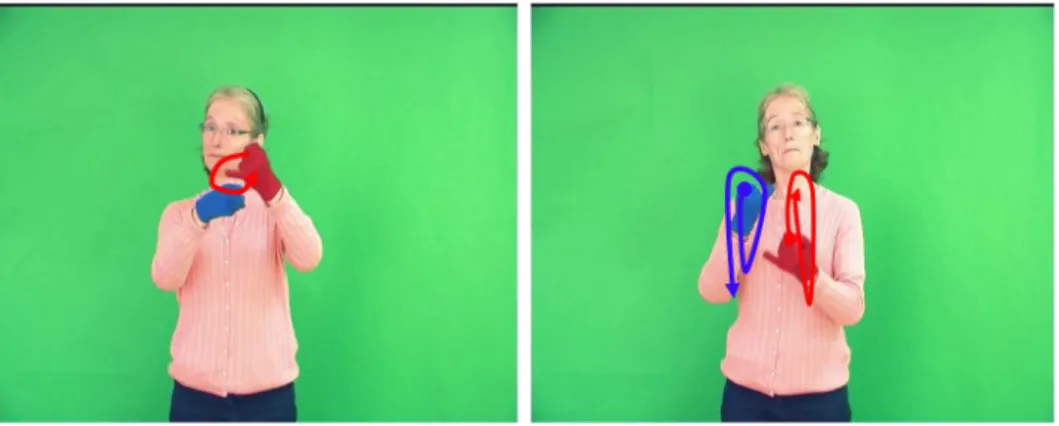
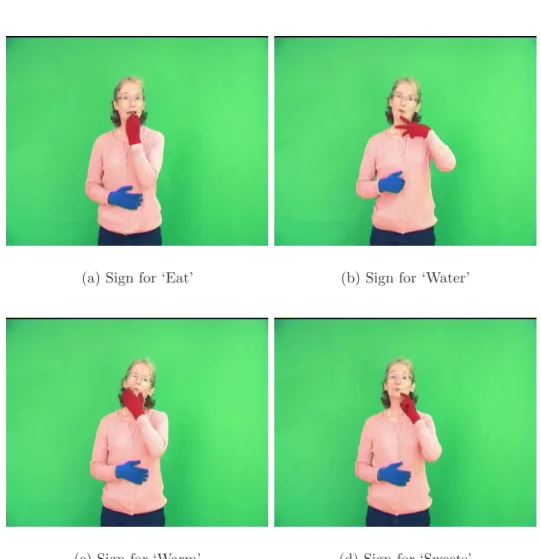
illus-trated in Figure2.1, where the signs ‘School’ and ‘Play’ share the same hand postures but have different motions. Similarly, in Figure 2.2, the signs ‘Big’ and ‘Paper’ share the same motion and can only be distinguished by hand posture. In Figure 2.3, the signs ‘Eat’, ‘Water’, ‘Warm’ and ‘Sweets’ could only be distinguished by their hand shape. Therefore, recognising sign lan-guage communication requires simultaneous analysis of the spatiotemporal gestures and hand posture channels.
(a) Sign for ‘School’ (b) Sign for ‘Play’
Figure 2.1: Examples of signs with similar hand posture. Signs must be distinguished using motion.
When spatiotemporal gestures are performed in a continuous sign lan-guage sentence, the hands need to move from the ending location of one sign to the starting location of the next. These inter-gesture transition periods are called movement epenthesis [SR89] and are not part of either of the gestures. Analysis of the spatiotemporal gesture channel must therefore distinguish between valid sign segments and movement epenthesis.
(a) Sign for ‘Big’ (b) Sign for ‘Paper’
Figure 2.2: Examples of signs with similar motion. Signs must be distin-guished using hand posture.
2.1.1
Applications of Sign Language Recognition
One of the main uses proposed for a sign language recognition system is a sign to text conversion system. This would require the complete translation of signed sentences to the text, or speech, of a spoken language. Such a translation system is not the only use for sign language recognition systems. There are other envisaged applications for sign language recognition systems such as a translation system for specific transactional domains such as post offices, banks etc. Another application is a bandwidth conserving system allowing communication between signers where recognised signs, which are the input of the communication system at one end, can be translated to avatar based animations at the other. An additional proposed application is an automated sign language teaching system. It could support users suffering from hearing loss, deaf people with sign language deficiencies and hearing
(a) Sign for ‘Eat’ (b) Sign for ‘Water’
(c) Sign for ‘Warm’ (d) Sign for ‘Sweets’
Figure 2.3: Examples of signs with similar location of articulation. Signs must be distinguished using hand posture.
people wishing to learn sign language.
Other envisaged applications include an automated, or semi-automated, system for the annotation of video databases of native signing. Linguistic re-search on sign language requires large scale annotated corpora and automated methods of analysing sign language videos would greatly improve annotation efficiency. Finally, sign language recognition systems could be incorporated into applications which enable an input interface for augmented commu-nication systems. Assistive technology implemented for human to human communication by people with speech impairments often require keyboard, mouse and joystick inputs. Systems which could incorporate natural aspects of sign language would increase the accessibility of these systems.
The techniques proposed in this thesis are not limited to sign language recognition. Our proposed techniques have potential to be applied to different problems that focus on human motion modeling and recognition, such as gesture controlledHuman Computer Interface (HCI) systems, human action analysis and social interaction analysis.
2.2
State of the Art on Sign Language
Recog-nition
In this section we will review the state of the art literature on sign language and gesture recognition and highlight the issues within the current literature which we propose solutions to.
of sign language, it is important that robust algorithms which model hand postures and spatiotemporal gestures be developed.
Research in the field of sign language recognition has made significant ad-vances in recent years. Gesture recognition systems which deal with temporal gestures and hand postures are reviewed in this section. For a comprehensive review of automatic sign language recognition, refer to the survey paper by Ong and Ranganath [OR05].
2.2.1
Gesture Data Acquisition
The focus of the work detailed in this thesis is the development of compu-tational models for the automatic learning and recognition of sign language information. In order to capture sign language information, data is mainly acquired using cameras or direct measure devices.
In this section we discuss some of the data acquisition methods using direct measure devices and cameras which have been implemented in the literature.
Wearable Computing Based Acquisition
Wearable computing approaches to sign language data acquisition offer ac-curate means of extracting information about the signers hand movements and hand shape.
Kim et al. [KWRA08] proposed a system which combined sensor data from accelerometers and anElectromyogram (EMG)which was used to mea-sure the electrical activity produced by the hand muscles. It was shown that
the information added by theEMG greatly improved the recognition rate of signs. Figure 2.4 shows a visualisation of the sensor setup for a single hand.
Figure 2.4: Sensor Placement for Bi-Channel recognition system proposed by Kim et al. [KWRA08]
Vogler et al. [VM04] recorded arm and hand movement data using “As-cension Technologies” MotionStar 3D tracking system and recorded hand posture information using a “Virtual Technologies” CybergloveT M. Fang et
al. [FGZ03,GFZC04] developed a large vocabulary sign recognition systems using two CyberglovesT M and three “Pohelmus” 3SPACE-position trackers.
Two trackers were positioned on the wrist of each hand and another posi-tioned on the signers back and were used to collect orientation and position data. The CyberglovesT M collected 18-dimensional hand shape information
for each hand. Similarly, Oz et al. [OL07] utilised a CybergloveT M along
with a “Flock of Birds” 3-D motion tracker to extract hand posture features. Figure2.5shows the CybergloveT M and “Flock of Birds” 3-D motion tracker.
Another data glove based system is proposed by McGuire et al. [MHRS+04]
where a mobile sign language translator is implemented using an Acceleglove (See Figure2.6). The Acceleglove consists of five micro two-axis accelerome-ters mounted on rings read finger flexion. Two more in the back of the palm
Figure 2.5: Left: Flock of Birds 3D motion tracker, Right: CyberGlove
measure orientation. Not shown in the figure are two potentiometers which measure bend at the shoulder and elbow and another two-axis accelerometer which measures the upper arm angles
Figure 2.6: The Acceleglove
An novel approach to sign language data acquisition was taken by Bras-hear et al. [BSLJ03] where features from both a hat mounted camera and accelerometer data were used to classifying signs (see Figure 2.7).
Wang et al. [WCZ+07] proposed a viewpoint invariant data acquisition
method. Their method was based on a virtual stereo vision system, using one camera and gloves with a specially designed colour pattern to indicate
Figure 2.7: Head mounted camera and accelerometer data collection imple-mented by Brashear et al [BSLJ03]
the 5 separate fingers, palm and back. Figure 2.8 shows a visualisation of the design of the gloves.
Figure 2.8: Gloves used by Wang et al. [WCZ+07]
Vision Based Acquisition
While wearable computing approaches to data acquisition can extract ac-curate features representing the signs being performed, some of these ap-proaches require that the signer wears cumbersome devices which can hinder the ease and naturalness of signing. An alternative approach is to acquire gesture data through a camera based input. In order to capture gesture
based information from camera based inputs, the hands must be located in the image sequence and this is often carried out using colour, motion and edge information [OR05]. A number of works have proposed techniques for the segmentation of hands from an image sequence and in this section we will discuss some of these techniques:
Yang et al. [YSL09] implemented a skin colour and motion based seg-mentation method which included a displacement estimation used when the hands overlap the face. A template hand, stored on a previous frame, was used if the detected hand region was much larger than the hand region de-tected in the previous frame or the hand detector failed to detect the hand region.
Holden et al. [HLO05b] used a Principal Component Analysis (PCA) based skin colour model to identify the hands. Their method to segment oc-cluded objects, using a combination of motion cues and the snakes algorithm, was used when hands and face overlap (see Figure2.9).
Figure 2.9: Examples of hand segmentation results from [HLO05b]
Cooper et al. [CB07] implemented a hand segmentation method using a skin colour model computed from the automatically detected face region. A model of the background was then created using a normalised histogram and
a threshold was applied to the likelihood ratio of face to background for each pixel (see Figure 2.10).
Figure 2.10: Examples of hand segmentation results from [CB07]
Askar et al. [AKE+04] proposed a skin colour segmentation method that
automatically adjusted to the participant and illumination conditions. In order to account for skin region contact, such as overlapping head and hands, a set of rules were implemented to track the hand when hand and face contact occurred (see Figure 2.11).
Figure 2.11: Examples of hand segmentation results from [AKE+04]
Barhate et al. [BPR+04] carried out hand segmentation using skin and
motion cues within an on-line predictive Eigen-Tracking framework which approximated the hand motion by an affine transformation. Their method was shown to work well with occlusions and under poor illumination (see Figure2.12).
Figure 2.12: Examples of hand segmentation results from [BPR+04]
Donoser et al. [DB08] proposed a hand segmentation technique which combined skin colour likelihood maps with a modified version of the Max-imally Stable Extremal Region (MSER) tracker. The MSER tracker found bright connected regions in the skin colour maps which had consequently darker values along their boundaries (see Figure2.13).
Figure 2.13: Examples of hand segmentation results from [DB08]
Buehler et al. [BZE09] implemented an articulated upper-body model to track the head, torso, arms and hands of the signer. A graph cut method was used to segment the hand region predicted by the tracker into hand or background signer (see Figure 2.14).
(a) Articulated Upper Body Tracking
(b) Graph Cut Segmentation
Figure 2.14: Examples of hand segmentation results from [BZE09]
were classified as hand or non-hand by a combination of three components: a signer-specific skin colour model, a spatially-varying non-skin colour model, and a spatial coherence prior (see Figure 2.15).
Figure 2.15: Examples of hand segmentation results from [LE09]
As we have discussed in this section, there are a variety of different tech-niques which have been proposed for the robust segmentation of hands from
image sequences. In order to achieve the full potential these segmentation methods have in the area of sign language recognition, we must develop algo-rithms which can recognise signs from the hand segmentation data. In this thesis we discuss our proposed set of techniques for the automatic learning and recognition of sign language. Our techniques are developed to utilise computer vision based hand segmentation data. We evaluate all of our pro-posed models using data extracted from image sequences, but the extraction techniques used are not the novel part of our work.
2.2.2
Spatiotemporal Gesture Recognition
The research into spatiotemporal gesture and sign recognition has two main categories: isolated and continuous recognition. Isolated recognition focuses on the classification of a single hand gesture. In continuous recognition, the user performs gestures one after the other and the aim is to spot and classify meaningful gesture segments from within the continuous stream of sign language.
Isolated Gesture Recognition
Yang et al. [YAT02] extracted motion trajectories fromAmerican Sign Lan-guage (ASL) videos and classified signs using a time delay neural network. Experiments based on a vocabulary of 40 signs showed the average recogni-tion rate of unseen test trajectories was 93.4%.
Fang et al. [FGZ03] addressed the problem of large vocabulary sign recog-nition by proposing a combination of self organising feature maps,HMMsand
a hierarchical decision tree, with low computational costs, for the recognition of isolated signs. Experiments were conducted on a data set of 61365 isolated samples of 5113 different signs. Results showed an average recognition rate of 91.6%.
Juang et al. [JK05] proposed a recurrent fuzzy network for fuzzy temporal sequence processing. They applied their method to a gesture recognition task and experiments showed a recognition rate of 92%.
Agris et al. [vASZK06] proposed an isolated sign recognition system based on a combination of Maximum Likelihood Linear Regression and Max-imum A Posteriori estimation. Their method was developed to consider the specifics of sign languages, such as one-handed signs. They implemented selected adaptation methods from speech recognition to improve the perfor-mance of their system when performing user independent recognition. A recognition rate of 78.6% was reported when recognising 153 isolated signs.
Shanableh et al. [SAAR07] proposed an isolated temporal gesture tech-nique for the recognition of Arabic sign language. They proposed temporal features which were extracted through forward, backward, and bi-directional predictions. These prediction errors were thresholded and accumulated into one image that represented the motion of the sequence. Experiments, based on a database of isolated signs, showed that their method achieved a classifi-cation performance ranging from 97% to 100% when classifying 23 different sign classes.
Wang et al. [WCZ+07] proposed a view invariant sign recognition system.
task based on the geometric constraint that the fundamental matrix associ-ated with two views should be unique when the observation and template signs are obtained synchronously under virtual stereo vision and vise versa. Experiments conducted on a vocabulary of 100 signs, where 5 isolated sam-ples of each sign were recorded, showed their method achieved an accuracy of 92%.
Cooper et al. [CB07] implemented an isolated sign recognition system using 1st order Markov Chains. In their model, signs were broken down in
visemes (equivalent to phonemes in speech) and a bank of Markov Chains were used to recognise the visemes as they were produced. Experiments, based on 5 unseen examples of each of the 164 signs in the vocabulary, showed a classification accuracy of 72.6%.
Kim et al. [KWRA08] evaluated an accelerometer and EMG based sign recognition system on 7 word level signs and results showed an average ac-curacy of 99.8% when tested on a total of 560 isolated samples.
Gunes et al. [GP09] propose an affect recognition system using hand gestures along with facial cues. Temporal segments of hand gestures and facial actions were detected using aHMMbased system. Experiments showed that their proposed system achieved an accuracy of 88.5% when tested on isolated videos.
Ding et al. [DM09] develop a sign language recognition model which incorporated hand shape, motion and 3D position in a single framework. Signs were recognised using a tree based classifier where, for example, if two signs had a similar hand shape then the root of the tree would represent
the hand shape and the branches would represent different motion based gestures. A recognition rate of 93.9% was reported for a vocabulary of 38 signs.
While these works propose promising gesture recognition techniques, the experiments are based on isolated gesture samples. Natural gestures which occur in sign language are continuous. Therefore sign language recognition requires spotting of the gesture from continuous videos (i.e. determining the start and end points of a meaningful gesture pattern).
Continuous Gesture Recognition
Extending isolated recognition to continuous signing is difficult problem. It requires automatic detection of movement epenthesis segments so that the recognition algorithm can be applied to segmented signs.
One proposed solution to movement epenthesis detection is an explicit segmentation model were subsets of features from gesture data are used as cues for valid gesture start and end point detection. Oz et al. [OL07] pro-posed a continuous recognition framework which detected “signing” and “not signing” segments using a velocity network. The velocity network classified a “signing” segment from when the hand first showed a change in velocity until the time the velocity showed a series of low velocities. A Neural Net-work based classifier was trained to recognise 60 different one handed ASL signs. Experiments conducted on a total of 360ASL words using histograms of feature vectors showed a recognition accuracy of 95%. The limitation of this explicit segmentation model arises from the difficulty in creating general
rules for sign boundary detection that could be applied to all types of manual and non-manual gestures [OR05]. For example, fluent signers perform sign language sentences in a very fluid and natural manner and sign boundaries often do not occur when there is a sharp change in hand velocity.
An approach to dealing with continuous recognition, without explicit seg-mentation, is to use HMMs for implicit sentence segmentation. Bauer et al. [BK02] and Starner et al. [SPW98] modeled each word or subunit with a HMM and then trained the HMMs with data collected from full sentences. Starner et al. [SPW98] conducted experiments on a vocabulary of 40 signs using a set of 478 sentences for training and testing. Results showed a word detection rate of 96.8%. A disadvantage of these methods is that training on full sentence data may result in a loss in valid sign recognition accuracy when tested on sentences not used in training. This is due to the large variations in the appearance of all the possible movement epenthesis that could occur between two signs.
Brashear et al. [BSLJ03] extended on the work of Starner et al. by devel-oping a mobile sign recognition system. Their HMM based sign recognition system was implemented to recognise continuous sentences using camera and accelerometer inputs. Experiments, conducted on a vocabulary of 5 signs, showed a recognition accuracy of 90.5%. It was also shown that combining accelerometer and vision data improved the performance when compared to vision only data (52.4%) and accelerometer only data (65.9%).
Other works deal with movement epenthesis by explicitly modeling the movements between signs. Gao et al. [GFZC04] proposed aTransition
Move-ment Models (TMM) where transition HMMs were created to model the transitions between each unique pair of signs. The total number of TMMs were then reduced by a process of dynamically clustering the transition parts. An iterative segmentation algorithm was implemented to automatically seg-ment the continuous sentences. Experiseg-ments, conducted on a set containing 3000 sentence samples with a vocabulary of 5113 signs from Chinese Sign Language (CSL), showed their method achieved an accuracy of 90.8%.
Vogler et al. [VM04] proposed a system to incorporate hand motion and hand posture data into a single recognition framework. A set of parallel HMMs were implemented to recognise signs from a vocabulary of 22 signs. Separate HMMs were implemented to model movement epenthesis between each unique ending and starting location of signs. Experiments showed their framework achieved a sign detection rate of 87.88% when tested on 99 sen-tences containing a total of 312 signs.
While these works, utilising explicit epenthesis models, have had promis-ing results in gesture recognition and movement epenthesis detection, the training of such systems involves a large amount of extra data collection, manual data labeling and model training due to the extra number of HMMs required to detect movement epenthesis. Few researchers have addressed the problem of movement epenthesis without explicitly modeling these move-ments.
An novel approach to gesture/activity spotting was proposed by Junker et al. [JALT08] where a combination of explicit motion segmentation andHMM gesture classification was carried out. A pre-selection stage was implemented
in order to identify relevant motion events. These candidate motion segments were then classified in isolation using HMMs. Experiments conducted to evaluate the gesture spotting system showed that the method performed well when spotting gestures in 2 different activity scenarios. Results showed a total precision of 0.74 and a total recall of 0.93 for the first scenario and total precision of 0.73 and a total recall of 0.79 for the second scenario.
Another solution to segmenting signs from continuous streams of data, without modeling movement epenthesis, is to use grammar based informa-tion. Yang et al. [YSL07,YSL10] proposed anASLrecognition method based on an enhanced Level Building algorithm and a Trigram grammar model. Their method was based on a dynamic programming approach to spot signs without explicit movement epenthesis models. The recognition rate was 83% with 39 signs, articulated in 150 different sentences. Their work was based on a two step approach for the recognition of continuous signs, where the first step recognised the possible signs in the sentence and the second step applied a grammar model to the possible signs. They reported only the results ob-tained after the second step which applied a trigram grammar model to the signs. The reliance of the system to the grammar model was shown in the experiments where the recognition rate of the system decreased from 83% to 68% when the trigram model was replaced by a bigram model. Holden et al. [HLO05a] developed an Australian sign language recognition system where each sign is modeled using aHMM model. The recognition model employed grammar rules, based on 21 distinct signs, to recognise continuous sentences. Experiments showed their system achieved 97% recognition rate on 163 test
sign phrases, from 14 different sentences. It was noted in the work that the sign vocabulary used in experiments consisted of signs which where mainly distinguishable from motion alone.
Yang et al. [YSL09] proposed a very promising technique without the need for explicit epenthesis training or grammar rules. They develop thresh-old models in aCRFmodel which performed an adaptive threshold for distin-guishing between signs in a vocabulary and non-sign patterns. Experiments showed their system could spot signs from continuous data with an 87.0% detection rate from a vocabulary of 48 signs where the system was trained on 10 isolated samples of each of the 48 signs. The system was then tested on continuous sentences which contained 480 samples of the signs in the sign vocabulary.
Non-Manual Signals
Recognising sign language communication requires simultaneous observation of manual and non-manual signals and their precise synchronisation and sig-nal integration. Thus understanding sign language involves research in areas of face and facial expression recognition tracking and human motion analysis and gesture recognition.
Recently there has been a significant amount of research investigating the role of non-manual signals in sign language and attempting to quantify their individual importance. Works such as [Bah96, vdKCE06, BS86] fo-cused on the role of head pose and body movement in sign language, where they reported a strong correlation linking head tilts and forwards
move-ments to questions or affirmations. The analysis of facial expressions for the interpretation of sign language has also received a significant amount of interest [GK06, GK07]. Computer-based approaches which model fa-cial movement usingActive Appearance Models (AAM) have been proposed [vAKK08, vAZC+08a, VG08]. Grossman et al. conducted an interesting
study on ASL, where it was shown that eyebrow movement, and the de-gree of eye aperture movement, had a direct link to emotions and questions [GK06]. They showed that anger, wh-questions (who, where, what, when, why, how) and quizzical questions exhibited lowered brows and squinted eyes, while surprise and yes/no questions showed raised brows and widened eyes. The development of a system combining manual and non-manual signals is a non-trivial task [COR05]. This is demonstrated by the limited amount of work dealing with the recognition of multimodal communication channels in sign language. Ma et al. [MGW00] used HMMs to model multimodal information in sign language but lip motion was the only non-manual signal used. Their work was based on the assumption that the information por-trayed by the lip movement directly coincided with that of the manual signs. While this is a valid assumption for mouthing, it cannot be generalised to other non-manual signals as they often span multiple manual signs and thus should be treated independently.
Issues Relevant to Spatiotemporal Gesture Recognition
The difficulty with recognising spatiotemporal gestures is that the hand must move from the end point of the previous gesture to the start point of the
next gesture. These inter-gesture transition periods are called movement epenthesis [SR89] and are not part of either of the signs. Thus, the issue with developing continuous recognition systems is creating algorithms which are be able to distinguish between valid sign segments and movement epenthesis.
As we have discussed, most previous work has required the explicit model-ing of each epenthesis or required specific grammar rules. While these works have had promising results in gesture recognition and movement epenthesis detection, the training of explicit epenthesis models involved a large amount of extra data collection, manual data labeling, model training and recognition computation due to the extra number ofHMMsrequired to detect movement epenthesis.
Another approach employed is to utilise grammar rules to reduce the num-ber of possible sign combinations which appear in signed sentences. Gram-mar rules will become a more important aspect of sign language recognition when sign vocabularies grow to represent a large portion of the signs used in everyday sign language communication. State of the art sign recognition research is now at the stage where the main focus is on developing algorithms to model signs. It is difficult to evaluate sign recognition models which em-ploy grammar rules on small sign vocabularies. For example, in a corpus of 30 signs which contains 8 nouns, if grammar rules are used to predict that the next sign is likely to be from the noun category, then the number of possible signs the recognition model must choose from is reduced to 8 signs. With the overall goal of large corpus sign recognition in mind, experiments should be conducted in order to evaluate recognition models in their ability
to distinguish one sign from as many other signs as possible. In the works discussed in Section2.2.2, which employ specific grammar rules, it is unclear how these models would perform if the grammar models were created from a larger real world corpus.
Other works focus on explicit gesture segmentation to facilitate continu-ous recognition. Particular gesture cues, such as changes in hand velocity, are used to determine gesture start and end points. While these explicit segmen-tation methods have been shown to work well in general activity recognition tasks, creating explicit segmentation rules for the task of sign language recog-nition is impractical due to variability in gesture structure and speed which occurs in natural sign language.
Few researchers have addressed the problem of movement epenthesis with-out employing grammar or segmentation rules or explicitly modeling the epenthesis. We propose a solution to this by developing a spatiotemporal ges-ture model which addresses the problem of movement epenthesis detection. We develop a HMM based threshold model training and recognition frame-work to classify spatiotemporal gestures and to identify movement epenthesis without explicitly training on movement epenthesis examples. Our proposed models can effectively recognise gestures from within sign sentences indepen-dent of any grammar rules.
Furthermore, while non-manual signals are an important aspect of sign language recognition, very few works have accounted for these non-manual signals when developing sign recognition models. We also show that our spa-tiotemporal recognition model is scalable to modes of communication other
than manual signs by developing robust head movement and facial expression recognition models.
2.2.3
Hand Posture Recognition
In the previous section we reviewed techniques proposed for the recognition of spatiotemporal gestures. In this section we review literature aimed at developing techniques for the automatic recognition of hand postures.
To describe the shape of the hand, a number of methods for 2D shape representation and recognition are used. These include segmented hand im-ages, binary hand silhouettes or hand blobs, and hand contours. Cui and Weng [CW00] used normalised segmented hand images as features and re-ported a 93.2% recognition rate on 28 different signs. Similarly Kadir et al. [KBOZ04] used normalised segmented hand images and greedy cluster-ing techniques to recognise hand shapes with 75% accuracy. PCA has been shown to be successfully applied to gesture data to reduce dimensionality of the extracted features. Henrik et al. [HMM97] applied a normalising tech-nique to segment hand images. PCAwas then applied to extract features for recognition. User dependent tests on the system showed a 99% recognition rate on 25 hand gestures, while user independent tests reported a drop in recognition accuracy to 70%.
Deng and Tsui [DT02] applied a two-layer PCA/ Multiple Discriminant Analysis scheme. A non user-independent experiment showed a recogni-tion rate up to 70% on 110 signs. Imagawa et al. [IMT+00] calculated an
symbols which correspond to

![Figure 2.4: Sensor Placement for Bi-Channel recognition system proposed by Kim et al. [KWRA08]](https://thumb-us.123doks.com/thumbv2/123dok_us/1073430.2642856/51.892.298.626.343.470/figure-sensor-placement-channel-recognition-proposed-kim-kwra.webp)
![Figure 2.7: Head mounted camera and accelerometer data collection imple- imple-mented by Brashear et al [BSLJ03]](https://thumb-us.123doks.com/thumbv2/123dok_us/1073430.2642856/53.892.256.668.261.429/figure-head-mounted-camera-accelerometer-collection-mented-brashear.webp)
![Figure 2.13: Examples of hand segmentation results from [DB08]](https://thumb-us.123doks.com/thumbv2/123dok_us/1073430.2642856/56.892.203.783.616.838/figure-examples-hand-segmentation-results-db.webp)