Strategos Guide To
Cycle Counting &
Inventory Accuracy
Copyright Notice
Copyright 2006 Strategos, Inc.
Site License Edition
As a registered purchaser of this Site License Edition, you may make multiple copies provided that those copies are distributed only to employees located at the purchasing site. The buyer may NOT sell or transfer the electronic file to any other division, site, individual or corporation. A personal edition of this book is available at low cost for individual purchasers. It is in an E-Book format and may be viewed or printed by any computer with Microsoft Internet Explorer, Version 5.0 or higher. For more information go to www.strategosinc.com.
Printing Note
This edition is designed for printing in either color or black and white. It is formatted for letter-size 8-1/2x11 paper. It may be printed on one or both sides and inserted in a three-ring binder. The distribution file is in standard PDF format. Adobe Acrobat Reader is required for printing and is available at no cost from www.adobe.com. To open this file you will need the authorized password provided at the time of purchase.
Published By Strategos, Inc. 3916 Wyandotte
Kansas City, Missouri, 64111, USA www.strategosinc.com
Author’s Preface
There seems to be an aura of mystery about cycle counting in many minds. Such mystery leads some people to over-estimate its value and view it as the panacea for inventory ills of all sorts. In other cases, the mystery makes people reluctant to use it where, in fact, it might make a valuable contribution to operations. The mystery and subsequent misjudgments and misapplications have led to mixed results and a mixed reputation for cycle counting. The popularity of Lean Manufacturing compounds any discussion with arguments that inventory should disappear and therefore make cycle counting irrelevant.
This small book attempts to take the mystery out of cycle counting. Part of the mystery comes from cycle counting’s theoretical basis in statistics. I have tried to explain this basis clearly and intuitively without the usual statistical notation and paraphernalia.
However, cycle counting is not the real issue. The real issue is inventory accuracy. Cycle counting, properly implemented and maintained, can make an important contribution to
inventory accuracy when part of a larger Manufacturing Strategy. This book also attempts to put cycle counting into that larger context and present other approaches and elements of an effective inventory accuracy program. It attempts to clarify the role of Lean Manufacturing and how lean elements interact with inventory accuracy.
I hope you find this book useful and valuable. Comments from readers are always welcome. You may reach me at: [email protected].
Contents
Author’s Preface 3
Contents 4
Tables 6
1.0 Inventory Accuracy 7
1.01 What Inventory Accuracy Is and Why It Matters 7
1.02 How To Measure Inventory Accuracy 9
1.03 Causes & Cures 13
2.0 Cycle Counting 15
2.01 Introduction To Cycle Counting 15
2.02 Why Cycle Counting works 16
2.03 Designing The Program 19
2.04 Selection Methods 27
2.05 Improving Effectiveness 28
2.06 Estimating Resources 29
2.07 Timing And Interference With Operations 30
2.08 Cycle Counting Implementation 31
3.0 Physical Inventories 33
3.01 The Annual Inventory 33
3.02 Conducting A Successful Audit 34
3.03 Cards, Count Sheets, Barcodes 35
3.04 Staffing For The Physical Inventory 38
4.0 Process Improvement 41
4.01 Prevention Versus Correction 41
4.02 Root Causes of Inventory Errors 43
4.03 Process Improvement Example 43
4.04 Theft & Shrinkage 47
5.0 Reducing Transaction Volume 48
5.01 The Drivers of High Transaction Volume 48
5.02 Techniques For Transaction Reduction 49
5.03 Transaction Reduction Example 52
6.0 Strategies For Inventory Accuracy 59
6.01 Introduction 59
6.02 Combining PI and Cycle Counting For Error Correction 59
6.03 Error Prevention 61
6.04 Organizing the Implementation Project 62
6.05 A Final Word 63
About The Author 64
Appendices 65
APP2-Kanban Systems 65
Appendix 1 Confidence Belt Charts 66
Appendix 2 Random Selection From A Database 69
Kanban Scheduling Systems 71
Figures
Figure 1 Physical Count and Records Agree 7
Figure 2 ABC Classification 11
Figure 3 Inventory Error & Transaction Rates 14
Figure 4 Cycle Counting Example 16
Figure 5 Statistical Sampling 17
Figure 6 Confidence Belt Chart 18
Figure 7 Using Confidence Belts 19
Figure 8 Count Rate & Improvement Speed 20
Figure 9 Effects of Error Creation 21
Figure 10 Effects of Database Size 22
Figure 11 Estimator Output Chart 25
Figure 12 ABC Output, Example A 26
Figure 13 IRA With Physical Inventory 34
Figure 14 Example Physical Inventory Project Plan 35
Figure 15 General Task Sequence for Count Sheets 36
Figure 16 Typical Count Sheet 36
Figure 17 General Task Sequence for Inventory Tags 37
Figure 18 Examples of Inventory Tags 37
Figure 19 Physical Inventory Temporary Organization Structure 39
Figure 20 Generalized Inventory Error Causes 42
Figure 21 Preliminary Error Characteristics 44
Figure 22 Over-Count Fishbone Diagram 45
Figure 23 Functional Layout Material Flow 48
Figure 24 Cellular Layout Material Flow 49
Figure 25 Peristaltic Pump Assembly 50
Figure 26 Original Peristaltic Pump BOM 51
Figure 27 Simplified Peristaltic Pump BOM 51
Figure 28 Original Casting Process With Transaction Points 53
Figure 29 Process With Kanban Scheduling 54
Figure 30 Process With Cellular Layout For Machining 55
Figure 31 With Cellular Layout, Kanban and Backflushing 56 Figure 32 Extending Kanban and Point-Of-Use Delivery To Supplier 57 Figure 33 IRA With Physical Inventory & Cycle Counting 60
Tables
Table 1 ABC Percentages & Examples 11
Table 2 Typical Count Tolerances 12
Table 3 Inventory Calculation Example 13
Table 4 Typical ABC Count Frequencies 22
Table 5 Example "A" ABC Estimating 23
Table 6 Estimator Data Inputs, Example A 24
Table 7 ABC Input Data, Example A 25
Table 8 Partial Cycle Count Error Log 44
Table 9 Comparison of Functional & Cellular Layouts 50
Table 10 Process Map Symbols 52
Chapter
1.0 Inventory Accuracy
This first chapter defines Inventory Accuracy and, explains why it is an important issue for any business that holds significant inventories. Inventory is a central theme of Lean Manufacturing, Lean Warehousing and Lean operations and here we explain how Inventory Accuracy fits into these Operations Strategies.
The chapterdescribes how to measure accuracy and addresses the question of “How
accurate is accurate?” It introduces the two important methods for correcting inventory errors, Physical Inventories and Cycle Counting. And, finally, we introduce the root causes of inaccuracy and how to eliminate or minimize them.
1.01 What Inventory Accuracy Is and Why It Matters
What Is Inventory Record Accuracy?
Inventory Record Accuracy (IRA) is a measure of how closely official inventory records match the physical inventory (figure 1). Many managers equate IRA with cycle counting, but there is a lot more to it than just counting.
Figure 1 Physical Count and Records Agree
The units of measurement are either dollar based or count based. These two bases have different purposes and may give widely differing results.
Accountants and financial auditors prefer dollar-based measurements of accuracy. Their concern is to ensure that the inventory value stated on books and tax returns is accurate at an aggregate level. Discrepancies on individual items hold little concern provided that positive and negative discrepancies are roughly equal and the total value is the same. Operations and material
management people have a stronger interest in the accuracy of individual SKUs. If one SKU is short, they can rarely substitute some other part or item that happens to be long. They need count based measurements of accuracy.
Record Physical
Why Inventory Accuracy Is Important
The reasons for having accurate records are legion. Stockouts increase cost in a hundred ways and sap the time and energy of everyone. Poor accuracy begets more inventory and requires more capital. Inventory is often the largest consumer of capital for an enterprise. The various reasons for accuracy fall into the two general categories of financial and operational. Here are a few of them:
Financial Reasons:
• Investors want to know that the book value is accurate and inventory is usually a large balance sheet item.
• Combined with other financial data into various ratios, imventory is a primary indicator of a company’s financial health and value.
• Conventional lenders, such as banks, often lend money using inventory as
collateral. If the loan should default, they want to ensure that the inventory stated is accurate. They are also likely to be concerned about obsolete and slow moving inventory.
• Taxation often depends on inventory value. Overpayment of taxes reduces profits and underpayment incurs penalties.
Operational Reasons:
• Stockouts interrupt production and create delivery delays.
• Missing items cause delays and idle time that reduce manufacturing efficiency.
• Schedules must often be juggled to accommodate stockouts.
• People waste hours looking for misplaced or missing items. This happens in the warehouse and often again on the manufacturing floor.
• When stockouts are frequent, inventory rises to compensate. This unnecessary inventory requires space and capital.
• Inventory turnover reflects overall manufacturing efficacy.
• MRP and ERP systems require very high accuracies (95%-99%) to function well.
• The annual physical inventory audit is a nuisance for everyone and takes several days from production capacity. Such audits are required when inventory accuracy is questionable but can be eliminated when accuracy is demonstrated to the auditors through cycle counting and other means.
IRA and Lean Operations
Inventory accuracy links to Lean Manufacturing in much the same way that quality is linked to Lean Manufacturing. They both eliminate waste and allow the smooth production with low inventories that characterizes lean. In fact, inventory accuracy is really a special case of quality; it is quality in the warehouse and transaction process.
Lean Manufacturing
Lean Manufacturing reduces the need for inventory and transaction volume in many ways. It makes high accuracy easier. If transaction volume is reduced through kanban, backflushing, Cellular Manufacturing or other simplification, errors drop proportionately. The stockouts common to firms with poor accuracy generate significant fears throughout the organization and create difficulties for a lean implementation. Because of this, increasing inventory accuracy through more conventional means such as cycle counting may be a necessary part of a lean implementation.
The Lean Warehouse
IRA is also an element of lean operations within the warehouse. Inaccurate records are one of the major sources of waste for warehouse and inventory operations. At he same time, streamlined warehouse processes and low inventory prevent many errors from occurring.
The Lean Office
The lean office takes Lean Manufacturing principles and applies them to the typical administrative and information-based activities of office work. Since inventory accuracy depends greatly on information-based transaction processes, lean office techniques apply directly. At the same time, increased inventory record accuracy helps smooth many front office processes that depend on inventory information.
1.02 How To Measure Inventory Accuracy
A Question of Quality
Inventory Record Accuracy is a quality issue. All the methods, principles, thinking and
philosophy of Total Quality Management (TQM) and Six Sigma apply. The work process is the process of conducting transactions, storing material and moving material. The product is an accurate inventory record. Our customers are the users of these records, primarily scheduling, sales and operations people who depend on their accuracy.
Foremost among the principles and philosophies is the concept of prevention versus detection. Prevention of errors is the key and most important approach. Detection and correction are
ABC & Tolerances
The Value of Classification
ABC classification and stratification is a common method for ranking the relative importance of inventory items. The most important items (A-Items) get counted more often and have more exacting count tolerances.
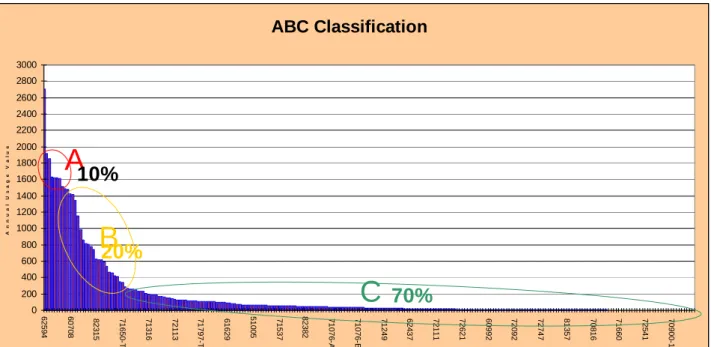
All items in an inventory database rarely need the same degree of accuracy. A manufacturer of industrial vehicles might need 100% IRA on their stock of engines, for example. Engines cost upward of $4000.00 each, occupy significant warehouse space and have a five-week delivery time. Their stock of ¼” flat washers, however, cost only about $0.002 each, requires minimal space and they are available at the local hardware store. Cycle counting washers with the same frequency and rigor as required for engines would cost more than the washers themselves. ABC classification is usually based on the value of the annual usage of each item. Item usage values follow Pareto’s principle with a few high value items and many low value items. Figure 2 illustrates this with a typical Product-Volume chart. However, judgment should also be used. Some items may have a low usage value but they are critical to operations and may have created difficulties in the past. Table 1 shows the typical range of percentages along with examples. Some companies extend this idea and add an “A+” category or a “D” category.
ABC classification is fundamental to any inventory strategy. It helps direct resources to those areas and items that have the most impact on operations and finance.
Figure 2 ABC Classification
Table 1 ABC Percentages & Examples
<2%
65%-75%
20%-30%
5%-15%
<1%
% of
SKUs
Consumables—shop rags, paper clips, soap, etc. Do not carry as inventory.
D
Low Value/Readily Available/Bulk—hardware, copy paper, etc. Often use weigh counting.
C
Medium Value—ball valves, raw steel, aluminum ingots, pulleys, standard machine components.
B
High Value/Critical Items—hydraulic valves, custom-made components.
A
Very High Value—diamonds, CPU chips, engines, complex products. Often kept i n security cage.
A+
Examples
Class
<2%
65%-75%
20%-30%
5%-15%
<1%
% of
SKUs
Consumables—shop rags, paper clips, soap, etc. Do not carry as inventory.
D
Low Value/Readily Available/Bulk—hardware, copy paper, etc. Often use weigh counting.
C
Medium Value—ball valves, raw steel, aluminum ingots, pulleys, standard machine components.
B
High Value/Critical Items—hydraulic valves, custom-made components.
A
Very High Value—diamonds, CPU chips, engines, complex products. Often kept i n security cage.
A+
Examples
Class
ABC Classification 0 200 400 600 800 1000 1200 1400 1600 1800 2000 2200 2400 2600 2800 3000 6 2 5 9 4 6 0 7 0 8 8 2 3 1 5 7 1 6 5 0 -T 7 1 3 1 6 7 2 1 1 3 7 1 7 9 7 -T 6 1 6 2 9 5 1 0 0 5 7 1 5 3 7 8 2 3 8 2 7 1 0 7 6 -A 7 1 0 7 6 -B 7 1 2 4 9 6 2 4 3 7 7 2 1 1 1 7 2 6 2 1 6 0 9 9 2 7 2 0 9 2 7 2 7 4 7 8 1 3 5 7 7 0 8 1 6 7 1 6 6 0 7 2 5 4 1 7 0 9 0 0 -1 Part # A n n u a l U s a g e V a l u eA
C
B
10%
70%
20%
Tolerances
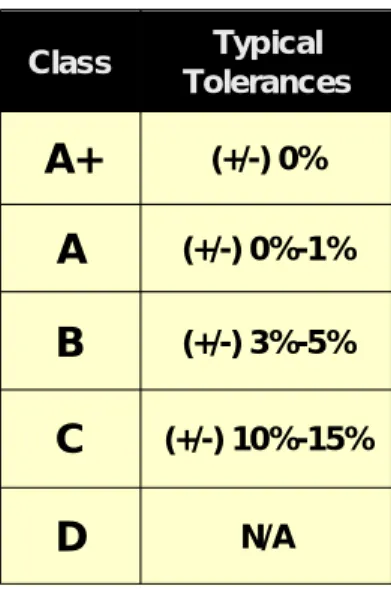
It is not unrealistic to expect that the physical count and record will exactly match for every item; nor is it practical. An
inventory record should be considered accurate if it matches the physical count within a reasonable tolerance. Most often, count tolerances are based on the ABC classification and typical tolerances are in table 2. There may be occasional exceptions to these tolerances.
Table 2 Typical Count Tolerances
Calculating Accuracy
The actual calculation of inventory accuracy is quit simple. It is the percentage of items having accurate records. The formula is:
The formula applies to inventory as a whole and also to each class (ABC) within the database. You can use it to calculate accuracy for a day’s cycle counting, or the annual physical audit.
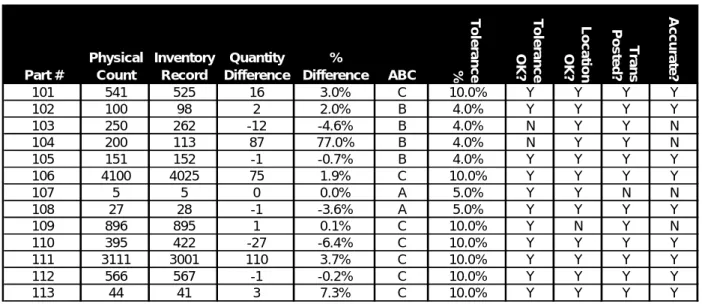
To count as accurate, a record should meet three criteria:
1. The quantity on record must match the physical count within the tolerance for that item. 2. The location on record must match the physical location.
3. The item should have no outstanding transactions.
Criterion three is sometimes a serious difficulty. In some organizations transactions take place (e.g. an item is received). But the transaction is not entered into the computer system or posted for hours, days or weeks. From a financial standpoint, such posting delays make no difference. From an operational standpoint, however, it is critical. Un-posted transactions create a lot of chaos. The author has spent many hours searching for parts that exist physically but their transaction was simply not posted.
Table 3 shows a sample of 13 items that were physically counted. It contains the physical count, the record quantity and the percentage difference. The tolerance limits are based upon the ABC class. Columns on the right indicate whether this item meets each of the three tests for an accurate record: count, location and transaction posting. Nine records pass all three tests. The IRA calculation is, therefore, (9/13 x 100)=69.2%.
IRA (%) =
Number of Correct Records
Number of Records Checked
X 100
N/A
D
(+/-) 10%-15%C
(+/-) 3%-5%B
(+/-) 0%-1%A
(+/-) 0%A+
Typical Tolerances Class N/AD
(+/-) 10%-15%C
(+/-) 3%-5%B
(+/-) 0%-1%A
(+/-) 0%A+
Typical Tolerances ClassTable 3 Inventory Calculation Example
1.03 Causes & Cures
Reasons For Inaccuracy
There are many causes for inaccurate records. People may enter data inaccurately or not at all. Confusing location codes cause discrepancies between recorded and actual locations.
Occasionally, software bugs introduce errors. The thousands of possible causes are either process-related or volume-related.
Process Related Errors— Each step in a transaction process introduces some probability for error, even if that probability is small. To reduce process-related errors, we must change the process.
Volume-Related Errors— Every transaction process has an inherent error rate or probability of error resulting from the structure and execution of the process. Over time, and with many
transactions, the number of new errors per week or per thousand transactions is relatively constant, if the process remains unchanged. The more transactions; the more errors.
Methods To Improve Accuracy
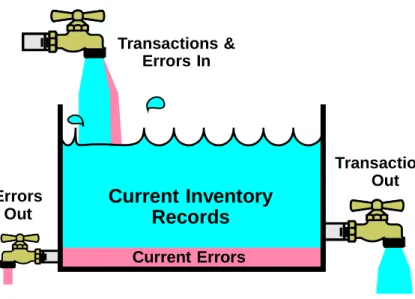
To improve inventory record accuracy, the error creation rate (i.e. errors per week, month, etc.) must be less than the error removal rate. To increase accuracy we can either decrease errors flowing in or increase the removal rate. Figure 3 illustrates.
Methods to improve accuracy include Cycle Counting, Physical Inventory, Transaction
Reduction and Process Improvement. Cycle counting and the physical inventory remove errors. Process improvement and transaction reduction prevents new errors. An optimal approach to Inventory Record Accuracy uses both.
Part # Physical Count Inventory Record Quantity Difference % Difference ABC T o le ra n c e % T o le ra n c e O K ? L o c a tio n O K ? T ra n s P o s te d ? A c c u ra te ? 101 541 525 16 3.0% C 10.0% Y Y Y Y 102 100 98 2 2.0% B 4.0% Y Y Y Y 103 250 262 -12 -4.6% B 4.0% N Y Y N 104 200 113 87 77.0% B 4.0% N Y Y N 105 151 152 -1 -0.7% B 4.0% Y Y Y Y 106 4100 4025 75 1.9% C 10.0% Y Y Y Y 107 5 5 0 0.0% A 5.0% Y Y N N 108 27 28 -1 -3.6% A 5.0% Y Y Y Y 109 896 895 1 0.1% C 10.0% Y N Y N 110 395 422 -27 -6.4% C 10.0% Y Y Y Y 111 3111 3001 110 3.7% C 10.0% Y Y Y Y 112 566 567 -1 -0.2% C 10.0% Y Y Y Y 113 44 41 3 7.3% C 10.0% Y Y Y Y Count= 9 IRA= 69.2%
Figure 3 Inventory Error & Transaction Rates
Below is a thumbnail summary of the four methods. Subsequent chapters elaborate on each of these methods and how to combine them into a comprehensive and effective inventory accuracy program that will enhance your Lean Manufacturing or other manufacturing strategy.
Physical Inventory
In a physical inventory, normal operations cease while a physical count of every item is
conducted. The counts are compared to inventory records and, when necessary, the records are corrected.
Cycle Counting
A small number of items are physically counted, daily, on a random or semi-random basis. The physical count is compared to the inventory record. When necessary, the records are corrected.
Process Improvement
Process Improvement examines the transaction processes. Changes are identified and implemented that reduce the probability of error.
Transaction Reduction
The most effective way to reduce errors is to reduce the number of transactions. Fewer transactions introduce fewer errors. Kanban, BOM simplification, cellular manufacturing and other elements of Lean make this feasible.