Number 83
Evidence Synthesis___________________________________
Screening for Hearing Loss in Adults Ages 50 Years and
Older: A Review of the Evidence for the U.S. Preventive
Services Task Force
Prepared for:
Agency for Health Care Research and Quality U.S. Department of Health and Human Services 540 Gaither Road
Rockville, MD 20850
Contract Number: HHSA-290-2007-10057-I-EPC3, Task Order No. 3
Prepared by:
Oregon Evidence-based Practice Center Oregon Health and Science University
3181 SW Sam Jackson Park Road, Mail Code BICC Portland, OR 97239
Kaiser Permanente Center for Health Research 3800 North Interstate Avenue
Portland, OR 97227 Investigators: Roger Chou, MD Tracy Dana, MLS Christina Bougatsos, BS Craig Fleming, MD Tracy Beil, MS
AHRQ Publication No. 11-05153-EF-1 March 2011
This report is based on research conducted by the Oregon Evidence-based Practice Center (EPC) under contract to the Agency for Healthcare Research and Quality (AHRQ), Rockville, MD (Contract No. 290-2007-10057-I). The investigators involved have declared no conflicts of interest with objectively conducting this research. The findings and conclusions in this document are those of the author(s), who are responsible for its content, and do not necessarily represent the views of AHRQ. No statement in this report should be construed as an official position of AHRQ or of the U.S. Department of Health and Human Services.
The information in this report is intended to help clinicians, employers, policymakers, and others make informed decisions about the provision of health care services. This report is intended as a reference and not as a substitute for clinical judgment.
This report may be used, in whole or in part, as the basis for the development of clinical practice guidelines and other quality enhancement tools, or as a basis for reimbursement and coverage policies. AHRQ or U.S. Department of Health and Human Services endorsement of such derivative products may not be stated or implied.
Acknowledgements: The authors acknowledge Rongwei Fu, PhD, Oregon Health & Science University, for statistical assistance; Daphne Plaut, MLS, Kaiser Permanente Center for Health Research, for conducting literature searches; the expert reviewers of the draft report; AHRQ Medical Officer Mary Barton, MD, MPP; and U.S. Preventive Services Task Force leads Rosanne Leipzig, MD, PhD, Joy Melnikow, MD, MPH, and Diana Petitti, MD, MPH, for their contributions to this report.
Suggested Citation: Chou R, Dana T, Bougatsos C, Fleming C, Beil T. Screening for Hearing Loss in Adults Ages 50 Years and Older: A Review of the Evidence for the U.S. Preventive Services Task Force. Evidence Synthesis No. 83. AHRQ Publication No. 11-05153-EF-1. Rockville, MD: Agency for Healthcare Research and Quality; March 2011.
Structured Abstract
Background: Hearing loss is common in older adults. Screening could identify untreated hearing loss and lead to interventions to improve hearing-related function and quality of life.
Purpose: To update the 1996 U.S. Preventive Services Task Force evidence review on screening for hearing loss in primary care settings in adults ages 50 years and older.
Data Sources: We searched Ovid MEDLINE from 1950 to July 2010, the Cochrane Database of Systematic Reviews, and the Cochrane Central Register of Controlled Trials through the second quarter of 2010 to identify relevant articles. We supplemented electronic searches with reviews of reference lists of relevant articles and solicited additional citations from experts.
Study Selection: We selected randomized trials and controlled observational studies that directly evaluated effects of screening for hearing loss in older (ages >50 years) adults. To evaluate indirect evidence on screening, we also included studies on the diagnostic accuracy of screening tests for hearing loss used in primary care settings, and randomized trials and controlled
observational studies that reported clinical outcomes associated with use of amplification.
Data Extraction: One investigator abstracted data and a second investigator checked data abstraction for accuracy. Two investigators independently assessed study quality using methods developed by the U.S. Preventive Services Task Force.
Data Synthesis: Evidence on benefits and harms of screening and treatments for hearing loss was synthesized qualitatively. One large (n=2305) randomized trial found that screening for hearing loss was associated with increased hearing aid use at 1 year, but screening was not associated with improvement in hearing-related function. There is good-quality evidencefrom 20 studies on diagnostic accuracy that common screening tests for hearing loss can help identify patients at higher risk for hearing loss. The whispered voice test at 2 feet and a single question regarding perceived hearing loss were comparable with a more detailed screening questionnaire or a hand-held audiometric device for identifying at least mild (>25 dB) hearing loss. Negative results using a hand-held audiometric device may be the most useful finding for ruling out at least moderate (>40 dB) hearing loss. One good-quality randomized trial found that immediate hearing aids were effective compared with wait-list control for improving hearing-related quality of life and function in patients with mild or moderate hearing loss and severe hearing-related handicap. We did not find direct evidence on harms of screening or treatments with hearing aids, but harms are likely to be small based on the non-invasive nature of screening and treatment, with no known serious adverse events.
Limitations: We excluded non-English language studies, included studies of diagnostic accuracy in high-prevalence specialty settings, and did not construct outcomes tables.
Conclusions: Additional research is needed to understand effects of screening compared with no screening on health outcomes, and to confirm benefits of treatment under conditions likely to be encountered in most primary care settings.
Table of Contents
I. Introduction ...1
Scope and Purpose ...1
Condition Definition ...1
Prevalence and Burden of Disease/Illness ...1
Etiology and Natural History ...2
Risk Factors ...2
Rationale for Screening/Screening Strategies ...2
Interventions/Treatment ...3
Current Clinical Practice ...3
Recommendations of Other Groups...3
Previous USPSTF Recommendation ...4
II. Methods...5
Search Strategies ...5
Study Selection ...6
Data Abstraction and Quality Rating ...6
Data Synthesis ...7
External Review ...7
III. Results ...8
Key Question 1. Does Screening for Hearing Loss in Asymptomatic Adults Ages 50 Years and Older Lead to Improved Health Outcomes? ...8
Summary ...8
Evidence ...8
Key Question 2. How Accurate Are the Methods for Hearing Loss Screening in Older Adults? ...9
Summary ...9
Evidence ...9
Key Question 3. How Efficacious Is the Treatment of Screening-Detected Hearing Loss in Improving Health Outcomes? ...12
Summary ...12
Evidence ...12
Key Question 4. What Are the Adverse Effects of Screening for Hearing Loss in Adults Ages 50 Years and Older? ...14
Summary ...14
Evidence ...15
Key Question 5. What Are the Adverse Effects of Treatment of Screening-Detected Hearing Loss in Adults Ages 50 Years and Older? ...15
Summary ...15
Evidence ...15
IV. Discussion ...16
Summary of Review Findings ...16
Does Adherence to Hearing Aid Use Improve Health Outcomes in Screened
Asymptomatic Adults Who Are Prescribed Hearing Aids? ...17
Are There Characteristics That Can Predict Adherence to Hearing Aid Use Among Screened Populations? ...18
Are There Treatments or Other Behavioral Interventions in Addition to Hearing Aid Use That Improve Health Outcomes in Adults With Hearing Loss? ...18
Limitations ...18 Emerging Issues ...19 Future Research ...19 Conclusions ...19 References ...20 Figure
Figure 1. Analytic Framework and Key Questions
Tables
Table 1. Randomized Controlled Trials of Screening and Treatment Table 2. Whispered Voice, Watch Tick, and Finger Rub Clinical Tests Table 3. Single Screening Question
Table 4. Screening Questionnaires Table 5. Handheld Audiometric Devices
Table 6. Diagnostic Accuracy of Screening Tests for Hearing Loss Table 7. Summary of Evidence
Appendixes
Appendix A – Methods
Appendix A1. Literature Search Strategies Appendix A2. Inclusion and Exclusion Criteria Appendix A3. Literature Flow Diagram
Appendix A4. Excluded Studies
Appendix A5. U.S. Preventive Services Task Force Quality Criteria Appendix A6. Expert Reviewers of the Draft Report
Appendix B – Evidence and Quality Tables
Appendix B1. Randomized Controlled Trials of Screening and Treatment Evidence Table Appendix B2. Quality Ratings for Trials of Screening and Treatment
Appendix B3. Whispered Voice, Watch Tick, and Finger Rub Clinical Tests Evidence Table
Appendix B4. Single Screening Question Evidence Table Appendix B5. Hearing Questionnaires Evidence Table
Appendix B6. Handheld Audiometric Devices Evidence Table Appendix B7. Quality Ratings of Diagnostic Test Studies Appendix C – Measures of Quality of Life or Function
I. INTRODUCTION
Scope and Purpose
Hearing loss is common in older adults, increases in prevalence and severity with age, and can affect quality of life and ability to function.1-5 The U.S. Preventive Services Task Force
(USPSTF) issued a recommendation on screening for hearing loss in adults ages 50 years and older in 1996.6 In 2009, the USPSTF commissioned a new evidence review in order to update its recommendation. The purpose of this report is to systematically evaluate the current evidence on screening for hearing loss in adults ages 50 years and older in primary care settings.
Condition Definition
A person with normal hearing perceives sounds at frequencies between 20 and 20,000 Hz.7 Frequencies between 500 and 4000 Hz are most important for speech processing. There is often discordance between objectively measured deficits in tonal perception at specific frequencies and intensity levels (measured as decibels) and subjective perceptions of hearing problems.8, 9 One study found that 20 percent of persons reporting hearing difficulty had normal hearing tests, while 6.2 percent of those not reporting difficulty had significant hearing loss.3 Hearing
problems despite normal hearing tests could be caused by abnormal signal processing or sound discrimination. Because treatments for hearing loss are targeted at improving tonal perception by signal amplification, we use the term “hearing loss” in this review to refer specifically to deficits found on objective testing.
The standard objective test for hearing loss is the pure-tone audiogram, in which a patient is placed in a soundproof booth and tested on ability to hear tones at a series of discrete
frequencies, typically in the range of 125 to 8000 Hz, at various decibels. There is no universally accepted definition for hearing loss. Reference criteria vary with regard to the frequencies and intensity thresholds used to determine hearing loss, and whether one or both ears are affected. Many studies define mild hearing loss as inability to hear frequencies associated with speech processing <25 dB and moderate hearing loss as inability to hear those frequencies <40 dB. Commonly used reference criteria include the Ventry and Weinstein criteria (>40 dB hearing loss at either 1000 or 2000 Hz in both ears, or >40 dB hearing loss at 1000 and 2000 Hz in one ear),9 the speech frequency pure-tone average (SFPTA) criteria (>25 dB average hearing loss at 500, 1000, and 2000 Hz in the better ear),10 and the high-frequency pure-tone average (HFPTA) criteria (>25 dB average hearing loss at 1000, 2000, and 4000 Hz in the better ear).11
Prevalence and Burden of Disease/Illness
In population-based studies of community-dwelling older adults (ages 50 years and older), the prevalence of hearing loss ranges from 20 to 40 percent depending on the population evaluated and the criteria used to define hearing loss.1, 3-5 In adults ages 80 years and older, the prevalence
increases to over 80 percent.1 In a prospective study of 1636 adults ages 48 to 92 years without hearing loss at baseline, the 5-year incidence of hearing loss was 21 percent.1 In one population-based study, about one third of older adults with hearing loss reported that they never had a hearing test.1
Hearing loss can impact both quality of life and ability to function in older adults. Individuals with hearing loss may have difficulty with speech discrimination, participation in social activities, ability to enjoy music, and localization of sounds.12 Hearing loss is associated with increased emotional dysfunction, depression, and social isolation.13-15 Older adults with moderate to severe hearing loss are more likely to experience impaired activities of daily living and
instrumental activities of daily living compared with those with mild or no hearing loss.2
Etiology and Natural History
Age-related hearing loss (presbycusis) is the most common cause of hearing loss in older adults. It refers to a type of sensorineural hearing loss involving degeneration of the cells of the organ of Corti. The hearing loss associated with presbycusis is typically gradual, progressive, and
bilateral.1, 16 The disease initially affects the higher frequencies before progressing to the lower frequencies.12 Hearing loss in older adults is multifactorial. In addition to age-related
degeneration, other contributing factors include genetic factors, exposure to loud noises, exposure to ototoxic agents, history of inner ear infections, and presence of systemic diseases such as diabetes mellitus.8, 12, 17 Conductive hearing loss accounts for about 8 percent of cases of hearing loss in older adults.1
Risk Factors
In addition to advanced age, a number of other risk factors are associated with hearing loss in older adults, including male sex, white race, family history, service/blue-collar occupation, exposure to loud noises, lower education level, smoking, hypertension, and diabetes.5, 17-21
Rationale for Screening/Screening Strategies
While hearing loss is common in older adults, individuals may not realize that they have hearing loss because symptoms are relatively mild or slowly progressive, they may perceive hearing loss but not seek evaluation for it, or they may have difficulty recognizing or reporting hearing loss due to comorbid conditions, such as cognitive impairment. Screening could identify individuals with hearing loss who could benefit from the use of hearing aids or other therapies to address hearing loss.
Although formal audiometric testing is required to diagnose hearing loss, the equipment is expensive and testing is time intensive and requires specially trained staff.8 Screening in primary
care settings is therefore typically based on the use of more readily performed tests that can identify those who should undergo a full audiometric evaluation. Clinical tests used to screen for hearing impairment include testing whether a patient can hear a whispered voice, a finger rub, or a watch tick at a specific distance. Perceived hearing loss or hearing-associated problems can be assessed by asking a single question (e.g., “Do you have difficulty with your hearing?”) or with a more detailed questionnaire. The Hearing Handicap Inventory for the Elderly-Screening (HHIE-S), the most commonly used screening questionnaire, is a 10-item self-administered
questionnaire that assesses social and emotional factors associated with hearing loss and requires about 2 minutes to complete.9, 22 The AudioScope (Welch Allyn, Inc., Skaneateles Falls, NY) is a handheld screening instrument consisting of an otoscope with a built-in audiometer. It assesses the ability of patients to hear tones of 20, 25, and 40 dB at frequencies of 500, 1000, 2000, and 4000 Hz and requires approximately 90 seconds to administer.22
Interventions/Treatment
Signal amplification is the primary treatment for hearing loss. Hearing aids vary widely in style, technology, features, and cost.12, 23 Hearing aid styles include behind-the-ear, ear, in-the-canal, and completely-in-the-canal designs. Digital signal processing has become the standard technology for hearing aids. Despite the high prevalence of hearing loss and many options for amplification, only 10 to 20 percent of those with hearing loss have ever used hearing aids, and 20 to 29 percent of patients who have used hearing aids at some point stop using them.3, 24, 25 Patients often experience dissatisfaction with hearing aids due to their appearance, background noise, discomfort, difficulty handling, and unmet expectations regarding effects on hearing impairment.12, 26 Other options for treatment of hearing loss include assistive listening devices (off-the-ear devices that amplify directional noise using a microphone or similar instrument), hearing rehabilitation, and cochlear implants for those with profound hearing loss who do not improve with hearing aids.12, 23
Current Clinical Practice
Surveys indicate that although physicians overwhelmingly (92 to 98 percent) believe that hearing loss negatively affects quality of life in older adults, many do not routinely screen patients (40 to 86 percent).27-29 Barriers to screening include lack of time, perception that there are more
pressing clinical issues, and lack of reimbursement.27-29
Recommendations of Other Groups
The American Speech-Language-Hearing Association recommends that adults be screened at least every decade through age 50 and at 3-year intervals thereafter.30 Recommendations from the American Academy of Family Physicians31 and the American Academy of Audiology32 refer to prior USPSTF recommendations. In 1994, the Canadian Task Force on Preventive Health
Care found fair evidence to screen the elderly for hearing impairment (B recommendation).33 The American Geriatrics Society and the AmericanAcademy of Otolaryngology Head and Neck Surgerydo not have recommendations.
Previous USPSTF Recommendation
In 1996, the USPSTF recommended “screening older adults for hearing impairment by periodically questioning them about their hearing, counseling them about the availability of hearing aid devices, and making referrals for abnormalities when appropriate (B
II. METHODS
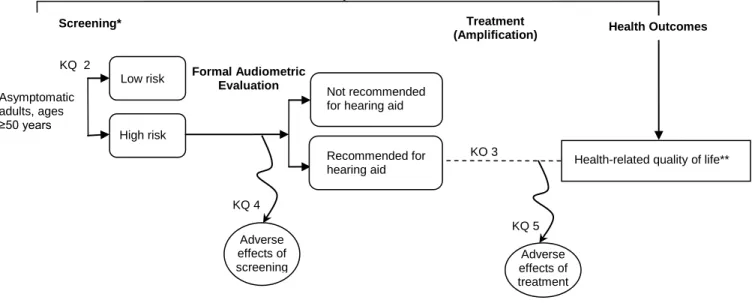
Using the methods of the USPSTF that are fully described in Appendix A and with the input of members of the USPSTF, we developed an analytic framework (Figure 1) and key questions (KQs) to guide our literature search and review. We defined the target population as persons ages 50 years and older who did not have diagnosed hearing loss and were evaluated in primary care settings, including patients both with and without perceived hearing loss. For the purposes of this review, both groups are referred to as “asymptomatic,” so long as they have not sought
evaluation for a perceived hearing problem. The target condition for this review was chronic sensorineural hearing loss, the most common type of hearing loss in older adults. We excluded conductive hearing loss, congenital hearing loss, and sudden hearing loss or hearing loss due to recent occupational or other exposure, as these were considered to be outside the scope of hearing screening in primary care. For treatments, we focused on hearing aids. Outcomes of interest were hearing-related function, quality of life, and adverse events related to screening or treatment (such as anxiety, labeling, or other psychosocial effects, and false-positive results). The KQs used to guide this evidence synthesis were:
1. Does screening for hearing loss in asymptomatic adults ages 50 years and older lead to improved health outcomes?
2. How accurate are the methods for hearing loss screening in older adults, including questionnaires, clinical techniques, and handheld audiometric devices?
3. How efficacious is the treatment of screening-detected hearing loss, namely amplification, in improving health outcomes?
4. What are the adverse effects of screening for hearing loss in adults ages 50 years and older?
5. What are the adverse effects of treatment of screening-detected hearing loss in adults ages 50 years and older?
Search Strategies
We searched Ovid MEDLINE from 1950 to July 2010 and the Cochrane Database of Systematic Reviews and the Cochrane Central Register of Controlled Trials through the second quarter of 2010 to identify relevant articles (Appendix A1). We identified additional studies from citations in relevant articles and experts in hearing screening and treatment.
Study Selection
We selected studies pertaining to screening, diagnosis, and treatment of hearing loss based on predefined inclusion and exclusion criteria for each KQ (Appendix A2). Two reviewers evaluated each study at the title/abstract and full-text article stages to determine eligibility for inclusion. The flow of studies from initial identification of titles and abstracts to final inclusion or exclusion is diagrammed in Appendix A3. We also included studies of hearing screening in specialty settings, but evaluated their applicability to primary care settings. The target sample was persons ages 50 years and older who did not have diagnosed hearing loss and were evaluated in primary care settings, including those with and without self-perceived hearing problems. The target condition for this review was chronic sensorineural hearing loss, the most common type of hearing loss in older adults.1 Although hearing problems can occur despite normal tonal
perception,3 hearing loss is generally defined based on pure-tone audiometric testing because the primary treatment is signal amplification. For screening tests, we focused on clinical tests (e.g., detection of a whispered voice, finger rub, or watch tick), a single question (e.g., “Do you have difficulty with your hearing?”), questionnaires (e.g., HHIE-S)9, 22 and handheld audiometric devices (e.g., the AudioScope). The purpose of all screening tests was to identify individuals at higher risk for hearing loss who should be referred for formal audiometry. We excluded the Rinne and Weber tests because their main purpose is to distinguish conductive from
sensorineural hearing loss, not to screen patients for hearing loss. For treatments, we focused on hearing aids and assistive listening devices (instruments with an off-ear microphone to pick up and amplify targeted sounds). Outcomes of interest were hearing-related function, quality of life, and adverse events related to screening or treatment. We used randomized controlled trials (RCTs) and controlled observational studies to assess the effectiveness and harms of screening and treatment. For diagnostic accuracy, we included studies that compared a screening test with a reference standard.
We excluded congenital hearing loss, sudden hearing loss, and hearing loss due to recent occupational or other exposure. We also excluded conductive hearing loss because it is uncommon in older adults.1 We restricted our review to published studies available in the English language. Studies that were excluded after review of the full-text article and reasons for exclusion are listed in Appendix A4.
Data Abstraction and Quality Rating
We abstracted details about the patient population, study design, data analysis, follow-up, and results. One author abstracted data and another author verified the abstracted data for accuracy. Two authors independently rated the internal validity of each study as “good,” “fair,” or “poor” using predefined criteria developed by the USPSTF (AppendixA5).34, 35 We also evaluated the applicability of studies to primary care screening, based on whether patients were recruited from primary care or community settings, the prevalence and severity of hearing loss, the proportion of patients with perceived hearing loss, and factors related to access to hearing aids (e.g., free hearing aids provided to eligible veterans). Discrepancies in quality ratings were resolved by discussion and consensus.
For diagnostic accuracy studies, we used the diagti procedure in Stata (Stata Version 10,
StataCorp, College Station, TX) to calculate sensitivities, specificities, and likelihood ratios. We used the cci procedure to calculate diagnostic odds ratios with exact confidence intervals.
Data Synthesis
We assessed the overall strength of the body of evidence for each KQ (“good,” “fair,” or
“poor”), or part of a KQ, using methods developed by the USPSTF, based on the number, quality and size of studies, consistency of results between studies, and directness of evidence.34 We did not quantitatively pool results of studies on diagnostic accuracy of screening tests for hearing loss due to differences across studies in populations evaluated, definitions of hearing loss, specific screening tests evaluated, and screening cutoffs applied. Instead, we created descriptive statistics with the median sensitivity, specificity, and likelihood ratios for detecting hearing loss of >25 and >40 dB, along with associated ranges. The total range rather than the interquartile range was chosen because several findings were reported in few studies, and because the summary range highlights the greater uncertainty we have in the estimates. For studies that reported diagnostic accuracy based on more than one definition of hearing loss, we estimated median values based on the Ventry and Weinstein criteria (for >40 dB hearing loss), the SFPTA criteria (for >25 dB hearing loss), or another definition most like the ones used by other relevant studies. There were too few randomized trials of treatments for hearing loss to perform meta-analysis.
External Review
We distributed a draft of the report for review by four external experts not affiliated with the USPSTF (Appendix A6), and revised the report based on their comments.
III. RESULTS
Key Question 1. Does Screening for Hearing Loss in
Asymptomatic Adults Ages 50 Years and Older Lead To
Improved Health Outcomes?
Summary
One trial found that screening with the HHIE-S, the AudioScope, or both was associated with greater hearing aid use at 1 year compared with no screening.36 Effects of screening on hearing aid use appeared to be limited to patients with perceived hearing loss at baseline. Screening was not associated with any differences in hearing-related quality of life compared with no screening. Because three quarters of patients enrolled in the trial reported perceived hearing loss at baseline and all patients were eligible to receive free hearing aids, results are likely to be most
generalizable to high-prevalence settings in which the cost of hearing aids is not a barrier.
Evidence
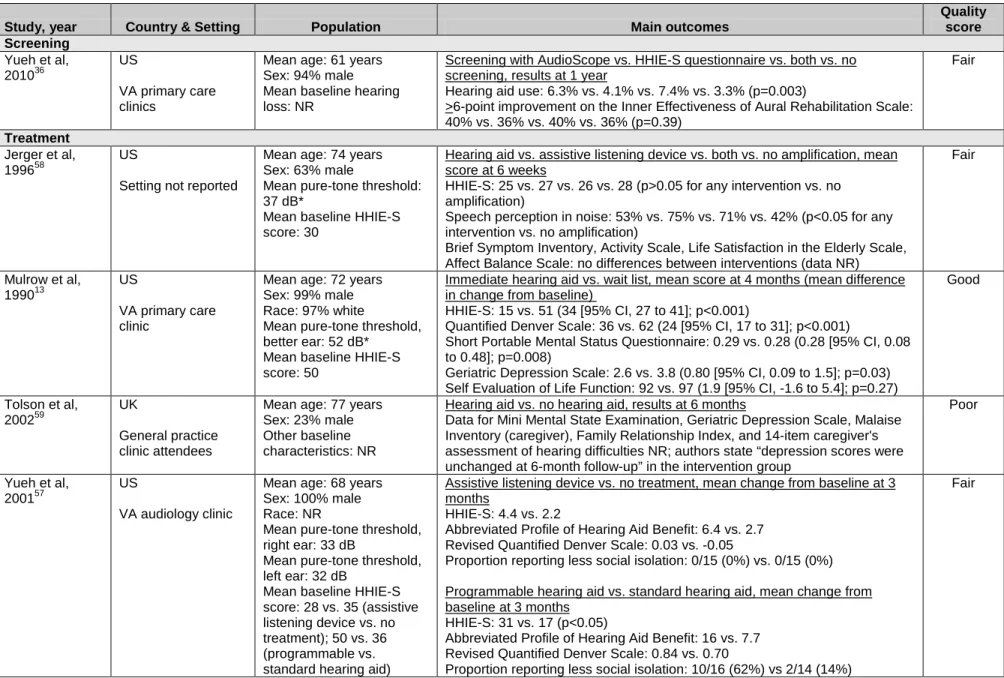
We identified one randomized trial of screening for hearing loss (Table 1, Appendixes B1 and
B2).36 Aspects of this trial were also described in a preliminary abstract37 and in an article describing its study design, baseline characteristics, and rates of positive screening results.38 We rated the Screening for Auditory Impairment—Which Hearing Assessment Test (SAI-WHAT) trial as fair quality primarily because of high loss to follow-up and unclear blinding status of outcomes assessors.36 The trial compared three different screening strategies (the AudioScope, based on inability to hear a 40 dB tone at 2000 Hz in either ear; the HHIE-S, based on a score >10; or the AudioScope plus the HHIE-S) versus usual care without screening in 2305
predominantly (94 percent) male patients ages 50 years and older (mean age, 61 years) at a Department of Veteran Affairs (VA) Medical Center. Some study design factors could limit the applicability of the SAI-WHAT trial to screening in other primary care settings. Specifically, all participants in the trial were eligible to receive free VA-issued hearing aids. In addition, about three quarters of patients reported perceived hearing loss at enrollment (based on the question, “Do you think you have hearing loss?”).
Rates of positive screening results were 19 percent in the AudioScope arm, 59 percent in the HHIE-S arm, and 64 percent in the combined arm. Hearing aid use at 1 year, the primary
outcome, was 6.3 percent in the AudioScope arm, 4.1 percent in the HHIE-S arm, 7.4 percent in the combined arm, and 3.3 percent in the control arm (p=0.03). In a post-hoc stratified analysis, hearing aid use was greater among patients with perceived hearing loss (5.7 to 9.6 percent in screened arms vs. 4.4 percent in control arm), but among those without perceived hearing loss, hearing aid use was minimal regardless of screening status (0 to 1.6 percent).
There was no difference in the proportion of patients that experienced a minimum clinically important difference (>6 points of improvement on a 0 to 100 scale) on the Inner Effectiveness of Aural Rehabilitation scale (a measure of hearing-related function), a secondary outcome of the
trial, at 1 year (36 to 40 percent in the screened arms vs. 36 percent in the control arm; p=0.39). In post-hoc analyses, there were also no differences in the proportion that experienced
improvement in hearing-related function when patients were stratified according to whether they had perceived hearing loss at baseline, except in a subgroup that was also ages 65 years and older (54 percent in the AudioScope arm, 34 percent in the HHIE-S arm, 40 percent in the combined arm, and 34 percent in the control arm).
Key Question 2. How Accurate Are the Methods for
Screening for Hearing Loss in Older Adults?
Summary
Twenty studies evaluated the diagnostic accuracy of clinical tests, a single question, a
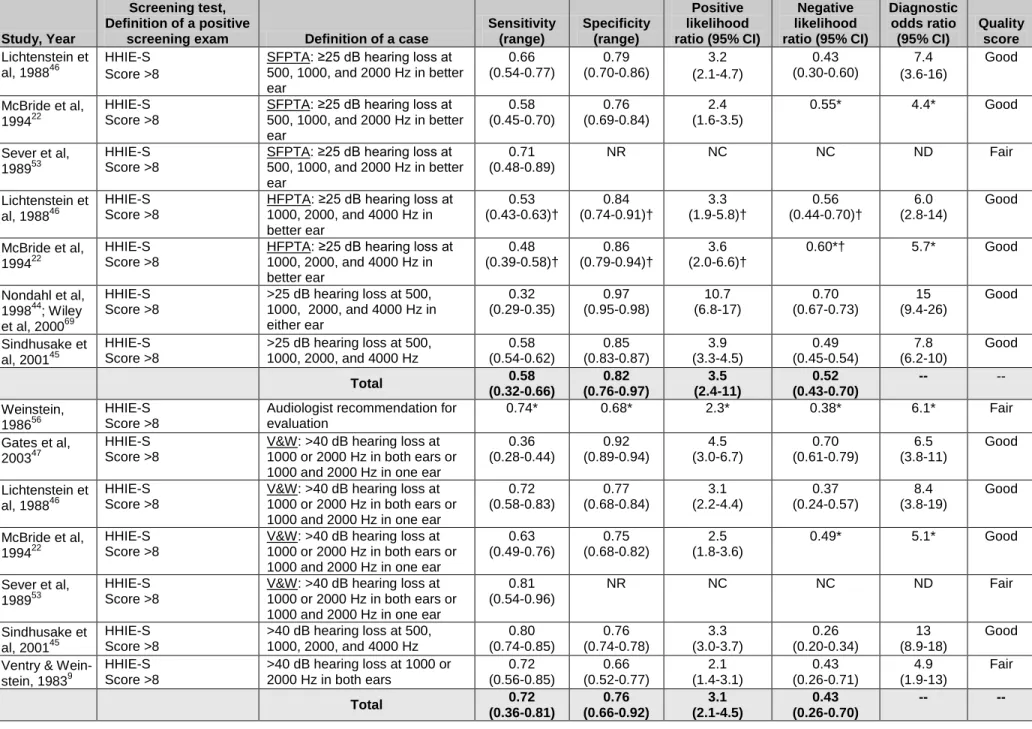
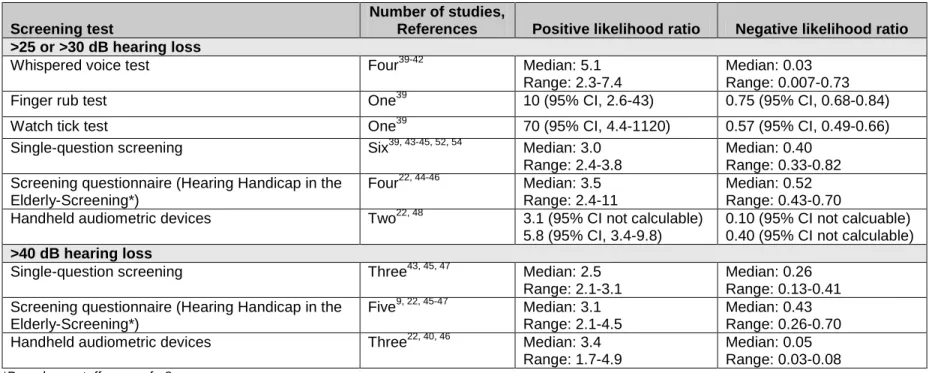
questionnaire, or a handheld audiometric device for identification of hearing loss in older adults. For detection of >25 or >30 dB hearing loss, four studies (one good-quality) found that the whispered voice test at 2 feet was associated with a median positive likelihood ratio (PLR) of 5.1 (range, 2.3 to 7.4) and median negative likelihood ratio (NLR) of 0.03 (range, 0.007 to 0.73).39-42 For detection of >25 dB hearing loss, six studies (four good-quality) found that a single question was associated with a median PLR of 3.0 (range, 2.4 to 3.8) and median NLR of 0.40 (range, 0.33 to 0.82),39, 43-45 and four good-quality studies22, 44-46 found that the HHIE-S (based on a cutoff score of 8) was associated with a median PLR of 3.5 (range, 2.4 to 11) and median NLR of 0.52 (range, 0.43 to 0.70). Likelihood ratio estimates were similar for detection of >40 dB hearing loss. For detection of >40 dB hearing loss, three studies (two good-quality) found that the AudioScope (based on ability to hear tones between 500 and 4000 Hz at 40 dB) was
associated with a median PLR of 3.4 (range, 1.7 to 4.9) and median NLR of 0.05 (range, 0.03 to 0.08).22, 40, 46
In direct comparisons, one good-quality study found that the watch tick and finger rub tests were associated with similar NLRs but substantially stronger PLRs compared with the whispered voice test or a single screening question.39 Three studies showed a consistent trade-off between lower sensitivity and higher specificity for the HHIE-S compared with a single screening question, resulting in somewhat stronger PLRs and weaker NLRs.39, 44, 45, 47 Two studies found that the AudioScopewas associated with stronger NLRs compared with the HHIE-S, with relatively small differences in PLR estimates.22, 46
Evidence
Twenty studies evaluated the diagnostic accuracy of various screening tests against a reference standard (usually pure-tone audiometry) for identification of hearing loss in older adults.9, 22, 39-56 Four studies evaluated clinical tests (Table2, AppendixB3),39-42 eight evaluated a single question (Table3, AppendixB4),39, 43-45, 47, 52, 54, 55 nine evaluated a hearing questionnaire (Table4, AppendixB5),9, 22, 44-47, 51, 53, 56 and six evaluated a handheld audiometric device (Table5, AppendixB6).22, 40, 46, 48-50 Four studies were population-based43-45, 47 and four22, 46, 53,
56
patients from specialty (usually an audiology or otolaryngology clinic) or other high-prevalence settings, or evaluated older adults dwelling in nursing homes.49, 55
We rated seven studies as good quality22, 39, 43-47 and the remainder as fair quality (Appendix B7). The most common methodological shortcomings were failure to describe enrollment of a representative spectrum of patients (nine studies met this criterion), failure to report
interpretation of the reference standard blinded to results of the screening test (five studies met this criterion), and failure to describe enrollment of a random or consecutive series of patients (11 studies met this criterion). All studies except for one used pure-tone audiometry as the reference standard for hearing loss, though four studies used a portable (bedside) audiometer instead of standard audiometry.49, 52, 54, 55 The exception was one study that performed an audiometric examination but used an audiologist as its reference standard.56
Table 6 summarizes the main results on diagnostic accuracy. Results for each screening test are described in more detail below.
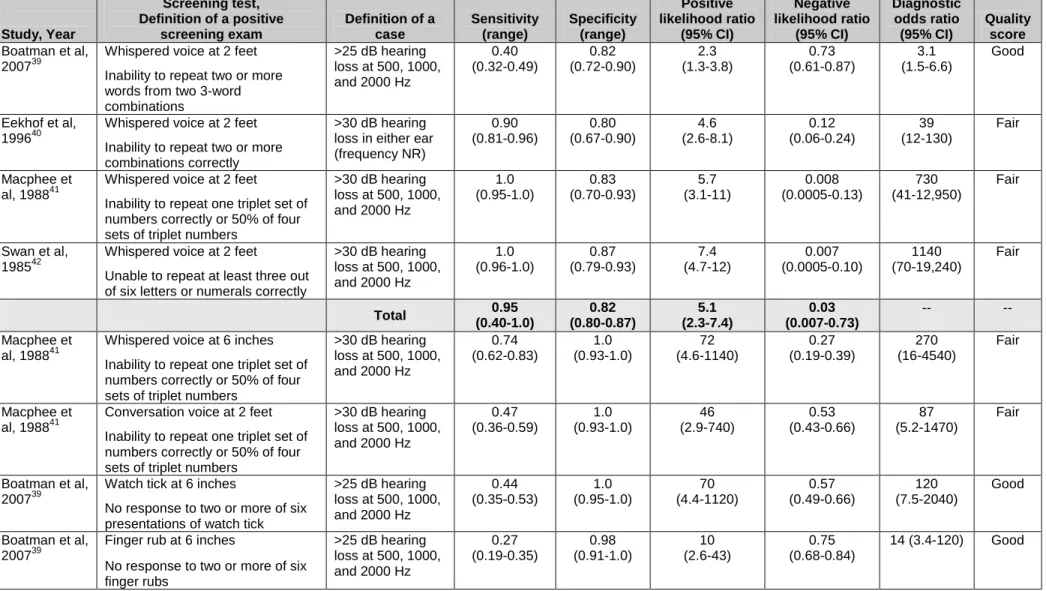
Whispered voice, finger rub, and watch tick tests. One good-quality39 and three fair-quality
40-42
studies evaluated the diagnostic accuracy of a whispered voice at 2 feet for identification of >25 or >30 dB hearing loss (Table2, AppendixB3). Likelihood ratio estimates varied, with a median PLR of 5.1 (range, 2.3 to 7.4) and median NLR of 0.03 (range, 0.007 to 0.73). The good-quality study reported the weakest likelihood ratios.39 Based on a sensitivity of 0.40 (range, 0.32 to 0.49) and specificity of 0.82 (range, 0.72 to 0.90), the PLR was 2.3 (95% CI, 1.3 to 3.8) and the NLR was 0.73 (95% CI, 0.61 to 0.87). In the three fair-quality studies, sensitivity was higher (range, 0.90 to 1.0), with similar specificity (range, 0.80 to 0.87), resulting in stronger likelihood ratios (PLR range, 4.6 to 7.4; NLR range, 0.007 to 0.12).40-42 One fair-quality study found that inability to hear a whispered voice at 6 inches (PLR, 72 [95% CI, 4.6 to 1140]) or a conversation at 2 feet (PLR, 46 [95% CI, 2.9 to 740]) was more useful than inability to hear a whispered voice at 2 feet (PLR, 5.7 [95% CI, 3.1 to 11]), but estimates were imprecise and the confidence
intervals overlapped.41 On the other hand, normal results on the first two tests were less useful than the whispered voice test at 2 feet for identifying those without hearing loss (NLR, 0.27 [95% CI, 0.19 to 0.39] and 0.53 [95% CI, 0.43 to 0.66], respectively, vs. 0.008 [95% CI, 0.0005 to 0.13]), primarily due to lower sensitivities.
The one good-quality study also evaluated the accuracy of the finger rub and watch tick tests at 6 inches for detecting >25 dB hearing loss (Table2, AppendixB3).39 Compared with the
whispered voice test, inability to hear a finger rub or watch tick was more useful for identifying hearing loss (PLR, 10 [95% CI, 2.6 to 43] and 70 [95% CI, 4.4 to 1120], respectively), with normal results similarly useful for identifying individuals without hearing loss (NLR, 0.75 [95% CI, 0.68 to 0.84] and 0.57 [95% CI, 0.46 to 0.66], respectively), based on similar sensitivities (0.27 [95% CI, 0.19 to 0.35] and 0.44 [95% CI, 0.35 to 0.53], respectively) and higher
specificities (0.98 [95% CI, 0.91 to 1.0] and 1.0 [95% CI, 0.95 to 1.0], respectively).
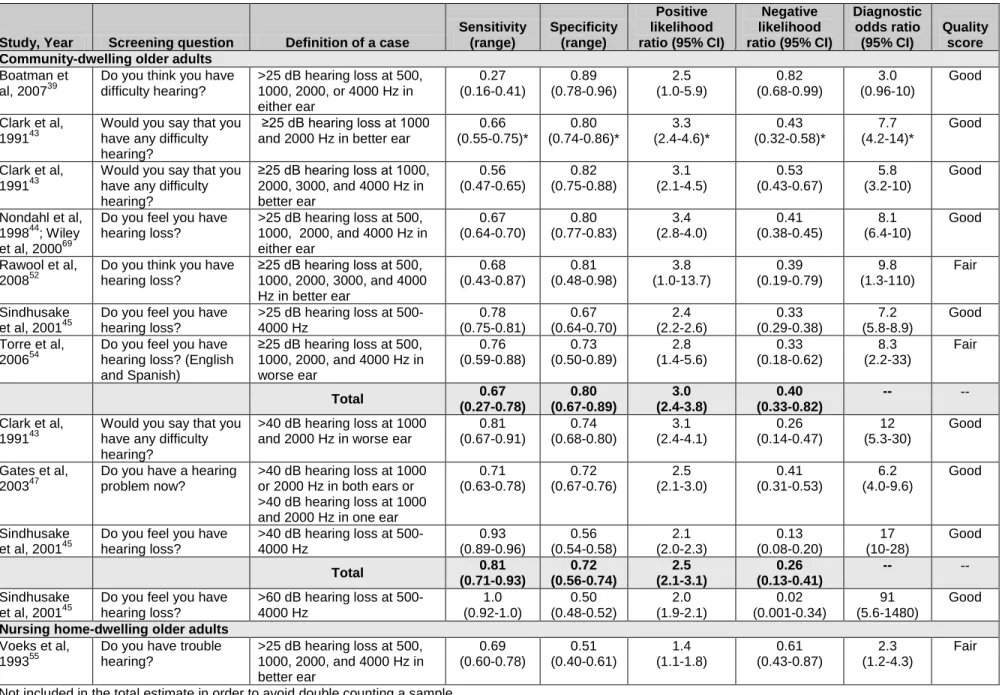
Single-question screening. Five good-quality39, 43-45, 47 and three fair-quality52, 54, 55 studies evaluated the diagnostic accuracy of a single question regarding perceived hearing difficulties (e.g., “Do you have difficulty with your hearing?”) for detection of hearing loss (Table3,
AppendixB4). For detection of >25 dB hearing loss, six studies reported a median sensitivity of 0.67 (range, 0.27 to 0.78) and median specificity of 0.80 (range, 0.67 to 0.89).39, 43-45, 52, 54 A
positive response to a single question increased the likelihood of hearing loss (median PLR, 3.0 [range, 2.4 to 3.8]), though the usefulness of a negative response was variable (median NLR, 0.40 [range, 0.33 to 0.82]). For detection of >40 dB hearing loss, three good-quality studies reported a median sensitivity of 0.81 (range, 0.71 to 0.93) and median specificity of 0.72 (range, 0.56 to 0.74), resulting in a median PLR of 2.5 (range, 2.1 to 3.1) and median NLR of 0.26 (range, 0.13 to 0.41).43, 45, 47 One fair-quality study of nursing home residents reported a weaker PLR (1.4 [95% CI, 1.1 to 1.8]) and similar NLR (0.61 [95% CI, 0.43 to 0.87]) compared with the other studies, which evaluated community-dwelling older adults.55
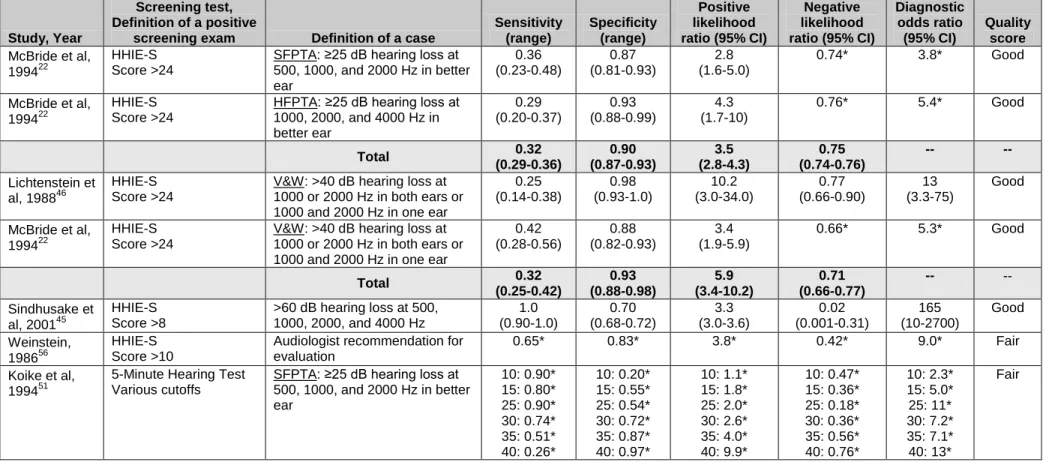
Screening questionnaires. Five good-quality22, 44-47 and three fair-quality9, 53, 56 studies evaluated the diagnostic accuracy of the HHIE-S screening questionnaire, and one fair-quality study evaluated the diagnostic accuracy of the 5-Minute Hearing Test51 (Table4, AppendixB5). For detection of >25 dB hearing loss, four good-quality studies reported a median sensitivity for the HHIE-S (based on a cutoff score >8) of 0.58 (range, 0.32 to 0.66) and median specificity of 0.82 (range, 0.76 to 0.97), resulting in a median PLR of 3.5 (range, 2.4 to 11) and NLR of 0.52 (range, 0.43 to 0.70).22, 44-46 One fair-quality study reported a somewhat lower PLR and similar NLR (2.3 and 0.38, respectively), but the reference standard was an audiologist recommendation for evaluation, rather than strictly results of pure-tone audiometry.56 Studies on the accuracy of HHIE-S cutoff scores >8 for identification of >40 dB hearing loss reported slightly better sensitivity and slightly worse specificity compared with identification of >25 dB hearing loss, resulting in similar likelihood ratios (Table 4).9, 22, 45-47 Changing the HHIE-S threshold from >8 to >24 increased the PLR for identification of >40 dB hearing loss (based on Ventry and
Weinstein criteria) from 3.1 to 10 and increased the NLR from 0.37 to 0.77 in one good-quality study (due to decreased sensitivity but higher specificity),46 but had little effect on likelihood ratio estimates for either >25 dB or >40 dB hearing loss in another good-quality study.22
One fair-quality study evaluated the accuracy of the 5-Minute Hearing Test for identification of >25 dB hearing loss at various cutoff scores.51 Sensitivity ranged from 0.90 at a cutoff score of 10 to 0.26 at a cutoff score of 40, with specificities of 0.20 and 0.97, respectively, resulting in PLRs of 1.1 to 9.9 and NLRs of 0.47 to 0.76, depending on the cutoff score evaluated.
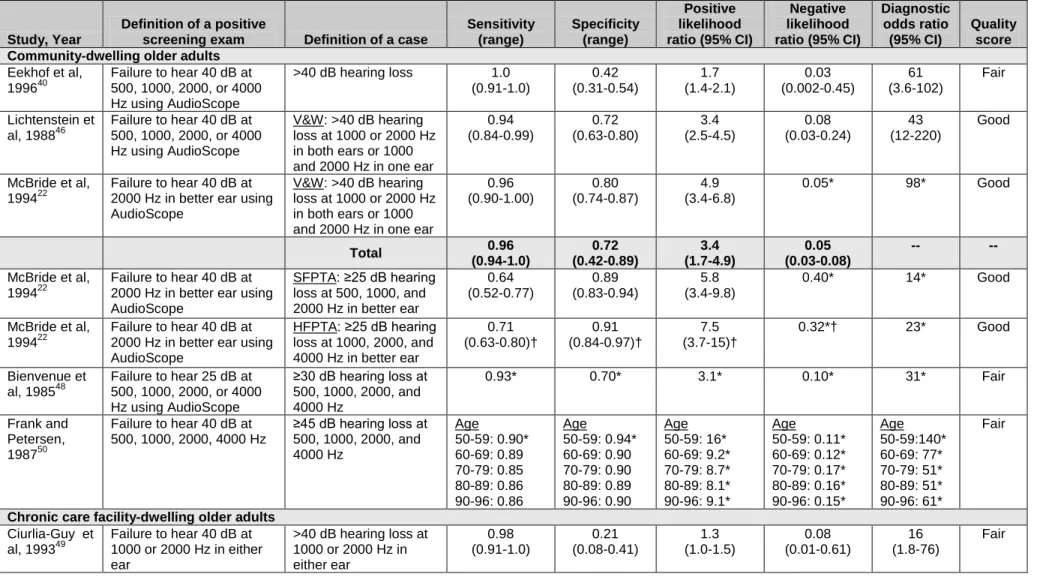
Handheld audiometric devices. Two good-quality22, 46 and four fair-quality40, 48-50 studies evaluated the diagnostic accuracy of the AudioScope handheld audiometric device for identification of hearing loss (Table 5, Appendix B6). The frequencies and intensities of the tones tested with the AudioScope varied across studies. For detection of >25 dB hearing loss, one good-quality study found that the AudioScope (based on ability to hear a 2000 Hz tone at 40 dB) was associated with a sensitivity of 0.64 (95% CI, 0.52 to 0.77) based on SFPTA criteria and 0.71 (95% CI, 0.63 to 0.80) based on HFPTA criteria, with specificities of 0.89 (95% CI, 0.83 to 0.94) and 0.91 (0.84 to 0.97), respectively.22 Corresponding PLRs were 5.8 (95% CI, 3.4 to 9.8) and 7.5 (95% CI, 3.7 to 15), and NLRs were 0.40 and 0.32 (CIs not calculable).22 For detection of >30 dB hearing loss, a fair-quality study found that the AudioScope (based on ability to hear 500, 1000, 2000, and 4000 Hz at 25 dB) was associated with a sensitivity of 0.93, specificity of 0.70, PLR of 3.1, and NLR of 0.10 (CIs not calculable).48 For detection of >40 dB hearing loss, three studies of community-dwelling older adults found that the AudioScope (based on ability to hear tones between 500 and 4000 Hz at 40 dB) was associated with a median sensitivity of 0.96 (range, 0.94 to 1.0), median specificity of 0.72 (range, 0.42 to 0.80), median PLR of 3.4 (range,
1.7 to 4.9), and median NLR of 0.05 (range, 0.03 to 0.08).22, 40, 46 A fair-quality study of older adult nursing home residents reported a very high sensitivity (0.98 [95% CI, 0.91 to 1.0]) but very low specificity (0.21 [95% CI, 0.08 to 0.41]) for identification of >40 dB hearing loss using the AudioScope (based on failure to hear 1000 or 2000 Hz in both ears), resulting in a much weaker PLR (1.3 [95% CI, 1.0 to 1.5]) but similar NLR (0.08 [95% CI, 0.01 to 0.61]) compared with results from the studies of community-dwelling older adults.49
Direct comparisons of different types of screening tests. Six good-quality studies directly compared the diagnostic accuracy of different screening tests for hearing loss in older adults.22, 39,
44-47
One study found that the whispered voice test and single question screening were associated with similar PLRs (2.3 [95% CI, 1.3 to 3.8] and 2.5 [95% CI, 1.0 to 5.9], respectively) and NLRs (0.73 [95% CI, 0.61 to 0.87] and 0.82 [95% CI, 0.68 to 0.99], respectively), but the watch tick and finger rub tests were associated with substantially stronger PLRs (70 [range, 4.4 to 1120] and 10 [range, 2.6 to 43], respectively) and comparable NLRs (0.57 [95% CI, 0.49 to 0.66] and 0.75 [95% CI, 0.68 to 0.84], respectively).39 Three studies showed a consistent trade-off between lower sensitivity and higher specificity for the HHIE-S compared with a single screening
question, resulting in somewhat stronger PLRs and weaker NLRs.39, 44, 45, 47 Two studies found that normal results on the AudioScope were generally associated with stronger NLRs (0.05 and 0.24) compared with the HHIE-S (0.37 and 0.76), with relatively small differences in PLR estimates, though likelihood ratio estimates varied depending on the HHIE-S cutoff score evaluated and the criteria used to define hearing loss.22, 46
Key Question 3. How Efficacious Is the Treatment of
Screening-Detected Hearing Loss in Improving Health
Outcomes?
Summary
Four RCTs evaluated benefits of amplification compared with no amplification for treatment of screening-detected hearing loss. One good-quality RCT found that immediate hearing aids were associated with near normalization of hearing-specific quality of life and communication
difficulties in veterans with primarily screening-detected moderate to severe hearing loss, compared with essentially no changes in these outcomes in wait-list controls.13 A smaller, fair-quality RCT found no clear difference between an assistive listening device and no treatment in veterans ineligible for free hearing aids with less severe hearing loss.57 Another fair-quality RCT found no difference between a hearing aid, an assistive listening device, or both compared with no amplification in a subgroup of patients not using hearing aids at enrollment with mild baseline hearing loss and hearing-related handicap. A fourth RCT of hearing aids versus no hearing aids reported outcomes very poorly.
Evidence
We identified four RCTs on treatment for hearing loss in older adults (Table 1, AppendixesB1
community-dwelling older adults. Numerous measures were used to assess both hearing-related and general quality of life and function (Appendix C).
One trial was rated good quality,13 two were rated fair quality,57, 58 and one was rated poor quality59 (Appendix B2). Shortcomings of the fair-quality trials included potentially important baseline differences between groups and failure to describe intention-to-treat analysis,57 and failure to describe randomization or allocation concealment methods or loss to follow-up.58 The poor-quality trial did not describe allocation concealment, use of intention-to-treat analysis, or loss to follow-up, and reported outcomes incompletely.59 All of the trials had characteristics which could limit generalizability to screening in typical primary care settings, including recruitment of mostly white male veterans,13, 57 restriction to patients eligible for free hearing aids,57 inclusion of patients referred for suspected hearing problems,13 and inclusion of patients already using hearing aids.58
The good-quality RCT (n=194) randomly assigned veterans (mean age, 72 years) to immediate hearing aids or wait-list control for 4 months.13 About two thirds of patients were recruited from a primary care setting based on a positive AudioScope screening for >40 dB hearing loss. The others were referred into the trial due to suspected hearing problems. The mean pure-tone threshold was 52 dB and similar among screening-detected and referred patients. The mean baseline HHIE score was about 50 (standard deviation [SD], 28), indicating severe (HHIE score >42) effects on hearing-related quality of life and function.60 Hearing-related quality of life outcomes were measured using the HHIE and the Quantified Denver Scale of Communication Function (QDS). General quality of life was assessed with the Geriatric Depression Scale (GDS), a 0 to 15 scale, the Short Portable Mental Status Questionnaire (SPMSQ), a 0 to 10 scale, and the Self-Evaluation of Life Function (SELF), a 54 to 216 scale.
At 4 months there was no change from baseline in HHIE or QDS scores in the control group, but the hearing aid group HHIE score improved from a mean of 49 at baseline to 15 at 4 months, and the QDS score improved from 59 to 36. The mean between-group difference in change from baseline was 34 (95% CI, 27 to 41) on the HHIE and 24 (95% CI, 17 to 31) on the QDS. Results were similar in the subgroup of screening-detected patients. Greater improvements in HHIE scores were associated with increased hearing aid use (p=0.05), but not with changes in QDS scores. Statistically significant but small (<1 point) effects on GDS and SPMSQ scores were also observed in the hearing aid group compared with the control group. However, the potential for improvement may have been limited because the baseline scores indicated only mild baseline depression or cognitive dysfunction. In both groups, there were no significant differences from baseline in SELF scores. A follow-up study found that improvements in HHIE and QDS scores were sustained in the hearing aid group through 12 months, even though the proportion of patients that reported 4 hours or more of daily hearing aid use decreased from 90 to 76 percent between 4 and 12 months.61
A second, fair-quality trial (n=64) enrolled veterans (mean age, 68 years) with less severe (mean pure-tone threshold, 32 dB) hearing loss.57 Patients eligible for free VA-issued hearing aids (n=30) were randomly assigned to a standard non-directional or programmable directional digital hearing aid. Patients ineligible for free hearing aids (n=30) were randomly assigned to an
reducing background noise) or no treatment. Although this design resulted in essentially two separate randomized trials, the investigators analyzed results as a single, four-armed randomized trial. A revised (shortened) version of the QDS (Revised Quantified Denver Scale of
Communication Function [RQDS]), a 1 to 5 scale,62 the HHIE, and the Abbreviated Profile of Hearing Aid Benefit (APHAB), a 0-to-100 scale questionnaire designed to assess self-reported communication ability,63 were used to assess hearing-specific quality of life. Baseline differences across the intervention groups in APHAB scores were statistically significant (range, 38 to 52; p=0.04). For baseline HHIE scores, differences across groups were not statistically significant, but ranged from moderate to severe and were likely to be clinically significant (range, 28 to 50). At 3-month follow-up, there were trivial improvements from baseline on HHIE scores in the assistive listening device and no treatment groups (mean change of 4.4 and 2.2 points, respectively), but both types of hearing aids were associated with clinically significant
improvements (mean change of 17 and 31 points in the standard and programmable hearing aid groups, respectively). Changes in APHAB scores were small in the assistive listening device and no treatment groups (mean change of 6.4 and 2.7 points, respectively), with no change in RQDS scores. Improvements in the APHAB score were larger in both hearing aid groups (mean change of 7.7 and 16 for standard and programmable hearing aids, respectively). Although both hearing aid groups experienced greater improvements in hearing-related outcomes compared with the no treatment and assistive listening device groups, there were baseline differences between groups. In addition, statistical significance was only reported for differences across all four groups, but such results are subject to additional confounding because patients were separately randomly assigned based on eligibility for free hearing aids.
In another fair-quality crossover trial (n=80), a subgroup of patients not using hearing aids at enrollment (mean pure-tone threshold hearing loss, 37 dB; mean HHIE score, 30) found no clear differences between hearing aids, an assistive listening device, or both compared with no
amplification on HHIE scores and other measures of function or quality of life.58 Improvements in HHIE scores for all four intervention groups were small and not clinically significant, ranging from 2.2 points in the no amplification group to 5.2 points in the hearing aid only group. A poor-quality trial (n=133) found that older adults randomly assigned to hearing aids did not experience improvement in GDS scores at 6 months, and did not report results in those randomly assigned to no hearing aids.59
Key Question 4. What Are the Adverse Effects of Screening
for Hearing Loss in Adults Ages 50 Years and Older?
Summary
We identified no studies on harms associated with screening for hearing loss in older adults. Harms are unlikely to be greater than minimal because screening and confirmatory testing are non-invasive and treatment with hearing aids is not associated with significant harms.
Evidence
No randomized trials or controlled observational studies evaluated harms associated with screening for hearing loss in older adults. Because screening and confirmatory testing are non-invasive and hearing aid treatment is not known to be associated with major harms, it is unlikely that adverse effects of screening for hearing loss would be greater than minimal. It is possible that screening could be associated with anxiety, labeling, or other psychosocial effects, but no studies are available to estimate these outcomes.
Key Question 5. What Are the Adverse Effects of Treatment
of Screening-Detected Hearing Loss in Adults Ages 50 Years
and Older?
Summary
No randomized trials of hearing aids evaluated harms, and we identified no relevant controlled observational studies. However, serious harms appear to be rare.
Evidence
Hearing aids are non-invasive and generally believed to be safe, although potential harms include dermatitis, accidental retention of molds, cerumen impaction, otitis externa, or associated middle ear problems,64-66 as well as psychosocial effects. Harms were not reported in any trials of hearing aids, and we identified no controlled observational studies on adverse effects associated with hearing aid use. Although it has been postulated that the amplification from hearing aids might lead to further deterioration in hearing, particularly in those with severe hearing loss because they require marked amplification, no study has addressed this issue.67
IV. DISCUSSION
Summary of Review Findings
Results of this evidence synthesis organized by KQ are summarized in Table 7.
SAI-WHAT is the only study that compared screening with no screening.36 Although hearing aid use was higher after 1 year with screening, there was no difference in the likelihood of
experiencing a clinically important improvement in hearing-related function. Interpretation of SAI-WHAT is critically dependent on whether hearing aid use is an acceptable surrogate marker for hearing-related quality of life and functional outcomes. Hearing aid use at 1 year was less than 10 percent in all arms of SAI-WHAT, and the trial was not powered to assess improvements in hearing-related function. Nonetheless, over one third of patients (screened or unscreened) in SAI-WHAT experienced a clinically significant improvement in hearing-related function, suggesting that factors other than hearing aid use may affect functional outcomes. SAI-WHAT also restricted enrollment to veterans eligible for free hearing aids, three quarters of whom reported perceived hearing loss. Therefore, results are likely to be most applicable to populations with a high prevalence of perceived hearing loss, in settings where treatment cost is not a barrier. There is good evidence from 20 studies of diagnostic accuracy that common screening tests for hearing loss are useful for identifying patients at higher risk for hearing loss. One challenge in interpreting studies of diagnostic accuracy is that studies used different thresholds and criteria to define hearing loss. The clinical relevance of detection of mild (25 to 40 dB) hearing loss as it pertains to effectiveness of screening is also uncertain, as the only trial showing benefits of hearing aids enrolled patients with screening-detected >40 dB hearing loss.13 Relatively simple tests, such as the whispered voice at 2 feet and a single question regarding perceived hearing loss, appear to be nearly as accurate compared with a more detailed hearing loss questionnaire or a handheld audiometric device for detecting hearing loss. A negative screening result based on a handheld audiometric device may be particularly useful for ruling out >40 dB hearing loss. Choices regarding which screening test to use may also depend in part on factors other than diagnostic accuracy, such as cost or convenience. For the whisper test, an important
consideration is the need for clinicians to administer the test in a standardized and consistent fashion (such as the method described in published studies of diagnostic accuracy).39 Although the finger rub and watch tick tests may be easier to standardize, more studies are needed to clarify their diagnostic accuracy, as both were only evaluated in one study.39
Our conclusions regarding diagnostic accuracy are generally in accord with another recently published systematic review.8 That systematic review estimated stronger likelihood ratios for the whispered voice test, largely because it was conducted before the publication of a recent, good-quality study39 that reported substantially weaker estimates. The other review also pooled likelihood ratio estimates, included studies2, 68, 69 that analyzed the same populations reported in other studies,42, 44 included studies less applicable to U.S. primary care settings (e.g., studies of nursing home patients in Lebanon or Singapore),70, 71 and did not include studies that we deemed relevant.47, 52 For the whispered voice test, the other review calculated a pooled PLR of 6.1 (95% CI, 4.5 to 8.4) and NLR of 0.03 (95% CI, 0 to 0.24); for the single question screening, a pooled
PLR of 2.5 (95% CI, 1.7 to 3.6) and NLR of 0.13 (95% CI, 0.09 to 0.19); for the HHIE-S (with a cutoff score >8), a pooled PLR of 3.8 (95% CI, 3.0 to 4.8) and NLR of 0.38 (95% CI, 0.29 to 0.51); and for the AudioScope,a pooled PLR of 2.4 (95% CI, 1.4 to 4.1) and NLR of 0.07 (95% CI, 0.03 to 0.17).8
Evidence on the efficacy of treatments for screening-detected hearing loss is limited. One good-quality RCT found that hearing aids resulted in near normalization of hearing-related good-quality of life and function in a subgroup of patients identified by screening, based on >40 dB hearing loss using a handheld audiometric device.13, 61 Because this trial was conducted in a VA center and almost exclusively enrolled white males, its generalizability to other settings may be limited. Two fair-quality RCTs found no clear differences in hearing-related quality of life or function between amplification and no treatment in patients with milder baseline hearing loss.57, 58 We did not find direct evidence on harms of screening or treatments with hearing aids. In
community-based and primary care populations, rates of false-positive results from screening for >25 dB hearing loss ranged from 5 to 41 percent,43-47 depending on the screening test and
population evaluated. However, harms of screening are likely to be minimal because screening is non-invasive, the reference standard (audiometric testing) is also non-invasive, and treatment with hearing aids is not known to be associated with serious adverse events. No study has validated the hypothesis that hearing aid use might lead to further hearing deterioration in those with severe to profound hearing loss because of the increased amplification required (the intensity level of sound rises by a factor of 10 for each additional decibel of amplification).67
Contextual Issues
Several contextual issues could help inform the interpretation of the findings of this evidence review.
Does Adherence to Hearing Aid Use Improve Health Outcomes in
Screened Asymptomatic Adults Who Are Prescribed Hearing Aids?
Older adults with hearing loss may not adhere to hearing aid use for cosmetic or psychosocial reasons, because of difficulty using the hearing aids, discomfort, cost, or perceived lack of benefit. In large population-based cohort studies, among the approximately one-third of older adults with hearing loss who had ever used hearing aids, 20 to 30 percent were no longer using them.1, 3 Despite the high rate of non-use or non-adherence to hearing aids, evidence showing that increased adherence improves health outcomes is limited. In one randomized trial, more hours per day of hearing aid use was positively correlated with greater improvements in HHIE (but not QDS) scores.13
Are There Characteristics That Can Predict Adherence to Hearing Aid
Use Among Screened Populations?
Several observational studies have attempted to identify factors that predict adherence to hearing aid use. The large (n=1629) Beaver Dam population-based cohort study probably provides the best evidence.25 It found that among older adults (84 percent ages 60–92 years) who had ever had a hearing aid, factors associated with adherence were older age (age vs. age plus 5 years: adjusted OR, 1.2 [95% CI, 1.1 to 1.3]), more severe hearing loss (moderate loss vs. mild loss: adjusted OR, 5.0 [95% CI, 3.0 to 8.6]), better education (≥16 years of education vs. <12 years of education: adjusted OR, 3.2 [95% CI, 1.7 to 6.1]), lower word recognition scores (<80 vs. ≥90 percent: adjusted OR, 2.7 [95% CI, 1.6 to 4.4]), worse HHIE scores (>26 vs. 0: adjusted OR, 7.8 [95% CI, 3.1 to 19]), and self-reported hearing loss (presence vs. absence of self-reported loss: adjusted OR, 4.9 [95% CI, 2.0 to 12]). A smaller (n=131) observational study found non-statistically significant trends toward greater adherence among college-educated women with a higher income (>$40,000 per year) compared with women without a college education and/or lower income,73 though these factors did not predict adherence in men. A long-term retrospective cohort study found that among 116 participants who received hearing aids, 43 percent were still using their hearing aids 12 years later.74 Presence of hearing loss in the better ear (dB vs. dB plus 10: OR, 2.4 [95% CI, 1.4 to 3.8]) and presence of moderately severe tinnitus (presence vs. absence of moderately severe tinnitus: OR, 4.6 [95% CI, 1.6 to 13]) predicted adherence.
Are There Treatments or Other Behavioral Interventions in Addition to
Hearing Aid Use That Improve Health Outcomes in Adults With
Hearing Loss?
We identified no studies on the effectiveness of behavioral interventions in addition to or instead of hearing aids to help patients cope with or manage hearing loss.
Limitations
Our evidence review has some potential limitations. First, evidence was very limited for benefits and harms of screening and treatments for hearing loss, making it difficult to reach strong
conclusions. Second, we excluded non-English language studies, which could introduce language bias, though we identified no relevant non-English language studies in literature searches or when searching reference lists. Third, a number of studies evaluated diagnostic accuracy of screening tests or programs in high-prevalence populations recruited from specialty settings, which could limit the generalizability to primary care settings. Finally, we did not attempt to construct outcomes tables due to the lack of sufficient direct or indirect evidence to reliably estimate benefits and harms.
Emerging Issues
We found no ongoing trials of screening for hearing loss or trials of hearing aids versus no treatment in searches of Scientific Projects database of federally funded research. One trial on effectiveness of group versus individual fitting of hearing aids and group versus individualized follow-up has completed recruitment and reported baseline characteristics of participants, but results are not yet
available.75
Future Research
Further research is needed to understand the potential benefits of screening and treatment for hearing loss in older individuals. Additional research is needed on the effectiveness of screening in typical primary care settings, the optimal age at which to start screening, and the severity of hearing loss that is likely to benefit from hearing aids, in order to help define optimal screening test thresholds and methods. In addition, RCTs to test the efficacy of hearing aids (including more effective or usable designs) or other interventions in improving health, function, and quality of life outcomes should be carried out in patients with screening-detected hearing loss who are representative of those seen in typical primary care settings. Particular efforts should be made to enroll patients with comorbid clinical conditions such as depression or cognitive
dysfunction that may be associated with or exacerbated by hearing loss.13 Because effectiveness of any hearing screening strategy will depend on how likely those who might benefit from hearing aids are to actually use them, research is needed on effective methods for enhancing follow-up rates and uptake of recommended treatment following screening.
Conclusions
Additional research is needed to understand effects on health outcomes of screening adults ages 50 years and older for hearing loss compared with no screening, and to confirm benefits of treatment under conditions likely to be encountered in most primary care settings.
References
1. Cruickshanks KJ, Wiley TL, Tweed TS, et al. Prevalence of hearing loss in older adults in Beaver Dam, Wisconsin. The Epidemiology of Hearing Loss Study. Am J Epidemiol. 1998;148(9):879-886.
2. Dalton DS, Cruickshanks KJ, Klein BE, Klein R, Wiley TL, Nondahl DM. The impact of hearing loss on quality of life in older adults. Gerontologist. 2003;43(5):661-668.
3. Gates GA, Cooper JC Jr, Kannel WB, Miller NJ. Hearing in the elderly: the Framingham cohort, 1983–1985, part I: basic audiometric test results. Ear Hear. 1990;11(4):247-256. 4. Reuben DB, Walsh K, Moore AA, Damesyn M, Greendale GA. Hearing loss in
community-dwelling older persons: national prevalence data and identification using simple questions. J Am Geriatr Soc. 1998;46(8):1008-1011.
5. Wallhagen MI, Strawbridge WJ, Cohen RD, Kaplan GA. An increasing prevalence of hearing impairment and associated risk factors over three decades of the Alameda County Study. Am J Public Health. 1997;87(3):440-442.
6. U.S. Preventive Services Task Force. Screening for hearing impairment in older adults. In Guide to Clinical Preventive Services. 2nd ed. Washington, DC: Department of Health and Human Services; 1996: pp 393-405.
7. Yueh B, Shapiro N, MacLean CH, Shekelle PG. Screening and management of adult hearing loss in primary care: scientific review. JAMA. 2003;289(15):1976-1985. 8. Bagai A, Thavendiranathan P, Detsky A. Does this patient have hearing impairment?
JAMA. 2006;295(4):416-428.
9. Ventry IM, Weinstein BE. Identification of elderly people with hearing problems. ASHA. 1983;25(7):37-42.
10. Clark JG. Uses and abuses of hearing loss classification. ASHA. 1984;23:493-500. 11. Goldstein D. Hearing impairment, hearing aids and audiology. ASHA. 1984;26:24-35. 12. Gates GA, Mills JH. Presbycusis. Lancet. 2005;366(9491):1111-1120.
13. Mulrow CD, Aguilar C, Endicott JE, et al. Quality-of-life changes and hearing impairment: a randomized trial. Ann Intern Med. 1990;113(3):188-194.
14. Weinstein BE, Ventry IM. Hearing impairment and social isolation in the elderly. J Speech Hear Res. 1982;25(4):593-599.
15. Carabellese C, Appollonio I, Rozzini R, et al. Sensory impairment and quality of life in a community elderly population. J Am Geriatr Soc. 1993;41(4):401-407.
16. Mulrow CD, Lichtenstein MJ. Screening for hearing impairment in the elderly: rationale and strategy. J Gen Int Med. 1991;6(3):249-258.
17. McMahon CM, Kifley A, Rochtchina E, Newall P, Mitchell P. The contribution of family history to hearing loss in an older population. Ear Hear. 2008;29(4):578-584.
18. Brant LJ, Gordon-Salant S, Pearson JD, et al. Risk factors related to age-associated hearing loss in the speech frequencies. J Am Acad Audiol. 1996;7(3):152-160. 19. Cruickshanks KJ, Klein R, Klein BE, Wiley TL, Nondahl DM, Tweed TS. Cigarette
smoking and hearing loss: the epidemiology of hearing loss study. JAMA. 1998;279(21):1715-1719.
20. Cruickshanks KJ, Tweed TS, Wiley TL, et al. The 5-year incidence and progression of hearing loss: the epidemiology of hearing loss study. Arch Otolaryngol Head Neck Surg. 2003;129(10):1041-1046.
21. Agrawal Y, Platz EA, Niparko JK. Prevalence of hearing loss and differences by demographic characteristics among US adults: data from the National Health and Nutrition Examination Survey, 1999–2004. Arch Intern Med. 2008;168(14):1522-1530. 22. McBride WS, Mulrow CD, Aguilar C, Tuley MR. Methods for screening for hearing loss
in older adults. Am J Med Sci. 1994;307(1):40-42.
23. Cook JA, Hawkins DB. Hearing loss and hearing aid treatment options. Mayo Clin Proc. 2006;81(2):234-237.
24. Gussekloo J, de Bont LE, von Faber M, et al. Auditory rehabilitation of older people from the general population—the Leiden 85-plus study. Br J Gen Pract.
2003;53(492):536-540.
25. Popelka MM, Cruickshanks KJ, Wiley TL, Tweed TS, Klein BE, Klein R. Low
prevalence of hearing aid use among older adults with hearing loss: the Epidemiology of Hearing Loss Study. J Am Geriatr Soc. 1998;46(9):1075-1078.
26. Bogardus ST Jr, Yueh B, Shekelle PG. Screening and management of adult hearing loss in primary care: clinical applications. JAMA. 2003;289(15):1986-1990.
27. Danhauer JL, Celani KE, Johnson CE. Use of a hearing and balance screening survey with local primary care physicians. Am J Audiol. 2008;17(1):3-13.
28. Cohen SM, Labadie RF, Haynes DS. Primary care approach to hearing loss: the hidden disability. Ear Nose Throat J. 2005;84(1):26-31.
29. Johnson CE, Danhauer JL, Koch LL, Celani KE, Lopez IP, Williams VA. Hearing and balance screening and referrals for Medicare patients: a national survey of primary care physicians. J Am Acad Audiol. 2008;19(2):171-190.
30. American Speech-Language-Hearing Association. Hearing Screening and Testing. Rockville, MD: American Speech-Language-Hearing Association; 2011. Accessed at
31. American Academy of Family Physicians. Recommendations for Clinical Preventive Services: Hearing Difficulties. Leawood, KS: American Academy of Family Physicians; 1996. Accessed at February 2011.
32. American Academy of Audiology. Hearing Impairment in Aged People: Report of the Task Force on Hearing Impairment in Aged People. Reston, VA: American Academy of Audiology; 2011. Accessed at
33. Canadian Task Force on Preventive Health Care. Prevention of Hearing Impairment and Disability in the Elderly. Ottawa, ON: Canadian Task Force on Preventive Health Care; 1994. Accessed at 2011.
34. Harris RP, Helfand M, Woolf SH, et al. Current methods of the U.S. Preventive Services Task Force: a review of the process. Am J Prev Med. 2001;20(3 Suppl):21-35.
35. Leeflang MM, Deeks JJ, Gatsonis C, Bossuyt PM; Cochrane Diagnostic Test Accuracy Working Group. Systematic reviews of diagnostic test accuracy. Ann Intern Med. 2008;149:889-897.
36. Yueh B, Collins MP, Souza PE, et al. Long-term effectiveness of screening for hearing loss: the Screening for Auditory Impairment—Which Hearing Assessment Test (SAI-WHAT) randomized trial. J Am Geriatr Soc. 2010;58:427-434.
37. Yueh B, Collins M, Souza P, Heagerty P, Loovis C, Hedrick S. Long-term effectiveness in a randomized trial of hearing loss screening. AAS Bulletin. 2005;30:31-32.
38. Yueh B, Collins MP, Souza PE, et al. Screening for Auditory Impairment—Which Hearing Assessment Test (SAI-WHAT): RCT design and baseline characteristics. Contemp Clin Trials. 2007;28(3):303-315.
39. Boatman DF, Miglioretti DL, Eberwein C, Alidoost M, Reich SG. How accurate are bedside hearing tests? Neurology. 2007;68(16):1311-1314.
40. Eekhof JA, de Bock GH, de Laat JA, Dap R, Schaapveld K, Springer MP. The whispered voice: the best test for screening for hearing impairment in general practice? Br J Gen Pract. 1996;46(409):473-474.
41. Macphee GJ, Crowther JA, McAlpine CH. A simple screening test for hearing impairment in elderly patients. Age Ageing. 1988;17(5):347-351.
42. Swan IR, Browning GG. The whispered voice as a screening test for hearing impairment. J R Coll Gen Pract. 1985;35(273):197.
43. Clark K, Sowers M, Wallace RB, Anderson C. The accuracy of self-reported hearing loss in women aged 60–85 years. Am J Epidemiol. 1991;134(7):704-708.
44. Nondahl DM, Cruickshanks KJ, Wiley TL, Tweed TS, Klein R, Klein BE. Accuracy of self-reported hearing loss. Audiology. 1998;37(5):295-301.
45. Sindhusake D, Mitchell P, Smith W, et al. Validation of self-reported hearing loss: the Blue Mountains Hearing Study. Int J Epidemiol. 2001;30(6):1371-1378.
46. Lichtenstein MJ, Bess FH, Logan SA. Validation of screening tools for identifying hearing-impaired elderly in primary care. JAMA. 1988;259(19):2875-2878.
47. Gates GA, Murphy M, Rees TS, Fraher A. Screening for handicapping hearing loss in the elderly. J Fam Pract. 2003;52(1):56-62.
48. Bienvenue GR, Michael PL, Chaffinch JC, Zeigler J. The AudioScope: a clinical tool for otoscopic and audiometric examination. Ear Hear. 1985;6(5):251-254.
49. Ciurlia-Guy E, Cashman M, Lewsen B. Identifying hearing loss and hearing handicap among chronic care elderly people. Gerontologist. 1993;33(5):644-649.
50. Frank T, Petersen DR. Accuracy of a 40 dB HL Audioscope and audiometer screening for adults. Ear Hear. 1987;8(3):180-183.
51. Koike KJ, Hurst MK, Wetmore SJ. Correlation between the American Academy of Otolaryngology-Head and Neck Surgery five-minute hearing test and standard audiologic data. Otolaryngol Head Neck Surg. 1994;111(5):625-632.
52. Rawool V, Keihl J. Perception of hearing status, communication, and hearing aids among socially active older individuals. J Otolaryngol. 2008;37(1):27-42.
53. Sever JC Jr, Harry DA, Rittenhouse TS. Using a self-assessment questionnaire to identify probable hearing loss among older adults. Percept Mot Skills. 1989;69(2):511-514. 54. Torre P, Moyer CJ, Haro NR. The accuracy of self-reported hearing loss in older
Latino-American adults. Int J Audiol. 2006;45(10):559-562.
55. Voeks SK, Gallagher CM, Langer EH, Drinka PJ. Self-reported hearing difficulty and audiometric thresholds in nursing home residents. J Fam Pract. 1993;36(1):54-58. 56. Weinstein BE. Validity of a screening protocol for identifying elderly people with
hearing problems. ASHA. 1986;28(5):41-45.
57. Yueh B, Souza PE, McDowell JA, et al. Randomized trial of amplification strategies. Arch Otolaryngol Head Neck Surg. 2001;127(10):1197-1204.
58. Jerger J, Chmiel R, Florin E, Pirozzolo F, Wilson N. Comparison of conventional amplification and an assistive listening device in elderly persons. Ear Hear. 1996;17(6):490-504.
59. Tolson D, Swan I, Knussen C. Hearing disability: a source of distress for older people and carers. Br J Nurs. 2002;11(15):1021-1025.
60. Ventry IM, Weinstein BE. The hearing handicap inventory for the elderly: a new tool. Ear Hear. 1982;3(3):128-134.
61. Mulrow CD, Tuley MR, Aguilar C. Sustained benefits of hearing aids. J Speech Hear Res. 1992;35(6):1402-1405.
62. Tuley MR, Mulrow CD, Aguilar C, Velez R. A critical reevaluation of the Quantified Denver Scale of Communication Function. Ear Hear. 1990;11(1):56-61.
63. Cox RM, Alexander GC. The abbreviated profile of hearing aid benefit. Ear Hear. 1995;16(2):176-186.
64. Kohan D, Sorin A, Marra S, Gottlieb M, Hoffman R. Surgical management of complications after hearing aid fitting. Laryngoscope. 2004;114(2):317-322.
65. Sood A, Taylor JS. Allergic contact dermatitis from hearing a