www.ijcit.com
376
The 3D Gaming Simulation for a Real-World
University Experience
Mbarani Echaminya, Sowon Karen, Shibwabo Bernard Kasamani*
Faculty of Information Technology, Strathmore University Nairobi- Kenya
*
bshibwabo {at} strathmore.eduAbstract— This paper presents a gaming system which simulates the life of an ordinary University student. The University selected is Strathmore University. The simulation gives the player an idea of life experience in the University as it would be in the real world. In addition to simulating how various aspects affect student life, the simulation also acts as a good way of exploring the university without actually having to be there. Therefore one can learn a lot about the university at the comfort of their seats without suffering too much time expense whilst at the same time enjoying the experience of gameplay.
To achieve the set goal Object Oriented Analysis and Design Methodology with Python scripting programming were used as to facilitate interactivity of the player. Blender 2.5 Beta software was used to model the virtual environment.
This simulation would be great to both explorers, researchers, lecturers, parents, students and aspiring students alike among others. Many love the experience of gameplay whilst at the same time gaining other learning benefits, depending on the learning intentions of the individual player, for instance, knowing their way around the university.
Keywords— Virtual Reality, 3D Game, Gameplay, Strathmore
University, Simulation
I. INTRODUCTION
Potential students who aspire to join certain universities usually have little or no idea how life is in the university or how it looks like. In most cases they only have the opportunity to know all this once they join the university. It is impossible to know how life is in a certain place unless you experience it for a period of time. They may also not be granted access into the university unless they become students. Also, they may have little or no motivation to join an institution because they have no idea how amazing the facilities are. The available facilities can be a big motivating factor that contributes to the choice of an institution of higher learning.
In addition to that, people who have already acquired jobs would want to know the proper whereabouts in the university but usually have no little or no time to do so. It is too time-consuming. There are also people who may want to explore a University e.g. Student Architects in order to get ideas from the great designs of the buildings but their busy lifestyle hinders them the opportunity to do so. It is not only about time but also a myriad of possible restrictions in order to access some locations or designs of the institution.
Architects are just one of the many who may want to have a good view of what a University environment has for display.
II. RELATED WORK
The most reported effects of games appear to focus on the negative consequences for instance game addiction, increased aggressiveness and the various medical and psychosocial effects. However, there are many references to the positive benefits of games. Research dating right back to the early 1980s has consistently shown that playing computer games (irrespective of genre) produces reductions in reaction times, improved hand eye co-ordination and raises players’ self-esteem. Ref. [3] adds that curiosity, fun and the nature of the challenge also appear to add to a game’s educational potential.
According to [3], games have numerous advantages as educational and research tools. They provide elements of interactivity that may stimulate learning in a number of ways. They also allow participants to experience curiosity and challenge. This may stimulate learning and they also equip children with state-of-the art technology as they would be forced to purchase them if they were to play the game. Games may help overcome technophobia (a condition well-known among many adults). Over time games may also help eliminate gender imbalance in Information Technology (IT) use (as males tend to be more avid IT users). Games may also help in the development of transferable IT skills and can also act as simulations which allow participants to engage in extraordinary activities and to destroy or even die without real consequences. That would help to know by simulation whether actually taking part in a certain venture is beneficial or detrimental.
In accordance with [2], Children are more exposed to games nowadays while they are still in school. There are several schools that make use of the medium of games in order to help the children to have better knowledge and understanding of the subjects that they are being taught. In fact, it is being considered as one of the most popular methods of teaching nowadays simply because there are a few games that help the children to improve their creativity and imagination.
It is also stated that playing games results to lots of improvements in the reflexes and experts say that those who play games are able to coordinate the hand and eye movements in a more flexible manner than others. Ref. [2]
www.ijcit.com
377
concurs, gaming is now considered as a form of physiotherapy and they are being recommended by the medical associations. Those people who are trying to make a comeback after fighting with some major illness or accident can actually experience a lot of improvements in their health if they start by playing computer games.
Video games also assist players to modify their problem solving abilities. Most games have different levels that go on becoming tougher and the player is supposed to take these challenges head on and strive for excellence as they try to complete the game too.
There are different types of games of many variations that come into play for example Puzzles, mazes, fantasy/adventure and simulation games [3]. Some games require physical skill and strategy, while others are games of chance. Some are board or adventure game, while others involve simulation involving real events or fantasy. However, no evidence supports a greater therapeutic or educational effect in either situation.
III.THE3DGAMINGSIMULATION
A. The Way Forward
Gaming can be applied to simulate a learning institution. This way, people would recall more about the physical institution for instance through something which is enjoyable. It would also be of great aid to new first year students for orientation purposes. Any student who missed the orientation or any who would like to know more about the Institution would easily explore it from the comfort of their seats whilst at the same time enjoy the experience of game play.
The proposed game has been developed using python and the Blender game engine. An extraordinary example of the practical usefulness of Python and the Blender Game Engine (BGE) can be seen in the collaborative fish population visualization project carried out by the University of British Columbia (UBC) Fisheries Centre and students in the UBC Masters of Digital Media program. The ambitious project focused on taking large amounts of complex statistical data describing projected populations of marine life and the results of fishing policies on the populations. Although the collected data was compelling, the researchers of the Fisheries Centre needed a way to make it accessible to biologists and non-statisticians.
The result of the collaboration is a dynamic 3D underwater environment with animated marine life in densities reflecting actual projections of the data. The user can select marine species and set parameters for fishing policy in real time, and the projected effect on the fish population will become immediately visible. The team at UBC hopes that this unique collaboration of game technology and intuitive data visualization can help to influence how fishing policy is made in the future.
Ref. [1] states, “Here’s a use for Blender that you haven’t seen before: the Great Northern Way Campus in Vancouver,
BC, Canada, has been quietly working with Blender and the Blender Game Engine to produce scientific data visualizations on the effect of fishing policy on fish populations. In addition, they’re looking for summer interns who can work with Blender”.
The proposed game begins with an attractive presentation of a University in 3D. A player can navigate to various location of the University. As the player navigates around, there are a set of variables that are known to influence the academic success of a typical student. Some of the variables are drugs and crime which are expected to lower the mean of the student in a semester. A combination of these factors then later sum up to present the player with a score after the game session is over. In order to deal with monotony, various levels of the game are provided with varying degree of complexity.
B. Game Analysis and Design
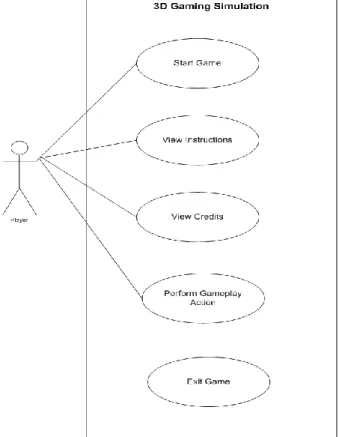
This section further elaborates the analysis and design methods. The proposed system intends to use OOADM due to its data orientation. Object Oriented Analysis and Design (OOAD) is used through its various Unified Modelling Language (UML) diagrams. The goal of object-oriented design (OOD) is to design the classes identified during the analysis phase, the user interface and data access and illustrate the relationships and the responsibilities that these different classes have. A class diagram can be used to bring out the graphical output of the relationships between these classes. Fig. 1 presents the main use case diagram.
www.ijcit.com
378
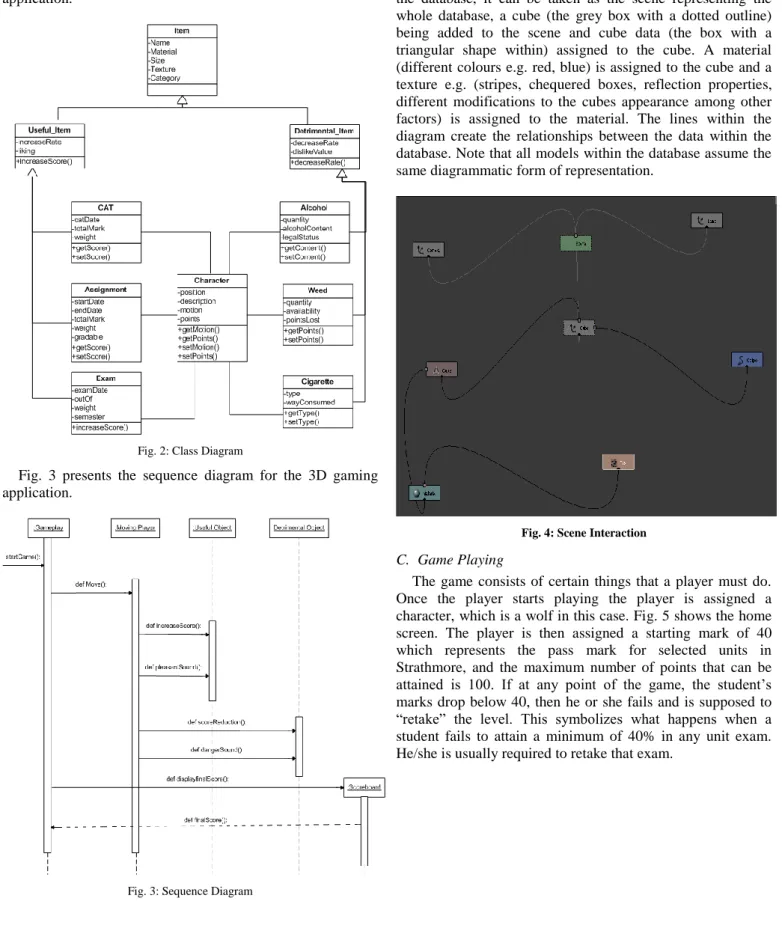
Fig. 2 presents the class diagram for the 3D gaming application.
Fig. 2: Class Diagram
Fig. 3 presents the sequence diagram for the 3D gaming application.
Fig. 3: Sequence Diagram
Fig.4 shows the interaction between scenes. For clarity of the database, it can be taken as the scene representing the whole database, a cube (the grey box with a dotted outline) being added to the scene and cube data (the box with a triangular shape within) assigned to the cube. A material (different colours e.g. red, blue) is assigned to the cube and a texture e.g. (stripes, chequered boxes, reflection properties, different modifications to the cubes appearance among other factors) is assigned to the material. The lines within the diagram create the relationships between the data within the database. Note that all models within the database assume the same diagrammatic form of representation.
Fig. 4: Scene Interaction C. Game Playing
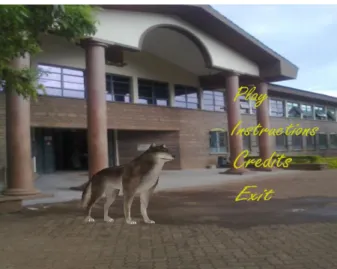
The game consists of certain things that a player must do. Once the player starts playing the player is assigned a character, which is a wolf in this case. Fig. 5 shows the home screen. The player is then assigned a starting mark of 40 which represents the pass mark for selected units in Strathmore, and the maximum number of points that can be attained is 100. If at any point of the game, the student’s marks drop below 40, then he or she fails and is supposed to “retake” the level. This symbolizes what happens when a student fails to attain a minimum of 40% in any unit exam. He/she is usually required to retake that exam.
www.ijcit.com
379 Fig. 5: The Opening Screen
So how does one attain points in the game? There are certain hidden documents in the game that symbolize the assignments, Continuous Assessment Tests (CATs) and exams that usually enable a student to score marks. Once the player finds any document in the game, he/she is assigned marks. Assignments are the easiest to find and usually carry the least marks. In this case, it is about 2 points. CATs are even harder to find in the game and they contribute to 5 points. The hardest to find are exams and they contribute to 10 points. The search for these documents shows that for a student to attain marks, they don’t come easy. They have to be earned. Additionally, it also symbolizes, that assignments and CATs are more easily done than exams as exams are the hardest to find in the game, while assignment and CATs are more easily accessible. Fig. 6 and Fig. 7 present the game play progress models that are subsequent to the first scene. Fig. 8 shows a Game-play scene with the wolf running across a corridor.
Fig. 6: A Game-play progress model scene representing a university section of focus.
Fig. 7: A Game-play progress model scene representing a university main entrance.
Fig. 8: A Game-play scene with the wolf running at the stairs that leads to the FIT section
The direction of the game is also controlled by the differences in the points that a person attains from assignments, cats and exams. The weighting or degree of influence shows that assignments in the school actually contribute fewer marks than CATS, while exams actually contribute the most.
There are also obstacles within the game that can cause the player to drop in points. Such are objects such as alcohol, cigarettes and weed which when accidentally picked, cause a drop in points. A drug like cocaine for instance can lead to a drop in 10 points. This symbolizes how a certain things are detrimental student life and how they can lead to a drop in grades. It might also not be easy to avoid them as they may be placed near assignments, exams or CATS and picked up accidentally. That difficulty to avoid them is a symbolism of the difficulty to avoid temptation to detrimental substances by some students and it also adds some challenge to the game.
Once the player feels that they have attained certain marks within the game and cannot survive any longer to maintain this due to the various variables that are bound to reduce the cumulative score such as weed and alcohol, they are supposed to flee to a certain exit point in the game and given merit based on the points they were able to score and maintain.
www.ijcit.com
380
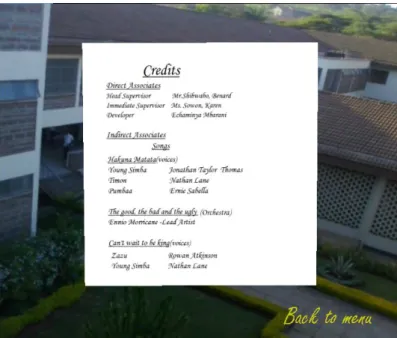
The game also contains instructions and credits. Credits contain information on those who were involved in the making of the game either directly or indirectly e.g. developer (see Fig. 9), those who sang the music that was used in the game, and so on. Exit basically terminates the application.
The following section presents sample code that enables movement of the character (wolf):
from bge import logic from bge import events #import aud def Player(): cont = logic.getCurrentController() obj = cont.owner motion = cont.actuators['Motion'] key = logic.keyboard.events kbleft = key[events.LEFTARROWKEY] kbright = key[events.RIGHTARROWKEY] kbup = key[events.UPARROWKEY] kbdown = key[events.DOWNARROWKEY] def Init():
if not 'init' in obj: obj['init'] = 1 def Update(): movespd = 0.9 mx = 0.0 my = 0.0 if kbleft > 0: mx = movespd if kbup > 0: my = -movespd elif kbdown > 0: my = movespd motion.dLoc = [mx, my, 0.0] cont.activate(motion) Init() Update()
Fig. 9: A Credits Scene
IV.SUMMARYANDCONCLUSIONS
In summary, the development of gaming systems is an interesting and innovative way to solve real world problems such as simulation matters, educational matters and so on. This paper presents a combination of gaming, simulation and moral values in an effort to solve an existing challenge which is lack of first-hand experience. The solution has been demonstrated by the 3D simulation gaming system that forms the key output presented in this paper.
The idea is with no doubt a great way of facing the reality. It is therefore recommended that more effort is directed towards the use of this approach in trying to solve real world problems.
The design of the phase 1 wing of the institution was achieved while other parts of the institution particularly the student centre were not included in the project. It is therefore also recommended that further work may be done to help improve upon the project or work towards developing similar projects in future in various institutions globally.
ACKNOWLEDGEMENT
We would like to thank Strathmore University for facilitating the project process. Further thanks to the National Commission for Science & Technology and Innovation (NCSTI), Kenya for the research support.
REFERENCES
[1] Bart (2008). Fish Population Data Visualisation, Internships at Great Northern Way Campus, Vancouver Retrieved February, 2012, from http://www.blendernation.com/2008/04/09/fish-population-data-visualisation-internships-at-great-northern-way-campus-vancouver/ [2] Game, lifeisjustagame.com (2011) http://lifeisjustagame.com . [3] Griffiths, M.D. (2010). Adolescent video game playing: Issues for the
classroom. Education Today: Quarterly Journal of the College of Teachers, 60(4), 31-34