Multi-sided platforMs:
current state and future research
S. A. YAblonSkYGraduate School of Management, St. Petersburg State University, Russia
In the digital age traditional ways of doing business have been transformed by a group of new platform-driven companies like Facebook, Amazon, Uber, Airbnb and some others. This relatively new digital economy research phenomenon requires inclusive understanding. The paper explores and questions platform research in the context of digital MSPs. It provides main definitions and discusses the concept of digital platform stack framework. The charteristics, advantages and disadvantages, opportunities and threats associated with the ac-tivities of digital platforms have been considered. The paper systematizes current research with a focus on the platform digital transformation, strategy, business models and architecture and suggests agenda for future research.
Keywords: business platform, technology platform, multi-sided platform, platform business model, platform stack.
JEL: O31, O32.
Postal Address: St. Petersburg State University, Graduate School of Management, 3, Volkhovskiy per., St. Petersburg, 199004, Russia.
© S. A. Yablonsky, 2019
https://doi.org/10.21638/spbu18.2019.407
17(4): 519–546 (2019) 17(4): 519–546 (2019)
introduction
Over recent decade there has been a rapid global transition from industrial to digital economy [Judah, 2016]. Digital transfor mation (DT) and resultant business model innovation have fundamentally altered con sumers’ expectations and behaviors, pres sured traditional firms and disrupted nu merous markets. DT of enterprises across industries is an emerging phenomenon. At a high level, DT covers the intense chang
es taking place in society and industries through the use of digital technologies [Vi al, 2019]. At the organizational level, it has been contended that firms must find means to innovate with new technologies by creat ing “strategies that embrace the implica tions of digital transformation and drive better operational performance” [Hess et al., 2016, p. 123]. Im ple men tation of the DT strategy as well as chang0es to an or ganization, including its structure, pro cesses and culture, requires bringing in
the capability to generate new paths for value creation [Vial, 2019]. Trans for ma tion processes involve technologies, firms’ capa bilities and interrelationships between the technology providers and recipients. The process also needs efforts and resources to demote the business, organizational, cul tural and market boundaries. Thus, platform DT related with platform intermediaries con stantly take charge of bridging this kind of communication gaps [Yab lon sky, 2016b].
Now platforms have become an important economic force with a total market value of $4.3 trl and an employment base of at least 1.3 mln direct employees and millions of others indirectly employed [Evans, Ga wer, 2016]. The regional surveys [Evans, 2016; DavidWest, Evans, 2016] identify 62 major platform companies operating across Asia with a market capitalization of $800 mln or more and 42 platform companies operat ing in 33 Afri can countries. The market value of the 62 Asian companies now exceeds $1.1 trl and has a powerful growing influ ence on shaping markets throughout the region and worldwide. Platforms are increas ingly prevalent: 16 of the 25 most valuable brands for 2014 function as platforms [Tau be, 2014]. P. Evans and A. Gawer stated that platform businesses can be found in a grow ing number of industries including social networking (Face book, Link ed In); Internet auctions and retail (Ama zon, eBay, Angie’s List); online financial and human resource functions (Work day, ElanceoDesk, Free lan cer, Work Fusion), urban transportation (Uber, Lyft, Sidecar), mobile payment (Ma ha la, Square) and clean energy (Sungevity, SolarCity, Ener NOC) [Evans, Gawer, 2016]. Airbnb or Uber threaten to disrupt well established industries like taxi or hospital ity services using platformdriven business model. It is stated that platforms facilitate generation of a potentially very large num ber of complementary innovations by tapping into the innovative capabilities of many ex ternal economic agents (actors) and function as a technological foundation at the heart of innovative business ecosystems [Tiwana,
2014; Jacobides et al., 2018]. P. Evans and A. Gawer have shown that platform compa nies are now visible global phenomena: they operate not only in advanced industrial mar kets, but throughout the entire world thanks to the growing availability of mobile digital technologies and In ter net [Evans, Gawer, 2016].
M. Cusumano, A. Gawer and D. Yoffie di vide all platforms into three types [Cu su ma no, Gawer, Yoffie, 2019]:
1. innovation platforms enable thirdparty firms to add complementary products and services to a core product or technology (examples: Google Android, Apple iPhone operating systems or Ama zon Web Ser vices);
2. transaction platforms enable the exchange of information, goods, or services (ex amples: Amazon Marketplace, Airbnb, or Uber);
3. hybrid platforms (emerging type). They prove that five of the six most valu able firms in the world are built around these types of platforms [Cusumano, Gawer, Yof fie, 2019]. In their analysis of data going back 20 years, they identify 43 publiclylist ed plat form companies in the Forbes Global 2000. Authors assert that “these platforms generated the same level of annual revenues (about $4.5 billion) as their nonplatform counterparts, but used half the number of employees. They also had twice the operat ing profits and much higher market values and growth rates” [Cusumano, Gawer, Yof fie, 2019].
In order to provide managerial guidance for platform DT, research needs to enhance understanding of how firms can achieve a sustain able competitive advantage by build ing on specific platform resources, which strategies they should adopt to win, and how the firm’s internal organization struc ture must change to support these strategies [Ver ho ef et al., 2019].
This paper contributes to existing discus sions on platform DT, strategy, business models and architecture by taking a multi disciplinary focus. We outline existing views
on digital platform transformation from the industrial organization (IO) economics, tech nology management and strategic manage ment perspectives. Using this review as a basis, we propose a future research agen da in the multiple domains that focuses on the influence of technological innovations on the emergence of the platforms.
Our review of the economic literature and the evidence on the progress of platforms provides considerations on the themes and directions of research. Such work can help policy makers and businesses to foster better understanding of digital platform develop ment in developed and emerging markets.
The paper is organized as follows: first, we introduce main platform DT defenitions and the platform conceptual framework, the methodology for which is explained in the following section; next, we discuss the main findings of platform research; finally, we propose an agenda for future research and conclude our findings.
defininG diGital platforMs
Multisided platforms have existed for years. For example, offline malls link con sumers and merchants, paper newspapers connect subscribers and advertisers. For several decades, scholars have discussed plat form concepts from a nondigital worldview. The fundamental insight that there is a broad class of businesses of this sort that have economic features not well explained by standard textbooks was presented by [Ro chet, Tirole, 2003]. Scholars have studied market power in twosided markets since the 1980s [Ro chet, Tirole, 2003; 2004; 2006]. A. Ga wer and M. Cusumano investigated how companies could compete through platforms [Ga wer, Cusumano, 2008]. J. Mo ore and co authors proposed strategic shift from com petition towards coopetition around a shar ed niche [Moore et al., 1997]. Recent books [Ti wa na, 2014; Evans, Schma lensee, 2016; Parker et al., 2016] specify how platforms are shaping business and business models
and actually are transforming entire econ omies. Plat form research is generally for malised both within the industrial innova tion management literature [Gawer, 2014; Tho mas, Autio, Gann, 2014] and the eco nomics literature [Parker, Van Alstyne, 2005]. The MPS literature is now regularly cit ed by competition authorities and courts [Evans, Schma len see, 2018]. These busi nesses pose novel problems for competition policy [Evans, 2003; Evans, Schma len see, 2016; 2018].
Platforms can take a variety of forms. There are many ways to categorize them. One typology of platforms is proposed by P. Evans and A. Gawer (Fig. 1).
Another classification is based on the struc ture of platform ecosystem and control. All platforms represent ecosystem with the same basic structure, comprising the fol lowing types of economic agents roles [Par ker, Van Alstyne, 2014; Van Alstyne, Parker, Choudary, 2016]:
1) owners of platforms or platform sponsors
control their intellectual property and governance. The owner sets the direction, controls the underlying platform technol ogy and provides the overall organizing structure for the platform via rules, gov ernance and ecosystem support. It can facilitate the ecosystem work by helping participants see how they are better off by being part of the system rather than outside of it. This role can be performed by one or many firms in alliances what is typical for sharing or collaborative economy [Como et al., 2016];
2) platform providers operate as a platforms’ interface with users. The platform pro vider defines common components, rules and architecture for the users of the plat form. This role can be done by one or many firms;
3) users (supply side) or producers create their offerings. These are content and application developers. Producers provide specific items that attract users to the platform — music, videogames, informa tion, services, etc.;
4) users (demand side) or the target con sumers of the platform solutions and services use producers’ offerings. They can be individuals or organizations. A. White showed that large body of em pirical work examines substances including [White, 2018]:
• regulation of online privacy (e. g. [Gold farb, Tucker, 2011]);
• contexts in which users substitute be tween online and offline platforms (e. g. [Goldfarb, Tucker, 2011]) and the effect of such substitution on broader social trends (e. g. [Gentzkow, Shapiro, 2011]);
• the dynamics of social behaviour in large online communities (e. g. [Zhang, Zhu, 2011]) and the ways in which online sell ers experiment (e. g. [Einav et al., 2011; Levin, 2012]).
Most of today’s platforms are principal ly digital (or online) [White, 2018; Menon et al., 2018]. They capture, transmit and monetize data, including personal data, over the Internet and other networks [Evans, Gawer, 2016]. They may not be purely dig ital, but most successful digital platforms currently take advantage of the digital in novations and power of pervasive Internet Transaction platforms Innovation platforms Integrated platforms Investment platforms Platform сompanies
A transaction platformis a technology, product or service that acts as a conduit (or intermediary) facilitating exchange or transactions between different users, buyers or suppliers.
es: Airbnb, Baidu, eBay, Netflix, Tencent, Yahoo, Uber
Compani
An innovation platformis a technology, product or service that serves as a foundation on top of which other firms (loosely organized into an innovative ecosystem) develop complementary technologies, products or services.
: Intel, Microsoft, SAP, Oracle Companies
An integrated platformis a technology, product or service that is both a transaction platform and an innovation platform. This category includes companies such as Apple, which has bot
matching platforms like the Apple App Store and a large third-party developer ecosystem that supports content creation on the platform.
: Alibaba, Amazon, Apple, Google, Facebook
h
Companies
Investment platformsconsist of companies that have developed a platform portfolio strategy and act as a holding company, active platform investor or both.
: Softbank, Naspers, Priceline Companies
Fig. 1. Platform typology
connectivity in the hand of millions of users. Platform technologies are essential for co ordinating suppliers and buyers to deliver consumer value. Facebook is a type of plat form that coordinates suppliers and consum ers of social information.Without a social media platform such as Facebook, it would be much more difficult and costly for people to exchange social information. Although concepts and notions can be borrowed from these streams of platform literature, digital platforms are particularly different in nu merous ways [White, 2018; Yablonsky, 2018a; 2018b]. A platform provides common stan dards, interfaces and tools to power core technologies in order to increase the pro ductivity and profitability of a company, a set of companies or users [Teece, 2010].
A successful MSP usually creates a net work of the relationships among economic entities (producers, stakeholders, distribu tors, consumers, government agencies, etc.) that, through competition and/or coopera tion, facilitate the creation and distribution of a platform product or service. The platform ecosystem metaphor could be used to describe such platform network that is characterized by open, flexible, demanddriven, interactive networked architecture and collaborative en vironments [Gawer, Cusumano, 2014]. The ecosystem concept is of increasing signifi cance in the field of the enterprise manage ment, system design and business architec ture. Starting from Moore’s work [Moore, 1996], the ecosystem concept has been ac tively discussed in management studies. The coevolution of the ecosystem is typically reliant on the technological leadership of one or two firms that provide a platform around, which other system members that provide inputs and complementary goods align their investments and strategies with [Parker, Van Alstyne, Jiang, 2017]. For some social and crowdfunding digital platforms creation of the digital ecosystem is a critical success factor for positive platform dynamics.
The operating models and capabilities of the generation of “born digital” platform organizations founded after 1995 are based
on exploiting digital technologies and tech nological platforms as a core competency. They are:
• not just startups (Amazon and eBay are 25 years old);
• not just small (Google has about 100000 em ployees);
• not just pure digital businesses (Tesla Motors makes cars);
• not just American (Alibaba Group is Chi nese, Yandex and Mail.ru Group are Rus sian).
Digital platform strategy becomes extre me ly complex as firms consider dynamic interactions of a multilayered business eco system [Teece, 2012]. The concept of plat form innovation can be widely defined as architecting new platform strategies and business models (or BM), making and pro moting new platform products and services, developing new platform processes to fa cilitate platform activities, to interact with platform actors and to design new platform structures for industry institutions [Lei blein, 2015; Yab lon sky, 2018a; 2018b]. For example, today simplified Ama zon platform business model portfolio consists of 10+ dif ferent business models, including Ama zon digital market place, Amazon Web Services (AWS) — Cloud Com puting Services, Ama zon Fire TV and others.
Unlike a traditional business, with clear internal and external structures, a platform provides business with a foundation where resources can come together in different combinations in order to create value. Some resources may be inside, permanently owned by the platform; some may be shared; and some can come from an outside ecosystem. The value comes largely from dynamic con nection of those resources, different actors and network effects between them. The plat forms exponentially grow creating large systems of information technologies, busi nesses and people [De Reuver, Sørensen, Basole, 2018]. Plat form providers such as Google, Facebook, Amazon, Alibaba and eBay are transforming the Internet into de facto closed domains, implying that all relevant
interactions take place outside the view of researchers [Eaton et al., 2015].
There is a rising interest in multisided platforms (MSPs) in the scholarly literature [McIntyre, Srinivasan, 2017]. Digital tech nological platforms are altering phenomena over the entire IS domain [De Reuver, Sø ren sen, Basole, 2018]. Architectures of plat form artefacts are changing as the modu larity of digital platforms is replacing tra ditional monolithic approaches [Tiwana, Kon syn ski, Bush, 2010]. As digital plat forms are competing on multiple levels of the technical and business architecture, spe cifying the appropriate unit of analysis is becoming increasingly difficult [Yab lon sky, 2018a; 2018b]. To architect a digital plat formbased business, organizations must lead their business to take a business driv en, outsidein approach.
The enterprise architecture (EA) frame work is a set of assumptions, concepts, val ues and practices that establishes a way of looking at enterprise via views on architec tural models [Bente, Bombosch, Shailendra, 2012]. EA relates to the practice of business optimization that addresses business archi tecture, performance management, organi zational structure and process architecture. It consists of describing the current and future structure and behavior of an orga nization’s processes, information systems, per son nel and organizational business units so they align with the organization’s stra tegic direction, going beyond information technology. At the same time Industry 4.0 that refers to the combination of several major innovations in digital technology that are hovered to transform the energy and manufacturing sectors and the industrial Internet of Things (IoT) enable powerful new ways of organizing global operations, plat form business model design and innovative multilayered EA. Today, there exist a num ber of EA frameworks with the goal of ad dressing the basic challenge of assessing, aligning and organizing business objectives with technical requirements and strategies. Examples include the Zachman En terprise
Framework, The Open Group Ar chitecture Framework, OMB Federal En terprise Ar chi tec ture and The Gartner Me thodology [Ben te, Bombosch, Shailen dra, 2012]. Be fore enterprise can configure, build or restruc ture a platform using such EA frameworks, it must put down comprehensive plan to ensure that the essential BM portfolio, plat form capabilities and resources are present, technologies are both compatible and useful and the proper infrastructure is in place to support the EA framework [Bente, Bom bosch, Shailendra, 2012].
Drawing on existing knowledge in the field of platform BM patterns [Osterwalder, Pigneur, 2010; Osterwalder et al., 2014; Blosch, Burton, 2016; Blaschke et al., 2017a; 2017b] and platform research [Evans, Ga wer, 2016], we argue that a me ta structuring perspective serving through the platform landscape represents an important contribu tion that remains missing. The objective of recent research was to create such a meta structuring perspective using a taxonomy enabled methodology to create a consistent structure of the digital platform innovation framework [Yablonsky, 2018a; 2018b]. The paper [Yab lon sky, 2018a] introduces the top down approach of platform EA in the context concept of choosing platform BM, architec ture, capabilities and the obstacles that lie in the way of platform configuration, with the objective of providing a better alignment between business and IT. MSP is usually form ed by a platform architecture with a subset of components (hardware, software, services), rules (technical standards, pro tocols for information exchange, policies and contracts that govern transactions) and a strategy with portfolio of BMs employed by users in most of their transactions. For example, the search MSP building blocks are shown in Fig. 2. As can be seen it has minimum three sides: content providers (who need users), users/searchers (who search for content) and advertisers (who want ac cess to users).
Definitions of core concepts on digital platforms are placed in Table 1.
Affiliation Affiliation
Side A:
Searchers Direct interconnections AdvertisersSide B:
Side C: Content providers Direct inte rconnections Direct inter connections Architecture: Data centers Cloud, social and mobile network infrastructures Components: Hardware Software Services Rules: Standards Protocols Policies Contracts Strategy & BM: Implementation Platform design Mobilization Monetization Bundling Envelopment Three-sided search platform
Affiliation
Fig. 2. Example: Search MSP building blocks
B a s e d o n: [Yablonsky, 2013; 2016a].
Table 1 definitions of core concepts on business platforms
concept definition
1 2
Multisided platform
(organizational view) Multisided platform is an organization that creates value primarily by enabling direct interactions between two (or more) distinct types of affiliated customers
[Hagiu, Wright, 2015]. MSP mediates different groups of users, such as buyers and sellers. MSPs reduce transactions costs and thereby facilitate valuecreating interactions between two or more different types of economic agents [Evans, Schmalensee, 2018]. D. S. Evans and R. Schmalensee argued that:
• MSPs are most often created and operated by private forprofit firms. Apple’s
iPhone operating system, for instance, is a twosided platform linking app de velopers and consumers;
• some MSPs have been the products of nonprofit entities (Visa and MasterCard,
for instance, were effectively nonprofit cooperatives for many years);
• few MSPs have been created by governments (this describes national currencies).
MSPs play critical roles in many economically important industries including payments, communications, financial exchanges, advertisingsupported media, operating systems and various internetbased industries such as online market places and ridesharing apps [Evans, Schmalensee, 2018]
Multisided markets According to the definition of previous studies [Evans, Hagiu, Schmalensee,
2006; Hagiu, Wright, 2015; Evans, Schmalensee, 2018], a multisided market exists, when at any point in time, there are:
• two or more distinct groups of customers;
• the value obtained by one kind of customers increases with the number
of the other kind of customers; and an intermediary is necessary for internal izing the externalities created by one group for the other group
Table 1 (continued)
1 2
Technology platform Technology platform is defined as building blocks that act as a foundation upon
which an array of firms (a business ecosystem) develop complementary products, technologies or services [Gawer, 2009], implying the following requirements for a platform:
• it should perform a critical function of the overall system or should solve
a crucial technological issue of an industry;
• it should be easy to connect to “build upon” and provide space for new and un
planned usage.
There are two main groups of technological platforms: product/service plat forms and network platforms
Network
technological plat form
A network technological platform or network platform is usually based on digital network(s) building blocks [Hagiu, Wright, 2015]. Network platforms differ from product platforms because of stronger network effects, switching costs and multihoming costs
Main platform economic agents (actors)
Customers, Partners, Emploees, Smart things/Smart machines
Multisided platform ecosystem
Platform ecosystem contains a number of firms and other institutions that work together to create and sustain new markets and new products [Teece, 2012]. An ecosystem may be anchored by a MSP. The coevolution of the ecosystem is typically reliant on the technological leadership of one or two firms that provide a platform around, which other system members that provide inputs and comple mentary goods align their investments and strategies with
Ecosystem
(organizational view) Collection of economic agents interacting with a contribution to the complements
Ecosystem
(technical view) A collection of complements (apps) to the core technical platform, mostly supplied by third party
Network externalities
(effects) A MSP creates value by coordinating the multiple groups of agents and, in particular, ensuring that there are enough agents of each type to make
participation worthwhile for all types [Evans, Schmalensee, 2018].
The value of the platform depends on the number of users in the same user group. That is called direct network externalities or effects.
In many cases, greater involvement by economic agents of at least one type increases the value of the platform to agents of other types. Such indirect network effect (externality) function something like economies of scale
on the demand side, tending to make larger platforms more attractive to poten tial customers [Evans, Schmalensee, 2018]
MSPs in the context
of digital business MSPs in the context of digital business exist at many levels. They range from highlevel platforms that enable a platform business model to lowlevel platforms that
provide a collection of business and/or technology capabilities that other products or services consume to deliver their own business capabilities. Platforms that enable a platform business model have associated business ecosystems. They typically expose their capabilities to members of those ecosystems via APIs. Internal platforms also expose their capabilities via APIs. But they may offer other mechanisms, such as di rect data access, as required by the products that consume them
Applications (apps) Executable pieces of software that are offered as apps, services or systems
to endusers
Boundary resources Software tools and regulations facilitating the arms’ length relationships between
fraMeWorK for sYsteMatic
platforM innoVation and
ManaGeMent
While studying digital platforms is already challenging as a consequence of their dis tributed nature [Constantinides, Hen frids son, Parker, 2018], developments in the bu siness environment pose even larger re search challenges for researchers. To man age digital platform business model (BM) portfolios and multilayered platform busi ness ecosystems, companies are creating a digital platform stack to share critical assets. The variance in company’s digital business performance is a function of dif ferences in the platform resources and ca pabilities of competing companies.A digital platform is a businessdriven framework that allows a community of partners, pro viders and customers to share and enhance digital processes and capabilities or to ex tend them for mutual benefit [Burton, Ba siliere, 2016]. This framework allows dif ferent combinations of BMs, leadership, talent, delivery and IT infrastructure plat forms that power digital business ecosys tems. There has been a growing interest in utilizing more than one methodology and method possibly from different spheres of thought within the same intrusion of dig ital economy and digital platforms. R. Flood and M. Jackson mentioned that enormo usly complex, multidimensional and ill structured problems that comprise social, behavioral, coercive, exploitative and ma nipulative components require such com binations and perennially preoccupied con temporary systems thinkers to develop different and independent endeavours and competing orientations [Flood, Jackson, 1991]. Authors propose a theoretically and
practically improved version of Total Sys tems Intervention as a sophisticated alterna tive, in a far more detailed and penetrating manner and assess its flexibility, responsive ness and sustainability in multimethodolo gy interventions.
In digital platform business, business and technology are complicated. To model a di git al business, managers must under stand what is needed for a business to achieve its goals and how these goals trans late into actionable strategy. A digital plat form business requires much more than technology (e.g. leadership, talent, skills and new BMs). A digital MSP is a business driven framework that allows a commu nity of partners, providers and customers to share and enhance digital processes and capabilities or to extend them for mutual benefit [Burton, Basiliere, 2016]. This frame work allows different combinations of BMs, leadership, talent, delivery and IT infra structure platforms that power digital bu siness ecosystems. A. Osterwalder defined a BM as “a conceptual tool that contains a set of elements and their relationships and allows expressing the business logic of a specific firm [Osterwalder, 2004]. It is a description of the value a company offers to one or several segments of customers and the architecture of the firm and its network of partners for creating, marketing and delivering this value and relationship capital, to generate profitable and sustain able revenue stream”. BM is a useful lens for understanding a company’s fundamen tal value creation logic. Currently, the in terpretation of BMs as formal conceptual representations/ descriptions becomes pre dominate [Osterwalder, 2004; Gassmann, Frankenberger, Csik, 2014]. A. Osterwalder and I. Pigneur have developed the popular Table 1 (continued)
1 2
Platform openness The extent to which platform boundary resources support complements
Digital MSP disrup tion
It is a process of changing multisided markets through digital capabilities, channels and assets. Digital business innovation forms disruptive platform effects
Business Model Canvas, taxonomy of nine main BM building blocks [Osterwalder, Pig neur, 2010] (Fig. 3).
We use Business Model Pattern (BMP) concept developed by [Osterwalder, Pigneur, 2010; Gassmann, Frankenberger, Csik, 2014; Remane et al., 2017; Yablonsky, 2018a; 2018b] as a way of structuring platform digital value drivers and platform BMP. We provide MSP BMP as a basic conceptual framework and knowledge management tool for describing, analysing and interpreting nonprice instruments used by digital plat forms, especially platform intermediaries. Using the MSP BMP as the basis of the digital intermediaries’ analysis and decision making, we update this pattern for each industry. A platform BM is a useful lens for understanding the company’s platform underlying logic because it explains what value is provided, how this value is created and delivered and how profits can be gener ated therefrom.
This concept helps to understand the capturing value from technological innova tions and platforms [Chesbrough, Ro sen bloom, 2002; Osterwalder, Pigneur, 2010; Osterwalder et al., 2014], the boundaries of a firm [Zott, Amit, Massa, 2010], and create a direct connection between business
strategy and business processes [AlDebei, Avison, 2010]. Therefore, we replace basic platform dimensions with platform BM pat tern dimensions based on platform expanded results of previous studies [Remane et al., 2017; Yablonsky, 2018b] (Appendix 1).
Recent platform research initially looks for constructing the conceptual foundations and requirements of an appropriate multi methodology digital platform approach. It aims for a multidimensional multilayered business platform framework development in order to facilitate understanding, analy sis and structure of business and digital platform integration for enterprises and industries. This approach proved particu larly beneficial for the field due to the cur rent lack of systematic empirical analysis from digital platform management research. The development is guided by the approach of Nickerson, Upkar and Muntermann [Nic ker son, Upkar, Muntermann, 2013] and fore sight methodology [Thom, 2010], which fa cilitates the iterative combination of con ceptualtoempirical and empiricaltocon ceptual approaches.
Following key dimensions of platform framework are selected [Yablonsky, 2018b]: 1) basic platform dimensions (components,
rules strategies); Key partnerships Key activities Key resources Value creation Value capture Revenue streams Cost structure Value proposition Value delivery Value propositions Channels Customer segments Customer relationships Business model
Fig. 3. Business model building blocks with metacomponents
2) additional platform players or economic agents or sides dimensions (producers, consumers, providers, owners);
3) innovation technology dimensions (inno vative dynamic digital key elements). Dimensions of platform frameworks have become popular to describe the convergence of innovation technologies [LeHong et al., 2016; LeHong, 2019]. In particular, we re fer to different approachers with different stage of granularity: from simplified four dimensions (social, mobile, analytics, cloud and IoT to SAP Digital Key Elements from BMDI: SAP Business Model Innovation Me tho dology [Oswald, Kleinemeier, 2017], IDC Innovation Accelerators and thirdplatform concept [IDC, 2017] and dynamic Gartner Top 10 Strategic Technology Trends 2018– 2020. For example, innovation technology dimensions may include cloud computing, mobile technologies, Big Data, IoT, Artificial Intelligence and other.
Every firm has tangible and intangible business assets (processes, human talent, technologies, infrastructure and informa tion) that can be used or developed to bring the digital business platform to life [Burton, Basiliere, 2016]. As it was mentioned [Yab lon sky, 2018a; 2018b], multisided business platform is usually a subset of components (hardware, software, services), rules (tech nical standards, protocols for information exchange, policies and contracts that govern transactions) and strategy/BMs building blocks employed by users in most of their transactions. R. Hunter and M. Coleman stat ed that “in the context of digital busi ness, a platform is an architecturally in novative means of sharing assets such as algorithms, data and functions with eco systems of people, businesses and things. A platform typically includes tools, func tions and support for multiple customer segments (e. g., buyers and sellers; students, faculty and administrators)” [Hunter, Co leman, 2016]. With new digital BMs, re sources may be added or combined in new and different ways to support the digital platform strategy or an organization may
start with a set of resources applied across the entire business or apply specific assets in a few areas.
The business and technology platform stacks constitute digital platform stack [Yab lon sky, 2018a; 2018b] (Fig. 4, Appendix 2).
Business platform stack includes BM and leadership platform, talent platform, deliv ery platform, promotion platform and oth er. Technology platform stack related to in novation technologies involves information systems platform, customer experience plat form, data and analytics platform, IoT plat form, ecosystems platform, trust platform, integration platform and other.
The digital business platform stack is intended to provide a higher level overview of the key capabilities necessary to assemble a digital business platform stack. With dig ital platform business models organised in BM portfolio, platform assets may be added or combined into new and different ways to support the digital platform strategy [Le Hong et al., 2016; LeHong, 2019]. Delivering digital platform requires new capabilities to enable, support and evolve digital busi ness [Burton, Basiliere, 2016].
A platform BM is a useful lens for un derstanding the company’s platform under lying logic because it explains what value is provided, how this value is created and delivered and how profits can be generated therefrom. This concept helps to understand the capturing value from technological in novations and platforms [Chesbrough, Ro sen bloom, 2002; Osterwalder, Pigneur, 2010; Osterwalder et al., 2014], the bound aries of a firm [Zott, Amit, Massa, 2010] and create a direct connection between busi ness strategy and business processes [Al Debei, Avison, 2010]. Platform BM portfo lio management is an important manage rial function [Osterwalder, Pigneur, 2010; Hagiu, 2014]. It involves the ongoing mon itoring of the activities that encompass the BM and of the incentives of all the stake holders who participate in the BM. BM management thus could be viewed as a part of a firm’s ordinary capabilities (in terms
of the daytoday performance of activities) and requires dynamic adaptation and trans formation.
Business platform stack
Business platforms stack is to large extent related to platform capabilities [Teece, 2010]. The key roles of a BM and leadership platform are to collect dispersed sources of knowledge, to recombine the collected know ledge in order to empower innovation and management and to transfer it to new tech nological and organization contexts.
The goal of a talent platform is to fa cilitate knowledge exchange in BM and lead ership environments and to offer affiliated economic agents the opportunity to access large intra ecosystem or ecosystem commu nities of economic agents with experiential, educational or professional knowledge in company’s diverse geographical and disci plinary fields [Boudreau, 2010; Boudreau, Lacetera, Lakhani, 2011; Colombo et al., 2013; Colombo, Dell’Era, Frattini, 2015; Evans, Gawer, 2016]. A talent business plat form creates value primarily by enabling direct interactions between two (or more)
2. Talent platform 3. Delive ry platform 4. Promotion platfor m 5. Technlogy infr astructur e platform s Business model 2
Business model 1 Business model 3
Enterprise
Ecosystem
1. Business model and leade
rship platform
Fig. 4. Digital platform stack
distinct types of affiliated talent consumers. The talent business platform is at the centre of the enterprise’s relationship with talent. How can enterprise acquire and keep top talent in the age of digital business? In the relationships with top talent, enterprise can use marketers’ tools and analyses. Seeing talent as a customer and employment by the talent platform as a brand promise fulfilled, can improve talent acquisition and retention. Persistent shortfalls in key talent areas show that enterprises have to act now to adapt their talent approaches to the digital world. A talent business platform serves the need of multiple customer segments — including enterprise executives and managers, HR professionals and recruiters and potential or current employees — to create and main tain engagement and evolving relationships between the enterprise and its contributors, internal and external [Hunter, Coleman, 2016]. Examples of sucessful external talent business platform with BM highly related with talent management are LinkedIn Ta lent, SmartRecruiters, Top Cod er, Upwork etc. [Ka ganer et al., 2013]. A key function of the talent platform is data capture and analysis related to talented individuals and talent pools — before, during and after their employment by the enterprise. The talent platform specifically supports an approach to talent that recognizes and leverages the “customer decision life cycle” of explore, evaluate and engage. Treating talent as a customer whose relationship with the en terprise includes a mix of exploration, eval uation and engagement over time is more realistic and fruitful for all involved than treating the acquisition of talent as a trans action.
A delivery business platform creates val ue primarily by enabling direct interactions between two (or more) distinct types of af filiated delivery consumers. Delivery busi ness platforms create and maintain engage ment and evolving relationships between the enterprise and its affiliated delivery consum ers, internal and external. For example, Famous pizza chains like Domino’s, Papa
John’s and Pizza Hut have been investing heavily in food delivery business platform for years. These pizza giants have developed ordering systems for smartwatches, con nected cars and even gaming consoles.
A promotion digital business platform
creates value primarily by enabling direct promotion interactions between two (or more) distinct types of affiliated platform participants — consumers, producers and providers. It provides creating internally managed outbound messages and externally inbounded messages by platform partici pants themselves. A promotion platform influences platform participants — consum ers, producers and providers — to submit multimedia messages, provide different types of activities and promote them on social media and platform ecosystems.
technology platform stack
Technology platforms stack is related to in novation technologies. To manage the new digital BMs and business ecosystems, com panies have to create a digital business plat form to share critical assets. T. Coltman and M. Queiroz stated that a firm’s strategy at the corporate level refers to the set of choic es about how to compete across the different businesses that constitute the corporate profile [Coltman, Queiroz, 2015]. At this level, strategic decisions are made about how technological platforms can support levels of data sharing and business process standardization across business units.
Corporate level strategy is reflected in corporate technological platforms that in clude data, hardware, network, applications and management services that are shared by business units. Thus, a core function of technological platforms is to provide the foundation that allows business units to le verage common factors of production and to promote process synergies where the joint value creation is greater than the sum of the value created by individual businesses. Realizing these synergies requires continuous efforts of alignment to ensure integration
of corporate strategy and corporate techno logical platforms capabilities.
Digital technology platforms are describ ed through the lens of applications and busi ness capability components they support (Fig. 4). There are multiple layers to these technological platforms, which are necessary to effectively implement and integrate it in practice [LeHong et al., 2016]. All capabili ties in the technology platforms’ stack can be sourced from any combination of internal resources or external partners (insourcing, outsourcing, asaservice and cloud sourcing).
The key concepts representing the com ponents of technology platform stack are defined in the Table 2.
future research
Platform companies are important for start ups as well as incumbents. They are becom ing an essential part of national systems of innovation. It was stated [Evans, 2016] that “the world’s largest platform companies are not only earning more patents but are seed
Table 2 definitions of core concepts on technology platforms
concept definition
1 2
The Enterprise Technology Architecture (ETA)
ETA viewpoint defines reusable standards, guidelines, individual parts and configurations that are technologyrelated (technical domains). ETA defines how these should be reused to provide infrastructure services via technical domains Information Systems
Platform (ISP)
Supports the front and back office and operations, such as enterprise resource planning and other core systems
Enterprise Resource Planning (ERP)
ERP is defined as the ability to deliver an integrated suite of business applica tions. ERP tools share a common process and data model, covering broad and deep operational endtoend processes, such as those found in finance, HR, distribution, manufacturing, service and the supply chain.
ERP applications automate and support a range of administrative and operational business processes across multiple industries, including line of business, custom erfacing, administrative and the asset management aspects of an enterprise. ERP deployments are complex and expensive endeavors and some organizations struggle to define the business benefits.
ERP looks for business benefits in four areas: a catalyst for business innovation, a platform for business process efficiency, a vehicle for process standardization and IT cost savings. Most enterprises focus on the last two areas, because they are the easiest to quantify; however, the first two areas often have the most significant impact on the enterprise
Customer Experience
Platform (CEP) Contains the main customerfacing counterparts, such as customer and citizen portals, omni channel commerce and customer apps
Data and Analytics
Platform (DAP) Includes information management and analytical capabilities. Data management programs and analytical applications fuel datadriven decision making and
algorithms automate discovery and action
IoT Platform Enterprises are increasingly connecting a broad variety and number of IoT
endpoints to access data from and better manage physical assets that are relevant to their business. IoT platform сonnects physical assets and smart machines (smart things) for monitoring, optimization, control, analytics and monetization. Capabilities include connectivity, analytics and integration to core and IoT systems
Table 2 (end)
1 2
Industrial IoT Platforms
Gartner defines the market for industrial IoT platforms as a set of integrated software capabilities. These capabilities span efforts to improve asset manage ment decision making, as well as operational visibility and control for plants, depots, infrastructure and equipment within assetintensive industries. These efforts also occur within related operating environments of those industries. The undustrial IoT platform may be consumed as a technology suite or as an open and generalpurpose application platform, or both in combination. The platform is engineered to support the requirements of safety, security and mission critical ity associated with industrial assets and their operating environments. The industrial IoT platform software that resides on devices — such as, controllers, routers, access points, gateways and edge computing systems — is considered part of a distributed industrial IoT platform
Ecosystems Platform
(EP) Supports the creation of and connection to, external ecosystems, marketplaces and communities. API management, control and security are its main elements
Application Programming Interface (API)
API is an interface that provides programmatic access to service functionality and data within an application or a database. It can be used as a building block for the development of new interactions with humans, other applications or smart devices. Companies use APIs to serve the needs of a digital transformation or an ecosystem and start a platform business model
Trust Platform (TP) A blockchain technology used to foster trust
Integration Platform
(IP) Supports the integration of all above platforms that allows the maximum flexibility to support business transformation demands
Marketing
Automation Platform (MAP)
MAP support lead management, scoring and nurturing activities across multiple marketing channels. The main goal of these systems is to convert contacts into scored, nurtured leads for sales teams to close. They assist with data cleansing by eliminating incomplete or redundant lead information and with lead augmen tation by providing additional information about prospects. Lead process manage ment and multichannel orchestration and execution are the primary functions of marketing automation in a B2B or businesstobusinesstoconsumer (B2B2C) context. Digital ad operations platforms are advertising operations and manage ment software for publishers and other sellers of digital advertising that support sales, pricing, optimization, yield management, analytics and delivery of adver tising traffic and assets across multiple digital channels, including online, mobile, signage and new formats for digital TV
B a s e d o n: [Gartner glossary; Yablonsky, 2018b]. ing whole ecosystems of startups in cutting edge areas of machine learning and artificial intelligence”.
A. Hein and coauthors [Hein et al., 2019] summurize that particular challenge for digital platform strategy:
• the chickenandegg problem: the plat form needs both the complementor and the consumer side to ensure a valid val ue proposition, but neither side is willing to join as long as the other side is not populated [Caillaud, Jullien, 2003];
• the multihoming behavior of users by reducing the exclusivity and dominant firm equilibria [Caillaud, Jullien, 2003; Koh, Fichman, 2014]. Digital platforms with a sufficient installed base — so called platform leaders — can use their dominant position in the market to in crease their market share even further [Gawer, Cusumano, 2014];
• platform envelopment to tap into new markets by subsidizing cloudcomput ing services or by using its information
superiority to outcompete internal com plementors [Zhu, 2018];
• intermediate perspective of valuecreat ing mechanisms in the digital platform ecosystem considers the intersection be tween the internal digital platform and the platform owner, the external ecosys tem and the autonomous complementors. A digital multilayered platform stack forms a competitive foundation upon which other firms can develop content, innovate with complementary technologies and create new services [Gawer, 2009; Yablonsky, 2018a; 2018b].
Recently P. Evans argued that “the po litical environment in Europe and the United States may point to a growth in nationalism, but the rapid growth of digital platforms, networks and data business models in fact represents the latest shift in the forces of globalization” [Evans, 2016]. Today it’s dif ficult to disagree with opinion about a sig
nificant change in the platform strategy priorities [MIT, 2019, p. 1]: “A decade ago, platform challenges seemed straightforward and the possibilities seemed endless. Stra te gists focused primarily on reducing trans action costs and on solving basic business problems. After that, they could drive scale and develop a revenue model. The mantra was: Get big fast! Now that platforms are sprawling and prolific businesses, a host of complex and farreaching concerns are on the rise. Governance and regulation are top ofmind for market leaders… In creasingly, providers worry about fraud, hate speech, privacy, security and trolls.”
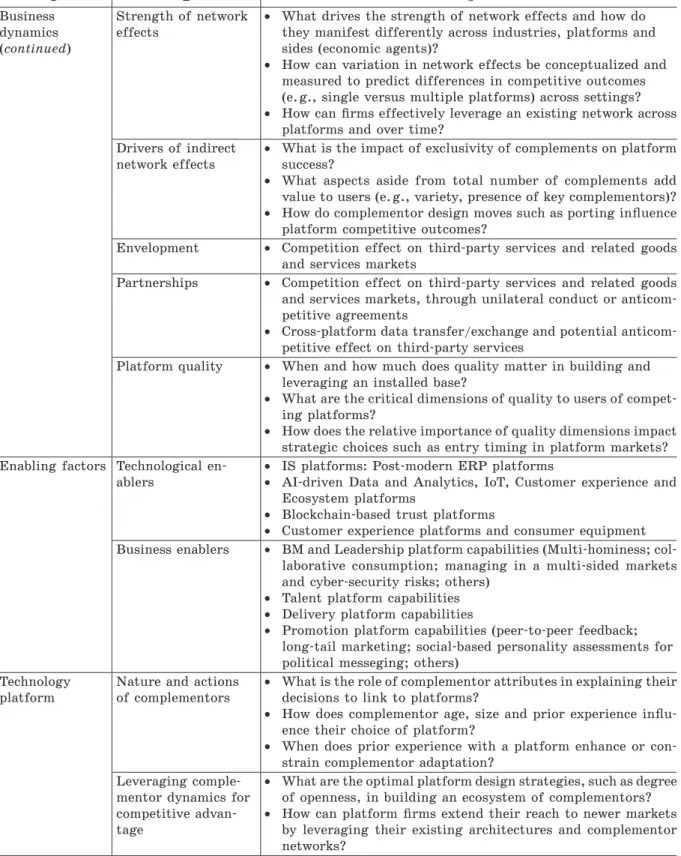
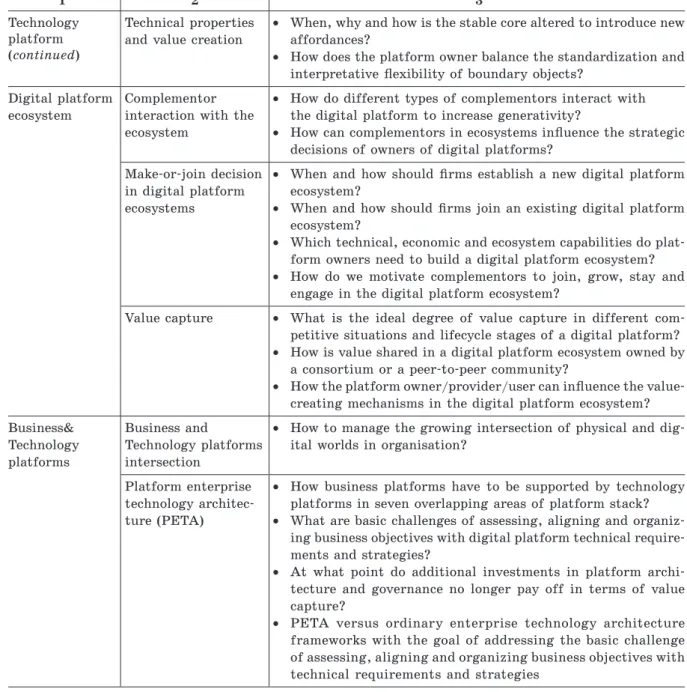
Table 3 summarizes the current state and future research considerations developed in this article and similar prior studies [Parker, Van Alstyne, Choudary, 2016; McIntyre et al., 2017; De Reuver, Sørensen, Basole, 2018; Yablonsky, 2018b; Hein et al., 2019; Vial, 2019].
Table 3 digital platforms research agenda
review area Key elements future research agenda/questions for emerging markets
1 2 3
Definition of
digital platform Economic definition of MSP • • Digital MSP business model industry patterns and portfoliosGlobal and state regulations, polices and standards
• Digital consumer behavior regulations
Functional/technical definition
• Platform stack
• Government platforms (goverenmentasaserviceplat forms)
• Private sector platforms
• Industry platforms
• Crowd in digital government/private platforms
Transactional versus nontransactional
• Testing for possible anticompetitive behavior
Platform regulation and policy concerns
Data protection, data privacy and data portability
• Regulatory, legal and institutional analysis in [emerging]
markets
• Data as essential facility
• Other
Platform
governance Demand side policies • Cost–benefit analysis of demand stimulation policies and interventions
• Other
Business dynamics
Network effects • Winnertakessome vs winnertakes all dynamics
• Interplatform competition and coopetition
• Nondiscriminatory access to the platform from third parties
Table 3 (continued) 1 2 3 Business dynamics (continued) Strength of network
effects • What drives the strength of network effects and how do they manifest differently across industries, platforms and
sides (economic agents)?
• How can variation in network effects be conceptualized and
measured to predict differences in competitive outcomes (e. g., single versus multiple platforms) across settings?
• How can firms effectively leverage an existing network across
platforms and over time? Drivers of indirect
network effects • What is the impact of exclusivity of complements on platform success?
• What aspects aside from total number of complements add
value to users (e. g., variety, presence of key complementors)?
• How do complementor design moves such as porting influence
platform competitive outcomes?
Envelopment • Competition effect on thirdparty services and related goods
and services markets
Partnerships • Competition effect on thirdparty services and related goods
and services markets, through unilateral conduct or anticom petitive agreements
• Crossplatform data transfer/exchange and potential anticom
petitive effect on thirdparty services
Platform quality • When and how much does quality matter in building and
leveraging an installed base?
• What are the critical dimensions of quality to users of compet
ing platforms?
• How does the relative importance of quality dimensions impact
strategic choices such as entry timing in platform markets? Enabling factors Technological en
ablers • • IS platforms: Postmodern ERP platformsAIdriven Data and Analytics, IoT, Customer experience and
Ecosystem platforms
• Blockchainbased trust platforms
• Customer experience platforms and consumer equipment
Business enablers • BM and Leadership platform capabilities (Multihominess; col
laborative consumption; managing in a multisided markets and cybersecurity risks; others)
• Talent platform capabilities
• Delivery platform capabilities
• Promotion platform capabilities (peertopeer feedback;
longtail marketing; socialbased personality assessments for political messeging; others)
Technology platform
Nature and actions of complementors
• What is the role of complementor attributes in explaining their
decisions to link to platforms?
• How does complementor age, size and prior experience influ
ence their choice of platform?
• When does prior experience with a platform enhance or con
strain complementor adaptation? Leveraging comple
mentor dynamics for competitive advan tage
• What are the optimal platform design strategies, such as degree
of openness, in building an ecosystem of complementors?
• How can platform firms extend their reach to newer markets
by leveraging their existing architectures and complementor networks?
Table 3 (continued) 1 2 3 Technology platform (continued) Technical properties and value creation
• When, why and how is the stable core altered to introduce new
affordances?
• How does the platform owner balance the standardization and
interpretative flexibility of boundary objects? Digital platform
ecosystem
Complementor interaction with the ecosystem
• How do different types of complementors interact with
the digital platform to increase generativity?
• How can complementors in ecosystems influence the strategic
decisions of owners of digital platforms? Makeorjoin decision
in digital platform ecosystems
• When and how should firms establish a new digital platform
ecosystem?
• When and how should firms join an existing digital platform
ecosystem?
• Which technical, economic and ecosystem capabilities do plat
form owners need to build a digital platform ecosystem?
• How do we motivate complementors to join, grow, stay and
engage in the digital platform ecosystem?
Value capture • What is the ideal degree of value capture in different com
petitive situations and lifecycle stages of a digital platform?
• How is value shared in a digital platform ecosystem owned by
a consortium or a peertopeer community?
• How the platform owner/provider/user can influence the value
creating mechanisms in the digital platform ecosystem? Business& Technology platforms Business and Technology platforms intersection
• How to manage the growing intersection of physical and dig
ital worlds in organisation? Platform enterprise
technology architec ture (PETA)
• How business platforms have to be supported by technology
platforms in seven overlapping areas of platform stack?
• What are basic challenges of assessing, aligning and organiz
ing business objectives with digital platform technical require ments and strategies?
• At what point do additional investments in platform archi
tecture and governance no longer pay off in terms of value capture?
• PETA versus ordinary enterprise technology architecture
frameworks with the goal of addressing the basic challenge of assessing, aligning and organizing business objectives with technical requirements and strategies
conclusion
Platforms enable new products/services by reusing platform components. They have lower fixed costs and enable service provid ers to market in a shorter period of time. Market platform intermediaries usually re duce search and transactions costs for in
teractions among two or more distinct groups of customers (e. g. suppliers and consumers for 7Eleven; sellers and buyers for eBay). The MSP literature is now regu larly cited by competition authorities and courts [Evans, Schmalensee, 2018]. These businesses pose novel problems for competi tion policy [Evans, 2003; Evans, Schma len Table 3 (end)
see, 2015]. However, M. Cusumano, A. Ga wer and D. Yoffie affirm that platform busi nesses can stand the test of time and win their share of battles with both digital and conventional competitors [Cusumano, Ga wer, Yoffie, 2019]. Authors argue that “plat forms can produce the fastest growing and highest profits companies in the world; and they can also become a formula for los ing a fortune while threaten democracy and political stability” [Cusumano, Gawer, Yof fie, 2019]. They assert that “the world’s most valuable companies are all platforms, in part because platforms have network ef fects, with the potential for a winnertake all or winnertakemost outcome”. However, “failure is more likely than winnertakeall: mispricing, mistrust, mistiming and hubris lead to hundreds of failures compared to relatively few successes” [Cu su ma no, Gawer, Yoffie, 2019]. To understand why and how platforms fail, D. Yoffie and coauthors iden tify 209 failures of American platforms over the last twenty years that competed with the 43 successful platforms [Yoffie et al., 2019]. The average life of the failed plat forms was only 4.9 years, many platforms collapsed within 2–3 years because they did not have enough users or funding. Scholars argue that standalone firms tended to have shorter lives than those that were acquired or launched as part of a larger firm or con sortium of firms, who were capable of fight ing longer (averaged 7.4 years). Overall, factors of digital platforms failures involve mispricing on one side of the market, in ability to develop trust with users and part ners, late entering or early dismissal of the competition [Cusumano, Gawer, Yoffie, 2019; Yoffie et al., 2019].
In reply to the challenges of the digital economy and high dynamics of platform business transformation, enterprises need the following:
• methodology for systematic digital plat-form business modellingbased on a lan-guage both business and technology ex-perts equally understand. An example of such theoretically and practically im
proved multimethodology for platform strategic and BM research is proposed in [Yablonsky, 2018a]. EA is most com monly associated with IT. In [Yablonsky, 2018a], a simplified, topdown approach of decision making of EA design is de scribed in the context of business plat form architecture. It focuses the on tech nology side with the objective of provid ing a better alignment between business and IT. Our research focused on the di gital platform stack (necessary platform components such as technology, leader ship, talent and skills, delivery, trust, marketing, ecosystem and BMs) required to support the capabilities of digital busi ness innovations;
• new capabilities to use the potential re-lationship of artificial intelligence, big data and advanced analytics with digital business platforms. In doing so, organiza tion has to develop technologyenabled innovation value chain to be used with a focus on datadriven humanmachine relationships and apply artificial intel ligence at different levels of data driven automation maturity [Yablonsky, 2019]. In the current digital age, when intan gible assets are becoming more crucial for a firm’s performance, new bigdata driven value dimensions can support busi ness leaders and management teams to provide more effective measurement and management of their intellectual and in formation capital assets;
• next-generation operating models based on intelligent process automation to be more agile, quicker to react and more ef-fective. Platform busineses have to de liver great customer experiences, take advantage of new technologies to cut costs, improve quality and transparency and build value;
• transformation of platform organization culture. Success in establishing the new execution model will depend on how well it is aligned with the organization culture and how successfully emploees are able to adapt to agile practices.
Platform business model pattern dimensions Value creation D8: Sourcing D9: Platform ecosistem involved D10: Value-creation process (key activities)
D11: Key Resources
D12: Revenue model Suppliers
Multiple parties No impact on platform ecosystem involved Research and design Supply Production Multiple steps Platform/network No impact on creation process Platform actors Partners No impact on sourcing External partners Internal resources Architecture Platform Product(s) Service(s) Components Rules Polices Sell Lend Intermediate Advertise No impact on revenue model Cost-Driven Value-Driven Value capture D13: Pricing strategy Fixed Costs Variable Costs Economies of Scale Economies of Scope Other Increase revenue
Reduce cost D14: Direct profit effect Multiple effects
No direct profit impact S o u r c e: [Yablonsky, 2018a; 2018b].
Overarching Value proposition Value delivery D3: Product type D1: Hierarchical impact D2: Degree of digitization D4: Strategy for differentiation Prototypical pattern Solution pattern Purely digital Digitally enabled Physical Financial Human Intellectual Property Hybrid Not specified Quality Customization Combination) Access/convenience Price Network effects No impact on differentiation Not necessarily digital
D5: Target customers
D6: Value delivery process
Platform actors segments Lock-in existing customers Other companies (B2B) No impact on target customers Brand and marketing
Sales channels Sales model
D7: Platform actors segments
Customer relationships management No impact on delivery process Producers
Consumers
Appendix 1 diMensions
Information systems plat
form (ISP)
Suppor
ts the fr
ont and back of
fice
and oper
ations, such as ERP and co
re
system
s
Employee digital collabor
ation and workplace
Back-of fice systems Co re enterprise system s Supplier por
tal and apps
Customer por
tal and apps
Business intelligence Endpoint computing Oper
ational technology (OT) system
s Other Digital plat form stack Business plat form s Deliver y plat form Cr
eates value primarily by enabling dir
ect inter actions bet ween t wo (or mor e) distinct types of af filiated deliver y consumer s Pr omotion plat form Cr
eates value primarily by enabling dir
ect pr omotion inter actions bet ween t wo (or mor e) distinct types of af
filiated platform par
ticipants consumer s, pr oducer s and pr ovider s — Other
Business model and
leadership plat
form
Facilitates knowledge exchange in business model and leadership envir
onments and of
fer
af
filiated actor
s the oppor
tunity to access lar
ge intr
a- or ecosystem communities of acto
rs
with
experiential, educational or pr
ofessional knowledge in company diver
se geogr aphical and disciplinar y field s Ta lent plat form Ser
ves the need of multiple customer segments
—i
ncluding enterprise executives and manager
s,
HR pr
ofessionals and r
ecruiter
s, as well as potential or curr
ent employees
—t
o cr
eate and maintai
n
engagement and evolving
re
lationships bet
ween the enterprise and its contributor
s, internal and external Technology plat form s Multichannel inter
action and comme
rc
e
Social net
works
Customer analytics Other
Customer experience plat
form (CEP)
Contains the main customer-facing counterpar
ts, such as customer and citizen
por
tals, omnichannel commer
ce
and customer apps Data and analy
tics plat
form (DAP)
Includes information managemen
t
and analytical capabilitie
s
Pa
rt
ner and supplier analytics
Business and oper
ational analytics
Algorithm engines Other
Io
T plat
form (IOTP)
Connects physical assets and smar
t machines
(smar
t things) for
monitoring, optimization, contr
ol, analytics and
monetization
Connectivity to enterprise-owned things an
d
smar
t machines
Connectivity to customer-owned things and smar
t machines
Connectivity to par
tner-owned things and smar
t machines Io T analytics Other Ecosystems plat form (EP) Suppor ts the cr
eation of, and
connection to, external ecosystems, marketplaces and communities
Other
API management soft
war
e
Customer-facing (or external-facing) public APIs Part
ner-facing public (or outgoing) APIs
Enterprise-run ecosystem
s
Industr
y- and vendor-run ecosystem
s
Trust plat
form (TP)
The Blockchhain, Holochain,
Ta
ngle, Hashgr
aph or other similar technologies
ar
e used to foster trust
Integr
ation plat
form (IP)
Suppor
ts integr
ation of all above platforms that allows for maximum flexibilit
y to suppor t business tr ansformation demands Other B a s e d o n: [Y ablonsk y, 2018b]. A ppendix 2 d iG it al pla tfor M s ta c K W ith c ap a B ilities
Technology plat
form
s
Multichannel inter
action and comme
rc
e
Social net
works
Customer analytics Other
Customer experience plat
form (CEP)
Contains the main customer-facing counterpar
ts, such as customer and citizen
por
tals, omnichannel commer
ce
and customer apps Data and analy
tics plat
form (DAP)
Includes information managemen
t
and analytical capabilitie
s
Pa
rt
ner and supplier analytics
Business and oper
ational analytics
Algorithm engines Other
Io
T plat
form (IOTP)
Connects physical assets and smar
t machines
(smar
t things) for
monitoring, optimization, contr
ol, analytics and
monetization
Connectivity to enterprise-owned things an
d
smar
t machines
Connectivity to customer-owned things and smar
t machines
Connectivity to par
tner-owned things and smar
t machines Io T analytics Other Ecosystems plat form (EP) Suppor ts the cr
eation of, and
connection to, external ecosystems, marketplaces and communities
Other
API management soft
war
e
Customer-facing (or external-facing) public APIs Part
ner-facing public (or outgoing) APIs
Enterprise-run ecosystem
s
Industr
y- and vendor-run ecosystem
s
Trust plat
form (TP)
The Blockchhain, Holochain,
Ta
ngle, Hashgr
aph or other similar technologies
ar
e used to foster trust
Integr
ation plat
form (IP)
Suppor
ts integr
ation of all above platforms that allows for maximum flexibilit
y to suppor t business tr ansformation demands Other B a s e d o n: [Y ablonsk y, 2018b].
![Fig. 1. Platform typology B a s e d o n: [Evans, Gawer, 2016].](https://thumb-us.123doks.com/thumbv2/123dok_us/1049612.2639158/4.871.115.797.116.688/fig-platform-typology-b-a-s-evans-gawer.webp)
![Fig. 2. Example: Search MSP building blocks B a s e d o n: [Yablonsky, 2013; 2016a].](https://thumb-us.123doks.com/thumbv2/123dok_us/1049612.2639158/7.871.80.765.107.457/fig-example-search-msp-building-blocks-b-yablonsky.webp)
![Fig. 3. Business model building blocks with metacomponents B a s e d o n: [Günzel, Holm, 2013; Gassmann, Frankenberger, Csik, 2014].](https://thumb-us.123doks.com/thumbv2/123dok_us/1049612.2639158/10.871.114.792.116.385/business-model-building-blocks-components-günzel-gassmann-frankenberger.webp)
![Fig. 4. Digital platform stack B a s e d o n: [Yablonsky, 2018a; 2018b].](https://thumb-us.123doks.com/thumbv2/123dok_us/1049612.2639158/12.871.112.793.111.676/fig-digital-platform-stack-b-a-s-yablonsky.webp)