A Content Analysis of the Use of Mixed Methods Studies in
Engineering Education
Abstract
The complex phenomena studied by engineering education researchers frequently require the complementary use of qualitative and quantitative approaches. In light of these needs, many researchers are utilizing mixed methods designs to take advantage of the relative strengths and individual merits of both quantitative and qualitative approaches. This article presents a brief overview of mixed methods research, and provides a content analysis how it is being used and reported in engineering education journals. Using a mixed methods approach, the authors first reviewed the application of mixed methods designs from fifteen articles from 2005 to the present against an existing set of criteria. Each article was then re-examined to explore how the authors address the integration of the quantitative and qualitative data. Finally consideration is given to how the authors of studies in engineering education interpret and report the meaning and use of mixed methods designs. The paper concludes with recommendations for engineering education researchers considering the use of a mixed methods approach.
I. Introduction
Despite the publication of several methodological texts and papers written to address the proper use of a mixed methods research design 1-4, there is still a lack of consensus on how to integrate multiple types of data and discuss the results. A content analysis of social science articles published by Bryman 5 found that researchers would state the use of both qualitative and quantitative research methods but only report the results of one data type. Another content analysis of evaluation research articles found that 44% of the articles did not integrate the
quantitative and qualitative data 4. Integration of the qualitative and quantitative data is a central tenet of a mixed methods research design. Mixing, defined by Creswell2 involves the “explicit relating of two data sets” and may occur in a number of ways including, merging, connecting or embedding. Instrumental to this definition is the notion of making the integration of two data sets explicit, indicating that where, how and why this happens should be clear to the audience.
Issues of data integration aside, a standard for the presentation of mixed methods research is equally unclear. Sandelowski 6 points out that methods alone do not define the nature of inquiry, but the execution and representation of the methods that signal the key differences. She goes on to discuss the lack of uniformity in presenting qualitative versus quantitative research, highlighting the question of whether data has even been mixed at all, or how the mixing
occurred. Bryman 7 suggests that more attention be paid to the writing of mixed methods articles, going a step further to suggest that the “fundamental issue of the degree to which mixed methods researchers genuinely integrate their findings has not been addressed (p.8).” A study by
engineering education researchers in 2009 discussed the ways that engineering education researchers could utilize educational research methods 8. Their results indicate that engineering education researchers could address their methods and evaluation criteria for their methods more explicitly. If engineering educations researchers are to maximize the impact of the data they collect, we argue that quantitative and qualitative data must be both integrated and reported in a meaningful way.
The purpose of this concurrent triangulation mixed methods content analysis is to examine the application of a mixed methods approach in engineering education journal articles with the aim of generating a set of guidelines for conducting and reporting mixed methods designs in engineering education.
1. How do the characteristics of engineering education research articles address the following criteria; collection and analysis of both qualitative and quantitative data, timing, and priority?
2. How do the authors address and justify the issue of integrating qualitative and quantitative data?
3. How do engineering education researchers interpret and report the meaning and use of mixed methods research designs?
In order to address these research questions, we first begin with a review of the current mixed methods literature, followed by the methods for qualitative and quantitative data
collection and analysis. We then present the results of both the quantitative and qualitative analysis, and the integration of both data sets in the discussion section. Finally we conclude with recommendations for researchers publishing in the field of engineering education and
suggestions for future research. II. Mixed Methods Research
Mixed methods have been described as a “third methodological movement” 3 following quantitative and qualitative approaches. Mixed methods researchers follow a pragmatic
approach, rather than subscribing to a qualitative or quantitative paradigm 9. Pragmatism, in short, proposes that the research questions should drive the research design and methods in a way that offers most useful answers. While there are multiple definitions for mixed methods both as a design and as a methodology, the definition chosen for this analysis is that of Creswell et al.
A mixed methods study involves the collection or analysis of both quantitative and/or qualitative data in a single study in which the data are collected
concurrently or sequentially, are given a priority, and involve the integration at one or more stages in the process of research 10.
This definition is not all inclusive but we would like to emphasize the idea that a mixed methods approach involves the collection, analysis and integration of both qualitative and quantitative data. The definition also presents the concept of assigning both a priority and implementation (or timing) to the data collection and analysis. In light of this definition we review some of key mixed methods terminology.
A. Mixed Methods Terminology
In addition to the research question and study purpose, researchers interested in conducting a mixed methods study should consider the following issues: timing, priority, and
mixing. These three elements can be thought of as decisions, with the choices made helping to define the overall research design 2.
1. Timing
One of the first key elements in a mixed methods study is deciding what the timing of the qualitative and quantitative data will be. Timing may also be referred to as implementation, or sequence of the components within the study 4. While timing may often refer to the data collection it is often more important to consider the timing relative to when the qualitative and quantitative data are utilized 2. Morse 11 proposed two ways for timing can be classified, either as concurrent or sequential. Concurrent timing is defined by qualitative and quantitative data collection and analysis occurring simultaneously during a single study phase. This is contrary to sequential timing, where a researcher implements each method in a distinct phase, using one type of data before the other type 2.
2. Priority
A second decision requiring careful consideration is the weighting, or emphasis, of each data type relative to the other. This could be described as determining what priority 12 is given to qualitative and quantitative research as it occurs throughout the study. This might include the way it is introduced, the literature, research questions or purpose statement as well as the data collection, analysis and interpretation 10. Priority can either be given to one method over the other, or equally for both methods. Creswell (2007) provides more details on priority and offers practical considerations for equal or unequal emphasis as well as some guidelines for
determining a studies priority based on published work. Arguably the determination of priority will differ amongst researchers and may be difficult to determine in a published work without sufficient documentation.
3. Mixing
The third, and most often overlooked, consideration for a mixed methods study is how the data will be mixed, or integrated. Mixing is the explicit relating of two data sets 2, meaning that a study containing both qualitative and quantitative data without explicitly mixing the data is may be more accurately described as a multi method study. Creswell (2007) offers three ways that data can be mixed, including: merging the data, embedding the data at the design level, and connecting from data analysis to data collection.
Merging data sets implies taking the two separate data sets individually and explicitly integrates into a new data set. Data can be merged at the interpretation stage, by analyzing them separately and then merging the two sets of results together for interpretation. Data can also be merged at the analysis stage, by transforming one data type into the other (for example
qualitizing or quantitizing, see separate discussion below). Mixing at the design level may occur when the researcher chooses to embed one type of data within another type, for example
qualitative data may be embedded within a larger quantitative design, and the timing may be sequential or concurrent. Finally the data may be connected, which occurs when analysis of one
type of data leads to the need for the other type of data. The connection may occur in multiple ways, such as participant selection and instrument development and validation among others.
4. Quantitizing and Qualitizing
One of the three ways that Creswell (2007) posits that data can be mixed is to merge the data at the analysis stage by quantitizing or qualitizing one data set. The term quantitizing has been used to describe the conversion of coded qualitative data into quantitative data, while
qualitizing converts quantitative into qualitative data 3, 13. Quantizing may be more thoroughly defined as the process of assigning numerical values to data conceived as not numerical 14. Several strategies exist for quantitizing qualitative data to create a single data set. One of the more common strategies counts the number of times a code appears. Other approaches enumerate the frequency of themes, percentage of theses in a given category, or who selects specific themes 3. Still other researchers may quantize the presence or absence of codes for each participant 13.
Qualitizing data is a process by which quantitative data are transformed into data
that can be analyzed qualitatively 15. Qualitized data is often displayed graphically, an excellent example of which is discussed in Onwuegbuzie and Dickinson 16 for comparing qualitative themes to qualitized quantitative profiles. Another example of qualitizing entails qualitative profiling by creating verbal portraits or typologies of participants according to their scores on two or more instruments 17. Along with other data collection and analysis techniques, both qualitizing and quantitizing can be used to extract more information from the original data set, or to confirm interpretations of it. These methods, also present one way to address the issue of integrating two data sets.
III. Methods A. Research Design
A concurrent triangulation design 18 was chosen for this study as shown in Figure 1. This figure shows the separate analysis stages for both the qualitative and quantitative data, and a clear indication of where and when the data were integrated. Although the timing of this design is labeled concurrent, the data were actually analyzed in a sequential manner with quantitative followed by qualitative. Each article was evaluated against the quantitative criteria and categorized into tables. Following this analysis, each article was explored for the qualitative themes. Both analyses were completed in immediate succession and with only one researcher completing the analysis we feel this is still an appropriate definition since neither data type was used to inform or bias the analysis of the other data type. This figure may also serve to guide the reader through the study design and the layout of this report.
Figure 1. Diagram of Research Design (adapted from Creswell (2007)) Data were collected from journals publishing engi
same data set was used for both phases of the study. was accomplished first, with articles
methods criteria discussed in Creswell (2007)
qualitative exploration of the ways the authors addressed the issue of data inte During the qualitative phase we examine
regarding the issue of integrating the data articles published in seven journals from 200
collected from the sample population for the two major phases of the project. Table 1. Research Design: Questions, Data Collection and Analysis Research
Question
Phenomenon of Interest
RQ 1 (quantitative)
How do current articles published by engineering education researchers meet the criteria for mixed methods research? RQ 2
(qualitative)
How do the authors address the issue of mixing (or integrating) the qualitative and quantitative data? RQ 3
(mixing)
How do engineering education researchers interpret and report the meaning and use of mixed methods research designs? B. Data Collection: Selection of the
Selecting the sample for this study involved reviewing articles published in several journals from 2005 to the present. Initially three journals were selected:
Engineering Education, Advances in Engineering Education, and the International J
Engineering Education. These journals were selected for their engineering education specific audience and full article content availability online.
the classification of the article as “mixed methods”
qualitative and quantitative data collection in the abstract. articles in each publication, the sample (nine
methods research in the field. In light of this an internet search was engineering education research articles featuring a mixed methods design
complete version available were selected for review (several additional articles were located but Diagram of Research Design (adapted from Creswell (2007))
collected from journals publishing engineering education research, and the used for both phases of the study. The quantitative evaluation of each mplished first, with articles selected based on a subset of an existing set of mixed methods criteria discussed in Creswell (2007). Following the quantitative evaluation was a
exploration of the ways the authors addressed the issue of data integration, or mixing. During the qualitative phase we examined the same sample to explore the themes that emerge
issue of integrating the data. The sample chosen for this study included journals from 2005 to present. Table 1 summarizes how the data collected from the sample population for the two major phases of the project.
Research Design: Questions, Data Collection and Analysis
Phenomenon of Interest Data Collection Data Analysis How do current articles
published by engineering education researchers meet
Articles were identified based on the use of qualitative and
quantitative data or self described mixed methods studies
Elements from each article were evaluated based on four criteria: collection and analysis of qualitative and quantitative data, timing, and priority How do the authors address
the issue of mixing (or itative
Articles were identified based on the use of qualitative and
quantitative data or self described mixed methods studies
Thematic coding of the individual articles using a constant comparative method
education researchers interpret and report the meaning and use of mixed methods research designs?
Specific combinations of themes and evaluation criteria were extracted from the qualitative and quantitative analysis
Data were integrated by means of mixing tables as shown in the discussion section
Data Collection: Selection of the Sample
Selecting the sample for this study involved reviewing articles published in several journals from 2005 to the present. Initially three journals were selected: The Journal of Engineering Education, Advances in Engineering Education, and the International J
These journals were selected for their engineering education specific audience and full article content availability online. Selection criteria for the articles
the classification of the article as “mixed methods” by the author(s) or by the specific mention of qualitative and quantitative data collection in the abstract. Following an initial review of
the sample (nine articles) was insufficient to fully characterize mixed methods research in the field. In light of this an internet search was conducted for additional engineering education research articles featuring a mixed methods design. Only articles with a complete version available were selected for review (several additional articles were located but
Diagram of Research Design (adapted from Creswell (2007))
neering education research, and the evaluation of each article a subset of an existing set of mixed Following the quantitative evaluation was a
gration, or mixing. the same sample to explore the themes that emerge
included 16 journal Table 1 summarizes how the data were
ata Analysis
Elements from each article were evaluated based on four criteria: collection and analysis of qualitative and quantitative data, timing, and priority Thematic coding of the individual articles using a constant comparative method Data were integrated by means
mixing tables as shown in the discussion section
Selecting the sample for this study involved reviewing articles published in several
he Journal of Engineering Education, Advances in Engineering Education, and the International Journal of
These journals were selected for their engineering education specific for the articles included the author(s) or by the specific mention of
Following an initial review of the insufficient to fully characterize mixed
conducted for additional . Only articles with a complete version available were selected for review (several additional articles were located but
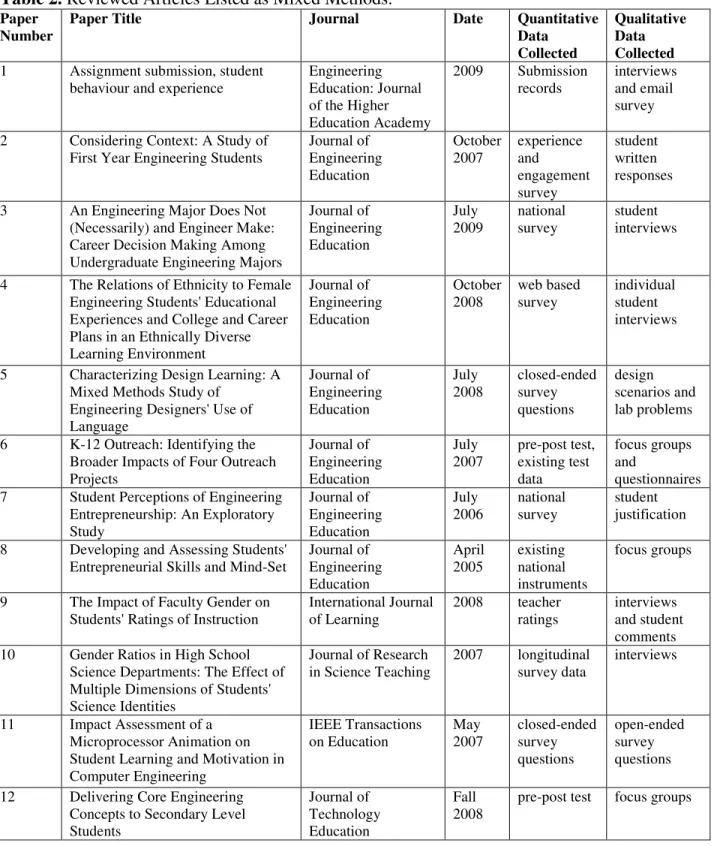
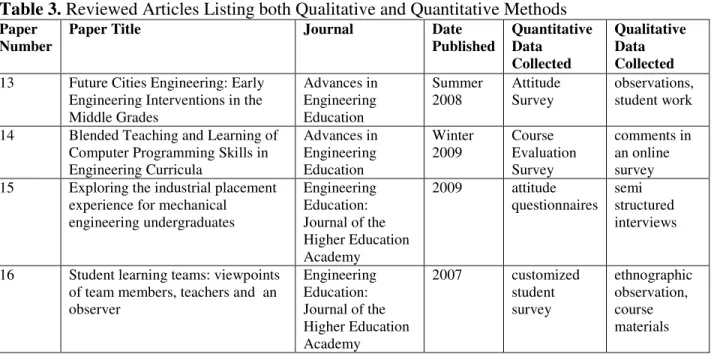
full manuscripts could not be obtained). This search resulted in a total of 16 articles from seven journals published from 2005 to the present. A summary of the 12 articles defined by the authors as mixed methods are given in Table 2, while the additional four articles citing both qualitative and quantitative data collection in the abstract are listed in Table 3.
Table 2. Reviewed Articles Listed as Mixed Methods. Paper
Number
Paper Title Journal Date Quantitative
Data Collected
Qualitative Data Collected
1 Assignment submission, student
behaviour and experience
Engineering Education: Journal of the Higher Education Academy 2009 Submission records interviews and email survey
2 Considering Context: A Study of
First Year Engineering Students
Journal of Engineering Education October 2007 experience and engagement survey student written responses
3 An Engineering Major Does Not
(Necessarily) and Engineer Make: Career Decision Making Among Undergraduate Engineering Majors
Journal of Engineering Education July 2009 national survey student interviews
4 The Relations of Ethnicity to Female
Engineering Students' Educational Experiences and College and Career Plans in an Ethnically Diverse Learning Environment Journal of Engineering Education October 2008 web based survey individual student interviews
5 Characterizing Design Learning: A
Mixed Methods Study of Engineering Designers' Use of Language Journal of Engineering Education July 2008 closed-ended survey questions design scenarios and lab problems
6 K-12 Outreach: Identifying the
Broader Impacts of Four Outreach Projects Journal of Engineering Education July 2007 pre-post test, existing test data focus groups and questionnaires
7 Student Perceptions of Engineering
Entrepreneurship: An Exploratory Study Journal of Engineering Education July 2006 national survey student justification
8 Developing and Assessing Students'
Entrepreneurial Skills and Mind-Set
Journal of Engineering Education April 2005 existing national instruments focus groups
9 The Impact of Faculty Gender on
Students' Ratings of Instruction
International Journal of Learning 2008 teacher ratings interviews and student comments
10 Gender Ratios in High School
Science Departments: The Effect of Multiple Dimensions of Students' Science Identities Journal of Research in Science Teaching 2007 longitudinal survey data interviews 11 Impact Assessment of a Microprocessor Animation on Student Learning and Motivation in Computer Engineering IEEE Transactions on Education May 2007 closed-ended survey questions open-ended survey questions
12 Delivering Core Engineering
Concepts to Secondary Level Students Journal of Technology Education Fall 2008
Table 3. Reviewed Articles Listing both Qualitative and Quantitative Methods Paper
Number
Paper Title Journal Date
Published Quantitative Data Collected Qualitative Data Collected
13 Future Cities Engineering: Early
Engineering Interventions in the Middle Grades Advances in Engineering Education Summer 2008 Attitude Survey observations, student work
14 Blended Teaching and Learning of
Computer Programming Skills in Engineering Curricula Advances in Engineering Education Winter 2009 Course Evaluation Survey comments in an online survey
15 Exploring the industrial placement
experience for mechanical engineering undergraduates Engineering Education: Journal of the Higher Education Academy 2009 attitude questionnaires semi structured interviews
16 Student learning teams: viewpoints
of team members, teachers and an observer Engineering Education: Journal of the Higher Education Academy 2007 customized student survey ethnographic observation, course materials
C. Quantitative Data Analysis: Article Evaluation
Upon completion of the data collection process each of the articles was reviewed against a subset of four criteria established by Creswell (2007) for mixed methods research designs (adapted from Table 3.2 pg 44). The first criterion chosen was the collection of both qualitative and quantitative data. Since this was one of the criteria for sample selection, most (if not all) of the articles should automatically meet this criterion. Paired with the collection of qualitative and quantitative data, we also examined each article to see if both data types were analyzed. A distinguishing feature for this stage of the evaluation was whether both data analysis results were presented at least in some form in the published work. The final two criteria for the quantitative evaluation were the priority the authors assigned to the qualitative and quantitative data as well as the timing of the data collection. Using these four criteria each article was systematically reviewed to determine whether engineering education researchers were publishing articles that meet the standards of mixed methods designs.
D. Qualitative Data Analysis: The Issue of Mixing
Constant comparative method 19 was used to systematically analyze the data and arrive at conclusions. Using the overarching theme of mixing, and guided by the literature, we developed an initial coding scheme. The initial coding scheme contained categories such as how the
authors addressed the integration of the data, how they justified using both types of data (or mixed methods as a design) and who they referenced regarding mixed methods research designs. This initial coding scheme made determining categories possible, while still allowing for
additional themes to emerge. A visual representation was created to begin grouping the textual data into general categories, and to determine the relationship between categories. Data were re-coded and new categories were created as necessary to capture emerging themes and relate them back to the research questions. From this analysis, several themes evolved, which are discussed in the next section.
IV. Results
Although the same set of data was used for both the qualitative and quantitative portions of this study, separate results were determined independently. The following sections discuss the results and findings from each of these data types.
A. Quantitative Results: Article Evaluation
During the quantitative data analysis (RQ 1), each article was evaluated against a subset of criteria established by Creswell et al (2007) for mixed methods research. The criteria not addressed in this quantitative analysis formed the basis for some of the qualitative analysis discussed in the next section. For each article we addressed the following:
1. Were both quantitative and qualitative data collected? 2. Were both qualitative and quantitative data analyzed? 3. What priority was assigned to the results or findings?
4. What was the timing of the collection and analysis of the data?
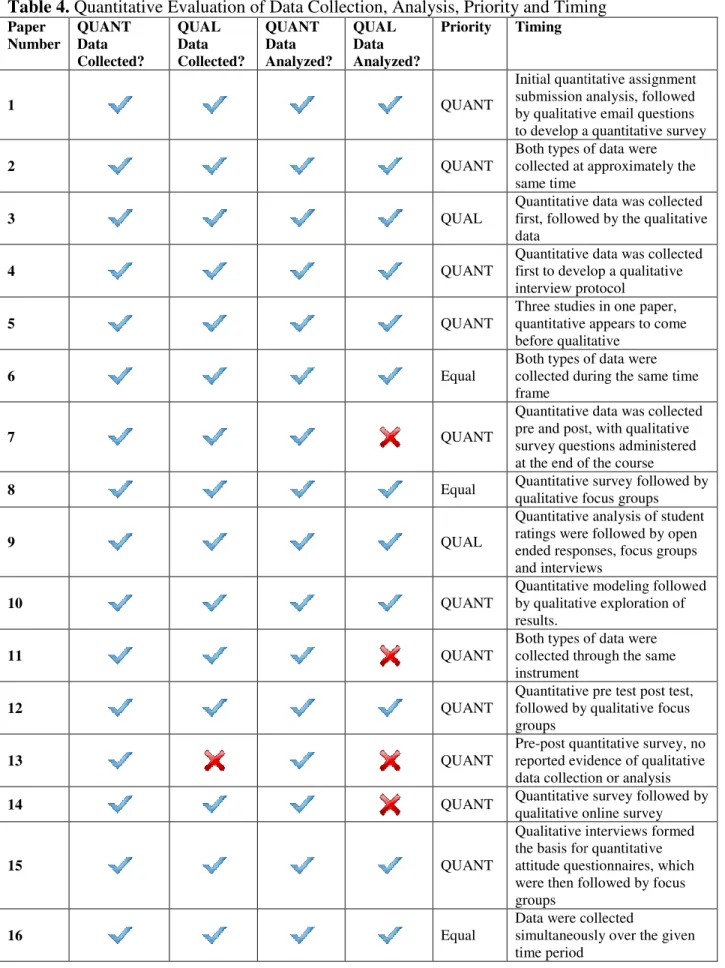
A summary of the results of the quantitative data analysis is shown in Table 4. Refer back to Table 2 for detailed information on each article including the article number. Evidence for data collection included comments discussing how the data were collected or presentation of the actual data. For the analysis criterion, we looked for evidence of an inductive approach along with thematic results for qualitative data. Evidence for quantitative analysis was generally summary tables or statistical results. In the event that the data presented did not meet the criteria for qualitative or quantitative analysis, an “X” was placed in that column. Timing was
determined based on statements in the methods section related to when each type of data were collected and analyzed. For most cases, this was either sequential (qualitative followed by quantitative or vice versa) or concurrent, with data collection and analysis occurring
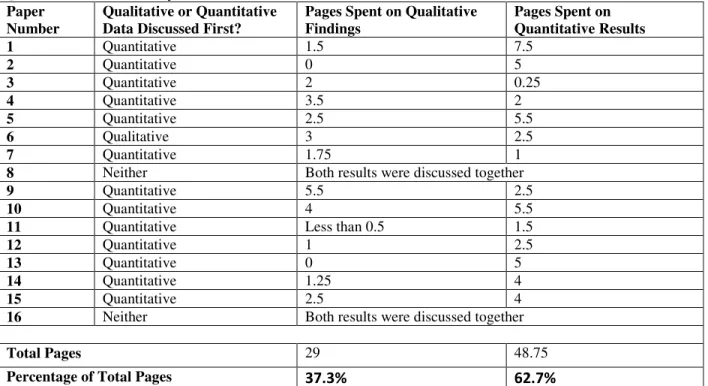
simultaneously for both data types. Establishing the priority for each article was a bit more challenging as authors may not have been clear on the importance of weight of each data type. In addition, many articles interwove the results sections, without separately discussing both data types. For this analysis, priority was determined based on the perceived relative weight of each data type as given in the reported results. To assist in determining the priority, Table 5 was created to establish the relative page weighting of each data analysis.
Table 4. Quantitative Evaluation of Data Collection, Analysis, Priority and Timing Paper Number QUANT Data Collected? QUAL Data Collected? 1 2 3 4 5 6 7 8 9 10 11 12 13 14 15 16
Quantitative Evaluation of Data Collection, Analysis, Priority and Timing
Collected? QUANT Data Analyzed? QUAL Data Analyzed? Priority Timing QUANT
Initial quantitative assignment submission analysis, followed by qualitative email questions to develop a quantitative survey QUANT
Both types of data were collected at approximately the same time
QUAL
Quantitative data wa
first, followed by the qualitative data
QUANT
Quantitative data was collected first to develop a qualitative interview protocol
QUANT
Three studies in one paper, quantitative appears to come before qualitative
Equal
Both types of data were collected during the same time frame
QUANT
Quantitative data was collected pre and post, with qualitative survey questions administered at the end of the course
Equal Quantitative survey followed by
qualitative focus groups QUAL
Quantitative analysis of student ratings were followed by open ended responses, focus groups and interviews
QUANT
Quantitative modeling followed by qualitative exploration of results.
QUANT
Both types of data were collected through the same instrument
QUANT
Quantitative pre test post test, followed by qualitative focus groups
QUANT
Pre-post quantitative survey, no reported evidence of qualitative data collection or analysis
QUANT Quantitative survey followed by
qualitative online survey
QUANT
Qualitative interviews formed the basis for quantitative attitude questionnaires, which were then followed by focus groups
Equal
Data were collected
simultaneously over the given time period
Quantitative Evaluation of Data Collection, Analysis, Priority and Timing
Initial quantitative assignment submission analysis, followed by qualitative email questions to develop a quantitative survey Both types of data were collected at approximately the Quantitative data was collected first, followed by the qualitative Quantitative data was collected first to develop a qualitative interview protocol
Three studies in one paper, quantitative appears to come before qualitative
Both types of data were collected during the same time Quantitative data was collected pre and post, with qualitative survey questions administered at the end of the course
Quantitative survey followed by tative focus groups Quantitative analysis of student ratings were followed by open ended responses, focus groups and interviews
Quantitative modeling followed by qualitative exploration of
ypes of data were collected through the same Quantitative pre test post test, followed by qualitative focus
post quantitative survey, no reported evidence of qualitative data collection or analysis Quantitative survey followed by qualitative online survey Qualitative interviews formed the basis for quantitative attitude questionnaires, which were then followed by focus Data were collected
As shown in Table 4, the majority of the articles cited collected and analyzed both qualitative and quantitative data. For all of the articles where this was not the case, the
qualitative data was lacking, most often in the results section. This is not to say that the authors did not collect or analyze qualitative data, just that evidence regarding the collection or analysis was not discernable in the report. As mentioned previously, determining the Priority for each article was assessed based on the representation of each data type in the results or findings section of the article.
Table 5. Determining Priority through Analysis of Page Weighting for Reporting Qualitative and Quantitative Data Analysis
Paper Number
Qualitative or Quantitative Data Discussed First?
Pages Spent on Qualitative Findings Pages Spent on Quantitative Results 1 Quantitative 1.5 7.5 2 Quantitative 0 5 3 Quantitative 2 0.25 4 Quantitative 3.5 2 5 Quantitative 2.5 5.5 6 Qualitative 3 2.5 7 Quantitative 1.75 1
8 Neither Both results were discussed together
9 Quantitative 5.5 2.5
10 Quantitative 4 5.5
11 Quantitative Less than 0.5 1.5
12 Quantitative 1 2.5
13 Quantitative 0 5
14 Quantitative 1.25 4
15 Quantitative 2.5 4
16 Neither Both results were discussed together
Total Pages 29 48.75
Percentage of Total Pages 37.3% 62.7%
As shown in Table 5, quantitative results were almost unanimously discussed first, with article six serving as the only article leading off with qualitative findings. Of the nearly 78 pages devoted to results and discussion, 63% were devoted to quantitative results. There were also two cases where the qualitative and quantitative results were so intermingled it was impossible to separate the two. For most articles, priority was determined based on the relative written emphasis placed on each data type. Articles eight and sixteen, which features results discussed together were given equal priority. Article six was the only other article with equal priority given to both qualitative and quantitative data. This article was especially challenging to categorize, and might actually have a slight tendency towards qualitative priority. Overall there were ten articles that featured quantitative data as the priority, and three each of equal and qualitative priority.
One of the final criteria listed by Creswell et al2 concerns the mixing (or integration) of both the qualitative and quantitative data. As previously discussed is Section II, integration of the data is often overlooked in reporting mixed methods research designs. In order to address this criterion, a inductive analysis was preformed to explore the ways that the authors of the
various studies listed in Table 4 addressed both the justification for using a mixed methods design and integration of both data types.
B. Qualitative Findings: The Issue of Mixing
To address the second research question, each article was thematically analyzed to explore how each author addressed the issue of mixing the data, and what types of justification were given for collecting and analyzing both qualitative and quantitative data (or using a mixed methods approach). Along with the textual justification for methodological designs, the mixed method literature cited by each author related to mixed methods research was explored for commonalities. A summary of the results is given in Table 6 below.
Table 6. Qualitative Mixing and Justification Themes
Mixing Themes Codes
One data type used to inform the collection of the other type
• analysis of the submission patterns were used to inform the construction of the survey questions
• The results from these [quantitative] analyses gave us direction in developing a semi-structured interview guide for the second phase Direct comparison and
explanation of one type with the other
• Quantitative summary of student decisions followed by the qualitative
exploration of these decisions
• Qualitative data help to explain the “why” and “how” of some of the
results obtained from the larger survey dataset, revealing insights once data were triangulated.
• To further interpret these [quantitative] findings, we now turn to the qualitative analysis
• The results of the qualitative data were directly compared to the results of the quantitative data
Transforming one data type into the other
• quantizing of the qualitative data (two occurrences)
Justification Themes Codes
Used to take advantage of the relative strengths of both data types
• The interview data also revealed additional emergent themes that would
have gone otherwise un-captured in a purely quantitative study
• more pragmatic approach to answering the evaluation questions
• Qualitative information provided much rich and detailed information
regarding the potential benefits, while the quantitative survey allowed for a larger sample size to be collected with the expectation that the results would be generalizable to the larger population
Address a broad range of research questions directed towards a complex phenomena
• address a broad range of research questions directed toward discerning complex phenomena
• a more comprehensive, cohesive understanding than could be obtained
by a single inquiry method Offers different perspectives and a
more thorough understanding of the same phenomena
• provide a better understanding of the issues under investigation
• provide different perspectives on the same phenomenon
Triangulation of both data for drawing conclusions
• Combination of both qualitative and quantitative assessment techniques
• Triangulation of data for the purpose of drawing conclusions
While there was no overwhelming consensus on the issue or mixing the qualitative and quantitative data, there were several themes that emerged from a few articles. First, three articles used one data type to inform the collection of the other data type. Gregory & Moron-Garcia 20, used qualitative email survey data to inform the design of their quantitative survey, where as
Trenor et al. 21used the quantitative results from their survey to develop a semi structured interview protocol. In Lock et al22, qualitative interviews were used to create a quantitative attitude questionnaire, the results of which were further explored using small group interviews. Several authors used another method of mixing the data by using one type of data to explain the results of the other data type. In several other articles 23-25, qualitative data were collected and analyzed to help explain quantitative results. Similar methods were discussed in Lichtenstein et al and Trenor et al21, 26as well. A slight majority (six) of the articles attempted to mix the data through direct comparison of the quantitative and qualitative results. In Kilgore et al27 and Atman et al28, the researchers quantized the qualitative data, and then compared the newly quantized results to the other quantitative data. Ferens et al29 collected both data types at the same time, using an instrument with both qualitative and quantitative questions. Other articles
30-32
had no separate results sections for their qualitative and quantitative data, and reported only the integrated results. The final three articles appeared to have no evidence or discussion related to mixing.
Another issue of interest was the methodological citations used to justify or explain the use of mixed methods research designs. In exploring this theme we hope to propose a set of guidelines for future publications. In the 12 self-described mixed methods articles, five (42%) contained at least one citation for mixed methods literature. Of the 13 explicit references to mixed methods literature, five were articles from Tashakkori and Teddlie 3, three of which were articles written or co authored by Creswell et al10. Another article cited Creswell10. Other literature included justification for qualitative methods, with two citations for Leydens et al33
related to assessment in engineering education. Other notable citations specifically for mixed methods literature included a reference to Johnson and Onweugbuzie 9.
V. Discussion
The quantitative analysis showed almost unanimous preference for quantitative methods, as indicated by 10 of the 16 articles prioritizing quantitative data. From the qualitative data we see that there are several themes that emerge related to both how the authors justify collection of both data types as well as how then proceed to mix the data. What we would like to explore further is the question: how do engineering education researchers interpret and report the meaning and use of mixed methods research designs?
In Table 7 we present the integration of the quantitative data on priority with the
qualitative mixing themes. From this data we see that engineering education researchers prefer to directly compare the results of both the qualitative and quantitative analysis (six occurrences) when they give priority equally or to the quantitative dat. There was also one case of direct data comparison for a qualitatively prioritized study. This was followed by using one type of data to inform collection of the other type with three cases, all quantitative priority. Finally there were two cases where the authors quantitized qualitative data. It should also be noted that the
language of article four mentioned two mixing themes, so it was placed in both locations. Of the 12 articles evaluated for mixing themes, only article nine offered no evidence or discussion of mixing.
Table 7. Article Number, Design Priority, and Qualitatively Derived Themes Integrating both QUAL and QUANT Data
Mixing Themes Qualitative
Priority
Quantitative Priority
Equal Priority
One data type used to inform the collection of the other type 1, 4, 15
Direct comparison and explanation of one type with the other 3, 10, 12, 4 6, 8, 16
Transforming one type of data into another type 2, 5
No evidence or discussion of mixing 9
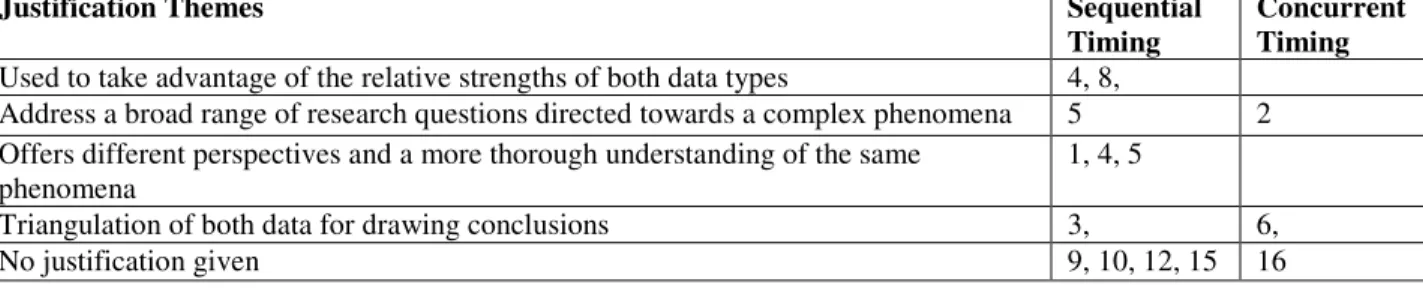
When it comes to timing, sequential data collection and analysis were used considerably more often than concurrent designs. Integrating timing decisions with the justification themes (Table 8) that emerged from the qualitative data yield some interesting insights. Several
different types of justification were given for using mixed methods research, and discarding the case of no justification given, the idea that mixed methods offers a more thorough understanding of the same phenomena was the most often used. These articles all featured sequential timing, and often mixed the data by using one type to inform collection of the other. The second most often used justification for mixed methods was to take advantage of the relative strengths of both data types (two studies). These studies were either of equal or qualitative priority, and featured various opinions on mixing the data. Articles that gave equal priority to both qualitative and quantitative data justified their use by the pragmatic nature of using both data types. These studies also credited the relative strengths of both types, indicating that “qualitative data was found to be extremely valuable in providing information on some of the constructs that are difficult to measure”. Equal priority articles used both sequential and concurrent timing.
Table 8. Article Number, Design Timing, and Qualitatively Derived Themes about Justification for Collecting and Analyzing both QUAL and QUANT Data
Justification Themes Sequential
Timing
Concurrent Timing
Used to take advantage of the relative strengths of both data types 4, 8,
Address a broad range of research questions directed towards a complex phenomena 5 2
Offers different perspectives and a more thorough understanding of the same phenomena
1, 4, 5
Triangulation of both data for drawing conclusions 3, 6,
No justification given 9, 10, 12, 15 16
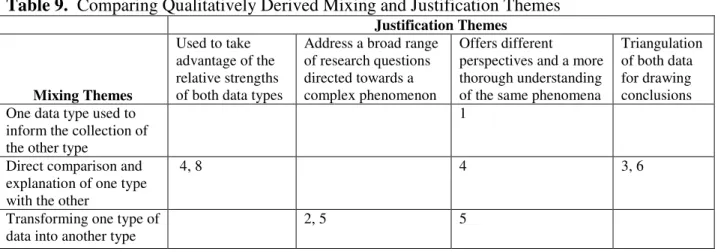
Another element worth discussing with respect to how engineering education researchers address mixing and justify mixed methods research is to compare how the justification themes relate to the mixing themes. Table 9 contrasts each of the qualitatively derived mixing themes against the qualitatively derived justification themes. We have chosen to leave out the articles that did not list a justification or address the mixing of the qualitative and quantitative data for simplicity. What this comparison shows is that for many engineering education researchers, the justification themes and mixing themes are often the same, motivated by each other. Consider for example the justification of addressing a broad range of research questions towards a
complex phenomenon. The two authors who justified the use of a mixed methods study this way both addressed the issue of mixing by quantitizing qualitative data. However when authors justified using a mixed methods approach as offering different perspectives and a more thorough understanding of the same phenomenon, all three mixing themes were used. It is also interesting
to note that in many cases the justification for using mixed methods is directly related to the type of mixing accomplished, such as direct comparison through triangulation (Articles 3 and 6). Table 9. Comparing Qualitatively Derived Mixing and Justification Themes
Justification Themes
Mixing Themes
Used to take advantage of the relative strengths of both data types
Address a broad range of research questions directed towards a complex phenomenon
Offers different
perspectives and a more thorough understanding of the same phenomena
Triangulation of both data for drawing conclusions One data type used to
inform the collection of the other type
1
Direct comparison and explanation of one type with the other
4, 8 4 3, 6
Transforming one type of data into another type
2, 5 5
A further take on the justification given in each article can be explored through the literature cited by the featured authors. Each of the articles listed for each justification theme cited mixed methods literature to support their justification. Four of the eight citations featured articles written by Creswell and Plano Clark 10, 34 as the methodological justification for conducting a mixed methods study. The majority of the authors did not however use the
language or notations systems proposed in this literature, but when comparing the language used in the mixing themes to the language used by Creswell2 there are several similarities. What we propose in the subsequent paragraphs are ways to increase the salience of mixed methods designs in engineering education research articles as well as make fuller use of the prescribed advantages of mixed methods designs.
Consider the summary of how Creswell and Plano Clark address mixing in section II. The authors propose that there are three ways that qualitative and quantitative data can be mixed, including: merging the data, connecting the data, and embedding the data at the design level. In the articles we reviewed that addressed how they mixed the data; all of these use language
similar to that of Creswell and Plano Clark, without using the explicit terminology. For example, both Kilgore et al27 and Atman et al28 mix the data by what Creswell and Plano Clark call
merging the data at the analysis stage through quantitizing qualitative data. Similarly Gergory and Moron-Garcia20 connect the data by using one type of data to inform the collection of the other type. Through the use of a common terminology offered by the literature, engineering education researchers will be able to more clearly situate their methods, increasing the perceived rigor of the published results. In addition to establishing methodological rigor, using a common terminology will allow engineering education researchers to communicate their research designs more effectively, enabling others to interpret and utilize their research.
Along with a common language, engineering education researchers should look more carefully at how they are mixing their data. While Creswell and Plano Clark offer a succinct package of terminology, we should also heed the advice of Bryman7 by taking advantage of the possibilities when mixing data. In many of the articles reviewed for this study, the mixing of the data was not readily apparent, making evaluating the research more difficult. Coupled with common terminology, engineering education researchers should utilize the mixed methods
designs suggested in the literature as a starting off point for designing their studies. These designs are not the only choices, but offer valuable insight for those just getting acquainted with a mixed methods approach.
VI. Conclusions
So what does this mean for the future of mixed methods research in engineering education? We would like to conclude with recommendations for how engineering education researchers can better showcase mixed methods studies by proposing a set of guidelines for reporting mixed methods research.
1. Common Terminology
Using existing terminology from the literature allows researchers to communicate their work quickly and efficiently without a lot of extra explanation, enabling more time to be spent on the results. This includes issues like priority, timing, mixing, and the overall research design. Including a diagram of the study, or using a notation system greatly increases the salience of your methods.
2. Report Collection and Analysis of Both Qualitative and Quantitative Data
Considering the criteria mentioned previously for mixed methods designs, it is important to collect and analyze both qualitative and quantitative data. It is equally important to discuss these steps when publishing the study. Explicitly relating your collection and analysis to the literature will enable your audience to better understand the how and why of your methods.
3. Don’t Forget to Mix the Data
Not only is mixing (or integrating) the qualitative and quantitative data a key criterion for mixed methods research, the benefits of this step are often underestimated. Think of the
additional information that may be uncovered when data are combined in new ways. While answering the research question should be the paramount concern Researchers who do not explore new ways to integrate their data may be missing out on valuable insights not immediately apparent in the qualitative or quantitative data alone.
The growing field of engineering education makes mixed methods designs an excellent opportunity to increase our understanding of the complex research questions under investigation. Through the use of a common set of terminology and taking care in the reporting procedures, engineering education researchers can use mixed methods designs to carry the discipline into the future.
References
1. Creswell, J.W., Research design: qualitative, quantitative, and mixed methods approaches. 3 ed. 2009,
Thousand Oaks: Sage
2. Creswell, J.W. and V.L. PlanoClark, Designing and Conducting Mixed Methods Research. 2007, Thousand
Oaks, Ca: Sage Publications.
3. Tashakkori, A. and C. Teddlie, eds. Handbook of mixed methods in social and behavioral research. 2003,
Sage Publications: Thousand Oaks, CA.
4. Greene, J.C., V.J. Caracelli, and W.F. Graham, Toward a conceptual framework for mixed-method
evaluation design. Educational Evaluation and Policy Analysis, 1989. 11(3): p. 255-274.
5. Bryman, A., Integrating quantitative and qualitative research: how is it done? Qualitative Research, 2006.
6: p. 97-113.
6. Sandelowski, M., Tables or Tableaux? The Challenges of Writing and Reading Mixed Methods Studies, in
Handbook of Mixed Methods Research in Social and Behavioral Research, A. Tashakkori and C. Teddlie, Editors. 2003, Sage Publications: Thousand Oaks, Ca. p. 321-350.
7. Bryman, A., Barriers to Integrating Quantitative and Qualitative Research. Journal of Mixed Methods
Research, 2007. 1(1): p. 8-22.
8. Borrego, M., E.P. Douglas, and C.T. Amelink, Quantitative, Qualitative, and Mixed Research Methods in
Engineering Education. Journal of Engineering Education, 2009. 98(1): p. 53-66.
9. Johnson, R.B. and A.J. Onweugbuzie, Mixed Methods Research: A Research Paradigm Whose Time Has
Come. Educational Researcher, 2004. 33(7): p. 14-26.
10. Creswell, J.W., et al., Advanced Mixed Methods Research Designs, in Handbook of Mixed Methods
Research in Social and Behavioral Research, A. Tashakkori and C. Teddlie, Editors. 2003, Sage Publications: Thousand Oaks, Ca. p. 209-240.
11. Morse, J.M., Approaches to qualitative-quantitative methodological triangulation. Nursing Research, 1991.
40: p. 120-123.
12. Morgan, D.L., Practical strategies for combining qualitative and quantitative methods: Applications to
health research. Qualitative Health Research, 1998. 8(3): p. 362-376.
13. Driscoll, D.L., et al., Merging Qualitative and Quantitative Data in Mixed Methods Research: How To and
Why Not? Ecological and Environmental Anthropology, 2007. 3(1): p. 19-28.
14. Sandelowski, M., C.I. Viols, and G. Knaft, On Quantitizing. Journal of Mixed Methods Research, 2009.
3(3): p. 208-222.
15. Tashakkori, A. and C. Teddlie, Mixed methodology: Combining qualitative and quantitative approaches.
Applied Social Research Methods Series. Vol. 46. 1998, Thousand Oaks, CA: Sage.
16. Onwuegbuzie, A.J. and W.B. Dickinson, Mixed Methods Analysis and Information Visualization:
Graphical Display for Effective Communication of Research Results. The Qualitative Report, 2008. 13(2): p. 204-225.
17. Sandelowski, M., Combining Qualitative and Quantitative Sampling, Data Collection, and Analysis
Techniques in Mixed-Method Studies. Research in Nursing & Health, 2000. 23(3): p. 246-255.
18. Creswell, J.W. and V.L. Plano Clark, Designing and Conducting Mixed Methods Research. 2007,
Thousand Oaks, CA: Sage Publications.
19. Strauss, A. and J. Corbin, Basics of qualitative research techniques and procedures for developing
grounded theory. 2 ed. 1998, London: Sage.
20. Gregory, K. and S. Moron-Garcia, Assignment submission, student behaviour and experience. Engineering
Education: Journal of the Higher Education Academy, 2009. 4(1): p. 16-27.
21. Trenor, J.M., et al., The Relations of Ethnicity to Female Engineering Students' Educational Experiences
and College and Career Plans in an Ethnically Diverse Learning Environment. Journal of Engineering Education, 2008. 97(4): p. 449-465.
22. Lock, G., et al., Exploring the industrial placement experience for mechanical engineering undergraduates.
Engineering Education: Journal of the Higher Education Academy, 2009. 4(1): p. 42-51.
23. Dabbagh, N. and D.A. Menascé, Student Perceptions of Engineering Entrepreneurship: An Exploratory
Study. Journal of Engineering Education, 2006. 95(2): p. 153-164.
24. Gilmartin, S., et al., Gender Ratios in High School Science Departments: The Effect of Percent Female
Faculty on Multiple Dimensions of Students' Science Identities. Journal of Research in Science Teaching, 2007. 44(7): p. 980-1009.
25. Merrill, C., et al., Delivering Core Engineering Concepts to Secondary Level Students. Journal of Technology Education, 2008. 20(1): p. 48-64.
26. Lichtenstein, G., et al., An Engineering Major Does Not (Necessarily) an Engineer Make: Career Decision
Making Among Undergraduate Engineering Majors. Journal of Engineering Education, 2009. 98(3): p. 227-234.
27. Kilgore, D., et al., Considering Context: A Study of First-Year Engineering Students. Journal of
Engineering Education, 2007. 96(4): p. 321-334.
28. Atman, C.J., D. Kilgore, and A.N.N. McKenna, Characterizing Design Learning: A Mixed-Methods Study
of Engineering Designers' Use of Language. Journal of Engineering Education, 2008. 97(3): p. 309-326.
29. Ferens, K., M. Friesen, and S. Ingram, Impact Assessment of a Microprocessor Animation on Student
Learning and Motivation in Computer Engineering. IEEE Transactions on Education, 2007. 50(2): p. 118-128.
30. Aman, C., et al., Student learning teams: viewpoints of team members, teachers and an observer.
Engineering Education: Journal of the Higher Education Academy, 2009. 4(1): p. 2-11.
31. Bilén, S.G., et al., Developing and Assessing Students' Entrepreneurial Skills and Mind-Set. Journal of
Engineering Education, 2005. 94(2): p. 233-243.
32. Moskal, B.M., et al., K-12 Outreach: Identifying the Broader Impacts of Four Outreach Projects. Journal
of Engineering Education, 2007. 96(3): p. 173-189.
33. Leydens, J.A., B.M. Moskal, and M.J. Pavlevich, Qualitative Methods Used in the Assessment of
Engineering Education. Journal of Engineering Education, 2004. 93(1): p. 65-72.
34. Creswell, J.W., Research Design: Qualitative, Quantitative, and Mixed Methods Approaches. 2003, SAGE
Publications: Thousand Oaks. p. 27-69, 87-118, 153-178.