Evaluating Effectiveness of Global Software Development Using the eXtreme
Programming Development Framework (XPDF)
Samantha J. Butler, Sian Hope
School of Informatics
University of Wales, Bangor
[email protected]
, [email protected]
Abstract
This paper presents an ongoing study into the productivity of the eXtreme Programming software development approach when carried out globally. XP is evaluated using a framework that has been developed using multiple data collection techniques. This study is in the early stages, at this point a pilot study is underway with a view to a more rigorous study once the analysis is complete and framework assessed. The paper also covers the future work that could be completed using this framework.
1. Introduction
Due to the changing nature of Software Engineering a greater number of people than ever are working in non-traditional development environments. This is pushing the existing Software development methods to new limits. These methods have been proven over a number of years to work to at least a satisfactory level in more orthodox settings, the question that my research poses is do they also work to the same satisfactory level when used in a geographically disparate manner.
This paper presents a theory that I proposed, the reasoning behind this investigation and an initial set of results and future experiments. This work is in its early stages and the results give an intermediary view of the investigation
.
2. Why I think XP can work in a Global
development environment
The eXtreme Programming (XP) approach has been proven by previous studies to be a successful development methodology in an orthodox development environment
[1][2]. In addition these studies show that although XP isn’t for everyone the majority of developers who have developed software using both traditional software development methods and XP believe that this is a more satisfying and productive way of writing software. There are now many tools available to encourage communication and numerous other tools available to allow two people to view and amend the same code at the same time from different locations, commonly grouped under the ‘groupware’ heading [3][4]. However the use of tools alone will not be sufficient. This work focuses on using XP as the process model with an eXtreme Programming Development Framework (XPDF) to evaluate this approach.
One of the four XP principles is communication and the importance of this to effective software development. Encouraging the level of communication suggested by XP in development teams working remotely has proved to be one of the most difficult areas to replicate. With the tools that are readily available and the XP approach, this work is evaluating whether it is possible to have a similar level of communication whilst working in remote locations to more orthodox software development teams.
3. What is XPDF?
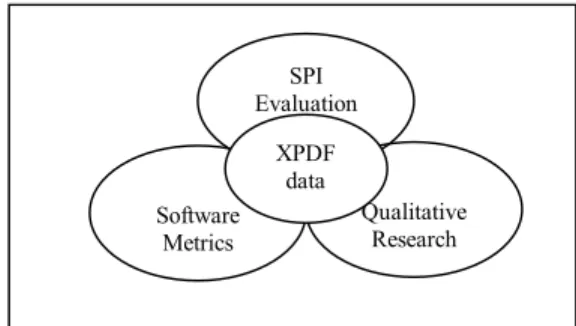
XPDF is an evaluation framework, which incorporates small, easily implemented, aspects from three, previously tried and tested investigation techniques. These include Software Process Improvement [5] evaluation processes, such as aspects from the Capability Maturity Model [6][7][8], which focuses heavily on the repeatability and reliability of the development method in question, in this case XP.
Qualitative Research techniques focus on the subjective opinions of those participating in the study; in
this context how people feel about working in remote locations in place of a more traditional development environment or using different development methodologies. Data will be collected using questionnaires and interviews [9][10].
Finally Software Metrics were collected, software metrics are the bare statistics of the team, number of lines of code produced in the time given, the number of errors in the final deliverable, any change from previously delivered work to name a few [11][12][13].
During the data collection phase data collected using each technique was treated in isolation, as indicated by Figure 1. However during the evaluation phase of the investigation several of the results will be analysed using two or more methodologies simultaneously.
Figure 1: The Evaluation Framework used.
Several XP practices can be carried out in the same way independently of the location of the developers. This study concentrates on the evaluation of the practices that must be adapted, these include pair programming, collective code ownership, customer onsite and always available, and high levels of communication and pair swapping [14][15]. XPDF aims to evaluate the productivity of teams using XP in remote situations in comparison to those in more traditional settings.
4. Preliminary results
Preliminary results show that XP is a very effective development methodology when used in an orthodox setting [1][2]. There are no official results for the effectiveness of XP when used on remotely conducted projects as this research is in its early stages. However early indicators of the analysis of data are that with the correct tools in place to aid communication XP can be just as effective when carried out in this manner as in more orthodox settings.
5. Experiments in Progress
5.1. Experiment 1
This experiment involves a number of volunteers. Each experiment requires two participants. After the pilot investigation it would be beneficial to have more participants involved throughout each iteration. People participating in this experiment are given an overview to eXtreme Programming, in the form of a handout for them to read. An in-depth knowledge is not required, as specific tasks are presented guiding the participants through XP in a stepwise manner.
A relatively simple exercise, involving the programming of a ‘Lego brick’ is presented for completion following XP principles. The main challenges of this task are the implementation of XP practices on this scale and with participants in different locations. The two participants are located in adjoining rooms. The person conducting the experiment is able to view the activities of both participants and give instructions to both participants or to each individual. Communication is by means of a telephone, NetMeeting and a code-sharing tool. All tasks are be presented by the customer as realistically as possible in the form of tasks and story cards decided at a planning meeting, again conducted remotely, with changing requirements and priorities.
5.2. Experiment 2
Software Hut is a module taken by all second year students taking a Computer Science / Studies degree course. During this module the students are asked to write a piece of software to fulfil a specific brief. All the students are given the same brief and all have to follow the same development process. To carry out the investigation effectively the group is split into two sub groups, both are presented with the same task. One group follows the XP principles in an orthodox manner, the other follows XP remotely. Both groups are evaluated using XPDF.
It could be argued that these students have insufficient experience in both developing software using any development process, or carrying out eXtreme Programming software development in particular. Software Metrics SPI Evaluation Qualitative Research XPDF data
However at no point in the specification of this research is it mentioned that the subjects under investigation are either experienced software developers or in mainstream industry. The criteria are that the participants are developing software on some scale following the eXtreme Processing methodology in a remote fashion. When this implementation is carried out the lack of experience will have to be taken into consideration when analysing the results. Similar studies evaluating XP in undergraduate modules have been carried out and the effect on the final conclusions shows to be negligible [16][17].
6. Future experiments – Why Use XPDF?
Small development teams carrying out all or some of their development using XP in a remote manner would be required to participate in the experiment. Companies would be required to supply similar information to that required in the experiments currently running. This would include the completion of qualitative and quantitative questionnaires, participation in an interview. As well as the above each company would be required to provide a summary of productivity during the course of the study.In return for their participation the company would gain feedback on the emotions of the development team regarding the process and productivity, suggestions on how the current process could be improved based on the information gathered from their company and the findings of others. All information supplied would be confidential.
As well as this companies would be included in any research papers resulting from the studies.
7. References
[1] Gittins, R.G., Hope, S., Williams, I. ‘Qualitative Studies of XP in a Medium Sized Business’ UPGRADE The European Online Magazine for the IT Professional. Vol. III, No.2, April 2002 http://www.upgrade-cepis.org [2] Gittins, R Qualitative Studies of XP in a Medium Sized Business’
Proceedings of the 2nd International Conference on Extreme Programming and Flexible Processes in Software Engineering. 20-23 May 2001, Sardinia, Italy [3] http://www.usabilityfirst.com/groupware/intro.txl [4] http://simon.cs.vt.edu/jamm/
[5]Systemic Software Engineering; Software Process Improvement White Paper; 2000
[6] Mark C. Paulk, Bill Curtis, Mary Beth Chrissis, and Charles V. Weber, "Capability Maturity Model, Version 1.1," IEEE Software, Vol. 10, No. 4, July 1993,
pp. 18-27.
[7] http://www.sei.cmu.edu/cmm/cmm.html
[8] http://www.sei.cmu.edu/cmm/
[9] Patton, M.Q; Qualitative Evaluation and Research Methods (2nd Edition; SAGE Publications
[10] Seaman, C.B; Qualitative methods in Empirical Studies of Software Engineering; IEEE Transitions in Software Engineering; Vol25 (4): 55-572 July/Aug 99 [11]Fenton, NE and Pfleeger, Shari Lawrence; Software Metrics, a Rigorous and Practical Approach; International Thompson Computer Press; 1996
[12]Goodman, Paul; Practical Implementation of software metrics; McGraw-Hill; London; New York: McGraw-Hill, c1993
[13] Cultivation and engineering of a software metrics
program; Iversen J, Mathiassen L INFORMATION SYSTEMS JOURNAL 13 (1): 3-19
JAN 2003
[14 ]Beck, K; eXtreme Programming Explained: Embrace Chnge; Addison Wesley; 2000
[15] Jefferies, R; Anderson, A; Hendrickson, C; eXtreme Programming Installed; Addison Wesley; 2000
[16] Macias, F, Holcombe, M; Empirical Experiments with XP, University of Sheffield, 2002
[17] Holcombe, M, Gheorghe, M, Macias, F; Teaching XP for Real: Some Initial Observations and Plans; University of Sheffield; 2002
IEEE COPYRIGHT FORM
To ensure uniformity of treatment among all contributors, other forms may not be substituted for this
form, nor may any wording of the form be changed. This form is intended for original material
submitted to the IEEE and must accompany any such material in order to be published by the IEEE.
Please read the form carefully and keep a copy for your files.
TITLE OF PAPER/ARTICLE/REPORT/PRESENTATION/SPEECH (hereinafter, “the Work”):
Evaluating Effectiveness of Global Software Development Using the extreme Programming Development Framework (XPDF) COMPLETE LIST OF AUTHORS:
Samantha Jayne Butler, Sian Hope
IEEE PUBLICATION TITLE (Journal, Magazine, Conference, Book): ICSE 2003, Global Software Development Workshop
Copyright Transfer
The undersigned hereby assigns to the Institute of Electrical and Electronics Engineers, Incorporated (the “IEEE”) all rights under copyright that may exist in and to the above Work, and any revised or expanded derivative works submitted to the IEEE by the undersigned based on the Work. The undersigned hereby warrants that the Work is original and that he/she is the author of the Work; to the extent the Work incorporates text passages, figures, data or other material from the works of others, the undersigned has obtained any necessary permissions. See reverse side for Retained Rights and other Terms and Conditions.
Author Responsibilities
The IEEE distributes its technical publications throughout the world and wants to ensure that the material
submitted to its publications is properly available to the readership of those publications. Authors must ensure
that their Work meets the requirements of IEEE Policy 6.4, including provisions covering originality,
authorship, author responsibilities and author misconduct. The full policy may be viewed at
http://www.ieee.org/about/whatis/policies/p6-4.xml. Authors are advised especially of IEEE Policy 6.4.1B(k): “It is the
responsibility of the authors, not the IEEE, to determine whether disclosure of their material requires the prior
consent of other parties and, if so, to obtain it.” Authors are also advised of IEEE Policy 6.3.B:
“It shall be
acknowledged that statements and opinions given in work published by the IEEE are the expression of the
authors. Responsibility for the content of published papers rests upon the authors, not IEEE.”
General Terms
•
The undersigned represents that he/she has the power and authority to make and execute this
assignment.
•
The undersigned agrees to indemnify and hold harmless the IEEE from any damage or expense that
may arise in the event of a breach of any of the warranties set forth above.
•
In the event the above work is not accepted and published by the IEEE or is withdrawn by the
author(s) before acceptance by the IEEE, the foregoing copyright transfer shall become null and void
and all materials embodying the Work submitted to the IEEE will be destroyed.
•
For jointly authored Works, all joint authors should sign, or one of the authors should sign as
authorized agent for the others.
(1)__Samantha J. Butler___________________________20/02/03_______________________________
U.S. Government Employee Certification (where applicable)
This will certify that all authors of the Work are U.S. government employees and prepared the Work on a subject within the scope of their official duties. As such, the Work is not subject to U.S. copyright protection.
(2)_____________________________________________________________
___________________________________
Authorized
Signature
Date
(Authors who are U.S. government employees should also sign signature line (1) above to enable the IEEE to claim and protect its copyright in international jurisdictions.)
Crown Copyright Certification (where applicable)
This will certify that all authors of the Work are employees of the British or British Commonwealth Government and prepared the Work in connection with their official duties. As such, the Work is subject to Crown Copyright and is not assigned to the IEEE as set forth in the first sentence of the Copyright Transfer Section above. The undersigned acknowledges, however, that the IEEE has the right to publish, distribute and reprint the Work in all forms and media.
(3)___Samantha J. Butler________________________20/02/03________________________________
Authorized Signature
Date
(Authors who are British or British Commonwealth Government employees should also sign line (1) above to indicate their acceptance of all terms other than the copyright transfer.)
rev. 121302
IEEE COPYRIGHT FORM
(continued)
RETAINED RIGHTS/TERMS AND CONDITIONS
1. Authors/employers retain all proprietary rights in any process, procedure, or article of manufacture described in the Work.
2. Authors/employers may reproduce or authorize others to reproduce the Work, material extracted verbatim from the Work, or derivative works for the author’s personal use or for company use, provided that the source and the IEEE copyright notice are indicated, the copies are not used in any way that implies IEEE endorsement of a product or service of any employer, and the copies themselves are not offered for sale.
3. Authors/employers may make limited distribution of all or portions of the Work prior to publication if they inform the IEEE in advance of the nature and extent of such limited distribution.
4. In the case of a Work performed under a U.S. Government contract or grant, the IEEE recognizes that the U.S. Government has royalty-free permission to reproduce all or portions of the Work, and to authorize others to do so, for official U.S. Government purposes only, if the contract/grant so requires.
5. For all uses not covered by items 2, 3, and 4, authors/employers must request permission from the IEEE Intellectual Property Rights office to reproduce or authorize the reproduction of the Work or material extracted verbatim from the Work, including figures and tables.
6. Although authors are permitted to re-use all or portions of the Work in other works, this does not include granting third-party requests for reprinting, republishing, or other types of re-use. The IEEE Intellectual Property Rights office must handle all such third-party requests.
INFORMATION FOR AUTHORS
It is the formal policy of the IEEE to own the copyrights to all copyrightable material in its technical publications and to the individual contributions contained therein, in order to protect the interests of the IEEE, its authors and their employers, and, at the same time, to facilitate the appropriate re-use of this material by others. The IEEE distributes its technical publications throughout the world and does so by various means such as hard copy, microfiche, microfilm, and electronic media. It also abstracts and may translate its publications, and articles contained therein, for inclusion in various compendiums, collective works, databases and similar publications.
Author/Employer Rights
If you are employed and prepared the Work on a subject within the scope of your employment, the copyright in the Work belongs to your employer as a work-for-hire. In that case, the IEEE assumes that when you sign this Form, you are authorized to do so by your employer and that your employer has consented to the transfer of copyright, to the representation and warranty of publication rights, and to all other terms and conditions of this Form. If such authorization and consent has not been given to you, an authorized representative of your employer should sign this Form as the Author.
Reprint/Republication Policy
The IEEE requires that the consent of the first-named author and employer be sought as a condition to granting reprint or republication rights to others or for permitting use of a Work for promotion or marketing purposes.
PLEASE DIRECT ALL QUESTIONS ABOUT THIS FORM TO:
Manager, IEEE Intellectual Property Rights Office, 445 Hoes Lane, P.O. Box 1331, Piscataway, NJ 08854-1131. Telephone +1 (732) 562-3966