Towards Automatic Generation of Semantic Types
in Scientific Workflows
?Shawn Bowers† Bertram Lud¨ascher† ‡ †
UC Davis Genome Center ‡
Department of Computer Science University of California, Davis {sbowers,ludaesch}@ucdavis.edu
Abstract. Scientific workflow systems are problem-solving environments that
allow scientists to automate and reproduce data management and analysis tasks. Workflow components include actors (e.g., queries, transformations, analyses, simulations, visualizations), and datasets which are produced and consumed by actors. The increasing number of such components creates the problem of discov-ering suitable components and of composing them to form the desired scientific workflow. In previous work we proposed the use of semantic types (annotations relative to an ontology) to solve these problems. Since creating semantic types can be complex and time-consuming, scalability of the approach becomes an is-sue. In this paper we propose a framework to automatically derive semantic types from a (possibly small) number of initial types. Our approach propagates the given semantic types through workflow steps whose input and output data struc-tures are related via query expressions. By propagating semantic types, we can significantly reduce the effort required to annotate datasets and components and even derive new “candidate axioms” for inclusion in annotation ontologies.
1
Introduction
Scientific analyses are often performed as a series of computation steps, grouped to-gether to form the logical stages of an analysis. For example, pre-processing input data, applying one or more statistical or data-mining techniques, and post-processing and vi-sualizing analysis results or discovered patterns may each be constructed from a num-ber of smaller computation steps. Scientific-workflow systems (e.g., T, T,1 and K[13]) have emerged as more versatile, extensible environments, compared with shell scripts and spreadsheets, to model and execute such analytical processes. Scientific workflows are useful to design [6] and execute end-to-end processes, and to enable the composition and sharing of computation steps, allowing scientists to more quickly experiment with and run complex analyses. Scientific workflows systems also provide scientists with a single point of access to heterogeneous data and computation services from multiple scientific disciplines and research groups. Providing such access
?This work supported in part by NSF/ITR SEEK (DBI-0533368), NSF/ITR GEON
(EAR-0225673), and DOE SDM (DE-FC02-01ER25486)
enables “cross-cutting” science, e.g., allowing ecological and genomic data to be mixed or complex statistical models to be combined across disciplines. A major challenge in providing this capability are semantic and terminological differences across scientific domains. Even within a discipline such as ecology, these problems exist, making data integration and service composition difficult both automatically and for a scientist. Our work focuses on providing rich metadata and ontologies to help bridge this gap and to enable wide-scale data and workflow interoperability. We have developed a framework for registering the semantics of data and services based on semantic types, which are mappings from datasets or services to concept expressions of an ontology. Our frame-work has been used to (semi-)automate data integration [2,14] and service composition [5], and is currently being developed and used within the Kscientific workflow system [2]. Providing semantic types, however, can be time-consuming for data and service providers, thereby limiting the applicability of metadata-intensive approaches to scientific data management.
In this paper, we describe an approach to make the management of semantic types more scalable by automating the generation of intermediate types within workflows. Our approach propagates the given semantic types through actors whose input and out-put data structures are related by a query expression, possibly approximating an actor’s function. In Section2we introduce the propagation problem and describe the benefits of our approach. In Section3 we present our semantic-type framework. In Section4 we develop our approach for propagating semantic types; related and future work is discussed in Section5.
2
The Propagation Problem
For our purposes, a scientific workflow consists of a number of actors, which are con-nected via directed edges called channels (Figure1). An actor is a component (e.g., a web service, shell command, local function, remote job) that can consume and produce data tokens. An actor has zero or more uniquely named ports designated as either input or output. With each port we can associate a structural type (or schema)Sdescribing the structure of data (tokens) flowing through that port. K’s structural type sys-tem, inherited from Ptolemy II [7], includes atomic types, e.g.,stringanddouble, and complex types such aslistandrecord. In a workflow, actors exchange infor-mation using channels that link an output port (token producer) to one or more input ports (token consumers). Workflows are executed according to a model of computation (implemented by a so-called director [7]), which specifies the overall workflow orches-tration and scheduling. Here we assume a model of computation that corresponds to a dataflow process network [11]. Figure1shows a simple workflow in Kfor com-puting species richness and productivity. The workflow performs a number of distinct computations over two input datasets shown on the left of the workflow, which results in the richness and productivity derived data products shown on the right.
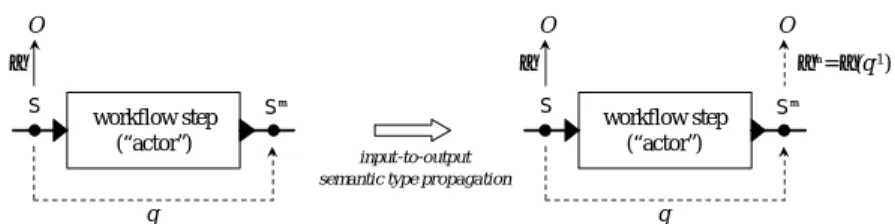
Semantic Type Propagation. Figure 2depicts the problem of propagating an input semantic typeαthrough an actor, yielding the output semantic typeα0. A semantic type αassociates elements of a schemaSwith concepts from an ontologyO. The goal of
Fig. 1. Simple scientific workflow for computing species richness and productivity [9]
propagation is to automatically generateα0, givenα. This is only possible if something is known about the relation between elements ofSand those inS’. A query expression
q provides this relation. The query q can approximate2the actual function f :S→S’
computed by the actor, e.g., q might “overestimate” f such that q(D) ⊇ f (D) for any
input data D. The propagation problem is to determineα0 : S’ → O, the semantic type of the output, given the input typeαand the query q. We denote this problem as computingα0 = α◦q−1 in Figure2, i.e., the composition ofαand (the inverse of)
q. Based on our semantic-type framework (Section3), we describe an initial approach towards solving this problem (Section4). Our approach places few restrictions on where initial semantic types are given. Semantic types may be provided for input data or for inputs of some actor(s) only, significantly reducing the amount of semantic description required to reuse workflows and actors. A user may also provide additional semantic types at specific points within a workflow, e.g., when the result of a computation creates new data values or adds semantic information. These semantic types are also propagated through actors. The advantages of our approach directly benefit scientific workflow engineers at various stages of workflow construction, including:
•Semantic types can be derived at workflow design-time (even before all actors or data are available), and thus can be used as a tool to help workflow engineers build new analyses. For example, propagated types can be presented to the user after two actors are connected, showing the resulting semantic types of combining the steps and the impact on the rest of the workflow. •Scientific workflows can often be executed over different input datasets. The workflow’s global inputs are typically quite generic, while a given dataset may have very specific semantic types. Our approach can propagate these specific semantic types of datasets, resulting in more accurate (specialized) semantic types at data binding-time.
•When a workflow is executed, derived data products are automatically given the propagated semantic type, minimizing the effort required to semantically type datasets at workflow runtime.
2Consider a filter function f that removes outliers and returns only “good” tokens. This function
can be modeled as a selectionσθwhereθis the filter condition. Obviously,S=S’in this case, which means thatαcan be propagated as is (in fact,α0=α∧θ
workflow step (“actor”) S S′ α O workflow step (“actor”) S S′ α α′= α(q-1) q O O q input-to-output semantic type propagation
Fig. 2. Actor with semantic typeα, propagated via query q, yielding semantic typeα0.
Another advantage of propagation is ontology augmentation. Consider an actorA2 having as input species richness data. The developer ofA2may provide a semantic type α2forA2’s input, stating that it was designed to “consume” Rdata.3 Assume a workflow designer has connected the output of another actorA1to the input ofA2, and for the output ofA1 a semantic typeα1 has been derived via propagation, indicating thatA0
1s output is of typesum(O), i.e., the arithmetic sum (resulting from an aggregation) of Odata. For the link:
A1
α1 α2
−−−−−−→ A2
to be semantically type correct, we must have thatα1 is “compatible” with α2, i.e.,
sum(O) v R. If we choose to run our propagation system in “auto-matic mode”, it will augment the given ontologyOwith this additional axiom. Con-versely, the system can be run in “interactive mode”, asking the user to determine whether the inferred axiom is correct and can be included inO, or whether there is something wrong with the connection. This example also illustrates that semantic type constraints between connected actors are “soft” in the sense that one can still execute the corresponding workflow steps, even though doing so may not be semantically mean-ingful. In contrast, the structural type constraint when connectingA1andA2is “hard”,
i.e., the schema types S1 andS2 must satisfy a subtyping constraintS1 S2 for the connection to be executable.
3
The Semantic-Type Framework
Query Expressions. Actors may have an associated query expression q, which may be derived from the component implementation (e.g., from a script or generated data transformation) or explicitly given by a service provider (e.g., for “black-box” actors whose inner workings are unknown). The most general form of a query expression is a logic constraintϕS∪S’ associating schema elements of the input port(s)Sof an actor
with those of its output port(s)S’. In analogy to data integration terminology, we can call q an Output-as-View (OAV) mapping if it has the form q= PS’:-ϕS, and an Input-as-View (IAV) mapping if it has the form q= PS:-ϕS’. Here, q is a logic atom defining
data elements of the output schemaS’(or the input schemaS) in terms of the query ϕS (orϕS’) overS(or S’, respectively). In this paper we focus on query expressions
3We use S
given in the OAV form. Query expresssions can contain the standard relational operators select, project, join, union, and group-by with aggregation (i.e., sum, count, avg, min, and max). Note that a query expression q does not need to exactly capture the function
f being computed by an actor. It is sufficient if q approximates f such that all structural associations betweenSandS’are preserved. These structural associations will then be used to propagate the semantic types fromStoS’.
We use Datalog notation [1], extended with aggregrate functions and grouping, to denote query expressions. Relations are denoted using capitals (Biom,Sscd, etc.) and variables are in lower-case (x, y,. . .). For example, query q1approximates the Create
Seasonal Community component of Figure1:
Biom1(o,y,s,t,p,b) :- Biom(o,y,s,t,p,b), Sscd(p) (q1) This query selectsBiomtuples (returned asBiom1tuples) whose p-values are present in theSscddata set.Biomrepresents a relational table consisting of measurements (with measurment-id o) of biomass b for a particular species p, year y, season s, and plot t. TheSscdrelation contains species found within a particular community.
Query expressions can contain group-by with aggregate operators syntactically writ-ten agg(x|¯y), where agg is the name of the aggregate operation, x is the aggregation variable, and ¯y is a comma-separated list of grouping variables. We introduce a new variable in the head of an aggregate query and assign it (using the “^” symbol) to the aggregate expression. For example, query q2gives the annual biomass for each plot and species (the Compute Annual Biomass actor):
Biom2(y,t,p,z^sum(b|y,t,p)):- Biom1(o,y,s,t,p,b) (q2) Union operations are expressed in the normal way using multiple rules. For example, query q3returns annual occurrence measurements (the Compute Occurrence actor):
Biom3(y,t,p,1):- Biom2(y,t,p,b), b>0 (q3)
Biom3(y,t,p,0):- Biom2(y,t,p,b), b≤0
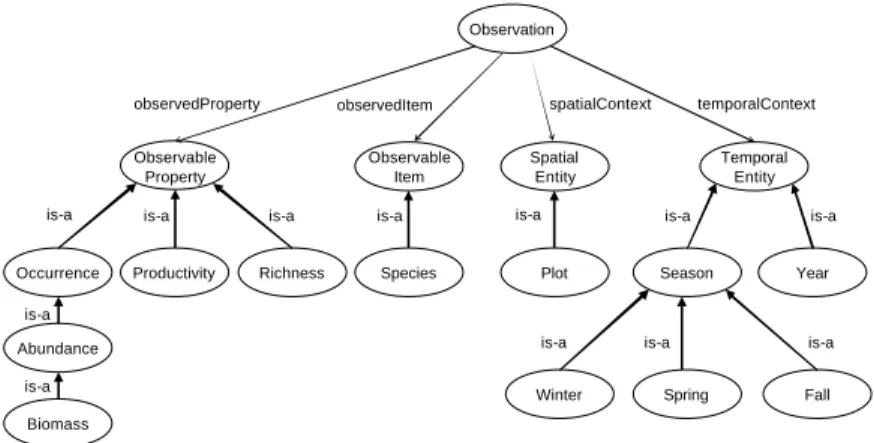
Ontologies. We use description logic to express ontologies, which are used to for-mally define the terms (concepts) in a given domain and their relationships (roles). The OWL-DL standard is also used in K for storing and exchanging ontologies. A simple ontology is shown in Figure3, representing definitions for ecological measure-ments (concept O) and ecological concepts such as A, R, etc. According to the underlying description-logic definitions (not shown in the figure), every observation has exactly one observed property (e.g., abundance) and item (e.g., species), and one or more spatial and temporal contexts. We assume a reasoning system is available to compute subsumption hierarchies from concept and role definitions. We use subsumption in particular to determine whether channels defined between actors are semantically compatible.
Semantic Types. Each structural type of a dataset, input, or output port, may be given a semantic type, which in its most general form is a logic constraintαS∪Oassociating
Observation Spatial Entity Temporal Entity Observable Item Observable Property Occurrence Abundance is-a Biomass is-a Productivity Richness
is-a is-a is-a
observedProperty observedItem Species is-a Plot is-a Season Year
Winter Spring Fall spatialContext temporalContext
is-a is-a
is-a is-a
is-a
Fig. 3. Simplified ecological measurement ontology shown graphically
Biom(o,y,s,t,p,b) →O(o) (1) Biom(o,y,s,t,p,b) →C(o,y)∧Y(y) (2) Biom(o,y,s,t,q,b)∧s=‘W’→C(o,s)∧W(s) (3) Biom(o,y,s,t,q,b)∧s=‘S’→C(o,s)∧S(s) (4) Biom(o,y,s,t,q,b)∧s=‘F’→C(o,s)∧F(s) (5) Biom(o,y,s,t,p,b) →C(o,t)∧P(t) (6) Biom(o,y,s,t,p,b) →I(o,p)∧S(p) (7) Biom(o,y,s,t,p,b) →P(o,b)∧B(b) (8)
Fig. 4. An example semantic type linkingbiomelements toelements
schema elementsSwith concept expressions from an ontologyO. We consider a syn-tactic form that we call Terminology-as-View (TAV) in which the ontology structure
Ois “virtually populated” with elements from the data schemaS, thereby establishing the desired semantic typeα= αS →αO. More precisely, we consider semantic types
having the formα= ∀¯x∃¯yαS( ¯x)→αO( ¯x,¯y), whereαS( ¯x) is a query over a data
struc-tureS, linking selected elements (captured via bindings of the variables ¯x) to concept expressionsαO( ¯x,¯y) over the ontologyO.
Figure4 gives example semantic-type constraints linking schema elements of the
Biomdata structureSused above to concepts and roles from the ontologyOgiven in Figure3. Line (1) states that every measurement inBiomrepresents an O. Line (2) states (i) that all year values inbiomare instances of the Yconcept, and (ii) that the year instance is a temporal context of the corresponding observation instance. Lines (3–5) are similar, but contain an additional condition on the value of the season, and lines (7–8) annotate species and biomass values.
4
Propagating Semantic Types
We divide our approach for propagating semantic types through actors into three classes of increasing expressibility for query expressions: conjunctive queries (i.e., containing only select, project, and join operations); conjunctive queries with aggregation; and conjunctive queries with aggregation and union.
The Conjunctive Case. Let query q and semantic typeαbe of the form: – q= ∀¯u∃¯v PS’( ¯u):-ϕS( ¯u,¯v)
– α= ∀¯x∃¯yαS( ¯x)→αO( ¯x,¯y)
Here, PS’is a logic atom over the output schemaS’andϕS is a query over the input
schema(s)S. Similarly, for semantic typesα, we relate instances of a schemaSwith those of an ontologyOvia subformulasαSandαO, respectively.
The basic idea of computingα0 = α◦q−1 is as follows. We would like to relate instances of the output schemaS’with instances ofO. Assume a substitution that satis-fiesϕS(in q) impliesαS(inα). For this substitution we can establish the desired relation
betweenS’andO, denoted abstractly asS’q
−1
{S
α
{O. More precisely, we consider q
as a logical constraint of the form:
q( ¯u)= PS’→Q1∧ · · · ∧Qn∧ψ | {z }
ϕS
andαof the form
α( ¯x)= A1∧ · · · ∧Ak | {z }
αS
→αO
where PS’is a logic atom over the output schemaS’, Qiand Ajare logic atoms over
the input schema(s)S, andψandαO are quantifier-free formulas. We assume that all
∃-quantified variables (¯v and ¯y above) have been eliminated through Skolemization so that q andαcan be seen as (implicitly)∀-quantified formulas with variables ¯u and ¯x.4
For propagatingα“through” q we use the inverse of q, i.e., the left-to-right (‘head→ body’) direction of the query (‘head :- body’). This direction is the one used in LAV-style query rewritings (e.g., for sound views) and also corresponds to the usually im-plicit direction in Datalog-style rules (aka Clark’s completion [10]). More precisely, q is defined by the equivalence∀¯u∃¯v PS’( ¯u)↔ ϕS( ¯u,¯v) where intuitively, ifϕS( ¯u,¯v) is a
result of the query q (in a model M), then PS’( ¯u) must also be true (in M) [10,12].
Observe that q can be written as a conjunction q1∧· · ·∧qn∧qψwith qi= PS’→Qi,
and qψ = PS’ →ψ. If we assume there is a substitutionσthat unifies some atom Qi0 and some Aj0, i.e., Q
σ i0=A
σ j0
5, we can infer from q
i0= PS’→Qi0andαa new semantic typeα0 i0of the form: α0 i0= P σ S’∧(αS\Aj0) σ→ασ O
4We assume that the variables ¯u in q( ¯u) are disjoint from the variables ¯x inα( ¯x). 5Tσdenotes the result of applyingσto a term T .
where (αS\Aj0) is the conjunction A1∧ · · · ∧Akwith Aj0 removed. It is easy to show that the semantic typeα0
i0is implied by qiandα. In this way, by successively “resolving away” atoms AjfromαSwith matching atoms QifromϕS, we can obtain new semantic
typesα0that relate elements of the output schemaS’to those in the ontologyO.
Example 1 (Propagation for Conjunctive Queries). Consider query q1 expressed as a first-order formula:
Biom1(o,y,s,t,q,p,b)→Biom(o,y,s,t,q,p,b)∧Sscd(p) (1) This formula can be resolved with semantic-type expression (8) in Figure4, resulting in the new formula:
Biom1(o,y,s,t,q,p,b)→P(o,b)∧B(b) (2) Observe that we now have biomass values b for the output schemaBiom1semantically typed as Binstances, linked through theProle.
Handling Aggregation. The approach for propagating conjunctive queries can also be used for aggregation, due to the particular syntactic representation used to express aggregate operators. As mentioned in Section2, we perform an additional step for ag-gregate queries that connects agag-gregate operators to certain ontology concept defintions, which can be further used to infer new connections between components. The following simple example demonstrates how propagation is used with aggregation.
Example 2 (Propagation for Aggregate Operators). Consider the following
Skolem-ized query q for the Compute Richness actor of Figure1:
Biom4(y,t,r^sum(c|y,t))→Biom3(y,t,fp(y,t,c),c) (1)
and the following (additional) output semantic type of the Compute Occurrence actor6:
Biom3(y,t,p,c)→O(c) (2)
We can resolve (1) and (2) above, resulting in the new formula:
Biom4(y,t,r^sum(c|y,t))→O(c) (3)
Observe that in this example we have “preserved” the fact that r is thesum of a variable c, and that values for c are Oinstances. Thus, we can see that r is exactly thesum of O. For propagated semantic types of this form, we also propagate a semantic-type expression where r is an instance of a new concept formed from the aggregate name and c’s assigned concept. Thus, for the previous propagated semantic type we also propagate:
Biom4(y,t,r^sum(c|y,t))→sum(O)(r) (4)
With this additional step it becomes possible, e.g., to determine that the
Com-pute Richness actor can safely be connected to other actors that input Rdata, leveraging definitions in the ontology such as sum(O) v R. Here,
sum(O) represents an ontology concept that is “linked” with a certain func-tionality in the query expression language.
Handling Union. Let the union query q be of the form:
q=∀¯u∃¯v PS’( ¯u):-ϕ1S( ¯u,¯v) ∀¯u∃¯v PS’( ¯u):-ϕ2S( ¯u,¯v)
which can also be written as the constraint q( ¯u)=PS’→ϕ1S∨ϕS2forϕ1S =Q11∧ · · · ∧ Q1n∧ψ1andϕ2S=Q
2
1∧ · · · ∧Q 2
n∧ψ2. To resolve q andα, we rewrite q into clausal form,
generating the two formulas q0( ¯u)=P
S’∧ ¬ϕ2S→ϕ 1 Sand q 00( ¯u)=P S’∧ ¬ϕ1S→ϕ 2 S.
Observe that q0(and similarly q00) can be rewritten as a conjunction q0 1∧ · · · ∧q
0
n∧q0ψ
with q0i=PS’∧ ¬ϕ2S→Q0iand q0ψ =PS’∧ ¬ϕ2S→ψ1. Assume there is a substitutionσ that unifies some atom Qi0and some Aj0for a semantic typeα( ¯x)=A1∧ · · · ∧Ak→αO. From q0andαwe can inferα0of the form:
α0= Pσ S’∧ ¬ϕ 2σ S ∧(αS\Aj0) σ→ασ O
where (αS\Aj0) is the conjunction A1∧ · · · ∧Akwith Aj0removed, similar to the regular conjunctive case. As before, we successively “resolve away” atoms Aj fromαS with
matching atoms Q1
i fromϕ
1
S.
We note thatα0may not be in the desired form for semantic types (it may not be in clausal form) because, e.g.,¬ϕ2
Smay result in a disjunctive formula. For such cases,
we can apply the following simple conversion. Assuming query expressions q=P→
(Q∧R)∨(Q0∧R0) and semantic typesα= Q→ αO, using resolution we infer, e.g., α0=P∧¬(Q0∧R0)→αO, which becomesα0
1=P∧¬Q 0→α
Oandα02=P∧¬R0→αO.
Example 3 (Propagation for Union). Consider query q3as the first-order formula:
Biom3(y,t,p,c)→(Biom2(y,t,p,fb(y,t,p))∧ fb(y,t,p)>0 ∧ c=0) ∨ (1)
(Biom2(y,t,p,fb(y,t,p))∧ fb(y,t,p)≤0 ∧ c=1)
and the Skolemized semantic-type propagated from the Compute Annual Biomass actor (note that we only include the result z of the original aggregrate operator):
Biom2(y,t,p,z)→I( fo(y,t,p),p)∧S(p) (2) Rewriting (1) into clausal form gives:
Biom3(y,t,p,c)∧ ¬(Biom2(y,t,p,fb(y,t,p))∧ fb(y,t,p)>0 ∧ c=0)→ (3) Biom2(y,t,p,fb(y,t,p))∧ fb(y,t,p)≤0 ∧ c=1
Biom3(y,t,p,c)∧ ¬(Biom2(y,t,p,fb(y,t,p))∧ fb(y,t,p)≤0 ∧ c=1)→ (4) Biom2(y,t,p,fb(y,t,p))∧ fb(y,t,p)>0 ∧ c=0
Resolving (2) and (3), e.g., results in the new annotation:
Biom3(y,t,p,c)∧ ¬(Biom2(y,t,p,fb(y,t,p))∧ fb(y,t,p)≤0 ∧ c=1)→ (4)
I( fo(y,t,p),p)∧S(p)
5
Concluding Remarks
The creation of rich semantic-type annotations can be a complex task, making the prob-lem of automatic generation of such types important for scalable “metadata-intensive” and “semantics-intensive” scientific applications. To this end, we have developed and presented a semantic-type propagation approach and sketched how queries involving selection, projection, join, aggregation, and union could be handled. Our approach is based on an inference procedure similar to the chase [1], which itself can be seen as a form of resolution [4]. Propagating semantic types is also related to work on data provenance [3,8] where the focus (in terms of propagation) is on supporting simple text-based annotations of relational table cells (instead of formulas over schemas), and on augmenting SQL to allow users to state specific schemes for propagating these value-based annotations to query results. In contrast, our semantic types are formal logic-based descriptions linking structural types to ontologies. These semantic types can be propagated within the framework of scientific workflows. We are currently investigat-ing the properties of a specialized inference procedure, based on algorithms in [15] for composing mappings given by logic constraints. We plan to implement semantic type propagation within Kas part of future work.
References
1. S. Abiteboul, R. Hull, and V. Vianu. Foundations of Databases. Addison Wesley, 1995. 2. C. Berkley, S. Bowers, M. Jones, B. Ludaescher, M. Schildhauer, and J. Tao. Incorporating
semantics in scientific workflow authoring. In Proc. of SSDBM, 2005.
3. D. Bhagwat, L. Chiticariu, W. C. Tan, and G. Vijayvargiya. An annotation management system for relational databases. In Proc. of VLDB, 2004.
4. J. Biskup and A. Kluck. A new approach to inferences of semantic constraints. In In Proc. of Advances in Databases and Information Systems, 1997.
5. S. Bowers and B. Lud¨ascher. An ontology-driven framework for data transformation in scientific workflows. In Proc. of DILS, volume 2994 of LNCS, 2004.
6. S. Bowers and B. Lud¨ascher. Actor-oriented design of scientific workflows. In 24th Intl.
Conf. on Conceptual Modeling (ER), 2005.
7. C. Brooks, E. A. Lee, X. Liu, S. Neuendorffer, Y. Zhao, and H. Zheng. The Ptolemy II Manual (vol. 1-3). Technical report, UC Berkeley, 2004.
8. P. Buneman, S. Khanna, and W. C. Tan. Why and where: A characterization of data prove-nance. In Proc. of ICDT, volume 1973 of LNCS, 2001.
9. D. Chalcraft, J. Williams, M. Smith, and M. Willig. Scale dependence in the species-richness-productivity relationship: The role of species turnover. Ecology, 85(10), 2004. 10. K. L. Clark. Negation as failure. In Logic and Databases. Plemum Press, 1977. 11. E. A. Lee and T. M. Parks. Dataflow process networks. Proc. of the IEEE, 83(5), 1995. 12. M. Lenzerini. Data integration: A theoretical perspective. In Proc. of PODS, 2002. 13. B. Lud¨ascher, I. Altintas, C. Berkley, D. Higgins, E. Jaeger, M. Jones, E. A. Lee, J. Tao,
and Y. Zhao. Scientific workflow management and the kepler system. Concurrency and Computation: Practice&Experience, 2005. to appear.
14. B. Lud¨ascher, A. Gupta, and M. E. Martone. Model-based mediation with domain maps. In Proc. of ICDE, 2001.
15. A. Nash, P. A. Bernstein, and S. Melnik. Composition of mappings given by embedded dependencies. In Proc. of PODS, 2005.
![Fig. 1. Simple scientific workflow for computing species richness and productivity [9]](https://thumb-us.123doks.com/thumbv2/123dok_us/9710103.2460784/3.918.211.707.173.388/fig-simple-scientific-workflow-computing-species-richness-productivity.webp)