Congressional Research Service ˜ The Library of Congress
CRS Report for Congress
Received through the CRS Web
Order Code RL33137Military Base Closures and the Impact Aid
Program for Education
November 4, 2005
Rebecca R. Skinner
Specialist in Social Legislation
Domestic Social Policy Division
Military Base Closures and
the Impact Aid Program for Education
Summary
Congress authorizes the Department of Defense (DoD) to realign or close military installations to meet the changing military requirements facing the United States and to reduce the costs of maintaining excess military infrastructure. DoD compiles a list of recommended Base Realignment and Closing (BRAC) actions that is then submitted to an independent BRAC Commission to review. The Commission subsequently submits its list of recommended actions to the President. The most recent BRAC Commission submitted its recommendations for base closures and realignment to the President on September 8, 2005. After agreeing with the recommendations, the President sent the Commission report to Congress on September 15, 2005. Congress has 45 days to enact a joint resolution of disapproval; otherwise, the recommendations become law.
The 2005 BRAC recommendations include the closure of 22 major military installations and the realignment of 33 others. The effect of these changes includes both an estimated savings of $35.6 billion for the military over the next 20 years and socioeconomic impacts on the communities affected by the changes. Included in these socioeconomic impacts are the effects on local educational agencies (LEA) serving children affected by the BRAC recommendations.
Under the Impact Aid program, the federal government provides financial assistance to LEAs adversely affected by the activities of the federal government. The program provides various types of payments, including compensation to LEAs for the federal ownership of certain property, funds for school construction, and compensation to LEAs enrolling federally connected children. Federally connected children include, for example, children whose parents are in the Armed Forces, as well as children whose parents are employed on federal property, such as a military installation. Educating federally connected children imposes a service burden, revenue burden, or both on an LEA, as the LEA may not receive the benefit of tax revenues to support their education.
LEAs losing or gaining federally connected students as a result of the BRAC recommendations may experience substantial challenges. These challenges may be created by the significant changes required by the BRAC recommendations but may also stem from the structure of the Impact Aid program. For LEAs experiencing a decline in enrollment, the LEAs may need to release staff or consolidate students into a smaller number of facilities. The structure of the Impact Aid program will provide these LEAs with a relatively brief period of time to make necessary adjustments without a loss of funding. For LEAs gaining federally connected students as a result of the BRAC recommendations, the structure of the Impact Aid program delays these LEAs from receiving immediate Impact Aid payments to adjust to the change in enrollment.
Contents
Overview of the Impact Aid Program . . . 2 Overview of Base Realignment and Closure Recommendations . . . 4 Possible Effects of Base Closure and Realignment on School Districts
Serving Federally Connected Students . . . 7 LEAs Losing Federally Connected Students as a Result of BRAC . . . . 7 LEAs Gaining Federally Connected Students as a Result of BRAC . . . 8 School Districts’ Responses to Troop Increases . . . 10
List of Tables
Table 1. Types of “Federally Connected” Children and Relevant Weights . . . 3 Table 2. Communities Expecting to Gain the Largest Number of Direct Positions as a Result of the 2005 BRAC Recommendations . . . 5 Table 3. Communities Expecting to Lose the Largest Number of Direct Positions as a Result of the 2005 BRAC Recommendations . . . 6
1 The BRAC Commission and the General Accountability Office believe that DoD’s claimed
cost avoidances attributable to military personnel actions should be excluded from the cost savings calculation, resulting in a savings of $15 billion over 20 years. (Defense Base Closure and Realignment Commission, 2005 Defense Base Closure and Realignment Commission Report, Executive Summary, Sept. 2005. Available online at [http://www.brac.gov]. Hereafter referred to as BRAC, Commission Report, Executive Summary.)
2 For detailed information about the BRAC Commission’s final report and proposed
legislation, see CRS Report RS22061, Military Base Closures: The 2005 BRAC Commission, by Daniel Else and David Lockwood. For additional information about military base closures and the socioeconomic impacts of these closures, see CRS Report RS22147, Military Base Closures: Socioeconomic Impacts, by Tadlock Cowan and Baird Webel. (Herafter referred to as CRS Report, CRS Report RS22147, Military Base Closures.)
Military Base Closures and
the Impact Aid Program for Education
Congress authorizes the Department of Defense (DoD) to realign or close military installations to meet the changing military requirements facing the United States and to reduce the costs of maintaining excess military infrastructure. DoD compiles a list of recommended Base Realignment and Closing (BRAC) actions that is then submitted to an independent BRAC Commission to review. The Commission subsequently submits its list of recommended actions to the President. The most recent BRAC Commission submitted its recommendations for base closures and realignment to the President on September 8, 2005. After agreeing with the recommendations, the President sent the Commission report to Congress on September 15, 2005. Congress has 45 days to enact a joint resolution of disapproval; otherwise, the recommendations become law.
The 2005 BRAC recommendations include the closure of 22 major military installations and the realignment of 33 others. The effect of these changes includes both an estimated savings of $35.6 billion for the military over the next 20 years1 and socioeconomic impacts on the communities affected by the changes. Included in these socioeconomic impacts are the effects on local educational agencies (LEA) serving children affected by the BRAC recommendations.2
Under the Impact Aid program, the federal government provides financial assistance to LEAs adversely affected by the activities of the federal government. It provides various types of payments, including compensation to LEAs for the federal ownership of certain property, funds for school construction, and compensation to LEAs enrolling federally connected children. Federally connected children include, for example, children whose parents are in the Armed Forces, as well as children whose parents are employed on federal property, such as a military installation. LEAs
CRS-2
3 For additional information about the types of payments made under the Impact Aid
program, see CRS Report RL31885, Impact Aid for Public K-12 Education: General Overview and Current Status, by Rebecca R. Skinner and Richard N. Apling.
losing or receiving federally connected students as a result of the BRAC recommendations may experience substantial challenges. These challenges may be created by the significant changes required by the BRAC recommendations but may also stem from the structure of the Impact Aid program.
The first part of this report provides a brief overview of the Impact Aid program, including the calculation of Impact Aid payments to LEAs, and an overview of the BRAC recommendations. This is followed by a discussion of the potential effects of the BRAC recommendations on LEAs that will both lose and gain students as a result of the changes. The report concludes with a brief discussion of actions that have been taken by LEAs in anticipation of large influxes of federally connected students.
Overview of the Impact Aid Program
The Impact Aid program was established in 1950 by P.L. 874 and P.L. 81-815. P.L. 81-874 authorized financial assistance for maintenance and operations to local educational agencies (LEA) adversely affected by the activities of the federal government. The Improving America’s School Act of 1994 (IASA, P.L. 103-382), which reauthorized the Elementary and Secondary Education Act of 1965 (ESEA), repealed P.L. 81-874 and P.L. 81-815, and included the Impact Aid program in ESEA Title VIII. The Impact Aid program was most recently reauthorized by the No Child Left Behind Act of 2001 (P.L. 107-110), extending the program authorization through 2007.3
The Impact Aid program supports various types of payments, including compensation to LEAs for the federal ownership of certain property (Section 8002), funds for school construction and facilities upgrades (Section 8007), and compensation to LEAs enrolling federally connected children (Section 8003). The latter is the most relevant payment for the purposes of this report, as it provides compensation to districts enrolling military students living on or off base. More specifically, federally connected children are children who reside with a parent who is a member of the Armed Forces living on or off federal property; reside with a parent who is an accredited foreign military officer living on federal property; reside on Indian lands; reside in low-rent public housing; or reside with a parent who is a civilian working and/or living on federal property.
From the inception of the Impact Aid program, federally connected children have been placed in different categories that are assigned corresponding weights based on the burden they impose on LEAs. The burden imposed by federally connected children results from a service burden, a revenue burden, or both. The service burden is a result of LEAs having to educate federally connected children without receiving the benefit of tax revenues to support their education. The revenue burden stems from the existence of federal property within the LEA that is not subject to property taxes.
CRS-3
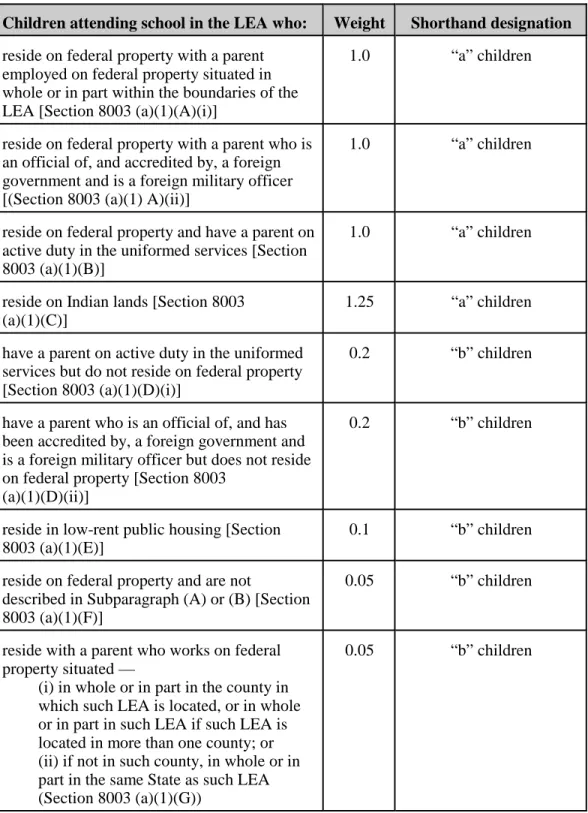
The burdens imposed by various categories of federally connected children are reflected in the weights assigned to each type of child. Table 1 contains the current weights for each category of federally connected children.
Table 1. Types of “Federally Connected” Children and Relevant Weights
Children attending school in the LEA who: Weight Shorthand designation
reside on federal property with a parent employed on federal property situated in whole or in part within the boundaries of the LEA [Section 8003 (a)(1)(A)(i)]
1.0 “a” children
reside on federal property with a parent who is an official of, and accredited by, a foreign government and is a foreign military officer [(Section 8003 (a)(1) A)(ii)]
1.0 “a” children
reside on federal property and have a parent on active duty in the uniformed services [Section 8003 (a)(1)(B)]
1.0 “a” children
reside on Indian lands [Section 8003 (a)(1)(C)]
1.25 “a” children
have a parent on active duty in the uniformed services but do not reside on federal property [Section 8003 (a)(1)(D)(i)]
0.2 “b” children
have a parent who is an official of, and has been accredited by, a foreign government and is a foreign military officer but does not reside on federal property [Section 8003
(a)(1)(D)(ii)]
0.2 “b” children
reside in low-rent public housing [Section 8003 (a)(1)(E)]
0.1 “b” children
reside on federal property and are not
described in Subparagraph (A) or (B) [Section 8003 (a)(1)(F)]
0.05 “b” children
reside with a parent who works on federal property situated —
(i) in whole or in part in the county in which such LEA is located, or in whole or in part in such LEA if such LEA is located in more than one county; or (ii) if not in such county, in whole or in part in the same State as such LEA (Section 8003 (a)(1)(G))
0.05 “b” children
Note: “a” and “b” children refer to designations used for various eligibility categories of federally
CRS-4
4 When appropriations are insufficient to provide maximum basic support payments to
districts, Section 8003(b) specifies how payments are to be reduced to correspond with appropriations.
5 BRAC, Commission Report, Executive Summary.
continue to be referred to as “a” or “b” children. As the table indicates, “a” children are those with higher weights.
Thus, federally connected children whose parents are members of the Armed Forces and live on federal property, whose parents live and work on federal property, whose parents are officials of a foreign government that serve as foreign military officers and live on federal property, or who reside on Indian lands carry the highest weight in the Impact Aid payments for federally connected children. Lesser weights are attributed to federally connected children whose parents are members of the Armed Forces but do not live on federal property.
Currently, to calculate an Impact Aid payment to an LEA, the district first identifies the number of students served in each category identified in Table 1. The number of students in each category is then multiplied by the appropriate weight and summed to create the school district’s weighted student count. This count is then used to calculate the LEA’s maximum basic support payment and actual basic support payment.4
Overview of Base Realignment
and Closure Recommendations
The first BRAC Commission was authorized by the Defense Authorization Amendments and Base Realignment and Closure Act of 1988 (P.L. 100-256), leading to the first round of BRAC in 1988. This was followed by the Defense Based Closure and Realignment Act of 1990, which provided the authorization for subsequent BRAC rounds in 1991, 1993, and 1995. The first four rounds of BRAC resulted in the closure or realignment of 97 bases. The current BRAC round was authorized by the National Defense Authorization Act of 2002 (P.L. 107-107). The current BRAC Commission received a list of recommended actions from the Secretary of Defense on May 13, 2005. It subsequently submitted its recommendations to the Administration on September 8, 2005. After agreeing with the Commission’s recommendations, the President sent the report to Congress on September 15, 2005, for approval. Congress has 45 days to enact a joint resolution of disapproval; otherwise, the recommendations become law. On October 27, 2005, the House voted 324-85 against a joint resolution to end the military base closure and realignment process, sponsored by Representative LaHood (IL).
Under the current BRAC recommendations, 22 major military installations would be closed and 33 others would be realigned.5 Expected savings over the next 20 years resulting from the Commission’s recommendations are estimated at $35.6 billion. The timeline for implementing the Commission’s recommendations is six
CRS-5
6 CRS Report, CRS Report RS22147, Military Base Closures.
years beginning in 2006. “Communities will have until 2011 to adjust to the changes and plan for transfer of the base to the community for redevelopment.”6
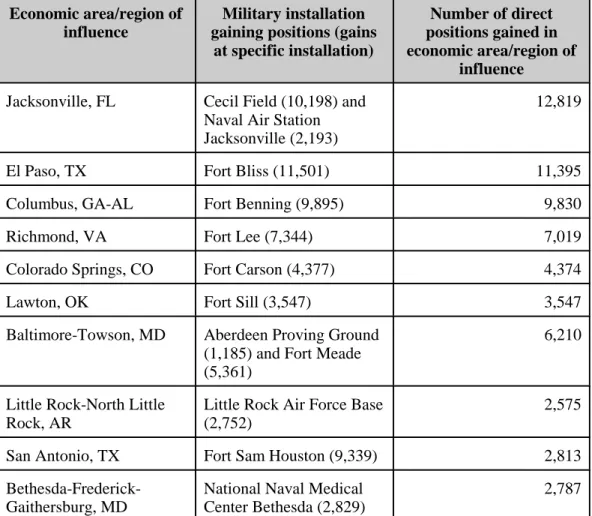
Table 2 lists the 10 communities gaining the largest numbers of direct positions
as a result of the BRAC recommendations. The number of new positions includes net job gains for direct military, civilian, and mission support contractor positions. The number of positions gained at a single location may exceed the number of new positions for an economic area or region of influence due to decreases in positions at other installations in the same area. Thus, for example, San Antonio, Texas will gain 2,813 positions overall, but Fort Sam Houston will gain more than 9,000 positions.
Table 2. Communities Expecting to Gain the Largest Number of Direct Positions as a Result
of the 2005 BRAC Recommendations
Economic area/region of influence
Military installation gaining positions (gains
at specific installation)
Number of direct positions gained in economic area/region of
influence
Jacksonville, FL Cecil Field (10,198) and Naval Air Station Jacksonville (2,193)
12,819
El Paso, TX Fort Bliss (11,501) 11,395 Columbus, GA-AL Fort Benning (9,895) 9,830 Richmond, VA Fort Lee (7,344) 7,019 Colorado Springs, CO Fort Carson (4,377) 4,374 Lawton, OK Fort Sill (3,547) 3,547 Baltimore-Towson, MD Aberdeen Proving Ground
(1,185) and Fort Meade (5,361)
6,210
Little Rock-North Little Rock, AR
Little Rock Air Force Base (2,752)
2,575
San Antonio, TX Fort Sam Houston (9,339) 2,813
Bethesda-Frederick-Gaithersburg, MD
National Naval Medical Center Bethesda (2,829)
2,787
Source: Defense Base Closure and Realignment Commission, 2005 Defense Base Closure and Realignment Commission Report, Appendix O. Sept. 2005. Available online at [http://www.brac.gov].
Note: The number of new positions includes net job gains for direct military, civilian, and mission
CRS-6
support activities on military installations has not been included. As the BRAC recommendations have not become public law, the data presented in this table represent anticipated changes should the recommendations become law.
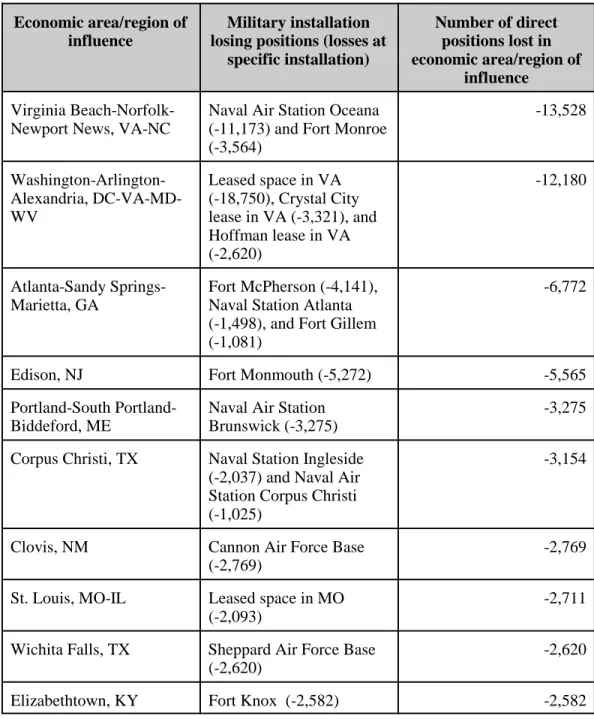
While many economic areas will experience substantial increases in personnel, many will also experience substantial decreases in personnel. Table 3 lists the 10 communities losing the largest number of direct positions as a result of the BRAC recommendations. The number of positions lost includes net job changes for direct military, civilian, and mission support contractor positions.
Table 3. Communities Expecting to Lose the Largest Number of Direct Positions as a Result
of the 2005 BRAC Recommendations
Economic area/region of influence
Military installation losing positions (losses at
specific installation) Number of direct positions lost in economic area/region of influence Virginia Beach-Norfolk-Newport News, VA-NC
Naval Air Station Oceana (-11,173) and Fort Monroe (-3,564) -13,528 Washington-Arlington-Alexandria, DC-VA-MD-WV Leased space in VA (-18,750), Crystal City lease in VA (-3,321), and Hoffman lease in VA (-2,620) -12,180 Atlanta-Sandy Springs-Marietta, GA Fort McPherson (-4,141), Naval Station Atlanta (-1,498), and Fort Gillem (-1,081)
-6,772
Edison, NJ Fort Monmouth (-5,272) -5,565 South
Portland-Biddeford, ME
Naval Air Station Brunswick (-3,275)
-3,275
Corpus Christi, TX Naval Station Ingleside (-2,037) and Naval Air Station Corpus Christi (-1,025)
-3,154
Clovis, NM Cannon Air Force Base (-2,769)
-2,769
St. Louis, MO-IL Leased space in MO (-2,093)
-2,711
Wichita Falls, TX Sheppard Air Force Base (-2,620)
-2,620
CRS-7
7 For heavily affected LEAs, ED uses data from the third fiscal year preceding the fiscal year
for which the LEA is applying for assistance [Section 8003(b)(2)(F)].
8 For some LEAs the decline in enrollment may be more gradual, depending on the timeline
for implementing the Commission’s recommendations for the associated military base.
9 Department of Defense, Office of Economic Adjustment, Community Reaction Guide:
2005 Military Base Closure Recommendations. Available online at [http://www.oea.gov/OEAWeb.nsf/FA61549067CAD9DA85256ED1005221E7/$File/5_ 6%20React-TB1%20Update.pdf].
Source: Defense Base Closure and Realignment Commission, 2005 Defense Base Closure and Realignment Commission Report, Appendix O. Sept. 2005. Available online at [http://www.brac.gov].
Note: The number of new positions includes net job gains for direct military, civilian, and mission
support contractor positions. The number of indirect job changes of local non-government jobs that support activities on military installations has not been included. As the BRAC recommendations have not become public law, the data presented in this table represent anticipated changes should the recommendations become law.
Possible Effects of Base Closure and Realignment
on School Districts Serving Federally Connected Students
While it is not clear at what point (in the six-year period available to implement the recommended changes) military and civilian staff will move, when they do leave, LEAs losing or receiving families as a result of the BRAC Commission’s recommendations may experience substantial changes. This section discusses possible effects of the loss of military children on LEAs, followed by a discussion of the challenges LEAs receiving large numbers of students may face.
LEAs Losing Federally Connected Students as a Result of BRAC.
In calculating payments to LEAs, the U.S. Department of Education (ED) uses student enrollment data from the prior school year [Section 8003(a)(1)].7 Therefore, LEAs that experience a decline in enrollment as a result of BRAC will continue to receive Impact Aid funding for students leaving the LEA for the school year following their departure. Essentially, this provides the LEA with one year to adjust to the decrease in enrollment, allowing time for the district to make decisions related to changes in student enrollment.8 For example, the decline in student enrollment may necessitate releasing staff or consolidating students into a smaller number of facilities. Beyond this one-year “hold harmless” period, LEAs losing federally connected students as a result of BRAC will not receive Impact Aid payments for the students no longer enrolled in the district.
In some instances, the loss of a military facility may be translated into new economic development opportunities for the surrounding community as communities explore base redevelopment potential.9 Depending on the ultimate use of the facility, such as an airport, port facility, or educational facility, new families may be attracted to the area, increasing student enrollment and potentially generating the need for more teachers and possibly school facilities. These changes may take several years
CRS-8
10 Several communities surrounding military facilities slated for closure, such as Fort
Monroe, Virginia; Fort Monmouth, New Jersey; and Fort Gillem, Georgia, which have already begun to plan local redevelopment authorities (LRA) to start the reuse process as quickly as possible. The Department of Defense’s Office of Economic Adjustment will not recognize the LRAs, however, until the BRAC recommendations become law. National Association of Installation Developers/Association of Defense Communities, BRAC Communities Launch Redevelopment Efforts, Oct. 13, 2005. Available online at [http://www.defensecommunities.org].
11 See Section 1119 of the Elementary and Secondary Education Act of 1965 (as amended
by the No Child Left Behind Act of 2001) for the qualifications of high-qualified teachers. For more information, also see CRS Report RL30834, K-12 Teacher Quality: Issues and Legislative Action, by James B. Stedman.
12 As discussed later in this report, the availability of Impact Aid funding for the following
school year for these students is dependent upon when in the school year they arrive relative to student count dates for the Impact Aid program.
to materialize — thus, potentially failing to generate new student enrollment quickly enough to replace the loss of students to the BRAC process.10
LEAs Gaining Federally Connected Students as a Result of BRAC.
Since basic support payments to LEAs are based on prior-year student enrollment data, LEAs that gain students as a result of BRAC will not receive Impact Aid funding for those new students until they have been enrolled in the district for at least part of a school year. That is, the LEA will not immediately receive additional
Impact Aid funding as a result of the increase in enrollment. While receiving
LEAs have been provided with some advance notice of potential changes through the BRAC process, LEAs receiving large numbers of students may experience a substantial financial burden for the first school year in which the students are enrolled. In addition, decisions that the LEA needs to make that are dependent on Impact Aid payments, such as staffing decisions, may be complicated by the timing of the data collection process used to determine subsequent payments and the timing of actual payments.
LEAs experiencing large increases in the number of students as a result of the BRAC recommendations may also need to hire several new teachers to meet the educational needs of these students. LEAs may experience problems in finding enough highly qualified teachers as required under the No Child Left Behind Act,11 hiring them to coincide with the shift in student population, and finding funds for their salaries. As previously mentioned, Impact Aid funding for students arriving in the LEA as a result of the BRAC will not be available until the following school year at the earliest.12 This puts the burden of supporting new staff on the LEA for at least the short term.
It should be noted that P.L. 81-874 included provisions for “sudden and substantial increases in attendance” that are not included in current law. Under Section 4 of P.L. 81-874, LEAs that experienced at least a 5% increase in student enrollment from one school year to the next as a direct result of activities of the United States and met certain other requirements, would have been eligible to receive compensation for serving these new students. The increase in enrollment had to
CRS-9
13 P.L. 81-874 was signed into law prior to the establishment of the U.S. Department of
Education. At the time, there was a Commissioner of Education who was subsequently replaced by the Secretary of Education when Education was elevated to a cabinet-level position. The reference to the Commissioner in P.L. 81-874 was not updated.
result in a “substantial and continuing financial burden” on the LEA and the LEA had to be making “a reasonable tax effort and ... exercising due diligence in availing itself of State and other financial assistance but (be) unable to meet the increased educational costs involved” [Section 4(a)].
If these conditions were met, LEAs were eligible to receive funding for the fiscal year in which the increase in enrollment occurred equal to the product of the number of new children enrolled in the LEA that the Commissioner of Education13 (Commissioner) determined to be the direct result of the activities of the United States — multiplied by the amount determined by the Commissioner to constitute the current expenditure level required to provide a free public education, minus the amount determined by the Commissioner to be available from state, local, and federal sources for the purpose of providing a free public education. In the subsequent fiscal year, LEAs were still entitled to receive extra support for any of these students for whom the LEA would not receive compensation under an Impact Aid payment for federally connected children. These provisions are not included in current Impact Aid statutory language.
Another potential problem facing LEAs receiving large influxes of new students as a result of BRAC may be related to facilities. Some LEAs may receive more students than can be accommodated in existing facilities. The Impact Aid program provides payments related to school construction and repair under Section 8007. The FY2005 appropriation for Section 8007 was $48.5 million. These funds are used to make formula grants and competitive grants for the construction program. Of the total funds appropriated for this section, 40% are distributed to LEAs that receive funds through Section 8003 and meet specific criteria. The remaining funds are used to award competitive grants for emergency repairs and modernization. Emergency repair grants may be used to repair or renovate a facility due to health or safety hazards. Modernization grants may be used to alter a facility to alleviate overcrowding or to provide more modern services (e.g., telecommunications). Statutory language currently gives higher priority to emergency repair grants than to modernization grants, and requires emergency repair grants to be awarded based on the severity of the emergency. Construction grants may only be awarded to LEAs that are eligible to receive support under Section 8003. LEAs experiencing large increases in student enrollment as a result of BRAC may consider applying for a Section 8007 grant if they can demonstrate they meet the criteria to receive funding. However, there will potentially be a delay between when the students arrive and when major adjustments to facilities can be made. In addition, the total Section 8007 appropriation for FY2005, for example, might not be sufficient to adequately assist all of the LEAs experiencing a large influx of new students with facility issues. No other federal program would currently provide a dedicated source of funding to address facility-specific issues requiring immediate or near term attention as a result of an increase in student enrollment due to BRAC.
CRS-10
14 U.S. Department of Education, Office of Elementary and Secondary Education Section
8003 Instructions. Available online at [http://www.ed.gov/programs/8003/applicant.html].
15 Education programs that are forward-funded receive a portion of their appropriation three
months prior to the start of the fiscal year for which the funds are appropriated. For example, forward-funded education programs would receive a portion of their FY2007 appropriation on July 1, 2006, rather than Oct. 1, 2006.
Another issue that may affect LEAs receiving students as a result of BRAC is the student count process. Student counts for the Impact Aid program are due to the ED by January 31 each school year. If students transfer into the LEA after January 31, these students will not be included in the student count used to calculate Impact Aid programs for the subsequent school year. Based on instructions provided to LEAs by ED for FY2006 Impact Aid payments, LEAs were permitted to conduct a second student count after January 30, 2005, but before May 14, 2005.14 LEAs conducting second counts were also required to resubmit their Impact Aid applications by September 30, 2005. FY2006 payments will be based on an average of the two counts. LEAs that receive students after January 31 will need to take steps to ensure that this second count occurs. While they may not receive full compensation during the next school year for any additional federally connected students received as a result of the BRAC due to the averaging of the first and second counts, failure to conduct the second count and the associated paperwork could result in LEAs receiving no Impact Aid payments for federally connected students enrolling after the January 31 count date.
Finally, unlike other federal education programs, the Impact Aid program is not forward-funded, meaning that the earliest appropriations could be made available to LEAs is the first day of the fiscal year.15 For example, the earliest FY2007 appropriations could be provided to LEAs would be October 1, 2006. Thus, even LEAs that enrolled large numbers of federally connected students as a result of the BRAC recommendations, and were able to submit enrollment data to ED that included those pupils, would not have Impact Aid payments for those students on the first day of the new school year. In practice, Impact Aid payments are often not made as a single payment with LEAs receiving multiple payments throughout the school year. In addition, depending on the budget appropriations process in Congress, payments could be further delayed if Congress does not pass the Labor-Health and Human Services-Education appropriations bill that funds the Impact Aid program by the start of the new fiscal year.
School Districts’ Responses to Troop Increases
Little information is readily available about how LEAs have adjusted to sudden increases in federally connected student enrollment as a result of BRAC or how LEAs are planning for BRAC 2005. As this is the fifth round of BRAC since 1988, LEAs may be able to seek guidance from LEAs that have already experienced large student increases resulting from previous BRAC rounds. While a few examples of activities undertaken by LEAs are presented below, it should be noted that there are no dedicated funds, such as Impact Aid funds, to assist with the transition process.
CRS-11
16 National Association of Installation Developers/Association of Defense Communities,
When an Installation Grows: The Impact of Expanding Missions on Communities. Jan. 2005. Available online at [http://www.defensecommunities.org/mission_growth.pdf].
17 National Association of Installation Developers/Association of Defense Communities,
Ready, Set, Grow: Defense Communities Make Plans to Accommodate New Missions. Sept. 22, 2005. Available online at [http://www.defensecommunities.org].
One relevant example of an LEA response to a sudden influx of military children (though not related to BRAC) occurred as a result of 850 additional soldiers being stationed at Fort Campbell in Kentucky, located near the Tennessee border.16 In response to the shift in troops, the Clarksville-Montgomery School System, which is located in Tennessee, expected to receive an additional 1,000 students. The school system received a $4 million earmark in the FY2005 defense appropriations bill to help defray the costs of educating these children.
Some information is also available about actions being taken by school systems in communities expecting to receive a large influx of students as a result of the 2005 BRAC recommendations.17 For example, Fort Riley in Kansas is expecting 3,400 troops to arrive in early 2006. School districts in the surrounding area have already hired additional teachers to handle the anticipated increase in student enrollment. School districts located near Fort Benning in Georgia have also begun to make plans to accommodate new student enrollment. School officials are working with other community officials to determine where new schools should be built in relation to expected growth patterns for housing. The school districts are seeking state and federal aid to build the schools prior to students’ arrival. They anticipate that they have four to five years to complete the new construction