The PaaS Payoff:
Greater Agility,
Less Cost
T
o say today’s IT managers are engaged in a difficult and often risky balancing act is an understatement. For many IT decision makers, success or failure of their departments and their larger enterprises hinges on how well they address conflicting business and technical requirements.One such challenge is to meet ever-growing demands for new and innovative applications to help business users capitalize on the latest market opportunities and block threats from competitors. In a perfect world, IT lead-ers would have growing budgets and a swarm of skilled technicians to deliver these services at a pace required by fast-changing business conditions. But the reality is far from perfect, which reveals a second, equally important challenge: Since IT shops will likely continue to see only modest gains at best in budgets and headcount, they must find ways to tightly manage costs.
As if this two-pronged challenge isn’t enough, IT leaders face a third imperative: ensure that any new technology initiatives they undertake don’t create security gaps for the world’s growing army of cyber criminals to exploit.
Fortunately, technological innovation can help by provid-ing internal optimizations that enable IT leaders to juggle multiple priorities and keep their enterprises thriving. UBM Tech’s new research reveals that IT decision mak-ers are looking to Platform as a Service (PaaS), a pillar of cloud computing and one now available in a variety of
Executive Summary
Today’s IT managers must balance often conflicting challenges. One imperative is to meet ever growing demands for new and innovative applications to help capitalize on business opportunities and thwart com-petitive threats. An equally important priority is to maintain tight control over spending and headcount. Third, IT leaders must ensure that any new technol-ogy initiatives don’t open up new security gaps.
Exclusive research by UBM Tech reveals that many IT decision makers are addressing these multiple requirements with the help of Platform as a Ser-vice (PaaS), a main pillar of cloud computing. The study also identified today’s top IT imperatives, the business and technical potential of PaaS, and best-practices enterprises can use for successfully transitioning to this important cloud technology.
This report takes a look at the data from this survey, and how PaaS can help IT leaders as they pursue fast-paced innovation in budget-conscious organizations.
Private Platform as a Service
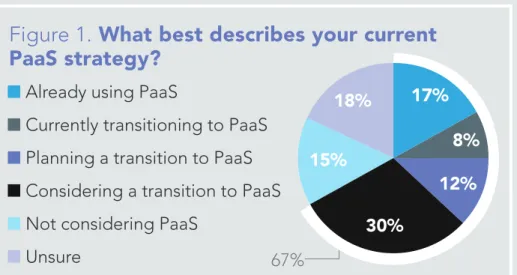
flexible implementation models, to address an array of business and technology challenges. In the UBM Tech survey, 67% of IT deci-sion makers say their organizations are considering or already using PaaS (see Figure 1).
Independently, industry analysts are also observing how PaaS is benefiting progressive enter-prises. “Depending on how much code you’re writing [PaaS] can accelerate delivery of applica-tions anywhere from 30% to 80%,” says John Treadway, senior vice president at Cloud Technology Partners, a consulting firm.
The UBM Tech survey polled IT decision makers and other senior leaders at midsized and large enterprises in a cross-section of commercial companies and public-sector agencies. The results identify today’s top IT imperatives, the business and technical poten-tial of PaaS, and best-practices enterprises can use to success-fully transition to this important cloud technology. The results
offer a clear picture of why PaaS is becoming the go-to strategy for modern businesses.
Multiple PaaS Options
As cloud computing continues to evolve, PaaS remains one of its core building blocks, along with Software as a Service and Infrastructure as a Service. PaaS distinguishes itself by serving the needs of professionals responsible for developing new applications and services, and optimizing the performance of these resources
in production systems. PaaS does this by giving developers access to easily provisioned pools of computing, network, and stor-age resources for creating and testing new applications. The best PaaS options offer familiar programming languages, such as Java, PHP, Ruby, Perl, and Python, as well as frameworks like Java Enterprise Edition. The result: Developers can focus on their core responsibilities – creating and deploying new applications and services – rather than spending time setting up the development environment.
“From a programmer’s view-point, deployment architectures take a lot of planning. But with PaaS, there are fewer things to worry about,” Treadway says. “I write code, I put it into a container, and application scaling and every-thing else just happens.”
PaaS comes in a variety of forms. Public PaaS relies on a third-party
Research Methodology
In March 2014 UBM Tech surveyed 278 business technology managers at orga-nizations with 500 or more employees in a cross-section of industry sectors on behalf of Red Hat. The study looked at business goals, technology challenges, and factors that impeded efforts to deliver new applications and services to meet changing market requirements. A key focus of the survey was interest in and adoption rates for Platform as a Service and how plans for this technology might evolve in the future. The greatest possible margin of error for the total respon-dent base (N=278) is +/- 5.8 percentage points. UBM Tech was responsible for all programming and data analysis. These procedures were carried out in strict accordance with standard market research practices.
Figure 1.
What best describes your current
PaaS strategy?
■
Already using PaaS
■
Currently transitioning to PaaS
■
Planning a transition to PaaS
■
Considering a transition to PaaS
■
Not considering PaaS
■
Unsure
DATA: UBM Tech survey of 278 business technology managers at companies with 500 or more employees, March 2014
15%
30%
8%
18%
12%
17%
67%
15%
provider to host the develop-ment resources. IT managers can also choose on-premises, or private, PaaS deployments, sometimes built with open-source technologies, as well as hybrid implementations that combine public and private platforms.
An organization’s individual requirements will determine which option is right for it. For example, a company wishing to avoid upfront capital expenditures and an ongoing management effort, can opt for public PaaS,
which lets IT teams quickly spin up development resources by con-tracting with a third-party that’s fully responsible for launching and maintaining the environment.
Nevertheless, on-premises PaaS offers some unique benefits,
such as full control of proprietary applications and data that enter-prises don’t want to trust to an outside entity. “Enterprises may be legally bound to ensure some data doesn’t leave the borders of their country,” says Brad Shimmin, service director for business tech-nology and software at Current Analysis, a consulting firm.
Because hybrid PaaS merges hosted and on-premises alter-natives, enterprises can take advantage of highly scalable programming tools along with
1 || 2 || 3 || 4 || 5 || 6 || 7 || 8 ||
On-premises PaaS
offers unique benefits,
such as control of
applications and data
that enterprises don’t
want to trust to an
outside entity.
NOTE: Percentages reflect combined scores on a scale of 1 to 10 where 10 is “very important.”
DATA: UBM Tech survey of 278 business technology managers at companies with 500 or more employees, March 2014
■
Not Important
■
Neutral
■
Important
Figure 2.
How important is each of the following to your organization’s IT department?
Improved security
Improved application performance
Improved application reliability
Reduced application development costs
Increased innovation
Increased mission agility
Automated IT maintenance
Faster time to market for new applications
Pay-per-use infrastructure
4%
4%
6%
8%
9%
10%
10%
17%
38%
16%
10%
14%
14%
23%
22%
22%
18%
26%
80%
86%
80%
78%
68%
68%
68%
65%
36%
close control of the data and infrastructure.
A Long To-Do List
Expanding choices associated with PaaS dovetail with a grow-ing list of requirements that IT shops must address. The need to keep core business applications modern and innovative is a top driver. For example, when asked what percentage of their organiza-tion’s applications need a refresh or replacement, almost two-thirds of the IT decision makers in UBM Tech’s survey say between 20% and 50%.
Other top concerns among a significant majority of respon-dents range from improving security and application
performance to enhancing appli-cation reliability and curbing
application-development costs (see Figure 2, p. 3).
Unfortunately, a host of road-blocks stymie these important goals. For example, nearly a third of the respondents report that their organizations are missing out on opportunities to implement or deploy new technologies because they are locked in to IT contracts that accompany the upfront license costs of proprietary soft-ware vendors.
The IT executives also single out sometimes lengthy steps in typical software development cycles as barriers to launching new applica-tions and services.
Half of the respondents say it takes at least a month to almost a year to provision a new environ-ment. Within that group, 21% say they require 2 to 5 months for
provisioning. Infrastructure main-tenance, application updates, application deployment, and testing are other time-consuming steps, for a majority of the respon-dents (see Figure 3).
However, time sinks aren’t the only concerns keeping IT deci-sion makers awake at night. A clear and present danger lurks within IT organizations: the rise of shadow IT, technologies built or procured without the sanction of the IT department. More than 80%
Figure 3.
During a typical software application development cycle, how long
does your organization spend on each of the following steps?
Almost two-thirds of
those surveyed say
that between 20%
and 50% of their
applications need to be
refreshed or replaced.
Less than 1 1 1 2 to 5 6 to 11 1 to 2 More than 8 hours day week month months months years 2 years Unsure
Requirements definition 2% 1% 7% 31% 31% 12% 5% 1% 10%
Training/final acceptance 1% 1% 19% 31% 22% 8% 4% 2% 12%
Application simulation/testing 0% 2% 9% 30% 28% 13% 5% 1% 12%
Application updates 3% 6% 16% 21% 26% 9% 3% 2% 14%
Application deployment 3% 5% 21% 20% 22% 10% 5% 2% 12%
Standard infrastructure maintenance 3% 11% 20% 20% 15% 9% 3% 3% 16%
Provision a new development environment 7% 6% 16% 16% 21% 12% 5% 3% 14%
Application development 1% 1% 2% 11% 31% 31% 10% 3% 10%
of the IT leaders surveyed say at least a few end-users run a tool or application for work purposes that has not been officially deployed by the IT department, while 37% say that many or almost all users rely on shadow IT technologies (see Figure 4). By speeding the deploy-ment of new applications and services, options such as PaaS help IT departments quickly respond to new business demands, which can discourage end-users from acting on their own.
These numbers are especially worrisome, given that 59% con-sider shadow IT a significant security concern (see Figure 5).
As important as security risks are, they’re not the only reason to fear shadow IT. The trend is often symptomatic of another fundamental problem, namely, that business users believe they
can get services more quickly by circumventing the IT department. When that happens, governance policies break down, and deci-sions get made without the benefit of the technical expertise available to match the right IT resources for the organization’s overall needs. Clearly, IT managers should explore any options that increase flexibility and shrink lead times for services vital to busi-ness operations, as well as create an environment that reduces risk and discourages employees from breaking governance policies.
A Comprehensive Answer
Against this backdrop of business and IT imperatives, nagging appli-cation development problems, and security concerns, decision makers are looking to PaaS for answers. PaaS is already becoming
an important component in IT road maps, with 67% of organizations considering it or already using it to develop and or host enterprise applications. The bottom line is that 57% of respondents say PaaS is critical to realizing their corporate goals (see Figure 6, p. 6).
While PaaS’s contribution to enterprises’ overall strategies is noteworthy, this particular cloud option can also deliver specific benefits for business operations and IT efficiency.
First, many respondents view PaaS as a resource for faster time
1 || 2 || 3 || 4 || 5 || 6 || 7 || 8 ||
Figure 5.
Do you
con-sider Shadow IT (i.e.,
IT solutions built or
procured and used
inside organizations
without
organiza-tional approval) to be
a significant security
concern?
■
Yes
■
No
■
Unsure
DATA: UBM Tech survey of 278 business technology managers at companies with 500 or more employ-ees, March 2014
16%
25%
59%
Figure 4.
Approximately how many end-users do
you anticipate using a tool or application for work
purposes that has not been officially deployed by
the organization’s IT department?
■
Almost all
■
Many
■
Some
■
Few
■
Almost
none
■
None
■
Unsure
DATA: UBM Tech survey of 278 business technology managers at companies with 500 or more employees, March 2014
37%
31%
6%
7%
30%
7%
6%
13%
Figure 6.
Please indicate how much you agree with the following statements.
■
Strongly agree
■
Agree
■
Disagree
■
Strongly disagree
New application development is vital to my organization’s ability to meet mission objectives
Transitioning to, or expanding our use of, PaaS will enable my organization
to fully leverage cloud computing benefits
My organization can transition to a PaaS model while maintaining the safety and
security of my organization’s data
Transitioning to PaaS is critical to application rationalization
PaaS is critical to realizing our corporate goals
DATA: UBM Tech survey of 278 business technology managers at companies with 500 or more employees, March 2014
to market (see Figure 7, p. 7). One explanation for this is the ability of PaaS to smooth the develop-ment process. Programmers want to focus on the application itself – “the APIs, user interfaces, and user experience, as opposed to all the plumbing,” says Cloud Technology Partners’ Treadway. “What I need to worry about is what services are deployed on the platform, such as the database and middleware, not how the database is deployed. As a result, the agility gain is immedi-ate and enormous.”
Second, PaaS can shorten application development cycles, sometimes by significant amounts. In fact, 56% of the respondents say the reduction would be 20% or more. Analysts report even greater reductions in
some real-world cases.
Treadway, for instance, worked with a banking client that used PaaS to make frequently used services, such as account balance look-ups, available through APIs. “The applications they write using this platform and the business processes they exposed are taking 80% less time to deliver than in the past,” he says.
Third, the potential to save money is another attraction of PaaS. Among the IT decision mak-ers in the survey, nearly 40% say PaaS could reduce their annual
IT budgets by at least 20%, while nearly two-thirds expect at least a 10% savings. One notable area for reducing expenses is in serv-ers used for development and testing, which in traditional envi-ronments can be time consuming and expensive to procure and set up. Virtualized servers either in an on-premises or hosted PaaS environment can mitigate these costs with computing power that can be dialed up as needed for a new project and then reallocated to other areas once an application goes live.
Finally, 37% of respondents see PaaS as a way to improve applica-tion performance while 33% see it as a way to boost reliability. Pre-built services available as plug-ins or cartridges enable developers to
32%
11%
8%
9%
58%
3%
69%
8%
54%
9%
48%
11%
7%
12%
29%
32%
15%
69%
9%
7%
56% of those surveyed
expect PaaS to
shorten application
development cycles by
20% or more.
write fewer lines of code to deploy new applications and business processes. Less new code means fewer chances to introduce bugs in the software and, ultimately, higher-quality programs.
Concerns Remain
But the path to PaaS isn’t entirely clear in the minds of IT decision makers. Not surprisingly, security ranks at the top of concerns (see Figure 8, p. 8). Other potential stumbling blocks are loss of control
over application infrastructure, getting locked into a proprietary infrastructure, and concerns about infrastructure reliability.
No surprises here. These are commonly held fears about any hosted cloud computing solution. Prudent IT managers must always question whether an outside orga-nization can fully protect valuable data and intellectual property in a multi-tenant environment, as well as deliver the performance levels defined in service agreements.
The same is true of vendor lock-in, which, as already noted, is a broad concern across IT departments that are intent on innovation.
Industry analysts encounter similar fears in their research, especially among enterprises that have studied PaaS offerings that use proprietary data formats and languages. “Problems emerge with data access when it crosses the firewall, and there are certainly issues with access control. Things aren’t as clean as they could be,” Current Analysis’s Shimmin says.
None of these challenges is necessarily a PaaS deal breaker, however, and many IT executives understand this reality. Nearly 60% say they believe they can transition to a PaaS model while maintain-ing the safety and security of their organization’s data.
But a collection of realistic concerns underscores the need for a clear migration strategy for enterprises that want to move from traditional development environments to a cloud-based PaaS alternative. Due diligence when vetting PaaS providers can alleviate concerns in hosted envi-ronments. Alternatively, choosing
1 || 2 || 3 || 4 || 5 || 6 || 7 || 8 ||
Faster time to market for new applications
Reduced costs
Improved application performance
Improved application reliability
Automated IT maintenance
Increased mission agility
Improved security
Increased innovation
Ability to share costs/implement charge-back with pay-per-use model
NOTE: Multiple responses allowed
DATA: UBM Tech survey of 278 business technology managers at companies with 500 or more employees, March 2014
Figure 7.
What benefits is your organization realizing,
or do you anticipate your organization will realize,
from implementing a PaaS model?
30%
30%
28%
33%
24%
16%
46%
45%
37%
Prudent IT managers
must always question
whether an outside
organization can
fully protect valuable
data and intellectual
property.
on-premises or hybrid PaaS implementations built with open-source technologies will address infrastructure control and vendor lock-in issues. In the process, enterprises gain the flexible, highly scalable resources they need for developing new applications and services to address emerging busi-ness opportunities and challenges ahead of the competition.
A Path for the Future
IT managers can expect to be juggling conflicting demands for fast-paced innovation and tight financial controls for the foresee-able future. In this environment, successful leaders must avoid solutions that could exacerbate long-standing problems, such as security vulnerabilities, contracts that shackle organizations to pro-prietary technologies, extended application development lifecy-cles, and situations that encourage shadow IT.
Maturing PaaS technologies, available in hosted, on-premises, and hybrid models, are poised to grow in importance for all phases of application delivery and give IT managers valuable resources to balance modernization and budget realities.
Security
Loss of control over application infrastructure
Getting locked into proprietary infrastructure
Concern over infrastructure reliability
Leadership resistance
Developer resistance
NOTE: Multiple responses allowed
DATA: UBM Tech survey of 278 business technology managers at companies with 500 or more employees, March 2014
Figure 8.
What are the most significant challenges
your organization faces with the transition to PaaS?
29%
17%
35%
51%
43%
40%
Red Hat is the world’s leading provider of open-source solutions, using a community-powered approach to provide reliable and high-performance cloud, virtualization, storage, Linux, and middleware technologies. Red Hat also offers award-winning support, training, and consulting services. Red Hat is an S&P company with more than 70 offices spanning
the globe, empowering its customers’ businesses. Learn more at redhat.com.
THE RED HAT ADVANTAGE
OpenShift Enterprise by Red Hat® is a cloud computing platform as
a service solution designed for on-premises or private cloud deploy-ments. OpenShift Enterprise provides an on-demand, elastic, scalable, and fully configured application development, testing, and hosting environment for application developers so they can focus on coding new application services.
Key Benefits:
• Gives application developers access to a self-service platform for build-ing and runnbuild-ing applications in the cloud.
• Gives IT operations a cloud platform with automated provisioning and scaling of applications.
• Provides a full suite of programming languages and developer tools for streamlining development processes.
• Allows IT to build and launch applications faster to better meet the needs of the business