24
Combating Corruption and Fraud for Sustainable Development:
Beyond Audit Procedures and Rules
Essien Akpanuko
University of Uyo, P. M. B. 1017 Uyo, Akwa Ibom State, Nigeria E-mail of the corresponding author: [email protected]
Abstract
Fraud and corruption have devastating effects, especially on the poorest citizens of developing countries and have spread even to countries once considered “clean.” Public sector bribery, fraud, and other forms of corruption have become leading concerns for legislators around the globe, as the diversion of public funds undermines control of the public purse and robs public policies of resources to ensure sustainable development. This paper discusses the different theories and strategies adopted by fraudsters, identify the different methods of combating this “cancer” in developed and developing countries outside the external audit approaches, and evaluate the external audit approach. It proposes strategies that are beyond compliance to external audit procedures and rules that will empower the citizens (principal) to demand for and enforce accountability from the public officials (agents). Thus, allowing for sustainable development. It argues that for these strategies to work effectively, a change in audit emphasis and a given level of decentralization is required. The principles and strategies presented in this paper can be considered by donor agencies to countries where fraud and corruption interfere with good governance.
Keywords: corruption and fraud, accountability, audit and governance 1. Introduction
Sustainable development depends largely on the provision of public goods and services. Over the years, considerable expenditures and investments have been made by governments, institutions and concerned agencies to ensure sustainable development. This development has remained a mirage because the goods and services are failing; falling short of the potential to improve outcomes. They are often inaccessible or prohibitively expensive. However, when accessible they are dysfunctional, extremely low in technical quality and unresponsive to the needs of diverse clientele (World Bank, 2004). Internationally corruption is known to be responsible for these failures and is a daunting obstacle to the sustainability of developmental activities. Given the growing evidence of the detrimental impact of corruption on sustainable development, concerns about corruption have mounted in recent years (World Bank, 2004). The list of this evidence is long and deserving of the attention given.
Corruption slows GDP growth (Abed and Davoodi 2000; Mauro 1995) and adversely affects capital accumulation (Lambsdorff 1999a, 1999b). It lowers the quality of education (Gupta, Davoodi, and Tiongson 2000), public infrastructure (Tanzi and Davoodi 1997) and health services (Tomaszewska and Shah 2000; Treisman 1999). It reduces the effectiveness of development aid and increases income inequality and poverty (Gupta, Davoodi, and Alonso-Terme 1998). Bribery, often the most visible manifestation of public sector corruption, harms the reputation of and erodes trust in the State. Corrupt and poor governance make it more difficult for the poor and other disadvantaged groups and minorities, to obtain public services. Corruption affect macroeconomic stability, when, for example, the allocation of debt guarantees based on cronyism or fraud in financial institutions leads to a loss of confidence by savers, investors, and foreign exchange markets.
The Bank of Credit and Commerce International (BCCI) scandal, uncovered in 1991, the corrupt practices at Mehran Bank in the Sindh Province of Pakistan in the mid-1990s, the Oceanic and Intercontinetal Bank Nigeria scandals uncovered in 2009, the Nigerian pension fund and oils subsidy Fraud uncovered in 2012, are few examples of corruption with dare public consequences. Sad to note that often time this crimes are not uncovered in the accounting and auditing process. For example, the BCCI scandal led to the financial ruin of Gabon, the corrupt practices at Mehran Bank in the Sindh Province of Pakistan and the Oceanic and Intercontinetal Bank Nigeria led to loss of public confidence in these countries banking system. The Nigerian pension fund and oil subsidy fraud led to loss of confidence and trust in the government. The numerous consequences of corruption are summarized by Cavil and
25 Sohail (2007:8).
The authenticating function of accounting, external auditing has had it fair share of blame, criticism and failures. Without ignoring the collapse of blue chip firms with ‘unqualified audit (clean) reports’ in developed and developing countries, the recent (2007) economic meltdown that has grounded economies and firms are blamed on the oversights of the accounting watchdogs (auditors or audit firms). This has resulted in untold loses and hardship, litigation of one form or the other and stringent audit rules to guide against a repeat and to cripple corruption. However, amidst these improvements and reforms, corruption still thrives and infects the systems of governance. Several techniques, methods and policy reforms have been suggested and some implemented to combat this infectious monster. However, as new strategies are introduced to disrupt corruption, the fraudsters-the agents-invents new techniques and improve the loopholes even in the new strategies to counter the disruption, thus leaving these methods ineffective. Are nations doomed to corruption? Can corruption be disrupted? What is responsible for the insignificant impact of existing strategies in combating corruption? What is the way forward? These questions define the objectives of this paper.
To achieve these objectives, the paper is presented in 5 sections. Section 2 addresses the concepts, theories and frameworks, model, varieties and sophistication of corruption. Section 3 evaluates the different methods of combating corruption. Section 4 presents the proposed methods and the challenges. Section 5 is the summary and concluding remarks.
2. The concepts, Theories and Empirical evidence of corruption 2.1 The Concept of Corruption
The word corruption comes from the Latin verb corruptus (to break); it means “broken object.”Conceptually, corruption is a form of behavior that departs from ethics, morality, tradition, law, and civic virtue. The World Bank and Transparency International treat corruption as the use of one’s public position for illegitimate private gains. Abuse of power and personal gain, however, can occur in the public and private domains, often through collusion by individuals from both sectors. The Lebanese, therefore, define corruption as the “behavior of private individuals or public officials who deviate from set responsibilities and use their position of power in order to serve private ends and secure private gains” (Kulluna, 1999). In simple and precise terms Corruption is the exercise of official powers against public interest (and includes both the public and private sectors) or the abuse of public office for private gains. For practical purposes, and for this discussion, the term is used to describe deception, bribery, forgery, extortion, fraud, theft, conspiracy, embezzlement, misappropriation, etc.
Public sector corruption has become alarming and a driving force for private sector corruption to gain momentum. Public sector corruption is a symptom of failed governance (Cavil and Sohail, 2007). Governance is defined as the norms, traditions, and institutions by which power and authority in a country are exercised. These norms, traditions, and institutions include the institutions of participation and accountability in governance, mechanisms of citizen voice and exit, and norms and networks of civic engagement; the constitutional-legal framework and the nature of accountability relationships between citizens and government; the process by which governments are selected, monitored, held accountable, and renewed or replaced; and the legitimacy, credibility, and efficacy of the institutions that govern political, economic, cultural, and social interactions among citizens and between citizens and their governments (Shah, 2007). Issues and concern about corruption is as old as the history of government and man. In 350 BC, Aristotle suggested in The Politics, “To protect the treasury from being defrauded, let all money be issued openly in front of the whole city, and let copies of the accounts be deposited in various wards.”
2.1.2 Models, Variation and Sophistication of Corruption
Corruption is not manifested in a single form. It typically takes at least five broad forms. Shah (2007) highlights the first four models, (a) Petty, administrative, or bureaucratic, (b) Grand, (c) State or regulatory capture and influence peddling, (d) Patronage, paternalism, clientelism, and being a “team player” and (e) Systemic Corruption. These are discussed briefly.
a) Petty, administrative, or bureaucratic corruption. Many corrupt acts are isolated transactions by individual public officials who abuse their office by demanding bribes and kickbacks, diverting public funds, or awarding favors in return for personal considerations. Such acts are often referred to as petty corruption, even though, in the aggregate, a substantial amount of public resources may be involved.
26
members of, or people associated with, the political or administrative elite), false representation, concealment of material facts and fraud; constitutes grand corruption. Fraud is the use of deception with the intention of obtaining an advantage, avoiding an obligation, or causing loss to another party. Fraud is a deliberate act that usually involves the use of deception to obtain some form of financial benefit or advantage from a position of authority or trust that often results in some form of loss to the organization defrauded. It refers to dishonesty in the form of an intentional deception or a willful misrepresentation of a material fact.
c) State or regulatory capture and influence peddling. State capture is the collusion by private actors with public officials or politicians for their mutual, private benefit. In this form of corruption, the private sector “captures” the state legislative, executive, and judicial apparatus for its own purposes. State capture coexists with the conventional (and opposite) view of corruption, in which public officials extort or otherwise exploit the private sector for private ends.
d) Patronage, paternalism, clientelism, and being a “team player.” Corruption occurs when officials use their official position to provide assistance to clients or colleagues with the same geographic, ethnic, or cultural origin so that they receive preferential treatment in their dealings with the public sector, including public sector employment. e) Systemic corruption. Many countries in the world suffer from systemic corruption. This type of corruption is analogous to organized crime; participants act not independently but in concert with one another, maintaining the system that allows them to extract rents and taking their own share of the rents.
2.2 The Theoretical Framework
Public sector corruption depends on a multitude of factors, such as the quality of public sector management, the nature of accountability relations between the government and citizens, the legal framework, and the degree to which public sector processes are accompanied by transparency and dissemination of information. To understand why corruption persists and what can be done to combat it, it is necessary to understand relationships of stakeholders in an environment of corruption. At the theoretical level, a number of interesting ideas have been put forward. These ideas can be broadly grouped into three categories (Aidt, 2003 and Jain, 2001) from the oldest to the latest: (a) Principal-Agent models, (b) New Public Management perspectives, and (c) Neo-Institutional Economics frameworks.
A. Principal-Agent Models
Of the three theories of stakeholder’s relationships in a State, the most widely used is the principal-agent model. Although there are two variations, this model believes in the “crime and punishment” theory of Becker (1968), which opines that self-interested public officials seek out or accept bribes as long as the expected gains from corruption exceed the expected costs (detection and punishment) associated with corrupt acts. In this model the state is led and managed by a benevolent dictator (the principal). The main aim of the principal is to motivate other government officials (agents); this includes the citizens, to act with integrity in the use of public resources (Banfield 1975; Becker1968, 1983; Becker and Stigler 1974; Klitgaard 1988, 1997; Rose-Ackerman1975, 1978 and Shah, 2007). Thus, given the crime-punishment relationship, the principal can control corruption by reducing the number of transactions over which public officials have discretion. This reduction in the scope of gains (transactions with discretion), increases the possibility for restrain, or increasing the punishment for corruption. Based on the increased possibility of restrain, Klitgaard (1988) observes that in the principal-agent relationship in the State, corruption equals monopoly plus discretion minus accountability.
In the first variation is without the legislators. In this variation, corruption can be reduced by rules-driven government that includes strong internal controls with little or no room for discretion by public officials (agents). This variation of the principal-agent model gained wide acceptance in public policy circles and served as a foundation for empirical research and policy design to combat administrative, bureaucratic, and petty corruption. However, this approach is not appropriate in highly corrupt countries, however, where the rules enforcers themselves add an extra burden of corruption and lack of discretion is thwarted by collusive behavior by corruptors. In fact, lack of discretion is often cited as a defense by corrupt officials who partake in corruption as part of a vertically well-knit network enjoying immunity from prosecution (Shah, 2007).
The second variation of this model integrates the role of legislators and elected officials in the analysis. Policy and legislation are manipulatively instituted in favor of particular interest groups (representing private sector interests and entities or individual units of public bureaucracy competing for higher budgets) in exchange for rents or side payments, by high-level government officials - represented by legislators or elected public officials. Legislators weigh the personal monetary gains from corrupt practices and improved chances of reelection against the chance of
27
being caught, punished, and losing an election with a tarnished reputation.
Several factors affect this decision. These include: (a) campaign financing mechanisms, (b) information access by voters, (c) the ability of citizens to vote out corrupt legislators, (d) the degree of political contestability, (e) the type of electoral system, (f) the democratic institutions and traditions in place, and (g) the institutions of accountability in governance (Acconcia, D’Amato, and Martina 2003;Andvig and Moene 1990; Chand and Moene 1997; Flatters and Macleod 1995;Grossman and Helpman 1994;Rose-Ackerman1978; and Van Rijckeghem and Weder 2001). This conceptual framework is useful in analyzing political corruption or state capture.
In analyzing corruption with this model, studies have shown varying conclusions with respect to centralization-decentralization nexus. These studies reaffirm that corruption incidence is context dependent and cannot be unbundled by general models (Shleifer and Vishny, 1993; Arikan, 2004, Bardhan and Mookherjee, 2005; Waller, Verdier, and Gardner, 2002; and Ahlin, 2001).
B. New Public Management Frameworks
This model explains the relationship among the public sector mandate, its authorizing environment, and the operational culture and capacity. The NPM calls for fundamental civil service and political reforms to create a government that is under contract and accountable for results to the principal, the leader or manager of the State. The contractors are the public officials. The citizen’s mandate is in the hands of the principal. Under these reforms, public officials would no longer have permanent rotating appointments but instead would keep their jobs as long as they have fulfilled their contractual obligations (Shah 1999, 2005). According to Shah (2007) the New Public Management (NPM) literature reveals a more fundamental discordance among the public sector mandate, its authorizing environment, and the operational culture and capacity. This discordance contributes to government acting like a runaway train and government officials indulging in rent-seeking behaviors, with little opportunity for citizens to constrain government behavior. The NPM paradigm presents clear implications for the study of localization and corruption. It argues for contractual arrangements in the provision of public services. Such a contractual framework may encourage competitive service delivery through outsourcing, strengthening the role of local government as a purchaser but not necessarily a provider of local services. Where the citizens are empowered to demand accountability for results, opportunities for corruption is reduced and citizen-centered governance is produced. Thus, Andrews and Shah (2005a) argue that citizen empowerment holds the key to enhanced accountability and reduced opportunities for corruption. On the contrary, Batley (1999) and Von Maravic (2003) disagree with such conclusions and argue that NPM could lead to higher corruption rather than greater accountability, because the tendering for service delivery and separation of purchasers from providers may lead to increased rent-seeking behaviors and enhanced possibilities for corruption.
C. Neo-Institutional Economics (NIE)Frameworks
This theory is developed from the causes and cures for corruption. This theory is a principal-agent relationship but the agent is more advantaged than the principal and can only be effective as determined by the agent. The leader and public officials are the agents while the citizens are the incapacitated principals. The principal delegates the authority to the agent, who then accepts responsibility to perform some services or take certain actions, on the principal's behalf. In doing this, it is presumed that the agent will always act in the best interest of the principal (Adesanya & Oloyede, 1972). But according to Jensen and Meckling (1976), if both parties are utility maximizers, their interest could diverge. It would then become necessary for the principal to establish appropriate incentives for the agent and at the same time monitor his activities in order to maximize the incidence of possible divergence of interest.
The Neo-institutional economics presents a refreshing perspective on the sophistication of the causes and limited cures of corruption due to the divergence of interest. This model argues that corruption results from the opportunistic behavior of public officials (agents), as citizens (principals) are either not empowered to hold public officials accountable for their corrupt acts or face high transaction costs in doing so. The capacity of the Principal to act or deicide is limited to available or incomplete information provided by the principal. They face high transaction costs in acquiring and processing more information. In contrast, agents (public officials) are better informed (Shah, 2007). This asymmetry of information allows agents to indulge in opportunistic behavior that goes unchecked because of the high transaction costs faced by principals and the lack of adequate countervailing institutions to enforce accountability in governance. The internal control systems and other means (external audits) of checking the excesses of the agents are in control by the agents. The NIE theorist asserts that when the institutions, incentives and sanctions are gotten right, service providers use resources well, deliver required service and level of performance and
28
provide for those in need. Schleifer and Vishny (1992) argues that the above assertion is impossible in a centrally planned economy as bureaucrats have incentive to produce less services, cause shortages and collect bribes for under-produced services. Therefore, economic liberalization, political democratization and social modernization can disrupt corruption (Kaufmann, 1997).
2.3 The Theories of Corruption and Empirical Evidence
The neo-institutional economics theory of corruption explains the operations of corrupt public officials and the failures of accounting controls than the other two theories. This is supported by the empirical literature. The public officials have capitalized on their manipulative laws to improve on their capacity to defraud the helpless masses. The 2004 World Bank study of Guatemala, Kenya, Latvia, Pakistan, the Philippines, and Tanzania, contains elaborate explanations and support. It identifies four causes of corruption based on in-depth country analysis:
1. Weak or no commitment of national leaders to combating corruption. 2. Lack of trust in the state as the guardian of the “public interest”. 3. Weak rule of law.
4. Ineffective Institutions of participation and accountability.
These factors reveal why the principal is incapacitated and her areas of strength is crippled by the agent. This explains the failures of measures and reforms designed to combat corruption. Thus, it important to state the obvious that:
1. Corruption endures in the public sector because public officials are either unwilling or unable to address it forcefully. In corrupt endemic societies, corruption touches the highest levels of government and many senior officeholders will not be motivated to work against it (in most cases they were brought in by these corrupt forces).
2. There is little or no public acceptance of the notion that the role of the state is to rise above private interests to protect the broader public interest, in societies where there is systemic corruption. “Clientelism” - public officeholders focusing on serving particular client groups linked to them by ethnic, geographic, or other ties - shapes the public landscape, creating conditions that are ripe for corruption. The line between what is public and what is private is blurred, so that abuse of public office for private gain is a way of life.
3. The immunity clause for public office holders (in Nigeria for instance) encourages public corruption. In such societies, law enforcement is often used as a device for furthering private interests rather than protecting the public interest. A dramatic example is the animal farm. A common symbol of the breakdown of the rule of law in highly corrupt countries is the police acting as lawbreakers rather than law enforcers (mounting road blocks to free armed robbers, kidnappers etc and stopping motorists for non-existing traffic violations as an excuse for extorting bribes, as in Nigeria). There is a compromise in the independence of the judiciary - a pillar of the rule of law – in countries with systemic corruption.
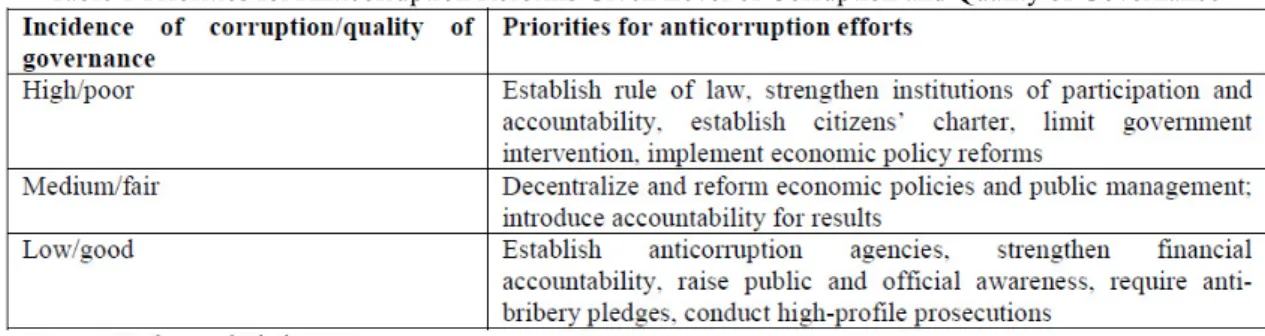
However, societies with low level of public sector corruption have strong institutions of participation and accountability that control abuses of power by public officials. In these societies the principal has a voice. These institutions are either created by the state itself (for example, electoral process, citizens’ charter, bills of rights, auditors general, the judiciary, the legislature) or arise outside of formal state structures (for example, the news media and organized civic groups). This is the reverse in countries with systemic corruption. This relationship is summarized in Table 1.
There is therefore the need to consider the various methods of combating corruption with special emphasis on external auditing. The audit or authentication process was designed to give the principal confidence and hope that her resources are properly managed to her advantage. How well this process has served the principal or used against her is addressed in the next section.
3. Evaluation of the different methods of combating corruption and their pitfalls
Relying on evidence that combating corruption and improving the rule of law can increase government revenue four times and ensure effective service delivery and sustainable developments, governments, donor agencies and concerned stakeholders of good governance have designed and implemented about 48 known measures to combat corruption aside from external audit and reliance on internal control.
3. 1 Non-Accounting Measures
29
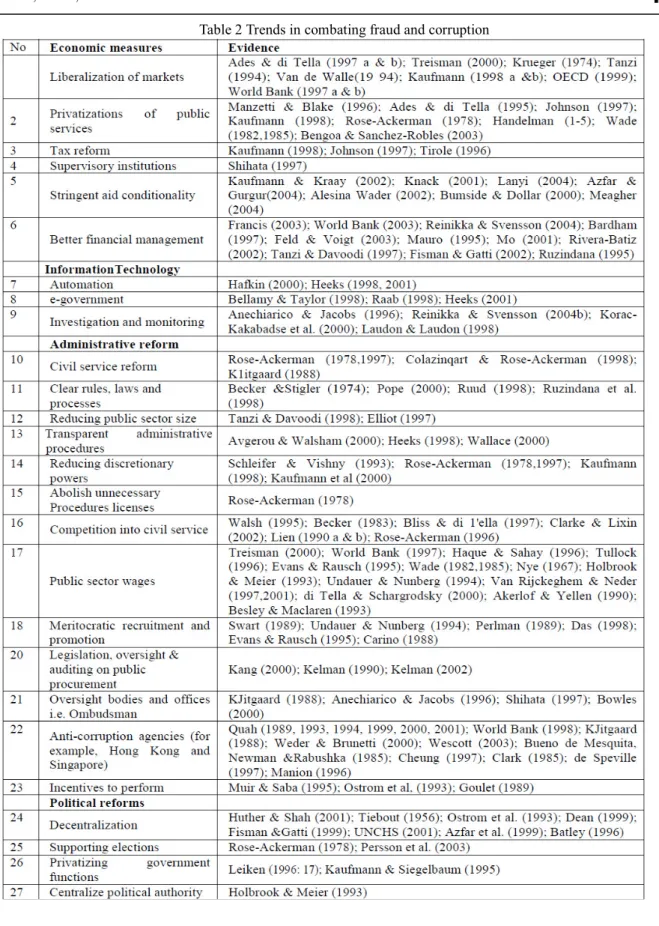
external auditing and the report thereof have lost their relevance. The users of accounting information have sought for solutions elsewhere. These measures are classified into: (a) Economic (b) Information Technology (c) Administrative reforms (d) Political reforms (e) Direct Democracy (f) Legal and Judicial (g) Behavioral measures. A summary of the trends in combating fraud and corruption is presented in Table 2.
The trend reflects the paradigm shift in the sophistication of corruption and its ability to thrive by weakening control and enforcement systems. The problem is compounded by path dependency (the fact that a major break with the past is difficult to achieve, because major reforms are likely to be blocked by influential interest groups); cultural and historical factors; and attitudes, in which those who are victimized by corruption feel that attempts to deal with corruption will lead to further victimization, with little hope of corrupt actors being brought to justice. These considerations lead principals to the conclusion that any attempt on their part to constrain corrupt behaviors will invite strong retaliation from powerful interests. Therefore, citizen empowerment (through devolution, citizens’ charters, bills of rights, elections, and other forms of civic engagement) assumes critical importance in combating corruption, because it may have a significant impact on the incentives faced by public officials to be responsive to public interest.
However, these measures of combating corruption have ignored the predicaments of the principal (the citizen) in their design except the behavioral measures, and focus on the systems designed by the agents (the public office holders). These systems are designed, re-designed and un-designed with loopholes to protect the agent or in way that it can be circumvented or beaten. The systems alone are always not the problem. The problem often is their implementation. Take for instance the system of separation of duties in internal control. Theoretically and in principle, it is perfect, but collusion (the human) factor makes implementation sometimes impossible and guarantees system failures. The behavioral measures also fail because they are founded and dependent on laws and systems that can be circumvented by the agents. Thus the agent thrives on continual improvement of strategies “to break” invented measures.
3.2 The External Audit: The Loopholes and the Need for Beyond the Audit Procedures and Rules in Combating Corruption
Auditing was ushered in when owners were no longer managers. Adam Smith said: "Being the managers rather of
other people's money than of their own, it cannot well be expected that they should look over it with the same anxious vigilance with which the partners of a private company frequently watch over their own. Negligence and profusion . . . must always prevail, more or less, in the management of the affairs of such a company" (Smith, 1904
ed: 233). Thus, auditing as an accounting function developed to give the owners (who are not managers’) reasonable
assurance that the assets, resources and interest in an enterprise are safe guarded and protected. Their report were read in the open for governments in the olden days, hence the concept of audit has roots from the Latin term ‘audire,’ which means to hear. In early days an auditor used to listen to the accounts read over by an accountant in order to check them. The original objective of auditing was to detect and prevent errors and frauds.
However, given the numerous developments in the auditing profession, the functions and objectives of auditing have undergone series of modifications. Currently, the major objective of external auditing is to examine the financial statements of an entity and provide management of the entity with a report expressing an opinion as to whether management’s assertion is fairly stated, in all material respects, based upon reasonable criteria. In achieving the above the auditors will obtain reasonable, rather than absolute evidence, that the financial statements are free from material misstatement, whether caused by error of fraud. Accordingly a material misstatement may remain undetected. Also, an audit is not designed to detect error and fraud that is immaterial to the financial statement. However, immaterial misstatement and any fraud or illegal acts discovered during the audit will be reported to the management (Dabroski, 2000).
According to ISA 240 (revised), the objectives of external auditors are:
i. To identify and assess the risk of material misstatement of the financial statements due to fraud by obtaining an understanding of the internal controls in respect of those assertions and ensure those controls are designed effectively.
ii. Obtain sufficient appropriate audit evidence regarding the assessed risk of material misstatement due to fraud, through designing and implementing appropriate responses.
iii. To respond appropriately to fraud or suspected fraud identified during audit and communicate same to those in charge of governance
30
The duties of the auditor are to primarily attest to the financial statements and internal controls relative to financial reporting, identify and assess risk related to financial reporting subject to material misstatement and to report fraud or suspected fraud to the managers. These processes must follow appropriate accounting and auditing standards including and conformance with Generally Acceptable Accounting Principles (GAAP).
An external audit program encompasses engaging an independent auditor to perform a full-scope financial statement audit, a balance-sheet-only audit, an attestation of internal controls over financial reporting, or other agreed-upon external audit procedures.
a. Financial statement audit: External auditing is traditionally associated with independent audits of financial statements. An independent audit of financial statements is designed to ensure that financial reports are prepared in accordance with GAAP. Independent financial statement audits are performed in accordance with GAAS. Their scope is sufficient to enable an auditor to express an opinion on the organization’s financial statements.
b. Attestation of internal control structure governing financial reporting: This type of audit examines and reports on management’s assertion concerning the effectiveness of the internal controls over financial reporting. The auditor’s attestation may cover all internal controls relating to annual financial statement preparation or specified schedules of call reports. Under this engagement, management documents its assessment of internal controls and prepares a written assertion specifying the criteria used and opining on control effectiveness. The auditor performs the attestation in accordance with generally accepted standards for attestation engagements.
c. Balance sheet audit: In this type of audit, an auditor examines and reports only on the balance sheet. As with financial statement audits, the auditor audits in accordance with GAAS, but does not examine or report on whether statements of income, changes to equity capital, or cash flow are fairly presented.
d. Agreed-upon procedures: This type of audit, carried out by directors or other independent parties, entails specified or agreed-upon procedural reviews of the adequacy of internal controls and the accuracy of financial information. Such an audit is commonly referred to as a directors’ examination. The independent parties can be public accountants, certified internal auditors, certified bank auditors, certified information systems auditors, consulting firms, or other knowledgeable parties.
An effective external audit function often provides the management with:
i. Reasonable assurance about the effectiveness of internal controls over financial reporting, the accuracy and timeliness in recording transactions, and the accuracy and completeness of financial and regulatory reports.
ii. An independent and objective view of an organization’s activities, including processes relative to financial reporting.
iii. Information useful to management in maintaining an organization’s risk management processes. 3.3 The Loopholes and the Need for Beyond the Audit Procedures and Rules in Combating Corruption
1. The objective of this authentication process excludes fraud and corruption detection. It is assumed that when the internal control rules are kept and records are kept in accordance with GAAP, fraud and corruption is reduced to zero. This assumption has ignored collusion and capture, the human factor that hinders implementation of efficient system rule and encourages system failure. The duty to detect fraud and corruption is that of the public official (the agent) and not the auditor (a representative of the principal).
2. Worse still, the auditor is engaged and paid by the public official on behalf of the principal. As the pay master he detects the tune. Refusal to dance to the tune of his pay master will mean no job in the future. This clause destroys the auditor’s independence and enhances his dependence. It gives the agents the power to capture willing parties to perpetrate corruption and form a syndicate to the detriment of the principal. This collusion extend even to the auditors the only hope of the principal
3. The internal report of failures and inefficiencies of management (areas to be improved upon) is made only to the public official (agent) and is unknown to the principal.
4. Auditing only seeks to ensure financial accountability. It ignores other forms of accountability; political, economic and social accountability. These other forms of accountability remain the sole responsibility of the agent.
31
What do we expect them to report, their failures or an invented success?
In summary, these loopholes are a result of the inadequacy of the external audit focus, design and implementation as a strategy for combating corruption. Some of these inadequacies in design and implementation of anticorruption strategies are:
a. It denies the principal (citizens) the opportunity to assess service delivery performance of the public officials or managers (agents).
b. It does not empower citizens by supporting bottom-up reforms. It supports top-down reforms.
c. It does not report or disseminate information to the citizens (principal) but to the public officials or managers (agents).
These accounting and non-accounting approaches, techniques, processes and reform policies, designed to disrupt corruption operates on the assumption that the ‘system’ alone is faulty. Hence, most of the policies, techniques or reforms are designed to amend, restructure or redesign the system. Some have failed to recognize the human side to corruption, while others having recognized the human factor have failed to capture and contend these human tendencies in their anticorruption strategies. This has led to the continuous increase in the size, magnitude and level of infection.
For external audit to improve its capacity to protect the interest, resources and assets of the citizens (principal) from corruption, corrupt public officials (agent) and ensure sustainable accountability, there is need therefore to go beyond the audit procedures and rules in addressing human tendencies, systems issues and limitations.
4. The Proposed Technique and the Challenges
All the propositions and suggestions will meet with little or no success if we do not learn from experience which strongly suggests that combating corruption requires an indirect approach that starts with its root causes. Such indirect approach requires adopting one or more of the several alternatives to traditional accountability and anticorruption strategies beyond audit procedures and rules. This can enhance the effectiveness of existing and suggested approaches. These alternatives include:
1. Enlargement in audit emphasis to include fraud detection:
Fraud and corruption thrive when accountability and transparency are absent. No doubt good financial reporting and auditing help reduce the misrepresentation that hides fraudulent operations and misleads the reader. For auditing to provide the desirable assurance that audited financial statements can be trusted to represent the economic activities they are intended to portray , given the sophistications of the agents (in defrauding the principal), the gap between stakeholder expectations and audit mandates must be closed. The gap is that the agent should not be responsible in exposing her crimes.
Traditionally, Audit Institutions (AIs) have agreed that the primary responsibility for preventing and detecting corruption rests with the administrative authorities (agents),such as the police or anticorruption agencies (the agents’ instruments) and not the citizens or her agents (the audit institutions). Audit institutions have not seen fraud and corruption busting as their main goal; the approach has been to prevent corruption in the field rather than detecting illegal activities. The public, however, believes that AIs seek to detect fraud and corruption.
This gap needs to be addressed by the AIs, which should put more emphasis on detecting fraud and corruption to shrink the expectation gap. They should continue to play an active role in raising awareness of the risks of fraud and corruption and fostering good governance and standards of conduct, but they should responsible for and focus more on detecting fraud and corruption. The agent cannot expose her crime; instead the crimes will be concealed the more if the responsibility should continue to rest on the agent. This can be done by combining controls audit procedures with financial attest audit procedures. Changing the audit emphasis will be a step in the right direction. This will meet with stiff opposition, but it is pertinent to ask why not?
2. Creation of opposition led Accountability committees
Rather than rely on regular audit committees opposition led committees should be created. These committees can act as whistle blowers, criticizing every activity that deviates from norms. This group stands the chance of being captured. However, whilst not captured, it can play a vital role in ensuring accountability by providing the principal with adequate information for decision to enforce punishment.
3. Recognition and ensuring accountability in all spheres of the economy
Public officers should be held accountable not only financially but, politically, economically and socially. This will enhance service delivery as it will give the principal the right to justice and punishment.
32
4. These alternatives to traditional audit mechanisms should be proactive
The audit procedures are not proactive. The agent knows when the auditors will be invited. He has enough time rearrange himself and the events around his operations. The recommended methods should not be annually only, it can be at any time of the year or even more than once. If the owners are responsible for engaging the auditors, then such audit and investigation should be without notice to the agent.
5. The Summary and Concluding Remarks
Corruption thrives because the agents have technically crippled the power of the principal to demand for and enforce accountability. Although several measures have been developed to combat corruption, these measures ignore the vital element of the accountability relationship (man) and concentrate on modifying the systems of accountability. The auditing function of accounting, designed to give the principal control over the operations of the agent, is under the control of the agent. Its main object is not fraud detection; it is the agent that appoints the auditor, who reports to the agent and is paid by the agent. In most instances where corrupt practices are uncovered, the audit reports are always clean. Therefore, this rules and procedures must be changed in favor of the principal. This will empower the principal to demand for and ensure accountability and guarantee sustainable development.
Combating corruption is not without conditions. It requires that:
a. Measures to address corruption must not fail to adequately consider and integrate the underlying drivers or face the unlikelihood to generate profound and sustainable results.
b. Such approach must not apply common policies and tools (that is, one-size-fits-all approaches) to countries in which acts of corruption and the quality of governance vary widely. Doing so increases the likely to fail.
c. There should be a strong and focused local “principal and ownership” if the suggested strategies are to be successful and sustainable.
This discussion confirms most policy conclusion that due recognition of the initial conditions is critical for the effectiveness of anticorruption policies. Anticorruption strategies are unlikely to succeed unless they recognize the pecking order of reforms in poor governance environments. To be sustainable anticorruption strategies must extend beyond the audit procedures and rules and be proactive.
References
Abed, G. T. and Davoodi. H. R. (2000). Corruption, Structural Reforms, and Economic Performance in the Transition Economies. IMF Working Paper 00/132, International Monetary Fund, Washington, DC.
Acconcia, A., D’Amato, M. and Martina, R. (2003). Corruption and Tax Evasion with Competitive Bribes. CSEF Working Paper 112, Centre for Studies in Economics and Finance, University of Salerno, Italy.
Adesanya, M. O. & Oloyede, E. O. (1972). Business Law in Nigeria. Lagos; Nigeria: Evans Brothers Ltd.
Ahlin, C. (2001). Corruption: Political Determinants and Macroeconomic Effects. Working Paper 01–W26, Department of Economics, Vanderbilt University, Nashville, TN.
Aidt, T. S. (2003). Economic Analysis of Corruption: A Survey. Economic Journal113 (491): F632–52.
Andrews, M. and Shah, A. (2005). Citizen-Centered Governance: A New Approach to Public Sector Reform. In Public Expenditure Analysis, ed. Anwar Shah, 152–82.Washington, DC: World Bank.
Andvig, J. C., and Moene, K. O. (1990). How Corruption May Corrupt. Journal of Economic Behavior and Organization 13 (1): 63–76.
Arikan, G. (2004). Fiscal Decentralization: A Remedy for Corruption? International Tax and Public Finance 11(2): 175–95.
Banfield, E. (1975). Corruption as Feature of Government Organization. Journal of Law and Economics 18 (3): 587– 695.
Bardhan, P. and Mookherjee, D. (2005). Decentralizing Anti-Poverty Program Delivery in Developing Countries. Journal of Public Economics 89 (4): 675–704.
33 Development Department, University of Birmingham, AL.
Becker, G. (1968). Crime and Punishment: An Economic Approach. Journal of Political Economy 76 (2): 169–217. ———.(1983). A Theory of Competition among Pressure Groups for Political Influence. Quarterly Journal of Economics 97 (3): 371–400.
Becker, G. and Stigler, G. (1974). Law Enforcement, Malfeasance and the Compensation of Enforcers. Journal of Legal Studies 3 (1): 1–18.
Cavil, S. and Sohail, M. (2007). Accountability Arrangements to combat Corruption: Literature Review. Water, Engineering Development Centre, Loughborough: Loughborough University.
Chand, S. K. and Moene, K. O. (1997). Controlling Fiscal Corruption. IMF Working Paper 97/100, International Monetary Fund, Washington, DC.
Dabroski, C, (2000). The Role of the Auditor. Seminar for Senior Bank Executives from Emerging Economies. Authur Anderson.
Flatters, Frank, and W. Bentley Macleod. 1995. “Administrative Corruption and Taxation.” International Tax and Public Finance 2 (3): 397–417.
Grossman, G. M., and Helpman, E. (1994). Protection for Sale. American Economic Review. 84 (4): 833–50.
Gupta, S., Davoodi, H. and Alonso-Terme, R. (1998). Does Corruption Affect Income Inequality and Poverty? Working Paper 98/76, International Monetary Fund, Washington, DC.
Gupta, S., Davoodi, H. and Tiongson, E. (2000). Corruption and the Provision of Health Care and Education Services. Working Paper 00/116, International Monetary Fund, Washington, DC.
Haaruis, K. C. (2000). Measuring and Explaining Variance between Anti-corruption Policies. University of Utrecht. Huther, J. and Shah, A. (2000). Anticorruption Policies and Programs: A Framework for Evaluation. Policy Research Working Paper 2501. World Bank, Washington, DC.
Jain, A. K. (2001). Corruption: A Review. Journal of Economic Surveys 15 (1): 71–121. Klitgaard, R. E. (1988). Controlling Corruption. Berkeley: University of California Press.
———. (1997). Cleaning Up and Invigorating the Civil Service. Public Administration and Development 17 (5): 487–509.
Kulluna, M. (1999). Lebanon Anti-corruption Initiative Report. Washington, DC: U.S. Agency for International Development. Available at www.kullunamassoul.org.lb/general/ report/Final.doc.
Mauro, P. (1995). Corruption and Growth. Quarterly Journal of Economics, 110 (3), 681-712.
Lambsdorff, J. G. (1999a). Corruption in Empirical Research: A Review. Paper presented at the Ninth International Anti-corruption Conference, Durban, South Africa.
———. (1999b). The Impact of Corruption on Capital Accumulation. Department of Economics, Gottingen University, Germany.
Rose-Ackerman, S. (1975). The Economics of Corruption. Journal of Public Economics 4 (2): 187–203.
———.(1978). Corruption: A Study in Political Economy. New York: Academic Press.
Shah, A. (1999). Governing for Results in a Globalized and Localized World. Pakistan Development Review 38 (4): 385–431.
———.(2005). On Getting the Giant to Kneel: Approaches to a Change in the Bureaucratic Culture. In Fiscal Management, ed. A. Shah, 211–229.Washington, DC: World Bank.
Shah, A. (2007). Tailoring the Fight against Corruption to Country Circumstances. In Performance Accountability and Combating Corruption. ed. Anwar Shah, 233-254.Washington,DC:World Bank.
Shleifer, A. and Vishny, R. W. (1993). Corruption. Quarterly Journal of Economics108 (3): 599–617. Smith, A. (1904). Wealth of Nations. Ed. Cannon, Vol. 2.
34
Tanzi, V. and Davoodi, H. (1997). Corruption, Public Investment, and Growth. IMF Working Paper 97/139, International Monetary Fund, Washington, DC.
Tomaszewska, E. and Shah, A. (2000). Phantom Hospitals, Ghost Schools, and Roads to Nowhere: The
Impact of Corruption on Public Service Delivery Performance in Developing Countries. Working Paper, World Bank, Operations Evaluation Department, Washington, DC.
Treisman, D. S. (1999). The Causes of Corruption: A Cross National Study. Department of Political Science, University of California, Los Angeles.
Van Rijckeghem, C., and Weder, B. (2001). Bureaucratic Corruption and the Rate of Temptation: Do Low Wages in Civil Service Cause Corruption? Journal of Development Economics 65 (2): 307–31.
Von Maravic, P. (2003). How to Analyse Corruption in the Context of Public Management Reform. Paper presented at the first meeting of the “Study Group on Ethics and Integrity of Governance European Group of Public Administration Conference,” Oeiras, Portugal, September 3–6.
Waller, C. J., Verdier, T. A. and Gardner, R. (2002). Corruption: Top-Down or Bottom-Up. Economic Inquiry 40 (4): 688–703.
World Bank (2004). Mainstreaming Anticorruption Activities in World Bank Assistance: A Review of Progress since 1997.Washington, DC: World Bank.
35