Load Hiding of Household’s Power Demand
Dominik Egarter
1, Christoph Prokop
2, and Wilfried Elmenreich
1Institute of Networked and Embedded Systems
Alpen-Adria-Universit¨
at Klagenfurt, Austria
1{
name.surname
}
@aau.at
2
[email protected]
June 11, 2014
Abstract
With the development and introduction of smart metering, the en-ergy information for costumers will change from infrequent manual meter readings to fine-grained energy consumption data. On the one hand these fine-grained measurements will lead to an improvement in costumers’ en-ergy habits, but on the other hand the fined-grained data produces in-formation about a household and also households’ inhabitants, which are the basis for many future privacy issues. To ensure household privacy and smart meter information owned by the household inhabitants, load hiding techniques were introduced to obfuscate the load demand visible at the household energy meter. In this work, a state-of-the-art battery-based load hiding (BLH) technique, which uses a controllable battery to disguise the power consumption and a novel load hiding technique called load-based load hiding (LLH) are presented. An LLH system uses an con-trollable household appliance to obfuscate the household’s power demand. We evaluate and compare both load hiding techniques on real household data and show that both techniques can strengthen household privacy but only LLH can increase appliance level privacy.
1
Introduction
In the context of smart grids and smart metering, the term privacy is becoming of high interest and is much discussed. Smart meters are accurate monitoring units providing fine-grained demand measurements in which these monitoring results disclose user behavior which could be extracted by smart algorithms and techniques. The foundation of algorithms to extract energy consumption
This work was performed in the research cluster Lakeside Labs funded by the European Regional Development Fund, the Carinthian Economic Promotion Fund (KWF), and the state of Austria under grants 20214/22935/34445 (Smart Microgrid Lab).
information was set in 1992 with the introduction of non-intrusive load moni-toring (NILM) [1]. NILM is a single-point metering approach which detects and identifies appliances in the total power demand of households. It uses appliance specific characteristics and smart classification approaches to identify appliances and sense at which point in time which appliances were running. State-of-the-art approaches [2, 3] depend on the granularity of the measurements. With 1s
measurement granularity NILM approaches can disaggregate around 10 differ-ent appliances [4]. With information of the power demand habits on appliance level, it is possible to extract user behaviors and habits by activity recognition and user profiling [5, 6]. An extreme example for analysing the energy data on appliance level is shown in [7]. In this work a smart meter is used to identify the multimedia content of a TV. Potentially interested stakeholders are presented in [8] such as the energy utility, creditors, press and marketing/advertisements partners, in an extreme case even criminals.
The loss of privacy by load disaggregation and energy mining is a huge upcoming smart grid and society issue which enforces the need of privacy pre-serving techniques, which can be divided into the following three possibilities [8]:
1. Anonymization of metering data: The metering data and costumer
iden-tity are separated by a third-party id [9].
2. Privacy-preserving metering data aggregation: Metering data is
geograph-ically encapsulated by aggregating the metering data of co-located con-sumers [10]
3. Masking and obfuscation of metering data: Masking the power demand
by adding or withdrawing the to the meter visible energy demand with the help of rechargeable batteries [11] or controllable loads.
To ensure household privacy without any interaction by third-parties or neigh-bours and to keep information at the owner side, this paper concentrates on obfuscating metering data. Obfuscating the metering data is usually done by controllable batteries and is called BLH. A BLH system charges and discharges the battery at strategic times to flatten the household’s energy demand. In this work we introduce a novel obfuscation approach of power draws called load-based load hiding (LLH). It uses energy-intensive household loads which are controllable, have a daily power consumption and are not user driven. A common household device which meets these requirements is an electric water boiler. In this paper, we describe controlling a boiler by randomly turning it on and off with the constraint to meet a given daily power consumption. LLH is obfuscating the power demand by putting noise to the power draw in contrast to BLH, which is trying to flatten the power draw.
The aim of this work is to test the novel introduced LLH technique to a state-of-the-art BLH technique. The obfuscation performance for both load hiding techniques is tested by a state-of-the-art NILM algorithm and by the evaluated error between the real and the obfuscated power draw. The tests are done on real household consumption data using a realistic model of battery and electric boiler.
The remainder of this paper is organized as follows: Section 2 and 3 are pre-senting basics about BLH and LLH whereas Section 4 describes the evaluation settings of the experiments such as the used dataset and evaluation metrics and the configuration and implementation of the BLH and LLH system. In Section 5, the results of the simulations for BLH and LLH are shown and are evaluated by the achieved obfuscation difference and the ability to detect appliances with a proposed NILM technique in the obfuscated power draw. Finally, the results and the pros and cons for both load hiding techniques are discussed in Section 6 and concluded in Section 7.
2
Battery-Based Load Hiding
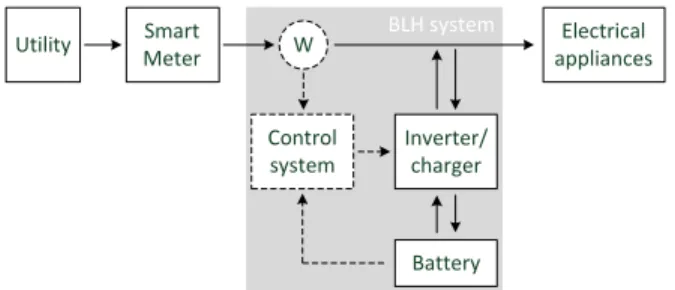
The first proposal to mask power demand using a rechargeable battery was presented in [13]. The idea bases on the installation of an intelligent BLH system between the smart meter and the internal wiring such as it is plotted in Figure 1. Utility Smart Meter W Electrical appliances Inverter/ charger Control system Battery BLH system
Figure 1: Schematic representation of a BLH system
The BLH system charges or rather discharges the battery at strategic times to modify the metered load, i.e. the electric active power demand that is ob-served by the smart meter. The aim is to hide or obscure load signatures, so that appliance usage events and usage patterns cannot be detected by NILM [13]. The first proposals of BLH-algorithms try to maintain a constant metered load. Any changes in net demand, which is the household’s active power demand except the BLH system, should be covered by the battery to flatten the energy consumption observed by the smart meter. Such an approach is diagrammed in Figure 2.
Unfortunately, in practise there are physical limitations of batteries like a maximum charging and discharging rate or the limited capacity of the battery. Taking these battery constraints and battery prices into account, the installation of a BLH-system that is capable to hide all usage events under all circumstances would be very costly. This leads to an optimization problem minimizing the leakage of information using feasible battery sizes. Several algorithms have been proposed to maintain the metered load that is transmitted to the utility constant as long as possible [11], such as the best-effort (BE) algorithm, the non-intrusive load leveling (NILL) algorithm and the stepping framework (SF).
Net Demand
Time Electric
power Battery charge/discharge
Time Electric
power
+
Constant metered load
Time Electric
power
Figure 2: BLH approach to flatten the metered load [14]
According to [11] the most promising algorithm is the SF usingLazy Stepping 2
algorithm, which will be used as the representative BLH algorithm for further evaluations.
The SF [11] makes the metered load to be integer multiples of a constant value, which is the minimum of either the maximum charge and discharge rate. For any possible net demand there exists a multiple of this constant satisfying the battery constraints. For each level of net demand one can choose either the level just higher than net demand, which will charge the battery, or the level just lower than net demand which will discharge the battery. If the battery’s state of charge (SOC) gets too high, then the system chooses the lower level and the reverse happens when the battery’s state gets too low. During normal operation the decision of whether to choose the upper or lower level is task of the SF. The authors suggest four algorithms: Lazy Stepping 1, Lazy Stepping
2,Lazy Charging andRandom Charging. With regards to the authors the most
successful approach is Lazy Stepping 2. It keeps the metered load constant if possible, otherwise it randomly chooses the upper or rather the lower level.
3
Load Based Load Hiding
Similar to a BLH system, one could realize an obfuscating system by using a variable load instead of the battery system. A variable load should be a powerful interruptible process that is not time-critical, not directly user driven and adjustable in its power consumption. Such a process could be a domestic electric hot water boiler, an electric heater, or perhaps even an electric vehicle charger. The device is assigned by a daily target energy consumption, i.e., an amount of energy the device is supposed to spend during a day in order to fulfill its target function. The device is not bound to certain times when to use energy but is limited by a maximum power. In the remainder, systems using such a variable load will be shortened by load-based load hiding (LLH). A LLH system has the major aim to increase (but not decrease as for BLH) the metered load level compared to the corresponding net demand. This is limited by both, the maximum power of the appliance used as a variable load and by the necessary
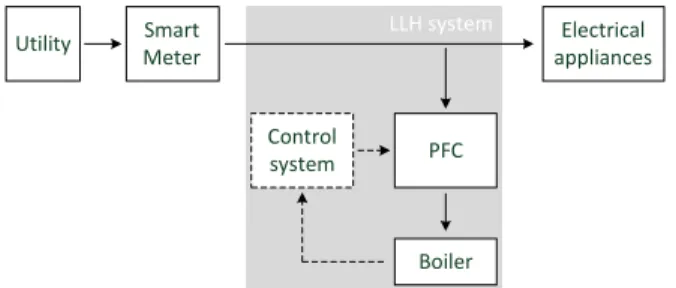
energy consumption of the device during a day. A novel implementation of a LLH system does not require any changes in the households internal wiring and furthermore necessitates no extra measurements like the actual level of net demand (demand apart from the variable load) which is necessary in case of a BLH system. The target model in this work is a completely passive electric boiler without any knowledge of the internal wiring, the appliances in use, net demand or the metered load. Figure 3 plots the schematic of such a system. The control system adjusts the current power consumption via a phase-fired controller (PFC) that modifies the voltage level depending on the customer’s needs and the set temperature of the boiler. Note thatP ∼U2asP =UR2 where
Rcan be assumed to be constant. Without any data of net demand, maintaining
Utility Smart Meter Electrical appliances PFC Control system Boiler LLH system
Figure 3: Schematic representation of a LLH system
a constant metered load is impossible. Additionally, holding a constant value like under BLH would necessitate some kind of forecast to fill the gap between net demand and the constant load to still meet the targeted energy level at the end of each day without leaking too much information. The basic idea of this proposal is to overlay net demand by a probabilistic signal, i.e. artificial created noise, which impedes the detection of the appliance’s states. Figure 4 plots net demand that is overlayed by a probabilistic load of the electric boiler. The
Net Demand
Time Electric
power Boiler’s load
+ Metered load Time Electric power Time Electric power
Figure 4: LLH approach to add noise
basis of this artificial noise is a probability distribution function, such as a beta distribution. The realizations must lie within the interval [0Pmax] wherePmax
is the maximum power of the variable load. With regards to the preprocessing of the NILM algorithm, that applies filters such as a running median filter, a higher level of randomization of the noise should decrease the efficacy of the NILM algorithm. We expect that a modified beta distribution can increase the level of privacy protection.
4
Evaluation Settings
4.1
Implementation
4.1.1 LLH-Settings
The simulation model of the LLH system is based on several simplifications. This paper does not implement a dynamic model of the electric boiler but only the maximum power of the boiler of 1600W and a daily target energy consumption without considering any further losses or devices. For the sake of simplicity, we assume a daily target energy consumption disregarding the temperature, amount or time of use of the hot water as the boiler’s end prod-uct. In detail, the daily target energy consumption is set to four scenarios [2.5,5,7.5,10]kW h. For simulating LLHPmaxis set toPmax= 1600W. Based
upon pre-evaluations, the parameter set of the underlying beta distribution is
α= 0.9, and β is derived by the expectationµ: β = α−µα·µ. In order to meet the target energy consumption, the expectation of the distribution function and the comparable constant load must be balanced, e.g.: a daily energy target of 5kW h can be realized by a constant load of µset = 500024W hh = 208.˙3W but
also by realizations of a random variable based on a probability distribution function with the same mean. When applying the modified beta distribution, the output varies randomly between 0 andPmax. The expectation lies in [0, P]
for a random time frame with a maximum of one hour, where P is randomly set between Pmax
4 and
3Pmax
4 . Ifµ is set higher thanµset the boiler consumes
more energy than it is planned for. Therefore, when setting the following time frame andµthe energy gap of the realizations compared to the constant load
µset is analyzed. If the gap exceeds ±0.5kW h the new expectation is limited
to [0, µset) or rather (µset, Pmax] depending on whether it was too high or too
low. There is a high probability that the daily energy consumption differs from the target consumption. The realized consumption lies in [4.29,7.8]kW h for a target energy of 5kW htaking the worst case into account.
4.1.2 BLH-Settings
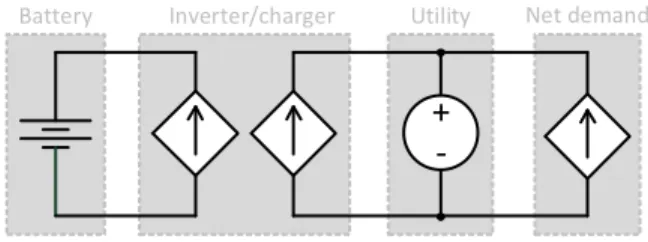
The simulation model for BLH is modeled in Matlab/Simulink using the Sim-PowerSystem library that provides a realistic battery model. For simplification, this work assumes a purely resistive system considering active power only, which allows the application of a DC model. Furthermore, the inverter/charger com-bination is idealized by two programmable current sources with zero losses. All other elements are assumed to be ideal as well. The reason for using a simu-lation model is the application of a realistic battery model that considers the
actual SOC of the battery. A schematic of the simulation model is plotted in Figure 5. Net demand
+
-Inverter/charger Utility BatteryFigure 5: BLH simulation model
The two programmable current sources of the inverter/charger combination are controlled by a control system, based on the battery’s SOC, the battery’s voltage level, the actual level of net demand and the BLH algorithm’s deci-sion. The left source represents the DC-side of the BLH system, the right current source represents the utility-side. If the output of the current source on the DC-side is positive, the source acts as a generator and the battery will be charged, if the current is negative the source acts as a load and the battery gets discharged. Therefore, if the current on the DC-side is positive, the power flows from the utility, that is represented by a voltage source, to the battery. In the following, the utility-side of the inverter/charger combination must act as a load on the secondary branch to consume this energy. Note that the absolute value of the power of both current sources must be balanced. Hence, the absolute values of the current may vary as the battery voltage on the DC-side may vary with the battery’s SOC. The household’s net demand is modeled by another programmable current source. This work assumes a BLH system using a lead-acid storage battery with a nominal voltage of 12 V. The depth of discharge of the battery is set to 70%, the SOC limits are 20% or rather 90%. The initial SOC for the first day is assumed to be 55%, which is the mean of the usable capacity. Both, the maximum charging but also discharging current are set to 0.3· 1
h ·C, e.g. 30A for a 100Ah type. The rated capacities are set to the
simulation cases [10,70,100,200,400,600]Ah.
4.2
Dataset
The presented evaluations are based on the dataset Green Electric Energy Dataset (GREEND) [15] containing appliance level power measurements of Aus-trian and Italian households. From this dataset we have chosen the household with ID 0 where the residents are a retired couple, spending most of time at home. We considered seven of the presented household appliances in our eval-uations (Table 1) where we have chosen these appliances due to their represen-tative for an household’s power demand and their simplicity to be monitored [16]. Each appliance was monitored separately and was afterwards aggregated to create a realistic household’s load profile. We have chosen a time duration of 14 successive days as an observation window with seconds resolution. For
preprocessing the time series we used a one-dimensional median filter of order 5.
4.3
Load Disaggregation Approach
We used the online load disaggregator based on the work in [3], which uses the particle filtering (PF) approach as a load disaggregator. The PF estimates the appliance state space where each appliance state is represented by the power value consumed by the device. The decision which appliance is on or off is made by a decision maker based on thresholding. To represent appliances, their operating states and operating behavior, of each used appliance is modeled by a hidden Markov model (HMM). The total household’s power demand is the aggregated power draw of each appliance for each time instant which is created by a fractional hidden Markov model (FHMM). The FHMM has the advantage to reduce the number of states compared to a simple HMM representing the aggregated power draw of each appliance.
4.4
Metric
4.4.1 Load Hiding metric
The root mean square error (RMSE) is well known for measuring the accuracy of forecasting models. In this work, RMSE should quantify the deviation between the original time series of net demand and the metered load profile after applying a load hiding system. This should quantify the information loss of the actual level of net demand, as opposed to the load changes in particular. The absolute value of RMSE is not significant as it changes with the sample length and other characteristics of the time series considered. In general a higher RMSE describes a higher level of privacy protection. The RMSE is defined asRM SE=
q 1 n
Pn
i=1(di−ei)2, weredirepresents the discrete time series of net demand,ei
the discrete time series of the metered load andnthe number of time samples.
4.4.2 Load Disaggregation Metric
To evaluate a load disaggregator there exists mainly three categories such as the event-based metrics (e.g true positives, true negatives, true positive rate, F-score, etc.), the non event-based metrics (e.g. mean error, hamming loss (H), etc.) and the overall metrics (e.g. energy error etc.). In this work we used the accuracy (ACC) to evaluate our dissaggregation results which is described by
ACC=T P+nT N, wherenrepresents the number of time samples,T P (number of times an appliance is correctly detected as on) the number of true positives and
T N(number of times an appliance is right detected as OFF) the number of true negatives of the classification process. The ACC is calculated on appliance level and in total by generating the mean of all appliance level ACCs. As reference, we calculated the ACC for an load disaggregator estimating all appliance states to be off over time. A good load disaggregation algorithm is expected to have a significantly better accuracy than this reference.
5
Results
5.1
RMSE for BLH and LLH
To evaluate the performance of BLH and LLH in deviating the original time series to the metered time series, the two obfuscation approaches are tested for different simulation cases mentioned. The BLH system varies the rated
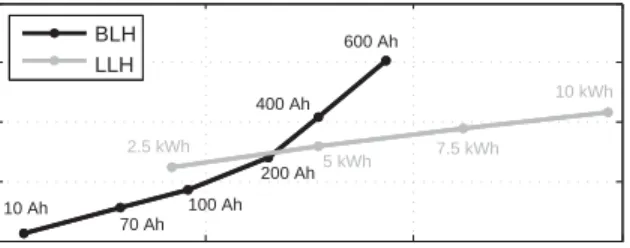
0 50 100 150 0 200 400 600 800 Energy turnover in kWh RMSE in W BLH LLH 0 50 100 150 0 200 400 600 800 Energy turnover in kWh RMSE in W 600 Ah 400 Ah 100 Ah 200 Ah 70 Ah 10 Ah 10 kWh 7.5 kWh 5 kWh 2.5 kWh
Figure 6: RMSE using BLH and LLH for varying battery capacity and varying daily power consumption
capacities by [10,70,100,200,400,600]Ah and the LLH approach varies the daily target energy consumption in between [2.5,5,7.5,10]kW h. Figure 6 plots the RMSE over the energy turnover for both, BLH and LLH. In case of LLH the energy turnover describes the energy consumption over the course of 14 days of the electric water boiler. When applying BLH the turnover is the aggregated sum of the absolute value of the energy from and to the battery. The smallest turnover comes along with a 10Ah battery using BLH. When increasing the battery’s capacity the RMSE increases progressively. When using a variable load the trend is upwards as well, but the RMSE increases more linear. Whereas the maximum power of LLH is set constant to 1600W, the maximum power of the battery system varies from appr. 36W for a 10Ahbattery type to appr. 2160W
for the 600Ahtype. For higher capacities this allows BLH to distort net demand on a higher level, which in turn yields to a greater RMSE compared to LLH.
0 5 10 15 20 25 30 35 40 0 1000 2000 3000 4000 5000 Time [h] Power [W]
Figure 7: Time section of original house-hold’s power draw
0 5 10 15 20 25 30 35 40 0 1000 2000 3000 4000 5000 Time [h] Power [W]
Figure 8: Time section of original house-hold’s power draw obfuscated by BLH
0 5 10 15 20 25 30 35 40 0 1000 2000 3000 4000 5000 Time [h] Power [W]
Figure 9: Time section of original house-hold’s power draw obfuscated by LLH
5.2
NILM on obscured power draw
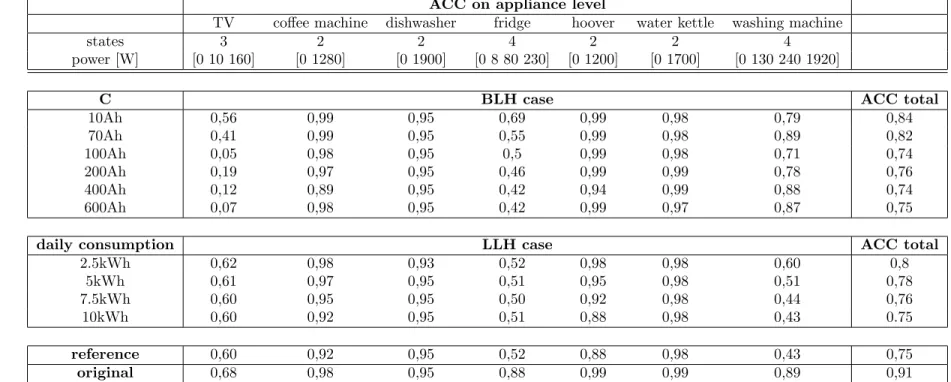
To evaluate the ability of BLH and LLH to obfuscate the household draw to the extent that NILM algorithms do not work any more, we tested the obfuscated demand profile with the presented NILM algorithm. In the case of BLH we used the same battery capacities as beforeC∈[10,70,100,200,400,600]Ah. In Table 1 the ACC results of the load disaggregator on appliance level and in total are presented. As reference, the load disaggregator result for the non-obfuscated case and the result of a load disaggregator estimating all appliances to be off over the whole observation window are listed. As expected, the ACC decreases with an increased battery capacity. The results show that different appliances are affected in a different way. For example the TV or the fridge having a comparable low energy demand, are highly affected by the BLH algorithm in which energy hogs such as the coffee machine or the hoover are much harder to hide. By comparing the ACC results with the reference ACC results, BLH can obfuscate the total power demand very well. A battery of size 100Ah is sufficient to make the load disaggregator not working in a sufficient way any longer.
ACC on appliance level
TV coffee machine dishwasher fridge hoover water kettle washing machine
states 3 2 2 4 2 2 4
power [W] [0 10 160] [0 1280] [0 1900] [0 8 80 230] [0 1200] [0 1700] [0 130 240 1920]
C BLH case ACC total
10Ah 0,56 0,99 0,95 0,69 0,99 0,98 0,79 0,84 70Ah 0,41 0,99 0,95 0,55 0,99 0,98 0,89 0,82 100Ah 0,05 0,98 0,95 0,5 0,99 0,98 0,71 0,74 200Ah 0,19 0,97 0,95 0,46 0,99 0,99 0,78 0,76 400Ah 0,12 0,89 0,95 0,42 0,94 0,99 0,88 0,74 600Ah 0,07 0,98 0,95 0,42 0,99 0,97 0,87 0,75
daily consumption LLH case ACC total
2.5kWh 0,62 0,98 0,93 0,52 0,98 0,98 0,60 0,8 5kWh 0,61 0,97 0,95 0,51 0,95 0,98 0,51 0,78 7.5kWh 0,60 0,95 0,95 0,50 0,92 0,98 0,44 0,76 10kWh 0,60 0,92 0,95 0,51 0,88 0,98 0,43 0.75 reference 0,60 0,92 0,95 0,52 0,88 0,98 0,43 0,75 original 0,68 0,98 0,95 0,88 0,99 0,99 0,89 0,91
Table 1: Accuracy of proposed NILM algorithm for BLH and LLH disguise household power draw on appliance level and on total. As a comparison, the ACC results on the original power draw and a reference estimation, where all appliance states are off, are listed as well.
In the case of an LLH obfuscated power demand, the power time series is inferred by a modified beta distribution controlled boiler noise signal. Table 1 lists the ACC results on appliance level and in total. By changing the energy target consumption, the ACC decreases whereas the privacy increases. In case 4, we even get the same ACC as in the reference case assuming all devices to be off over the whole observation window.
6
Discussion
To use BLH and LLH in real households, additional hardware and devices are needed. In case of BLH an adequate battery, additional wiring and a control-ling unit including an inverter has to be installed. Assuming the implementa-tion using a cheap maintenance free starter battery of a car with a short life cycle, the approximated costs for this battery are approximately 150e for a 100 Ah type, that must be renewed after a few years. A fully remotely control-lable inverter/charger combination for currents up to 35 A costs approximately 1000e[12]. Compared to the battery system with the inverter/charger com-bination the measuring units and control system are cheap, especially when considering mass production. Hence, the initial total costs of a 100 Ah BLH system should be in the range of 1000e to 1500e[12]. Compared to BLH, LLH has a lower need for additional hardware. No additional battery and wiring is needed, in which the boiler requires a controlling unit to adjust the power values of the boiler. For a LLH the approximated costs are less than 200e assuming an already installed electric hot water boiler. A power regulator for 230 V and a maximum power of 2000 VA is available for less than 50e, similarly to BLH the control system should be quite cheap, but the tricky part of a LLH implementation is the installation of a temperature sensor in an existing hot water boiler, which could be more expensive. According the work of Monacchi et. al. [17] there are regional differences of appliance type usage. In Italy, electric boilers are quite uncommon whereas electric boilers in Austria are very usual. Thus, dependent on the region different load hiding techniques can be applied (Austria-LLH, Italy-BLH). Both, BLH and LLH are trying to obfuscate the household’s power demand as much as possible. Examples for the original power draw (Figure 7), the BLH (Figure 8) and the LLH (Figure 9) obfuscated consumption data are presented. Taking the results of the previous section into consideration, BLH is better than LLH in obfuscating the total power demand. The RMSE and the ACC values of a BLH system are either the same or better than for a LLH system. But BLH has the disadvantage that it is not able to obfuscate energy-intensive appliances without installing very costly batteries. In contrast, LLH is modifying the power demand in a way that the presented NILM cannot detect running states of both small consuming devices as well as of energy hogs. The results of Table 1 show that the estimator get nearly the same results than a load disaggregator estimation all appliances to be off. Therefore, LLH is promising as a load hiding technique due to its ability to obfuscate appliance and household consumption data.
7
Conclusion
To ensure privacy in homes is an important topic for households with smart me-ters. Smart meters are providing fine-grained consumption data in which it is possible to extract habits and behaviors of inhabitants by assigning a meaning to the consumption data. The technique called non-intrusive load monitor-ing (NILM) is the basic step to get appliance usage data from the household power consumption which is finally used for user modeling. This information introduces privacy threats which are tried to be preserved by so-called load hiding techniques. State-of-the-art load hiding techniques are obfuscating the consumption data by using a battery to modify the to the energy meter visible energy by adding or withdrawing energy. The technique is called battery-based load hiding (BLH). In this paper, a novel load hiding technique based on a con-trollable household device (e.g., electric boiler) is presented. The used household device (such as the electric boiler) should be non-user-driven and should have a daily consumption demand. It tries to obfuscate the power demand by ran-domly affecting the household’s power demand using noise, whereas BLH tries to flatten the power demand as much as possible. In this paper, both load hiding techniques are compared by the RMSE value of the obfuscated and non-obfuscated power consumption and by the applicability of NILM algorithms on the obfuscated power demand. Simulation results on real household data show that both techniques strengthen the household privacy in a way that the used NILM approach is disabled to identify running appliances. Although for a given energy turnover the presented BLH system achieves a better behavior for a household with mostly small appliances, the LLH is better in obfuscating appliances with high power consumption. If a suitable device, e.g. an electric boiler, is available, a suitable LLH system can be installed of much lower cost.
References
[1] G. Hart, “Nonintrusive appliance load monitoring,” Proceedings of the IEEE, vol. 80, no. 12, pp. 1870–1891, 1992.
[2] M. Zeifman and K. Roth, “Nonintrusive appliance load monitoring: Review and outlook,” IEEE Trans. Consum. Electron., vol. 57, no. 1, pp. 76 –84, february 2011.
[3] D. Egarter, V. P. Bhuvana, and W. Elmenreich, “Appliance state estima-tion based on particle filtering,” inProceedings of the 5th ACM Workshop
on Embedded Systems For Energy-Efficient Buildings BuildSys, 2013.
[4] K. C. Armel, A. Gupta, G. Shrimali, and A. Albert, “Is disaggregation the holy grail of energy efficiency? The case of electricity,”Energy Policy, vol. 52, no. 0, pp. 213 – 234, 2013.
[5] T. A. Nguyen and M. Aiello, “Energy intelligent buildings based on user activity: A survey,” Energy and Buildings, vol. 56, no. 0, pp. 244 – 257, 2013.
[6] M. Lisovich, D. Mulligan, and S. Wicker, “Inferring personal information from demand-response systems,” IEEE Security Privacy, vol. 8, no. 1, pp. 11–20, 2010.
[7] B. J. Ulrich Greveler and D. Loehr, “Multimedia content identification through smart meter power usage profiles,” in Proceedings of the
Inter-national Conference on Information and Knowledge Engineering IKE’12,
2012.
[8] F. Skopik, “Security is not enough! On privacy challenges in smart grids,”
International Journal on Smart Grid and Clean Energy, vol. 1, no. 1, pp.
7–14, 2012.
[9] C. Efthymiou and G. Kalogridis, “Smart grid privacy via anonymization of smart metering data,” inProceeding of IEEE International Conference on
Smart Grid Communications (SmartGridComm), 2010.
[10] F. Li, B. Luo, and P. Liu, “Secure and privacy-preserving information aggregation for smart grids,” Internation Journal Security and Networks, vol. 6, no. 1, pp. 28–39, 2011.
[11] W. Yang, N. Li, Y. Qi, W. Qardaji, S. McLaughlin, and P. McDaniel, “Minimizing private data disclosures in the smart grid,” in Proceedings of
ACM conference on Computer and Communications Security, 2012.
[12] C. Prokop, “Load hiding of household’s power demand,” Diplomarbeit, TU Graz and University of Klagenfurt, 2014.
[13] G. Kalogridis, C. Efthymiou, S. Denic, T. Lewis, and R. Cepeda, “Privacy for smart meters: Towards undetectable appliance load signatures,” in Pro-ceedings of IEEE International Conference on Smart Grid Communications
(SmartGridComm), 2010.
[14] S. McLaughlin, P. McDaniel, and W. Aiello, “Protecting consumer pri-vacy from electric load monitoring,” inProceedings of ACM conference on
Computer and communications security, 2011.
[15] A. Monacchi, D. Egarter, W. Elmenreich, S. D’Alessandro, and A. M. Tonello, “GREEND: an energy consumption dataset of households in Italy and Austria,” inArXiv e-prints, 2014.
[16] D. R. Carlson, H. S. Matthews, and M. Berges, “One size does not fit all: Averaged data on household electricity is inadequate for residential energy policy and decisions,”Energy and Buildings, vol. 64, no. 0, pp. 132 – 144, 2013.
[17] A. Monacchi, W. Elmenreich, S. D’Alessandro, and A. M. Tonello, “Strate-gies for energy conservation in Carinthia and Friuli-Venezia Giulia,” in
Proc. of the 39th Annual Conference of the IEEE Industrial Electronics
![Figure 2: BLH approach to flatten the metered load [14]](https://thumb-us.123doks.com/thumbv2/123dok_us/1411481.2688889/4.918.281.634.187.376/figure-blh-approach-flatten-metered-load.webp)