E-mail: [email protected], [email protected]
Reuse Practices and Innovation in
Software Services: is there a link?
Marina Moreira1, Eduardo Raupp2 1University of Brasília – UnB – Brazil
2COPPEAD Business School, Federal University of Rio de Janeiro – COPPEAD/UFRJ - Brazil Received 17 Feb 2015, Revised 15 July 2015, Accepted 15 July 2015, Published 1 Sep. 2015
Abstracts: The reutilization of modules and solutions, a traditional way to reduce costs and delays in the development of software, is not seen as a practice that leads to the outcome of innovations. This study aims to investigate the relationship between the practices of “reuse” and the emerging of innovations in software services companies in Brazil. The study considers data from questionnaires and results of an interview with a specialist. It states that the practice of reuse is not always associated with the use of module libraries, often occurring in a non-planned manner. Its adoption involves the professionalization of management and the adoption of organizational settings for the storage of solutions already developed in module libraries.
Keywords:Innovation in software services; reuse practices; innovation in services; software as a service; recombinative innovations
Introduction
Brazilian Industrial Policy defines government actions intended to foster innovation in enterprises and places Information Technology as one of its four strategic sectors (Brasil, 2011). Such action establishes the software sector as focus for public investments concerning science, technology and innovation as a way of increasing Brazilian enterprises competitiveness in international markets. The Software sector is admitted to be highly knowledge-dependent and represents one of the best-of growth opportunities for Brazilian companies in domestic markets as well as in internationalization strategies.
The activities that form the software sector may be described as a pool of great variety. It goes all the way from standard products sold as ready-to-use solutions to highly personalized softwares, including the group of consulting, business process outsourcing, training and system integration, to name a few. Such a group represents the software services, a segment that holds one of the greatest market prospects for domestic firms since they have geographical and cultural advantages.
Firms developing software services have adopted practices of “reuse”, consisting of the reutilization of modules and solutions previously developed for the production of new softwares. Reuse practices are a way to reduce costs and development time for companies, but the literature does not account for such techniques as practices that lead to innovations. Despite that, firms have gradually increased their use of reuse practices leading to a consistent increase in their number of new softwares presented to the market. Since reuse allows firms to reduce their developing time, improve their use of resources and enlarge their number of new products, could one presume the existence of a connection between reuse and innovation?
The answer to such a question requires us to investigate two main lines of thought. First, we need to make clear the reasons why enterprises invest in reuse practices considering advantages in organizational levels. Second, we need to properly understand what it means to innovate in software services – what mainly leads us to questioning the very nature of innovation in services. In the present research, we therefore assume the challenge of establishing a link between the practices of reuse and the emerging of innovations in software services. To achieve such a goal, we have considered 28 companies developing softwares services in Federal District, the third largest cluster of information technology in Brazil.
Software services in Brazil
The so-called “software services” represent a segment in the software industry including multiple activities highly intensive in terms of client-developer relational aspects (Gadrey & Gallouj, 1998). By definition, software is traditionally accounted for the computer instructions created for hardware in order to make it able to perform functions (Steinmueller, 1995). From this simple functional role to the one effectively performed by software services in current service economies (Rubalcaba, 2007), what has changed? First, we may understand the peculiarities associated to software services when compared to traditional softwares. Literature exploring software industry traditionally points out some internal categories for its products. One of them considers the form of arriving of a software in a market, admitting it may consist of a software package, an onboard software or a software service. Software packages are already set and present themselves finalized as a ready-to-use option. They
are, in terms, no different from a tangible good such as a car or a pen. When highlighting service characteristics – such as being perishable, hard to stock or by evoking a high degree of uncertainty about its products (Hill, 1977; Gallouj, 2002; Miles, 2005; Rubalcaba, 2007) –, its lack of interaction between its producer and its customer stands out, allowing us to easily mark it as being closer to a product than to a service.
The onboard software is commonly purchased with a hardware, being included in the equipment at the time of acquisition. Its purchase happens to be non-optional, since the customer acquires both software and hardware conjointly. Software services, in turn, have its main features developed for a particular customer as a single unit. It means that a software produced only once corresponds to a service output, while a software sold repeatedly has a stronger correspondence to a manufactured good (Steinmueller, 1995). Software services include “a variety of services directly or indirectly related to software, from training, maintenance and support until the full custom development” (Petit et al., 2007, p. 13). Gutierrez & Alexandre (2001, 15) show that, according to the purchase method adopted, software services may correspond to discrete services or to outsourcing. Services designed as discrete are “those achieved in a short period of time and predetermined” and may be characterized by simple contracts in which the responsibility of the project goes to the client. In general, discrete services are provided by outside companies depending on the client’s inability to develop them internally. The outsourcing, in turn, implies transferring the responsibility of a project to the external developer.
Software services also vary in terms of their value. Some software services commonly referred to as low-value services are “those based more on ability to do in accordance with specifications already defined, such as custom programming (coding) and empowerment”, while high-value services involve actions that demand “greater input of intelligence and expertise in proposing solutions, such as survey and analysis of requirements and specification of the solution in the service of development and custom empowerment ” (Petit et al., 2007, 14).
A survey conducted by Abes (2006, 5) provides six categories of software services in Brazil. They are:
· Consulting: “consulting services and advice relating to the Information Technology
(IT).”
· System integration: “integrated planning solutions, design, implementation and
management of IT solutions to meet the technical specifications defined by the customer, given the business´s individual needs”.
· Outsourcing: “activity in which a service provider outside the organization assumes
responsibility for the management and operation of part or all of client’s IT infrastructure, including networking, communications, maintenance and operation of systems and applications, among others.”
· Support: “services related to the installation, configuration and customization of
software, services and technical support for users.”
· Training: “process of empowerment of user or customer related development,
administration or use of IT.”
· BPO (Business Process Outsourcing): “services provided by supplier external to
the organization which include the transfer of management and execution of work processes or complete business function.”
In the Brazilian context, software services play a role of special relevancy. Unlike other activities in the software industry, in the segment of software services, in general, there are no monopolies of globally dominant firms, what occurs typically in highly internationalized markets (Roselino, 1998). Therefore, opportunities in service providing may be extended to domestic firms. It represents a segment where domestic firms have greater chances of integration in the market.
In assessing the software industry in Brazil, official data point to the existence of 918.200 enterprises developing non-financial services in the country. Such companies annually generate around U$ 300 billion on operational incomes. IT services account for the biggest share of operational incomes among all of Brazilian service activities. Such data shows Brazilian IT services sector as being highly efficient (IBGE, 2009).
Being a large country, Brazil certainly shows disparities in its enterprises clusters placed along its territory. One of the most expressive Brazilian clusters corresponds to the one on Federal District – geographical cut established to carry out the empirical research proposal of this study. This geographical demarcation is justified by the presence of the third largest cluster of information technology in Brazil. The survey on the Local Productive Arrangement of the Federal District, which considers software development companies, denotes the beginning of activities in the 1970´s, with marked expansion between 1985 and 2002 when 89.97% of existing companies were founded (Fernandes et al., 2004). In 2004, the survey indicates that there were 1024 companies that were part of the IT industry, being the main economic activities computer systems consulting, development of programs and activities of maintenance, which marks the predominance of software services among all the activities in the software industry in the Federal District (Fernandes et al., 2004).
Software as service: what implications?
In considering the concept of service, the vision of Edvardsson et al. (2000, 47) might be considered as a starting point, for whom this concept can be defined as “the description of a client’s needs and how those needs will be met. He (the concept of service) refers to the usefulness, benefits and values that the service itself and its offer of supporting services provide and transmit to the customer”.
Regarding the service activity, it is considered the vision of Gadrey (2001, 32), for whom this activity can be seen as: “an operation that aims at transforming the state of reality C, possessed or used by consumer B, held by services A at the request of B, and often linked to, not coming to, however, the production of goods that can circulate economically regardless of support offered by C”.
Services are highly dependent on the establishment of a simultaneity between its supply and consumption, namely, a time coincidence between these steps (Kon, 2004). In the case of software services, it is possible to identify such simultaneity between its supply and consumption. The provision of a service is characterized by a certain change in its previous state (Kon, 2004). This change “may be durable and not ephemeral or perish, despite the difficult distinction between the immediate product provided and the long-term effect” (Kon, 2004, 48). This vision goes against what was presented by Gadrey (2001, 32), which defines product services as “a change of state of reality subject to intervention.”
In the case of the software industry (or, more specifically, in the services segment of software), you can identify the changes generated by the provision of service, which alter
the existing status before the adoption of the service. The provision of a software training, for example, depends on interaction between the producer and the customer – having in mind that the customer must provide the parameters of the service to be provided and, possibly, specific information on its sector of activity - , contributes to the change of knowledge and empowerment of the client, which meets the definitions given by Kon (2004) and Gadrey (2001).
In assessing the expansion of service activities, Gadrey (2001, 39) comes from the “fundamental principle of service activities”, which concerns the following thoughts: “the services in wide expansion are almost all services involving relationships.” From that thought, the author introduced the concept of service relationship, which consists of “interactions of information, verbal interactions, interpersonal exchanges and direct contacts between producers and beneficiaries of services (Gadrey, 2001, 39).
Following the concept of service relationship proposed by Gadrey (2001) and the existence of relationships between participants in providing a service - supplier and consumer - characteristic of the expanding activities of service, you can attach great potential to the activity of software development as a service which has direct relations between participants. The activity of developing software services has clear service characteristics.
Practices of reuse
The reuse of modules and previously developed solutions - by the developer or even by external developers - is a practice known in the context of the software industry as “reuse.” Antelme et al. (2000, 445) define that the procedures for reuse are “sharing, acquiring and maintaining software assets”, presenting two possible ways for this practice: the so-called development for reuse, which is the “development of reusable modules”, and the so-called development with reuse, which refers to the “development of systems with reused modules.” Steinmueller (1995, 3) argues that the practices of reuse “allows software producers to ´customize´ software for clients more cost-effectively than designing from scratch” and is a frequent practice in the software industry.
Antelme et al. (2000, 445) show that reuse can occur either in a planned or in an “opportunistic / ad-hoc” way, drawing attention to the fact that the planned use “implies explicit reuse standards and processes” as well as “an up-front investment in the development of reusable resources”. The authors expose a wide practice of reuse in all levels of business, drawing attention to the common use of such practices in situations ad-hoc and “not as a result of a strategic and systematic approach” (Antelme et al., 2000, 444). Therefore, the reuse of modules and solutions previously developed in the context of the software industry usually comes in response to an imminent demand and not as a result of a business strategy. The statements of Antelme et al. (2000) meet the foregoing by Rothenberger et al. (2003, 825), which show that the practice of reuse may occur in a non-planned manner, which occurs when “individual developers recognize reuse opportunities informally”, or, planned, from producing and maintaining repositions of software to enable predictable recoveries of reusable resources. The authors add, though, that the development of re-usable software needs further work, as the “reusable components need to be developed in a generic fashion that allows their use in various contexts.” (Rothenberger et al., 2003, 825).
The practices of reuse in the process of developing a software requires, at a technical level, the development of a so-called library of resources, allowing storage solutions and
resources already developed for future use (Antelme et al., 2000) . Thus, the creation of these libraries - or repositories for software - and the consequent storage of reusable components represents, as state Rothenberger et al. (2003, 825), a “substantial investment for an organization that can only pay off in the long run when development effort is saved through reuse in software projects. “
Among the benefits and advantages arising from the practices of reuse, it is possible to highlight the reduction of the development of new softwares, increasing the capacity of reconfiguration to meet the requirements of customers, reducing development costs and risks of errors and increasing the effectiveness of use of available resources for development (Antelme et al., 2000).
The practice of reuse in software services: service innovations?
In considering the practices of reuse in the software industry, it is possible to establish links between their use and the rise of innovations in the development of software. To investigate these innovations in the context of the activities of software services, we adopted the model proposed by Gallouj (2002). In an integrative perspective, the author proposes a typology for the products - whether in goods or services - and, afterwards, the representation of a product as a result of the technologies employed and of the skills of both customers and service providers involved.
To the better understanding of the characteristics that form a good or service, Gallouj (2002, 53) assumes that “for goods as for services, the technical characteristics are knowledge, competences embodied in tangible (or intangible) systems.” The author points out, however, that “the provision of the service is generally the result of a combination of the following two mechanisms: the utilization of (tangible or intangible) technical characteristics that are themselves based on competence, and the direct mobilizations of competences “ (Gallouj, 2002, 54).
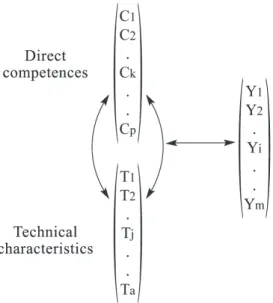
Adopting this position, Gallouj (2002) proposes the addition of skills to the process of formation of a good or service, offering a model of analysis that considers products - goods or services - as systems of characteristics and skills. The proposed model is based on vectors, being the vectors C1, C2, (...), Cp for the direct competence of the service provider / producer of the goods. The vectors T1, T2, Tn (...), would be for the technical characteristics employed in providing a service or production of goods, while the vectors Y1, Y2, (...), Yn represent the final characteristics that ultimately represent the final product, or the actual service provided or the good supplied.
Figure 1: A representation of a product or service as a system of characteristics and competences (GALLOUJ; 2002, 54).
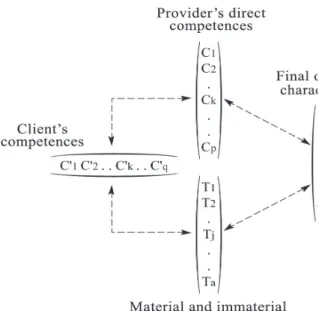
Gallouj (2002) argues also that in the case of so-called “pure services” - services that depend solely on the responsibility of the provider to demand technological characteristics in his performance - the model would be formed only by vectors C and Y. Because of the remarkable importance of the participation of customer in providing a service - principle of service relations - Gallouj (2002) proposes to consider the skills of the client and their consequent separation from powers of the service provider in the previous model. As a result, the author comes to a model that can be applied both to goods as well as services, since it considers the powers of customers (vectors C’1, C’2, (...), C’q), the skills of service providers (C1, C2, (...), Cp), the technical material and immaterial (T1, T2, (...), Tn) and the final characteristics, which represent the final product (vectors Y1, Y2 , (...), Yn) - goods or services.
Figure 2: The most general form (GALLOUJ; 2002, 58).
After considering the vectors and the features that make the product - a service or a good - and Gallouj (2002, 68) presents an important observation regarding the emergence of innovations in the production of goods or services “in sum, innovation may arise out of the (positive or negative) ‘dynamic’ the vectors of the characteristics: [T] in its various forms, [C], [Y], [C ‘] or any combination of these various vectors.” Finally, Gallouj (2002, 70) defines innovation as “any change affecting one or more terms of one or more vectors of characteristics (of whatever kind - technical, service or competence).” By that definition, the author argues that these changes may arise from “evolution or variation, disappearance, appearance, association, dissociation or formatting (in the etymological sense of giving shape to or imposing a format on an ill-defined element)” (Gallouj, 2002, 70).
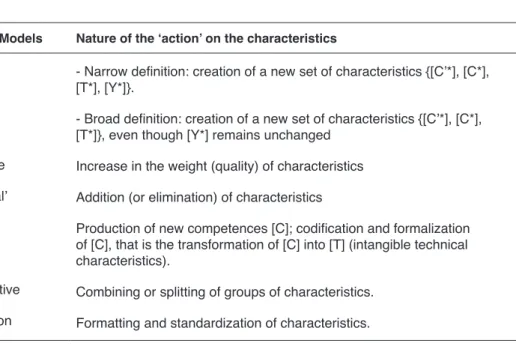
Regarding intent, Gallouj (2002) argues that innovation can be the result of an intentional process - as it occurs in innovations arising from research and development - or, then, can arise naturally from learning mechanisms. In the first case, would be innovations and programs, in the second, emerging innovations. Based on this conception of innovation, Gallouj (2002, 70) proposes models of innovation that look forward to “describing the particular dynamics of characteristics”, arguing that these models of innovation would not be restricted to the analysis of innovations in services, but possibly extended the analysis of innovation in property. Initially, Gallouj (2002) introduced six models of innovation: Radical innovation, incremental, ad hoc, Recombined and Formalization. The author warns, though, of the fact that the proposed models may make connections among themselves.
Table 1: The various models of innovation and the dynamic of characteristics (GALLOUJ; 2002, 71).
Innovation Models Nature of the ‘action’ on the characteristics
Radical Ameliorative ‘Incremental’ Ad hoc Recombinative Formalization
- Narrow definition: creation of a new set of characteristics {[C’*], [C*], [T*], [Y*]}.
- Broad definition: creation of a new set of characteristics {[C’*], [C*], [T*]}, even though [Y*] remains unchanged
Increase in the weight (quality) of characteristics Addition (or elimination) of characteristics
Production of new competences [C]; codification and formalization of [C], that is the transformation of [C] into [T] (intangible technical characteristics).
Combining or splitting of groups of characteristics. Formatting and standardization of characteristics.
For this study, which considers the innovations in the context of the practices of reuse in software services, it particularly interests us to consider a model of innovation proposed by Gallouj (2002): the recombined innovations (sometimes called architectural innovations), which are based on combination or separation of technical background. This is a model of innovation “based on the systematic re-use or ‘recycling’ of existing ‘components’ or characteristics, which does not preclude the creation, in some cases, of radically new’ products’” (GALLOUJ, 2002, 79). Recombined innovations may arise from the creation of a new product through a combination of characteristics of two or more products or backgrounds, then, from the creation of new products and it was based on the separation of characteristics of an existing product. In that case, some features might even become standalone products. Gallouj (2002) reinforces, again, that the introduction of an existing technology to a product can set a case of recombined innovation.
In considering the practice of reuse of modules and parts of software already developed for the development / improvement of new software - practice of reuse - it is possible to establish links between these practices and definitions of Gallouj (2002) for recombined innovations. It is precisely in combination or in the separation of technical background - in order that the reuse is based on the addition, deletion or combination of modules - it is possible to consider that the practice of reuse represents, in the context of software services, practices that generate innovations. Observed in real practice, the development of software based on the reuse of modules, often from libraries of software, meets the description proposed by Gallouj (2002, 79) for recombined innovations: “recycling ‘of existing’ components’ or characteristics, which does not preclude the creation, in some cases, of radically new ‘products’. “ Although the practices of reuse are not traditionally regarded as innovative practices, in Gallouj settings (2002) may therefore characterize them as practices that lead to the emerging of innovations.
Method
Since the objective is to investigate the practices of reuse in software services in Brazil, this study adopts procedures and methodology of research using questionnaires in a random sample of companies that develop software services in Brazil, in the practice of reuse in the development of software.
For this purpose, the questionnaire seeks to identify the size (micro, medium, large and small) of the business and their options for using techniques of reuse of codes and managing tools for module libraries. For the purposes of the questionnaire, we have achieved a sample of 28 software enterprises, corresponding to about 40% of local population. Next, the study presents the results of an exploratory semi-structured interview conducted with a Brazilian specialist in the software industry to investigate the occurrence of practices of module reuse of software services, mainly, their frequency of use and obstacles to their use. The specific option of holding a semi-structured interview with a specialist from the software industry agrees with the possibilities laid out by Flick (2004, 104) for obtaining data by the interviewee, representing data generalized to a group -- that in the case, would be formed by software developing companies on the chosen region - and the expert “integrated to the study not as a single event but as representative of a group.” Considering the use of questionnaires, and the realization of semi-structured, this study takes on characteristics of a joint research (with qualitative and quantitative methods), one can characterize it as a study of cross section, bearing in mind that proposes to study a specific date and time (Richardson, 2007).
The practice of reuse in Brazilian software services
Data obtained from the application of the questionnaires showed that 46% of companies surveyed had less than 20 employees, being characterized as micro, 29% had between 21 and 100 employees and were classified as small businesses, 7% had between 101 to 500 employees, which characterized them as medium-sized enterprises and, finally, 18% had over 500 employees and were considered large companies. Among the micro, 100% did re-use codes, while in small companies that percentage was 75%. In medium-sized companies, 100% re-used codes and in larger enterprises 100% adopted such practices. By identifying the use of managers for module libraries, the poll showed that 54% of micro-companies have been using this tool. In small micro-companies, the percentage of use reached 50%, while in medium and large companies the re-use adoption was used in 100% of the cases.
Further analysis of data obtained from the questionnaires showed that although most businesses practice reuse of codes (93%), it is not confirmed as regarding the use of module libraries, hence only 61% of companies surveyed fit this case. This finding agrees with Rothenberger et al. (2003) with regard to possible occurrences in the practice of reuse. When such practices occur in a planned way, they are generally results of organizational investments in order to compose libraries of modules, which require investments that will possibly only be recovered in the long term (Rothenberger et al., 2003). In the case of the surveyed companies, the practices of reuse occur frequently, but are not always associated with the use of module libraries. It follows from the obtained data, that the most common form of reuse identified in the surveyed companies, refers to the non-planned reuse, which
occurs from responses from developers to opportunities encountered during the process of development, but in no way planned.
In considering the practice of reuse of modules in software developing services in Brazil, the interview with the specialist in the industry showed that this practice is significant, capable of bringing economic benefits to the development process, and to facilitate the generation of new products. However, the interview shows that the occurrence of use and the practice of reuse is limited, and the specialist gives the characteristics of Brazilian companies, indicating that the reuse “should always happen in a very accelerated way, but is not part of our culture. Brazilians are creative beings par excellence, do not like much to touch up something, but rather likes doing something new”.
The search for development of entirely new products in detriment of products derived from the reuse of solutions already carried out in enterprises, justifies the specialist, and occurs as a result of business management performed by professionals with technical profiles for implementing the program. This fact can be explained by the small size of software developing enterprises that, in the majority (75%), are micro and small enterprises, where the founding members commonly have technical profile and training. Depending on the profile, these professionals would be motivated by the challenge of technical implementation of the solution issued by the client and not by business strategies, which leads companies to keep the focus on the challenges of developing technical solutions, not paying attention to the storage process of these solutions and to incorporate developed software as the scope of business development.
As for the question presented by the expert regarding the technical challenges that motivates the development of software, it is the highlight of the interview: “from the moment when the technician did it, there is no challenge, he can do it again. There, the solution is lost. “The interview shows, therefore, that a solution or software developed would be the focus of attention of companies to date of its delivery to the customer, in many cases, no reuse of these solutions. Again, it is possible to establish relationships with the presented by Rothenberger et al. (2003, 825), which emphasize the high costs of implementation of a library of modules - which would represent a solution to the need for storage of the solutions developed for future uses. Failure to adopt the practice of reuse can be due to the lack of organizational settings on the storage of solutions already developed, and the low use of module libraries.
Finally, it is considered an observation revealed in the interview with the specialist for enterprises that showed significant results and trajectory of growth. The expert attributes the success of these companies to the following fact: “in management, strategy lies in non-technical people who are able to think ‘outside the box’, who understand that the challenge is not IT, but another “. Finally, the expert points out a path for the growth of technology-based companies: “when they reach the stage of a mature business, well managed, I think they will grow in a more accelerated way. Marketing or business have always been bottlenecks in technology-based companies, because the technician is technical, so he does not know how to manage, does not know how to sell”. Considering the comments of the expert, one may identify that the growth and business development on software companies by reuse practices consists of a challenge involving professional management.
Conclusion
The practice of reuse is traditionally seen as a way to reduce costs and delays in development of software, although the connection between reuse practices and development of innovations is not commonly presented in the literature on the reuse of modules in software. Our study allowed us to characterize such connections in the by examining such proximity between the practices of reuse and the characteristics of recombinative service innovations. Results show that the practice of reuse corresponds not only to a way of reducing costs and optimizing software development, but also as leading to the emerging of innovations to be adopted by companies.
By investigating the practices of the reuse of software services in Brazil through questionnaires, the study revealed how many companies actually used re-use practices: 100% of micro, 75% of small businesses, 100% of medium-sized enterprises and 100% of the large companies. Regarding the use of managing agents for module libraries, the poll found using this reuse corresponded to 54% of micro, 50% of small businesses and 100% of medium and large enterprises. The analysis of data obtained from the questionnaires also showed that although most businesses do reuse of codes (93%), they do not always use strategies to manage their previously developed modules. Actually, only 61% of the companies in our sample happened to have formalized practices for the management of module libraries. That means we have a high level of reuse practices, but low level of formalization in practices. Although companies do commonly reuse their codes, they usually do it in an unplanned and – most of all – unorganized way.
Such results complement previous findings obtained from the exploratory semi-structured interview with a specialist on Brazilian software industry. The interview showed that practices of reuse in Brazilian companies are significant and also capable of bringing economic advantages in software development process as well as facilitating the creation of new products. The use of reuse practices by companies has proved to be, however, limited. Companies seem to be keeping their focus on solving technical solutions challenges instead of focusing on the construction and feeding of module libraries for future reuse. We may also point out a limiting factor to reuse - high costs for implementing module libraries. Such failure may be attributed, therefore, to the the lack of organizational settings on the storage of solutions previously developed, as well as to the low use of libraries of modules. Our study concludes, therefore, that growth and business development ofsoftware companies may highly benefit from reuse practices by reducing costs, developing time and also by improving their chances to achieve innovation by means of recombinative innovation, although they still lack management practices in order to transform previously accomplished technical challenges into modules that may function as inputs to future reuse practices.
References
Abes – Brazilian Association of the Software Companies. (2006): Assessment and development in Brazilian software industry.
Antelme, R.; Moultrie, J.; Probert, D. (2000): Engineering reuse: a framework for improving performance. ICMIT.
Brasil. (2003): Directives on industrial, technological and foreign trade policies.
Edvardsson, B.; Gustafsson, A; Johnson, M; Sandén, B. (2000): New service development and innovation in the service economy. Lund, Sweden: Studentlitteratur.
Fernandes, A. M.; Balestro, M.; Motta, A. G. (2004): The software cluster in Federal District. RedeSist.
Flick, U. (2004): An introduction to qualitative research. Porto Alegre: Bookman.
Gadrey, J. (2001): Services use, productivity and performance evaluation. In: Salerno, M. (org). Service relationship: production and evaluation. São Paulo: Editora Senac. pp. 23-65.
Gallouj, F. (2002): Innovation in the service economy: the new wealth of nations. Cheltenham: Edward Elgar.
Gutierrez, R.; Alexandre, P. (2004): Electronic complex: introduction to software. BNDES Setorial, 20, pp 3-76.
Kon, A. (2004): Service economy: theory and evolution in Brazil. Rio de Janeiro: Editora Campus.
Petit, D.; Janssen, R.; Leitão, C. (2007): Software and information technology services exportation: basic concepts. Brazilian Small Business Suport Services. Santa Catarina, Florianópolis.
Richardson, R. (2007): Social research: methods and technics. Editora Atlas, São Paulo. Roselino, J. (1998): An analisys of the potentiality of the brazilian software activity
considering the sectors‘ competitive practices.Economy institute, University of Campinas – Unicamp.
Rothenberger, M.; Dooley, K.; Kulkarni, U.; Nada, N. (2003): Strategies for software reuse: a principal component analysis of reuse practices. IEEE Transactions on software engineering 29, n. 9.
Steinmueller, W. (1995): The U.S. software industry: an analysis and interpretive history. MERIT – Maastricht Economic Research Institute on Innovation and Technology.