INNOVATION IN MOBILE CLOUDS
Analysis of an Open Telco Application
Antero Juntunen, Vesa Suikkola, Yrjo Raivio, Sakari Luukkainen
Department of Computer Science and Engineering, Aalto University School of Science, Konemiehentie 2, Espoo, Finland [email protected], [email protected], [email protected], [email protected]
Keywords: mobile cloud computing, open telco, business model, application, STOF
Abstract: Cloud computing is emerging in several ICT areas, including the mobile services industry. This development is known as mobile cloud computing (MCC). MCC may save mobile energy consumption and be utilized to overcome the fragmentation challenges of application developers, who must take into account various mobile operating systems. This paper introduces a novel mobile-device-independent development approach. Mobile applications will be placed into a cloud and will utilize open application programming interfaces from the telecom infrastructure. This approach, called Open Telco, enables application deployment that is fully based on cloud-computing principles. In this study, we present a business model analysis of an application case called Event Experience, using the Service, Technology, Organization, and Finance (STOF) framework.
1
INTRODUCTION
Cloud computing refers to utilizing a virtualized, on-demand server environment that hides the true technical architecture of computing resources such as storage and servers The main benefit of cloud computing is to free the application developer from hardware-management concerns and some of the financial issues involved in having to own the servers, the full capacity of which is rarely used.
Mobile cloud computing (MCC) can be defined as using cloud-computing principles to deliver applications and services for mobile devices. An additional benefit of cloud computing in the mobile environment is that it enables delivering advanced applications to mobile devices with limited data processing and storage capabilities by utilizing cloud resources such as processing power and storage. By offloading intensive data-processing tasks to the cloud, MCC applications can offer features such as image and voice recognition that would not be otherwise possible considering the limited computing power, memory, and data storage available on mobile devices. In addition, MCC may help reduce the energy consumption and save the battery of mobile devices by utilizing cloud resources, even if the device had sufficient processing power to complete the tasks locally.
One of the most significant problems facing mobile application developers is the fragmentation of mobile space. As a result, a mobile developer targeting a large user base has to create applications for many different operating systems (OSes), significantly increasing the effort and time required in application development. Moreover, fragmentation is an issue even within a single OS, as new versions of an OS may not support old applications.
The MCC concept offers a reasonable solution to OS fragmentation by allowing developers to create web-based applications that are stored on the cloud and used through mobile browsers. Because no application needs to be installed on the handset, every mobile phone with a capable browser can utilize services using this MCC approach. Although this solution is dependent on the standardization of mobile browsers on different OSes, these standardization issues are much less significant than the general problem of mobile OS fragmentation.
In our study, we extend these kinds of MCC applications with application programming interfaces (APIs) offered by mobile operators. These APIs provide developers with additional capabilities – such as user location – in a device-independent manner, further decreasing the effect of fragmentation. In addition, the messaging capability provided by the APIs enables designing applications
that can reside wholly in the cloud and communicate with the user device through SMS/MMS messages. Thus, the basic functionality of these applications may be available to all users, regardless of the capabilities or OS of their mobile phones. This concept of open operator APIs – called Open Telco (OT), originally presented by Raivio, Luukkainen, and Juntunen (2009) – describes a framework for open telecommunications-operator network interfaces, or OT APIs, that connect the operators and external service developers together to form an environment for telco mash-up services. The GSM Association (GSMA) has been leading the OT API standardization effort with their OneAPI specification (GSMA, 2010a), which has initially focused on text and multimedia messaging, positioning, and payment capabilities. The pilot of OneAPI in Canada provides a valuable foundation for the progress of OT. Standardization will drive OT as a key enabler for the success of mobile cloud applications. However, the adoption of OT will require new, revolutionary applications which showcase the value of the system and drive the ecosystem towards critical mass.
This paper presents a business model analysis of what we have identified as a potential revolutionary application for the mobile cloud: Event Experience (EE) is a service which combines mobile event tickets to socially-engaging complementary services that enhance the experience of the event. The service provides a unified event experience by utilizing a combination of mobility and social networks through the use of Open Telco (OT) APIs. The service utilizes all of the mobile capabilities offered by the GSMA OneAPI v.1.0 standard (GSMA, 2010a); that is, text and multimedia messaging, positioning, and payment capabilities.
2
METHODOLOGY
This paper utilizes case study methodology, which is defined by Yin (2003) as an empirical inquiry focusing on a contemporary phenomenon along with its real-life context, which may not be clearly separated from the phenomenon itself. The single case study used in this paper is also known as an intrinsic case study (Stake, 1995), which examines one specific case in depth. In contrast, instrumental studies examine multiple cases and try to generalize the phenomena observed in the cases into theories. An intrinsic case study is well suited to examining a service case that is under development and not yet on the consumer market.
In this case, the focus is not on generalizing the findings of the case into theory, but on demonstrating the potential of the Open Telco (OT) concept in promoting service innovation by utilizing a specific service as an example. We implemented an internal prototype of the Event Experience application in order to gain practical knowledge of the OT service development environment. We analyze the business model of the service and include the lessons learned from developing the application as part of the analysis. We apply a service-science perspective in the analysis of the application by utilizing the Service, Technology, Organization, Finance (STOF) framework that was specifically developed for analyzing business models of mobile services (Bouwman, De Vos, and Haaker, 2008). The model provides a holistic view on business models: the service domain concentrates on the value proposition of the service, the technology domain on the technologies required to deliver the service, the organization domain on the value network, the roles, and value activities of the different actors within the network, and the finance domain on the income and cost models of the service. This study highlights issues critical in launching a developer and service ecosystem utilizing OT.
3
THEORETICAL
BACKGROUND
3.1
Service Innovation Diffusion
The diffusion of innovations typically follows an S-curve, which plots the number of adopters of an innovation against time. The S-curve illustrates the slow initial adoption of an innovation when awareness of the innovation is being built, a more rapid increase of adopters as the innovation becomes more popular, and a decreasing rate of adoption as the innovation saturates the market.
A key element in the S-curve is the critical mass of adopters. When the critical mass is reached, the innovation reaches the takeoff stage, the number of adopters rapidly increases, and the diffusion of the innovation becomes self-sustaining. For many innovations, this phenomenon can be due to supply-side economies of scale and/or network effects. If an innovation exhibits positive network effects, the innovation becomes more valuable the more users adopt it. This phenomenon is often known as Metcalfe’s Law, which states that the value of a
network is directly proportional to the square of its users (Shapiro and Varian, 1999).
Our focus is on the early stage of innovation diffusion, when the service in question has not yet reached critical mass. Rogers (2003) highlights several characteristics of an innovation that influence its adoption: the relevant advantages of an innovation over existing systems, the compatibility of an innovation with the adopters, the complexity of an innovation, as well as the trialability and observability of an innovation.
3.2
Value of Service Experimentation
In incremental service evolution, it is possible to assess the market and make financial analyses before the beginning of service development, whereas in the case of radical service innovation, the market analysis contains considerable uncertainty. The problem is often that in the latter case, more attention is focused on the differential technological advantage the new service will offer over the existing solutions rather than on customer benefits and commercial opportunities (Veryzer, 1998).
Successful new service innovations are influenced by the renewal of the related technology platforms. The use of modular system architecture in the introductory phase of a new communications platform, when the market uncertainty is high, provides a larger field of options from which to select according to later market development and emerging customer needs (Gaynor, 2003). The modular structure – such as the one used in the Open Telco service platform – enables cost-effective experimentation of suitable new services, especially when they are targeted at latent needs of end users. These needs tend to develop from basic features into more advanced ones during such an experimentation process (Clark, 1985; Thomke, 2003).
New services should be developed by phased approximations and finally approach the market on the basis of better information in circumstances of lower uncertainty. Identifying critical success factors in an early phase makes it easier and cheaper to react to any problems and to approach the right market segments by correct timing, differentiation, and pricing.
4
ANALYSIS OF EVENT
EXPERIENCE APPLICATION
4.1
Service Domain
The essence of the service is described by the following use scenario:
Alice and Bob find an interesting event on their favorite social networking site. They click to attend the event and notice the EE service is available for this event. They order the service by specifying their mobile subscriptions to the application and receive admittance and complementary bus tickets by MMS and/or SMS. On the event day, Alice and Bob are heading to the venue well in advance as the service informs them a rush is expected. Their phones alert both at the same time – the organizer is guiding them to use Gate B as Gate A is crowded. They get in and find their seats in no time with the area map included in the service. Now it is time to read the latest comments by other visitors on the event wall and see if any of their friends are located at the venue. The organizer also invites Alice and Bob to take part in polls. After the event, Bob orders some merchandise through the EE page; he can conveniently pay for the order by mobile phone.
The value proposition of EE is to reduce the effort and enhance the experience related to events by offering a unified service bundle to event attendees. The value proposition is achieved through service integration, or bundling, which can increase the user value of the service bundle to more than the sum of its parts (Bouwman et al., 2008). The bundle includes end-user services such as:
Event information service providing the event program, schedule, and seating chart.
Proactive crowding avoidance at the venue An event-specific blog and media feed, through
which the attendees can receive and send messages to each other.
Polling and voting system, for example, for voting the encore song or rating the previous song at concerts.
Friend-presence service for checking if a friend is attending the event.
Public transportation ticket or a navigation service to the venue.
An event store that can offer video recordings of the event, song downloads, or other event-related merchandise available for purchase through the event-store system by download or delivery.
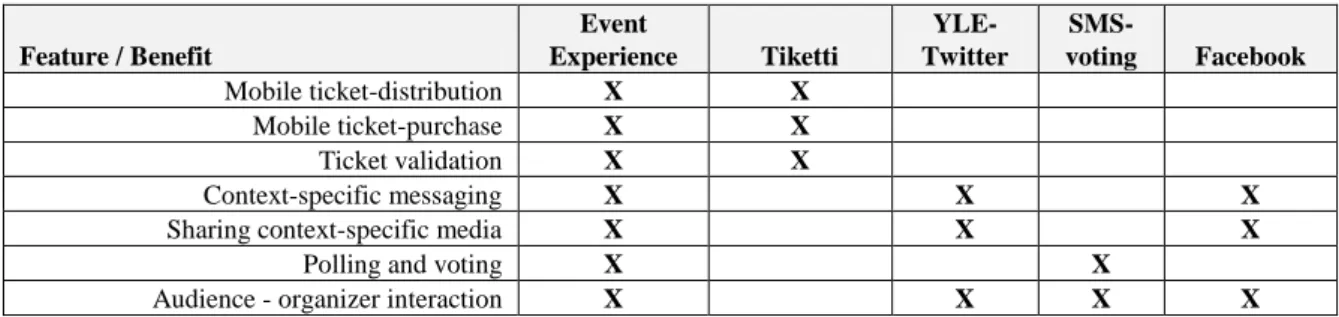
Table 1. Comparison of Event Experience core service to alternate services. Feature / Benefit Event Experience Tiketti YLE-Twitter SMS-voting Facebook Mobile ticket-distribution X X Mobile ticket-purchase X X Ticket validation X X Context-specific messaging X X X
Sharing context-specific media X X X
Polling and voting X X
Audience - organizer interaction X X X X
In addition, EE includes an organizer service, which offers the event organizers an easy way to interact with their audience as well as the benefits of mobile ticketing. A key element in the service is that it allows practically any user to act as an event organizer with relatively low effort. Benefits for the event organizer include decreased ticket distribution and processing costs, increased sales through the Internet, ticket validation to prevent ticket misuse, and effortless reach of audience through organizer web client. For example, the event organizer can send SMS messages, issue SMS polls, moderate the event blog, and issue crowding alerts to event attendees.
In the EE service, the target customers and end users for the ticket service are event attendees, whereas the target customers and end users for the organizer service are event organizers. Thus, for the sake of simplicity, event-attending customers are referred to as the user and the event-organizing customers as the organizer. The core service for these users is formed from the ticketing and event-specific information and social-networking features. There are some existing services in the event-ticketing industry to which EE can be compared to. For example, in Finland, Steam Communications provides electronic-ticketing solutions for mobile and e-mail delivery (Steam Communications, 2010); however, the service has focused only on the actual ticketing and admittance service, aiming to realize the benefits of mobile ticketing. The system is realized by machine readable matrix barcodes, that is, 2D barcodes and numeric codes. A case example utilizing the Steam Communication ticketing system is Tiketti ticket office (Tiketti, 2010). Tiketti provides electronic tickets via e-mail, SMS, and MMS at the same price and lower service fees than regular tickets. In addition, Twitter could also be considered as an alternate service to the event blog and media feed service component, which offers similar benefits for connecting event-specific comments to an event through tagging (Twitter,
2010). However, Twitter does not directly enable posting media, such as pictures, video, and audio, to the blog feed and it is up to the users to tag the messages to some specific event, while in Event Experience tagging is done automatically. Another comparable case, in terms of the event-blogging service, is the experiment of the Finnish national public service broadcasting company, Yleisradio, displaying Twitter tweets on television screens during Eurovision Song Contest 2010 via Teksti-TV teletext system (Yleisradio, 2010). Feedback for the experiment was largely positive (Silvast, 2010), which would imply that similar services could be successful in the Event Experience context as well. The feedback also requested integration of voting element to the service, which would imply that the voting and polling service in Event Experience is a compatible part of the service bundle. Estonia based company Mobi Solutions has also developed an SMS-based mobile voting system called SMS-voting
for arranging polls during events (Mobi Solutions, 2010). Table 1 presents a comparison of the features and benefits between the EE core-service to the presented existing services.
Even though many of the service components present in EE are available as separate services through separate service providers, similar services taking advantage of service integration to the degree of EE are not presently available. Thus, the main benefit of EE over the alternate services is service integration. In addition, EE provides some unique benefits presently not available in other services, such as a system to interact with the event organizer during the event; for example, through the voting and polling system. Furthermore, telco billing and charging capabilities can reduce the effort of purchase, since the transaction can be charged directly to the mobile subscription whereas the current charging systems provided by ticketing offices usually require manual per-purchase payments, for example, via online banking. The effort of using different service components in EE
can be minimized by integrating the user interface for all of the components in a single, browser-based application.
To summarize, the value proposition of EE for the user forms through a tightly integrated, experience-enhancing, socially engaging, and in part unique service bundle for event attendees, providing a unified event experience before, during, and after the event. For the organizer, the value is created through providing a low-weight, mobile interaction channel to the users as well as through the benefits of mobile ticketing. The final quality of the value proposition will depend on the degree of integration in the bundled services. Integration to existing social networking services is crucial in order to take advantage of existing online social communities.
4.2
Technology Domain
As per our definition of the mobile cloud paradigm presented in Section 1, the whole EE application is placed on cloud infrastructure, such as the public-cloud service Amazon EC2 (Amazon Web Services LLC, 2010). Thus, the processing requirements on the end-user device are decreased. Moreover, services using this approach are not as reliant on the capabilities of end-user devices and can be targeted to a wider range of mobile phones. Furthermore, if no application is required on the handset, adopting the service will be easier for the user, and the service deployment process becomes much simpler for the service provider. Another substantial benefit of placing the EE application in the cloud is the capability to overcome the fragmentation problem of mobile operating systems.
A prototype version of the EE service was developed during September-October 2010, which included a subset of the features described in Section 4.1. The main focus of the prototype implementation was to build a proof-of-concept application. For this version of the service, we had to implement mock-up versions of the functionality because some of the technical capabilities of GSMA OneAPI standard were not available; instead, we utilized the proprietary open APIs provided by a single operator. We do not see this as an issue as the goal for this version was to build a prototype, which is to be used to showcase the value proposition. More specifically, mock-up functionality was done in context of the payment capabilities.
The prototype project was carried out in cooperation with University of Helsinki Department of Computer Science as part of the Software Factory program (Software Factory, 2010). The prototype
was developed during a seven-week period at the Software Factory. The total development effort accounted to about 500 hours.
The primary features of the prototype included preliminary versions of the user and organizer applications and integration to the Facebook social-networking platform (Facebook, 2010). The Facebook platform was chosen because it is widespread and the de facto event publication site and because it connects visitors, friends, and events.
In addition, Facebook enables content sharing and provides open interfaces for additional applications. The usable functionality of the prototype was limited to the event-wall feature, SMS/MMS-based mobile ticketing and payment mock-ups, as well as messaging. The system architecture was based on the Model-View-Controller model, which allows extending the functionality: new features can be added later; for example, based on user or other stakeholder feedback for the service prototype.
The most significant challenges for the implementation were created by the actual integration to external systems – more specifically, the Facebook social-networking platform integration proved to be problematic. Thus, even though Open APIs are a key enabler for the new cloud-based applications, they can also create significant hurdles for the external service-developer. One example of such hurdles is poor documentation of external APIs, which will in effect destroy the low barriers of experimentation and entry. Thus, the external APIs impose both technical and business restrictions and dependencies for the developer. The technical issues are already being addressed by the GSMA OneAPI standard, which facilitates an experimentation-friendly environment in the context of OT APIs.
4.3
Organization Domain
As the organizational model of OT, this study assumes the so-called virtual-broker model, in which the operators act as a single access point to the common network capabilities of a cross-network environment (Raivio, Luukkainen, and Seppälä, 2011; Suikkola, 2011). A similar multi-operator value network exists also in the recently launched Finnish mobile certificate service, in which the operators have co-operated exceptionally closely (Mobiilivarmenne, 2010).
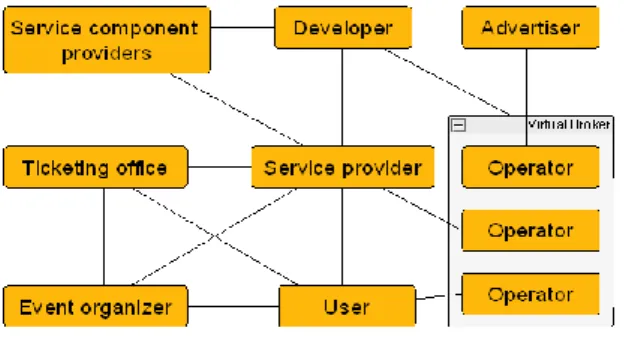
Figure 1 shows an example of the value network for EE. The most central role in the value network is naturally dedicated for the service provider who manages the service integration and is responsible for the operation of the service as a whole. Different
service components can be implemented by leveraging existing external systems through Open APIs; for example, in case of public transportation tickets, cooperation is required with local public transportation companies. The service may also benefit from using external providers for other components as well; for example, it is possible to integrate with social networking platforms for the event wall and cooperate with existing online stores for the event store.
Figure 1: Event Experience Value Network
The role labeled service component providers also includes hosting and cloud infrastructure, which allow the service application to run on the cloud. The role of the operators and the virtual broker is providing the required mobile capabilities, such as positioning and payment capabilities. The operators also provide accessibility to the end users, advertisers, and other possible partners through the virtual broker. The role of the ticketing office is not mandatory: if the EE service is targeted for the existing event-ticketing market, competition with the existing ticketing offices will be fierce. Thus, targeting this market would most likely require cooperation with the existing ticket offices. However, the EE service would be more suited to serve the event organizers who currently do not utilize tickets because of the lack of a service such as EE, thus creating a completely new market of ticketing.
4.4
Finance Domain
The service provider will benefit from the OT approach by taking advantage of cloud infrastructure and external open APIs, which allow entry to the OT ecosystem with minimal upfront capital investment. Furthermore, the use of cloud infrastructure allows rapidly scaling up the service in case it becomes popular with the end users.
The most important investment in this case is the application development and service-component
integration work. Integration of ticketing, social networking, location-based services, and online stores to one application is a substantial task and presents considerable risks. The risks can be mitigated by modularizing the system; for example, a critical end-user mass could be built by a socially engaging, context-aware event service and later capitalized on by including the other components. Our prototype implementation efforts provide insight to the costs of such an investment. About 500 hours were spent on the implementation of the SMS/MMS messaging functionalities and on integrating to the event and social-networking features of Facebook. We estimate that another 250 hours of development would be required before the implementation would be able to fulfill the core value proposition of the service. Assuming a development effort cost of 20€ per hour, the implementation investment would account to 15 000€. However, this figure can only be considered a rough estimate.
Operational costs sources for EE include the telco capability costs, cloud infrastructure costs, and service operation and marketing costs. The most important of the OT capabilities is the payment capability; without affordable telco payment capabilities, EE will most likely fail. For example, 70/30 revenue share (GSMA, 2010b) of the capability is unacceptable from the EE provider point of view, since the service provider will likely be unable to add a 30 percent margin in the ticket price just for the payment-capability provider. Moreover, ticketing offices and online stores already have their existing billing and charging capabilities in place, which are usually implemented using credit card or electronic-banking based methods of payment. Operator billing and charging capabilities do offer the advantage of decreased end-user effort but suffer from the disadvantage of increased credit risk and working capital for the ticketing office. This credit risk is due to service consumption preceding payment of the service. As mobile subscriptions are often post-paid, this becomes a very real risk for the service providers, who may be required to wait up to 90 days to receive the payment from the operators (GSMA, 2010b).
The feasibility of the location-based features will depend on the pricing of the positioning capabilities. It is unclear whether the location-based functionalities add enough value for the end users to be willing to pay extra for them. Thus, the costs would have to be covered by other means, such as through advertising revenues. Operation costs are
also significant in EE. For example, labor may be required in handling the voting and polling results.
The most important revenue streams for the service provider come from the users, organizers, and advertisers. In addition, the service provider and the external service component providers can share revenues generated through the use of these service components – assuming the service component is not free for the user. However, the model does allow free-for-user service model.
5
DISCUSSION
We have identified several factors that contribute to the potential success of the Event Experience (EE) service. First, EE provides a bundle of numerous related services, which increases the value of the whole service for the end user to more than the sum of its parts by enhancing the user experience and reducing the effort required to use the service (Bouwman et al., 2008). This kind of service integration is currently lacking on the market, which is why EE enjoys a relative advantage over existing solutions (Rogers, 2003). Second, event organizers benefit from the service through increased interaction with the users as well as through the advantages provided by mobile ticketing. Third, EE allows any end user to conveniently arrange ticketed events. In addition, EE is particularly suitable for smaller events, where ticketing is currently underutilized. Fourth, the virtual-broker model helps simplify the value network and maximize the potential user base.
In addition, mobile cloud computing (MCC) and Open Telco (OT) provide numerous benefits for service developers in general and for the EE service in specific. First, EE benefits from the general cloud computing advantages that hold in the mobile space as well: reduced need for investments in computing infrastructure, better overall utilization of computing resources, and the option to rapidly scale up the service as needed. Second, MCC benefits the EE service by reducing OS fragmentation, energy consumption in mobile devices, and dependence on end-user handset capabilities. In addition, the EE application is easier to deploy and it can be used with essentially any mobile phone as well as by any subscriber of an operator offering standardized APIs.
On the other hand, the EE service is dependent on the APIs on which the service is built, which imposes both technical and business restrictions. From the developer point of view, it is essential that open APIs are stable and backwards compatible.
Furthermore, alternative sources for the open API information are required in order to avoid vendor lock-in risks. Alternatives are available for the telecom APIs, such as messaging, location, and payment methods, but replacing a dominant market player such as Facebook is difficult, at least within a short time period.
In general, OT can enable service developers to create services quickly and cost-effectively. Using this approach, it may be possible to target niche customer segments and create profitable services in the long tail because the costs of the services remain low. This type of easy service experimentation, supported by the modularity of the OT system architecture, may also allow creating new iterations of services that better correspond to latent customer needs (Gaynor, 2003). In addition, because these services are not tied to any one device, operating system, or application store, the potential market of OT services is very large. The EE application demonstrates the possibilities of the OT approach and hopefully motivates the development of similar services. By utilizing open APIs, EE and other OT services may leverage existing external assets both in the Internet and in the mobile space, thus increasing the chances of success in the early phase of service diffusion.
6
CONCLUSION
We have presented a mobile cloud computing approach called Open Telco (OT) that utilizes the opportunities offered by open APIs. We implemented an example OT application, Event Experience (EE), and analyzed it using the STOF framework. The preliminary results indicate that the OT approach has clear benefits compared to traditional applications installed in mobile devices and is well-suited for start-up companies, potentially fostering new ICT entrepreneurship.
Although we have highlighted some key benefits of the OT approach by analyzing the EE service, the study has some limitations. The study focuses on only one service, which limits how far we can generalize our findings of the OT ecosystem and service bundling. Facebook provides an attractive platform for service bundles, but platform limitations restrict its usage at the moment. Moreover, the service in question is still a prototype and not in consumer use, and the APIs used were proprietary and provided by a single operator.
Thus, we would like to analyze other OT services in the future and use multiple-case-study
methodology to present conclusions about the service development ecosystem in question. In addition, we would like to implement a true pilot with live users in a multi-operator environment.
ACKNOWLEDGEMENTS
The work is supported by Tekes (the Finnish Funding Agency for Technology and Innovation, www.tekes.fi) as a part of Cloud Software Program (www.cloudsoftwareprogram.org) of Tivit (Strategic Centre for Science, Technology and Innovation in the Field of ICT, www.tivit.fi).
REFERENCES
Amazon Web Services LLC. (2010). Amazon Elastic Compute Cloud (Amazon EC2). Retrieved November 17, 2010, from http://aws.amazon.com/ec2/
Bouwman, H., De Vos, H., and Haaker, T. (eds). (2008).
Mobile Service Innovation and Business Models (1st ed.). Springer.
Clark, K. B. (1985). The interaction of design hierarchies and market concepts in technological evolution.
Research Policy, 14(5), 235-251.
Facebook. (2010). Facebook Developers. Retrieved November 17, 2010, from http://developers.facebook.com/
Gaynor, M. (2003). Network services investment guide: maximizing ROI in uncertain times. Wiley Publishing. GSM Association. (2010a). GSM World - OneAPI V1.0.
Retrieved November 26, 2010, from http://www.gsmworld.com/oneapi/
GSM Association. (2010b). General OneAPI FAQs. Retrieved February 24, 2011, from http://canada.oneapi.gsmworld.com/portal/tws_gcop/R esources/FAQ
Mobi Solutions. (2010). Mobi Solutions: SMS-gateway & marketing in Estonia, Latvia and Lithuania, M-government & Mobile Apps development > SMS-voting at Events. Retrieved August 11, 2010, from
http://www.mobisolutions.com/services/m-services-at-events
Mobiilivarmenne. (2010). Mobiilivarmennus käynnistyy Suomessa. Retrieved December 3, 2010, from http://www.mobiilivarmenne.fi/fi/fi_7.html
Raivio, Y., Luukkainen, S., and Juntunen, A. (2009). Open Telco: A New Business Potential. In Mobility '09, 6th International Conference on Mobile Technology, Application & Systems.
Raivio, Y., Luukkainen, S., and Seppälä, S. (2011). Towards Open Telco - Business Models of API Management Providers. In HICSS ’11, 44th Hawaii International Conference on System Sciences.
Rogers, E. M. (2003). Diffusion of Innovations(5th ed.).
New York: The Free Press.
Shapiro, H. and Varian, H.R. (1999). Information Rules. Boston: Harvard Business School Press.
Silvast, A. (2010). Twitter siirtyy televisioon Teksti-TV:n välityksellä | YLE Blogit | yle.fi. Retrieved June 22, 2010 from http://blogit.yle.fi/kehitys-kehittyy/twitter-siirtyy-televisioon-teksti-tvn-valityksella
Software Factory, (2010). Software Factory. Retrieved November 22, 2010, from http://www.softwarefactory.cc/
Stake, R. (1995). The art of case study research. London: Sage Publications.
Steam Communications. (2010). Etusivu | Steam Communications. Retrieved June 23, 2010, from http://www.steam.fi/
Suikkola, V. (2011). Value Generation in Mobile Clouds – Analysis of Emerging Applications. (Master’s Thesis). Espoo, Finland: Aalto University School of Science. Thomke, S. (2003). Experimentation matters. Harvard
Business School Press.
Tiketti. (2010). Tiketti. Retrieved June 23, 2010, from http://www.tiketti.fi/
Twitter. (2010). Twitter. Retrieved June 23, 2010, from http://twitter.com/
Veryzer, R. W. Jr. (1998). Discontinuous Innovation and the New Product Development Process. Journal of Product Innovation Management, 15(4), 304-321. Yin, R. (2003). Case study research: design and methods.
Thousand Oaks: Sage Publications.
Yleisradio. (2010). Euroviisut tuo Twitter-viestit TV-ruutuun | Euroviisut | yle.fi. Retrieved June 17, 2010, from http://euroviisut.yle.fi/uutiset/2010-05-06/euroviisut-tuo-twitter-viestit-tv-ruutuun