HOST SPECIFICITY, NEGATIVE FEEDBACKS, AND PATHOGEN
DEFENSE IN THE PLANT PHYLLOSPHERE MICROBIOME
Briana Kathleen Whitaker
Submitted to the faculty of the University Graduate School in partial fulfillment of the requirements
for the degree Doctor of Philosophy in the Department of Biology,
Indiana University July 2018
Accepted by the Graduate Faculty, Indiana University, in partial fulfillment of the requirements for the degree of Doctor of Philosophy.
Doctoral Committee _____________________________________ Keith Clay, PhD _____________________________________ Jay Lennon, PhD _____________________________________ Curt Lively, PhD _____________________________________ Heather Reynolds, PhD June 22, 2018
Acknowledgements
During the course of my dissertation research, I was funded as a National Science Foundation Graduate Research Fellows, as well as by the National Institutes of Health Genetics, Cellular & Molecular Sciences Training Grant and the Department of Biology at Indiana University (IU). Funding support for the described research was provided by IU’s McCormick Science Grant, the Provost’s Travel Award for Women in Science at IU, the IU Research and Teaching Preserve (RTP), the Indiana Academy of Science, the Prairie Biotic Research Inc. Small Grant Award, the G.W. Brackenridge Fellowship, the Fred Seward Award, and the Indiana Daffodil Society Scholarship, as well as in part by a grant to Dr. J. Bever by NSF DEB#1556664. A portion of this research was conducted through research agreements with the U.S. DOE Fermilab National Environmental Research Park, the Fermi Research Alliance (FRA), the USDA Forest Service, and Shawnee National Forest System, orchestrated by scientists and staff on site: Dr. R. Walton, Mr. R. Campbell, and Mr. R. McClanahan. I was also assisted by research scientists and staff at Argonne National Laboratories and the IU Center for Genomics and Bioinformatics to perform the molecular and bioinformatic techniques used in this research. The IU Greenhouse and RTP Staff helped establish and maintain the Bayles Road field site and greenhouse experiments on the IU campus. I would like to personally thank the Clay and Bever labs for innumerable support over the past five years, in particular: Dr. J. Bever, Dr. N. Christian, Z. Shearin, Q. Chai, Dr. J. Bauer, M. Zaret, K. Hoban, I. Carrico, and M. Iang. Additionally, Dr. E. Knox, Dr. M. Vaughan, J. Brown, L. Cole, Q. Zhu, Dr. T. Cheeke, J. Teresi, J. Bender, and Dr. M. Busman provided expertise and assistance for the described research. I am very thankful to Dr. M. Bakker for hosting me as a graduate research intern student through the NSF-Graduate Research Internship Program, sponsored by the U.S. Department of Agriculture – Agricultural Research Service in
Peoria, IL. Lastly, I would like to thank the members of my committee, Drs. J. Lennon, C. Lively, and H. Reynolds, as well as my major advisor Dr. K. Clay, for the support, direction, advice, and constructive criticism they have provided me with over the past five years.
Briana Kathleen Whitaker
HOST SPECIFICITY, NEGATIVE FEEDBACKS, AND PATHOGEN DEFENSE IN THE PLANT PHYLLOSPHERE MICROBIOME
My dissertation research spans several topics in plant microbial ecology. In two research projects, I have explored whether host specificity influences fungal endophyte community structure in plant leaves across several ecotypes of switchgrass (Panicum virgatum) and across 19 plant species within the Asteraceae family. In these works, I found contrasting results for the importance of host specificity, where fungal endophytes did not preferentially colonize specific host ecotypes within a single species, but did preferentially colonize specific host species within a single family. Additionally, I also found that more phylogenetically related host species within the Asteraceae family shared more similar fungal endophyte communities than more
phylogenetically distant hosts. In another portion of my research, I applied a novel extension of the plant-soil feedback framework to microbiota associated with aboveground tissues, termed “plant-phyllosphere feedback”. In this work, I found that all four species tested experienced strong negative plant-phyllosphere feedback suggesting that phyllosphere, like rhizosphere (belowground), microbiota can potentially mediate plant species coexistence via negative feedbacks. In a final work, I tested whether traits displayed by bacterial endophytes in vitro can be used to reliably predict disease reduction outcomes in planta across variable climatic
conditions using wheat plants and the fungal pathogen Fusarium graminearum. I did not
ultimately find that in vitro trait assessments were good predictors of disease reduction outcomes in planta. However, my analyses did reveal differences among bacterial endophytes in their resilience to variable climatic conditions and degree of pathogen antagonism, emphasizing the
importance of considering the abiotic environment for studies of putatively beneficial plant microbiota. Through my dissertation research, I have provided evidence for the extent and limitations of host specificity in the aboveground plant microbiome, the potential role of aboveground plant microbes in mediating species coexistence, and their role in reducing pathogenic outcomes in an agriculturally relevant host.
_____________________________________ Keith Clay, PhD _____________________________________ Jay Lennon, PhD _____________________________________ Curt Lively, PhD _____________________________________ Heather Reynolds, PhD
Table of Contents
Title Page ... i
Acceptance Page ... ii
Acknowledgements ... iii
Abstract ... v
Table of Contents ... vii
Introduction ... 1
Literature cited ... 5
Chapter 1 – Foliar fungal endophyte communities are structured by environment but not host ecotype in Panicum virgatum (switchgrass) ... 7
Literature cited ... 24
Figures and Tables ... 32
Supplemental material ... 39
Chapter 2 – Phylogenetic relatedness of Asteraceae hosts determines foliar microbiome community structure in a common garden environment ... 50
Literature cited ... 72
Figures and Tables ... 81
Supplemental material ... 90
Chapter 3 – Negative plant-phyllosphere feedbacks in native Asteraceae hosts – a novel extension of the plant-soil feedback framework ... 107
Literature cited ... 128
Supplemental material ... 142
Chapter 4 – Bacterial endophyte antagonism against a fungal pathogen in vitro does not predict efficacy in planta ... 149
Literature cited ... 172
Figures and tables ... 178
Supplemental material ... 190
Conclusion ... 195 Curriculum Vitae
Introduction
A major goal of community ecology is to connect interactions between species within communities across spatial and temporal scales (Ricklefs 2004, Vellend 2010). For example, within the macro-organismal world, this can mean studying the physiology and behavior of predator-prey interactions locally and then scaling upwards to understand the effects of these behavior dynamics on a surrounding system of interconnected habitat patches. Or similarly, determining nutrient use efficiencies of individual plant species, and using that information to understand nutrient cycling across an entire forest. However, for the micro-organismal world it can be difficult to determine what spatial scale is the most relevant one for study (Mihaljevic 2012), due to the inherently microscopic nature of microbial interactions combined with their potentially macroscopic effects on host immunity and fitness or on ecosystem processes such as nutrient cycling. For example, some estimates suggest that a single handful of soil can contain tens to hundreds of millions of microorganisms belonging to over 5,000 species (Ramirez et al. 2015). For microbial colonizers of macroscopic hosts, community ecologists could choose to study microbial community composition and function within a single host tissue or organ (e.g., the gut or a leaf), at the level of a single host, across a population of hosts or a mixed community of potential hosts, or regionally across landscapes. My body of dissertation research is focused on the cross-section of several spatial scales in plant-microbial ecology.
Using a combination of traditional, culture-based and next-generation sequencing approaches, I tested the competing mechanisms of host specificity and local environment in driving plant microbiome community assembly. Secondly, I tested how microbial inoculum sources in the aboveground plant microbiome (i.e., the phyllosphere) alters plant fitness and whether plant fitness consequences are conditional on the identity of phyllosphere inoculum
from con- versus heterospecific hosts. These results were then placed in a plant-plant interaction framework to test whether phyllosphere microbial communities are a potential mechanism for the stabilization of plant-species interactions through negative feedbacks. Lastly, at the level of a single plant organ, I tested whether the interactions between potentially plant-growth promoting bacterial species and a fungal pathogen of wheat inflorescences are altered by the abiotic
environment and whether in planta outcomes can be predicted by in vitro interaction traits. These research questions are summarized into the following four chapter titles.
Chapter 1 – Foliar fungal endophyte communities are structured by environment but not host ecotype in Panicum virgatum (switchgrass) – in revision at Ecology Chapter 2 – Phylogenetic relatedness of Asteraceae hosts predicts foliar
microbiome community structure in a common garden environment – in revision at Molecular Ecology
Chapter 3 – Negative plant-phyllosphere feedbacks in native Asteraceae hosts – a novel extension of the plant-soil feedback framework – published in Ecology Letters (2017)
Chapter 4 – Bacterial endophyte antagonism against a fungal pathogen in vitro does not predict efficacy in planta – in preparation
In the following section, I introduce the primary study system used in this research: the plant phyllosphere microbiome.
Study System – Phyllosphere Microbiome
The phyllosphere microbiome, defined as the microbial colonizers of aerial plant tissues and organs, has received significantly less attention than the rhizosphere microbiome (Peñuelas
and Terradas 2014). However, we know that phyllosphere, like rhizosphere, microbiota can also form diverse and complex communities spanning the bacterial, archaeal, and eukaryotic
kingdoms, with a variety of functional and trophic roles (Porras-Alfaro and Bayman 2011). Previously, researchers were only able to use culture-dependent techniques to characterize these communities; relying on the culturability of microbial taxa alone to understand their ecology within hosts. With the advent of Next Generation Sequencing and the discovery of previously un-characterized microbiota, our knowledge of the diversity of these systems has rapidly advanced. However, culture-dependent approaches remain an important tool in a microbial ecologist’s toolkit due to the ability to directly measure traits on microbial symbionts in culture, study entire genomes in search of functional genes, or inoculate microbial species back onto asymptomatic or gnotobiotic hosts (Busby et al. 2017).
Many different techniques have been used over the past few decades to identify
mechanisms of community assembly for phyllosphere microbiota. These techniques have tended to divide the phyllosphere into two compartments, “endo-” and “epi-” spheres, which refer to the internal or external residence of symbionts on plant tissues, respectively. Leaf exclosure
experiments (i.e., “bagging”; (Kaneko and Kaneko 2004), along with rainwater collection in forest understories (Wilson 1996), and exposure of developing seedlings to conspecific leaf litter (Christian et al. 2017) indicate that these communities primarily arise via three core ‘seed
banks’: air, rain, and leaf litter (Christian et al. 2015). Yet few studies to date have directly manipulated these inocula sources, in conjunction with manipulating recipient host genetic identity to determine the relative influence on microbial community assembly.
My research exploring the identity of the specific microbial taxa inhabiting aboveground plant tissues has focused on the endosphere. Fungal and bacterial endophytes are thought to
colonize aboveground plant tissues via stomata (Huang et al. 2018), wounds, or other natural openings in plant tissues (e.g., anther/stigma extrusion at flowering;Graham and Browne 2009). Upon colonization, fungal endophytes in particular are known for their impacts on plant tissue chemistry via the production of secondary metabolites (Strobel and Daisy 2003). These metabolites are thought to be involved in plant defense via the creation of a
spatially-heterogeneous chemical landscape that renders the host tissue unpalatable for insect herbivores or unfavorable for colonization by pathogenic microbes (Herre et al. 2007). However, both fungal and bacterial endophytes are thought to act as part of the plant immune system via direct competition with pathogenic microbiota, or indirectly via immune system priming (Porras-Alfaro and Bayman 2011).
Unfortunately, the precise molecular interactions used by plants for the recruitment and maintenance of most types of phyllosphere microbiota remains unknown. Despite these
uncertainties, many questions regarding the ecology and natural history of these microbiomes are ripe for study through the use of manipulatory experiments and inoculation studies. Through my dissertation research I hope to provide insights into multiple scales of the plant phyllosphere microbiome. Specifically, testing how microbial species interact within single plant organs, how the environment and host genetic filtering structure phyllosphere microbial communities, and whether phyllosphere microbiota can influence plant-plant interactions.
Literature Cited
Busby, P. E., C. Soman, M. R. Wagner, M. L. Friesen, J. Kremer, A. Bennett, M. Morsy, J. A. Eisen, J. E. Leach, and J. L. Dangl. 2017. Research priorities for harnessing plant
microbiomes in sustainable agriculture. PLoS Biology 15:e2001793.
Christian, N., E. A. Herre, L. C. Mejia, and K. Clay. 2017. Exposure to the leaf litter microbiome of healthy adults protects seedlings from pathogen damage. Proceedings of the Royal
Society: Biological Sciences 284:1–8.
Christian, N., B. K. Whitaker, and K. Clay. 2015. Microbiomes: unifying animal and plant systems through the lens of community ecology theory. Frontiers in Microbiology 6:1–15. Graham, S., and R. A. Browne. 2009. Anther extrusion and fusarium head blight resistance in
European wheat. Journal of Phytopathology 157:580–582.
Herre, E. A., L. C. Mejía, D. A. Kyllo, E. Rojas, Z. Maynard, A. Butler, and S. A. Van Bael. 2007. Ecological implications of anti-pathogen effects of tropical fungal endophytes and mycorrhizae. Ecology 88:550–558.
Huang, Y.-L., N. Zimmerman, and A. E. Arnold. 2018. Observations on the early establishment of foliar endophytic fungi in leaf discs and living leaves of a model woody angiosperm, Populus trichocarpa (Salicaceae). Journal of Fungi 4:1–15.
Kaneko, R., and S. Kaneko. 2004. The effect of bagging branches on levels of endophytic fungal infection in Japanese beech leaves. Forest Pathology 34:65–78.
Mihaljevic, J. R. 2012. Linking metacommunity theory and symbiont evolutionary ecology. Trends in Ecology and Evolution 27:323–329.
Peñuelas, J., and J. Terradas. 2014. The foliar microbiome. Trends in Plant Science 19:278–280. Porras-Alfaro, A., and P. Bayman. 2011. Hidden fungi, emergent properties: endophytes and
microbiomes. Annual Review of Phytopathology 49:291–315.
Ramirez, K. S., M. Döring, N. Eisenhauer, C. Gardi, J. Ladau, J. W. Leff, G. Lentendu, Z. Lindo, M. C. Rillig, D. Russell, S. Scheu, M. G. St. John, F. T. De Vries, T. Wubet, W. H. van der Putten, and D. H. Wall. 2015. Toward a global platform for linking soil biodiversity data. Frontiers in Ecology and Evolution 3:1–7.
Ricklefs, R. E. 2004. A comprehensive framework for global patterns in biodiversity. Ecology Letters 7:1–15.
Strobel, G., and B. Daisy. 2003. Bioprospecting for microbial endophytes and their natural products. Microbiology and Molecular Biology Reviews 67:491–502.
Vellend, M. 2010. Conceptual synthesis in community ecology. The Quarterly Review of Biology 85:183–206.
Wilson, D. 1996. Manipulation of infection levels of horizontally transmitted fungal endophytes in the field. Mycological Research 100:827–830.
Title: Foliar fungal endophyte communities are structured by environment but not host ecotype in Panicum virgatum (switchgrass)
Authors: Briana K. Whitaker (BKW)1*, Heather L. Reynolds (HLR)1, Keith Clay (KC)1
1 Department of Biology, Indiana University, Bloomington, IN
Emails: [email protected]; [email protected]; [email protected]
Author for correspondence: Briana K. Whitaker
Address: Department of Biology, Jordan Hall, 1001 E. 3rd St, Indiana University, Bloomington, IN, 47405-3700; Tel: (+1) 8128551674; Fax: (+1) 8128556705; Email: [email protected]
Article Type: Article; Word Count: Abstract (307), Total (4208), Introduction (992), Materials and Methods (1575), Results (595), Discussion (1046);References (61), Figures (5), Color Figures (5), Tables (1), Text Boxes (0)
Keywords switchgrass, ecotype, community assembly, host specificity, biotic adaption, fungal endophyte, GxE
Abstract
Experimental tests of community assembly mechanisms for host-associated microbiomes in nature are lacking. Asymptomatic foliar fungal endophytes are a major component of the plant microbiome and are increasingly recognized for their impacts on plant performance, including pathogen defense, hormonal manipulation, and drought tolerance. However, it remains unclear whether fungal endophyte colonization is simply a function of spore type and abundance within the local environment, or whether certain host ecotypes or genotypes are preferentially
colonized, reflecting some degree of biotic adaptation in the symbioses. Whether local environment, host ecotype, or some combination of both controls the pattern of microbiome formation across hosts represents a new dimension to the age-old debate of nature versus nurture. Here we used a reciprocal transplant design to explore the extent of host specificity and biotic adaptation in the plant microbiome, as evidenced by differential colonization of host genetic types by endophytes. Specifically, replicate plants from three locally-adapted ecotypes of the native grass Panicum virgatum (switchgrass) were transplanted at three geographically distinct field sites (one home and two away) in the Midwestern US. At the end of the growing season, plant leaves were harvested and the fungal microbiome characterized using culture-dependent sequencing techniques. Our results demonstrated that fungal endophyte community structure was determined by local environment (i.e., site), but not by host ecotype. Fungal richness and
diversity also strongly differed by site, with lower fungal diversity at a riparian field site, whereas host ecotype had no effect. By contrast, there were significant differences in plant phenotypes across all ecotypes and sites, indicating ecotypic differentiation of host phenotype. Our results indicate that community structure in the switchgrass fungal microbiome is driven primarily by environmental factors. From an applied perspective, this suggests that applications
of putative plant-growth promoting foliar fungi to hosts for improved yields may not be effective if local environmental inocula displace inoculated fungi.
Introduction
Host-associated microbial communities are increasingly well-characterized throughout the tree of life (Christian et al. 2015), yet an understanding of the factors controlling their
ecological assembly under field conditions is still lacking (Peay 2014). In particular, it is unclear to what extent environmentally-transmitted microbiomes are structured by host factors such as host age (Hawlena et al. 2013) and host resistance (Hale et al. 2014), versus environmental factors such as local climate (Bálint et al. 2015), soil conditions (Bakker et al. 2014), and the surrounding community of alternate host species (Bakker et al. 2014, Laforest-Lapointe et al. 2017). Furthermore, host and environmental factors can be non-independent; local environment can shape host phenotype (Johnson and Agrawal 2005), which can then feed back to shape microbiome community assembly (Gehring et al. 2014). While local adaption to abiotic conditions is a well-studied mechanism driving genetic diversity within heterogeneous environments (Howe et al. 2003), population divergence (Agren and Schemske 2012), and patterns of population distributions across space and time (Hereford 2009). These patterns can also be driven by local adaptation to biotic conditions, such as the presence of mutualists (Warren II and Bradford 2014), antagonists (Nosil 2004) or preferred hosts for colonization (Laine et al. 2014).
For example, local adaptation of rust pathogens to ecotypes of wild flax has been demonstrated where ‘avirulence’ loci in the pathogen were strongly differentiated by host ecotype but not by distance (Laine et al. 2014). Similarly, greater virulence has been
demonstrated for sympatric wheat cultivar-pathogen combinations relative to allopatric
combinations (Ahmed et al. 1995). Local adaptation to host species has also been documented for vertically-transmitted symbionts, including fungal endophytes of grasses (Afkhami et al. 2014) and bacterial symbionts of parasitic nematodes (Chapuis et al. 2009). In these instances, at least one member of the partnership has restricted gene flow due to their reliance on vertical transmission during host reproduction.
However, whether local adaptation to biotic conditions is possible for asymptomatic, horizontally-transmitted microbes is less certain (Greischar and Koskella 2007). Long-distance dispersal events and horizontal gene transfer can homogenize genetic variation in microbial taxa (Hanson et al. 2012) and reduce biotic adaptation to host types (Papke and Ward 2004), or increase the likelihood of maladaptation (Sullivan and Faeth 2004). Conversely, the rapid evolution of microbial taxa, relative to their hosts, could increase genetic variation within microbial populations and strengthen biotic adaptation to local host ecotypes (Hanson et al. 2012). Biotic adaptation within host-symbiont interactions is directly analogous to the concept of host specificity, where biotic adaptation is defined as local adaptation that alters species
interactions (Urban 2011) and host specificity is defined as preferential colonization of specific host genetic types (Barrett and Heil 2012). Both concepts depend on the relative migration rates and dispersal asymmetries between the symbiont and its host across both partners’ geographic ranges (Gandon et al. 1996, Nuismer et al. 1999). The strongest test for biotic adaptation, and host specificity, is reciprocal inoculation or exposure to local sources of inocula (Kawecki and Ebert 2004).
In plants, foliar fungal endophytes (FFE) comprise a major component of the
and theoretical research (Christian et al. 2015). FFE are defined by their asymptomatic infection of plant tissues during at least a portion of their life cycle, and have been isolated from every plant species studied to date (Rodriguez et al. 2009). These symbionts span diverse functional and trophic roles, such as mutualists, pathogens, and latent saprotrophs (Porras-Alfaro and Bayman 2011). Among FFE, colonization of new hosts is predominately horizontal through air-, rain-, and litter- borne spores (reviewed in Christian et al. 2015), along with occasional re-colonization of new tissues from the previous season’s buds and petioles (Kaneko and Kaneko 2004) or colonization of seeds via spores dispersed with pollen grains (Hodgson et al. 2014).
Correlational studies support local environment as an important force structuring FFE communities (Christian et al. 2016, Giauque and Hawkes 2016). Environment-specific
differences in FFE community structure can arise through dispersal limitation, but few studies have explicitly examined the dispersal limits of individual FFE species. Some FFE species (or species complexes) have ranges spanning hundreds to thousands of kilometers (e.g.,
Lophodermium australe, Oono et al. 2014; Colletotrichum gloesporieodes, Rojas et al. 2015), while other FFE communities appear to have a more limited geographic distribution (U’Ren et al. 2012). Results from studies testing the role of host specificity as a driver of FFE community structure have also been mixed. For example, researchers have shown strong variation in FFE composition across co-occurring fern species (Del Olmo-Ruiz and Arnold 2014), tree species (Vincent et al. 2016), and among tree genotypes (Ahlholm et al. 2002). By contrast, a study on understory tropical grasses found that FFE composition was independent of host species identity (Higgins et al. 2014).
To quantify the effect of host specificity and biotic adaptation, as measured by
communities, requires using host populations in both their home and away ranges. Reciprocal transplant studies can distinguish among competing mechanisms for microbial community assembly across geographically and phenotypically-defined host ecotypes. We used a reciprocal transplant study to assess whether FFE differentially colonize Panicum virgatum L. (switchgrass) ecotypes, defined here as a locally-adapted, genetically-based phenotype, or whether FFE
community structure is determined primarily by the local environment and inocula sources, or whether both processes act simultaneously to structure FFE communities. We predicted that both host ecotype and the local environment would interactively affect FFE community structure, whereby certain FFE species would preferentially colonize certain host types (Bálint et al. 2015), but that local inocula sources of FFE from the surrounding environment would strongly
influence FFE community structure across sites (Giauque and Hawkes 2016). However, our results support a dominant role for local environment in structuring FFE communities and more generally provide insights into the factors affecting switchgrass microbiomes that may be applicable to a wider range of plant systems.
Materials and Methods
Description of Host Study System and Sites
Switchgrass is a perennial C4 grass native to tallgrass prairies, riparian zones, and many other habitats of North America (Casler et al. 2011). Its geographic distribution extends from Mexico to Canada (Casler et al. 2011). Periodic glaciation, causing alternatively high gene flow and high population isolation, has led to the large phenotypic variation observed across the plant’s range, with many described ecotypes (e.g., ‘Alamo’, ‘Kanlow’, ‘Blackwell’, ‘Pathfinder’, etc.; Casler et al. 2011, Lowry et al. 2014). This high degree of natural phenotypic variation in the grass makes it an ideal model system for the study of FFE community structure. Switchgrass
is also of great interest as an alternative biofuel source and is used widely for horticultural practices in the United States (Casler et al. 2011, Lowry et al. 2014).
Three sites were used in this study: a remnant riparian zone, a restored mesic prairie, and an old successional field (Supporting Information SI Fig. S1). Each site (i.e., “Madison”,
“Fermi”, and “Shawnee”) was chosen to represent a historic home for a given switchgrass ecotype (i.e., “Madison”, “Fermi”, and “Cave-in-Rock”, respectively). The sites were separated by at least 350 km, suggesting high genetic divergence amongst the switchgrass ecotypes. Across sites, total rainfall during the course of the experiment (i.e., 10 weeks) ranged from 11.9cm at the old successional field to 23.3cm at the restored mesic prairie (Midwestern Regional Climate Center cli-MATE program). A description of all three experimental sites and associated seed collection efforts is presented in the SI Methods, as well as a table of site-level climate details (SI Table S1).
Germination & Field Transplantation
Seeds from all three ecotypes were surface-sterilized in a 0.5% bleach solution for 5min and then rinsed in distilled water. Seed coats were removed using sterile sand paper and
incubated on moist filter paper in sterile 6cm petri dishes for a period of 2-5 weeks during April and May 2014. Upon germination, seedlings were transplanted into 164mL conetainers (Stuewe and Sons, Yellow, SC10) with a 1:1 mix of pasteurized compost soil and sand. Plants were grown in the greenhouses at Indiana University for 6-10 weeks and watered as needed. Two weeks before transplantation in the field, each plant was planted into a dual-pot. To create the dual-pot, the bottom of one 3.8L plastic pot was removed using an electric saw, then nested inside a second intact pot and filled with pasteurized compost soil. A single switchgrass plant was then transplanted into each pot and fertilized with 4.9mL of 13-13-13 Osmocote fertilizer,
after which the plants received no additional fertilizer during the course of the experiment. After moving plants to the field sites, the outer, intact pot was removed and the inner, bottomless pot sunk into the ground, flush with the soil surface. This ensured natural root growth at the field sites, while inhibiting rhizomatous spread into the surrounding plant communities.
Transplantation occurred between July 9th and 12th, 2014 across the three sites.
Eight plants per ecotype-site combination were used as treatment replication (8 host plants x 3 sites x 3 ecotypes). Due to low seed germination, only n=7 CIR were planted at the Fermi and Madison sites (N=70). Exposure to environmental sources of FFE inocula began upon transplantation at the field sites. Plant height and tiller number were recorded for all plants prior to field transplantation and microbial exposure (Fig. 1). Both pre-planting height (F2,57 = 7.95, p = 0.0009; Fig. 1A) and tiller count (Poisson model for count data; χ22,61 = 13.79, p = 0.0010; Fig. 1B) differed significantly among ecotypes, confirming genetic variation among ecotypes when grown in a common greenhouse environment. CIR ecotype plants were taller, while Madison ecotype plants produced more tillers.
Each plant was trimmed at the time of transplantation to a height of approximately 15cm to reduce transplant shock. Before planting, each field plot was cleared of existing vegetation to a height of approximately 15cm height and the resulting litter removed. Plots were either 2.7m x 7.3m or 3.7m x 5.5m depending on the space available at each site. Spacing between plants was 0.91m and planting order was randomized across individuals at each field site. Local soil was used to lightly cover the base of experimental plants and pots (approx. 2cm). Following planting, each plant was watered with 5.7L of water after which no additional water was applied.
After 10 weeks of growth, three leaves were sampled from each plant at mid-tiller (i.e., mid-canopy) height in September 2014 for FFE community characterization. Two Fermi ecotype plants died at the Madison site before leaves could be collected, leaving N=68 host plants. To characterize FFE communities, leaf tissues were sub-sampled. Leaves were first cut into 4-8cm segments, which were then cut into ½-cm squares using grid paper. From these, six leaf squares were haphazardly selected and quartered into 2.5mm square fragments, yielding 24 small leaf fragments per plant which were surface sterilized. This leaf size has been shown to be ideal for reducing fungal isolation to a single FFE per square yet also capturing the greatest overall community diversity (Gamboa et al. 2002). Leaf fragments were submerged sequentially in 70% ethanol (3min), a 0.5% bleach solution (2min), and sterile water (1min) using a metal tea strainer (Mejia et al. 2008). The strainer and leaf fragments were dried on a sterile Kimwipe (1min) after which 16 leaf fragments per individual plant were haphazardly selected and plated individually on 750uL of corn meal agar (CMA) in a sterile 2 mL microcentrifuge tube (U’Ren et al. 2009). Tetracycline was added to the CMA to prevent bacterial growth.
Tubes were then sealed with parafilm and incubated at 23°C on a 12-hr light cycle for 6 weeks. All leaf fragments which yielded fungal growth were sub-cultured onto 6cm CMA plates to produce pure cultures. CMA plates were sealed with parafilm and fungal cultures incubated for an additional 4 weeks, after which individual fungal colonies were grouped on the basis of colony morphology, color, and growth rate (Lacap et al. 2003), resulting in 44 putative
morphotypes. For each defined morphotype at least one, but typically two or more isolates were subjected to DNA extraction and sequencing (Shipunov et al. 2008). In addition, all cultures that had ambiguous morphological characteristics, or that appeared to be morphologically unique (i.e., singletons) were sequenced. In total, DNA was extracted, amplified, and sequenced for 381
FFE cultures. Vouchers of living mycelia were suspended in sterile water and stored at room temperature at Indiana University. Detailed molecular procedures for fungal DNA extraction and amplification are presented in the SI Methods
Consensus sequences for each sequenced FFE isolate were manually inspected, assembled, and edited using CodonCode (v.7.1.2, CodonCode Corporation, Centerville, MA) and grouped at the 95% sequence similarity level with a minimum of 40% overlap. Putative names were assigned to each operational taxonomic unit (OTU) using the RDP naïve Bayesian classifier (v.2.12) and the Warcup fungal ITS database (Deshpande et al. 2015). Results and confidence thresholds from this classification are presented in Table S2. Representative sequences from each OTU were submitted to GenBank under accession numbers MH178669-MH178739.
Statistical Analyses
All statistical analyses were conducted in R (v3.4.2). Species accumulation curves and estimates of total richness were inferred for fungal OTUs using the ‘specaccum’ function in the ‘vegan’ package (Oksanen et al. 2017). Linear models were constructed to test whether the FFE species richness and diversity (Shannon index) per host differed across ecotype and site
treatment groups. Tukey’s post-hoc test was used to test significance of pairwise comparison between groups within treatments for continuous, non-integral response variables. Plant height and tiller number at the time of leaf sampling, as well as relative growth rate based on changes in plant size from transplantation to sampling, were tested as covariates in the models of FFE richness and diversity, but all were insignificant and thus are not presented. We used the Bray-Curtis dissimilarity index to test for differences in FFE community structure using a
package, 1000 permutations; Oksanen et al. 2017). A Hellinger transformation was applied to the FFE community matrix to limit the influence of abundant OTUs (Legendre and Gallagher 2001). All putative singletons were excluded from community structure analysis (Higgins et al. 2014). Differences in FFE community structure were visualized using non-metric multidimensional scaling (NMDS). To determine how much variance was explained by host ecotype and planting site (Legendre and Gallagher 2001), we performed a variance partitioning analysis (RDA; ‘varpart’ function, ‘vegan’ package; Oksanen et al. 2017) with the transformed FFE community matrix as the response variable. Constrained RDA followed by a pseudo-F test was used to assess significance. To determine which FFE OTUs best characterized the microbial
communities as a function of switchgrass ecotype and planting site, we performed Dufrêne and Legendre’s indicator species analysis (1997) using the ‘labdsv’ package (10,000 randomizations; Roberts 2016). Indicator OTUs are identified by their relative fidelity to a specific group (i.e., ecotypes or sites) and weighted by their relative abundance across all groups. Linear models were also constructed to test whether plant height and tiller count at leaf sampling differed across ecotype and site treatment groups. For the tiller counts, a negative binomial model was used due to overdispersion in the data. For the post-treatment size analyses, two Madison-ecotype plants grown at the Fermi site were not included due to mislabeling at harvest (leaving N=66 plants for the post-treatment size analyses).
Results
From 68 plants spanning three geographic sites and three switchgrass ecotypes, we cultured 813 isolates from 1088 leaf fragments. Of the leaf fragments plated, 74.7% yielded fungal growth. From 768 isolates, we identified 71 fungal OTUs based on sequencing data. The other 45 isolates either failed to yield high quality sequence data or were difficult to regrow from
vouchers. These isolates (1 morphotype and 43 putative singletons) constituted 5.5% of the dataset and were excluded from further analyses. Of the 71 fungal OTUs identified, 38 OTUs were isolated more than once and 33 OTUs were isolated only once (i.e., singletons). Across sites, 37 OTUs were identified from plants grown at the Fermi site, 15 OTUs from the Madison site, and 47 OTUs from the Shawnee site. Similarly, for the Fermi, Madison, and CIR ecotypes, 43, 42, and 39 fungal OTUs were identified, respectively. The most abundant OTU represented 28.7% of individual isolates and the top ten most abundant OTUs accounted for 71.2% of all isolates (Fig. 2A; Table S2). Species accumulation curves, depicting the number of accumulated taxa per plant host, remained non-asymptomatic, but the estimated richness fell within the 95% confidence interval for the total experiment (Fig 2B) and showed similar rates of accumulation across sites (Fig. 2C). Thus, the dataset was considered sufficient for the community analyses described below (Del Olmo-Ruiz and Arnold 2014).
FFE OTU richness per-plant ranged from 1 to 10. Average per-plant FFE richness varied across sites (Fig. 3B, χ22,59 = 13.6, p = 0.0011), but not by ecotype (Fig. 3A, p = 0.9823). In particular, average per-plant FFE richness was significantly lower at the Madison site relative to the other two sites (Fig. 3B). Average per-plant FFE diversity also varied significantly across sites (Fig. 3D, F2,59 = 18.7, p < 0.0001), but not among ecotypes (Fig. 3C, p = 0.8988), such that average per-plant FFE diversity was also lower at the Madison site relative to the Fermi and Shawnee sites (Fig. 3D). Overall, FFE diversity per-plant ranged from 0, for one plant where all isolates were identical, up to 2.30. There was no significant interaction between host ecotype and site for either FFE richness or diversity.
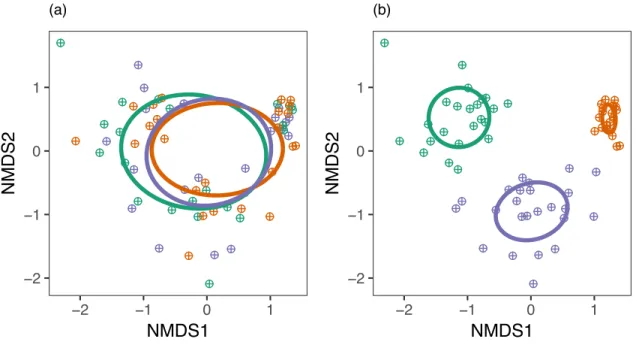
FFE community structure differed significantly by site (pseudo-F2,59 = 31.6, p = 0.0010; Fig. 4B), but not by host ecotype (p = 0.5465; Fig. 4A). There was no interaction between site
and host ecotype in driving FFE community structure (p = 0.7103). Variance partitioning analysis showed that site explained 42.53% of the variation in FFE community structure
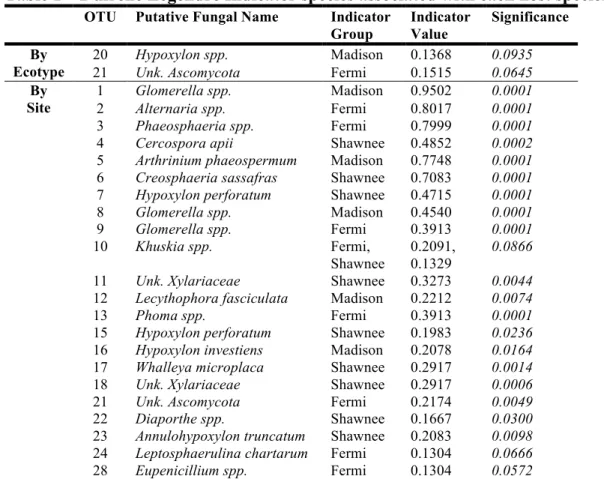
(pseudo-F2,63 = 24.5, p = 0.001). Host ecotype did not explain any variation in FFE community structure (p = 0.540) and there was a large amount of unexplained variation (58.85%). Indicator species analysis identified two fungal OTUs that had high specificity and relative abundance to specific switchgrass ecotypes at a threshold α < 0.10 (Table 1). By contrast, 22 fungal OTUs were indicative of specific sites (α < 0.10; Table 1).
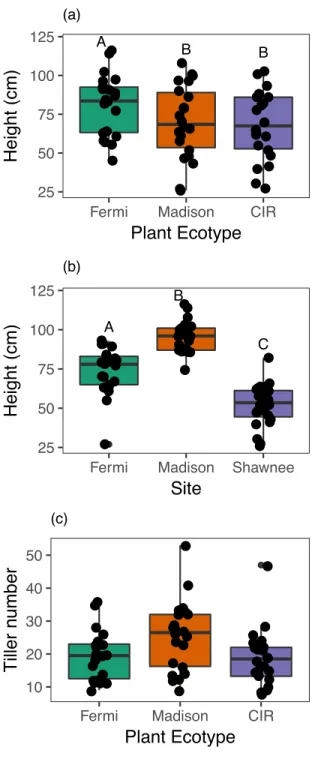
Plant height at time of FFE sampling differed among ecotypes (F2,57 = 8.67, p = 0.0005), where the Fermi ecotype was significantly taller than both the Madison and CIR ecotypes, which did not differ from each other (Fig. 5A). Plant height also varied by site (F2,57 = 76.8, p
<0.0001), such that all two-way comparisons between sites were significant (p <0.0001 for all; Fig. 5B), but there was no interaction between ecotype and site on plant height (p = 0.6658). Plant tiller count at time of harvest varied by ecotype (χ22,57= 8.10, p = 0.0174; Fig. 5C), but not by site (p = 0.3208).
Discussion
Our results demonstrate that site, encompassing local environmental conditions and local sources of microbial inoculum, is the primary force structuring switchgrass FFE communities. Site was a significant predictor of FFE species richness, diversity, and community structure, and explained the majority of the variation in community structure across hosts. Contrary to our original prediction, switchgrass host ecotype had no direct effect, and did not interact with local site, in driving FFE richness, diversity, or structure. Our reciprocal transplant design provided a strong test for the role of biotic adaptation in FFE communities, but in this study we did not detect differential colonization of host ecotypes even within a single site. On the other hand, both
site and ecotype had significant effects on plant phenotype after 10 weeks of growth under field conditions, indicating genetic differences among switchgrass ecotypes for phenotype but not for the assembly of FFE communities.
There are several potential explanations for the strong effects of site, versus host ecotype, as the primary driver of FFE community structure in switchgrass. It is possible that the three ecotypes used in this study were too genetically similar. However, genetic differences in plant phenotype were detected when grown in a common greenhouse environment (Fig. 1) and at the three field sites (Fig. 5), but those phenotypic differences did not correspond to differences in FFE communities (Fig. 4). Previous research has demonstrated host-genotype specific
differences in FFE community structure for balsam poplar (Bálint et al. 2015) and birch trees (Ahlholm et al. 2002). Differences were also found among several cereal species and cultivars across two sites in the structure of their epiphytic and endophytic fungal colonizers (Sapkota et al. 2015). Here, the geographic distance among sites (≥350km) and the attendant environmental and biological variation may have overwhelmed differences in FFE communities due to genetic differences among ecotypes. The three sites differed in local climate, surrounding vegetation, and soil type and texture, which can have important influences on microbial community structure (Bakker et al. 2014, Giauque and Hawkes 2016). Additionally, while spore dispersal across large distances may be possible, the effective dispersal of most fungi, and other microbial groups, is unknown (Hanson et al. 2012) and may have been limited among the three sites. Lastly, while rapid temporal turnover in FFE communities is well documented (e.g., "seasonality", Jumpponen and Jones 2010), it may be that the 10-week period of host exposure favored local environmental effects at the expense of host-specific effects, which may require more time to become evident.
Deciphering the importance of specific mechanisms driving FFE community structure at the local site level is complex. Previous research has shown that local plant community diversity can drive differences in soil microbial communities (Bakker et al. 2014) and leaf bacterial communities (Laforest-Lapointe et al. 2017), and disturbance regimes can impact FFE
community assembly (Kandalepas et al. 2015). The low FFE diversity at the Madison site might therefore be related to the site’s relatively low plant community diversity (personal observation) and high level of disturbance due to water-level fluctuations along the Ohio River where native switchgrass and the Madison transplant site occurred. Future research should test whether FFE communities are determined in part by local plant community diversity and how differential disturbance regimes affect FFE communities.
Increasing attention is being paid to the microbial associations of switchgrass due to its biofuel and forage crop potential (Casler et al. 2011). Previous research on plant-growth
promoting microbiota in switchgrass has focused on ectomycorrhizal (i.e., Serbacina vermifera; (Ghimire and Craven 2011) and leaf-colonizing bacteria symbioses (i.e., Burkholderia
phytofirmans strain PsJN; (Lowman et al. 2016, Wang et al. 2016). Fewer studies have examined FFE community differences in switchgrass (but see (Ghimire et al. 2011, Giauque and Hawkes 2013). One study that examined the plant-growth promoting effects of FFE on developing switchgrass seedlings found a large range in effects of individual FFE from beneficial to antagonistic (Kleczewski et al. 2012). In our study, little evidence was found for host-specific colonization by FFE taxa or host-specific fitness effects. However, a large number of previously unidentified FFE species were found at all three sites. Specifically, of the 71 OTUs isolated, only 34 could be identified to the species level with confidence, indicating that the phyllosphere microflora of prairies, old fields, and riparian areas remains largely uncharacterized.
Given the potential importance of the switchgrass microbiome for agriculture, we
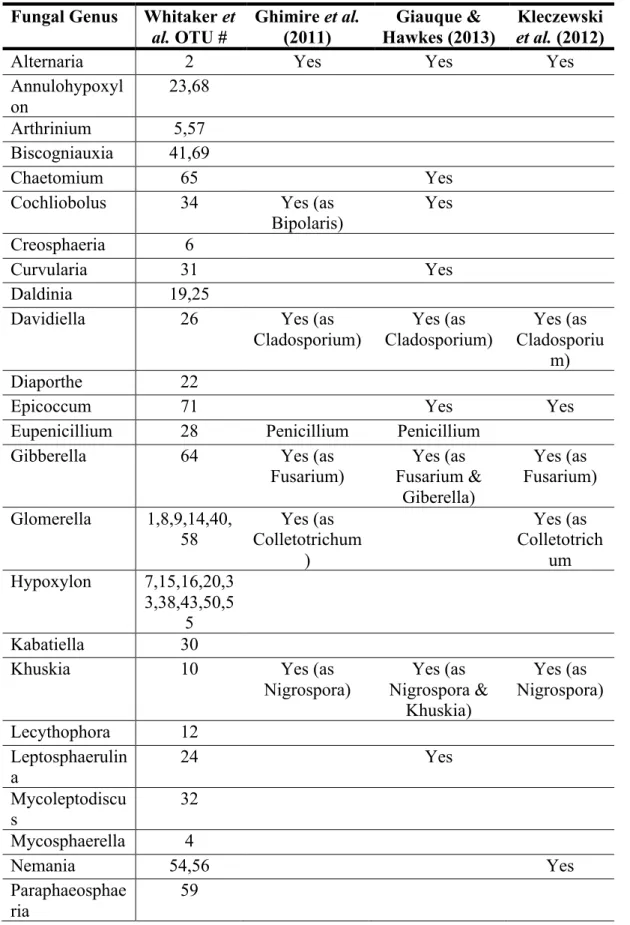
conducted a comparative analysis of the fungal genera identified here with the results of Ghimire et al. (2011), Giauque & Hawkes (2013), and Kleczewski et al. (2012) (Table S3). Five genera were common to switchgrass across all four studies (e.g., Alternaria, Davidiella, Gibberella, Khuskia, and Phoma) and an additional five genera were identified in three of the four studies (e.g., Cochliobolus, Epicoccum, [Eu-]Penicillium, Glomerella, Phaeosphaeria). Of these fungal genera, three were among the top ten most frequently isolated in our study (e.g., Alternaria, Khuskia, and Phaeosphaeria). This comparison among studies indicates that, despite the broad geographic range of these studies, differences in sampling methods, and use of sequence databases for fungal classification, there are many fungal genera that may be widespread colonizers of switchgrass aboveground tissues.
While the interaction between genetics and environment is recognized as an important determinant of host fitness (Hereford 2009) and species interactions (Johnson and Agrawal 2005), our results strongly support local environment as the primary determinant of FFE
community structure in switchgrass. FFE communities did not exhibit ecotype specificity either within sites or across sites. It remains an open question whether these results would hold for other plant groups (e.g., trees, forbs, or other grasses) or across sites that are less geographically disparate or ecologically divergent. Our results also suggest that researchers should test whether pre-inoculation with plant-growth promoting FFE in switchgrass is effective, or if putative host varieties are rapidly colonized by local environmental inocula that then outcompete the
inoculated FFE. Controlled tests using transplants across either spatial or abiotic gradients (e.g., precipitation patterns, prevailing wind direction, soil pH, slope, etc.) represent the next steps to determine how FFE communities are structured and how FFE communities impact plant
function. Overall, our results enhance our understanding of the dominant drivers of microbiome structure in an ecologically and economically-important grass species that furthermore may be applied to a wider range of host varieties and plant study systems.
Acknowledgements
The authors would like to thank Dr. R. Walton, Mr. R. Campbell, and Mr. R. McClanahan for their assistance at Fermilab and Shawnee National Forest. This work was conducted through research agreements with the U.S. DOE Fermilab National Environmental Research Park, the Fermi Research Alliance (FRA), the USDA Forest Service, and Shawnee National Forest System. We thank Z. Shearin, Q. Chai, N. Christian, K. Hoban, and M. Zaret for assistance with the project. B.K.W. was supported by the NIH Genetics, Cellular & Molecular Sciences Training Grant and as an NSF Graduate Research Fellow during the course of the experiment and through writing of the manuscript. Travel funding to field sites was provided by the Provost’s Travel Award for Women in Science at IU. The research was funded by IU’s McCormick Science Grant, as well as the G.W. Brackenridge Fellowship, Fred Seward Award, Indiana Daffodil Society Scholarship, and the Prairie Biotic Research Inc. Small Grant Award.
Literature Cited
Afkhami, M. E., P. J. Mcintyre, and S. Y. Strauss. 2014. Mutualist-mediated effects on species’ range limits across large geographic scales. Ecology Letters 17:1265–1273.
Agren, J., and D. W. Schemske. 2012. Reciprocal transplants demonstrate strong adaptive differentiation of the model organism Arabidopsis thaliana in its native range. New Phytologist 194:1112–1122.
Ahlholm, J. U., M. Helander, J. Henriksson, M. Metzler, and K. Saikkonen. 2002. Environmental conditions and host genotype direct genetic diversity of Venturia ditricha, a fungal
endophyte of birch trees. Evolution 56:1566–1573.
Ahmed, H. U., C. C. Mundt, and S. M. Coakley. 1995. Host-pathogen relationship of geographically diverse iolates of Septoria tritici and wheat cultivars. Plant Pathology 44:838–847.
Bakker, M. G., D. C. Schlatter, L. Otto-Hanson, and L. L. Kinkel. 2014. Diffuse symbioses: roles of plant-plant, plant-microbe and microbe-microbe interactions in structuring the soil
microbiome. Molecular Ecology 23:1571–1583.
Bálint, M., L. Bartha, R. B. O’Hara, M. S. Olson, J. Otte, M. Pfenninger, A. L. Robertson, P. Tiffin, and I. Schmitt. 2015. Relocation, high-latitude warming and host genetic identity shape the foliar fungal microbiome of poplars. Molecular Ecology 24:235–248.
Barrett, L. G., and M. Heil. 2012. Unifying concepts and mechanisms in the specificity of plant-enemy interactions. Trends in Plant Science 17:282–292.
Casler, M. D., C. M. Tobias, S. M. Kaeppler, C. R. Buell, Z.-Y. Wang, P. Cao, J. Schmutz, and P. Ronald. 2011. The Switchgrass genome: tools and strategies. The Plant Genome 4:273– 282.
Chapuis, É., V. Emelianoff, V. Paulmier, N. Le Brun, S. Pagès, M. Sicard, and J. B. Ferdy. 2009. Manifold aspects of specificity in a nematode-bacterium mutualism. Journal of
Evolutionary Biology 22:2104–2117.
Christian, N., C. Sullivan, N. D. Visser, and K. Clay. 2016. Plant host and geographic location drive endophyte community composition in the face of perturbation. Microbial Ecology 72:621–632.
Christian, N., B. K. Whitaker, and K. Clay. 2015. Microbiomes: unifying animal and plant systems through the lens of community ecology theory. Frontiers in Microbiology 6:1–15. Deshpande, V., Q. Wang, P. Greenfield, M. Charleston, A. Porras-Alfaro, C. R. Kuske, J. R.
Cole, D. J. Midgley, and N. Tran-Dinh. 2015. Fungal identification using a Bayesian classifier and the Warcup training set of internal transcribed spacer sequences. Mycologia 108:1–5.
Dufrene, M., and P. Legendre. 1997. Species assemblages and indicator species: the need for a flexible asymmetrical approach. Ecological Monographs 67:345–366.
Gamboa, M. A., S. Laureano, and P. Bayman. 2002. Measuring diversity of endophytic fungi in leaf fragments: does size matter? Mycopathologia 156:41–45.
Gandon, S., Y. Capowiez, Y. Dubois, Y. Michalakis, and I. Olivieri. 1996. Local adaptation and gene-for-gene coevolution in a metapopulation model. Proceedings of the Royal Society B: Biological Sciences 263:1003–1009.
Gehring, C., D. Flores-Rentería, C. M. Sthultz, T. M. Leonard, L. Flores-Rentería, A. V Whipple, and T. G. Whitham. 2014. Plant genetics and interspecific competitive
interactions determine ectomycorrhizal fungal community responses to climate change. Molecular Ecology 23:1379–1391.
Ghimire, S. R., N. D. Charlton, J. D. Bell, Y. L. Krishnamurthy, and K. D. Craven. 2011. Biodiversity of fungal endophyte communities inhabiting switchgrass (Panicum virgatum L.) growing in the native tallgrass prairie of northern Oklahoma. Fungal Diversity 47:19– 27.
Ghimire, S. R., and K. D. Craven. 2011. Enhancement of switchgrass (Panicum virgatum L.) biomass production under drought conditions by the ectomycorrhizal fungus Sebacina vermifera. Applied and Environmental Microbiology 77:7063–7067.
Giauque, H., and C. V Hawkes. 2013. Climate affects symbiotic fungal endophyte diversity and performance. American Journal of Botany 100:1435–1444.
Giauque, H., and C. V. Hawkes. 2016. Historical and current climate drive spatial and temporal patterns in fungal endophyte diversity. Fungal Ecology 20:108–114.
Greischar, M. A., and B. Koskella. 2007. A synthesis of experimental work on parasite local adaptation. Ecology Letters 10:418–434.
Hale, I. L., K. Broders, and G. Iriarte. 2014. A Vavilovian approach to discovering crop-associated microbes with potential to enhance plant immunity. Frontiers in Plant Science 5:492.
Hanson, C. A., J. A. Fuhrman, M. C. Horner-Devine, and J. B. H. Martiny. 2012. Beyond biogeographic patterns: processes shaping the microbial landscape. Nature Reviews Microbiology 10:497–506.
Hawlena, H., E. Rynkiewicz, E. Toh, A. Alfred, L. A. Durden, M. W. Hastriter, D. E. Nelson, R. Rong, D. Munro, Q. Dong, C. Fuqua, and K. Clay. 2013. The arthropod, but not the
vertebrate host or its environment, dictates bacterial community composition of fleas and ticks. The ISME Journal 7:221–223.
Hereford, J. 2009. A quantitative survey of local adaptation and fitness trade-offs. American Naturalist 173:579–588.
Higgins, K. L., A. E. Arnold, P. D. Coley, and T. A. Kursar. 2014. Communities of fungal endophytes in tropical forest grasses: highly diverse host- and habitat generalists characterized by strong spatial structure. Fungal Ecology 8:1–11.
Hodgson, S., C. de Cates, J. Hodgson, N. J. Morley, B. C. Sutton, and A. C. Gange. 2014. Vertical transmission of fungal endophytes is widespread in forbs. Ecology and Evolution 4:1199–1208.
Howe, G. T., S. N. Aitken, D. B. Neale, K. D. Jermstad, N. C. Wheeler, and T. H. Chen. 2003. From genotype to phenotype: unraveling the complexities of cold adaptation in forest trees. Canadian Journal of Botany 81:1247–1266.
Johnson, M. T., and A. A. Agrawal. 2005. Plant genotype and environment interact to shape a diverse arthropod community on evening primrose (Oenothera biennis). Ecology 86:874– 885.
Jumpponen, A., and K. L. Jones. 2010. Seasonally dynamic fungal communities in the Quercus macrocarpa phyllosphere differ between urban and nonurban environments. New
Phytologist 186:496–513.
Kandalepas, D., M. J. Blum, and S. A. Van Bael. 2015. Shifts in symbiotic endophyte
communities of a foundational salt marsh grass following oil exposure from the Deepwater Horizon oil spill. Plos One 10:e0122378.
Kaneko, R., and S. Kaneko. 2004. The effect of bagging branches on levels of endophytic fungal infection in Japanese beech leaves. Forest Pathology 34:65–78.
7:1225–1241.
Kleczewski, N. M., J. T. Bauer, J. D. Bever, K. Clay, and H. L. Reynolds. 2012. A survey of endophytic fungi of switchgrass (Panicum virgatum) in the Midwest, and their putative roles in plant growth. Fungal Ecology 5:521–529.
Lacap, D., K. Hyde, and E. Liew. 2003. An evaluation of the fungal “morphotype” concept based on ribosomal DNA sequences. Fungal Diversity 12:53–66.
Laforest-Lapointe, I., A. Paquette, C. Messier, and S. W. Kembel. 2017. Leaf bacterial diversity mediates plant diversity and ecosystem function relationships. Nature 546:145–147.
Laine, A.-L., J. J. Burdon, A. Nemri, and P. H. Thrall. 2014. Host ecotype generates evolutionary and epidemiological divergence across a pathogen metapopulation. Proceedings of the Royal Society B: Biological Sciences 281:20140522.
Legendre, P., and E. D. Gallagher. 2001. Ecologically meaningful transformations for ordination of species data. Oecologia 129:271–280.
Lowman, S., S. Kim-Dura, C. Mei, and J. Nowak. 2016. Strategies for enhancement of switchgrass (Panicum virgatum L .) performance under limited nitrogen supply based on utilization of N-fixing bacterial endophytes. Plant Soil 405:47–63.
Lowry, D. B., K. D. Behrman, P. Grabowski, G. P. Morris, J. R. Kiniry, and T. E. Juenger. 2014. Adaptations between ecotypes and along environmental gradients in Panicum virgatum. The American Naturalist 183:1–11.
Mejia, L. C., E. I. Rojas, Z. Maynard, S. Van Bael, A. E. Arnold, P. Hebbar, G. J. Samuels, N. Robbins, and E. A. Herre. 2008. Endophytic fungi as biocontrol agents of Theombroma cacao pathogens. Biological Control 46:4–14.
environments. Proceedings of the Royal Society B: Biological Sciences 271:1521–1528. Nuismer, S. L., J. N. Thompson, and R. Gomulkiewicz. 1999. Gene flow and geographically
structured coevolution. Proceedings of the Royal Society B: Biological Sciences 266:605– 609.
Oksanen, J., F. G. Blanchet, M. Friendly, R. Kindt, P. Legendre, D. McGlinn, P. R. Minchin, R. B. O’Hara, G. L. Simpson, P. Solymos, M. H. H. Stevens, E. Szoecs, and H. Wagner. 2017. “vegan” Community Ecology Package.
Del Olmo-Ruiz, M., and A. E. Arnold. 2014. Interannual variation and host affiliations of endophytic fungi associated with ferns at La Selva, Costa Rica. Mycologia 106:8–21. Oono, R., F. Lutzoni, A. E. Arnold, L. Kaye, J. M. U’Ren, G. May, and I. Carbone. 2014.
Genetic variation in horizontally transmitted fungal endophytes of pine needles reveals population structure in cryptic species. American Journal of Botany 101:1362–1374. Papke, R. T., and D. M. Ward. 2004. The importance of physical isolation to microbial
diversification. FEMS Microbiology Ecology 48:293–303.
Peay, K. G. 2014. Back to the future: natural history and the way forward in modern fungal ecology. Fungal Ecology 12:4–9.
Porras-Alfaro, A., and P. Bayman. 2011. Hidden fungi, emergent properties: endophytes and microbiomes. Annual Review of Phytopathology 49:291–315.
Roberts, D. W. 2016. “labdsv” Package: Ordination and Multivariate Analysis for Ecology. Rodriguez, R. J., J. F. White Jr., A. E. Arnold, and R. S. Redman. 2009. Fungal endophytes:
diversity and functional roles. The New Phytologist 182:314–330.
Rojas, E. I., S. A. Rehner, G. J. Samuels, S. A. Van Bael, E. A. Herre, P. Cannon, R. Chen, J. Pang, R. Wang, Y. Zhang, Y.-Q. Peng, and T. Sha. 2015. Colletotrichum gloeosporioides
s.l. associated with Theobroma cacao and other plants in Panama: multilocus phylogenies distinguish host-associated pathogens from asymptomatic endophytes. Mycologia
102:1318–1338.
Sapkota, R., K. Knorr, L. N. Jørgensen, K. A. O’Hanlon, and M. Nicolaisen. 2015. Host genotype is an important determinant of the cereal phyllosphere mycobiome. New Phytologist 207:1134–1144.
Shipunov, A., G. Newcombe, A. K. H. Raghavendra, and C. L. Anderson. 2008. Hidden diversity of endophytic fungi in an invasive plant. American Journal of Botany 95:1096– 108.
Sullivan, T. J., and S. H. Faeth. 2004. Gene flow in the endophyte Neotyphodium and implications for coevolution with Festuca arizonica. Molecular Ecology 13:649–656. U’Ren, J. M., J. W. Dalling, R. E. Gallery, D. R. Maddison, E. C. Davis, C. M. Gibson, and A.
E. Arnold. 2009. Diversity and evolutionary origins of fungi associated with seeds of a neotropical pioneer tree: a case study for analysing fungal environmental samples. Mycological Research 113:432–449.
U’Ren, J. M., F. Lutzoni, J. Miadlikowska, A. D. Laetsch, and A. E. Arnold. 2012. Host and geographic structure of endophytic and endolichenic fungi at a continental scale. American Journal of Botany 99:898–914.
Urban, M. C. 2011. The evolution of species interactions across natural landscapes. Ecology Letters 14:723–732.
Vincent, J. B., G. D. Weiblen, and G. May. 2016. Host associations and beta diversity of fungal endophyte communities in New Guinea rainforest trees. Molecular Ecology 25:825–841. Wang, B., J. R. Seiler, and C. Mei. 2016. A microbial endophyte enhanced growth of switchgrass
under two drought cycles improving leaf level physiology and leaf development. Environmental and Experimental Botany 122:100–108.
Warren II, R. J., and M. A. Bradford. 2014. Mutualism fails when climate response differs between interacting species. Global Change Biology 20:466–474.
Figures and Tables
Table 1 – Dufrene Legendre Indicator species associated with each host species. OTU Putative Fungal Name Indicator
Group Indicator Value Significance By Ecotype 20 Hypoxylon spp. Madison 0.1368 0.0935 21 Unk. Ascomycota Fermi 0.1515 0.0645 By
Site
1 Glomerella spp. Madison 0.9502 0.0001 2 Alternaria spp. Fermi 0.8017 0.0001 3 Phaeosphaeria spp. Fermi 0.7999 0.0001 4 Cercospora apii Shawnee 0.4852 0.0002 5 Arthrinium phaeospermum Madison 0.7748 0.0001 6 Creosphaeria sassafras Shawnee 0.7083 0.0001 7 Hypoxylon perforatum Shawnee 0.4715 0.0001 8 Glomerella spp. Madison 0.4540 0.0001 9 Glomerella spp. Fermi 0.3913 0.0001 10 Khuskia spp. Fermi,
Shawnee 0.2091, 0.1329
0.0866 11 Unk. Xylariaceae Shawnee 0.3273 0.0044 12 Lecythophora fasciculata Madison 0.2212 0.0074
13 Phoma spp. Fermi 0.3913 0.0001
15 Hypoxylon perforatum Shawnee 0.1983 0.0236 16 Hypoxylon investiens Madison 0.2078 0.0164 17 Whalleya microplaca Shawnee 0.2917 0.0014 18 Unk. Xylariaceae Shawnee 0.2917 0.0006 21 Unk. Ascomycota Fermi 0.2174 0.0049 22 Diaporthe spp. Shawnee 0.1667 0.0300 23 Annulohypoxylon truncatum Shawnee 0.2083 0.0098 24 Leptosphaerulina chartarum Fermi 0.1304 0.0666 28 Eupenicillium spp. Fermi 0.1304 0.0572
Operational taxonomic units (OTUs) with significant indicator values (p < 0.10) are listed in order of frequency of isolation (i.e., from common to rare). For ‘unknown’ taxonomic levels, the abbreviation ‘Unk.’ is used.
Fig. 1.Average plant height (a) and tiller number (b) differed between ecotypes when grown in a common greenhouse environment prior to field transplantation. Each point represents an individual plant. Vertical lines depict the data range out to 1.5 times the
interquartile range. Letters depict significant pairwise differences among groups in concordance with post-hoc analyses.
●● ●● ● ● ●●● ● ● ● ● ● ● ● ● ● ● ● ● ● ● ● ● ● ● ● ● ● ● ● ● ● ● ● ● ● ● ● ● ●● ● ● ● ● ● ● ● ● ● ● ● ● ● ● ●● ● ● ● ● ● ● ● A A B 60 70 80 90
Fermi Madison CIR
Plant Ecotype Height (cm) (a) ● ● ● ● ● ● ● ● ● ● ● ● ● ● ● ● ● ● ● ● ● ● ● ●● ● ● ● ● ● ● ● ●●● ● ● ● ● ● ●● ● ● ● ● ● ● ● ● ● ● ● ● ● ● ● ● ● ● ● ● ● ● ● ● ● 4 8 12 16
Fermi Madison CIR
Plant Ecotype
Tiller n
umber
Fig. 2 – Relative abundance distribution for top ten most frequently isolated foliar fungal endophytes and species accumulation curves. In (a), the colored bars indicate the relative colonization per OTU across the three switchgrass ecotypes. In (b), the number of observed OTUs, the bootstrap estimate of total species richness (S), and the 95 % confidence interval (CI) around the estimated richness is shown for the overall experiment. In (c), the bootstrap estimate of species richness is shown for each site.
0 10 20 30 40 50 60 70 0 10 20 30 40 50 60 70
No. of Plant Samples
A ccumulat ed T axa Estimated S Observed S 95% CIs (b) 0 5 10 15 20 0 5 10 15 20
No. of Plant Samples
A ccumulat ed T axa Fermi Madison Shawnee (c) 0.0 0.1 0.2 0.3 OTU1OTU2OTU3OTU4OTU5OTU6OTU7OTU8OTU9OTU10 Relat ive A bundance Ecotype FERMI MADISON CIR (a)
Fig. 3.FFE community richness (a,b) and Shannon diversity (c,d) varied by site, but not by ecotype. Each point represents an individual plant. Vertical lines depict the data range out to 1.5 times the interquartile range. Letters depict significant pairwise differences among groups in concordance with post-hoc analyses.
● ● ● ●● ● ● ●● ●● ●● ● ● ● ● ● ●● ● ● ● ● ● ● ● ● ● ● ● ● ● ● ● ●● ● ● ●● ● ● ● ● ● ●● ● ● ● ● ● ● ●● ● ● ● ● ● ● ● ● ● ● ● ● 2.5 5.0 7.5 10.0
Fermi Madison CIR Plant Ecotype Fungal r ichness (a) ● ● ● ● ● ● ● ● ● ● ● ● ● ●● ● ● ● ● ● ● ● ● ● ● ● ● ● ● ● ● ● ● ●● ● ● ● ● ●● ● ● ● ● ● ● ● ● ● ● ● ● ● ● ● ● ● ● ● ● ● ● ● ● ● ● ● 2.5 5.0 7.5 10.0
Fermi Madison Shawnee Site Fungal r ichness (b) ● ● ● ● ● ● ● ● ● ● ●● ● ● ● ● ● ● ●● ● ● ● ● ● ●● ● ● ● ● ● ● ●● ●● ● ● ● ●● ● ● ● ● ●● ● ● ● ● ● ● ● ● ● ● ● ● ● ● ● ● ● ● ● ● 0.0 0.5 1.0 1.5 2.0 2.5
Fermi Madison CIR Plant Ecotype Shannon div ersity (c) ● ● ●● ● ● ● ● ● ● ● ● ● ● ●● ● ● ● ● ● ● ● ● ● ● ● ●● ● ● ● ● ● ●● ●● ● ● ● ●● ● ● ● ● ●● ● ● ● ● ● ● ● ● ● ● ● ● ● ● ● ● ● ● ● ● A B C 0.0 0.5 1.0 1.5 2.0 2.5
Fermi Madison Shawnee Site
Shannon div
ersity
Fig. 4. FFE community structure did not vary by ecotype (a), but did vary by site (b). The location of each host individual in ordination space is denoted by a hatched circle. The ellipses represent the centroid and standard deviation for each treatment group (green = Fermi, orange = Madison,purple = Shawnee/Cave-in-Rock for site [a] and ecotype [b]).
● ● ● ● ● ● ● ● ● ● ● ● ● ●● ● ● ● ● ● ● ● ● ● ● ● ● ● ● ● ● ● ● ● ●● ● ● ● ● ● ● ● ● ● ● ● ● ● ● ● ● ● ● ● ● ● ● ● ● ● ● ●● ● ● ● ● −2 −1 0 1 −2 −1 0 1 NMDS1 NMDS2 (a) ● ● ● ● ● ● ● ● ● ● ● ● ● ●● ● ● ● ● ● ● ● ● ● ● ● ● ● ● ● ● ● ● ● ●● ● ● ● ● ● ● ● ● ● ● ● ● ● ● ● ● ● ● ● ● ● ● ● ● ● ● ●● ● ● ● ● −2 −1 0 1 −2 −1 0 1 NMDS1 NMDS2 (b)
Fig. 5.Average plant height differed between ecotypes (A) and field site (B), and tiller number differs between ecotypes (C) at time of leaf collection. Each point represents an individual plant. Vertical lines depict the data range out to 1.5 times the interquartile range. Letters depict significant pairwise differences among groups in concordance with post-hoc analyses. ● ● ● ● ●● ● ● ● ● ● ● ● ●● ● ● ● ● ● ● ● ● ● ● ● ● ● ●● ● ● ● ● ● ● ● ● ● ● ● ● ● ● ● ● ● ● ● ● ●● ● ● ● ● ● ● ● ● ● ● ● ● ● ● A B B 25 50 75 100 125
Fermi Madison CIR Plant Ecotype Height (cm) (a) ● ● ● ● ● ● ● ● ● ●●● ● ● ●● ● ● ● ● ● ● ● ● ● ● ● ● ● ●● ● ● ● ● ● ● ● ● ● ● ● ● ● ● ● ● ● ● ● ● ●● ●● ● ● ● ● ● ● ● ● ● ● ● ● A B C 25 50 75 100 125
Fermi Madison Shawnee Site Height (cm) (b) ● ● ●● ● ● ● ● ● ● ● ●● ● ● ● ● ●● ● ● ● ● ●● ● ● ● ● ● ● ● ● ● ● ● ● ● ● ● ●● ● ● ● ● ● ● ● ● ● ● ● ● ● ● ● ● ● ● ● ● ● ● ● ● ● 10 20 30 40 50
Fermi Madison CIR Plant Ecotype
Tiller n
umber
Supporting Information
Fig. S1. Map of field site physical locations. Labels indicate “M” for Madison IN, “F” for Fermi IL, and “S” for Shawnee
Madison Madison Madison Madison Fermi Fermi Fermi Fermi Shawnee Shawnee Shawnee Shawnee 38 40 42 −90 −88 −86 −84 Longitude Latitude
SI Methods
Description of Sites
Madison: Seed for the Madison ecotype was collected in 2008 by H. Reynolds from a riparian zone along the Ohio River in Madison, IN. The transplant plot used in this experiment was located within the Madison City Campgrounds on a 30-degree slope and 8m above the river waterline at the time of planting (38°43'54.2"N, 85°21'58.7"W). The soil type is a mixture of silt and gravel over the rocky shoreline and the resident plant community included Sorghum
halepense (Johnson grass), Cyperus esculentus (Yellow Nutsedge), and Ipomoea spp. (Morning Glory), as well as switchgrass.
Fermi: The Fermi ecotype seed was also collected in 2008 by H. Reynolds from a restored tallgrass prairie in Batavia, IL. The prairie is managed by the Fermilab National Accelerator Laboratory (Fermilab). Land managers restored Fermilab Prairie Tract 23, the site used in this experiment (41°51'35.2"N, 88°15'10.9"W), in 2000 using locally-sourced seed from nearby natural areas – for example, from the Gensburg-Markham remnant prairies 106
kilometers away (Betz et al. 1996). The site is burned, as needed, on a seasonal basis. The resident plant community includes many prairie natives, such as switchgrass, Helianthus grosseserratus (Sawtooth Sunflower), Monarda fistulosa (Wild Bergamot), and Andropogon gerardii (Big Bluestem grass). The soil type is a silty clay loam.
Cave-In-Rock (CIR): Seed from the agricultural cultivar Cave-In-Rock (CIR) was also used in this experiment. CIR is an upland octoploid accession (Zalapa et al. 2011), released for use by the U.S. Department of Agriculture in 1973 with no history of breeding or selection (Casler et al. 2011). The accession was derived from a natural population of switchgrass from southern Illinois, although the precise location was not recorded, and is named for the nearby