Physical Design for Non-relational
Data Systems
by
Michael J. Mior
A thesis
presented to the University of Waterloo in fulfillment of the
thesis requirement for the degree of Doctor of Philosophy
in
Computer Science
Waterloo, Ontario, Canada, 2018
Examining Committee Membership
The following served on the Examining Committee for this thesis. The decision of the Examining Committee is by majority vote.
External Examiner: Paolo Atzeni
Professor, Dipartimento di Ingegneria Universit`a Roma Tre
Supervisor: Kenneth Salem
Professor, David R. Cheriton School of Computer Science University of Waterloo
Internal Members: Grant Weddell
Professor, David R. Cheriton School of Computer Science University of Waterloo
Bernard Wong
Associate Professor, David R. Cheriton School of Computer Science University of Waterloo
Internal-External Member: Lin Tan
Associate Professor, Dept. of Electrical and Computer Engineering University of Waterloo
This thesis consists of material all of which I authored or co-authored: see Statement of Contributions included in the thesis. This is a true copy of the thesis, including any required final revisions, as accepted by my examiners.
Statement of Contributions
I would like to acknowledge the names of my co-authors who contributed to the research described in this dissertation. These include:
1. Kenneth Salem 2. Ashraf Aboulnaga 3. Rui Liu
Portions of this thesis are based on published or accepted peer-reviewed papers of which I am the first author [95, 96,94]. I was the primary contributor to this work, including the conception and development of the ideas, the analysis, and the preparation of papers. The collaborators listed above provided feedback and assisted with editing the text of these papers.
Abstract
Decades of research have gone into the optimization of physical designs, query execution, and related tools for relational databases. These techniques and tools make it possible for non-expert users to make effective use of relational database management systems. However, the drive for flexible data models and increased scalability has spawned a new generation of data management systems which largely eschew the relational model. These include systems such as NoSQL databases and distributed analytics frameworks such as Apache Spark which make use of a diverse set of data models. Optimization techniques and tools developed for relational data do not directly apply in this setting. This leaves developers making use of these systems with the need to become intimately familiar with system details to obtain good performance.
We present techniques and tools for physical design for non-relational data systems. We explore two settings: NoSQL database systems and distributed analytics frameworks. While NoSQL databases often avoid explicit schema definitions, many choices on how to structure data remain. These choices can have a significant impact on application perfor-mance. The data structuring process normally requires expert knowledge of the underlying database. We present the NoSQL Schema Evaluator (NoSE). Given a target workload, NoSE provides an optimized physical design for NoSQL database applications which com-pares favourably to schemas designed by expert users. To enable existing applications to benefit from conceptual modeling, we also present an algorithm to recover a logical model from a denormalized database instance.
Our second setting is distributed analytics frameworks such as Apache Spark. As is the case for NoSQL databases, expert knowledge of Spark is often required to construct efficient data pipelines. In NoSQL systems, a key challenge is how to structure stored data, while in Spark, a key challenge is how to cache intermediate results. We examine a particularly common scenario in Spark which involves performing iterative analysis on an input dataset. We show that jobs written in an intuitive manner using existing Spark APIs can have poor performance. We propose ReSpark, which automates caching decisions for iterative Spark analyses. Like NoSE, ReSpark makes it possible for non-expert users to obtain good performance from a non-relational data system.
Acknowledgements
I am thankful for the continued guidance provided by my advisor Dr. Ken Salem. Without his patience and support through many years (and many drafts) I surely would not have made it this far.
Thanks also to the rest of my committee, Dr. Paolo Atzeni, Dr. Lin Tan, Dr. Grant Weddell, and Dr. Bernard Wong for their time invested in reviewing and providing feedback on this thesis.
I am also grateful for my church family at Waterloo University Bible Fellowship. Their support in countless ways over the years and their friendship has meant a great deal. They and the other friends I have made during my time in Waterloo have enriched my life significantly.
Finally, thank you to my family for their continued love and support through my many years of study. Their encouragement has been invaluable to me.
Dedication
This thesis is dedicated to my Lord and saviour Jesus Christ to whom I owe my life. Whatever you do, in word or in deed, do all in the name of the Lord Jesus, giving thanks to God the Father, through him. — Colossians 3:17
Table of Contents
List of Tables xii
List of Figures xiii
1 Introduction 1
1.1 NoSQL Database Schemas . . . 1
1.2 Distributed Data Processing . . . 3
1.3 Thesis Organization and Research Contributions . . . 4
2 Background and Related Work 5 2.1 NoSQL Client Interfaces . . . 5
2.1.1 Key-Value Stores . . . 6
2.1.2 Extensible Record Stores . . . 6
2.1.3 Document Stores . . . 7
2.2 Relational Database Physical Design . . . 7
2.2.1 Structure Enumeration . . . 8
2.2.2 What-If Analysis . . . 9
2.2.3 Design Optimality . . . 10
2.3 NoSQL Schema Design . . . 11
2.3.1 Design Principles . . . 11
2.4 Query Processing in NoSQL Systems . . . 13
2.4.1 Object-Oriented Data Access . . . 14
2.4.2 Higher Level Query Languages. . . 14
2.5 Conceptual Modeling . . . 15
2.6 Database Normalization . . . 17
2.7 Non-relational Data Processing . . . 18
3 Physical Schema Design Automation 20 3.1 Schema Design Example . . . 20
3.2 System Overview . . . 24
3.2.1 Database Conceptual Model . . . 24
3.2.2 Workload Description . . . 24
3.2.3 Extensible Record Stores . . . 26
3.2.4 The Schema Design Problem . . . 27
3.3 Schema Advisor . . . 28 3.3.1 Candidate Enumeration . . . 28 3.3.2 Query Planning . . . 35 3.4 Schema Optimization . . . 37 3.5 Cost Model . . . 39 3.5.1 Calibration . . . 40 3.6 Updates . . . 41 3.6.1 Update Language . . . 41 3.6.2 Update Plans . . . 41
3.6.3 Column family enumeration for updates . . . 45
3.6.4 BIP Modifications. . . 47
3.7 Case Study . . . 47
3.8 Evaluation . . . 51
3.8.1 Schema Quality . . . 51
3.8.2 Advisor Runtime . . . 55
4 ESON:Schema Recovery from Denormalized Physical Designs 58
4.1 Renormalization Overview . . . 61
4.2 The Generic Physical Schema . . . 62
4.3 Dependency Input . . . 65
4.4 ESON Normalization Algorithm . . . 66
4.4.1 Dependency Inference . . . 67
4.4.2 BCNF Decomposition . . . 69
4.4.3 Folding. . . 70
4.4.4 Breaking IND Cycles . . . 72
4.4.5 IDNF . . . 74
4.5 Dependency Mining . . . 75
4.5.1 Mining for NoSQL Normalization . . . 75
4.6 Applications of the Logical Model . . . 76
4.6.1 Ad-Hoc Query Execution. . . 77
4.6.2 View Definition Recovery . . . 78
4.7 Case Studies . . . 79
4.7.1 RUBiS . . . 80
4.7.2 MongoDB . . . 81
4.7.3 Twissandra . . . 83
4.8 Summary of ESON . . . 86
5 Cache Design for Data Processing Systems 87 5.1 Motivation . . . 87
5.2 The Problem . . . 88
5.2.1 Iterative Computation in Spark . . . 89
5.2.2 Caching . . . 91
5.3 ReSpark . . . 94
5.3.2 Lazy Unpersist . . . 100
5.4 Evaluation . . . 103
5.4.1 Spark-Bench . . . 103
5.4.2 Other Iterative Algorithms . . . 112
5.5 Summary of ReSpark . . . 115
6 Conclusion and Future Work 116 6.1 Future Work . . . 117
References 119 APPENDICES 131 A NoSE Workloads and Selected Schemas 132 A.1 Conceptual Model. . . 132
A.2 Workload . . . 133
A.3 Schemas . . . 136
A.3.1 NoSE Bidding . . . 136
A.3.2 Normalized . . . 140
A.3.3 Expert . . . 143
A.3.4 NoSE Browsing . . . 146
A.3.5 NoSE 10× . . . 148
A.3.6 NoSE 100× . . . 152
B ESON Proofs 157 B.1 All inference of dependencies is sound . . . 157
B.2 All transformations are lossless-join . . . 158
B.3 Inclusion dependencies in the final schema are key-based . . . 159
List of Tables
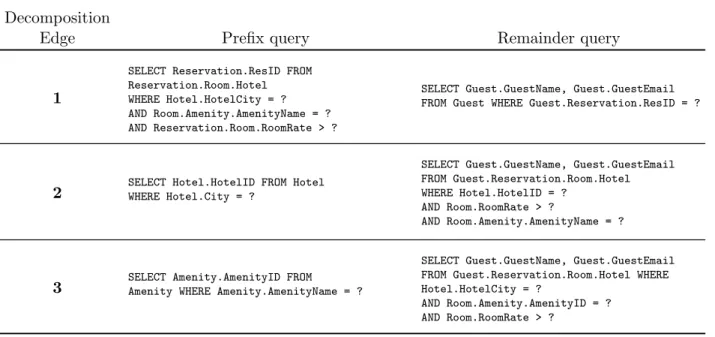
3.1 Example of query decomposition for candidate enumeration for the query in Figure 3.3a . . . 32 5.1 Summary of evaluated Spark applications . . . 104
List of Figures
3.1 Entity graph for a hotel booking system. . . 21
3.2 Schema advisor overview . . . 23
3.3 Example query against the hotel booking system schema . . . 25
3.4 Complete schema advisor architecture . . . 29
3.5 Materialized view column family generation . . . 31
3.6 Column family enumeration . . . 34
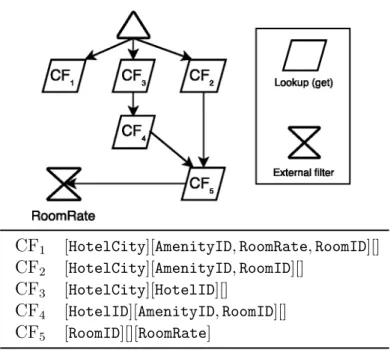
3.7 Example query plan space . . . 36
3.8 Binary integer program for schema optimization . . . 38
3.9 BIP constraints for the plan graph from Figure 3.7 . . . 39
3.10 Example NoSE update statements . . . 42
3.11 An example NoSE query, materialized view, and update. . . 42
3.12 Support query generation . . . 44
3.13 Support queries for the update shown in Figure 3.11. . . 44
3.14 Column family enumeration for workloads with updates . . . 46
3.15 BIP modifications for updates . . . 47
3.16 Entities modeled in EasyAntiCheat . . . 48
3.17 Important queries in the EasyAntiCheat workload . . . 49
3.18 Column families produced for the EasyAntiCheat workload . . . 50
3.19 Response time of RUBiS request types using three different schemas. . . . 52
3.21 Advisor runtime for varying workload scale factors . . . 55
4.1 Schema example after renormalization . . . 60
4.2 NoSQL schema evolution lifecycle . . . 61
4.3 A CQL ItemBids table, and corresponding schema . . . 63
4.4 An ItemBids table in HBase . . . 63
4.5 An ItemBids collection in MongoDB . . . 64
4.6 Algorithm for normalization to interaction-free IDNF . . . 67
4.7 Example generic physical schema and dependencies. . . 68
4.8 Relations and dependencies after BCNF decomposition. . . 70
4.9 Relation folding based on INDs . . . 71
4.10 Breaking circular inclusion dependencies . . . 73
4.11 Query rewriting against the logical schema . . . 77
4.12 Physical relations from MongoDB schema . . . 82
4.13 Dependencies on MongoDB physical relations . . . 82
4.14 MongoDB example schema entities . . . 83
4.15 Twissandra physical relations . . . 84
4.16 Dependencies on Twissandra physical relations . . . 85
4.17 Twissandra schema entities. . . 85
5.1 Three variants of a sample iterative Spark application . . . 90
5.2 Runtime for the Spark application from Figure 5.1 . . . 91
5.3 Abridged version of PageRank in Spark . . . 93
5.4 PageRank runtime with and without materialization. . . 94
5.5 A Spark program making use of ReSpark’s explicit iteration . . . 96
5.6 Generated RDDs for the job in Figure 5.5 labeled with RDD ID . . . 96
5.7 Simplified algorithms for tracking RDD usage information . . . 99
5.9 Check for RDDs which can possibly be unpersisted . . . 102
5.10 Several iterations of the Spark PageRank algorithm . . . 102
5.11 Structure of Spark’s Pregel implementation. . . 105
5.12 Shortest paths benchmark results . . . 106
5.13 Structure of Spark’s PageRank implementation . . . 107
5.14 PageRank benchmark results. . . 108
5.15 Structure of Spark’s K-means implementation . . . 109
5.16 K-means clustering benchmark results . . . 110
5.17 Structure of Spark’s strongly connected components implementation . . . . 111
5.18 Strongly connected components benchmark results. . . 112
5.19 Iterative Python code for LOPQ in Spark . . . 113
5.20 LOPQ performance using ReSpark . . . 114
5.21 BigITQ performance using ReSpark . . . 114
5.22 Iterative Python code for ITQ in Spark . . . 115
Chapter 1
Introduction
Physical design is an important consideration when building data systems. The appro-priate choice of data structures and caching policies can have a significant impact on performance. The problem of physical design has been studied extensively for relational databases. However, there has been little work on physical design for newer non-relational systems, despite physical design being an equally important concern. Unlike relational data systems, non-relational data systems typically lack any design tools and automation and instead rely on manual design and configuration, which demand expert knowledge of the target system. In this thesis, we explore the problem of physical design in two types of non-relational data systems: NoSQL databases and distributed data processing frame-works. In both settings, we automate decisions which previously required expert input and achieve either comparable or improved performance.
1.1
NoSQL Database Schemas
NoSQL systems have become a popular choice as database backends for applications be-cause of the high performance, scalability, and availability that they provide. In Chapters3 and 4 of this thesis, we focus on systems that Cattell termed extensible record stores in his taxonomy of NoSQL systems [29]. In extensible record stores, applications can create tables of records, with each record identified by a key. However, the application need not define the set of columns in the records in advance. Instead, each record can have an arbitrary collection of columns, each with an associated value. Because of this flexibility, applications can encode their data in both the keys and column values. We refer to tables
in such systems ascolumn families. Examples of extensible record stores that support this column family model include Cassandra [79], HBase [1], and Bigtable [31].
Before a developer can build an extensible record store application, it is necessary to define a schema for the underlying record store. Although the schema of an extensible record store is flexible in the sense that the application does not need to define specific columns in advance, it is still necessary to decide what column families will exist in the record store, what information each column family will encode, and how it will be encoded. That is, whether data will be stored as keys, column names, or column values. These choices are important because the performance of the application depends strongly on the underlying schema. For example, some schemas may allow the system to provide answers to some queries with a single lookup while other queries may require multiple lookups.
Although it is important to choose a good schema, there are no tools or established methodologies to guide and support this process. Instead, schema design for extensible record stores is commonly based on general heuristics and rules of thumb. For example, eBay [108] and Netflix [76] have shared examples and guidelines for designing schemas for Cassandra. Specific recommendations includenot designing column families as one would design relational tables, ensuring that column families reflect the anticipated workload, and denormalizing data to improve read performance. While such recommendations are useful, they are necessarily vague and generic, and require adaptation to each application. The first research contribution of this thesis is a tool that can recommend a specific schema, optimized for a target application, so that it is not necessary to rely on general rules of thumb. We propose a principled approach to the problem of schema design for extensible record stores. Our tool, the NoSQL Schema Evaluator (NoSE) uses a cost-based approach. By estimating the performance that candidate schemas would have for the tar-get application, we recommend the schema that results in the best estimated performance. We designed our tool for use early in the application development process; the tool rec-ommends a schema and the application is then developed using that schema. In addition to providing a schema definition, our tool also recommends a specific implementation of the application’s queries against the proposed schema. NoSE is described in Chapter 3. We show that the designs produced by NoSE can outperform those produced by expert designers. Furthermore, the use of NoSE does not require the user to understand the performance characteristics of the target database.
While NoSE is helpful for designing new applications, existing NoSQL applications using denormalized data can also benefit from automated approaches to schema design. NoSE, like many relational design tools, distinguishes between an abstractconceptual model of the database and aphysical design, which describes how the database should be stored
to provide good performance for a specific application workload and target NoSQL system. Existing applications typically did not have the benefit of a tool such as NoSE and may not have a well-defined conceptual database model. Without such a model, it can be difficult for application developers to understand the database and to revise the physical design as the application evolves. For example, to add a new type of information to the database, an application developer must determine how to incorporate that information into the existing denormalized schema, depending on how the new information will be used. To add new queries or updates, the application developer must understand whether they can be supported efficiently with the existing physical database design, or determine how to change the design to support the new workload without hurting the performance of existing parts of the application.
Since denormalization is done by the application developer, the database system is unaware of it and cannot help. Unless the application developer maintains external doc-umentation, the only knowledge of this denormalization is embedded within the source code. We aim to surface this knowledge by generating a useful conceptual model of the data from either an instance of the denormalized database or user-provided information on the database structure. We refer to this surfacing task asschema renormalization. Our solution to the renormalization problem is presented in Chapter 4. We present an algo-rithm we call ESON which is provided a denormalized database schema and functional and inclusion dependencies on that schema as input. We show both by construction and by example that ESON is able to remove denormalization which exists in the schema to produce a useful conceptual model.
1.2
Distributed Data Processing
Unlike NoSQL database systems, many distributed computing frameworks such as Apache Spark do not rely heavily on workload-optimized physical design. This is because data is commonly processed from a variety of external sources and the format of the data is not under the control of the application developer. Nevertheless, for good performance, the physical representation of intermediate results must be carefully chosen. In particular, Spark relies on effective materialization and caching of these intermediate results.
Applications using Spark’s computation model have been constructed for a wide va-riety of domains including machine learning and graph analytics. A common pattern in applications is to iteratively evolve a dataset until reaching some user-specified convergence condition. Unfortunately, the Spark runtime is unaware of the existence of iteration in the
application program. Furthermore, Spark’s execution model makes it difficult for develop-ers unfamiliar with implementation-level details of Spark to write efficient programs.
In Spark applications, effective use of caching is necessary to avoid recomputing inter-mediate results from previous iterations. However, we demonstrate that straightforward use of Spark’s caching APIs can unintuitively result in poor performance. In Chapter 5, we present ReSpark, a series of enhancements to the APIs provided by Spark to explicitly expose information on iterative computation to the Spark runtime. This allows ReSpark to automate caching decisions for iterative programs in a similar manner to how we automate schema design for NoSQL systems. As is the case with NoSQL applications, these decisions are often non-intuitive and would normally rely on expert knowledge of the Spark runtime. Through an evaluation against real-world applications, we demonstrate that ReSpark’s caching policy can achieve comparable performance to manually optimized workflows with-out the need for deep understanding of Spark’s caching and execution mechanisms.
1.3
Thesis Organization and Research Contributions
Chapter2presents related work. Our contributions are presented in the following chapters: Chapter3describes the NoSQL Schema Evaluator (NoSE), our tool for schema design automation for NoSQL databases. NoSE provides a fully automated tool for NoSQL database design. We implemented NoSE as a prototype targeting the Apache Cas-sandra wide column store. Our experimental results show that designs created by NoSE outperform designs created by an expert user of Cassandra.
Our algorithm, ESON, for recovering useful normalized models from denormalized NoSQL schemas is given in Chapter 4. We demonstrate with examples that ESON is able to recover useful models from a variety of denormalized database models, in an automated or semi-automated fashion.
In Chapter 5, we continue our exploration of automating design decisions in mod-ern data processing systems. ReSpark automates caching for iterative workflows in Apache Spark similar to how NoSE is able to optimize NoSQL systems. By exposing iteration to the Spark runtime, ReSpark automatically decides when to cache inter-mediate results. A performance evaluation on several workloads shows that ReSpark can achieve performance similar to applications with manual caching annotations. Finally Chapter6, summarizes the thesis and provides some directions for future work.
Chapter 2
Background and Related Work
This chapter provides background on the physical design problems we consider in this thesis, as well as the non-relational data systems we aim to optimize. Section2.1provides an overview of different types of NoSQL databases. Solutions to physical design problems in relational databases are outlined in Section 2.2. Existing solutions for schema design for NoSQL systems as well as their shortcomings are described in Section2.3. Sections 2.4 and2.5discuss work related to high-level models of data and queries relevant to our physical design problem. In Section 2.6, we summarize existing approaches for normalization of database schemas as they relate to our algorithm for schema renormalization. Finally, Section 2.7 discusses existing solutions for distributed data processing in non-relational data systems.
2.1
NoSQL Client Interfaces
The interface provided to clients by NoSQL databases is often much more restricted than a relational database interface. For any fixed schema, the client interface determines the class of queries which can be answered. Previous authors have discussed differences among the interfaces presented by NoSQL databases [22, 71]. Below we summarize some points of discussion and examine how this impacts queries which can be answered for a given schema. It is difficult to cover the wide variety of interfaces available in NoSQL systems. Our focus in the subsections below is according to the classification defined by Cattell [29].
2.1.1
Key-Value Stores
The primary interface to many key value stores consists of two operations: putandget[29].
put stores a value under a particular key and get retrieves a value given a key. This implies that if an application wants a query to be directly answerable by a key-value store, the answer to the query must be stored in the database and the application must have the corresponding key. This severely limits the types of queries which can be performed without significant denormalization by the application when keys are stored. It is common for key-value stores to support atomic operations only on individual keys. This is a result of the coordination overhead which is required for distributed transactions across multiple keys.
Many key-value stores have expanded their interface to support other useful operations. For example, Redis [9] is referred to as a “data structure server.” In addition to put and
get, it supports storing other data structures such as sets, hashes, and lists. HyperDex [51] also offers similar interfaces for these structures.
2.1.2
Extensible Record Stores
The interface presented by extensible record stores is typically a superset of the put/get
interface of a key-value store. Apache Cassandra [79], Apache HBase [1], and Bigtable [31] all present a similar interface. Groups of records are divided into “column families” which are analogous to relational database tables. Each column family consists of a series of rows with each row identified by some arbitrary key. Rows can contain an arbitrary number of columns and data is often sparse (i.e. it is common for rows to have no values for most columns).
Clients can retrieve data from extensible record stores by specifying some range of row keys. However, in the case of the most common configuration of Cassandra, range queries across row keys are disallowed and a single row key must be given. In either case, the choice of row key is important for data locality. Data are placed on nodes in the distributed system according to their row key. A range can also be given for columns, which allows only a subset of the data corresponding to a row key to be returned.
In addition to specifying the locality and possible query patterns, the selection of row key also impacts data modification. When updating data in an extensible record store, many systems restrict the atomicity of updates to data under a single row key. This is important when designing a schema for an application which requires atomic updates. If
a data item is explicitly denormalized under multiple row keys, it will not be possible to perform atomic updates on that piece of data.
2.1.3
Document Stores
Records in a document store are referred to as “documents”. Documents allow arbitrary nesting of values identified by some primary key. Documents are grouped into “collections” which typically correspond to the type of entity being modeled. This basic model is shared by many document stores such as MongoDB [8], CouchDB [5], and Amazon’s SimpleDB [3]. All of these document stores support retrieving a document from a collection by its key as well as the definition of secondary indexes on properties of the document.
One feature typically lacking in document stores is joining documents between two collections. Some document stores such as SimpleDB don’t provide any mechanism to perform joins. One alternative is the map-reduce [47] interface presented by databases such as MongoDB and CouchDB. This interface allows users to specify arbitrary map-reduce programs which execute inside the database engine. By writing a map-reduce program it is possible to perform joins and complex aggregations. However, map-reduce is not designed to be used in real time and can produce unacceptably high latencies for some queries [39]. As with extensible record stores, a common restriction when updating documents in a document store is that an update can only be performed atomically within a single document. If it is necessary to update data atomically, then this data must be grouped together under a single document.
2.2
Relational Database Physical Design
One formulation of the problem of physical database design is the index selection problem (ISP) [40]. The goal of the index selection problem is to find an optimal or near-optimal set of indexes for relations in a relational database given a particular workload. Exactly one primary index per relation must be selected (although this is commonly fixed as correspond-ing to the primary key of each relation). One or more secondary indexes which improve performance of queries in the workload may be selected. This physical design problem has also been extended to include other denormalized physical structures such as materialized views [11]. Many design tools currently exist in commercial products such as Microsoft AutoAdmin[11], DB2 Design Advisor[132], and Oracle Automatic SQL Tuning[44]. Badia and Lemire [16] break down relational database modeling into three steps: 1) conceptual
modeling (which we further discuss in Section 2.5), 2) logical modeling, and 3) physical modeling. They identify logical modeling as a well-defined process in relational schema design, although this is not the case for NoSQL databases. The ISP for relational databases (with the inclusion of materialized view selection) equates to step three above.
Vertica[80] consists of a SQL interface built on the C-Store column-oriented database[117]. It uses multiple encoding techniques to efficiently store denormalized views (called projec-tions) to improve query performance. DBDesigner [124] is a tool for Vertica which is able to automatically select projections. To make these selections, it makes use of Vertica’s query optimizer and user-defined policies to iteratively propose projections which provide some benefit to queries in the workload. While the selected schemas perform well, the iterative approach may yield suboptimal results. Earlier work by Rasin and Zodnik[111] also discusses automated schema design for C-Store. However, these techniques cannot be easily generalized to apply to NoSQL database architectures. The rest of this section ana-lyzes common techniques to solve the ISP in a relational database setting while identifying shortcomings in translating these approaches to NoSQL databases.
2.2.1
Structure Enumeration
When performing physical schema design, it is necessary to determine which structures to evaluate. Candidate enumeration is the process of constructing a candidate set of possi-ble physical structures which may be useful in a final schema. Enumeration is normally performed using simple heuristics such as constructing materialized views for queries in the input workload [133]. The major challenge for the DB2 Design Advisor was the large search space produced by interactions between various features (e.g. materialized views and indexes). Design Advisor defines an algorithm called SAEFIS (Smart column Enumeration for Index Scans) [115]. SAEFIS avoids enumerating all possible indexes for a query by ex-amining various combinations of attributes used in equality and range predicates, ordering clauses, and other columns in the query. This significantly reduces the number of sec-ondary indexes which are examined. For constructing materialized views, more advanced techniques can examine common subexpressions within queries in the input workload which are used to construct views [41].
In the NoSQL setting, enumeration is still required in order to provide options on which structures should be consider. However, due to the lack of a standard query language and differences in physical data structures, existing techniques for enumeration in relational databases do not apply directly.
2.2.2
What-If Analysis
After determining a set of candidate structures, physical schema design tools typically rely on a “what-if” analysis [33]. These analyses may make use of the database query optimizer to estimate the cost of executing queries using physical structures such as materialized views or secondary indexes without the overhead of actually creating these structures. The use of what-if analysis allows the design tool to obtain an estimated cost for using each candidate physical structure. We note however, that this is generally not possible in schema design for NoSQL databases as there is no optimizer for higher-level application queries. With a cost estimate, a simple solution used by some advisors is to construct a variant of the knapsack problem and to maximize the expected reduction in cost for a given storage budget [115]. Calls to the optimizer for query cost estimates can be the limiting factor in algorithm performance due to the high latency of these calls. C-PQO [20] reduces the number of calls to the optimizer to one per query in the input workload. This approach works by instrumenting the optimizer to isolate rules which are relevant to access path selection. This allows a single call to the optimizer to produce the possible access paths to use for a query. When solving the optimization problem, it is then possible to simulate single-index query execution plans based on the available access paths. Using these simulated plans, the original index selection problem can be solved. INUM [104] also attempts to reduce the number of calls to the optimizer by caching the results of optimizer calls. The INUM approach can be used with any index selection algorithm to improve execution speed. After calling the optimizer once for a query, INUM simply replaces the data access operators in the query execution plans with operators using a different physical structure. It is possible to estimate the cost of these operators relying only on the cost model used by the optimizer without requiring the entire optimization procedure to be invoked.
Several alternative solutions have been developed with the goal of either producing higher-quality results or producing results with a faster execution time. Bruno and Chaud-huri [19] take a relaxation-based approach. The initial set of candidates is the union of the optimal configurations for each query in the input workload. They then construct a search space by defining several merge operators which can combine or remove physical struc-tures from a set of candidates. The goal is to produce a new candidate physical schema which requires less space without a significant loss of efficiency (in terms of expected query execution time). Candidate schemas are then recursively “relaxed” by replacing physical structures to produce new candidates until a time bound is exceeded. The recommended physical design is then the one with the least expected cost among those which have been discovered.
However, none of these solutions are directly applicable in the NoSQL database setting since NoSQL databases typically have no cost model. This makes it impossible to estimate query execution times. While we can develop a useful cost model for NoSQL databases, any selection algorithm in a NoSQL setting will be required to select structures based on a conceptual model. NoSQL database design requires selection of the entirety of the structures to be stored in the database and cannot assume the existence of any structures such as base tables which is common for relational database design tools. This differs from the common case for relational databases described above where the goal is to select secondary structures over an existing model.
2.2.3
Design Optimality
Many efforts in constructing design tools have also attempted to find globally optimal solu-tions. One approach is to use genetic algorithms to mutate possible design decisions until an acceptable solution is found. A desirable property of this approach is that continued execution will lead to better solutions. Ko laczkowski and Rybi´nski propose an approach which starts with the optimal execution plan for each query and then mutates operators in the plan space [77]. Calle et al. take a similar approach but consider mutating a selection of physical structures [25]. Both of these approaches show significant improvements when compared to commercial database optimizer tools.
Other work has focused on formulating improved linear programming solutions to the problem. CoPhy [45] uses an integer linear program (ILP) with constraints that each query in the original workload must have exactly one valid plan. The objective function used is the expected cost of executing queries in the workload under a particular selection of physical structures. As with the genetic algorithm approach, the solver may be terminated as soon as an acceptable solution is reached but may be run continually until optimality if desired. Formulation as an ILP is also desirable since it enables the addition of additional constraints desired by the database administrator. An example is that the update cost for some physical structures should not exceed a particular threshold. We make use of a similar ILP formulation in our automated NoSQL schema design tool described in Chapter 3.
Relational tools, as described above, rely on input from the database system’s query optimizer. In many NoSQL systems, the simple data model and query language means that an optimizer for higher level queries does not exist. This increases the importance of effective schema design since there are fewer opportunities for optimization given a fixed schema and a limited number of access paths.
2.3
NoSQL Schema Design
Although the problem of schema design for NoSQL databases is relatively new, there has been some existing work exploring this problem. The remainder of this section discusses existing solutions and highlights opportunities for improvement.
2.3.1
Design Principles
Users of NoSQL databases frequently rely on manually applied “rules of thumb” for schema design. These approaches are generic and rely on the expertise of the application designer to select a suitable schema. To illustrate this point further, one commonly cited piece of advice for the Cassandra extensible store is to model physical structures to closely correspond to the application workload [108,76]. This frequently involves some level of denormalization. For example, consider an e-commerce application which allows users to “like” items [108]. If an application frequently retrieves a list of users who like an item when the item is displayed, then it is beneficial to denormalize and store user data partitioned by items. On the other hand, if it is more common to retrieve a list of items a user has liked, then item data should be denormalized and partitioned by user. While these rules of thumb are helpful, they are often vague and self-contradictory. One recommendation given by Patel [108] to denormalize and duplicate for read performance immediately followed with a warning not to do so unless necessary. In fact, correct application of these rules can rely on expert knowledge of performance of the backend database to know what denormalizations will be beneficial in different scenarios. In the example above, the user must know that it is inefficient to separately request information on users who like an item if that data is not denormalized.
A similar problem exists with document store databases. For document store schema design, a common design decision is embedding versus external references [2]. Documents can be nested arbitrarily deep in a document store, so it is possible to embed one entity within the document corresponding to another entity. Alternatively, a document can con-tain a reference to the primary key of another document. Since joins cannot be performed efficiently, the choice of embedding has a significant impact on performance. Kanade et al. [69] studied the effects of this design choice for a simple data model and workload. They observed a difference of several orders of magnitude in query execution time depending on the level of embedding. Moreover, the performance differences vary dramatically for dif-ferent queries suggesting that knowledge of the workload is critical in making the choice of embedding.
2.3.2
Automated Approaches
NoSQL databases present several new issues which are not solved by relational schema design tools. There is not a clear separation of the application data model and physical schema in a NoSQL database. In many cases, the database has no awareness of the data model actually used by applications since the database only sees a denormalized view of the data. This leaves any mapping between the application data model and the physical schema dependent on knowledge of the database administrator. This is evidenced by various developers attempting to evaluate application changes when moving from relational to NoSQL database backends. Project EPIC [114] found that significant changes from a relational data model were required when moving to the Cassandra extensible record store. The authors discovered that this required significant denormalization to efficiently service different application queries. Their analysis was heavily dependent on knowledge of the queries executed by the application and required the application to change in order to make use of the denormalized data.
Scherzinger et al. [113] also identify the need for good schema design in NoSQL stores by evaluating the high cost of poor schema design. Data items are frequently colocated in order to reduce the number of distributed transactions. However, the more data is grouped together, the higher the likelihood of concurrent writes to the same partition of data. A na¨ıve schema design can result in 20–35% of write transactions failing for a given workload. This is a result of the high level of concurrent writes and the use of optimistic currency control by the backend database. The problem is completely avoided by selecting a better schema. Kanade et al. [69] examine a related problem in the MongoDB document store. They identify multiple techniques for representing a data model in a document store and show that the representation can have an order of magnitude impact on query performance. Furthermore, the impact is highly dependent on the particular workload. They use this observation as motivation for exploring workload-driven physical design for document stores.
An existing tool, by Vajk et al.[123], also attempts to solve the problem of NoSQL database design. Their system starts with a normalized schema and produces an optimized schema based on the cost of executing a given set of queries. The authors identify a tradeoff between query execution time and the storage cost of denormalization which is relevant to development of our automated schema design tool which we introduce in Chapter 3. The approach does not deal with updates, which we do address in our work.
Rule-based approaches have also been proposed for adapting relational [83] and OLAP [37, 36] schemas for NoSQL databases. Such transformations may be helpful when adapting an existing application to use a NoSQL database. However, when designing a new application
from scratch, such an approach is unnecessarily restrictive since starting from an existing schema for another database technology limits the possible schemas which can be explored. A rule-based approach also makes it difficult to incorporate workload information which is critical for schema design since data should be stored in a similar manner to how it will be accessed [108, 76].
Some rule-based approaches focus on maintaining atomicity for transactions within the original workload. As discussed further in Section2.1, the choice of physical schema implic-itly establishes boundaries for transactions. Data denormalized across these transaction boundaries cannot be updated atomically. Bugiotti et al. [23] define NoAM, the NoSQL Abstract Model. The schema design problem associated with NoAM is the partitioning of “aggregates” or collections of related entries. Aggregate partitioning attempts to colocate entries which are frequently accessed together while separating entries which are modified independently to avoid contention. This aggregate approach does not consider denormal-izing or duplicating data which may be necessary when different queries access data based on distinct attributes.
Other approaches have attempted to target specific databases. SimpleSQL[24] provides a relational layer on top of Amazon SimpleDB which automatically creates the necessary schema to answer queries. However, SimpleSQL makes specific assumptions about the data model and consistency properties of the underlying datastore. This makes the approach difficult to generalize for other datastores.
SAGE [86] performs logical and physical design for “new SQL” systems. New SQL systems aim to provide the scalability of NoSQL databases while retaining the consistency and high-level query semantics of relational databases. SAGE attempts to create “entity groups” by partitioning logical entities into hierarchies of related objects so related entities can be accessed together (e.g. a customer along with all their orders). This approach works well for the class of systems SAGE was designed for, but it is most similar to the relational database techniques discussed in Section2.2. However, the approach taken by SAGE does not translate well to NoSQL schema design as it fails to deal with important issues such as denormalization.
2.4
Query Processing in NoSQL Systems
In the following sections we examine different approaches to query processing in NoSQL systems. As discussed in Section 2.1, NoSQL databases often present highly simplified query interfaces to applications. This often requires applications using complex queries
to implement these queries manually against these interfaces. The following sections dis-cuss how these different approaches relate to our goal of building a NoSQL design tool which supports application developers in designing schemas suitable for executing high-level queries.
2.4.1
Object-Oriented Data Access
A common abstraction layer over relational databases is object-relational mapping (ORM) [72]. ORM interfaces aim to take classes in an object-oriented programming language and add methods which automatically fetch and mutate data from a backend database. This has the desirable property of freeing application developers from the details of querying the backend database. In addition, the ORM layer can abstract away differences between backend database implementations.
ORM interfaces have also been proposed for abstracting the differences between NoSQL systems. Atzeni et al. [15] created Save Our Systems (SOS) as a simple approach to ab-stracting access to NoSQL systems. Their approach presents a simple interface to store and retrieve objects from different types of NoSQL stores. St¨orl et al. [118] present many other existing NoSQL ORM tools and show that they vary widely in their features and backend database support. They also show that these ORMs approximately double ex-ecution time over a number of different queries. One important point the authors note is that the use of an ORM implicitly defines the schema used by the backend database. This is critical to schema design as the choice of how objects are modeled also defines the schema. Kundera [7], which is the most full-featured option discussed, provides minimal support for exploiting materialized views and requires an external service to perform some complex queries such as joins and aggregation. These tools cannot effectively make use of the rule-based wisdom discussed in Section2.3.1 of storing data of related entities together in the backend database.
2.4.2
Higher Level Query Languages
NoSQL databases commonly provide a very restricted query interface in order to achieve high performance. For example, many key-value stores, such as Riak [10], provide little more than access to a blob of data given a key. In most cases, it is either not possible or very expensive to query data by any attribute other than the key. This means that when designing the schema, care must be taken when selecting the keys since this choice defines which queries can be made efficiently in the future. Data stores following the Bigtable [31]
model offer richer semantics than simply querying by key, but still provide far fewer access paths to data as compared to relational databases. Still other databases, such as Redis [9], provide many alternative data structures such as sets and lists which can be accessed and modified by a key. These features can be exploited to efficiently support application workloads, but doing so requires strong support from the application side to compose the simple structures provided by the database. This composition requires an effective use of these data structures through a carefully-constructed application schema.
Many approaches exist for executing complex analytical queries over NoSQL databases. A popular solution for databases such as HBase and Cassandra is Hive [121]. Hive takes complex queries in a SQL-like language (HiveQL) as input and uses the MapReduce [47] framework to execute these queries. Query execution in Hive consists of executing one or more map-reduce jobs which compute values for each relevant row in the input tables and then aggregating these results to provide the query response. MapReduce targets batch jobs and as Hive queries can consist of multiple MapReduce jobs, the observed latency can be quite high. QMapper [126] aims to translate SQL queries written for a relational database into efficient and correct HiveQL queries. While QMapper uses a cost-based optimization model to reduce latency, the queries being examined still have execution times on the order of hundreds of seconds. Pig Latin [101] also attempts to provide a higher-level interface for processing data using MapReduce, but does not attempt to perform any optimization and formulates “queries” as query execution plans. These approaches are useful but typically rely on non-standard query languages.
Gadkari et al.[55] and Apache Phoenix [6] aim to support low-latency queries in HBase by compiling SQL queries into a series of HBase scans. While this can be effective, the performance of queries is still dependent on how data is partitioned. These approaches also currently fail to take advantage of data which is explicitly denormalized or pre-aggregated by the application as these changes are not visible in the data model. However, executions engines such as these would be useful for implementing query plans based on recommen-dations from a schema design tool.
2.5
Conceptual Modeling
Before discussing how to construct queries, it is necessary to have a conceptual model of underlying data which these queries can reference. A common data model used for expressing conceptual queries is the enhanced entity-relationship diagram (EER) [49]. EER diagrams specify a class hierarchy for entities to be stored in the database. Each possible class has an associated set of attributes as well as relationships to other classes.
In addition, it is helpful to estimate statistics for the data to be stored in the database. For example, such statistics may include the number each type of entity and the cardinality of relationships and attributes. This information is commonly exploited by query optimiz-ers to estimating the cost of a query execution plan. The same information is also relevant to physical schema design which often makes use of the query optimizer, as discussed be-low. A similar approach is to use unified modeling language (UML) [112] diagrams for conceptual models. UML class diagrams are similar to EER diagrams in that they specify classes in the data model as well as attributes associated with each class. UML has also been successfully used a conceptual model when designing database schemas [100].
Many other approaches to conceptual modeling for data and queries already exist. One example is GMAP [122], which was proposed as a technique for improving the physical data independence of relational database systems. In GMAP, both application queries and physical structures are described using a conceptual entity-relationship model. Queries are mapped to one or more physical structures which can be used to produce answers to the query. In the case of GMAP, this approach is used out of a desire to provide a more thorough form of physical data independence.
Others have also proposed to write application queries directly against a conceptual schema. For example, ERQL [81], is a conceptual query language over EER models. ERQL is based around the concept of “path expressions”. A path expression follows links in the EER schema to connect entity sets to either their associated attributes or to other entity sets via relationships. Predicates can then be applied to these path expressions to restrict the data returned to only contain entities matching these predicates. The authors also discuss more advanced features such as quantification and aggregate functions. They also define a view definition language which is useful for representing denormalized database structures without a specific physical schema. Kifer et al. [73] also define a query language based on path expressions, but for object-oriented databases. Similarly to ERQL, XSQL queries specify path expressions over the object graph and use these expression both for attributes and fields which are selected.
A different approach to conceptual modeling is demonstrated by query languages such as LISA-D [120] and RIDL [92] which are instead based on object role modeling (ORM). ORM simply considers the conceptual model as a set of objects playing various roles. These languages were very complex, with others such as ConQuer [18] being developed with the primary goal of being easily understood by end users. A transformation process allows ConQuer queries to be translated into SQL queries for a given relational model.
Other related work exists in database reverse engineering (DBRE). The goal of DBRE is to produce a greater understanding of the semantics of a database instance, commonly
through the construction of a higher level logical model of the data. Some approaches, such of that of Andersson [12], depend heavily on information extracted from join queries to determine related entity sets. Such queries do not exist in our setting since NoSQL databases do not permit joins. Others, such as those proposed by Chiang et al. [38] and Premerlani and Blaha [109], present only an informal process as opposed to a specific algorithm. Markowitz and Makowsky [90] present a technique for converting relational database schemas into enhanced entity relationship (EER) schemas [119]. Their algorithm
RmapRaccepts a relational schema and a set of functional and inclusion dependencies and produces an EER schema. However, their approach does not produce a schema normalized according to the input functional dependencies.
Conceptual query languages, such as those defined above, present useful tools for schema design. We can borrow concepts from these languages and adapt them for our purposes. Our current approach most resembles GMAP with adaptations to make it more suitable for use in Cassandra. Our schema design tool begins with a conceptual model and queries are written against this conceptual model in a similar manner to ERQL. When performing schema extraction, we aim to produce a conceptual model in a form similar to that of the EER models used by ERQL. However, we restrict queries to those which we know can be easily and efficiently answered using structures which fit into common NoSQL database systems (we specifically focus on Apache Cassandra).
2.6
Database Normalization
Significant literature exists dealing with database normalization. Much of this existing work revolves around eliminating redundancy in relational tables based on different forms of data dependencies. Codd [42] defines normal forms of relations based on functional dependencies. Eliminating redundancies based on functional dependencies is a necessary but not sufficient condition for normalization in our setting. Codd’s normal forms focus around decomposing relations to eliminate redundant information. However, they do not deal with the case where the application duplicates data across multiple relations.
Inclusion dependencies are a natural way to express duplication of data in multiple re-lations. Other researchers have established normal forms which aim to normalize relations according to inclusion dependencies [88, 85, 82] in addition to functional dependencies. These normal forms, specifically IDNF [82], provide the foundation of our approach to renormalization discussed in Chapter 4. Although these normal forms are useful, there has been little work in algorithms for normalization. Our approach borrows heavily from
Mannila and R¨aih¨a [88] who present a variant of a normal form involving inclusion de-pendencies and an associated interactive normalization algorithm. However, it does not produce useful schemas in the presence of heavily denormalized data which we established as common in our setting. Specifically, their approach is not able to eliminate all data duplicated in different relations.
Also related is the problem ofschema matching [110] where the goal is to establish the correspondence between two schemas. A solution to the schema matching problem would allow lifting an application on a given logical schema, but is not useful for discovering which logical schema to use, a nontrivial task which we address in this work.
There is significant existing work in automatically mining both functional [89] and inclusion [70] dependencies from both database instances and queries. These approaches are complementary to our techniques since we can provide the mined dependencies as input into our algorithm. We can also take advantages of faster approaches to dependency mining as they are developed. Papenbrock and Naumann [106] present a set of heuristics for making use of mined dependencies to normalize a schema according to BCNF. We leverage these heuristics to incorporate dependency mining into our algorithm as discussed in Section4.5.
2.7
Non-relational Data Processing
Opportunities for optimizing iterative computations in distributed computing frameworks have been explored in the past with Hadoop and MapReduce [47]. HaLoop [21] modi-fies the MapReduce programming model to allow developers to explicitly express iterative computation. The runtime of these iterative jobs is then optimized by colocating tasks op-erating on the same partition on the same physical nodes across iterations. Furthermore, the data used by each of these tasks is cached on each node. While this provided signif-icant speedup for MapReduce jobs, we note that the scheduling and caching policies of Spark are able to provide a similar level of optimization without specific awareness of iter-ation. In addition to scheduling optimizations, iMapReduce [131] allows map tasks to run asynchronously within an iteration. Since computation in Spark is lazy by definition, this explicit optimization is unnecessary. iHadoop [50] further exploits the potential of asyn-chrony by also performing the loop termination check in parallel with speculative execution of the following iteration. If the algorithm is deemed to have terminated, the additional iteration is aborted. Since computations in Spark are lazy, we note that attempting the same optimization may prove harmful. The results of the previous iteration may not be materialized and performing the termination check in parallel may result in redundant
evaluation since the Spark scheduler does not attempt to avoid duplicate executions. We leave further exploration of this technique to future work.
Several other pieces of existing work have attempted to optimize the use of the cache in Spark. Neutrino [128] attempts to optimize the use of the cache in Spark by using a dynamic programming algorithm to select the appropriate caching strategy for each partition in an RDD. Neutrino requires a trace of the algorithm execution in order to make these decisions, which we avoid in our solution (presented in Chapter5). The authors claim the trace can be obtained from running the same algorithm on a smaller dataset. However, in some iterative Spark applications, the structure of a job is data-dependent since loop termination conditions can depend on data values. RDDShare [32] aims to identify views which can be cached in submitted Spark SQL queries to improve performance of future queries. This does not allow for optimization within a single job and only works with SQL queries. Quartet [48] has a goal similar to RDDShare of optimizing the sharing of data across jobs and functions with any Spark job. However, Quartet only serves to optimize the use of cached partitions of files and does not accelerate jobs using in-memory data. LCS [57] is a new cache eviction strategy for Spark that attempts to make more efficient use of the cache by keeping partitions which are expected to be more expensive to compute. While this results in more effective use of RDDs which have been annotated by application programmers, it does not help solve the problem of deciding what to put in the cache. Furthermore, LCS still suffers from the unpersist issue discussed in Section5.3.2.
Apache Flink [26] is designed to support batch and stream processing in a single ex-ecution engine. Flink includes support for iteration steps, an operator which expresses iteration explicitly to the runtime in a manner similar to the one we use in ReSpark. When using Flink’s iteration steps, only data from the immediately preceding iteration can be used. This is unlike Spark where each iteration can make use of arbitrary references to previously computed data. For applications fitting this pattern, having a complete view of the application structure including iteration enables Flink to determine when a dataset used during iteration is constant. When this occurs, Flink automatically caches the data so it is not recomputed on future iterations. Furthermore, Flink holds the incremental results produced by iterative computations in memory. This allows the next iteration to read this data multiple times without recomputation. While the approach to caching iteration steps used by Flink is effective, the computation model is also more restrictive. In addition to caching, Flink attempts to optimize job scheduling. Similar scheduling optimizations to scheduling in Spark may prove beneficial.
Chapter 3
Physical Schema Design Automation
Our first avenue of exploring physical design for non-relational data systems is NoSQL database systems. This chapter presents the following contributions. First, we formulate the schema design problem for extensible record stores. Second, we propose a solution to the schema design problem embodied in a schema design advisor we call NoSE, the NoSQL Schema Evaluator. We start with a conceptual model of the data required by a target application as well as a description of how the application will use the data. NoSE then recommends both an extensible record store schema, i.e., a set of column family definitions optimized for the target application, and guidelines for developing applications using this schema. Finally, we present a case study and evaluation of NoSE, using two application scenarios.A conference submission based on this work was presented at the IEEE 2016 Interna-tional Conference on Data Engineering [95]. An invited extended journal submission was also published in IEEE Transactions on Knowledge and Data Engineering [96].
3.1
Schema Design Example
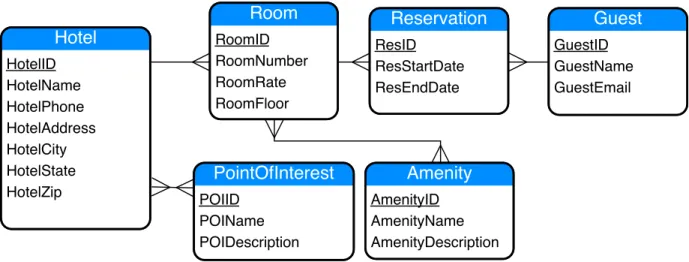
In this section we present a simple example to illustrate the schema design problem for extensible record stores. Suppose we are building an application to manage hotel reser-vations. The conceptual model in Figure 3.1, adapted from Hewitt [64], describes the application’s data.
The schema design problem for extensible record stores is the problem of deciding what column families to create and what information to store in each column family, for
Figure 3.1: Entity graph for a hotel booking system.
Each box represents an entity set, and edges between boxes represent relationships.
a given application. In general, this will depend on what the target application needs to do. For example, suppose that the application will need to use the extensible record store to obtain information about the points of interest (POIs) near hotels booked by a guest, given the guest’sGuestID. The primary operations supported by an extensible record store are retrieval (get) or update (put) of one or more columns from a record, given a record key. Thus, an application could easily answer this query if the record store included a column family with GuestIDs as record keys and columns corresponding to POIs. That is, the column family would include one record for each guest. A guest’s record includes one column for each POI associated with a hotel at which that guest has booked a room. The column names are POIIDs, and each column stores a composite value consisting of
POINameand POIDescription. In general, each guest’s record in this column family may have different columns. Furthermore, the application may add or remove columns from a guest’s record when updating that guest’s hotel bookings in the record store. With such a column family, the application can obtain point of interest information for a given guest using a single get operation. This column family is effectively a materialized view which stores the result of the application query for all guests.
In this thesis, we will describe such a column family using the following triple notation:
[GuestID][POIID][POIName, POIDescription]
The first element of the triple indicates the attribute values used as record keys in the column family. The second element indicates the attribute values used as column names, and the third indicates those used as column values. We refer to the first element as the partitioning key, since extensible record stores typically horizontally partition column families based on the record keys. We refer to the second element as the clustering key, since extensible record stores typically physically cluster each record’s columns by column name. We assume records in each partition are sorted according to the clustering key. Both the second and third components of the triple can optionally be empty indicating no fields in that component of the column family. The correspondence of these triples to structures used in an extensible record store is described in Section3.2.3.
Although this column family is ideal for executing the single application query we have considered, it may not be ideal when we consider the application’s entire workload. For example, if the application expects to be updating the names and descriptions of points of interest frequently, the above column family may not be ideal because of the denormalization of point of interest information, i.e., the name and description of a POI may appear multiple times in the records for different guests. Instead, it may be better to create two column families, as follows:
[GuestID][POIID][]
[POIID][][POIName, POIDescription]
This stores information about each point of interest once, in a separate column family, making it easy to update. Similarly, if the application also needs to perform another query that returns information about the points of interest near a given hotel, it may be better to create three column families, such as these:
[GuestID][HotelID][] [HotelID][POIID][]
[POIID][][POIName, POIDescription]
In this schema, which is more normalized, records in the third column family consist of a key (a POIID) and a single column which stores the POIName and POIDescription as a composite value. The second column family, which maps HotelIDs to POIIDs, will be useful for both the original query and the new one.
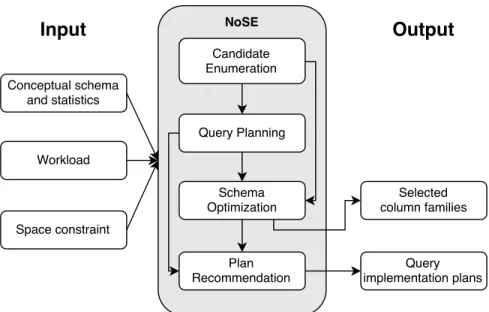
The goal of our system, NoSE, is to explore this space of alternatives and recommend a good set of column families, taking into account both the entire application workload and the characteristics of the extensible record store.
NoSE solves a schema design problem similar to the problem of schema design for rela-tional databases. However, there are also significant differences between the two problems. Relational systems provide a clean separation between logical and physical schemas. Stan-dard procedures exist for translating a conceptual model, as in Figure3.1, to a normalized logical relational schema, i.e., a set of table definitions, usable for defining the application’s workload. The logical schema often determines a physical schema consisting of a set of base tables. The physical layout of these base tables is then optimized and supplemented with additional physical structures, such as indexes and materialized views, to tune the physical design to the anticipated workload. There are many tools for recommending a good set of physical structures for a given workload as discussed in Section 2.2.
Extensible record stores, in contrast, do not provide a clean separation between logical and physical design. There is only a single schema, which is both logical and physical. Thus, NoSE starts with the conceptual model, and produces both a recommended schema and plans for implementing the application against the schema. Further, the schema recommended by NoSE represents the entire schema, not a supplement to a fixed set of base tables. Unlike most relational physical design tools, NoSE must ensure that the workload iscovered, i.e., that the column families it recommends are sufficient to allow for the implementation of the entire workload.
3.2
System Overview
Figure3.2gives a high level illustration of the NoSE schema advisor. We designed NoSE for use early in the process of developing an extensible record store application. The advisor produces two outputs. The first is a recommended schema, which describes the column families used to store the application’s data. The second output is a set ofplans, one plan for each query and update in the workload. Each plan describes how the application should use the column families in the recommended schema to implement a query or an update. These plans serve as a guide for the application developer.
3.2.1
Database Conceptual Model
To recommend a schema for the target application, NoSE must have a conceptual model describing the information to store in the record store. NoSE expects this conceptual model in the form of an entity graph, such as the one shown in Figure 3.1. Entity graphs are simply a slightly modified (restricted) type of entity-relationship (ER) model [34]. Each box represents a type of entity, and each edge represents a relationship between entities and describes the associated cardinality of the relationship (one-to-many, one-to-one, or many-to-many). Entities have attributes, with one of these serving as a key (i.e., no composite keys are permitted). For example, the model shown in Figure3.1 indicates that each room has a room number and rate. In addition, each room is associated with a hotel and set of reservations.
3.2.2
Workload Description
The second input to NoSE is a set of parameterized queries and updates which describe how the target application intends to use the database. Each query and update has an associated weight indicating its relative frequency in the anticipated workload. We focus here on the queries, and defer discussion of updates to Section 3.6.
NoSE expresses queries directly over the conceptual model. Each query in the workload returns information about one or more entities in the entity graph. Figure3.3a shows an example of a NoSE query, expressed using an SQL-like syntax, which returns the names and email addresses of guests who have reserved rooms with a particular amenity in given city at a given minimum rate. In this example,?city,?amenityand ?rateare parameters. Each query implies a query graph which is a subgraph of the entity graph. A path referenced in the FROM clause defines a portion of this graph. A query can define branches in the