Games, Learning, Collaboration and Cognitive Divide
Miguel Nussbaum
Escuela de Ingeniería
Pontificia Universidad Católica de Chile
[email protected]
Cognitive Divide
The growth of information and communication technologies (ICT) has brought them within reach of a
broad spectrum of the world’s population. As well as the changes they have wrought in communication,
entertainment and productive processes, ICT are transforming frequent users’ cognitive skills (Preiss and
Stenberg, 2005).
A study by (García et al 2007a) showed that Games had a significant influence in the development of
memory and attention processes on the basis of the Weschler Intelligence Scale digit span subtest. Table
1 shows the results of the impact of Games in this study, which involved 275 Chilean school children
from a sample selected from 2,286 seventh-graders at 30 educational institutions picked randomly from
among 438 middle socio-economic state-subsidized schools located in the urban areas of greater
Santiago. From the 275 children, 80 defined themselves as gamers and 60 as not technology users. The
rest were in other groups not relevant for this study.
Table 1: Memory and attention test results (García et al.,2007).
In a second study (Garcia et al 2007b), we showed that both frequent ICT use and socio-economic level
have a significant effect on the scores they obtain on the memory and attention test. Nevertheless, the
impact of frequent ICT use is statistically greater than that for the socio-economic level.. The inferior test
results obtained by those young people attending schools in sectors where low socio-economic level
households predominate are a manifestation of the digital divide. Its critical nature becomes all the more
apparent, however, when the technological context is analyzed, for what the findings reveal is the
emergence of a new dimension to the problem that has been called the
cognitive divide
(García et al.,
2005). In effect, the inequalities in cognitive skill development are the product not only of the
individual’s socio-cultural context but also of the technological context they have access to.
Video Games in School
Learning how to play educational games does not necessarily imply learning the instructional domain.
Learning happens only when students actively build the connections between game moves and the
underlying knowledge (Conati et.al. 1993). Whether students can build these connections usually
depends upon individual differences in knowledge and in the meta-cognitive skills relevant to learn from
autonomous exploration (e.g., self-explanation and self monitoring) (Shute 1993). The challenge is how
to provide individualized interventions that trigger learning, without interfering with the high level of
engagement that educational games trigger, precisely because they do not remind students of traditional
educational activities (Conati et al. 2004).
The challenge of developing educational video games is how to conciliate pedagogical and play factors.
The key is to present the educational content in the context of the game environment. The game
transforms into the learning mediator, capable of providing the child with tasks that fit his or her
knowledge and skills. Each game requires a story that gives meaning to the game’s dynamics and
objectives. The design of the game has to be focused on the playability features, where the goal is not to
expose the child directly to the content, but facilitate ludic and entertaining processes that motivate the
child to remain in the activity (Fabricatore et al 2002). In the following experience, we chose simple
action games, easy to understand in terms of their objectives and characters’ movements that promote the
exploration of a virtual world, and present game dynamics that are agile and highly motivating for small
children.
The experience was carried out with a sample composed of 1224 students attending 1° and 2° elementary
grade, of low socioeconomic background. Students were placed in there groups: experimental group
(EG), internal control group (IC), same school and same educational level, and external control group
(EC) different school but same educational level. The IC and EC allowed to control the Hawthorn´s
effect (Clark, 2000), i.e., the alternation of behaviors because the subjects are aware of being studied.
Each child of the EG had a machine that was used daily for 20 to 40 minutes, inside the classroom. The
total average student playing time for the experience was 30 hours. Besides the first two sessions, where
the research team modeled the use of the video games, the rest were run by the teacher, with a weekly
supervision of one member of the research team.
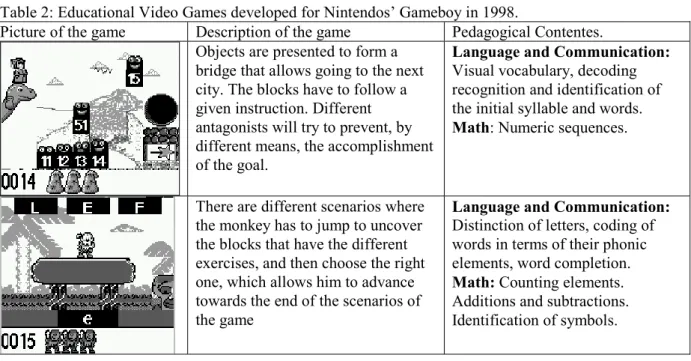
We designed a total of seven video games which included the contents corresponding to the first two
years of school, following the plans and programs from the Ministry of Education in Chile. The used
platform was NINTENDO’S Gameboy since it was the cheapest and ubiquitous platform when the
system was developed (1995-1998). It had a four level grayscale 160 X 144 display which constrained
the game design.
The contents were organized so that they had an increasing level of complexity, following the school
curriculum. The games had a progressive and increasing level of difficulty, based on the presentation of
antagonists and obstacles. According to the child’s pedagogical and gaming performance, the game
provided feedback, through a self-regulation system that dynamically adapted the level of difficulty of
the contents to the player’s learning pace, presenting the player contents based on his or her level of
knowledge. Table 2. shows two of the seven developed games (Rosas et al 2003).
The intervention had a significant effect on posttest Math scores, controlling for pretest ability. There
was a significant difference between means for children in the experimental schools (either experimental
or internal control classes) and the external control group, but no mean differences were found between
the experimental and internal control groups. A similar pattern of results was observed for posttest
Spelling. For Reading Comprehension the difference was in the expected direction but was not
significant. (Rosas et al 2003)
Table 2: Educational Video Games developed for Nintendos’ Gameboy in 1998.
Picture of the game
Description of the game
Pedagogical Contentes.
Objects are presented to form a
bridge that allows going to the next
city. The blocks have to follow a
given instruction. Different
antagonists will try to prevent, by
different means, the accomplishment
of the goal.
Language and Communication:
Visual vocabulary, decoding
recognition and identification of
the initial syllable and words.
Math
: Numeric sequences.
There are different scenarios where
the monkey has to jump to uncover
the blocks that have the different
exercises, and then choose the right
one, which allows him to advance
towards the end of the scenarios of
the game
Language and Communication:
Distinction of letters, coding of
words in terms of their phonic
elements, word completion.
Math:
Counting elements.
Additions and subtractions.
Identification of symbols.
These results show the presence of Hawthorn’s effect (Clark, 2000). This was explicit since teachers of
the IC were aware of the experiment, and therefore made special efforts to accomplish an adequate
performance of their students, sometimes trying to ‘‘compete’’ with achievement in the EG. It is
interesting to note that in the EG the effect of using video games, although not significantly better than
the IC groups, was not negative, considering that they used regular instruction periods to implement this
experience.
The students’ demands for the video games were used by teachers as a motivational tool. For example, in
order to avoid students arriving late, or to manage tiredness exhibited by students towards the end of the
day. Teachers reported that the games turned out to be so motivating that students developed a greater
interest in learning and even a higher motivation in attending school itself. There was a particularly high
percentage of teachers who attributed an improvement in attention and concentration of their students, as
well as an increase in self-esteem. On all dimensions, except discipline, the percentage of teachers that
recognized a positive change in the posttest was higher than the percentage of teachers that expected a
change in the pretest. This shows that some of the teachers who beforehand did not think that the
introduction of video games in the classroom was going to make a difference, changed their opinion after
the experiment, and concluded that the video games had indeed a positive influence on the teaching and
learning environment.
Collaborative face to face Computer Supported Collaborative Learning Games
When students have the opportunity to work in small groups, they develop a common understanding, as
well as verbal and social abilities. When children work collaboratively together, they show increased
participation in group discussions, demonstrate a more sophisticated level of discourse, engage in fewer
interruptions when others speak, and provide more intellectually valuable contributions to those
discussions (Shachar et al 1994). The collective decision phase aim is to lead the group to construct a
consensus meaning, key of social constructivism. However, small group learning is not a widely endorsed
practice. (Pianta et al 2007) indicate that in a study of 1000 students in 1
st, 3
rdand 5
thgrade, only 7% of
the students spent in small-group instruction (two to five students).
Computer Supported Collaborative Learning (CSCL) (Crook 1994) adopts a constructive approach using
the computer more as a partner than as a tutor.. The focus is not so much on the individual who learns
and thinks, as it is on the collaborative group that explores and reasons. When computer supported
collaboration occurs in a same place with children working face to face in a small group, we talk of face
to face CSCL, possible with wirelessly interconnected PDAs as Pocket PCs (Zurita & Nussbaum 2007).
In this case, we can recognize two networks. The social network, where group mates interact verbally,
and the technological network that transparently supports the social network activities, by coordinating
and synchronizing activity states, and mediating the activities and the social interaction of the peers
(Zurita & Nussbaum 2004)
Collaborative Role Game (Reyes et al 2007) is a face to face CSCL activity that has two simultaneous
objectives. In the game ones, children have to collaboratively achieve playing aims. The second is
educational, where they have to build collaboratively a learning objective. For both aims, children have
rolls. The game roles are defined by a specific capacity that only one child has and required to achieve
the activity aim. The educational roles are determined by learning capacities that each child receives,
e.g., the letters each child can pick. If a child performs a role, of play or learn, s/he is not assigned, all the
children loose. The aim is that the entire group is responsible of the work so they perform as a team.
With an adequate game design the three children are active, where a strategy has to be worked out by the
group for achieving the games aim requiring collaborative discussion on the construction procedure. It
compels group member to work and play with specific roles and its interactivity requires group
communication for building agreement, to move on to the next stage of the exercise.
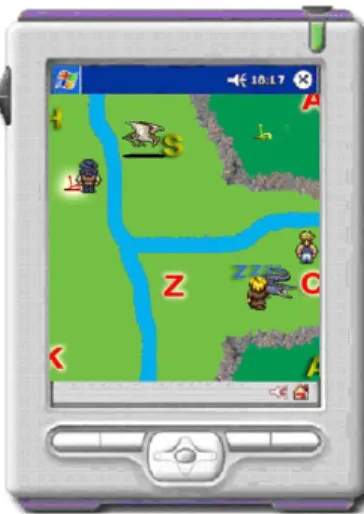
At the start of the game the Pocket PC announces in a spoken way the target word. The letters making up
the word are scattered around a map (Figure 1) that depicts a jungle full of dangers in the form of rivers,
cliffs and wild animals. The children must navigate and surmount these obstacles in order to reach the
letters that spell out the word in the right order. The size of the Pocket PC screen is QVGA (240x320),
but by scrolling the effective game area can be doubled or tripled (theoretically it is unlimited, depending
only on the machines’ capacity).
Figure 1. Role Game, a face to face CSCL multiplayer game.