Under-Savers Anonymous
:
Evidence on self-help groups and peer pressure as
savings commitment device
∗
Felipe Kast
†Stephan Meier
‡Dina Pomeranz
§PRELIMINARY VERSION. COMMENTS VERY WELCOME!
Abstract
Peer groups are widely observed to be used as commitment devices to reach personal goals, but there is little empirical evidence evaluating their effective-ness and analyzing what aspect leads to their success. We conduct two ran-domized field experiments among low-income micro-entrepreneurs in Chile to shed light on these questions. We find that self-help peer groups increase the number of deposits in a formal savings account 3.5-fold, and almost double the average savings balance. Comparing this effect to a separate treatment with an increased interest rate, we estimate that a commensurate effect would require increasing the interest rate by about 7.8 percentage points, and find that most participants do not respond to the increased interest rate at all. A second field experiment shows that over 80% of this effect can be achieved without actual meetings or peer pressure, through simple text messages that remind participants of their savings commitment, and give them feedback on their achievement. A text message coupled with peer pressure by a real-life savings buddy has no larger effect than a text message that simply informs participants of their own achievement and the success rate of others. These findings suggest that regular follow-up and taking stock may be more impor-tant than actual peer pressure in making peer group meetings an effective tool to encourage savings.
∗We thank Alberto Alesina, Shawn Cole, David Cutler, Michael Kremer, Lakshmi Iyer, David
Laibson, Brigitte Madrian, Sendhil Mullainathan and Alvin Roth for helpful comments and dis-cussions. We are grateful to Fondo Esperanza, Banco Credichile and Microdatos for outstanding collaboration in the implementation process. This project would not have been possible without the generous support by the following institutions: the Ford Foundation, the Lab for Economic Applications and Policy (LEAP) at Harvard, the Woman and Public Policy Program at the Harvard Kennedy School, the David Rockefeller Center for Latin American Studies, the Chazen Institute of International Business at Columbia Business School, the Columbia University CIBER, and the Russell Sage Foundation Small Grants Program.
†Pontificia Universidad Catolica de Chile, Avda. Vicuna Mackenna 4860, Macul, Santiago, Chile ‡Columbia University, Graduate School of Business, 710 Uris Hall, 3022 Broadway, New York,
NY 10027; [email protected].
1
Introduction
Many people have difficulty following through with plans that involve immediate costs and delayed benefits such as quitting smoking, losing weight, going to the gym, reducing debt levels or sticking to savings goals. As a consequence, a large segment of the population is unsatisfied with their behavior in certain areas. For savings outcomes, for example, a substantial proportion of the population in developed and developing countries report that they are unhappy with their current savings amount and regret not having saved more (Choi et al., 2002, for the US, authors’ survey results for Chile).
A growing body of literature in economics focuses on individuals’ self-control prob-lem or the degree of their present-biased time preferences as part of the probprob-lem (e.g. Angeletos et al., 2001; Laibson, 1997; O’Donoghue and Rabin, 1999). Much of this past work analyses the decisions of a single decision maker. While the decisions in-volved are often individualistic in principal, they are critically influenced by peers. In fact, the use of peers as a commitment device to overcome self-control problems is a widely observed phenomenon. Self-help peer groups, such as Alcoholics Anonymous or weight-loss groups, enjoy widespread popularity and claim to help people over-come their self-control problems.1 There is, however, no clean evidence investigating
whether self-help peer groups actually help overcome self-control problems and what aspect of peer groups is most critical for their effectiveness.2
This paper analyzes the effect of self-help peer groups for a financial goal: in-creasing savings. We conduct two randomized field experiments among low-income micro-entrepreneurs in Chile to test the power of self-help peer groups in helping peo-1For example, AA has 2.1m members world-wide, 1.3 of them in the US (www.aa.org), and each week an average of 1.3m participants attend a Weight Watchers meeting (www.weightwatchersinternational.com).
2The only study on self-help peer groups we are aware of is a medical study by Walsh et al. (1991) which compares AA meetings with hospital treatment. The effect of AA meetingsper sewas not tested, however.
ple increase their savings. The effect of self-help peer groups is particularly important for saving behavior for at least two reasons. First, overcoming self-control problems is key in helping people reach their own goals. Many people report regretting not having saved more. At the same time, a series of mechanisms that help overcom-ing self-control problems have been shown to be effective in increasovercom-ing savovercom-ings (e.g. Madrian and Shea, 2001; Thaler and Benartzi, 2004). Second, most of these mecha-nisms, such as defaults and direct deposits from wages, have been found to be effective for people working in the formal labor market in developed countries. However, most of these mechanisms cannot be applied to those working in the informal sector or to independent entrepreneurs. Alternative mechanisms are therefore important, espe-cially in developing countries where a large share of the population does not have a formal wage bill.
Two randomized field experiments shed light on the power of self-help peer groups as a commitment device and investigate the importance of actual peers for their effectiveness. Our first experiment tests the effectiveness of self-help peer groups to help individuals increase their savings. It is conducted among 2,700 members of Fondo Esperanza, a Chilean microfinance organization. Their members are micro-entrepreneurs and meet on a weekly basis in groups. 68% of participants say they frequently regret not having saved more.
We randomly select some groups to be offered savings accounts with a self-help peer group component. Individuals in these groups have an opportunity to publicly declare their weekly deposit goal in their group. Fulfilling their weekly goals is sub-sequently monitored in the regular meetings, and compliance is rewarded with public acknowledgement in the group. No monetary incentives for compliance are provided. We compare the savings outcomes of individuals in the self-help group treatment with a control group that was only offered the savings account without a self-help group component, and with a third set of groups that was offered savings accounts
with a substantially increased interest rate. The treatment with the increased interest rate serves as a benchmark to compare the effect of the self-help peer groups with a traditional approach to increase savings. To our knowledge, this is the first study evaluating the impact of a peer commitment device on the use of savings accounts, and the first experimental study to evaluate the impact of interest rates on savings.3
The results show that self-help peer groups help increase savings substantially. The number of deposits per month increases more than 3.5-fold and the amounts saved almost double. We compare the effect of peer groups to the more traditional means of fostering savings, an interest rate increase. Linearly extrapolating from a treatment in which we increase the interest rate from 0.3% to 5% indicates that the effect of self-help peer groups on average amounts saved corresponds to increase in the interest rate by about 7.8 percentage points. However, this comparison underestimates the relative effectiveness of the peer group treatment for most people: Looking at the quantile effects reveals that self-help peer groups affect a much larger share of participants than an interest rate increase. While only a small number of savers take advantage of the increased interest rate, the self-help peer groups help a much larger share of participants increase their savings.
Conceptually, the impact of self-help peer groups as a commitment device for savings can be due to various features of those groups. The regular meetings of peers can act as a commitment device, where the other group members function as an enforcement mechanism of a contract or a binding implicit agreement to stick to a 3Beshears et al. (2009) study the effect of informing employees of a US firm of other employees’ 401(k) plan participation. Their results show that peer information increases savings only for certain employees and not for others. Ashraf et al. (2006b) analyze a commitment mechanism in the Philippines that allow for withdrawals of savings only after a certain date, after a certain amount has been accumulated, or for a specific purpose. They show that such a commitment device can increase savings and is particularly attractive for present-biased individuals. The same authors also conduct a study that analyses the effect of deposit collectors as a commitment device in The Phillipines (Ashraf et al., 2006a). They investigate the determinants of participation for a deposit collection service for micro-savers in the Philippines and find that distance to the branch of the bank, a measure of transaction costs, and marriage status, a measure of intra-household dynamics, have significant predictive power on participation.
savings plan. Such peer pressure can help achieve one’s savings goal either through direct peer punishment of deviation from a resolution or indirectly, if deviations from following one’s plan negatively impacting a person’s reputation and image (Bernheim (for a similar argument about norm adherence, see, e.g. 1994) and Ariely et al. (for image motivation, see 2009); Benabou and Tirole (for image motivation, see 2006). Mas and Moretti (2009) show in a different setting, namely a work environment, that peer monitoring can have substantial behavioral effects. The effect is particularly strong if the peers know each other well, i.e. they have experienced past interactions and expect future interactions. If peer pressure is the main factor driving the impact of self-help peer groups, then physical meetings may be key to the success of peer groups. At a minimum, the behavior of an individual has to be observed by at least one other peer.
However, there might be mechanisms other than peer pressure that make peer groups effective. Self-help peer groups might affect savings because they provide information (Battaglini et al., 2005), trigger a competitive trait to win (e.g. Fliessbach et al. (2007) and Cooper and Fan (2008)) or function as a reminder (Karlan et al., 2010). Battaglini et al. (2005) show theoretically that observing others who stick to their plan can be motivating. However, the only paper we are aware of on the effects of conveying information about peers’ behavior on savings by Beshears et al. (2009) shows that this channel is delicate and can even backfire (see also Schultz et al., 2007). Karlan et al. (2010) show that monthly text message reminders can increase savings. If self-help peer groups operate mainly through learning about the behavior of others, or as reminders, then physical meetings might not be as important required, and in the latter case, actual peers are not required at all.
While many factors may be important for the impact of self-help peer groups, unbundling the effect helps not only to better understand the effect of peers in de-cisions with self-control problems, it also allows to investigate which aspects of the
successful self-help peer groups are crucial and which are dispensable. This has im-portant policy implications. While effective, regular peer meetings are also relatively cumbersome and may only appeal to a narrow population. Their scalability might therefore be limited. Unbundling different elements of peers as a commitment device allows distilling their most powerful elements, and can give guidance for the choice of more cost-effective, scalable delivery models.
Our second experiment is the first attempt to unbundle the effect of peers as a commitment device, by investigating the importance of actual peer meetings and peer pressure for their effectiveness. This field experiment is implemented in the same setting as the peer group experiment. It consists of two treatments and a control group that use text messages instead of actual group meetings. Similar to the peer group meetings, the text messages provide regular follow-up to the participant, giving them weekly feedback on whether or not they fulfilled on their commitment to make a weekly deposit.
The first treatment combines the regular follow-up through the text message with peer pressure by a real-life “Savings Buddy”: Participants choose a person that will encourage them to stick to their savings plan. Both the savings buddy and the participant then receive a weekly text message, informing them whether or not the participant made a deposit this week. The message sent to the participant also reminds the participant that the savings buddy received the same information.
This peer pressure treatment is compared to the control group, which receives no text messages, and to a second text-message treatment with no savings buddy. Like in the peer pressure treatment, in the second text-message treatment the partic-ipants receive a weekly text message, informing them whether or not they made their promised weekly deposit. Instead of a reminder that their savings buddy received in-formation about their performance, this group receives inin-formation about how many other participants made their weekly deposit.
Comparing the two treatments together to the control group that received no text messages sheds light on the question whether actual in-person meetings are an indispensable element for the finding that self-help peer groups are a powerful device to increase savings. The results show that regular follow-up through text messages can capture a significant part of what makes peer group meetings effective as a commitment device: Our calculations indicate that over 80% of the effect of meetings can be achieved by peer-related text messages. Receiving a weekly text message doubles the number of monthly deposits and increases the average amount of new savings from zero to almost 8000 Pesos.
These findings indicate that regular in-person meetings are not an indispensable feature of the power of self-help peer groups and that modern technologies can be employed to play the role of “synthetic self-help groups”, providing strong effects that may be much more scalable than in-person meetings.
Comparing the effect of the “Savings Buddy”-treatment to the treatment of text messages without peer pressure gives insights into the role of peer pressure for the effectiveness of self-help peer groups as a commitment device. The results show that peer pressure through a savings buddy has no larger effect than receiving a text message with feedback about one’s own achievement and information about the success rate of others. This suggests that actual peer pressure, through fear of embarrassment or desire for positive signaling, is not the main aspect of what makes self-help peer groups effective. Regular reminders coupled with information on how one compares to others turn out to be just as powerful.
Combined with the results of Beshears et al. (2009), who find information about peers’ savings performance not to be very effective in increasing savings, and the results of Karlan et al. (2010), who find that reminders positively affect savings, our results suggest that while self-help peer groups are very effective in increasing savings, their effectiveness may be less due to the social interaction and peer pressure than
commonly assumed, and more due to the regular follow-up and feedback mechanism that they provide.
The remainder of the paper is organized as follows: Section 2 presents the set-up and the design of both field experiments. Section 3 presents the result of Experiment 1 on the effect of self-help peer groups on savings. Section 4 presents evidence from Experiment 2 using text messages to test the importance of peer meetings and peer pressure on savings. Section 5 concludes.
2
Background, Data, and Design of Experiments
2.1
Background and Data
Both randomized field experiments for this study are conducted in collaboration with two partner institutions: The microfinance institution “Fondo Esperanza (FE),” and a large private bank, “Banco Credichile.”
The context of FE is particularly suitable to study the role that peer groups can play as a commitment device for those who do not have access to the types of commitment devices that have been found to be effective for employees in the formal sector. Members of FE are self-employed micro-entrepreneurs (e.g. street vendors, cosmetic saleswomen), many of whom work in the informal sector. About 90% of FE members are women, and most live and work in urban areas.
Members of FE meet regularly, on a weekly or biweekly basis, in groups of 10-20 peers, together with a group monitor from FE. This feature allows us to incorporate the peer group based commitment structure, in order to study the impact of self-help peer groups on savings. The purpose of the meetings is to enforce the regular repayment of the micro-loans that participants receive from FE in 3-month cycles. The loans are intended for investment in their micro-enterprise, and the credit cycles
as well as the immediate and regular repayments are on a rigid schedule that does not provide liquidity for irregular or unexpected financial needs.
A large portion of participants therefore express the desire to build savings that are available as a buffer stock for emergencies or towards non-business related goals. This is the main reason expressed for why participants are interested in saving and borrowing at the same time.
The savings accounts that are offered to clients of FE as part of the randomized experiments are with the commercial bank, “Banco Credichile”, because FE is not a licensed bank and is therefore not legally allowed to hold savings deposits. The accounts offered to participants have no maintenance fee or minimum balance. Most accounts yield a 0.3% real interest rate, with a special 5% real interest rate granted to a randomly selected sub-sample of the participants (discussed below).
We draw on three different sources of data: data on our key outcomes of inter-est, namely take-up and use of the savings accounts, is directly obtained from Banco Credichile, the bank holding the accounts. It includes information on which par-ticipants open an account, whether they use the account after opening it, and the dates and amounts of all withdrawals and deposits made after opening the account. The second source of data comes from administrative files that FE collected about its members. This data includes information about estimated household size and income, participants’ years of education, as well as the amount of credit with FE.
Finally, we complement these two sources of administrative data with an extensive baseline and follow-up survey. The baseline survey was conducted prior to the intro-duction of the savings accounts in April-May 2008 during one of the group meetings. The follow-up survey was conducted one year after the introduction of the savings accounts, in June-July 2008, through individual interviews. All surveys were admin-istered by Centro de Microdatos from the University of Chile. In the context of the follow-up survey, we randomized participants into the treatments of the text message
experiment (see below).
2.2
Experiment 1: Self-Help Peer Groups
Design
Our first experiment analyzes the effect of self-help peer groups on savings and is conducted among 196 groups with a total of 2,682 members of the microfinance organization Fondo Esperanza (FE). Before the start of the intervention, a baseline survey is first conducted in April/May 2008. It is administered to the groups in one of their regular meetings and filled out by each participant individually. In the weeks following the baseline survey, one of three types of savings accounts with the commercial bank Banco Credichile is introduced to the groups, with an offer to open such an account.
The universe of study participants consists of all members of the 196 groups who are in the meeting when the baseline survey is conducted. Groups are randomly assigned to one of the three types of savings accounts and all members of each group are offered only one of the three types of savings accounts, without knowing the existence of the other types of accounts. All three types of accounts are attractive compared to other options in the market in that they have no maintenance fees, no minimum balance, and the possibility is offered to go to the bank together with other interested members of the group in order to open the account together.
Among those offered a savings account, half are randomly selected for the self-help group feature as a commitment device. The other half is only offered a savings account without any group support beyond the opening of the account. Among those who did not receive the peer group commitment structure, half receive a basic account, the other half receive an increased interest rate of 5%. The types of accounts have the following features:
1. Basic savings account: The basic savings account is an individual savings ac-count, with a real annual interest rate of 0.3% (similar to the highest available alternative in the Chilean market), no maintenance fees, no minimum balance, and a two dollar minimum opening deposit. General conditions are the same across all accounts: savings are completely liquid for withdrawal at any time and the conditions are guaranteed for a minimum duration of two years. 2. Self-help group account: This account is identical to the basic account but with
an added accountability structure, such that the weekly peer group meetings act as a self-help peer group in the following way: group members have the option of publicly announcing to the group what their weekly savings goal is for the coming credit cycle (approximately 3 months). Subsequently, members verify in each group meeting who complied with their own savings goal and who did not. Those who complied and show a deposit slip to prove it receive a sticker in a booklet. Those who collect enough stickers receive a diploma as a non-monetary award.
3. High interest account: The high interest rate account is identical to the basic account, but offers a 5% real interest rate instead of 0.3%. It is explicitly presented to the group as the savings account with the highest yield in the market, and the concept of interest rates and compounded interest is explained to participants in the meeting when the account is introduced.
Summary Statistics
Table 1 presents summary statistics for the 196 groups in the sample of the peer group experiment. As expected given the random assignment, average characteristics in the groups assigned to different treatments are very similar, and there are no statistically significant differences with the exception of group size.
Participants in the study have an average of 9.65 years of schooling and their mean age is 43 years. Monthly income per capita of their households is 84,212 pesos (about 160 USD), with an average household size of 4.3 people. 68% of participants did not have a savings account prior to the study. The mean total savings for those who did have a pre-existing account is 69,108 pesos. While the income is expressed in per capita terms, these savings may be the combined savings of several household mem-bers, especially including participants’ children. Participants’ mean debt, including the micro-loan from FE, was 408,312 pesos. The larger amounts of debt compared to savings is not surprising given that participants are entrepreneurs and most of their debt is backed up by inventories and future sales.
The average number of people who were present the day of the baseline survey is 14.7 per group, with a slightly lower average in groups offered the basic savings account. For the questions about attitudes toward savings and toward their peers in FE, as well as participants’ discount rate and hyperbolic discounting, we conduct an F-test, which clearly rejects the null hypothesis that they are jointly significant in predicting whether a group has been assigned to a basic account or one of the other two accounts.
2.3
Experiment 2: Text Messages Follow-Up
Design
The second experiment of our study is conducted among 873 participants who had opened an account with Banco Credichile in the scope of the peer group experiment. Experiment 2 starts a little over a year later. During the individual follow-up survey to the peer group experiment, eligible participants are randomly offered one of two text message services aimed at helping them reach their personal savings goals, or are assigned to the control group:
1. Peer Pressure treatment: One third of eligible participants are offered a “Savings-Buddy Text Message Service”. It simulates the aspect of the regular follow-up of peer group meetings through a weekly text message, and combines it with peer pressure by a real-life “Savings Buddy”: The participants set a weekly sav-ings goal for themselves. They then choose a person that will encourage them to stick to their savings plan as their savings buddy. Both the savings buddy and the participant subsequently receive a weekly text message, informing them whether or not the participant made a deposit this week. The message sent to the participant also reminds the participant that the savings buddy received the same information.4
2. Savings Information treatment: In the same way as in the peer pressure treat-ment, participants of the “Savings Information Text Message Service” are asked to set a weekly savings goal for themselves, and receive a weekly text message, informing them whether or not they made their weekly deposit. However, there is no savings buddy exerting pressure on them to comply, and instead of a re-minder that their savings buddy received information about their performance, this group is told how many other participants made their weekly deposit. 3. Control treatment: A control group is asked in the same way as the two
treat-ment groups to set themselves a weekly savings goal, but is not offered either of the two text-message services.
Sample selection and set-up of the intervention
Prior to administering the survey, we randomly assigned all participants of Experi-ment 1 who had opened a savings account to one of the three text message treatExperi-ment groups described above. The randomization was stratified by savings balance in the accounts with Banco Credichile prior to the intervention and by the peer groups
within FE to which the participants belonged. This latter stratification automatically assures stratification by type of savings account of Experiment 1.
In order to maximize the take-up rate, prior to being offered a text message service during the survey, study participants, including the control group, were asked a set of screening questions, to determine who would remain in this study. First, potential participants were asked whether they owned a cell phone. Only those who had a cell phone (85.2% of all participants who had opened a savings account) were told about a new cell phone service designed to help people reach their savings goals. This service would offer people the option to receive weekly text messages reminding them of their savings goal and motivating them to reach it. Participants were then asked whether in the hypothetical case that such a service was provided for free, would they be interested in participating. Only those who responded yes to this question (69.5% of participants with cell phones) were maintained in the study. This process led to our sample of 873 participants in the text message experiment.
These 873 study participants, including the control group, were asked how much they would aim to save over the next three months if such a service were offered and how much that would translate into in terms of weekly targets. Those who were offered one of the two services were then informed that they had really been selected to participate for free in the service for three months, and the details of their particular service (“Savings Buddy” or “Savings Information”) were explained to them. If they chose to actually participate in the service, they were then asked for their phone number. Those in the Savings Buddy service were additionally told to choose a Savings Buddy, and were instructed to choose someone who would motivate them towards their savings goal. The name and phone number of that person were subsequently registered. Finally, participants were asked to state their relationship to their buddy and the reason they selected that individual.
to ensure that their phone number was working, that they understood the procedures, and that all their outstanding questions were answered. The research team matched weekly data from the bank with individuals in the study and sent corresponding text messages to participants. The text message service started as soon as the researchers obtained the data from the interviews, and the preparation procedures described above were completed. Since the interviews happened in a staggered manner over time, different participants started receiving the service at different points in time. However, the service ended for everyone at the same time at the end of October 2009.
Summary Statistics
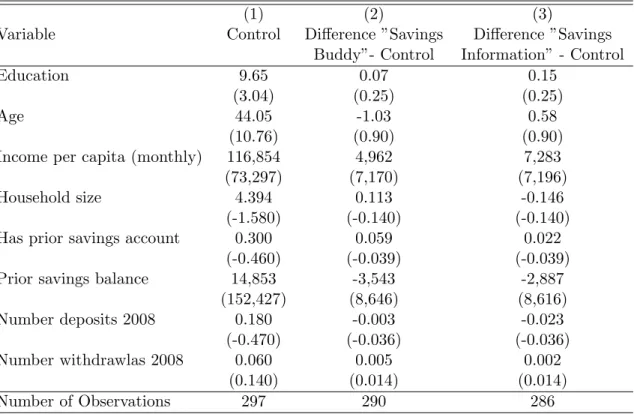
Table 2 presents summary statistics for the 873 participants in our sample (i.e. those who said they would be interested in principle in the service if it were offered). As expected given the random assignment, average characteristics in the groups as-signed to different treatments are very similar.
[Table 2 about here.]
Mean monthly per capita income of participants’ household is about 117,000 Chilean Pesos, or about 230 USD, with an average of 4.4 members in each house-hold. Similar to the sample in the peer group experiment their mean age is 44 years, with an education of 9.6 years on average. Also very similar to the sample in the peer group experiment, seventy percent of participants don ˜Ot have a savings account prior to the account they opened in the context of this study. The average savings balance in those accounts at the beginning of the text message experiment is 14,853 pesos or about 30 USD. The average number of monthly deposits in 2008 is 0.18 and average number of withdrawals is 0.06.
Take-up rates of the two treatments is very similar. 42.2% of participants in the sample of those who expressed interest in the service end up actually signing up when it was indeed offered to them. This number is only very slightly different between the
two treatments, with 42.8% for the Savings Buddy service and 41.6% for the Savings Information treatment.
In the following, we show the results of both experiments. Section 3 presents evidence on the impact of self-help peer groups for saving, compared to a regular savings account and to a high interest rate account. In section 4, we show the results of the text message intervention, which shed light on the questions of whether peer pressure and actual in-person meetings are the crucial element of what makes self-help peer groups effective as a commitment device work.
3
The Effect of Self-Help Peer Groups on Savings
The results of Experiment 1 are presented in two steps: In a first step, we look at the overall “Intent-to-Treat (ITT)” and the “Treatment-on-the-Treated (TOT)” effect of self-help peer groups on deposits and amount saved. In a second step, we compare the impact of self-help peer groups to the effectiveness of a substantial increase in the interest rate in order to get a sense of the magnitude of the peer group effect compared to a more traditional means to increase savings.
3.1
Self-Help Peer Groups
Figure 1 shows the ITT effect of self-help groups on deposit and savings behavior compared to a basic savings account. The figure shows savings outcomes for 12 months after the experiment started. It is clear from the figure that self-help peer groups increase savings outcomes, measured in two ways:
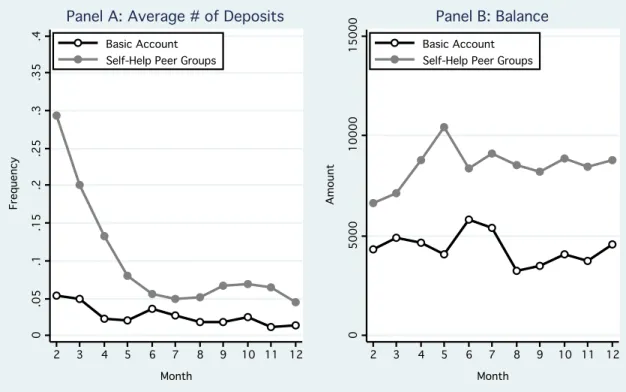
Panel A of Figure 1 shows the effect of self-help peer groups on the number of deposits per month. The figure indicates that the average number of deposits is almost 4-times higher for people who were randomly assigned to a self-help group compared to people who were not. The effect is very strong in the first few months
after self-help peer groups were formed. But while it decreases over time, even in the end of the year, the number of deposits is still 3.5-times higher compared to the control group.
[Figure 1]
Panel B of Figure 1 shows that self-help peer groups not only increase the number of deposits but actually lead to higher savings balances. It displays the mean balance in the savings account for those in the peer treatment and the control group. Average balance is 2-times higher for people in self-help peer groups compared to the basic account. The effect persists over time and the difference does not decrease during a whole first year after the introduction of the self-help groups.
We estimate the following regressions to further test whether the effect is signifi-cant. This will also allow us to extend the specification and compare the effect to the high interest accounts.
Si =α+β1Self Helpi+β2Interest Ratei+i (1)
Si is the savings outcome for individual i. We will analyze three savings out-comes: (1) the average monthly number of deposits, (2) the average monthly de-posited amount, and (3) the average balance (total deposits minus withdrawals). In order to illustrate the effect of outliers, we show the results for the mean of the de-posited amount and the savings balance for the whole sample as well as winsorized at top 1% and top 5%. Self Help is a dummy variable equal to 1 for individuals in the self-help peer groups and 0 otherwise. Interest Rate is a dummy variable equal to 1 if the individual has a savings account with a high interest rate and 0 otherwise.
is an error term.5
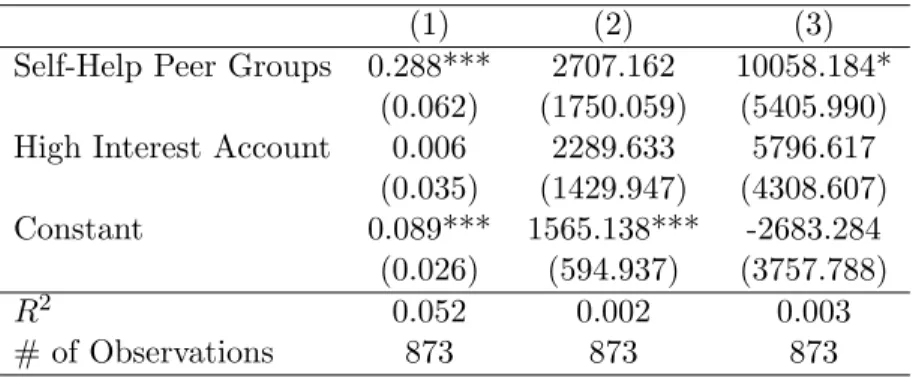
Table 3 shows the effect of self-help peer groups on savings outcomes. Panel A presents the ITT effect for all three outcomes. The regression results support the results in Figure 1: The number of deposits, the amount deposited and the savings balance is significantly higher for the self-help peer group treatment than in the control group that was only offered a basic account.
Panel B in Table 3 shows the TOT effects of self-help peer groups. Take-up rates of the savings accounts are very similar between the treatments: 50% for the basic account, 51% for the High Interest account and 55% for the self-help peer groups (none of the differences is statistically significant). We would therefore expect the TOT effects to be approximately double the ITT effects. Panel B shows that indeed the effects are about twice the size.
In sum, the evidence indicates that the self-help peer groups are effective in en-couraging deposits by participants, which in turn leads to a substantial increased average balance in the accounts. The increased number of deposits is therefore not offset by a corresponding increase in withdrawals even though savings accounts are fully liquid, and withdrawals are not observed by the peers.
3.2
Self-Help Peer Groups vs. Interest Rate Increase
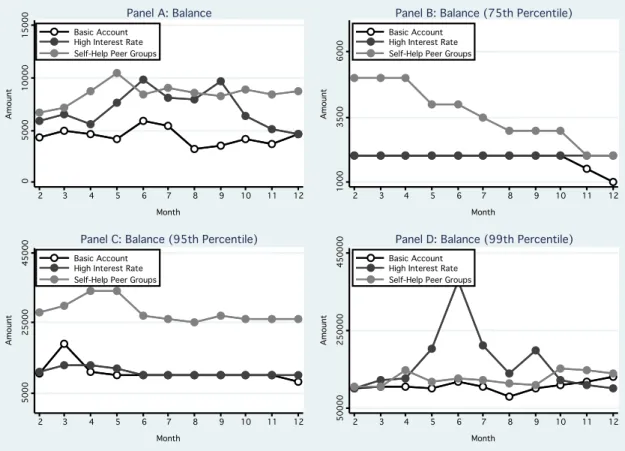
To get a sense of the magnitude of the effect of self-help peer groups on savings, we compare it to the impact of a more classical treatment to encourage saving. In a separate treatment, the interest rate is increased to 5% annually in real terms. This is substantially higher than the 0.3% offered in the self-help peer treatment and in the basic account. Figure 2 compares the effect of self-help groups to the high interest account and the basic account. The four panels show the treatment effects on the mean savings balances as well as the 75, 95, and 99 percentile (the median is zero, given that the take-up is only about 50%). The panels show at least three interesting patterns:
First, it is not readily apparent whether the mean amount saved (Panel A) differs between the self-help peer groups and the high interest accounts. Especially in the beginning, savings are very similar. In the fourth quarter of the first year, balances are higher in the self-help peer groups compared to high interest rate. A second interesting observation is that mean savings in the high interest rate are not substantially higher than in the basic account indicating that people did not react much to the substantial interest rate increase. Thirdly, Panels B-D show that while the difference between self-help peer groups and high interest accounts on mean savings is not substantial, looking at the whole distribution reveals much starker results. Panel B shows that the 75th percentile of balances is substantially higher for self-help groups than for the increased interest rate. Even at the 95th percentile of savings, people seem not to react to an interest rate increase at all (Panel C). Only at the very top of the distribution (Panel D for the 99 percentile) does the interest rate lead to higher savings. In sum, Figure 2 indicates that self-help peer groups significantly shift the distribution of savings and a substantial increase in the interest occurs only at the very right tail of the savings distribution.
Table 3 supports those findings in regressions. The table provides the effect of the
Interest Rate treatment compared to the control group. It also shows thep-value of a F-test that compares the effect ofSelf Help and Interest Rate. The table shows that the high interest rate is not able to significantly increase the average number of deposits. In most specifications, a substantial interest rate increase is also not able to significantly increase the mean amount deposited or the mean savings balance compared to the basic account. While the high interest rate account increases the savings balance by 50%, the increase is not statistically significant. And for the winsorized amounts, which reduce the importance of extreme values, the interest rate increase never has a substantial effect. For all outcomes, the self-help peer groups are much more successful in increasing savings. Comparing the self-help peer groups
with the interest rate increase shows that the difference is statistically significant for number of deposits and for the winsorized savings amounts, indicating that except for a small number of individuals, the self-help peer groups are more successful. An increase of almost five percentage points in the real interest rate does not increase savings as much as a peer-based commitment device. If we take the results from Column (5) and linearly extrapolate the point estimation of the interest rate increase, the results indicate that the self-help peer groups have an effect equivalent to an increase in the interest rate to 7.8%.
The finding that an increase in the interest rate of almost 5 percentage points (from 0.3% to 5%) has very little impact on savings and no impact on most of the distribution is striking in itself. Even individuals who have substantial savings in other savings accounts do not reallocate their money into the high interest account (which is designed such that there is no similarly attractive interest rate commonly available in the Chilean market). Based on the pre-experiment survey, about 32% of individuals have savings in a pre-existing account. If we split those with pre-existing savings further into two groups at the median savings balance, we can investigate whether “high pre-treatment savers” transfer their money to the high interest bearing account. Savings in the high interest accounts is not higher for ’high pre-treatment savers’ than for people with no or low savings in other accounts and the savings are orders of magnitude lower in the account of the study than in the high savers’ pre-existing accounts. This indicates that the high interest rate do not lead to savings reallocation. Indeed, when asked in a survey one year after they received the savings account whether they made any transfers from their pre-existing account into the account they received in the context of this study, only 1% indicate that they did so. There are many potential reasons for why individuals do not react to an increase in interest rate and why people who have savings in other accounts do not make transfers to the high-interest bearing account. Savings in other accounts might not be liquid;
savings in different accounts may be mentally accounted for different purposes, etc. A series of questions in our follow-up survey allow for more informed speculation about potential reasons. A very prominent candidate for why participants do not react to the high interest rate and do not reallocate money from a lower interest bearing account seems to be a poor understanding of interest rates. Only 2% say that they know what the interest rate is in the alternative savings account.6 Asked to indicate which of the two accounts had a higher interest rate, 63% of those in the high interest rate treatment nevertheless think that their alternative savings account has a higher interest rate. This is extremely unlikely, as with a 5% higher interest rate than the basic savings account, the high-interest rate account in the savings accounts provided through this study was chosen in such a way as to represent a much higher interest rate than other alternatives commonly available in the Chilean market.
The fact that participants seem to have a very weak grasp of the concept of interest rates and of the returns of their respective savings accounts is especially interesting given that in the context of this experiment, the higher interest rate was made exceptionally salient. Before opening an account, participants received a one-hour training, explaining the effect of interest rates and compounded interest rates in a very intuitive manner, and showing them that the savings account they were being offered represented the highest alternative in the market. Our finding that even in this situation, participants seemed very unaware of the relative returns of their savings accounts, is an indication that the general population of a similar background to those analyzed in this study cannot be expected to have much command of the notion of interest rates or relative returns. Models or policies based on the assumption that low-income individuals will respond to changes in interest rates should therefore be 6The questions in this section of the paper were asked of those participants who had opened a savings account in the context of this study and indicated in the follow-up survey one year later that they also had an additional savings account. For participants who indicated having more than one savings account, the questions of this section were asked about the savings account in which they indicated having the largest amount of savings.
treated with caution. This finding illustrates another advantage of self-help peer groups compared to more traditional approaches: they require little financial literacy. In sum, our first experiment provides causal evidence that self-help peer groups work. Self-help peer groups increase the savings balanced by about 100%. Self-help peer groups work much better in increasing savings than a substantial increase in the interest rate. The follow-up surveys suggest that many individuals have a poor understanding of interest rate. Self-help peer groups are therefore ideal not only in settings in which traditional means of increasing savings, such as defaults in company sponsored savings plans, are not available. They also require much less financial sophistication.
4
The Importance of Peers and Peer Pressure
The previous section established that self-help peer group meetings are effective at increasing savings. However, such meetings are also very costly in the sense that people have to physically meet their peers on a regular basis. This section investi-gates whether such physical peer meetings and peer pressure are actually the crucial elements of what makes self-help peer groups effective in raising savings. This is also the first attempt to unbundle the effect of self-help peer groups.
The text-message experiment provides evidence on these questions. We first an-alyze whether regular follow-up in “synthetic” peer group meetings through peer-related text messages can achieve similar results to the regular follow up in physical peer group meetings. We then investigate how important actual peer pressure is for the effect, by comparing two different types of text message follow-up services. In particular, we study whether regular follow-ups combined with being observed by others affects savings more than regular follow-ups combined with information about savings performance of others.
4.1
The Effect of Peer Text Messages on Savings
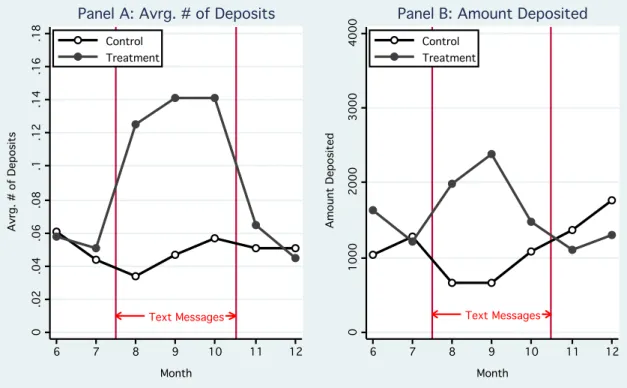
Figure 3 shows the impact of being assigned to receive a peer-related text message compared to the control group. The horizontal axis represents calendar months in the year 2009, and the area between the horizontal lines marks the period during which the text message intervention was implemented (called “Intervention Period” going forward). Panel A in Figure 3 shows the average number of deposits per month, and Panel B shows the average amount deposited.
[Figure 3]
Figure 3 reveals three important results: First, before the experiment begins in August 2009 (month 8), there is no significant difference between treatment and control group in both panels. Deposits in June and July trend slightly downward in the cold winter months in Chile, but this trend is no different between treatment and control.
Second, in the months in which the treatment group received peer savings text messages, savings outcomes are substantially different between the treatment and the control groups. The number of deposits per month is substantially higher in the treat-ment group compared to the control group (Panel A). The treattreat-ment almost triples the number of weekly deposits. The amounts deposited (Panel B) are much more noisy to measure, but even there, we see a substantial difference between individuals in the treatment vs. the control group in August and September, while the difference in October is smaller.7
Third, after the text messages stop, the savings rate of the treated groups de-creases, and the savings behavior looks very similar again across groups. This indi-7Since the amounts of savings are very noisy due to a small number of large deposits, the amounts depicted in the graph are winsorized at the 5% level. In the regressions that follow, we indicate results with winsorized and unwinsorized amounts.
cates that while the weekly messages had a strong effect of encouraging individuals to make deposits, there are no long-run effects of the treatment on deposit patterns. In order to estimate the significance of the treatment effect on savings, we estimate regressions of the following general form:
Si =α+β1T reatmenti+P rior Savingsi+i (2)
where Si is the savings outcome for individual i during the intervention period.
T reatment is a dummy variable equal to 1 for individuals in the treatment groups and 0 otherwise. In addition, we include individual average savings level prior to the intervention period. While prior savings is not significantly different between treatments due to the randomization, controlling for it reduces much of the noise. Prior savings is predictive of savings in the intervention period for multiple reasons. On the one hand, mechanically, people who have prior savings can withdraw more in the intervention period leading to possible negative net savings in the intervention period while people with no prior savings cannot have net withdrawals. On the other hand, those with higher price savings may be more positively predisposed to use the savings account and may be richer, and so can respond more slowly to the text messages.
We use three measures for Si: (1) average number of monthly deposits made, (2) average monthly amount deposited in Chilean Pesos, and (3) total savings (deposits-withdrawals) in the intervention period. The amounts deposited or saved are shown as means and winsorized at top 1% or top 5%.
Table 4 presents the results of OLS regressions for all three outcome measures during the intervention period. Panel A shows the ITT effect while Panel B shows the TOT effect. The results indicate that peer related text messages have a
substan-tial effect on savings. In the ITT specification, the average number of deposits is more than two times higher in the text message treatments than in the control group. Not only do people deposit more often, they also deposit higher amounts. The av-erage monthly deposited amount is about 2,000 Pesos higher in the treatment group compared to the control. As a result, participants in the treatment group increase their savings balance in the intervention period by about 7,800 Pesos. This increase constitutes about 7% of the average monthly income. Obviously, TOT effect is even higher. Given that take-up is about 42%, the TOT effects are slightly more than double in size. For balances, that implies that treated individuals saved, on average, around 19,000 Pesos or 38 USD in three months compared to 0 for the control group.8
[Table 4 about here.]
To approximate how much of the self-help peer groups effects (with physical meet-ings) can be achieved with only peer-related text messages, we compare the effect of Experiment 1 with the effect of Experiment 2. Since it is not randomly assigned who participates in the text message experiment, however, the comparison will only give a rough approximation. First, we can simply compare the ITT effects in Table 3 and in Table 4, where we see that the text message treatment has about the same if not a stronger effect than self-help peer groups. However, this comparison is problematic as participants in the text message experiment are a select subsample of the sample of the peer group experiment: they all took up a bank account as part of the study, they have a cell phone, and they expressed interest in a text message follow-up service to help them save more. In addition, the effect in Experiment 1 is for 12 months after the experiment started the intervention period of the text message experiment is only 3 months.
8The net new savings of zero in the control group indicates that participants in this group on average withdrew the same amount as they deposited, with net new savings negative for some participants during this period.
In order to account for these differences, the most conservative comparison can be achieved in the following way: We calculate the effect of self-help peer groups for the three first months (August to October 2008) among the sample of the 873 participants who also ended up participating in the text message experiment. We focus only on the first three months of treatment, when the peer group meetings had the strongest effect (August to October 2009). This also has the advantage of comparing savings in the same calendar months, one year apart, so it can control for seasonal effects. Finally, when looking at the impact of peer group meetings, TOT and ITT are by construction identical in this sample, since all participants opened a savings account. For a conservative comparison, we look at the ITT effect of the text message experiment.
In this benchmark (see Table A1 in the Appendix), peer-related text messages achieve about 80% of the effect of the peer group treatment on net new savings. While physical meetings in self-help peer groups increase the savings balance by around 10,000 Pesos in three months compared to the control group, peer-related text message increase savings by around 8,000 Pesos. This rough comparison of the two experiments (keeping in mind that participation in the two experiments is not randomized) suggests that follow-up through peer-related text messages is almost as effective as follow-up through regular in-person group meetings.
In sum, the overall result of the text message experiment shows that peer-related text messages, i.e. “synthetic peer groups”, have a substantial effect on savings. Comparison to the effect of real self-help peer groups suggests that text messages can achieve at least 80% of the effect of “real” peer groups. This finding is a first indication that the physical meetings are not as central for the effect of self-help peer groups as previously thought. In the next section, we investigate whether the effect of peer-related text messages is driven by peer pressure, ie. being observed by others.
4.2
The Impact of a “Savings Buddy”
So far, we have analyzed the combined impact of both types of text message treatments and savings behavior. In order to investigate the importance of peer pressure, the following section presents results on the difference between the two types of text message treatments: in the ”Savings Buddy” treatment, a designated savings buddy chosen by the participant also receives information about the participant’s success at making the weekly deposit and the participant receives confirmation about their own performance and a reminder that the savings buddy was informed as well. In the ”Savings Information” treatment, no one else can observe the performance of the participant, and the participant receives confirmation about their own performance along with information about what fraction of other participants similar to them made their weekly deposits.
At the time of signing up to the Savings Buddy treatment, participants answer questions about the relationship to the chosen ‘Savings Buddy’ and the main reason for choosing the person. The answers indicate that the peer pressure might be partic-ularly strong in this setting. As indicated in Table 5, 77% chose a relative. Among the relatives chosen, the most common savings buddy choice is a son or daughter (32%), followed by partner (25%), other relative (14%), and parent (6%). Concerning non-relatives, 17% chose a close friend, 2% chose a neighbor, and 3% chose someone else. Participants clearly chose savings buddies who are close to them, either a close rela-tive or a close friend. According to Mas and Moretti (2009) who study peer pressure in another context, peer pressure can be expected to be particularly strong if the peers know each other, i.e. had past interactions and expect future interaction.
[Table 5 about here.]
Concerning the motivation for selecting their specific savings buddy, the most fre-quently stated reason (30%) is that the person chosen is very strict and will motivate
the participant to comply with his or her savings goal. This is followed by 28% of participants who state that the person was chosen because the participant generally shares financial information with them. The third most frequent reason stated (19%) is that the person is a role model when it comes to savings, in terms of being very organized and adept at complying with his or her own savings goals. Another 12% of participants indicate having chosen that person because they share a bank account with them. Very few participants (5%) indicate that they chose their savings buddy for being a relaxed person and who will be understanding if the participant cannot reach their savings goal. 3% say the reason is something else, and 2% did not reply to that question. These statements indicate that the majority of participants were really aiming to choose a savings buddy who cares about their behavior, someone closely related to them, who is expected to hold them accountable, rather than someone lenient who will not exert pressure.
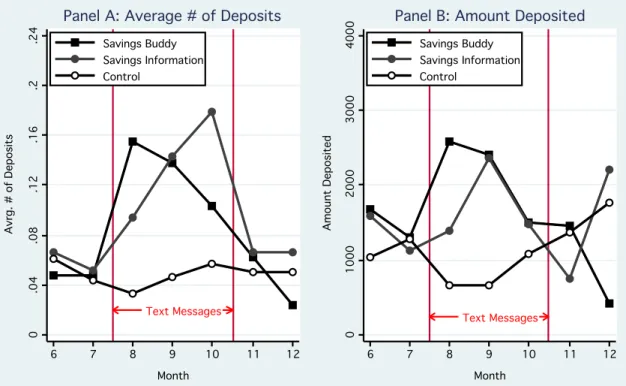
Figure 4 shows the Intent-to-Treat effect of the ”Savings Buddy” compared to both the control group and the ‘Savings Information’ treatment. Both in terms of number of deposits per months (Panel A) and in terms of amount deposited (Panel B) the treatment effects of ”Savings Buddy” and ”Savings Information” treatments follow very similar patterns. Both treatments increase deposits compared to the control, and there is very little difference between the two treatments.9
[Figure 4 about here.]
Table 6 confirms the impression from the figure that there is no difference between the two treatments. This table only includes individuals who were in one of the two text message treatments. The coefficients of a dummy for whether individuals are assigned to the ‘Savings Buddy’ treatment indicate no significant difference compared 9The figures seem to indicate that there is a different time trend between the two treatments. However, when looking at a week-per-week measure (shown in Figure A1 in the Appendix), the two treatments look very similar in terms of effect over time.
to the ‘Savings Information’ treatment. For none of the three outcome variables, having a ‘Savings Buddy’ has a substantially different effect.
[Table 6 about here.]
In sum, the results show that peer pressure in the “Savings Buddy” treatment does not have a larger effect on savings than a text message with relatively minor information about the behavior of others. The lack of an effect of the treatment with peer pressure is even more striking in light of the choices of the savings buddy and the information contained in the “Savings Information” text messages. The message (see the text in Appendix A) only informs participants about the percentage of others with similar characteristics to theirs that made a deposit in a given week (often that number is very low or even zero). Evidence for (Beshears et al., 2009) suggests that such information may have very limited effects on savings. That the text message still had a substantial effect suggests again that peers are likely not the main reason for its impact (as discussed below in more detail).
5
Discussion and Conclusion
Even though saving is an individual decision, peers can function as a powerful commitment device to help bring actual and planned savings levels closer together. In many other domains, self-help peer groups are also claimed to help people stick to their plans, for example to quit drinking or lose weight. Clean evidence on the impact of such self-help peer groups and on the role of peer pressure is notably lacking.
This paper provides to our knowledge the first rigorous study that tests whether self-help peer groups are effective and how important actual peer pressure is in this context. Our first experiment shows that self-help peer groups have a large positive impact on savings. Individuals who were assigned to groups that discuss savings in their weekly meetings and monitor which participants reach their weekly savings
goal have average balances that are around twice as high as individuals who were not assigned to the self-help peer group treatment. This effect is substantial in size compared to other means to increasing savings. We benchmark the magnitude against a more classical measure, an interest rate increase from 0.3% to 5%. Self-help peer groups have a stronger impact and, in particular, affect a larger share of participants, while only very few individuals react to the increased interest rate (a result which is striking and novel in itself).
Even participants who had substantial prior savings do not seem to reallocate them into the high yield savings account. One potential interpretation for why self-help peer groups work better and more widely than an interest rate increase is the degree of financial sophistication required. Our survey evidence suggests that participants do not understand the concept of interest rates and do not know the interest rates on their own accounts. This is the case even though the concept of interest rates was explained to participants in simple terms and the fact that this account is especially beneficial was made exceptionally salient.
Our second experiment starts to unbundle the effect of self-help peer groups by investigating the importance of physical meetings between peers and the influence of peer pressure. The results show that at least 80% of the effect of self-help peer groups can be achieved without actual meetings, and that coupled with a regular follow-up, peer pressure has no stronger effect than simply informing individuals about how many others fulfilled their commitment. Combined with evidence that information about savings behavior of peers has quite limited effects (Beshears et al., 2009) and that monthly text message reminders increase savings (Karlan et al., 2010), our results suggest that regular follow-up and feedback about one’s own behavior may be more important aspects of self-help peer groups than the actual peers. Physical meetings and peer pressure or being observed by others are found to be less important than conventionally assumed.
From a policy perspective, our results show two things. First, self-help peer groups can be very effective to achieve a shared individual goal, especially in settings where people already meet regularly for other reasons, and may therefore be worth en-couraging. Second, modern communication technology can be employed to produce “virtual” peer groups to encourage savings or other desirable goals, for which peo-ple exhibit self-control problems. They maintain the crucial follow-up and feedback mechanism of the self-help peer groups, without requiring the peer pressure or actual meetings. This produces strong effects in a manner that may be much more easily scalable and appeal to a larger segment of the population than actual group meet-ings. These findings may be applicable beyond the issue of savings to other areas where people make resolutions but find it difficult to follow through, such as preven-tive health measures (e.g. diabetes, sports), environmentally friendly behavior (e.g. saving energy), or charitable donations.
6
Bibliography
Angeletos, George-Marios, Laibson, David, Repetto, Andrea, Tobacman, Jeremy, and Weinberg, Stephen, “The Hyperbolic Consumption Model: Calibra-tion, SimulaCalibra-tion, and Empirical EvaluaCalibra-tion,” The Journal of Economic Perspectives, 2001,15(3), 47–68.
Ariely, Dan, Anat Bracha, and Stephan Meier, “Doing Good or Doing Well? Im-age Motivation and Monetary Incentives in Behaving Prosocially.,”American Economic Review, 2009, 99(1), 544–555.
Ashraf, Nava, Dean Karlan, and Wesley Yin, “Deposit collectors,” Advances in Economic Analysis & Policy, 2006, 6 (2), Article 5.
, , and , “Tying Odysseus to the Mast: Evidence from a Commitment Savings Product in the Philippines,”Quarterly Journal of Economics, 2006, 121(1), 635–672. Battaglini, Marco, Roland B´enabou, and Jean Tirole, “Self-control in peer groups,”
Journal of Economic Theory, 2005,123 (2), 105–134.
Benabou, Roland and Jean Tirole, “Incentives and Prosocial behavior,” American Economic Review, 2006,96 (5), 1652–1678.
Bernheim, Douglas, “A theory of conformity,”Journal of Political Economy, 1994,102
(5), 841–877.
Beshears, John, James Choi, David Laibson, Madrian Brigitte, and Katherine Milkman, “The Effect of Providing Peer Information on Retirement Savings Decisions,”
Working Paper, 2009.
Choi, James, David Laibson, Brigitte Madrian, and Andrew Metrick, “Defined contribution pensions: Plan rules, participant choices, and the path of least resistance,”
Tax policy and the economy, 2002, 16, 67–113.
Cooper, David J. and Hanming Fan, “Understanding overbidding in second price auctions: an experimental study,”The Economic Journal, 2008, 118, 1572–1595.
Fliessbach, K., B Weber, Trautner P., T. Dohmen, U. Sunde, C. E. Elger, and A. Falk, “Social comparison affects reward-related brain activity in the human ventral striatum,”Science, 2007, 318 (5854), 1305–1308.
Karlan, Dean, Margaret McConnell, Sendhil Mullainathan, and Johathan Zin-man, “Getting on the Top of Mind: How Reminders Increase Savings,”Working Paper, 2010.
Laibson, David, “Golden Eggs and Hyperbolic Discounting,” Quarterly Journal of Eco-nomics, 1997,112 (2), 443–477.
Madrian, Brigitte and Dennis Shea, “The power of suggestion: Inertia in 401 (k) participation and savings behavior,” Quarterly Journal of Economics, 2001, 116 (4), 1149–1187.
Mas, A. and E. Moretti, “Peers at work,” The American Economic Review, 2009, 99
(1), 112–145.
O’Donoghue, Ted and Matthew Rabin, “Doing It Now or Later,”American Economic Review, 1999, 89(1), 103–124.
Schultz, P Wesley., Jessica M. Nolan, Robert B. Cialdini, Noah J. Goldstein, and Vladas Griskevicius, “The constructive, destructive, and reconstructive power of social norms,”Psychological Science, 2007,18 (5), 429.
Thaler, Richard and Shlomo Benartzi, “Save More TomorrowTM: Using behavioral economics to increase employee saving,” Journal of Political Economy, 2004, 112 (S1), 164–187.
Walsh, D.C., R.W. Hingson, D.M. Merrigan, S.M. Levenson, LA Cupples, T. Heeren, G.A. Coffman, C.A. Becker, T.A. Barker, S.K. Hamilton et al., “A randomized trial of treatment options for alcohol-abusing workers,”New England Journal of Medicine, 1991, 325(11), 775.
0 0 0 .05 .05 .05 .1 .1 .1 .15 .15 .15 .2 .2 .2 .25 .25 .25 .3 .3 .3 .35 .35 .35 .4 .4 .4 Frequency Frequency Frequency 2 2 2 3 3 3 4 4 4 5 5 5 6 6 6 7 7 7 8 8 8 9 9 9 10 10 10 11 11 11 12 12 12 Month Month Month Basic Account Basic Account Basic Account
Self-Help Peer Groups
Self-Help Peer Groups Self-Help Peer Groups
Panel A: Average # of Deposits
Panel A: Average # of Deposits Panel A: Average # of Deposits
0 0 0 5000 5000 5000 10000 10000 10000 15000 15000 15000 Amount Amount Amount 2 2 2 3 3 3 4 4 4 5 5 5 6 6 6 7 7 7 8 8 8 9 9 9 10 10 10 11 11 11 12 12 12 Month Month Month Basic Account Basic Account Basic Account
Self-Help Peer Groups
Self-Help Peer Groups Self-Help Peer Groups
Panel B: Balance
Panel B: Balance Panel B: Balance
Figure 1: Effect of Self-Help Peer Groups on Savings (Experiment 1)
Notes: Panel A shows the number of deposits in a given month. Panel B shows average balance in the savings accounts (deposits - withdrawals). The graph shows savings outcomes for the first year after Experiment 1 started. ‘Month’ indicates the months since the experiment started.
0 0 0 5000 5000 5000 10000 10000 10000 15000 15000 15000 Amount Amount Amount 2 2 2 3 3 3 4 4 4 5 5 5 6 6 6 7 7 7 8 8 8 9 9 9 10 10 10 11 11 11 12 12 12 Month Month Month Basic Account Basic Account Basic Account
High Interest Rate
High Interest Rate High Interest Rate
Self-Help Peer Groups
Self-Help Peer Groups Self-Help Peer Groups
Panel A: Balance Panel A: Balance Panel A: Balance 1000 1000 1000 3500 3500 3500 6000 6000 6000 Amount Amount Amount 2 2 2 3 3 3 4 4 4 5 5 5 6 6 6 7 7 7 8 8 8 9 9 9 10 10 10 11 11 11 12 12 12 Month Month Month Basic Account Basic Account Basic Account
High Interest Rate
High Interest Rate High Interest Rate
Self-Help Peer Groups
Self-Help Peer Groups Self-Help Peer Groups
Panel B: Balance (75th Percentile)
Panel B: Balance (75th Percentile) Panel B: Balance (75th Percentile)
5000 5000 5000 25000 25000 25000 45000 45000 45000 Amount Amount Amount 2 2 2 3 3 3 4 4 4 5 5 5 6 6 6 7 7 7 8 8 8 9 9 9 10 10 10 11 11 11 12 12 12 Month Month Month Basic Account Basic Account Basic Account
High Interest Rate
High Interest Rate High Interest Rate
Self-Help Peer Groups
Self-Help Peer Groups Self-Help Peer Groups
Panel C: Balance (95th Percentile)
Panel C: Balance (95th Percentile) Panel C: Balance (95th Percentile)
50000 50000 50000 250000 250000 250000 450000 450000 450000 Amount Amount Amount 2 2 2 3 3 3 4 4 4 5 5 5 6 6 6 7 7 7 8 8 8 9 9 9 10 10 10 11 11 11 12 12 12 Month Month Month Basic Account Basic Account Basic Account
High Interest Rate
High Interest Rate High Interest Rate
Self-Help Peer Groups
Self-Help Peer Groups Self-Help Peer Groups
Panel D: Balance (99th Percentile)
Panel D: Balance (99th Percentile) Panel D: Balance (99th Percentile)
Figure 2: Effect of Self-Help Peer Groups and High Interest(Experiment 1)
Notes: Panel A shows average balance in the savings accounts (deposits - withdrawals). Panel B shows the 75th percentile in average balance in savings accounts, Panel C and Panel D show the 95th and 99th percentile, respectively. The graph shows savings outcomes for the first year after Experiment 1 started. ‘Month’ indicates the months since the experiment started.
Text Messages Text Messages Text Messages 0 0 0 .02 .02 .02 .04 .04 .04 .06 .06 .06 .08 .08 .08 .1 .1 .1 .12 .12 .12 .14 .14 .14 .16 .16 .16 .18 .18 .18 Avrg. # of Deposits Avrg. # of Deposits Avrg. # of Deposits 6 6 6 7 7 7 8 8 8 9 9 9 10 10 10 11 11 11 12 12 12 Month Month Month Control Control Control Treatment Treatment Treatment
Panel A: Avrg. # of Deposits
Panel A: Avrg. # of Deposits Panel A: Avrg. # of Deposits
Text Messages Text Messages Text Messages 0 0 0 1000 1000 1000 2000 2000 2000 3000 3000 3000 4000 4000 4000 Amount Deposited Amount Deposited Amount Deposited 6 6 6 7 7 7 8 8 8 9 9 9 10 10 10 11 11 11 12 12 12 Month Month Month Control Control Control Treatment Treatment Treatment
Panel B: Amount Deposited
Panel B: Amount Deposited Panel B: Amount Deposited
Figure 3: Effect of Peer Text Messages on Savings (Experiment 2)
Notes: Panel A shows the number of deposits in a given month. Panel B shows the amount deposited per month in Chilean Pesos. The amount is winsorized at the top 5%. The experiment started in August (month 8) until October (month 10).
Text Messages Text Messages Text Messages 0 0 0 .04 .04 .04 .08 .08 .08 .12 .12 .12 .16 .16 .16 .2 .2 .2 .24 .24 .24 Avrg. # of Deposits Avrg. # of Deposits Avrg. # of Deposits 6 6 6 7 7 7 8 8 8 9 9 9 10 10 10 11 11 11 12 12 12 Month Month Month Savings Buddy Savings Buddy Savings Buddy Savings Information Savings Information Savings Information Control Control Control
Panel A: Average # of Deposits
Panel A: Average # of Deposits Panel A: Average # of Deposits
Text Messages Text Messages Text Messages 0 0 0 1000 1000 1000 2000 2000 2000 3000 3000 3000 4000 4000 4000 Amount Deposited Amount Deposited Amount Deposited 6 6 6 7 7 7 8 8 8 9 9 9 10 10 10 11 11 11 12 12 12 Month Month Month Savings Buddy Savings Buddy Savings Buddy Savings Information Savings Information Savings Information Control Control Control
Panel B: Amount Deposited
Panel B: Amount Deposited Panel B: Amount Deposited
Figure 4: Impact of a “Savings Buddy” in Experiment 2
Notes: Panel A shows the number of deposits in a given month. Panel B shows the amount deposited per month in Chilean Pesos. The amount is winsorized at the top 5%. The experiment started in August (month 8) until October (month 10).
T able 1: Summary Statistics and Balance of Randomization (Exp erimen t 1) All C on trol T reatmen t 1 T reatmen t 2 Difference All Basic Self-Help P eer High in terest T reatmen t 1 -T reatmen t 2-accoun ts accoun t Groups accoun t Con trol Con trol V ariable (1) (2) (3) (4) (5) (6) Education 9.65 9.59 9.65 9.72 0.06 0.12 (3.05) (2.99) (3.05) (3.07) (0.21) (0.24) Age 43.38 43.50 43.56 42.80 0.06 -0.62 (11.55) (11.70) (11.49) (11.60) (0.71) (0.84) Income p er c ap ita 84,212 92,523 82,107 81,658 -10,416 -10,865 (mon thly) (133, 780) (236,123) (88,266) (86,238) (14,172) (14,493) Household size 4.32 4.41 4.28 4.30 -0.13 -0. 07 (1.74) (1.81) (1.73) (1.72) (0.12) (0.14) P eople w ith sa vings 0.32 0.33 0.31 0.32 -0.03 -0.01 accoun t (0.46) (0.47) (0.46) (0.47) (0.03) (0.03) Financial sa vings 69,108 80,227 66,631 64,933 -13,596 -15,293 (290,570) (431,114) (260,897) (189,481) (18,058) (18,165) Mean Financial debt 408,312 400,073 434,632 356,620 34,558 -43,453 (833,319) (804,914) (944,669) (538,193) (50,446) (50,275) Group size 14.70 13.49 15.08 15.21 1.58** 1.71** (3.91) (3.68) (3.90) (3.72) (0.07) (0.08) # of group s 196 46 104 46 # of observ ations 2,687 571 1,463 653 In columns (1)-(4) standard deviations are presen ted in paren theses b elo w group means. Columns (5) and (6) sho w the difference b et w een treatmen t and con trol groups b y regressing a dumm y for the treatmen t on the outcome v ariable. Robust standard e rr ors clustered at th e group lev el are sho wn in paren theses. Mon e tary figures are in 2008 Chilean p esos. 500 Chilean p esos w as equiv alen t to 1 US dollar at that time. L evel of signific anc e : * p < 0 . 1, ** p < 0 . 05, *** p < 0 . 01.