Skidmore College
Creative Matter
Economics Student Theses and Capstone Projects Economics
2018
Bitcoin and Volatility: Does the Media Play a Role?
Nicholas McWharter
Skidmore College, [email protected]
Follow this and additional works at:https://creativematter.skidmore.edu/econ_studt_schol
Part of theEconomics Commons
This Thesis is brought to you for free and open access by the Economics at Creative Matter. It has been accepted for inclusion in Economics Student Theses and Capstone Projects by an authorized administrator of Creative Matter. For more information, please [email protected].
Recommended Citation
McWharter, Nicholas, "Bitcoin and Volatility: Does the Media Play a Role?" (2018).Economics Student Theses and Capstone Projects. 82.
Bitcoin and Volatility: Does the Media Play a Role?
Nicholas McWharter
∗May 3, 2018
This thesis is submitted in partial fulfillment of the requirements for the course Senior Seminar (EC 375), during the Spring Semester of 2018
While Writing this thesis, I have not witnessed any wrongdoing, nor have I personally vio-lated any conditions of the Skidmore College Honor Code
Abstract
The worlds first successful crypto currency (Bitcoin) has gained a lot of attention both positive and negative. The main issue keeping Bitcoin from being fully accepted by the public is its high volatility and unpredictability.This research provides an empirical analysis that offers insights into the factors that cause Bitcoin to maintain a high price volatility. The primary goal of the research is to determine whether or not the media plays a role on Bitcoin volatility. Our model uses ordinary least squares regression analysis to support the findings of previous research that generally uses GARCH models. The results show that Bitcoin volatility is primarily correlated with Google trends search data. Furthermore we find that negative news announcements have a significant positive correlation with Bitcoin volatility; whereas, economic health indicator variables yield insignificant results. Although our analysis suggest Bitcoin is an unsafe investment tool, we propose a number of future research possibilities that should enhance our understanding of crypto currencies so that they can eventually be utilized to their fullest potential.
1
Introduction
Bitcoin is the worlds first successful crypto currency (often referred to as a crypto). Mon-etary systems around the globe are looking at crypto currencies as an alternative payment system. The crypto currency phenomenon could potentially bring many advantages to any-one who currently exchanges currency. There are benefits, for example cryptos have lower transaction fees then standard money transfers. Investors have also latched on to Bitcoin as a new way to grow funds. Bitcoin can be traded for standard money and its price varies on a minute to minute basis. Although many investors hold onto their coins for an extended period of time, some investors have adopted a day trading strategy to take advantage of frequent price changes. Since the inauguration of Bitcoin however, both economists and investors have struggled to forecast the market.
The public is becoming more aware of Bitcoin through news and social media outlets (Stenquist and Lonno, 2017). This growth in popularity has sparked a new wave of investors that maintain faith in Bitcoins ability to hold its value. Some investors even take out loans in order to purchase Bitcoin with the hope that its price will go up. Unfortunately, it is extremely difficult to tell if these investors are making the right decision. The reason Bitcoin is so difficult to predict is because it has a high price volatility. It is essential for investors to grasp the underlying reasons for this volatility in order to make promising investment decisions. In this modern climate of technology, information is rapidly spread through news sources and social media outlets. Is it possible that news is a driving factor in Bitcoin’s price volatility?
In November of 2013, Bitcoin’s price peaked at $1132.36 Unites States Dollars (USD). One month later the Chinese government banned its financial institutions from using Bitcoin. In February of 2014 a large crypto currency exchange, Mt. Gox, a Bitcoin exchange based in Japan was hacked, thereby leaving Bitcoin and its users extremely vulnerable. In the aftermath of the related press releases Bitcoin’s price fell to $626.50 (Bitcoinity, 2018). It is possible that this price drop would have been less severe if the public was unaware of
these events. Researchers set out to determine some of the causes of Bitcoin’s volatility. Glaser et al. (2014a) finds that news and media is dominant in forecasting crypto currency price fluctuations. Lamon et al. (2016) found that negative news typically causes more volatility than positive news. Matta et al. (2016) found they were able to make Bitcoin price predictions based off Google search data. Also Barker (2018) finds that large individual transactions also play a role in Bitcoins volatility.
The purpose of this research is to determine whether or not major media sources have an impact on Bitcoin’s volatility. Our empirical goal was to construct a model that accurately captures the factors that drive Bitcoin volatility. Ordinary least squares (OLS) regression analysis is applied with monthly time series data to test the hypothesis that media has a significant and positive impact on the volatility of Bitcoin. A set of control variables, that were determined by previous research, are used to isolate a news indicator variable’s impact on the dependent variable (the log of Bitcoin price volatility). The analytical framework seeks to replicate work from a pool of previous research.
Contributions are made in this paper by applying an alternative model (namely OLS) to test multiple theories found by previous research, which generally utilizes GARCH models. GARCH models are generally used to study Bitcoin volatility because the GARCH model is apparently more effective at estimating models with dependent variables that are measured in volatility (Glaser et al., 2014a). The results in this study show that OLS can be utilized to replicate the GARCH models’ results. Furthermore, our research contributes to previ-ous research by using more recent data, which is important because Bitcoin is such a new phenomenon. Our research also sheds new light on the nature of the relationship between consumer confidence and Bitcoin volatility. In conjunction with previous studies, our analy-sis provides insights for investors and economists looking to gain a better understanding of Bitcoin’s volatility and how Bitcoin’s market reacts to shocks. It should also be noted that this paper provides all governments and investors with information and suggestions that can be used to develop policies designed to regulate Bitcoin properly, or make future investing
decisions.
After performing robustness checks, our research finds that the Google trends data vari-able dominates in correlation with the volatility of Bitcoin. In other words, an index mea-suring public searches on Google for the word Bitcoin yielded the most significant positive results and contributed more to explaining changes in volatility than all other variables com-bined. Furthermore, the results find that negative news also has a significant positive impact on Bitcoin’s price volatility. Last, the results suggest economic health variables have an in-significant effect in determining price volatility. When considering the results cohesively, our findings harmonize wonderfully with the pool of previous research focusing on crypto currencies.
The layout of the paper continues by presenting some background information on the Bitcoin system in section 2. Section 3 reviews previous literature. Section 4 presents the theory, data, analytical framework, and model used to perform the regressions. Section 5 presents our results. Section 6 discusses and critiques our results and relates them to the previous literature. And section 7 concludes by summarizing the research and discussing future research possibilities.
2
Background
2.1
What is Bitcoin?
In 2009 Satoshi Nakamoto (a pseudonym that represents the programmer or programmers that invented Bitcoin) defined Bitcoin as a peer-to-peer payment system of electronic cash (Nakamoto, 2008). Nakamoto was successful at solving the double spender problem in a way that does not require a third party. The double spender problem is the idea that electronic money transfers could be copied and sent to multiple users at one time. This would create new money out of nothing, which would be a critical flaw. Fiat currencies such as the United States Dollar use banks and digital tracking systems to prevent this from happening. For
instance, if someone tries to send a hundred dollars to two people at once, their bank will only send one transaction at a time and record the change in their balance between each transaction. In this example, banks act as a third party to prevent the double spender problem from occurring. Many electronic money services use a similar approach such as Venmo, PayPal, and Visa; however, all of these require a third party to record transactions and balances. Bitcoin is the first popular electronic cash system that does not need a third party (Nakamoto, 2008). This was made possible by creating a network of nodes (computers) that time stamp, assimilate, and record transactions (and balances). These nodes, otherwise known as miners, are compensated with coins for using their computing power to verify and assimilate transactions into blocks by solving cryptographic problems which appends new blocks to the preexisting ledger of blocks (Nakamoto, 2008)(Cermak, 2017). A cryptographic problem (in this scenario) is essentially a function that requires a unique numerical sequence input to obtain a desired output. In this case, the correct output builds and appends a new block to the ledger, which in return rewards the node that solves the problem with new crypto currency. All of these nodes are simultaneously working on these problems by randomly inputting sequences into the function until one node happens to enter the correct sequence. Once the problem is solved, the nodes begin working on the next cryptographic problem presented. Thus, the third party that tracks transactions and balances is an entire network of nodes working together to build a public ledger rather than a third-party, such as a bank.
Bitcoins are traded between users by utilizing a system of online wallets. Each wallet has its own address. Funds are traded from the sending party by designating both an amount to spend, and the address of the receiving party. The transaction is then confirmed publicly by the nodes and eventually recorded to the public ledger within a new block that is appended to the chain of previous blocks. This chain is available to the public online and is known as Bitcoin’s block chain (BlockChain, 2018).
2.2
Miners and Supply of Bitcoin
The supply of Bitcoins in circulation increases periodically through the reward process of mining. When a miner successfully solves a cryptographic problem, which appends a new block of transactions to the chain, they are awarded with new Bitcoins that were not previously available. Bitcoin’s block chain programmers are able to adjust the difficulty of these cryptographic problems, which in turn controls the rate at which Bitcoins are mined. Similarly, the reward amounts for solving problems are changed as the exchange rate between Bitcoin and fiat currency changes (Kroll et al., 2015).
Transaction fees also provide an incentive for miners to continue verifying transactions. Transaction fees are paid by the sending party during a transaction and are awarded to the miners. If the sending party chooses to pay a higher transaction fee they are generally awarded with a faster transaction speed.
This current mining structure has proved to be very resilient and the number of miners has been increasing, for the most part, since the inauguration of Bitcoin (Lischke and Fabian, 2016). The maximum supply of Bitcoin however is set at 21 million coins, which are estimated to be in circulation around the year 2140. In 2140, assuming Bitcoin still exists, miners would rely solely on transaction fees as an incentive to maintain the block chain ledger. Many studies, for example Bohme et al. (2015), view Bitcoins supply as a potential flaw because it will not grow with inflationary economies. Our analysis disagrees with this claim, which will be addressed in section 2.3. But aside from its supply, Bitcoin has a number of caveats that should not be ignored.
2.3
Bitcoin Caveats
Although there are many advantages to crypto currencies it is important to consider their potential drawbacks as well. Bitcoin transactions are completely irreversible. Once a transaction is initiated it is impossible to reverse. It is crucial for a user to be fully confident they are sending payments to the correct address. Furthermore, irreversible transactions in
conjunction with a level of anonymity are an incentive for users to commit fraud. Alterna-tively, a credit card company deals with fraud by charging users a fee to use their service. These fees are used to cover losses in cases of fraud. Since Bitcoin is decentralized (meaning it has no third party), once coins are lost they are nearly impossible to retrieve. A credit card company, on the other hand, provide some insurance to its users to prevent them from being exposed to risks associated with fraud.
Bitcoin attracts a wide variety of users, some of which use Bitcoin to facilitate the trade of illegal goods (Polasik et al., 2015). Since transactions are irreversible and somewhat anonymous, it did not take long for users to connect Bitcoin to Tor Browser (Tor), which is a browser on the internet that protects users online identity. Bitcoin was the first crypto currency to be used as a secure medium of exchange on Tor market places that are designed to trade illegal goods (Nuti et al., 2011). Bitcoin transactions can be made completely anonymously if the sending party uses a tool called a tumbler. Tumblers are found online, and are run by third parties who hold onto a relatively large pool of coins. The sending party transfers the coins to the tumbler who then sends an equal amount of different coins to the final destination. Theoretically this makes it nearly impossible to identify the trading parties by observing the block chain ledger. Beyond legal issues, as previously mentioned Bitcoin may have some fundamental problems as well.
Studies such as Bohme et al. (2015), Weber (2016), Yermack (2013), Cermak (2017), and Cheung et al. (2015) suggest that there are structural issues associated with Bitcoin. The claim suggests Bitcoin’s fixed supply may have issues later on since its supply cannot grow with an inflationary economy. The treasury can simply print more bills whereas Bitcoin’s supply is stuck at a max of $21 million coins. We argue that these assumptions are not well founded. In the United States it is mandatory to pay for things such as taxes in USD. The USD is more than just a paper currency. It arguably derives intrinsic value from the fact that it is necessary to have in order to purchase certain goods. Bitcoin, on the other hand, holds its intrinsic value in the advantages it maintains over the USD, such as lower transaction
fees and the ability to trade at denominations less than one penny. They are similar, but currently difficult to compare. Bitcoin does not necessarily need to behave like the USD (or other fiat currencies) to supplement an inflationary economy. It is impossible to predict how the economy would function if solely based off Bitcoin. Since Bitcoin and fiat currencies work in conjunction with one another, it is a stretch to make the claim that Bitcoin’s fixed supply is problematic using a comparison. One could alternately make an argument that Bitcoin’s scarcity and fixed supply could help maintain its longevity and value. This is because if its supply is fixed, as demand increases with an inflationary economy, its value should increase as well. Either way, there is not enough research or data to make these accusations. Another uncertainty among Bitcoin is its ability to remain secure.
Like many other crypto currencies, Bitcoin has fallen victim to the world of hackers and scammers. There is something about crypto’s anonymity and illegal uses that appear to attract hackers and scam artists. For example, if someone steals a pool of Bitcoins that were obtained through the illegal sale of drugs, the victim is going to have a very tough time retrieving their coins using any legal system. Crypto currency exchanges tend to be targeted as well because there is an aspect of low risk and high reward. Currency exchanges are constantly working to patch any holes they may have in their code. Some exchanges even pay bounty hackers to find potential bugs in their system. Bounty hackers are essentially professional hackers who are legally paid to find weak points in a crypto currency exchange’s system. Wealthy investors, on the other hand, are not always aware of how vulnerable their coins may be. Reports of coins being stolen from wallets appear frequently according to (DeepDotWeb, 2018). The best hackers are generally good at hiding their identity and there are a variety of tools that can be used to launder crypto currency funds that are stolen (Barker, 2018). Governments around the world are working to end this problem; however, for the time being it is still relevant.
Investors should educate themselves on the various options to protect their coins. There are hardware wallets which are essentially an external hard drive that hold crypto currencies.
The purpose of hardware wallets is to protect coins from becoming inaccessible or stolen. Sometimes holding coins online can be risky, especially if the website used to hold the coins has its data stolen by hackers. In conclusion, anyone who wishes to invest heavily in crypto currency should consider buying a hardware wallet to protect their funds.
2.4
Historical Significance
Many projects before Nakamoto’s project intended to accomplish similar goals but were unsuccessful. Barber et al. (2012) performs an in depth investigation which cross-examines previous research to provide insight into what allowed Bitcoin to become successful. The authors conclude that Bitcoin’s original appeal resides in its simplicity, flexibility, and de-centralization. Decentralization is attractive because it allows transactions to come with lower fees then standard money transfers. Furthermore, Bitcoin allows transactions to be more confidential and irreversible, meaning no third party can overturn a transaction once it has been initiated. We previously mention this as a caveat, but it can also be seen as a benefit. For example, if someone wishes to send money to an illegal organization, a bank will stop the transaction. On the other hand, if Bitcoin is utilized, no third party can reverse a transaction once it has been initiated.
Bitcoin’s structure is simple because it uses incentives to encourage miners to maintain the public block chain. The system does require some maintenance, but it is relatively self-sufficient (Nakamoto, 2008). The structure of block chain technology contains flexible components such as the ability to adjust the cryptographic problems in a way that makes the supply predictable (Barber et al., 2012). Bitcoin developers discovered a niche in the world of electronic money and were able to implement the idea very well. All parties in-volved enjoy benefits. The miners are rewarded financially and the trading parties enjoy lower transaction fees (among a number of other advantage). Also Bitcoin has the ability to trade denominations smaller than one penny. Although this has not been very useful thus far, it is expected that this may become useful for entities such as internet providers
(Ingram et al., 2015). For instance an internet provider could charge for internet use in tiny denominations continuously, using smart contracts. Smart contracts allow the performance of credible transactions without a third party (DeepDotWeb, 2018). These could help re-duce costs and open a new world of possibilities for how the world does business. Crypto currencies have provided potential insights into how to build: reliable online voting systems, improved insurance contracts, protected will distributions upon death, and many more new and improved applications (Barber et al., 2012). Many people, including Bill Gates, say that crypto currencies are the currency of the future (Forbes, 2018).
3
Literature Review
3.1
Demand and Market Structure
Glaser et al. (2014b) conducted a study that aimed to provide insight into whether users’ interest regarding digital currencies is driven by its appeal as an asset or as a currency. They found that newer Bitcoin users are more likely to use Bitcoin as an investment tool and hold onto their coins for a longer period of time. Older Bitcoin users are more concerned with using Bitcoin as a medium of exchange. This study also found that in general Bitcoin users biasedly responded more toward positive news, which the study asserts is an indication that Bitcoin users are limited in their level of professionalism and objectivity. We disagree with this claim since it is presented without a comparison to another asset. According to the confirmation bias people should be more motivated by positive news if it correlates with their beliefs about a certain asset class (Lamon et al., 2016). Alternatively, most other papers such as Bouoiyour and Selmi (2016) find that Bitcoin prices typically react more to negative news rather than positive news. Our analysis aims to provide further insight into this topic. Lischke and Fabian (2016) discuss Bitcoin’s trading activity. They find there is a strong relationship between user activity and exchange rate, although there is not a strong relation-ship between user activity and trading volume. They also find Bitcoins are traded primarily
by countries with good technological infrastructure such as the United States, Canada, Ger-many, China, Japan, and Korea. Furthermore, Bitcoin price peaks are generally followed by spikes in user activity. This implies that Bitcoin price formation shows signs of specu-lative investing behavior (Lischke and Fabian, 2016). Ultimately the research suggests the demand of Bitcoin is primarily composed of investors seeking capital gains. This study can be improved by including recent data, or by identifying the location of the Bitcoins traded that use some sort of VPN (Virtual Privacy Network) or Tor router. The most interesting take away from this pool of litterature is the lack of a connection between trading activity and trading volume. It suggests that Bitcoin’s exchange rate could be very hard to predict in the short run since price swings can be caused by a small number of large transactions (Barker, 2018).
3.2
The Variables that Determine Bitcoin Price
Many studies have aimed to determine the factors that form Bitcoin price. Bouoiyour et al. (2016) conducted a study that found the primary factors that determine Bitcoin price are long-term fundamentals such as its market structure. This paper uses Empirical Mode Decomposition (EMD) which is ineffective at isolating specific variables. However, Georgoula et al. (2015) conducted a study using a time series analysis which predicts Bitcoin prices are affected by: the U.S. economy, the USD exchange rate with the Euro (which represent general prices), media and web searches, exchange volumes, mining difficulty, Bitcoins in circulation, and the stock market. This model can be improved and extended in many ways by using recent data and more variables. For example, the model does not use an index for consumer confidence, also nearly all of their economic health indicator variables come from the United States (U.S.).
Bitcoin is an international currency, so it would be better to use more than U.S. data. Alternatively, the majority of literature including Ciaian et al. (2016) and Puri (2016), find that economic health variables tend to not significantly affect Bitcoin price. These studies
use a larger data set consisting of more than one country’s data. They do find that market structure fundamentals such as supply, demand, trade activity, and new information have a significant impact on price. It is interesting that they find new information (such as news) to significantly affect prices.
Brandvold et al. (2015) studies the contribution of Bitcoin exchanges to price discovery and finds that information share (simply the distribution of information) is dynamic and evolves significantly over time. More importantly they find that Mt. Gox and BTC-e, the largest exchanges at the time, had the highest information share among exchanges. The idea is that information share (such as advertising) translates to more activity in the Bitcoin market.
Ingram et al. (2015) conducts an analysis that finds that Bitcoin users are generally confident in its ability to maintain its value, although certain events such as the Mt. Gox crash can cripple market prices in the short run. This study explores Bitcoins resilience and concludes that some form of regulation will be necessary to control Bitcoin price variations. Furthermore Cheung et al. (2015), Bouoiyour and Selmi (2016), Lischke and Fabian (2016), Barber et al. (2012), and Nouri et al. (2017) have a similar assessments on why Bitcoin regulation should be implemented. Primarily it would protect the economy and make Bitcoin a more useful asset.
Ingram et al. (2015), Dyhrberg (2015), and Weber (2016) compare Bitcoin to the Barrow Gold Standard model in their research. This comparison should be used with caution, as Bitcoin and gold are very different even if they function the same to some extent. Weber (2016) and Dyhrberg (2015) do a good job addressing these differences while making inter-esting comparisons between Bitcoin and gold’s price formation. Each asset has a relatively predictable supply but an unpredictable level of demand. Gold and Bitcoin also have similar price reactions to changes in fiat currency exchange rates and economic health (Dyhrberg, 2015). Weber (2016) tried to predict a world which runs on a Bitcoin standard much like the Gold Standard from 1880-1913 in the United States. Weber (2016) predicts that this would
lead to mild deflation and constant exchange rates; however, much like the Gold Standard, they infer it would not survive due to unpredictability. It is possible that gold and Bitcoin are somewhat substitutes since data shows there is an inverse relationship between Bitcoin and Gold exchange rates (Yermack, 2013).
To summarize, there is some disagreement regarding how macro variables affect Bitcoin price. Ultimately the majority of the research suggests economic health variables do not significantly affect Bitcoin prices (Ciaian et al., 2016)(Puri, 2016). There is an agreement however, that Bitcoin price is determined by anything that affects supply and demand such as advertising, substitutes and compliments (other currencies or Gold), average transac-tion volume, and media coverage. Bitcoin experiences a high level of price variatransac-tion and a re-occurring theme among the studies suggest that some form of regulation should be implemented to make Bitcoin a safer and more predictable currency.
3.3
Bitcoin as an Alternative to Fiat Currencies or as an Asset
Although crypto currencies such as Bitcoin provide some advantages to its users, it is not currently capable of replacing fiat currencies all together (Cermak, 2017)(Glaser et al., 2014a)(Bouoiyour and Selmi, 2016). Yermack (2013) and Cermak (2017) specifically seek to determine whether Bitcoin is capable of acting as a medium of exchange, a store of value, and a unit of account. Both papers cross-examine previous research on Bitcoin, and through their analysis they utilize GARCH models that find Bitcoin behaves more like a speculative investment rather than a currency. It does not maintain a good store of value or act as a replaceable medium of exchange due to its high volatility. Both papers discuss a future where Bitcoin becomes less volatile over time; however, they do not consider how media and other exogenous factors can keep Bitcoin volatile for an unknown duration. In the long run, as Bitcoin becomes more popular it is possible that its market activity stabilizes into a predictable pattern, which allows its price to become less volatile (Yermack, 2013)(Cermak, 2017). Unfortunately this price stability is not evident in the last year of data (Bitcoinity,
2018).
As an asset, Bitcoin has grabbed the attention of many non-tech consumers who otherwise would not know anything about crypto currencies. The adoption of Bitcoin as an asset was a crucial step in promoting awareness of Bitcoin and many cryptos alike (Burnish and White, 2017). Klabbers (2015) seeks to evaluate the risk of investing in Bitcoin and draws inferences about using cryptos as financial tool. Perhaps not surprisingly, Klabbers paper finds that although portfolios with Bitcoin generally succeed, there is too much risk involved for it to be a wise investment. The paper suggests investors should use Bitcoin as a financial tool only if they are fully aware of the risk. However, Burnish and White (2017) argue that Bitcoin has some interesting advantages, such as a high ceiling and bullish trends, which makes it a new unique asset class that is useful if adopted into portfolios. Since Bitcoin lacks a long timeline of data these papers lack a sufficient amount of evidence to effectively make these conclusions.
Unlike the USD, Bitcoin has no central bank to effectively regulate its supply and infla-tion. It should not surprise users that Bitcoin behaves differently than a standard currency. Cheung et al. (2015) shows that Bitcoin prices are vulnerable to becoming speculative bub-bles. It also notes that bubble bursts in the market almost always coincide with major events such as the crash of Mt. Gox. Although the Cheung et al paper avoids addressing the exact mechanisms which form these bubbles, we infer from Puri (2016), who analyzes Bitcoin prices in relation to Google trends, that popularity and interest in Bitcoin affect the public in a way that spurs speculative investing behavior.
Puri (2016) aims to analyze how public interest impacts Bitcoin prices. Their research finds that search volume significantly impacts Bitcoin, whereas no traditional economic health indicator (such as unemployment and gross domestic product) have a significant impact on prices. This study would be improved if recent data were used, but it is interest-ing that they found Bitcoin prices could be predicted based on Google trends data, which is used in their study as a gauge for public interest in Bitcoin.
Mt. Gox was the worlds leading Bitcoin exchange from 2010 to 2014 (Bitcoinity, 2018). In 2013 it fell victim to a series of attacks from hackers who stole Bitcoins, but more importantly, showed Mt. Gox was vulnerable. The Chinese Government previously decided to stop its banks from using crypto currencies due to similar danger. Soon after Mt. Gox went bankrupt, the price of Bitcoin crashed. Consumers in the market did not appear confident in the asset, which encouraged Bitcoin owners to rapidly dump their coins (Cheung et al., 2015). This was one of the first major bubble bursts and it revealed how quickly Bitcoin investors could be crushed by huge price drops.
Bitcoin has gained a lot of confidence and popularity since the Mt. Gox crash, but recent events prove that it is still victim to bursting price bubbles. In February of 2018 many banks decided that they would not allow users to buy crypto currencies using their credit cards. Furthermore Facebook banned crypto currency ads, and the Korean and Indian governments announced they would take measures to eliminate the use of cryptos all together. As a result, Bitcoins price fell approximately 48% from its peak in December of 2017 to February of 2018 (Bitcoinity, 2018). Investors are very vulnerable in the Bitcoin market due to unexpected events. My research attempts to investigate the role that media plays in the volatility of Bitcoin prices.
3.4
Bitcoin and Media
In order to evaluate how the media can affect Bitcoin’s prices we explored a number of studies that evaluates the media’s role in public opinion, stocks, and other markets. Gerber et al. (2009) uses a natural field experiment to analyze whether the media can influence voting decisions. They find that exposure to media has a significant effect on which candidate a person votes for. For this experiment they primarily focus on news papers as the news source, and collect their own data using self report surveys on their subjects. Andersson et al. (2006), Nikkinen et al. (2006), Fang and Peress (2009), and Kim et al. (2004) all investigate the relationship between news announcements and security markets such as stocks and bonds.
In general, all of these articles would agree that the media is capable of affecting trading markets in one way or another. Although each study explores a different subset of news and markets, the main piece of information to consider is that traders use news announcements, current events, and public opinion to predict which way markets will move. These studies are helpful because they provide insights into what traders look at when attempting to predict Bitcoin price fluctuations, assuming the investors in each market rely on similar information. Stenquist and Lonno (2017) is a study that analyzes the ability to predict price fluctua-tions in crypto currencies based on social media. They find that they are able to make correct predictions, which provides insight into the relationship that social media has on the price of Bitcoin. Kaminski and Gloor (2014) is able to use emotional signals of tweets to predict the direction of prices in the Bitcoin market. For instance positive tweets about Bitcoin are cor-related in positive price jumps and negative tweets are corcor-related with negative price jumps. Nuti et al. (2011), Mai et al. (2015), Lamon et al. (2016), Bukovina and Marticek (2016), and Matta et al. (2016) all find similar results for various forms of social media. What these papers lack is integrating larger forms of media into their model by drawing the connection from major news announcements to twitter or other forms of social media. It would not be surprising if spikes in social media activity were initiated from larger forms of media. The transmission of major media down to social media platforms would be an interesting topic to explore; however, For the purpose of this research we mostly focus on how major media announcements affect Bitcoin price fluctuations. In order to make this connection we must establish a difference between major media announcements and non-major announcements.
3.5
Using Google Trends
In order to measure the general awareness of a media announcement we will use Google Trends as a control variable as well as a tool to measure the public awareness of a media announcement. Choi and Varian (2012) show how they use Google trends to forecast near-term values of economic indicators. For example, they analyze how to predict unemployment
rates by examining trends on researching available jobs. Furthermore, this paper addresses how Google trends can be used as an indicator for predicting consumer confidence. They find that a reduction of confidence in the oil and automobile market generally coincided with search queries for hybrid vehicles and renewable energy. We will employ similar logic to investigate the relationship between Google searches and major news announcements. Ideally Google trends will act as an accurate indicator of how many Bitcoin users are aware of a certain news article. Research already suggests a connection between Google searches and Bitcoin prices (Matta et al., 2016)(Puri, 2016). We hope to build off this previous work by building a bridge between major media releases and Google searches, and then evaluating how these in turn affect price volatility in Bitcoin exchanges.
3.6
Recap
Glaser et al. (2014a) is the only study we found that aims to determine what affect the media has on Bitcoin volatility. They use a GARCH model and time series data that finds media does have a significant impact on price volatility. This paper was written in 2014 and a lot of Bitcoin data has accumulated since then. The study could also contain some omitted variable bias because they do not incorporate a gauge for public interest using Google trends data. Bitcoin has not been around for very long and its popularity is generally increasing as well as its price (Bitcoinity, 2018). The lack of a long timeline makes it difficult to provide the necessary data and analysis to predict future outcomes in the crypto market. From the literature outlined above I plan to build off some of their shortcomings by providing more recent data and including a cohesive set of necessary control variables in my analysis.
Although Bitcoin is more volatile than most assets and currencies, it still displays sim-ilar characteristics which allow researchers to build models that attempt to predict price fluctuations. It appears Bitcoin’s price is primarily determined by variables that affect the demand such investor speculation, and public interest (Brandvold et al., 2015). Substitutes such as gold may also influence Bitcoins price (Ciaian et al., 2016). Since Bitcoin is on a
much smaller scale then most fiat currencies (market cap just over $10 billion) and Bitcoin has no central bank to regulate its supply, it makes sense that it experiences larger price fluctuations than standard forms of currency. This is especially true when individual users make transactions that are large enough to have an immediate effect on demand and market price. Matta et al. (2016), Kaminski and Gloor (2014), and Puri (2016) also shows that Bit-coin’s price has a relationship with Google searches and social media usage. This research will aid my quantitative analysis (which describes the relationship between media and price volatility) by providing the necessary insights and explanations to build an effective model.
4
Analytical Framework and Theory
4.1
Bitcoin Volatility in Theory
The exact causes of Bitcoin’s volatility are relatively unknown. Examining the compo-nents of Bitcoin price formation provides insights into why the currency remains so volatile. The main components of its price formation include variables that change demand. Nothing formally regulates the exchange of Bitcoins and investors’ faith in Bitcoin can be shifted by market conditions and current events, so the perceived value changes sporadically when the public’s opinion of Bitcoin changes. The price is primarily determined by what investors be-lieve will happen to the value of Bitcoin in the near future (Brandvold et al., 2015). Volatility of Bitcoin is then, in theory, caused by the perceived value of Bitcoin rapidly increasing or decreasing. In conjunction, these price changes are correlated with the number of buyers entering the market (Ciaian et al., 2016). This is because an increase in demand allows sellers to trade Bitcoin at higher prices. Sellers have an incentive to behave this way be-cause they are primarily selling Bitcoin for the purpose of obtaining capital gains (Ingram et al., 2015). Thus, anything that causes people to enter the market should cause prices to increase. Alternatively, when buyers leave the market sellers are forced to lower their prices if they wish to convert their Bitcoins into fiat currency. Buyers entering the market should
generally have a greater impact on volatility due to Bitcoin being a new phenomenon, which will be explained in more details in section 4.4.
News persuades the public to enter or leave the Bitcoin market through the manipulation of public opinion. In turn the public’s opinion changes the demand and perceived value of Bitcoin as well as (Stenquist and Lonno, 2017). Then when the price of Bitcoin changes on the market it reinforces the news announcement’s effect on the public’s opinion and further changes demand and perceived value, leading to a snowball effect.
The snow ball effect is the concept that the original change the news has on the public’s opinion may have an initially small impact on the market. But the small impact manipulates more of the public’s opinion which generates a greater impact on the market, and so on. This is due to buyers in the market basing their investing decisions off of both projected changes as well as observable current changes in the price of Bitcoin.
Figure 1 displays a flow chart for how news theoretically generates volatility in the Bitcoin market. Although the news announcement has nearly immediate effects on the perceived value and fluctuation of demand, it is unclear how much or how long the snowball effect can hamper or inflate Bitcoin’s price. It is possible that the effect continues until a new news announcement changes the public’s opinion again. Evidence of this is seen in the time period between February and March of 2018 when a series of negative news announcements corre-lated with an extended period of falling prices (Bitcoinity, 2018). According to BlockChain (2018) the number of transactions fell sharply during this time period. Investors were likely leaving the market due to the falling prices as well as a lack of belief that the price would go back up in the near future.
According to Barker (2018) there are a few other exogenous factors that can drive price volatility. Large holders of Bitcoins can shift prices when making large transactions due to the relatively small nature of Bitcoin. Wealthy investors can drive prices up by purchasing a large amount at once, thus increasing demand, and then sell for a quick profit creating a mini bubble. Furthermore, investors can buy a large amount of a crypto currency, then
advertise the currency through social media to deliberately increase demand through other investors, then sell the currency once the increase in demand translates to higher market prices.
Since Bitcoin has no national borders, countries with high inflation may invest in Bitcoin as a borrowing instrument. For example, Argentina has very high inflation, so they may invest in Bitcoin to avoid the devaluation of their currency. Nations outside Argentina can then earn higher returns lending cryptos to Argentina then they could using debt instruments in their own currency. This also offsets the risk of exposure to high inflation in the Argentine market (Barker, 2018). A debt instrument is a paper or electronic obligation that enables the issuing party to raise funds by promising to repay the lender according to specified rules (Barker, 2018). Examples of debt instruments include notes, bonds, debentures, certificates, mortgages, leases or other agreements between a lender and a borrower. In general, this behavior increases demand in the market because countries like Argentina are generally looking to buy a large amount of coins. If Argentina, or any government, demands a large amount of coins, it enables sellers to raise prices thus creating volatility.
Tax treatment and government regulation of Bitcoin could also be capable of creating more volatility (Barker, 2018). Investors can view tax treatment and regulation as an incen-tive to enter or leave the market. Governments’ regulations and taxation of Bitcoin suggests the currency is gaining legitimacy in the eyes of the national leaders. In this view, investors gain faith in Bitcoin’s ability to maintain its value and longevity. On the other hand, taxa-tion and regulataxa-tion strips away some of the intrinsic value Bitcoin beholds over fiat currency. Regulation and taxation strips away some of the uses that attracted investors to the mar-ket in the first place. Examples include: The purchase of illegal goods, tax-free growth, anonymity, and cheap money transfers (Barker, 2018). Governments would like to stop the use of crypto currencies to purchase illegal goods which may involve removing their ability to make completely anonymous transactions. Furthermore, governments would like to profit from capital gains on cryptos by imposing new tax laws. Taxing Bitcoin could potentially
generate a new channel of income to support governments across the world.
Governments have an incentive to make Bitcoin transfers more expensive in order to make their own currencies a more competitive substitute for money transfers. Governments would like to prevent Bitcoins from replacing the use of their home currencies in order to protect the current monetary systems in place (Barker, 2018). It is not yet clear what governments across the world will do to control Bitcoin; however, if Bitcoin continues to gain popularity then government interventions are likely. Users may feel less motivated to use Bitcoin if they fear laws and taxation are going to outweigh the benefits that attracted them to the market in the first place. In this sense, regulation and taxation will reduce the demand of Bitcoin, which in turn should force sellers to lower the market price. Whether regulation will decrease or increase demand depends on how the public responds to new laws and taxation. There is a lack of data to make a prediction regarding the public’s response.
Will legitimization, in the eyes of governments, outweigh the possible negative conse-quences of international regulation in the Bitcoin market? News and media can play a role in manipulating the public’s opinion of future policies. Cermak (2017) and Yermack (2013) suggests that Bitcoin will be safer and more manageable for nations if its volatility stabi-lizes. Our research is designed specifically to evaluate whether news announcements alter the public’s opinion in a way that drives the volatility of Bitcoin’s price.
4.2
Data
In order to investigate our research question, ordinary least squares regression analysis is employed on time series data to capture, isolate, and evaluate the variables that drive Bitcoin price volatility. A summary of the variables employed to test this theory is included in figure 2. The dependent variable measuring volatility of Bitcoin prices is denoted lnVolatility. We utilize the log of volatility so that the coefficients can be interpreted as either semi or full elasticities. This monthly data was obtained from Bitcoinity (2018) and is the average of hourly standard deviations of Bitcoin prices recorded from July 2010 to March 2018 across
each exchange available on Bitcoinity (2018), which provides a data set of 92 observations. To test the findings of Glaser et al. (2014a) we utilize a variable denoted NewsIndicator, which is a dummy variable that equals 1 if there are news announcements present during month t, otherwise it equals 0. lnTrasactions/Volume is monthly data that denotes the log of average daily transactions divided by the volume of bitcoin traded in dollars during month t collected from BlockChain (2018). The variable lnTrasactions/Volume measures the average size of a transaction and is used to control for wealthy investors creating price bubbles by making large individual transactions. Here we utilize the log of Trasactions/Volume so that the coefficient for lnTrasactions/Volume can be interpreted as a full elasticity. The price of gold in USD is monthly data denoted GOLDUSD and contains average gold prices in month t. The price of gold is utilized to control for the possibility that gold and Bitcoin are substitutes suggested by Dyhrberg (2015).
Google trends data is denoted GoogleTrendsBitcoin which represents an index that in-dicates search activity on Google for the term Bitcoin. This index varies from 0 to 100 and captures the number of searches for the term Bitcoin relative to all other searches. The variable GoogleTrendsBitcoin is used to control for public interest in Bitcoin and to test the findings of Puri (2016). Furthermore, we use GoogleTrendsBitcoin as a tool of comparison to evaluate whether a news announcement gained enough public attention. For example, if there was a news announcement in month t, but GoogleTrendsBitcoin fell sharply, we conclude the news announcement did not gain enough public interest and designate NewsIndicator a 0 for the given month.
We use A financial stress index STLFSI (St. Louis Financial Stress Indicator) and a con-sumer confidence index denoted FinancialStressIndex and Concon-sumerConfidence respectively. In the STLFSI, 0 Represents normal market conditions whereas positive values represent above normal stress and negative values represent below average stress. ConsumerConfi-dence is measured on an index where 100 represents average ConsumerConfiConsumerConfi-dence in the respective economy. These data were collected from BureauofLaborStatistic (2018).
Un-employment rates, interest rates, and change in consumer price index (CPI) are collected for the United States, Japan, China, Germany, Korea, Canada, and the Euro zone from BureauofLaborStatistic (2018). These variables are denoted Unemployment, Interest, and CPI Change respectively. It is important to note that the ConsumerConfidence index is also collected across these seven nations as well. For values that are collected annually or quarterly the same value is recorded across all months that the time period represents. For example, Japanese unemployment is recorded annually, so the same number is recorded for the 12 months that are representative of the year indicated.
Two dummy variables are used to indicate both positive news months and negative news months. These variables are denoted GoodDummy and BadDummy respectively. These vari-ables are used to separate and compare negative and postive news’s effect on price volatility. The relative sentiment of the news articles presented during a given month is determined by critical analysis. For example, in GoodDummy, a 1 represents a month that a positive news article is present whereas a 0 represents otherwise. The negative news article dummy is constructed similarly. The positive and negative news announcements are determined upon the opinion of whether the news announcement hurts or helps Bitcoin’s dependability in the eyes of investors. If both negative and positive news is present during a given month, the news articles are weighed by general significance and analyzed intuitively. For example, if a negative news announcement during a given month obtained more attention than a positive news announcement during the same month, then the month is indicated as having only a negative news announcement present rather than both. In figure 2 it is notable that 32.2 percent of the months in our data had positive news whereas only 16.1 percent of months had negative news announcements present. If a month had both negative and positive news announcements of equal significance, then a 0 was recorded for both GoodDummy and Bad-Dummy.
4.3
Analytical Framework
Four models were constructed to replicate the factors that drive the volatility of Bit-coin. In models (1) through (3) the variable of interest is NewsIndicator and the dependent variable is lnVolatility. Model (1) Shows lnVolatility as a function of NewsIndicator and GoogleTrendsBitcoin. Model (2) Adds lnTransactions/Volume and GOLDUSD, but does not include economic health variables. Model (3) appends all of the economic health in-dicator variables, and model (4) Uses GoodDummy and BadDummy as the variables of interest.
(1) lnVolatiltiy =β0+β1N ewsIndicatort+β2GoogleT rendsBitcoint+t
lnVolatility = log of Bitcoin price volatility GoogleTrendsBitcoin = Google trends data
NewsIndicator = Dummy variable indicating the presence of a news article
(2) lnVolatiltiy =β0+β1N ewsIndicatorGooglet+β2lnT ransaction/V olumet+β3GOLDU SDt+t
lnTransaction/Volume = Average size of transactions (number/volume) GOLDUSD = Price of Gold in USD
(3) lnVolatiltiy =β0+β1N ewsIndicatort+β2GoogleT rendsBitcoint+β3lnT ransaction/V olumet+β4GOLDU SDt+β5F inancialStressIndext+
β6ConsumerConf idencet+β7U nemploymentt+β8Interestt+β9CP I Changet+t
5 variables are added to control for economic health
(4) lnVolatiltiy =β0+β1GoogleT rendsBitcoint+β2lnT ransaction/V olumet+β3GOLDU SDt+β4F inancialStressIndext+β5ConsumerConf idencet+
β6U nemploymentt+β7Interestt+β8CP I Changet+t+β9BadDummyt+β10GoodDummyt+t
The variable of interest changes from NewsIndicator to indicators for negative news and positive news: namely BadDummy and Good-Dummy
4.4
Expected Signs of Coefficients and Variable Explanation
The expected signs of each variable are shown in figure 3. Glaser et al. (2014a) suggests that the presence of news should have a positive relationship on price volatility. Therefor we expect positive signs for NewsIndicator, BadDummy, and GoodDummy. An increase in the average transaction volume per day should have a positive relationship with price volatility (Lischke and Fabian, 2016)(Barker, 2018). Previous research suggests that trading volume has little relationship with frequency of trades; however, large individual transactions
are captured in this variable and these transactions should increase price volatility. For this reason we expect a positive coefficient for lnTransactions/Volume. It is expected that GOLDUSD has a positive coefficient because if gold prices increase it is an incentive to enter the Bitcoin market since investors are predicted to view these currencies as substitutes (Dyhrberg, 2015). Alternatively, one could argue that as gold prices decrease it is an incentive to leave the Bitcoin market; however, since Bitcoin is a new phenomenon it is assumed that there exists a stronger relationship between the transmission of buyers into the Bitcoin market and price volatility, rather than buyers leaving the Bitcoin market (Glaser et al., 2014b). This assumption is supported by data found in BlockChain (2018). As the number of transactions decreases, volatility generally decreases as well. The same argument is used for the following variables.
FinancialStressIndex is expected to have a positive coefficient because more financial stress encourages people to enter the crypto market rather than a typical security, because securities are typically affected negatively by economic stress (Glaser et al., 2014a). Higher unemployment implies consumers have less available income to enter the Bitcoin market, so we expect a negative coefficient for Unemployment. Higher interest rates generally make investors more reluctant to trade their dollars for alternative currencies, thus decreasing transmission into the Bitcoin market (Bouoiyour and Selmi, 2016). We expect a negative coefficient for Interest due to this reason.
Consumer confidence could be either positively or negatively correlated with people en-tering the Bitcoin market. Confidence in the economy could persuade people to invest more heavily in cryptos, or it could cause people to invest more heavily in assets such as stocks rather than alternative currencies (Dyhrberg, 2015). Our expected sign for consumer Con-sumerConfidence is undetermined. CPI Change is expected to have a positive coefficient because as the value of a currency decreases investors should be more willing to invest in alternative currencies such as Bitcoin (Polasik et al., 2015).
does not belong to one country’s economy, all economic variables were collected from the countries that historically trade the most Bitcoins namely: Japan, China, Korea, Germany, United States, and Canada (Lamon et al., 2016). It should be noted that data was also collected from the European Zone. Only the maximum, average, or the minimum value for each variable is used, and this decision depends on how the variable should affect the Bitcoin market. We aim to use the values that drive Bitcoin price volatility the most. For example, if low unemployment rates in Japan are driving the volatility in the Bitcoin market we would like to capture this correlation in our model. Based on this analysis, our decisions follow accordingly. Unemployment rates and interest rates should have a negative correlation with the number of people who are entering the Bitcoin market, so the minimum among all countries is used to reflect the values that should have the most impact on Bitcoin volatility. CPI Change should have a positive relationship with the number of people entering the Bitcoin market, so the maximum across all countries is used. ConsumerConfidence could be either positively or negatively correlated with people entering the Bitcoin market. For this variable the average among all countries is used.
5
Results
5.1
Robustness Checks
Each of the four models were checked for auto correlation and multi collinearity. Figure 4 outlines the variance inflation factors (VIFs) for each independent variable. All VIFs are under 5 indicating there are no issues with multi collinearity. In figure 5 the Durbin-Watson t-score is displayed along with the critical t-score at the 5 percent level. The results indicate that auto correlation is not an issue in any of the regressions.
In the first model we obtain a significant coefficient, which may indicate presence of the omitted variable bias. This issue is resolved in the other 3 models. We do not view this as a crucial problem because the first model is primarily utilized for comparison purposes
with the other three models. For the most part, there are no variables that yield the wrong sign of coefficient. In model (4) we notice GoodDummy yields the wrong sign but with very insignificant results, so it is possible that there are no issues with omitted variable biases, but we should be skeptical.
5.2
Results
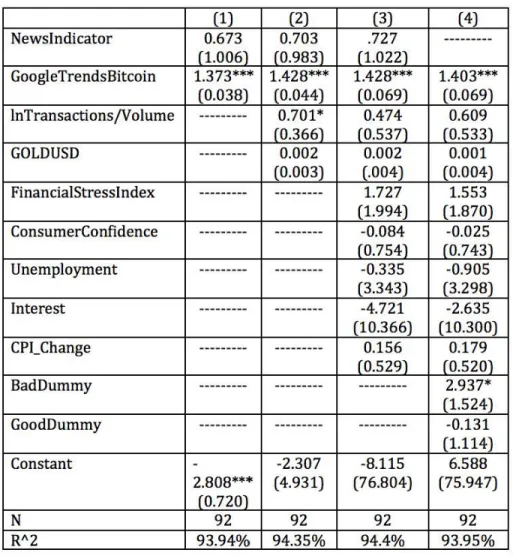
The results are outlined in figure 6. Most variables yield insignificant results. Models (1) through (3) did not yield significant results for our variable of interest, namely NewsIndica-tor. However, GoogleTrendsBitcoin has significant results at the 1% level in all four models. Model (1) is used to show how strong of a relationship Google trends data has on volatil-ity. An increase of 1 unit in the GoogleTrendsBitcoin index constitutes an expected 1.4% increase in price volatility. We noticed TheR2 value does not change significantly across all
four models. This indicates that GoogleTrendsBitcoin correlates heavily with the dependent variable lnVolatility. In model (2) lnTransactions/Volume yields a significant positive coef-ficient at the 10% level, but GOLDUSD yields insignificant results. Model (2) suggests that a 1% increase in the average transaction size correlates with a 0.7% increase in price volatil-ity. In models (3) and (4) lnTransactions/Volume and GOLDUSD both yield insignificant results.
Notably all five variables used to control for economic health yielded insignificant results in models (3) and (4) as expected. In model (4), BadDummy yielded significant results at the 10% level. Model (4) suggests that the presence of a negative news article correlates with a 2.9% increase in Bitcoin’s price volatility. Last we noticed that although ConsumerConfi-dence is insignificant in models (3) and (4), it obtains a negative sign in each, indicating the possibility of a negative relationship with price volatility . A closer look at these results are explained in the discussion below.
6
Discussion
The results suggest that Google trends data has the most significant influence on the volatility of Bitcoin prices. This agrees with the literature (Puri, 2016). Perhaps this is due to Bitcoin being a new phenomenon, and the more search activity truly manipulates the public’s investing behavior. The purpose of model (1) is to show how the R2 value is very high even though only two variables are included. This is due to Google trends correlating with the majority of change in Bitcoin prices. Not surprisingly it yielded significant and positive results.
The NewsIndicator variable did not yield significant results; however, model (4) yields significant positive results for BadDummy. According to figure 2 there are significantly less negative news articles (16.1%) than positive articles (32.2%) during the time period of observations. This suggests that these results may become clearer as a longer timeline for Bitcoin develops. GoodDummy yields insignificant results and the wrong sign in model (4). We conclude from this, that in our model, negative news has a stronger influence than positive news in the NewsIndicator variable’s ability to explain price volatility. The idea that negative news influences investors in the Bitcoin market more than positive news is supported by (Kaminski and Gloor, 2014).
Model (2) is utilized for comparison purposes with model (3). We notice that lnTrans-action/Volume is significant in model (2) and becomes insignificant when economic health variables are included in models (3) and (4). Previous research suggests that economic health variables may have little to no effect on the price of Bitcoin (Ciaian et al., 2016)(Puri, 2016). We replicate this discovery in models (3) and (4) since we find FinancialStressIndex, Con-sumerConfidence, Unemployment, Interest, and CPI Change to all yield insignificant results. Furthermore, these variables do not have a significant affect on the R2 value or other
coef-ficients when we compare models (2) and (3). We do notice however, ConsumerConfidence yields a negative coefficient in models (3) and (4). Literature suggests that consumer con-fidence does not have a precise direction of influence on the volatility of Bitcoin (Klabbers,
2015), so perhaps a larger data set can confirm that consumer confidence has a negative relationship with Bitcoin price volatility.
6.1
Critiques
It is possible that there are other variables that have a significant influence on Bitcoin’s price volatility that were not included in any of our four models. The current literature that attempts to explain Bitcoin volatility is not fully developed. Our research reinforces the re-sults of previous literature; however, there are still some caveats to our study. Unfortunately, this study utilizes monthly data whereas daily data would capture better approximations. The issue with collecting the data is that many of the economic variables are collected on a monthly, quarterly, or annual basis. It is not currently feasible to construct a daily data set using the same variables to test our hypothesis. Furthermore, a time lag may be useful to capture non-immediate effects on price volatility (Glaser et al., 2014b). It is possible that many of the independent variables have a delayed impact on Bitcoin price volatility.
As mentioned previously, it is possible that the models in this study have omitted vari-ables that are causing biases. Including these omitted varivari-ables while simultaneously avoiding issues with multicollinearity would certainly generate a more accurate model. Furthermore, we may also benefit by using instruments to reflect the possibility that Bitcoin volatility could be driving some of our independent variables. For example, as Bitcoin’s price becomes more volatile the public may be using Google as a tool to learn more about its volatility. In this sense, volatility would be driving the Google trends data rather than Google trends data driving volatility. Resolving this issue along with the other problems previously mentioned is left up to future research.
As Bitcoin’s timeline evolves, more relevant data will help economists build better mod-els to predict and influence the price of Bitcoin. For the most part our modmod-els re-affirmed many of the discoveries from previous literature. But Bitcoin’s lack of a time line implies our results could change as new data is recorded. It will be interesting to observe how the next
international recession effects Bitcoin’s price volatility. It is crucial that new research contin-ues to utilize and re-evaluate updated data in order to gain a comprehensive understanding of the Bitcoin market.
6.2
Bitcoin as an Asset
During January and February of 2018 three separate news announcements shocked the crypto currency world. Google and Facebook announced it would no longer support crypto currency advertisements, and the SEC (Security Exchange Commission) made it clear that crypto currencies must obey security laws by demanding ICOs and crypto currency platforms to be registered (Forbes, 2018). In the wake of these announcements Bitcoins price fell over 40% in the following two months. According to the results of this study, price volatility is primarily correlated with Google trends data. With no central bank or laws to protect Bitcoin and its users, we suggest not using Bitcoin as an investment tool due to the high risk and unstable nature of its price formation. Investors artificially drive Bitcoin’s price upwards based solely on expectations. This can be very dangerous since news and the public’s opinion can have such a large effect on price. If Bitcoin were only used as a medium of exchange its price may better reflect the intrinsic value of Bitcoin, thus creating support for long-term stability. For now, Bitcoin prices do not reflect the real value of using block chain technology. Once crypto currencies have been built into public infrastructure its intrinsic value should increase since it will gain more advantages over fiat currency. Until then, Bitcoin is too unpredictable to be utilized as a reliable investment tool.
7
Conclusion
This study set out to determine whether or not news has a significant impact on the volatility of Bitcoin. Using OLS regression analysis, our models find Google trends data to be the most important factor in determining Bitcoin volatility. This signifies that the number
of people searching the term Bitcoin correlates highly with price volatility. A closer look at the results reveals that, in our data set, negative news has a significant impact on price volatility. Furthermore, our models found economic indicator variables to be insignificant in determining price volatility. Further research is necessary to address a few questions. First, what affect does the volatility of Bitcoin have on the economies around the world? What factors, if any, can be used to mediate Bitcoin’s volatility? What impact does Bitcoin’s volatility have on its own longevity? And last, what are all the factors, besides the ones laid out in this paper, that cause Bitcoin to remain so volatile?
Policies may need to be implemented to mitigate Bitcoin’s market’s effect on the wellbeing of the world’s economy. If Bitcoin creates economic chaos, then it should be regulated and monitored more closely. Policy makers would need to identify a method to safely mitigate Bitcoin’s volatility, which in turn should make the crypto currency safer, without hurting the economy. If Bitcoin’s volatility implies that it is a short-term phenomenon, meaning it is likely to be replaced with something better and safer, then policy makers should consider the phasing out of Bitcoin as a reasonable solution to its associated economic chaos.
This paper addresses a few variables that appear to drive Bitcoin’s volatility, namely Google trends data and negative news announcements. A deeper analysis of these variables, as well as a closer look at other possible explanations for Bitcoin’s volatility should be investigated in order to properly grasp how Bitcoin’s market reacts to shocks and other exogenous factors. Our research suggests that Bitcoin is not currently a wise investment tool due to its unpredictable price changes. More information and data must be unraveled before investors can securely rely on Bitcoins price to behave in a predictive manner.
Alternative money systems such as Bitcoin have come and are here to stay. More forms of regulation are likely on the horizon, and policy implementation will need the help of economists. Since Bitcoin does not belong to a single country, regulating Bitcoin should initiate in the form of a conversation between multiple nations. One thing researchers need to understand is why Google trends data is so highly correlated with price volatility. A
collective look at this question from multiple points of view will likely generate the most effective way to go about implementing policies. Many new crypto currencies are emerging, and there are a lot of advantages to be utilized from this technology. But In order for cryptos to have a smooth transition into the world’s infrastructure it will require a collective effort to understand the implications of each policy made within a society. In time, there will ideally be enough data and research to properly regulate and utilize crypto currencies to their fullest potential.
Figure 1
Figure 3
Figure 4
Figure 6: Dependent variable is lnVolatility: Standard errors are in parentheses (* significant at 10%, *** significant at 1%) (1) (2) (3) (4) Newslndicator 0.673 0.703 .727 ... (1.006) (0.983) (1.022) GoogleTrendsBitcoin 1.373*** 1.428*** 1.428*** 1.403*** (0.038) (0.044) (0.069) (0.069) lnTransactions/Volume ... 0.701* 0.474 0.609 f0.366) f0.537) f0.5331 GOLDUSD ... 0.002 0.002 0.001 (0.003) (.004) (0.004) FinancialStresslndex ... .. ... 1.727 1.553 (1.994) (1.870) ConsumerConfidence --- --- -0.084 -0.025 f0.754) f0.743) Unemployment
---
... -0.335 -0.905 (3.343) (3.298) Interest ... ... -4.721 -2.635 (10.366) (10.300) CPI_Change ... .. ... 0.156 0.179 f0.529) f0.520) BadDummy --- --- --- 2.937* (1.524) GoodDummy ... ...---
-0.131 (1.114) Constant-
-2.307 -8.115 6.588 2.808*** (4.931) (76.804) (75.947) (0.720) N 92 92 92 92 R/\2 93.94% 94.35% 94.4% 93.95%References
Andersson, M., Hansen, L. J., and Sebestyen, S. (2006). “Which news moves the euro area bond market?” Working Paper Series 631, European Central Bank.
Barber, S., Boyen, X., Shi, E., and Uzun, E. (2012). “Bitter to better- how to make bitcoin a better currency.”
Barker, J. (2018). “https://www.investopedia.com/articles/investing/052014/why-bitcoins-value-so-volatile.asp.”
Bitcoinity (2018). “http://bitcoinity.org.” BlockChain (2018). “https://blockchain.info.”
Bohme, R., Christin, N., Edelman, B., and Moore, T. (2015). “Bitcoin: Economics, technol-ogy, and governance.” The Journal of Economic Perspectives, 29(2), 213–238.
Bouoiyour, J., and Selmi, R. (2016). “Bitcoin: A beginning of a new phase?” Economics Bulletin, 36(3), 1430–1440.
Bouoiyour, J., Tiwari, A. K., Selmi, R., and Olayeni, O. R. (2016). “What drives bitcoin price?” Economics Bulletin, 36(2), 843–850.
Brandvold, M., Molnar, P., Vagstad, K., and Valstad, C. (2015). “Price discovery on bitcoin exchanges.”Journal of international financial markets, institutions and money,36, 18–35. Bukovina, J., and Marticek, M. (2016). “Sentiment and bitcoin volatility.” MENDELU Work-ing Papers in Business and Economics 2016-58, Mendel University in Brno, Faculty of Business and Economics.
BureauofLaborStatistic (2018). “https://fred.stlouisfed.org.”
Burnish, C., and White, A. (2017). “Bitcoin - ringing the bell for a new asset class.”Research. Cermak, V. (2017). “Can bitcoin become a viable alternative to fiat currency.”
Cheung, A. W.-K., Roca, E., and Su, J.-J. (2015). “Crypto-currency bubbles: an application of the phillips-shi-yu (2013) methodology on mt. gox bitcoin prices.” Applied Economics,
47(23), 2348–2358.
Record, 88, 2–9.
Ciaian, P., Rajcaniova, M., and d’Artis Kancs (2016). “The economics of bitcoin price for-mation.” Applied Economics, 48(19), 1799–1815.
DeepDotWeb (2018). “https://www.deepdotweb.com.”
Dyhrberg, A. H. (2015). “Bitcoin, gold and the dollar: A garch volatility analysis.”
Fang, L., and Peress, J. (2009). “Media coverage and the cross-section of stock returns.”The journal of finance,64(5), 2023–2052.
Forbes (2018). “forbes.com.”
Georgoula, I., Pounarakis, D., Blanks, C., Sotriopoulos, D., and Giggles, G. (2015). “Using time- series and sentiment analysis to detect the determinants of bitcoin prices.”
Gerber, A. S., Karlan, D., and Bergan, D. (2009). “Does the media matter? a field ex-periment measuring the effect of newspapers on voting behavior and political opinions.”
American Economic Journal: Applied Economics, 1(2), 35–52.
Glaser, F., Haferkorn, M., Christian, M., and Zimmermann, K. (2014a). “How to price a digital currency? empirical insights of media coverage on the bitcoin bubble.”
Glaser, F., Zimmerman, K., Haferkorn, M., and Siring, M. (2014b). “Bitcoin- asset of cur-rency? revealing users’ hidden intentions.”
Ingram, C., Marcel, M., and Robin, T. (2015). “”a bad apple went away” exploring resilience among bitcoin entrepenuers.”
Kaminski, J., and Gloor, P. A. (2014). “Nowcasting the bitcoin market with twitter signals.”
CoRR,abs/1406.7577.
Kim, S.-J., McKenzie, M. D., and Faff, R. W. (2004). “Macroeconomic news announcements and the role of expectations: evidence for us bond, stock and foreign exchange markets.”
Journal of Multinational Financial Management,14(3), 217–232.
Klabbers, S. (2015).Bitcoin as an Investment: The added value of Bitcoin in a Global Market Portfolio. Ph.D. thesis.