GREEN LINE EXTENSION PROJECT
PROJECT MANAGEMENT PLAN
Preliminary Engineering PhasePROJECT MANAGEMENT PLAN – PRELIMINARY ENGINEERING PHASE ENDORSEMENT PAGE
Recommended By:
Mary R. Ainsley
Director of Design and Construction - Green Line Extension Project Massachusetts Bay Transportation Authority Program Manager
Katherine S. Fichter, Green Line Extension Project
Massachusetts Department of Transportation Program Manager Manager of Long-Range Planning
Revision Log
Revision Date of Issuance Description of Changes Sections Revised
1st Draft April 16, 2010 1st Draft for Comments All Sections
2nd Draft November 29, 2010
2nd Draft with FTA/PMOC’s 6/22/10 Comments Incorporated and revisions to reflect changes in MBTA/MassDOT contract
All Sections
3rd Draft January 4, 2010 Updated ridership numbers based on revised SUMMIT runs and added
OMP to list of Attachments. Section1, Attachment N
4th Draft February 14, 2011
Updated to include further info re: Management Control and design standards; includes revised Org Chart.
Sections 2, 3 and 9.
5th Draft May 31, 2011
Updated to reflect changes in Gilbane/HDR JV Team procedures including revised org chart, QAP, Management Configuration Plan, Progress Reports, Preliminary Risk Register, Revised Cost Estimate, Draft Real Estate Listing, Attachment additions and changes to Attachment Numbering
All Sections
6th Draft August 25, 2011
Updated project schedule (Ch. 3), Attachment A – Key Staff Directory, Revised Attachment E to reflect two separate QA & QC processes: E-1 PM/CM Quality Assurance Plan E-2 PM/CM Design Quality Control Procedures, Attachment H – Sample Project Monthly Progress Report, revised Attachment I – SCC Worksheets, Attachment N – Real Estate Acquisition List,
TABLE OF CONTENTS
1. INTRODUCTION………. 1
1.1 Project Description………..………. 2
1.2 Legal Authority and Requirements………..……… 6
1.3 Definitions of Terms ………..………. 7
2. ORGANIZATION AND STAFFING……….. 8
2.1 Project Organization-Preliminary Engineering ……….... 8
2.2 Key Agency Personnel……….... 9
2.3 Design Consultant – HDR/Gilbane and Subconsultants……… 14
2.4 Governmental and Oversight Agencies………. 18
2.5 Equal Employment Opportunity Policy………. 20
3. MANAGEMENT CONTROL………... 21
3.1 Functional and Technical Control………... 21
3.2 Cost Control………... 25
3.3 Schedule Control……… 32
3.4 Cash Management………. 37
3.5 Configuration Management………. 38
3.6 Configuration Management Planning………. 38
3.7 Document Management ……….. 38
3.8 Baseline Management ………. 39
3.9 Change Management……… 39
3.10 Cost Management………. 39
4. LABOR RELATIONS AND POLICY……….. 40
5. RISK MANAGEMENT AND INSURANCE……… 41
5.1 Scope……….. 41 5.2 Risk Identification……….. 41 5.3 Evaluation………... 41 5.4 Risk Control……….... 42 5.5 Insurance……….... 42 6. ENVIRONMENTAL ASSESSMENT AND MITIGATION………. 43
7. PROCUREMENT OF SERVICES……….... 44
7.1 Procurement Methodologies………... 44
7.2 Procurement of Design-Build Contracts………... 44
7.3 Procurement Packaging……… 45
7.5 Affirmative Action Goals………... 46
7.6 Contract Modifications………... 46
8. PROCUREMENT OF MATERIALS AND EQUIPMENT……….. 47
8.1 Procedure for Procurement of System-wide Components ………… 47
8.2 Quality Assurance Requirements ……….……. 47
8.3 System and Equipment Test and Evaluation Plan ………. 47
8.4 Identification of DBE Opportunities……….…… 47
9. PRELIMINARY ENGINEERING PROGRAM………. 48
9.1 Requirements and Standards……….. 48
9.2 Design Supervision………... 49
9.3 Design Coordination – Internal, External………... 49
9.4 Design Review Process……… 50
9.5 Value Engineering………. 51
9.6 Constructability Reviews……….. 53
9.7 Operations and Management (O&M) Considerations and Reviews. 53
9.8 Change Control……….. 54
9.9 Systems Integration……….. 54
9.10 Reliability, Availability, Maintainability, Dependability and Safety…. 55
10. RIGHT-OF-WAY ACQUISITION……….. 56
10.1 Overview……….. 56
10.2 Conceptual to Preliminary Engineering Design Property Acquisition Cost Estimates………... 56
10.3 Negotiation of Final Appraised Value with Landowner………. 57
10.4 License Agreements……….. 57
10.5 Eminent Domain………. 57
11. COMMUNITY OUTREACH PLAN……… 59
11.1 Community Outreach Program Objectives………. 59
11.2 Community Outreach Program………. 59
11.3 Interfaces with Elected Officials and Government Agencies……….. 60
11.4 Media Interface………... 61
12. CONSTRUCTION PROGRAM………... 62
13. INTERAGENCY COORDINATION……….. 63
13.1 MassDOT and the MBTA Interagency Agreements with Utility Providers………... 63
13.2 Tracking Interagency Inputs………... 63
13.3 Agreements with City and State Agencies and Authorities…………. 64
ATTACHMENTS
A Green Line Extension Project - Key Staff Directory B MBTA Project Management Manual
C Configuration Management Plan
D MBTA/MassDOT Project Quality Assurance Plan E-1 PM/CM Quality Assurance Plan
E-2 PM/CM Design Quality Control Procedures
F Sample Design Consultant Monthly Progress Report G Document Control Plan
H Sample Project Monthly Progress Report I Project Capital Cost Estimate (SCC Format) J Preliminary Design Risk Register
K MBTA Procurement Manual for Construction (January 2010)
L MBTA Procurement Manual for Professional Services (January 2010) M MBTA Contract Change Order Guidelines (February 2010)
N MBTA Real Estate Acquisition Management Plan O MBTA Safety and Security Management Plan
P MBTA Light Rail Transit System Operations and Maintenance Plan Q MBTA Commuter Rail Fleet Management Plan
R MBTA Heavy Rail and Light Rail Operations Fleet Management Plan S MBTA Bus Fleet Management Plan
1
1. INTRODUCTION
Section 324 of the Surface Transportation and Uniform Relocation Assistance Act of 1987 requires that major capital projects prepare and implement a Project Management Plan (herein known as the PMP or the “Plan”). The Massachusetts Bay Transportation Authority (MBTA) and the Massachusetts Department of Transportation (MassDOT) have prepared this PMP that provides a framework for the management of the Green Line Extension project. This PMP defines the details of project management during the preliminary engineering phase of project development, and also provides the framework for managing the subsequent final design, construction, procurement, testing and startup, and revenue service phases. This document outlines the management philosophy, goals and objectives, and organizational structure; defines the responsibilities and roles of project participants; identifies the interactions among project staff and consultants; and specifies the general procedures and management tools that will be implemented to ensure effective project management and successful project completion.
In addition to serving as a clarifying guide for all project participants, this document will serve as a basis for measuring and assessing the project’s performance and consistency with the Plan. As the project advances into preliminary engineering, MBTA, with the support of MassDOT, will provide the necessary resources and expertise to allow for proper and effective management of this project. As design and construction work advances and additional procedures are developed, the Plan will be updated as needed and appropriate.
The development of the PMP will be an evolving process: the PMP will be updated and revised as needed. Per FTA guidance, revisions to the PMP will include periodic updates to the plan, especially related to project budget and schedule, financing, ridership estimates, and the status of local efforts to enhance ridership where ridership estimates are contingent on the success of those efforts. At a minimum, the PMP will be updated prior to advancing into the Final Design and Construction phases. The MBTA will be responsible for the maintenance of and subsequent revisions to the PMP as part of the preliminary engineering phase, with the support of MassDOT.
Procedure for Revisions
The parties requesting the revision will issue a written request to the MBTA stating the proposed change(s) and the reason(s) for the changes. MassDOT and the MBTA will review each request. If the proposed revision(s) is approved, the MBTA will issue the change(s) to all recipients of the manual. A published revision will include:
• A cover memo describing how and where to place the revision in the manual (revision instructions);
• A new cover page with revised date;
• A revised Table of Contents, if required;
• The revised pages of text with revision number and revision date placed at the bottom of the page; and
2
1.1
Project Description
The Green Line Extension project (the project) is an initiative of the MBTA and MassDOT to expand transit services in order to improve mobility and regional access for residents in some of the region’s most densely populated municipalities of Cambridge, Somerville, and Medford, Massachusetts. The purpose of the Green Line Extension project is to improve corridor mobility, boost transit ridership, improve air quality, ensure equitable distribution of transit services, and support opportunities for smart growth initiatives and sustainable development in the project study area of Cambridge, Somerville, and Medford.
The project would provide Green Line service for 4.3 miles beyond a relocated Lechmere Station to College Avenue in Medford and to Union Square in Somerville using a two-branch operation, both to be operated within existing MBTA commuter rail rights-of-way. The proposed Green Line Extension project is shown in Figure 1-1. The project’s two branches consist of:
• A main branch, 3.4-miles long, to Medford within the existing MBTA Lowell Line commuter rail right-of-way (the “Medford Branch”) with five stations and the terminus at College Avenue in Medford. Intermediate stations are located at Washington Street, Gilman Square, Lowell Street, and Ball Square.
• A second branch, approximately 0.9 miles long, to Union Square in Somerville (the “Union Square Branch”). This branch would follow the existing MBTA Fitchburg Line commuter rail right-of-way and includes a single station at Union Square.
Additionally, the project will include acquisition of 24 new Green Line vehicles and construction of a support facility for storage and servicing of the fleet and existing north side Green Line operations.
Travel Times
Travel times between proposed stations were estimated based on travel distances and estimated speeds. The travel speeds between proposed stations were based on the railroad’s physical and operational characteristics. Estimated travel time between each station for the proposed Green Line Medford Branch is shown in Table 1-1.
3 Figure 1-1 Project Area Map
4
Table 1-1 Proposed Green Line Extension Project: Medford Branch Travel Times
Station Distance (miles) Travel Time (minutes) Dwell Time (minutes) Cumulative Travel Time (minutes) Lechmere Brickbottom 0.78 2.25 0.75 3 Gilman Square 0.71 1.25 0.75 2 Lowell Street 0.70 1.25 0.75 2 Ball Square 0.49 0.75 0.75 1.5 College Avenue 0.57 1.0 0 1.0 Total 9.5
*Estimated travel time between Lechmere Station and Union Square Station is 4.5 minutes.
Headways
The operating plan for the Green Line Extension project would extend the existing Green Line D branch service from the relocated Lechmere Station to the northwest to College Avenue. The Green Line service beyond Lechmere Station for the Medford Branch would operate on headways equal to that of the existing Green Line D branch service: five minutes in the morning and evening peak periods and ten minutes during off-peak periods. The Green Line service beyond Lechmere Station for the Union Square Branch would operate on headways equal to that of the existing Green Line E branch service: six minutes in the morning peak period, five minutes in the evening peak period, and between nine and 10 minutes during off-peak periods.
Fares
Fares for the Green Line Medford Branch and Union Square Branch under the proposed Green Line Extension project will be consistent with the current fare structure for the MBTA Subway System.
Vehicle Requirements
The Green Line Extension project vehicle fleet will include a mix of three vehicle types: the two current vehicles (Type 7 high-floor cars and Type 8 low-floor cars) and a new “Type 9” low-floor car, which is currently under development. The Type 9 cars will be procured as part of the Green Line Extension project, which will expand service on the existing Green Line. Based on the passenger capacity and the projected ridership and proposed operating plan, it was determined that 24 additional Green Line cars would be needed to accommodate the proposed headways and projected ridership for the project.
5
Ridership
The Green Line Extension project is expected to generate new systemwide transit ridership of 7,500 boardings per day and a reduction of 25,728 VMT per day (projected to the year 2030). Table 1-2 shows the daily station boardings and alightings at the proposed stations. More detailed discussion on the project can be found in Green Line Extension DEIR/EA.1
Table 1-2: Green Line Extension Project: Station Level Data
Anticipated Station Level Weekday Boardings and Alightings
Base Year No-Build (2030) Proposed Action (2030)
Boardings Alightings Boardings Alightings Boardings Alightings
Key Operating Characteristics
• Green E ends at
Lechmere
• Green E ends at
Lechmere
• Green E ends at Union
Square • Green D ends at Government Center • Green D ends at Government Center • Green D ends at College Avenue • Rte 80: Arlington to Lechmere • Rte 80: Arlington to Lechmere • Existing Lechmere Station • Existing Lechmere Station • Relocated Lechmere Station System Existing
Green Line North Station 8,700 8,700 12,640 12,640 13,610 13,610
Green Line Science Park Station 800 800 1,790 1,790 1,170 1,170
Green Line Existing Lechmere Station 6,400 6,400 9,290 9,290 n/a n/a
Extension
Green Line Relocated Lechmere Station n/a n/a n/a n/a 7,100 7,100
Green Line
Washington Street Station
(formerly Brickbottom) n/a n/a n/a n/a 2,830 2,830
Green Line Gilman Square Station n/a n/a n/a n/a 3,930 3,930
Green Line Lowell Street Station n/a n/a n/a n/a 1,140 1,140
Green Line Ball Square Station n/a n/a n/a n/a 1,850 1,850
Green Line College Avenue Station n/a n/a n/a n/a 2,140 2,140
Green Line Union Square Station n/a n/a n/a n/a 3,570 3,570
1
Federal Transit Administration and Executive Office of Transportation and Public Works. Green Line Extension Project Draft Environmental Impact Report/Environmental Assessment and Section 4(f) Statement. October 15, 2009.
6
1.2
Legal Authority and Requirements
On November 1, 2009, the Massachusetts transportation agencies underwent a fundamental structural change with the creation of the Massachusetts Department of Transportation (MassDOT). Chapter 25 of the Acts of 2009, “An Act Modernizing the Transportation Systems of the Commonwealth of Massachusetts” consolidated the Commonwealth’s transportation agencies into one umbrella agency, MassDOT. Now, the Secretary and Chief Executive Officer (CEO) oversees four implementing divisions as well as the Office of Transportation Planning. The implementing divisions are Rail and Transit, Highway, Registry of Motor Vehicles, and Aeronautics. In the current structure, the MBTA remains autonomous; however, changes to the structure of its Board place the Authority more in line with the transportation agenda of the Commonwealth as a whole.
MassDOT is the current proponent for the Green Line Extension project. The MBTA, with support from MassDOT, will take the management lead during the preliminary engineering phase of the project. The MBTA will manage the development of preliminary design plans and bid package materials to support procurement of a design-build contractor. MassDOT will be responsible for funding the construction and incremental operating costs for the project. MassDOT will defer to the MBTA’s design, safety, quality assurance, and real estate acquisition guidelines during subsequent phases of this project.
The Green Line Extension is a State Implementation Plan (SIP) project and, therefore, a Commonwealth commitment under the federal Clean Air Act. The funding of this project is a legal requirement of the state. While MassDOT is seeking federal New Starts funding for the project, the Commonwealth will fund the entire project if federal funding is not available.
As the operating agency and ultimate owner of the Green Line Extension, the MBTA will manage the preliminary engineering phase and the final design and construction of the project. The MBTA, with support from MassDOT, is currently seeking a contractor to provide preliminary engineering, program management and construction management services. This contractor hereafter will be referred to as the “Design Consultant.” Upon selection of a Design Consultant, the lead management responsibility for the project will be transitioned from MassDOT to the MBTA. The MBTA will be the entity to procure design-build services and manage the construction of the project. MassDOT will continue to provide oversight on the project as the design-build contract moves forward, and will also help to ensure robust public outreach during the preliminary engineering, final design and construction phases of the project.
The Green Line Extension Program Management Team (PMT), which consists of senior management from the MBTA and MassDOT, will design and oversee the construction of the project in accordance with all applicable federal and state laws, regulations, codes, and guidelines. In addition, the PMT will proactively work to ensure that the project is compatible not only with city regulations, services and facilities, but also with the residential neighborhoods and businesses abutting the project.
7
1.3
Definition of Terms
This Plan is applicable to the Green Line Extension project wherein the Design Consultant will be contracted to provide preliminary engineering design for the MBTA to solicit a design-build contractor. The MBTA, with support from MassDOT, will oversee the Design Consultant’s engineering design in order to achieve cost effective design, construction, maintenance and operations, while at the same time achieving the required level of passenger safety, system reliability and service comfort. Terms used throughout this document include:
•
Design Consultant – An independent design consultant that performs design work as directed by the MBTA or MassDOT, conducts design reviews and coordinates these reviews with the MBTA and MassDOT Program Managers or designees, third party agencies and utilities.• Design Review – The systematic and orderly review of design documents, drawings and specifications by all project disciplines at pre-established milestones throughout the design phase.
•
Preliminary Engineering – The preliminary engineering phase will be initiated at the conclusion of the Environmental Assessment. Preliminary engineering is the design phase that takes the project from a conceptual state to a level of design that allows a realistic estimate of project costs, construction schedule, environmental and community impacts. This design phase will also include performance specifications, technical provisions and statements of work for the design-build contractor. Preliminary engineering will bring the project to an appropriate level of design completion for major project components.8
2. ORGANIZATION AND STAFFING
To successfully manage the planning, design, and construction of the Green Line Extension project, a fully integrated team of MBTA, MassDOT and Design Consultant staff will be established. Section 2 of the PMP describes the organization and the structure that will be in place during the preliminary engineering phase. It provides a description of the functions, major responsibilities, and qualifications of the senior executives and key managers involved.
The Green Line Extension project Equal Employment Opportunity policy is the same one that is used by the MBTA and MassDOT. This section affirms the project’s commitment to fair employment considerations for all applicants considered for employment or procurement activities.
2.1 Project Organization – Preliminary Engineering
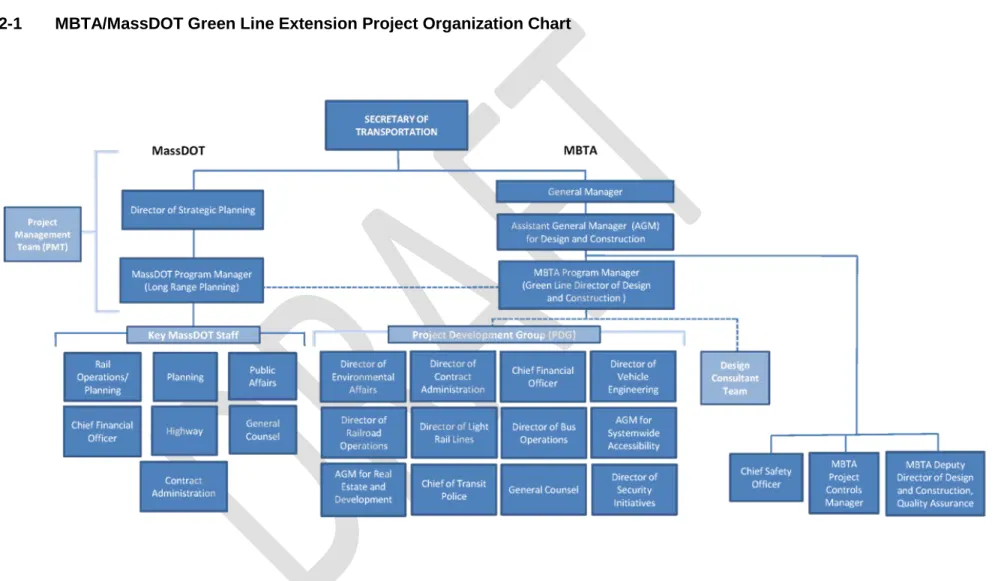
The Green Line Extension project will be successfully implemented through the concerted efforts of various organizations and responsible parties, who will work together as an integrated team providing multiple levels of oversight to ensure a successful outcome for the project.
• The Project Management Team (PMT) for the Green Line Extension is the combined senior management staff of the MBTA and MassDOT. The PMT and all other organizations involved in the project will work towards the common goal of successfully completing the project and meeting the expectations of the cities of Cambridge, Somerville and Medford, and other project stakeholders. The PMT will be responsible for managing planning, conceptual and preliminary engineering, and completion of all state and federal environmental review documents as well as all documents and submittals required as part of the FTA’s New Starts program.
• The project team will also include a Project Development Group (PDG), which will consist of technical, operations and senior management staff from the MBTA. Technical areas of expertise for the PDG will include, but not be limited to, commuter rail, light rail, planning, systems, power, bus, highway, vehicles, legal, and contracts. The PDG will provide technical and advisory support to the PMT throughout the project.
• In addition to the PDG, the project team will include various key technical, operations and senior management staff from various departments within MassDOT including, but not limited to, the Highway Division, Rail Operation and Planning, Legal, and Public Affairs. These key MassDOT team members will function similarly to the PDG and will provide technical and advisory support to the PMT.
• The PMT will also be supported by the Design Consultant and all associated subconsultants. The Design Consultant consists of an independent design consulting organization that performs design work as directed by the PMT, conducts design reviews and coordinates these reviews with the PMT. The MBTA Program Manager
9
will be responsible for managing the Design Consultant.
• The project will also involve support and oversight organizations such as the FTA, Central Transportation Planning Staff (CTPS), and the Boston Region Metropolitan Planning Organization (MPO).
The following sections describe the structure, integration, and interfaces of the project organization. These relationships are also shown on the Organization Chart in Figure 2-1. The MBTA and MassDOT organization will be described in Section 2.2, followed by the Design Consultant organization described in Section 2.3.
2.2
Key Agency Personnel
2.2.1 The Program Management Team
The PMT will be an integrated staff of managers and personnel from both the MBTA and MassDOT. The PMT will avoid overlaps in duties and functions and will provide the flexibility to accomplish project objectives effectively and efficiently. The positions of the key MBTA and MassDOT staff that comprise the PMT are shown in Figure 2-1.
The PMT for the Green Line Extension project must meet the goal of completing this project efficiently, safely, within budget, according to scope, and with a high degree of quality.
During the preliminary engineering phase of project development, the MBTA Program Manager will head the PMT. The MBTA Program Manager will be responsible for managing preliminary engineering, development of a design-build procurement package, and other interim components such as design, financial analysis and FTA coordination.
A MassDOT Program Manager has been assigned to support the MBTA Program Manager during the preliminary engineering phase and for the duration of the project. The MassDOT Program Manager will continue to provide assistance to the MBTA during all stages of project development, in order to ensure project continuity.
During preliminary engineering, and before each submittal, the Design Consultant will submit a project cost estimate and schedule to the MBTA and MassDOT Program Managers for their review. At the request of the client, the Design Consultant will provide scope, cost and schedule analysis for any major changes to the project.
MBTA Program Manager
The MBTA Program Manager will coordinate the day-to-day activities of the Green Line Extension project, including managing the Design Consultant throughout the preliminary engineering phase of the project. The MBTA Program Manager will be the single point of contact for all official information on the project. All project activities will be coordinated through the MBTA Program Manager.
10 Major Responsibilities
• Responsible for managing all day-to-day activities and providing oversight of the Green Line Extension PMT and the Design Consultant.
•
Coordinate within the MBTA on project management, project design reviews, etc.•
Responsible for performing a construction cost evaluation at the preliminaryengineering design phase submission.
• Manage the planning, scope, design and engineering, and deliver timely, cost-effective, and high quality projects for the MBTA.
• Review progress reports in accordance with the scope to maintain schedule and budget.
• Coordinate with MBTA and MassDOT departments and other key stakeholders.
• Represent the MBTA in dealings with elected officials, outside agencies (e.g. federal and local agencies) and community groups.
MassDOT Program Manager
During the preliminary engineering phase, the MassDOT Program Manager will support the MBTA in coordinating with appropriate MassDOT staff and act as a liaison with the FTA and the public.
Major Responsibilities
• Coordinate with the various MassDOT departments to ensure the project is developed consistent with MassDOT standards for delivering capital projects.
• Establish performance measures with respect to key program area goals of quality, cost-effectiveness, and timeliness.
• Represent MassDOT in dealings with outside agencies, including the FTA, and community groups.
11
12
2.2.2 Project Development Group (PDG)
During the preliminary engineering phase, the PMT will be supported by staff from various departments within the MBTA having different areas of expertise. Major technical issues and proposed solutions specific to the project design will be presented to a formal working group, the Project Development Group (PDG). The PDG will be comprised of MBTA senior management and technical and operations staff. The positions of the key MBTA staff that will comprise the PDG are shown in Figure 2-1, and a table cataloguing the specific person that holds each position is included as Attachment A.
Members of the PDG will provide advice in their particular areas of expertise/discipline. The PDG will also meet at project milestones in the preliminary engineering phase to ensure that all departments are fully briefed on the project and can comment on all aspects of the project.
Major Responsibilities
• Provide high-level technical support and expertise;
• Review designs, documents, and plans and deal with complex project issues; and
• Provide advice, reports, or assistance with the production of items, such as reports. Disciplines and expertise represented in the PDG will include, but not be limited to:
• Materials Procurement
• Rail Vehicle Engineering
• Police
• Safety
• Bus Operations
• Commuter Rail Operations
• Subway Operations
• Systemwide Maintenance and Improvements
• Information Technology
• Fixed Route Services
• Government Affairs
• Finance
• Legal
• Development and Real Estate
• Labor Relations
• Budget
• Environmental Affairs
• Organizational Diversity and Civil Rights
• Operations Planning and Scheduling
• Strategic Planning
• Design and Construction
13
2.2.3 Other Key MBTA and MassDOT Staff
MBTA Deputy Director of Design and Construction, Quality Assurance
The MBTA Deputy Director of Design and Construction, Quality Assurance reports to the AGM, who has designated the Deputy Director of Design and Construction, Quality Assurance as the person with the responsibility and authority to ensure that the MBTA quality policy is implemented and maintained on projects. The Deputy Director of Design and Construction, Quality Assurance has the necessary freedom, to implement quality related activities in all areas of MBTA projects; to identify quality problems; to initiate, recommend or provide solutions to project management, and to verify implementation of solutions. In matters related to quality on the project, the Deputy Director of Design and Construction, Quality Assurance will have complete and ready access to the PMT and the AGM.
In cases where conflicts regarding quality cannot be resolved between the Deputy Director of Design and Construction, Quality Assurance and the MBTA Program Manager (Director of Design and Construction - Green Line), final resolution will rest with the AGM.
MBTA Chief Safety Officer
The MBTA Chief Safety Officer is responsible for administrative oversight and management of the System Safety Department and is responsible for the coordination with local, state, and federal law enforcement agencies, as well as the MBTA Police. The MBTA Chief Safety Officer ensures the MBTA complies with federal, state, and local, when applicable, laws, statutes, regulations, rules, and guidelines for safety. The MBTA Chief Safety Officer shall direct all programs involving accident and safety investigations, fire and accident prevention, hazard identification, safety audit activities, and construction and environmental safety. The MBTA Chief Safety Officer will be responsible for reviewing the project Safety and Security Management Plan and will serve as the liaison with the Massachusetts Department of Public Utilities – Transportation Division and other external departments/agencies as designated by the MBTA General Manager.
MBTA Project Controls Manager
The MBTA Project Control Manager is responsible for providing technical advice and support in the areas of scheduling, cost estimating, and document control. The Project Controls Manager will be responsible for managing scheduling and estimating activities provided by outside consultants; assisting with review and analysis of project schedules and estimates, and assisting the MBTA and MassDOT Program Mangers with monitoring project schedules against actual progress by:
• Comparing baseline and report progress against the schedule;
• Forecasting impacts of proposed changes on schedules and costs;
• Assisting with workarounds and mitigation strategies for implementation by contractors; and
14
Key MassDOT Staff
Similar to the PDG in makeup, staff from various MassDOT departments will meet periodically to assist the PMT from preliminary engineering through the startup of revenue operations. Disciplines and expertise from MassDOT that will be represented on the project team will include, but not be limited to:
• MassDOT Highway
• Rail Operations and Planning
• Contract Administration
• Legal
• Public Affairs
2.3 Design Co
nsultant and Subconsultants
The Design Consultant will be retained by the MBTA to provide engineering design, program management, construction management, and support services to the PMT. The Design Consultant is expected to lead several sub-consultant firms. The Design Consultant will be responsible for the preliminary engineering phase of the Green Line Extension project, along with program management and construction management.
The Design Consultant will assist the PMT during the preliminary engineering phase, including the interim components such as design, financial analysis, coordination with the FTA and development of design-build contract documents. Once the preliminary engineering phase is completed, the project will continue with a design-build contract for final design and construction and the Design Consultant will then assist the MBTA with program management and construction management services. Another consultant will be selected as an Owner’s Representative for the MBTA before the conclusion of preliminary engineering.
Once a contract with the Design Consultant is issued, updates to the PMP will be prepared and additional information will be provided. All updates to the PMP will be submitted to the FTA for review.
2.3.1 Design Consultant Management Team
The Design Consultant Management Team is anticipated to consist of several key project management and technical staff. The following describes several proposed key management staff for the Design Consultant Team. This section will be updated, as appropriate, upon issuance of a contract with the Design Consultant.
Principal
The Design Consultant will identify a single Principal for this project. The Principal will ensure that the necessary corporate resources are available to support the needs of the project in a timely and effective manner.
15 Major Responsibilities
• Review project performance and individual performance of team firms.
• Ensure availability of corporate resources.
Project Manager
The Project Manager, who will be responsible for the overall project performance, will support the MBTA Program Manager. The Project Manager will also coordinate with all participants, as required, to build consensus on major project issues. While the Project Manager will report directly to the MBTA Program Manager, the Project Manager will have authority over all Design Consultant project matters; provide the ability to directly address any concerns or MBTA and MassDOT requests; directly interface with the PDG on issues regarding project design, construction techniques, quality, schedule, and budget performance.
Major Responsibilities
• Provide overall project leadership and direction to consultant staff and subconsultant staff.
• Interface with the MBTA and MassDOT through the MBTA Program Manager.
• Interface with regulatory agencies having jurisdiction over the project.
Project Controls Manager
The Project Controls Manager will be responsible for systems and procedures to meet project needs and MBTA and MassDOT requirements. The Project Controls Manager will oversee the project management system to ensure the accuracy and effectiveness of all non-drawing deliverables and adherence to cost, schedule, and contract requirements; and will interface with the MBTA and MassDOT on issues of cost, schedule, staffing, contract administration, scope control, and related issues.
Major Responsibilities
• Oversee project controls and procedures.
• Supervise cost and budget control and contract oversight.
• Prepare the Monthly Project Status Report.
• Develop the project cost estimate.
• Oversee budget and staffing.
Quality Manager
The Quality Manager will be responsible for the development and maintenance of the project-specific Quality Management Plan and monitoring the Design Consultant’s performance against the plan.
16 Major Responsibilities
• Develop and maintain the Quality Management Plan.
• Implement the corrective action system.
• Coordinate quality planning with senior management.
• Provide independent oversight of project activities, including audits.
Engineering Manager
The Engineering Manager will be responsible for the completion of preliminary engineering and development of the design-build procurement package. The Engineering Manager’s responsibilities will include addressing the more critical technical issues and proposing solutions for these issues. The Engineering Manager will work directly with the MBTA and MassDOT, keep the Project Manager informed of open issues, and lead the team of various engineering professionals.
Major Responsibilities
• Direct and oversee design in compliance with the scope.
• Manage the interface of the design effort with the MBTA and MassDOT.
• Direct and oversee the inclusion of all technical requirements.
• Ensure that all plans, specifications and estimates comply with MBTA and MassDOT requirements.
Planning/Policy Manager
The Planning/Policy Manager will be responsible for preparing and retaining documents related to the federal funding process on behalf of the MBTA and MassDOT. In addition, this manager will ensure that environmental compliance and mitigation commitments are being met by the project.
Major Responsibilities
• Develop and maintain documents as part of New Starts and FTA funding requirements.
• Review ridership models and adjust as project design dictates.
• Oversee the development and implementation of documents in compliance with environmental requirements.
17 Figure 2-2 Design Consultant Organization Chart
18
Civic Engagement Manager
The Civic Engagement Manager will be responsible for managing the public outreach and public participation for the project.
Major Responsibilities
• Facilitate and organize public meetings.
• Ensure adherence to the Public Involvement Plan.
• Act as a point of contact for community groups and individuals in the public.
2.4 Governmental and Oversight Agencies
2.4.1 Federal Agencies
The Green Line Extension is seeking to construct the project in part with federal funds and, therefore, certain federal transportation agencies have oversight and overview responsibilities for the program. These include:
Federal Transit Administration Transportation Systems Center Kendall Square
55 Broadway, Suite 920 Cambridge, MA 02142-1093
The FTA is a federal agency granted oversight authority within the United States Department of Transportation. The FTA administers the allocation and use of federalfunds for mass transit projects, such as the Green Line Extension project. In accordance with its charter, the FTA will evaluate the project for funding eligibility at several milestones.
The FTA has contracts with consultants to perform Project Management Oversight (PMO) to ensure compliance with FTA requirements. The PMO Contractor (PMOC) for the Green Line Extension project is Kal Krishnan Consulting Services, Inc. The contact for the PMOC is:
Ron Anderson, Sr. Vice President Kal Krishnan Consulting Services, Inc 900 Wilshire Blvd., Suite 1230
Los Angeles, CA 90017
Beginning with the preliminary engineering phase of the project, both the MBTA and MassDOT Program Managers will maintain coordination with the FTA and the PMOC.
19
2.4.2 Local Agencies
The Green Line Extension project is located within the cities of Cambridge, Somerville and Medford. The MBTA and MassDOT will maintain coordination with each city’s departments of Planning, Engineering and Construction, Transportation, Water and Sewer Commission, and other appropriate departments during the planning, design and construction phases of the project. The MassDOT Program Manager will be the coordinator for this effort.
2.4.3 Regulatory Agencies
The complexity of the Green Line Extension project requires close coordination with federal, state and county regulatory agencies. The following list includes the major regulatory agencies that will be kept apprised of the project design and construction, and may be requested to review and comment on aspects of the project.
• United States Environmental Protection Agency (EPA)
• Federal Transit Administration (FTA)
• Federal Railway Administration (FRA)
• Massachusetts Department of Conservation and Recreation (DCR)
• Massachusetts Executive Office of Energy and Environmental Affairs (EEA)
• Massachusetts Historical Commission (MHC)
• Department of Public Utilities (DPU)
Beginning with the preliminary engineering phase of the project, the MBTA Program Manager will be the coordinator for this effort.
2.4.4 Utilities
This project may affect the right-of-way of various utilities. The following is a list of utilities that may be affected:
• Above Net • AT&T • Cambridge Drain • Cambridge Sewer • Cambridge Water • Comcast • Level 3 • Lightower • MBTA (Drainage) • MCI • Medford Drain • Medford Sewer • Medford Water
• Massachusetts Water Resources Authority (MWRA) Sewer
20 • NGRID Electric • NGRID Gas • NSTAR Electric • NSTAR Electric • NSTAR Gas • RCN • Spectra–AGT Gas • Somerville Drain • Somerville Sewer • Somerville Water • Verizon
Beginning with the preliminary engineering phase of the project, the MBTA will be responsible for coordinating with the utilities with support from the Design Consultant.
2.5
Equal Employment Opportunity Policy
The MBTA and MassDOT have developed an Equal Employment Opportunity policy, and do not discriminate against any person in employment and/or in access to contracts. Further, it is the MBTA’s policy to make certain that all applicants are considered for employment, or procurement opportunities regardless of race, religion, creed, color, sex, age, national origin, disability, or marital status. All consultants will comply with the MBTA and MassDOT policy, as well as the Federal Equal Employment Opportunity policy.
The Green Line Extension project will adopt the Equal Employment Opportunity policy of the MBTA and MassDOT. As defined in this policy, affirmative action will include, but not be limited to, recruitment, hiring, promotion, compensation, benefits, transfers, layoffs, recalls, company sponsored training, education, and social and recreational programs. Goals with specific measurement factors are established to assist management’s progress toward finding remedies to any apparent discrimination.
The Green Line Extension project bases decisions on the individual’s qualifications as related to the position for which he or she is being considered. In this regard, rules of conduct are enforced equitably and impartially.
21
3. MANAGEMENT CONTROL
3.1
Functional and Technical Control
Functional control of the Green Line Extension project will be guided by the Project Quality Assurance Plan (PQAP) that will be used by the Design Consultant, the MBTA and MassDOT. The PQAP includes topics such as correspondence control, invoicing procedures, project reporting, file management and other items pertinent to the execution of the project. The format and content of the PQAP will be consistent with the MBTA QA/QC Manual, and will be submitted to the MBTA and MassDOT for review and concurrence. The PQAP will outline in general terms the procedures common to all project participants.
In order to maintain effective, consistent and timely control of all activities by the MBTA and various project participants and enhance the potential for an “on-time and on-budget” completion, the Project Management Team (PMT) will apply “best practices” for Program/Project Control and Reporting. The PMT will work with the MBTA to update the integrated Program Management Control System (PMCS) that tracks and integrates the following critical control elements for each party that is engaged on the overall Green Line Extension project:
• Performance Schedule
• Cost/Budget
• Progress Plan
• Document Control
The PMCS will be revised and updated based on the detailed work breakdown structure (WBS) with individual cost and schedule information provided by each contracting party for its part in the particular WBS element, integrated in a common software platform and established in a hierarchy of tracking and reporting. At the outset of the project the PMT will meet with each project participant to establish the format and detail required for each of the above-noted WBS elements. This information will be incorporated into one overall system that the PMT will maintain and control. This method will enable individuals involved in the project from the General Manager and Assistant General Manager levels (e.g., Level I) down to a Project Manager and Project Budget Analyst level (e.g., Level IV) to review Project Status and Information at various levels depending on their particular needs, while all information is being generated from a common source thereby ensuring consistency of reporting.
The PMCS will enable the quick and efficient control and identification of such issues as the following:
• Dependencies from one party to another
• Upcoming milestones and required performance characteristics
• Critical information need dates
• Key decision points/dates
• Performance and Progress Trends
• Deliverable Status and Requirements
22 • Exception Reporting
• Financial Status and Cash Flow Projections
The PMT will employ an “Earned Value” system of reporting progress against budget/cost. The PMT shall prepare a monthly status update of the PMCS in order to provide timely management reporting which will enable rapid response and mitigation to adverse trends, problem areas, progress shortfalls, potential progress or cost impacts, etc. before they become Milestone impacts. The PMT will meet with the MBTA and project participants as needed to review planned vs. actual progress, forecasted activity for ensuing periods, areas in need of recovery and upcoming critical milestones.
3.1.1 Technical Baseline/Configuration Control
The technical baseline of the project will be defined by the following levels:
Level 1: The Green Line Extension project
Level 2: Discipline Project Management Civil Structural Architectural Systems Geotechnical
Construction Staging / Cost Estimating Environmental
New Starts
Public Participation FTA Workshops
Level 3: Earned Value Costing Levels within Each Discipline
Level 4: Detailed Task Breakdown
Configuration Control or Configuration Management will be detailed and tracked at the lowest affected level at which the change and/or modification to the particular element appears. Any necessary change and/or modification to a particular element will be detailed to describe the change and/or modification, the reason the change and/or modification is necessary and anticipated impacts to associated elements. The configuration change must also document the effects (either positive or negative) to both the construction cost and construction schedule. If approved, notification of the configuration change and/or modification will be sent to all Discipline Task Leaders. The Configuration Management Plan is appended to this PMP as Attachments C.
3.1.2 Design Reviews
23
MBTA’s Project Management Manual, which is appended to this PMP as Attachment B) are an integral part of the design process and necessary to ensure that both the right problem is solved and that it is solved correctly. The quality assurance process for reviews is organized by phase, by discipline and across disciplines. It is both a pro-active and a reactive process; it is pro-active in the systems that are set up and the steps that are required, and it is reactive in the review of data and drawings by senior staff.
Review Systems
The review systems are developed to assist engineering in controlling the design process. These system elements are set up at the beginning of the project to enable efficient and complete project reviews including:
• Deliverables matrices that define what is required for each deliverable by discipline.
• Information management systems that ensure the latest information is available to all parties.
• Issue tracking system to ensure resolution before deliverables are due.
• Identification of responsible reviewer by discipline and by overall deliverable (cross-discipline).
• Review schedules by deliverable, including early, interim and final reviews.
• Creation of project-specific checklists for reviews, both within discipline and cross-discipline.
During the preliminary engineering phase of the project, three major design documents are expected to be prepared and submitted for review: Intermediate Design Submittal; Pre-Final Design Submittal; and Final Design Submittal.
Standards and Criteria Review
The review process used during design will include:
• Review of all applicable codes and standards;
• Review of emerging standards and agreement on their use;
• Agreement on operational and functional criteria;
• Review of study and field investigation results; and
• Review of concept design for key issues and their solutions.
Design Reviews
Design reviews will be conducted for both individual disciplines and for multi-disciplinary coordination by senior staff, utilizing the review system tools including checklists, deliverable matrices and issues lists. Reviews will be both formal on a scheduled basis, and informal as the work progresses. These reviews will include the internal checks from the preparer and reviewer and will also address the need for interdisciplinary reviews and coordination between the departments and groups. In addition to the in-process steps, the project team will conduct high-level design reviews, independent reviews, and peer reviews at critical project junctures. During the preliminary engineering phase of the
24
project, various working groups will meet regularly to discuss and coordinate various design aspects of the project. The Design Consultant will hold a weekly coordination meeting, and the MBTA will hold a monthly inter-disciplinary design meeting. A Design Working Group, consisting of stakeholders from the public, will meet on a quarterly basis to ensure that stakeholder concerns are also incorporated into the design processes.
Reviews will also be occurring on an on-going basis by the senior staff. Commentary from those reviews, as well as feedback from presentations and discussions with team members, will be documented in an issues-tracking system. The system works to keep all interface disciplines and organizations informed on issues, to engender discussion and provide a way of tracking an issue to resolution. The issues list then serves as a final checklist in reviews. Design reviews will also include peer reviews on an as-needed basis to ensure all professional work was performed within proper standards and will be implemented by credible professionals.
Constructability Reviews
The Design Consultant will participate in or conduct constructability reviews at various points in the design process. Participation may include providing support to a separate MBTA and/or MassDOT review process or may be the actual performance of the review, as directed by the MBTA and MassDOT. It is anticipated that constructability review, as with value engineering, will be done early in the preliminary engineering design phase. This is the point in time at which there is the greatest opportunity to achieve benefits in quality, cost, and time savings. Constructability reviews should also be introduced during the intermediate and final design phases as design details are developed. Each constructability review will be formally documented with all comments, recommendations, alternatives proposals, etc., incorporated together with the proposed response by the Design Consultant.
Constructability review personnel will be located in the Design Consultant’s project office. They will function as an integral part of the team from the beginning of the design effort, serving as advisors who offer an owner’s view of the project. This eliminates the hand-off from design to construction that occurs in most traditional projects. The construction personnel add value and enhance efficiency from the earliest stages of concept development. The construction staff is an integral part of the team, acting as key resource personnel supporting the MBTA Program Manager. They will participate in all of the in-house quality reviews, bringing the construction perspective to each design element. This on-going direct participation by construction experts with recent local experience will ensure that the issues of constructability, maintainability, and durability are thoroughly addressed during the design process and reflect the realities of the construction and labor market.
Bid-ability Reviews
In addition to analyses of constructability, it is extremely important that documents be reviewed for bid-ability. Near the end of preliminary engineering, the bid documents, consisting of plans; specifications; general and special conditions; and addenda, will be reviewed by the MBTA with support from the Owner’s Representative and the Design
25
Consultant to determine that all required permits and approvals have been obtained. At the time of Pre-Final Design Definition Document submittal, the bid document will also be reviewed by the MBTA and the appropriate departments who will be managing the design-build contractor.
3.1.3 QA/QC Program
For the Green Line Extension project, the MBTA and MassDOT will follow a Project Quality Assurance Plan (PQAP), meeting the requirement of the FTA’s Essential Elements of a QA/QC System that outlines and directs the specific auditing requirements that the MBTA and MassDOT will perform during the life of the project. The Design Consultant will also prepare a project-specific Design Consultant Quality Assurance/Quality Control Plan that has been reviewed and approved by the MBTA. This plan will outline the specific procedures that all participants of the Design Consultant will follow in terms of Quality Control. The plan also requires specific quality assurance measures and audits that are performed internal to the Design Consultant.
The PQAP and the Design Consultant Quality Assurance/Quality Control Plan will work in concert and complement one another to ensure the project is delivered with the quality intended. The purpose of the Quality Assurance plans is to formalize responsibilities, organization, procedures and implementation of the program, and to define their relationship to the Quality Control function. Both plans are appended to this PMP as Attachments D and E.
3.2.
Cost Control
The Design Consultant will establish and maintain a cost control and reporting system. Through this system, the Design Consultant will provide the MBTA and MassDOT with monthly summary-level cost information derived from approved budgets, current estimates, progress payments and other actual costs. This information is reported in the monthly progress report that the Design Consultant submits to the MBTA and MassDOT Program Managers. A sample Design Consultant Monthly Progress Report will be developed upon selection of the Design Consultant and will be included in Attachment F.
The Design Consultant will prepare project financial analyses, budgets, forecasts, cost estimates, project breakdown schedules, cost reduction evaluations, and financial data to meet the project’s specific needs. On a monthly basis, the Design Consultant tracks and evaluates trends and variances in the costs associated with design. Working with the MBTA and the MassDOT Program Managers, the Design Consultant assists in the evaluation of costs associated with construction, administration, utilities, real estate, and other items. In addition, the Design Consultant will recommend adjustments when adverse trends occur.
The Design Consultant Project Controls Manger will take the lead on developing, monitoring and maintaining the various components of the Cost Control System. The Design Control Project Controls Manager, in coordination with the MBTA Program Manager, will work closely with the appropriate MBTA Project Controls and Finance staff to ensure that the project costs
26
and available contingency amounts are monitored continuously and that there is adequate funding to cover proposed budget changes. Use or reallocation of contingency funds must be approved by the Assistant General Manager for Design and Construction. Cost deviations that will result in increasing the overall Program Budget will have to be approved by the MBTA Board once it is demonstrated that adequate funding exists to finance the proposed change.
3.2.1 Maintaining Baseline Project Cost
The Baseline Program Budget will be developed at the end of the preliminary engineering phase, after the alignment is refined and the project is very well defined. This will be the cost basis against which future cost performance will be measured. design-build contractor bids and performance will be constantly monitored throughout final design and construction to maintain consistency with the Baseline Program Budget.
As part of the federal funding process, the MBTA and MassDOT will request from the FTA a definitive funding contribution to the project. Once this amount is determined, the baseline budget will reflect the project cost line items in accordance with the Full Funding Grant Agreement. These line items may include support and maintenance equipment, real estate acquisition, professional service contracts, construction contracts, force accounts, supporting services and contingencies, as well as other items.
Once the Baseline Program Budget has been established, with a contingency amount consistent with the level of design, any major design changes that impact budget or schedule will undergo an independent review process. The MBTA Program Manager will direct the Design Consultant to analyze submittals associated with redesigns for cost and schedule impacts and identify any potential mitigation measures. If there is a need to increase the overall program budget, approvals from the MBTA Board will be required.
3.2.2 Performance Measurement
During the preliminary engineering design phase, there are two major components associated with the total project cost: the cost of professional services and administration, and the cost of construction. Although the actual cost of the construction will not be confirmed until the design-build contract is awarded, it is the design that influences the cost of construction. It is essential that these costs are continuously monitored and controlled throughout the preliminary engineering phase to ensure that the project progresses within budget.
The fundamental principle of cost management is the establishment of a budget estimate for the scope of work, and introduction of a set of metrics against which adherence to the budget may be measured. For this project, during preliminary engineering the Design Consultant will prepare a Work Breakdown Structure (WBS) for its activities, including specific milestones for preparation/submission of deliverables. Budgets will be applied to the WBS. An Earned Value analysis will be performed on a monthly basis to chart actual progress of specific tasks versus the actual budget spent and the “value earned” for the work that was accomplished. The percentage of work completed will be compared to the percentage of task budget expended. This analysis will be monitored and reported to the MBTA and MassDOT as a part of the Design Consultant Monthly Progress Report.
27
An Original Program Budget has been established. During the preliminary engineering phase, this Original Budget will be further refined at various stages of design, with a final Baseline Program Budget being developed at the end of preliminary engineering. The project costs will be developed in accordance with project requirements and procedures to ensure consistency of one estimate to another and will be prepared in such a manner to enable the proper evaluation of critical “cost drivers” of the overall project cost. As preliminary engineering begins to further define the specific attributes of the project, these costs will be updated and monitored so that the final Baseline Program Budget may be controlled. These metrics will continue during the design-build contract.
3.2.3 Contingency Management
Contingency funding is a fiscal planning tool for managing the risk of cost escalations and covering potential cost estimate shortfalls. Inclusion of a contingency amount in the cost estimate will minimize the impact of potential cost increases and provide for an earlier discussion of how potential budget deviations can be addressed.
Risks will be defined with specific costs allocated to them, as opposed to just "bumping up" the total cost. A risk allocated cost contingency will be included in the total project cost estimate for the mitigation of all significant risks. Risk management and contingency funding can be utilized to mitigate those risks that cause cost escalations throughout the project.
During the preparation of the Original Budget, a risk assessment was performed for the entire project in order to define and quantify the potential risk areas and types. Risk assessments will continue to be performed periodically throughout the project to update contingency amounts. Some examples of risk assessment areas include the analysis of differing site conditions, utility impacts, hazardous materials, environmental considerations, third-party concerns, geological conditions, market conditions, increased cost of commodities, etc.
When refining the project cost estimate, subsequent risk assessments will include allocating risk contingencies for major cost elements. This will assist in the mitigation of uncertainties and help create a conservative cost expectation. Probability of occurrence, severity and expected dollar value are variables that may be utilized when quantifying risk as a contingency amount. After all known risks have been identified, the cost estimate's contingency-funding levels should reflect the amount of risk associated with the project's major cost elements. Additionally, an overall management contingency can be included to cover unknown, unanticipated risks.
The following are major cost elements for contingencies that should be considered for Major projects: 1) a Construction contingency to cover cost growth during construction; 2) a Design contingency (based on different levels of design completion); 3) an overall Management contingency for third-party and other unanticipated changes; and 4) other contingencies for areas that may show a high potential for risk and change, (i.e., environmental mitigation, right-of-way, utilities, highly specialized designs, etc.). Other areas of interest for contingency cost estimating may include contractor availability and historical contingency levels for similar projects.
28
Construction contingencies will be established and adjusted based on the assessed risk in exposure to construction cost escalations. Project funding will be reviewed at periodic intervals and unused contingency funds can be released to be made available for other contracts.
Design contingency amounts will be based on the amount of design completed. When the final design is complete, the design contingency amount in the cost estimate will equal zero. Projects under design are not overestimated; the contingency is based on the uncertainty inherent in the remaining design to be completed.
The MBTA Program Manager’s responsibilities will include managing cost and schedule deviations from the approved budget and schedule, impacts resulting from the deviations, and initiatives being analyzed or implemented in order to recover any cost overruns or schedule delays. During the preliminary engineering phase of the project, the MBTA Program Manager will authorize use of management contingency and transfers to and from contingency, pending approval from the Assistant General Manager for Design and Construction, and will be responsible for reporting on contingency transfers.
An overall management contingency will be incorporated. This contingency will be a "stand-alone" piece of the cost estimate that is managed by the MBTA and MassDOT Program Managers and will be used for a broad spectrum of uncertainties.
Management of the transfer of costs to and from contingency line items will be administered and tracked carefully by the MBTA Program Manager. Cost transfers will be correlated to the major element type of cost escalation. For example, if work outside of a clearly defined scope is found to be essential and justifiable in the future, then a management decision can be made to pay for the added work from the management contingency or another appropriate contingency. On the other hand, for a specific utility issue that has a utility contingency, careful tracking of this particular contingency can help management better analyze cost overruns.
Reasons supporting contingency transfers will be noted and included in all pertinent reporting. This is so a comparison analysis to the available contingency amounts can be periodically analyzed for contingency usage rates. This analysis will show MBTA and MassDOT Program Managers that a reasonable and sufficient amount of contingency remains to keep the project within the latest approved budget.
3.2.4 Escalation Factor Derivation
The Financial Plan will take the capital costs for the following projects and escalate them to year-of-expenditure dollars (YOE$): (1) the Green Line Extension project, (2) other MassDOT SIP Commitment projects, and (3) the MBTA capital projects. The plan will take the capital costs for these project in base year 2009 dollars and escalate them to YOE$ by applying an average of forecasts of the Engineering News-Record’s (ENR’s) Building Cost Index (BCI) and Construction Cost Index (CCI) for the Boston metropolitan area.
Note: This section will be updated to reflect the escalation factor analysis once the Financial Plan is complete for the FY2012 New Starts submission.
29
3.2.5 Contracting Techniques
Contracting strategies must satisfy all objectives of the Green Line Extension project. The selected methods and strategies must accommodate the project schedule and budget, enhance system integration, anticipate the capabilities and limitations of the local contracting community, and satisfy federal, state and local requirements.
In July, 2010, MassDOT prepared a Project Delivery Alternatives Report, which identified different project delivery methods and discussed advantages and disadvantages for each one of them. The report concluded that the design-build method is advantageous over Design-Bid-Build with regard to project duration, cost controls, claims and change orders. The design-build method was approved by the Massachusetts State Legislature as an effective procurement technique in 2002 and since then has been used for various transit projects including the Greenbush project. With direction from the MBTA Program Manager, the Design Consultant will develop design-build contract bid documents under the supervision of the MBTA’s Contract Administration Department.
The MBTA Procurement Department will conduct bidding and perform contract award services including: advertising for bids; conducting pre-bid conferences; administering the document addenda; collecting and opening bids; administering bid evaluation and contractor selection and resolving selection disputes. MassDOT will provide support to the MBTA during this phase. The procurement of the design-build contractor will include a Request for Qualifications to identify potential teams who will be asked to submit a proposal, with interviews to be scheduled with each team after the evaluation committee has been given sufficient time to review the proposal submissions.
Since the Massachusetts State Legislature previously approved sufficient funding for the Green Line Extension’s local match, the Assistant General Manager for Design and Construction will recommend award to the responsive bidder as determined by the evaluation requirements established for the design-build contract. Consistent with the MBTA’s enabling legislation, the recommendation will be made to the MBTA Board, which will approve award of the contract and commit the funds.
3.2.6 Cost Allocation Plan
The Preliminary Project Budget is $953.7 million in 2010 dollars, as outlined below.
Category Budget (millions)
Right-of-Way $ 67.6
Construction $ 487.8
Vehicles $ 79.3
Administration/Professional Services $ 125.6
Contingency (Unallocated) $ 84.6
30
Escalation $108,886
*Contingency (Total) $ 953,740
Based on the Cost Estimate dated 12/13/2010, and submitted to the FTA.
*The total contingency amount includes the unallocated contingency ($83.8 million) as well as the allocated contingency as a percentage of Base Yr Dollars (these amounts are included in the Budget values for each category shown in the table).
The estimate includes an unallocated contingency of $84 million or a total contingency of $199.7 million, which are 13 percent and 31 percent of the base year dollars for all categories presented in FTA’s Standard Cost Category (SCC) sheet, respectively. The cost estima