
2016
Systemic Risk Regulation in Comparative Perspective
Systemic Risk Regulation in Comparative Perspective
Cristie Ford
Allard School of Law at the University of British Columbia, [email protected]
Follow this and additional works at: https://commons.allard.ubc.ca/fac_pubs Part of the Law Commons
Citation Details Citation Details
Cristie Ford, "Systemic Risk Regulation in Comparative Perspective" (2016) [unpublished].
This Working Paper is brought to you for free and open access by the Faculty Publications at Allard Research Commons. It has been accepted for inclusion in Faculty Publications by an authorized administrator of Allard Research Commons. For more information, please contact [email protected], [email protected].
LSMC) à la réglementation en matière de risque systémique de trois autres juridictions : les États-Unis (É.-U.), le Royaume-Uni (R.-U.) et l’Union européenne (UE). Dans le cadre de ce rapport, j’examine aussi, au besoin, les
mesures internationales visant à définir et à répondre au risque systémique3.
Les économistes tout comme les régulateurs reconnaissent que le risque systémique est une préoccupation réelle et continue. Il est généralement reconnu, dans la communauté internationale, que la crise financière de 2008 est apparue dans l’espace règlementaire des les marchés des capitaux. Puisque les conditions de base et les structures réglementaires varient d’une juridiction à une autre, les réponses réglementaires de l’après-crise sont aussi différentes dans chaque juridiction. Cependant, en ce qui a trait aux réponses de l’après-crise des thèmes communs se recoupent dans toutes ces juridictions, notamment:
1 Je remercie Kelly Kan et Mona Yousif, respectivement JD 2017 et 2016 de l’Allard School of
Law, pour leur aide à la recherche exceptionnelle dans le cadre du présent projet.
2 Le présent rapport est fondé sur l’ébauche d’avant-projet de la LSMC que j’ai reçue de Justice
Canada le 23 décembre 2015. La LSMC contient plusieurs sections distinctes et couvre tant la réglementation du risque systémique que les questions relevant du pouvoir fédéral en matière criminelle. Il contient aussi des dispositions administratives et d’application de la loi qui découlent des dispositions de fond. Le présent rapport ne porte que sur les aspects de la Loi portant sur la réglementation du risque systémique et sur la collecte de données, c.-à-d. les Parties I et II.
3 Le présent rapport adopte la définition de « risque systémique » établie dans un rapport conjoint
de la BRI, du FMI et du CSF au G-20 en 2009 : [TRADUCTION] « Le risque d’une perturbation des services financiers i) causée par l’entravement de l’ensemble ou d’une partie du système financier et ii) susceptible d’avoir des conséquences négatives graves sur l’économie réelle. La notion d’effets externes négatifs provenant de la perturbation ou la défaillance d’une institution financière, d’un marché ou d’un instrument est un élément fondamental de la définition. Tous les types d’intermédiaires, d’infrastructures ou de marchés financiers sont susceptibles de présenter une certaine importance systémique ». Fonds monétaire international, Banque des règlements internationaux et Conseil de stabilité financière, Guidance to Assess the Systemic Importance Of Financial Institutions, Markets And Instruments: Initial Considerations. 2009. Disponible en anglais seulement : https://www.imf.org/external/np/g20/pdf/100109.pdf. Ce rapport utilise également le terme réglementation macroprudentielle de manière interchangeable avec le terme réglementation du risque systémique.
* Traduction non révisée par l’auteur du rapport
2. Garantir que les régulateurs disposent d’un nouvel ensemble d’outils dans le cadre des marchés de capitaux, lesquels sont différents de ceux disponibles pour réglementer le marché des valeurs mobilières au quotidien.
Au sujet du premier point : en comparaison avec les É.-U., le R.-U. et l’UE, le Canada est la seule juridiction qui n’a pas de structure réglementaire au niveau national (ou, pour l’UE, au niveau supranational) pour traiter du risque
systémique dans ses marchés de capitaux4. Contrairement aux autres
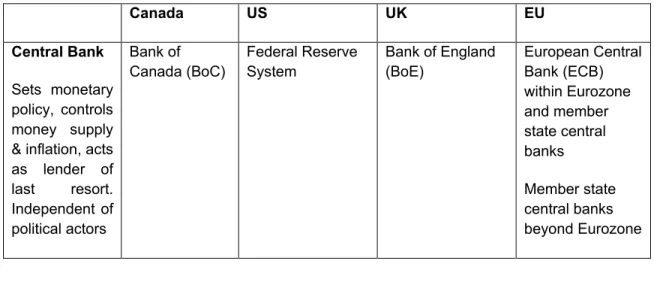
juridictions dont il est question ici, le Canada n’a même pas la capacité de recueillir les renseignements nécessaires, ni de répondre à des situations urgentes.
Au sujet du deuxième point : en plus d’avoir la capacité de répondre de façon significative au risque systémique, toutes les autres juridictions ont également une structure réglementaire différente visant à identifier, réduire et répondre au
risque systémique. Chacune des juridictions examinées considère que la nature
du risque systémique est différente des risques quotidiens qui apparaissent au
sein marchés, risques que les régulateurs provinciaux couvrent clairement au
Canada. Le risque systémique est un risque menaçant le marché lui-même et,
en raison de son caractère généralisé, il agit différemment. Cela signifie que, dans chacune des juridictions à l’étude, beaucoup des outils de réglementation concrets mis en place pour répondre au risque systémique sont différents des
4 Aux fins de ce rapport, les « marchés de capitaux » sont les marchés financiers dans lesquels
sont vendus les titres d'emprunt et de participation, les instruments dérivés, ainsi que les instruments à court terme, comme les opérations de pensions sur titre (repurchase agreements). Ce sont les marchés dont les compagnies se servent pour mobiliser des capitaux. Ces marchés font partie intégrante des « marchés financiers », plus vastes, qui aux fins de ce rapport, signifient toutes les activités du secteur financier relevant du champ d’application des régulateurs du secteur bancaire, de l’assurance et des marchés de capitaux.
marchés de capitaux d’une façon conforme aux orientations politiques internationales et aux avancées législatives d’après-crise des autres juridictions (tenant compte des différences liées aux particularités institutionnelles et constitutionnelles de chaque juridiction). En particulier, en ce qui a trait aux deux points susmentionnés :
1. Garantir que les structures réglementaires nécessaires existent : la LSMC
comblerait une lacune en matière de risque systémique dans les marchés
de capitaux, offrant une capacité que les autres régulateurs nationaux de
marchés de capitaux aux É.-U., au R.-U. et à l’UE possèdent déjà. La LSMC met l’accent sur la surveillance et la règlementation du risque
systémique dans les marchés de capitaux. Elle ne créerait pas un
organisme de surveillance du risque systémique visant les marchés financiers dans leur ensemble. Elle n’établirait pas non plus un forum multi-agences pour discuter et coordonner les actions portant sur le risque systémique. Le Comité consultatif supérieur du Canada (CCS) remplit déjà cette fonction, bien qu’il n’y ait pas de représentant d’un organisme de règlementation des marchés de capitaux, ce qui limite grandement sa portée. La participation de l’Autorité de réglementation des marchés des capitaux (« l’Autorité ») au CCS comblerait cette lacune.
2. Garantir que les régulateurs disposent d’un nouvel ensemble d’outils dans le cadre des marchés de capitaux : les pouvoirs prévus dans l’ébauche
d’avant-projet de la LSMC cherchent à cerner et à gérer le risque
systémique et non à protéger les investisseurs ou à garantir que les marchés de capitaux sont justes et efficaces. La gamme de pouvoirs
prévus dans l’ébauche d’avant-projet de la LSMC correspond aux
pouvoirs en matière de risque systémique qui existent déjà dans les autres juridictions étudiées dans le présent rapport.
regulation in three other jurisdictions: the United States (US), the United Kingdom (UK) and the European Union (EU). As part of this report I also discuss, as
necessary, international measures to define and address systemic risk. 3
Economists and regulators alike recognize that systemic risk is a real and ongoing concern. It is generally accepted in the international community that the capital markets were the regulatory space in which the financial crisis of 2008 developed. Background conditions and regulatory structures differ from jurisdiction to jurisdiction, meaning that post-crisis regulatory responses also look different in each jurisdiction. However, common themes run through all these jurisdictions in terms of responses to the crisis. They are:
1 I am grateful to Kelly Kan and Mona Yousif, Allard Law JDs 2017 and 2016 respectively, for
exceptional research assistance on this project.
2 The present report is based on a draft proposed CMSA that I received from Justice Canada on
December 23, 2015. The CMSA contains several discrete sections and covers both systemic risk
regulation and matters under federal criminal law power, along with administration and
enforcement provisions that flow from the substantive provisions. This report addresses only the systemic risk regulation and data collection aspects of the Act; i.e., its Parts I and 2.
3 This report adopts the definition of “systemic risk” put forward in a joint report by the BIS, IMF,
and FSB to the G20 in 2009: “the risk of disruption to financial services that is (i) caused by an impairment of all or parts of the financial system and (ii) has the potential to have serious negative consequences for the real economy. Fundamental to the definition is the notion of negative externalities from a disruption or failure in a financial institution, market, or instrument. All types of financial intermediaries, markets, and infrastructure can potentially be systemically
important to some degree.” IMF/BIS/FSB, Guidance to Assess the Systemic Importance Of
Financial Institutions, Markets And Instruments: Initial Considerations, Report to the G20 Finance Ministers and Central Bank Governors (October 2009). Available at
https://www.imf.org/external/np/G-20/pdf/100109.pdf. This report also uses the term “macroprudential regulation” interchangeably with “systemic risk regulation”.
i
1. Ensuring the necessary regulatory structure exists to give the jurisdiction the ability to respond quickly, proactively, effectively and in a coordinated fashion at the national or supranational (i.e., market-wide) level, and 2. Ensuring a new set of tools are available to regulators in the capital markets,
which are different in kind from those provided for to address day-to-day securities regulation.
On the first point: as compared to the US, the UK and the EU, Canada is the only jurisdiction that does not have the regulatory structure at the national level (or, for
the EU, the supranational level) to address systemic risk in its capital markets.4
Unlike the other jurisdictions considered here, Canada lacks even the ability to gather necessary information, or to respond in urgent situations.
On the second point: in addition to the capacity to respond meaningfully to systemic risk, in all other jurisdictions we also see a different kind of regulatory structure, geared toward identifying, reducing and responding to systemic risk. In each of the jurisdictions studied, systemic risk is considered different in nature from the kinds of day-to-day risks that arise within markets, which we see addressed by the different provincial regulators in Canada. Systemic risk is a risk to the market itself and, by virtue of its systems-level properties, it behaves differently. This means that, in each of the jurisdictions examined, many of the concrete regulatory
4 For purposes of this report, “capital markets” are the financial markets in which debt and equity
securities and derivatives, as well as short term instruments like securities repurchase
agreements, are sold. They are the markets that companies use to raise capital. They are part of the broader “financial markets”, which for purposes of this report means all financial sector activities that fall under the jurisdiction of banking, insurance and capital markets regulators.
ii
tools put in place to address systemic risk are different in kind from the regulatory tools that already exist to manage day-to-day operations of the securities markets. The proposed CMSA addresses systemic risk in capital markets in a manner that is consistent with international policy guidance and with post-crisis legislative developments in other jurisdictions (once necessary differences due to each jurisdiction’s unique institutional and constitutional arrangements are taken into account). In particular, vis-à-vis the two points above,
1. Ensuring the necessary regulatory structure exists: the CMSA would fill a
gap around systemic risk in the capital markets, providing capacity that
other national capital markets regulators in the US, the UK and the EU already have. The CMSA focuses on systemic risk oversight and regulation in the capital markets. It would not create a broad systemic risk oversight body over the financial markets as a whole. Nor would it establish a multi-agency forum for discussing, responding to and coordinating action with respect to systemic risk. Canada’s Senior Advisory Committee (SAC) already serves that function albeit with no representation from a capital markets regulator, which drastically limits its range. Adding the Capital Markets Regulatory Authority (“Authority”) to SAC’s membership would fill this gap.
2. Ensuring a new set of tools are available to regulators in the capital markets:
the powers provided for in the proposed CMSA are geared toward
identifying and managing systemic risk, not toward protecting investors or ensuring fair and efficient capital markets. The suite of powers contemplated in the proposed CMSA is in line with the systemic risk powers that now exist in the other jurisdictions studied here.
TABLE OF CONTENTS
MY QUALIFICATIONS ... 1
ABBREVIATIONS USED IN THIS REPORT... 2
I. BACKGROUND: GLOBAL RECOGNITION THAT SYSTEMIC RISK CALLED FOR A NEW SET OF RESPONSES ... 3
THE LAST FINANCIAL CRISIS AND SYSTEMIC RISK ... 3
GLOBAL RESPONSE ... 7
REFORMS TO REGULATORY STRUCTURES AT THE NATIONAL AND EULEVELS ... 13
Table 1: Financial Regulatory Bodies Relevant to Systemic Risk ... 21
PROVINCIAL SECURITIES REGULATORS (DAY-TO-DAY REGULATION OF SECURITIES) ... 24
COORDINATION THROUGH CANADIAN SECURITIES ADMINISTRATORS (CSA)(INFORMAL BODY, RE DAY -TO-DAY REGULATION OF SECURITIES) ... 24
OSFI(GENERALLY PRUDENTIAL REGULATION OF FEDERALLY REGULATED INSURERS) ... 25
PROVINCIAL INSURANCE REGULATORS (GENERALLY MARKET CONDUCT REGULATION – LICENSING AND MARKETING) ... 25
COORDINATION THROUGH CANADIAN COUNCIL OF INSURANCE REGULATORS (INFORMAL BODY) ... 25
II. COMPARING THE PROPOSED CMSA WITH INTERNATIONAL STANDARDS AND TRANSNATIONAL REGULATORY STRUCTURES ... 25
NEW REGULATORY STRUCTURE ... 26
DEFINITIONS OF SYSTEMIC RISK ... 28
DATA COLLECTION IN RELATION TO SYSTEMIC RISK ... 29
DESIGNATION AS SYSTEMICALLY IMPORTANT OR RISKY:FACTORS ... 32
REGULATORY POWERS TO ADDRESS SYSTEMIC RISK ... 36
Urgent Order Powers in Relation to Systemic Risk ... 41
III. CMSA POWERS AS COMPARED TO PROVINCIAL / TERRITORIAL SECURITIES REGULATORY PROVISIONS ... 42
My Qualifications
I am an Associate Professor and the Director of the Centre for Business Law at the University of British Columbia, Allard School of Law.
My research focuses primarily on regulatory theory as it relates to international,
US and Canadian financial and securities regulation. I have several publications analyzing novel remedies in securities law enforcement, principles-based approaches to securities regulation, systemic risk regulation and the regulation of financial innovation, and prospects for "responsive" financial regulation. I am co-author of the leading text, Canadian Securities Regulation (5th ed., 2014) with His Excellency the Right Honourable David Johnston and Kathleen Rockwell.
Prior to joining UBC, I practiced securities regulation and administrative law in both Canada and the United States (the latter at Davis Polk and Wardwell LLP in New York). I obtained my graduate degrees from Columbia Law School, where I also taught in a variety of capacities. I sit on the editorial boards of the international peer-reviewed journals Regulation & Governance (which I also edited from 2012 to 2015) and the Journal of International Economic Law, and I am a member of the Academic Advisory Board of the Canadian Coalition for Good Governance (CCGG). I am currently at work on a book project for Cambridge University Press, which examines the relationship between regulation and financial innovation.
Abbreviations used in this Report
INTERNATIONAL/TRANSNATIONAL
BODIES EU / UK / US REGULATORS OR BODIES
IMF International Monetary Fund ESRB European Systemic Risk Board
FSB Financial Stability Board ECB European Central Bank
BIS
Bank for International Settlements
ESAs European Supervisory Authorities
(comprised of EBA, ESMA, EIOPA)
G20 Group of Twenty EBA European Banking Authority
BCBS Basel Committee on Banking
Supervision ESMA European Securities and Markets Authority
IOSCO International Organization of
Securities Commissions EIOPA European Insurance and Occupational Pensions Authority
ESFS European System of Financial
Supervision CANADIAN BODIES
SEC US Securities and Exchange
Commission
BoC Bank of Canada CFTC US Commodity Futures Trading
Commission
OSFI Office of the Superintendent of
Financial Institutions
FSOC US Financial Stability Oversight
Council
CDIC Canadian Deposit Insurance
Corporation
OFR US Office of Financial Research
FISC Financial Institutions Supervisory
Committee FIO US Federal Insurance Office
CSA Canadian Securities
Administrators FDIC US Federal Deposit Insurance Corporation
SAC Senior Advisory Committee BoE Bank of England
PRA UK Prudential Regulation
Authority (subsidiary of BoE)
BENCHMARKS FCA UK Financial Conduct Authority
LIBOR
London Inter-Bank Offered Rate FPC UK Financial Policy Committee (housed in BoE)
EURIBOR European Inter-Bank Offered
Rate OTHER ABBREVIATIONS
TIBOR Tokyo Inter-Bank Offered Rate CCP Central counterparty
CDOR Canadian Dollar Offered Rate OTC Over-the-counter [derivatives]
CORRA Canadian Overnight Repo Rate MMFs Money Market Funds
SIFI Systemically important financial
institution 2
I. Background: Global Recognition that Systemic Risk Called for a New Set of Responses
1. The following paragraphs describe the contemporary context in which the
legislators and regulators of the financial systems must work. My objective in presenting this information is to facilitate the reader’s understanding of the main concerns resulting from the last financial crisis (2007-2008) and the international policy context before examining the specific national and EU regulatory regimes.
The Last Financial Crisis and Systemic Risk
2. As other experts in this file discuss,5 it is widely recognized that the financial
crisis that began in 2007-2008 in North America was substantially a product of unrecognized systemic risk building up within the capital markets. Its impact extended far beyond just the capital markets – and beyond the United States, the jurisdiction at the epicentre of the problems. Subsequent rounds produced bank failures in many jurisdictions, a sovereign debt crisis in Europe, and continued economic stagnation worldwide, demonstrating the breadth and depth of the impact that excessive collective risk-taking in the capital markets can have, and the extent of interconnectedness in contemporary global financial markets.
3. Systemic risk is understood to be of a different order of risk from the risks
associated with a loss of a particular investment, and to involve threats to
5 Notably Andrew Metrick, discussing money market funds, asset-backed commercial paper, the
repo market and OTC derivatives (paras 19, 24, 33 and 37) . 3
the continued existence or functioning of the market as a whole. Systemic risk may build up in highly complex and opaque markets, for highly complex and opaque products, and if not addressed can lead to fast-moving, unpredictable and potentially very damaging contagion and amplification effects that develop at that level.
4. Economists and regulators now understand that contemporary markets
behave like systems. Systems are characterized by interconnectedness,
unpredictability, and fast-moving, multiple round contagion effects.6 The
behavior of markets as systems results from financial innovation, which has broken down the formerly watertight compartments between banks, insurance companies, and the issuers and market participants operating in the capital markets. In each of these sectors, companies can now build and market products that are functionally identical to investors. More fundamentally, financial innovations marketed through the capital markets have “shattered the atom” of conventional financial products, taking apart the component elements of formerly straightforward instruments and
refashioning them into new ones.7 This has altered the relationships
6 Two university-based dynamic systemic risk models track systemic risk in real time and publish
weekly results: they are the V-Lab at the Volatility Institute, NYU Stern School of Business and the Centre of Risk Management (CRML), Faculté des Hautes Etudes Commercials, Université de
Lausanne, respectively at http://vlab.stern.nyu.edu and http://www.crml.ch/index.php?id=4. As the
FSB/IMF/BIS report above notes, different national jurisdictions are using different
methodologies, including network analysis and contagion modeling, to assess how the system
itself, and thus systemic risk, operates. Report, supra note 3 at Box 3, p. 20.
7 Ronald J. Gilson & Charles K. Whitehead, “Deconstructing Equity: Public Ownership, Agency
Costs, and Complete Financial Markets”(2008) 108 Colum. L. Rev. 231. The use of derivatives
has implications for the day-to-day regulation of the capital markets and for investor rights as well. For example, “empty voting” and “morphable ownership” – that is, the separation of a share’s economic interest from its voting rights through the use of equity derivatives – has undermined the traditional link between vote and economic interest that conceptually underpins corporate
4
between and among institutions, investors, and market participants,
introducing layers of complexity and interconnectedness.8 Complex new
chains of institutions and relationships have been introduced, which can circumvent prudential regulatory requirements (moving the products out of the reach of banking regulation and into the securities markets where “shadow banking” occurs), and fuel liquidity-dependent markets that, it turns
out, are inherently unstable in times of crisis.9 While this innovation can
takeover bid regulation. See Henry T.C. Hu & Bernard Black, “The New Vote Buying: Empty Voting and Hidden (Morphable) Ownership” (2006) 79 S. Cal. L. Rev. 811 and “Empty Voting and Hidden (Morphable) Ownership: Taxonomy, Implications, and Reforms” (2006) 61:3 Bus. Law. 1011. Nor are equity and debt instruments even entirely distinct anymore, thanks to innovations such as “reverse exchange securities” (which create assets that are half share, half bond). See, e.g., Tamar Frankel, “New Financial Assets: Separating Ownership from Control” (2010) 33 Seattle UL Rev 931 at 945- 946.
8 Professor Steven Schwarcz has discussed the challenge of complexity in the financial markets
in a way that helps shed light on what “systemic risk” entails today. He describes complexity in the assets that underlie modern structured financial products — for example, variability in property values, interest rates, mortgage terms, and the creditworthiness of individual
mortgagees — overlayered with complexity in the design of the structured products themselves — for example, in the design of synthetic products so complex that adequate disclosure to investors was virtually impossible — and exacerbated by complexity in modern financial markets (including indirect holding systems and the widespread use of complex mathematical risk
modeling). Schwarcz examines how these multiple complexities can lead to inappropriate lending standards, failures of disclosure, and a lack of transparency and even of comprehensibility. Perhaps the most difficult problem to manage is that they also create a complex system characterized by intricate causal relationships and a “tight coupling” within credit markets, in which events tend to amplify each other and move rapidly into crisis mode. Steven L Schwarcz,
“Regulating Complexity in Financial Markets” (2009) 87 Wash U L Rev 211-268.
9 Financial Services Authority, The Turner Review: A Regulatory Response to the Global Banking
Crisis (2009) at 16, 21. Securitization is also based on complex mathematical modeling, which
can itself be flawed or oversimplified: ibid. at 22; see also Erik Gerding, “Code, Crash, and Open
Source: The Outsourcing of Financial Regulation to Risk Models and the Global Financial Crisis” (2009) 84 Wash U L Rev 127-198. The FSB has identified shadow banking as a priority and identified some of the main sources of systemic risk within and connected to the shadow banking
sector: FSB, Shadow Banking: Strengthening Oversight and Regulation (27 October 2011):
http://www.fsb.org/wp-content/uploads/r 111027a.pdf?page moved=1.
5
create more efficient capital markets for periods of time, it also amplifies risk, makes it harder to track, allows it to coalesce in unanticipated places,
and threatens overall systemic stability.10
5. Regulators now appreciate that the market as a whole, as well as financial
innovation, continues to present new and poorly-understood risks.11
6. Aspects of innovative products and practices affect the day-to-day
operation of the securities market. Many of the risks created by these new
products can be addressed within a market, such as through disclosure
10 Schwarcz, supra note 8. Gilson & Whitehead, supra note 7; see also Patricia A McCoy, Andrey
D Pavlov & Susan M Wachter, “Systemic Risk through Securitization: The Result of Deregulation and Regulatory Failure” (2009) 41 Conn L Rev 1327.
11 Two examples of financial innovation that currently present new, poorly understood risk are: (1)
High frequency trading (HFT) – algorithmic trading using extremely fast computers, in which firms move in and out of securities within milliseconds or less in order to take advantage of market movements, and was responsible for the May 2010 Flash Crash; and, (2) “Fintech” – tech companies’ incursion into the financial markets, seeking to disrupt incumbents’ positions using
entirely different business models. The best-known critique of HFT is Michael Lewis, Flash Boys:
A Wall Street Revolt (New York: WW Norton and Co., 2014); see also Harald Malmgren & Mark
Stys, “The Marginalizing of the Individual Investor” The Magazine of International Economic
Policy (2010) at 46; IOSCO, “Regulatory Issues Raised by the Impact of Technological Changes on Market Integrity and Efficiency” (July 2011) at 16; IIROC, Administrative Notice, “IIROC Study of High Frequency Trading – Completion of Final Phase” (December 9, 2015) summarizing the
results of their three-phase study, at
http://www.iiroc.ca/Documents/2015/1daac865-ab9b-4ba7-9e7e-fd1588db2b5e en.pdf. On March 6, 2010, starting at approximately 2:45 pm, the S&P 500 dove an unprecedented 900 points. By 4pm closing it had recovered 600 of those points. The crash was precipitated by an exceptionally large (and erroneous) electronic sell order for a derivative that was keyed off the S&P’s value. While the order put downward pressure on the S&P’s value, it was HFT traders’ algorithmic response to it that exacerbated the pressure and created a crash. Andrei Kirilenko et al., “The Flash Crash: The Impact of High Frequency Trading on an Electronic Market” (2011):
http://www.cftc.gov/idc/groups/public/@economicanalysis/documents/file/oce flashcrash0314.pdf
. The FSB has begun to examine the systemic risks that may arise from fintech: Letter from Mark Carney, Chairman, FSB to G-20 Finance Ministers and Central Bank Governors (22 February
2016) at 1, 6:
http://www.fsb.org/wp-content/uploads/FSB-Chair-letter-to-G-20-Ministers-and-Governors-February-2016.pdf.
6
requirements (as an investor-facing measure) or the duty of care imposed on registrants (as a business conduct measure). At the same time, these innovative products and practices can also create a different order of risk to the financial system as a whole, which calls for an entirely different set of regulatory responses.
Global Response
7. The awareness of the importance of systemic risk has yielded new levels of
international coordination. Globally, regulators’ concerns have centered around the clear need for better information (including how risks are developing and how they are transmitted), the need for better coordination
across borders, better integration across regulatory silos,12 and the capacity
to move quickly and collectively in urgent situations to avoid contagion, or multiple rounds of spreading contagion. In short, the global policy response has been based on the understanding that management of this risk requires
(1) the regulatory capacity to see and understand financial markets at the
systemic level, and (2) to respond quickly and effectively to prevent a
potential source of systemic risk from actually having an adverse impact, to contain risk and to avoid contagion. The global community also recognized that in the years leading up to the crisis, certain kinds of products in the capital markets had been under-regulated, non-transparent, and complex,
12 As noted above, securities issuers, banks and insurers can now offer functionally near-identical
products for investors. The traditional financial regulatory structure, however, distinguishes between banks, insurers and securities issuers and subjects each to a different regulatory
structure. In the wake of the last financial crisis, regulators realized that cross-border coordination would be essential in future, but also that inter-regulatory coordination and “big picture”
integration had to be improved in order to eliminate regulatory gaps.
7
and that the markets for them had been vectors for transmitting systemic
risk. Prominent among these were over-the-counter (OTC) derivatives13
and securitized products.
8. No single institution or group has jurisdiction over or responsibility for what
is now a global financial system. The main players internationally, each of which has either been created post-crisis to address systemic risk and coordination, or which has generated new initiatives in response to the
crisis, are:14
• The Group of Twenty (G20) comprises 19 countries plus the European Union. The first G20 national leaders’ summit was convened in November
13 OTC derivatives trade “over the counter”, meaning that they are bilateral contracts for, usually,
quite customized products. They can be contrasted with exchange-traded derivatives, for which a public market, like the Montréal Bourse, exists. Exchanges provide transparency and price discovery functions that the OTC market does not, and as such exchange-traded derivatives do not present the same problems of opacity and the potential buildup of unrecognized systemic risk. As well, because OTC derivatives tend to be customized, they also tend to be highly complex. The market for them is much larger than the market for exchange-traded derivatives. Exchange traded derivatives are standardized, comparable, and transparent by comparison. Within OTC derivatives, the G20 Commitments developed another distinction: “standardized” OTC derivatives are relatively common and quite liquid (e.g., “plain vanilla” interest rate swaps), while
non-standardized OTC derivatives are essentially the customized ones. Under the G20 Commitments discussed immediately below, standardized OTC derivatives are now expected to be cleared through a central clearing party, which mitigates the buildup of unrecognized systemic risk within untracked bilateral contracts. A central clearing party interposes itself between buyer and seller of a derivatives contract. Non-standardized OTC derivatives need not be cleared in that way, but trades in them must still be recorded with a trade repository, which at least helps improve transparency. G20 Leaders Statement: The Pittsburgh Summit (September 24-25, 2009):
http://www.G-20.utoronto.ca/2009/2009communique0925.html at para. 13.
14 The list below does not include every potentially relevant international or transnational body.
E.g., it does not discuss the Organization for Economic Co-operation and Development (OECD) or the World Bank, since their contributions to the specific problem of systemic risk regulation in the capital markets has been less central. Both sit on the FSB, however.
8
2008 to coordinate a global response to the financial crisis. Since then, it has become the primary policy forum for international economic cooperation among G20 leaders. At its Pittsburgh summit in 2009, the G20 committed to a series of regulatory reforms (the G20 Commitments) designed to address some of the most glaring regulatory failures leading up
to the last financial crisis, such as those in the OTC derivatives markets.15
The G20 Commitments also recognize the necessity for tools to assess and
monitor the buildup of macroprudential risk.16
• Bank for International Settlements (BIS) (www.bis.org): the BIS is an organization of 60-some members, all central banks. Its membership includes the central banks of all the jurisdictions discussed in this report, including the EU. Its mission is to “serve central banks in their pursuit of monetary and financial stability, to foster international cooperation in those areas and to act as a bank for central banks”. The BIS houses the Basel Committee on Banking Supervision (BCBS), whose purpose is to provide “a forum for regular cooperation on banking supervisory matters. Its
15 G20 Leaders Statement, supra note 13. This report concentrates on the parts of the Pittsburgh
Summit commitments that deal with international financial regulation: see especially paragraphs 10 to 16 (under the heading, “Strengthening the International Financial Regulatory System”).
Other parts of the Leaders Statement address, inter alia, energy security, climate change, the
IMF and the development banks, and supporting the economically vulnerable.
16 G20 Leaders Statement, supra note 13, par. 12 under the heading, “Strengthening the
International Financial Regulatory System”.
9
mandate is to strengthen the regulation, supervision and practices of banks
worldwide with the purpose of enhancing financial stability.”17
• The Financial Stability Board (FSB) (www.fsb.org): The G20 established the FSB in 2009 with the mandate to promote international financial
stability. 18 It is the main international body tasked with identifying,
understanding and coordinating responses to systemic risk, including in the capital markets sector. It sets standards and policies, which its members commit to implementing at the national level. Its members are representatives – generally central bankers, finance ministers, and key regulators – from 25 jurisdictions, as well as international financial
institutions and other bodies.19 It has a secretariat (i.e., a professional staff)
housed within the BIS. The FSB describes its work in terms of a three stage process: identifying systemic risk in the financial sector, helping to develop and promote the implementation of effective regulatory responses to it, and overseeing and monitoring implementation of those responses. It
designates “key standards for sound financial systems”,20 produces highly
17 Bank for International Settlements, “About the Basel Committee,” September 30, 2015,
available at http://www.bis.org/bcbs/about.htm. Canada, through OSFI, began adopting the
Committee’s latest version of capital rules for banks (Basel III) in 2013 and progress is ongoing.
18 Both the G20 and the FSB had their origins in the pre-financial crisis era, but both were
substantially modified in structure, membership and form in 2009. Their pre-crisis history is omitted here.
19 Members from relevant jurisdictions include leaders of OSFI, the Bank of Canada and the
Department of Finance (Canada), the Treasury, Bank of England and FCA (UK), the Federal Reserve, Treasury and SEC (US), and the ECB. IOSCO is among its international members, as are the BIS and its Basel Committee, the OECD, World Bank, and IMF.
20 These standards are developed by other international standard setters – the IMF, the Basel
Committee, and IOSCO among others – and FSB designation indicates that they are “broadly 10
influential research reports, works cooperatively with other institutions including the BIS, IMF and IOSCO, develops policy specifically concerned with global financial stability and systemic risk, conducts “peer reviews” of member states’ financial stability and their implementation of international
standards and FSB-recognized policies,21 and delivers progress reports to
the G20. Among its most important reports are its 2009 report to the G20 on assessing the systemic importance of financial institutions, markets and instruments; and its 2011 report and recommendations for strengthening
oversight and regulation in the shadow banking sector.22
• International Organization of Securities Commissions (IOSCO)
(www.iosco.org): IOSCO’s membership comprises the securities regulators
in more than 115 jurisdictions23. It seeks to set global standards within the
securities sector, provides technical assistance, education, training and
accepted as representing minimum requirements for good practice that countries are encouraged to meet or exceed”. See FSB, Key Standards for Sound Financial Systems,
http://www.fsb.org/what-we-do/about-the-compendium-of-standards/key standards/.
21 Canada’s peer review notes that “establishing a single national securities regulator would bring
clear economic benefits – a simpler regulatory infrastructure, easier coordination and information sharing in the event of market distress, and improved cross-border cooperation. The IMF and the
OECD have both recommended this ” (going on to describe the Reference). FSB, Peer Review
of Canada: Review Report (30 January 2012) at page 7:
http://www.fsb.org/wp-content/uploads/r 120130.pdf.
22 FSB/IMF/BIS, Guidance to Assess the Systemic Importance of Financial Institutions, Markets
and Instruments: Initial Considerations, (2009), supra note 3; FSB, Shadow Banking: Strengthening Oversight and Regulation (2011), supra note 9.
23 See https://www.iosco.org/about/?subsection=membership&memid=1. This includes four out of
ten of the Canadian provinces. Canada has three votes, not four, since the number of votes for subdivisions of national units is capped at three:
http://www.iosco.org/about/?subsection=becoming a member.
11
research to its members, and coordinates with other international organizations on matters of shared interest. It does not have a substantial permanent staff. Its most important contributions for present purposes are a set of standards, the Objectives and Principles of Securities Regulation (substantially revised in June 2010), which have been endorsed by the G20, the FSB and the IMF; a set of principles for financial market infrastructures, jointly produced with the BIS; and a set of standards for financial
benchmarks, also endorsed by the G20 and the FSB.24
• International Monetary Fund (IMF) (www.imf.org): the IMF is an organization of 188 countries, working to “foster global monetary cooperation, secure financial stability, facilitate international trade, promote high employment and sustainable economic growth, and reduce poverty around the world”. The IMF operates at the level of nation states, e.g., providing loans to member countries and providing technical assistance. Its work is less relevant to systemic risk in the capital markets, but it works alongside the FSB and other organizations in filling data gaps. With the World Bank, it also evaluates member countries’ financial systems (including banks, securities markets, pension and mutual funds, insurers, market infrastructures, central bank, and regulatory and supervisory
authorities). It assessed Canada’s financial stability in February 2014.25
24 IOSCO, “Objectives and Principles of Securities Regulation” (June 2010),
https://www.iosco.org/library/pubdocs/pdf/IOSCOPD323.pdf; BIS/IOSCO “Principles for Financial
Market Infrastructures” (April 2012), http://www.bis.org/cpmi/publ/d101a.pdf; IOSCO, “Principles
for Financial Benchmarks” (July 2013):
http://www.iosco.org/library/pubdocs/pdf/IOSCOPD415.pdf.
25 Their first key recommendation is discussed below, infra at note 50 et seq.
12
9. Multiple entities with different membership and structure all to some degree aim to ensure the stability and robustness of the global financial system, within which capital markets, banking, insurance, and policy are intertwined. While the Financial Stability Board (FSB) is the single most important policy-oriented body tasked with identifying, understanding and coordinating responses to systemic risk, it has regularly coauthored reports with other organizations. Thus, even when looking only at the capital markets sector, it would present an incomplete picture to rely primarily on IOSCO alone. Reforms to Regulatory Structures at the National and EU Levels
10. Since the last financial crisis, many countries have adopted domestic
regulatory reform, in relation to both regulatory content and governance structure, to meet international commitments and incorporate lessons learned from the crisis with respect to systemic risk. This report considers the regulatory regime in the US, the UK, and the EU. A more detailed explanation of the regulatory structure of each regime, as well as a diagram visually representing their current financial market regulatory structure, is found in Appendix A.
11. Every jurisdiction studied here, except Canada as it is now, has (1) a
systemic risk oversight and regulatory structure that spans financial sectors (banking, insurance and capital markets), and (2) a set of tools capable of detecting, monitoring, and preventing systemic risk in their national capital markets.
12. Some reforms by the comparator jurisdictions were more extensive –
notably, the UK. As well, reforms in each comparator jurisdiction were necessarily different, reflecting differences in legacy regulatory structures.
13. However, none of these jurisdictions has taken the approach of addressing systemic risk going forward by focusing more on capital markets regulation on its own – using the same tools as ever – within the parameters of its traditional jurisdiction. The responses in these jurisdictions to the systemic risk that arose in the capital markets and caused the financial crisis, even though it had arisen originally in the capital markets, was not to conclude that capital markets regulators had simply failed to discharge their responsibilities. In every jurisdiction, systemic risk regulation post-crisis has been understood to require a different regulatory structure and a different set of tools than simply those that existed to answer to investor protection and efficient market priorities in the capital markets. Each of the jurisdictions discussed here turned its mind to ensuring that it had in place a regulatory structure with the ability to respond quickly, proactively, effectively and in a coordinated fashion at the national level (or at the supranational level for the EU).
14. The following are the common regulatory reforms taken by these
jurisdictions.
15. Addressing shortcomings or gaps in existing regulatory structures, in terms
of systemic risk regulation in particular, by closing regulatory gaps:
• Across jurisdictions: implementation specific measures, such as central
clearing and trade repository reporting for OTC derivatives, as agreed to by the G-20;
• The UK overhauled its financial regulatory structure. In response to a
perception that capital markets priorities had swamped prudential regulatory priorities within a unified financial regulator, that unified regulator was abolished and two new ones created. The UK adopted a version of
“twin peaks” regulatory structure, which allocates regulatory jurisdiction primarily along functional lines rather than, as was traditionally the case, along industry lines. The UK adopted a version of “twin peaks” regulatory structure under which one regulator, the Prudential Regulatory Authority (PRA), is responsible for prudential regulation of systemically important institutions across all of banking, capital markets and insurance. A separate regulator, the Financial Conduct Authority (FCA), is responsible for investor protection, business conduct, market integrity and competition across all of banking, capital markets and insurance (as well as for prudential regulation
of smaller, non systemically important institutions);26
• Through the Dodd-Frank Act (Dodd-Frank),27 the US clarified the division
of responsibilities between the SEC and the CFTC, set out the role of the Federal Reserve in regulating systemically important financial companies, and enhanced oversight of the OTC derivatives markets. The fact that shadow banks (non-bank financial institutions operating in the capital markets) were not subject to prudential regulation was addressed by creating FSOC designation, as discussed below.
26 The term “business conduct” or “market conduct” in the capital markets are generally
understood to refer to professional regulation of registrants, meaning professionals operating in the industry (especially dealers and advisors), to ensure that they maintain sound business practices and appropriate prudential standards, that conflicts of interest are mitigated, that they understand their clients’ needs and what would be an appropriate investment for them, and that they do not take advantage of the informational asymmetry they possess relative to their clients. In discussing business conduct regulation beyond capital markets (i.e., in banking and
insurance), the term should be understood to mean primarily prudential requirements.
27 Dodd-Frank Wall Street Reform and Consumer Protection Act, 12 USC 5301 (2010), s 113.
15
• In the EU, where the financial crisis evolved into the 2010/11 Eurozone debt crisis, “Member States tried to address the systemic fragility of their banking systems through national policy tools, but it became clear that, for those countries [in the Eurozone] that shared a currency and were therefore more
interdependent, more had to be done.” 28 Reforms included addressing
gaps in banking oversight by creating a Banking Union (which applies to Eurozone countries and can be joined by non-Eurozone EU countries). This involved establishing the Single Supervisory Mechanism, which grants the European Central Bank a strong supervisory role for financial stability of all banks in the Eurozone.
16. New regulatory structures to specifically address systemic risk,
notwithstanding that existing regulators in some of these jurisdictions already had jurisdiction over some aspects of systemic risk:
• Dodd-Frank established a new systemic risk oversight body, the Financial
Stability Oversight Council (FSOC). The US overlaid FSOC over its competent federal regulators that already possess jurisdiction over systemic risk in the capital markets (Securities Exchange Commission (SEC) and the Commodity Futures Trading Commission (CFTC)). The US also created a new Office of Financial Research (OFR) to support FSOC, and a new Federal Insurance Office (FIO) concerned with systemic risk in the insurance sector.
28 See: http://ec.europa.eu/information
society/newsroom/cf/fisma/item-detail.cfm?item id=20758&newsletter id=166&lang=en and http://ec.europa.eu/finance/general-policy/banking-union/index en.htm.
16
• In the UK, the BoE is now responsible for overseeing UK financial stability as a whole, including through its subsidiary the PRA, which prudentially regulates systemically important financial firms, and through the Financial Policy Committee (FPC), an independent subcommittee of the Court of Directors of the Bank of England (BoE) with responsibility for identifying, monitoring and responding to systemic risk.
• The EU established a new overarching European System of Financial
Supervision (ESFS), which includes the new European Systemic Risk Board (ESRB), and three sectoral European Supervisory Authorities (ESAs) with broad systemic risk powers in the form of a “specialized and ongoing
capacity to respond effectively to the materialization of systemic risks”.29
17. Ensuring the capacity to proactively and effectively identify systemic risk
problems across its financial sectors. This has mainly been done by creating new research capacity and new systemic risk oversight bodies as discussed above:
• In the US, the OFR collects information on financial firms from regulators
and monitors the financial system to identify potential systemic risks. The SEC also created a new Economic and Risk Analysis Division;
• In the UK, the FPC is responsible for monitoring the stability of the UK
financial system and identifying and assessing systemic risks, and for preparing semi-annual financial stability reports.
29 European Parliament and Council, Regulation (EU) No 1095/2010 establishing a European
Supervisory Authority (European Securities and Markets Authority), Article 24(1), online:
https://www.esrb.europa.eu/shared/pdf/ESRB-en.pdf?717d13c66b5166d0a0a792b400ea0d69 17
• In the EU, the relevant functions of the European Systemic Risk Board (ESRB) concerning systemic risk include data collection, sharing information with EU-level and national bodies, and collaborating with the ESAs to identify and measure systemic risk, identifying and prioritizing risks.
18. Ensuring the capacity to proactively and effectively respond to systemic
risk problems across its financial sectors:
• In the US, the SEC and CFTC are the primary investor protection and
business conduct regulators for the vast majority of capital markets issues and market participants. They can both regulate US capital markets “all the way up” with respect to these concerns, including with respect to systemic
risk.30 Now, the US FSOC can also designate financial companies,
including non-bank institutions operating in the capital markets, as “systemically important financial institutions” (SIFIs). SIFI designation results in increased regulation and supervision by the Federal Reserve, and requires the institution to adhere to heightened prudential standards. This ensures that systemically important non-banks are also subject to prudential regulation, and it fills a gap that existed previously.
• In the UK, the BoE directly prudentially regulates essential financial market
infrastructure, such as clearing houses, settlement systems and payment systems. In relation to macro-prudential matters, the FPC has the authority to give directions to the FCA and PRA requiring them to exercise their
30 They are “primary financial regulatory agenc[ies]” as defined in Dodd Frank §5301(12). For an
example of the SEC seeking to use what I am calling the top end of its jurisdiction, see the
discussion of the asset management industry, infra at note 44.
18
functions in order to implement a macroprudential measure.31 The PRA and/or FCA must comply with the FPC’s directions as soon as reasonably
practicable.32 The FCP also has the power to make recommendations to
the FCA, PRA, to the Treasury, within the Bank or to any persons, and the FCA and PRA must either comply with the recommendation, or explain its
reason for not complying.33 In certain circumstances, the PRA can exercise
a veto on the FCA: it may instruct the FCA to refrain from exercising its regulatory authority, if the PRA deems that that action may threaten the stability of the UK financial system or cause a financial institution to fail,
whose failure would have adversely affect the UK financial system.34
• The European Systemic Risk Board (ESRB) can issue warnings and
recommendations (to the Union, any member state, or any relevant EU or
member state regulator), which trigger an “act or explain” mechanism.35
31Financial Services Act 2012 ss. 9H. HM Treasury, in consultation with either the FPC or the
BoE, prescribes macro-prudential measures, which form the basis of the FPC’s directions. Ibid.at
s. 9L. The FPC also prepares policy statements, produces reports, and may make
recommendations within the BoE or to HM Treasury on select matters relating to its mandate:
ibid. ss. 9O, 9P, 9W. 32Ibid., s. 9I.
33Ibid., s. 9Q(3).
34Ibid.,, s. 3I.
35 For example, the ESRB has recommended to member states that they designate an authority
entrusted with conduct of macroprudential policy and equip it with sufficient powers, which the ESRB describes. ESRB, Recommendation on the macro-prudential mandate of national authorities”, ESRB/2011/3, online:
http://www.esrb.europa.eu/pub/pdf/ESRB Recommendation on National Macroprudential Man dates.pdf?87d545ebc9fe76b76b6c545b6bad218c. Following on the act or comply provisions, the ESRB issued a detailed follow-up report assessing countries’ compliance with the
recommendation, and issuing countries final grades (showing that 24 of 29 countries were largely 19
19. Ensuring coordination between and within jurisdictions and regulators:
• FSOC is responsible for facilitating information sharing and coordination
among financial regulators;
• Each of the UK FCA and PRA has the duty to coordinate the exercise of its
functions with the other, and must co-operate with the BoE with regard to
financial stability;36
• The overarching European System of Financial Supervision (ESFS)
facilitates coordination across financial sectors, and between the EU and national levels.
Financial Regulation in Canada
20. Canada maintains a regulatory regime with jurisdiction divided along the
traditional industry or entity lines unlike, for example, the UK, which has moved to a functionally-oriented division of responsibilities. The three main sectors of regulation are: (1) Banks, which are federally regulated by OSFI; (2) the day-to-day regulation of the capital markets as carried out by provincial and territorial securities regulators; and, (3) insurance, which is regulated at both the federal and provincial level.
or fully compliant by the deadline): ESRB Follow-up Report – Overall Assessment (June 2014), online:
http://www.esrb.europa.eu/pub/pdf/recommendations/2014/ESRB 2014.en.pdf?b0f13f86c2fe485 5025f70a23ab0a258.
36Financial Services Act, supra note 31 at ss. 3D, 3Q. 20
21. Canada also has a Senior Advisory Committee (SAC), a non-statutory consultative forum for financial sector policy issues, including financial stability and systemic vulnerabilities. SAC can coordinate among all the federal-level entities. A more complete description of Canada’s regulatory scheme and a representation by diagram is in Appendix B.
22. In comparing Canada to the UK, the US and the EU, it is apparent that each
jurisdiction contains certain features and functions in common, with the notable absence in Canada of a systemic risk regulator with responsibility for the capital markets. This is represented by Table 1 below.
Table 1: Financial Regulatory Bodies Relevant to Systemic
Risk37 Canada US UK EU Central Bank Sets monetary policy, controls money supply & inflation, acts as lender of last resort. Independent of political actors Bank of Canada (BoC) Federal Reserve System Bank of England (BoE) European Central Bank (ECB) within Eurozone and member state central banks Member state central banks beyond Eurozone
37 Financial regulation has other components not discussed here, since they are less directly
connected to systemic risk regulation. E.g., this table also does not specifically discuss credit union regulation or pension fund regulation, or other consumer financial protection agencies (e.g., the Consumer Financial Protection Bureau in the US or the Financial Consumer Agency of Canada). New initiatives for orderly resolution of systemically important financial institutions are also not covered. Note as well that this table omits considerable detail, including e.g., that depository insurance is broader in scope in some jurisdictions (the UK) than in others (Canada and the US).
21
Canada US UK EU Financial
Policy Body (as relevant to this report) Sets fiscal and economic policy Department of Finance Department of the Treasury Her Majesty’s Treasury None at EU level Coordination among member state economics and finance ministers through EU Economic and Financial Affairs Council (informal body)38 Depository Insurance Guarantees depositors’ deposits in identified institutions, generally banks Canada Deposit Insurance Corporation (CDIC) Federal Deposit Insurance Corporation (FDIC) Financial Services Compensation Scheme All EU member states have depository insurance schemes, harmonized in accordance with EU Directive on Deposit Guarantee Schemes 94/19/EC Coordinating / Oversight Body for Senior Advisory Committee Financial Stability Oversight Council (FSOC) makes Bank of England (BoE)’s Financial Policy Committee European Systemic Risk Board (ESRB)
38 One of the persistent shortcomings within EU financial regulation is that it is an economic and
monetary union (through the ECB and, for Eurozone members, based on the Euro) without being a fiscal union – i.e., there is no EU- or Eurozone-level finance ministry equivalent. Among other problems, the disconnect between single currency and potentially lax domestic fiscal policy can lead to sovereign debt crises, like the ones in Greece, Ireland, Portugal and Spain (and thus the Eurozone generally). Since 2012, the EU has made strides toward greater EU coordination, and surveillance of Eurozone member state budgetary processes, in an effort to address this
considerable gap.
22
Canada US UK EU Addressing Systemic Risk Across Sectors (SAC)39 coordinates among regulators but has no capital markets representative recommendations , designates bank and non-bank entities as systemically important, coordinates among relevant regulators and institutions (FPC) plays additional role in generating directions and recommendations , ensuring PRA and FCA are coordinating generates systemic risk warnings and makes recommendation s Regulator with Responsibilit y for Systemic Risk in Capital Markets Some may also cover banking, insurance None CMSA Authority [proposed] Primarily Securities and Exchange Commission (SEC) and Commodity Futures Trading Commission (CFTC) BoE responsible for overall systemic stability Prudential Regulatory Authority (PRA) and Financial Conduct Authority (FCA) are responsible regulators European Supervisory Authorities (ESAs)40 and national regulators ECB and national central banks
(monitoring)41
39 Another committee, the Financial Institutions Supervisory Committee (FISC), has the same
membership as SAC but focuses more directly on ensuring federal coordination and
communication with regard to financial institution supervision. SAC is a discussion forum for financial sector policy issues, including financial stability and systemic vulnerabilities. See IMF,
Canada Country Report at pp. 15-16, https://www.imf.org/external/pubs/ft/scr/2014/cr1470.pdf
40 The ESAs are the three Union-level bodies with jurisdiction over banking, securities/derivatives
and insurance respectively: the European Banking Authority (EBA), the European Securities and Markets Authority (ESMA) and the European Insurance and Occupational Pensions Authority (EIOPA).
41 Under the Single Supervisory Mechanism (SSM), as of November 2014, banks deemed
“significant” are supervised directly by the ECB. The SSM is mandatory for all Eurozone member state banks and voluntary for other non-Eurozone EU banks.
23
Canada US UK EU Securities Regulator(s) Oversees markets for securities and derivatives Provincial securities regulators (day-to-day regulation of securities) Coordination through Canadian Securities Administrators (CSA) (informal body, re day-to-day regulation of securities)
Primarily SEC and CFTC State-level regulators for intrastate and some exempt market distributions
PRA and FCA jointly for all of banking, securities and insurance European Securities and Markets Authority (ESMA) and member state securities authorities Banking Regulator Oversees banks Office of the Superintenden t of Financial Institutions (OSFI) Primarily Federal Reserve System FDIC supervises state-chartered banks not part of the Reserve system European Banking Authority (EBA) for rulebook ECB (for single supervisory mechanism), assisted by banking union member state central banks, within Eurozone Member state banking authorities beyond Eurozone 24
Canada US UK EU Insurance Regulator(s) Oversees insurers OSFI (generally prudential regulation of federally regulated insurers) Provincial insurance regulators (generally market conduct regulation – licensing and marketing) Coordination through Canadian Council of Insurance Regulators (informal body)42 State-level regulators Coordination through National Association of Insurance Supervisors (informal body) Subject to federal monitoring by Federal Insurance Office (FIO) under Dodd-Frank Act Title V European Insurance & Occupational Pensions Authority (EIOPA) and member state insurance authorities
II. Comparing the Proposed CMSA with International Standards and Transnational Regulatory Structures
23. The proposed CMSA addresses systemic risk in capital markets in a
manner that is consistent with international policy guidance and with
post-42 CCIR members are the provincial/territorial insurance regulators. OSFI is an “associate
member”: http://www.ccir-ccrra.org/en/about/members.asp.
25
crisis legislative developments in the other jurisdictions examined above, once necessary differences due to each jurisdiction’s unique institutional and constitutional arrangements are taken into account.
New Regulatory Structure
24. The proposed CMSA would create within the same regulator a data
collection capacity, and a regulator on systemic risk in the Canadian capital markets. Relative to the changes made in the other jurisdictions discussed
in this report, the changes proposed in the CMSA are relatively minimal,
and generally of a gap-filling variety. The CMSA would fill a gap around
systemic risk in the capital markets, providing oversight and the regulatory capacity to address systemic risk in those markets only.
25. The proposed CMSA would not create a broad systemic risk oversight body
over the entire financial market, as these other jurisdictions have done (US FSOC, UK FPC, and EU ESRB). Nor would it establish a multi-agency forum for discussing, responding to and coordinating action with respect to systemic risk across financial sectors. Canada’s Senior Advisory Committee (SAC) already serves that function, albeit presently with no representation from a capital markets regulator, which drastically limits its
range.43 The proposed CMSA would provide for oversight and regulation in
the capital markets only, contingent on a finding of systemic risk or systemic
43 It is expected that the new Authority (CMRA) with the statutory mandate to address systemic
risk in the Canadian capital markets, would acquire a seat on SAC. See Government of Canada,
Budget 2015, Chapter 4.1, http://www.budget.gc.ca/2015/docs/plan/ch4-1-eng.html. (“The Senior
Advisory Committee supports the provision of advice on a broad range of issues related to the stability of the Canadian financial system and legislative, regulatory, and policy issues affecting the sector. It is expected that the Capital Markets Regulatory Authority will contribute to SAC deliberations after it has begun operating.”)
26
importance, and with a requirement to consider what other regulation is already in place.
26. In terms of regulatory capacity concerning systemic risk, the Authority would
exercise powers similar to powers that national capital markets regulators in the US, the UK, and the EU already have. Specifically, the proposed CMSA would create a regulator with the capacity to manage systemic risk in the capital markets in a way that, post-crisis, the US SEC, CFTC and
Federal Reserve can already substantially do;44 that the UK FCA and PRA
can already substantially do;45 and that member state authorities and
44 Dodd-Frank allows FSOC to determine that a nonbank financial company should be subject to
prudential supervision by the Federal Reserve, in order to address systemic risk. For their part, the SEC and CFTC are responsible for discharging G20 Commitments relating to trade
repositories and central counterparty clearing of derivatives as discussed below, as well as several other aspects not discussed in detail here: see Mary Jo White, Testimony on “Mitigating Systemic Risk in the Financial Markets through Wall Street Reforms” (30 July 2013) at
https://www.sec.gov/News/Testimony/Detail/Testimony/1370539733678. The SEC has issued several proposed rules in the last year seeking to impose additional requirements on the asset management industry as well: US FSOC, “Update on Review of Asset Management Products and Activities” (18 April 2016) at
https://www.treasury.gov/initiatives/fsoc/news/Documents/FSOC%20Update%20on%20Review% 20of%20Asset%20Management%20Products%20and%20Activities.pdf at p. 2.
45 PRA regulates significant financial institutions (“PRA-authorised persons”) for prudential safety
and soundness. Its general objective is “promoting the safety and soundness of PRA-authorised persons” but given that PRA-authorised persons are systemically significant, that objective is to be advanced primarily by seeking to ensure that their business “is carried on in a way which avoids any adverse effect on the stability of the UK financial system”, and seeking to minimize the
adverse effect that their failure could have on “the stability of the UK financial system”. Financial
Services Act of 2012 s. 2B(2), (3). The FCA also plays a role in regard to systemic risk through its “integrity objective,” which is “protecting and enhancing the integrity of the UK financial system”
and which includes the UK financial system’s “soundness, stability and resilience”: Financial
Services Act of 2012 s. 1D(1), (2).
27
![Figure : Financial Regulation Framework around Systemic Risk in the European Union [1] “Business conduct” in the capital markets context refers generally to professional regulation of registrants for qualifications and sound business practices, mitigating](https://thumb-us.123doks.com/thumbv2/123dok_us/754100.2595310/64.918.125.775.197.979/financial-regulation-framework-professional-regulation-registrants-qualifications-mitigating.webp)
