University of Massachusetts Amherst University of Massachusetts Amherst
ScholarWorks@UMass Amherst
ScholarWorks@UMass Amherst
Doctoral Dissertations Dissertations and Theses
August 2015
A Platform for Scalable Low-Latency Analytics using MapReduce
A Platform for Scalable Low-Latency Analytics using MapReduce
Boduo LiUniversity of Massachusetts - Amherst
Follow this and additional works at: https://scholarworks.umass.edu/dissertations_2
Part of the Databases and Information Systems Commons, and the Systems Architecture Commons Recommended Citation
Recommended Citation
Li, Boduo, "A Platform for Scalable Low-Latency Analytics using MapReduce" (2015). Doctoral Dissertations. 378.
https://scholarworks.umass.edu/dissertations_2/378
This Open Access Dissertation is brought to you for free and open access by the Dissertations and Theses at ScholarWorks@UMass Amherst. It has been accepted for inclusion in Doctoral Dissertations by an authorized administrator of ScholarWorks@UMass Amherst. For more information, please contact
A PLATFORM FOR SCALABLE LOW-LATENCY ANALYTICS
USING MAPREDUCE
A Dissertation Presented by
BODUO LI
Submitted to the Graduate School of the
University of Massachusetts Amherst in partial fulfillment of the requirements for the degree of
DOCTOR OF PHILOSOPHY May 2015
© Copyright by Boduo Li 2015 All Rights Reserved
A PLATFORM FOR SCALABLE LOW-LATENCY ANALYTICS
USING MAPREDUCE
A Dissertation Presented by
BODUO LI
Approved as to style and content by:
Yanlei Diao, Chair
Prashant Shenoy, Member
Andrew McGregor, Member
David Irwin, Member
Lori A. Clarke, Chair Computer Science
ACKNOWLEDGMENTS
Foremost, I would like to express my sincere gratitude to my PhD advisor, Prof. Yanlei Diao, without whose guidance and support for years, the thesis would not be possible. I learnt from her not only kills to conduct research, from literature survey and solving technical problems to academic writing and presentation, but also time management, ways of critical thinking, insistence on quality of work and positive attitude towards difficulties. They will be highly valuable to me in my entire career.
I am grateful to all my thesis committee members. I am deeply indebted to Prof. Prashant Shenoy, who co-advised me throughout my thesis work. I benefited a lot from his patience, vision and immense knowledge. With his help, I was able to complete the thesis with the integration of insights across various research areas, such as queuing theory and operating systems. Next, I would like to thank Prof. Andrew McGregor, who I have closely worked with. His knowledge and enthusiasm in algorithm research inspired me to design various algorithms in the thesis. I am also grateful for having Prof. David Irwin on my thesis committee and his comments on the work.
I am grateful to many other professors at UMass. I specially thank Prof. Michael Zink for his patient help in my first year of PhD on a case study that was in a totally unknown research domain to me. I am grateful to Prof. Gerome Miklau and Alexandra Meliou for input and discussions about many aspects of database research.
I would like to thank my colleagues and friends at UMass. I particularly thank Edward Mazur for his close collaboration and his friendship. He performed extensive benchmarks over the existing related systems, such as Hadoop and HOP. I also deeply felt inspired from his devotion to techniques. During my early years at UMass, I collaborated with senior
students Thanh Tran, Zhao Cao and Devesh Agrawal. I appreciate that I could have the chance to learn from their experiences, which helped me start my PhD journey more easily. I am grateful to Yue Wang, Chao Li and Bo Jiang for active discussion with me on my research problems, as well as all the members of the database group for sharing thoughts without reservation and making the lab a nice place to work. I thank Rachel Lavery and Leeanne Leclerc for making my PhD study much easier by taking care of administrative issues. I thank Tyler Trafford for maintaining the cluster used in my thesis work. And I would like to thank all my friends at UMass who made my life at Amherst enjoyable and memorable.
During my PhD study, I had an opportunity to work as a summer intern at IBM Almaden Research Center. I would like to thank Dr. Sandeep Tata and Dr. Yannis Sismanis for their great mentorship and the experience of working in an industrial research lab. I am also grateful to all the friends I made there for many laughters in the enjoyable summer.
I am deeply obliged to my parents who are always considerate and supportive when I was facing difficulties during my PhD study. Although I have not been home for a few years, I can always feel their love, which has encouraged me to keep moving forward. I feel so lucky and proud to have them as my parents.
Finally, I want to express my heartfelt thanks to my dear wife, Liping. Since twelve years ago, she accompanied me in every step in my life. She has been my classmate, labmate, and soulmate. She was always there standing by me through the times good and bad. Without her support, the doctorate would not be possible. I dedicate this thesis to her.
ABSTRACT
A PLATFORM FOR SCALABLE LOW-LATENCY ANALYTICS
USING MAPREDUCE
MAY 2015
BODUO LI
Bachelor, HARBIN INSTITUTE OF TECHNOLOGY, CHINA Master, HARBIN INSTITUTE OF TECHNOLOGY, CHINA
M.S., UNIVERSITY OF MASSACHUSETTS AMHERST Ph.D., UNIVERSITY OF MASSACHUSETTS AMHERST
Directed by: Professor Yanlei Diao
Today, the ability to process “big data” has become crucial to the information needs of many enterprise businesses, scientific applications, and governments. Recently, there have been increasing needs of processing data that is not only “big” but also “fast”. Here “fast data” refers to high-speed real-time and near real-time data streams, such as Twitter feeds, search query streams, click streams, impressions, and system logs. To handle both historical data and real-time data, many companies have to maintain multiple systems. However, recent real-world case studies show that maintaining multiple systems cause not only code duplication, but also intensive manual work to partition the analytics workloads and determine which data is processed by which system. These issues point to the need for a general, unified data processing framework to support analytical queries with different latency requirements.
This thesis takes a further step towards building a general, unified system for big and fast data analytics. In order to build such a system, I propose to build on existing solutions on data parallelism and extend them with two new features: incremental processing and stream processing with latency constraints. This thesis starts with Hadoop, the most popular open-source MapReduce implementation, which provides proven scalability based on data parallelism. I answer the following questions: (1) Is Hadoop able to support incremental processing? (2) What are the necessary architecture changes in order to support incremental processing? (3) What are the additional design features needed to support stream processing with latency constraints? The thesis includes three parts that answer each of the questions. The first part of the thesis validates whether the existing MapReduce implementations can support incremental processing. Incremental processing means that computation is performed as soon as the relevant data becomes available. My extensive benchmark study of Hadoop-based MapReduce systems shows that the widely-used sort-merge implementation for partitioning and parallel processing poses a fundamental barrier to incremental computa-tion. I further propose a cost model, and optimize the Hadoop system configuration based on the model. The benchmark results over the optimized system verify that the barrier to incremental computation is intrinsic, and cannot be removed by tuning system parameters. In the second part of the thesis, I employ various purely hash-based techniques to enable fast in-memory incremental processing in MapReduce, and frequent key based techniques to extend such processing to workloads that require memory more than available. I evaluate my Hadoop-based prototype equipped with all proposed techniques. The results show that the hash techniques allow the reduce progress to keep up with the map progress with up to 3 orders of magnitude reduction of internal disk spills, and enable results to be returned early.
The third part of the thesis aims to support stream processing with latency constraints based on the incremental processing platform resulted from the second part. I perform a benchmark study to understand the sources of latency. I then propose a number of nec-essary architecture changes to support stream processing, and augment the platform with
new latency-aware model-driven resource planning and latency-aware runtime scheduling techniques to meet user-specified latency constraints while maximizing throughput. Ex-periments using real-world workloads show that the techniques reduce the latency from tens or hundreds of seconds to sub-second, with 2x-5x increase in throughput. The new platform offers 1-2 orders of magnitude improvements over Storm, a commercial-grade distributed stream system, and Spark Streaming, a state-of-the-art academic prototype, when considering both latency and throughput.
TABLE OF CONTENTS
Page
ACKNOWLEDGMENTS . . . iv
ABSTRACT . . . vi
LIST OF TABLES. . . xiii
LIST OF FIGURES . . . xv
CHAPTER 1. INTRODUCTION . . . 1
1.1 Thesis Contributions . . . 5
1.1.1 Hadoop Benchmarking and Optimization . . . 5
1.1.2 Incremental Processing . . . 6
1.1.3 Stream Processing with Latency Constraints . . . 7
1.1.4 System Development and Code Release . . . 10
1.2 Thesis Organization . . . 11
2. RELATED WORK. . . .12
2.1 A Survey of Data-Parallel Systems . . . 12
2.1.1 System Design Features for Low-Latency Analytics . . . 12
2.1.2 Comparison of Data-Parallel Systems . . . 14
2.2 Query Model and Query Language . . . 19
2.3 Out-of-order Processing. . . 20
2.4 Fault-tolerance. . . 21
2.5 Elasticity . . . 22
2.6 MapReduce . . . 23
2.7 Stream Database Systems . . . 24
3. HADOOP BENCHMARKING AND OPTIMIZATION . . . 26
3.1 Background . . . 27
3.1.1 Overview of MapReduce . . . 27
3.1.2 Overview of the Hadoop Implementation . . . 28
3.2 Benchmarking and Analysis . . . 30
3.2.1 Experimental Setup . . . 31 3.2.2 Result Analysis . . . 32 3.2.3 Architectural Improvements . . . 37 3.2.4 MapReduce Online . . . 38 3.2.5 Summary of Results . . . 40 3.3 Optimizing Hadoop . . . 41
3.3.1 An Analytical Model for Hadoop . . . 41
3.3.1.1 Modeling I/O Cost in Bytes . . . 42
3.3.1.2 Modeling the Number of I/O requests . . . 45
3.3.1.3 Modeling the Startup Cost . . . 47
3.3.1.4 Combining All in Time Measurement . . . 48
3.3.2 Optimizing Hadoop based on our Analytical Model . . . 48
3.3.2.1 Optimizations . . . 48
3.3.2.2 Analysis of Optimized Hadoop . . . 52
3.3.3 Pipelining in Hadoop . . . 54
3.4 Summary . . . 57
4. INCREMENTAL PROCESSING . . . .58
4.1 A New Hash-based Platform . . . 59
4.1.1 A Basic Hash Technique (MR-hash) . . . 60
4.1.2 An Incremental Hash Technique (INC-hash) . . . 62
4.1.3 A Dynamic Incremental Hash Technique (DINC-hash) . . . 67
4.1.3.1 Analysis of the DINC Algorithm . . . 70
4.1.3.2 Heuristic Improvement and the Marker Algorithm . . . 74
4.1.4 Optimizing Other System Parameters . . . 76
4.3 Performance Evaluation . . . 80
4.3.1 Small Key-state Space: MR-hash versus INC-hash . . . 81
4.3.2 Large Key-state Space: INC-hash versus DINC-hash . . . 83
4.3.3 Dynamic Hashing with Alternative Caching Algorithms . . . 86
4.3.4 Dynamic Hashing under Coverage Requirements . . . 90
4.3.5 Validation using Amazon EC2 . . . 91
4.4 Related Work . . . 96
4.5 Summary . . . 97
5. STREAM PROCESSING WITH LATENCY CONSTRAINTS . . . .98
5.1 An Initial Benchmark Study . . . 100
5.2 System Design . . . 104
5.2.1 Overview of A Scalable Stream System . . . 104
5.2.2 Extended MapReduce Architecture . . . 108
5.3 Resource Planning . . . 112
5.3.1 Model-driven Resource Planning . . . 112
5.3.2 (µ, σ2) of Per-Tuple Latency . . . 115
5.3.3 (µ, σ2) of Per-Window Latency . . . 120
5.3.4 Quantiles of Latency . . . 123
5.3.5 Job-Specific Statistics . . . 124
5.3.6 Supporting Multiple MapReduce Rounds . . . 125
5.4 Runtime Scheduling . . . 126
5.4.1 Batch-level Scheduling . . . 127
5.4.2 Tuple-level Cost-aware Scheduling . . . 128
5.4.3 Optimization in Cost-aware Scheduling . . . 136
5.4.4 Extension for Time Windows . . . 137
5.5 Performance Evaluation . . . 138
5.5.1 Latency-Aware Configuration . . . 138
5.5.2 Latency-Aware Scheduling . . . 143
5.5.3 Comparison to Other Systems . . . 146
5.5.4 Summary . . . 152
5.6 Related Work . . . 152
6. CONCLUSIONS AND FUTURE WORK . . . .156
6.1 Thesis Summary . . . 156
6.1.1 Hadoop Benchmarking and Optimization . . . 156
6.1.2 Incremental Processing . . . 157
6.1.3 Stream Processing with Latency Constraints . . . 158
6.1.4 Resulting System . . . 159
6.2 Future Work . . . 160
LIST OF TABLES
Table Page
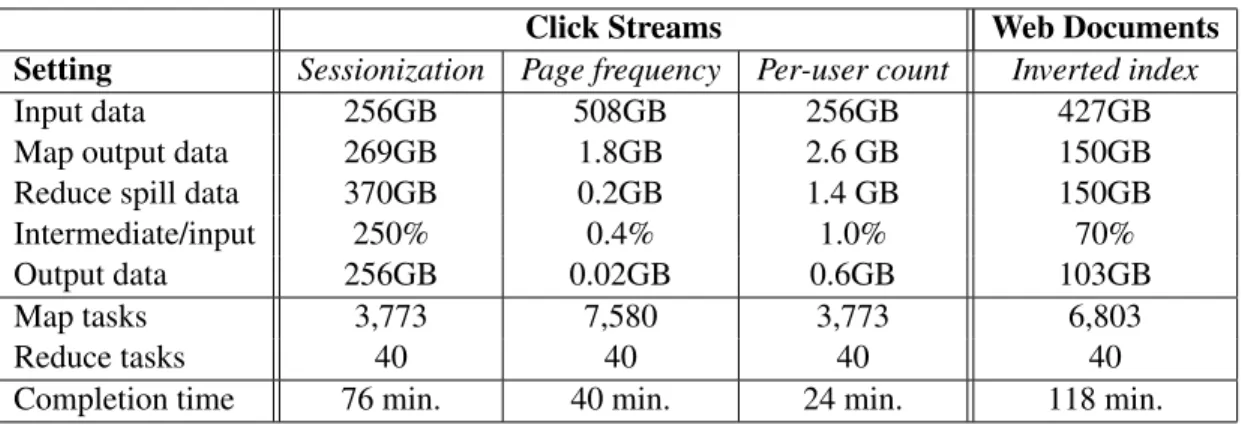
2.1 Design features and system parameters of existing data-parallel systems. . . 17 3.1 Workloads and their running time in the benchmark. . . 30 3.2 Average CPU cycles per node, measured by CPU seconds, in the map phase
(256GB worldcup dataset). . . 35 3.3 Symbols used in Hadoop analysis. . . 41 4.1 Comparing optimized Hadoop (using sort-merge), MR-hash, and INC-hash.
85
4.2 Comparing sessionization to INC-hash with 0.5KB state, INC-hash with
2KB state, and DINC-hash with 2KB state. . . 85 4.3 Comparing INC-hash, DINC-Frequent and DINC-Marker in terms of
reduce spill (GB). . . 87 4.4 Comparing INC-hash, DINC-Frequent, DINC-SS and DINC-Marker with
the trigram counting workload over the Twitter dataset in terms of
reduce spill (GB). . . 89 4.5 Comparing optimized Hadoop (using sort-merge), MR-hash, and INC-hash
on EC2. . . 94 4.6 Comparing sessionization to INC-hash with 0.5KB state, INC-hash with
2KB state, and DINC-hash with 2KB state on EC2. . . 94 4.7 Comparing INC-hash, DINC-Frequent and DINC-Marker with the trigram
counting workload over the Twitter dataset on EC2 in terms of reduce
spill (GB). . . 95 5.1 Streaming workloads in Twitter feed and click analysis. . . 101
5.3 Latency breakdown of a map output tuplee(e0 is the map input tuple that
generatese). . . 116
5.4 Hardware specification in modeling. . . 117
5.5 Job-specific statistics required by the model. . . 124
LIST OF FIGURES
Figure Page
2.1 Dependencies between system design features and system parameters for
low-latency analytics. . . 14
3.1 Architecture of the Hadoop implementation of MapReduce. . . 29
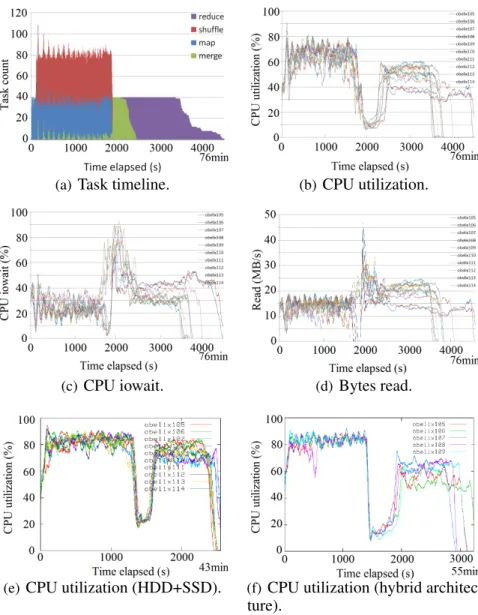
3.2 Experimental results using the sessionization workload. . . 33
3.3 Task timeline using the inverted index construction workload. . . 36
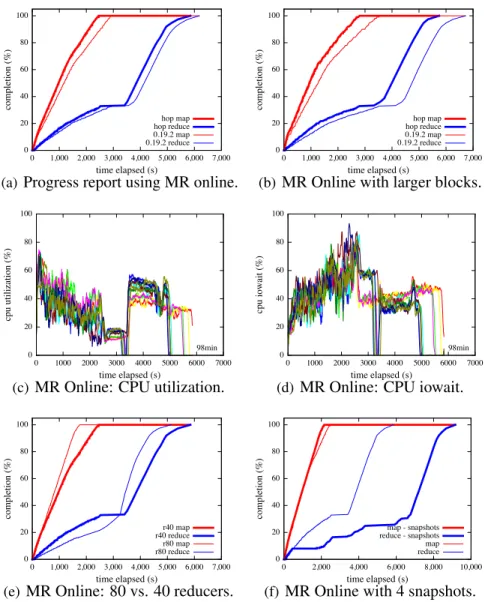
3.4 Results for MapReduce Online using the sessionization workload. . . 39
3.5 Analysis of the tree of files created in multi-pass merge. . . 44
3.6 Validating our model against actual measurements in a Hadoop cluster. . . 49
3.7 Performance of optimized Hadoop based on our model. . . 52
3.8 Performance of MapReduce Online with pipelining of data. . . 54
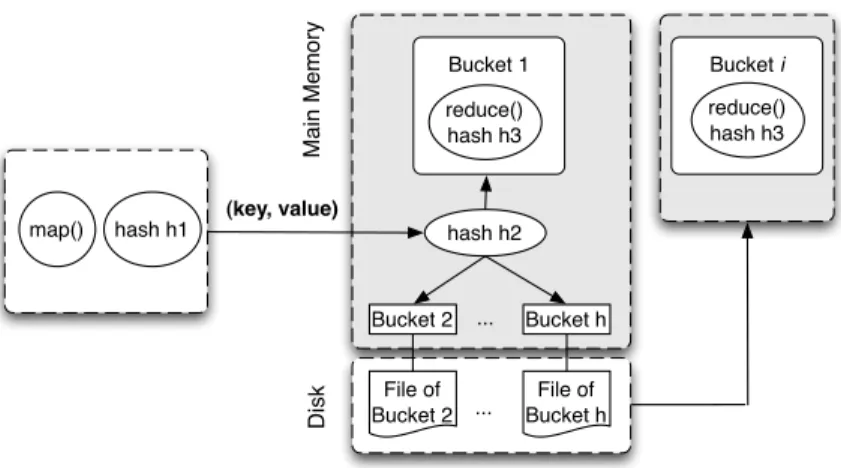
4.1 MR-hash: hashing in mappers and two phase hash processing in reducers. . . 60
4.2 (Dynamic) Incremental Hash: monitoring keys and updating states. . . 62
4.3 Determining the number of buckets hgiven memory sizeBand key-state space sizeU. . . 65
4.4 Architecture of our Hadoop-based platform for incremental processing. . . 78
4.5 Progress report using hash implementations. . . 82
4.6 Progress report using hash implementations. . . 84 4.7 Disk spills of reducers in Twitter trigram counting when we tune the
4.8 Progress report using hash implementations on EC2. . . 92
4.9 Sessionization with DINC-hash on EC2. . . 93
5.1 A latency benchmark study of stock Hadoop and Incremental Hadoop. . . 103
5.2 A query modeled as a dataflow DAG. . . 105
5.3 MapReduce architecture extended with distributor & queues of mini batches. . . 109
5.4 An example of window latencies. . . 121
5.5 An example of treeT. . . 133
5.6 Accuracy of the model for average latency. . . 139
5.7 Accuracy of the model for quantiles of latency. . . 140
5.8 Validity of the model-driven configuration optimization under average latency. . . 141
5.9 Validity of the model-driven configuration optimization under quantiles of latency. . . 142
5.10 Results of our model-driven configuration optimization. . . 143
5.11 Results of runtime scheduling. . . 144
5.12 Results of runtime scheduling. . . 145
5.13 Evaluation of Storm on latency and throughput. . . 147
5.14 Evaluation of Spark Streaming on latency and throughput. . . 149
5.15 Comparing Hadoop, INC-hash, Spark Streaming, Storm and our system on latency and throughput. . . 151
CHAPTER 1
INTRODUCTION
Today, data is being generated at an unprecedented rate – so much that 90% of the data in the world was generated in the last two years [44]. It is estimated that 2.5 quintillion (1018) bytes of data are generated per day in the world from various sources including human-initiated data sources such as public web contents and social media, machine logs that record system and user activities, and sensors that monitor environment and human body conditions, etc. [88] The ability to process “big data” has become crucial to the information needs of many enterprise businesses, scientific applications, and governments. Recently, there have been increasing needs of processing data that is not only “big” but also “fast”. Here “fast data” refers to high-speed real-time and near real-time data streams, such as Twitter feeds, search query streams, click streams, impressions, and system logs. For instance, a breaking news reporting service that monitors the Twitter firehose requires tweet feeds to be analyzed within seconds to detect hot topics and breaking news events [55]. As another example, Google’s Zeitgeist pipeline ingests a continuous input of search queries and detects anomalous queries, which are spiking or dipping, again within seconds [4].
To handle both historical data and real-time data, many companies have to maintain multiple systems. However, recent real-world case studies point to the need for a unified data processing framework that supports big and fast data analytics, including analytical queries with different latency requirements. In particular, a recent study by Twitter’s real-time search assistance team [65] shows the need to compute statistics across different temporal granularities with different latency tolerances e.g., evidence at the per-minute level to track
for slower moving and tail queries. Using separate systems for batch processing and real-time processing causes not only code duplication, but also intensive manual work to partition the analytics workloads and determine which data is processed by which system.
Motivated by these observations, this thesis takes a further step towards ageneral,unified data processing framework that supports big and fast data analytics with different latency requirements. This thesis answers a fundamental question: “What are the necessary design features of a general, unified system for big and fast data analytics?” In order to build such a system, I propose to build on existing solutions on data parallelism and extend them with two new features: (1)incremental processingand (2)stream processing with latency constraints. In the following, I explain these concepts in more detail.
Data Parallelism is a fundamental mechanism for data processing at scale. It partitions a large dataset into smaller subsets, following either the storage order (physical partitioning) or a user-specified logical condition (logical partitioning), and then executes an analytic task in parallel over these subsets. MapReduce [25, 34, 47, 8, 68, 49, 54, 41] is a popular parallel processing model that embraces data parallelism, and has shown its scalability on thousands of machines. It also provides an easy-to-use programming model, and fault tolerance transparent to users. MapReduce and its most popular open-source implementation, Hadoop [94], have become the core of a large ecosystem of products for big data analytics. However, the MapReduce model is not well suited for time-sensitive workloads with latency requirements since it is primarily designed for batch processing. More concretely, MapReduce implementations require the entire dataset to be loaded into the cluster before running analytical queries and the query answers are only returned at the end of a long-running job, thereby incurring long latencies and making them unsuitable for processing “fast data”. Since MapReduce provides high scalability based on data parallelism and has gained tremendous popularity, in this thesis, I study how to support the following design features in the context of MapReduce. But my key ideas and techniques, once adapted, can be valuable to other big data systems based on data parallelism as well.
Incremental Processing means that computation is performed as soon as the relevant data becomes available. Incremental processing enables tuples to move quickly through a pipeline of operators, and thus is essential to returning query answers with low latency. Due to the need of quick movement of tuples between operators, incremental processing requires that no blocking operator should exist. However, blocking operators such as sort-merge are widely used in batch-processing systems, including the existing MapReduce systems. To respond to the needs of low-latency analytics, a variety of new systems have been developed, including Google’s MillWheel [4] and Percolator [77], Twitter’s Storm [92], Facebook’s Ptail and Puma [13], Microsoft’s Naiad [70] and Sonora [95], WalmartLabs’ Muppet [55], IBM’s System S [101], Yahoo’s S4 [72], and academic prototypes such as Spark Streaming [99], StreamMapReduce [14], StreamCloud [35], SEEP [16] and TimeStream [79]. However, some systems [72, 92, 16, 70] do not provide built-in support of incremental processing, and thus impose the significant overhead of implementing incremental processing to users. Other systems mentioned above [14, 55, 95, 4, 99] provide mechanisms targeting at incremental processing, but with focus on the case when the memory is sufficiently large. Some of the systems can handle the situation of insufficient memory but only with simple approaches such as dropping and recomputing part of data [99], and simply spilling some data to a storage system backed by disks [55, 95, 4]. They do not provide any mechanism to maximize the portion of data processed using fast in-memory computation, and hence to perform incremental computation more efficiently.
In this thesis, I propose to fundamentally transform the batch processing paradigm in MapReduce systems into incremental processing, i.e., to move processing forward with newly arriving data items, and to do so efficiently even under constrained memory. Towards this goal, I propose a new purely hash-based framework with new hash algorithms and dynamic frequency analysis of data to support high-performance incremental processing under data parallelism.
Stream Processing with Latency Constraints is crucial to processing “fast data” in many applications [55, 65, 4]. For example, the latency constraints can be “news events should be returned within 3 seconds on average”, and “99% anomalous queries should be identified within 500 milliseconds”. However, the existing fast data systems [4, 14, 16, 35, 55, 70, 72, 79, 92, 95, 99] are “best-effort only”, where system performance is determined by static parameter values set manually by system administrators. In practice, enterprise businesses cannot afford the manual work to find the optimal configuration that meets the latency constraint for each job.
In this thesis, I propose various techniques to support stream processing with latency constraints in a platform with data parallelism and incremental processing. I propose a number of necessary architecture changes to support stream processing, and augment the platform with new latency-aware model-driven resource planning and latency-aware runtime scheduling techniques to meet user-specified latency constraints while maximizing throughput.
In order to build a system with the above design features, I start with the open-source MapReduce implementation, Hadoop, due to its proven scalability based on data parallelism, as well as its many compatible software tools, and its broad user community. The work presented in this thesis answers the following questions: (1) Is Hadoop able to support incremental processing? (2) What are the necessary architecture changes in order to support incremental processing? (3) What are the additional design features needed to support stream processing with latency constraints? To address these questions, my thesis work is naturally divided into the following three pieces: Hadoop benchmarking and optimization, incremental processing, and stream processing with latency constraints. The contributions of each piece of work are discussed in detail in the subsequent section.
1.1
Thesis Contributions
1.1.1 Hadoop Benchmarking and Optimization
In the first piece of work, I aim to understand whether Hadoop, after tuning its parameters for optimization, is able to support incremental processing and why if not. In order to support incremental processing, where computation is performed as soon as the relevant data becomes available, a MapReduce system should avoid any blocking operations and also computational and I/O bottlenecks that prevent data from “smoothly” flowing through map and reduce phases on the processing pipeline.
With the questions and this guideline in mind, I conduct a thorough benchmarking study, evaluating existing MapReduce platforms including Hadoop and MapReduce Online (which performs pipelining of intermediate data [22]). The results reveal that the main mechanism for parallel processing used in these systems, based on a sort-merge technique, is subject to a significant I/O bottleneck as well as blocking: In particular, I find that the merge step is potentially blocking and can incur significant I/O costs due to intermediate data. Furthermore, MapReduce Online’s pipelining functionality only redistributes workloads between the map and reduce tasks, and is not effective for reducing blocking or I/O overhead.
Building on these benchmarking results, I perform an in-depth analysis of Hadoop, using a theoretically sound analytical model to explain the empirical results. Given the complexity of the Hadoop software and its myriad of configuration parameters, I seek to understand whether the above performance limitations are inherent to Hadoop or whether tuning of key system parameters can overcome those drawbacks from the standpoint of incremental processing. The key results are two-fold: (1) It is shown that my analytical model can be used to choose appropriate values of Hadoop parameters, thereby reducing I/O and startup costs. (2) Despite a range of optimizations, the I/O bottleneck as well as blocking persist, and the reduce progress falls significantly behind the map progress, hence violating the requirements of efficient incremental processing. Both theoretical and empirical
analyses show that the sort-merge implementation, used to support data parallelism, poses a fundamental barrier to incremental processing.
1.1.2 Incremental Processing
Based on the insight that the sort-merge implementation in the original MapReduce model poses a fundamental barrier to incremental processing, my next goal is to propose a new data analysis platform, based on MapReduce, that is geared for incremental processing. More concretely, I made two key architecture changes to Hadoop:
My first mechanism replaces the sort-merge implementation in Hadoop with a purely hash-based framework, which is designed to address the I/O bottleneck as well as the blocking behavior of sort-merge. I devise two hash techniques to suit different reduce functions, depending on whether the reduce function permits incremental processing or not. Besides eliminating the sorting cost from the map tasks, these hash techniques can provide fast in-memory processing of the reduce function when the memory reaches a sufficient size as determined by the workload and algorithm.
My second mechanism further brings the benefits of fast in-memory processing to workloads that require a large key-state space that far exceeds available memory. I propose both deterministic and randomized techniques to dynamically recognize popular keys and then update their states using a full in-memory processing path, both saving I/Os and enabling early answers for these keys. Less popular keys trigger I/Os to stage data to disk but have limited impact on the overall efficiency.
I implement all these techniques in Hadoop, which results in a prototype, namely Incremental Hadoop. Experiments on a range of workloads in click stream analysis and web document analysis show the following main results: (1) My hash techniques significantly improve the progress of the map tasks, due to the elimination of sorting, and given sufficient memory, enable fast in-memory processing of the reduce function. (2) For challenging workloads that require a large key-state space, my dynamic hashing mechanism significantly
reduces I/Os and enables the reduce progress to keep up with the map progress, thereby realizing incremental processing. For instance, for sessionization over a click stream, the reducers output user sessions as data is read and finish as soon as all mappers finish reading the data in 34.5 minutes, triggering only 0.1GB internal data spill to disk in the job. In contrast, the original Hadoop system returns all the results towards the end of the 81 minute job, writing 370GB internal data spill to disk. (3) Further trade-offs exist between my hash-based techniques under different workload types, data localities, and memory sizes, with dynamic hashing working the best under constrained memory and most workloads.
1.1.3 Stream Processing with Latency Constraints
The revised MapReduce platform offers data parallelism and incremental processing. But are they enough for streaming analytical queries with stringent latency requirements? And if not, which additional design features are needed? These two questions will be addressed in my last piece of work.
My starting point is a thorough understanding of the sources of latency in a system supporting data parallelism and incremental processing. I conduct a benchmark study in the revised MapReduce platform, and it reveals that while incremental processing allows arriving tuples to be processed one-at-a-time, it does not guarantee the actual latency of processing each tuple in a large distributed system. (1) A key observation is that to enable streaming analytics with bounded latency of processing (e.g., 1 second) through a distributed system, it is crucial to determine thedegree of parallelism(e.g., the number of processes per node) andgranularity of scheduling(e.g., batching data items every 5ms for shuffling). Otherwise, upstream and downstream operators may process data at different speeds, causing substantial data accumulation in between. This reason, as well as using a large batch size as granularity for scheduling, will cause long wait time before tuples are processed or shuffled. The appropriate choices of those parameters vary widely among analytic tasks due to different computation needs – using the fixed values tuned for one workload is far
from ideal for other workloads, often resulting in high latency of tuples moving through the system. (2) When the memory of a cluster is not large enough to process all data in memory, the tuples spilled to disk experience high latency because their processing is often deferred to a later phase (e.g., at the end) of the job.
These two key observations call forjob-specific resource planningto select the appropri-ate parameter settings andlatency-aware schedulingto determine which tuples to process and in what order to process them in order to keep latency low, both not being well-addressed by existing work. Tremendous engineering efforts have been invested in industry on the resource allocation for critical workloads. The recent development of Hadoop Yarn [93] separates resource management from data processing frameworks such as MapReduce, demonstrating the importance of resource management itself. However, Yarn only provides a friendly interface for users to set key system parameters, but cannot do so automatically for a given job. Recent fast data systems [4, 14, 16, 35, 55, 70, 72, 79, 92, 95, 99] are “best-effort only”, where resource configuration does not take latency constraints or job characteristics as input. Instead, the configuration merely includes static parameter values set manually by system administrators. In practice, enterprise businesses cannot afford the manual work to find the optimal configuration for each job.
Different with existing work and effort, I solve the first issue by proposing a model-driven resource planning with two new unique features and the second issue by devising two runtime scheduling algorithms, as elaborated below.
Model-driven Resource Planning. To solve the first issue, I propose a model-driven approach to automatically determining the resource allocation plan for each job. The first unique aspect of my approach is that I consider performance, including both latency and throughput, in a holistic manner. A naive approach to minimizing latency may overprovision resources, e.g., giving all resources to push one tuple at a time through the distributed system, which limits throughput severely. Instead, I formulate the per-job resource planning problem as a constrained optimization problem: given a user analytic job and latency constraintL,
find a resource allocation plan to maximize throughput while subjecting the latency of results toL. The second feature is the support of a variety of latency models, including per-tuple latency, per-window latency, and any quantiles associated with these latency distributions. Then any of these latency metrics can be subjected to the user latency constraint. To develop this collection of models, I identify and analyze the dominant components of latency in a complex distributed system. This involves two challenges: First, latency here covers a wide range of data processing behaviors, e.g., for processing individual tuples, producing windowed results from a set of tuples, and capturing the variation of each type of latency. Second, a distributed system based on data parallelism also exhibits complex system behaviors. My major contribution here lies in a clean extraction of dominant data processing and system-level behaviors from the Incremental Hadoop I previously implemented with a maze of complexity.
Latency-aware Scheduling. To solve the second issue, I further propose latency-aware scheduling at runtime to determine the set of tuples to process and the order to process them in order to maximize the number of results that meet the latency requirement, i.e., the total utility. Such runtime scheduling is helpful because at runtime, the workload characteristics may differ from those provided earlier to my model-driven resource planning, e.g., due to bursty inputs and change of computation costs under constrained memory. Thus, runtime selection and prioritization of tuples greatly affects the overall utility. While the problem of maximizing total utility is close to online scheduling problems in real-time operating systems [52, 21], these techniques either incur high time and space complexity for scheduling a large number of tuples, or do not consider tuple processing costs effectively. I propose two runtime scheduling algorithms, at batch-level and tuple-level, respectively, which consider both costs and deadlines of data processing. In particular, my tuple-level scheduling algorithm has provable results on the quality of runtime schedules and efficiency of the scheduling algorithm.
Evaluation using real-world workloads such as click stream analysis and tweet analysis show the following results: (1) My models can capture the trend of actual latency changes when tuning system parameters, with error rates within 15% for the average latency metric, and within 20% for 0.9 and 0.99-quantiles of latency. (2) My model-driven approach to resource planning can reduce the average latency from 10’s of seconds in Incremental Hadoop to sub-second, with 2x-5x increase in throughput. (3) For runtime scheduling, my latency-aware tuple scheduling algorithm outperforms Dover [52], a state-of-the-art scheduling algorithm with provable optimality in the worse case, and can dramatically improve the number of tuples meeting the latency constraint, especially under constrained memory.
I finally compare our system to Twitter Storm[92] andSpark Streaming [99], two state-of-the-art distributed stream systems. For all workloads tested, my system offers1-2 orders of magnitudeimprovements over Storm and Sparking Streaming when considering both latency and throughput. As a proof-of-concept, my system, which is implemented in the general Hadoop framework, significantly outperforms custom distributed stream systems due to the key design features introduced in this work: our performance gains come from (1) the support of min-batches as the granularity for incremental processing and shuffling, while Spark Streaming lacks stable support of small batches and incremental processing of windows, and Storm incurs high scheduling overhead; (2) the job-specific resource allocation plans, which eliminate data accumulation and long wait in queues, which the other two systems cannot support.
1.1.4 System Development and Code Release
I have built a prototype of the platform for big and fast data analytics on Hadoop 0.20.1. And the resulting Hadoop-based prototype can run (1) in the originalbatch mode, fully supporting existing analytic tasks in enterprise businesses, or (2) in the new streaming modewhere user-specified latency constraints are handled automatically by the system and
used to guide resource planning and scheduling, with tremendous performance benefits over custom distributed stream systems. The code has been released as SCALLA 0.1 [62]. I also anticipate that while my implementation is in Hadoop, my key ideas and techniques, once adapted, can be valuable to other big data systems based on data parallelism.
1.2
Thesis Organization
The related work is discussed in Chapter 2. I perform benchmark study and system configuration optimization on existing MapReduce platforms in Chapter 3, and show that even the optimized MapReduce platform is still not well-suited for low-latency analytics due to the existence of a blocking operator and high I/O cost. In Chapter 4, I present a new platform for incremental processing that removes the blocking operator and minimizes I/O costs. To support stream processing with latency constraints, in Chapter 5, I further make necessary architectural changes and propose model-based configuration optimization as well as runtime scheduling techniques. I finally summarize the thesis and discuss the future work in Chapter 6.
CHAPTER 2
RELATED WORK
This chapter presents a survey of literature relevant to big data and fast data processing.
2.1
A Survey of Data-Parallel Systems
Data parallelismis a fundamental mechanism for data processing at scale. It partitions a large dataset into smaller subsets, following either the storage order (physical partitioning) or a user-specified logical condition (logical partitioning), and then executes an analytic task in parallel over these subsets. This section provides a survey of existing systems that support data parallelism, and compare them under the important design features for low-latency analytics. Before the discussion of the systems, we first introduce the key design features.
2.1.1 System Design Features for Low-Latency Analytics
We define a few system design features regarding low-latency analytics as follows.
I Batch Processing is the computation paradigm used to process a large collection of stored historical data. In batch processing, the results are usually returned at the end of a long-running job, and hence blocking operators that require all input data before emitting any output, such as sort-merge, are widely used.
I Incremental Processing means computation is performed as soon as the relevant data becomes available. With incremental processing, tuples can move quickly through a pipeline of operators. Incremental processing is a computation paradigm opposed to batch process in the sense that blocking operators should not exist. We use the following standard to determine that a system supports incremental processing: The
time between when an input tuple enters the system and when the tuple is consumed by the computation in any operator does not depend on the input size.
I (Near) Real-time Latency Constraints are supported if a system takes user-defined (near) real-time latency requirements into consideration and provides built-in mecha-nisms to satisfy the requirements.
Besides the above design features, several types of system parameters are closely related to low-latency analytics, and can be configured differently depending on the design features. The parameters are described below.
I Granularity of Computation is the data unit at which an operator schedules com-putation. There are several common granularities. (1)Per-tuple: an operator performs the computation of a tuple as soon as the tuple arrives. (2)Mini-batch: an operator collects input data, packs input data into small batches (e.g. every 5ms), and performs the computation for a batch at a time. (3)Input Chunk: an operator reads input data from a file system, such as HDFS, where input data is partitioned into physical chunks, and the operator performs the computation for a chunk at a time. (4)All Data: an operator waits until all input data is available, and then starts computation.
I Granularity of Shuffling is the data unit at which network transmission is scheduled. Common granularities arePer-tuple,Mini-batchandInput Chunk, which are defined similarly as in granularity of computation.
I Degree of Parallelism refers to the number of machines and the number of con-current processes or threads per machine used to perform the computation of an operator.
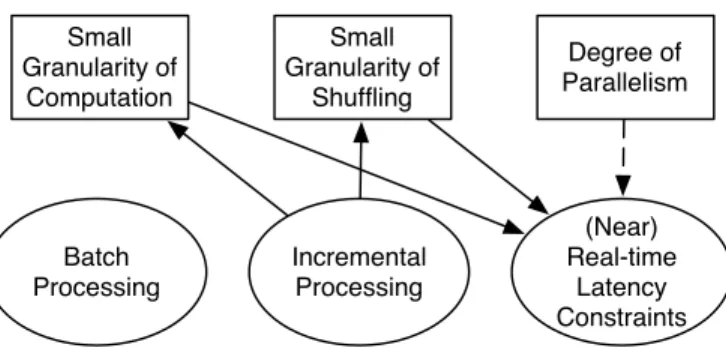
Figure 2.1 shows the dependencies between the above system design features. (1) The support of (near) real-time latency constraints requires small granularities of computation and shuffling. The reason is that, in order to achieve low latency, tuples need to move quickly between operators, which can only happen when the granularities of computation
Incremental Processing (Near) Real-time Latency Constraints Small Granularity of Computation Small Granularity of Shuffling Degree of Parallelism Batch Processing
Figure 2.1. Dependencies between system design features and system parameters for low-latency analytics.
and shuffling are small. (2) The support of (near) real-time latency constraints requires not only appropriate configuration of the granularities of computation and shuffling, but also appropriate configuration of the degree of parallelism. This is because the degree of parallelism affects the resource allocation among operators. As we will show in Chapter 5, inappropriate resource allocation may cause data accumulation between operators, and thus result in unbounded latency. (3) Small granularities of computation and shuffling require incremental processing. The reason is that the delay of computation at an operator may prevent the use of small granularities of computation and shuffling. For example, for a blocking operator, since it requires all input data before it emits any output, both the granularity of computation and the granularity of shuffling for the output can only beAll Data. The dependency graph reveals the relationship between two system design features: the support of latency constraints depends on incremental processing. In this thesis, we first solve the problem of incremental processing, and then further study how to support latency constraints.
2.1.2 Comparison of Data-Parallel Systems
We next compare the existing data-parallel systems under the design features and key system parameters. Although the traditional parallel databases [28, 27] adopt data parallelism, we exclude them from the comparison due to their limited scalability. We start by a brief introduction of the state-of-the-art systems.
MapReduce [25] is a widely-used parallel processing model for big data analytics. At the API level, MapReduce simply includes two functions: Themapfunction transforms input data intohkey, valueipairs, and thereducefunction is applied to each list of values that correspond to the same key. This programming model abstracts away complex distributed systems issues, thereby providing users with rapid utilization of computing resources. To achieve parallelism, at the system level, MapReduce essentially implements“group data by key, then apply the reduce function to each group.” This computation model permits data parallelism because both the extraction of hkey, valuei pairs and the application of
thereducefunction to each group can be performed in parallel on many nodes. Besides
this computation model, a MapReduce system also implements other functionalities such as scheduling, load balancing, and fault tolerance. An analytical query can be compiled (e.g., using a MapReduce-based query compiler [73]) into an acyclic dataflow graph, where each vertex is a MapReduce job consisting onemapfunction and onereducefunction, and an edge connects two jobs if one job takes the other job’s output as input. Hadoop [37] is the most popular open-source implementation of MapReduce. The Hadoop Distributed File System (HDFS) handles the reading of job input data and writing of job output data. The unit of data storage in HDFS is a 64MB block by default (128MB in newer Hadoop releases) and can be set to other values during configuration. These blocks serve as the granularity formapcomputation and also control the granularity of data shuffling between mappers and reducers. Hadoop uses a sort-merge1 technique to implement the group-by functionality [94] for parallel processing (Google’s MapReduce system is reported to use a similar implementation [25], but further details are lacking due to the use of proprietary code). A large Hadoop-centered ecosystem for parallel processing, including Hive [43], Pig [78] and HBase [38], etc., has been built and applied widely in industry.
MapReduce Online [22] improves MapReduce with pipelining of data. There are two district features for data pipelining from mappers to reducers. First, as each mapper produces output, it can push data eagerly to the reducers. The granularity of such data shuffling is controlled by a parameter. Second, an adaptive control mechanism is in place to balance work between mappers and reducers. For instance, if the reducers become overloaded, the mappers will write the output to local disks and wait until reducers are able to keep up again. MapReduce Online also allows reducers to periodically output snapshots (e.g., when reducers have received 25%, 50%, 75%, ..., of the data). This is done by performing the merge operation over the existing data for every snapshot. Hadoop Online Prototype (HOP) [36] is an open-source implementation of MapReduce Online based on Hadoop. Spark [98] is an open-source, fault-tolerant parallel processing system tailored for in-memory computation. In Spark, data is stored in a distributed in-in-memory data abstraction, called Resilient Distributed Datasets (RDDs). Spark transforms an RDD to another RDD by user-defined coarse-grained transformations, includingmap and reduce, and other transformations such as sample, distinct, unionand intersection. An ana-lytical job consists of one or multiple transformations. Spark provides fault-tolerance by tracking the lineage of each RDD, and re-computing any lost partition of an RDD.Spark Streaming [99]is a functionality integrated in Spark that enables parallel stream processing. Spark Streaming periodically creates a mini-batch containing the streaming input data, and transforms stream processing into a sequence Spark batch jobs over input mini-batches. Storm [92] is an open-source parallel stream processing system. A Storm cluster runs topologies that are similar to MapReduce jobs but can run continuously over streams. A topology is a dataflow graph of logical operators, which are called Spouts and Bolts. Spouts emit data as source streams of the system and Bolts consume input streams, do data processing, and possibly emit new streams to downstream operators. Storm supports shuffling between operators via various types of grouping, where field grouping is the same as the partitioning of map output in MapReduce. MillWheel [4]andNaiad [70]are two
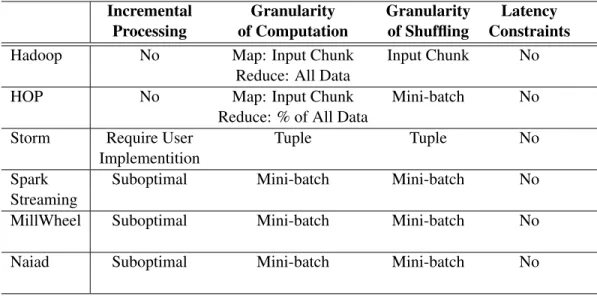
Table 2.1.Design features and system parameters of existing data-parallel systems.
Incremental Granularity Granularity Latency
Processing of Computation of Shuffling Constraints
Hadoop No Map: Input Chunk Input Chunk No
Reduce: All Data
HOP No Map: Input Chunk Mini-batch No
Reduce: % of All Data
Storm Require User Tuple Tuple No
Implementition
Spark Suboptimal Mini-batch Mini-batch No
Streaming
MillWheel Suboptimal Mini-batch Mini-batch No
Naiad Suboptimal Mini-batch Mini-batch No
parallel systems that also support continuous execution of a dataflow graph of operators. Compared to Storm, MillWheel provides a richer API and a stronger support of fault tolerance, while Naiad supports cyclic dataflow graphs in iterative workloads. Moreover, MillWheel and Naiad allow batching tuples for computation and shuffling, whereas Storm only supports per-tuple computation and shuffling.
We now compare the above data-parallel systems in terms of the design features and key system parameters as shown in Table 2.1. (1)Incremental Processing.As mentioned earlier, Hadoop and HOP adopt a blocking operator, sort-merge, to implement the partitioning in the MapReduce model. Hence, they do not support incremental processing. Storm provides a flexible API for parallel processing but imposes the complexity of the implementation of in-cremental processing to users. Spark Streaming, MillWheel and Naiad provide mechanisms for incremental processing, but focus on the case when the memory is sufficiently large. When the memory is insufficient, Spark Streaming drops part of the data that cannot fit in memory, and recompute the dropped data later, which incurs high cost due to repeated CPU computation, disk I/Os and network transmission. MillWheel simply stores data that cannot fit in memory in a data storage system, such as BigTable [19], without considering a more efficient way to perform in-memory incremental computation. Naiad lacks the detail about
any mechanism dealing with insufficient memory. This thesis proposes efficient techniques for incremental processing with both sufficient and insufficient memory in Chapter 4. (2) Granularity of Computation. In Hadoop, due to the sort-merge operation, the execution of thereducefunction cannot start before all data is received by the reducers. Thus, the reducers can only schedule computation at the granularity of all data. In HOP, since the output of snapshots is allowed, the reducers can schedule computation at the granularity of a pre-defined percentage of all data (e.g. every 25% of all data). As introduced earlier, in Storm, each operator processes a tuple at a time upon the arrival of a tuple. Spark Streaming, MillWheel and Naiad allow an operator to group tuples into mini-batches and process a batch at a time. (3) Granularity of Shuffling. The shuffling granularity in Hadoop is all the map output from an input chunk, while HOP allows more eager shuffling in smaller mini-batches. In Storm, the shuffling granularity is in individual tuples. In Spark Streaming, MillWheel and Naiad, the shuffling granularity is in mini-batches. (4)(Near) Real-time Latency Constraints. Hadoop and HOP do not support any latency constraint due to the lack of incremental processing. Although Spark Streaming, Storm, MillWheel and Naiad support incremental processing in some cases, they do not support user-defined latency constraints. In fact, all these existing systems are best-effort systems. They do not take latency constraints into consideration, whereas the system configuration merely includes static parameter values set manually by system administrators. We will further investigate the necessary system design features required by latency constraints besides incremental processing in Chapter 5.
Besides Spark Streaming, Storm, MillWheel and Naiad, a variety of other systems have been developed for parallel stream processing, such as Google’s Percolator [77], Facebook’s Ptail and Puma [13], Microsoft’s Sonora [95], WalmatLabs’ Muppet [55], IBM’s System S [101], Yahoo’s S4 [72], and academic prototypes such as StreamCloud [35], SEEP [16],
TimeStream [79] and StreamMapReduce [14]. We now summarize the techniques used in these systems from different aspects in the subsequent sections.
2.2
Query Model and Query Language
A parallel stream system (PSS) is typically able to perform multiple continuous queries (jobs) in parallel. The logical model of a query varies from system to system, but usually can be generalized as a dataflow graph, where computation units (CUs) are interconnected by data streams [72, 92, 95, 4, 16, 79, 70]. A CU takes one or multiple input streams from data source or upstream CUs, and generates one or multiple output streams to downstream CUs or consumers outside the system. A CU can perform stateless computation such as filtering and transformation, or stateful computation such as window, group-by, aggregate and join.
PSSs are usually tailored for the shared-nothing architecture for high scalability. In order to handle high input rate, most systems provide both pipeline parallelism and data parallelism in the physical plan of execution. In pipeline parallelism, different CUs can run in parallel on different machines. In data parallelism, multiple instances (processes or threads) of a CU can run in parallel across different machines, with each instance performing a fraction of the workload of the CU. Both types of parallelism allow the execution of a query to scale out given more machines. Data parallelism requires that the input tuples are partitioned to multiple instances of a CU. Common partitioning schemes include random partitioning, key-based partitioning and broadcast. In random partitioning, a tuple is sent to a randomly selected CU instance. In key-based partitioning, the destination CU instance is determined by the value of a key attribute in the tuple. In broadcast, a tuple is sent to all instances of a CU. The partitioning scheme can be chosen based on the workload.
A system usually provides a low-level programming interface using a general program-ming language, such as Java or C++, to define the dataflow graph of a query and implement the functionalities of the CUs. The programming interface of a CU typically includes a
set of user-defined callback functions. The most common callback is a function that is triggered by each tuple from the input stream. Other callbacks include functions triggered by timers [4] and functions triggered by system activities for fault tolerance [70, 16]. In these callbacks, a programmer can update the state of the CU instance if the CU is stateful, and call a system function to generate tuples to the output stream. In general, there are two types of low-level programming interfaces. In the first type, the system treats a CU instance as a black box, and user-defined functions can create and update an arbitrary form of state of the CU instance [72, 92, 16, 70]. This type of interface is flexible but imposes significant overhead to the programmer for functionalities such as fault tolerance, scaling out and memory management. In the second type, the system explicitly manages key-state pairs for a CU [14, 4]. The system partitions the key-state pairs to all the instances of the CU based on keys. The input tuples also have a key attribute. Each input tuple can only update the state that share the same key. The exposure of the computation state enables the system to provide more functionalities and optimizations that are transparent to the programmer. Some systems also support high-level query languages, such as LINQ [79]. A query written in a high-level language is usually automatically compiled into a job written in the low-level programming interface for execution.
2.3
Out-of-order Processing.
Since some operations are order-sensitive, such as time-based window, the system must handle out of order data due to delayed network delivery and different progress of workers in cluster computing. In particular, even if all the tuples arrive from external sources in time order or they are simply timestamped by the system in arrival order, after they are partitioned and assigned to different instances of a CU and processed on different nodes, there is unlikely any guarantee that the tuples will arrive at a downstream CU instance in time order. Since a CU running time-based window needs to identify the complete set of
tuples that fall in a window, the system must have a way to tell the CU instance whether it has seen all the tuples in a time window.
There are two common solutions in the literature: One is to use punctuations [57] or low watermarks [4], which announce that at timet, an operator has seen all the data up to timet−δ. If a CU instance receives such an announcement, it can process all the windows whose end times precedet−δ. However, the most recent study on the MillWheel system [4] reports that out-of-order data can prevent low watermarks from advancing for large amounts of time.
The most advanced technique for out-of-order data [53] proposes to process significantly late data separately in order to reduce latency and buffering cost without dropping data. Consider an example of 30-second windows, and assume that time is marked using integers 1, 2, 3, ... Tuples that arrive before time 30 belong to the windowWv1
30, where30is the end
time of the window andv1is the version number. At time 30, the window closes and a result
ofWv1
30 is ready for output (or buffering). For the late tuples that arrive between time 30 and
60 but should belong toW30, the system initiates a new windowW30v2 (which is possible if
the operation permits incremental updates). At time 60, a result ofWv2
30 is ready for output
(or buffering), and so on.
2.4
Fault-tolerance.
Failure is common to see in a large group of machines. When a CU instance fails, a PSS should recover the state of the instance and guarantee correct output without causing high delay of output. Two types of approaches have been adopted by PSSs : (1) upstream backup and checkpointing [14, 95, 16, 4], and (2) lineage-based re-computation [79, 99]. In the first approach, each CU instance maintains a log of its output, and periodically creates a checkpoint of its state and the content in its output queues. A checkpoint is created asynchronously to a reliable storage such as a distributed file system. After that, the upstream CU instances are notified to prune the content older than the checkpoint in their output logs.
If the failure of a CU instance is detected, the PSS creates a new instance of the CU and restores the state and the content of the output queues from the most recent checkpoint of the failed instance. Then, the output logs of the upstream CU instances are replayed to the new instance to bring it up-to-date. This approach guarantees at-least-one delivery. The failed instance and the downstream instances may process some tuples more than once. The correctness of idempotent operators, such as min, max and union, is guaranteed. For non-idempotent operators, additional duplicate removal techniques are required [4]. In the second approach, the system keeps track of the lineage of the states during the processing, a dependency graph of the states and the operations that generate each state from its parent states. When the state of a CU instance is lost, it is recomputed from its parent states. If a parent state is also lost, the system recursively recover any lost states that are required based on the lineage graph. Based on either of the two approaches, in order to reduce the latency caused by recovery, techniques have been proposed to recover the state of a CU instance in parallel using multiple new instances [16, 99].
2.5
Elasticity
Due to the nature of continuous queries, a system should adapt to changes in the workload characteristics without interrupting the execution of the queries or causing high latency. Especially in the cloud environment, where users are charged in the pay-as-you-go manner, elasticity is highly desired to scale out to more machines when overload occurs and scale in to fewer machines when the machines are under utilized. For stateful operators [95, 16, 79], the basic idea is to abandon an instance of a CU that needs to scale out, and use fault-tolerance techniques to recover the abandoned instance with multiple new instances. [82] proposes techniques for stateless operators to scale out, with focus on finding the optimal number of processing threads for an operator.
We have introduced a variety of parallel stream processing systems from different technical aspects. In the subsequent sections, we discuss other relevant systems.
2.6
MapReduce
In this section, we briefly discuss the literature relevant to the MapReduce model. Query Processing using MapReduce. [17, 47, 73, 76, 91, 97] has been a research topic of significant interest lately. To the best of our knowledge, none of these systems support incremental processing. Dryad [97] uses in-memory hashing to implement MapReduce group-by but falls back on the sort-merge implementation when the data size exceeds memory. Merge Reduce Merge [96] implements hash join using a technique similar to our baseline MR-hash, but lacks further implementation details. SCOPE [17] is a SQL-like declarative language designed for parallel processing with support of three key user-defined functions: process (similar tomap), reduce (similar toreduce) and combine (similar to a join operator). SCOPE provides the same functionality as Merge Reduce Merge and does not propose new hash techniques beyond the state-of-the-art. Several other projects are in parallel to our work: The work in [8] focuses on optimizing Hadoop parameters and ParaTimer [68] aims to provide an indicator of remaining time of MapReduce jobs. Neither of them improves MapReduce for incremental computation.
Cost Models for MapReduce. Recent work presented models to predict total running time of a MapReduce job over stored data based on analysis of CPU, I/O and network costs or based on training over profiles of previous jobs [40, 41, 42, 45, 30]. These models differ from ours as we aim to capture latency, which relates to a different set of system parameters and concerns, such as the input rate, queue sizes, and latency in each step. ParaTimer [68] is a progress indictor for MapReduce jobs, which identifies map and reduce tasks on a query’s critical path. It serves a different purpose from our goal of modeling latency. Zeitler et al. [100] proposed a model of total CPU cost for distributed continuous queries, a different
Computation Models for MapReduce. Karloff et al. [49] suggest a theoretical abstrac-tion of MapReduce. The abstracabstrac-tion employs a model that is both general and sufficiently simple such that it encourages algorithm research to design and analyze more sophisticated MapReduce algorithms. However, this model is based on simple assumptions that are not suitable for system research like our study. First, no distinction is made between disk and main memory. Second, the model is only applicable to the case that each machine has memoryO(n1−e)wherenis the size of entire input and
eis a small constant. Third, the model assumes that all map tasks have to complete before the beginning of the reduce phase, which makes the model invalid for incremental computation.
2.7
Stream Database Systems
Stream databases [1, 15, 18, 69] laid a foundation for stream processing including window semantics, optimized implementations, and out-of-order data processing. Our work leverages state-of-the-art techniques for windowed operations and out of order processing in the new context of the MapReduce cluster computing. Techniques for QoS including scheduling and load shedding have been studied in Aurora/Borealis [15, 7, 1, 59, 90, 89]. However, scheduling in Aurora [15] considers latency only based on CPU costs and selectivity of operators in the single-machine environment, whereas our resource planning considers many more factors in a distributed system and uses constrained optimization to support both latency and throughput. Load shedding in Borealis [89] allocates resources in a distributed environment by solving a linear optimization problem, but only maximizes throughput without considering latency and only supports pipeline parallelism without data parallelism.
2.8
Parallel Database Systems
Parallel databases [28, 27] require special hardware and lacked sufficient solutions to fault tolerance, hence having limited scalability. Their implementations use hashing
intensively. In contrast, our work leverages the massive parallelism of MapReduce and extends it to incremental processing and low-latency analytics. We use MR-hash, a technique similar to hybrid hash used in parallel databases [28], as a baseline. Our more advanced hash techniques emphasize incremental processing and in-memory processing for hot keys in order to support low-latency analytics.
Emerging parallel databases [2, 3, 12, 32] use MapReduce for query processing, lever-aging its scalability and fault tolerance, but do not support incremental processing or low-latency analytics.
2.9
Other Systems
DEDUCE [54] extends System S with the capability of executing MapReduce jobs, but for batch processing. CBP [61] supports stateful bulk processing for incremental analytics, but not low-latency streaming analytics (e.g., with running time of 10’s to 100’s of minutes). Photon [5] is designed particularly for joining data streams in real-time, but focuses on issues other than efficient incremental processing and supporting latency constraints.
CHAPTER 3
HADOOP BENCHMARKING AND OPTIMIZATION
In this chapter, we answer the following research question: “Are the existing MapReduce implementations able to support incremental processing?” Incremental processing means that computation is performed as soon as the relevant data becomes available. Incremental processing enables tuples to move quickly through a pipeline of operators, and thus is essential to returning query answers with low latency.
We first conduct a thorough benchmarking study, evaluating existing MapReduce plat-forms including Hadoop and MapReduce Online (which perplat-forms pipelining of intermediate data [22]). The results reveal that the main mechanism for parallel processing used in these systems, based on a sort-merge technique, is subject to a significant I/O bottleneck as well as blocking: In particular, we find that the merge step is potentially blocking and can incur significant I/O costs due to intermediate data. Furthermore, MapReduce Online’s pipelining functionality only redistributes workloads between the map and reduce tasks, and is not effective for reducing blocking or I/O overhead.
Next, building on these benchmarking results, we perform an in-depth analysis of Hadoop, using a theoretically sound analytical model to explain the empirical results. Given the complexity of the Hadoop software and its myriad of configuration parameters, we seek to understand whether the above performance limitations are inherent to Hadoop or whether tuning of key system parameters can overcome those drawbacks from the standpoint of incremental processing. The key results are two-fold: (1) It is shown that our analytical model can be used to choose appropriate values of Hadoop parameters, thereby reducing I/O and startup costs. (2) Despite a range of optimizations, the I/O bottleneck as well as
blocking persist, and the reduce progress falls significantly behind the map progress, hence violating the requirements of efficient incremental processing. Both theoretical and empirical analyses show that the sort-merge implementation, used to support data parallelism, poses a fundamental barrier to incremental processing.
This chapter is organized as follows. We first provide a technical background of MapRe-duce in Section 3.1. We then describe our benchmark results of the MapReMapRe-duce systems in Section 3.2. We show the optimization of Hadoop configuration and the analysis of the results in Section 3.3. We finally conclude in Section 3.4.
3.1
Background
To provide a technical context for the discussion in this chapter, we begin with back-ground on MapReduce, followed by the overview of Hadoop, the most popular open-source implementation of MapReduce.
3.1.1 Overview of MapReduce
At the API level, the MapReduceprogramming modelsimply includes two functions: Themapfunction transforms input data intohkey, valueipairs, and thereducefunction is applied to each list of values that correspond to the same key. This programming model abstracts away complex distributed systems issues, thereby providing users with rapid utilization of computing resources. As an example, consider how we would parse a click stream to find the most visited pages. More specifically, we want to count how many times each page has been visited. Suppose the schema for a visits table is (timestamp, user, url). Consider the following SQL query:
SELECT COUNT(*) FROM visits GROUP BY url;
Page clicks are grouped by url and then aggregated using COUNTfor each url. Now consider the equivalent MapReduce job for computing page frequencies below. The map function emits a new<url, count>tuple for each visit in the click stream, where the count
is 1. The reduce function then groups these tuples by url and sums the number of visits to each url.
function map(rid, visit) { emit(visit.url, 1); }
function reduce(url, iterator<int> count) { int total = 0;
foreach count c total += c; emit(url, total); }
To achieve parallelism, the MapReduce system essentially implements “group data by key, then apply the reduce function to each group”. Thiscomputation model, referred to as MapReduce group-by, permits parallelism because both the extraction ofhkey, valuei pairs and the application of the reduce function to each group can be performed in parallel on many nodes. The system code of MapReduce implements this computation model (and other functionality such as load balancing and fault tolerance).
The MapReduce program of an analytical query includes both the map and reduce functions compiled from the query (e.g., using a MapReduce-based query compiler [73, 43]) and the MapReduce system’s code for parallelism.
3.1.2 Overview of the Hadoop Implementation
We consider Hadoop, the most popular open-source implementation of MapReduce, in our study. Hadoop uses block-level scheduling and a sort-merge technique [94] to implement the group-by functionality for parallel processing (Google’s MapReduce system is reported to use a similar implementation [25], but further details are lacking due to the use of proprietary code).
The Hadoop Distributed File System (HDFS) handles fault tolerance and replication for reading job input data and writing job output data. By default, the unit of data storage in
Data Load Map( ) Local Sort * Combine Map Write Map T ask Data Load Map( ) Local Sort * Combine Map Write Map T ask ... Merge & * Combine Reduce( ) Final Write Reduce T ask Merg