A symmetric cryptographic scheme for data integrity verification in cloud databases
Luca Ferretti, Mirco Marchetti, Mauro Andreolini, and Michele Colajanni University of Modena and Reggio Emilia
Abstract
Cloud database services represent a great opportunity for companies and organizations in terms of management and cost savings. However, outsourcing private data to external providers leads to risks of confidentiality and integrity violations. We propose an original solution based on encrypted Bloom filters that addresses the latter problem by allowing a cloud service user to detect unauthorized modifications to his outsourced data. Moreover, we propose an original analytical model that can be used to minimize storage and network overhead depending on the database structure and workload. We assess the effectiveness of the proposal as well as its performance improvements with respect to existing solutions by evaluating storage and network costs through micro-benchmarks and the TPC-C workload standard.
Keywords: authentication, integrity, Bloom filter, MAC, cloud, database
1. Introduction
Cloud database services represent an important oppor-tunity for many enterprises and organizations attracted by high availability and scalability guarantees. However, their adoption is limited by the perceived risks about data confidentiality and integrity that can be violated by insid-ers and external attackinsid-ers [32]. In this paper we consider the problem of data integrity in cloud databases, and we propose an efficient solution to assess the integrity of out-sourced data while minimizing network and storage over-head.
We should consider that cloud service contracts do not oblige providers to notify tenants about data corruption, hence verifying data integrity remains a tenant’s burden. Existing verification solutions are affected by prohibitive computational, storage and bandwidth overhead that have an impact on costs because additional network and stor-age usstor-age increases cloud service expenses [22]. We pro-pose a novel solution for integrity verification that allows a tenant to efficiently detect unauthorized modifications on outsourced data at reduced storage and network overhead. The contribution of this paper is threefold:
it defines a novel integrity protocol and analyzes the guarantees that it offers;
it proposes an analytical model that allows the ten-ant to optimize the parameters of the proposed in-tegrity protocol with the goal of minimizing storage and network overhead as a function of database work-load characteristics;
it evaluates the performance of the proposed protocol through micro-benchmarks and the TPC-C standard database benchmark.
The literature on database outsourcing faces three types of correctness guarantees: integrity, completeness and freshness [10, 30, 46, 50]. Completeness and integrity are satisfied if the result of a query includes all and only the relevant data that an authorized party inserted in the da-tabase, thus guaranteeing that tenant’s data is not altered, deleted or ignored by the outsourced database. Freshness ensures that a client receives the latest version of the re-quested data. This paper focuses on integrity and proposes a novel scheme that allows efficient detection of unautho-rized modifications of data stored in cloud databases.
Existing solutions to guarantee data integrity leverage cryptographic digests that can be based on asymmetric or symmetric primitives. Asymmetric cryptographic accu-mulators [7, 39] ensure optimal asymptotic complexity in storage, computation, and network usage [35], but their ex-cessive computational costs prevent their adoption in most database scenarios [15]. Symmetric Message Authentica-tion Codes (MAC) can guarantee the integrity of tenant files stored in the cloud [2], but their adoption in cloud database services poses several challenges related to the granularity of the protected data: if every value is pro-tected by a MAC, the database storage increases consider-ably; if the entire set of rows/tables are protected by one MAC, then the verification of each value requires to fetch an entire row/table, thus imposing an excessive network overhead that renders verification unfeasible.
The proposed scheme relies on a variant of Bloom fil-ters [8] for the detection of unauthorized modifications to outsourced data. This choice guarantees two benefits: the processes of integrity verification and update of the authentication structures cause low network and storage overhead; all cryptographic operations are based on sym-metric schemes that do not introduce significant
computa-tion overhead. The performance of the proposed scheme depends on Bloom filter sizes that should be chosen on the basis of the integrity guarantees required by the tenant. We enrich the proposal by offering an analytical model that takes as its input the integrity requirement, the data-base characteristics and workload, and evaluates the opti-mal size of the Bloom filters that minimize overheads and related cloud service costs.
Our proposal is orthogonal to data encryption strategies for data confidentiality proposed in literature [20, 21, 23, 43], and can be integrated with encryption algorithms to achieve both confidentiality and integrity of data stored in cloud databases. Moreover, it can be used to design solutions that aim to ensure data completeness and fresh-ness [47].
To the best of our knowledge, the proposed scheme is the most efficient solution for detecting unauthorized modifications in cloud database services. We demonstrate its benefits through micro-benchmarks and the standard TPC-C benchmark. All results show that the proposed scheme greatly reduces network and storage footprint with respect to existing proposals.
The remaining part of the paper is organized as fol-lows. Section 2 describes the considered cloud database scenario and the threat model. Section 3 outlines theo-retical background on Bloom filters. Section 4 presents the proposed solution and its security guarantees. Sec-tion 5 describes how the tenant must size the protocol parameters to achieve the required security level. Sec-tion 6 presents the analytical method to minimize over-head. Section 7 discusses performance in terms of storage and network overhead, and compare results against state-of-the-art schemes. Section 8 compares our solution with existing proposals. Finally, Section 9 concludes the paper by summarizing its main contributions and future work. For further implementation details, security analyses and proofs please refer to the Appendices.
2. Scenario and threat model
We consider a scenario where a tenant stores large amounts of data into a cloud database through clients that issue read and write operations. The tenant benefits from pay-per-use cloud prices with the goal of reducing his op-erational costs, but his data at rest, in motion and in use are subject to different security threats.
Our proposal aims to improve security of data in use against internal malicious attackers, and can be combined with additional solutions to protect other attack surfaces. For example, clients and database servers should adopt the SSL/TLS protocol suite to protect confidentiality and integrity of data in motion as well as the ability to detect replay and reflection attacks. The cloud provider must own a valid PKI certificate that avoids man-in-the-middle attacks. All clients must own valid credentials (e.g., API tokens, client-side PKI certificates) that allow the provider
to identify and authenticate them, as well as grant proper access on the resources stored in the database.
In the proposed scheme, we assume that all clients share the same secret key, that can be distributed according to known key distribution schemes [9], as well through more efficient strategies that are specific to the field of cloud database services [16, 20]. We assume that the secret key is not known by the cloud provider nor by any other part that is not authorized to manipulate tenant data. We assume that all clients are trusted and will never send cor-rupted data to the cloud database, nor will leak confi-dential information to unauthorized parties (including the cloud provider). On the other hand, we assume that the cloud provider is not trusted and could alter tenant’s data. Modification may be caused by hardware or software fail-ures, as well as by deliberate attacks coming from external adversaries or from insiders within the cloud organization. From the tenant’s point of view, any unauthorized modi-fication represents a data integrity violation.
Data integrity and authenticity is a prominent re-search area of the cryptography community, and is usu-ally guaranteed by means of message authentication codes (MAC) [5]. A MAC applied to arbitrary data together with a secret key produces a(cryptographic) digest (also calledtag), that is a compressed representation of the in-put data. An attacker can violate integrity by forging a digest on behalf of the authorized users. The security level of a MAC depends on the key and digest sizes. The key size determines the security level against off-line brute-force attacks, in which the attacker knows some plaintext data and the corresponding digest, and tries to guess the key. Key length should always comply with standards rec-ommendations [4]. The digest size, that is constant with regard to the size of the input, determines the probability of guessing a valid digest. Since only an authorized party can verify a digest, this attack can only be executed by participating to the secure protocol and interacting with the authorized parties.
The security threats against the integrity of data out-sourced to a remote database are peculiar to this context. In other scenarios, such as protocols for secure commu-nications, protecting data integrity requires scheme that withstand adaptive attacks, where attackers can adopt a trial-and-error strategy and attempt a large number of un-successful attacks. On the other hand, in the outsourced database scenario, the attackers cannot access the verifi-cation function because there is no reason to expose this service. As a consequence, one unsuccessful attack is suffi-cient for the tenant to detect an integrity violationHence, for this scenario it is sufficient that integrity solutions with-standnon-adaptive attacks.
Among all proposed security models, our scheme must protect data against the so called chosen ciphertext at-tacks (CCA) assuming that an attacker tries to forge a ciphertext corresponding to a valid plaintext. The litera-ture distinguishes betweennon-adaptively chosen cipher-text attacks (CCA1) and adaptively chosen ciphertext
at-tacks (CCA2)depending on attacker capabilities. Crypto-graphic schemes areCCA1-secure orCCA2-secure if they are resistant against CCA1 and CCA2 attack models, re-spectively. We design a novel cryptographic scheme that ensures integrity of data outsourced to a cloud provider by allowing a tenant to detect whether data has been modi-fied without authorization. The adopted scheme is robust against CCA1 attacks. While it is possible to improve its security guarantees, the proposed scheme should not be used to protect integrity in scenarios requiring CCA2-security guarantees.
The proposed protocol guarantees data integrity with-out incurring in excessive overheads affecting state-of-the-art schemes. For this reason, it perfectly suits the cloud scenario where network and storage overheads are costly metered resources.
3. Theoretical background
Besides the attack models and cryptographic protocols discussed in the previous Section 2, the main theoretical foundations used in this paper are related to Bloom fil-ters [8, 11, 34], that are space-efficient data structures for representing sets. A Bloom filter (BF) can be described as an array of m bits (abit string) built using k hash func-tions. Each hash function maps an arbitrary long string to an integer within the range rms “ 0, . . . , m´1. To insert an element in the BF, we compute the hash func-tions of the element and set to one the corresponding bits in the BF bit string. A BF supports membership queries that allow false positives, in the sense that a query may return a positive answer even if an element is not stored in the Bloom filter (BF). As an advantage, queries never return false negatives. To execute a membership query for a given element, we compute the hash functions of the ele-ment and verify if all the corresponding bits in the BF bit string are set to one. A false positive occurs if the bits are equal to one even if the element was not inserted in the BF.
The probability of getting a false positive, namely the false positive rate, depends on the sizemof the BF, on the number of hash functionskand on the number of valuesn stored in the BF. The false positive rate functionfp¨qcan be computed as following: fpm, n, kq “ « 1´ ˆ 1´ 1 m ˙knffk « p1´e´kn{m qk (1) The optimal number of hash functions ¯k is the value of k that minimizes the false positive rate, and can be com-puted in terms of mandn[11]:
¯ k“m
n ¨lnp2q (2)
Moreover, the optimal false positive rate f¯pm, nq “
fpm, n,¯kqcan be computed as following: ¯ fpm, nq « p1´e´kn¯ {m q ¯ k “2´¯k “e´mnlnp2q2 (3) a1 ac aC v1,1 . . . v1,C e1 . . . vr,c . . . er vR,1 . . . vR,C eR
Table 1:Database table enriched with a column containing
cryptographic digests.
Note that if the optimal amount of hash functionsk “k¯ is used, then the estimated amount of bits set to one is half the size of the BF and the bit string created by the BF function resembles a randomly generated string [11, 33, 34].
4. Protocol design
We describe the solution based on encrypted BF to guar-antee integrity of data outsourced in outsourced databases while minimizing computational, storage and network overhead. Let us consider a table having R rows and C columns. We denote as vr,c the value stored in the r-th
row and c-th column of the table, where r “ r1, . . . , Rs
andc“ r1, . . . , Cs. Similarly,Vris defined as the set of all
values that belong to ther-th row, that ispvr,1, . . . , vr,Cq.
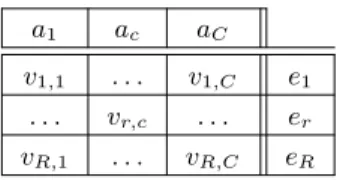
We add to all database tables a new column storing a short control structure, namely acryptographic digest (or justdigest), that allows the tenant to verify the integrity of all the data stored in the corresponding row. The no-tation er identifies the digest associated to the r-th row
of a table. Table 1 shows the modified database schema, where ac is the name of column c. We assume that the
tenant database administrator generates a secret key and distributes it to authorized clients and that the algorithms used in the protocol are public. We now describe how an authorized client executes insert, read and update opera-tions.
4.1. Insert operation
An authorized client issues an insert operation by send-ing a tuple of valuesVrand the associated digesterto the
cloud database. The client computes er according to the
following equation:
er“Eskpiv, brq, (4)
whereEskp¨qis anIND-CPA-secure symmetric encryption algorithm, sk is the secret key and iv is the random ini-tialization vector. The encryption algorithm takes as input the valuebr, that is a bit string computed as following:
br“ C ł
c“1
Bτmpac, vr,cq, (5)
whereac is the label of the column associated to the value
vr,c,Žis the bitwiseORoperator andBτmp¨qis a BF
of the size of the input values. The functionBm
τ p¨qis
com-puted by using keyed hash functions (e.g., HMAC algo-rithms [5]) that accept multiple inputs [36] and the secret key τ. For the sake of clarity in the rest of the paper we will refer to functionBm
τ p¨qand to its outputs assecret BF
function andsecret BFs, respectively. As an example, we say that the valuebris thesecret BF associated to the row
r and, as expressed by equation (5), that it stores the set of elements tpac, vr,cqucPr1,...,Cs. We propose a candidate
implementation in Appendix A.
The use of keyed hash functions is uncommon, since BFs are usually implemented through public hash functions. However, in our protocol this is not a viable option. Let us consider an adversary that tries to insert a fake value in the row r. If BFs are based on public hash functions, an attacker that knows Vr can compute br and randomly
generate fake values until a false positive is obtained. The average amount of trials that are necessary to find a valid fake value depends on the false positive rate of the BF and not on the security level of the encryption functionEskp¨q. We observe that any data given in input to the function should be binary encoded as it is typical for most protocols in symmetric cryptography. The proposed protocol also supports missing (null) values inserted in the database. Whenever a client inserts a null value in the database, he inserts an encoding convention in the corresponding digest. All encoding functions and conventions are public and known to all the parties. They are also used in the verification phase.
4.2. Read operations
Let us assume that the client wants to retrieve one value vr,c from the cloud database and to verify its integrity.
This can be accomplished by fetching the required value together with the corresponding digesterthrough a select
query. We note that there is no need to retrieve all the other values of the row r because the BF supports effi-cient set membership. The client then decrypts er using
sk as decryption key and obtainsbr. Now he can execute
a membership test of the valuevr,c onbr by means of the
secret key τ (see Appendix A for a candidate implemen-tation). If the membership test fails, then an integrity violation has been detected. If it occurs, then one of the following is true:
the value vr,c has not been tampered with and
in-tegrity holds;
the integrity of vr,c has been compromised, but the
membership test returned a false positive.
False positives are a well known drawback of BFs, but they can be limited by a careful choice of the BF parameters. A thorough analysis of the attacks against BFs and of how they can be prevented is proposed in Section 4.4.
We recall that the elements stored in the secret BF are a concatenation of values stored in the database and of the labels associated to their column. This design choice
prevents attacks based on columns scrambling. As an ex-ample, we consider a table with two columns c1 and c2.
An authorized client inserts two valuesvr,c1,vr,c2and the
digest er computed through Equations (5) and (4). The
values inserted in the secret BF are obtained by concate-nating the labelsc1andc2to the corresponding valuesvr,c1
andvr,c2. Now, let us assume that an adversary swaps the
two values. When the tenant requests any of the two val-ues, he executes integrity checks. He obtains the values vr,c1 andvr,c2 for the columnsc2 andc1, respectively. To
verify integrity he concatenates the values with the asso-ciated columns and tests the membership of the results in the secret BF. Since the resulting elements are different, he detects an integrity error. This strategy can also be used with databases with complex hierarchical schema by substituting the name of the column with the unique path or identifier used to retrieve the value.
Another threat is represented by attacks based on rows scrambling. As an example, consider a client that issues the following select query: SELECTc2 FROMtablename
WHERE c1 “ x. Let us assume that only row r2
sat-isfies the WHERE clause, hence a correct cloud provider should returnvr2,c2together withe2. An adversary cloud
provider may reply with a value of columnc2, but
belong-ing to a row that does not satisfy the WHERE clause. Suppose that the cloud provider replies with vr1,c2 and
e1. Our protocol is able to detect this incorrect result,
because the client verifies that bothpc2, vr1,c2qandpc1, xq
are stored ine1. While the first check succeeds, the second
fails, and the client is able to detect the row scrambling attack of the cloud provider. This design choice protects the database against row scrambling for any type of query, and similar examples may be provided for range queries. 4.3. Update operations
When a client issues an update operation to modify one or more values belonging to rowr, he must also update the digester. We distinguish two methods to issue update
op-erations: thealways renew strategy, and thegreedy renew strategy.
Thealways renew strategy is the simplest one and im-plies the execution of update operations as insert oper-ations. The client fetches all the row values from the database, even those that are not modified by the up-date, and computes a digest that stores the updated tuple as described in the previous paragraph, by using Equa-tions (4), (5). The main drawback of this simple update strategy is that the tenant retrieves unnecessary values every time he updates even one value, thus causing high network overhead.
Thegreedy renew method requires the execution of up-date operations without having to download unnecessary data from the cloud database service, thus reducing the network overhead. In this strategy, the client that up-dates some values V1
r Ă Vr retrieves only the values Vr1
and the associated digester. First, the clients verifies the
BF b1
r associated to the updated values by decrypting the
retrieved digester intobr and adding the new values.
Fi-nally, it re-encrypts the value by using the secret key sk and a new random initialization vectoriv1. The update of er can be summarized as following:
e1 r“Esk ` iv1,Bm τ pVr1q _Dskperq ˘ , (6)
where _denotes the bitwise OR operator.
Here we propose an informal description of the issues that must be addressed when sizing the protocol param-eters, while a precise evaluation is proposed in Section 5. The false positive rate of the secret BFs increases after each update operation. Hence, when using the greedy re-new strategy the following design choices must be taken into account. The digest must be able to store a num-ber of values higher than the cardinality of columns with-out affecting security. Moreover, renew update operations must be executed periodically before affecting the secu-rity guarantees. In particular, since bigger BFs have lower false positive rates, the greedy renew strategy requires to oversize the digest stored in the database. By knowing the maximum amount of values that can be stored in the digests, one can estimate when to execute renew opera-tions. Increasing the size of the BF introduces a trade-off between the storage and network overhead. We propose an analytical methodology to choose the best protocol pa-rameters in Section 6.
4.4. Security analysis
We analyze the security guarantees of the proposed scheme by identifying possible attacks and by evaluating the sizing requirements to defend against them. All se-curity analyses are discussed under the threat model de-scribed in Section 2. We distinguish two types of attacks. Attacks on the plaintext values. The attacker modi-fies an existing tuple by inserting fake values without mod-ifying the associated digest. In this case the attacker can leverage the BFs false positives by guessing an element whose membership query is answered positively even if the element was not inserted by the tenant.
Attacks on the digests. The attacker generates new digests for existing or new tuples without any knowledge about the secret key. In this case the attacker aims to take advantage of the malleability intrinsic to IND-CPA encryption functions to manipulate the underlying BF.
The straightforward design choice to defend against at-tacks on the digests is to protect their integrity. This is usually accomplished by attaching a MAC computed on the encrypted digest or by using an authenticated en-cryption scheme [37] instead of the IND-CPA enen-cryption as described in Section 4.1. Both design strategies in-crease storage and bandwidth overhead. In Appendix B we demonstrate that in the considered scenario, the attacks on the digests are always less convenient than the attacks on plaintext values. As a result, the protocol parameters must be sized to defend against attacks on plaintext values
and there is no need to protect the encrypted BF with a MAC or to use an authenticated encryption scheme.
we recall that the proposed approach does not work when an adversary can execute adaptive attacks (see Sec-tion 2), because he could exploit the malleability of the IND-CPA encryption to efficiently forge fake digests. 5. Sizing boundaries
In this section we show how to size the protocol param-eters to guarantee the security levels required by the cloud tenant. To this purpose, we define theacceptable false pos-itive rate εas the highest false positive probability that a cloud tenant wants to tolerate. For example, if the cloud tenant deems ε“ 0.01 acceptable, then the attacker has only 1 chance out of 100 to modify a value without being detected. We also observe that the probabilities of de-tecting modifications of different values are independent of each other. Hence, if the attacker alterst values of the database, the probability of not being detected is equal to εt. In the previous example, ifε“0.01 and the attacker modifies 3 values, the probability of not being detected drops to 10´6. The proposed model takes as its input the
acceptable false positive rate chosen by the cloud tenant and the database workload, and then computes the small-est BF size that still satisfies the constraints on the false positive rate.
Starting from the Equation (3) we propose a model that can be used to compute the lower bound on the BF size satisfying the acceptable false positive rate ε. We distin-guish two typical workload scenarios:
a database in which values are only created, read, and deleted (CRD);
a database in which values may be created, read, up-dated, and deleted (CRUD).
As in the CRD scenario there are no updates, only whole rows can be inserted or deleted. Hence, the number of ele-mentsninserted in the BF is always equal to the number of columnsc. In this scenario the goal is to minimize stor-age and network overhead by using the smallest BF that satisfies the upper bound on the acceptable false positive rate. We define mmin as the optimal value for m in the
CRD scenario. By using the inverse of Equation (3) with ¯
f “εandn“c, the tenant can computemmin as
follow-ing: mmin“ S ´c¨lnpεq lnp2q2 W (7) Then, the cloud tenant can compute ¯k by substituting mmin andcformandnin Equation (2).
In the CRUD scenario, we also need to handle update operations that represent authorized modifications of ten-ant data stored in the cloud database. As discussed in Section 4.3, update operations can be executed according to two strategies: always renew andgreedy renew.
5.1. Always renew
When a value needs to be updated in the always re-new case, the tenant retrieves all the other values of the same row and recomputes the corresponding encrypted BF. Since the BF for a row is rebuilt from scratch after any update query, it always contains a number of values (n) that is equal to the number of columns of the table (c). As the value ofndoes not change over the lifetime of a BF, the false positive rate f remains constant and the computation of mminfalls back to Equation (7).
5.2. Greedy renew
The main goal of the greedy renew strategy is to exe-cute updates without having to always renew the digest, thus reducing network overhead. If we want to perform several updates while avoiding that the false positive rate f exceeds the acceptable false positive rateε, we need to accommodate for a larger BF, having m ą mmin. After
inserting a row, the number of values stored in the BF n is equal to the number of columns c. Whenever a tenant updates a value, he also needs to add the new value to the BF attached to the row. This implies thatnincreases over the BF lifetime, thus causing an increase of f that may eventually become higher than ε. To avoid that an update causes f ąε, the tenant has to renew the BF to resetf to its original value. We defineuas the maximum number of values that the tenant can update while keeping f ďε, and we propose a method that the tenant can use to computeuas a function ofc,εandm.
A fresh BF includes c values and, by definition, can tolerate up to uinsertions before needing a renew. Thus, the maximum number of elements that can be inserted is nmax“c`u. By using the inverse of Equation (3), where
¯
f “ε, the tenant can computenmax as follows:
nmax“ [ ´m¨lnp2q 2 lnpεq _ (8) Then, the tenant can compute ¯k by substitutingnmax to
n in Equation (2). The number of updates left until the greedy renew is u“nmax´c. Through Equation (8) we
obtain: u“ [ ´m¨lnp2q 2 lnpεq _ ´c (9)
The only other parameter required to build the BF ism. A lower bound formis represented bymmin, as computed
from Equation (7). Form“mmin, the tenant has to
per-form a greedy renew for every update, thus falling back to the always renew strategy. Values of m higher than mminreduce the network overhead for update operations,
but they increase storage and network overhead for select and insert operations. The choice of the best value for m depends on the acceptable false positive rate, the work-load, the database structure, and on the trade-off between
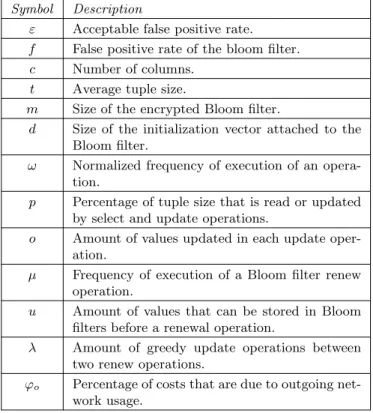
Symbol Description
ε Acceptable false positive rate.
f False positive rate of the bloom filter.
c Number of columns.
t Average tuple size.
m Size of the encrypted Bloom filter.
d Size of the initialization vector attached to the Bloom filter.
ω Normalized frequency of execution of an opera-tion.
p Percentage of tuple size that is read or updated by select and update operations.
o Amount of values updated in each update oper-ation.
µ Frequency of execution of a Bloom filter renew operation.
u Amount of values that can be stored in Bloom filters before a renewal operation.
λ Amount of greedy update operations between two renew operations.
ϕo Percentage of costs that are due to outgoing net-work usage.
Table 2: Model parameters.
storage and network overhead. In the following section we propose an analytical method to estimate the optimal BF size with respect to the tenant requirements.
6. Analytical model for overhead minimization We have shown that a greedy renew strategy requiring larger BFs reduces network overhead in an update sce-nario at the cost of additional storage overhead. Now we propose an analytical model that takes as its inputs the acceptable false positive rateε, the database characteris-tics and the database workload, and computes the best BF size, namelymbest, that minimizes the costs faced by
a tenant. In Section 6.1, we introduce the cost models for cloud database services. In Section 6.2, we describe our cost minimization methodology for a proxy-based ar-chitecture. In Section 6.3, we extend the minimization methodology for an alternative architecture that does not leverage any proxy. Table 2 summarizes the main param-eters used in the models.
6.1. Costs and network usage models
We assume that the tenant uses a typical pay-per-use cloud database service, where the costs are a function of storage, ingoing network and outgoing network traffic. We assume service costs that are independent of each other, that is, where the total cost of the service can be modeled by the following equation:
Cost“CostpStorageq `CostpN etInq `CostpN etOutq
We denote as ϕs, ϕi andϕo the cost weights related to
storage, ingoing and outgoing network, respectively. We define them as coefficients that are normalized with respect to the total cost (ϕs`ϕi`ϕo“1):
ϕs“ CostpStorageq Cost (11) ϕi“ CostpN etInq Cost (12) ϕo“ CostpN etOutq Cost (13)
If the database is already deployed in the cloud, the ten-ant can determine ϕs, ϕi and ϕo by using the real costs
of the basic service without our extensions. Otherwise, he can compute the costs and the corresponding weights by using estimation methodologies proposed in literature (e.g., [17, 22, 48]). In any case, it is important to evalu-ate the network usage that depends on type and number of operations executed on the database. We consider the most common operations: select, update and insert. We are not interested in delete operations because they do not transfer data between the tenant and the cloud provider.
We define the global workload W as the tuple
ppωS, Sq,pωU, Uq,pωI, Iqq, where S, U, I are workload
de-scriptions for select, update and insert operations, and ωS, ωU and ωI represent the normalized execution
fre-quencies of the operations within the workload W. We introduce the ingoing and outgoing network usage I and O for a given workload. For example,OSpSqis the outgo-ing network usage for the select workload S, while IIpIq
is the ingoing network usage for the insert workloadI. Select operations affect only the outgoing network usage, since they only fetch data from the database service. On the other hand, insert operations affect only the ingoing network usage, because they push data to the database service. Finally, update operations affect both ingoing and outgoing network usage. Ingoing network usage is due to the upload of a new value; outgoing network usage is due to the download of the digests and, possibly, of all the other row values (in case of a digest renew).
We define the total outgoing (N etIn) and ingoing net-work usage (N etOut) as:
N etIn“ωI ¨IIpIq `ωU¨IUpUq (14)
N etOut“ωS¨OSpSq `ωU¨OUpUq (15)
We model IIpIqby assuming that any insert operation
creates a new tuple whose average size is the sum of three components: the average sizetof the tuple in the original database, the size of the digest m, and the size d of the initialization vector used to encrypt the BF. Hence, the ingoing network usageIIpIqcan be computed as follows:
IIpIq “t`m`d (16)
The formula for the ingoing network usage IUpUq due
to updates is more complex. We assume that each up-date operation will push on average to the database an
amount of data that is the sum of three components: the average amount of values transmitted, the size of the BF m, and the size dof the initialization vector used to en-crypt the BF. We can define the workload U as a set of tuplespω, p, oq, each describing a single class of update op-erations. The parameterωis the normalized frequency of execution (ř
ωPUω“1),pis the ratio between the size of
the updated values and the size of the updated row, and o is the number of updated values (o ďc). The average ratio of data modified by an update operation ¯pu can be
computed as the weighted average of the sizes of updated values across the different classes of update operations, that is: ¯ pu“ ÿ pω,p,oqPU ω¨p (17)
Multiplying ¯puby the average tuple sizetyields the
aver-age amount of data transmitted by all update operations. Thus, the ingoing network usageIUpUqcan be written as: IUpUq “m`d`t¨p¯u (18)
Note that theovalues modeled in thepω, p, oqtuple is used later to quantify the amount of values that can be updated without requiring a greedy renew.
To defineOSpSqwe model the workload of select opera-tionsS as a set of tuplestpω, pqu, each describing a single class of select operations. The parameterω is the normal-ized frequency of execution andpis the ratio between the average size of the retrieved data and the size of a row. We estimate the average outgoing network usage due to select operations as the weighted average of network usage of the different types of select operations, that is:
OSpSq “m`d`t¨ ÿ
pω,pqPS
ω¨p (19) Finally, for the model of the outgoing network usage OUpUq due to update operations we must consider the
greedy renew strategy used to periodically renew the BFs. An update operation that does not renew the digest only retrieves the subset of the row that will be updated. An update operation that renews the digest retrieves the whole row. We model the average outgoing network usage of update operations as the following weighted average:
OUpUq “m`d`t¨ r1´ p1´µq ¨ p1´p¯uqs, (20)
whereµis the average frequency rate of the renew opera-tions, that is directly proportional to the amount of values u that we can insert in the BFs (see Section 4) and in-versely proportional to the amount of valuesoupdated in each update operation. As uis inversely proportional to the BF sizem(see Equation (9)), choosing greater values ofmallows us to reduce the frequency of renew operations. However, this choice increases the network usage of both greedy and renew operations. The aim of our methodol-ogy is to estimate the value m “ mbest that minimizes
Equation (20). Then, by using this optimal solution, we are able to minimize Equation (10). To optimize Equa-tion (20) we must denoteµ in terms ofm. In this paper, we propose two variants of the protocol.
The stateful variant assumes that the states of BFs are known. This scheme can be deployed on architec-tures based on a proxy that tracks the update opera-tions issued by all clients. We discuss the scheme in Section 6.2.
Thestateless variant assumes that distributed clients operate on the cloud database without any interme-diary servers and without knowing the states of BFs. This scheme can be easily deployed on client-side ap-plications without any intermediate server, but offers weaker security guarantees in presence of some ad-vanced attack scenarios. We discuss the scheme and its security guarantees in Section 6.3.
6.2. Stateful protocol
We initially consider a stateful protocol that is able to track the number of values inserted in all the encrypted BFs. A possible architecture leverages a trusted proxy that intercepts all operations issued to the cloud database service. This proxy manages a counter for each digest to track the number of values stored in each of them. A similar architecture is characterized by two drawbacks:
it increases the tenant costs due to infrastructure management;
if the tenant has geographically distributed clients, this scheme is not efficient because all client requests must pass through the proxy.
For these reasons, we also propose the optimization methodology for an alternative distributed architecture in Section 6.3.
Let λ be the number of greedy update operations be-tween two consecutive renewals. The renew frequency rate µcan be expressed as a function of λas following:
µ“ 1
1`λ (21)
The parameterλcan be estimated as the ratio between the amount of values that can be inserted in the BF, that isu(see Equation (9)), and the expected amount of values modified by each update operations, namely ¯ou:
λ“ u ¯ ou (22) where: ¯ ou“ ÿ pω,o,pqPU ω¨o (23)
is the weighted average of the number of values updated in each update operation for each class. To obtain a good
27 28 29 210 m 3000 4000 5000 6000 7000 8000 bw [bit/op] =0.0001 =0.001 =0.01
Figure 1: Estimated average network usage for each update operation as a function of the BF sizem.
approximation ofuin the most general scenario in which the update workload includes many classes of update op-erations, we define the following constraint: u should be chosen as the maximum linear combination of the values
touthat is lower or equal to the maximum amount of val-ues that can be stored in the BF. Hence, we adjust the definition ofuin Equation (9) as following:
u“max xPN0|xď ´ m¨lnp2q2 lnpεq ´c, x“ ÿ pd,oqPN0ˆU d¨o( (24) The outgoing network usage due to update operations can be estimated by substituting Equations (24), (22) and (21) in (20).
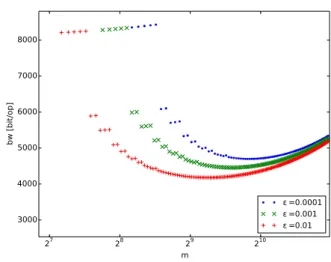
For the sake of clarity, we describe an example by refer-ring to Figure 1. This figure shows the behavior of Equa-tion (20), where the y-axis represents the estimated aver-age outgoing network usaver-ageOUpUqfor update operations,
while the x-axis represents the BF size m (in log-scale). Points represent admissible BF sizes and the correspond-ing outgocorrespond-ing network usage due to update operations. The estimation refers to a table ofc“15 columns and in which the tuples have an average size oft “1KB. The size of the initialization vector is d “ 64bit. The update work-load is characterized by two operations updating o1 “ 5
ando2“7 values that transferp1“30% andp2“60% of
the tuple size. The execution frequencies areω1“0.7 and
ω2“0.3, respectively. Figure 1 reports also three
scenar-ios that correspond to the acceptable false positive rates ε “ 1%,0.1%,0.01%. For each of them, through Equa-tion (7), we can compute the minimum BF sizes, that are mmin “ 144, mmin “ 216 and mmin “ 288 bits,
respec-tively. Choosing these values requires an always renew strategy and, as previously discussed and confirmed by the figure, they do not allow to minimize network usage. We need to compute the value of mfor which the
outgo-ing network usage is minimal. To this purpose, in Figure 1 we define “segment” a set of close, aligned points of the same curve. Each point corresponds to incremental values of u (the first point occurs foru“0, the second one for u“1, and so on). The goal of our analysis is to compute the local minimum in each segment; then, we compute the global minimum among all the local minima.
We note that for increasing BF sizes, the network usage increases within the same segment. We obtain this behav-ior when increasing the BF size does not incur in additional greedy update operations, due to the constraint imposed on u by Equation (24). As an example, let us consider the first “segment”., where the first value corresponds to the bandwidth usage for m“mmin, for which no greedy
update operation is possible. Choosing any other value of m within the first segment implies anuin range 1, . . . ,4 which is always less then any admissible number of up-dated values in the considered workload (we recall that o “ to1 “5, o2 “7u). Thus, no greedy update operation
can be executed as well. As a result, the local minimum of segment is the minimum value ofm for that segment.
We defineM as the set of the local minima: M “ # mˇˇ [ ´m¨lnp2q 2 lnpεq ´c _ P řd¨o( pd,oqPN0ˆU + (25) Here, the goal is to define which value of M is the global minimum of the estimation function. To this aim, we com-pute the minimum of the continuous function that inter-sects the elements of M, namely m90. Then, the absolute
minimum of the target function is the nearest neighbor of 9 m0in M. 9 m0“ ´ pc´o¯uq ¨lnε lnp2q2 ` a ¯ ou¨t¨lnε¨ pp¯u´1q lnp2q (26)
The proposed methodology estimates the best value of m that reduces outgoing network usage due to the up-date workload. Computing the value ofmthat minimizes the overall cloud service cost is an immediate extension of Equation (26). As described by the Equations (14)— (18), ingoing network usage due to insert and update, and outgoing network usage due to select is linearly depen-dent on m. Hence, we can use the costs weight ϕo (see
Equation (13)) and the workload frequencyωu (see
Equa-tion (14)) to compute the minimum of the continuous form of the Equation (10) as following:
ˆ m0“ ´ pc´o¯uq ¨lnε lnp2q2 ` a ωu¨ϕo¨¯ou¨t¨lnε¨ pp¯u´1q lnp2q (27) The optimal BF size mbest is the nearest neighbor of ˆm0
in the setM, computed through Equation (25).
In Appendix D, we propose a closed-form equation to compute the optimal value of m in a simple yet com-mon scenario characterized by an update workload that includes only one class of update operation.
6.3. Stateless protocol
We now discuss how to minimize the proposed verifi-cation mechanism in a stateless protocol variant. In this scenario each client operates directly on the cloud data-base service with no knowledge about the state of the BFs. Hence, it is necessary to decide when to renew the BFs without knowing the actual amount of values inserted in them. We propose the following implementation: each update operation is greedy with a given probability, oth-erwise it renews the BF. This approach suffers from two drawbacks:
a client might renew a BF even if the acceptable amount of update operations has not been reached yet;
a client might not renew a BF even if the accept-able amount of update operations has already been reached.
The former issue does not impact the ability of a system to verify integrity, although the outgoing network usage might be higher than necessary. On the other hand, the latter issue may lead to a false positive rate higher than ε. Even worse, this cannot be completely prevented when using the stateless protocol variant. We assume that the tenant chooses a probability of not exceeding ε, then we analyze the behavior of this protocol and minimize its over-head.
This methodology assumes a weaker security model with respect to the stateful protocol. By keeping track of the operations executed by the tenant, the storage provider knows if the tenant exceededs the amount of acceptable updates. Thus, he is able to attack the scheme when it has security guarantees lower thanε. Hence, this variant is secure only against attackers that have read/write access to the tenants data for a short amount of time (referring to literature terminology, we could call it as a snapshot active adversary [25]).
We define q as the false positive threshold that is the probability of keepingf ďε. We assume that a client ex-ecutes a renew operation with probabilityµand a greedy operation with probability 1´µ. Then, q can be com-puted as the probability of not exceeding the acceptable amount of update operations λ that is, the CDF of the geometric probability distribution with meanµand num-ber of failuresλ. We note that our construction allows to estimate the outgoing network usage due to updates by using Equation (20), however the estimation of µ is dif-ferent from that of the stateful protocol. The valueµcan be estimated as the inverse of the CDF of the geometric distribution:
µ“1´aλ 1
´q (28)
One can obtain the equation estimating the outgo-ing network usage due to updates by substitutoutgo-ing
Equa-27 28 29 210 211 212 m 0 2000 4000 6000 8000 bw [bit/op] Stateful Stateless, q = 0.99 Stateless, q = 0.9 Stateless, q = 0.8
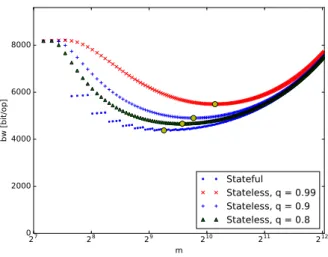
Figure 2: Estimated average network usage as a function of the BF sizemfor the stateless protocol.
tion (28) in (20) as following: OUpUq “m`d`t¨ ” 1´ p1´p¯uq ¨ aλ 1 ´q ı (29) Let us compare the behavior of this function with that of the stateful protocol in Section 6.2 by referring to Fig-ure 2. It compares the network usage estimation between the stateful and the stateless protocols for the following values of false positive threshold: q “0.8,0.9,0.99. The database characteristics and the workload parameters are the same of the scenario previously proposed in Figure 1. This figure shows that the performance of the stateless pro-tocol is similar to that of the stateful propro-tocol forq“0.8, although it is unrealistic to consider q“0.8 as an accept-able choice for a cloud tenant. (It would mean that the tenant accepts a 20% probability of exceeding the required ε.) Even more important, we note that the best BF size changes with respect to the stateful protocol and also for different values ofq.
The optimal BF size mbest can be computed through
the approach already shown for the stateful protocol: we first compute the set of local minimaM;
we compute a continuous function that intersects all the local minima;
we identify the global minimumm90of this continuous
function;
finally we select as mbest the local minimum that is
the nearest neighbor ofm90.
The evaluation of λ and M use the same models and equations adopted for the stateful protocol, but for the estimation of the renew frequency rate µ we use Equa-tion (28). One can estimate the outgoing network usage caused by update operations by substituting the Equa-tion (22) in (29). We can compute the optimum BF size
9
m0 of the continuous form of the Equation (29) as
follow-ing: 9 m0“ ´ c¨lnpεq lnp2q2 ´o¯¨lnp1´qq ¨lnpεq 2¨lnp2q2¨Wpxq , (30) x“ ´1 2 ¨ d ¯ o¨lnp1´qq ¨lnpεq t¨ p1´p¯q ¨lnp2q2 , (31)
whereWp¨qis theLambert W function [14].
We can extend this evaluation to compute the best value ofm“mˆ0to minimize the overall costs (see
tion (10)) as done for the stateful protocol (see Equa-tion (27)): ˆ m0“ ´ c¨lnpεq lnp2q2 ´¯o¨lnp1´qq ¨lnpεq 2¨lnp2q2¨Wpˆxq , (32) ˆ x“ ´1 2 ¨ d ¯ o¨lnp1´qq ¨lnpεq ϕo¨ωu¨t¨ p1´p¯q ¨lnp2q2 , (33) 7. Performance evaluation
To analyze the performance of the proposed solution we compare its storage and network overhead to those of other two solutions for the integrity of outsourced databases that are proposed in literature and commonly adopted in prac-tice.
The first solution is to associate a MAC tag to each value stored in the database by using HMAC-SHA256. This solution causes a high storage overhead because a 256-bit digest is bigger than many primitive data types. Its main benefit is that the cloud tenant can verify the integrity of a value without having to retrieve other un-necessary values from the remote cloud database service. In the performance evaluation we refer to this solution as VLH (value-level HMAC). The second solution, proposed in [44], associates an HMAC-SHA256 to all the values of the same row. The resulting scheme has the same struc-ture of that shown in Table 1, but the last column is used to store a HMAC rather than an encrypted BF. We refer to this solution asTLH (tuple-level HMAC). This approach has a clear benefit in terms of storage overhead with re-spect to the VLH solution. However, whenever the tenant wants to verify the integrity of one value, he has to re-trieve all the values stored in the same row. The retrieval of unnecessary values increases the network overhead.
To compare the performance of our approach against VLH and TLH we compute the optimal BF size mbest
for the acceptable false positive rate ε of the tenant, and we consider both the stateful and stateless protocols as a function of different acceptable false positive rates (ε “ 10´2,10´3,10´4) and two maximum false positive
thresholdsq“0.9,0.99. We refer to our solution as EBF (Encrypted BF). We initially analyze the performance re-lated to micro-benchmarks with different database charac-teristics and workloads. Then we evaluate the storage and network overhead of a realistic scenario by referring to the TPC-C workload.
Plain [bytes] VLH [bytes] (overhead) TLH [bytes] (overhead)
EBF [bytes] (overhead) ε“0.01 ε“0.001 ε“0.0001
Storage Overhead Tuple size 500 820 (64%) 532 (6.4%) 520 (4%) 526 (5.2%) 532 (6.4%)
Network overhead
Selectp“10% 50 82 (64%) 532 (964%) 70 (40%) 76 (52%) 82 (64%)
Selectp“50% 250 410 (64%) 532 (112%) 270 (8%) 276 (10.4%) 282 (12.8%)
Insert 500 820 (64%) 532 (6.4%) 520 (4%) 526 (5.2%) 532 (6.4%)
Table 3: Storage and network usage comparison for VLH, TLH and EBF integrity solutions.
7.1. Micro-benchmark workloads
We refer to a table in which each row is t “500 bytes long, and contains c “ 10 values. We assume that all values have the same size. We encrypt the BF by using a standard Blowfish 64-bit cipher [45] with a d “ 64-bit initialization vector.
We consider a scenario that includes only select and in-sert operations. As described in Section 4.4, in this sce-nario the optimal choice is the minimum BF size m “
mmin. By using Equation (7), we computemmin`dequal
to 160,208,256 bits forεequal to 10´2,10´3,10´4,
respec-tively. For insert operations, all the values of the row and all the corresponding digests (HMACs for VLH and TLH, Encrypted Bloom Filters for EBF) have to be transmit-ted from the client to the cloud database. Moreover, we consider three types of select operations depending on the amount of retrieved values.
Table 3 summarizes the number of bytes stored and transmitted for the different integrity strategies. The first row shows that VLH has the greatest storage overhead, while TLH and all EBF configurations have comparable overhead. The second row reports the bytes downloaded in the case of a select that retrieves only one value. The per-formance of EBF and VLH is optimal, because the tenant needs to retrieve just one value and the associated digest. If the select accesses only a subset of data, then EBF has a clear advantage over both TLH and VLH, as shown by the third row in which the tenant needs 5 out of the 10 values of a row. When select queries read all the values of a row, the performance of EBF and TLH is optimal, while VLH incurs in a high network overhead because the tenant has to retrieve one control structure for each value.
7.2. Mixed operations of the TPC-C workload
Now we consider the TPC-C standard OLTP bench-mark, that is commonly adopted for evaluating database performance. The contribution is twofold: we show how to leverage the proposed overhead minimization method-ology described in Section 6; then, we demonstrate the performance advantages of using EBF in realistic work-load scenarios.
Using the proposed methodology to estimate the best BFs size requires to translate database workloads into the parameters of the proposed model. Let us refer to a TPC-C compliant database represented in Table 4. We
distin-27 28 29 210 211 212 m 0 1000 2000 3000 4000 5000 6000 bw [bit/op] VLH TLH Plaintext Stateful Stateless, q = 0.9 Stateless, q = 0.99
Figure 3: Estimated average network usage for each update operation in terms of the BF sizem.
guish two kinds of parameters: those describing the data-base schema, and those representing the workload. The number of columns c and the average size of the tuples t are described in the first two rows of the table. More-over, the TPC-C standard defines a workload in which five transactions are executed with certain probabilities. Each transaction is a set of mixed operations executed on many tables. Let us focus on the tabledistrict (we limit to it for space reasons, although the same approach can be applied to any other table). This table has 11 columns and the average size of the tuples is 107 bytes. Two update opera-tions are executed on the table, and both of them update only one value. The size fractionpof a tuple transferred by an update can be obtained by computing the ratio be-tween the sum of the sizes of the columns interested by the operation, and the average size of the tuplet. The up-date operations are executed within thenew orderand the payment transactions, that have probabilities of execution equal to 45% and 43%, respectively. The frequencies of executiontωuwithin the UPDATE workload can be com-puted by normalizing their values, that is ω “43{p43`45q
andω“45{p43`45q. The frequency of executionωU of the
update workload can be obtained by computing the sum of all the transaction frequencies of the update operations divided by the frequencies of all the operations executed on that table.
Table warehouse district item customer history stock order new order order line
Number of columnsc 9 11 5 21 8 17 8 3 10
Avg. tuple size t{8
[bytes]
99 107 87 681 53 318 34 12 62
# values updatedtou 1 1,1 (none) 1,4, 3 (none) 1 1 (none) 1
Perc. sizetpu[%] 9.1 8.41,3.7 (none) 1.3,76.8,3.38 (none) 1.57 11.8 (none) 6.5
Execution freq. tωu
[%]
100 48.8,51.2 (none) 8.53,10.7,80.8 (none) 100 100 (none) 100
UPDATE freq.ωu[%] 32.8 50 0 33.8 0 47.9 7.02 0 6.56
Table 4:Analysis of the tables of a TPC-C compliant database
We now investigate the performance of integrity strate-gies applied to table customer by limiting the analysis to Figures 3 and 4 for space reasons. The figures compare the estimation of average network usage due to update operations in databases that adopt VLH, TLH and EBF integrity strategies and with the plaintext database. Fig-ure 3 details network usage for increasing BF sizes when the acceptable false positive rate ε is equal to 10´3.
Fig-ure 4 details network usage for decreasing acceptable false positive rates in the range 2´5, . . . ,2´80. In Figure 3 we
note that the estimated network usage for the VLH, TLH and plaintext databases is constant, because they do not leverage BFs. The figure shows also that EBF greatly im-proves network overhead over TLH. Moreover, the stateful protocol allows us to achieve results comparable to that of VLH.
In Figure 4 we note that the proposed protocols are con-venient even for much stronger security guarantees. The stateless protocol with a very high false positive threshold (q “ 0.99) is convenient up to an acceptable false posi-tive rate equal to about 2´34, and the stateful version is
convenient up to about 2´70. We highlight that the
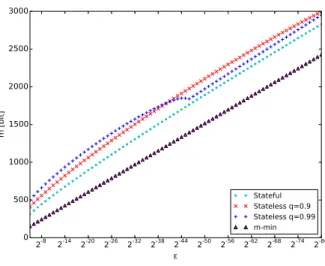
con-venience of the protocol depends on the workload. In both Figures 4 and 4 we note that if the tenant chooses an al-ways renew strategy, then the network usage overhead is increased both with respect to the greedy renew strategy (due to the retrieval of all the values of the tuple) and to the VLH solution (due to bigger BF sizes). Finally, in Fig-ure 5 we show the sizes of the BFs stored in database as a function of the acceptable false positive rate ε. We note that asεdecreases, the choice of the best BF size becomes closer to the minimum BF size.
8. Related work
Many cloud providers offer database services [26], but their security in terms of tenant’s data confidentiality and integrity remains an open research area. Literature proposes architectures and protocols aimed at improving service dependability by guaranteeing data confidential-ity [20, 21, 43]. They typically assume the honest-but-curiousthreat model where the main threat, besides exter-nal attackers, is represented by a cloud provider employee that may snitch on tenant’s data, without modifying it.
2-80 2-74 2-68 2-62 2-56 2-50 2-44 2-38 2-32 2-26 2-20 2-14 2-8 0 1000 2000 3000 4000 5000 6000 7000 8000 9000 bw [bit/op] VLH TLH Plaintext Stateful Stateless q=0.9 Stateless q=0.99 m-min
Figure 4: Estimated average network usage for each update in terms of acceptable false positive rateε.
These architectures rely on encryption strategies that al-low the tenant to execute SQL operations on encrypted data. In this paper we consider a different threat model in which data outsourced to the cloud may become corrupted, due to incorrect or faulty operations of the cloud provider or to deliberate attacks. Protocols guaranteeing verifica-tion of computaverifica-tions over outsourced data [42] are affected by high computational costs, especially on the server, and they are not convenient for database supporting CRUD workloads.
The scenario considered in this paper is a case of the more general data publishing scenario, in which the ob-jective of the tenant is to leverage some third party in-frastructure to distribute information to many users. In the data publishing scenario there are two classes of ac-tors: owners, that can write data, and users, that only execute read operations. All solutions for guaranteeing in-tegrity in this scenario [10, 31, 39] are based on asymmetric cryptography, and allow users to verify data integrity by leveraging digital signatures generated by owners. Similar approaches could guarantee integrity even in our database outsourcing scenario, but they are affected by high com-putation overhead [15]. For this reason we propose a novel protocol ensuring data integrity based on symmetric
en-2-80 2-74 2-68 2-62 2-56 2-50 2-44 2-38 2-32 2-26 2-20 2-14 2-8 0 500 1000 1500 2000 2500 3000 m [bit] Stateful Stateless q=0.9 Stateless q=0.99 m-min
Figure 5: BF size in terms of the acceptable false positive rateε.
cryption primitives.
Research efforts on guaranteeing integrity for files in cloud storage services tend to associate a Message Au-thentication Code (MAC) to each file stored in the cloud. In such a way, a cloud tenant can verify data integrity by downloading a file, recomputing the MAC and comparing it with the tag stored in the cloud. Since we assume that only legitimate users know the symmetric key required to compute a MAC, any adversary that tries to modify data without authorization cannot compute a new valid MAC. These approaches could be extended to the cloud database services by associating a MAC to each attribute stored in the database (for example, each element in any tuple). However, the storage size of a MAC is non-trivial (e.g., 256 bits for HMAC based on SHA256) and bigger than many primitive data types commonly stored in a data-base. This causes two problems that make a similar ap-proach inapplicable to cloud database services: the storage of a MAC for each database attribute causes an excessive storage overhead; the transmission of MACs causes an ex-cessive network overhead. Since storage and network usage is metered in cloud services, solutions based on MACs lead to excessive cost increases for the tenant.
Storage overhead can be reduced by using one MAC to authenticate multiple attributes [41] (for example, one MAC for each tuple or table), but a similar approach im-plies that whenever a cloud tenant aims to verify the in-tegrity of one attribute, he has to retrieve all the other at-tributes related to the same MAC. For example, it would be necessary to download all the attributes of a row or of a table even if the cloud tenant wants to verify the integrity of only one of them. This approach may be viable for file storage services [44] because MACs are associated to data blocks of large sizes that are accessed independently, but it causes high network overhead in database workloads, es-pecially when queries often requests a small table subset.
A more intersecting approach relies on provable data
possession protocols [3, 19] and proofs of retrievability [27], that allow tenants to verify integrity of very large data stored in outsourced databases when there is no need to retrieve them. In this scenario, the database provider is able to prove that he still maintains the tenant outsourced data by only returning a small amount of data [38]. Prov-able data possession protocols offer low communication costs for workloads that involve few or no read operations and tight integrity guarantees, such as replicated backups or ledgers. However, they are not convenient for CRUD workloads involving frequent read and update operations. Proofs of retrievability cannot be applied on unencrypted data, thus limiting their scope to specific applications.
The approach most related to our proposal is based on cryptographic accumulators [7] and asymmetric cryptog-raphy (e.g., RSA accumulators [24], bilinear accumula-tors [39], and aggregate signatures [13]). These methods support membership operations, that is, the tenant can as-sociate a cryptographic accumulator to each tuple of the database, and can test the integrity of each value with-out having to download the entire tuple. Cryptographic accumulators are effective and efficient in guaranteeing in-tegrity for some scenarios, such as log databases [31] and source code repositories [12]. On the other hand, because of asymmetric cryptography, they introduce a high com-putational overhead that makes them unsuitable to the majority of database workloads, especially when data is managed by cloud providers. In [15] the authors compare PADs (Persistent Authenticated Dictionaries) built upon RSA accumulators against PADs built upon other cryp-tographic data structures such as hashes and traditional digital signatures. They conclude that RSA accumula-tors are never the preferable algorithm despite their supe-rior asymptotic complexity, due to the high computational costs.
Other results based on Bloom filters to efficiently de-tect accidental and malicious modifications of files stored in the cloud are reported in [1, 49]. The authors of [49] proposed a scalable checksum algorithm based on Bloom filters that reduce processing times in highly-parallel en-vironments. Their solution allows the detection of data modifications in the case of accidental data corruption, but it cannot guarantee data authenticity in the case of adversarial modifications by malicious attackers in a data outsourcing scenario. The protocol proposed in [1] can be applied to adversarial scenarios, but it focuses on medium-to-large file sizes. Hence, it seems not practicable for the cloud database context that is typically characterized by a high volume of small-sized data.
The use of Bloom filters as cryptographic data struc-tures has been investigated by other authors [18, 40]. In [40], the researchers propose the use of Bloom filters as symmetric cryptographic accumulators, but their com-putational cost is two orders of magnitude higher than that of RSA asymmetric accumulators [29]. Recent literature in the field of secure two-party computation protocols [18] has proposed a data structure based on Bloom filters and
secret sharing to execute private set intersection protocols based on oblivious transfer. Since their data structure has a size much higher than that of common Bloom filters, their proposal is inapplicable to the cloud database sce-nario because it causes unacceptable network and storage overhead.
To the best of our knowledge, this is the first paper that proposes and evaluates a practical scheme for the verifica-tion of data integrity in cloud database services with the guarantee of efficient verification, low computational costs, and low overhead in terms of extra storage and network traffic. By combining Bloom filters and symmetric en-cryption, our scheme protects data against unauthorized modification by cloud employees and external attackers while minimizing computational costs related to Bloom filter verification and update. Moreover, it has the ca-pability of testing set membership of an element without retrieving all the other attributes of the same row, thus minimizing network and storage overhead.
9. Conclusions
Public cloud databases are appealing services that allow companies to outsource data management infrastructures, but their adoption is hindered by concerns about confi-dentiality and integrity of information managed by a third subject. We propose a novel scheme that allows cloud tenants to detect unauthorized modifications to data out-sourced to untrusted cloud providers. We demonstrate that the solution, based on encrypted Bloom filters, is at-tractive especially in the case of metered network traffic and storage, that is common in cloud database service offers. The proposed solution allows the tenant to tune the trade-off between the probability of detecting unau-thorized data modifications and storage and network over-head. We show that the protocol is applicable to architec-tures that are based on an intermediate trusted proxy and to distributed independent clients. We propose analytical methodologies that allow us to calculate the best size of the Bloom filters to minimize storage and network over-head and the cloud service costs. We demonstrate that the proposed scheme and methodologies are effective and that they reduce resource usage in realistic scenarios. The storage overhead of the proposed protocol is comparable or smaller than that of other solutions for database integrity and its network overhead is consistently lower.
As future work we are studying the integration of the proposed Bloom filter strategy with mechanisms for guar-anteeing data completeness and freshness.
References
[1] Adtiya, T., Baruah, P., Mukkamaka, R., Jul. 2011. Space-efficient bloom filter for enforcing integrity of outsourced data in cloud environments. In: Proc. Fourth IEEE Int’l Conf. Cloud Computing.
[2] Almulla, S. A., Yeun, C. Y., Mar.-Apr. 2010. Cloud comput-ing security management. In: Proc. Second IEEE Int’l Conf. Engineering Systems Management and Applications.
[3] Ateniese, G., Di Pietro, R., Mancini, L. V., Tsudik, G., 2008. Scalable and efficient provable data possession. In: Proc. Fourth ACM Int’l Conf. Security and privacy in communication net-works.
[4] Barker, E., Barker, W., Burr, W., Polk, W., Smid, M., 2007. Nist special publication 800-57. Tech. Rep. 57.
[5] Bellare, M., Canetti, R., Krawczyk, H., 1996. Keying hash func-tions for message authentication. In: Advances in Cryptology. Springer.
[6] Bellare, M., Canetti, R., Krawczyk, H., 1996. Pseudorandom functions revisited: The cascade construction and its concrete security. In: Proc. 37th IEEE Annual Symp. Foundations of Computer Science.
[7] Benaloh, J., De Mare, M., 1994. One-way accumulators: A de-centralized alternative to digital signatures. In: Advances in Cryptology. Springer.
[8] Bloom, B. H., 1970. Space/time trade-offs in hash coding with allowable errors. Comm. ACM.
[9] Blundo, C., Cresti, A., Vaccaro, U., Jun.-Jul. 1994. Key distri-bution schemes. In: Proc. IEEE Int’l Symp. Information The-ory.
[10] Brandenburger, M., Cachin, C., Kneˇzevi´c, N., 2015. Don’t trust the cloud, verify: integrity and consistency for cloud object stores. In: Proc. 8th ACM Int’l Conf. Systems and Storage. [11] Broder, A., Mitzenmacher, M., 2004. Network applications of
bloom filters: A survey. Internet Mathematics.
[12] Camenisch, J., Lysyanskaya, A., 2002. Dynamic accumulators and application to efficient revocation of anonymous credentials. In: Advances in Cryptology. Springer.
[13] Chen, X., Li, J., Weng, J., Ma, J., Lou, W., 2016. Verifi-able computation over large database with incremental updates. IEEE Trans. Computers.
[14] Corless, R. M., Gonnet, G. H., Hare, D. E., Jeffrey, D. J., Knuth, D. E., 1996. On the lambertw function. Advances in Computational mathematics.
[15] Crosby, S. A., Wallach, D. S., 2011. Authenticated dictionaries: Real-world costs and trade-offs. ACM Trans. Information and System Security.
[16] De Capitani di Vimercati, S., Foresti, S., Jajodia, S., Para-boschi, S., Samarati, P., 2007. Over-encryption: management of access control evolution on outsourced data. In: Proc. 33rd Int’l Conf. Very Large Data Bases.
[17] Deelman, E., Singh, G., Livny, M., Berriman, B., Good, J., 2008. The cost of doing science on the cloud: the montage ex-ample. In: Proc. ACM/IEEE Conf. Supercomputing.
[18] Dong, C., Chen, L., Wen, Z., 2013. When private set intersec-tion meets big data: an efficient and scalable protocol. In: Proc. ACM SIGSAC conference on Computer & communications se-curity.
[19] Erway, C. C., K¨up¸c¨u, A., Papamanthou, C., Tamassia, R., 2015. Dynamic provable data possession. ACM Trans. Information and System Security.
[20] Ferretti, L., Colajanni, M., Marchetti, M., Dec. 2013. Access control enforcement of query-aware encrypted cloud databases. In: Proc. Fifth IEEE Int’l Conf. Cloud Computing Technology and Science.
[21] Ferretti, L., Colajanni, M., Marchetti, M., 2014. Distrib-uted, concurrent, and independent access to encrypted cloud databases. IEEE Trans. Parallel and Distributed Systems. [22] Ferretti, L., Pierazzi, F., Colajanni, M., Marchetti, M., 2014.
Performance and cost evaluation of an adaptive encryption ar-chitecture for cloud databases. IEEE Trans. Cloud Computing. [23] Ferretti, L., Pierazzi, F., Colajanni, M., Marchetti, M., 2014. Scalable architecture for multi-user encrypted sql operations on cloud database services. IEEE Trans. Cloud Computing. [24] Goodrich, M. T., Tamassia, R., Hasi´c, J., 2002. An efficient
dynamic and distributed cryptographic accumulator. In: Infor-mation Security. Springer.