Doctoral Dissertations Student Theses and Dissertations
Spring 2012
Low-complexity soft-decision feedback turbo equalization for
Low-complexity soft-decision feedback turbo equalization for
multilevel modulations
multilevel modulations
Huang LouFollow this and additional works at: https://scholarsmine.mst.edu/doctoral_dissertations
Part of the Electrical and Computer Engineering Commons
Department: Electrical and Computer Engineering Department: Electrical and Computer Engineering Recommended Citation
Recommended Citation
Lou, Huang, "Low-complexity soft-decision feedback turbo equalization for multilevel modulations" (2012). Doctoral Dissertations. 1913.
https://scholarsmine.mst.edu/doctoral_dissertations/1913
This thesis is brought to you by Scholars' Mine, a service of the Missouri S&T Library and Learning Resources. This work is protected by U. S. Copyright Law. Unauthorized use including reproduction for redistribution requires the permission of the copyright holder. For more information, please contact [email protected].
by
HUANG LOU
A DISSERTATION
Presented to the Faculty of the Graduate School of the MISSOURI UNIVERSITY OF SCIENCE AND TECHNOLOGY
In Partial Fulfillment of the Requirements for the Degree DOCTOR OF PHILOSOPHY
in
ELECTRICAL ENGINEERING 2012
Approved by Chengshan Xiao, Advisor
Steve Grant Kurt Kosbar Sahra Sedigh Xiaoqing Liu
PUBLICATION DISSERTATION OPTION
This dissertation consists of the following four published or submitted papers, formatted in the style used by the Missouri University of Science and Technology, listed as follows:
Paper I, H. Lou, and C. Xiao, “Soft-decision Feedback Turbo Equalization for Multilevel Modulations,” has been published in IEEE Trans. Signal Processing, vol.59, pp.186-195, Jan. 2011. (pages 7-37)
Paper II, H. Lou, and C. Xiao, “Soft Feedback ISI Canceller-based Turbo Equalization for Multilevel modulations,” has been submitted to IEEE Trans. Communications, Oct. 2011. (pages 38-50)
Paper III, A. Rafati, H. Lou and C. Xiao, “Low-complexity soft-decision feed-back turbo equalization for MIMO systems with multilevel modulations,” has been published in IEEE Trans. Veh. Technol., vol.60, No.7, Sept. 2011. (pages 51-79)
Paper IV, A. Rafati, H. Lou, Y. R. Zheng and C. Xiao, “Soft Feedback Turbo Equalization for Underwater Acoustic Communications,” has been published in MTS/IEEE OCEANS, Kona, Hawaii, Sep. 19-22, 2011. (pages 80-95)
Paper V, A. Rafati, H. Lou and C. Xiao, “On the Soft-Decision Feedback Turbo Equalization for Underwater Acoustic Communications,” has been submitted to Journal of the Acoustical Society of America, Oct. 2011. (pages 96-128)
ABSTRACT
This dissertation proposes two new decision feedback equalization schemes suitable for multilevel modulation systems employing turbo equalization. One is soft-decision feedback equalization (SDFE) that takes into account the reliability of both
softa prioriinformation and soft decisions of the data symbols. The proposed SDFE
exhibits lower signal to noise ratio (SNR) threshold that is required for “water fall” bit error rate (BER) and much faster convergence than the near-optimal exact min-imum mean square error linear equalizer (Exact-MMSE-LE) for high-order constel-lation moduconstel-lations. The proposed SDFE also offers a low computational complexity compared to the Exact-MMSE-LE.
The drawback of the SDFE is that its coefficients cannot reach the matched filter bound (MFB) and therefore after a large number of iterations (e.g. 10), its per-formance becomes inferior to that of the Exact-MMSE-LE. Therefore, soft feedback intersymbol interference (ISI) canceller-based (SIC) structure is investigated. The SIC structure not only exhibits the same low complexity, low SNR threshold and fast convergence as the SDFE but also reaches the MFB after a large number of itera-tions. Both theoretical analysis and numerical simulations demonstrate why the SIC achieves MFB while the SDFE cannot.
These two turbo equalization structures are also extended from single-input single-output (SISO) systems to multiple-input multiple-output (MIMO) systems and applied in high data-rate underwater acoustic (UWA) communications.
ACKNOWLEDGMENTS
The research work reported in this dissertation was carried out with the De-partment of Electrical and Computer Engineering at Missouri University of Science and Technology, Rolla, Missouri, USA, from January 2009 to December 2011.
I am most grateful to my supervisor, Dr. Chengshan Xiao. I truly appreciate his valuable encouragement and guidance during the course of the research, his gen-erous support on research funding, his understanding of the special challenges that I have encountered. His diligent working style, zealous scientific attitude, and strict academic requirements have made him an excellent example for me.
I would also like to extend my appreciation to the members of my advisory committee, Drs. Steve L. Grant, Kurt Kosbar, Sahra Sedigh, and Xiaoqing Liu, the specialists of graduate office, Mrs. Sharon Matson, Mrs. Vicki Hudgins, and Regina P. Kohout, for their precious time in examining this dissertation and their valuable advice to my research work.
It is my pleasure to thank all my friends for their company and help during my Ph.D. years and all the colleagues in Missouri S&T for their assistance in my research work, especially, Mr. Amirhossein Rafati, for his efforts on some of the works in this dissertation.
I am indebted to my father Genlang Lou and my mother Huanying Yu, who have set my roots and given me wings, and who have always believed in me and encouraged me. My extraordinary love and gratitude go to my girl friend, Huai Huang, for paying back her true love with all she has.
TABLE OF CONTENTS
Page
PUBLICATION DISSERTATION OPTION . . . iii
ABSTRACT . . . iv
ACKNOWLEDGMENTS . . . v
LIST OF ILLUSTRATIONS . . . x
LIST OF TABLES . . . xiii
SECTION 1 INTRODUCTION . . . 1 1.1 BACKGROUND . . . 1 1.2 PROBLEM STATEMENT . . . 2 1.3 SUMMARY OF CONTRIBUTIONS . . . 3 1.4 REFERENCES . . . 5 PAPER I. SOFT-DECISION FEEDBACK TURBO EQUALIZATION FOR MULTI-LEVEL MODULATIONS . . . 7
Abstract . . . 7
1 Introduction . . . 7
2 Preliminary . . . 10
3 Soft-Decision Feedback Turbo Equalizer . . . 12
3.1 SDFE Coefficients . . . 12
3.2 SDFE Structure . . . 13
3.3 Expected Value Computation for BPSK . . . 14
3.4 Expected Value Computation for Multilevel Modulations . . . 17
3.5 Low-Complexity SDFE . . . 20
4.1 EXIT Chart of a MAX-LOG-MAP Decoder . . . 23
4.2 BER Estimation . . . 24
4.3 EXIT Chart of Turbo Equalizer . . . 24
4.4 SNR Threshold . . . 28
5 Simulation Results . . . 31
6 Conclusions . . . 34
7 Appendix . . . 35
8 References . . . 36
II. SOFT FEEDBACK ISI CANCELLER-BASED TURBO EQUALIZATION FOR MULTILEVEL MODULATIONS . . . 38
Abstract . . . 38
1 Introduction . . . 38
2 Preliminary . . . 40
3 Soft Intersymbol Interference Canceller . . . 41
3.1 SIC Structure And Coefficients . . . 41
3.2 Expected Value Computation for Multilevel Modulations . . . 43
4 Performance Analysis With EXIT Chart . . . 46
5 Simulation Results . . . 47
6 Conclusions . . . 48
7 References . . . 49
III. LOW COMPLEXITY SOFT-DECISION FEEDBACK TURBO EQUAL-IZATION FOR MIMO SYSTEMS WITH MULTILEVEL MODULATIONS . 51 Abstract . . . 51
1 Introduction . . . 51
2 System Model . . . 54
3 SDFE Structure . . . 58
3.1 Expected Value Computation for BPSK Modulation . . . 60
4 Low-Complexity Implementation . . . 64
5 Convergence Analysis . . . 66
6 Simulation Results . . . 72
7 Conclusion . . . 77
8 References . . . 77
IV. SOFT FEEDBACK TURBO EQUALIZATION FOR UNDERWATER ACOUSTIC COMMUNICATIONS . . . 80
Abstract . . . 80
1 Introduction . . . 80
2 System Model . . . 82
3 Signalling and Data Structure . . . 83
4 Proposed Detection Scheme . . . 85
5 Experimental Results . . . 91
5.1 Doppler Frequency Estimation . . . 92
5.2 BER Results . . . 93
6 Conclusion . . . 94
7 References . . . 94
V. ON THE SOFT-DECISION FEEDBACK TURBO EQUALIZATION FOR UNDERWATER ACOUSTIC COMMUNICATIONS . . . 96
Abstract . . . 96
1 Introduction . . . 96
2 Signalling and Data Structure . . . 99
3 Proposed SDFE Detection Scheme . . . 101
3.1 MIMO UWA Channel Estimation . . . 103
3.2 The Proposed SDFE Algorithm . . . 105
4 Experimental Results . . . 114
4.1 Synchronization . . . 115
4.3 Phase Correction . . . 121
4.4 Equalization and Decoding . . . 121
4.5 BER Results . . . 123 5 Conclusion . . . 125 6 Acknowledgement . . . 126 7 References . . . 126 SECTION 2 CONCLUSIONS . . . 129 3 PUBLICATIONS . . . 131 VITA . . . 132
LIST OF ILLUSTRATIONS
Figure Page
PAPER I
1 Transmitter section of the data transmission system. . . 10
2 Soft-decision feedback turbo equalizer. . . 14
3 Model for analysis of the iterative receiver. . . 23
4 EXIT charts of a MAX-Log-MAP decoder. . . 23
5 BER of a MAX-Log-MAP decoder as a function of IDi. . . 25
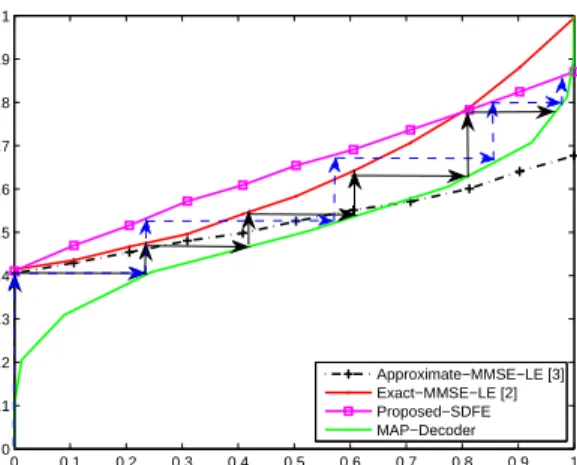
6 EXIT chart of turbo equalizer at 5 dB SNR for BPSK. . . 26
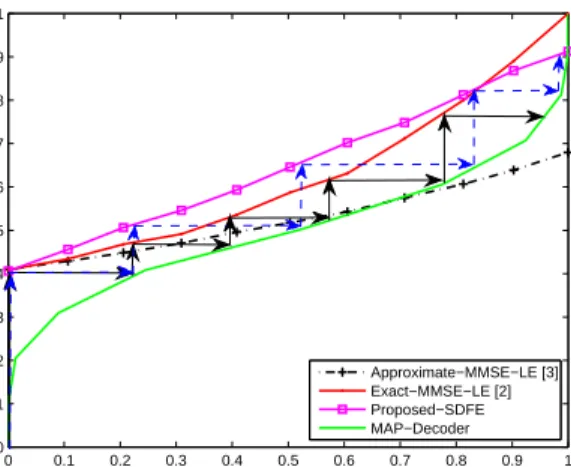
7 EXIT chart at 9 dB SNR for QPSK in Channel B. . . 26
8 EXIT chart of turbo equalizer at 15 dB SNR for 8PSK. . . 27
9 EXIT chart of turbo equalizer at 20 dB SNR for 16QAM. . . 28
10 EXIT chart at 5 dB SNR for QPSK. . . 29
11 EXIT chart at 12 dB SNR for 8PSK. . . 30
12 EXIT chart at 17 dB SNR for 16QAM. . . 31
13 BPSK BER performance. . . 32
14 QPSK BER performance. . . 33
15 8PSK BER performance. . . 33
16 16QAM BER performance. . . 34
PAPER II 1 Soft feedback ISI canceler. . . 42
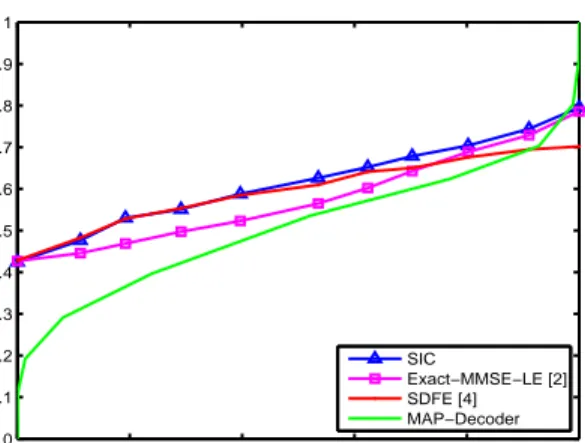
2 EXIT chart of turbo equalizer at 8dB SNR for 8PSK. . . 46
3 EXIT chart of turbo equalizer at 12dB SNR for 16QAM. . . 47
4 8PSK BER performance. . . 48
PAPER III
1 Block diagram of the SDFE transmitter and receiver. . . 54
2 Block diagram of the proposed SDFE receiver. . . 59
3 EXIT chart for BPSK constellation (26 dB). . . 68
4 EXIT chart for QPSK constellation (28 dB). . . 69
5 EXIT chart for 8PSK constellation (30dB). . . 69
6 EXIT chart for 16QAM constellation (35dB). . . 70
7 Projected EXIT chart for 16QAM constellation (35 dB). . . 70
8 Average Projected EXIT chart for BPSK constellation (26 dB). . . 71
9 Average Projected EXIT chart for QPSK constellation (28 dB). . . 72
10 Average Projected EXIT chart for 8PSK constellation (30dB). . . 73
11 Average Projected EXIT chart for 16QAM constellation (35dB). . . 73
12 BPSK BER performance. . . 75
13 QPSK BER performance. . . 75
14 8PSK BER performance. . . 76
15 16QAM BER performance. . . 76
PAPER IV 1 MACE10 data structure. . . 85
2 Block diagram of the kth branch of the proposed turbo receiver. . . 86
3 LFM signal correlation. . . 92
4 The estimated doppler speed. . . 93
PAPER V 1 Block diagram of the SDFE transmitter and receiver. . . 100
2 ACOMM09 data structure. . . 101
3 Partition structure of the transmitted data payload. . . 105
5 Received passband signal (2Tx),one burst. . . 116 6 Correlation between the received signal and the local LFMB signal. . . 116 7 Application of wavelet transform for synchronization. . . 118 8 Amplitude of the time varying channel for the duration of 20 blocks. . . . 119 9 Demonstration of channel estimation improvement for sub-channel T1-H2. 119 10 Demonstration of channel estimation improvement for sub-channel T1-H5. 120 11 Scatter plot of the original equalized symbols for 16QAM Constellation. . . 122 12 Scatter plot of the 16QAM symbols after phase correction. . . 122 13 Demonstration of turbo equalization with 16QAM constellation. . . 123
LIST OF TABLES
Table Page
PAPER I
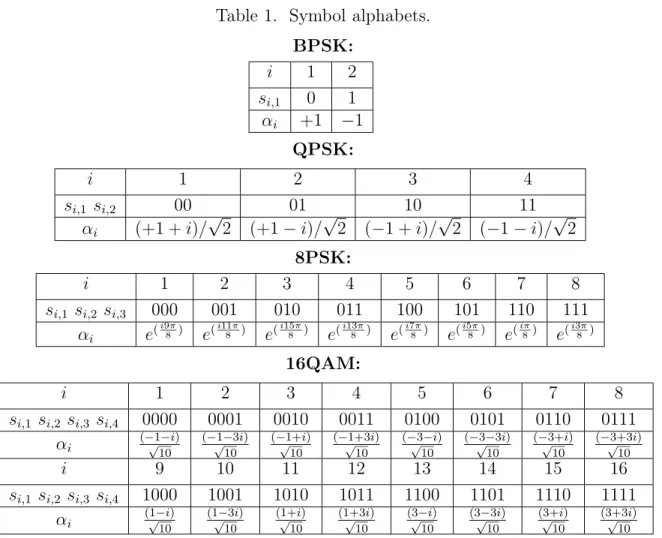
1 Symbol alphabets. . . 11
2 LLR λn,j approximation for symbol alphabets in Table 1. . . 18
3 SDFE equalizer algorithm. . . 22
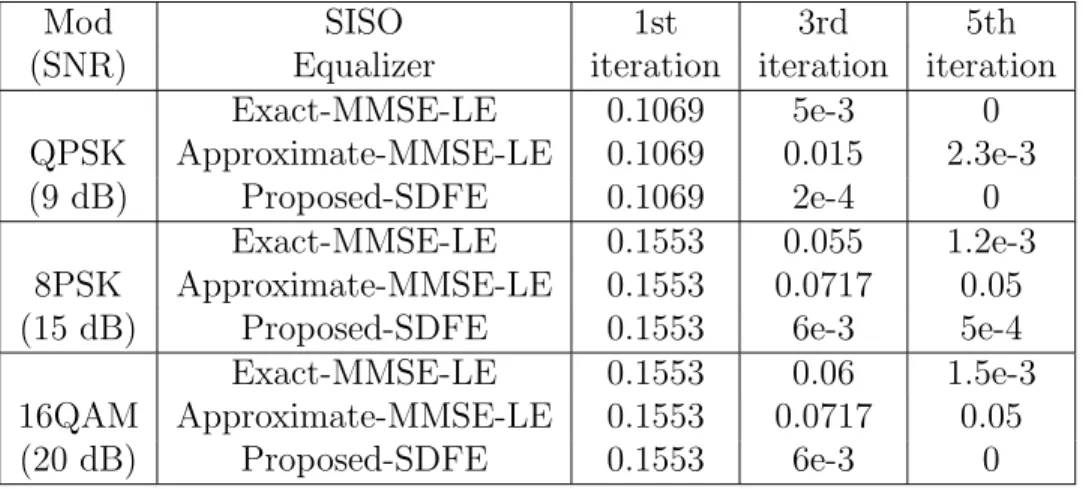
4 Expected BER for various SISO equalizers and a MAP decoder. . . 29
PAPER II 1 Symbol alphabets. . . 41
2 LLR λn,j approximation for symbol alphabets. . . 45
PAPER III 1 Symbol alphabets. . . 55
2 LLR simplifications for different constellations. . . 64
3 SDFE equalizer algorithm. . . 65
PAPER IV 1 Symbol alphabets. . . 84
2 LLR simplifications for different constellations. . . 90
3 Detection results for 2×12 MIMO. . . 94
PAPER V 1 Data blocks structure. . . 100
2 Symbol alphabets. . . 113
3 LLR simplifications for different constellations. . . 113
4 BER for 2×8 MIMO in ACOMM09 experiment (Nb = 1024). . . 124
5 BER for 2×8 MIMO in ACOMM09 experiment (Nb = 2048). . . 124
1.1 BACKGROUND
In many practical communication systems, data is transmitted over a channel with intersymbol interference (ISI). At the transmitter, the data is often protected by the addition of a controlled amount of redundancy using forward error correction or an error-correction code (ECC). It is then the task of the receiver to exploit both the structure of the transmit symbol constellation and the structure of the code to detect and docode the transmitted data sequence. Methods that exploit the structure of the transmitted symbol constellation are referred to as equalization, whereas those that exploit the structure of the code are termed decoding.
In a typical receiver, the data received from the channel is processed with an equalizer to mitigate the effects of ISI. The equalizer then produces estimates of the data, which are passed onto the decoder for the ECC. For complexity reasons, the equalization task typically consists of linear processing of the received channel output [linear equalizer (LE)] and possibly past symbol estimates [decision feedback equalizer (DFE)] [1], [2]. The parameters of these filters can be designed according to a variety of different optimization criteria, such as the zero foring (ZF) or MMSE criteria [1], [2]. Optimal equalization methods for minimizing the bit error rate (BER) and the sequence error rate are also nonlinear and are based on maximum likelihood (ML) estimation, which turns into maximum a posterior probability (MAP) estimation in presence of a priori information about the transimtted data. We refer to this estimation method as MAP/ML equalization.
When the data has been protected with a convolutional code, improvements in the BER can be easily obtained through the use of soft-input convolutional decoder.
Most practical communication systems also insert an interleaver after the encoder (in the transmitter) and a deinterleaver before the decoder (in the receiver). The process of interleaving premutes the symbols within a given block of data and, therefore, tends to decorrelate error events introduced by the equalizer between neighboring symbols. Convolutional decoder are often troubled by such error ”bursts” if left unpermuted.
A BER-optimal receiver that jointly addresses equalization and decoding is usually impractically complex, in particular, in the presence of an interleaver. How-ever, a number of iterative receiver algorithms have been developed that achieve near-optimal performance by repeating the equalization and decoding tasks on the same set of received data, using feedback information from the decoder in the equalization process. This method, which is called turbo equalization, was first proposed in [3]. By iteratively exchanging soft extrinsic information between a soft-input soft-output (SISO) equalizer and a SISO decoder, turbo equalizer can achieve large performance gains over separated equalizer and decoder structure.
1.2 PROBLEM STATEMENT
In its original form, Douillard et al. employed maximum a posterior proba-bility (MAP) equalization and decoding methods in an iterative fashion. Unfortu-nately, the computational complexity of the MAP equalizer depends exponentially on constellation size and the length of the channel impulse response (CIR). Therefore, the design of low-complexity turbo equalizers based on minimum mean square error (MMSE) criterion has attracted considerable interests [4]- [10]. Existing approaches to MMSE-based SISO turbo equalizers can be roughly classified into three categories. First, MMSE linear equalizers (MMSE-LE) [4, 5] treat each data symbol as a random variable with mean and variance computed from the a priori information. The exact solution of MMSE-LE (Exact-MMSE-LE) achieves close to MAP perfor-mance, but its all coefficients have to be computed anew for every symbol, resulting in
a time-varying equalizer whose computational complexity is quadratic in the number of equalizer coefficients. The approximate solution of MMSE-LE with “no a priori
information” (approximate-MMSE-LE), yielding time-invariant coefficients, is also proposed in [5]. However, its performance is not as good as Exact-MMSE-LE.
Second, MMSE decision feedback equalizers under perfect hard decision as-sumption (MMSE-DFE-HD) are designed in [5]. It feeds back hard decisions and thus suffers error propagation. To alleviate error propagation arising from hard de-cisions, soft-decision feedback (MMSE-DFE-SD) is employed in [8]- [10]. However, their equalizer coefficients derivation is still under hard decision assumption which could be suboptimal for soft-decision feedback implementation.
Third, soft-feedback equalizer (SFE) proposed in [6, 7] combines soft decisions with the a priori information for ISI cancelation. And more importantly, its equal-izer coefficients derivation is based on soft-decision feedback, which is different from perfect hard decision assumption. However, SFE is actually an ISI cancelation de-vice with both anti-causal and causal filters rather than a general decision feedback filter. Also, SFE needs an iterative procedure to compute γe (probability density
function parameter of equalizer extrinsic information output) and restricts itself in BPSK modulation.
Motivated by the respective advantages and limitations of the methods in the literature, two new decision feedback equalizer structures suitable for multilevel modulation systems are proposed for turbo equalization.
1.3 SUMMARY OF CONTRIBUTIONS
This dissertation will consist of a couple of journal publications and conference papers listed in the publication list. The published and expected contributions are:
1. The soft decision feedback turbo equalizer (SDFE) for multilevel modula-tion. The proposed SDFE took into account the reliability of both softa priori infor-mation and soft decisions of the data symbols. For the first iteration, the proposed SDFE starts as MMSE linear equalizer. As iterations progress, the proposed SDFE behaves as soft-decision feedback MMSE DFE. When both soft a priori information and soft decisions become more reliable, the feedforward filter of the proposed SDFE approaches matched filter. Both EXIT chart analysis and simulation results have shown that the proposed SDFE performs close to the high-complexity Exact-MMSE-LE in BPSK/QPSK modulation. For high level modulations, the proposed SDFE exhibits lower SNR threshold and converges much faster than the high-complexity Exact-MMSE-LE.
2. The Soft Feedback ISI Canceller-based turbo equalizer (SIC) for multilevel modulation. The drawback of the SDFE is its coefficients couldn’t reach matched fil-ter bound and therefore affil-ter a large number of ifil-terations (e.g. 10), its performance becomes inferior to that of Exact-MMSE-LE. SIC structure is therefore investigated, which is also a linear complexity equalizer that not only exhibits the same low com-lexity, low SNR threshold and fast convergence as the SDFE but also reaches matched filter bound after a large number of iterations.
3. Extend SDFE from single-input single-output (SISO) systems to multiple-input multiple-output (MIMO) communication systems. The purpose of this ex-tension is to develop a low-complexity, iterative soft-decision feedback equalization (SDFE) receiver for severe, frequency selective ISI channels in input multiple-output (MIMO) communication systems. The proposed MIMO-SDFE algorithm of-fers a novel approach to combat error propagation. Performance of the proposed detection scheme is verified through simulations using different signal constellations. The performance and convergence property of the proposed MIMO-SDFE algorithm
are analyzed using extrinsic information transfer (EXIT) chart and verified by sim-ulations in a severe inter-symbol interference channel. Simulation results show that our proposed algorithm has a significant improvement over the approximate MMSE linear turbo equalizer proposed in [4]. Moreover, we show that the performance of the proposed equalization scheme improves significantly when higher order constellations are used for digital modulation.
4. Apply SDFE and SIC in high data-rate underwater acoustic (UWA) com-munication systems. Mitigating inter-symbol interference (ISI) is one of the most important challenges in achieving high data rates in underwater acoustic (UWA) com-munication systems. To alleviate the fast temporal variations and long multi-path delay spreads of the underwater channels, both SDFE and SIC structures are ap-plied for single-carrier underwater acoustic communications. The proposed detection schemes have been tested by undersea trial data collected in the undersea experiment named ACOMM09 and MACE10. The testings have been performed with different transmission ranges, different modulation schemes, and different MIMO system con-figurations. The results show that the proposed algorithms provided robust detection for MIMO UWA communications.
1.4 REFERENCES
[1] J. Proakis, Digital Communications, 4th ed., McGraw-Hill, 2000. [2] S. Haykin, Communications Systems, 3rd ed., New York: Wiley, 1994.
[3] C. Douillard, C. Berrou, A. Picart, and A. Glavieux, “Iterative correction of intersymbol interference: Turbo Equalization,” European Trans. on Telecomm, vol.6, pp.507-511, Sept.-Oct. 1995.
[4] M. T¨uchler, A. C. Singer, and R. Koetter, “Minimum mean square error equal-ization using a priori information,” in IEEE Trans. Signal Processing, vol.50, pp.673-683, Mar. 2002.
[5] M. T¨uchler, R. Koetter, and A. C. Singer, “Turbo equalization: Principles and new results,” IEEE Trans. Commun, vol.50, no.5, pp.754-767, May. 2002. [6] R. R. Lopes and J. R. Barry, “The soft-feedback equalizer for turbo equalization
of highly dispersive channels,” IEEE Trans. Commun, vol.54, no.5, pp.783-788, May. 2006.
[7] R. R. Lopes, “Iterative estimation, equalization and decoding,” Ph.D. disserta-tion, Georgia Inst. Technol., Atlanta, GA, 2003.
[8] J. Wu and Y. R. Zheng, “Low complexity soft-input soft-output block decision feedback equalization,” IEEE J. Select. Areas Commun., vol.26, no.2, pp.281-289, Feb. 2008.
[9] A. Glavieux, C. Laot and J. Labat, “Turbo equalization over a frequency selective channel,” inProc. Int. Symp. Turbo Codes, Related Topics, Brest, France, pp.96-102, Sep. 1997.
[10] Z.Wu and J. Cioffi, “Low complexity iterative decoding with Decision-Aided Equalization for magnetic recording channels,” IEEE J. Select. Areas Commun., vol.19, no.4, pp.699-708, April. 2001.
PAPER
I. SOFT-DECISION FEEDBACK TURBO EQUALIZATION FOR MULTILEVEL MODULATIONS
Huang Lou and Chengshan Xiao, Fellow, IEEE
Abstract—Error propagation phenomena is the major drawback for existing
hard-decision feedback turbo equalizers. In this paper, we propose a new soft-hard-decision feed-back equalizer (SDFE) suitable for multilevel modulation systems employing turbo equalization. The proposed SDFE offers a low computational complexity growing only linearly with the number of equalizer coefficients, as opposed to the quadratic com-plexity of MMSE-based linear turbo equalizer with time-varying coefficients (Exact-MMSE-LE). The performance and convergence property of the proposed SDFE are analyzed using extrinsic information transfer (EXIT) chart and verified by simula-tions in a severe intersymbol interference channel set by Proakis. Results show that our approach performs close to Exact-MMSE-LE for BPSK/QPSK modulation. And for 8PSK/16QAM modulations, the proposed SDFE performs much better. It ex-hibits lower SNR threshold (SNR required for “water fall” BER) and much faster convergence than Exact-MMSE-LE.
1 Introduction
Turbo equalization is a joint channel equalization and channel decoding scheme used in communication systems with data transmission over intersymbol interfer-ence (ISI) channel [1]. By iteratively exchanging soft extrinsic information between a soft-input soft-output (SISO) equalizer and a SISO decoder, turbo equalizer can achieve large performance gains over separated equalizer and decoder structure. In
its original form, Douillardet al. employed maximuma posterior probability (MAP) equalization and decoding methods in an iterative fashion. Unfortunately, the com-putational complexity of the MAP equalizer depends exponentially on constellation size and the length of the channel impulse response (CIR). Therefore, the design of low-complexity turbo equalizers based on minimum mean square error (MMSE) crite-rion has attracted considerable interests [2]- [8]. Existing approaches to MMSE-based SISO turbo equalizers can be roughly classified into three categories.
First, MMSE linear equalizers (MMSE-LE) [2, 3] treat each data symbol as a random variable with mean and variance computed from the a priori information. The exact solution of MMSE-LE (Exact-MMSE-LE) achieves close to MAP perfor-mance, but its all coefficients have to be computed anew for every symbol, resulting in a time-varying equalizer whose computational complexity is quadratic in the number of equalizer coefficients. The approximate solution of MMSE-LE with “no a priori
information” (approximate-MMSE-LE), yielding time-invariant coefficients, is also proposed in [3]. However, its performance is not as good as Exact-MMSE-LE.
Second, MMSE decision feedback equalizers under perfect hard decision as-sumption (MMSE-DFE-HD) are designed in [3]. It feeds back hard decisions and thus suffers error propagation. To alleviate error propagation arising from hard deci-sions, soft-decision feedback (MMSE-DFE-SD) is employed in [6]- [8]. However, their equalizer coefficients derivation is still under hard decision assumption which could be suboptimal for soft-decision feedback implementation.
Third, soft-feedback equalizer (SFE) proposed in [4, 5] combines soft decisions with the a priori information for ISI cancelation. And more importantly, its equal-izer coefficients derivation is based on soft-decision feedback, which is different from perfect hard decision assumption. However, SFE is actually an ISI cancelation de-vice with both anti-causal and causal filters rather than a general decision feedback filter. Also, SFE needs an iterative procedure to compute γe (probability density
function parameter of equalizer extrinsic information output) and restricts itself in BPSK modulation.
Motivated by the respective advantages and limitations of the methods in the literature, we here propose a low-complexity MMSE-based SISO SDFE, a turbo equalization scheme that shares some similarities with SFE in [4, 5]. However, our approach differs SFE in three aspects:
1) we include time-varying offset dn (compensating for a possibly nonzero mean of
data symbols given a prioriinformation) in equalizer coefficients derivation to cancel both anti-causal and causal ISI. Because of dn, the anti-causal filter is not needed
any more. Also, the equalizer structure appears to be a natural generalization of traditional DFE from hard-decision to soft-decision.
2) MMSE-LE is employed in first turbo iteration to replace the iterative procedure for initial γe computation. Therefore, the induced convergence delay and computation
burden in [4] can be avoided.
3) we extend the modulation from BPSK to MPSK and QAM. For BPSK, the prob-ability density function (pdf) of extrinsic information is easy to obtain. However, for multilevel modulations, proper LLR approximation needs to be made with certain methods for specific symbol alphabets.
Moreover, timing-invariant equalizer coefficients are employed for low-complexity purpose in the proposed SDFE. With the help of both a priori information and soft decisions, the proposed SDFE not only successfully mitigates the error propagation phenomena existed in hard-decision feedback turbo equalizers, but also shows better performance than Exact-MMSE-LE for high level modulations.
The remainder of this paper is organized as follows. A brief definition of a coded data transmitter and signals are given in Section II. In section III, we describe the general structure of the proposed SDFE. The performance of the proposed SDFE is analyzed in Section IV with the tool of EXIT chart. Simulation results are verified
and compared to existing turbo equalizations in Section V. Section VI draws the conclusion.
2 Preliminary
We consider the transmitter depicted together with the ISI channel in Figure 1. LengthKc×Qbit sequencesc= [c1c2· · ·cKc] are subject to transmitting over an ISI channel, where subsequences cn= [cn,1 cn,2· · ·cn,Q] with bitscn,j ∈0,1. The mapper
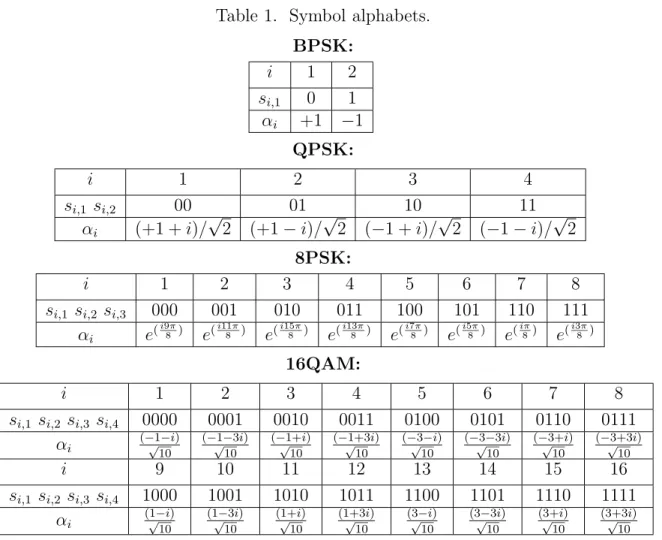
maps eachcnto a symbolxnfrom the 2Q−ary constellation setS ={α1, α2,· · · , α2Q}, where αi corresponds to the bit pattern si = [si,1 si,2· · ·si,Q] with si,j ∈0,1 in Table
1.
Encoder Mapper ISI
data
Π cn xn
wn
zn
Figure 1. Transmitter section of the data transmission system.
The ISI channel is of length M with impulse response
h[n] =
M−1
X k=0
hkδ[n−k]
and the noise sampleswnare independent and identically distributed (i.i.d.) with the
variance of σ2
w/2 for both real and imaginary part. Thus, the receiver input zn can
be written as zn = M−1 X k=0 hkxn−k+wn (1)
Table 1. Symbol alphabets. BPSK: i 1 2 si,1 0 1 αi +1 −1 QPSK: i 1 2 3 4 si,1 si,2 00 01 10 11 αi (+1 +i)/ √ 2 (+1−i)/√2 (−1 +i)/√2 (−1−i)/√2 8PSK: i 1 2 3 4 5 6 7 8 si,1 si,2 si,3 000 001 010 011 100 101 110 111 αi e( i9π 8 ) e( i11π 8 ) e( i15π 8 ) e( i13π 8 ) e( i7π 8 ) e( i5π 8 ) e( iπ 8) e( i3π 8 ) 16QAM: i 1 2 3 4 5 6 7 8 si,1 si,2 si,3 si,4 0000 0001 0010 0011 0100 0101 0110 0111 αi (−√110−i) (−√1−103i) (−√1+10i) (−√1+310i) (−√310−i) (−√3−103i) (−√3+10i) (−√3+310i) i 9 10 11 12 13 14 15 16 si,1 si,2 si,3 si,4 1000 1001 1010 1011 1100 1101 1110 1111 αi (1√−10i) (1√−103i) (1+√10i) (1+3√10i) (3√−10i) (3√−103i) (3+√10i) (3+3√10i)
or in matrix form for N =N1+N2+ 1 received symbols
zn=Hxn+wn (2) zn= [zn−N2 zn−N2+1· · ·zn+N1] T xn= [xn−N2−M+1 xn−N2−M+2· · ·xn+N1] T wn= [wn−N2 wn−N2+1· · ·wn+N1] T H= hM−1 · · · h0 · · · 0 ... . .. . .. . .. ... 0 · · · hM−1 · · · h0 .
In the sequel, some frequently used notations are introduced. Vectors are written in bold letters. Matrices are specified in bold capital letters. Time indexn is used to denote time-varying quantities. Thei×j matrix1i×j and0i×j contains all ones
and all zeros. Ii is an i×i identity matrix. (·)∗, (·)−1, (·)T and (·)H are respectively
the conjugate, inverse, transpose and hermitian operators. The covariance operator Cov(x, y) is given by E(xyH)−E(x)E(yH), where E(.) is the expectation operator.
3 Soft-Decision Feedback Turbo Equalizer
3.1 SDFE Coefficients
The MMSE estimate ˆxn of the transmitted symbol xn is given by
ˆ xn =fnzn+bnxdn+dn (3) xdn= [xdn−N3 x d n−N3+1· · ·x d n−1]T fn= [fN2,n fN2−1,n· · ·f−N1,n] bn= [bN3,n bN3−1,n· · ·b1,n]
whereN3 =N2+M−1,xdn is the past decided estimate determined by softa priori
information λp
n and soft extrinsic information λn. fn and bn are feedforward and
feedback coefficients, respectively.
Now, we assume that Cov(xn, xm)=Cov(xn, xmd )=Cov(xdn, xdm)=0 for all n, m
and n6=m. This is reasonable since xd
n is approximately equal to xn. Then,
fH
n ,bHn(Hermitian of fn,bn) and dn are obtained as
fnH =σw2IN+H Cffn−Cfbn(Cbbn)−1CfbHn HH−1sn (4) bHn =−(Cbbn)−1HCfbHn fnH (5) dn =E{xn} −fnHE{xn} −bnE{xdn} (6) ˆ xn =fn(zn−HE{xn})+bn(xdn−E{xnd})+E{xn} (7) where Cffn =E{xnxHn} −E{xn}E{xHn} Cfbn =E{xnxdHn } −E{xn}E{xdHn } Cbbn =E{xdnxdHn } −E{xdn}E{xdHn } sn =H(E{xnx∗n} −E{xn}E{x∗n}).
Proof: See Appendix.
3.2 SDFE Structure
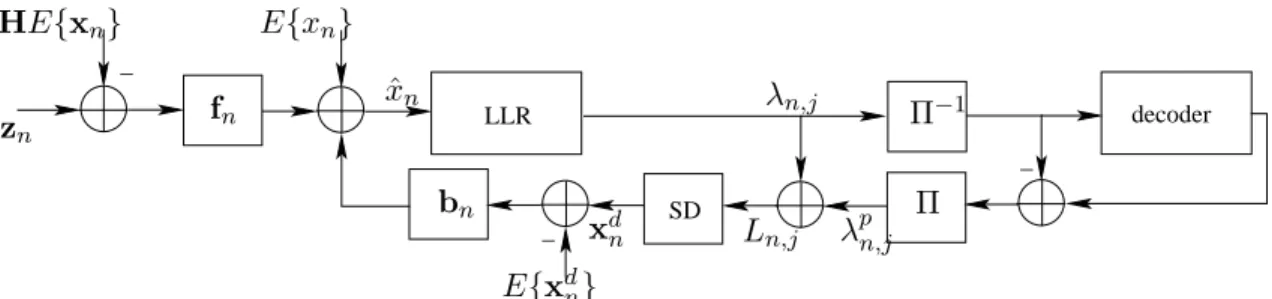
According to equation (7), we establish the equalizer structure for the pro-posed SDFE as shown in Figure 2. As we can see, for the first iteration,HE{xn}=
0(N1+N2+1)×1, E{xn} = 0, E{x
d
n} = 0N3×1, the proposed SDFE becomes the
tradi-tional decision feedback equalizer [14]. As iterations progress,HE{xn}indnbecomes
more reliable and is used to cancel both anti-casual and casual ISI from zn(the same
function as ISI-canceling filters in SFE [4]). Meanwhile, fn is approaching matched
filter response to h[n].
In order to compute fn,bn and dn, covariance matricesCffn, Cfbn and Cbbn have
to be decided first. Cff
n can be easily computed using the a priori information from
decoder. For calculating Cfb
− LLR decoder − − SD Π Π−1 E{xdn} xd n bn λpn,j λn,j Ln,j ˆ xn E{xn} fn HE{xn} zn
Figure 2. Soft-decision feedback turbo equalizer.
assumption in [3], expectation values ξ=E{xdn},ζ=E{xdnxdn∗} and β=E{xnxdn∗} have
to be determined according to the quality of both soft a priori information and soft decisions of data symbols. Here we have assumed that ξ, β and ζ are time-invariant for all n, since the average symbol error probability is approximately the same for each symbol.
3.3 Expected Value Computation for BPSK
Since the expected valuesξ, β and ζ are functions of xd
n, and xdn is a function
of LLR valuesλnand λpn, we now have to obtain the pdf ofλn and λpn. The approach
will be similar to the one presented in [4].
At the output of the equalizer, we assume as in [10] that the estimate ˆxn is
the output of an equivalent AWGN channel having xn∈ {−1,1} as its input:
ˆ
xn =Axn+vn (8)
where A = E{xˆnxn∗} = fnsn and vn is a white Gaussian noise with zero mean and
The computation of the extrinsic LLR λn,j of coded bit cn,j (j = 1 for BPSK) is obtained as λn,1 = log P(ˆxn|xn= 1) P(ˆxn|xn=−1) = 2ˆxn 1−A. (9) Let γe= 2A/(1−A), we have λn,1 ∼ N(xnγe,2γe).
Also, the a priori information λpn,1 of cn,1 can be computed from another
equivalent AWGN channel with output
ln=xn+un (10)
where un∼ N(0, σu2), let γp = 2/σu2, one can get
λpn,1 = log P(xn = 1)
P(xn =−1)
=γpln (11)
and λpn,1 ∼ N(xnγp,2γp).
After addingλn,1 and λpn,1 together, we have the full LLR value Ln,1 =λn,1+ λpn,1 and it follows Ln,1 ∼ N(xn(γe+γp),2(γe+γp)). The computation of xd n is then written as xdn= tanh(Ln,1/2) (12) and thus, ξ=E{xdn} =E{tanh(Ln,1/2)|xn= 1}Pr(xn= 1) +E{tanh(Ln,1/2)|xn=−1}Pr(xn =−1) = 0 (13)
β=E{xnxdn∗} =E{tanh(Ln,1/2)|xn = 1}Pr(xn= 1) −E{tanh(Ln,1/2)|xn=−1}Pr(xn=−1) =E{tanh(Ln,1/2)|xn = 1} (14) ζ =E{xdnxdn∗} =E{tanh2(Ln,1/2)|xn= 1}Pr(xn= 1) +E{tanh2(Ln,1/2)|xn=−1}Pr(xn =−1) =E{tanh2(Ln,1/2)|xn= 1}. (15)
Notice here we have made equal probability assumption since ξ, β and ζ are not used for individual xn. Generally speaking, E{xdn}, E{xnxnd∗} and E{xdnxdn∗} are
time-varying for each xn according to the a priori probability.
Although no closed-form formula exists for β and ζ, they can be computed by numerical methods as long as we know the parameters γe and γp.
Because E{|λpn,1|2}=γ2
p + 2γp,γp can be estimated directly from the a priori
information λpn,1. The maximum-likelihood (ML) estimate ofγp is then obtained as
γpM L= v u u t1 + 1 Kc Kc X n=1 |λpn,1|2−1. (16)
To determine γe, we need know A=fnsn, while we need γe to calculateβ and
ζ, and thus fn. This is problematic. To find both simultaneously, Lopes and Barry
propose giving an initial estimate for γe, then compute fn and γe iteratively, until
lot of computations. In our latter subsection, we will introduce a method to avoid this iterative procedure.
3.4 Expected Value Computation for Multilevel Modulations
We rewrite the estimate ˆxn of xn ∈S as:
ˆ
xn =Axn+vn (17)
and it follows ˆxn ∼ N(xnA, σ2), where σ2 =A(1−A), A=fnsn [10].
The symbol extrinsic probability is presented as
P(ˆxn|xn=αi) = 1 σ2π exp(−ρn,i) (18) ρn,i =| ˆ xn−Aαi|2 σ2 . (19)
The extrinsic LLR λn,j of coded bitcn,j is the function of P(ˆxn|xn=αi):
λn,j = log P αi:cn,j=0P(ˆxn|αi) Q ∀j′,j′ 6 =jP(cn,j′) P αi:cn,j=1P(ˆxn|αi) Q ∀j′,j′ 6 =jP(cn,j′) = log P αi:cn,j=0exp(−ρn,i+ P ∀j′,j′ 6 =j˜si,jL(cn,j′)/2) P αi:cn,j=1exp(−ρn,i+ P ∀j′,j′ 6 =j˜si,jL(cn,j′)/2) (20) where ˜ si,j = +1 if si,j = 0 −1 if si,j = 1
Substituting (18) and (19) to (20), one can get λn,j as a function of ˆxn. This
For QPSK or QAM modulation, the complexity of the relation between λn,j
and ˆxn can be reduced by using minimum-based LLR simplification defined by
log(exp(−x) + exp(−y)) =−min(x, y) +
log(1 + exp(−|x−y|))≈ −min(x, y) (21)
when |x−y| is sufficiently large.
For MPSK (M > 2) modulation, the minimum-based LLR simplifications can not be made because several symbols are quite close to each other on the unit circle. Instead, a geometric approach [11] can be applied to estimate LLR λn,j. The
approximation is listed in Table 2.
Table 2. LLRλn,j approximation for symbol alphabets in Table 1.
QPSK: - λn,1 ≈2 √ 2Re{xˆn}/(1−A). - λn,2 ≈2 √ 2Im{xˆn}/(1−A). 8PSK: - λn,1 ≈ −4 sin(7π/8)Im{xˆn}/(1−A). - λn,2 ≈ −4 sin(7π/8)Re{xˆn}/(1−A). - λn,3 ≈1.0824(|Re{xˆn}| − |Im{xˆn}|)/(1−A). 16QAM: - λn,1 ≈ −4Re{xˆn}/( √ 10(1−A)). - λn,2 ≈(8A−4 √ 10|Re{xˆn}|)/(10(1−A)). - λn,3 ≈ −4Im{xˆn}/( √ 10(1−A)). - λn,4 ≈(8A−4 √ 10|Im{xˆn}|)/(10(1−A)).
After obtaining λn,j, we can calculate full LLR value Ln,j of coded bit cn,j λpn,j = logP(cn,j = 0) P(cn,j = 1) (22) Ln,j =λn,j +λpn,j (23) where λpn,j ∼ N(γp,2γp) in condition of cn,j = 0. The computation of xd n is given by xdn = X αi∈S αiP( ˜xdn=αi) (24) P( ˜xd n=αi) = Q Y j=1 1 2(1 + ˜si,jtanh(Ln,j/2)). (25)
By exploiting symmetries and equal probability of αi ∈S, we get
ξ= 0 (26)
β =αiE{xnd∗|xn =αi} (27)
ζ =E{xdnxnd∗|xn =αi} (28)
where for MPSK, αi can be any elements in S, while for QAM, β and ζ should be
re-scaled when |αi| 6= 1. Since xdn is a function of Ln,j, as long as we know the
parametersγp of λpn,j andAof ˆxn, expected valuesβ and ζ can be calculated through
numerical methods.
The ML estimate ofγM L
p can be estimated using
γpM L = v u u t1 + 1 Kc ×Q Kc X n=1 Q X j=1 |λpn,j|2−1. (29)
In order to determine A, we need fn, while we need A to calculate β and ζ, and
thus fn. The same iteration procedure as in BPSK case can be used to find both
simultaneously.
3.5 Low-Complexity SDFE
An important aspect of these SISO equalizer algorithms is their computational complexity. Computing fn, bn, Cfbn and Cbbn for each time step n causes a higher
computational load. The complexity can be reduced by using time-invariant fTI, bTI,
CfbTI and Cbb
TI in each data block given by
fTIH = [σw2IN +H(IN1+N2+M −CfbTI(CbbTI)−1CfbHTI )HH]−1s (30) bHTI =−(CbbTI)−1HCfbHTI fTIH (31) dn=E{xn} −fTIHE{xn} −bTIE{xdn} (32) ˆ xn=fTIzn+bTIxdn+dn (33) where s=H[01×(N2+M−1) 1 01×N1] T CbbTI =ζIN3 CfbTI= β 0 · · · 0 0 β · · · 0 .. . . .. ... ... 0 · · · 0 β 0 · · · · 0 ... ... ... ... 0 · · · 0 .
When |λn,j| and |λpn,j| go to infinity, β → 1 and ζ → 1, thus fTIH → [σw2IN +
HCHH+ssH]−1s, which is close to the matched filter responsefH
M F = [σ2wIN+ssH]−1s. C= IN1×N1 0N1×(N2+M) 0(N2+M)×N1 0(N2+M)×(N2+M) .
Also we have observed that in [4], in order to reduce computational complex-ity, they only compute fn and γe iteratively for first turbo iteration. In later turbo
iterations, they calculate fn using theγe from previous turbo iteration. An updated
γe is then computed and passed on to the next turbo iteration.
In fact, for the first turbo iteration, soft decisions are usually not reliable. So we suggest replacing the proposed SDFE with MMSE-LE to reduce error propagations and in the meantime, avoid iterative calculation of initial fn.
The key algorithm for SDFE equalizer is summarized in Table 3, where the index (i) refers to the turbo iteration, fH
TI
(i)
, bH TI
(i)
and dn(i) are equalizer parameters
for i−th turbo iteration, γe(i+1) (or A(i+1)) is calculated at i−th iteration but passed
on to (i+ 1)−th turbo iteration.
Furthermore, for real-time hardware implementation, a mapping table between
γe (or A) and ξ, ζ and β can be pre-computed and stored in lookup table (LUT) for
specific modulations. In this way, lots of computational burdens can be reduced. The total computational complexity will depend only linearly on the number of equalizer coefficients, as opposed to the quadratic complexity of Exact-MMSE-LE.
4 Performance Analysis With EXIT Chart
The performance of the proposed SDFE equalizer is analyzed in this section by using the tool of extrinsic information transfer chart [3, 9, 12, 13], which traces the
Table 3. SDFE equalizer algorithm. FIRST ITERATION: - fH TI (1) = [σ2 wIN +HHH]−1s, bHTI (1) =0N3×1 and dn (1) = 0.
- Compute ˆx(1)n using equation (33).
BPSK:
· γe(2) = 2fTI(1)s/(1−fTI(1)s).
· Compute λn,1(1) and xdn
(1)
using equations (9) and (12).
MPSK/QAM:
· A(2) =f
TI(1)s.
· Compute λn,j(1) and xdn
(1)
using equations (20) and (24).
The i−th ITERATION (i > 1):
- Compute γp(i) using equation (29).
BPSK:
· Compute ζ(i) and β(i) using equations (14) and (15).
MPSK/QAM:
· Compute ζ(i) and β(i) using equations (27) and (28).
- Compute fTIH(i), bTIH(i) and dn(i) using equations (30), (31) and (32).
- Compute ˆx(ni) using equation (33).
BPSK:
· γe(i+1) = 2fTI(i)s/(1−fTI(i)s).
· Compute λn,1(i) and xdn
(i)
using equations (9) and (12)..
MPSK/QAM:
· A(i+1) =f
TI(i)s.
· Compute λn,j(i) and xdn
(i)
using equations (20) and (24).
evolution of mutual information between data symbols and its LLR through iterations. It is used to graphically predict the behavior of the iterative algorithm.
The SISO equalizer/decoder can be modeled as a mutual information trans-fer device, i.e., given a priori mutual information at the input, IEi, IDi, the
equal-izer/decoder generates a new mutual information,IEo, IDo, at the output by
Decoder Equalizer Π−1 Π IEi IEo IDi IDo
Figure 3. Model for analysis of the iterative receiver.
4.1 EXIT Chart of a MAX-LOG-MAP Decoder
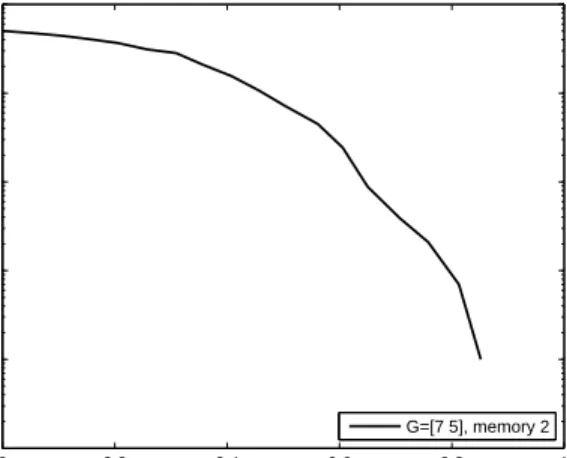
Figure 4 shows the EXIT chart of a MAX-LOG-MAP decoder using rate R= 1/2 convolutional code with generator polynomial in octal notation G = [7,5]. To obtain this EXIT chart, 106 coded bits generated from randomly chosen equiprobable
information bits and 106 corresponding Gaussian distributed a priori LLRs given
a preset σi are used. For the chosen σi, the mutual information IDi is computed
numerically using 0 0.2 0.4 0.6 0.8 1 0 0.1 0.2 0.3 0.4 0.5 0.6 0.7 0.8 0.9 1 ID i ID o G=[7 5], memory 2
IDi = 1 2 X x∈{+1,−1} Z +∞ −∞ fL(l|x) ·log2 2fL(l|x) fL(l|+ 1) +fL(l| −1) dl (34) fL(l|x) =φ((l−xσi2/2)/σi)/σi (35) where φ(x) = e−x2
/2/√2π. The pdfs of the output LLRs are estimated using
his-togram method, which is then used to obtain IDo using the same equation in (34).
The EXIT chart is depicted by repeating the procedure above for several values ofσi
yielding pairs (IDi, IDo).
4.2 BER Estimation
The EXIT analysis is also used to estimate the BER of MAX-LOG-MAP decoder output after an arbitrary number of iterations [9]. This estimation is based on the Gaussian assumption (35) yielding a unique BER corresponding to decoder input IDi.
Figure 5 displays the BER as a function of IDi on logarithmic scales for rate
R = 1/2 convolutional code with generator polynomial in octal notation G = [7,5]. As we can see, when input mutual information IDi = 0.5 or less, the corresponding
decoder BER will be 0.07 or higher. whenIDi is greater than 0.8, the decoder achieves
BER lower than 10−4.
4.3 EXIT Chart of Turbo Equalizer
We now study EXIT charts of several Turbo equalizers for BPSK, QPSK, 8PSK and 16QAM modulations with different SNR values. We consider the length-5 ISI channel h= [0.227,0.46,0.6880.460.227]. This channel causes severe ISI, enabling turbo equalization to yield large performance gains. The estimator filter parameters are set up as follows: N1 = 9, N2 = 5, N3 = N2 +M − 1. The iteration process
0 0.2 0.4 0.6 0.8 1 10−4 10−3 10−2 10−1 100 ID i BER G=[7 5], memory 2
Figure 5. BER of a MAX-Log-MAP decoder as a function of IDi.
between equalizer and decoder can be visualized by using a trajectory trace following
IEi/IDo →IEo/IDi and IEo/IDi →IEi/IDo.
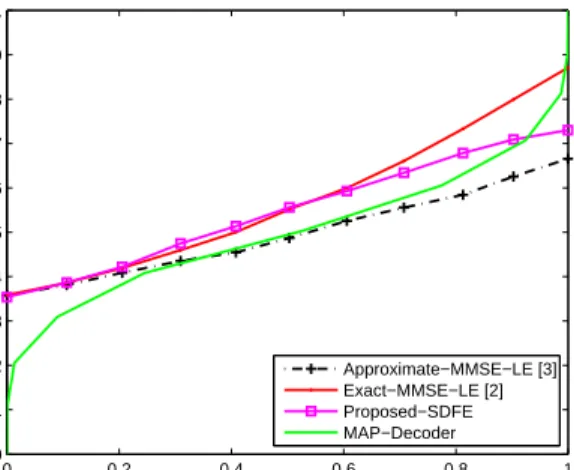
For BPSK case in Figure 6, the proposed SDFE has the same slope as Exact-MMSE-LE for small value of IEi. However, it shows a poorer performance than
Exact-MMSE-LE for large value of IEi. The maximumIEo for the proposed SDFE is
only 0.7 while Exact-MMSE-LE could achieve 0.87. The reason is Exact-MMSE-LE approaches matched filter fH
M F closer than the proposed SDFE in case of large IEi
input. Approximate-MMSE-LE is the worst. For example, it stops improving the performance after around three iterations and remains in the fixed point IEo = 0.4.
Figure 7 depicts the EXIT charts for QPSK modulation. As we can see, in small and medium IEi input region, the proposed SDFE has a wider tunnel than
Exact-MMSE-LE, which means the proposed SDFE has a faster convergence rate. For example, the proposed SDFE could reach IEo = 0.83 after 3 iterations while
Exact-MMSE-LE only gets IEo = 0.68. In large IEi input region, Exact-MMSE-LE
0 0.2 0.4 0.6 0.8 1 0 0.1 0.2 0.3 0.4 0.5 0.6 0.7 0.8 0.9 1 IE i/IDo IE o /ID i Approximate−MMSE−LE [3] Exact−MMSE−LE [2] Proposed−SDFE MAP−Decoder
Figure 6. EXIT chart of turbo equalizer at 5 dB SNR for BPSK.
5 iterations, Exact-MMSE-LE reaches IEo = 0.96, which is greater than IEo = 0.9
for the proposed SDFE.
0 0.1 0.2 0.3 0.4 0.5 0.6 0.7 0.8 0.9 1 0 0.1 0.2 0.3 0.4 0.5 0.6 0.7 0.8 0.9 1 IE i/IDo IEo /ID i Approximate−MMSE−LE [3] Exact−MMSE−LE [2] Proposed−SDFE MAP−Decoder
Figure 7. EXIT chart at 9 dB SNR for QPSK in Channel B.
For 8PSK case in Figure 8, it can be seen from the trajectory trace that the convergence rate, which is determined by the width of the tunnel between the
transfer curves of the equalizer and the decoder, of the proposed SDFE is faster than Exact-MMSE-LE. The proposed SDFE could reach IEo = 0.67 (IEo = 0.87)
after 3 (5) iterations while Exact-MMSE-LE only gets IEo = 0.54 (IEo = 0.78).
Although Exact-MMSE-LE is capable of achieving the mutual information IEo = 1
as the iterations progress, which is better than IEo = 0.88 for the proposed SDFE,
IEo = 0.88 is actually high enough for decoder to get near error free performance as
we can see from Figure 5. Approximate-MMSE-LE is still the worst, it touches the flipped decoder transfer curve at IEo = 0.57 and stops improvement.
0 0.1 0.2 0.3 0.4 0.5 0.6 0.7 0.8 0.9 1 0 0.1 0.2 0.3 0.4 0.5 0.6 0.7 0.8 0.9 1 IEi/IDo IEo /ID i Approximate−MMSE−LE [3] Exact−MMSE−LE [2] Proposed−SDFE MAP−Decoder
Figure 8. EXIT chart of turbo equalizer at 15 dB SNR for 8PSK.
The similar convergence property occurs for 16QAM case in Figure 9. The proposed SDFE could reach IEo = 0.67 (IEo = 0.9) after 3 (5) iterations while
Exact-MMSE-LE only gets IEo = 0.53 (IEo = 0.77). And also, the output mutual
information IEo = 0.92 for large value of IEi for the proposed SDFE is indeed high
0 0.1 0.2 0.3 0.4 0.5 0.6 0.7 0.8 0.9 1 0 0.1 0.2 0.3 0.4 0.5 0.6 0.7 0.8 0.9 1 IE i/IDo IEo /ID i Approximate−MMSE−LE [3] Exact−MMSE−LE [2] Proposed−SDFE MAP−Decoder
Figure 9. EXIT chart of turbo equalizer at 20 dB SNR for 16QAM.
Following the traces of all SISO equalizers in Figure 7, 8 and 9 yields values for IDi after each iteration. Using Figure 5, we can compute estimates of the BER
given in Table 4.
4.4 SNR Threshold
The EXIT chart can be used to determine the threshold SNR for a turbo equalizer defined as the SNR above which the turbo equalizer converges to a small BER, and below which the turbo equalizer does not converge to a small BER. The thresholds were obtained by generating equalizer EXIT charts at varying SNRs until the transfer curve touched or intersected the flipped decoder transfer curve at IDo =
0.5 or less, which corresponds to a fixed point of the system with a BER of 0.07 or more. Since the equalizer and the flipped decoder transfer curve have a similar slope, increasing the SNR will nearly result in a parallel upshift of the equalizer transfer curve, yielding a quickly moving fixed point in the area around IDo = 0.5. The
corresponding BER changes quickly too, which is usually observed water fall region in the BER plot.
Table 4. Expected BER for various SISO equalizers and a MAP decoder.
Mod SISO 1st 3rd 5th
(SNR) Equalizer iteration iteration iteration
Exact-MMSE-LE 0.1069 5e-3 0
QPSK Approximate-MMSE-LE 0.1069 0.015 2.3e-3
(9 dB) Proposed-SDFE 0.1069 2e-4 0
Exact-MMSE-LE 0.1553 0.055 1.2e-3
8PSK Approximate-MMSE-LE 0.1553 0.0717 0.05
(15 dB) Proposed-SDFE 0.1553 6e-3 5e-4
Exact-MMSE-LE 0.1553 0.06 1.5e-3
16QAM Approximate-MMSE-LE 0.1553 0.0717 0.05
(20 dB) Proposed-SDFE 0.1553 6e-3 0
Figure 10 shows EXIT transfer curves for QPSK case. As we can see, when
SNR = 5dB, Exact-MMSE-LE stop improvements at a small value of IDi = 0.45.
While for the proposed SDFE, a narrow tunnel guides the convergence point to ap-proach IDi = 0.73. This tells us that SNR threshold for the proposed SDFE is lower
than that of Exact-MMSE-LE.
0 0.2 0.4 0.6 0.8 1 0 0.1 0.2 0.3 0.4 0.5 0.6 0.7 0.8 0.9 1 IEi/IDo IE o /ID i Exact−MMSE−LE [2]: 5db Proposed−SDFE: 5db MAP−Decoder
Figure 11 shows EXIT transfer curves for 8PSK case. When SNR = 12dB, Exact-MMSE-LE stop improvements at a small value of IDi = 0.43. While for the
proposed SDFE, a narrow tunnel guides the convergence point to approach IDi =
0.78.
Figure 12 shows SNR thresholds for 16QAM case. Similar results were ob-tained from EXIT chart. SNR thresholds for Exact-MMSE-LE is more than 17dB, while for the proposed SDFE, SNR thresholds is less than 17dB.
0 0.2 0.4 0.6 0.8 1 0 0.1 0.2 0.3 0.4 0.5 0.6 0.7 0.8 0.9 1 IEi/IDo IE o /ID i Exact−MMSE−LE [2]: 12db Proposed−SDFE: 12db MAP−Decoder
Figure 11. EXIT chart at 12 dB SNR for 8PSK.
Therefore, for both 8PSK and 16QAM, the proposed SDFE exhibits a lower SNR threshold than Exact-MMSE-LE. We also conclude that the proposed SDFE would performance better than Exact-MMSE-LE in low SNR region, because the proposed SDFE has a longer and wider tunnel in the EXIT chart.
0 0.2 0.4 0.6 0.8 1 0 0.1 0.2 0.3 0.4 0.5 0.6 0.7 0.8 0.9 1 IEi/IDo IE o /ID i Exact−MMSE−LE [2]: 17db Proposed−SDFE: 17db MAP−Decoder
Figure 12. EXIT chart at 17 dB SNR for 16QAM.
5 Simulation Results
We compare the performance of different turbo equalizers, including Exact-MMSE-LE [2], approximate-Exact-MMSE-LE [3], SFE [4], MMSE-DFE-SD, and the pro-posed SDFE with time-invariant coefficientsfTI andbTI. The performance of
MMSE-DFE-HD can be found in [3] and is not included here. It suffers severe error propaga-tion and doesn’t improve as iterapropaga-tion goes. In all cases, the transmitted binary bits are encoded by a rateR= 1/2 convolutional code with generator polynomial in octal notationG= [7,5], followed by a size 10560 random interleaver. We consider the same ISI channel as in [2]- [4] with the impulse responsesh= [0.227,0.46,0.688,0.46,0.227] causing severe ISI. The filter parameters for Exact-MMSE-LE and approximate-MMSE-LE are set to (N1 = 9, N2 = 5) and for the proposed SDFE to (N1 = 9, N2 = 5, N3 = N2 +M −1). MAX-LOG-MAP algorithm is employed for channel
We begin with the performance for BPSK modulation depicted in Figure 13. After 3 or 10 iterations, the BER curves exhibit that the system using Exact-MMSE-LE is the best, followed by the proposed SDFE, MMSE-DFE-SD and the approximate-MMSE-LE. The gain improvement between 3 and 10 iterations is significant in this channel because of the larger slope in exit chart. It is also interesting to note that the proposed SDFE achieves a performance similar to that of SFE after 10 iterations. This result makes sense since both the proposed SDFE and SFE combine soft decisions with the a priori information for equalization.
3 4 5 6 7 8 9 10 11 10−5 10−4 10−3 10−2 10−1 100 Eb/No(db) BER Exact−MMSE−LE [2] Approximate−MMSE−LE [3] MMSE−DFE−SD SFE [4] Proposed−SDFE 10 iterations 3 iterations
Figure 13. BPSK BER performance.
Figure 14 shows the BER results for QPSK modulation. SFE is not included since it only considers BPSK in [4]. As we can see, the BER curves exhibit the ex-pected behavior as indicated in EXIT chart. For 3 iterations, the proposed SDFE has a lower BER than Exact-MMSE-LE. After 5 iterations, Exact-MMSE-LE out-performs the proposed SDFE. Also, we notice that the performance gap between the proposed SDFE and MMSE-DFE-SD starts to increase.
5 6 7 8 9 10 11 12 13 10−5 10−4 10−3 10−2 10−1 100 SNR(db) BER Exact−MMSE−LE [2] Approximate−MMSE−LE [3] MMSE−DFE−SD Proposed−SDFE 3 iterations 5 iterations
Figure 14. QPSK BER performance.
For 8PSK modulation, all BER performance curves are plotted in Figure 15 (MMSE-DFE-SD starts to suffer error propagation for 8PSK modulation and its BER performance is not included). From this figure, the system using the proposed SDFE performs the best, followed by Exact-MMSE-LE and the approximate-MMSE-LE. After 5 iterations, the proposed SDFE provides nearly 1.3 dB (5.6 dB) gain at 10−3
BER compared to Exact-MMSE-LE (the approximate-MMSE-LE). This result agrees with the analysis from EXIT chart in Figure 8 and BER predictions in Table 4.
12 13 14 15 16 17 18 19 20 10−5 10−4 10−3 10−2 10−1 100 SNR(db) BER Exact−MMSE−LE [2] Approximate−MMSE−LE [3] Proposed SDFE 3 iterations 5 iterations
Similar performance results are observed for 16QAM case shown in Figure 16 (MMSE-DFE-SD suffers error propagation for 16QAM modulation and its BER per-formance is not included). The proposed SDFE exhibits lowest SNR threshold and fastest convergence. After 5 iterations, the proposed SDFE provides nearly 1.5 dB (6 dB) gain at 10−3 BER compared to Exact-MMSE-LE (the approximate-MMSE-LE).
These BER curves also matches well with the EXIT chart in Figure 9 and BER predictions in Table 4. 16 17 18 19 20 21 22 23 24 10−4 10−3 10−2 10−1 100 SNR(db) BER Exact−MMSE−LE [2] Approximate−MMSE−LE [3] Proposed SDFE 3 iterations 5 iterations
Figure 16. 16QAM BER performance.
It is noted that the proposed SDFE is also working well for 64QAM. Details are omitted for brevity.
6 Conclusions
A low-complexity MMSE-based soft-decision feedback turbo equalizer has been proposed for both BPSK and multilevel modulations. The proposed SDFE took into
account the reliability of both soft a prioriinformation and soft decisions of the data symbols. For the first iteration, the proposed SDFE starts as MMSE linear equalizer. As iterations progress, the proposed SDFE behaves as soft-decision feedback MMSE DFE. When both soft a priori information and soft decisions become more reliable, the feedforward filter of the proposed SDFE approaches matched filter. Both EXIT chart analysis and simulation results have shown that the proposed SDFE performs close to the high-complexity Exact-MMSE-LE in BPSK/QPSK modulation. For high level modulations, the proposed SDFE exhibits lower SNR threshold and converges much faster than the high-complexity Exact-MMSE-LE.
7 Appendix
We solve the set (fn,bn, dn) that minimize E{|xn−xˆn|2} using partial
differ-entiation. ∂E{|xn−xˆn|2} ∂d∗ n =−2E{xn−fnzn−bnxdn−dn} (36) ∂E{|xn−xˆn|2} ∂fH n =−2E{(xn−fnzn−bnxdn−dn)zHn} (37) ∂E{|xn−xˆn|2} ∂bH n =−2E{(xn−fnzn−bnxdn−dn)xdHn } (38)
By replacing zn with equation (2) and setting equation (36) to zero, we get
We then insert dn into equations (37) and (38) and set both to zero. After
combining elements using the quantities Cff
n, Cfbn, Cbbn and sn, we have
fnHCfbn +bnCbbn = 0 (39)
(σw2IN+HCffnHH)fnH +HCfbnbHn =sn. (40)
Solving equations (39) and (40) for (fn,bn) yields
fnH =σw2IN+H Cffn−Cfbn(Cbbn)−1CfbHn
HH−1sn
bHn =−(Cbbn)−1HCfbHn fnH.
8 References
[1] C. Douillard, C. Berrou, A. Picart, and A. Glavieux, “Iterative correction of intersymbol interference: Turbo Equalization,” European Trans. on Telecomm, vol.6, pp.507-511, Sept.-Oct. 1995.
[2] M. T¨uchler, A. C. Singer, and R. Koetter, “Minimum mean square error equal-ization using a priori information,” in IEEE Trans. Signal Processing, vol.50, pp.673-683, Mar. 2002.
[3] M. T¨uchler, R. Koetter, and A. C. Singer, “Turbo equalization: Principles and new results,” IEEE Trans. Commun, vol.50, no.5, pp.754-767, May. 2002. [4] R. R. Lopes and J. R. Barry, “The soft-feedback equalizer for turbo equalization
of highly dispersive channels,” IEEE Trans. Commun, vol.54, no.5, pp.783-788, May. 2006.
[5] R. R. Lopes, “Iterative estimation, equalization and decoding,” Ph.D. disserta-tion, Georgia Inst. Technol., Atlanta, GA, 2003.
[6] J. Wu and Y. R. Zheng, “Low complexity soft-input soft-output block decision feedback equalization,” IEEE J. Select. Areas Commun., vol.26, no.2, pp.281-289, Feb. 2008.
[7] A. Glavieux, C. Laot and J. Labat, “Turbo equalization over a frequency selective channel,” inProc. Int. Symp. Turbo Codes, Related Topics, Brest, France, pp.96-102, Sep. 1997.
[8] Z. Wu and J. Cioffi, “Low complexity iterative decoding with Decision-Aided Equalization for magnetic recording channels,” IEEE J. Select. Areas Commun., vol.19, no.4, pp.699-708, April. 2001.
[9] S. Ten Brink, “Convergence behavior of iteratively decoded parallel concatenated codes,” IEEE Trans.Commun, vol.40, no.10, pp.1727-1737, Oct. 2001.
[10] A. Dejonghe and L. Vanderdorpe, “Turbo equalization for multilevel modulation: An efficient low-complexity scheme,” in Proc. IEEE Int. Conf. Commun, vol.3, pp.1863-1867, 2002.
[11] P. Vila, I. Fijalkow, C. Laot, D. Leroux, D. Pirez, S. Ronger, and C. Langlais, “Reduced-complexity M-ary decoders for turbo-equalization,” in 2nd Int. Symp. Turbo Codes and Related Topics, Brest, France, Sept.4-7 2000.
[12] J. Hagenauer, “The EXIT chart - introduction to the extrinsic information trans-fer in iterative processing,” EUSIPCO, 2004.
[13] Seok-Jun Lee, A. C. Singer, and N. R. Shanbhag, “Linear Turbo Equalization Analysis via BER Transfer and EXIT Charts,” inIEEE Trans. Signal Processing, vol.53, pp.2883-2897, August. 2005.
II. SOFT FEEDBACK ISI CANCELLER-BASED TURBO EQUALIZATION FOR MULTILEVEL MODULATIONS
Huang Lou and Chengshan Xiao, Fellow, IEEE
Abstract—A low-complexity soft-decision feedback turbo equalizer (SDFE) for
mul-tilevel modulations was proposed by Louet al.. It was shown that the SDFE exhibits lower complexity, lower SNR threshold and much faster convergence than MMSE-based linear turbo equalizer with time-varying coefficients (Exact-MMSE-LE). The drawback of the SDFE is its coefficients couldn’t reach matched filter bound and therefore after large number of iterations (e.g. 10), its performance becomes inferior to that of Exact-MMSE-LE. In this letter, we investigate the low-complexity soft feedback intersymbol interference (ISI) canceller (SIC) structure proposed by Lopes
et al. for multilevel modulation cases. Interesting results reveal that the SIC struc-ture not only exhibits lower comlexity, lower SNR threshold and faster convergence as SDFE but also reaches matched filter bound after large number of iterations.
1 Introduction
Turbo equalization is a powerful approach to perform joint equalization and decoding over intersymbol interference (ISI) channel [1]. In its original form, Douillard
et al. employed maximum a posterior probability (MAP) equalization and
decod-ing methods in an iterative fashion. One drawback of the MAP equalizer is that its computational complexity depends exponentially on constellation size and the length of the channel impulse response (CIR). This has motivated the development of complexity-reduced alternatives to MAP equalizer, such as minimum mean square error (MMSE) linear equalizers (MMSE-LE), MMSE decision feedback equalizers (DFE) and MMSE interference cancellers (MMSE-IC) in [2]- [8].
The exact solution of MMSE-LE (Exact-MMSE-LE) in [2, 3] achieves close to MAP performance, but its all coefficients have to be computed anew for every symbol, resulting in a time-varying equalizer with quadratic computational complexity. The approximate solution of MMSE-LE with “no a priori information” (approximate-MMSE-LE), yielding time-invariant coefficients, is also proposed in [3]. However, its performance is not as good as Exact-MMSE-LE.
MMSE-DFE under perfect hard decision assumption is designed in [3]. Error propagation phenomena is the major drawback of this kind of equalizers. To alleviate error propagation arising from hard decisions, soft-decision DFE (SDFE) is employed in [4]. It was shown that SDFE exhibits lower complexity (update per iteration), lower SNR threshold and much faster convergence than Exact-MMSE-LE (update per symbol). The drawback of SDFE is its coefficients couldn’t reach matched filter response to CIR and therefore it becomes inferior to Exact-MMSE-LE after large number of iterations.
In this letter, we investigate the low-complexity SIC structure in [7,8] for mul-tilevel modulation cases. Interesting results are found through EXIT chart analysis and BER simulations. It shows that the SIC structure not only exhibits lower com-lexity, lower SNR threshold and faster convergence as SDFE but also reaches matched filter response to CIR after large number of iterations.
The remainder of this letter is organized as follows. A brief definition of signals are given in Section II. In Section III, we describe the structure and coefficients of SIC. The performance of SIC is analyzed in Section IV with the tool of EXIT chart. Simulation results are verified and compared to both SDFE and Exact-MMSE-LE in Section V. Section VI draws the conclusion.
2 Preliminary
We consider the transmission of lengthKc×Qbit sequencesc= [c1 c2· · ·cKc],
where subsequences cn = [cn,1 cn,2· · ·cn,Q] with bits cn,j ∈ 0,1. The mapper maps
each cn to a symbol xn from the 2Q−ary constellation set S = {α1, α2,· · · , α2Q}, where αi corresponds to the bit pattern si = [si,1 si,2· · ·si,Q] with si,j ∈0,1 in Table
1.
The receiver input can be written aszn =PMk=0−1hkxn−k+wnor in matrix form
for N =N1+N2+ 1 received symbols
zn=Hxn+wn (1) zn= [zn−N2 zn−N2 +1· · ·zn+N1] T xn= [xn−N2−M+1 xn−N2−M+2· · ·xn+N1] T wn= [wn−N2 wn−N2 +1· · ·wn+N1] T H= hM−1 · · · h0 · · · 0 ... . .. . .. . .. ... 0 · · · hM−1 · · · h0
where hk is the channel impulse response with length M and wn is the independent
and identically distributed (i.i.d.) noise with variance of σ2
w/2 for both real and
imaginary part.
In the sequel, some frequently used notations are introduced. Vectors are written in bold letters. Matrices are specified in bold capital letters. Time index n
is used to denote time-varying quantities. The i×j matrix 1i×j and 0i×j contains
all ones and all zeros. Ii is an i×i identity matrix. (·)∗, (·)−1, (·)T and (·)H are
respectively the conjugate, inverse, transpose and hermitian operators. E(.) is the expectation operator.
Table 1. Symbol alphabets. BPSK: i 1 2 si,1 0 1 αi +1 −1 QPSK: i 1 2 3 4 si,1 si,2 00 01 10 11 αi (+1 +i)/ √ 2 (+1−i)/√2 (−1 +i)/√2 (−1−i)/√2 8PSK: i 1 2 3 4 5 6 7 8 si,1 si,2 si,3 000 001 010 011 100 101 110 111 αi e( i9π 8 ) e( i11π 8 ) e( i15π 8 ) e( i13π 8 ) e( i7π 8 ) e( i5π 8 ) e( iπ 8) e( i3π 8 ) 16QAM: i 1 2 3 4 5 6 7 8 si,1 si,2 si,3 si,4 0000 0001 0010 0011 0100 0101 0110 0111 αi (−√110−i) (−√1−103i) (−√1+10i) (−√1+310i) (−√310−i) (−√3−103i) (−√3+10i) (−√3+310i) i 9 10 11 12 13 14 15 16 si,1 si,2 si,3 si,4 1000 1001 1010 1011 1100 1101 1110 1111 αi (1√−10i) (1√−103i) (1+√10i) (1+3√10i) (3√−10i) (3√−103i) (3+√10i) (3+3√10i)
3 Soft Intersymbol Interference Canceller
3.1 SIC Structure And Coefficients
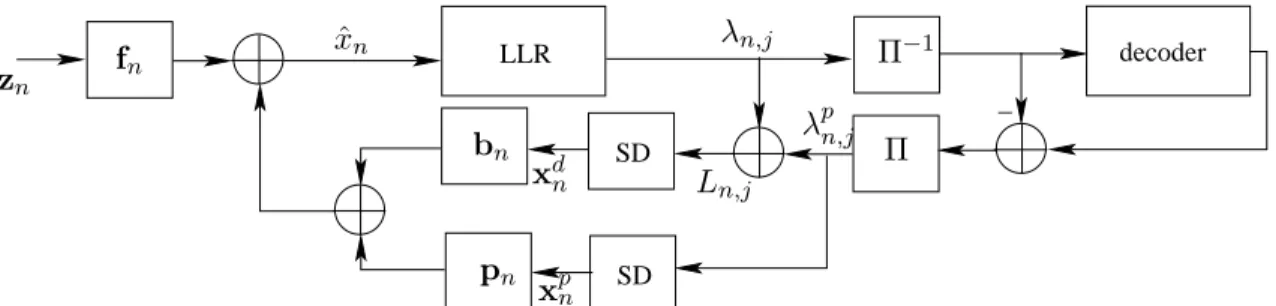
Figure 1 shows the block diagram of SIC in the context of a turbo equalizer [7, 8]. Both causal and anti-causal soft-decided symbols xd
n and xpn are estimated and
fed back for ISI cancellation. fn, bn and pn are filter coefficients. λn,j and λpn,j are
decoder − LLR SD SD Π Π−1 xdn bn λ p n,j λn,j Ln,j ˆ xn xpn fn pn zn
Figure 1. Soft feedback ISI canceler.
The MMSE estimate ˆxn of the transmitted symbol xn is given by
ˆ xn =fnzn+bnxdn+pnxpn (2) xdn= [xdn−N3 xnd−N3+1· · ·xdn−1]T xpn= [xpn+1 xnp+2· · ·xpn+N1]T fn= [fN2,n fN2−1,n· · ·f−N1,n] bn= [bN3,n bN3−1,n· · ·b1,n] pn= [p−1,n p−2,n· · ·p−N1,n] where N3 =N2+M −1.
According to [7, 8], the time-invariant (without time index n) minimum MSE values of fH
n ,bHn and pHn are obtained as
fH = σ2wIN+HHH− β2 p ζp HpHHp − β2 b ζb HbHHb −1 s (3) bH =−βb ζb HHbfH (4) pH =−βp ζp HHpfH (5)
where s =H[01×(N2+M−1) 1 01×N1]
T, β
b=E{xnxnd∗}, βp=E{xnxpn∗}, ζb=E{xdnxdn∗} and
ζp=E{xpnxpn∗}. Also, Hp is the most right N1 columns of H and Hb is the most left
N3 columns ofH.
When LLR |λn,j| and |λpn,j| go to infinity, βb →1, βp →1, ζb →1 and ζp →1,
thus fH →[σ2
wIN +ssH]−1s, which is the matched filter response fM FH to h[n].
3.2 Expected Value Computation for Multilevel Modulations
In order to computef,b and p,βb, βp, ζb and ζp have to be decided first.
Since the a prioriinformation can be modeled as an equivalent AWGN chan-nel, we have λpn,j ∼ N(γp,2γp) when cn,j = 0 ( λpn,j ∼ N(−γp,2γp) when cn,j = 1).
And the computation of xp
n can be given by xpn = X αi∈S αiP(˜xpn =αi) (6) P(˜xpn=αi) = Q Y j=1 1 2(1 + ˜si,jtanh(λ p n,j/2)). (7)
By exploiting symmetries and equal probability of αi ∈S, we get
βp =αiE{xnp∗|xn =αi} (8)
ζp =E{xpnxnp∗|xn =αi} (9)
where for MPSK, αi can be any elements in S, while for QAM, βp and ζp should be
re-scaled when |αi| 6= 1.
Notice that the value of γp is needed. Fortunately, the ML estimate of γpM L
can be obtained using
γpM L = v u u t1 + 1 Kc ×Q Kc X n=1 Q X j=1 |λpn,j|2−1. (10)