A
CONSENSUS
REPORT
N
A T I O N A L
Q
U A L I T Y
F
O R U M
National Voluntary
Consensus Standards
for Health Information
Technology:
Structural Measures
2008
T
he implementation and use of health information technology (HIT)holds great promise for the overall improvement of healthcare qual-ity in the United States. HIT is not, and never should be considered, a panacea. Technology applications cannot by themselves improve the quality of healthcare. Rather, by helping clinicians access and manage patient information, HIT, when suitably combined with necessary process and structure changes, will enable long-term, sustainable quality improvement.Unfortunately, healthcare’s track record in information technology is unenviable. The field has lagged behind other industries in its adoption of information technology, and many providers have endured clumsy implementations of HIT applications. It has become clear that a critical step to encouraging the adoption of HIT and fostering improvement in healthcare delivery is identifying the metrics with which to measure its acquisition and effective use.
This report identifies nine structural measures to assess and encour-age HIT adoption by clinicians. These measures were vetted through NQF’s Consensus Development Process, which means they carry special legal status as voluntary consensus standards. They are suitable for public reporting.
We thank the Centers for Medicare & Medicaid Services for its support of this project, and we thank NQF Members and the members of the Health Information Technology Structural Measures Steering Committee for their stewardship of this work. Their clear understand-ing of the role that HIT must play in fosterunderstand-ing quality improvement will encourage and facilitate the successful adoption of these technologies, to the ultimate benefit of the patient.
Janet M. Corrigan, PhD, MBA President and Chief Executive Officer
Foreword
No part of this report may be reproduced, stored in a retrieval system, or transmitted, in any form or by any means electronic, mechanical, photocopying, recording, or otherwise, without prior written permission of the
National Quality Forum. Requests for permission to reprint or make copies should be directed to: Permissions
National Quality Forum 601 13th Street NW
Suite 500 North Washington, DC 20005
Fax 202-783-3434 www.qualityforum.org
Table of Contents
Executive Summary... v
Background ... 1
Identifying Potential Consensus Standards for HIT... 2
Purpose... 2
Scope... 2
Evaluating Candidate Consensus Standards ... 3
NQF Measure Evaluation Criteria... 3
Performance Threshold ... 4
Existing Standards Harmonization ... 4
National Voluntary Consensus Standards for HIT: Structural Measures 2008... 5
Harmonization Recommendations... 5
Table 1–National Voluntary Consensus Standards for HIT: Structural Measures 2008 ... 6 Measures Endorsed... 8 E-prescribing... 8 Interoperable EHRs... 9 Care Management... 11 Quality Registries... 12 Medical Home ... 13
Measures Not Endorsed... 14
Research Recommendations... 14
Acknowledgment... 15
References... 15
National Voluntary Consensus
Standards for Health Information
Technology: Structural Measures 2008
(continued)
Appendix A—Specifications of the National Voluntary Consensus Standards
for Health Information Technology: Structural Measures 2008... A-1 Appendix B —Steering Committee and Project Staff ... B-1 Appendix C—Glossary... C-1
N
ATIONAL
Q
UALITY
F
ORUM
Executive Summary
T
he use of information systems and related technologies—that is,health information technology (HIT)—has the potential to improve each of the six aims of the healthcare system—safety, efficiency, timeli-ness, efficacy, patient-centeredtimeli-ness, and equitability—by helping clini-cians manage large amounts of clinical information. The adoption of HIT by clinicians has been shown to improve quality by reducing medical errors, reducing failure to follow up on abnormal results, eliminating repetitive testing, allowing more timely follow-up of results, and providing clinical decision support (CDS) tools to facilitate evidence-based care. Specific examples of HIT applications with demonstrated quality improvements include electronic prescribing (e-prescribing), electronic results delivery, patient tracking and care management, CDS, computer physician order entry, and fully inte-grated electronic health records (EHRs). A critical step to encouraging the adoption of HIT and fostering improvement in healthcare delivery is identifying the metrics with which to measure its acquisition and effective use.As part of its Health Information Technology Structural Measures project, the National Quality Forum (NQF) has endorsed nine struc-tural consensus standards to assess and encourage HIT adoption by clinicians. With its endorsement of these measures, NQF emphasizes the importance of sending a consistent message to all audiences: Quality improvement through the use of HIT requires standards
National Voluntary Consensus
Standards for Health Information
regarding how clinical information is recorded, stored, and shared. Without universal compliance with such informa-tion standards, HIT efforts are inefficient, at best, and clinical care is fragmented and dangerous, at worst. HIT structural quality measures were therefore harmonized with
ongoing efforts to standardize clinical information, such as certifying EHRs by the Certification Commission for Health-care Information Technology and defining EHR capabilities by the Health Level 7 EHR-S Functional Model.
National Voluntary Consensus Standards for HIT: Structural Measures 2008
E-prescribing■ Adoption of medication e-prescribing
■ EHR with EDI prescribing used in encounters where a prescribing event occurred
Interoperable EHRs
■ Adoption of Health Information Technology
■ The ability for providers with HIT to receive laboratory data electronically directly into their qualified/certified EHR system
as discrete searchable data elements Care Management
■ The ability to use health information technology to perform care management at the point of care ■ Tracking of clinical results between visits
Quality Registries
■ Participation in a practice-based or individual quality database registry with a standard measure set
■ Participation by a physician or other clinician in systematic clinical database registry that includes consensus endorsed
quality measures Medical Home
N
ATIONAL
Q
UALITY
F
ORUM
Background
T
he use of information systems and related technologies has thepotential to improve each of the six aims of the healthcare system— safety, efficiency, timeliness, efficacy, patient-centeredness, and equi-tability1—by helping clinicians manage large amounts of clinicalinformation. The computer hardware and software used to manage (store, retrieve, share, and use) this clinical information can broadly be defined as health information technology (HIT).
The adoption of HIT by clinicians has been shown to improve quality by reducing medical errors, reducing failure to follow up on abnormal results, eliminating repetitive testing, allowing more timely follow-up of results, and providing clinical decision support (CDS) tools to facilitate evidence-based care. Specific examples of HIT appli-cations with demonstrated quality improvements include electronic prescribing (e-prescribing), electronic results delivery, patient tracking and care management, CDS, computerized physician order entry (CPOE), and fully integrated electronic health records (EHRs).2
Despite these quality improvements, the full value proposition of HIT for quality improvement has not been actualized, depending on the care setting and the type of clinical application. For example, although a majority of U.S. hospitals report HIT adoption at some level, applications are often for reviewing results, while CPOE and electronic documentation utilization are estimated to be less than 20 percent.3 In the ambulatory setting, only one quarter of practices
utilize some component of an EHR, and, of those, approximately 6 percent electronically prescribe.4,5Some reasons for the slow adoption
National Voluntary Consensus
Standards for Health Information
of HIT include EHR limitations and the misalignment of incentives.6
The federal government has supported and encouraged the adoption of HIT for the purpose of improving the quality and efficiency of healthcare in the United States and has made efforts to regulate EHR products and align incentives. In 2004, President Bush set a goal of widespread adoption of EHRs within 10 years. As a result, the Department of Health and Human Services (DHHS) Office of the National Coordinator for Health
Information Technology, often referred to as “ONC” by the public, was established to address the need for a secure, nationwide, interoperable HIT infrastructure. In 2005, DHHS awarded a contract to the Certifica-tion Commission for Healthcare InformaCertifica-tion Technology (CCHIT) to establish EHR standardization criteria and certify EHR products. To encourage adoption, DHHS announced a five-year demonstration project to provide financial incentives for small- to medium-sized clinical practices to utilize EHRs. In October 2007, at the request of the Centers for Medicare & Medicaid Services (CMS), the National Quality Forum (NQF) launched a new effort to achieve national voluntary con-sensus on a set of structural performance measures to assess the adoption of HIT by clinicians.
A critical step to encouraging the adoption of HIT is identifying the metrics with which to measure its acquisition and effective use. The purpose of NQF’s Health Information Technology Structural Measures project is to identify these metrics.
Identifying Potential
Consensus Standards for HIT
A
Steering Committee (Appendix B)guided the evaluation and recommen-dation of potential consensus standards. The Steering Committee established selection criteria after considering the purpose and scope of the project.Purpose
The purpose of these structural measures is to evaluate the adoption and effective utilization of HIT by clinicians to improve quality.
Scope
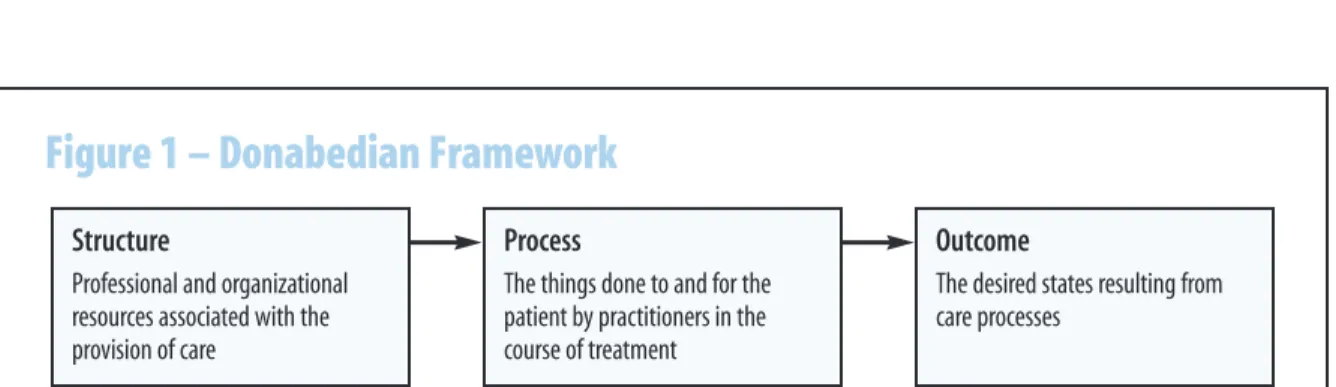
From a Donabedian perspective, structures are required to enable processes that lead to improved outcomes (Figure 1). Although a strategic goal of NQF has been to move toward increased use of outcome measures, because of the relatively low adoption rates of HIT, this project focuses on structural measures.
Structural measures were solicited per-taining to the following functional domains: 1. e-prescribing, including drug interactions, safety alerts, and formulary management tools;
2. EHRs, including those with the capability for interoperability;
3. evidence-based CDS systems; 4. CPOE; and
5. reporting to clinical registries and track-ing systems that have a data repository function and that analyze and report process and outcome data.
Given the early stage of development of performance measures in the HIT domain, NQF provided a 60-day advanced Call for Measures in October 2007. Candidate consensus standards were subsequently solicited though a 30-day Call for Measures in December 2007. The Steering Committee was encouraged to frame its recommenda-tions according to the scope of the project, which was limited to measures related to the adoption or effective use of HIT. A total of 18 measures were evaluated within the project scope.
Evaluating Candidate
Consensus Standards
T
he Steering Committee identified threeconceptual frameworks with which to evaluate and select a parsimonious set of HIT structural measures:1. the standard NQF evaluation criteria; 2. performance thresholds; and
3. the harmonization of existing standards.
NQF Measure Evaluation Criteria
Eighteen candidate consensus standards were evaluated by the Steering Committee using standardized criteria derived from the work of the NQF Strategic Framework Board and endorsed by NQF:7
1. Important—the extent to which a measure reflects a variation in quality, low levels of overall performance, and the extent to which it captures key aspects of the flow of care.
2. Scientifically acceptable—the extent to which the measure is evidence based and will produce consistent and credible results when implemented.
3. Useable—the extent to which intended audiences (e.g., consumers, purchasers) can understand the results of the measure and are likely to find them useful for decisionmaking.
4. Feasible—the extent to which data can be obtained within the normal flow of clinical care and the extent to which an implementation plan can be achieved.
Figure 1 – Donabedian Framework
Structure
Professional and organizational resources associated with the provision of care
Process
The things done to and for the patient by practitioners in the course of treatment
Outcome
The desired states resulting from care processes
Source: Zinn JS, Mor V, Organizational structure and the delivery of primary care to older Americans. Health Serv Res,1998;33:354-380, p. 355.
Performance Threshold
The Steering Committee grouped the measures into the following content domains: e-prescribing, interoperable EHRs, care management, quality registries, and the medical home. Within each
domain, the Committee used the concept of performance thresholds to assist in its selection of measures.
Individual quality measures seek to improve performance for a given fraction of the measured population (Figure 2). The measure specifications define the target measurement audience; structural measures with relatively low requirements (“meas-ure 1”) target providers with lower levels of HIT adoption, and measures with high requirements (“measure 2”) target the other end of the adoption spectrum— “early adopters.” The Steering Committee sought to identify sets of measures within each HIT domain to bothencourage initial adoption and raise the bar higher for early adopters. Furthermore, the Committee recognized the incremental collection burden for each additional endorsed
measure and therefore recommended parsimonious sets of measures within each measure domain and avoided duplicate measures if feasible. Within each domain, the Committee recommended harmoniza-tion of concepts among measures, when applicable, and sought to avoid duplicating distinct concepts among similar measures. As a clinical example, HgA1c and LDL management are both important to diabetic care, yet these two concepts may be sepa-rated into two measures. Similarly, for e-prescribing, although decision support and EHR integration are both important concepts, these may be separated into two measures. This separation does not imply that one of the individual concepts is more important than the other; rather, it provides an opportunity for modular, step-wise adoption.
Existing Standards Harmonization
The Steering Committee recognized the challenges involved in aligning competing standardization efforts. To align with existing and projected future HIT policy, the Committee attempted to align all measures with CCHIT-recommended EHR certification criteria. If such criteria are not yet defined, definitions of specific EHR capabilities should be harmonized with work from the Health Level 7 (HL7) (a standards-development organization) EHR-S Functional Model. This alignment provides a single target for HIT develop-ment and adoption and sends a clear message to both consumers and HIT vendors encouraging the development and adoption of CCHIT-certified systems.
Because the majority of candidate consensus standards were new and only
Figure 2 – Relative
Measure Impact
HIT adoption m ea su re 2 m ea su re 1 Po pu la tio none had been fully tested, the Committee recommended conditions for updating these measures to align them with the overarching goals of parsimony and standardization efforts. The National Committee for Quality Assurance (NCQA) withdrew five of the measures it had submitted for further development and future consideration to better align with the Steering Committee recommendations; four had been initially recommended for endorsement contingent upon specific Steering Committee recommended modi-fications, and one was not recommended. Nine measures were recommended for endorsement, eight of which were for time-limited endorsement (Table 1).
National Voluntary Consensus
Standards for HIT: Structural
Measures 2008
Harmonization Recommendations
The Steering Committee made the following harmonization recommendations:
■ Electronic Health Records—For all measures that reference the use of an EHR, unify them to a single definition structured by CCHIT certification. Because early-adopter clinicians may have purchased an EHR prior to the origination of the CCHIT, the Committee suggested the use of a three-year window
to allow for either a) an EHR to become CCHIT certified or b) the clinician to change EHRs, if CCHIT criteria exist for that specialty. All EHRs should have the minimum capabilities of managing a medication and problem list, storing laboratory data electronically, and meet-ing basic privacy and security elements. All EHRs referenced in these measures must meet the following criteria: a. CCHIT-certified EHR at the time of
measurement; or
b. if CCHIT certification is available (in primary care or a specialty) on or before August 1, 2008, but the system in use is not CCHIT certified, the EHR must meet the following criteria: 1. ability to manage a medication list,i
AND
2. ability to manage a problem list,ii
AND
3. ability to manually enter or elec-tronically receive, store, and display laboratory results as discrete
searchable data elements,iiiAND
4. ability to meet basic privacy and security elements,ivAND
5. the EHR (above) must be CCHIT certified on or before August 1, 2011, or another CCHIT-certified product must be in use for compli-ance after August 1, 2011; OR c. if CCHIT certification is not available
for a specialty on August 1, 2008, the EHR must have capabilities 1, 2, 3, AND 4 in section b above.
iCreate, maintain, and display a patient-specific medication list. iiCreate, maintain, and display a patient-specific problem list.
iiiLaboratory data that can be recorded in predefined fields in predefined formats within the EHR that allow for reports to be
generated, such as reports that show the trends of a specific element over time.
ivFor the purpose of this measure, basic privacy and security elements include 1) the ability to audit the date/time and user
Table 1—National Voluntary Consensus Standards for HIT: Structural Measures 2008*
MEASURE NUMBER/MEASURE NAME MEASURE DESCRIPTION IP OWNERa
E-prescribing
0486** Documents whether a provider has adopted a qualified e-prescribing CMS
Adoption of medication e-prescribing system and the extent of use in the ambulatory setting.
0487 Of all patient encounters within the past month that used an electronic NYCDHMH
EHR with EDI prescribing used in health record (EHR) with electronic data interchange (EDI) where a
encounters where a prescribing event prescribing event occurred, how many used EDI for the prescribing event.
occurred
Interoperable EHRs
0488 Documents whether a provider has adopted and is using health CMS
Adoption of Health Information information technology. To qualify, the provider must have adopted and
Technology be using a certified/qualified electronic health record (EHR).
0489 Documents the extent to which a provider uses a certified/qualified CMS
The ability for providers with HIT to electronic health record (EHR) system that incorporates an electronic data
receive laboratory data electronically interchange with one or more laboratories allowing for direct electronic
directly into their qualified/certified transmission of laboratory data into the electronic health record (EHR) as
EHR system as discrete searchable discrete searchable data elements.
data elements Care Management
0490 Documents the extent to which a provider uses a certified/qualified EHR CMS
The ability to use health information system capable of enhancing care management at the point of care.To
technology to perform care qualify, the facility must have implemented processes within its EHR for
management at the point of care disease management that incorporate the principles of care management at the point of care, which include:
a. the ability to identify specific patients by diagnosis or medication use b. the capacity to present alerts for disease management, preventive
services, and wellness during the visit via the EHR
c. the ability to provide support for standard care plans, guidelines, protocols.
0491 Documentation of the extent to which a provider uses a certified/qualified CMS
Tracking of clinical results between electronic health record (EHR) system to track pending laboratory tests,
visits diagnostic studies (including common preventive screenings), or patient
referrals. The Electronic Health Record includes provider reminders when clinical results are not received within a predefined timeframe.
*All measures except 0494 are recommended for time-limited endorsement. **NQF measure ID number.
aIP owner—Intellectual Property owner and copyright holder. ALL RIGHTS RESERVED. For the most current specifications
and supporting information, please refer to the IP owner.
IP OWNERS
CMS - Centers for Medicare & Medicaid Services (www.cms.hhs.gov)
NCQA -National Committee for Quality Assurance (www.ncqa.org)
NYCDHMH - New York City Department of Health and Mental Hygiene (www.nyc.gov/html/doh/html/home/home.shtml)
Table 1—National Voluntary Consensus Standards for HIT: Structural Measures 2008*
MEASURE NUMBER/MEASURE NAME MEASURE DESCRIPTION IP OWNERa
Quality Registries
0492 This registry should be capable of: CMS
Participation in a practice-based or a. generating population-based reports relating to published guideline
individual quality database registry goals or benchmarking data
with a standard measure set b. providing comparisons to the practitioner
c. providing feedback that is related to guideline goals d. capturing data for one or more chronic disease conditions
(e.g., diabetes) or preventive care measures (e.g., USPTF recommendations) for all patients eligible for the measures.
0493 Participation in a systematic qualified clinical database registry involves: CMS
Participation by a physician or other a. physician or other clinician submits standardized data elements
clinician in a systematic clinical to registry
database registry that includes b. data elements are applicable to consensus endorsed quality measures
consensus endorsed quality measures c. registry measures shall include at least two (2) representative NQF consensus endorsed measures for registry’s clinical topic(s) and report on all patients eligible for the selected measures
d. registry provides calculated measures results, benchmarking, and quality improvement information to individual physicians and clinicians e. registry must receive data from more than five separate practices and
may not be located (warehoused) at an individual group’s practice Participation in a national or statewide registry is encouraged for this measure
f. registry may provide feedback directly to the provider’s local registry if one exists.
Medical Home
0494 The Medical Home System Survey is a survey of physician practices that NCQA
Medical Home System Survey assesses whether the practice is functioning as a patient-centered medical home by providing ongoing, coordinated patient care. Meeting Medical Home System Survey standards demonstrates that practices have physician-led teams that provide patients with:
a. improved access and communication
b. care management using evidence-based guidelines c. patient tracking and registry functions
d. support for patient self-management e. test and referral tracking
■ Change the use of “physician” in the measures to “clinician” or “provider.” ■ If measures utilize CPT-II codes or
G-codes, plain English explanations should be included.
■ If measures have specific functional requirements (e.g., alerts, reminders, tracking, documenting) in their defini-tions, these should be aligned with CCHIT definitions, when available, and otherwise they should be aligned with the HL7 EHR-S Functional Model. The Steering Committee emphasized the importance of sending consistent mes-sages to EHR vendors and establishing consistent goals for further EHR devel-opment. These have been previously defined by CCHIT and HL7.
■ If measures specify a claims-based approach to reporting, include a methodology to extract the data and report directly from EHRs. Although the goal of these measures is to advance HIT adoption, popular incentive programs traditionally are structured around claims reporting; therefore, it is impor-tant to maintain this reporting function. However, because the infrastructure is developed for alternative methods of quality reporting, the Committee encouraged the development of reporting from EHRs into the measure specifications.
■ If measures are structured around encounters, encounter definitions should be harmonized (usually by means of G-codes or CPT-II G-codes) across measures and across measure developers. The Steering Committee emphasized that harmonization will improve ease of interpretation across measures.
■ If measure specifications state no
exclusions, yet numerator reporting gen-erates exclusions, these criteria should be stated explicitly in the exclusion text. ■ If measures have exclusions, explicitly
state whether those exclusions are to be removed from the numerator or denomi-nator. This philosophical distinction can translate into significant variation in measure results. The Steering Committee recommended that excluded patients and encounters should be removed from the denominator.
Measures Endorsed
Unless otherwise specified, the auditing of measure requirement compliance is at the discretion of the party implementing the measure. Although future specifications may include additional auditing require-ments, the Steering Committee considered self-attestation to be the primary means of validating current compliance.
E-prescribing
Quality is improved through e-prescribing by reducing legibility errors, providing interaction and dosing alerts, and reducing costs by comparing equally effective alter-native medications. Although these quality improvements are maximized with com-plete clinical information (e.g., diagnoses, allergies, other medications, age, gender), there are benefits from stand-alone e-pre-scribing systems that have a limited set of patient information. Therefore, the Steering Committee recommended two measures for e-prescribing to encourage the adoption of either a stand-alone e-pre-scribing tool with built-in decision support
(e.g., intelligent alerts and reminders), which may be a first step for some clini-cians, and also e-prescribing within an EHR. The Committee recommended the harmonization of denominator coding criteria between these two measures.
0486 Adoption of medication e-prescribing
(CMS/QIP)
vThe Steering Committee recommended against allowing handwritten exceptions, because of the overwhelming safety data regarding legibility. However, if prescrip-tions are required that cannot be sent electronically, such as required by law (e.g., controlled substances), or if the patient cannot identify a recipient pharmacy during the visit, then exclusions are allowed, pro-vided that they are still processed through the e-prescribing system and printed. This process would allow for the benefits of legible prescriptions generated with the decision support. Additionally, the Steering Committee recommended that an inopera-ble e-prescribing system (e.g., a system malfunction) should not be an exclusion criterion, because as a structural measure, system “up-time” is critical and should be measured. Therefore, an alterative exclusion was recommended to account for system “down-time” of the receiving pharmacy. The Steering Committee com-mended this measure for allowing the use of a stand-alone e-prescribing system without discouraging the use of such e-prescribing within an EHR.
0487 EHR with EDI prescribing used in
encounters where a prescribing event occurred
(NYCDHMH)
The Steering Committee enthusiastically supported this second e-prescribing measure, which explicitly requires e-prescribing from within a certified/
qualified EHR. Although benefits are present from stand-alone e-prescribing systems, the additional clinical data that are available from within an EHR (e.g., diagnoses/problems, allergies, medica-tions, demographics) provide an increased level of safety checks. Although this measure does not explicitly require safety checks, the Steering Committee proposed that implementers of these measures consider this measure in conjunction with the Adoption of Medication e-prescribing measure to achieve the maximum impact of e-prescribing with safety checks from within an EHR.
Interoperable EHRs
The interoperability of EHRs improves quality through the efficiencies of informa-tion sharing, the timeliness of results reporting, and the safety improvements derived from the availability of standard-ized clinical information. The adoption and utilization of an EHR in clinical practice are typically performed in steps. The Steering Committee recommended two measures to increase the adoption of interoperable EHRs—the first for the adoption of an EHR to manage clinical data within a practice, and the second for receiving external clinical data (e.g., laboratory results) from an external source (e.g., laboratory) into the EHR.
0488 Adoption of Health Information Technology
(CMS/QIP)
As reflected in the common definition of a certified/qualified EHR, the Steering Committee emphasized the need for certi-fying an EHR’s compliance with data and functional requirement standards while allowing creative flexibilities in utilizing those standards (i.e., information presenta-tion, workflow design) to encourage inno-vation in a competitive, open EHR market. vDeveloped by Quality Insights of Pennsylvania.
The Committee strongly recommended the use of CCHIT-certified EHRs. To avoid penalizing early adopters for purchasing EHRs prior to the formal recognition of CCHIT, the Committee recommended a three-year window to allow for either CCHIT certification by the EHR vendor or for the clinician to obtain a CCHIT-certified EHR. Members of the Committee strongly agreed that during this three-year window, all EHRs must have the minimum capabili-ties of managing medication lists, problem lists, and electronic laboratory results with basic privacy and security protections in place. These three high-yield data cate-gories can be utilized for a majority of care decisions and therefore will provide the greatest initial impact on quality improve-ment processes. Although both certification by the vendor or the alternative of an EHR switch by the clinician have their associated costs, the message from the Committee was clear: The benefits of standardized functional requirements and interoperability through CCHIT certifica-tion outweigh the associated up-front and maintenance costs of certification.
Because EHR up-time is critical (i.e., the EHR is of no use if the system is not working or “down” because of technical reasons), the Steering Committee recom-mended removing all exclusion criteria, including “system being inoperable at the time of the visit.”
0489 The ability for providers with HIT to receive
laboratory data electronically directly into
their qualified/certified EHR system as discrete
searchable data elements (CMS/QIP)
The Steering Committee recognized the strengths of this measure, including electronic transmission and discrete search-able data. Efficiencies garnered from the electronic transmission are timeliness of results reporting and decreased costs
through automation. Although there are additional associated costs for the initial implementation and auditing of electronic transmissions, the Steering Committee rec-ognized the resulting quality improvements associated with the use of these electroni-cally transmitted, discrete, searchable data. Such uses include automated safety checks, reminders, and alerts generated from laboratory data and other patient-specific clinical information in the EHR, including the patient medication list, problem list, and other previously received laboratory results, as required by a certified/qualified EHR.
The Steering Committee recognized a limitation in the reporting methodology for this measure that is specific to the reporting workflow. This measure requires reporting at the end of the encounter at which time laboratory tests are ordered and relies on the provider’s assessment of the “anticipated” transmission. Although this is a suboptimal process—because the ultimate question to be answered is whether the laboratory results were entered into the EHR—the alternative workflow would require the provider to submit the measure at a later date after
the results have been received, which introduces the need for additional work and possible errors if the results are not
received. An EHR reporting mechanism, also suggested by the Steering Committee, would require clinician order entry to identify which laboratory tests were ordered. Although clinical order entry has been shown to reduce errors, it is beyond the scope of this measure and does not adequately represent the current state of initial EHR adoption. Therefore, the Committee recommended the current claims-based reporting approach and encouraged further workflow development for an EHR-based approach.
Finally, the Steering Committee recog-nized the limitation of some laboratories that do not set up the electronic data interchanges (EDIs) needed to transmit laboratory results to small clinical practices. Although the standards for transmitting such data are well defined, this barrier is a function of the relatively high incremental laboratory cost of the additional customiza-tion required for each EDI that is created. The Steering Committee concluded that providing such an exclusion criterion would remove the provider and vendor impetus to seek EDIs from laboratories. Although this limitation may place small clinical practices at a disadvantage during measurement, the Steering Committee recognized that the measurement process, in and of itself, would emphasize the need to bridge this critical gap in incentives for the automated delivery of laboratory results. Furthermore, the Steering Committee rec-ognized that this measure may encourage the development of alternative solutions for connecting each practice to each labora-tory, such as Health Information Exchanges (HIEs) or Regional Health Information Organizations (RHIOs).
Although the Steering Committee recognized the limitations of the reporting mechanism and the lack of EDI setup for small clinical practice EHRs, Committee members agreed with the intent of the measure that the provider should utilize an EHR that is capable of receiving laboratory data and therefore recommended the measure.
Care Management
Care management HIT tools improve qual-ity by identifying patients who may have otherwise fallen through the cracks of the healthcare delivery system. The Steering Committee identified the domains of man-agement to include identifying patients for
whom care is required, providing CDS for effective care, and tracking patient prefer-ences, orders, and clinical results that are produced through these tools. The Steering Committee recommended measuring the adoption of care management HIT tools in three phases: during an encounter with a single patient, between visits for a single patient, and between visits for a patient population. The Committee recommended measures for the first two phases and two registry measures (see the quality registries domain below) for population management.
0490 The ability to use health information
technology to perform care management at the
point of care (CMS/QIP)
The Steering Committee recognized the strengths of the CDS provided in this measure, as a result of the minimum qualified/certified EHR requirements (medication list, problem list, and labora-tory results). The Committee recommended the removal of the between-visit reminders from this measure, because they would inhibit the initial adoption of care manage-ment tools by adding complexities inherent to between-visit reminders. Furthermore, the Committee recognized that such between-visit reminders already were represented in a separate measure. The Committee emphasized that for effective decision support, the correct information needs to be presented in the correct format to the correct person at the correct time, as defined by this measure.
0491 Tracking of clinical results between
visits (CMS/QIP)
The Steering Committee recognized the importance of tracking laboratory tests, diagnostic studies (e.g., exercise treadmill test, x-rays, and CT scans), and referrals (e.g., eye exam for diabetics from an ophthalmologist, recommendations from
subspecialists). Although the first care management measure helps with managing clinical tests duringthe visit, this measure closes the loop of care to ensure that ordered tests or referrals are completed
betweenvisits.
The Steering Committee acknowledged a missing component of care management: identifying tests between visits that have not yet been ordered. For example, the result of the first care management meas-ure listed may remind a provider duringa patient visit to refer that patient to a gas-troenterologist for routine colorectal cancer screening, and the results of this measure may remind the provider betweenvisits if no consultation letter or testing results have been received from the gastroenterol-ogist. However, the initial reminder is dependent upon that first visit and would not have occurred if that patient had not scheduled the visit. Therefore, there is a need for patient trackingbetween visits when screening or follow-up tests are required but have not been ordered, and this needs to operate independently of patient visits (see the research recommen-dations in this report). Some components of this need are met through the quality registry measures.
Quality Registries
Registries improve quality directly, by tracking patients in need of care and providing feedback to providers, and
indirectly, by collecting data on the effi-ciency, safety, equitability, and effectiveness of care to guide quality improvement efforts. For optimal direct impact, registry results should be available to clinicians in real-time, at the point of care. Yet broad regional and national data are required from disparate care settings to identify opportunities for improvement and effect change on a larger scale. Because of
limitations in sharing clinical data, the Steering Committee recommended separat-ing local and remote registries. Therefore, two registry measures are recommended: one for participation in local registries and one for statewide or national registries.
0492 Participation in a practice-based or
individual quality database registry with a
standard measure set (CMS)
The Steering Committee recognized the critical components of this measure: utilizing standard measures and providing direct feedback to clinicians. Although this measure does not require data from remote practice sites in real-time, the Steering Committee recommended including published guideline goals and available benchmarking summary data, when avail-able. The Committee recognized that the benefit from comparison among clinicians within the same practice and guideline goals outweighed the burden of broad data collection from multiple sites required for real-time regional or national comparison. Therefore, the Committee recommended incorporating the latter requirement into a separate statewide or national registry measure. The Committee encouraged the inclusion of chronic disease and preventive care measures.
0493 Participation by a physician or other
clinician in a systematic clinical database registry
that includes consensus endorsed quality
measures (CMS)
The Steering Committee recognized the critical components of this measure: utiliz-ing nationallyrecognized measures and collecting data from disparate practices. The Steering Committee recommended including, at a minimum, NQF-endorsed®
measures. The Committee recognized the relatively low minimum requirement of at least fiveseparate practices, but believed
this would encourage further development of the registry market and advance initial adoption. Finally, although an optimal registry function would be direct commu-nication between local and remote registries, existing EHRs and remote registries do not commonly support this function. Therefore, to encourage initial participation, the Steering Committee recommended that local-remote communication remain optional.
Medical Home
The medical home is a broad model of primary care that aims to improve quality by providing coordinated, effective, con-tinuous, patient-centered care. Although each of the previously discussed measures focuses on particular aspects of care deliv-ery, the medical home concept highlights the cumulative impact of information management on coordinated care.
0494 Medical Home System Survey (NCQA)
The Steering Committee acknowledged the strengths of the medical home concept as the cumulative result of numerous HIT efforts. However, the Committee high-lighted opportunities for improvement for this version of the Medical Home System Survey. First, although other measures in this project have been aligned with CCHIT and HL7 EHR-S Functional Model defini-tions, some criteria in this survey are not specifically aligned. This lack of alignment has the potential to provide two different endpoints for HIT adoption, thus inhibit-ing coordinated HIT progress. Although the measure developer agreed with the need for further alignment, the survey tool currently is in use and the version in development is not in cycle with this project. Therefore, as a condition of recommendation, the measure developers agreed to align terminologies with thecertified/qualified EHR requirements dis-cussed in this report, as well as functional requirements defined by CCHIT or the HL7 EHR-S Functional Model, during the next revision of the survey tool, which is expected within the next year.
Second, the Committee recognized discrepancies between the non-HIT processes allowed in the survey and the HIT processes encouraged by the measures endorsed through this project. For example, although the survey encourages HIT adoption, test and referral tracking can be completed with handwritten spreadsheets, but the measure Tracking of Clinical Results Between Visits (above) requires use of an EHR for this function. The rationale of the measure developer for these non-HIT allowances is one that balances the benefits of handwritten processes with that of the cost of automat-ing the processes within an EHR. Both the Steering Committee and the measure developer recognized that although the ultimate goal may be no handwritten allowances, the handwritten processes were established in the survey to encourage initial adoption and will change to stricter HIT requirements as HIT adoption rates increase. The Steering Committee recog-nized that although the broad benefits of reforming internal practice structures and processes outweigh the costs of HIT misalignment, the quality goal is the same: to create a more effective medical home for patients.
Finally, the Steering Committee recog-nized the need to differentiate between the survey tool and the formal NCQA recognition program. According to NQF policy, the specifications for all measures recommended for endorsement must be made public so that any party can complete the measure according to the specifications. Recommendation for endorsement of the
survey tool is based on the importance, scientific acceptability, usability, and feasi-bility of the survey tool. The method by which the survey tool is implemented, whether by using public specifications for process improvements or through the formal NCQA recognition program, is beyond the purview of NQF’s endorsement.
Measures Not Endorsed
ST-001-08
viElectronic fax prescribing used in
encounters where a prescription event occurred
(NYCDHMH)
The Steering Committee recognized the limited quality improvement potential realized by using electronic fax alone, in the absence of safety checks with decision support and communication efficiencies with EDI. Furthermore, this measure is not aligned with the future CMS regulations regarding prescription facsimile. The Steering Committee recommended other e-prescribing measures with greater potential for quality improvement.
ST-002-08 Standalone e-prescribing with EDI used
in encounters where a prescription event occurred
(NYCDHMH)
The Steering Committee acknowledged the communication efficiencies derived from EDI but recommended against this meas-ure because of a lack of decision support. In the interest of having a parsimonious set of e-prescribing measures, the Steering Committee recommended other measures that captured the two critical components separately: e-prescribing decision support and incorporation into the EHR, as opposed to being stand-alone, as a goal.
ST-016-08 Use of registry generated quality
reports to assess clinic quality (GE)
The Steering Committee recognized the utility of quality measurement feedback from a registry, but recommended against endorsing this measure in favor of two alternative registry measures with more complete specifications required for successful implementation. Furthermore, this measure had no measure steward that would be responsible for maintenance.
Research Recommendations
T
he Steering Committee recommended a number of quality measurement research objectives to further advance the role of HIT in improving clinical care. The Committee encouraged continued collaboration between the quality and vendor communities to standardize measure representation and automate quality measurement calculations and reporting as EHR functions. Additional measures should be developed to: ■ identify patients who required carebetween visits;
■ build upon these structural measures to more clearly extend thinking regarding effective use of HIT;
■ encourage the development and use of personal health tools, including personal health records and patient portals, and optimize their interoperability with EHRs;
■ encourage the use of Web 2.0 technolo-gies to enhance information sharing, standardization, and collaboration between EHRs;
■ align with the Markle Foundation’s Connecting for Health Common Framework;
■ evaluate CPOE;
■ evaluate laboratory/procedure results received as a result of CPOE;
■ evaluate image and imaging results transmission;
■ evaluate HIT adoption using existing EHR data;
■ evaluate the communication between EHRs and ancillary systems;
■ evaluate the quality of EHR data; ■ evaluate the EHR interoperability and
coordination between providers using standardized data structures (e.g., Continuity of Care Record, Clinical Document Architecture);
■ evaluate EHR interoperability and coordination with the public health system;
■ evaluate EHR interoperability and coordination with subacute care facilities (e.g., dialysis centers);
■ evaluate the composite adoption and utilization of HIT;
■ evaluate effective medication reconciliation;
■ evaluate the quality of decision support knowledge and use case testing; and ■ evaluate change management/hand-off
methodology.
Acknowledgment
T
his work was conducted under a contract from CMS.References
1Institute of Medicine, Crossing the Quality
Chasm: A New Health System for the 21st Century,
Washington, DC: National Academy Press; 2001.
2Chaudhry B, Wang J, Wu S, et al., Systematic
review: impact of health information technology on the quality, efficiency, and costs of medical care, Ann Intern Med,2006;144:742-752.
3American Hospital Association (AHA),
Continued Progress: Hospital Use of Information Technology,AHA; 2007.
4Robert Wood Johnson Foundation (RWJF),
Health Information Technology in the United States: The Information Base for Progress,RWJF; 2006.
5SureScripts, National Progress Report on
E-Prescribing,SureScripts; 2007.
6Middleton B, Hammond WE, Brennan PF,
et al., Accelerating U.S. EHR adoption: how to get there from here. recommendations based on the 2004 ACMI retreat, J Am Med Inform Assoc,
2005;12(1):13-19.
7National Quality Forum (NQF), A National
Framework for Healthcare Quality Measurement and Reporting: A Consensus Report,Washington, DC: NQF; 2002.
Appendix A
Specifications of the
National Voluntary Consensus
Standards for Health Information
Technology: Structural Measures 2008
N
ATIONAL
Q
UALITY
F
ORUM
T
his table presents the specifications for each of the National QualityForum (NQF)-endorsed® consensus standards for healthinforma-tion technology: structural measures 2008. All informainforma-tion presented has been derived directly from the measure developer without modi-fication or alteration (except when the measure developer agreed to such modification during the NQF Consensus Development Process) and is current as of October 2008.
All NQF-endorsed voluntary consensus standards are open source, meaning they are fully accessible and disclosed.
Notes
(1) All references to electronic health records (EHRs) must meet the following criteria:
a. Certification Commission for Healthcare Information Technology (CCHIT)-certified EHR at the time of measurement; or
b. If CCHIT certification is available (in primary care or a specialty) on or before August 1, 2008, but the system in use is not CCHIT certified, the EHR must meet the following criteria:
1. ability to manage a medication list AND 2. ability to manage a problem list AND
3. ability to manually enter or electronically receive, store, and display laboratory results as discrete searchable data elements AND 4. ability to meet basic privacy and security elements AND
5. the EHR (above) must be CCHIT certified on or before August 1, 2011, or another CCHIT-certified product must be in use for compliance after August 1, 2011; or
c. If CCHIT certification is not available for a specialty on August 1, 2008, the EHR must have capabilities 1, 2, 3, AND 4 in section b above.
Manage a medication list—create, maintain, and display a patient specific medication list.
Manage a problem list—create, maintain, and display a patient specific problem list.
Discrete searchable data elements—laboratory data that can be recorded in predefined fields in predefined
formats within the EHR that allow for reports to be generated, such as trends of a specific element over time. This cannot be easily done if data are entered via a free text format or by merely scanning a report into the EHR.
Basic privacy and security elements—for the purpose of this measure, basic privacy and security elements
include 1) the ability to audit the date/time and user each time a patient chart is printed AND 2) the ability to archive and retrieve health record information.
(2) All measures except 0494 have time-limited endorsement.
(3) For all measures developed by CMS, the reporting period is defined by the program implementing the measure. As defined by CMS for the PQRI program, this is one calendar year.
(4) The following applies to measures 0486 and 0487: A CPT code or G-code is required to identify patients for denominator inclusion. 90801, 90802, 90804, 90805, 90806, 90807, 90808, 90809, 92002, 92004, 92012, 92014, 96150, 96151, 96152, 99201, 99202, 99203, 99204, 99205, 99211, 99212, 99213, 99214, 99215, 99241, 99242, 99243, 99244, 99245, 99381, 99382, 99383, 99384, 99385, 99386, 99387, 99391, 99392, 99393, 99394, 99395, 99396, 99397, G0101, G0108, G0109.
(5) The following applies to measures 0488, 0489, 0490, and 0491: A CPT service code or G-code is required to identify patients for denominator inclusion. 90801, 90802, 90804, 90805, 90806, 90807, 90808, 90809, 92002, 92004, 92012, 92014, 96150, 96151, 96152, 97001, 97002, 97003, 97004, 97750, 97802, 97803, 97804, 98940, 98941, 98942, 99201, 99202, 99203, 99204, 99205, 99211, 99212, 99213, 99214, 99215, 99241, 99242, 99243, 99244, 99245, 99381, 99382, 99383, 99384, 99385, 99386, 99387, 99391, 99392, 99393, 99394, 99395, 99396, 99397, D7140, D7210, G0101, G0108, G0109, G0270, G0271.
(more)
A-3
Appendix A—Specifications of the National Voluntary Consensus Standards for Health Information Technology: Structural Measures 2008
E-PRESCRIBING
Measure Number
Measure
Measure
Measure
Measure
Measure Name
IP Owner
Description
Denominator
Numerator
Exclusions
0486 Adoption of medication e-prescribing
CMS Documents whether provider has adopted a
qualified e-prescribingsystem and the extent
of use in the ambulatory setting.
All patient encounters. All prescriptions created during the
encounter were generated using an
e-prescribing system (G8443) that is capable of ALL of the following: 1. generating a complete active
medication list incorporating electronic data received from applicable pharmacies and pharmacy
benefit managers (PBM) if available
2. selecting medications, printing prescriptions, electronically transmit-ting prescriptions, and conductransmit-ting all
alertsfor e-prescribingincluding undesirable or unsafe situations, such as potentially inappropriate dose or route of administration of a drug, drug-drug interactions, allergy concerns, or warnings and cautions 3. providing information related to the
availability of lower cost, therapeuti-cally appropriate alternatives (if any) 4. providing information on formulary or
tiered formulary medications, patient eligibility, and authorization require-ments received electronically from the patient’s drug plan.
E-Prescribing System available but no prescrip-tions were generated.
G8445: No prescriptions were generated during the encounter. Provider does have access to a qualified e-prescribing system OR,
E-prescribing System available but not used for one or more prescriptions due to system/patient reasons.
G8446: Provider does have access to a qualified e-prescribing system. Some or all prescriptions generated during the encounter were printed or phoned in as required by state or federal law or regulation, patient request, or pharmacy system being unable to receive electronic transmission.
(more)
A-4
Measure Name
IP Owner
Description
Denominator
Numerator
Exclusions
0487 EHR with EDI prescribing used in encounters where a prescrib-ing event occurred
NYCDHMH Of all patient encounters within the past month that used an electronic health record
(EHR)with electronic data interchange(EDI) where a prescribing event occurred, how many used EDI for the prescribing event.
All patient encounters. Number of encounters using an
electronic health record (EHR) with EDI, where EDI was used for a prescribing event.
1. Controlled substance(s) requiring non-EDI prescription are printed,
OR
2. prescriptions are printed due to patient preference for non-EDI prescription and indicated in a structured and auditable
format,OR
3. no prescriptions are generated during the
encounter,OR
4. the receiving-end of EDI transmission is inoperable and unable to receive EDI transmission at the time of prescribing.
(more)
A-5
Measure Name
IP Owner
Description
Denominator
Numerator
Exclusions
0488
Adoption of Health Information Technology
0489 The ability for providers with HIT to receive laboratory data electronically directly into their qualified/certified EHR system as discrete searchable data elements CMS CMS
Documents whether provider has adopted and is using health information technology. To qualify, the provider must have adopted and be using a certified/qualified electronic health record (EHR).
Documents the extent to which a provider uses a certified/qualified electronic health record (EHR) system that incorporates an electronic data interchange with one or more laboratories allowing for direct electronic transmission of laboratory data into the electronic health record (EHR) as discrete searchable data elements.
All patient encounters.
All patient encounters.
Patient encounter documentation substantiates use of certified/qualified electronic health record (EHR).
G8447: Patient encounter was documented using a CCHIT-certified EHR. G8448: Patient encounter was documented using a qualified, non-CCHIT-certified EHR.
Patient encounter with follow-up laboratory data anticipated to be transmitted electronically directly into the EHR.
GEDI01: The patient required at least one qualified laboratory test at the encounter and was referred to a laboratory that has the capability of transmitting the results to the electronic health record as discrete searchable data elements.
None.
Patient Encounter NOT Requiring Laboratory Test
GEDI02: The patient did not require a qualified laboratory test at the encounter.
(more)
A-6
Measure Name
IP Owner
Description
Denominator
Numerator
Exclusions
0490
The ability to use health information technology to perform care management at the point of care
CMS Documents the extent to which a provider uses
a certified/qualified electronic health record
(EHR) system capable of enhancing care
managementat the point of care. To qualify, the facility must have implemented processes within its EHR for disease management that incorporate the principles of care management at the point of care, which include:
a. the ability to identify specific patients by diagnosis or medication use
b. the capacity to present alertsfor disease
management, preventive services, and wellness during the visit via the EHR c. the ability to provide support for standard
care plans, practice guidelines,and protocols.
All patient encounters. Patient encounter documented on a
certified/qualified electronic health
record capable of enhancing care
managementat the point of care. To qualify, the facility must have implemented processes within its EHR for disease management that incorporate the principles of care management at the point of care. The system shall have the ability, at the point of clinical decisionmaking, to identify patient specific suggestions/
reminders,screening tests/exams, and other preventive service in support of disease management, routine preven-tive, and wellness patient care standards. The system shall have the ability to
provide access to the standard care plan,
protocol, and practice guideline
documents when requested at the time of the clinical encounter. These documents may reside within the system or be provided through links to external sources.
GCM01 (in the process of creation): Patient encounter was documented using a certified/qualified electronic health record at the point of care, which includes:
(more)
A-7
Measure Name
IP Owner
Description
Denominator
Numerator
Exclusions
0490
The ability to use health information technology to perform care management at the point of care
continued
0491
Tracking of clinical results between visits
CMS Documentation of the extent to which a
provider uses a certified/qualified electronic health record (EHR) system to track pending laboratory tests, diagnostic studies (including common preventive screenings), or patient
referrals. The Electronic Health Record
includes provider reminderswhen clinical
results are not received within a predefined timeframe.
All patient encounters.
1. The ability to identify specific patients by diagnosis or medication use 2. The capacity to present alertsto the
clinician for disease management, preventive services and wellness during the visit via the EHR
3. The ability to provide support for standard care plans,guidelines, and protocols.
Patient encounter documented on a certified/qualified electronic health record capable of tracking clinical results between visits including pending labora-tory tests, diagnostic studies (including common preventive screenings), or patient referrals.The Electronic Health Record includes provider reminders when clinical results are not received within a predefined timeframe.
GTLT01: At the time of the patient encounter, all resulting orders for laboratory tests, diagnostic studies (including common preventive screen-ings), or patient referrals were entered into a a certified/qualified electronic health record capable of tracking clinical results between visits. The Electronic Health Record includes provider reminders when clinical results are not received within a predefined timeframe.
Patient Encounter NOT Requiring Laboratory Test, Diagnostic Studies, Referrals
GTLT02: Patient had no orders for laboratory tests, diagnostic studies (including common preventive screen-ings) or patient referrals at this patient encounter.
(more)
A-8
Measure Name
IP Owner
Description
Denominator
Numerator
Exclusions
0492 Participation in a practice-based or individual quality database registry with a standard measure set
CMS This registry should be capable of:
a. generating population-based reports relating to published guideline goals or benchmarking data
b. providing comparisons to the practitioner c. providing feedback that is related to
guideline goals
d. capturing data for one or more chronic disease conditions (e.g., diabetes) or preventive care measures (e.g., USPTF recommendations) for all patients eligible for the measures.
1 The clinician participates in a
practice-based or individual clinical database registry capable of the following: a. generating population-based reports
relating to published guideline goals or benchmarking data
b. providing comparisons to the practitioner
c. providing feedback that is related to guideline goals
d. capturing data for one or more chronic disease conditions (e.g., diabetes) or preventive care measures (e.g., USPTF recommendations) for all patients eligible for the measures.
(more)
A-9
Measure Name
IP Owner
Description
Denominator
Numerator
Exclusions
0493 Participation by a physician or other clinician in a systematic clinical database registry that includes consensus endorsed quality measures
CMS Participation in a systematic qualified clinical
database registry involves:
a. physician or other clinician submits standardized data elements to registry b. data elements are applicable to consensus
endorsed quality measures
c. registry measures shall include at least two (2) representative NQF consensus endorsed measures for registry’s clinical topic(s) and report on all patients eligible for the selected measures
d. registry provides calculated measures results, benchmarking, and quality improvement information to individual physicians and clinicians
e. registry must receive data from more than 5 separate practices and may not be located (warehoused) at an individual group’s practice. Participation in a national or state-wide registry is encouraged for this measure
f. registry may provide feedback directly to the provider’s local registry if one exists.
1 The clinician participates in a systematic
qualified clinical database registry capable of the following:
a. physician or other clinician submits standardized data elements to registry b. data elements are applicable to
consensus endorsed quality measures c. registry measures shall include at
least two (2) representative NQF consensus endorsed measures for registry’s clinical topic(s) and report on all patients eligible for the selected measures
d. registry provides calculated measures results, benchmarking, and quality improvement information to individual physicians and clinicians e. registry must receive data from more
than 5 separate practices and may not be located (warehoused) at an individual group’s practice. Participation in a national or state-wide registry is encouraged for this measure
f. registry may provide feedback directly to the provider’s local registry if one exists.
(more)
A-10
Measure Name
IP Owner
Description
0494
Medical Home System Survey*
NCQA The Medical Home System Survey is a survey of physician practices that assesses whether the practice is functioning as a patient-centered medical
home by providing ongoing, coordinated patient care. Meeting Medical Home System Survey standards demonstrates that practices have physician-led teams that provide patients with:
a. improved access and communication
b. care management using evidence-based guidelines c. patient tracking and registry functions
d. support for patient self-management e. test and referral tracking
f. practice performance and improvement functions.
Standard 1: Access and Communication Pts
A. Has written standards for patient access and patient communication 4
B. Uses data to show it meets its standards for patient access and communication 5
(9)
Standard 2: Patient Tracking and Registry Functions Pts
A. Uses data system for basic patient information (mostly non-clinical data) 2
B. Has clinical data system with clinical data in searchable data fields 3
C. Uses the clinical data system 3
D. Used paper or electronic-based charting tools to organize clinical information 6
E. Uses data to identify important diagnoses and conditions in practice 4
F. Generates lists of patients and reminds patients and clinicians of services needed
(population management) 3
(21)
Standard 3: Care Management Pts
A. Adopts and implements evidence-based guidelines for three conditions 3
B. Generates reminders about preventive services for clinicians 4
C. Uses non-physician staff to manage patient care 3
D. Conducts care management, including care plans, assessing progress,
addressing barriers 5
E. Coordinates care/follow-up for patients who receive care in inpatient and
outpatient facilities 5
(20)
Standard 4: Patient Self-Management Support Pts
A. Assesses language preference and other communication barriers 2
B. Actively supports patient self-management 4
(6)
A-11
Standard 5: Electronic Prescribing Pts
A. Uses electronic system to write prescriptions 3
B. Has electronic prescription writer with safety checks 3
C. Has electronic prescription writer with cost checks 2
(8)
Standard 6: Test Tracking Pts
A. Tracks tests and identifies abnormal results systematically 7
B. Uses electronic systems to order and retrieve tests and flag duplicate tests 6
(13)
Standard 7: Referral Tracking Pts
A. Tracks referrals using paper-based or electronic system 4
(4)
Standard 8: Performance Reporting & Improvement Pts
A. Measures clinical and/or service performance by physician or across the practice 3
B. Survey of patients’ care experience 3
C. Reports performance across the practice or by physician 3
D. Sets goals and takes action to improve performance 3
E. Produces reports using standardized measures 2
F. Transmits reports with standardized measures electronically to external entities 1
(15)
Standard 9: Advanced Electronic Communications Pts
A. Availability of interactive website 1
B. Electronic patient identification 2
C. Electronic care management support 1
N
ATIONAL
Q
UALITY
F
ORUM
Donald Mon, PhD
American Health Information Management Association Chicago, IL
Eva Powell, MSW
National Partnership for Women & Families
Washington, DC
Anthony Rogers, MSPH
Arizona Healthcare Cost Containment System Phoenix, AZ
Mark Siska, RPh, MBA/TM
Mayo Clinic Rochester, MN
Dean Sittig, PhD
Kaiser Permanente: Northwest Region
Portland, OR
Sheila Teasdale, MMedSci, FBCS
American Medical Association Chicago, IL
Ferdinand Velasco, MD
Texas Health Resources Arlington, TX
Steven Waldren, MD, MS
American Academy of Family Physicians
Leawood, KS
Appendix B
Steering Committee and Project Staff
Steering Committee
Blackford Middleton, MD, MPH, MSc (Co-Chair)
Partners HealthCare System, Inc. Wellesley, MA
Joel Slackman, MS (Co-Chair)
Blue Cross Blue Shield Association Washington, DC
John Blair, MD
Taconic IPA Fishkill, NY
Clair Callan, MBA, MD, CPE
Hospira Lake Forest, IL
Connie White Delaney, PhD, RN, FAAN
University of Minnesota School of Nursing Minneapolis, MN Paul Fu, MD, MPH Lumetra/Illumisys San Clemente, CA Gus Geraci, MD McKesson Corporation Broomfield, CO
Ron Iller, MBA, MS
Premier, Inc. Philadelphia, PA
Project Staff
Helen Burstin, MD, MPH
Senior Vice President, Performance Measures
Daniel Rosenthal, MD, MSc, MPH
Program Director, Health Information Technology
Reva Winkler, MD, MPH
N
ATIONAL
Q
UALITY
F
ORUM
Term
iDefinitions
Alert Written or acoustic signals to announce the arrival of messages and results and to avoid possible undesirable situations, such as contradictions, conflicts, erroneous entry, tasks that are not performed in time, or exceptional results. A Passive Alert will appear on the screen in the form of a message. An Active Alert calls for immediate attention, and the appropriate person is immediately notified, for example, by beeper.
Care management Proactively coordinating interventions and follow