Deposited in DRO:
15 February 2016Version of attached le:
Published VersionPeer-review status of attached le:
Peer-reviewedCitation for published item:
Zhang, Zhenkai and Salous, Sana and Li, Hailin and Tian, Yubo (2015) 'Optimal coordination method of opportunistic array radars for multi-target-tracking-based radio frequency stealth in clutter.', Radio science., 50 (11). 1187-1196 .
Further information on publisher's website:
http://dx.doi.org/10.1002/2015RS00572
Publisher's copyright statement:
Zhang, Z., S. Salous, H. Li, and Y. Tian (2015), Optimal coordination method of opportunistic array radars for multi-target-tracking-based radio frequency stealth in clutter, Radio Science, 50(11), 11871196, 10.1002/2015RS00572 (DOI). To view the published open abstract, go to http://dx.doi.org and enter the DOI.
Additional information:
Use policy
The full-text may be used and/or reproduced, and given to third parties in any format or medium, without prior permission or charge, for personal research or study, educational, or not-for-prot purposes provided that:
• a full bibliographic reference is made to the original source • alinkis made to the metadata record in DRO
• the full-text is not changed in any way
The full-text must not be sold in any format or medium without the formal permission of the copyright holders. Please consult thefull DRO policyfor further details.
Durham University Library, Stockton Road, Durham DH1 3LY, United Kingdom Tel : +44 (0)191 334 3042 | Fax : +44 (0)191 334 2971
Optimal coordination method of opportunistic
array radars for multi-target-tracking-based
radio frequency stealth in clutter
Zhenkai Zhang1,2, Sana Salous2, Hailin Li3, and Yubo Tian1
1
College of Electronic Information, JiangSu University of Science and Technology, Zhenjiang, China,2Centre for Communication Systems, Durham University, Durham, UK,3Key Laboratory of Radar Imaging and Microwave Photonics,
NanJing University of Aeronautics and Astronautics, Nanjing, China
Abstract
Opportunistic array radar is a new radar system that can improve the modern radar performance effectively. In order to improve its radio frequency stealth ability, a novel coordination method ofopportunistic array radars in the network for target tracking in clutter is presented. First, the database of radar cross section for targets is built, then the signal-to-noise ratio for netted radars is computed according to the radar cross section and range of target. Then the joint probabilistic data association algorithm of tracking is improved with consideration of emitted power of the opportunistic array radar, which has a main impact on detection probability for tracking in clutter. Finally, with the help of grey relational grade and covariance control, the opportunistic array radar with the minimum radiated power will be selected for better radio frequency stealth performance. Simulation results show that the proposed algorithm not only has excellent tracking accuracy in clutter but also saves much more radiated power comparing with other methods.
1. Introduction
A new radar concept, the opportunistic array radar (OAR) which is also called distributed phased array radar, has been proposed by some scholars in recent years [Jenn and Loke, 2009;Long et al., 2009;Gong et al., 2013], based on digital array radar. OAR is a new radar system based on the stealth of the platform, which can improve the modern radar performance effectively. The array elements of opportunistic array radar are dis-tributed randomly in the aircraft or ship platform. The beamforming data, control signals, and target return signals are sent wirelessly between the transmit/receive modules, where the beamformer and signal proces-sor are located away from the modules. The concept, principle, and characteristics of the opportunistic digital array radar are presented inLong et al.[2009]. Phase orthogonal code sets with low autocorrelation and cross-correlation properties, which can be used in the OAR systems, are reported inGong et al.[2013]. But the research of the OAR is still at the beginning, for example, there are very few studies on the radiation control of the OAR network.
Low probability intercept (LPI) is one of the important features of modern radars. In order to improve the LPI performance, we not only need to reduce the radar cross section (RCS) of the radar platform but also reduce the radiation of the radars, which is also called radio frequency stealth (RFS)[Lynch, 2013]. In order to achieve the important tactical requirement of RFS, dynamically controlling the emission of the radar during the radar coordination is very necessary. As we know, the less emission of the radar, the more excellent performance of the RFS. The sensor management algorithm for RFS is proposed inKrishnamurthy[2005], by formulation the problem as a partially observed Markov decision process with an ongoing multiarmed bandit structure. An overview of the theory, algorithms, and applications of sensor management is presented in Hero and Cochran[2011], as it has developed over the past decades and as it stands today. The work inChavali and Nehorai[2012] computes the posterior Cramér-Rao bound on the estimates of the target state and the channel state and uses it as an optimization criterion for the antenna selection and power allocation algorithms. A joint scheme of antenna subset selection and optimal power allocation for localization is accomplished by solving a constrained optimization problem that is formulated to minimize the error in estimating target position, while conserving transmitter number and power budget [Ma et al., 2014]. The paper [Dallil et al., 2013] presents a new method for data association in multitarget tracking based on evidence theory. Radar detection, multitarget tracking, and data fusion techniques are applied to experimental data collected during an HF-radar experiment
PUBLICATIONS
Radio Science
RESEARCH ARTICLE
10.1002/2015RS005728 Key Points:•A novel coordination method of opportunistic array radars
•The joint probabilistic data association algorithm of tracking is improved •The algorithm will choose the radar
which will radiate the minimum power
Correspondence to:
Z. Zhang, [email protected]
Citation:
Zhang, Z., S. Salous, H. Li, and Y. Tian (2015), Optimal coordination method of opportunistic array radars for multi-target-tracking-based radio frequency stealth in clutter,Radio Sci.,50, 1187–1196, doi:10.1002/ 2015RS005728. Received 14 APR 2015 Accepted 29 SEP 2015
Accepted article online 24 OCT 2015 Published online 25 NOV 2015
©2015. American Geophysical Union. All Rights Reserved.
[Maresca et al., 2014], in order to solve the shortcomings such as poor range and azimuth resolution, and high nonlinearity of the sensor association. But almost all of those works concern the performance of the radars instead of RFS capability. A novel RFS optimization algorithm [Shi et al., 2014a, 2014b] is presented for target tracking in radar network architectures, where Schleher intercept factor [Lynch, 2013] is utilized as an optimiza-tion metric for RFS performance. The paper [Shi et al.,2014a, 2014b] proposes a novel RFS optimization strategy based on mutual information to improve the RFS performance for radar network. However, both of the two works control the power control problems of single target without clutter.
In this paper, a novel algorithm of power allocation for OAR networks during target tracking in clutter based on RFS is proposed. The remainder of this paper is organized as follows. Section 2 introduces the grey relation grade theory. Section 3 presents the coordination method of opportunistic array radars for multitarget track assignment in clutter. Simulations of the proposed algorithms and comparison results with other methods are provided in section 4. The conclusions are presented in section 5.
2. Grey Relational Grade Theory
In this paper, Grey relational grade (GRG) is used to measure the similarity of the desired tracking perfor-mance and actual tracking perforperfor-mance. Grey system theory is proposed inDeng[1982]. It can be used to Figure 1.Procedure of the proposed algorithm.
analyze the indeterminate and incomplete data to establish the systematic relations. GRG in grey system the-ory expresses the comparability between two patterns. In other words, GRG can be viewed as a measure of similarity forfinite sequences and has been widely used and developed. Desired sequenceY0and inspected
sequenceYjare represented asY0= {y0(k)|k= 1,2,…,n} andYj= {yj(k)|k= 1,2,…,n,j= 1,2,…,m}, respectively. The grey relational coefficient betweenYjandY0at thekth component is defined as follows:
ε0jð Þ ¼k A1þζA2 y0ð Þ k yjð Þk þζA2 (1)
whereA1¼minj’ mink’y0 k′ yj’ k′ ,A2¼maxj’ maxk’y0 k′ yj’ k′ ,ζ is the resolution coefficient which controls the resolution between the two distance factors, and it is also used to reduce possible influence of distortion from bias by excessiveA2. Usually,ζ is assumed as 0.5 tofit the practical requirements [Murat and Abdulkadir,2015]. The average relational coefficient is the GRG, which has the form of
GRG Y0;Yj ¼1 n
∑
n k¼1ε0j k ð Þ (2)In our algorithm of power control for OAR, the higher value of GRG is taken into consideration as the stronger relational degree between the predicted tracking accuracy and desired tracking accuracy. Thus, the higher GRG indicates that the predicted error covariance matrix is closer to the desired matrix, which will be described in the next section.
3. Coordination Methods of Opportunistic Array Radars for Multitarget Track
Assignment in Clutter
First, the database of radar cross section (RCS) for targets is built, and the relation model between the signal-to-noise ratio (SNR) during tracking and RCS will be obtained. Then the joint probabilistic association (JPDA) algorithm of tracking is improved with the consideration of emitted power of OAR. Finally, the opportunistic array radar and its radiated power will be selected for better RFS performance, with the help of GRG and cov-ariance control. The procedure of proposed algorithm can be shown in Figure 1.
3.1. Designing the RCS Database of the Targets for OAR
RCS is a measure of the magnitude relative to an isotropic scatterer. RCS depends on the position and orien-tation of the target with respect to both the source of the incident wave (e.g., the FM transmitter) and the measurement location (i.e., the radar receiver). As the array elements of OAR are distributed randomly in the platform, so the OAR can transmit and receive electromagnetic wave from different angles, and the OAR can obtain much more varieties of RCS than the conventional phased array radar, of which the array ele-ments are distributed regularly. So the power selection method based the target RCS is more effective and suitable for OAR than conventional radars.
It is necessary to design the RCS database for OARfirst. In radar applications, we are often interested in how well a target captures and reradiates electromagnetic energy. RCS is a function of size, shape, and composi-tion of the target as well as the polarizacomposi-tion and frequency of the incident wave. For each class within our library of potential targets, a database of RCS values (prior to tracking) corresponding to various incident and scattered directions is generated using the method inMoulin[2002]. The targets in this paper can be modeled as a collection of ideal scattering centers, each with valuegnand positionrn= (xn,yn,zn). This model
is appropriate when the wavelength of the incidentfield is small relative to the target dimensions. In addition, each scattering center is assumed to be visible from all observation angles, the scattering from the target can be written as
rcs fð ;θ;ϕÞ ¼
∑
ngnexp½j2πðXxnþYynþZznÞ (3)
whereX¼2f
csinθcosφ,Y¼2cfsinθsinϕ,Z¼2cfcosθ, and (θ,ϕ) represent the incident direction in a spherical
coordinate system centered on the target;fis the carrier frequency of the signal; andcis the speed of light. The capitalized notation highlights the fact that (x,y,z) and (X,Y,Z) form a Fourier transform pair. The RCS database will be built after sampling of RCS (f,θ,ϕ) is uniformed.
3.2. Computing the Signal-to-Noise Ratio and Detection Probability of OAR Network During Target Tracking
The separate RCS value for each radar pair can be obtained from the RCS database. Thermal noise at each receiver is assumed to be statistically independent. For these conditions, the overall netted radar sensitivity can be calculated by summing up the partial signal-to-noise ratio (SNR) [Teng et al., 2007] of each transmitter-receiver pair (assuming that all signals can be separately distinguished at each transmitter-receiver), which is given by
SNRnetted¼
∑
m i¼1∑
n j¼1 PtiGtiGrjσijλ 2 it 4π ð Þ3k BTsijR2tiR2rjNFjLij (4)wherePtiis theith peak transmitted power,GtiandGrjare theith transmitter gain andjth receiver gain,σijof the target means theith transmitter andjth receiver which is assumed to be known in our library,λiis theith
transmitted wavelength,tandkBare target integration time and Boltzmann’s constant respectively,Tsijis the
receiving system noise temperature(at a particular receiver),NFjrepresents the noisefigure at each receiver,
Lijis the system loss forith transmitter andjth receiver,RtiandRrjare the distance fromith transmitter to the
target and distance from target tojth receiver.
Then the detection probabilityPd[Zhang and Zhou, 2012] can be represented as
Pd¼exp
lnPfa
1þSNRnetted
(5) wherePfais false-alarm probability. From (5), we can see that the detection probability has an important impact on the tracking performance in the clutter, which is the function of radiated power and target RCS and range.
3.3. Tracking Algorithm in the Clutter
LetX(k) andZ(k) represent the state vector and the observation vector, respectively; the state equation and transfer equation at timekare
Xðkþ1Þ ¼Fðkþ1ÞXð Þ þk w kð Þ (6)
Zð Þ ¼k HXð Þ þk v kð Þ (7) wherew(k) andv(k) are stationary white noise processes with covariance matricesQ(k) andW(k),Fis the transition matrix andHis the observation matrix.
The covariance matrixW(k) of measurement noise is controlled by the radiated power of the OARs, RCS, and range of the target during tracking. We assume all the OARs in the network transmit the same waveform. For designing the waveform, the linear frequency modulation (LFM) combined with Gaussian pulse [Haykin et al., 2011] for amplitude modulation is selected in this paper. Range and range-rate measurements are obtained using this type of waveform of which the excellent performance of range and velocity resolution is proved in
Haykin et al.[2011] andCabrera[2014]. The measurement noise covariance [Cabrera,2014] is given by
Wk¼ c2p u2 2SNRknetted c2bpu2 w0SNRknetted c2bpu2 w0SNRknetted c2bp u2 w0SNRknetted 1 2pu2þ2b 2p u2 2 6 6 6 4 3 7 7 7 5 (8)
Herecdenotes the wave speed (m/s) andw0denotes the carrier frequency (Hz),pudenotes the pulse length
(μs) andbdenotes the sweep rate (Hz/s). Paramterbcan be positive (LFM upsweep), negative (LFM down-sweep), or zero. In this paper, all the waveform parameters are assumed to be constant except the signal-to-noise ratioSNRknettedat timek.
From (4) and (8), we can see that different signal-to-noise ratioSNRnettedin the radar network can lead to
dif-ferent measurement noise covariance. However, during the tracking process,RtiandRrjare unknown before
radar detection in (4). SoRtiandRrjat timekare predicted according to target’s velocity, the distance fromith
transmitter to the target, and distance from target tojth receiver at the last sampling timek-1. SoRtiandRrj
Rpreti ð Þ ¼k Rtiðk1Þ þT veiðk1Þ (9) Rprerj ð Þ ¼k Rrjðk1Þ þT vejðk1Þ (10)
WhereTis the tracking interval,vei(k1) andvej(k1) are estimated by theith andjth OAR using the tracking
algorithm at timek1.
As we know, JPDA is a method of associating plots detected in the current scan with tracks using a probabilistic score, and many researchers devote their attentions [Habtemariam et al., 2013;Tae et al., 2015] to improve track-ing accuracy in clutter under the assumption that the detection probabilityPdis equal to 1. In this paper, JPDA will be improved to track the targets in clutter, with the consideration of OAR power in the network.
The update equation of the Kalmanfilter is
Xð Þ ¼k Xðk=k1Þ þKð Þk υð Þk (11) whereKis thefilter gain matrix andυis the combined innovation [Josip et al., 2014].
υð Þ ¼k
∑
Npp¼1βtp
k
ð Þυtpð Þk (12)
whereβtpis the probability that plotpis originated from the target under trackt,υtpis the innovation of the pth plot, andNpis the number of plots. The updated covariance matrix is given by
Figure 2.Trajectory and clutter environment of the two targets.
Figure 3.Tracking result of target 1.
Pð Þ ¼k β0ð Þk Pðk=k1Þ þ½1β0ð Þk Pcðk=kÞ þePð Þk (13) where e Pð Þ ¼k Kð Þk
∑
Np p¼1βtp k ð Þυtpð Þk υTtpð Þ k υð Þk υTð Þk 2 4 3 5KTð Þk (14)AndPc(k/k) = [IK(k)H]P(k/k1),Pis the error covariance matrix of the stateX,Iis the identity matrix, andβ0
is the probability that none of the measurements in the gate originated from the target in track. The marginal association probabilityβtpis βtp¼
∑
i P ϑiZkgwbtpð Þϑi (15) whereϑiis a joint event (global hypothesis) andŵtp(ϑi) is a binary variable indicating whether joint eventϑicontains the association of tracktand plotp. Theith joint event is a hypothesis associating plots and targets at thekth scan. The probabilities of the individual joint events (joint probabilities) are given by
Figure 4.Tracking result of target 2.
P ϑið Þjk Zk ¼ρϕ c′ ∏ Np p¼1Nf υpð Þk τp ∏ NT t¼1ð ÞPD δt 1P D ð Þ1δt (16) wherePDis the probability of detecting the target,ϕis the number of clutter plots,ρis the spatial density of false
measurements,δtis a binary variable indicating whether a track has been assigned to a plot,Nfrepresents the function of Normal distribution,NTis number of current tracks,NPis the number of plots on this scan,τpis a
binary variable indicating whether the plot is assigned to a track andc’is a normalizing constant.
From (13) to (16), we can see the detection probabilityPDhas an impact on the tracking performance in
clut-ter. So the OAR radars can radiate adaptively according to different target RCS and range in order to meet the requirement of desired tracking covariance. In (16), detection probabilityPDwill be obtained from the
pre-dicted signal-to-noise ratio, then the error covariance matrixPpre(k) can be predicted through (13). 3.4. Scheduling of OARs and Their Power
Phased array elements of the opportunistic array radar are placed at available open areas over the entire length of the platform, and the elements are self-standing transmit-receive modules. As a result, it is difficult to continuously change the emitted power for every direction in real-time. We assume that a power database in every direction is already obtained. The power set which the radarmcan radiate is denoted asPowm,
Powm¼ Pm
av1;Pmav2…;Pmavn
f g (17)
wherePmav1<Pmav2…,<Pmavn. Different radiated power from the setPowmcan lead to different covariance matrix of measurement noise, which will have an impact on the result of predicted error covariance matrix. Figure 6.Comparison of tracking performance of target 2.
Table 1. Comparison of Range ARMSE
Method
Target1 Target2
X-ARMSE (km) Y-ARMSE (km) X-ARMSE (km) Y-ARMSE (km)
RFS 0.5736 0.3311 0.4188 0.4767
Fusion1 0.4315 0.3559 0.3731 0.3878
Fusion2 0.5750 0.3450 0.5129 0.4308
In order to select the optimal radiated power, the desired error covariance matrix Pdes should be set for the M
radars in the networkfirst. The predicted error covariance matrix for mth OAR from different power in the set of Powmcan be obtained from (13) to (16)
Ppreset¼Ppre1 ;Ppre2 …;Ppren (18) Using the Grey relational grade theory, we can obtain the GRG results between the predicted error covariance matrix and the desired matrix Pdes:
GRGmset¼fGRGm1;GRGm2…;GRGmng
(19) The powerPmavi, which leads to the maximum grey relational grade, will be selected for themth OAR in the
network. Then a power set can be given
Pow¼ P1
avi;P2avj…;Pmavk
(20) In order to obtain best RFS performance, the algorithm will choose the radar which will radiate the minimum power in the network for tracking at timek.
4. Simulation Results
In this section, Monte Carlo simulations are performed to analyze the performance of the proposed power control method of opportunistic array radar. We use LFM with pulse length of 20μs and sweep rate of 1010Hz/s. The radar operated at afixed carrier frequency of 10 GHz with speed of electromagnetic wave of 3 × 10⁸m/s is employed in this paper.
4.1. Trajectory Design
We assume that there are two OARs working for the two targets tracking in clutter. The motion model of the two targets includes constant velocity model and coordinated turn rate model, and transmission matrix [Aly et al., 2009] can be represented as (21) and (22), respectively.
FCV¼ 1 T 0 0 0 1 0 0 0 0 1 T 0 0 0 1 2 6 6 6 4 3 7 7 7 5 (21) FCT¼ 1 sinωT ω 0 1cosωT ω 0 cosωT 0 sinωT ω 0 1cosωT ω 1 sinωT ω 0 sinðωTÞ 0 cosωT 2 6 6 6 6 6 6 6 6 4 3 7 7 7 7 7 7 7 7 5 (22)
whereTis the sampling interval,ωis the turn factor,T= 1s, andω= 0.1.
Figure 2 shows the two targets trajectory with their measurement, results which are produced by the simula-tion in 100 s. The clutter for the every target is produced randomly during the trajectory. The posisimula-tions of the radars are (50 km,150 km) and (150 km, 0 km), respectively.
4.2. Comparison of Tracking Performance
Based the GRG and JPDA methods, the proposed radiated energy algorithm for radio frequency stealth (RFS) is compared with the data fusion methods inDallil et al.[2013] andHuo[2014], which are labeled as“Fusion1” Figure 7.Radiation label of the radars.
and “Fusion2,” respectively, in the simula-tion. Both algorithms are assumed to radiate the maximum power in order to get the highest detection probability, which is approximately equal to 1; the proposed method is realized with Pd>0.9. The
root-mean-square error (RMSE) of time k and average root-mean-square error (ARMSE) of the whole tracking process can be formu-lated as (23) and (24) respectively:
RMSEð Þ ¼k ffiffiffiffiffiffiffiffiffiffiffiffiffiffiffiffiffiffiffiffiffiffiffiffiffiffiffiffiffiffiffiffiffiffiffiffi 1 Mc ∑ Mc m¼1 xkbx m k 2 s (23) ARMSE¼ 1 Nt ∑ Nt k¼1 RMSE kð Þ (24) whereMcis the number of the Monte Carlo
simulation, xk is the true state of the
system, bxm
k is the estimated vector at the mth simulation, and Nt is the total tracking time in every
simulation. In the simulation,Mc= 200,Nt= 100.
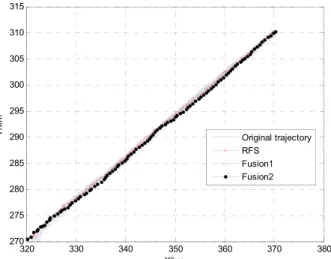
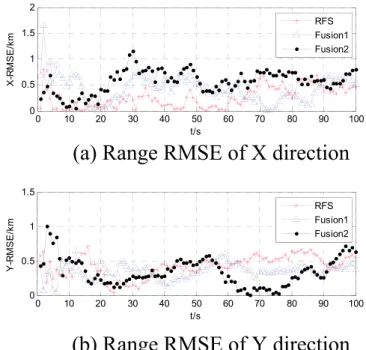
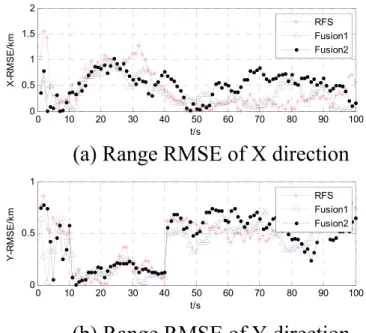
Figures 3 and 4 show the tracking results of two targets using the three methods. The RMSE of the two targets inXandYdirection are shown in Figures 5 and 6, respectively. Table 1 shows the ARMSE of the range. Compared with the two data fusion methods, we can see that the proposed method RFS presents almost the same excellent tracking accuracy.
4.3. Comparison of RFS Performance
As the paper focuses on the research of radar RFS ability instead of radar system design, the scattering valuegnis
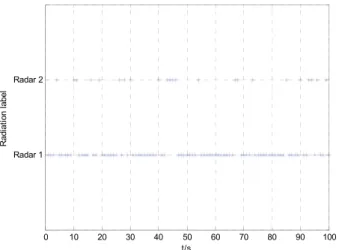
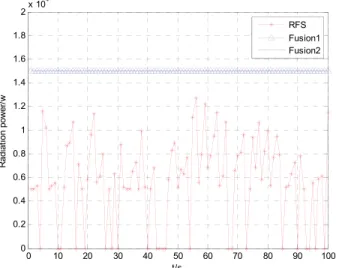
produced randomly with uniform distribution every time, then the RCS value can be predicted according to the track-ing results and (3). The power levels in the simulation are assumed to be from 5kwto 15kwwith interval of 100w. The radiation label of the two opportunistic radars is shown in Figure 7. We can see that the radars work in turn. The radiated power of the radar 1 and radar 2 are illustrated in Figures 8 and 9, respectively. Compared with the two fusion methods, we can see that the proposed method not only present excellent tracking accuracy but also reduce much more radiated power.
As a result, the proposed method has better RFS ability than others. With the advantage of the transmitting and receiving property of the OAR, the radars can be selected to work according to targets’positions and RCSs in order to meet the requirement of desired tracking performance. However, the other data fusion methods are proposed to improve the tracking performance instead of the RFS ability.
5. Conclusions
In this paper, we have presented a new strategy of power control for the OAR net-work based on RFS. During the target tracking in the clutter, the relation model is built between the radiated power and tracking performance, as the power has an impact on the measurement noise covariance. Then the opportunistic array radar and its radiated power can be selected according to the targets’RCSs from different ranges and angles, in order Figure 9.Comparison of radiated power of Radar 2.
Figure 8.Comparison of radiated power of Radar 1.
to meet the requirement of tracking performance which is measured by GRG theory. The simulation results show the proposed algorithm reduces much more radiated power with excellent tracking per-formance in clutter.
References
Aly, S. M., R. E. Fouly, and H. Braka (2009), Extended Kalmanfiltering and interacting multiple model for tracking maneuvering targets in sensor networks,2009 Seventh Workshop on Intelligent solutions in Embedded Systems, Ancona, 25–26 June, pp. 149–156.
Cabrera, J. B. D. (2014), Tracker-based adaptive schemes for optimal waveform selection,2014 IEEE Radar Conference, Cincinnati, OH, pp. 298–302, 19–23 May.
Chavali, P., and A. Nehorai (2012), Scheduling and power allocation in a cognitive radar network for multiple-target tracking,IEEE Trans. Signal Process.,60(2), 715–729.
Dallil, A., M. Oussalah, and A. Ouldali (2013), Sensor fusion and target tracking using evidential data association,IEEE Sensor. J.,13(1), 285–293. Deng, J. L. (1982), Control problems of grey system,Syst. Control Lett.,1(5), 288–294.
Gong, S. F., W. J. Long, and H. Huang (2013), Poly phase orthogonal sequences design for opportunistic array radar via HGA,J. Syst. Eng. Electron.,24(1), 60–67.
Habtemariam, B., R. Tharmarasa, and T. Thayaparan (2013), A multiple-detection joint probabilistic data associationfilter,IEEE J. Select. Top. Signal Process.,7(3), 461–471.
Haykin, S., A. Zia, and Y. Xue (2011), Control theoretic approach to tracking radar: First step toward cognition,Digit. signal Process.,21, 576–585. Hero, A. O., and D. Cochran (2011), Sensor Management: Past, Present, and Future,IEEE Sensor. J.,11(12), 3064–3075.
Huo, Y. Y. (2014), The optimal energy allocation scheme for decision fusion in heterogeneous radar sensor networks,2014 Sixth International Conference on Wireless Communications and Signal Processing(WCSP), pp. 1–5, Hefei, China, 23–25 Oct.
Jenn, D., and Y. Loke (2009), Distributed Phased Arrays and Wireless Beamforming Networks,Int. J. Distrib. Sens. Network.,5, 283–302. Josip, C., M. Ivan, and J. K. Srecko (2014), Detection and tracking of dynamic objects using 3D laser range sensor on a mobile platform,2014
11th International Conference on Informatics in Control, Automation and Robotics, Vienna, Austria, pp. 110–119, 1–3 Sep.
Krishnamurthy, V. (2005), Emission management for low probability intercept sensors in network centric warfare,IEEE Trans. Aerosp. Electron. Syst.,41(1), 133–151.
Long, W. J., D. Ben, and M. H. Pan (2009), Opportunistic Digital Array Radar and its technical characteristic analysis,2009 IET International Radar Conference, Guilin, China, pp. 1–4.
Lynch, D. A. (2013),Introduction to RF Stealth, SciTech Publ., Raleigh, North Carolina.
Ma, B. T., H. W. Chen, and B. Sun (2014), A joint scheme of antenna selection and power allocation for localization in MIMO radar sensor networks,IEEE Commun. Lett.,18(12), 2225–2228.
Maresca, S., P. Braca, and J. Horstmann (2014), Maritime surveillance using multiple high-frequency surface–wave radars,IEEE Trans. Geosci. Remote Sens.,52(8), 5056–5071.
Moulin, H. S. (2002), A particlefiltering approach to FM-band passive radar tracking and automatic target recognition,2002 IEEE Aerospace Conference, pp. 1789–1808.
Murat, S., and G. Abdulkadir (2015), Multi-response optimization of minimum quantity lubrication parameters using Taguchi-based grey relational analysis in turning of difficult-to-cut alloy Haynes 25,J. Clean. Prod.,91, 347–357.
Shi, C. G., J. J. Zhou, and F. Wang (2014a), Minimum mean square error based low probability of intercept optimization for radar network, 2014 IEEE International Conference on Signal Processing, Communications and Computing(ICSPCC), Guilin, China, 5–8 Aug., pp. 10-13. Shi, C. G., J. J. Zhou, and F. Wang (2014b), Low probability of intercept optimization for radar network based on mutual information,2014 IEEE
China Summit & International Conference on Signal and Information Processing(ChinaSIP), Xi’an, China, 9–13 July, pp. 683-687. Tae, H. K., D. Muslcki, and L. S. Lyul (2015), Smoothing joint integrated probabilistic data association,IET Radar Sonar Nav.,9(1), 62–66. Teng, Y., H. D. Griffiths, and C. J. Baker (2007), Netted radar sensitivity and ambiguity,IET Radar Sonar Nav.,11(6), 479–486.
Zhang, Z. K., and J. J. Zhou (2012), A novel LPI method of radar’s energy control,Prog. Electromagn. Res. C,33, 81–94.
Acknowledgments
The authors would like to thank the anonymous reviewers for their insight-ful comments and suggestions that have contributed to improve this paper. We note that there are no data sharing issues since all of the numerical infor-mation is produced by solving the equations of the proposed algorithm, which are realized by MATLAB software in the paper. This work was supported by The National Natural Science Funds Fund (61401179) in China, Colleges of Jiangsu Province Natural Science Fund (14KJB510009), the Science and Technology on Electronic Information Control Laboratory Project, Scientific Research Start-up Funding from Jiangsu University of Science and Technology, and Fundamental Research Funds for the Central Universities (NJ20140010).