Volume 44 Issue 6 Article 6
2019
The Benefits and Challenges of Embedding Work Integrated
The Benefits and Challenges of Embedding Work Integrated
Learning: A Case Study in a University Education Degree Program
Learning: A Case Study in a University Education Degree Program
Maria Doolan
University of Notre Dame, Australia, [email protected] Ben Piggott
University of Notre Dame Australia, [email protected] Sian Chapman
University of Notre Dame, Australia Paul Rycroft
University of Notre Dame, Australia
Follow this and additional works at: https://ro.ecu.edu.au/ajte
Part of the Teacher Education and Professional Development Commons
Recommended Citation Recommended Citation
Doolan, M., Piggott, B., Chapman, S., & Rycroft, P. (2019). The Benefits and Challenges of Embedding Work Integrated Learning: A Case Study in a University Education Degree Program. Australian Journal of
Teacher Education, 44(6).
http://dx.doi.org/10.14221/ajte.2018v44n6.6
The Benefits and Challenges of Embedding Work Integrated Learning: A
Case Study in a University Education Degree Program
Maria Doolan Ben Piggott Sian Chapman
Paul Rycroft University of Notre Dame
Abstract: Embedded Work Integrated Learning (EWIL) is a specific model of Work Integrated Learning (WIL); students work with industry in small blocks of time at regular intervals throughout semester focussing on reflective learning in authentic work environments. This study highlights benefits and challenges experienced when incorporating EWIL into a university education degree. Data was collected through survey and interview; students and graduates were surveyed and industry partners were interviewed. Reflections from university staff involved in the degree were also included. Results demonstrate EWIL is an effective pedagogical strategy in terms of providing authentic, real world learning
experiences and enhancing students’ employability skills. Specifically, students’ communication skills, organisational abilities and
confidence are enriched. Challenges encountered included time constraints, increasing student cohort size and staffing changes. These challenges can be overcome with planning and relationship development. The findings of this study provide insight and guidance for institutions considering implementing EWIL models into
comparable university programs.
Key Words: Work Integrated Learning, Employability, Curriculum Design, Core Skills for Work, Community Engagement
Introduction
The competitive nature of national and global work climates demand potential employees not only have exceptional knowledge and skills, but be innovative, dynamic individuals ready to contribute in their work environment (Ferns, Campbell, & Zegwaard, 2014; Haasler, 2013; Maclean & Jagannathan, 2014). This readiness applies to prospective teachers as much as any other profession, particularly as teaching has a significant impact on a vulnerable section of society, namely children. Teachers need to demonstrate through appropriate evidence, professional standards governed by the Australian Institute for Teaching and School Leadership (AITSL), the body charged by the federal government to oversee teacher standards. Higher educational institutions preparing future teachers must, therefore, facilitate the development of teaching students’ employability skills (Craven et al., 2014; Treagust, Won, Petersen, & Wynne, 2015) in order to meet these standards. In
program with the placement of students in schools for varying blocks of time which can range from one week first year to ten weeks in fourth year. This is a very intense time for students as they navigate their way through their professional and teaching obligations with little distance from day to day practice for detailed reflection on their own learning.
Embedded Work Integrated Learning (EWIL) strategically threads learning and reflection together over time (Bosco & Ferns, 2014) allowing for deeper reflection and improvements in aspects of their practice. It must be emphasised that, whilst the WIL and EWIL programs both reinforce certain fundamental concepts and skills, their structure and purpose are unique; thus one cannot be substituted for the other. The Bachelor of Health and Physical Education (HPE) degree in this case study, uses both WIL and EWIL programs as a response to graduate teacher competency demands. This case study addresses the call for evidence of course quality (Bosco and Ferns, 2014); it focuses specifically on the effectiveness of EWIL in facilitating development of employability skills in HPE degree students and highlights the benefits and challenges associated with its implementation.
Literature Review
Core Skills for Work
In response to the Australian Government and widespread industry demands for a competent and more skilled workforce (Ferns et al., 2014), Australia’s Department of Industry, Innovation, Climate Change, Science Research and Department of Education, Employment and Workplace Relations (Depts of IICCSR & EEWR) produced the Employability Skills for the Future report (Department of Industry & Department of Education, 2013), also known as the Employability Skills Framework (ESF) which was written in 2002. The ESF articulated skills and attributes employees needed to engage and succeed in the workforce. The framework was later refined for educators and trainers into the Core Skills for Work Framework (CSfW) which advocates the incorporation of employability skills into educative curriculum (Department of Industry & Department of Education, 2013) The CSfW offered a unique approach to employability; it emphasised skills that could be learned and thus, were pertinent for planning and implementation of curriculum instead of merely focussing on skills considered as advantageous or desirable (Department of Industry & Department of Education, 2013). These skills were expressed in three skill clusters; Navigate the World of Work (managing career and work life and working with roles, rights and protocols), Interact with Others (communicating, connecting and working with others, appreciating diversity) and Get the Work Done (planning, organising, decision making, problem solving, creativity and innovation and working in a digital world).
The Australian Government’s Transforming Australia’s Higher Education System report (Australian Government, 2009), challenged the tertiary sector to improve graduate outcomes, upskill the emerging workforce and essentially embrace the CSfW as a model of best practice. Universities Australia’s Landmark strategy to make graduates more ‘job ready’ (Universities Australia, 2015) supported this demand for upskilling and concurred with research which highlighted the need for higher educational institutions to accept
responsibility for ensuring their students encounter premier preparatory experiences and are indeed, work-ready (Bosco & Ferns, 2014; Bradley, Noonan, Nugent, & Scales, 2008; Commonwealth of Australia, 2009; Ferns, 2012; Patrick et al., 2008; Prinsley & Baranyai, 2015; Wingrove & Turner, 2015). In light of this challenge to the higher education sector, this exploration of the effectiveness in developing employability skills and the benefits and challenges of including pertinent educational workplace learning experiences, specifically Embedded Work Integrated Learning (EWIL), in a degree program becomes even more
relevant as universities seek to evidence their success in meeting this demand for work readiness.
Work Integrated Learning
Work Integrated Learning (WIL) is an umbrella term for a range of approaches and strategies that facilitate integration of theory with the practice of work, within a purposefully designed curriculum (Patrick et al., 2008; Prinsley & Baranyai, 2015). Acknowledged and validated as a means of ensuring authentic learning scenarios, students have the opportunity to implement theoretical concepts in a practical setting (Billett, 2009; Ferns & Zegwaard, 2014; Orrell, 2004). The degree in this case study has deliberately used WIL throughout the degree to provide students with irreplaceable experience in a range of school (industry partner) settings which ultimately enhances their employability (Ferns et al., 2014; Jackson, 2015; Prinsley & Baranyai, 2015). In addition to development of generic skills such as interpersonal and self-management skills, problem solving and teamwork (Freudenberg, Brimble &, Cameron, 2011), engagement with industry via WIL provides graduates or prospective employees with greater insight as to what workplace skills they require, a foundation for professional networking and ideas as to how to plan for a successful career in that specific industry (Daniel & Daniel, 2015). Indeed, research suggests the inclusion of various WIL programs are a valid and valuable component of university curriculum (Bosco & Ferns, 2014; Ferns et al., 2014; Smith, 2012).
Research also provides clear outlines for characteristics of WIL best practice (Freudenberg et al., 2011; Jackson, 2015; O’Shea, 2014; Smith, 2012). Table 1 provides a summary of these characteristics.
Characteristics
Learning objectives drive the learning experiences Provision of real/authentic work environments
Induction processes prior to practice to prepare students for workplace expectations Adequate access to supervisors before during and following practical learning experiences Industry input into provision of work environment
Integration of on campus and workplace learning and skill development Inclusion of planning and goal setting for practical experiences
Opportunities for self-reflection and peer exchange Scaffolding for development of critical reflection skills Assessment aligned to learning objectives
Engage in program review
Table 1. Summary of Characteristics of WIL Best Practice
The HPE degree in this case study uses two types of WIL; one where students spend a significant block of time working directly with industry partners (such as two 10 week school placements in third and fourth year of the degree) and another, where the WIL placement is strategically threaded or explicitly embedded into a subject throughout a semester and into subjects throughout the degree (Bosco & Ferns, 2014). This type of WIL, termed Embedded Work Integrated Learning (EWIL) by the authors, is the focus of this case study. The
inclusion of EWIL in this degree, provides a slower more controlled approach to the practice of critical reflection guiding the practical application of skills.
Embedded Work Integrated Learning
EWIL is one model of WIL that adheres to characteristics of quality WIL, as identified in the literature (Jackson, 2015; O'Shea, 2014; Smith, 2012; Winchestor-Seeto et al., 2015). In this model students learn about essential aspects of the teaching profession in a compartmentalised way whilst engaged in microcosmic real world settings. They are
provided opportunities to implement what they have learned over a given timeframe, critique their teaching performance and modify their actions accordingly, allowing particular aspects of their learning and development to be intensely scaffolded and supported over this time. A number of EWIL opportunities are strategically placed throughout the HPE teaching degree involved in this case study; these opportunities are outlined in Table 2.
Year of Degree
Industry Partner Descriptions University Students’ Tasks
1 Local Primary School Plan and deliver an eight week fundamental movement skills program for an individual pupil “buddy”
2 Various Local Secondary Colleges
School-based Curriculum Leaders
Observe curriculum models in a school setting
Complete a written report and oral presentation
3 Various Local Secondary Colleges
Heads of Special Needs
Plan and deliver an eight week FMS program for an individual pupil with special needs
3 Regional Secondary Colleges Sports Association
Director of Sport
Work with the Director of Sport to organise and implement the Regional Secondary Colleges Sport Association Swimming and Athletics Carnivals
3 Various Local Primary Schools Heads of Health & Physical Education
Work with the Head of Department to plan and implement tabloid carnival for students
3 AFL Football Club
Community Goals Manager
Work with the Community Goals Manager to plan and implement a “Gala Day” for schools
Table 2. EWIL opportunities embedded in the HPE degree
A specific example in the third year of the HPE degree, is a course which prepares university students to teach students with disabilities and diverse learning needs (Department of Education, 2018). The semester-long course has three and a half contact hours per week, made up of a two hour lecture and a one and a half hour tutorial. The lecture time focuses on inclusive practice with regards to special needs pupils, discussing various strategies and teaching styles for inclusion. In the tutorial time, university students work with pupils with special needs from local high schools, delivering a fundamental movement skills (FMS) program. Students are assigned a ‘buddy’ and have to plan, prepare and implement a program that includes assessing and monitoring achievement. Reflection on the weekly program is an important part of the process and allows the students time and space to trial different ideas. There is also a steady progression of concepts and practices delivered and developed over the semester via university lecturers and industry partner collaborations. This, combined with the recurring cycle of practical application and critical reflection over the duration of the course, offers significant opportunity for student growth and development in regards to them teaching pupils with special needs.
It is important to note that EWIL used in this manner is a value adding entity in the degree, not intended to replace the WIL program. While the EWIL and WIL programs do provide common experiences that reinforce certain aspects essential to graduate teachers, they also present different learning opportunities simply due to the nature of their structure. For example, the third year special needs related course offers a more controlled, deliberate learning environment involving a small group community. The WIL experiences included in the HPE degree, five and ten week School Experiences and a ten week Internship, expose students to a more open, spontaneous environment with a larger, broader scale community. Each program offers unique experiences and learning opportunities. The EWIL and WIL programs complement one another in their endeavours to develop student teachers’ prerequisite core skills for work.
Purpose and Significance
The ultimate goal of EWIL in this degree, is to prepare and equip university graduates to be classroom-ready teachers. The purpose of this case study was to determine how the EWIL program links with CSfW and investigate whether EWIL is effective in enhancing students’ employability skills, thus augmenting their work-ready status. Additionally, the specific benefits and challenges encountered by EWIL program stakeholders provide an insight for other institutions that may be interested in similar programming.
The results hold significance for the students, industry partners and the university in relation to articulating and evidencing the state of graduates’ work readiness. Furthermore, this study guides planning and implementation of future EWIL programs, which in turn, enhances graduates’ classroom readiness, ensures workplace/industry/government demands are met and fulfils universities’ (teacher preparation /accreditation) objectives.
Methods
After gaining the appropriate university ethics approval, a quantitative, confirmatory approach and a qualitative, exploratory approach were used to evaluate the EWIL program in relation to graduate employability skills (Ferns, 2012; Smith, 2014). The Standard
Descriptors for the career stage of Graduate teacher (Australian Institute for Teaching and School Leadership, 2015) and the Depts of IICCSR & EEWR’s CSfW (Department of Industry & Department of Education, 2013), federal government indicators of graduate employability skills, were used to guide and structure the survey and interviews. Surveys containing a 5-point Likert scale (Lee and Paek, 2014, Lozano et al., 2008, Wakita et al., 2012) fulfilled the confirmatory aspect, while open ended survey questions and exploratory interviews were used to incorporate a qualitative approach. A constructivist interpretive approach (McChesney & Aldridge, 2019) was then applied to the qualitative data from the open ended survey questions. The mixed methods approach was used to enhance the richness of data and explore the topic from the participant’s perspective (Anderson, Croxon, &
McGarry, 2015; Fleming, Martin, Hughes, & Zinn, 2009; Goodwin et al., 2014; McChesney & Aldridge, 2019; Smith, 2012, 2014). Having experience with the EWIL program and a vested interest in determining its impact warranted students, industry partners and university lecturers being included as participants.
Data Collection
Current students (third and fourth year students of a four year Bachelor of HPE teaching degree) and recent graduates were surveyed in relation to their perceptions of EWIL effectiveness. The survey, consisting of fifteen questions (5-point Likert scale questions and open ended questions asking for comments/recommendations/explanations) was constructed using Survey Monkey and piloted by a trial survey group. The survey was then disseminated via students’ email addresses. Respondents totalled 52; this included 16 third year students, 23 fourth year students and 13 recent graduates.
Industry partners, (teachers from local primary schools, local secondary colleges and staff at a professional AFL club), with between 5 – 10 year histories of providing EWIL placement opportunities for this HPE degree were interviewed using a semi-structured interview format. The interviews were recorded, transcribed and coded employing a thematic coding system triangulated by the research team. The survey and interview formats focussed on three main themes; Core Skills for Work, AITSL Standards and Overall Perceptions. Final sections of the survey and interviews gathered information relating to students’ and industry partners’ overall perceptions of the EWIL program. University lecturers (co-ordinators of the EWIL program) also submitted summaries of their experiences regarding benefits and
challenges of implementing the EWIL program. Data relating to Core Skills for Work, AITSL Standards and Overall Perceptions was analysed. For the purpose of this paper, however, only results specific to the topic of benefits and challenges encountered with EWIL and their subsequent effect on employability skills have been included.
Results
The results are divided into three sections, Core Skills for Work I, Core Skills for Work II and Overall Perceptions. The first section, presents quantitative data relating to Core Skills for Work and its indicated subsections, whereas the second section presents frequency of qualitative data relating to Core Skills for Work; both highlight the relevance of these skills to the university degree program and relationship with the readiness for work initiative. The third section of results presents qualitative data relating to overall perceptions of EWIL from the participant perspective.
Core Skills for Work I
The three subsections of Core Skills for Work I (Navigate the World of Work, Interact with Others and Get the Work Done) are based on a 5-point Likert scale (1 = Strongly Disagree, 2 = Disagree, 3 = Not Sure, 4 = Agree, 5 = Strongly Agree).
Navigate the World of Work
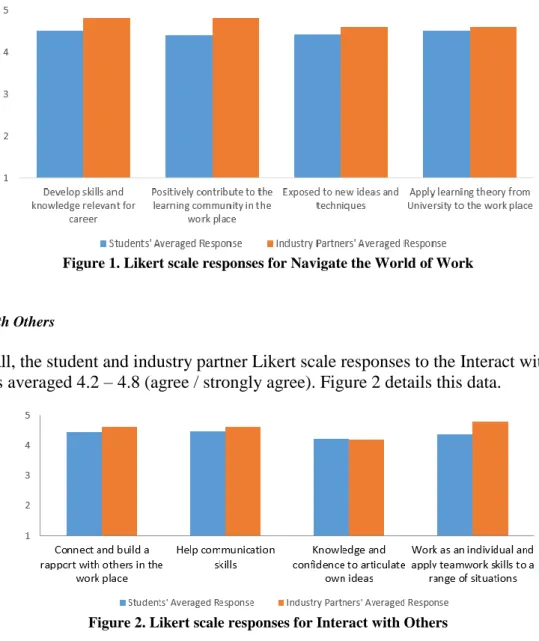
Overall, students and industry partners indicated they agreed or strongly agreed that the EWIL program offered opportunity for learning and development of Navigate the World of Work outcomes; averaged Likert scale responses ranged from 4.43 – 4.8. Figure 1 presents student and industry partners’ averaged responses for the four categories surveyed.
Figure 1. Likert scale responses for Navigate the World of Work
Interact with Others
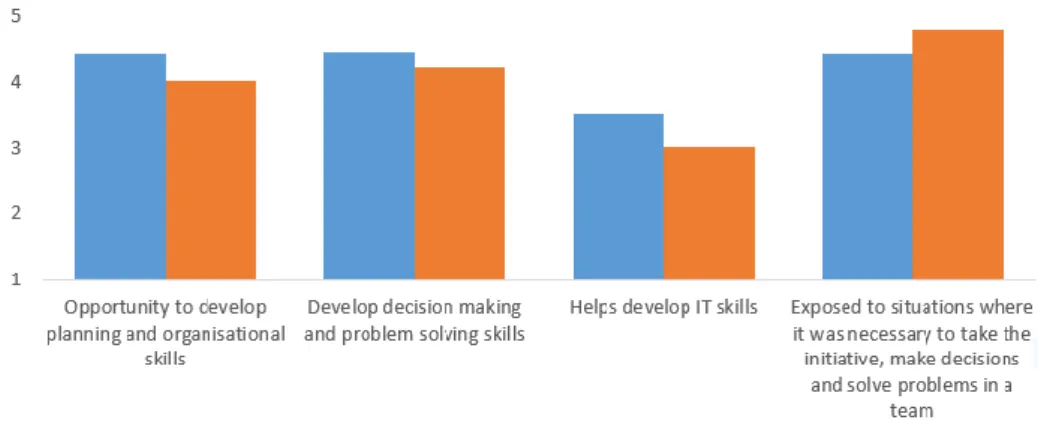
Overall, the student and industry partner Likert scale responses to the Interact with Others categories averaged 4.2 – 4.8 (agree / strongly agree). Figure 2 details this data.
Figure 2. Likert scale responses for Interact with Others
Get the Work Done
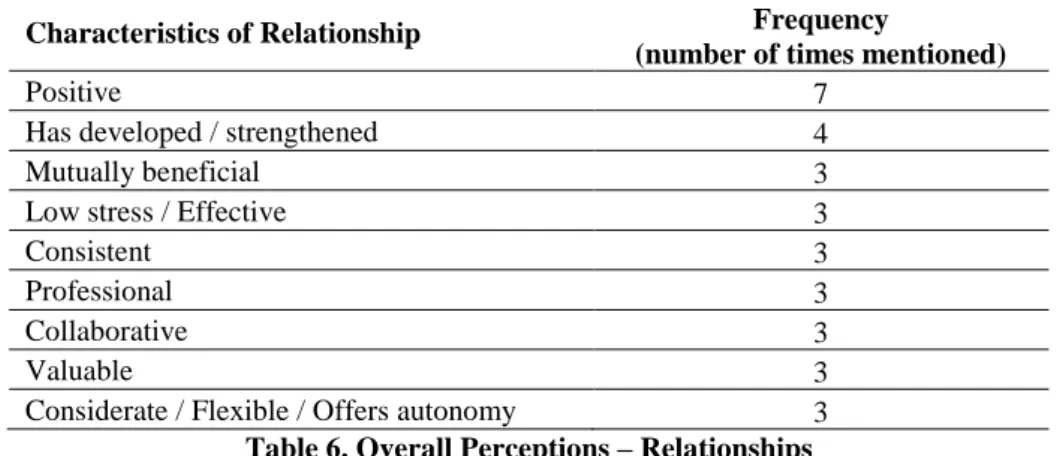
Averaged Likert scale responses for Get the Work Done category ranged from 3 – 4.8. The departure from an overall agree / strongly agree response in this case was due solely to the question of whether EWIL helped develop IT skills; both students and industry partners indicated they were not sure (averaged Likert scale responses were 3.52 and 3, respectively). Remaining categories returned averaged Likert scale scores between 4 – 4.8 (agree / strongly agree). Get the Work Done results are presented in Figure 3.
Figure 3. Likert scale responses for Get the Work Done
Core Skills for Work II
Participants provided responses to open ended questions relating to each of the three subsections of Core Skills for Work II (Navigate the World of Work, Interact with Others and Get the Work Done). These responses were analyzed using an interpretivist approach
(McChesney & Aldridge, 2019); the frequency of each category was identified. Some responses were unique, in that they did not link with other identified categories, however, as they represented a different idea these responses were included in their own category with a frequency of 1.
Navigate the World of Work
Open ended questions identified specific Navigate the World of Work outcomes that were implemented and improved via the EWIL program; development of communication skills, appropriate teaching strategies, understanding and implementing curriculum and preparation/organisation skills were the most common responses. Table 3 presents a more detailed summary of these responses.
Outcomes Identified by Students and Industry Partners
Frequency
(number of times mentioned)
Communication skills 10
Appropriate teaching strategies 10 Curriculum understanding & implementation 9 Preparation / organisation 7 Planning 4 Hands on experience 4 Flexibility 3 Professional experience 3 Teamwork 3
Self-reflection / critical thinking 3
Problem solving 2
Behaviour management 2
Assessing & feedback 2 Time / stress management 2
Confidence 1
Interact with Others
Comments relating to Interact with Others identified networking with school communities (particularly teachers), networking with other organisations and securing employment/work experience opportunities as prevalent outcomes of the EWIL program. Table 4 outlines the range of comments for this category.
Outcomes Identified by Students and Industry Partners
Frequency (number of times
mentioned)
Networking with school communities 14 Secured accreditation / work experience / job opportunity 13 Networking / developed relationships with teachers 11 Networking with other organisations 10 Developed relationships with peers 3 Developed relationships with special needs students 3 Developed relationships with range of different aged
students 2
Developed relationships with university staff 1
Table 4. Interact with Others outcomes
Get the Work Done
This subsection garnered fewer comments, but still identified some recurrent ideas. Improved planning and problem solving skills were commonly identified outcomes, as was the quality of being flexible or adaptable. The lack of opportunity to develop IT skills was also highlighted. Outcomes for Get the Work Done section are presented in Table 5.
Outcomes Identified by Students and Industry Partners
Frequency
(number of times mentioned)
More effective planning & organisation 4 Improved problem solving 3 Being flexible / adaptable 3 IT opportunities lacking 3
Teamwork opportunities 2
Decision making experience 2
Decreased stress 1
Opportunity to use / develop initiative 1
Table 5. Get the Work Done outcomes
Overall Perceptions
Overall Perceptions has subsections relating to Relationships, Benefits, Challenges and Recommendations. These subsections were also established using an interpretivist strategy (McChesney & Aldridge, 2019) during the coding process as they were the categories most frequently raised. The interview style of data collection with industry
partners garnered lengthy and divergent responses. In an effort to provide highly relevant data and retain reader interest, the researchers considered it appropriate to include succinct quotes. Whilst participants’ names have been changed for anonymity, interview responses attributed to each particular individual are accurate.
Relationships
Interview responses reveal that the EWIL program fosters positive, mutually beneficial relationships between the university and industry partners. Shane, offers an industry partner’s perspective in relation to their involvement in the EWIL program when stating, “Fantastic. Every year it just seems to be getting better and better, it’s something that we really value. We mention it in our handbook, and we see it as a significant community bond.”
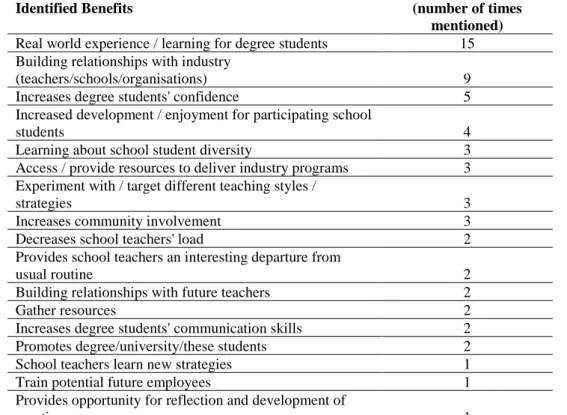
Table 6 summarises common responses in regard to the relationship between the university and industry partners.
Characteristics of Relationship Frequency
(number of times mentioned)
Positive 7
Has developed / strengthened 4
Mutually beneficial 3
Low stress / Effective 3
Consistent 3
Professional 3
Collaborative 3
Valuable 3
Considerate / Flexible / Offers autonomy 3
Table 6. Overall Perceptions – Relationships
Benefits
Real world experiences are the most commonly reported benefit for university students involved in the EWIL program. The following comment from third year student, Steve, underscores this notion, “It has helped as it allowed me to experience how teaching the content would be to students…it allowed me to experience working with others in a
professional environment.” Industry partner Jenny, also indicates the authentic workplace benefits of EWIL with her statement, “It’s such an awesome, hands-on learning
environment.” Another often-mentioned benefit of EWIL was networking and building relationships with teachers/school communities/industry organisations. Recent graduate Dallas, made the following comment in relation to the benefits of EWIL, “It also allowed me to develop relationships with schools and teachers which has resulted in employment
opportunities.”
University lecturers’ summaries offered a different perspective regarding positive relationship outcomes, with Chris stating, “Benefits for the university include fulfilling objectives to contribute to the community and developing relationships with external organisations.” Improved confidence for university students was also a regular response. This is reflected in fourth year student, Abby’s, quote. “I've gained confidence and skill.”
Interview responses also identified EWIL experiences as providing a unique
environment and offering students the advantage of being able to attend to a particular focus. Shane, industry partner offered this comment when asked to identify EWIL benefits, “I think that the program creates a sort of environment where the students can experiment with
different styles of teaching. The 1-on-1 is great, but the program also creates opportunities to work and implement with larger groups as well.” University lecturer Chris advocates EWIL as a unique learning experience commenting that programs, “Can target specific skills
through EWILs that students may not get experience in during normal lectures, tutorials or other WILS … which may be an essential skillset for that industry.”
The EWIL co-ordinators’ (university lecturers’) reflections identified other interesting benefits. Sophie, another university lecturer interviewed stated, “Feel as though we are offering a valuable contribution to the community by providing a service to industry partners which might not be otherwise offered.” Furthermore, university lecturer Chris said, “The university… benefits from producing competent, work-ready graduates…this has knock on effects such as enhancing the reputation of the university, augmenting relationships with industry/community and attracting increased numbers of prospective students.”
A summary of responses regarding benefits of the EWIL program are presented in Table 7.
Identified Benefits
Frequency (number of times
mentioned)
Real world experience / learning for degree students 15 Building relationships with industry
(teachers/schools/organisations) 9 Increases degree students' confidence 5 Increased development / enjoyment for participating school
students 4
Learning about school student diversity 3 Access / provide resources to deliver industry programs 3 Experiment with / target different teaching styles /
strategies 3
Increases community involvement 3 Decreases school teachers' load 2 Provides school teachers an interesting departure from
usual routine 2
Building relationships with future teachers 2
Gather resources 2
Increases degree students' communication skills 2 Promotes degree/university/these students 2 School teachers learn new strategies 1 Train potential future employees 1 Provides opportunity for reflection and development of
practice 1
Attracts prospective students 1
Table 7. Overall Perceptions - benefits of the EWIL program
Challenges
The prevailing challenge or barrier regarding the EWIL program was the limited time allocated to actual engagement in EWIL placements. Harold, an industry partner, articulated his view on time limits when he said, “I think the length of time needs to extend to make it more effective as well. I think with more time, they'd have more experience and confidence.”
The problem of limited time was essentially due to timetable constraints; the matching of university and industry partner schedules sometimes hampered the contact time university students accumulated in EWIL experiences. Industry partner, Jenny, offered this insight: “There are no negatives but more challenges. One is when I can’t get students due to conflicting timetables.”
program. University lecturer Sophie commented that, “Essentially, EWIL works due to the relationship that exists between the university and the industry partner which take time to develop. Need to ensure the sustainability of programs when people in either organization move roles or jobs.” The statement from university lecturer Chris also said, “A challenge rather than a barrier, is that with increasing student numbers, the benefits of the EWIL experience can be diluted unless more industry partners are recruited.”
Challenges of the EWIL program, as identified by all stakeholders, are summarised in Table 8.
Identified Challenges
Frequency (number of times
mentioned)
Limited time / timetable constraints 8
Staff changes 2
Increased number of degree students 2 Incidental challenges involved with school student
excursions 1
School students' absence 1 Different abilities of university students 1
Parental objections 1
Physical environment/venue 1
Table 8. Overall perceptions – challenges of the EWIL program
Recommendations
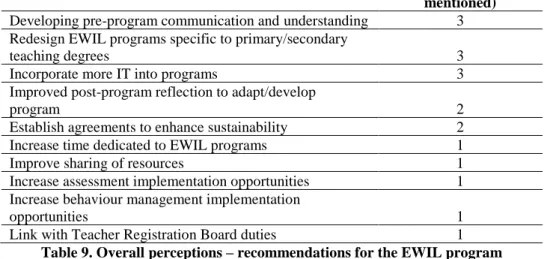
Recommendations for the planning and structure of the EWIL program uncovered a number of issues, mostly relating to further developing communication and understanding between all stakeholders. Chris gave a university lecturer’s viewpoint with, “University staff need to be in dialogue with relevant industry stakeholders to ensure that EWIL is relevant and beneficial for an ever-changing workforce.” Luke commented that as an industry partner they could be “…seeking more feedback from the students that are involved…how it ran from their point of view… [asking] as an industry, is there something that we could be doing better, so that we can make that happen.” Ensuring the programs were sustainable was raised by university lecturer Sophie when she said, “Encourage sustainability between university and industry partners by formalising agreements to ensure consistency in the EWIL program when there are staff changes.”
Degree students’, industry partners’ and university lecturers’ recommendations for existing and future EWIL programs are presented in Table 9.
Recommendations for existing and future programs
Frequency (number of times
mentioned)
Developing pre-program communication and understanding 3 Redesign EWIL programs specific to primary/secondary
teaching degrees 3
Incorporate more IT into programs 3 Improved post-program reflection to adapt/develop
program 2
Establish agreements to enhance sustainability 2 Increase time dedicated to EWIL programs 1 Improve sharing of resources 1 Increase assessment implementation opportunities 1 Increase behaviour management implementation
opportunities 1
Link with Teacher Registration Board duties 1
Table 9. Overall perceptions – recommendations for the EWIL program
Discussion
Results indicate that the EWIL program in this case study is effective in enhancing students’ employability skills. This is in line with findings from other WIL research which identify positive impacts on employability following WIL experiences (Freudenberg, Brimble, and Cameron, 2011; Smith et al., 2014).
Improved communication skills and the development of professional relationships and networks were particularly significant outcomes of this EWIL program. The building of relationships, networking with career-relevant professionals and developing communication skills was reported in various ways across the Navigate the World of Work, Interact with Others, Relationships and Benefits sections. These outcomes address many skill areas
outlined in the CSfW framework (Department of Industry & Department of Education, 2013), such as Communicate for work and Connect and work with others. They also satisfy
employer/industry expectations of graduates and potential employees relating to
communication and relationship building skills (Bandaranaike & Willison, 2015; Ferns, 2012; Fleming et al., 2009), and concur with graduates’ reports of developing communication and interpersonal skills via WIL (Sleap &Reed, 2006).
Findings of this study also suggest that students develop planning, organisational and problem solving skills, in line with CSfW’s Plan and Organise, Identify and Solve Problems (Department of Industry & Department of Education, 2013). These outcomes, reported across Navigate the World of Work and Get the Work Done sections of this case study, reflect previous research. Participants in studies by Daniel and Daniel (2015) and Freudenberg at al., (2011) indicated improved time-keeping, problem solving and initiative as a result of their WIL engagement.
EWIL outcomes specific to a teaching career (improved knowledge and
understanding of curriculum and opportunity to implement various teaching strategies to a range of school students), link with the Manage Career and Work Life, Recognise and Utilise Diverse Perspectives and Create and Innovate Skill Areas of the CSfW framework
(Department of Industry & Department of Education, 2013). Similarly, WIL was an effective way to develop discipline-specific generic skills and professional knowledge (Brown, 2010)
Results across Navigate the World of Work and Benefits sections in this study indicated that students’ confidence was also enhanced. Other WIL focused studies showed students, university staff and industry partners alike, all identified improved confidence as a
result of WIL program participation (Brown, 2010; Jackson, 2015; Wingrove & Turner, 2015).
Results suggest that EWIL is a valuable component of this HPE degree. Evidence of EWIL’s effectiveness in developing a myriad of employability skills, specific to a career in teaching, is of great benefit to students in their pursuit of a teaching position in a competitive employment environment (Balogh, 2017; Branley, 2016). Interview responses identifying benefits for industry partners (e.g. Access / provide resources to deliver industry programs, Decreases school teachers' load, Provides school teachers an interesting departure from usual routine, School teachers learn new strategies, Attracts prospective students) and community members (e.g. Increased development / enjoyment for participating school students, Increases community involvement) also offer evidence of the value of this EWIL program.
Furthermore, these findings justify the continuance of EWIL in the HPE degree and provide evidence to the wider community and for the institution itself, that this university is fulfilling its obligation to produce work ready graduates via its teacher education program.
Arguably, the most important aspect of any EWIL program is its authenticity or the provision of real work, in real environments, encompassing real challenges (Bosco & Ferns, 2014; Smith, 2012, 2014). There is compelling evidence suggesting this case study’s EWIL program provided authentic, real world learning experiences for the degree students (as per Navigate the World of Work, Interact with Others and Benefits sections). For example, students engaged in real life settings such as physical education lessons, a school tabloid carnival and combined schools’ (regional) special needs swimming and athletics carnivals. This authenticity was not only reported as a benefit of this EWIL program, but is recognised as a characteristic of a good quality WIL (Jackson, 2015; Patrick et al., 2008; Smith, 2012, 2014).
The ability to target specific skills and shape assessment tasks to ensure learning, understanding and development is a significant feature of EWIL. Whilst there is some opportunity for this in traditional education degree WIL placements (such as the 10 week school placement), the busy environment usually focuses on teaching, and often students do not get opportunity to reflect at an in-depth level nor to repeatedly implement revised plans or strategies. With EWIL experiences, there is generally a week between tutorials which allows for a more in-depth, research-based reflection. As a result, this space and time, combined with access to lecturer and mentor support, offers students the circumstances to apply their discoveries, through unique and effective learning opportunities (Darling-Hammond, 2006; Jackson, 2015; Smith, 2012; Wingrove & Turner, 2015). This also facilitates adoption of critically reflective practices for their future careers (Wingrove & Turner, 2015).
In contrast, the most commonly reported challenge or barrier to effective teaching and learning with EWIL placements related to timetable restrictions, which limited the time students actually engaged in EWIL experiences. Various challenges linked to a lack of time were reported by Jackson (2015), and both industry partners and university lecturers
indicated the value of open communication, adaptability and forward planning in maintaining good rapport and fulfilling EWIL objectives. The challenge of providing stability and
continuity with the program in the face of formalized agreements was suggested by
University staff as a way of ensuring sustainability. Brown (2010) discussed similar concerns and solutions suggesting as with timetable constraints, these minor challenges can be
adequately managed when industry partners and program coordinators engage in open dialogue, and adopt a flexible and considerate approach.
Increasing student cohort size also poses a number of challenges. It dilutes the EWIL experience; more students accessing the same number of placement opportunities means less engaged learning time overall. It also places increased pressure on university lecturers to recruit additional placements, and increased pressure on industry partners to provide them.
The possible subsequent effects on delivering quality education is a consideration for university policy makers setting enrolment targets.
Further advancement of communication channels (prior, during and post placement) was a common theme linking stakeholders’ recommendations for existing and future EWIL programs; this is an interesting revelation considering the identification of communication skills as a significant outcome/benefit of the EWIL program. Further improvement of communication channels seeks to create an even more effective learning experience and this is also endorsed by previous research (Billett, 2009; Smith, 2012). In light of this, institutions offering EWIL experiences should prioritise time and resources to enhance communication mechanisms between themselves and industry partners.
Future research might look to recruit a larger number of participants, particularly those who identify as recent graduates, as their reflections on searching for employment would offer a unique and worthwhile perspective. Gauging recent graduates’ employment status would also add value to such studies given the focus of improving employability skills via EWIL is to secure employment. A further recommendation for future research would be to include students and recent graduates from other education degree programs.
Conclusion
EWIL is an effective pedagogical strategy to ensure students develop employability skills. The significance of students developing these skills via EWIL, is that all stakeholders benefit. Students themselves are more employable, industry benefits from a more highly skilled work force, and while using students to resource their own initiatives, industry gains satisfaction and credit from having contributed to this professional learning. EWIL done well also enhances the university’s reputation, producing quality graduates, meeting teacher education accreditation objectives and providing valuable service to industry and community. The relationship between key personnel in the tertiary institution and the industry partner is crucial to successful EWIL implementation. This case study involved a HPE education degree, however it is felt that other education degree programs and degree programs in other professions could consider adopting and adapting the EWIL model to add value to their students’ learning experience.
Limitations
Survey participation was limited by the finite number of available, current email addresses used to disseminate the online survey and the time constraint placed on responding to the survey. A further limitation was that the 52 participants were students and recent graduates of a Bachelor of HPE at one particular university and therefore, specific findings may not be generalized to all teacher education students nor to all teacher education settings. The survey itself, was limited in the number of response categories, but conformed to
References
Anderson, J., Croxon, L., & McGarry, D. (2015). Identifying student knowledge and
perception of what is valuable to professional practice: A mixed method study. Nurse Education Today, 35, 1240–1245. Retrieved from
https://www.sciencedirect.com/journal/nurse-education-today. https://doi.org/10.1016/j.nedt.2015.04.007
Australian Collaborative Education Network Limited. (2015). National Strategy on Work Integrated Learning in University Education. Retrieved from
http://cdn1.acen.edu.au/wp-content/uploads/2015/03/National-WIL-Strategy-in-university-education-032015.pdf.
Australian Government. (2009). Transforming Australia’s Higher Education System. Canberra, ACT: Retrieved from
http://www.caul.edu.au/content/upload/files/org/caul20101deewr.pdf.
Australian Government. (2013). Core Skills for Work Developmental Framework: a Guide for Employers. Canberra, ACT.
Australian Institute for Teaching and School Leadership. (2015). Australian Professional Standards for Teachers. Retrieved from http://www.aitsl.edu.au/australian-professional-standards-for-teachers/standards/list.
Balough, S. 2017. Teaching graduates find it tough to break into the classroom [Online]. Available: https://www.theaustralian.com.au/national-affairs/education/teaching-
graduates-find-it-tough-to-break-into-the-classroom/news-story/80924f57c5ad223923cdfa77c060b72c [Accessed 1st May 2018].
Bandaranaike, S., and J. Willison. (2015). "Building capacity for work-readiness: Bridging the cognitive and affective domains." Asia-Pacific Journal of Cooperative Education
16 (3), 223-233. Retrived from https://www.tandfonline.com/toc/cape20/current. Billett, S. (2009). Realising the educational worth of integrating work experiences in higher
education. Studies in Higher Education, 34(7), 827-843. https://doi.org/10.1080/03075070802706561
Bosco, A., & Ferns, S. (2014). Embedding of authentic assessment in work-integrated learning curriculum. Asia-Pacific Journal of Cooperative Education, 15(4), 281-290. Retrived from https://www.tandfonline.com/toc/cape20/current.
Bradley, D., Noonan, P., Nugent, H., & Scales, B. (2008). Review of Australian Higher Education: Final Report [Bradley Review]. Retrieved from
http://apo.org.au/sites/all/modules/pubdlcnt/pubdlcnt.php?nid=15776&file=http://apo. org.au/files/Resource/higher_education_review_one_document_02.pdf.
Branley, A. 2016. Teaching job shortage leaves hundreds of graduates unable to complete qualifications [Online]. Available: http://www.abc.net.au/news/2016-02-03/job-shortage-leaves-teachers-unable-to-complete-qualifications/7136722 [Accessed 1st May 2018].
Brown, N. (2010). WIL [ling] to share: an institutional conversation to guide policy and practice in work‐integrated learning. Higher Education Research & Development, 29(5), 507-518. https://doi.org/10.1080/07294360.2010.502219
Craven, G., Beswick, K., Fleming, J., Fletcher, J., Green, M., Jensen, B., . . . Rickards, F. (2014). Action Now, Classroom Ready Teachers Report. Canberra: Department of Education Retrieved from
https://docs.education.gov.au/system/files/doc/other/action_now_classroom_ready_te achers_print.pdf.
Daniel, R., & Daniel, L. (2015). Enhancing capacity for success in the creative industries: Undergraduate student reflections on the implementation of work-integrated learning strategies. Asia-Pacific Journal of Cooperative Education, 16(3), 199-209. Retrived from https://www.tandfonline.com/toc/cape20/current.
Darling-Hammond, L. (2006). Constructing 21st-century teacher education. Journal of Teacher Education, 57(3), 300-314. https://doi.org/10.1177/0022487105285962 Department of Education, W. A. 2018. Available: http://det.wa.edu.au/ssen/detcms/portal/
[Accessed 1st May 2018].
Department of Industry, Innovation, Climate Change, Science Research & Tertiary Education., & Department of Education, Employment and Workplace Relations. (2013). Core Skills for Work Developmental Framework. Canberra: Australian Government.
Ferns, S. (2012). Graduate employability: Teaching staff, employer and graduate
perceptions. Paper presented at the 2012 Australian Collaborative Education Network National Conference.
Ferns, S., Campbell, M., & Zegwaard, K. (2014). Work Integrated Learning. In S. Ferns (Ed.), HERDSA Guide Work Integrated Learning in the Curriculum. Milperra: HERDSA.
Ferns, S., & Zegwaard, K. (2014). Critical assessment issues in work-integrated learning.
Asia-Pacific Journal of Cooperative Education, 15(3), 179-188. Retrived from https://www.tandfonline.com/toc/cape20/current.
Fleming, J., Martin, A., Hughes, H., & Zinn, C. (2009). Maximizing work integrated learning experiences through identifying graduate competencies for employability: A case study of sport studies in higher education. Asia-Pacific Journal of Cooperative Education, 10(3), 189-201. Retrived from
https://www.tandfonline.com/toc/cape20/current.
Freudenberg, B., Brimble, M., & Cameron, C. (2011). WIL and generic skill development: The development of business students' generic skills through work-integrated
learning. Asia-Pacific Journal of Cooperative Education. 12(2), 79-93. Retrived from https://www.tandfonline.com/toc/cape20/current.
Goodwin, A., Smith, L., Souto-Manning, M., Cheruvu, R., Tan, M., Reed, R., & Taveras, L. (2014). What should teacher educators know and be able to do? Perspectives from practicing teacher educators. Journal of Teacher Education, 65(4), 284-302.
https://doi.org/10.1177/0022487114535266
Haasler, S. (2013). Employability skills and the notion of ‘self’. International Journal of Training and Development, 17(3), 233-243. https://doi.org/10.1111/ijtd.12012 Jackson, D. (2015). Employability skill development in work-integrated learning: Barriers
and best practice. Studies in Higher Education, 40(2), 350-367. https://doi.org/10.1080/03075079.2013.842221
Lozano, L., Garcia-Cueto, E. & Muniz, J. (2008). Effect of the number of response categories on the reliability and validity of rating scales. Methodology: European Journal of Research Methods for the Behavioral and Social Sciences, 4, 73.
https://doi.org/10.1027/1614-2241.4.2.73
Lee, J. & Paek, I. 2014. In search of the optimal number of response categories in a rating scale. Journal of Psychoeducational Assessment, 32, 663-673.
https://doi.org/10.1177/0734282914522200
Maclean, R., & Jagannathan, S. (2014). Introduction—Improving skills development for employability in an ever-changing world. Prospects, 44(2), 159-165.
McChesney, K., & Aldridge, J. (2019) Weaving an interpretivist stance throughout mixed methods research. International Journal of Research & Method in Education, 42:3, 225-238. https://doi.org/10.1080/1743727X.2019.1590811
O'Shea, A. (2014). Models of WIL. In S. Ferns (Ed.), HERDSA Guide Work Integrated Learning in the Curriculum. Milperra: HERDSA.
Orrell, J. (2004). Work-integrated learning programmes: Management and educational quality. Paper presented at the Proceedings of the Australian Universities Quality Forum.
Patrick, C., Peach, D., Pocknee, C., Webb, F., Flectcher, M., & Pretto , G. (2008). The WIL Report: a National Scoping study. Brisbane: Queensalnd University of Technology Retrieved from
http://eprints.qut.edu.au/44065/1/WIL-Report-grants-project-jan09.pdf.
Prinsley, R., & Baranyai, K. (2015). Stem Trained and Job Ready. Office of the Chief Scientist, Australian Government Retrieved from
http://www.chiefscientist.gov.au/wp-content/uploads/OPS12-WIL_web.pdf. Sleap, M., & Reed, H. (2006). Views of sport science graduates regarding work skills
developed at university. Teaching in Higher Education 11 (1):47-61. https://doi.org/10.1080/13562510500400123
Smith, C. (2012). Evaluating the quality of work-integrated learning curricula: A
comprehensive framework. Higher Education Research & Development, 31(2), 247-262. https://doi.org/10.1080/07294360.2011.558072
Smith, C. (2014). Evaluating the Quality of WIL. In S. Ferns (Ed.), HERDSA Guide Work Integrated Learning in the Curriculum. Milperra: HERDSA.
Smith, C., Ferns, S., Russell, L., & Cretchley, P. (2014). The impact of work integrated learning on student work-readiness. Australian Government & Office for Learning & Teaching Retrieved from bhtrsmt.
Treagust, D., Won, M., Petersen, J., & Wynne, G. (2015). Science teacher education in Australia: Initiatives and challenges to improve the quality of teaching. Journal of Science Teacher Education, 26(1), 81-98. https://doi.org/10.1007/s10972-014-9410-3 Universities Australia. (2015). Landmark strategy to make graduates more ‘job ready’.
Deakin, AUSTRALIA: Universities Australia Retrieved from
https://www.universitiesaustralia.edu.au/news/media-releases/Landmark-strategy-to-make-graduates-more--job-ready-#.VrIG_aSQ_IU.
Wakita, T., Ueshima, N., & Noguchi, H. 2012. Psychological distance between categories in the Likert scale: Comparing different numbers of options. Educational and
Psychological Measurement, 72, 533-546. https://doi.org/10.1177/0013164411431162
Wingrove, D., & Turner, M. (2015). Where there is a WIL there is a way: Using a critical reflective approach to enhance work readiness. Asia-Pacific Journal of Cooperative Education, 16(3), 211-222. Retrived from
https://www.tandfonline.com/toc/cape20/current
Winchester-Seeto, T., Mackaway, J., Peach, D., Moore, K., Ferns, S., & Campbell, M. (2015). Principles, Guidelines and Startegies for Incluive WIL. Brisbane