Developing End-user ICT skills: case of Higher Learning
Institutions in Tanzania
Yuda Julius Chatama
Mzumbe University – Dar Es Salaam Campus College, P. O. Box 20266 Dar Es Salaam, Tanzania E-mail of author: [email protected]
Abstract
Information and Communication Technology (ICT) constitutes an infrastructure that permits higher learning institutions to perform their key function of teaching, learning, research and consultancy in an efficient and effective way (Mikko, 2006). However, before any new technology can be utilized those who will be using it need to have skills to do so (Okpaku, 2003). Studies done by scholars including Wanyenda (2008); Lwehabura (2008); Mostert and Quinn (2009); Archibong and David (2009); Ademodi and Adepoju (2009) as well as Swarts and Wachira (2010) shows that, Information searching skills, Information evaluation skills and skills on ethical use of information are vital in higher learning Institutions. The emphasis shown by scholars on the need to develop end-user ICT skills tempt one to believe that Higher Learning Institutions invest heavily in this area so as to equip such skills to all students and staff. However, based on findings only 6.1%, 4.7% and 6.8% had adequate skills on searching, evaluation and ethical use of information respectively; 50.7%, 43.9% and 52% had little knowledge while 43.2%, 51.4% and 41.2% had no such skills respectively. This paper examines the environment in which end-user ICT skills are being developed; deduces the effectiveness of strategies used in developing such skills; identifies challenges and finally recommends means through which the process of developing End-user ICT skills among students and staff could be improved.
Keywords: ICT, End-user ICT skills, Higher Learning Institutions, Tanzania
1. Introduction
The broad meaning of the term “developing end-user ICT skills” as commonly used, stands synonymous to training, which has been defined by Armstrong (2001), as the process whose key function is to fill the gap between what people know and can do and what they should and be able to do. A slightly narrow perspective looks the term synonymous to ICT training which has been defined by INASP (2006), as the delivery of relevant ICT content which empowers students, staff and researchers to use ICT. Although the concept remain unchanged, “developing end-user ICT skills” as per this paper refers to the process in which skills on searching, evaluation and ethical use of information are being developed among students, staff and researchers via University facilitation.
As the matter of fact, ICT is becoming necessary for individuals to engage meaningfully across various life domains including education, government, work, politics and social services (Fountain, 2001). However, not everyone possesses skills needed to use ICT effectively. This situation creates societal demands for end-user ICT skills. The overall aim of developing end-user ICT skills is to create ICT literate workforce which would contribute to country’s economic growth through: increasing productivity across all sectors; facilitating market expansion beyond borders to harvest economies of scale; lowering costs of and facilitating access to services; providing access to research; development of ICT products and services; contributing to better governance; and provision of positive externalities like enhancing creativity, learning as well as problem-solving skills Donald (2005).
In Tanzania, ICT has been perceived to be a strategic tool and the Government was committed to support the development and use of ICT in addressing various developmental challenges. Policy documents like ICT Policy, 2003 and Vision 2025, outlined ICT as a powerful developmental facilitator in the fight against poverty, ignorance and disease. The government promotes ICT and encourages public and private sector to invest in ICT sector and development of appropriate skills among citizens for effective use of ICT. Based on Swarts and Wachira (2010), the government provides exemption of Tax on ICT facilities, which serve as incentive for purchase and use ICT facilities. In the same spirit, the government has funded the laying of over 10,000Km national fibre optic cable covering 126 Districts in mainland Tanzania and Zanzibar. The fibre optic technology aimed at lowering Telecommunication costs by 95% so as to enable citizen to make use of ICT.
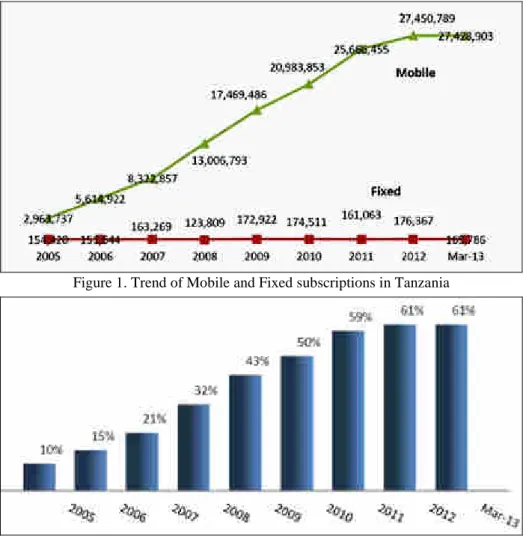
As of March 2013, the Broadcasting sector had 85 Radio and 26 Television stations, while the Telecom sector had two fixed-line operators TTCL and ZANTEL; seven operational mobile networks including Vodacom, Celtel, TiGo and Zantel as the four dominating networks and 95 Internet Service Providers (TCRA, 2013). Trends in telecom statistics indicated a growth of fixed and mobile subscriptions from 3,118,157 in 2005 to 27,598,689 in 2013 as shown by figure 1, and illustrated by a rise in Teledensity from 10% in 2005 to 61% in 2013 as shown by figure 2 (TCRA, 2013). Furthermore, government incentives has facilitated introduction of wireless broadband and 3G technologies. These technologies increased the use of Internet on mobile phones hence boosting overall Internet usage. Based on estimates (ITU, 2012) and statistics on Internet World Starts (2012), Tanzania had 820,000 and 5,629,532 Internet users in 2005 and 2012 respectively. So considering efforts explained above, Tanzania government clearly indicates to be of the opinion that, the use of ICT is inevitable and consequently end-user ICT skills development among citizens is neccessary.
Figure 1. Trend of Mobile and Fixed subscriptions in Tanzania
Figure 2. Teledensity (Penetration)
2. Rationale for developing end-user ICT skills in Higher Learning Institutions
Higher learning institutions in Tanzania and elsewhere in the world exist with the aim of transmitting knowledge necessary in developing appropriate human resources for building social, economic and political organizations and carry forward national development (Akinleye, 2002). The core functions of Higher Learning Institutions includes; teaching, learning, research and consultancy. Different authorities consider ICT as playing enabling role in facilitating achievement of the core functions of higher learning institutions. For example; SIDA (2005), define ICT as the main instrument for information and knowledge transfer both globally and within countries, while UNESCO (2002) asserts that, ICT adds value to the processes of learning, and in the organization and management of learning institutions.
In the same vein, different scholars conclude that effective use of ICT is a key to success in higher learning institutions. For example; Mikko (2006) consider ICT to constitute an infrastructure that permits higher learning institutions to perform effectively particularly on how it enables teaching, learning, research and consultancy
while Wema (2007) consider ICT to facilitate the use of computer assisted teaching and learning technologies, the use of developed digital services and automation of service points as well as the use of electronic resources such as electronic books, journals, databases and websites. That is to say, the use of ICT increases the potential for students to learn independently as they can access information when outside of the physical campus in the online learning environment. This increasing shift towards e-learning and a growing expectation for students to learn independently requires students to be given opportunities to build their end-user ICT skills which are the key to autonomous learning (Andretta, 2005).
3. Status of End-user ICT skills development in Higher Learning Institutions
In order to understand the status of End-user ICT skills development in higher learning institutions, one need to look at both the efforts made by such institutions in developing end-user ICT skills as well as achievement gained. In the context of this paper, efforts made were identified by looking at a number of factors including opportunities created by higher learning institutions which separately or collectively influence the process of end user ICT skills development. On the other hand, achievement was gauged against percentage of students with relevant end-user ICT skills as per literature. Factors and opportunities which were considered by this paper include; availability of ICT training policies; availability and accessibility of ICT infrastructure and facilities; availability of opportunities for developing ICT skills as well as the availability of qualified training workforce. Appropriate end-user ICT skills, (searching, evaluation and ethical use of information) among students were considered achievement by the paper as explained below.
3.1 Availability of policies for developing ICT skills
There are two policies which influence End-user ICT skills development in higher learning institutions namely; ICT policy and Human Resource Policy. Makerere (2004) revealed that, ICT policy influences ICT skills development in two ways, first; it provides statement on who has to be trained, what training they need and how that training would be delivered. Secondly, the specific requirements of the policy help to show what is actually needed for its implementation. For example; in Makerere (2004), four University level policy requirements were noted. First; all students in all faculties were required to take the prescribed credit carrying introductory level module(s) within twelve months of first registration. Second; all staff recruited into positions at or above M14 were required to demonstrate the prescribed level of ICT skills competence before formal appointment. Third; before appointment to Assistant lecturer level, academic staff were required to demonstrate the prescribed level of competence in technology enhanced interactive learning techniques. And fourth; It was required that each faculty, school or institute has at least 1 computer per 5 students enrolled for undergraduate degree and postgraduate diploma courses and 1 computer per Masters or PhD student.
On the other hand, Human Resource Policy reveals that, for an organization to achieve its objectives, it has to have adequately qualified staff (Armstrong, 2001). To this end, among other things, human resources policy requires University staff to have appropriate qualification to perform their roles including developing end user ICT skills among students. That means implementation of Human Resources Policy necessitates the University to recruit ICT literate staff or facilitate unqualified staff to go for further studies so as to acquire prescribed level of competence with regards to end user ICT skills. Studies have shows that, both ICT policy and human resources policy have never received proportionate attention. Rosenberg (2005) noted, low ICT skills among academic staff and Pejova, (2002) noted lack of qualified staff as the predominant feature for most Universities in developing countries.
3.2 Availability of ICT infrastructure and facilities
In Tanzania higher learning institutions have made a remarkable investment in ICT. The status report for higher education institutions in Tanzania (2008), noted that most Universities had dedicated computer centres, computer laboratories, computer networks, and other important accessories. Education and research networking activities has began to take off and e-learning as a strategy to increase access was becoming central to many of the higher learning institutions. The cost of connectivity was high but in higher education institutions VSAT has been used for high bandwidth due to high demand of internet as a major vehicle for the transfer of data and access to information (Mafu, 2004).
Taking the University of Dar es Salaam for example; through Technology Enhanced Independent Learning (TEIL) project, it managed to complete the computer networks in all faculties, institutes, administrative building through fibre optic cabling and also between main campus, MUCHS and UCLAS through 11Mbps wireless connection. It also established computer laboratories in almost all faculties, administrative buildings and students’ halls. Within the project, a total of 300 computers have been installed in computer laboratories, 300
computers have been bought and loaned to staff at a reduced rate and video conferencing facilities have been installed at the University. Furthermore, to enhance the process of teaching and learning, a course management software blackboard has been purchased and installed. In general, these facilities have enabled lecturers to teach more students in different classrooms at the same time (Kiondo, 2004).
However, ICT facilities purchased by higher learning institutions do not satisfy the increasing demand of such facilities at the institutions. Manda (2005) found that, the University of Dar es salaam had 32 computers connected with internet for library users, 309 for students and administrative staff, and 538 for academic staff while the total population of students and staff was well above 9000 and concluded that, the demand for computers is so great that University computing centres at UDSM cannot meet the demand of students and staff. Other studies have produced similar results. For example; Pejova, (2002) noted that, lack of technology has made it difficult to develop meaningful ICT skills development programs and projects that would lead towards optimal exploitation of the available information resources at Universities in developing countries. Archibong and David (2009) noted lack of ICT training infrastructure and facilities, while Wanyenda (2008) noted lack of computers and space in computer rooms for many higher learning institutions in developing countries.
3.3 Accessibility of materials for developing ICT skills
According to Wanyenda (2008), it is the responsibility of University management to facilitate ICT skills development by allocating resources in terms of funds, expertise and time. However, Msuya (2002) noted that, lack of funds limit Universities to facilitate access to skills development materials like manuals, brochures, and CDs/DVDs. With regards to internet access, Swarts and Wachira (2010) have shown that, the recent introduction of the 3G wireless broadband service has greatly boosted Internet access and usage. Inadequate space within computer rooms and lack of computers were no longer constraining access to internet. Students were able to connect their laptops with the internet wirelessly via modems or wireless Local Area Network provided at the University Campus.
3.4 Availability of opportunities for developing ICT skills
Before 1990 the available form of ICT skills being developed at the University in Tanzania was a mere library orientation programme for introducing new students and staff to the library, its layout, collections and services. Bibliographic user instruction programmes began in early 1990, when CD-ROM services were introduced at the University of Dar es salaam. Its aim was to familiarize students and staff with basic search techniques and how to search information needed for research purpose (Hepworth and Wema, 2006).
Traditionally, participation to End-user ICT skills development programme was on voluntary basis. Kiondo & Katunzi-Mollel (2005), noted that a good number of students and staff lack awareness of existing ICT training programme which were being offered by the University of Dar es salaam library. Although, in some cases faculty members requested the library to organize special training for groups of students in particular subject disciplines (INASP, 2004). That is to say, the number of students and staff attending the programme was generally low.
The ICT skills being developed was changing in response to change in technology. For example; in 2001 after introduction of Internet enabled access to free Internet resources and those that the library subscribed to, ICT skills training content changed slightly and included bibliographic instruction and information retrieval techniques (University of Dar Es Salaam, 2001). Thereafter, ICT skills on using the Internet, access to electronic journals and resources as well as on searching and evaluation skills for electronic resources came in. In most cases activities related to developing ICT skills were conducted through short seminars/workshops, or informally when students and staff visited the library (Hepworth and Wema, 2006).
3.5 Availability of personnel for developing ICT skills
Wildt and Schneckenberg (2006) conducted a study on Understanding the concept of E-competence for academic staff while Mostert and Quinn (2009) did a similar study titled “Using ICTs in Teaching and Learning: Reflections on Professional Development of Academic Staff” both studies concluded that, students and academic staff need to be aware of, and understand, the innovative potential of the technology that is available for their teaching, learning, research and consultancy; and that they need to develop specific, appropriate and new competences to cope with the technological challenges. To the contrary, studies done in Tanzania identified low competence of ICT skills among academicians, researchers and graduate students. For example; Busagala and Msuya, (2002) as well as Pejova (2002) found that 72.5% of academicians, researchers and graduate students had limited information searching skills.
Similar findings were arrived by studies done outside Tanzania, for example; Ademodi and Adepoju (2009), conducted a study in Ondo and Ekiti states in Nigeria and found that, the rate of computer skills and competence among ICT trainers working with libraries was low. Dzandu (2010) conducted a study in six selected institutes of the Council for Scientific and Industrial Research (CSIR), Ghana and found that, skills in the use of computers, internet and databases among research officers was very low. Rosenberg, (2005) investigated the status of University libraries in Africa and noted that; low ICT skills among teaching staff has posed a challenge for using ICT related information services.
3.6 End-User ICT skills being developed
In their study titled “Online search skills of Shiraz University postgraduate students” Mehrad and Fahimi (2009) found that, more than 84% of students indicated searching skills to be useful and had helped them to retrieve information in the least amount of time and that was the main source of their zeal in learning more about searching skills. Also, in the study titled “Skills and training needs for use of electronic information resources (EIRs) among students in four Tanzanian Universities” Lwehabura (2008) found that, 97.7% of students indicated information evaluation skills to be very useful. Both studies concluded that while any Internet user is able to browse it and find information using any search engine, the most important thing, especially for students, is the accuracy and reliability of information found. This requires them to have skills of not only searching but also evaluating and judging the value of information.
Based on Alijani and Dehghani (2006), effective searching includes; the ability to use boolean operators in simple and advanced search also known as Boolean searching; the ability to include keywords that should come exactly next to each other, also known as Phrase searching; the ability to include keywords which should come adjacent to each other, also known as Proximity searching; the ability to limit search to a specific field, also known as field searching; the ability to add a sign at the beginning or end of the root of a word in order to retrieve morphologically variant forms bearing the same root/stem, also known as truncation; the ability to limit the search to a specific time (time limitation); and the ability to determine effective synonyms and keywords also known as suitable keywords searching.
On the other hand, Metzger (2007) outlined five recommended criteria for evaluating the credibility of online information plus their sources. These are; accuracy involves seeking other sources to validate the information; authority which involves checking the author, verify his qualifications or credentials, checking whether contact information are provided, looking for “stamp of approval” or a recommendation from known expert; currency involves checking if the information is up-to-date; objectivity involves considerations of the goal/objective of posting the information or whether the views on the site represent facts or opinion; coverage involves checking if the information is complete and comprehensive.
As pointed out earlier, possessing searching and evaluation skills is a key to retrieving
appropriate and
intended information. However the one with such skills is left with the challenge of using retrieved information ethically. Based on University of Witwatersrand (2001), in order to use information ethically, understanding of basic protections provided by copyright laws is necessary. Such protections includes; copying; selling; distributing; preparing new work based on copyrighted online resources and how copyright laws strive to balance the interests of copyright owners and users. In the context of higher learning institutions, end-user ICT skills which have been recommended by scholars and consequently being developed includes; searching skills, evaluation skills andskills on ethical use of information.
4. Conceptual framework
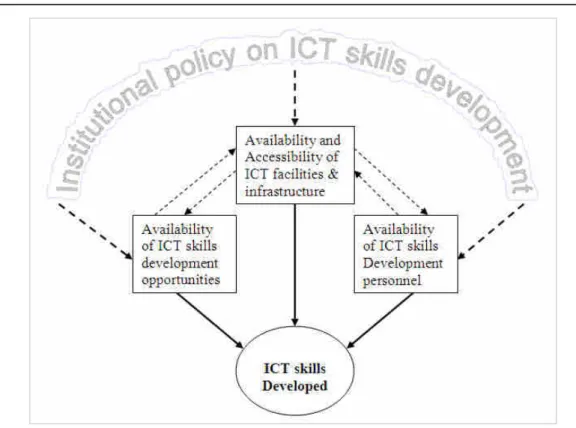
In order to According to Frankfort Nachmias and Nachmias (2005), a concept is and idea of something formed by mentally combining all its characteristics or particulars or an abstraction or representation of an object or a phenomenon. A framework is simply the structure of the research idea or concept and how it is put together. Therefore, conceptual framework elaborates the problem in relation to relevant literature. It summaries the major (dependent and independent) variables in a schematic diagram and present such variables with respect to their hypothesized relationships. Based on available literature explained earlier, there are five independent variables and one dependent variable which altogether define the environment under which ICT skills are being developed in Higher Learning Institutions in Tanzania. Their relationship was hypothesized to be presented dramatically as shown by figure 3 (Authors’ construct).
Figure 3. Conceptual framework
Based on conceptual framework presented above, policies for developing ICT skills affect the way higher learning institutions invest in making sure that; ICT infrastructure and facilities are in place and accessible; opportunities for developing ICT skills are created and appropriate personnel for performing the task are available. In that way, policies together with each of these three variables individually and collectively affect the process of developing ICT skills. As pointed out in the literature, searching skills, evaluation skills as well as skills on ethical use of information were the most useful skills in higher learning environment. Based on framework the dependent variable involved testing if higher learning institutions have done enough in
developing these three skills among ICT users.
5. MethodologyThis paper was based on the study conducted by author in eight selected higher learning institutions in Tanzania. The population of interest to the study was the entire number of students in all higher learning institutions. Based on reports, Tanzania had 43 higher learning institutions with 49,967 students (TCU 2008). The study used exploratory research design because not much was already known about the situation at hand, and no information was available on how similar problems or research issues have been solved in the past. Exploratory study are undertaken to better comprehend the nature of the problem since very few studies might have been conducted in that area (Sekaran, 2003). Survey was selected and employed as a research strategy in this study. In surveys literature is used to help in identifying ideas and theories which are then tested using data. Surveys are popular as they allow the collection of large amount of data from a sizeable population in a highly economical way. A questionnaire however is not the only data collection technique that belongs to the survey strategy, structured observation and structured interview also belong to this category (Saunders, 2007).
The study used two types of sampling design; purposive and stratified random sampling. With purposive, items are deliberately selected to constitute a sample which represents the population, while with stratified random sampling the population is stratified into a number of non – overlapping sub-populations or strata and sample items are selected from each stratum based on simple random sampling (Kothari, 2004). Purposive sampling was used to get such items like the higher learning institutions to be involved in the study; departments from which to get key informants plus getting the key informants themselves. Stratified random sampling was used to get respondents among undergraduates and post-graduates students.
As to get fair representation of Public institutions, the Open University of Tanzania (OUT); the University of Dar es salaam (UDSM); Ardhi University (ARU); Muhimbili University of Health and Allied Sciences (MUHAS); Dar es salaam University college of Education (DUCE) and Mzumbe University Dar es salaam Campus College (MUDCC) were selected. Private institutions were represented by; International Medical and Technological University (IMTU) and Tumaini University Dar es salaam College (TUDARCO). Public institutions were represented by six while private by two due to the fact that 78.4% of the entire population of students comes from public institutions while only 21.5% are from private institutions (TCU 2008).
When selecting departments from which to get key informants the role of such departments in developing end user ICT skills was considered. Furthermore, in selecting respondents, the idea was to collect data from both providers and recipients of ICT skills. Key informants were drawn from among management staff at ICT or library departments. The basis for selecting informants was the depth of knowledge of end user ICT skills related to functions of the department. Informants provided detailed information on developments, and the status of end-user ICT skills development at their respective institutions.
Kothari (2004), asserts that “if the items within the population are homogeneous, a small sample can serve the purpose” because precisions in estimates and the level of confidence are high when items within the population are homogeneous. The population was presumed homogeneous because respondents were students and staff from higher learning institutions whose key functions like; teaching and learning; research; and consultancy, are basically the same. With that reasoning the study used less than 5% of the population as the sample size. The study relied mainly on primary sources of information, and data were collected using observation, interviews and questionnaires. Observation aimed at collecting data on two important related to developing ICT skills, First; the availability and second, the accessibility of ICT infrastructure and training facilities to students and staff in higher learning institutions. Cohen et al., (2000) recommends the use of observation as it provide an opportunity to gather live data from live situation. Questionnaire aimed at facilitating convenience of reaching respondents who were not easily reachable and provided respondents with time to give well thought out answers (Kothari, 2004). Interview aimed at collecting data from key informants, who provided detailed information with regard to end user ICT skills development. On the other hand, documentary review was used as secondary data collection method. Documents are claimed to be a bridge for obtaining rich data for the research, so documents are source of information without which research is impossible (Bell, 1993).
6. Findings
Findings were aggregated based on independent and dependent variables outlined in the conceptual framework. 6.1 Availability of institutional policy for ICT skills development
Only 4.2% of ICT trainers acknowledged the existence of such policies at their respective institutions, 22.9% declined while 72.9% had no idea as to whether such policies do exist or not. Follow up interview revealed that all higher learning institutions had two policies related to developing ICT skills. The first one was the ICT policy which deliberates on who has to be trained, what training they need and how that training would be delivered while the second one was Human Resources Policy which deliberates on credentials and qualifications appropriate for staff who are involved in ICT skills training to end-users. It was anticipated that, higher learning institutions would place ICT skills development obligation within trainers’ job descriptions. However, findings revealed that 79.2% of sampled staff had no such obligation within their job descriptions implying that, higher learning institutions in Tanzania had put very little emphasis on implementation of both ICT and Human resources policies. Had it not been the case, these policies would have been well communicated to ICT trainers owing to their central role in developing End-user ICT skills.
6.2 Availability of infrastructure and facilities for developing ICT skills
Although 91.9% of respondents indicated that their institution had a dedicated computer center/laboratory; 83.1% were of the opinion that, computer laboratories at their institution had few computers, with respect to number of students. Follow up interview with key informants arrived at the same conclusion which was supported by studies by Mafu (2004); Manda (2005); Wanyenda (2008) and Wachira (2010). According to Makerere (2004), adequate number of computers must have been in the ratio of 1 computer per 5 students enrolled for undergraduate degree and postgraduate diploma courses, and 1 computer per Masters or PhD student. Lack of ICT training facilities is mainly caused by the fact that, in many developing countries like Tanzania, University’s capital and recurrent budgets are largely dependent on grants from government (or donors) which are prone to cuts owing to competing priorities. For example; Simui and Kanyengo (2004) found
that, the University of Zambia, was not in position to buy even a single book leave alone a computer; for more than five years, because the library did not have any funding.
6.3 Access to materials and services for developing ICT skills
Surprisingly, despite lack of adequate number of computers at the institutional level, at individual level 68.2% of students had access to computers connected with internet; 14.9% had access to manuals; 11.5% had access to brochures/leaflets; and 2% had access to CDs/DVDs with ICT skills training contents. Follow up interview together with observation found that, a large proportion of students possess their own laptops which were connected to internet via modem or institutional wireless LAN hence by-passing access constraints related to lack of space within computer rooms and fewer computers possessed by higher learning institutions. These findings were in line with Swarts and Wachira (2010) who noted that, the recent introduction of 3G wireless broadband services has greatly boosted Internet usage.
6.4 Availability of opportunities for developing ICT skills
Findings revealed that, three end-user ICT training opportunities were created for students; orientation sessions which were accessed by 80.4% of respondents; seminars and workshops which was attended by 10.8% as and a course integrated within the curriculum which was attended by only 4.7% of students. Follow up interview and observation revealed three facts, first; all universities were using orientation sessions to deliver training on end-user ICT skills to students. Second, seminars and workshops organized for the purpose of developing ICT skills were very few, and thirdly, with the exception of one University (MUHAS) students were not provided with a course which facilitates end-user ICT skills to be taught and assessed like any other subject. That is to say, most Universities had no course integrated in the curriculum and were not using seminars and workshops intensively. However, According to Rowley (1997), full fledged course on ICT skills, together with seminars and workshops on end-user ICT skills are important because they bring together professionals from a wide variety of expertise and experiences to share information, ideas, knowledge and skills on a wide range of ICT issues and to network among themselves. This means seminars are very useful to students as they provide avenue for them to discuss issues and share ideas, knowledge and skills with experts.
On the other hand, capacity building opportunities created for trainers had two categories of findings; 31.2% and 47.9% on facilitation to go for further studies leading to certification and facilitation to attend ICT skills related seminars and workshops respectively. According to Lwehabura (2008), in an academic environment information is a vital input for all learning, teaching, research and consultancy activities. However, most information required to support assembling academic and professional careers requires extensive literature searching and the gathering of ideas from different sources and in different formats. Thus, individuals who are able to use the right information from the right source at the right time stand a better chance of succeeding in their endeavors than those who cannot do so. That is to say, capacity building on part of ICT trainers was expected to be among University’s key priority area.
6.5 Availability of qualified ICT skills trainers
With regard to whether Universities have qualified ICT trainers; 47.9% staff working with library or ICT department who were expected to play a central role in ICT skills development did not have ICT related academic or professional certification; 8.3% had Certificates; 12.5% had Diploma; 12.5% had Degree; 14.6% had Master’s and only 4.2% had PhDs’. When the number of sampled ICT trainers who had no ICT related certification was analyzed, 65% had the working experience of more than five years. This implied that, Universities have the tendency of employing and retaining potential ICT trainers who have no related certification. Follow up interview revealed that, Universities were aware of provision of ICT skills to end-users which are done by trainers who have no appropriate academic or professional capacity to do so.
6.6 Output in terms of skills being developed
With regard to ICT skills being developed; aggregate findings indicated that, of the three end-user ICT skills; information searching was mastered by 6.1% while 50.7% had little knowledge; evaluation of information was mastered by 4.7% while 43.9% had little knowledge; ethical use of scholarly information was mastered by 6.8% while 52% had little knowledge. That is to say, 43.2%, 51.4% and 41.2% of students in higher learning institutions in Tanzania had no searching skills, evaluation skills and skills on ethical use of scholarly work respectively.
7. Conclusions
• End-user ICT skills development in higher learning institutions is and will continue to be essential in filling the gap between what students and trainers know and can do, and what they should and be able to do in terms of using ICT in their teaching, learning, research and consultancy.
• Evolution of wireless broadband and 3G technologies has facilitated the availability of wireless Local Area Networks in Universities which has greatly improved access to Internet. Students connect their laptops with Internet via University’s wireless LAN or via modem. This could be used to facilitate ICT training, if Universities would have been delivering specific ICT skills development content online through University website.
• ICT training opportunities created by Universities were not fully promoted and marketed. For example; during data collection, a large proportion of MUHAS and UDSM students were not aware of existence of ICT training advert on their library website.
• There are institutional barriers with regard to end-user ICT skills development. These includes; possession of small computer laboratories with few computers connected with internet; lack of ICT training materials like manuals, brochures, leaflets, CDs and DVDs; lack of qualified ICT trainers; and lack of support from University management.
• The proportion of students with appropriate end-user ICT skills including searching, evaluation and ethical use of information was very small.
8. Recommendations
i) Higher learning institutions should integrate end-user ICT skills within the curriculum. This will enable teaching and assessing such skills like any other subject.
ii) Higher learning institutions should market policies related to ICT training to all stakeholders involved in its implementation. This will enable trainers and trainee to be aware of what is expected of them with respect to end-user ICT skills.
iii) Higher learning institutions should ensure that, ICT infrastructure and facilities, ICT training materials and qualified workforce are in place as to support teaching and learning using ICT. There should be a concrete and transparent way of allocating funds needed to finance end-user ICT skills development. iv) The Government should allocate funds to improve infrastructure especially electrification in rural areas.
ICT as a subject within the curriculum for primary and secondary schools in Tanzania do exist, but it is not taught in rural areas due to lack of power.
v) Owing to competing priorities to be met by University budget, the purchase of computers for students has always been left out. So students should be advised to buy their own computers.
vi) Universities should create more in-house training seminars and workshops for the purpose of delivering updates as to enhance ICT trainers’ effectiveness
vii) More awareness programmes are needed to educate the University community about the importance of end-user ICT skills. Posters, stickers and newsletters could be used.
References
Ademodi, D. T. and Adepoju, E. O (2009). “Computer skills among librarians in academic libraries in Odo and Ekiti States, Nigeria”. In Library philosophy and practice. African Partnership Forum (2008). ICT in Africa: Boosting Economic Growth and Poverty Reduction: 10th meeting of the African partnership
Forum, Tokyo Japan. 7–8, April, 2008
Akinleye, L. (2002). “Indigenous knowledge systems, communication, and sustainable development (IKSSD)”, In Soola, E.O., ed. Communicating for development purposes. Ibadan: Kraft Books Ltd.
Alijani, R.& Dehghani, L. (2006). “Online retrieval, systems and methods”, Tehran: Chapar.
Andretta, S. (2005). “From prescribed reading to excitement or the burden of choice”. Information literacy:
foundation of e-learning. ASLIB Proceedings: New Information Perspectives, 57(2) pp.181 – 190
Archibong, I. A. and David, O. E. (2009). “ICT in University Education: Usage and Challenges among Academic Staff”. African research review: an International Multi-Disciplinary Journal, Ethiopia Vol. 3 (2) January, 2009 (pp. 404-414)
Armstrong, M. (2001). “Human Resources Management Practices”. USA; Kogan Page.
Bell, J. (1993). “Doing your research in social sciences and education”. Chadwick: St Edmundsbury Press. Cohen, L. L. et al,.(2000). “Research methods in education”. London, Routledge Falmer.
Donald S. (2005). “The Impact of Investment in IT on Economic Performance: Implications for Developing Countries”. World Development, 33, 5, 681–700.
Fountain, J.E. (2001). “Building the Virtual State: Information Technology and Institutional Change”,
Washington, DC: Brookings Institution Press.
Frankfort-Nachmias, C. and Nachmias, D. (2005). “Research methods in the social sciences”. St. Martin’s Press,
Inc. London.
Hepworth M. and Wema, E. (2006). “The design and implementation of an information literacy training course that integrated Information and Library Science conceptions of information literacy, educational theory and information behaviour research: a Tanzanian pilot study”. Loughborough University. United
Kingdom.Vol.5(1), 2006.
http://www.ics.heacademy.ac.uk/italics/vol5-1/pdf/hepworth-evans-final.pdf
(accessed 30 July 2013)
INASP (2004). “The use and impact of electronic resources in academic and research institutions in Tanzania”. INASP country report. Unpublished, 2004.
INASP (2006). “ICT Training: INASP workshops for African University library staff”. By Martin Belcher, Sara Gwynn and Diana Rosenberg. Information Development 2006 22: 116. Online version of this article can be found at: http://idv.sagepub.com/content/22/2/116 (accessed 30 July 2013)
Kiondo E. (2004) “An assessment of levels of IT investments, electronic information resource usage and information literacy skills of users as the University of Dar es salaam”, 6th Standing conference of African National and University Libraries (SCANUL-ECS) 2nd-5th July 2004, pp. 37-49, (2004)
Kiondo, E. & Katunzi-Mollel, K. (2005). “Information literacy programmes in Tanzania academic libraries: the case of university of Dar Es Salaam library” [Un-published report, 2005]
Kiondo, E. and Nawe, J. (2003) “Enhancement of IT adaptation at the University of Dar es salaam Library”, a
proposal submitted to Carnegie Corporation of New York
Kothari, C. R. (2004). “Research methodology Methods and techniques. 2nd revised edition”, New age
international (P) Ltd.
Lwehabura, M.J.F. (2008). “Skills and training needs for use of electronic information resources(EIRs) among students in four Tanzanian Universities”. University of Dar es salaam Journal Vol.10 (1&2)
Mafu, S. (2004) “From the Oral Tradition to the Information Era: The Case of Tanzania”, International Journal
on Multicultural Societies (IJMS), Vol. 6, No. 1, pp. 53–78
Makerere (2004) “Makerere University ICT policy master plan phase 2; 2005 - 2009
http://mak.ac.ug/sites/default/files/downloads/Makerere%20University%20ICT%20Policy%2
0(2005-2009).pdf
(accessed 30 December 2013)
Malekani, A.W. (2006) “A study of students’ internet perceptions at Sokoine University of Agriculture”. MA Thesis. University of Dar es salaam
Malekani, A.W. (2006) “A comparison of information needs and information-seeking behaviour of students at Open University and Sokoine University of Agriculture. Tanzania”. University of Dar es salaam library
Journal, 7 (1): 57- 70
Manda, Paul A. (2005) “Electronic resource usage in academic and research institutions in Tanzania”.
Information Development, 21(4): 269-282.
Mehrad and Fahimi (2009). “
Online Search Skills of Shiraz University Post Graduate Students: A
Survey”
. International Journal of Information Science and Management. Vol. 7, No. 1. http://www.srlst.com/ijist/ijism-Vol7No1/ijism71-1-13.pdf (accessed 30 Nov 2013)Metzger, M. J (2007). “
Making Sense of Credibility on the Web: Models for Evaluating Online
Information and Recommendations”. Journal of the American Society for Information
Science and Technology, 58(13) September, pp. 2078–2091
Mikko V, (2006). “Implementing Information and Communication Technology in Higher Education in Tanzania”. International Information Management Corporation. www.IST-Africa.org/Conference2006 (Accessed 15 July 2013)
Mostert, M and Quinn, L (2009) “Using ICTs in Teaching and Learning: Reflections on Professional Development of Academic Staff”. International Journal of Education and Development using ICT. 5(5), June 2009, pp. 72-84
Msuya, J.M, and Busagala, L.S.P (2002). “Awareness and skills of the Tanzanian researchers about scientific literature searching on the Internet”, The South African Journal of clinical nutrition. Vol. 15, No.2 pp. 18, (2002).
Okpaku, J. O (2003), “Information and Communications Technology, National Development and Scaling up the War against HIV/AIDS”, A background paper presented at Expert Consultative Meeting on Building
e-governance capacity in African countries held in Tangier, Morocco on 20-22 October 2003.
Pejova, Z. (2002) “Information Literacy: An Issue which Requests Urgent Action in Developing Countries and Countries in Transition”. White Paper prepared for UNESCO, the U.S. National Commission on
Libraries and Information Science, and the National Forum on Information Literacy, for use at the Information Literacy Meeting of Experts, Prague, The Czech Republic. [Online] Available at:
http://www.nclis.gov/libinter/infolitconf&meet/papers/pejova-fullpaper.pdf (Accessed on 16 Nov 2012). Rosenberg, D. (2005). “Towards the digital library: findings of an investigation to establish the current status of
university libraries in Africa”. Oxford: INASP.
Saunders, M. (2007). “Research methods for business students 4th edition”, Pearson education Limited;
Edinburgh, England.
Sekaran, U. (2003). Research methods for business: a skill building approach 4th edition”, John Wiley and sons
Inc. New Jersey, USA.
Simui, M. H. and Kanyengo, C. W (2004) “Investigation into the funding of University libraries in Zambia”.
South Africa; INASP and the Standing Conference of African National and University libraries in Eastern, Central and Southern Africa (SCANNUL-ECS)
Swarts, P and Wachira, E.M (2010) Tanzania: ICT in education situational analysis”. URT
TCRA (2013) “Telecom statistics”
http://ww.tcra.go.tz/images/documents/telecommunication/telecomStatsMarch13.pdf (accessed 13 August, 2013
TCU (2008) “Guide to Higher Education in Tanzania, 2008 Fourth Edition”. Dar es Salaam: TCU pp. iii-iv. TCU (2010) “Statistics: Universities and University Colleges Enrollment of Students”
http://www.tcu.go.tz/uploads/file/statistics for 2009-2010.pdf (accessed 13 June, 2012) UDSM (2001). “Five-year rolling strategic plan”. Dar Es Salaam: UDSM
UNESCO, (2001) “Public services: application of the internet in developing countries”. UNESCO, Paris. UNESCO, (2002) “Information and Communication Technology in education: a curriculum for schools and
Programme of teacher development”. http://unesdoc.unesco.org/images/0012/001295/129538e.pdf (access 5 October 2012)
UNESCO, (2008). “Towards Information Literacy indicators: conceptual framework paper prepared by Ralph Catts and Jesus Lau”. http:// www.uis.unesco.org/template/pdf/cscl/InfoLit.pdf (accessed 5 August, 2012).
University of Witwatersrand (2001), Copyright Service Office, Smuts Avenue, Johannesburg,
www.wits.ac.za/library/services/copyright (accessed 5 August, 2012).
Wanyenda, L C (2008) “Training in online search skills at Sokoine University of Agriculture, Tanzania: the use of TEEAL and AGORA databases”. University of Dar es salaam library journal Vol 10, no. 1&2 http://www.ajol.info/index.php/udslj/article/viewFile/43416/26952 (accessed 5 August, 2012).
Wema, E. (2007). “The role of ICT unit” http://library.udsm.ac.tz/Library_Services/Ict_Unit.php (Access 5 December. 2012).
Wildt, J. and Schneckenberg, D. (2006) “Understanding the concept of E-competence for academic staff”.
Center for Research on Higher Education and Faculty Development, University of Dortmund. Germany