1
2013
2014
Architecture
Ka
ris
sa M
eier
s
Th
esi
s
Enlivening transitional buildings and cities.
Eightfold
2 3
Eightfold Architecture
A Design Thesis Submitted to the Department of Architecture and Landscape Architecture of North Dakota State University.
By Karissa Meiers
In Partial Fulfillment of the Requirements for the Degree of Master of Architecture
Primary Thesis Advisor
Thesis Committee Chair
May 2014 Fargo, North Dakota
4 5
Ta
ble o
f C
on
ten
ts
13 15 17 19 21 23 24 25 26 27 28 29 30 31 32 33 35-47 49-71 73-81 83-85 87-95 97-103 105-107 109-111 112 113 Abstract Problem Statement Statement of IntentTypology and Theoretical Premise/Unifying Idea Project Justification
Proposal Narrative
User/Client Description Major Project Elements Site Information: Midwest Site Information: Fargo Christian Science Building Site Photos
Project Emphasis A Plan For Proceeding Spring Schedule
Program & Unifying Idea Case Studies
Historical Narrative Goals of this Thesis Site Analysis Photo Grid
Program Requirements References
Previous Studio Experience Karissa Meiers
6
T
ab
les & Figur
es
Figure 1 Table 1.1 Table 1.2 Table 1.3 Figure 2.1 Figure 2.2 Figure 3.1 Figure 3.2 Figure 3.3 Figure 3.4 Figure 3.5 Figure 4.01 Figure 4.02 Figure 4.03 Figure 4.04 Figure 4.05 Figure 4.06 Figure 4.07 Figure 4.08 Figure 4.09Cover Graphic: Eightfold Architecture Midwest Region Map
Fargo North Dakota City Boundaries Site and Context
Site Photo
Site Photo of the Existing Building
Thangka with Prajnaparamita. Anonymous artist. Located in Na-tional Museum in Warsaw, Poland.
Reaching Buddha. Anonymous artist. Located in Archeological Mu-seum in Sarnath, India. Photo taken by Tevaprapas Makklay.
Fengxian Temple. Anonymous artist. Located in the Xiangtang Mountains in China. Photo taken by Holland Cotter.
Manuha Paya. Anonymous artist. Located in Pagan, Burma. Photos taken by Myanmar’s NET.
Langara Student Union Floor Plan 1
Womb World. Anonymous artist. Located in the private collection of Sylvan Barnet and William Burto. Photo’s taken for the Metropolitan Museum of Art.
Image: archdaily Image Editing: Karissa Meiers Langara Student Union Perspective
Image: archdaily
Langara Student Union Ramps Image: http://wsb-eng.com Thermenex
Image: http://thermenex.com/index.php?p=learnmore Langara Student Union Floor Plan 2
Image: archdaily Image Editing: Karissa Meiers Langara Student Union Floor Plan 1
Image: archdaily Image Editing: Karissa Meiers Langara Student Union Site Plan
Image: Canadian Architect Magazine Image Editing: Karissa Meiers
Langara Student Union North Elevation Image: Karissa Meiers
Langara Student Union West Elevation Image: Karissa Meiers
Langara Student Union Section A Image: Canadian Architect Magazine Image Editing: Karissa Meiers
6 7 Figure 5.01 Figure 5.02 Figure 5.03 Figure 5.04 Figure 5.05 Figure 5.06 Figure 5.07 Figure 5.08 Figure 5.09 Figure 5.10 Figure 6.01 Figure 6.02 Figure 6.03 Figure 6.04 Figure 6.05 Figure 6.06 Figure 6.07 Figure 6.08 Figure 6.09 Figure 6.10
Images: Karissa Meiers
Flanders Business School Facade Image: archdaily
Flanders Business School Perspective Image: archdaily
Flanders Business School Conference Room Image: archdaily
Flanders Business School Floor Plan 1
Image: archdaily Image Editing: Karissa Meiers Flanders Business School Floor Plan 2
Image: archdaily Image Editing: Karissa Meiers Flanders Business School Site Plan
Image: Karissa Meiers
Flanders Business School South Elevation Image: Karissa Meiers
Flanders Business School Section A
Image: archdaily Image Editing: Karissa Meiers Flanders Business School Section B
Image: archdaily Image Editing: Karissa Meiers Flanders Student Union Diagrams
Image: Karissa Meiers
Nulman Lewis Student Center Perspective Image: archdaily
Nulman Lewis Student Center Back Perspective Image: archdaily
Nulman Lewis Student Center Interior Perspective Image: archdaily
Nulman Lewis Student Center Floor Plan 1
Image: Architectural Record Image Editing: Karissa Meiers Nulman Lewis Student Center Floor Plan 2
Image: Architectural Record Image Editing: Karissa Meiers Nulman Lewis Student Center Floor Plan 3
Image: Architectural Record Image Editing: Karissa Meiers Nulman Lewis Student Center Site Plan
Image: inhabitat.com Image Editing: Karissa Meiers Nulman Lewis Student Center Section A
Image: archdaily Image Editing: Karissa Meiers Nulman Lewis Student Center Section B
Image: Karissa Meiers
8
T
ab
les & Figur
es
Figure 6.11 Table 7.00 Table 7.01 Table 7.02 Table 7.03 Table 7.04 Table 7.05 Table 7.06 Table 7.07 Table 7.08 Table 7.09 Image: archdaily Image Editing: Karissa MeiersNulman Lewis Student Center Diagrams Images: Karissa Meiers
Construction of Student Unions Diagram Information: (Robinson, 2013)
Image: Karissa Meiers Temperature Diagram
Information:http://www.climate-zone.com/climate/united-states/ north-dakota/fargo/
Image: Karissa Meiers Humidity Diagram
Information:http://weatherspark.com/averages/30234/Fargo-North-Dakota-United-States
Image: Karissa Meiers Precipitation Diagram
Information:http://www.climate-zone.com/climate/united-states/ north-dakota/fargo/
Image: Karissa Meiers Cloudiness Diagram
Information:http://weatherspark.com/averages/30234/Fargo-North-Dakota-United-States
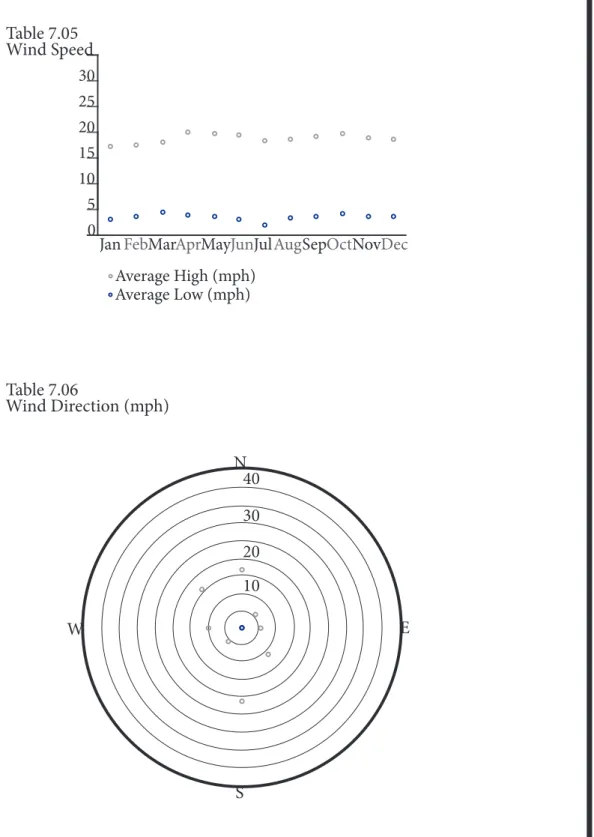
Image: Karissa Meiers Wind Speed Diagram
Information:http://weatherspark.com/averages/30234/Fargo-North-Dakota-United-States
Image: Karissa Meiers Wind Direction Diagram
Information:http://weatherspark.com/averages/30234/Fargo-North-Dakota-United-States
Image: Karissa Meiers Sun Path Diagram
Information:http://www.gaisma.com/en/location/fargo-north-da-kota.html
Image: Karissa Meiers Slope and Climate Diagram
Information: http://climate.umn.edu/pdf/fargo_climate.pdf Image: Google Earth
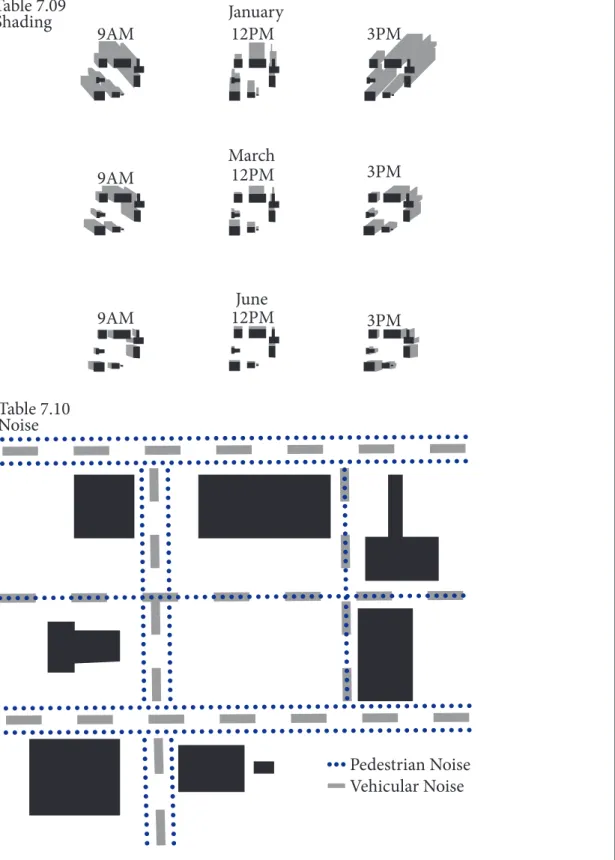
Image Editing: Karissa Meiers Shading Diagram
8 9 Table 7.10 Table 7.11 Table 7.12 Figure 8.1 Figure 8.2 Figure 8.3 Figure 8.4 Figure 8.5 Figure 8.6 Figure 8.7 Table 9.1 Table 9.2 Noise Diagram
Image: Karissa Meiers Image: Karissa Meiers
Topography and Average Air Movement Diagram
Information:http://www.npwrc.usgs.gov/resource/habitat/climate/ wind.htm
Image: Karissa Meiers
Existing Pavement and Soil Layers Diagram
Pavement Informatoin: http://www.okhotmix.com/Websites/oapa/ Images/Parking%20Lot%20Design%20Manual%20for%20Web.pdf Soil Information:http://www.nrcs.usda.gov/Internet/FSE_MANU-SCRIPTS/north_dakota/fargoND1903/fargoND1903.pdf
Image: Karissa Meiers Photo Grid Diagram Image: Karissa Meiers
Photo’s taken by Karissa Meiers Photo’s taken by Karissa Meiers Photo’s taken by Karissa Meiers Photo’s taken by Karissa Meiers Photo’s taken by Karissa Meiers Photo’s taken by Karissa Meiers Image: Karissa Meiers
12 13
This thesis investigates the question of how Eightfold Architecture can help inspire us to save ex-isting abandoned buildings, and with this bring an enlightened functionality to transitional areas of our cities. The concept of Eightfold Architecture, rather then architectural renovation, has been chosen to guide this research and design so to keep the importance of a cyclical nature in mind and to emphasize the reality of ethics in this way of designing.
The current downtown campus has been very successful. With moving part of the NDSU campus downtown a spark of new life was created in the existing downtown. Unfortunately, the downtown campus is missing a student gathering facility. For the application of this project I will look into how re-birthing the vacant Christian Science building, along with an addition across the street, for the use of a student union will help to continue and to expand on the breath of new life that the downtown Fargo area has. Since this project is re-birthing an existing vacant building it is my motivation to really dive into the history of the context, site, and existing building to extend it’s consciousness, through Eightfold Architecture, to create a successful development of an existing building, a new building, and an urban environment.
Key Words:
Eightfold Architecture, Reality, Breath of New Life, Cyclical, History, Extended Consciousness, Urban Environment, Re-birth.14 15
Problem Statement
How can the idea of
Eightfold Architecture
help inspire us to save existing abandoned buildings and bring new life to transitional areas of our city?16 17
Statement o
f In
ten
18 19
Manner
Object
Action
Actor
Typology
Theoretical
Premise
/Unifying
Idea
Premises
NDSU Downtown Student Union
Claim
Unifying
Idea
By re-birthing structures that have been vacant we can bring new life, with the means of Eightfold Architecture,
to not only the building, but also transitional areas of our cities.
Architectural rebirth with the influence of Eightfold Ar-chitecture can create new potential functions in the exist-ing built environment.
Students and faculty need to have a formal gathering place in the downtown campus. This will in turn effect the community members of the area.
This concept will bring new life to the vacant Christian Science building and a transitional area of Fargo, ND. Through Eightfold Architecture new life will be brought to a structure and a transitional part of Fargo.
NDSU lacks a formal student gathering point down-town. By creating a student union downtown students would be benefited by a formal gathering space.
There are several abandoned buildings in the down-town Fargo area. By moving a student union into an abandoned building this unused building would have the chance to serve another purpose.
Giving new life, in this case as a student union, to an abandoned building downtown not only could ben-efit the students of NDSU but also benben-efit the city by bringing new life to a more transitional area of down-town Fargo. This would be from choosing a location in downtown that, besides residentially, is not flourishing.
Abandoned buildings need a new purpose through
Eightfold Architecture, and with this new found pur-pose, will come more lively parts of cities that may have been lacking functions due to a transitional location.
20 21
Pr
oj
ec
t J
us
tific
at
io
n
By giving abandoned buildings a meaningful purpose not only will new life be given to these buildings but a new dynamic functional-ity will be brought to transitional areas of our cities.
“The history of a community is incomplete without an historic and architectural structures survey of buildings which make up the neighborhoods and the business districts. Such structures, regard-less of architectural style or age, are a part of the streetscape which makes a community a ‘home.’ Preservation of such structures and districts is critical to providing a cultural continuum, an anchor for an evolving community.” (Roberts, 1983) This quote is from the preface to a book called Fargo Heritage and written by the Fargo Heritage Society. This quote shows that there is a desire in Fargo to preserve its architectural history. In order to do this these build-ings need to continue themselves with new functions.
“Blight and Deterioration. The Renaissance Zone is located in the oldest part of the city, which could explain some of the physical deterioration that currently exists. However, the Zone also con-tains some of the community’s most distinctive and important buildings. The age of the building stock does not, in and of itself, constitute a reason for blight and deterioration to continue in the Zone. The implementation of the Renaissance Zone Development Plan will provide a coordinated response to development concerns and issues in the Renaissance Zone area, giving both investors and customers a reason to “come back downtown” and to believe that renewal, reinvestment and redevelopment is, in fact, possible and profitable.” (“Addendum of 1999 Fargo Renaissance Zone Devel-opment Plan,” 2003).
“The main reason these redevelopment projects are so important to our communities is because it is a way we can preserve older buildings, which in their own way tell a story about a cities his-tory. It allows people to improve their community without having to demolish a building and build new things. But also it can create a big economic and social impact. It creates jobs within the com-munity, enlivens the community through the creation of culture and new businesses, and brings in more money for that given city.” (Livorsi, 2013)
As you approach an abandoned building your senses are striking out. What are you feeling? Do you feel small? Do you feel curious? Humble? Spectral? Forgotten? Inconsequential? Vacant build-ings hold a sense of absent grandeur. You may even question what happened here? Why is this structure unused? Is this building really so depleted of life that it could not serve another lively pur-pose? Thoughts of what this building could be might even pop into your head. My thesis is about how I have a sneaking suspicion that these feelings that we have when we walk up to a building of this abandoned nature is for a reason. These buildings are not an end; they are just a beginning of a new life.
Throughout my life, from traveling and being at home, I have discovered the oddities of some of the bare buildings that surround me at home. Growing up in Stanley, Grand Forks, and Fargo, North Dakota, I have continuously been struck by the absent feeling that these numerous vacant buildings give me and the surrounding area. I have been lucky enough to travel for many different occasions in my life. I have seen the potential that abandoned buildings possess. For example, Antwerp, Belgium as a city became a prosperous city as far back as the 16th century (“A Brief History of An-twerp,” 2011). Since 1984, after many years of growth and decay as a city, Antwerp has turned to reuse and urban renewal projects (Lorquet, 2012). Obviously, the 16th century is not the only time in history that Antwerp was prosperous in. It was quite a lively place in the early 1900’s, I have read, but it has taken some time for the city to create prosperous urban renewal plans and realize that the old is the new. I sense that some of our cities in the midwest are still too young in their histories to realize that it is critical to rebirth our existing buildings. Give these lifeless buildings a new form. Give these vacant structures a new life. This is truly caring for our city.
If something is to be appreciated, cared for, and remembered this something needs to have char-acteristics that define and shape it as a form. If a building is designed with a clear focus towards a set of architectural ethics the building could be virtuous with this guide. If we want to recreate in an ethical way we need to look towards an ethical concept to guide us. How could you design an architectural ethics system? I will try to examine a relion that speaks of life and morals to try and understand their regard towards ethics and see if this can translate into a system of how ethics influence architecture.
24 25
The Downtown union will mainly have three different types of people using this academic facility.
There will be the student.
Students will be the main occupants of this building just because these are the people who will spend most of their time in this building. Here the students will come in the morning to park their cars or bikes, study before class, grab a coffee, eat meals, congregate for different events, showcase their work, mingle with friends, purchase school items, pay campus bills, use public computers, workout, and get information about the campus.There will be the employee.
The employee will use this facility the second most. The employees will go about their jobs in this building. There will be a need for building staff mem-bers, sales associates, receptionists, professors, baristas, cooks, and computer technicians. These employees can also use the building as a student would, for example have a meal, but they will most likely spend a little bit less time here then the student because of their schedules.There will be the guest.
Guests will use this building the least but are regarded with much respect in the building. Guest will likely be family or friends to either the student or em-ployer. These people may be invited for a multitude of reasons to be in this building. They could use this facility to view student art, eat or grab a coffee with the person they know that uses this building, see a presentation, receive campus information, or buy campus items.Scholarly and Technology Spaces
Auditorium Computer Zone Gallery
Main Study Space
Major Project Elements
Site
Car and Bike Parking Ramp Green Space
Business,Operations, and Sales
Bison Connection NDSU Store Information Office
Mechanical and Overlap
Corridors Mechanical Space
D
ow
nt
ow
n S
tuden
t U
nio
n
Dining, Recreation, and Wellness
Coffee Shop Dining Center Wellness Center
26 27
Reg
io
n
Sit
e I
nf
or
m
at
ion
Midwest Region
This site is located in the midwest region of the United States. More specifi-cally, this site is located in Fargo, North Dakota. With 9.98 inhabitants per square mile North Dakota has the fourth lowest inhabitants per square mile in the United States. One of the primary goals of this project is to combat this rather absent feeling of low population and unused buildings through the preservation of a piece of existing architecture with an addition on the site.
Fargo
Fargo, North Dakota is a city on the East border of North Dakota. The Red River is the dividing line between Minnesota and North Dakota. This is the largest city in North Dakota, having 105,549 inhabitants.
In comparison to other cities in the world Fargo is a very young city with only be-ing founded in 1871. Fargo is strivbe-ing to hang on to its fairly youthful history and is doing this through having a Renaissance Zone. The Renaissance Zone of Fargo is a zone of buildings that are among some of the older buildings in Fargo that have great potential for reuse. “The Zone contained a combination of commercial, retail, and residential properties that were deemed to have high redevelopment potential. The boundary was recommended by the Renaissance Zone Advisory Committee following an exhaustive evaluation, ranking, and selection process.” (“Addendum of 1999 Fargo Renaissance Zone Development Plan,” 2003). The Re-naissance Zone, in the downtown Fargo area, is a zone of buildings that give prop-erty tax and income tax incentives to possible investors in hopes of creating a more dynamic downtown. (“Addendum of 1999 Fargo Renaissance Zone Development Plan,” 2003).
28 29 Renaissance Zone 9t h S tre et 1st Avenue South Main Avenue 8t h S tre et
Christian Science Building Site
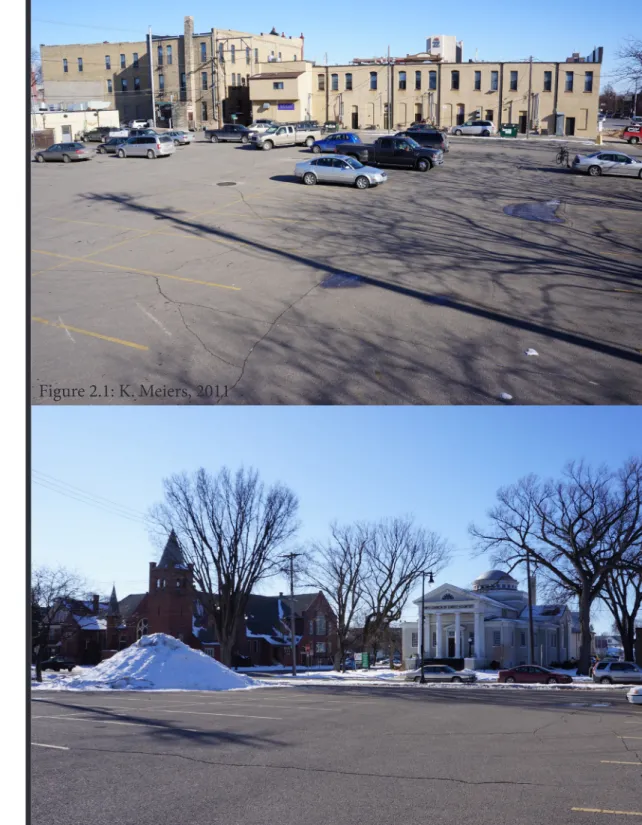
The sites for my project is located on first avenue and surrounding 9th street and is within the Renaissance Zone of downtown Fargo. It is in a transitional edge of downtown and is within a few blocks of Island Park. There is one building on this site and that is the Christian Science Building which was built in 1914 by local architects Hasby and Gillespie (“Property Summary,” 2008). This building will stay on the site throughout my project and will be re-birthed to serve the function as a Downtown Student Union for NDSU.
30
Si
te
P
ho
to
s
Figure 2.1: K. Meiers, 2011 Figure 2.2: K. Meiers, 201130 31
Abandoned buildings need a new purpose. Through Eightfold Architecture and with this new found purpose that the rebirth of a struture can bring, will come more lively parts of cities that may have been less lively and transitional. Eightfold Architecture is a concept that I have come up with that has a few different meanings embodied in it. I will explain what this concept means in the terms of renovation, city development, and design and where these meanings will take my research.
Firstly, architectural rebirth means to take an existing piece of architecture that lacks a given pur-pose because of neglect and give it a new breath of life. This is not just a renovation. This is a re-birthed piece of architecture that will have the utmost sensitivity towards the projects site, context, history, sustainability, and future. Specifically, this concept will be applied to the Christian Science building in Downtown Fargo. This building, with focusing towards Eightfold Architecture, will be rebirthed as a Downtown Student Union for NDSU. This concept does not allow for a building to be renovated and its history to be lost or forgotten, it needs to be reactualized. The buildings exist-ing architecture holds a very important piece of this history, the history is a part of this buildexist-ings essence or soul, and it is my intention to be respectful and preserve this history.
Secondly, architectural rebirth means bringing new life to an area of a city that might only be used for transitions. New life will come to this area because there will be a new population of people using this area of the city because of a new use of a building, the NDSU Downtown Union. The Christian Science building is on the border of the more occupied area of downtown Fargo. By bringing a new group of people; students, faculty, and visitors, to this area this will no longer be a transition of the downtown but another lively area of the downtown.
Thirdly, architectural rebirth means to design with an ethical conept in mind. To create an ethical concept it would be important to gain influence from somthing that speaks of ethics. Eightfold Ar-chitecture is a set of ethics to focus on and utilize while designing to help the designs of architecture to be focused around morals so as to create virtuous buildings.
A Plan For Proceeding
My research direction is as follows.
My research will be conducted in a way so that I will have the necessary knowledge needed to design within the scope of Eightfold Architec-ture. This research will continue to evolve throughout the entire project. Specifically my research will be focused on my theoretical premise/unifying idea, project typology, the ethics of architec-ture, historical context, the history of the site, the history of the existing building, site analysis, and programmatic requirements.The following is my plan of design methodology.
The design method-ology I will employ throughout my research and design identifies most closely to a mixed method quantitative/qualitative approach. This approach will be influenced by the concurrent transforma-tive strategy. I will use multiple means throughout this project to gather these different types of data. I will use graphic analysis, digital analysis, writing, drawing, and a more personal method of gathering this information such as face to face encounters. Observing, interpreting, searching, analyzing, and creating will be my actions in the research.This is my plan for documenting the design process.
These pieces of design will be preserved digitally and physically in this book. It will also be available in the North Dakota State University libraries digital collection in the architectural theses institutional reposi-tory. My schedule, which lists the completion dates of different aspects of my design and deadlines, in on the following page.32 33
Ja
n
Fe
b
Ma
r
Ap
r
M
ay
Project D ocum entationSpring Schedule
Context A nalysis Concep tual A nalysis ECS P assive A nalysis ECS A ctive A nalysis Structura l D evelopm ent Flo or P lan D evelopm ent En velope D evelopm ent Material D evelopm ent Structura l R ede velopm ent Section D evelopm ent Mid term R eviews Project R evisio n Render ing/A rtistic Prep F or P resen tation Pres entation L ayout CD o f B oards D ue Plotting a nd M odel Exhi bit I nstallatio n Thesi s E xhi bit Fin al Th esis R eviews Fin al Th esis D ocum ent D ue Comm encem ent Rede velopm ent 9-11 12-18 19-25 26-31 1-8 9-15 16-22 23-28 1-4 5-9 10-15 16-23 24-31 1-7 8-15 16 17-22 23 24-25 26-30 1-3 4-6 7 8-9 10 1134 35
Program & U
nif
yin
g
Id
ea
Unifying Idea.
Abandoned buildings need a new purpose through Eightfold Architecture,and with this new found purpose, will come more lively parts of cities that may have been lacking functions due to a transitional location.
Introduction.
The following research is the path I chose to create a conceptual design method based off of morality. I have looked towards Buddhism to help inspire me to create a vir-tuous design concept that can be applicable to anyone rather then only people of a certain belief system like Buddhism. I chose to examine Buddhism because I was looking at abandoned build-ings as a lack of life. I searched for a belief system that spoke about life. I wanted to design in a way that used morality as a basis of design. I saw Buddhism as an insightful religion that spoke clearly about life and morality. Buddhism inspired me to create a framework of architectural ethics for me to follow while creating and redesigning the existing abandoned building so I could create an extension of the building that was virtuous.The following research is an investigation at understanding Buddhism. I wanted to understand with more depth the Buddhist’s idea of rebirth and how this is achieved. With having gained the knowledge of what the eightfold path is I wanted to see how and if this could translate into an archi-tectural ethics system that could be used for designing beyond Buddhist Buildings. The translation I have created is called Eightfold Architecture. It’s focus is on ethical principles of design that would create virtuous buildings. The Buddhist Eightfold path serves as a parti for my development of this concept of Eightfold Architecture. Eightfold Architecture essentially being a set of moral design aspi-rations can then be used for designing any type of architecture that’s design pursues virtuousness. Proceeding this specific Buddhism research, the development of Eightfold Architecture, and the conclusions I draw from this there will be more research about the historical relevance, site char-acteristics, and typological needs of this project. Further research and inquiry into developing student unionsm, the sites needs, and the historical aspects of the site will create a project that will work cohesively in its environment and be the base knowledge that will be essential for the onset of designing with Eightfold Architecture.
36 37
Buddhism.
Buddhism is a religion or path where the practice and experience of spiritual development leads to insight into the real nature of reality, rather then a system of beliefs relying on faith which many Westerners are accustomed towards. (“What is Buddhism,” 2013). Much of our society in the United States were raised as Christians so this concept may be confusing or puz-zling to us. We understand Christianity as a belief system with relation to faith. Faith is accepting the beliefs of that system. Buddhism, however, teaches you to practice Buddhist teachings and to discover for yourself, rather then having faith in a belief. (O’Brien, 2013). Inevitably, by discover-ing these teachdiscover-ings from your path, changes will happen within yourself and qualities such as awareness, kindness and wisdom will be gained.Buddha.
Buddhism began about 2,500 years ago based off of the teachings of Siddhartha Gau-tama. Siddhartha Gautama, it is said, was born to a royal family of a small kingdom on the India and Nepal border. It is hard to say an exact date of when Gautama was born but scholars have ac-cepted the range of 486 BCE to 483 BCE. Gautama’s mother dreamt a white elephant entered her womb through her right side while she was pregnant. In their culture this represents future great-ness. After birth, a holy man predicted to Siddhartha Gautama’s father that his son would either be a great king or a holy man. Siddhartha Gautama lived a sheltered life because his father hoped for him to become a great king and did not want him pondering about life. Inevitably, one day Sid-dhartha Gautama left the palace and saw a dead man, a sick man, and an old man. (Trainor, 2001).The Way of the Buddha
Observing is also a prominent factor of Buddhism. Many forms of art and imagery are used in Buddhist writings to communicate the ultimate truth in which Buddha realized. This ultimate truth is called Dhar-ma. Dharma is meant to be something that someone should seek and see for themselves. This ties back to the path of spiritual development. (Trainor, 2001) Figure 3.1
Siddhartha Gautama abruptly took himself out of his privileged upbringing after realizing that life included old age, sickness, and death. This began his pondering over the meaning of life, which led him to leave his palace and become a wondering holy man. After some time of wondering he had not solved the meaning of life and death. This led him to take a different route, which was to look into his heart and mind. He vowed to sit beneath a Pipal tree until enlightenment was gained. After forty days he became enlightened. After this the Pipal Tree is known as the Bodhi tree, which means enlightenment tree. (Trainor, 2001). The first thing Siddhartha Gautama gained knowledge of was his past lives, and then he gained the divine eye, which is the power to see others past lives. Enlightenment, also, brought insight to him from the different aspects of life, such as suffering which was what brought him on the quest in the beginning. Siddhartha Gautama became known as Buddha, ”one who is awake,” after realizing the nature of life, death, and existence. Buddha never claimed to be a god just that he was enlightened. (“Who Was The Buddha,” 2013). For seven weeks after his enlightenment Buddha meditated in different places. Each place Buddha meditated he experienced, felt, and thought different things. (Trainor, 2001). After Buddha’s seven weeks of mediation he traveled and spread understanding as well as his liberating new found knowledge. His spread of knowledge is known as the first turning of the dharma wheel. As mentioned ear-lier, he did not teach what he realized when he was enlightened, he taught people how to realize this for themselves. Enlightenment is reached through one’s own experiences, not through beliefs. (O’Brien, 2013). His teachings are known as the Buddha Dharma or teachings of the enlightened one. The Buddha Dharma is broken down even further into three traditional divisions of Buddha’s
The name of this piece is Darmachakra Mudra. Made out of sandstone this sculpture is a little over five feet tall. It is located in the Archeological Museum in Sar-nath India. The Buddha’s hands in this picture are in the position of Darmachakra Mudra, which is associ-ated with his first teachings. (Tchi, 2013)
38 39
teachings. Firstly, there are the sutra’s. This is Buddha’s words that were recorded by his monks. Secondly, there is the vinaya. This is how monks and nuns should handle themselves. And thirdly, there is the abidharma. This is a more complex classification of Buddhist concepts. His teachings and enlightenment have been gained and passed down through the present day. (Alexander, 2006).
Rebirth.
The cycle of birth, death, and rebirth is known as samsara. The only way out of this cycle is finding a means of liberation from it. Liberation from this is nirvana. (Trainor, 2001). The following sentence describes what Buddhists believe happens at death until rebirth. “We have seen earlier that a being is nothing but a combination of physical and mental forces or energies. What we call death is the total non-functioning of the physical body. Do all these forces and energies stop altogether with the non-functioning of the body? Buddhism says ‘No’. Will, volition, desire, thirst to exist, to continue, to become more and more, is a tremendous force that moves whole lives, whole existences, that even moves the whole world. This is the greatest force, the greatest energy in the world. According to Buddhism, this force does not stop with the non-functioning of the body, which is death; but it continues manifesting itself in another form, producing re-existence which is called rebirth.” (Rahula, 1974).Rebirth is commonly confused with reincarnation. The idea that there is some sort of identity that gets re-birthed into a new body is rejected in Buddhism. Buddhist’s believe humans, like every-thing else in the world, are in a state of changing flux so a static concept of soul is not possible.
This is the Fengxian Temple from the 6th Century A.D. This particular Buddhist cave scene is located in the Xiang-tang Mountains of China. It is a common Buddhist pilgrim-age site.
This concept is known as anatman or non-self. What the Buddha did believe a person was made up of was a physical body, feelings, perceptions, mental dispositions, and consciousness. The concept of non-self serves the purpose of informing us that attachments and desires are constructs that our created individualities have made and this ends up leading to suffering. (Trainor, 2001).
Four Noble Truths.
The four noble truths are how Buddha understood the human con-dition and were the contents of his first teaching. Through Buddha’s realization of these truths he became enlightened. The first noble truth is that all life includes suffering. The point of this truth is not to be pessimistic but to observe realistically. To observe this is escaping from denial of life’s suffering. Once this is realized people can try to lower this suffering in others by showing love and kindness to all. The second noble truth is that all of life’s suffering is caused directly from desire. According to Buddhism if people stop acting out of desire there would be nothing to suffer over. Desire is what creates harmful actions. It is in the most optimistic light that these truths are taught. They are taught so people can understand that humans have the potential to go beyond suffering if they can live without desire. (Trainor, 2001). The third noble truth is where the typical cyclical Buddhists pattern becomes less cyclical. The third noble truth is that there is an end to suffering if someone can detach themselves from all desires. This truth is where many people become con-fused. The other truths were direct statements that are easy to understand. The third truth is be-coming a more spiritual concept. It is something many would need to experience from living thisThis Buddha resting in Nirva-na is known as Manuha Paya. The temple where this Bud-dha can be found is in Pagan, Burma. (Trainor, 2001). Figure 3.4
40 41
way to understand or to believe. (Byrd, 2013). If you can follow the first and second noble truth that you can go beyond the cyclical patterns that desire, karma, and rebirth have on life. Going beyond this is to attain Enlightenment or Nirvana. Going beyond attachment and suffering is guided by the fourth noble truth in which it says this can be attained by following the eight fold path. (Trainor, 2001).
Eight Fold Path.
As explained earlier, the eightfold paths are necessary ways of life that must be followed if nirvana is to be realized. This path works on morality, meditation, and wisdom. Each part of the path is a necessary framework to actualize the next. (Trainor, 2001).The first factor of the eightfold path is right understanding. It is said that with right understanding individuals take on their responsibility from their thoughts and actions. Right understanding is insight into the true nature of reality. (Harvey, 1990).
The second factor of the eightfold path is right thought. Right thought is the controlling of your thoughts from any sort of cruelty to loving kindness. (Harvey, 1990).
The third factor of the eightfold path is right speech. Right speech is the abstinence from gossip, back stabbing words, or any other sort of message spread by the mouth that is not necessary and good. (Harvey, 1990).
The fourth factor of the eightfold path is right action. Right action is viewed as stopping from act-ing wrong with your body. Thact-ings that would be considered wrong action would be like stealact-ing
This is a mandala known as Womb World. (Shumacher, 2013). A mandala is a meditation object to help attain enlightenment. (Trainor, 2001). Womb World is a Japanese mandala that was created sometime between 1392 and 1568. It is apart of Sylvan Barnet and William Burto ‘s private collection.
or physical fighting. (Harvey, 1990).
The fifth factor of the eightfold path is right livelihood. Right livelihood is making a living justly. It is not right to make a living in any way that causes suffering to others. (Harvey, 1990).
The sixth factor of the eightfold path is right effort. Right effort is the development of the mind. Right effort is training the mind to avoid attachment, unskillfulness. It also focuses on develop-ing your meditation practice. The last part of right effort is to maintain these developments of the mind. (Harvey, 1990).
The seventh factor of the eightfold path is right mindfulness. Right mindfulness is a factor while meditating that means to be aware of what is arising and diffusing. (Harvey, 1990).
The eighth factor of the eightfold path is right concentration. Right concentration is the focus of the self on keeping collected. This focus comes from meditation objects and creates a deep calm. (Harvey, 1990).
By following the four noble truths and the eightfold path a progression to enlightenment takes place. The eightfold path causes deep reflection and meditation that begins to form the right mo-rality for a Buddhist. This momo-rality is often looked at as wisdom. To successfully reach nirvana more then knowledge of the path must exist. Following the path becomes a way of life and the true understanding of the path can only lead to Nirvana. (Trainor, 2001).
42 43
Architectural Rebirth.
The previous research about Buddhism helped inspire me to create a virtuous design concept that can be applicable to anyone rather then only people of a certain belief system like Buddhism. I chose to examine Buddhism because I was looking at aban-doned buildings as a lack of life. I searched for a belief system that spoke about life. I wanted to design in a way that used morality as a basis of design. I saw Buddhism as an insightful religion that spoke clearly about life and morality. Buddhism inspired me to create a framework of archi-tectural ethics to follow while creating and redesigning the existing abandoned building so I could create an extension of the building that could be seen as virtuous. The following is a way of looking at architecture that can help to produce more lively buildings and to breathe new life into existing buildings. Eightfold Architecture is my set of design aspirations to follow to help me create a virtu-ous building.The first virtue of Eightfold Architecture is that of Right Consideration. Right Consideration in architecture has to do with the implications and necessary information about the project to start conceiving a design. Considerations for virtuous architecture include the history of a place, ty-pological considerations, site and context concerns, aspirations, the current impact of design, the community, the users, and the future of place.
After developing a better understanding of what may be relevant considerations for virtuous design it is an appropriate time to begin forming design intentions. The second virtue of Eightfold Archi-tecture is that of Right Intention. Right Intention deals with using the knowledge gained from the previous architectural considerations in developing intentions that will produce the most positive results in the built environment. It is important to understand that our considerations have large physical and social impacts. Our intentions must keep these physical and social impacts in mind at all phases of the design.
The third virtue of Eightfold Architecture is that of Right Appearance. Appearances are often what people think architecture is. As knowledge grows about what architecture needs to consider it be-comes clearer that there are a lot of other aspects besides appearances at work regarding architec-ture. However, through appearances we create environments that can cause positive and negative experiences. So appearance do seem to be a very important piece of architecture. The appearance of architecture can have a profound impact on life. People inhabiting a building are exposed to the different psychological factors that color, size, smell, and light can impose on them. Also, having nature present in or around your building can reduce stress in occupants. (Wells, 2008). In order
for a built environment to be successful and convey virtue it must be formulated from ethical con-siderations. It is important that the appearance of our buildings do indeed create beautiful environ-ments that have positive mental and physical results.
Forming an appearance of a space must work hand in hand with how the space operates. The fourth virtue of Eightfold Architecture is that of Right Operation. As an architect develops the appearance of a building it is important to understand how the building is intended to operate. It is necessary for the building to serve its function well. It is also necessary for the building to operate for ev-eryone. This means it is important to understand how people may move through the space. The building must allow for people to move through the space with disabilities and without disabilities. Moving through space leads to how buildings also play a role on our physical health. The location and walkability of the building can lead to health factors that must be thought of. The safety and accessibility of the building can also keep people safe from harm. Along with this, it is important to consider how a building will smell, sound, feel, and look at different times of the day. Perceptions are unique to the individual so it is important to keep in mind how different people might perceive the space or how the perception of the space might change over time. How the building operates can highly effect how people perceive the space. Also, it is important to think about the impact your building has on the site’s plant life or animal life. (Wells, 2008).
The fifth virtue of Eightfold Architecture is that of Right Sustenance. It is not only important for the building to appear and operate in the right way but also to sustain itself in a virtuous manner. It is important for a building to use energy efficiently and not deplete the environment of impor-tant resources. It is imporimpor-tant to understand what are the ways buildings can negatively effect the environment so this is not the case with future designs. Buildings are responsible for 40% of the world’s energy consumption and one third of the world’s carbon dioxide emissions. Excessive car-bon dioxide emissions are heating up our cities and creating smog which then negatively effects life. By heating up our cities more air conditioning is needed and therefore more energy. Architecture has been know to use water inefficiently as well. By understanding that these are problems positive design working against these factors can be accomplished. (“Environment For Beginners,” 2013). Along with this the building must be built to sustain itself. The materials in the building must be durable as to allow for a long life. With a long life it is almost certain that some changes may occur in the building. The building should be built with these changes in mind. The building should not be built so statically that no other function than the one it already serves can be successful.
44 45
The architect should think about the potential transformations the building might undergo in the future so to be prepared for sustaining itself through these transformations as well.
How will you and others interpret the space being created? This is what the next virtue of Eightfold Architecture is based off of. The sixth virtue of Eightfold Architecture is Right Interpretation. It is important to understand how you, others, community members, visitors, residents, and anyone may interpret your created environment. It is important that the design conveys virtuous results to everyone with the considerations of the necessary sustenance, operations, and appearance of the building and does not make a negative statement on the buildings environment. Architecture should promote lively conditions into objects. It should be a goal of architects to create environ-ments where people can interpret these lively conditions from the objects we create.
The seventh virtue of eightfold architecture is Right Application. Once all of the necessary compo-nents of design are on track with the path of Eightfold Architecture the final application needs to be laid out. It is here with this final design that it is important to see if the application of all the previ-ous rights created a virtuprevi-ous building that will promote good for its users and for its environment. It is important to make sure that this building does not damage but enriches nature.
The last right of Eightfold Architecture is Right Production. This is the phase of design that speaks to actualizing the building in a virtuous, respectful, and mindful manner. The production must utilize sustainable practices and minimize waste as best as possible. It is important for the building to be built with care so there is not flaws that can produce undesirable results later so the building can live in harmony with its users and environment.
Summary
The information that was located previous to Eightfold Architecture’s theoretical premise and unify-ing idea research was all very important information that was necessary to form an idea for what path would be necessary to follow during this research. The information leading to the theoreti-cal premise and unifying idea research did its job in leading me towards ideas that would give me something I was interested in and ideas that were fruitful to other parts of the project. I have understood this research to be a very important middle step in this book. First came the basic re-search, thoughts, and ideas that were necessary to understand the scope or the vision of the project. This research was the next step in the necessary process. This step is learning the very important ideas that will influence your desin intentions. This step is becoming experts in the topics we have chosen to guide our thesis. What follows this research is important particulars that also helps in the process of becoming an expert in the thesis topic.
In summary to the theoretical premise and unifying idea research, this thesis has made the claim that by re-birthing structures that have been vacant we can bring new life, with the means of Eight-fold Architecture, to not only the building, but also transitional areas of our cities. In order to devel-op the concept I have created of Eightfold Architecture it was necessary for me to find a concept that spoke about the cycle of life. My thesis finds importance in the development of lively architecture so I looked towards Buddhism to see how this religion regarded life. Researching this religion led me to understand that rebirth into life is a cycle called samsara and that in order to be free from this cycle, Nirvana, you must follow the eightfold path that is based off of morality, meditation, and wisdom. The eightfold path is essentially a path of ethics to follow to obtain enlightenment. This made me wonder what a design concept based on design morals would be able to create. Would following an architectural eightfold path be able to create a enlightened or virtuous building that would be the guiding inspiration for me to follow to create a successful rebirth of the Christian Science Buildings? Could the application of Eightfold Architecture on this built environment help to create a lively and functional new environment in a transitional neighborhood of Fargo? With these questions, I decided to think about the most important design morals that could be applicable to all built environments and create the concept of Eightfold Architecture with them. Would this set of architectural ethic’s be able to create a virtuous building?
46 47
The goal of creating Eightfold Architecture is to create a virtuous building rebirth of the unused Christian Science Building and an addition to this building that will work with my unifying idea that abandoned buildings need a new purpose through eightfold architecture, and with this new found purpose, will come more lively parts of cities that may have been lacking functions due to a transitional location.
As I mentioned earlier, there is another section of this thesis that has more research about the his-torical relevance, typological needs, and site analysis necessary to this project. Further research and inquiry into developing student unions and the historical aspects of the site will create a project that will work cohesively in its environment and be the base knowledge that will be essential for the onset of designing for a specific building typology with Eightfold Architecture.
La
nga
ra S
tuden
t U
nio
n
I chose to examine the Langara Student Union in Vancouver, Can-ada because an extension of the Langara Student Union is situated between two existing classroom buildings on the Langara college campus. The Langara Student Union, with its 17,900 square feet, works as a hub among the campus buildings. (“Langara Student Union / Teeple Architects in association with IBI/HB Architects,” 2011). For Vancouver Canada this student union is distinguish-able because the architects that designed the building at Steeple Architects decided the best material for this building would have a black color. This is unusual to Vancouver since many of their buildings are made of glass so most of their buildings pick up light blue and grey tones. (Soules, 2010).
The Langara Student Union is similar to the other case studies I chose because like all of the other cases a large part of the project was how this building would interact with the existing buildings on the site. This student union needed to work as a hub for the campus so cohesion was necessary for this student union to be successful on this campus. However, this building differs in that this essence of a hub meant creating a flow of moving through the space. It was important for the students to flow through the differ-ent buildings on the campus and flow from inside to outside with ease by the use of this building. (“Langara Student Union / Teeple Figure 4.01
50 51
Architects in association with IBI/HB Architects,” 2011).
As mentioned earlier, the Langara Student Union works as a hub among the different campus buildings of Langara College. The Langara Student Union brings flow and unity to the campus from its unique design that was inspired by some challenging elements that are located on its site. This flow and unity was not the easiest creation because of the challenges the many different ground ele-vations created. The use of ramps and stairs in an elegant and sleek fashion is how the Langara Student Union’s design overcame the large shifts in elevation. These ramps and stairs serve their pur-pose straight forwardly when it comes to function but their less straight forward function is the unique outlooks onto the campus that they create. (Soules, 2010).
The physical design of the Langara Student Union was largely based off of the site but the other design considerations that went into this student union that make this building quite unique is it’s sustainability features. This student union hoped to have large en-ergy savings and as minimal as possible greenhouse gas emissions. This building found it logical to use a new heating and cooling system called Thermenex. Thermenex stresses to build an efficient envelope that uses glass sparingly and design for optimal usage of lights, fans, and motors while designing aspects to resuse wasted energy. This is exactly what this student union did. Then with the building designed for these features in mind and with the Ther-menex your buildings heating and cooling needs are taken care of. The Thermenex works by moving thermal energy from wasted ar-eas to arar-eas where it is needed. Thermenex uses water to move
this heat focusing on the waters temperature as to not be wasteful. Thermenex technology is a pipe that reduces the work needed to move the heat. With the need for fewer components and heating and cooling in one, this system reduces life cycle costs. (Thermen-ex, 2012). Heat is taken
from areas that generate heat, like computer rooms and moved to areas of the buildings that may need this heat. This shift of heating and cooling is used throughout the building. This system heats the stu-dent union building, one of the existing buildings it connects with, and a few other buildings next to the student union. This build-ing is LEED Gold status and getting all 10 points for energy. Three fourths
of the annual heating energy demands of these buildings come from thermal exchange within these buildings.
With my idea of eightfold architecture, sustainable practices work-ing with and shapwork-ing design will become important durwork-ing my de-sign process. The fifth virtue of Eightfold Architecture, right sus-tenance, is about this. It is not only important for the building to appear and operate in the right way but also to sustain itself in a virtuous manner. It is important for a building to use energy ef-ficiently and not deplete the environment of important resources. The concept of Eightfold Architecture contains virtuous parameters that are important to architecture that I plan to uphold my designs to. In this case study I learned about a heating and cooling system, Thermenex, that could work relatively well in Fargo, North Da-kota since it is operating efficiently in Vancouver, Canada. With the accumulation of the knowledge I gained from researching this student union my unifying idea has stayed the same but this case has expanded upon ideas I have for Eightfold Architecture.
52 53
La
nga
ra S
tuden
t U
nio
n
Va
nco
uv
er
, C
an
ad
a
0 50mCirculation Growth Green
Space Student Quad
0 25m 0 25m Floor Plan 1 Floor Plan 2 Section A Figure 4.04 Figure 4.05 Figure 4.06
0 25m 0 25m 0 25m Section A Figure 4.09 West Elevation Figure 4.08 North Elevation Figure 4.07
54 55 Plan to Section Circulation Massing Natural Light Structure Hierarchy of Space Geometry
La
nga
ra S
tuden
t U
nio
n
Spa
tial
D
ia
gr
am
s
Figur e 4.156 57
Fl
an
der
s B
usin
es
s S
ch
oo
l
I chose to examine the Flanders Business School in Antwerp, Bel-gium because this building was a renovation of a 19th century building that was in need of lots of design work. The Flanders Business School, with its 1,608.07 square meters or 5275.82 square feet, was a unique development because it was important that the design of this building respect the history of the building and sur-rounding area yet be able to function efficiently for modern re-quirements of academia. Buro II & ARCHI + 1 with help from Jan de Vloed made sure to keep the important elements of the exist-ing buildexist-ing apparent from the beginnexist-ing of the design process. (“Flanders Business School Renovation / BURO II & ARCHI+I,” 2011).The Flanders Business School is similar to the other case studies I chose because they all have to do with, in varying degrees, renovat-ing old space for a new purpose. However, unlike the other case studies this renovation was also changing typologies. The other renovations were staying within the same typology. This change of typology for this building is not surprising since this is the oldest buildings of all the case studies I chose being built in the 19th
century. (“Flanders Business School Renovation / BURO II & ARCHI+I,” 2011).
The Flanders Business School’s design was largely invented by the social needs of a business school. Modern education has spatial requirements that this business school needed to address by the means of an existing building that had spatial restrictions. It was clear that new infrastructure was needed for the Flanders Business School but it was a desire of the schools to preserve much of the original architecture of a large room on the ground floor and the
facades of the building. With the necessary renovations to the in-frastructure the design met the modern requirements the Flanders Business School was looking for. The spaces that met these re-quirement are an auditorium, cafeteria, conference rooms, coffee shop, and office spaces. (“Flanders Business School Renovation / BURO II & ARCHI+I,” 2011).
Flanders Business School wanted to be recognize as being creative and dynamic as entrepreneurs. It was important to the school that the design emphasized this creativity and dynamism in an
58 59
gaging way. The architects designed in a way where the circulation among the spaces and their relationships represented to one an-other this engagement of it’s priorities. An example of this is how one of the conference rooms is semi suspended out of the existing historic building. This is a representation of how the architects
fo-und a creative design solution to mixing modern design with the old but still keep-ing the character of the historic building. Another example of mixing modern de-sign with historic ar-chitecture is on the ground level where many aspects of the building were desir-able to keep. Here, instead of taking away from the historic large room, a circular room was added. The original room containing this circular room con-trasts it’s modern organic shape with its 19th century architecture. (“Flanders Business School Renovation / BURO II & ARCHI+I,” 2011).
Like the last case study, this case study worked well with my thesis and did not alter my unifying idea. I enjoyed seeing ways that ar-chitects showed respect to existing architecture by restoring it but at the same time got to use their modern designs. What I found most appealing about this case study was how interesting the mod-ern shapes they designed looked in the midst of a historical build-ing. I would really like to create such an intriguing environment with my design that allows the historical building to look elegant but at the same time showcase how interesting modern design can look juxtaposed next to older buildings. The original building made modern design a challenge because of its spatial limitations and this could be a problem that I run into with my project.
60
Fl
an
der
s B
usin
es
s S
ch
oo
l
A
nt
w
er
p, B
elg
ium
0 10m 0 10m Floor Plan 1 Figure 5.04 Floor Plan 2 Figure 5.05 Green Space Parking Section B Section A Figure 5.0660 61 0 10m 10m 0 10m 0 Figure 5.07 South Elevation Figure 5.08 Section A Figure 5.09 Section B
62
A
nt
w
er
p, B
elg
ium
Spa
tial
D
ia
gr
am
s
Fl
an
der
s B
usin
es
s S
ch
oo
l
Geometry Hierarchy of Space Structure Natural Light Circulation Massing Plan to Section Figur e 5.1A
nt
w
er
p, B
elg
ium
N
ulm
an L
ew
is S
tuden
t C
en
ter
I chose to examine the Nulman Lewis Student Center in Provi-dence, Rhode Island, USA because the building’s site constraints interested me and because the spatial restraints were relevant to my project. (“The Wheeler School Nulman Lewis Student Center / Ann Beha Architects,” 2011). The Nulman Lewis Student Cen-ter is a student cenCen-ter for ages of students just beginning school through highschool. The Nulman Lewis Student Center, with its 5,000 square feet of space to develop on, was a space constraint that Ann Beha Architects decided to make less constraining by using a transparent material to link the existing school buildings that were be renovated with this project as well. The renovation area of the existing space was 5,000 square feet. (Lentz, 2013).
This project is similar to the other projects because it was designed in a way that was committed to sustainability. However, this build-ing is the only one of the case studies that has a green roof that benefits the building by keeping it cooler and absorbs rainwater to help the storm water system. (“The Wheeler School Nulman Lewis Figure 6.01
64 65
Center / Ann Beha Architects,” 2011).
The Wheeler school needed a student center for its rising number of students. Several designs from various architects were consid-ered but Ann Beha Architect’s design was selected because of it’s strategic look at space that would be prime to develop on. The ar-chitects suggested using a narrow plot of urban space between the schools existing alumni house and the middle school. Previously this space was wasted, consisting of a concrete slap with dumpsters on it. This student center, on the narrow site, became a functional bridge between the two existing buildings. (Lentz, 2013).
It was important that the design of the student center stood out among the historic buildings and did not try to copy their style. The linking building was to stand out but not overwhelm the other buildings. In order for the new student center to not overwhelm the existing buildings but still stand out, certain design features were to be learned from the existing buildings. The student center stood out by being the only transparent building between the ex-isting structures but it’s aluminum mullions learned their propor-tions from these existing structures so there was cohesion among the three. Some sort of cohesive element on the exterior of the
building hinting to how these three buildings worked together was necessary. Inside these three building, with the help of renova-tions, it is hard to tell the buildings apart because they function as one building. (Lentz, 2013).
Just as much thoughtful design went into creating this building’s interiors. The concrete structure is left exposed to show how the building is structured and to give some insight to students on how buildings are constructed. A steel stair divides certain spaces and connects each floor with the next. (“The Wheeler School Nulman Lewis Student Center / Ann Beha Architects,” 2011).
The orienta-tion of the new student center creates inter-est from the side walk for the Wheeler School. All of the original buildings of the Wheeler School face inwards while the back sides
of the buildings face the street. Originally the existing school buildings lacked a building that’s orientation welcomed someone into the school. The new student center with it’s contemporary clear bridge like space and orientation towards the street welcomes students and visitors from the street into the more private school area. (“The Wheeler School Nulman Lewis Student Center / Ann Beha Architects,” 2011).
This student center did not make me change my unifying idea but did warn me about the importance of orientation in designing with existing architectural influences. This correlates to my sixth virtue of Eightfold Architecture; right interpretation. I plan to focus on how people will interpret the design. Things like how welcoming a space is because of it’s orientation are important to think about if a design is to be successful.
66 67
Floor Plan 1 Figure 6.06
A
nt
w
er
p, B
elg
ium
Pr
ov
iden
ce
, R
ho
de I
sla
nd
N
ulm
an L
ew
is S
tuden
t C
en
ter
Floor Plan 1 10’ 0Floor Plan 1 Figure 6.05
10’ 0 10’ 020’ Site Plan Figure 6.07 0 Figure 6.04
Section A 10’ 0 Section B 10’ 0 South Elevation 10’ 0 Figure 6.08 Figure 6.09 Figure 6.10
68 69
Spa
tial
D
ia
gr
am
s
N
ulm
an L
ew
is S
tuden
t C
en
ter
Geometry Natural Light Structure Massing Circulation Plan to Section Hierarchy of Space Figur e 6.11Typ
olog
ic
al S
umm
ar
y
I chose the individual projects within this series of case studies because they all had a unique way of designing ei-ther within the constraints of an existing building, beside the constraints of an existing building, or between the con-straints of existing buildings. Each of the projects I chose to use for my case study series also had a slightly differ-ent typology but they all had to do with being educational buildings. Having these slightly different typologies be a part of one series let me examine how the architects de-signed for these types and made me see how a collage stu-dent union may differ from a stustu-dent center for younger students or how it may be different from a business school with more needs for conference and auditorium space. These are some of the factors that made me chose these projects to look at for my case studies.
Each one of these projects I chose for my case studies were created in a circumstance where they were to interact with an existing building. The Langara Student Union was the most different from the other two cases in that it interacted with not very old existing buildings. The other two cases interacted with historical buildings. The site I have chosen for my thesis has a historical building on it. In the regard to new buildings interacting with historical architecture the Langara Student Union is not quite as applicable to my project as the other cases. I will need to focus on how a new building can stand out in this context yet not stand out so that it looks awkward next to an elegant historical building. The Langara Student Union did not offer my project much advice in this area. Yet, in other areas the Langara Student Union was very applicable to my project. A way that the Langara Student Union case study applied to my project was with having similarities with the means that I plan to create my project. The Langara Student Union is an incredibly sustainable building that is inspiring to my fifth virtue of Eightfold Architecture; right sustenance. This case gave me some wonderful ideas on how sustainability