Sonderforschungsbereich/Transregio 15 · www.gesy.uni-mannheim.de
Universität Mannheim · Freie Universität Berlin · Humboldt-Universität zu Berlin · Ludwig-Maximilians-Universität München Rheinische Friedrich-Wilhelms-Universität Bonn · Zentrum für Europäische Wirtschaftsforschung Mannheim
Speaker: Prof. Konrad Stahl, Ph.D. · Department of Economics · University of Mannheim · D-68131 Mannheim, Phone: +49(0621)1812786 · Fax: +49(0621)1812785
March 2006
*Tobias J. Klein, University of Mannheim, Department of Economics, 68131 Mannheim, Germany. [email protected]
**Christian Lambertz, University of Mannheim, Department of Economics, 68131 Mannheim, Germany. [email protected]
***Giancarlo Spagnolo, Consip, Stockholm School of Economics, and C.E.P.R. [email protected] ****Konrad O. Stahl, University of Mannheim, Department of Economics, 68131 Mannheim, Germany; C.E.P.R.,
CESifo, and ZEW. [email protected]
Financial support from the Deutsche Forschungsgemeinschaft through SFB/TR 15 is gratefully acknowledged. Discussion Paper No. 62
Last Minute Feedback
Tobias J. Klein*Christian Lambertz** Giancarlo Spagnolo***
Tobias J. Klein
Christian Lambertz
Giancarlo Spagnolo
Konrad O. Stahl
†first version: July 9, 2005
this version: March 3, 2006
Abstract
Feedback mechanisms that allow partners to rate each other after a transaction are considered crucial for the success of anonymous internet trading platforms. We document an asymmetry in the feedback behavior on eBay, propose an explanation based on the micro structure of the feedback mechanism and the time when feed-backs are given, and support this explanation by findings from a large data set. Our analysis implies that the informational content of feedback records is likely to be low. The reason for this is that agents appear to leave feedbacks strategically. Neg-ative feedbacks are given late, in the “last minute,” or not given at all, most likely because of the fear of retaliative negative feedback. Conversely, positive feedbacks are given early in order to encourage reciprocation. Towards refining our insights into the observed pattern, we look separately at buyers and sellers, and relate the magnitude of the effects to the trading partners’ experience.
JEL Classification: D44, L15, L86.
Keywords: eBay, reputation mechanism, strategic feedback behavior, informa-tional content, reciprocity, fear of retaliation.
∗We are grateful to Florian Hauber and Johannes Koenen for excellent research assistance. We truly
appreciate having had the opportunity to extensively work on this paper during the 2005 C.E.P.R. European Summer Symposium in Economic Theory in Gerzensee, Switzerland.
†T. Klein ([email protected]) and C. Lambertz ([email protected]):
Uni-versity of Mannheim; K. Stahl ([email protected]): UniUni-versity of Mannheim, C.E.P.R.,CESifo, and ZEW; G. Spagnolo ([email protected]): Consip, Stockholm School of Economics, and C.E.P.R.Address: University of Mannheim, Department of Economics, 68131 Mannheim, Germany.
The secret. . . is to wait until the 90 day feedback period is nearly up and then zap em w[ith a] negative feedback when they only have a few hours remaining to respond. . . That way they can’t retaliate. . . This only wor[ks] if you are able to hold a grudge for 90 days. . . —An eBay user.1
1. Introduction
Feedback mechanisms in electronic markets allow partners to rate each other after a transaction. These schemes, also referred to as “reputation mechanisms,” are claimed to be crucial for the success of anonymous trading platforms such as eBay.2 On these
platforms the room for opportunistic behavior on both sides of the market is particularly wide: anonymity and distance allow sellers to cheat on the quality of the good. Likewise, buyers can potentially be dishonest concerning their payment behavior.3
In spite of the incentive to free ride—providing feedback appears a purely altruistic act
prima facie—feedback is given in the better part of the transactions on eBay.4 Therefore,
it could be argued that this device plays an important role in diminishing informational asymmetries by enhancing the discipline of transacting parties. However, there is a lively discussion about the economic effects of reputation mechanisms in electronic markets.5
Rather than focusing on the effects of reputation, for example on prices or the prob-ability of selling, we focus on the timing of feedbacks. In particular, we document an asymmetry in the feedback behavior that was previously un-noted in the literature, pro-pose an explanation based on the micro structure of the eBay feedback mechanism, and support this explanation by findings from a large data set. Our analysis implies that the informational content of feedback records is possibly rather low. This is often neglected by eBay users.6
1This quote is taken from a newsgroup discussion on
2For example, in the founder’s letter posted on February 26, 1996, Pierre Omidyar claims that “some people are dishonest. Or deceptive. . . But here, those people can’t hide. We’ll drive them away.” See
3According to the Internet Crime Complaint Center (IC3) 2004 Internet Fraud Crime Report “internet auction fraud was by far the most reported offense, comprising 71.2% of 207,449 referred complaints.” See auction fraud is on the rise, with an increasing number of consumers complaining about sellers who deliver their advertised goods late or not at all, or deliver something far less valuable than promised.” See the FTC’s “Top Ten Dot Cons” on 2006).
4Resnick and Zeckhauser (2001) were among the first to investigate feedback behavior on eBay. They find that in about 52 per cent of the transactions feedback is left.
5See Dellarocas (2005) for a useful survey of recent research on reputation mechanisms. The effects of seller reputation on prices and the probability of selling the object are usually found to be negligible or positive. See, for example, Melnik and Alm (2002), Bajari and Horta¸csu (2003), Cabral and Horta¸csu (2005), Livingston and Evans (2004), Lucking-Reiley, Bryan, Prasad, and Reeves (2005), Houser and Wooders (forthcoming). See also Bajari and Horta¸csu (2004) as well as Resnick, Zeckhauser, Swanson, and Lockwood (2004) for an overview.
infor-On eBay, both the seller and the buyer of an object are allowed to rate each other after a transaction. Mostly, feedbacks are positive. Moreover, it is well known that the correlation between first and second feedbacks is very high. We argue that this is at least partly driven by expectations onfeedback reciprocity, i.e. giving a positive feedback while expecting the trading partner to reciprocate.7 In contrast, and surprisingly, incidences
of feedback retaliation, i.e. reacting to a negative feedback with a negative, are relatively rare in the data. In most cases, the second feedback is missing. In particular, in our data, we find that about 71 per cent of the positive feedbacks are reciprocated, whereas only about 37 per cent of the negative feedbacks are retaliated.
Feedback behavior can be influenced by several forces including the outcome of the transaction and strategic considerations. Public statements by eBay emphasize the ability of the feedback mechanism to discipline transacting parties by informing potential future trading partners about their current conduct.8 Truthful reporting, however, may be in
conflict with strategic feedback behavior which is present whenever agents anticipate the opponents’ reactions when giving feedback. The following newsgroup discussion contains interesting insights of some eBay users. Its title is “Fix some eBay problems” and the contributions show that users are well aware of feedback retaliation.9 One buyer reports
Just last week, I had my first unpleasant experience in five years of eBay’ing. I received an item from a seller who had not left feedback for me (I mailed my money order the day after the auction ended). I was not happy with the item - flaws were not disclosed in the listing - and I notified the seller. After three e-mails and three phone calls went unanswered, I left negative feedback for her. She turned around and posted retaliatory negative feedback for me ruining my 100% rating. Indeed, the system needs to be improved.
Another user writes
In the past I’ve not left any neg[ative] feedback as I’m afraid of revenge feed-back that’ll paint me as a bad trading partner. . . the dodgy seller ends up with getting away with it just to rip someone else off.
Yet another user notes
As a buyer I have had problems with false item descriptions, even if you get a refund . . . you end up paying postage for the item to you and back. Up till now I have not left any feedback for these bastards because of revenge.
mational content of feedback score and “drastically underestimate the risk of trading online.” Likewise, Resnick, Zeckhauser, Swanson, and Lockwood (2004) question whether price premia, which they find, reflect a reputation equilibrium, and should in fact not be observed in the data.
7Dellarocas, Fan, and Wood (2004) relate the motivation for leaving positive feedback to the user’s expectation of reciprocal behavior from their trading partners.
8eBay states that the feedback “comments and ratings are valuable indicators of your reputation as a buyer or seller on eBay,” see 2006).
and one concludes that
I have been basing my purchase decisions [on eBay] on sellers’ feedback scores. I had no idea these scores are so unreliable . . . They are holding this feedback system out as the reason we should trust sellers, but the system has little to no basis in truth . . . I suspect there are many, many people out there who have had actual monetary losses from this behavior.
This shows that at least some users are aware of possible feedback retaliation, or “revenge.” Therefore, a reputation of being an imitator, who always reacts strategically to a positive feedback with a positive reply, and to a negative feedback with a negative reply, could be valuable because it encourages future partners to give positive feedbacks, and discourages them from giving negative ones. eBay even sells a service to sellers allowing them to automatically reciprocate positive feedbacks.10 Such behavior is in
principle observable to other users on eBay.11
Our explanation for the asymmetry between the likelihood of a positive feedback being reciprocated and a negative one being retaliated is based on the institutional rules for giving feedback, combined with agents’ expectations about retaliation and the assumption of attention decreasing in time. We argue that if an agent strategically anticipates the likely reaction of her counterpart and considers giving a first positive feedback, she should give it as early as possible in order to maximize the probability of a favorable reciprocation. Conversely, if an agent considers giving negative feedback first and is concerned with possible retaliation, she should give the feedback as late as possible, i.e. she should opt for alast minute feedback to minimize the time that is left for the counterpart to retaliate. This explanation implies that agents dissatisfied with their trading partners anticipate the risk of revenge, and may therefore be induced to refrain from leaving negative feed-backs all together, reducing and biasing the informational content of the reputation index towards positive outcomes. If agents who give the first feedback expect the opponent to reciprocate positive feedbacks, or retaliate negative feedbacks, then one would expect negative first feedbacks to be rare and positive ones to be common, a pattern that is usually found.12
In order to support this explanation, we collected a large data set on eBay auctions and the ensuing feedbacks. We find that feedback is given substantially earlier if positive rather than neutral or negative. Moreover, our nonparametric analysis reveals that the probability of the trading partner reacting to the feedback is decreasing in the time the first feedback was given. It is interesting to see that this is the case no matter whether the feedback was positive or negative. As predicted, the probability that a feedback is negative increases substantially towards the last minute of the feedback period.
Towards refining our insights into the observed pattern, we look separately at buyers and sellers, and the trading partners’ experience as well as at interaction effects between
10The price for an online seller tool which includes this service is currently $15.99 a month, see
11In particular, the feedbacks a user gets and the replies she leaves can be inferred from her feedback record.
12See, for example, Resnick, Kuwabara, Zeckhauser, and Friedman (2000), Resnick and Zeckhauser (2001), Bajari and Horta¸csu (2004), Cabral and Horta¸csu (2005), and Chwelos and Dhar (2005).
role and experience. In particular, we find that experience promotes strategic behavior. In the conclusion we also propose simple changes in the eBay feedback mechanism that could greatly reduce this form of strategic behavior and improve its informational content. In this paper, we argue that giving negative feedback in the “last minute” and positive feedbacks early is motivated by strategic considerations. “Last minute bidding” in English auctions with fixed ending time (Roth and Ockenfels 2002) is a similar phenomenon. In both cases last minute action is exploited in order to prevent the opponents’ reaction to the revelation of private information. However, if one were to consider mechanisms without fixed ending times, agents in an auction would still prefer placing a bid to abstaining.13
On the contrary, giving a negative feedback becomes less attractive because of the fear of retaliation. Therefore, from a welfare point of view, the presence of a last minute is desirable in the context of feedbacks, whereas in the context of bids, it is not necessarily so.
2. The eBay Feedback Mechanism
eBay is by far the biggest internet trading platform that brings together both private and professional buyers and sellers. In 2005, the number of listings exceeded 1.9 billion and eBay’s gross merchandise volume accounted to more than 44 billion U.S. dollars.14
Amongst other services, eBay provides a second price auction mechanism in which the seller describes the object and specifies a reservation price as well as the length of the auction period. Then, potential buyers can enter their bids.
As a matter of principle, eBay is only involved in the post auction transaction process if problems arise. In general, information on the conduct of the two parties is neither observable to us nor to future trading partners. Instead, eBay encourages its users to leave a feedback for each other within 90 days after the termination of the auction.15 If
a feedback is given, it consists of a positive, a negative, or a neutral mark, and is accom-panied by unformatted comments. For every user, eBay keeps a feedback record which contains all feedbacks received and left from transactions in which she was involved.16 A
recorded feedback cannot be removed unless both parties agree to. All marks are sum-marized in a feedback score and several summary statistics including the percentage of positive feedbacks.17 While the feedback score can easily be observed by any partner in
the bidding process the observation of the detailed remarks is more involved.
In order to investigate the possibility of strategic feedback behavior, let us now discuss the decision to give feedback. At first, we make the simplifying assumptions that the
13For example, Amazon type auctions end only when no more bids are placed.
14See
15More precisely, eBay encourages, and guarantees recording feedback only within this period. An informal survey and the empirical evidence suggest that feedback thereafter is extremely rare. We will further comment on this in Section 5 below.
16eBay also offers internet shop services. Thus, feedbacks may also be based on experiences in trading via this channel, rather than auction trading.
17The feedback score is calculated as the number of users who left at least one positive feedback minus the number of users who left at least one negative feedback.
timing of this decision is restricted to the 90 day period after the end of the auction and that there is no possibility to withdraw feedbacks. In Section 5 below, we will comment in detail on these assumptions and provide a schematic sensitivity analysis. A decision tree for the “feedback game” that starts after the end of an auction is provided in Appendix A.
For the ease of the exposition, we follow a convention in the literature and occasionally group neutral and negative marks together, see e.g. Resnick and Zeckhauser (2001) and Cabral and Horta¸csu (2005). We will refer to them as negatives.18 Moreover, in the sequel
we refer to the first and second feedback as feedback and reply, respectively.
We now juxtapose two modes of feedback behavior: truth telling, or non strategic feedback, on the one hand and strategic, or opportunistic feedback, on the other hand. The former truthfully reveals information on the outcome of the transaction and thus leads to establishing credible feedback records, whereas the latter yields potentially biased reports influenced by the anticipation of the possible reaction of the trading partner.
Consider two parties of an eBay transaction, a buyer and a seller. Suppose that both are planning to interact with other partners in the future, and therefore attach positive value to their reputation. That is, both agents derive positive utility (expected pay off) from a positive, zero utility from no, and negative utility from a negative feedback received. This will be the case as long as there is some potential future trading partner believing that the feedback score is informative about the likely behavior of its holder.19
If the parties truthfully report their evaluation of the transaction without taking into account the reaction to their feedback in form of a reply, they should be indifferent about the timing of the feedback. However, the fact that delayed delivery or payment is seen as bad performance should imply that some negatives are given relatively late. In the empirical analysis, we disentangle this delay from a strategic delay.
On eBay, feedbacks are immediately observable to the counterpart. If the parties are influenced by strategic considerations, the timing at which feedbacks are left may thus become relevant.20
Suppose the two agents believe that their partners may have a tendency to reciprocate positive and retaliate negative feedbacks. This tendency to reciprocate may be due to behavioral components in agents’ decision making processes, similar to the ones found by Fehr and Schmid (1999), due to the attempt to build up a reputation as a “reciprocator” or “impersonator” in order to discourage future negative feedbacks and encourage positive ones—“the high courtesy equilibrium” of Resnick and Zeckhauser (2001)—, or due to a
18However, we should emphasize that separating neutral from negative marks would not qualitatively change our results.
19As was already pointed out in footnote 5 price effects of reputation are usually found to be nonneg-ative. Therefore, a “good” reputation is valuable to sellers. In principle, potential buyers in an auction could distinguish feedbacks the seller has received as a seller from feedbacks she has received as a buyer. However, it is a complex task to infer separate summary statistics from the records. See also Cabral and Horta¸csu (2005) who find that at least some sellers were able to build up their reputation as buyers. Even pure buyers can benefit from a “good” reputation record since sellers are allowed to exclude buyers from their auctions. This is possible on the basis of their subjective judgement of a bidder’s reputation record.
positive 0.982
feedback neutral 0.008 negative 0.01
2,471,459 observations.
Table 1: Sample probabilities for the feedback.
combination of both motives. The quotes in the Introduction indicate that such beliefs are realistic.
Suppose, in addition, that agents believe that the likelihood to receive a reply to their feedback is decreasing with the time at which the feedback is left after the end of the auction. This is a reasonable expectation given that attention is costly and is likely to be fading in time. For obvious reasons this probability tends to zero when the first feedback is given very close to the expiration of the 90 day period after which feedbacks cannot be left any more—in the last minute.
Then, agents willing to post a negative feedback for a non performing partner will find it convenient to wait and do it in the last minute in order to minimize the likelihood that her counterpart notes the negative feedback and has the time to retaliate. Conversely, agents willing to post a first positive feedback will find it convenient to do it early in order to maximize the likelihood that her counterpart notes and reciprocates it.
Therefore, ceteris paribus, we expect for feedbacks that are left strategically that the first feedback will be given early when it is positive, in order to encourage positive reciprocation. Conversely, we expect it to be given late, or not at all, when it is negative— in order to reduce the likelihood of receiving a retaliatory negative feedback. Because of this, we also expect positive feedbacks to be reciprocated more often than negative feedbacks are retaliated.
3. Feedback Patterns
The data for the empirical analysis were collected in the second quarter of 2005 from the eBay platform. Starting from randomly drawn auctions we created a data set consisting of 2,471,459 auction records including respective feedbacks and their timing. By construc-tion, the data include auctions for which at least one feedback was left. It is a random sample with respect to the category of the auctioned good which we think is appropriate for the purpose of this empirical analysis since we want to study feedback behavior in general. The data collection procedure is described in more detail in Appendix B.
Table 1 contains sample probabilities for the feedback being positive, neutral, or neg-ative.21 Observe that 98 per cent of the feedbacks are positive. These numbers are
conditional on at least one feedback being left, as indicated before. Resnick and
reply
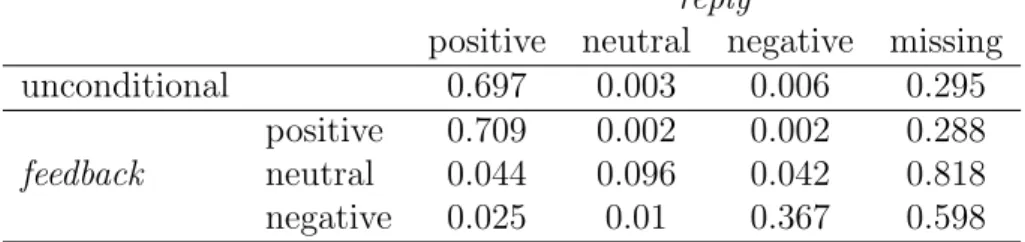
positive neutral negative missing unconditional 0.697 0.003 0.006 0.295
positive 0.709 0.002 0.002 0.288
feedback neutral 0.044 0.096 0.042 0.818
negative 0.025 0.01 0.367 0.598
2,471,459 observations.
Table 2: Unconditional and conditional sample probabilities for the reply.
hauser (2001) report a similar table and find that at least one feedback is left in 52 per cent of the transactions. If reporting was truthful and non strategic, the other 48 per cent of the feedbacks could reasonably be assumed to be missing at random. Otherwise, it could well be that neutrals or negatives are hiding behind these missing feedbacks.
Table 2 contains unconditional and conditional sample probabilities for the reply being positive, neutral, negative, or missing. In 70 per cent of the cases a reply is left. In about 71 per cent of the cases we observe that a positive feedback is reciprocated whereas only in about 37 per cent of the cases a negative feedback is retaliated.
We have argued in Section 2 that the relationship between the timing and type of the feedback is key in trying to understand these empirical phenomena.
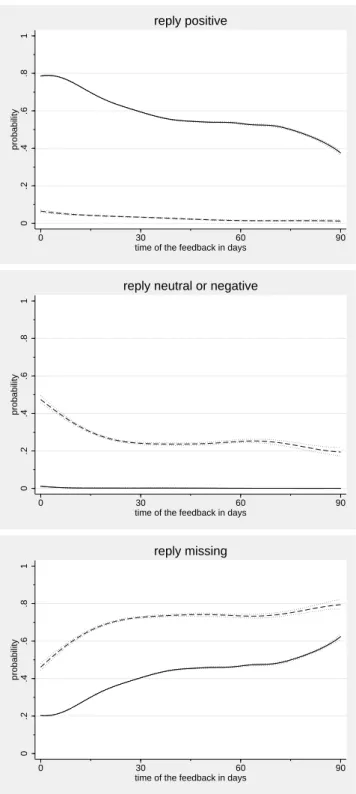
In Figure 1, we have plotted the dependence between the reply and both the time of the feedback and its type. This was done by nonparametric local linear regressions of indicator variables for the type of the reply on the time of the feedback.22 All graphs show
that the later the feedback is given the less likely it is that a reply is given at all. More precisely, the probability that a reply is missing is increasing in time. This observation is independent of the type of the feedback.
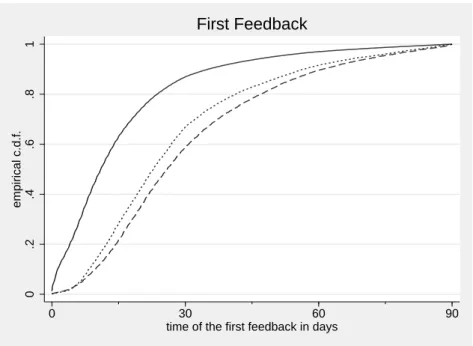
In Figure 2, we document the timing of feedbacks. It shows empirical distribution functions of the time the feedback is given conditioned on the type of feedback. In particular, we find that in a first order stochastic dominance sense feedback is given earlier if it is positive rather than neutral, and in turn neutral rather than negative.
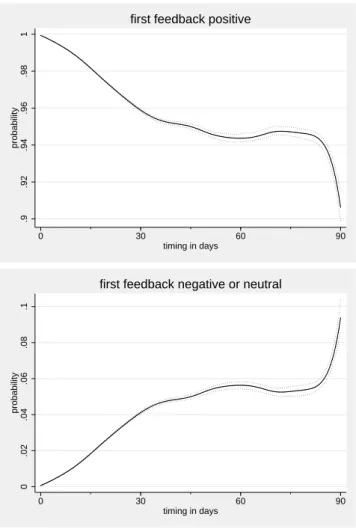
These estimates are complemented with estimated conditional probabilities of the feedback being positive as well as the probability of a feedback being neutral or negative, conditional on the time of the feedback, respectively. Recall that most feedback is positive and is left relatively early within the 90 day period. However, Figure 3 shows that the later the feedback is left, the more likely it is to be negative or neutral—even culminating into a spike right at the end of the 90 day period. Hence, there is last minute feedback in the sense that feedback left in the “last minute” is much more likely to be negative.
22We used a Gaussian kernel. It turned out that the choice of the bandwidth did not have a substantial impact on these estimates. Notice that confidence intervals are extremely narrow due to the size of the data set.
0 .2 .4 .6 .8 1 probability 0 30 60 90
time of the feedback in days
reply positive 0 .2 .4 .6 .8 1 probability 0 30 60 90
time of the feedback in days
reply neutral or negative
0 .2 .4 .6 .8 1 probability 0 30 60 90
time of the feedback in days
reply missing
Figure 1: The probability of a positive (top), negative or neutral (middle), and missing (bottom) reply given a positive (solid line) and negative or neutral (dashed line) feedback against time of the feedback. Local linear regressions and bootstrapped 95 per cent confidence intervals (100 replications).
0 .2 .4 .6 .8 1 empirical c.d.f. 0 30 60 90
time of the first feedback in days First Feedback
Figure 2: Empirical cumulative distribution functions for the timing of the feedback given that it is positive, neutral, or negative (from left to right). Note that negative and neutral feedbacks are given later in a first order stochastic dominance sense.
4. Strategic Feedback Behavior
We have documented the existence of a robust “Last Minute Feedback” effect for negative feedbacks, and of a symmetric early feedback effect for positive ones. In Section 2, we have argued that feedbacks are possibly given late when they are negative because agents strategically postpone the time at which the negative feedback is left to minimize the likelihood of retaliation. However, even if feedback behavior was non strategic, negative or neutral marks could be given later simply because the transaction was delayed and
therefore, a negative or neutral feedback is left. These effects could entirely stem from transactions characterized by late delivery in which a truthful negative report is posted late. Conversely, those transactions characterized by timely delivery on both sides are likely to produce truthful positive feedbacks that are posted early. Resnick and Zeckhauser (2001, Table 2) have analyzed the feedback comments belonging to a sample of negative or neutral marks. On one hand, they find that 11 per cent of the complaints were about slow shipment. Additionally, in 23 per cent of the cases buyers claimed not to have received the item after they had paid for it. Hence, there is at least some scope for delays. On the other hand, however, in 24 per cent of the cases the good was shipped in time but was in poor condition, thus giving room for truthful negative and timely feedback. While these observations contribute to the explanation of the observed pattern, they quantitatively work in the same direction as the incentive to act strategically, and thus postpone negative or neutral marks. In this section we present evidence strongly suggesting that delayed
.9 .92 .94 .96 .98 1 probability 0 30 60 90 timing in days
first feedback positive
0 .02 .04 .06 .08 .1 probability 0 30 60 90 timing in days
first feedback negative or neutral
Figure 3: The probability of a positive (top) and neutral/negative (bottom) feedback against time. Local linear regressions and bootstrapped 95 per cent confidence intervals (100 replications).
performance is not the only driving force of Last Minute Feedback, i.e. that agents do indeed leave feedbacks strategically.
4.1. Last Minute Feedback
Figure 3 shows that the probability that a negative or neutral feedback is left increases in the first 30 to 40 days after the end of an auction. This increase could be explained by information revelation over time in problematic, possibly delayed, transactions which result in a negative or neutral feedback. Thereafter, until the last day of the 90 day feedback period, the probability of a negative or neutral mark seems not to depend on the timing of the feedback. However, it increases dramatically on the 90th day after the end of an auction. As for statistical inference, we have regressed an indicator variable for a negative or neutral feedback on a spline function in the time of the feedback, controlling
for experience of the trading partners, and on whether the feedback was left by the buyer or the seller. It reveals that the probability that a given feedback is negative or neutral on the last half a day of the 90 day period after the end of the auction increases by about 6 per cent on average. This increase is highly significant at any level. This can hardly be reconciled with non strategic behavior since that would require that all of a sudden more negative or neutral than positive information on the trading partner would be revealed on the second half of the 90th day, compared to the 50 day period preceding this day.
4.2. The Role of the ‘Role’
0 .2 .4 .6 .8 1 empirical c.d.f. 0 30 60 90
time of the first feedback in days
First Feedback
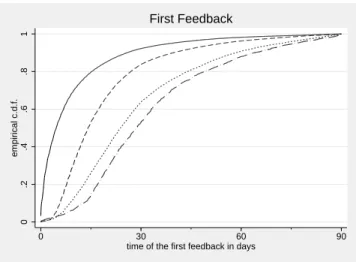
Figure 4: Empirical cumulative distribution functions for the timing of the feedback given that it is given by the seller and that it is positive positive, buyer and positive, buyer and negative or neutral, seller and negative or neutral (from left to right).
In general, we suppose sellers to be more likely to be sellers in future transactions so that they are more interested in getting a positive feedback and avoiding a negative one. In consequence, the effects we have documented so far should be more pronounced for sellers once agents act strategically, since sellers’ interest in their reputation is higher. Figure 4 shows that feedbacks are in fact given substantially earlier if they are positive and given by the seller, as compared to positives given by the buyer. Along these lines, we find that negative or neutral marks are given later by sellers. We interpret this as further evidence for strategic behavior.
4.3. The Effect of Experience
In several decades of experimental economics evidence has been accumulated on the effect of players’ experience in strategic interactions. An important aspect therein is a deepened
0 .2 .4 .6 .8 1 empirical c.d.f. 0 30 60 90
time of the first feedback in days
First Feedback
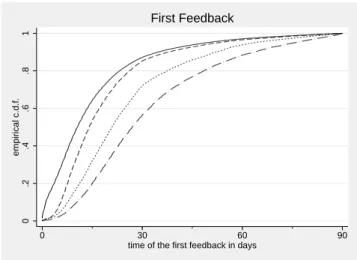
Figure 5: Empirical cumulative distribution functions for the timing of the feedback given high experience and the feedback being positive, low experience and positive, low experience and negative or neutral, high experience and negative or neutral (from left to right).
understanding of the opponent’s strategic reaction to one’s action once a strategic situa-tion is experienced repeatedly. On eBay, a proxy for experience that is easily observable is an agent’s feedback score. Once feedback behavior is strategic, we should therefore again expect the observed patterns to be more pronounced for experienced agents. Figure 5 shows that this is the case in our data. High experience is defined by a feedback score of at least 20. We have also run regressions in which we include the role of the agent giving feedback and its experience as explanatory variables. The results confirm this finding since the effect is statistically significant at any level. Such an analysis is sensible because experience and role are positively correlated.
4.4. Tools
In further support of these findings, it has been suggested in various newsgroups to set up a service that automates strategic feedback timing. In a typical conversation, a user suggests23
will someone out there please invent FEEDBACK SNIPER SOFTWARE that allows one to leave feedback (good or bad) at the last second? that way, you can leave legit[imate] bad feedback w[ith] no fear of retaliatory bad feedback left for you- thus purifying the ebay world, making ebay stock go up, and just
23See, e.g.,
making ebay a better community as a whole. i do not leave deserved bad feedback for fear of retaliatory bad feedback left on me!!!
And indeed, Auctionhawk, a company specialized on offering services around eBay, developed and advertised a service, for payment, to give feedback in the last minute.24
The discussion, however, continues with the remark that
It has already been suggested on this forum a handful of times. The problem is that its not an exact 90 days. It can be several days longer.
and the reply
random time and not 90 days, eh? that would definitely throw the idea for a loop. if we could isolate the time generator at ebay and get a handle on how these times are generated we could do it an ebay would be a purer place as crooks would think twice about fraud.
In fact, Auctionhawk has stopped advertising this feature in the meantime. Strategic implications of the randomness of the last minute will be at the center of our discussion in Subsection 5.1.
5. Mutual Feedback Withdrawal and Extended Feedback Periods
So far, we have abstracted from two features that are peculiar to the eBay feedback mechanism. First, feedbacks and replies can be left more than 90 days after the end of the auction and second, feedbacks and replies can be withdrawn if both parties agree to. We discuss the implications of these institutional details in two subsections.
5.1. Extended Feedback Periods
So far, we have been working under the simplifying assumption that feedbacks can only be left within 90 days from the end of the auction. While eBay guarantees that both parties’ feedback comment for the other party is recorded if it is left within 90 days after the end of the auction, it is a little known fact that this does not exclude the possibility of leaving feedback after this 90 day period. In eBay’s own words: “eBay only commits to items being available for 90 days, so if it is greater than 90 days you may not be able to leave feedback.”25
After 90 days, eBay removes the link on a member’s personal “My eBay” page that encourages one to leave feedback. However, since the item number identifying a particular transaction is known in principle, one might still be able to leave feedback for a transaction
24See (February 2006). A free
re-minder service for “last minute feedback” is offered by U.K. Auction Watch at
by doing so manually. This finding is connected to what we experienced during our data collection: in feedback profiles auction details are linked for 90 days after the feedback was left or received. If details are not linked, this does not necessarily imply that they are not available any more.
In our random sample of auctions we found only very few cases in which feedback was left more than 90 days after the end of an auction. In particular, only 0.03 per cent of the feedbacks and 0.06 per cent of the replies were given after 90 days. If the feedback was negative, the probability that is was given after 90 days was only 0.4 per cent. In this case, the probability of a retaliative reply is 20 per cent.
From these findings we conclude that the possibility of leaving feedback later than 90 days after the end of an auction seems to be a little known secret and we doubt that many users consider the chance that even their “last minute” feedback could be followed by retaliation.
Even if it was publicly known that leaving feedback for longer than 90 days is possible, our analysis and conclusions would only slightly change. The empirical evidence in favor of the explanation given in this paper, namely the difference in the timing of positive and negative feedbacks we found, remains unchanged.
As for agents’ strategic situation, what matters is the effect of such a “random last minute” on the decision to leave a feedback. For any given time at which a feedback is left, the possibility for the other agent to reply after the 90 day deadline simply increases the likelihood of receiving such a reply. Specifically, for positive feedbacks, this marginally increases the incentive to leave a positive feedback. Conversely, the extended period tends to further discourage negative feedbacks. It allows the agent to postpone a first negative feedback even more (after the 90th day). This is at the risk that the negative feedback is not registered. The benefit is a lower probability that the feedback is retaliated if the attention of the trading partner is fading over time.
All in all, we conclude that the uncertain length of the extended period in which a feedback can be given works against finding evidence for “last minute feedback” by making the “last minute” a probabilistic deadline. We still found this evidence in the data and believe our empirical results would be stronger if the period for leaving feedbacks would be of fixed length.
5.2. Mutual Feedback Withdrawal
A less well known feature of the eBay feedback mechanism is that, after feedbacks are given, they can be withdrawn subject to the mutual approval by both parties. All feed-backs, one or two, that are given up to the time of the withdrawal are removed and no more feedbacks can be left. If feedbacks are removed, they do not enter the calculation of the feedback score but remain in the parties’ feedback histories as “withdrawn” feedbacks. Additionally, the number of withdrawn feedbacks is shown next to the members’ feedback summary. Surprisingly, in our data, only 0.1 per cent of all feedbacks were withdrawn, 25
per cent of these within two days after the last feedback was left.26
Obviously, the possibility to withdraw feedbacks increases agents’ ability to renegotiate in order to reach a final agreement. It allows agents to trade feedbacks, in particular a withdrawn negative for a withdrawn negative. This ability to renegotiate may have negative effects on the informational content of the feedback mechanism by promoting strategic, i.e. non-truthful, feedbacks.27
While it is observable whether feedbacks were withdrawn, we cannot observe whether the withdrawn feedbacks were positives or negatives. However, under the assumption that a good reputation record is valuable to at least one party, two positives should never be withdrawn. Therefore, we restrict our attention to situations in which at least one negative feedback was left.
5.2.1. Withdrawal of Two Negative Feedbacks
Rational agents and backward induction. The simplest among these situations, the one in which we expect most feedbacks to be withdrawn, is the case in which two negative feedbacks were left. Suppose both parties in the transaction value not having negative feedbacks more than the procedural cost of withdrawing feedbacks, are rational and not norm guided, and have a negligible chance of trading again in the future. Suppose further that observing and interpreting an agent’s past feedback behavior—how has an agent left feedbacks and reacted to other agents’ feedbacks in the past?—is too costly relative to the value of the transaction. Then, simple backward induction applies and suggests that two negative feedbacks will always be renegotiated and withdrawn, independent of the history that led to them.
We found the following advice in a guide entitled “How to Sell on eBay”:28
However much you’re not supposed to do it, you really shouldn’t let a buyer leave you negative feedback without leaving them a negative in return . . . This might not be the ’nicest’ way to do business on eBay, but it’s the only real-istic way to protect your flawless reputation. Don’t be worried: retaliatory feedback is not against eBay’s rules, however much it should be. Anyway, you’re not just doing this for revenge—it’s essential for the next step. Try for a Mutual Withdrawal. Since the buyer probably won’t want a negative
26Note that in principle, we could have missed some late feedbacks and late feedback withdrawals if they occurred very late after the end of the auction, say 125 days. This is due to the design of the data collection procedure and it would be beyond the scope of this paper to improve on this. However, in view of the observation that already between the 90th and 100st day after the end of the auction incidences of feedback activity decline to a negligible number we are only missing very few feedbacks.
27See Dini and Spagnolo (2005a) for a general result. This is why Dini and Spagnolo (2005b) and Dellarocas, Dini, and Spagnolo (forthcoming) suggest to keep feedback mechanisms unilateral whenever it is possible: then, trading a positive feedback against a positive feedback is not an option. Provided that other forms of (e.g. monetary) trade are costly the informational content of such feedbacks increases. The empirical results in Chwelos and Dhar (2005) nicely support this policy prescription.
28See
response or feedback comment on their record, you can do a simple “I’ll take away my negative if you take away yours” deal. This is called mutual feedback withdrawal, and the process can be started at this page:. . .
Reputation as a punisher. For Sections 3 and 4’s empirical analysis we have coded withdrawn feedbacks as negatives. Surprisingly, even under this assumption, only 22 per cent of all retaliated feedbacks were mutually withdrawn afterwards.29 Not withdrawing
a negative feedback may serve as a signalling device for an agent because she can thereby build a reputation as a “tough” punisher to deter future cheating, or receiving negative feedbacks.30
Experience. We consider it more likely that many agents involved in badly performing transactions were unexperienced and did not know about the possibility of withdrawal. To test this hypothesis we calculated withdrawal probabilities by the experience of the trading partners. We say that an agent is experienced if her feedback score is at least 10. If both trading partners are experienced, the probability of a feedback to be withdrawn was 23.5 per cent. If only one of them was inexperienced, this number declined to about 18.5 per cent. Unfortunately, even in our large data set there is no case in which both trading partners were inexperienced and a feedback was withdrawn. This shows once more that strategic behavior is promoted by experience.
Withdrawal as a threat. Alternatively, assume that agents believe there exist potential trading partners who do not fear retaliation because they do not value their own reputa-tion. These could, e.g., be occasional buyers paying in advance. Such agents could make use of the possibility to withdraw feedbacks to signal toughness by giving a negative feed-back early, before the good is delivered. The signal to the trading partner would be that their valuation for reputation is low so that they are always prepared to give a negative or retaliate a negative without withdrawing it thereafter if the delivered good does not conform to promises. This can be used to exact performance of the other trading partner.
5.2.2. Withdrawal of One Negative Feedback
In case only one negative feedback was given, naturally, only one party is interested in the withdrawal of this feedback. Suppose reports were truthful, so that one party (say the seller) was satisfied by the trading partner’s performance (say prompt payment), but the other party was not (the buyer found the good of lower than expected quality). Then, the unsatisfied party that left a negative could agree to withdraw the feedbacks in exchange for a discount in price, or the seller’s willingness to take back the good. However, in general, these “renegotiated” transactions are hard to enforce. Since feedbacks are already given, and can only be jointly withdrawn, there is no guarantee for the accomplishment of such a new agreement. In our example, after the seller accepts to take back the good, if she
29In general, Section 3 and 4’s findings are robust to feedback withdrawal: dropping all observations in which feedback was withdrawn did not change our results.
30This requires that observing and analyzing an agent’s past feedback behavior is an option for at least some potential future trading partners. We are sceptical about this possibility, given how complex it is to track and interpret an agent’s past feedback behavior by manually going through her feedback history.
returns the money first the buyer could be inclined not to return the good, or not to agree to withdraw the feedback given that hers is positive. Likewise, if the good is sent back first, the seller may not want to return the money. These enforcement problems ofex post
renegotiation in asymmetric situations, where no feedback mechanism is present to limit opportunism, let us believe that most withdrawn feedbacks are couples of negatives.
6. Policy Implications and Concluding Remarks
In this paper, we have highlighted empirical phenomena such as “last minute (negative) feedbacks” and have reconciled them with an idea of agents’ strategic feedback behavior on eBay. In particular, we have shown evidence indicating that agents tend to anticipate reactions of the trading partner in the “feedback game” when they leave feedback.
Moreover, agents seem to be aware of the risk that a negative feedback is retaliated. This implies that positive feedbacks are usually given early, with the aim of stimulating reciprocation, and negative feedbacks are given late or not given at all, in fear of retalia-tion. Therefore, positive feedbacks are likely to be given too often and negatives are likely to be given too seldom. Hence, negative feedbacks, if they are given, typically contain more information than positive ones. In general, the informational content of feedback histories in such eBay type bilateral feedback mechanisms appears to be low.
Let us finally develop some ideas towards improving the design of the feedback mecha-nism.31 Our analysis suggests that the “feedback game” should be made less transparent
to both parties. In particular, favorable “anonymity” could be present in a mechanism in which both feedbacks are revealed to the trading partners and the public only if no more feedbacks can be left. This could be done after a fixed period, or after both have already given their feedback. Note that this device requires that feedback withdrawal is not pos-sible. Otherwise, under general conditions, it is a dominant strategy for the players to always leave a negative feedback in order to be able to renegotiate after feedbacks have been revealed.
In general, the performance of buyers, if they are asked to pay first, is subject to little uncertainty. It is also easier to discipline them: either the full payment arrives in time, and bank transfer details can demonstrate this, or it does not. Sellers can instead “cheat” in non evident ways on a variety of aspects of their performance, and this opaqueness creates room for opportunistic behavior. Therefore, it may be worthwhile to limit feedbacks to buyers rating sellers as in Amazon auctions.32
We shall end with the appeal that33
Sooner or later we all face this dilemma on e-Bay. Do we slag an obvious jerk with a negative feedback, only to get a retaliatory negative feedback from him. You have to decide if it’s worth it. Always check out his feedback first. See if
31Roth (2002) makes a strong case for economists helping todesign markets and institutions.
32This is also suitable for e-procurement platforms. See Dini and Spagnolo (2005a, 2005b) for further details.
he posts retaliatory feedbacks. Avoid him like the plague if he does. In your case, seeing as how you aren’t out any cash, I would just let this one slide. Let this moron fester in his own little crooked world. There are a lot of goofs out there in e-Bayland, just steer clear of them if possible. IMHO [in my humble opinion], save your negative feedbacks for the really bad experiences that cost you serious money. Cheers!
References
Bajari, P., and A. Hortac¸su (2003): “The Winner’s Curse, Reserve Prices, and
Endogenous Entry: Empirical Insights from eBay Auctions,” RAND Journal of Eco-nomics, 34(2), 329–355.
(2004): “Economic Insights from Internet Auctions,” Journal of Economic Lit-erature, 42(2), 457–489.
Cabral, L. M. B., and A. Hortac¸su (2005): “The Dynamics of Seller Reputation:
Theory and Evidence from eBay,” Mimeograph.
Chwelos, P., andT. Dhar(2005): “Caveat Emptor: Differences in Online Reputation
Mechanisms,” Mimeograph.
Dellarocas, C. (2005): “Reputation Mechanisms,” Working Paper, University of
Maryland.
Dellarocas, C., F. Dini, and G. Spagnolo (forthcoming): “Designing Reputation
Mechanisms,” inHandbook of Procurement, ed. by N. Dimitri, G. Piga,andG. Spagnolo, chap. 18. Cambridge University Press, in press.
Dellarocas, C., M. Fan, and C. A. Wood (2004): “Self-Interest, Reciprocity, and
Participation in Online Reputation Systems,” Working Paper.
Dini, F.,andG. Spagnolo(2005a): “Buying Reputation on eBay,” Manuscript, Consip
Research Unit and Stockholm School of Economics.
(2005b): “Reputation Mechanisms and Electronic Markets: Economic Issues and Proposals for Public Procurement,” in Challenges in Public Procurement: an In-ternational Perspective, ed. by K. V. Thai, A. Araujo, R. Y. Carter, G. Callender, D. Drabkin, R. Grimm, K. R. Ejlskov Jensen, R. E. Lloyd, C. P. McCue,andJ. Telgen. Academic Press.
Fehr, E., and K. Schmid (1999): “A Theory of Fairness, Competition and
Coopera-tion,”Quarterly Journal of Economics, 114(3), 817–868.
Houser, D., and J. Wooders (forthcoming): “Reputation in Auctions: Theory, and
Jin, G. Z., and A. Kato (2002): “Blind Trust Online: Experimental Evidence from Baseball Cards,” Working Paper, University of Maryland.
Livingston, J. A., and W. N. Evans (2004): “Do Bidders in Internet Auctions Trust
Sellers? A Structural Model of Bidder Behavior on eBay,” Working Paper, Bentley College.
Lucking-Reiley, D., D. Bryan, N. Prasad, and D. Reeves(2005): “Pennies from
eBay: the Determinants of Price in Online Auctions,” Working Paper, University of Arizona.
Melnik, M. I., and J. Alm (2002): “Does a Seller’s Reputation Matter? Evidence
from eBay Auctions,”Journal of Industrial Economics, 50(3), 337–349.
Resnick, P., K. Kuwabara, R. Zeckhauser, and E. Friedman (2000):
“Reputa-tion systems,”Communications of the ACM, 43(12), 45–48.
Resnick, P., and R. Zeckhauser (2001): “Trust Among Strangers in Internet
Trans-actions: Empirical Analysis of eBay’s Reputation System. The Economics of the Inter-net and E-Commerce.,” in Advances in Applied Microeconomics, ed. by M. R. Baye, vol. 11, Amsterdam. Elsevier Science.
Resnick, P., R. Zeckhauser, J. Swanson, and K. Lockwood (2004): “The Value
of Reputation on eBay: A Controlled Experiment,” Working Paper, Harvard Kennedy School of Business.
Roth, A. E.(2002): “The Economist as Engineer: Game Theory, Experimentation, and
Computation as Tools for Design Economics,”Econometrica, 70(4), 1341–1378.
Roth, A. E., and A. Ockenfels (2002): “Last-Minute Bidding and the Rules for
Ending Second-Price Auctions: Evidence from eBay and Amazon on the Internet,”
American Economic Review, 92(4), 1093–1103.
Appendix A: Decision Tree
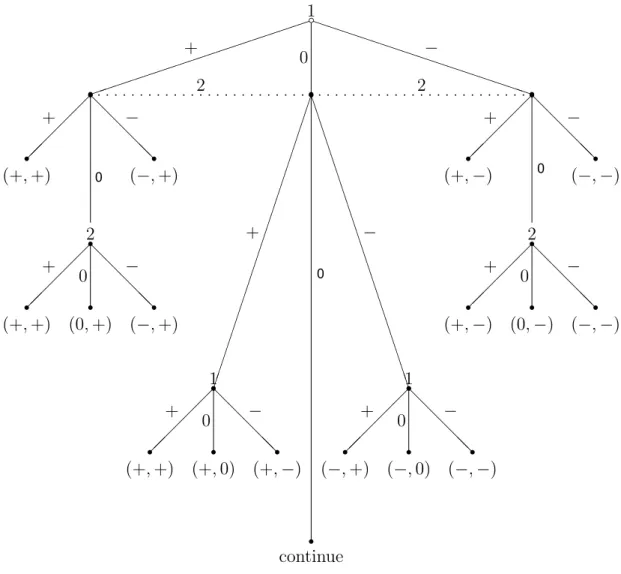
Figures 6 and 7 describe the decision tree for the “feedback game” that starts right after the end of the auction. Here, we assume for simplicity that feedback can be left for 90 days. Together, Figures 6 and 7 depict the 90 days long decision tree as a continuum of decision nodes. Starting from the first instant after the auction agents 1 and 2, which we treat symmetrically, simultaneously choose whether or not to give a feedback, as long as neither of them has placed their feedback yet. The first decision node of Figure 6 depicts this simultaneous game for the first instant of time. Each agent can simultaneously choose among abstaining from giving feedback (0), giving a positive feedback (+), and giving a negative or neutral one (−). A pair (+,−), e.g., denotes that agent 1 received a positive mark from agent 2 whereas agent 2 received a negative mark from agent 1. As usual, the information set at 2’s decision node implies that 1 and 2’s decisions are simultaneous, i.e.
b ³ ³ ³ ³ ³ ³ ³ ³ ³ ³ ³ ³ ³ ³ ³ PPP PPP PPP PPP PPP 1 + 0 − r r r p p p p p p p p p p p p p p p p p p p p p p p p p p2 p p p p p p p p p p p p p p p p p p p p p p p p p p2 r ¡ ¡ ¡ ¡ ¡ @ @ @ @@ + − r (+,+) r (−,+) r r ¡ ¡ ¡ ¡ ¡ @ @ @ @@ 2 + 0 − r (+,+) r (0,+) r (−,+) r £ £ £ £ £ £ £ £ £ £ £ £ £ £ £ £ £ £ £ £ B B B B B B B B B B B B B B B B B B B B + − r r r r continue r ¡ ¡ ¡ ¡ ¡ @ @ @ @@ 1 + 0 − r (+,+) r (+,0) r (+,−) r ¡ ¡ ¡ ¡ ¡ @ @ @ @@ 1 + 0 − r (−,+) r (−,0) r (−,−) r ¡ ¡ ¡ ¡ ¡ @ @ @ @@ + − r (+,−) r (−,−) r r ¡ ¡ ¡ ¡ ¡ @ @ @ @@ 2 + 0 − r (+,−) r (0,−) r (−,−)
Figure 6: Decision tree before the last minute.
b ³ ³ ³ ³ ³ ³ ³ ³ ³ ³ ³ ³ ³ ³ ³ PPP PPP PPP PPP PPP 1 + 0 − r r r p p p p p p p p p p p p p p p p p p p p p p p p p p2 p p p p p p p p p p p p p p p p p p p p p p p p p p2 r ¡ ¡ ¡ ¡ ¡ @ @ @ @@ + 0 − r (+,+) r (0,+) r (−,+) r ¡ ¡ ¡ ¡ ¡ @ @ @ @@ + 0 − r (+,0) r (0,0) r (−,0) r ¡ ¡ ¡ ¡ ¡ @ @ @ @@ + 0 − r (+,−) r (0,−) r (−,−)
Figure 7: Decision tree in the last minute.
0 0
that neither of the two players observes the trading partner’s decision for that instant before choosing. If both 1 and 2 choose to give a feedback in an instant of time, the “feedback game” ends and the two feedbacks are recorded and become observable on the platform. If one of the two agents gives her feedback and the other does not, the other agent will be able to observe the feedback received an instant of time later, and will remain the only one with a choice to make. As long as both 1 and 2 choose not to give feedback and the last instant is not reached, the simultaneous game starts again in the following instant of time. Once the “last minute” is reached, i.e. the last instant of the 90 days in which a feedback can be given, the simultaneous decision node changes form into that described in Figure 7.
Appendix B: Data Collection
We first randomly drew auction numbers and downloaded the respective auction details. From these auction details we obtained the respective seller member ID and randomly selected 10,000 sellers from the United States.
In a next step, for each seller, we used the information in her feedback profile to obtain auction details including the corresponding feedback which was received and left, and the respective timing information. By construction, since we start from a member’s feedback profile, our sample consists of auction records for which at least one feedback was left by either the seller or the buyer. In order to minimize the loss of information, we include only those auctions into our data set which ended at least 100 days before the date of our data collection. Moreover, we require the auctions to have ended at most 125 days before the date of our data collection. This value is suggested by the data because after 125 days auction details might not be available any more.
We restrict our attention to standard eBay auctions. That is, we drop auctions that belong to “eBay Motors,” are “Live Auctions,” serve as an “Advertisement Only,” and are “Quantity Items.” Moreover, we do not consider auctions which ended early.