APITECH-2019
Journal of Physics: Conference Series 1399 (2019) 022032
IOP Publishing doi:10.1088/1742-6596/1399/2/022032
Optimal parameters selection of particle swarm optimization
based global maximum power point tracking of partially
shaded PV
Sergey Obukhov1, Ahmed Ibrahim1, 2 and Raef Aboelsaud 1, 2
1Tomsk Polytechnic University, 30, Lenina ave., Tomsk, 634050, Russia 2Electrical Power & Machines Department, Faculty of Engineering, Zagazig University, Egypt
E-mail: [email protected]
Abstract. This paper presents optimal parameters selection of particle swarm optimization (PSO) algorithm for determining the global maximum power point tracking of photovoltaic array under partially shaded conditions. Under partial shading, the power- voltage characteristics have a more complex shape with several local peaks and one global peak. The two proposed controllers include dynamic Particle Swarm Optimization, and constant particle swarm optimization. The developed algorithms are implemented in MATLAB/Simulink platform, and their performances are evaluated. The results indicate that the dynamic particle swarm optimization algorithm can very fast track the GMPP within 128 ms for different shading conditions. In addition, the average tracking efficiency of the proposed algorithm is higher than 99.89%, which provides good prospects to apply this algorithm in the control search unit for the global maximum power point in stations.
1. Introduction
These days, the faster rise in electricity demand and the novel change in ecological situations like global warming generation by means of traditional sources. These sources such as oil and coal results in growing the greenhouse effect and environmental pollution issues in the universe leading to a necessity for novel resources of energy which inexpensive, and more sustainable [1]. Generating electricity from renewable resources is required to decrease global warming, minimize pollution and substitute for the lack of conventional energy sources. Among the resources of renewable energy, the photovoltaic (PV) modules which are one of the most distinguished in the world because it has a longer lifespan (Typically more than 20 years), and many several advantages [2].A major challenge in using PV source is to tackle its nonlinear power – voltage characteristics [3], which affected by temperature and the solar irradiance [4]. Therefore, the maximum power point tracking (MPPT) is essential to increase the energy conversions by delivering the maximum power to load from the PV module. Numerous conventional algorithms have been carried out on MPPT approaches [5]. For instance, constant voltage [6], Perturb and Observe [7], incremental inductance [8], Hill climbing [7], frictional short-circuit current [9], ripple correlation control and sliding control [10]. However, these methods give good response under normal irradiance of solar panels they failed to track the global maximum power point (GMPP) in case of partial shading conditions (PSC) [11]. In actual operating conditions, PV solar cells, especially a large area,
APITECH-2019
Journal of Physics: Conference Series 1399 (2019) 022032
IOP Publishing doi:10.1088/1742-6596/1399/2/022032
often operate under partial shading conditions (PSC) caused by a cloud, a shadow from trees and nearby buildings, etc. Under PSC of the solar panel, its P-V characteristic is distorted and get more complicated with several local peaks (LPs), which significantly complicates the task of determining the global maximum power point (GMPP) of the solar panels [12]. All the conventional methods of searching for the MPPT that is used in photovoltaic station controllers do not provide reliable tracking of the GMPP of the P-V characteristic, which leads to increased losses and reduces the reliability of the PV power plant.Recently, the researchers have worked how to track the GMPP under PSC using soft computing techniques. Among them are the fuzzy logic control (FLC), artificial neural networks (ANN), genetic algorithm (GA), particle swarm optimizations (PSO) and ant colony optimizations [13]. They test the performance of their algorithms under dynamic changes of the solar irradiance of the PV panel [14]. Although the very high cost of implementation the ANN and fuzzy logic, they capable of tracking the GMPP with lower oscillation in power as compared to P&O algorithm. Many researchers used PSO in their model with selecting its three basic parameters (inertia factor w, acceleration coefficients c1 and c2) by try and error; this is resulting in a long time tracking and many iterations to reach the MPP [15]. Moreover, they tested the performance of the PSO algorithm on resistive load in the absence of the charging battery, which already interfaced in the main PV plant. In this paper, the GMPP under partially shaded conditions is determined using two types of PSO. The first type is named dynamic PSO (DPSO) in which its parameters are varying with the time. The second type is constant PSO (CPSO) in which parameters are selected by try and error. The main contributions of this paper are to select the optimal parameters of the PSO, and then test the performance of the two proposed PSO with the charging battery.
2. Characteristics of PV array under partial shading conditions
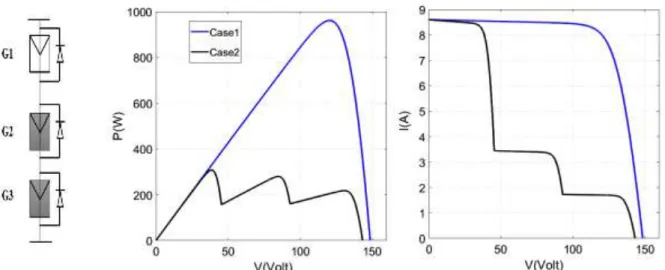
As explained before, in the presence of partial shading, many local peaks appears on the power-voltage characteristics of PV array. To mitigate this problem, bypass diode is interfaced in the PV module as shown in figure 1 [16].
a) b) c)
Figure 1. a) Proposed 3S1P configuration b) Voltage–power and c) current- voltage characteristics in case of fully illuminated and partially shaded PV.
The configuration (3S1P) consists of 3 PV modules, arranged by three modules per string with maximum power of 320.01 W. The overall output power of the system is about 961.1Wp. As demonstrated in figure 1, several local peaks appear on the characteristic curve of PV array, also the output power is increased in case of PSC as compared in its value in uniform irradiance.
APITECH-2019
Journal of Physics: Conference Series 1399 (2019) 022032
IOP Publishing doi:10.1088/1742-6596/1399/2/022032
3. Particle swarm optimization
Particle swarm optimization (PSO) algorithm- one of the optimization tools based on the behaviour of folk of birds and was created by James Kennedy and Russell Eberhart in 1995 [17]. The PSO is based on the continuous movement of particles in a possible solution space, while the current state of the particle is characterized by two variables: the coordinate xi and the speed of movement k
i
v . In this study, the duty cycle of the DC-DC buck converter represents the particle of the swarm. Therefore,
1
k k k
i i i
D D v (1) And the velocity of each duty cycle can be calculated by:
1 1 1 _ 2 2 _i k k k k k k k i i best i i best i v v w c r D D c r G D (2)
Where
с
1,
с
2are acceleration constants;r
1,
r
2are random functions in the range [0, 1].4. Design and implementation of PSO
To minimize the tracking time of the GMPP of the PV panels, it is necessary to take into account three important factors when design the PSO algorithm, and these parameters are the choice of PSO parameters, the number of particles, and the sample time.
4.1. Parameters selecting of the PSO algorithm
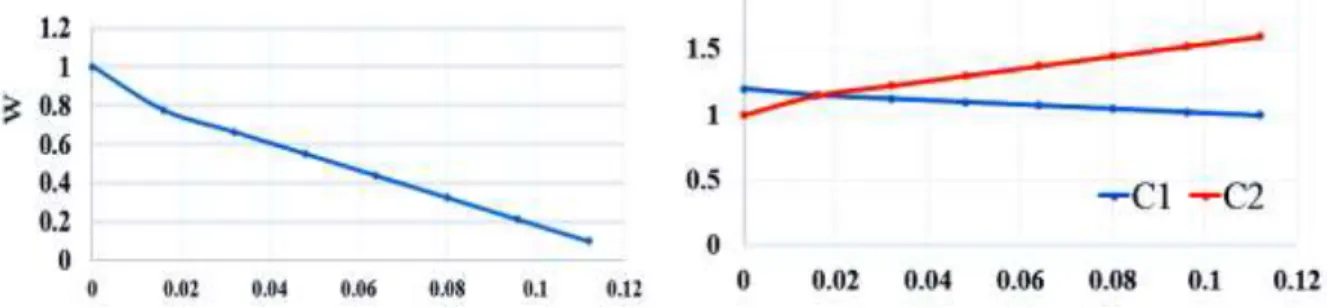
One of the significant disadvantages of the classical PSO in solving optima local problems is that it trapped in unrequired solution, which leads to the loss of the exploration abilities. The dynamic PSO was proposed to overcome the drawbacks in the classical PSO. This type of PSO, in which its parameters are varying with the time. The inertia weight w, which determines the gradient of the particle velocity, is used to keep the convergence behaviour of PSO. The variation of w can be defined between [0, 1]. To decrease the scanning time research for the GMPP, a decreasing the value of w with time is preferable as demonstrated in figure 2a. The w is gradually changed according the following equation:
max max min max ( ) K k W W w w k (3) Where wmax,wmin- are the maximum and minimum value of the coefficient of inertia; kmax is the
maximum number of iterations and K is the value of the current iteration.
Time(Sec) Time(Sec)
a) b)
Figure 2. Variation of the DPSO parameters with the time.
The acceleration coefficients of the cognitive and social components in the velocity update equation
APITECH-2019
Journal of Physics: Conference Series 1399 (2019) 022032
IOP Publishing doi:10.1088/1742-6596/1399/2/022032
latter stages. The modification of the acceleration coefficients is to improve the global search capability of the particles in the early stage of the optimization process.
1 1max 1,max 1,min
max
(
)
Kk
c
c
c
c
k
(4)2 2,max 2,max 2,min
max ( ) K k c c c c k (5)
Where
c
1K,c
2Kare the time-varying acceleration coefficients. Choosing c1 > c2 would bias samplingtoward the direction ofPpbesti, while in the opposite case, c1< c2, sampling toward the direction of
gpbest
would be favoured.4.2. Optimal selection of particle number
A large number of particles will lead to increase the tracking time. The following table shows the detailed comparison between the different numbers of particles.
Table 1. The performance of the DPSO for different numbers of particle swarm
Number of particles V P(W) Tracking time (s.) Energy loss (W.s) GMPP % Normal irradiance N =3 117.36 953.55 0.32 74.29 99.20 N=4 117.36 953.55 0.45 72.99 99.20 N=6 117.26 953.43 0.46 99.18 961.11 99.19 N=8 95.98 811.53 0.48 109.3 84.43 Partial shading condition N =3 81.82 410.72 0.22 45.00 85.45 N=4 126.72 487.71 0.33 39.88 99.52 N=6 126.73 487.52 0.62 68.66 488.01 99.52 N=8 126.75 487.61 0.94 95.11 99.49 5. Simulation Results
Figure 3 shows the Matlab/ Simulink model of the proposed model for 3S1P configuration. The DC-DC buck converter is selected in the current work to match the MPP controller with the charging battery. The selected parameters of the converter are L= 120 µH; C1=25 µF and switching frequency f=25 kHz.
The tracking efficiency of the controller can be calculated from Eq. 6.
0 max 100, % P P (6) Where Р0 is the output power of the PV panel, that tracked by the algorithm; Рmax - the value of the
maximum real power. The performance of the two algorithms has been tested under a temperature of T=25°C and different solar irradiance.
APITECH-2019
Journal of Physics: Conference Series 1399 (2019) 022032
IOP Publishing doi:10.1088/1742-6596/1399/2/022032
Figure 3. MATLAB simulation of the proposed model for 3S1P configuration.
Time (Sec) Time (Sec)
Figure 4. Detailed simulation results for PV system under the uniform irradiance for DPSO and
CPSO.
Time(Sec) Time(Sec)
Figure 5. Detailed simulation results for PV system under the PSC for DPSO and CPSO.
6. Conclusion
APITECH-2019
Journal of Physics: Conference Series 1399 (2019) 022032
IOP Publishing doi:10.1088/1742-6596/1399/2/022032
number of particles. From the simulation results, it was found that the DPSO provides reliable and efficient tracking of the global maximum power point of solar panels under partial shading. For all test cases, the tracking efficiency of the DPSO is higher than 99.9% within 128 ms.
Acknowledgements
The authors gratefully acknowledge the support offered by the ‘higher Education of the Russian Federation’, under the Grant No: RFMEFI57617X0098 (Agreement on the provision of subsidies dated 09/26/2017 No. 075-11-2018-181, internal agreement number 14.576.21.0098) for this research study.
References
[1] Obukhov S and Ibrahim A 2017 Analysis of the Energy Potential of Renewable Energy Sources Egypt ed A A Kozyreva, A O Zhdanova and G V Kuznetsov MATEC Web Conf.141 01035 [2] Ibrahim A, Aboelsaud R and Obukhov S 2019 Improved particle swarm optimization for global
maximum power point tracking of partially shaded PV array Electr. Eng
[3] Obukhov S, Plotnikov I and Kryuchkova M 2016 Simulation of Electrical Characteristics of a Solar Panel IOP Conf. Ser. Mater. Sci. Eng.132 012017
[4] Romero-cadaval E, Spagnuolo G and Franquelo L G 2013 Grid-Connected Photovoltaic Generation Plants IEEE Ind. Electron. Mag.7 6–20
[5] Zhang J, Ding K, Mei R and Cai Y 2018 Global maximum power point tracking method based on sorting particle swarm optimizer Int. J. Green Energy
[6] Belhachat F and Larbes C 2019 Comprehensive review on global maximum power point tracking techniques for PV systems subjected to partial shading conditions Sol. Energy
[7] Liu F, Kang Y, Yu Z and Duan S 2008 Comparison of P&O and hill climbing MPPT methods for grid-connected PV converter 2008 3rd IEEE Conference on Industrial Electronics and Applications, ICIEA 2008
[8] Safari A and Mekhilef S 2011 Incremental conductance MPPT method for PV systems Canadian Conference on Electrical and Computer Engineering
[9] Kamarzaman N A and Tan C W 2014 A comprehensive review of maximum power point tracking algorithms for photovoltaic systems Renew. Sustain. Energy Rev.37 585–98
[10] Husain M A, Tariq A, Hameed S, Arif M S Bin and Jain A 2017 Comparative assessment of maximum power point tracking procedures for photovoltaic systems Green Energy Environ.
[11] Ibrahim A, Aboelsaud R and Obukhov S 2019 Maximum power point tracking of partially shading PV system using cuckoo search algorithm Int. J. Power Electron. Drive Syst.10 [12] Huang Y-P, Chen X and Ye C-E 2018 A Hybrid Maximum Power Point Tracking Approach for
Photovoltaic Systems under Partial Shading Conditions Using a Modified Genetic Algorithm and the Firefly Algorithm Int. J. Photoenergy2018 1–13
[13] Obukhov S and Ibrahim, A R A 2018 Maximum Power Point Tracking OF Partially Shading PV system Using Particle Swarm Optimization 4th Int. Conf. Front. Educ. Technol. Proc. , Moscow, June 25-27, 2018 161–5
[14] Rezk H, Fathy A and Abdelaziz A Y 2017 A comparison of different global MPPT techniques based on meta-heuristic algorithms for photovoltaic system subjected to partial shading conditions Renew. Sustain. Energy Rev.74 377–86
[15] Liu Y H, Huang S C, Huang J W and Liang W C 2012 A particle swarm optimization-based maximum power point tracking algorithm for PV systems operating under partially shaded conditions IEEE Trans. Energy Convers
[16] Obukhov S G and Plotnikov I A 2017 Simulation model of operation of autonomous photovoltaic plant under actual operating conditions Bull. Tomsk Polytech. Univ. Geo Assets Eng
[17] Poli R, Kennedy J and Blackwell T 2007 Particle swarm optimization An overview IEEE Trans. Syst. Man. Cybern. B. Cybern