This paper can be downloaded without charge at: The Fondazione Eni Enrico Mattei Note di Lavoro Series Index: http://www.feem.it/Feem/Pub/Publications/WPapers/default.htm
Social Science Research Network Electronic Paper Collection: http://ssrn.com/abstract=1003791
Spatial Agglomeration, Technology
and Outsourcing of Knowledge
Intensive Business Services
Empirical Insights from Italy
Roberto Antonietti and Giulio Cainelli
NOTA DI LAVORO 79.2007
JULY 2007
KTHC – Knowledge, Technology, Human Capital
Roberto Antonietti, Department of Economics, University of Bologna Giulio Cainelli, University of Bari and CERIS-CNR
Spatial Agglomeration, Technology and Outsourcing of Knowledge
Intensive Business Services.
Empirical Insights from Italy
Summary
Aim of this paper is to explore the main drivers of outsourcing of knowledge intensive business services by Italian manufacturing firms. While anecdotal and empirical evidence has emphasized labour cost and scale economies as behind firms’ choices to outsource production or service activities, here we focus on spatial agglomeration and technology as important factors. Using microeconomic data on a repeated cross-section of Italian manufacturing firms for the period 1998-2003, we develop a two-stage model in order to avoid selection bias: first, we estimate the determinants of the firm's decision to outsource business-related services; second, we estimate the main factors underlying the intensity and complexity of KIBS outsourcing, expressed by the number of service activities that are externalized. Our results show that labour cost-savings are not relevant in driving the decision to outsource KIBS, but ICT, R&D and location within a dense and technologically developed industrial district have very positive effects.
Keywords: KIBS, Service Outsourcing, R&D, ICT, Spatial Agglomeration JEL Classification: L24, L84, R32, R12
Address for correspondence: Roberto Antonietti Department of Economics University of Bologna Strada Maggiore 45 40125 Bologna Italy Phone: +390512092658 Fax: +390512092670 E-mail: [email protected]
1. Introduction
Over the last two decades a new form of division of labour has emerged where firms are splitting the production stages of their supply value chains into different modules, which can be located outside the firm’s boundaries.
Recently along with outsourcing of material inputs and the low skill-intensive stages of production, the outsourcing of business services has been receiving attention: improvements in communication technology and the digitization and increasing globalization of information software have enabled business services to be split into modules, which do not need to be developed internally, and can be produced almost anywhere in the world. Thus firms can now contract out services, ranging from routine call centre work to higher value software programming or research and development (R&D) activities.
Although outsourcing of intermediate material inputs is still far more important, there is much current debate about the relocation of white-collar jobs, in particular high-skill intensive business-related services. Despite the attention this is receiving in the media and by policy makers, and the increasing anxiety related to possible job losses in the home country, little empirical research has been conducted on service outsourcing, and, particularly, on the outsourcing of knowledge intensive business services (KIBS).
KIBS are often considered one of the hallmarks of the so called ‘knowledge economy’. The drive towards specialization and a focus on core business activities accompanied by efforts to compress management hierarchies by reducing the number of layers within the production organization that began in the 1960s, continues to contribute to huge growth in services employment in both the US and the European Union (EU) (Cainelli et al., 2006). The increased knowledge-intensity of services and knowledge requirements of customers have increased the overall knowledge intensity of all sectors of the economy, creating the conditions for the rapid emergence of a specific subset of business services, i.e. “those services that involve economic activities which are intended to result in the creation, accumulation or dissemination of knowledge” (Miles et al., 1995, p. 18). This has promoted growth of the KIBS sector, which consists of firms aimed at providing support and assistance to other firms and organizations in order to deal with activities that complement production and with problems where external sources of knowledge are required. KIBS are broadly consultancy and problem-solving firms which performs for other firms, services that encompass high intellectual value-added (Muller, 2001). The literature has generally identified two broad types of KIBS: the commonly employed distinction refers to (i) advisory services, primarily involving legal activities, bookkeeping, auditing, business and management activities, marketing,
advertising and other administrative tasks; and (ii) technical services, such as computer-related activities, engineering and design, technical analysis, and testing (Koschatzky and Zenker, 1999). Another distinction was made by Miles et al. (1995) which is that between traditional professional services which are likely to be intensive users of new technology (marketing, advertising, training, design, financial services, office services, building services, management consultancy, accounting, legal services, environmental services), and new technology-based services (telematics and computer networks, training in new technologies, design involving new technologies, technical engineering, research and development, IT-based building and environmental services, and so on).
In addition, KIBS are characterised by their heavy reliance on professional knowledge, both codified-explicit and tacit-implicit. They can be considered a primary source of information and external knowledge; they can use their knowledge to produce intermediary services for their clients’ production processes; and, they are typically supplied to business through strong supplier-user interactions (Miles et al., 1995; Muller and Zenker, 2001).
This last feature of KIBS is of particular importance for two reasons. First, the client-related nature of the service helps to shape the process of knowledge creation and diffusion by KIBS. In this context, Muller and Zenker (2001) and Strambach (2001) distinguish among three types of interaction: (i) first, knowledge acquisition, that takes place through interaction with client firms; (ii) second, knowledge recombination which occurs within KIBS and involves interaction between newly acquired and existing knowledge; (iii) third, knowledge transfer from KIBS to clients which occurs when knowledge has been acquired and recombined and takes the form of new or enhanced services.
In addition, the face-to-face contacts needed for the exchange of tacit knowledge makes proximity and spatial agglomeration crucial, even in presence of globalized knowledge flows. “KIBS are confronted with the specific problems of their clients and thus they require most often direct contacts with them in order to conceive solutions by recombining existing knowledge and complementing it with new inputs if necessary. A high share of these interactions, especially in the starting phase of a consulting activity, is characterized by a strong tacit content, requiring personal contacts in particular. Proximity (geographical, social, cultural, etc.) is hence helpful to manage these phases” (Muller and Zenker, 2001, p. 1506).
While the role played by KIBS in producing and diffusing knowledge across firms and regions has been fairly studied, the effects of outsourcing KIBS are less clear and few contributions available have focused primarily on identifying the main effects of outsourcing in terms of productivity (Girma and Görg, 2004; Amiti and Wei, 2006), firm profitability (Görg and Hanley,
2004) or domestic employment (Amiti and Wei, 2005). The main determinants of the firms’ decision to externally relocate business services have also been less well explored.
This paper aims to address these gaps by developing an empirical analysis for a sample of Italian manufacturing firms. For the empirical investigation, we use a firm-level balanced repeated cross-section sample of 1,777 Italian manufacturing firms for the period 1998-2003. The data are drawn from the VIII and IX waves of the Survey on Manufacturing Firms conducted by Capitalia. Using these microeconomic data, we develop a two-stage Heckman model in order to avoid selection bias: first, we estimate the determinants of firm's decision to outsource business-related services; second, we estimate the main factors underlying the complexity of KIBS outsourcing, expressed by the number of service activities externalized.
The article makes three contributions to the empirical literature: (i) first, because of the knowledge-intensive nature of the outsourced services, it focuses particularly on factors related to technology and spatial agglomeration, other than on labour costs and the search for scale economies; (ii) second, it does not focus exclusively on large firms, but investigates the drivers of KIBS outsourcing for a sample of small and medium sized firms, some of them located within Italian industrial districts; (iii) third, rather than focusing the analysis on the simple decision to outsource KIBS, we look at the factors that drive the decision to externalize more service activities: in other words, the intensity and the complexity of the outsourcing process.
The paper is organised as follows. Section 2 explores the literature developed around the issue of the determinants of service outsourcing. Section 3 presents the data and empirical methodology employed in the analysis. Section 4 discusses the main results of the econometric investigation and section 5 concludes the paper.
2. Related literature
Most of the studies in the empirical literature concentrate on material input outsourcing and evidence on service outsourcing is rather scant. Moreover, most studies on service outsourcing are devoted to exploring the main trends (Jones and Kierzkowski, 2001; Yeats, 2001; Borga and Zeile, 2004) and effects, particularly in terms of firms’ labour and total factor productivity (Girma and Görg, 2004; Amiti and Wei, 2006), profitability (Görg and Hanley, 2004), employment and wage inequality (Feenstra and Hanson, 1996; Amiti and Wei, 2005) and overall structural change (McCarthy and Anagnostou, 2004; Montresor and Vittucci Marzetti, 2007).
With respect to what determines the decision to outsource, the evidence suggests three factors involved in the decision to re-locate the production of service inputs outside the firm’s
boundaries (Abraham and Taylor, 1996; Girma and Görg, 2004). The most important of these is the savings on labour costs, that is, achieving reductions in the wages and benefits payable to non-core employees by contracting out peripheral or complementary stages of production to low-wage regions or countries. This supposes that high-wage firms would typically be expected to outsource more intensively than low-wage firms.
The second factor is demand volatility: the more a firm’s output is subject to seasonal fluctuations, the more it will try to outsource peak period tasks in order to maintain as steady a flow of employment as possible over time. However, one would expect there to be a negative relationship between demand volatility and the propensity to contract out if the firm were able to internally re-organize tasks at relatively lower costs than the outsourcing case.
The third factor is the search for specialized skills or equipment that the firm lacks in house. What is relevant here is the achievement of scale economies in the supply of the process or service that the firms seeks to outsource. There may be scale economies in the production of specific inputs such that firm size becomes a determinant of its outsourcing strategy: since small and medium sized firms usually find it more difficult to achieve a minimum efficient scale of production, they will be more keen to outsource production. However, as small firms have less flexibility than large firms to react to variability in consumer demand, and face higher search costs, a positive relationship may emerge between firm size and outsourcing.
In addition to these traditional drivers of labour cost, output cyclicality and scale economies, there are other factors that contribute to the decision to farm out service activities. Girma and Görg (2004), for instance, point out that the nationality of the firm’s ownership may have a positive influence on the propensity to internationally outsource services: foreign-owned firms, in particular, are found to be more prone to outsource because they are expected to be part of a vertical multinational in which there will be specialization and higher outsourcing of activities to vertically linked plants and because they are expected to have better access to external providers of services than domestic firms.
In addition technology plays a role: there is a positive relation between service outsourcing and investments in computer equipment and information and communication technology (ICT) in the workplace (Bartel, Lach and Sicherman, 2005; Hölzl, Reinstaller and Windrum, 2005), high R&D intensity, and the presence of a highly skilled workforce within domestic firms.
There are several explanations for this positive role of technology in shaping firms’ decisions to externalize service activities: Acemoglu et al. (2006), for instance, postulate that firms closer to the technological frontier will be more willing to decentralize their activities in order to take
advantage of information and techniques that are not widely available. For this reason, younger firms, whose short history limits their ability to learn about their own specific needs, and firms investing more in R&D, are more like to choose a decentralized organizational form than older firms.
Apart from this, advances in transport and communication technology have acted to weaken the link between specialization and geographic concentration, making it highly possible to separate tasks in time and space. “When instructions can be delivered instantaneously, components and unfinished goods can be moved quickly and cheaply, and the output of many tasks can be conveyed electronically, firms can take advantage of factor cost disparities in different countries without sacrificing the gains from specialization” (Grossman and Rossi-Hansberg, 2006, p. 2). The result has been a boom in the outsourcing of both manufacturing and other business activities.
Finally, ICT reduce the firms’ external coordination costs significantly, creating the conditions for organization of its activities in modules using new experimental designs (Hölzl, Reinstaller and Windrum, 2005). In particular, network-based technologies can provide the means for radically re-organizing interactions with other firms along the supply chain, thus creating new opportunities for outsourcing to specialist KIBS providers.
In this paper we argue that there is another factor that may be relevant in the outsourcing of KIBS: spatial agglomeration, that is, the location of firms within a dense industrial area, where the probability of finding specialized external providers is high and which favours face-to-face contacts and close spatial interaction, particularly stimulated by the intangible and complex nature of KIBS. Although the traditional literature on international outsourcing seems to neglect this aspect, a strand of studies on foreign direct investment (FDI) and agglomeration economies has emerged which explores the main costs and advantages linked to decisions about where to re-locate activities. The theory in this context argues that the decision about where to re-locate an activity may be driven by the existence of positive externalities generated by the presence of other firms in the same geographic area. These kind of benefits, also refereed to as Marshall-Arrow-Romer (MAR) externalities (Glaeser et al., 1992; Cainelli and Leoncini, 1999; Cainelli et al., 2007a), emerge based on three factors: (i) the transmission of knowledge among firms and workers due to geographical proximity (knowledge spillovers), informal contacts and labour mobility; (ii) the formation of specialized local labour markets, which results in skilled workers available in large numbers and avoids any kind of labour shortage (labour-pooling); (iii) the availability of a wide range of services and productive factors within a geographically concentrated market (input sharing).
The literature on agglomeration and FDI (Wheeler and Mody, 1992; Head, Ries and Swenson, 1995; Bronzini, 2004; Federico, 2006) generally finds a positive effect of spatial agglomeration for attracting FDI inflows independent of the measure of agglomeration used and econometric technique adopted. In addition, this positive effect can influence both domestic and foreign investors, thus the high availability of industry-specific inputs or services in a particular geographic area attracts both national and foreign firms, making foreign investments geographically concentrated.
Here we argue that spatial agglomeration may play a significant role in driving the decision to outsource KIBS: due to their characteristics, the re-location of such services requires the firm to search for highly specialized markets, particularly abundant in high-skill personnel and where informal and face-to-face interactions promote the transmission and re-codification of tacit knowledge. We think that industrial districts, characterized by relatively close communities (Cainelli, 2007) and the existence of agglomeration externalities, may represent a highly attractive geographic space for externalization of knowledge-intensive activities.
3. Data and methodology
3.1. The data-set
In this paper we use a balanced repeated cross-section of Italian manufacturing firms for the period 1998-2003. These data are drawn from the VIII and IX waves of the Survey on Manufacturing Firms (Indagine sulle Imprese Manifatturiere) carried out by Capitalia (ex Mediocredito Centrale), which conducted interviews in 2001 and 2004 of all firms with 500 employees and over, and with a representative sample of firms with more than 11 and less than 500 employees, stratified by geographic area, industry, and employment size. These two waves of information gathering involved 4,680 and 4,289 firms respectively; the number of firms in the merged sample, after deleting outliers and observations with no balance sheet information, is 1,777 firms. Table 1 shows the structure of this sample of firms by Pavitt sectors for the merged sample and for the reference 1998-2000 wave.
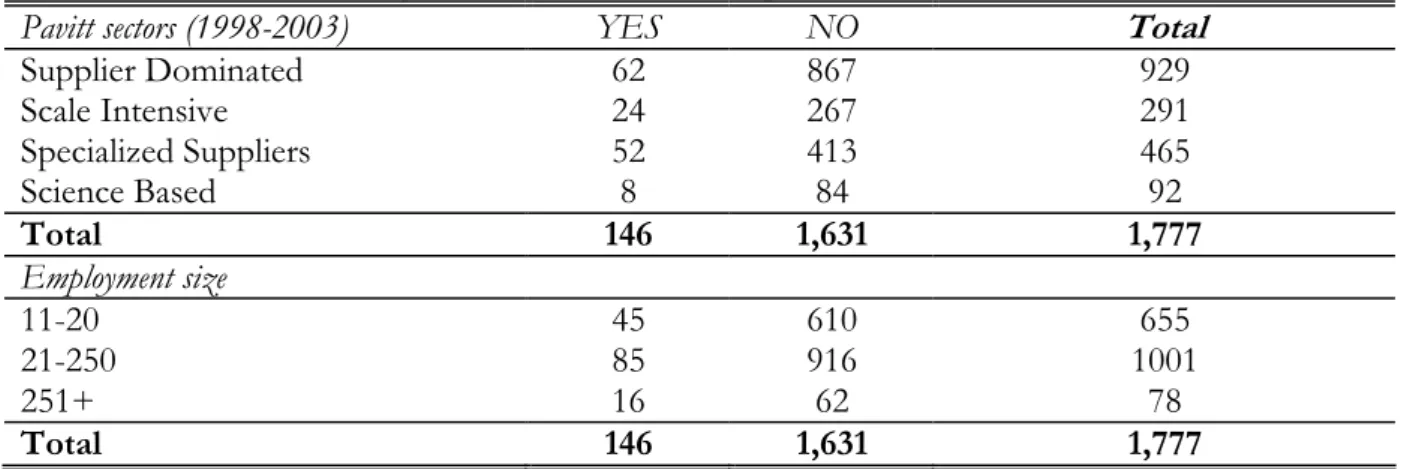
Table 2 shows the distributions by Pavitt sectors and employment size of firms that outsourced at least one of their business service activities over the period 2001-03. The number of firms that outsourced KIBS is 146, which is 8.2% of the 1,777 firms of the sample. By KIBS we mean both traditional professional and new technology-based services, and particularly: (i) administrative and managerial activities; (ii) accounting and bookkeeping; (iii) computer-related activities; (iv) R&D, engineering and design; (v) testing and technical analysis; (vi) advertising; (vii) personnel research and selection. Other services, such as janitorial and call center activities are not considered knowledge-intensive.
Table 1 – Sample structure by Pavitt sectors and employment classes size
Pavitt sectors (1998-2003) 11-20 21-250 251+
Total
Supplier Dominated 366 513 50 929 Scale Intensive 125 141 25 291 Specialized Suppliers 134 292 39 465 Science Based 30 55 7 92 Total 655 1,001 121 1,777 Pavitt sectors (1998-2000) Supplier Dominated 985 1335 124 2,444 Scale Intensive 392 383 74 849 Specialized Suppliers 422 626 91 1,139 Science Based 70 150 28 248 Total 1,869 2,494 317 4,680
Table 2 – KIBS outsourcing by Pavitt sectors and employment size
Pavitt sectors (1998-2003) YES NO
Total
Supplier Dominated 62 867 929 Scale Intensive 24 267 291 Specialized Suppliers 52 413 465 Science Based 8 84 92 Total 146 1,631 1,777 Employment size 11-20 45 610 655 21-250 85 916 1001 251+ 16 62 78 Total 146 1,631 1,777
Table 2 shows that the most active firms in terms of KIBS outsourcing are the medium-sized companies in the traditional (textile and clothing, food, paper and printing) and specialized suppliers sectors (mechanical products, office accounting and computer machinery, precision instruments).
As already mentioned as well as a simple indicator on the decision to outsource KIBS, we calculated a second indicator to approximate for the intensity and the complexity of outsourcing, calculated as the number activities outsourced by each firm from the total number of activities listed in the questionnaire (seven).
Table 3 describes the distribution of this indicator within the sample by Pavitt sectors and employment size. What emerges is that most firms outsource just one activity of the seven, and that the most outsourcing-intensive firms are again medium-sized companies in the supplier dominated and specialized supplier sectors.
Table 3 – Intensity and complexity of KIBS outsourcing by Pavitt sector and employment size Number of outsourced activities
Pavitt sector 1 2 3 4 5 6
Total
Supplier Dominated 33 20 5 1 1 2 62
Scale Intensive 18 3 3 0 0 0 24
Specialized Suppliers 31 9 4 7 1 0 52
Science Based 5 0 1 2 0 0 8
Total 87 32 13 10 2 2 146
Employment size 1 2 3 4 5 6
Total
11-20 29 11 0 2 1 2 45
21-250 47 19 12 7 0 0 85
251+ 11 2 1 1 1 0 16
Total 87 32 13 10 2 2 146
Since we want to look at the spatial determinants of KIBS outsourcing, we looked at the distribution of outsourcing by firms’ spatial agglomerated areas. Table 4 shows how the indicator for outsourcing complexity varies according to the industrial district1 to which the firm belongs
to.
1 In this paper we adopt the National Statistical Institute (Sforzi-ISTAT) classification of Italian industrial districts (ISTAT, 1997). This procedure – known as the Sforzi-ISTAT procedure – identifies 159 Italian industrial districts, starting from information on commuting provided by the 2001 Population Census. It consists of two steps. First, it divides the national territory into 686 Local Labour Systems (LLS) on the basis of the degree of commuting in each Italian municipality. These LLSs are groupings of municipalities characterized by a certain degree of commuting to work. Secondly, it defines as industrial districts those LLSs that satisfy the following three requirements: (i) percentage of manufacturing employees compared to the total of non-agricultural is higher than the national average; (ii) there is specialisation in one particular manufacturing industry; (iii) the percentage of employees working in firms with less than 250 employees is higher than the national average. In this way, 159 industrial districts were identified.
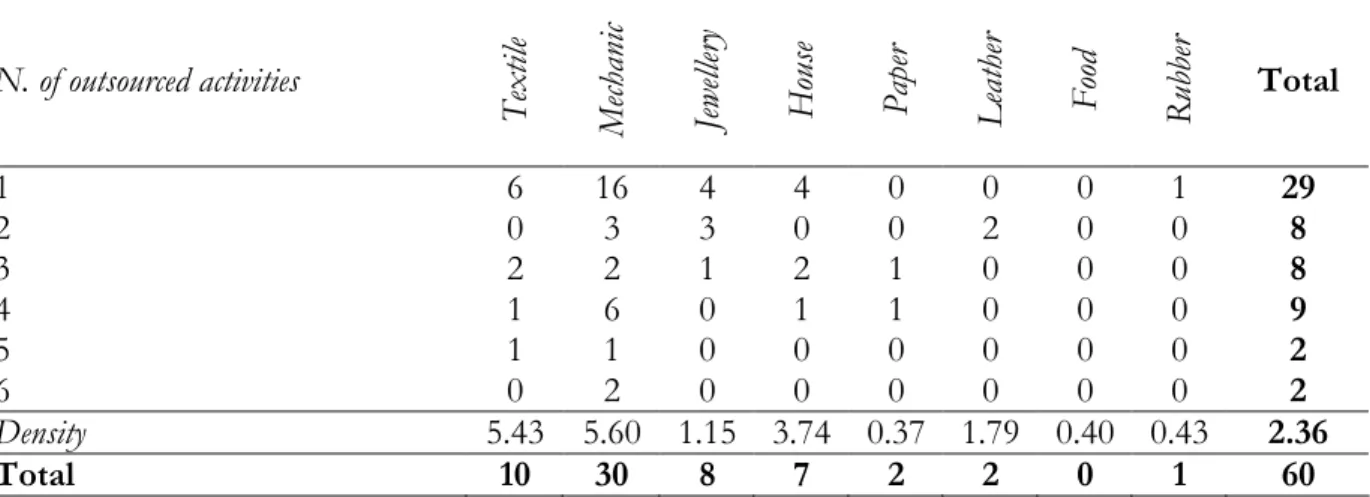
Table 4 – Intensity and complexity of KIBS by type of industrial district N. of outsourced activities T ex ti le M ec ha ni c Je w el le ry H ou se P ap er L ea th er F oo d R ub be r Total 1 6 16 4 4 0 0 0 1 29 2 0 3 3 0 0 2 0 0 8 3 2 2 1 2 1 0 0 0 8 4 1 6 0 1 1 0 0 0 9 5 1 1 0 0 0 0 0 0 2 6 0 2 0 0 0 0 0 0 2 Density 5.43 5.60 1.15 3.74 0.37 1.79 0.40 0.43 2.36 Total 10 30 8 7 2 2 0 1 60
Source: VIII and IX Surveys on Manufacturing Firms (Capitalia, 2001; 2004) and XVIII Censimento generale dell’industria e dei servizi (ISTAT, 2001).
Textile: textiles and garments; Mechanic: mechanical products; Jewellery: jewellery and musical instruments; House: housing related goods; Paper: paper and paper products: Leather: leather and shoes; Food: food and beverages; Rubber:
rubber and plastics. Density= number of local units in each group of districts (by specialization)/total Italian district area.
From Table 4 it is clear that industrial districts specialized in the production of textiles and mechanical products are characterized by the highest level of outsourcing of KIBS. In Italy, the mechanical and textile districts have also the highest density, calculated here as the number of local units of production2 per km2 per district area relative to the national average. Therefore, we
should expect a stronger agglomeration effect for firms in denser more firm populated areas (i.e. textile and mechanical products), since the probability and the number of inter-firm interactions should be higher than in other areas.
3.2. Methodology
The goal of this empirical analysis is to identify which factors have an influence on the volume of outsourced knowledge-intensive activities, which is some indicator of the intensity and the complexity of the outsourcing strategy based on our belief that the more high skill-intensive services firms externalize the higher is the number of interactions they have to manage.
Since we only observe this indicator for a subset of the sample, we are in front of a truncated sample at a threshold level of ci=0 and thus need to correct for such a problem that can bias our
2 According to EUROSTAT ISIC-Rev3 classification, a local unit is any “enterprise or part thereof (e.g. a workshop, factory, warehouse, office, mine or depot) situated in a geographically identified place. At or from this place economic activity is carried out for which - save for certain exceptions - one or more persons work (even if only part-time) for one and the same enterprise”.
OLS estimates. For this reason, we used the Heckman two-step estimator for selection models (Heckman, 1976; 1979). Such models are common in microeconometric studies, particularly in the estimation of wage equations or consumer expenditure.
The procedure adopted is as follows and aims to estimate an equation of the type
) ... ( 0 1x1 x u s y si i = i
β
+β
+ +β
k k + with E(siu|x1,...,xk)=0 (1)where si =1 is the selection indicator that we observe only if ui≤ ci- xiβ and the error term is
normally distributed with zero conditional mean3. Since s
i depends directly on ui, si and ui will not
be uncorrelated, even conditional on xi, so the standard OLS estimator is no longer consistent. The usual way of tackling sample selection bias is to add an explicit selection equation to the population model of interest, e.g.:
u x x yi =
β
0 +β
1 1+...+β
k k + with E(siu|x1,...,xk)=0[
... 0]
1 0 + 1 1+ + + ≥ =γ
γ
γ
m mν
i z z s (2)in which we assume that elements of x and z are always observed and
0 ) ,..., ; ,..., | (u x1 xk z1 zm = E .
The Heckman two-stage estimation method (Heckit) is used to estimate γ using the entire sample and, in a next step, to consistently estimate β on the subset of observations for which the selection variable is observed. Operationally, the Heckit first uses the n observations of the sample and estimates a probit model of si on zi and obtain estimates of
γ
ˆ. Then it calculates the inverse Mill’s ratioλ
ˆi =λ
(zi,γ
ˆ) for each i with si =1 (the selected sample). In the second stage, the selected sample is used to estimate yi on xi andλ
ˆi and obtain estimates of β that areconsistent and approximately normally distributed.
In our case, the selection indicator is given by a dummy variable equal to 1 if firm i has outsourced KIBS in the period 2001-03 (out_kibs), and the second-stage dependent variable is represented by the index of outsourcing complexity (kibs_int), as given by the number of service
3 It is easy to see that when s
i =1, we return to the standard initial model yi =βo+β1x1+...+βkxk+u, whereas, when si
activities externalized over the total number of phases the firm can potentially contract out (in this case seven). The reference questions from the questionnaire are presented in Appendix A. In the first stage we consider two sets of independent variables: (i) controls, and (ii) variables that capture those factors underlying the decisions to outsource KIBS, as suggested by the literature. As controls we include six types of variables: (i) four geographic dummies (North West, North East, Centre and South); (ii) three size dummies (D11-20; D21-249 and D250+); iii) four Pavitt sector dummies (Scale Intensive; Specialised Suppliers; Science Based and Supplier Dominated); (iv) a dummy (Group) measuring whether or not a firm belongs to a business group; (v) a variable (Lage) measuring the age of the firm; and, finally, (vi) a variable measuring the capital intensity of the firm’s production process (K/L). Appendix B provides a more detailed definition of these variables.
In order to capture other factors behind the decision to outsource KIBS, we consider the following variables: (i) labour costs per employee (Labour costs) and (ii) a technology dummy (ICT) which gives information about the firm’s propensity to invest in ICT (Internet and network-based technologies). These two variables are calculated for the 1998-2000 wave, so as to a priori avoid any possible problem of reverse causality in the relationship between the dependent variables and the covariates.
In the second stage equation we include both controls and those variables we think can directly affect the complexity of the outsourcing decision when controlling for unit labour costs and ICT4. We include: (i) a R&D dummy, with the idea that the more the firm invests in R&D the closer it is to the technological frontier and the higher the probability of deciding for a decentralized organizational form (Acemoglu et al., 2006); (ii) a spatial agglomeration dummy (district) capturing the firm’s localization within an industrial district, further decomposed into eight dummies for each type of industrial district listed in Table 4 (text, mech, gold, house, paper, leather, food, rubber); (iii) a geographic agglomeration variable (density) computed, following Ciccone and Hall (1996), as the number of local units belonging to a district d with specialization s per km2
of the district’s area relative to the national average:
4 The are two reasons for deciding not to include the same variables in the first and the second stages: first, we want to avoid as much as possible problems of collinearity among regressors, which can make the Heckit estimations very imprecise; (ii) second, only in the case that a variable appears only at the second stage we interpret its estimated coefficient as the marginal effect of a unit variation in this variable on y (Wooldridge, 2001).
Italy s Italy d s d s d Land Unit Land Unit Density , = , , . (3)
Since it provides a measure of externalities related to the geographic scope of agglomeration economies, this variable is particularly useful to investigate the role played by agglomeration of firms belonging to the same district: the higher the index, the denser is the observed district with respect to the national average, and the higher is the possibility that firms will benefit from knowledge spillover and rapid transmission of ideas.
In addition to these three variables we also include interaction terms between R&D and district dummies/spatial density variables in order to capture the possible joint effects of technology and spatial agglomeration.
4. Empirical results
Tables 5, 6, 7 and 8 report the results of our econometric analysis. The comment on our findings relate to the stages in the Heckman procedure, bearing in mind that in the first stage the dependent variable is related to the decision to outsource at least one stage of firm’s KIBS to external agents, and in the second stage the dependent variable is the number of services outsourced over the total number of activities that firms could potentially externalize.
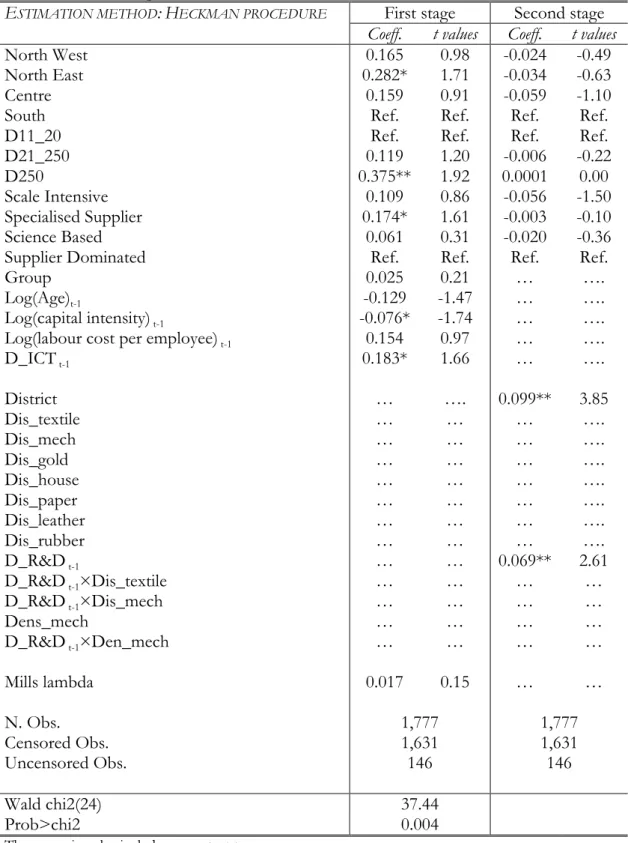
We start with the first stage. An analysis of the results in tables shows that the size dummy capturing firms with more than 251 employees is positive and statistically significant. This can be interpreted as evidence that large firms have a higher probability of contracting out KIBS since they manage a wider range of business activities. In other words, the decision to outsource KIBS depends on firms size. Only large firms are capable of organising their entire activity on a wide, often international scale, based on their better availability of financial capital and strategic resources involving management, organization, logistics and so on. The indicator of capital intensity is statistically significant, but in this case the sign of the coefficient is, as expected, negative. In other words, the higher the capital intensity, the lower the probability of outsourcing KIBS. This means that firms are more willing to outsource labour-intensive phases, which generally are the KIBS. The last explanatory variable that is statistically significant in this first stage of the Heckman procedure is the ICT dummy: that is, a dummy that takes the value 1 if firms have invested in ICT equipments (Internet and network-based technology) during the period 1998-2000 and 0 otherwise. Our results show that this variable is both statistically significant and positive. This can be interpreted as evidence that firms that invest in ICT are
more likely to outsource high skill-intensive services because ICTs (Internet and network-related technology) enable significant reductions in the coordination costs of firms thus generating the conditions for organizing activities through modules. Finally, it is interesting to note that the unit labour cost variable, although positive, is not statistically significant. In other words, according to our econometric findings, labour cost-savings do not seem to be a relevant reason driving the decision to outsource KIBS.
Table 5 – Heckman procedure: estimates
First stage Second stage
ESTIMATION METHOD:HECKMAN PROCEDURE
Coeff. t values Coeff. t values
North West 0.165 0.98 -0.024 -0.49
North East 0.282* 1.71 -0.034 -0.63
Centre 0.159 0.91 -0.059 -1.10
South Ref. Ref. Ref. Ref.
D11_20 Ref. Ref. Ref. Ref.
D21_250 0.119 1.20 -0.006 -0.22
D250 0.375** 1.92 0.0001 0.00
Scale Intensive 0.109 0.86 -0.056 -1.50
Specialised Supplier 0.174* 1.61 -0.003 -0.10
Science Based 0.061 0.31 -0.020 -0.36
Supplier Dominated Ref. Ref. Ref. Ref.
Group 0.025 0.21 … ….
Log(Age)t-1 -0.129 -1.47 … ….
Log(capital intensity) t-1 -0.076* -1.74 … ….
Log(labour cost per employee) t-1 0.154 0.97 … ….
D_ICT t-1 0.183* 1.66 … …. District … …. 0.099** 3.85 Dis_textile … … … …. Dis_mech … … … …. Dis_gold … … … …. Dis_house … … … …. Dis_paper … … … …. Dis_leather … … … …. Dis_rubber … … … …. D_R&D t-1 … … 0.069** 2.61 D_R&D t-1×Dis_textile … … … … D_R&D t-1×Dis_mech … … … … Dens_mech … … … … D_R&D t-1×Den_mech … … … … Mills lambda 0.017 0.15 … … N. Obs. 1,777 1,777 Censored Obs. 1,631 1,631 Uncensored Obs. 146 146 Wald chi2(24) 37.44 Prob>chi2 0.004
The regression also includes a constant term Legend: ** significant at 5%; * significant at 10%
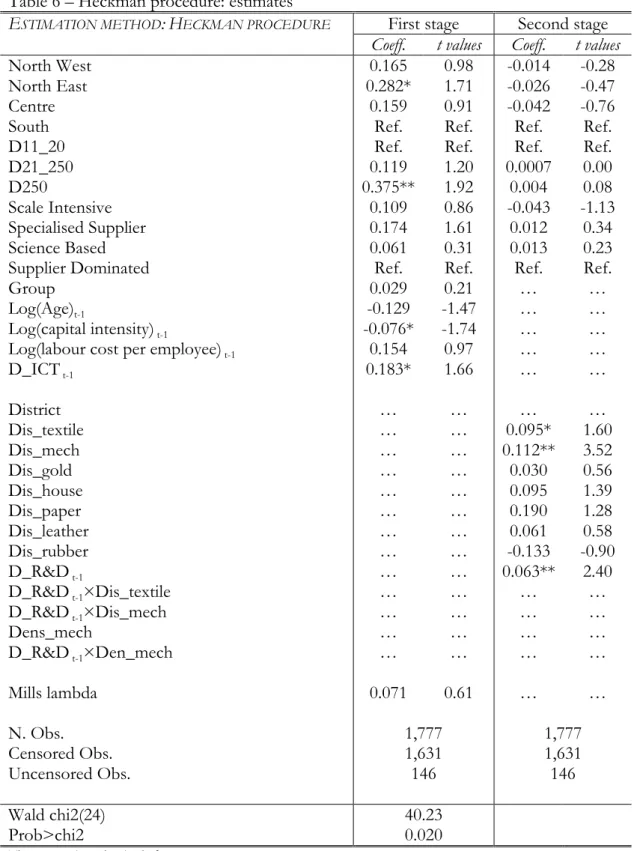
Table 6 – Heckman procedure: estimates
First stage Second stage
ESTIMATION METHOD:HECKMAN PROCEDURE
Coeff. t values Coeff. t values
North West 0.165 0.98 -0.014 -0.28
North East 0.282* 1.71 -0.026 -0.47
Centre 0.159 0.91 -0.042 -0.76
South Ref. Ref. Ref. Ref.
D11_20 Ref. Ref. Ref. Ref.
D21_250 0.119 1.20 0.0007 0.00
D250 0.375** 1.92 0.004 0.08
Scale Intensive 0.109 0.86 -0.043 -1.13
Specialised Supplier 0.174 1.61 0.012 0.34
Science Based 0.061 0.31 0.013 0.23
Supplier Dominated Ref. Ref. Ref. Ref.
Group 0.029 0.21 … …
Log(Age)t-1 -0.129 -1.47 … …
Log(capital intensity) t-1 -0.076* -1.74 … …
Log(labour cost per employee) t-1 0.154 0.97 … …
D_ICT t-1 0.183* 1.66 … … District … … … … Dis_textile … … 0.095* 1.60 Dis_mech … … 0.112** 3.52 Dis_gold … … 0.030 0.56 Dis_house … … 0.095 1.39 Dis_paper … … 0.190 1.28 Dis_leather … … 0.061 0.58 Dis_rubber … … -0.133 -0.90 D_R&D t-1 … … 0.063** 2.40 D_R&D t-1×Dis_textile … … … … D_R&D t-1×Dis_mech … … … … Dens_mech … … … … D_R&D t-1×Den_mech … … … … Mills lambda 0.071 0.61 … … N. Obs. 1,777 1,777 Censored Obs. 1,631 1,631 Uncensored Obs. 146 146 Wald chi2(24) 40.23 Prob>chi2 0.020
The regression also includes a constant term Legend: ** significant at 5%; * significant at 10%
Table 7 – Heckman procedure: estimates
First stage Second stage
ESTIMATION METHOD:HECKMAN PROCEDURE
Coeff. t values Coeff. t values
North West 0.165 0.98 -0.012 -0.25
North East 0.282* 1.71 -0.011 -0.21
Centre 0.159 0.91 -0.040 -0.76
South Ref. Ref. Ref. Ref.
D11_20 Ref. Ref. Ref. Ref.
D21_250 0.119 1.20 0.003 0.14
D250 0.375* 1.92 0.005 0.11
Scale Intensive 0.109 0.86 -0.054 -1.47
Specialised Supplier 0.174* 1.61 0.007 0.22
Science Based 0.061 0.31 -0.007 -0.12
Supplier Dominated Ref. Ref. Ref. Ref.
Group 0.025 0.21 … …
Log(Age)t-1 -0.129 -1.47 … …
Log(capital intensity) t-1 -0.076* -1.74 … …
Log(labour cost per employee) t-1 0.154 0.97 … …
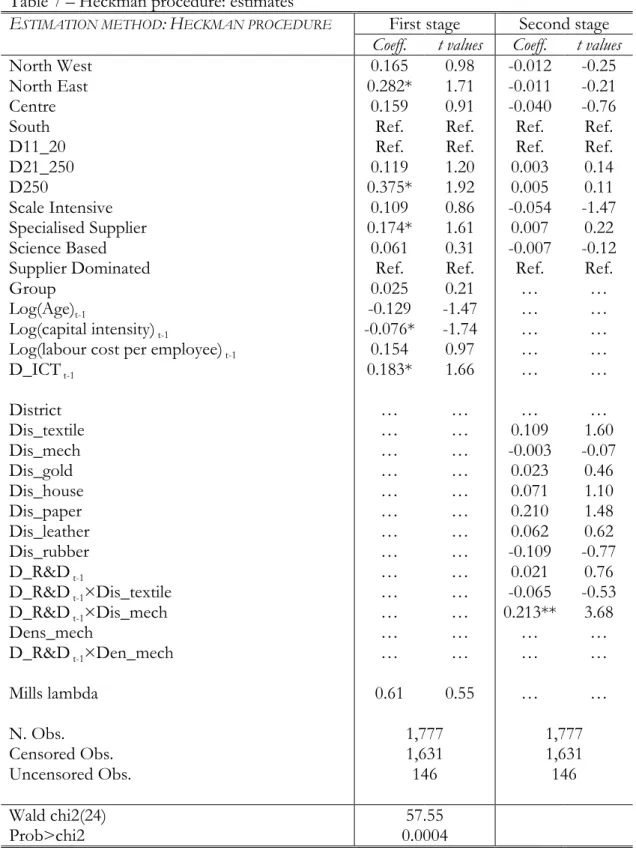
D_ICT t-1 0.183* 1.66 … … District … … … … Dis_textile … … 0.109 1.60 Dis_mech … … -0.003 -0.07 Dis_gold … … 0.023 0.46 Dis_house … … 0.071 1.10 Dis_paper … … 0.210 1.48 Dis_leather … … 0.062 0.62 Dis_rubber … … -0.109 -0.77 D_R&D t-1 … … 0.021 0.76 D_R&D t-1×Dis_textile … … -0.065 -0.53 D_R&D t-1×Dis_mech … … 0.213** 3.68 Dens_mech … … … … D_R&D t-1×Den_mech … … … … Mills lambda 0.61 0.55 … … N. Obs. 1,777 1,777 Censored Obs. 1,631 1,631 Uncensored Obs. 146 146 Wald chi2(24) 57.55 Prob>chi2 0.0004
The regression also includes a constant term Legend: ** significant at 5%; * significant at 10%
Table 8 – Heckman procedure: estimates
First stage Second stage
ESTIMATION METHOD:HECKMAN PROCEDURE
Coeff. t values Coeff. t values
North West 0.165 0.98 -0.007 -0.14
North East 0.282* 1.71 0.0007 0.01
Centre 0.159 0.91 -0.035 -0.66
South Ref. Ref. Ref. Ref.
D11_20 Ref. Ref. Ref. Ref.
D21_250 0.119 1.20 0.004 0.16
D250 0.375* 1.92 0.001 0.04
Scale Intensive 0.109 0.86 -0.051 -1.34
Specialised Supplier 0.174 1.61 0.006 0.18
Science Based 0.061 0.31 0.010 0.19
Supplier Dominated Ref. Ref. Ref. Ref.
Group 0.025 0.21 … …
Log(Age)t-1 -0.129 -1.47 … …
Log(capital intensity) t-1 -0.076* -1.74 … …
Log(labour cost per employee) t-1 0.154 0.97 … …
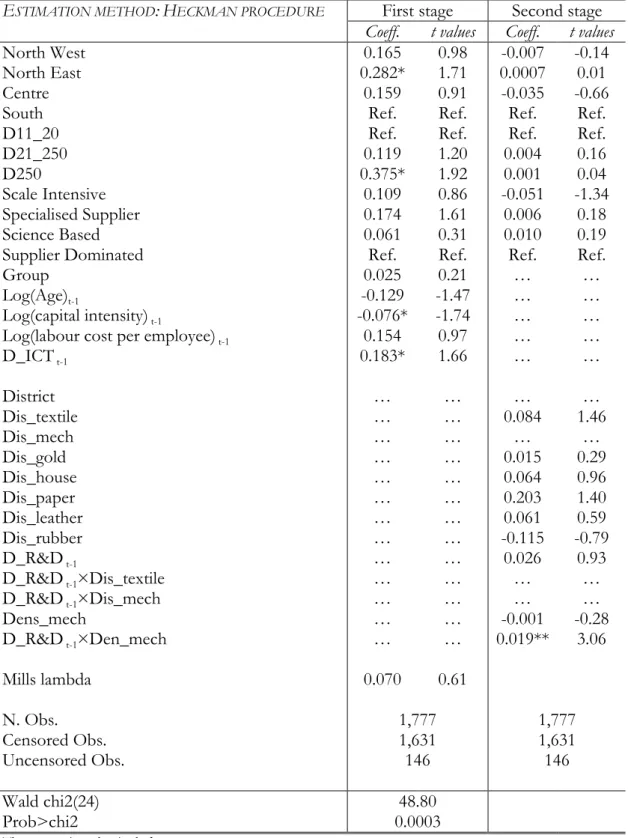
D_ICT t-1 0.183* 1.66 … … District … … … … Dis_textile … … 0.084 1.46 Dis_mech … … … … Dis_gold … … 0.015 0.29 Dis_house … … 0.064 0.96 Dis_paper … … 0.203 1.40 Dis_leather … … 0.061 0.59 Dis_rubber … … -0.115 -0.79 D_R&D t-1 … … 0.026 0.93 D_R&D t-1×Dis_textile … … … … D_R&D t-1×Dis_mech … … … … Dens_mech … … -0.001 -0.28 D_R&D t-1×Den_mech … … 0.019** 3.06 Mills lambda 0.070 0.61 N. Obs. 1,777 1,777 Censored Obs. 1,631 1,631 Uncensored Obs. 146 146 Wald chi2(24) 48.80 Prob>chi2 0.0003
The regression also includes a constant term Legend: ** significant at 5%; * significant at 10%
In the second stage of the Heckman procedure, the dependent variable is constituted by the number of services outsourced over the total number of activities that firms could potentially externalize. This variable can be interpreted as a measure of intensity and complexity of KIBS outsourcing activity. What emerges first from the econometric findings is the role of the R&D dummy, which measures whether or not firms invested in R&D activities during the period 1998-2000. This dummy is statistically significant and positive. This finding is in line with Acemoglu et al., 2006: i.e., the closer the firm is to the technological frontier, the more it will focus on its technological core, and seek to decentralize complementary activities.
Another interesting result concerns the role of spatial agglomeration on these processes. As already noted we measured this variable in two ways: first, using a dummy indicating whether or nor a firm belongs to an industrial district, and secondly using a measure of spatial density. What emerges is that firms belonging to industrial districts, in general, are more prone to outsource higher volumes of KIBS. This is particularly true for textile and mechanical industrial districts. As far as the spatial density measure is concerned, we can see that the higher the density of the industrial district, the higher the intensity and complexity, from an organizational point of view, of KIBS outsourcing. It is interesting to note that the results are similar whatever variable is used to measure spatial agglomeration. This means that within this context what matters is not elements specific to industrial districts such as the social dimension or the sharing of a common system of cultural and social values, as suggested by the traditional literature on Italian industrial districts (Brusco, 1982; Becattini, 1989; Dei Ottati, 1994; Brusco et al., 1996; Cainelli, 2007), but simply the forces associated with spatial proximity.
These findings can be generally interpreted as a symptom that spatial agglomeration externalities, however measured, matter in driving the choice about how many services firms will contract out. In fact, Marshallian externalities make more convenient to contract out KIBS since spatial proximity, face-to-face contacts, trust and better control of quality and time delivery allowed by the existence, within a bounded geographic area, of multiple specialized service providers make it easier to manage a range of complex tasks characterized by a high degree of complexity and non-codifiable aspects. More generally, spatial agglomeration reduces transaction costs for district firms allowing them to organize their activities in modules, and to contract out KIBS activities. Finally, we introduced some interaction terms into our econometric specifications. The main result of this analysis is confirmation that, as suggested by some recent contributions (Cainelli et. al. 2007b; Cainelli and Iacobucci, 2007) spatial agglomeration matters only when it is linked to technology. This result seems to be particularly true in the case of mechanical districts. In this
case the interaction term between the R&D and the mechanic district dummy is positive and highly statistically significant. This means that the more technologically advanced is the firm, and the denser is the agglomerated area in which it is located, the higher the intensity and the complexity of KIBS outsourcing. The outsourcing by district firms of high skill-intensive phases, requires trust, face-to-face interactions, knowledge transfer, quality and time delivery control, etc., and thus the localization of KIBS providers within industrial clusters represents – according to our econometric findings – a relevant strategic condition for fostering these processes. In other words, the interaction between spatial agglomeration and technology affects KIBS outsourcing and thus firms’ organization and governance, since district firms specialized in the production of mechanical products seem generally to show a higher propensity to focus on their technological core.
5. Conclusions
Since the mid 1980s a new form of division of labour has emerged in which firms split up the production stages of their value chain into different modules, whose production can be located outside the firm’s boundaries in order to exploit the benefits of localization.
Although initially it was the production of low skill-intensive, low-quality goods that was commonly outsourced, technological progress and reduction in transport and communication costs, has encouraged the outsourcing of high skill-intensive, high-quality goods and services. The outsourcing of services, and, particularly, KIBS has received relatively little attention in the empirical literature which has generally focused on exploring its main effects in terms of firm profitability and domestic employment.
In this paper we have examined the determinants of the decision to outsource KIBS at firm level. Working with a sample of Italian manufacturing firms for the period 1998-2003, we investigated the main factors underlying the intensity and the complexity of the KIBS outsourcing process, as expressed by the number of service activities actually externalized by each firm. After correcting for sample selection, we find that: (i) the propensity to outsource is not affected by labour cost savings reasons, but depends directly on the firm’s size and investment in ICT equipment, and is negatively related to the firm’s capital intensity; (ii) the volume of KIBS outsourcing is positively related to its investment in R&D, belonging to a relatively dense local production system and the interaction between R&D and spatial agglomeration, which is particularly evident in mechanical industrial districts.
Our results are in line with the literature emphasizing the role of agglomeration externalities in affecting the decision to relocate knowledge-intensive activities on a domestic, or local scale, where geographic proximity, knowledge spillovers and closer interaction among agents make it easier for firms to manage complex transactions and increase their competitiveness even in the face of increasing globalization of production.
References
Abraham K.G., Taylor S.K. (1996), Firm’s use of outside contractors: theory and evidence, Journal of Labor Economics, vol. 14. n. 3, pp. 394-424.
Acemoglu D.K., Aghion P., Lelarge C., Van Reenen J., Zilibotti F. (2006), Technology, information and the decentralization of the firm, NBER Working Paper n. 12206.
Amiti M., Wei S.J. (2005), Fear of service outsourcing. Is it justified?, Economic Policy, April, pp. 307-347.
Amiti M., Wei S.J. (2006), Service offshoring and productivity: evidence from the United States, NBER Working Paper n. 11926, January.
Bartel A.P., Lach S., Sicherman N. (2005), Outsourcing and technological change, NBER Working Paper n. 11158, February.
Becattini G. (1989), Sectors and/or districts: Some remarks on the conceptual foundation of industrial economics, Goodman E., Bamford J. (eds), Small firms and industrial districts in Italy, Routledge, London.
Borga M., Zeile W.J. (2004), International fragmentation of production and the intrafirm trade of United States multinational companies, Bureau of Economic Analysis, Working Paper n. 2004-02. Bronzini, R. (2004), Foreign direct investment and agglomeration: evidence from Italy, Banca d’Italia, Tema di Discussione n. 526, December.
Brusco S. (1982), The Emilian model: production decentralisation and social integration, Cambridge Journal of Economics, vol. 6, n. 2, pp. 167-184.
Brusco S. Cainelli G., Forni F., Franchi M., Malusardi A., Righetti R. (1996), The evolution of industrial districts in Emilia Romagna, Cossentino F., Pyke F., Sengenberger W. (eds), Local and regional response to global pressure. The case of Italy and its industrial districts, International Labour Office (ILO), Geneve.
Cainelli G., Leoncini R. (1999), Externalities and long-term local industrial development. Some evidence from Italy”, Revue d’Economie Industrielle, n. 4, pp. 25-39, 1999.
Cainelli G., Evangelista R., Savona M. (2006), Innovation and economic performance in services. A firm-level analysis, Cambridge Journal of Economics, vol. 30, n. 3, pp. 435-458, 2006.
Cainelli G. (2007), Industrial districts. Theoretical and empirical insights, Handbook of Research on Clusters: Theories, Policies and Case Studies (ed. Karlsson C.), Edward Elgar, Cheltenham (forthcoming).
Cainelli G., Iacobucci D. (2007), Agglomeration, technology, and business groups, Edward Elgar, Cheltenham (forthcoming).
Cainelli G., Leoncini R., Montini A. (2007a), Spatial knowledge spillovers and regional productivity growth in Europe, Revue d’ Economie Régionale et Urbaine, n. 2, pp. 201-222, 2007. Cainelli G., Mazzanti M., Mancinelli S. (2007b) Social capital and innovation dynamics in district-based local systems, Journal of Socio-Economics, n. 6., vol. 36 (forthcoming).
Ciccone A., Hall R. (1996), Productivity and the density of economic activity, American Economic Review, vol. 86, n.1, pp. 54-70.
Dei Ottati G. (1994), Trust, interlinking transactions and credit in the industrial district, Cambridge Journal of Economics, vol. 18, n.6.
Federico S. (2006), L’internazionalizzazione produttiva italiana e I distretti industriali: un’analisi degli investimenti diretti all’estero, Banca d’Italia, Tema di Discussione n. 592, May.
Feenstra R.C., Hanson G.H. (1996), Globalizaton, outsourcing and wage inequality, American Economic Review, vol. 86, n. 2, pp. 240-245.
Girma S., Görg H. (2004), Outsourcing, foreign ownership and productivity: evidence from UK establishment level data, Review of International Economics, vol. 12, n. 5, pp. 817-832.
Görg H., Hanley A. (2004), Does outsourcing increase profitability? The Economic and Social Review, vol. 35, n. 3, pp. 367-387.
Glaeser E.L., Kallal H.D., Sheinkman J.A., Shleifer A. (1992), Growth in cities, Journal of Political Economy, vol. 100, n. 6, pp. 1126-1152.
Grossman G. M., Rossi-Hansberg E. (2006), Trading tasks: a simple theory of offshoring, NBER Working Paper n. 12721, December.
Head K.J., Ries J., Swenson D. (1995), Agglomeration benefits and location choice: evidence from Japanese manufacturing plants, Journal of International Economics, vol. 38, n. 3-4, pp. 223-247. Heckman J.J. (1976), The common structure of statistical models of truncation, sample selection, and limited dependent variables and a simple estimator for such models, Annals of Economic and Social Measurement, vol. 5, pp. 475-492.
Heckman J.J. (1979), Sample selection bias as specification error, Econometrica, vol. 47, n.1, pp. 153-161.
Hölzl W., Reinstaller A., Windrum P. (2005), Organisational innovation, information technology, and outsourcing to business services, MERIT-Infonomics Research Memorandum n. 2005-030, Maastricht University.
Jones R.W., Kierzkowski H. (2001), A framework for fragmentation, in Arndt S.W. and Kierzkowski H. (Eds.), Fragmentation: new production patterns in the world economy, Oxford, Oxford University Press.
Koschatzky K., Zenker A. (1999), The regional embeddedness of small manufacturing and service firms: regional networking as knowledge source of innovation, ISI, Regions and Firms Working Paper n. R2/1999.
McCarthy I., Anagnostou A. (2004), The impact of outsourcing on the transaction cost and boundaries of manufacturing, International Journal of Production Economics, vol. 88, pp. 61-71.
Miles I., Kastrinos N., Flanagan K., Bilderbeek R., den Hertog P., Huntink W., Bouman M. (1995), Knowledge intensive business services: their roles as users, carriers and sources of innovation, Report to DG13 SPRINT-EIMS, PREST, Manchester, March.
Montresor S., Vittucci Marzetti G. (2007), Outsourcing and structural change: what can input-output analysis say about it?, Economia Politica, vol. 24, n. 1, April.
Muller E. (2001), Innovation interactions between knowledge-intensive business services and small-and medium-sized enterprises: analysis in terms of evolution, knowledge and territories, Physica, Heidelberg.
Muller E., Zenker A. (2001), Business services as actors of knowledge transformation: the role of KIBS in regional and national innovation systems, Research Policy, vol. 30, pp. 1501-1516.
Strambach S. (2001), Innovation processes and the role of knowledge-intensive business services, in Koschatzky K., Kulicke M. and Zenker A. (Eds.), Innovation networks: concepts and challenges in the European perspective, Physica, Heidelber, pp. 53-68.
Wheeler D., Mody A. (1992), International investment location decision, Journal of International Economics, vol. 33, n. 1-2, pp. 55-76.
Wooldridge J.M. (2001), Econometric analysis of cross section and panel data, Cambridge (MA), MIT Press.
Yeats A.J. (2001), Just how big is global production sharing?, in Arndt S.W. and Kierzkowski H. (Eds.), Fragmentation: new production patterns in the world economy, Oxford, Oxford University Press.
Appendix A
Definition of KIBS outsourcing from the questionnaire
(1) In the three years 2001-2003, has the firm externalized (outsourcing) activities that were previously integrated?
1. Yes 2. No
(2) If yes, indicate which ones:
1. Stages of the production process 2. Administrative-managerial activities 3. Accounting and bookkeping
4. Computer-related activities
5. Research and development, engineering, design 6. Testing and technical analyses
7. Advertising
8. Research of personnel 9. Storage and packing 10. Janitorial services 11. Call center
12. Other activities (specify)
Appendix B Variables description
Variable Description
Dependent Variables
Out_kibs 1 if the firm has outsourced at least one stage of its KIBS activities to external agents; 0 otherwise
Kibs_int Number of services outsourced over total number of activities the firm could potentially externalize (seven)
Independent variables Age
Lage Natural logarithm (2003-year of firm’s set-up) Geographical Area
North West Liguria, Lombardia, Piemonte, Valle d’Aosta
North East Emilia-Romagna, Friuli Venezia-Giulia, Trentino Alto-Adige, Veneto Centre Abruzzo, Lazio, Marche, Molise, Toscana, Umbria
South Basilicata, Calabria, Campania, Puglia, Sardegna, Sicilia Employment Size
D11_20 11-20 employees
D21_250 21-250 employees
D250 251+ employees
Sector of economic activity – Pavitt classification
Supplier dominated Textiles, footwear, food and beverage, paper and printing, wood Scale intensive Basic metals, motor vehicles and trailers
Specialized suppliers Machinery and equipment, office accounting and computer machinery, medical optical and precision instruments Science based Chemicals, pharmaceuticals, electronics
Groups of firms
Group 2003 1 if the firms belonged to a business group at 31.12.2003; 0 otherwise Capital intensity Log of average capital-labor ratio for 1998-2000
Unit Labor Costs
Labor cost Log of labour cost per employee (1998-2000) Technology
ICT 1 if the firm has invested in ICT equipment (internet and network-based technology) in the period 1998-2000; 0 otherwise
R&D 1 if the firm has invested in R&D in the period 1998-2000; 0 otherwise
Spatial agglomeration
District 1 if the firm is located within an industrial district (ISTAT classification)
Density Number of local units placed in district d with specialization s per km2 of the district’s land surface relative to the national average
Districts specialization
Textile Textile and garments Mechanic Mechanical products
Gold Jewellery and music instruments House Housing-related goods
Leather Leather and shoes
Food Food and beverages
Rubber Rubber and plastics Interaction terms
R&D_district 1 if the firm has invested in R&D and is located within an industrial district (R&D * District)
R&D_Textile 1 if the firm has invested in R&D and is located within a district specialized in textiles and garments
R&D_Mechanic 1 if the firm has invested in R&D and is located within a district specialized in mechanical products
R&D_density R&D * Density
Density_Mechanic Density of Mechanical districts (Density*Mechanic) R&D_density_mechanic R&D*Density*Mechanic
NOTE DI LAVORO DELLA FONDAZIONE ENI ENRICO MATTEI Fondazione Eni Enrico Mattei Working Paper Series
Our Note di Lavoro are available on the Internet at the following addresses:
http://www.feem.it/Feem/Pub/Publications/WPapers/default.htm http://www.ssrn.com/link/feem.html
http://www.repec.org http://agecon.lib.umn.edu http://www.bepress.com/feem/
NOTE DI LAVORO PUBLISHED IN 2007
NRM 1.2007 Rinaldo Brau, Alessandro Lanza, and Francesco Pigliaru: How Fast are Small Tourism Countries Growing?
The 1980-2003 Evidence
PRCG 2.2007 C.V. Fiorio, M. Florio, S. Salini and P. Ferrari: Consumers’ Attitudes on Services of General Interest in the EU: Accessibility, Price and Quality 2000-2004
PRCG 3.2007 Cesare Dosi and Michele Moretto: Concession Bidding Rules and Investment Time Flexibility
IEM 4.2007 Chiara Longo, Matteo Manera, Anil Markandya and Elisa Scarpa: Evaluating the Empirical Performance of
Alternative Econometric Models for Oil Price Forecasting
PRCG 5.2007 Bernardo Bortolotti, William Megginson and Scott B. Smart: The Rise of Accelerated Seasoned Equity
Underwritings
CCMP 6.2007 Valentina Bosetti and Massimo Tavoni: Uncertain R&D, Backstop Technology and GHGs Stabilization
CCMP 7.2007 Robert Küster, Ingo Ellersdorfer, Ulrich Fahl (lxxxi): A CGE-Analysis of Energy Policies Considering Labor
Market Imperfections and Technology Specifications
CCMP 8.2007 Mònica Serrano (lxxxi): The Production and Consumption Accounting Principles as a Guideline for Designing
Environmental Tax Policy
CCMP 9.2007 Erwin L. Corong (lxxxi): Economic and Poverty Impacts of a Voluntary Carbon Reduction for a Small
Liberalized Developing Economy: The Case of the Philippines
CCMP 10.2007 Valentina Bosetti, Emanuele Massetti, and Massimo Tavoni: The WITCH Model. Structure, Baseline, Solutions
SIEV 11.2007 Margherita Turvani, Aline Chiabai, Anna Alberini and Stefania Tonin: Public Policies for Contaminated Site
Cleanup: The Opinions of the Italian Public
CCMP 12.2007 M. Berrittella, A. Certa, M. Enea and P. Zito: An Analytic Hierarchy Process for The Evaluation of Transport Policies to Reduce Climate Change Impacts
NRM 13.2007 Francesco Bosello, Barbara Buchner, Jacopo Crimi, Carlo Giupponi and Andrea Povellato: The Kyoto
Protocol and the Effect of Existing and Planned Measures in the Agricultural and Forestry Sector in the EU25
NRM 14.2007 Francesco Bosello, Carlo Giupponi and Andrea Povellato: A Review of Recent Studies on Cost Effectiveness of
GHG Mitigation Measures in the European Agro-Forestry Sector
CCMP 15.2007 Massimo Tavoni, Brent Sohngen, and Valentina Bosetti: Forestry and the Carbon Market Response to Stabilize
Climate
ETA 16.2007 Erik Ansink and Arjan Ruijs: Climate Change and the Stability of Water Allocation Agreements
ETA 17.2007 François Gusdorf and Stéphane Hallegatte: Compact or Spread-Out Cities: Urban Planning, Taxation, and the
Vulnerability to Transportation Shocks
NRM 18.2007 Giovanni Bella: A Bug’s Life: Competition Among Species Towards the Environment
IEM 19.2007 Valeria Termini and Laura Cavallo: “Spot, Bilateral and Futures Trading in Electricity Markets. Implications for Stability”
ETA 20.2007 Stéphane Hallegatte and Michael Ghil: Endogenous Business Cycles and the Economic Response to Exogenous
Shocks
CTN 21.2007 Thierry Bréchet, François Gerard and Henry Tulkens: Climate Coalitions: A Theoretical and Computational
Appraisal
CCMP 22.2007 Claudia Kettner, Angela Köppl, Stefan P. Schleicher and Gregor Thenius: Stringency and Distribution in the
EU Emissions Trading Scheme –The 2005 Evidence
NRM 23.2007 Hongyu Ding, Arjan Ruijs and Ekko C. van Ierland: Designing a Decision Support System for Marine Reserves
Management: An Economic Analysis for the Dutch North Sea
CCMP 24.2007 Massimiliano Mazzanti, Anna Montini and Roberto Zoboli: Economic Dynamics, Emission Trends and the EKC
Hypothesis New Evidence Using NAMEA and Provincial Panel Data for Italy
ETA 25.2007 Joan Canton: Redealing the Cards: How the Presence of an Eco-Industry Modifies the Political Economy of
Environmental Policies
ETA 26.2007 Joan Canton: Environmental Taxation and International Eco-Industries
CCMP 27.2007 Oscar Cacho and Leslie Lipper (lxxxii): Abatement and Transaction Costs of Carbon-Sink Projects Involving
Smallholders
CCMP 28.2007 A. Caparrós, E. Cerdá, P. Ovando and P. Campos (lxxxii): Carbon Sequestration with Reforestations and
Biodiversity-Scenic Values
CCMP 30.2007 Raul Ponce-Hernandez (lxxxii): A Modelling Framework for Addressing the Synergies between Global Conventions through Land Use Changes: Carbon Sequestration, Biodiversity Conservation, Prevention of Land Degradation and Food Security in Agricultural and Forested Lands in Developing Countries
ETA 31.2007 Michele Moretto and Gianpaolo Rossini: Are Workers’ Enterprises Entry Policies Conventional
KTHC 32.2007 Giacomo Degli Antoni: Do Social Relations Affect Economic Welfare? A Microeconomic Empirical Analysis
CCMP 33.2007 Reyer Gerlagh and Onno Kuik: Carbon Leakage with International Technology Spillovers
CCMP 34.2007 Richard S.J. Tol: The Impact of a Carbon Tax on International Tourism
CCMP 35.2007 Reyer Gerlagh, Snorre Kverndokk and Knut Einar Rosendahl: Optimal Timing of Environmental Policy;
Interaction Between Environmental Taxes and Innovation Externalitie
SIEV 36.2007 Anna Alberini and Alberto Longo: Valuing the Cultural Monuments of Armenia: Bayesian Updating of Prior
Beliefs in Contingent Valuation
CCMP 37.2007 Roeland Bracke, Tom Verbeke and Veerle Dejonckheere: What Distinguishes EMAS Participants? An
Exploration of Company Characteristics
CCMP 38.2007 E. Tzouvelekas, D. Vouvaki and A. Xepapadeas: Total Factor Productivity Growth and the Environment: A Case
for Green Growth Accounting
CCMP 39.2007 Klaus Keller, Louise I. Miltich, Alexander Robinson and Richard S.J. Tol: How Overconfident are Current
Projections of Anthropogenic Carbon Dioxide Emissions?
CCMP 40.2007 Massimiliano Mazzanti and Roberto Zoboli: Environmental Efficiency, Emission Trends and Labour
Productivity: Trade-Off or Joint Dynamics? Empirical Evidence Using NAMEA Panel Data
PRCG 41.2007 Veronica Ronchi: Populism and Neopopulism in Latin America: Clientelism, Trade Union Organisation and
Electoral Support in Mexico and Argentina in the ‘90s
PRCG 42.2007 Veronica Ronchi: The Neoliberal Myth in Latin America: The Cases of Mexico and Argentina in the ‘90s
CCMP 43.2007 David Anthoff, Cameron Hepburn and Richard S.J. Tol: Equity Weighting and the Marginal Damage Costs of
Climate Change
ETA 44.2007 Bouwe R. Dijkstra and Dirk T.G. Rübbelke: Group Rewards and Individual Sanctions in Environmental Policy
KTHC 45.2007 Benno Torgler: Trust in International Organizations: An Empirical Investigation Focusing on the United Nations
CCMP 46.2007 Enrica De Cian, Elisa Lanzi and Roberto Roson: The Impact of Temperature Change on Energy Demand: A
Dynamic Panel Analysis
CCMP 47.2007 Edwin van der Werf: Production Functions for Climate Policy Modeling: An Empirical Analysis
KTHC 48.2007 Francesco Lancia and Giovanni Prarolo: A Politico-Economic Model of Aging, Technology Adoption and
Growth
NRM 49.2007 Giulia Minoia: Gender Issue and Water Management in the Mediterranean Basin, Middle East and North Africa
KTHC 50.2007 Susanna Mancinelli and Massimiliano Mazzanti: SME Performance, Innovation and Networking Evidence on
Complementarities for a Local Economic System
CCMP 51.2007 Kelly C. de Bruin, Rob B. Dellinkand Richard S.J. Tol: AD-DICE: An Implementation of Adaptation in the DICE
Model
NRM 52.2007 Frank van Kouwen, Carel Dieperink, Paul P. Schot and Martin J. Wassen: Interactive Problem Structuring with
ICZM Stakeholders
CCMP 53.2007 Valeria Costantini and Francesco Crespi: Environmental Regulation and the Export Dynamics of Energy
Technologies
CCMP 54.2007 Barbara Buchner, Michela Catenacci and Alessandra Sgobbi: Governance and Environmental Policy
Integration in Europe: What Can We learn from the EU Emission Trading Scheme?
CCMP 55.2007 David Anthoff and Richard S.J. Tol: On International Equity Weights and National Decision Making on Climate
Change
CCMP 56.2007 Edwin van der Werf and Sonja Peterson: Modeling Linkages Between Climate Policy and Land Use: An
Overview
CCMP 57.2007 Fabien Prieur: The Environmental Kuznets Curve in a World of Irreversibility
KTHC 58.2007 Roberto Antonietti and Giulio Cainelli: Production Outsourcing, Organizational Governance and Firm’s
Technological Performance: Evidence from Italy
SIEV 59.2007 Marco Percolo: Urban Transport Policies and the Environment: Evidence from Italy
ETA 60.2007 Henk Folmer and Pierre von Mouche: Linking of Repeated Games. When Does It Lead to More Cooperation
and Pareto Improvements?
CCMP 61.2007 Arthur Riedacker (lxxxi): A Global Land Use and Biomass Approach to Reduce Greenhouse Gas Emissions,
Fossil Fuel Use and to Preserve Biodiversity
CCMP 62.2007 Jordi Roca and Mònica Serrano: Atmospheric Pollution and Consumption Patterns in Spain: An Input-Output
Approach
CCMP 63.2007 Derek W. Bunn and Carlo Fezzi (lxxxi): Interaction of European Carbon Trading and Energy Prices
CTN 64.2007 Benjamin Golub and Matthew O. Jackson (lxxxiii): Naïve Learning in Social Networks: Convergence, Influence
and Wisdom of Crowds
CTN 65.2007 Jacob K. Goeree, Arno Riedl and Aljaž Ule (lxxxiii): In Search of Stars: Network Formation among
Heterogeneous Agents
CTN 66.2007 Gönül Doğan, M.A.L.M. van Assen, Arnout van de Rijt, and Vincent Buskens (lxxxiii): The Stability of
Exchange Networks
CTN 67.2007 Ben Zissimos (lxxxiii): Why are Trade Agreements Regional?
CTN 68.2007 Jacques Drèze, Michel Le Breton, Alexei Savvateev and Shlomo Weber (lxxxiii): «Almost» Subsidy-free Spatial