!
!
!
ROSKILDE UNIVERSITY
!
Department of Communication, Business and Information Technologies
Semester Project on Internal Branding
!
(A case study of Coca-Cola and Google)
!
Submitted by
Project Supervisor
Rajendra Dhakal (51250) Christian Skjald
Ramesh Rijal (50593)
February 9, 2015
Table of Contents
!
Abstract ...3 CHAPTER 1: INTRODUCTION ...4 1.1 Background ...4 1.2 Internal Branding: ...5 1.3 Problem Area ...7 1.4 Problem statement ...81.5 Specification and demarcation ...8
1.6 Target audience: ...9
1.7 Structure of the Paper: ...9
CHAPTER 2: METHODOLOGY ...12
2.1 Research Philosophy ...12
2.2 Research Approach ...14
2.3 Quantitative Research and Qualitative Research ...15
2.4 Research Strategy ...16
2.5 Collection of data ...18
2.6 Research Techniques ...18
2.7 Ethical Issues ...19
2.8 Securing the quality of data ...20
2.9 Limitation of the project: ...21
CHAPTER 3: REVIEW OF LITERATURE ...22
3.2 Internal branding mechanisms: ...23
3.3 Brand Identity: ...25
3.4 Brand commitment: ...30
3.5 Brand loyalty: ...32
Chapter 4: CONTEXTUALISATION ...35
4.1 Company profile: The Coca-Cola Company ...35
4.2 Company profile: Google ...40
CHAPTER 5: ANALYSIS ...45
CHAPTER 6: DISCUSSION AND CONCLUSION ...60
DISCUSSION ...60
AREAS OF FURTHER STUDY ...66
Note to Examiners
We would like to inform that this project report is the collaboration of four students (Anu Rai, Josphat Omanga, Rajendra Dhakal and Ramesh Rijal). Unfortunately, the group has been split into two groups and they are:
1. Anu Rai and Josphat Omanga
2. Rajendra Dhakal (51250) and Ramesh Rijal (50593)
!
Thus, both groups have identical project report.
!
!
!
!
Abstract
The project report provides an insight into internal branding of two different leading firms – Coca-Cola and Google. The aim of this project report is to study how these two companies use internal branding to promote or build brand performance of the company. This report fol-lows a qualitative research method. The report is deductive in nature and hence, it is guided by the literatures of internal branding.
The project report conducted research on brand identity, brand commitment and brand loyalty of employees in Coca-Cola and Google. The positive findings of brand identity, brand com-mitment and brand loyalty will lead to better brand performance of the employees and the company as a whole. The findings show that Coca-Cola and Google are able to create distinc-tive brand identity and communicate it through continuous open dialogue to its employees. The employees working in these companies are fully committed because of the brand-fit sys-tem, effective communication, autonomy in work, and supportive leadership behaviour of the management. The work environment and culture of Coca-Cola and Google shaped their em-ployees to be more loyal for the brand they work for. From the analysis, it can be seen that Coca-Cola and Google are able to secure brand identity, brand commitment and brand loyalty of employees, which is reflected in better brand performance.
!
CHAPTER 1: INTRODUCTION
This chapter presents introduction of branding, problem area, problem statement, target audi-ence and structure of the project. The chapter begins with the background and meaning of branding given by different scholars. It also provides brief overview of the internal branding, which is the main area of the research in the project. It further discuss the problem area and problem formulation raised from the areas of internal branding. The chapter ends with outli-ning the structure of the project.
1.1 Background
Product Brand and Consumers
With the growing awareness towards the financial value of the brand in the period of 1980, banding has attracted considerable interest among consultants, researchers and scholars (de Chernatory, 1999) though it has been realised as the concurrent topic for a long period (Schultz & Hatch, 2003). “A brand is a label, a delegating right by a company, which we can experience, make evaluation and have some feeling towards and building some kinds of asso-ciation with to perceive value” (Bakus et al., 2009). Giving emphasis on perception Dunan and Moiarty, (1998) said: In order to create brand value “perception plays more role than real-ity” and the company as a brand can only exist in the mind of customers as the management can successfully manage the perception of customers towards the company.
A brand is regarded as ‘‘a purveyor of advantages’’ when we look from consumer perspective (O’Cass & Grace, 2003, p. 452). Apart from communicating the source of offering (Aaker, 1991; 1996), brand also indicates quality and further minimizes cost of search and the risk of transactions (Davis et al., 2000; Janiszewski & van Osselaer, 2000; Keller, 1998). This shows that organization having strong brand image are in advantage. The organization having strong brands has described it as one of the most valuable assets of an organization, which contribute as primary source of differentiation from other brands (Grace & O’Cass, 2005a). Therefore, one can argue that a an organization with powerful brand may able to gain a sustainable com-petitive advantage that will lead to long-term profitability based on increased market share, positive word-of-mouth, reduced marketing costs, and premium price charged on products
(Aaker, 1996; Chaudhuri & Holbrook, 2001; Jacoby & Chestnut, 1978). So, Brand is becom-ing more valuable intangible resources for any organisation to constantly retain existbecom-ing cus-tomers, attract new customers and compete in the diverse marketplace.
Harris and de Chernatony (2001) argued, “Brands are thus multi-dimensional creations that coordinate a company’s operational and emotional values with customer activities and their various needs”. Supporting this idea Simoes and Dibb (2001) also stated, the company should try to create branding in such a way that it strikes the consumers’ mind and they believe and feel that they are purchasing brands and not any regular products. Further, Morsing (2006)also proposed that branding focuses on developing emotional value to its target customer, which fundamentally creates an imaginative and visual associations to increase the appeal of prod-ucts or services.
Although most of the scholars (some discussed above) has put their views and perspective regarding the relations between brand and consumers, they came with the conclusion that brands play an integral part in today’s consumer markets due to their capability of providing value for both the customer and the firm. But at the same time organisational staffs who work in full-fledged capacity to produce product or service and who are considered as front men to provide the meaning of brand to their customers are often thought to be shadowed or neglect-ed. de Chernatory (2001) states that these days most of the organisation are recognising the role of employees considering the fact that employees are the symbol of the brand and also recognised as brand ambassaders. Employees can develop trust relation with consumers by involving with consumers in a purchase decision from functional value (what customer re-cieve) as well as from emotional values (make consumers feel the brand as a safe choice, ful-filling their expectation in terms of performance, style ,status and excitements). This growing importance of moving branding culture from individual brand product to corporate branding as internal branding is the point of departure, which lead us to conduct a research and write the research paper.
1.2 Internal Branding:
The shifting pattern of organisation to build emotional values promotes organisation that they need to link their brand with the corporate value, as internal branding process. The internal
branding literature provides knowledge about how companies conduct branding internallyto-wards employees in order to qualify them so as to deliver positive customer experience exter-nally. This link in turn creates employees to become customer aware, as well as to perform in align with brand values.
Leberecht (2004) explained that internal branding contains the organization's systems, values, policies and behaviours towards the objectives of motivating, attracting and retaining the or-ganization’s current and potential employees who can interact on behalf of the company to external stakeholders and can differentiate the organization in an increasingly competitive working environment. Simoes and Dibb (2001) describe this process as: “Internalising the brand” involving their employees in the care and nurturing of the brand, which involves 1) explaining and selling the brand to employees, 2) Sharing the information related to the re-search and strategy behind the presented brand 3) Creative communication of the brand to employees, 4) training employees in brand-strengthening behaviours, and 5) rewarding and celebrating employees whose actions support the brand.
Santos-Vijande et al., (2012) stated that internal branding is crucial in operationalising a brand orientation and ensuring employees to share the characteristics of the brand. This action is essential in implementing brand-building activities. He further stated that internal branding is significant, as the systematically planned management of behaviour, communication, and symbolism utilised by an organisation will attain a favourable and positive reputation with target audience. Such brand-management processes will help employees to articulate organi-sational goals and objectives effectively and deliver the brand promise to customers.
Thus, the study tries to understand the internal branding process from the employees’ percep-tion by examining the relapercep-tionship between internal branding among employees with different brand attitudes in terms brand identification, brand commitment, and brand loyalty and em-ployees’ brand. These attributes in turn leads to identify the employee performance in terms of their delivery of the brand promise. In order to examine this, a descriptive analysis of bever-age company and technological company – Coca Cola and Google has been taken into con-sideration.
1.3 Problem Area
Internal branding according to Ahmed and Rafiq (2003) explains its role in assisting an organ-isation in promoting the brand internally, namely to employees with an aim to ensure the con-gruence between internal and external brand messages. That is, as Boone (2000) stresses it is theemployee who could transfer the organisation brand messages (i.e. brand promise) into re-ality that reflects the customers’ expected brand experience. Thus, organisations need to adopt a internal branding approach in order for employees to become customer conscious, as well as to create brand value. Further, Drake et al. (2005) mentioned internal branding has been no-ticed as an tool of an organisation’s success in delivering the brand promise to meet con-sumers’ brand expectations set by various communication activities. Vallaster (2004) declares that at first employee should acknowledge and understand their brand before they could transmit the brand ’s value in all form of communication related to consumers.
The studies done by Punjaisri and Wilson, (2007) on internal branding has claimed that inter-nal branding along with its tools for instance training and interinter-nal communications, could in-spire employees’ brand identification, brand commitment, and brand loyalty.
Brand identification can be viewed as “the extent of psychological attachment of employees to the brand, which influences their willingness to exert extraeffort towards reaching the brand goal” (Burmann and Zeplin, 2005, p. 284). It is often argued to be an antecedent ofem-ployees’ brand commitment. Aurand et al. (2005) argue thatan effective internal branding campaign induces employees’ brand commitment as it develops the shared understanding of a brand across an organisation;. Thomson et al. (1999) have supported that an effective internal communication of a brand with employees enhances their intellectual (understanding) and emotional engagement (commitment) with a brand. Pritchard et al. (1999) argue that com-mitment is a key precursor toloyalty or retention. Reichheld (1996) conceptualises loyalty as a willingness to remain with the present company. Employees’ loyalty is essential to the success of any organisations, which helps the organisation to respond effectively with the consumer expectation. It also drives down costs through reduced recruitment and training expenditures and all the cost efficiencies which accrue from skilled workers who are up to speed and famil-iar with both the tasks at hand and their customers, thereby improving an organisation’s val-ues in terms of reputation, brand and profit maximisation. Furthermore, Bloemer and
Odek-erken-Schro (2006) adds loyal employees are likely to exhibit a relatively stable and con-scious tendency to engage in a relationship with their employer.
Although a number of authors put their views that link between internal branding and em-ployees’ brand performance in delivering the brand promise, this paper will be based on framework of the Punjasri and Wilson (2007) where they outlined the mediating effect of brand identification, brand commitment and brand loyalty on the link between internal brand-ing tools and employees’ brand performance and the project will investigates how successful-ly organisations in this paper Coca-Cola and Google has been used these internal branding’s tools to deliver their brand promise. Therefore, mentioned issues on internal branding leads to formulate the following problem statement:
!
1.4 Problem statement
!
How have two leading firms – Coca-Cola and Google capitalized internal branding to promote their brand performance?
1.5 Specification and demarcation
The focus of this paper is to identify: what could be the role of internal branding in order to deliver organisation’s brand promise creating brand identity, brand commitment and brand loyalty on the organisational employees with the internal branding tools? Thus, the internal branding attributes which are supposed to be unique -as they depend on the nature of the bu-siness and along with the policy of organisation - is a central aspect of this paper and we be-lieve that those attributes are the positive outcome of internal branding tools.
!
While examining the phenomenon of the internal branding, we have collected several relevant literatures related to the subject brand management and we concentrated on identifying how organisation could implement their internal branding process. Discussing on the internal branding tools (such as training , internal communication) and internal branding attributes as discussed above took almost our time because they are the main source of literature in order to guide our paper. We are limiting ourselves to collect the literature related to external
bran-ding because we are investigating on internal issues which are inside organisation and related to employees.
!
1.6 Target audience:
As the paper has been presented with the framework including both the theoretical and practi-cal relevancy so the target group could be expected in two groups. The first group is related with the theoretical relevance where we could believe that professor, teachers, researchers and students in the field of branding as well as marketing could get benefited because of the ac-cess of literature related to brand and especially internal branding .
The second group may be more related to the practical relevance where the target audience could be companies and organisation who show their interest in the internal branding. For those companies who are lacking behind for adopting internal branding, might be interested in knowing what internal branding can do for the business taking as a benchmarking though it has been done in case of Coca Cola and Google.
!
!
1.7 Structure of the Paper:
This research project is divided into six chapters. The outline of those chapters can be seen below in figure 1. The project begins with the introduction chapter, followed by methodology, literature review, Company description, analysis and it ends with the chapter of discussion, conclusion and recommendation.
!
!
!
Figure 1 : Study outline (Own Source)
Chapter 1: Introduction
!
• Background • Internal Branding Chapter 2: Methodology • Research Philosophy • Research approach • Research Strategy • Collection of data Chapter III Review of Literature • Internal Branding • Brand Identity • Brad Commitment Chapter IV Contextualisation• Company profile of Coca-Cola • Company profile of Google Inc.
Chapter V Analysis
• Brand identity of Coca-Cola and Google
• Brand commitiment in case of Coca-Cola and Google • Brand Loyalty in case of Coca-Cola and Google
Chapter VI Conclusion
• Discussion • Conclusion
!
Introduction: The introduction chapter starts with the background explaining the relations of brand and consumers. The chapter presents the brief role of internal branding and its attributes in order to deliver the brand promise, which is the main source of problem area and problem statement. This part also presents the way the paper has been written with expecting to whom the paper could be useful.
!
Methodology: The second chapter describes the methodology that guides the project. It describes the research philosophy, research approach, and case study research strategy that have been used in the project. It overviews the data collection methods, research techniques, ethical issues and the methodology chapterconcludes with the discussion about reliability and validity of the project.
!
Review of literature: This chapter presents research and theory by different scholars regar-ding the internal branregar-ding. The theoretical part of this project is divided into four parts. The first part consists of introduction of the internal branding. The second part consists of the lite-rature of internal branding process and its importance; the third part consists of explaining the attributes of internal branding process and last partconsist of outcomes of internal branding.
!
Contextualization: This chapter provides the description of the case (Coca-Cola and Google) that we chose for the research of internal branding. The chapter gives brief introduction of the vision, products, and culture of these two companies.
!
Analysis: The chapter contains the analytical part of the project. In this chapter, the empirical findings are described and compared with the literature mentioned in chapter III.
!
Conclusion:The project report is ended in this final chapter by providing an answer to the issues raised on problem statement in chapter I.
!
!
!
CHAPTER 2: METHODOLOGY
This chapter provides the framework of methodology that will be applied in the project. The chapter initiates with different research philosophy where the project will use constructionism and interpretivism philosophy. This project is qualitative research and is deductive in nature. The project will use case study as research strategy. The chapter also includes research tech-niques, ethical issues and reliability and validity of the project.
!
2.1 Research Philosophy
Research philosophy is related with the development of knowledge in a particular field and the nature of that knowledge (Saunders et al., 2012, p. 127). It helps the researcher to con-struct the knowledge and conduct the research in an effective way. Research philosophy is significant in research methodology, as it will influence research strategy and methods that will be used in the project. Research philosophy includes epistemology and ontology.
!
2.1.1 Epistemology
Epistemology is related with nature of knowledge. It is defined as “the theory or science of the method or grounds of knowledge” (Blaikie, 1993). It provides an answer to the questions of “what is acceptable knowledge and what are the sources and limits of knowledge?” It is concerned about the ways through which knowledge can be produced and argued (Eriksson & Kovalainen, 2008, p. 14). Epistemology deals with whether the social actors can or should examine the social world according to the same principles and process as the natural science (Bryman, 2012, p. 27). The two epistemological positions are known as positivism and inter-pretivism.
!
Positivism in epistemological position explains about the “resource” researcher where he/she adopts the methods or philosophical stance of natural sciences to study the social reality (Saunders et al., 2012, p. 134). The researcher following positivism use structured methodol-ogy to facilitate replication (Gill and Johnson (2010); cited in Saunders et al., 2012, p. 135). Moreover, objective or positivist researcher conducts the researches that are based on facts,
search casualty and certain laws. The positivist researcher takes the stance of natural scientist and supports their research by experiments, survey, and structured interviews (Wood, 1999). In this project, we do not act like a natural scientist and we do not look casualty, conduct sur-vey and experiment the subject. Therefore, we are not positivist researcher.
!
Interpretivism in epistemological position explains about the “feeling” researcher. The inter-pretivist researcher adopts an empathetic stance to study social world (Saunders et al., 2012, p. 137). Interpretivism allows the researcher to understand the difference between people and objects and give or interpret subjective meaning of social action.
!
The project follows interpretivism perspective because we will collect the facts on particular subject and interpret the result from our own point of view. In this project, we are collecting the detailed information of the case study and interpreting and applying this information in an appropriate context. Moreover, we are not just explaining human behaviour but also trying to understand it.
!
!
3.1.2 Ontology
Ontology is related with nature of reality. It is defined as “the theory or science of being” (Blaikie, 1993). It provides an answer to the question of “what is there in the world” (Eriksson & Kovalainen, 2008, p. 13). Ontology deals with whether the social world is considered as reality external to social actors or it is something that social actors are in the process of constructing from their own perceptions and actions (Bryman, 2012, p. 19). In oth-er words, it describes a researchoth-er view or assumptions that he/she makes on the social world i.e. whether there exists an objective reality or subjective reality.
The two ontological positions are known as objectivism and Constructionism.
!
Objectivism in ontological position describes that social world or social phenomena exist in reality external and are independent from social actors and their activities (Saunders et al., 2012, p. 131). Objectivism assumes that social reality is beyond the reach and influence of social actors.
But on the other hand, Constructionism in ontological position describes that social world or social phenomena are constructed from the perceptions, social interactions and consequent actions of social actors. Moreover, these social phenomena and their meanings are not fixed but are in a constant state of revision as social interactions between social actors are on going process and are never ended (Saunders et al., 2012, p. 132). Therefore, Constructionism al-lows a researcher to study the situation and reality occurring behind so as to understand what is actually happening.
The project report follows constructionism perspective because we will construct our own knowledge and understanding of social phenomena. The social phenomenon in this project is brand, whose meaning has been constantly researched and revised by the different social ac-tors. Further, we believe that social world are not external or independent to us but it is rather constructed through human interaction and activities. The project tries to analyse internal branding of the Coca Cola and Google and in this case, social world is the brand image of Coca Cola and Google that is constructed through perceptions of its consumers and employ-ees.
This research is trying to understand the subjectivities of the case of research and socially constructed meanings about the social phenomenon; the project will have qualitative research method.
!
2.2 Research Approach
Deduction approach is mostly considered as scientific research. Deduction approach tries to search and explain the causal relationship between theory and variables. It is a dominant re-search approach in the natural science (Sunders et al., 2012, p. 145). The deduction rere-search approach begins with reviewing a particular theory or literature, deduces it to certain hyposis and then conducts a research on the empirical world by collecting data and testing the the-ory (Esterberg and Kristin, 2002). In deductive approach, it is the thethe-ory that guides the re-search (Bryman, 2012, p. 19). Therefore, Deduction is the human process that moves from the known to the unknown (Spangler, 1986, p.101).
!
Induction approach begins with examining the empirical world by collecting data and in that productive process the researcher develops the theory consistent with their findings (Esterberg
and Kristin, 2002). In induction approach, the outcome of the research is the formulation of a theory or conceptual framework (Bryman, 2012). In this project, deduction research approach is not used since we will not formulate any kind of new theory or framework. We will only examine already existing theory and what is happening in the real world.
!
Therefore, this project is deductive in nature because it has a clear hypothesis related to inter-nal branding and brand performance. The hypothesis is tested collecting empirical data of two companies Coca-Cola and Google. The hypothesis has been derived from the knowledge that group members had on the subject and also from the theories of branding that was included in course curriculum.
!
2.3 Quantitative Research and Qualitative Research
The research can be conducted through either qualitative or quantitative method or mixing both method to reach to certain conclusion.
!
In qualitative research method, findings or conclusions are based on unstructured interviews and data analysis procedure that uses non-numeric data (Saunders et al., 2012, p. 161). Quali-tative research mostly aims to provide an in-depth understanding of the subject where certain behaviours and phenomena take place. It focuses on human emotions and experiences. It is designed to understand human nature, which encourages informants to introduce concepts of importance from their own perspective rather than adhering to areas that have been pre-de-termined by the researcher. The analysis is conducted through the use of conceptualization (Saunders et al., 2012, p. 547). The most common method for collecting data in Qualitative research is observation and in-depth interviews. The other methods are discussion in groups, triads, focus groups, bulletin boards, dyads, ethnographic participation or observation, and uninterrupted observation. However, qualitative research may also put collected data in such a way that would allow conducting statistical analysis. This suggests that it is possible to quan-tify qualitative data.
!
In quantitative research method, findings and conclusions are made through the numerical data and other quantification methods (Saunders et al., 2012, p. 161). This method uses
statis-tical tools or diagrams rather than words. Quantitative research quantifies the problem and understands its generality by looking at the projected results to a larger population. In quanti-tative research method, the researcher collects data through surveys, structured interviews, audits, points of purchase (purchase transactions) and other quantitative research techniques. The project doesn’t use quantitative research, as it doesn’t contain any numeric figures or data from surveys or audits.
!
In this project, we will use qualitative research method to give better information and under-standing of the internal branding in relation to brand identity, brand commitment and brand loyalty in beverage and technological market. The qualitative research in the project will pro-vide clear understanding of the overall company and the environment that it is related to. The project uses theories and empirical data and based on these we would try to find answer to the problem formulation. Qualitative research method will deliver proper answer of the problem and help us to understand the company’s branding strategy and its value on corporate brand-ing. Moreover, the project is social constructionism and interpretivism as mentioned above and qualitative research provides richer and complex data that will explore the subject in deeper and real manner (Saunders et al., 2012, p. 546). Hence, it is justified that the project is a qualitative research.
!
2.4 Research Strategy
A research strategy is defined as a plan that a researcher makes on how will he/she answer the research question. The choice of the research strategy is guided by the research question and objectives of the project. This research strategy will help to maintain the coherence through-out the research design and helps to answer the research question and achieve objectives (Saunders et al., 2012, p. 173).
!
The different research strategies discussed by Saunders et al. (2012, p. 173) are: Experimental strategy, Survey strategy, Archival Research, Case Study, Ethnography strategy, Action Re-search, Grounded Theory and Narrative inquiry. The first two strategies experiment and sur-vey are used in quantitative research design whereas last four strategies are mostly used in
qualitative research design. Similarly, archival research and case study strategy can be used in both qualitative and quantitative research design (Saunders et al., 2012, p. 173).
!
Among different research strategies, case study and survey are the most popular and widely applicable in social science. This research project has chosen case study research strategy be-cause it will conduct an empirical investigation on internal branding by taking the case of two different companies.
!
Case study
A case study is “an empirical study that investigates a particular contemporary phenomenon within its real-life context in non-narrow scientific setting using multiple source of evidence” (Robson, 2002). The study has to be complex. The project is a case study because it studies broad and complex social phenomena and the research will be conducted by collecting relevant data from multiple sources such as reports, articles and other documents and archives. Similarly, the primary research question deals with phenomenon within real-life context, as we are going to study the relation between internal branding and brand perfor-mance of beverage and technological companies.
According to Saunders et al. (2012, p. 179), case study can achieve rich understanding of an organization and context of the research. As the definition suggests the aim of the project is to conduct intensive analysis and have in-depth knowledge of the particular subject and the cho-sen organization.
Generally, case study research can constitute as a single case or a multiple case study. A single case study research focuses on only one specific group or organisation. A multiple case study research focuses on investigating more than one group or organisation. A multiple case strate-gy is used to focus on whether the findings from one case can be replicated into other cases (Saunders et al., 2012, p. 180). The finding from multiple case studies provides strong support and justification to theoretical propositions. The data collected from several cases are more dynamic and compelling than those from single a case (Yin, 2009).
The multiple case study strategy is chosen because it will help the project to have higher ben-efits in analysis than a single case study. The project studies two big companies of different industry Coca Cola and Google with the identical contextual factor such as company vision,
mission, background, brand strategies, employees’ perception, and brand performance. These two cases will be compared and analysed with theory to produce compelling findings. The findings from the analysis of these two brands will be generalized.
Further, it has been believed that case study research strategy can be worthy way to explore and challenge existing theory (Saunders et al., 2012, p. 180).
!
!
2.5 Collection of data
The empirical materials collected for the project are taken mostly from the secondary sources. The project doesn’t have any interviews of the company, which we have mentioned on limita-tions of the project. So, we consider annual reports, sustainability reports and other reports published by Coca Cola and Google as our prime data. The information and statistics avail-able in these reports are the major part of the empirical data and framework for the analysis. Similarly, other data and information that will be used in the project will be obtained from different sources such as books, social networking websites, journals, academic papers, news-paper articles, and other independent researches that will be enlisted in the references. The academic archives are collected through various sources and databases like Emerald, Business source complete, JSTOR, and also Roskilde University database.
All these sources have contributed in obtaining literatures of branding and empirical data of the companies. And these literatures will be used to compare with the empirical material in the analysis chapter. Further, we will also include critical analysis on the basis of the findings. Therefore, the collection of data will help us to acknowledge the past and present scenario of the subject. The secondary data will also help us to view perspective of other researcher. Hence, all the sources will help to analyse the problem clearly and find an answer to the prob-lem formulation.
!
2.6 Research Techniques
There are various research techniques and these techniques are used to extract as many infor-mation as possible on a particular subject. According to Olsen and Pederson (2011), qualita-tive research can be done through using six research techniques. These research techniques
are case archives, direct observation, interviews, documentary techniques, participatory ob-servation, and artifacts-the ethnographic tradition.
!
In this project, we will use case archives (historical documentation). The project is based on the case study; so past or historical data will be a significant material to understand contextual background. This data will further help in interpreting and analysing the research problem. The project will use various sources for data collection and these data (reports, journals, archives) can be from past to recent years. Therefore, the project will use case archives as re-search technique in order to conduct qualitative rere-search method.
!
2.7 Ethical Issues
Ethical issues are important throughout the research. Hence, research project should be planned with the ethical principle of not causing harm to anyone (Saunders et al., 2012, p. 237). We have been more cautious (keeping ethical issues in our mind) while writing this re-search project. The motive of this rere-search is not to harm anyone; instead this rere-search project is conducted and designed in such a way that meets the academic criteria. We are not planning to follow and include same process and information that has been used by previous searchers who have done similar kind of research. But we have been following scientific re-search method.
Ethical concern related to the issue of invasion of privacy (Bryman, 2012, p. 142) is taken care while writing the project.
The project report is based on the literature review and data from various sources. We have gathered data and information that are relevant to the project in order to answer the main problem formulation. Therefore, that information is not used further for other purposes but is used only to analyse and find answer to the research question.
!
The ethical issues that should be considered during data collection are fabrication of data. Fabrication of any data is not acceptable and unethical course of action (Saunders et al., 2012, p. 241). In this research project, we have not modified or forged any data and information and we have provided references to it. Moreover, we have been true to empirical data and all liter-atures that have major contribution in the research project.
!
!
2.8 Securing the quality of data
Reliability and Validity
According to the Olsen and Pedersen (2008), reliability is related with the data in relation to the data collection technique. The data that are precise and well described have a high degree of reliability. Reliability refers to “whether the data collection techniques and analytical pro-cedures would produce consistent findings if the study were repeated on another occasion or by different groups” (Saunders et al., 2012, p. 192). The outcome should not vary much when the research is done under similar circumstances. Hence, it is concerned with the study’s abili-ty to be replicated. However, it would be difficult to conclude that our project will be reliable if the social setting changes a lot.
It is easier to increase degree of reliability in quantitative research. This project is a qualitative research and hence, it raised the question whether reliability can be well established in the project.
Further, Reliability also refers whether one can actually rely on the sources of the data and the data itself. Reliability deals with the reliable data that must be dependable, trustworthy, au-thentic, genuine, and reputable. Therefore, reliability is related with the data accuracy. In this project, the data are mostly collected from the reliable sources and we have also written the source from which that particular data is taken to increase the reliability. The empirical mate-rials that are collected from the various reports of the respective company can be counted as reliable source.
!
Reliability only is not sufficient to ensure quality of a research. Therefore, validity is required (Saunders et al., 2012, p.193).
Validity refers to issue of how well the research variables that are to measure a concept actual-ly measure that concept (Bryman, 2012, p. 171). Validity demonstrates the causal relation-ships of the variables in any research question, which will explain the integrity of the outcome of the research (Bryman, 2012, Olsen & Pedersen, 2008). There is a good match between data and our conclusions because we have revisited and reviewed empirical material through out the process of writing the project.
!
Conclusively, the chosen literature is appropriate for research problem. We collected and combined all the empirical material based on the theoretical framework; the project can be seen as reliable and valid.
!
!
2.9 Limitation of the project:
• The project report doesn’t include any sort of interviews from the employees of Coca-Cola and Google Company. Coca-Coca-Cola and Google are giant companies and it is very difficult to contact their employees for interviews. Though we approached Coca-Cola Denmark and Google Copenhagen through email and letter but unfortunately we didn’t get any positive response from these companies. So, we are unable to include their per-spectives in project. However, we have collected as much as information about these two different companies through secondary sources and other sources as mentioned in data collection methods.
• The time for writing the project is another factor, which constraint us from conducting the research in more effective way. Though we have investigated the business operation and internal branding of Coca-Cola and Google, we didn’t have enough time to conduct deeper research on the particular topic.
• The analysis section in the chapter 5 is limited on the descriptive form. Test of null and alternative hypothesis are done based on the literature review. The project is limited with integrating the literature review with the theory by making comparisons. However, we tried to more critical and analytical about the findings on discussion section. In this section, we have tried to write our own point of view.
!
!
!
!
!
!
!!
CHAPTER 3: REVIEW OF LITERATURE
This chapter exhibits the various literatures of internal branding and its areas that are studied in the project. The chapter presents definitions and framework of internal branding that has been used in the project. It discusses brand identity, brand commitment and brand loyalty, which are the key for brand performance.
!
3.1 What is Internal Branding?
Various definitions have been fronted by different scholars as to what internal branding is. Some scholars described internal branding as the same as internal marketing. However, despi-te the slight deviance in definition, all the scholars agree on one common denominator; brea-ching the gap between what the customers know about the company brand and what the em-ployees know about their company’ brand. In respect to this, this paper takes the following two definitions:
According to MacLaverty et al. (2007) “Internal branding is the set of strategic processes that align and empower employees to deliver the appropriate customer experience in a consistent fashion. These processes include, but are not limited to, internal communications, training support, leadership practices, reward & recognition programs, recruitment practices and sustainability factors”.
According to Punjaisri & Wilson (2010) “internal branding describes the activities underta-ken by an organisation to ensure that the brand promise reflecting the espoused brand values that set customers’expectations is enacted and delivered by employees”.
We can see from the above two definitions that there are key words: on one hand we have “customers’ experience” and “customer expectations”; and on the other hand, we have “align and empower employees” and “delivered by employees”. What these two definitions are gi-ving out is that: first, employees are empowered and are able to deliver the brand as per the customers experience and expectations.
3.2 Internal branding mechanisms:
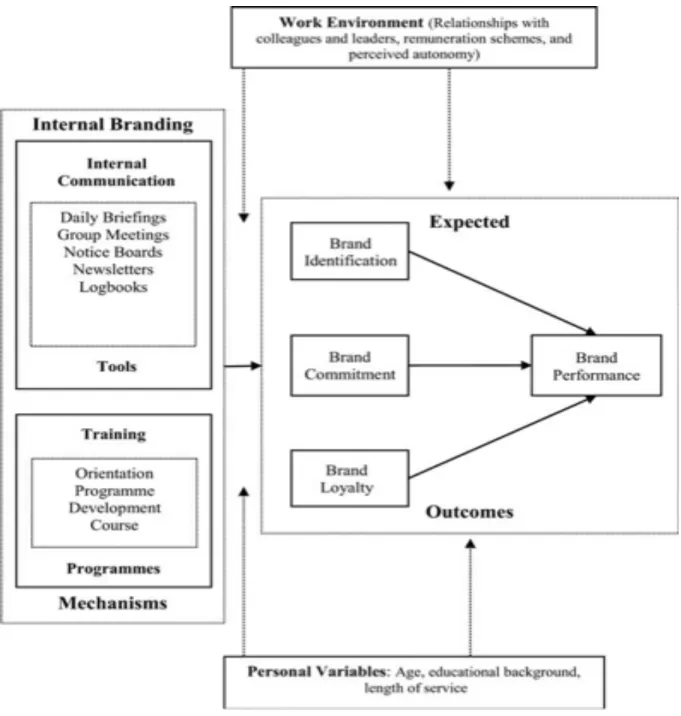
According to Punjaisri & Wilson (2010), there are two mechanisms that enhance and promote internal branding. They are: internal communication and training. According to the business dictionary, internal communication is the sharing of information within an organization for business purposes . Internal communication can take place via tools a such as: speech or daily 1
briefings, telephone, group meetings, Notice Boards, Newsletters, mail, paging, fax, closed Internet connections and computer networks. Training takes the form of programmes such as: orientation and development courses. See figure 2 below:
!
http://www.businessdictionary.com/definition/internal-communication.html
!
Figure 2: The proposed framework of Internal Branding leading to Brand performance
Source: Punjaisri & Wilson (2010:1525)
!
There are two variables that influence the employees’ capacity to deliver brand performance. Thee two variables are: Work environment and personal variables. See figure 2 above.
!
!
Work environment:
According to Punjaisri and Wilson (2010) factors such as working relationships with fellow workmates, and seniors, motivation schemes and perceived autonomy are some of the factors that affect employees’ service delivery capacity. In this case, the scholars conclude that when have the opinion that they are getting enough support from their colleagues and seniors and this is accompanied by the proper recognition schemes and some degree of autonomy, then the employees believe that they can deliver the brand promise effectively and efficiently. This means that the work environment triggers employees’attitude towards the brand.
Personal Variables:
Punjaisri and Wilson (2010) also argue that factors such as age, education background, and duration of duty also play a significant role in the employees support brand attitude. In this case, employees at older age, for example over 30years, tend to be more loyal to the brand than their younger colleagues. At the same time, the scholars conclude that employees who have worked in the company for a longer period of time express more emotional attachment to the brand and wish to stay more with the brand. On education, the scholars conclude that those with higher qualification tend to be less loyal to the brand in comparison to the ones with lower qualifications.
From figure 2 above, we can see that the internal branding mechanisms, (communications and training) and the variables (environment and personal) can be taken to be contextual fra-meworks in the process of achieving brand performance. These frafra-meworks enable employees to experience brand identity, brand commitment and brand loyalty.
These are discussed as follows:
3.3 Brand Identity:
The business online dictionary defines brand identity as: “the visible elements of a brand (such as colors, design, logotype, name, and symbol) that together identify and distinguish the brand in the consumers' mind” . 2 According to Harris and de Chernatony (2001) corporate
http://www.businessdictionary.com/definition/brand-identity.html 2
identity represents the company’s ethos, aims, and values that create a sense of individuality, which distinguishes a brand.
!
Brand identity model:
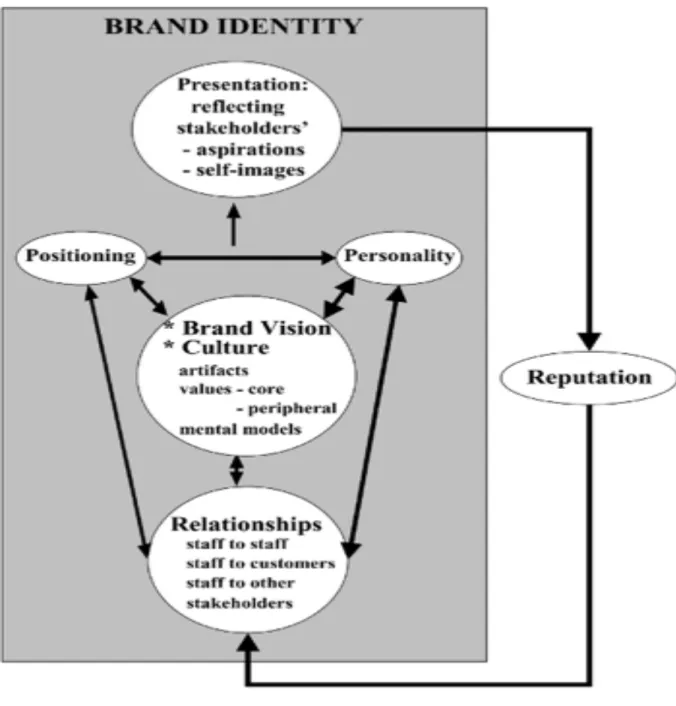
Brand Identity consists of six components as follow: vision and culture, positioning, persona-lity, relationships, stakeholder reflections and reputation. See figure 3 below:
!
Source: Harris and de Chernatony (2001: 443)
Brand vision and culture:
Vision entails the brand’s main objective; that is, the main reason why the brand exists which includes its core values that provide a system of guiding principles (Harris & de Chernatony, 2001). According to Harris and de Chernatony, it’s the responsibility of managers to commu-nicate the company brand vision or purpose to the employees. This communication needs to be done in a clear and precise way so that employees can understand how their roles relate to the company vision. At the same time, it’s important that managers should convey the compa-ny’s values to the employees, as this will set a guideline on employee attitude and behavior. Even though brands may display different values and norms, Harris and de Chernatony (2001) argues and concludes that it’s the regularity of the perception and the nature of those values that may led to successful brands. This means that for a positive brand perception to be crea-ted in the minds of the customers, the values and norms of the organisation must be commu-nicated in a unified and consistent manner.
The organisations culture entails employees’ collective feelings, values and assumptions in relation to the organisation they are working for and provides a pathway on how employees behave in certain different and new situations (see Harris & de Chernatomy, 2001, Punjaisri & Wilson, 2007). In this respect, the management should be keen on the company’s culture and how it links to the company’s specific brand values. In the absence of the linkage between the two (culture and brand values), the result will be a wrong perception sent to the stakeholders and this will affect the company brand. According to Bettencourt and Brown, (1997) cited by Harris and de Chernatony, (2001), if well managed, company culture can be a tool for compe-titive advantage. The managers’ role is to promote a culture, which will serve the interests of the employees, the company and the outside stakeholders. In this case, managers need to communicate on the corporate values and needs that need to remain unchanged and those that should dynamically reflect the needs and challenges of other stakeholder needs.
Positioning:
The online business dictionary defines positioning as: “a marketing strategy that aims to make a brand occupy a distinct position, relative to competing brands, in the mind of the
cu-stomer” . According to Harris and de Chernatony (2001), a brand sets and gives out various 3 perspectives of: what the brand is, who is it meant to serve and what the brand has to offer. In this case, the company management should enhance employees understanding of the brand position in relation to the other competing brands in the market. This should be done in rela-tion to the company’s mission and core values.
Relationships:
This is the crucial stage where the personal contact between the brand and its consumers is established. This happen in-line with the values as defined in the brand personality (Harris and de Chernatony, 2001). From figure 3 above it can be seen as relationships takes different perspectives; staff to staff, staff to customers and staff to other stakeholders. From figure 3 above, we see start employees have a great role in maintaining the consistency of these rela-tionships. For this reason, Harris and de Cheenatony concludes that managers need to make sure that employees know and understand the nature and type of relationship to build when dealing with the fellow employees, customers and the other stakeholders without deviating from the company’s core values.
Presentation:
From figure 3 above, we can see that presentation is represented by outcome of the other identity variables of vision and values, personality, positioning and relationships. This forms the final stage in brand identity and is meant to reflect the customers’ hopes. According to Harris and de Chernatony, (2001) presents also bring out the brands symbolic meaning, which helps consumers to understand their feelings. As both employees and advertising interact with the customers their role in creating the symbolic meaning of the brand cannot be ignored by the managers. According to Harris and de Chenartony, (2001) managers need to be very keen to detect any incompatibility between the brand as desired by the customer and how the brand is conveyed through advertising and employees behavior.
Reputation:
http://www.businessdictionary.com/definition/positioning.html 3
The Merriam-Webster dictionary defines reputation as: “the common opinion that people have about someone or something: the way in which people think of someone or something” . 4 According Fombrun and Rindova (1996) as cited by Harris and de Chenartony (2001) “a brand reputation represents a collective representation of a brand’s past actions and results that describes the brands ability to deliver valued outcomes to multiple stakeholders”. From figure 3 above, we can see that brand reputation is as the outcome of the brand identity as bu-ild by the combination of the internal brand resources. In this case, Harris and de Chernatony (2001) aver that the brand identity model provide a guideline on how to reduce the gap be-tween the brand’s identity and its reputation. For this reason, Harris and de Chernatony (2001) concludes that managers have the responsibility to harmonize work and direct staff in such a way so as to narrow the gap between brand identity and brand reputation.
Personality:
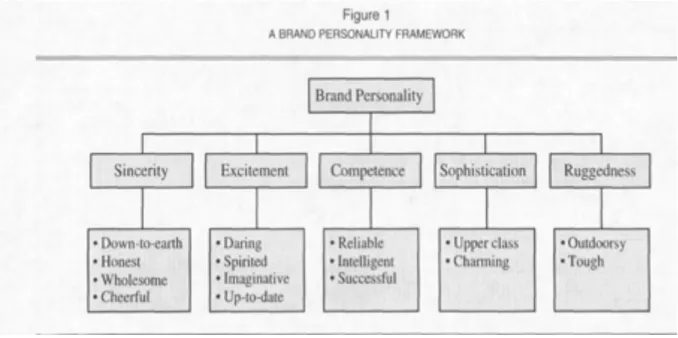
Brand personality refers to the emotional set of human features and characteristics associated with the brand (Aaker, 1997), which originate from the brand main values (Harris and de Chernatony 2001). According to Aaker (1997) the personality emotions are more so enhan-ced through the physical contact of the company employees by the brand users- customers. This implies that it’s the managers’ responsibility to make sure that the company’s brand per-sonality is well understood by the employees. This will allow the employees to deliver the brand personality to the customers. According to Aaker (1997), brand personality entails the following: sincerity, excitement, competence, sophistication and raggedness. See figure 4 be-low:
http://www.merriam-webster.com/dictionary/reputation 4
!
Figure 4: brand personality framework Source: Aaker (1997)
3.4 Brand commitment:
“Brand commitment is the psychological attachment of employees to the brand, which influ-ences their willingness to exert extra effort towards attaining the brand goals”(Burman and Zeplin, 2004). In another way it means that brand commitment a link, which provides a bond between the employee and the organisation. Burman and Zeplin, further describes commit-ment as brand citizenship. The scholars further define brand citizenship behavior as the total constructs which describes a number of employee behaviors that trigger brand identity. There are three major drivers of brand commitment: compliance, identification and internalization.
Compliance:
Compliance entails the adoption or displaying of certain behaviors that are in line with the specific brand identity. In this case, employees adopts given behaviors in order to balance be-tween the inputs and the outputs. It can be either to gain some extrinsic rewards or to avoid penalties. In most of the cases, compliance is directed by the organisational structure, which spells out the formal rewards and sanctions in relation to tasks.
Identification in this case takes the dimension where all the employees in an organisation ac-cept the social influence and align themselves as one group that is responsible for creating brand reputation and perception. This implies that each person accepts the success and the failures of the brand, as one’s owns.
!
Internalisation:
Internalisation of brand identity describes how one adopts the main brand values of an organi-sation into owns self- concepts to guide ones actions. Internaliorgani-sation is mainly constructed through organisational socialization. This is normally done through colleagues, superiors or values formal communication.
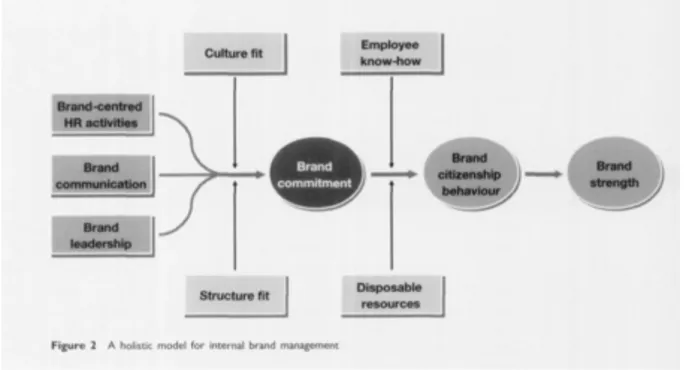
Furthermore, as figure 5 below indicates, Burman and Zeplin, (2004) developed the following three levers that generate brand commitment: brand centered human resources activities, brand communication and brand leadership.
!
Figure 5: Holistic model for internal brand management Source: Burman and Zeplin, (2004)
However, the scholars do not see these levers as stand-alone in the process of internal bran-ding process leabran-ding to brand equity or brand strength. These levers need to be operating wit-hin the contexts of: culture and structure fit to generate brand commitment. According to Burman and Zeplin, (2004), brand commitment will also lead to brand citizenship ones em-ployees have been given the required know-how and resources to promote consistent brand experience. However, it should be noted that these contextual frame works will only lead to compliance but do not generate any identification or internalisation. As Burman and Zeplin, (2004) concludes; brand commitment based on identification is mainly based on brand lea-dership while brand identity internalisation is achieved through human resource (HR) activi-ties and communication.
!
3.5 Brand loyalty:
According to the online dictionary brand loyalty is: “the extent of the faithfulness of consu-mers to a particular brand, expressed through their repeat purchases, irrespective of the mar-keting pressure generated by the competing brands” . However, this definition looks the 5
brand loyalty from the external perspective and the paper will be focusing from the internal perspective, in this case how through internal branding, employees will be loyal to the brand and ultimately deliver this brand royalty to the customers.
Yew, Yeung, and Cheung (2011) found that employee brand loyalty is essential factor in order to induce sales performance with providing quality service to consumers. Chefmarket journal writes on its paper giving title : “building loyalty starts with employees” that an inconve-nient truth in loyalty marketing is —“no matter how much money and time a brand invests in rewards , programs and social welfare a customer’s loyalty can swing in either direction with just one employee interactions”. So it can be understood that external loyalty on brand de-pends on how the far can organisation able to create internal loyalty inside in an organisation. Kabiraj & Shanmugan, (2011) writes organisation can expect the level of loyalty from its em-ployee if it can get successfully involved their emem-ployee in their managerial process that is spurious or low brand loyalty is associated with low employee involvement whereas or true or
http://www.businessdictionary.com/definition/brand-loyalty.html 5
high loyalty obtains when employees are more involved with the product or services. Disen-gaged employee are supposed to kill the brand experience of consumers (cheifmarket.com). Engaged employees who get engaged, love products they are selling. Further they arekind and polite to customers, enthusiastic and willing to promote to others how amazing your company and products are(sweettoothrewards.com)
So understanding the level of employee brand loyalty resulting from investment in branding processes ( level of involvement ) has implications for management because of its potential to predict willingness to promote and defend the company’s products(Kabiraj & Shanmugan, 2011). employee brand commitment, employee product perception, employers attitudes to-wards employees , and the company’s overall reward and recognition and promotional efforts are some of the notable issues that were found to influence on the employee loyalty according to Chaudhuri and Holbrook(2001). To this list, Chaudhuri and Holbrook(2001) further add brand trust as another determinant of brand loyalty. Jim Cunningham also wrote on his paper for argomarketing. com (June 25, 2014) that if the employer or the management share the company’s stories about the problem they have encountered and give the tricks and tips to their employees on a personal level then it could be a good idea to develop loyal feeling to-ward the company. Forces (march 29, 2009) also writes that “There are two important factors to keeping your people brand loyal: “how you say goodbye and how you keep in touch.” Memon&Kolachi (2012, pg 50-51) argues that the organisation can adopt the 4 E’s frame-work to promote employee branding process and accordingly to them employee engagement, employee empowerment, employee equity and employee education are the primary means that could employer approached to their employee to expect high loyalty form them.
Criticism:
Internal branding is a source of brand performance and has been explained from the theories of internal branding. But there is still a room for doubt that whether the internal branding might be misinterpreted, misused and overrated or not in various cases. The main aspect of internal branding is about its practices within an organization with some issues like culture, communication, leadership and so on. These issues may contain numerous criticisms within
internal branding. So, it is quite interesting to assess the literature of internal branding that we have used in this project report.
!
It is believed that standard communication, design, attitude and practices across different di-mensions within an organization and is advantageous in terms of cost and consistency. Due to which the organization needs to think about the end users. Brand values and organizational values are addressed on the basis of consumers’ wants and interests rather than the employees. There are some organizations, which ban employees to do something in relation to their be-haviors, attitude and interests. For an example, Coca Cola Company dismissed a delivery dri-ver who was spotted drinking Pepsi when he was at work (CNN, 2003). Organizational per-formance in relation to internal branding has been explained on the basis of leadership as well. Normally, the senior managers or leaders make the organizational policies and is com-municated to the employees expressing what is to be done and how. The organization talks and employees are supposed to listen. It is difficult to understand and imagine how branding is internalized with such dominating environment, which denies employee’s participation. Through internal branding, employees are given several responsibilities in order to achieve the brand values. Due to which, organization expects higher level of outcomes. This creates a level of stress or tension to the employees to meet the expectations. This situation goes be-yond the situation of control if the employees are placed with insufficient support from the organization to respond the higher expectations.
!
In brief, internal branding literatures mentioned above put positive values for organizational branding performance. But it is also necessary to understand in such a way to minimize the drawbacks of internal branding because an aspect can be viewed differently and nothing is completely perfect and universe.
!
!
!
!
!
Chapter 4: CONTEXTUALISATION
This chapter gives general summary of the case study that the project is based on. The chap-ter includes the company profile, mission, vision of the Coca-Cola Company and Google Inc. It also gives insight about the organisation structure and Coca-Cola and Google as a brand.
!
4.1 Company profile: The Coca-Cola Company
The Coca-Cola Company is the largest beverage company in the world. It was founded in 1886 in the United States and currently the brand sells its products in more than 200 countries (Coca-cola.com, 2014).
This brand has the largest distribution channel in the world and it sells its beverages to con-sumers at a rate of 1.9 billion servings a day. Along with its bottling partners, the Coca-Cola Company is ranked as the worlds top 10 private employers having more than 700,000 system associates. 6
!
4.1.1 Company Mission
In order to thrive as a business over the years to come, the Coca-Cola Company understands the trends and is willing to prepare for the future. Therefore, it has introduced 2020 Vision, which is a long-term plan for the business that provides a roadmap to success with its bottling partners. 7
!
Mission
➢ To refresh the world
➢ To inspire moments of optimism and happiness
➢ To create value and make a difference
!
!
4.1.2 Company Vision http://www.coca-colacompany.com/history/#TCCC 6 http://www.coca-colacompany.com/our-company/mission-vision-values#TCCC 7The vision of the Coca-Cola Company guides different aspects of the business and addresses the key points, which will help the company to achieve sustainable and quality growth. Its vision are mentioned below:
➢ People: The Company desires to have good working environment so that its employ-ees are inspired to be the best.
➢ Portfolio: The Company aims to satisfy people’s desires and needs by introducing a portfolio of quality beverage to the world.
➢ Partners: The Company aims to develop a strong network of customers and suppliers so that it can create a mutual value.
➢ Planet: The Company initiates to be more responsible citizen by building and sup-porting sustainable communities and protecting the environment.
➢ Productivity: The Company also aims to be highly effective and fast-moving organi-zation by continuously adapting with the changing business environment and people’s needs.
!
!
4.1.3 Products
The most famous brand Coca-Cola is recognized as the most valuable brands in the world ranking in the 4th place (Forbes, 2014). The Coca-Cola Company own, license and market 8
non-alcoholic varieties of beverages. Globally it offers more than 3500 drinks. Its products consist of sparkling beverages, and other products like enhanced waters, juices, ready-to-drink teas and coffees and other energy and sports drinks.
The Coca-Cola Company offers more than 800 reduced or low or no calorie drink options for their consumers. This option covers almost 25 percent of the company’s global portfolio. The company continues to innovate its products in terms of taste, quality and safety through in-gredients and sweeteners used for beverages. In the year 2013, the company offered more than 400 new drinks where 100 of them were low calorie or calorie free drinks (Sustainability Report, 2013/2014, p. 11).
http://www.forbes.com/companies/coca-cola/
The products of Coca-Cola such as Coca-Cola, Diet Coke, Fanta and Sprite are listed on the world’s top five non-alcoholic sparkling beverage brands. The product portfolio of the com-pany is worth 17 billion dollars.
!
4.1.4 The Coca-Cola System
The Coca-Cola Company has a global reach but it operates on a local scale. The company has its own Coca-Cola system that includes the company and its worldwide bottling partners.
!
Organisation Structure
The head of the Coca-Cola Company are the Board of directors who are committed to the firm values. They are the corporate leaders who direct and support the business operations in regional sector across the world. As we know that the company doesn’t control all its bottling partners and hence, the franchise of the company operates independently from the main branch. The company has categorized its operations of different regional sector in an in-ternational group according to the geography, known as senior operations.
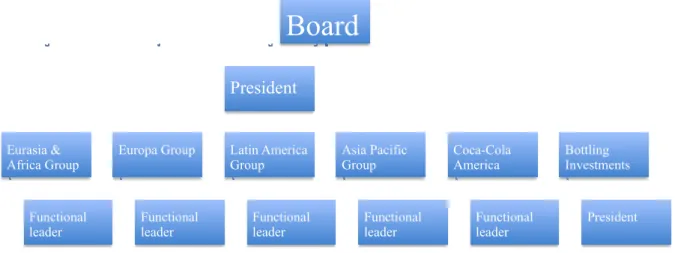
The Coca-Cola Company’s operating structure is based on the internal financing reporting. As on December 31, 2013, its operating segments consist of five geographical groups named as: Eurasia and Africa Group, Europe Group, Latin America Group, Asia Pacific Group, Coca-Cola North America. In operations group, bottling Investment group is also included. All these six operation segments are known are “operating groups” (Annual Report, 2013, p. 2). Each of these groups has their own president who controls their operation area. There are functional areas in each region where they have leaders as shown in figure below. The senior functional leaders include chief administrative officer, general counsel, global chief customer officer, chief financial officer, chief marketing and commercial officer, President of bottling investment group, Chief technical and innovation officer, chief public affairs and communica-tion officer and chief informacommunica-tion officer. 9
!
http://www.coca-colacompany.com/our-company/coca-cola-leaders#TCCC
!
Figure 6: Organization Structure (Own Source)
!
!
With the Coca-Cola system the company focuses in every single community where it operates its business. The Coca-Cola Company and its system operate through various local channels. 10
!
The Coca-Cola Company sells its beverage products through direct form of finished products or through concentrates. The Coca-Cola Company produces the “concentrates” and “syrups”, which contributes in generating net operating revenues. The concentrates and syrups are sold to authorized or licensed Coca-Cola bottlers (bottling partners) throughout the world. The bot-tlers’ having contracts of their own region with the company produces finished beverages from the concentrates and syrups by combining it with sweeteners and sparkling or still water. The finished products are packaged in authorized cans and bottles and have Coca-Cola trade-marks in it. The bottling partners then sells and distributes the beverages directly or indirectly to consumers and retail stores (coca-colacompany.com, 2014).
!
The Coca Cola Company has licensed the brands to more than 250 bottling partners all over the world. All bottling partners share a good relationship with its customers and work close11
-ly with them. Moreover, in year 2006 Bottling Investment group was formed. This group pro-vides venture capital, manages its facilities and the ownership challenges, and focuses on