Pacific University
CommonKnowledge
School of Physician Assistant Studies Theses, Dissertations and Capstone Projects
Summer 8-9-2014
The Effect of Patient-Centered Medical Homes on
Provider Satisfaction and Burnout
Mallory Danielson
Pacific University
Follow this and additional works at:http://commons.pacificu.edu/pa Part of theMedicine and Health Sciences Commons
This Capstone Project is brought to you for free and open access by the Theses, Dissertations and Capstone Projects at CommonKnowledge. It has been accepted for inclusion in School of Physician Assistant Studies by an authorized administrator of CommonKnowledge. For more information, please [email protected].
Recommended Citation
Danielson, Mallory, "The Effect of Patient-Centered Medical Homes on Provider Satisfaction and Burnout" (2014).School of Physician Assistant Studies.Paper 495.
The Effect of Patient-Centered Medical Homes on Provider Satisfaction
and Burnout
Abstract
Background:This promise of a patient centered medical home (PCMH) is being embraced by many, in hopes that it will improve healthcare in the United States by decreasing costs and improving patient outcomes. However, as important as cost and patient outcomes are, another integral part of the PCMH equation isn’t discussed very often: the providers. How will PCMHs impact providers? This systematic review of literature will investigate the use of PCMHs and its affect on the satisfaction and burnout of providers.
Methods:An exhaustive search of current medical literature was performed on Medline-OVID, EBMR-Cochrane Review, and CINAHL, using the keywordpatient-centered medical homeand the MESH terms patient centered care, job satisfaction,andburnout, professional. The references of relevant articles were screened for additional studies.
Results:Two articles were found to satisfy inclusion criteria. Lewis et al was an observational retrospective cohort study which used a self-administered survey in 2010 to assess staff morale, job satisfaction, burnout, and respondents’ perceptions of PCMH characteristics at 65 safety net clinics in five states. Lewis et al found that the total PCMH score was associated with higherstaffmorale but that theprovidershad less freedom from burnout as the PCMH score increased. Reid et al used a prospective, two group before and after evaluation of the PCMH pilot at Group Health, located in western Washington. Researchers compared the staff and providers at the PCMH clinic with the staff and providers at two other non-PCMH clinics. At 24-months the mean emotional exhaustion scores for the PCMH was significantly lower than the control clinics.
Conclusion:Research on this topic is of low quality and is very limited with only one study assessing provider satisfaction and two studies assessing provider burnout. Though it may appear that PCMH may decrease provider burnout, conflict in the research does exist. More research is needed as PCMHs become an industry standard in the coming years.
Degree Type
Capstone Project
Degree Name
Master of Science in Physician Assistant Studies
Keywords
Burnout, Professional; Patient-centered care; Patient-centered Medical Home; Job Satisfaction
Subject Categories
Medicine and Health Sciences
Rights
Terms of use for work posted in CommonKnowledge.
Copyright and terms of use
If you have downloaded this document directly from the web or from CommonKnowledge, see the “Rights” section on the previous page for the terms of use.
If you have received this document through an interlibrary loan/document delivery service, the following terms of use apply:
Copyright in this work is held by the author(s). You may download or print any portion of this document for personal use only, or for any use that is allowed by fair use (Title 17, §107 U.S.C.). Except for personal or fair use, you or your borrowing library may not reproduce, remix, republish, post, transmit, or
distribute this document, or any portion thereof, without the permission of the copyright owner. [Note: If this document is licensed under a Creative Commons license (see “Rights” on the previous page) which allows broader usage rights, your use is governed by the terms of that license.]
Inquiries regarding further use of these materials should be addressed to: CommonKnowledge Rights, Pacific University Library, 2043 College Way, Forest Grove, OR 97116, (503) 352-7209. Email inquiries may be directed to:. [email protected]
NOTICE TO READERS
This work is not a peer-reviewed publication. The Master’s Candidate author of this work has made every effort to provide accurate information and to rely on authoritative sources in the completion of this work. However, neither the author nor the faculty advisor(s) warrants the completeness, accuracy or usefulness of the information provided in this work. This work should not be considered authoritative or comprehensive in and of itself and the author and advisor(s) disclaim all responsibility for the results obtained from use of the information contained in this work. Knowledge and practice change constantly, and readers are advised to confirm the information found in this work with other more current and/or comprehensive sources.
The student author attests that this work is completely his/her original authorship and that no material in this work has been plagiarized, fabricated or incorrectly attributed.
The Effect of
Medical Homes
Satisfaction and Burnout
A Clinical Graduate Project Submitted to the Faculty of the School of Physician Assistant Studies
For the Masters of Science Degree,
Faculty Advisor:
The Effect of Patient-Centered
Medical Homes on Provider
Satisfaction and Burnout
Mallory Danielson
A Clinical Graduate Project Submitted to the Faculty of the School of Physician Assistant Studies
Pacific University Hillsboro, OR
For the Masters of Science Degree, August 9, 2014
Faculty Advisor: Saje Davis-Risen, PA-C, MS
2
BIOGRAPHY
Mallory Danielson was raised in Provo, Utah and received her AS in Mathematics in 2008, her BS in Exercise Science in 2010, and an MPH in 2012. To combat her obvious nerd tendencies, she tries to spend time outdoors as much as possible. With great
opportunities to rock climb, run, bike, snowboard, kayak, white water raft, and even surf, Mallory has truly fallen in love with Oregon. Mallory hopes to use her degrees to help alleviate suffering in the world through domestic and international work with the rural and underserved populations ignored by so many. She is so very grateful to Pacific University, her friends, and her family as they’ve helped her achieve her goals and more fully live her life.
ABSTRACT
Background: This promise of a patient centered medical home (PCMH) is being embraced by many, in hopes that it will improve healthcare in the United States by decreasing costs and improving patient outcomes. However, as important as cost and patient outcomes are, another integral part of the PCMH equation isn’t discussed very often: the providers. How will PCMHs impact providers? This
systematic review of literature will investigate the use of PCMHs and its affect on the satisfaction and burnout of providers.
Methods: An exhaustive search of current medical literature was performed on Medline-OVID, EBMR-Cochrane Review, and CINAHL, using the keyword patient-centered medical home and the MESH terms patient centered care, job satisfaction,
and burnout, professional. The references of relevant articles were screened for additional studies.
Results: Two articles were found to satisfy inclusion criteria. Lewis et al was an observational retrospective cohort study which used a self-administered survey in 2010 to assess staff morale, job satisfaction, burnout, and respondents’ perceptions of PCMH characteristics at 65 safety net clinics in five states. Lewis et al found that the total PCMH score was associated with higher staff morale but that the providers
had less freedom from burnout as the PCMH score increased. Reid et alused a prospective, two group before and after evaluation of the PCMH pilot at Group Health, located in western Washington.Researchers compared the staff and providers at the PCMH clinic with the staff and providers at two other non-PCMH clinics.At 24-months the mean emotional exhaustion scores for the PCMH was significantly lower than the control clinics.
Conclusion: Research on this topic is of low quality and is very limited with only one study assessing provider satisfaction and two studies assessing provider burnout. Though it may appear that PCMH may decrease provider burnout, conflict in the research does exist. More research is needed as PCMHs become an industry standard in the coming years.
Keywords: Burnout, Professional; Patient-centered care; Patient-centered Medical Home; Job Satisfaction
4
ACKNOWLEDGEMENTS
TABLE OF CONTENTS
Biography ... 2 Abstract ... 3 Acknowledgements ... 4 Table of Contents ... 5 List of Tables... 6 List of Figures ... 6 List of Abbreviations ... 6 BACKGROUND ... 7 METHODS ... 9 RESULTS ... 9 Lewis et al ... 10 Reid et al ... 12 DISCUSSION ... 13 Limitations ... 13 GRADE ... 15 CONCLUSION ... 15 References ... 176
LIST OF TABLES
Table 1: Lewis et al Participant Characteristics ... 21 Table 2: Reid et al Participant Characteristics ... 21 Table 3: Characteristics and Summary of Reviewed Studies ... 22
LIST OF FIGURES
Figure 1: The Search Equation………..…..……….20
Figure 2: Search Results ... 20
LIST OF ABBREVIATIONS
LPN……….…Licensed Practical Nurse MA………Medical Assistant NP………..Nurse Practitioner PA……….Physician Assistant PCMH……….Patient-centered Medical Home PPACA……….………..Patient Protection and Affordable Care Act RCT……….……….……….……….Random-Controlled Trial RN……….…Registered Nurse
The Effect of Patient-Centered
Medical Homes on Provider
Satisfaction and Burnout
BACKGROUND
“The medical home model holds promise as a way to improve health care in America by transforming how primary care is organized and delivered.”1 This
promise of a medical home is being embraced by many, in hopes that it will improve healthcare in the United States by decreasing costs and improving patient
outcomes.2,3 Developed in 1967, medical homes were initially set up to manage the
care of children with complicated diseases. Now, a medical home is defined by its five encompassing functions and attributes: comprehensive care, patient-centered care, coordinated care, accessible services, and quality and safety.1 With the use of
this model, also known as a patient-centered medical home (PCMH), there is hope to reduce unnecessary tests, redundant paperwork, and improve preventative care. Thus, medical homes have the potential to improve patient outcomes and decrease costs.
Healthcare in the US is expensive. In 2011, the United States spent 17.9% of its Gross Domestic Product on healthcare. This equates to $8680 per person for a total of $2.7 trillion dollars.4 Compared with the rest of the world, only Switzerland,
Norway, and Luxembourg spend more per capita.5 However, the increased costs do
not correspond to improved patient outcomes. Specifically, infant mortality rate is often used to judge the overall health of a nation. Ranked at 50 out of 224, the
8
United States falls behind such countries as Canada, Cuba, the UK, and Japan. For example, Japan spends half as much on healthcare and still has les than half of the infant deaths per capita than occur in the US.5,6
With higher than average costs and lower than average outcomes, the Patient Protection and the Affordable Care Act (PPACA) was passed on March 21, 2010 to help combat this spending and to improve health. The PPACA advocates for the use of PCMHs and will shape the way that medicine is provided in the US. However, as important as cost and patient outcomes are, another integral part of the PCMH equation isn’t discussed very often: the providers. How will PCMHs impact
providers? Will PCMH place more responsibility on already overtaxed clinicians and increase risk for burnout? Or will the team approach and improved outcomes
increase job satisfaction? Burnout is best described by Dr. Holt,
“Whether it is inertia after a long week of nights on call or intense surgical cases or a series of discouraging patient outcomes in spite of our every effort, we know the feeling...a sense of detachment from patients, emotional and physical exhaustion, discouragement about perceived accomplishments, and a general malaise within and outside the practice.”7
Measured through the Maslach Burnout Inventory, nearly 60% of all medical students, residents, interns, medical professors, and private clinicians are affected by burnout.8-13This burnout can lead to depression, anxiety, other problems
associated with psychological morbidity, and in some cases a decrease in patient care. 14-16 Therefore, this systematic review of literature will investigate the use of
METHODS
An exhaustive search of current medical literature was performed on Medline-OVID, EBMR-Cochrane Review, and CINAHL, using the keyword patient-centered medical home and the MESH terms patient centered care, job satisfaction,
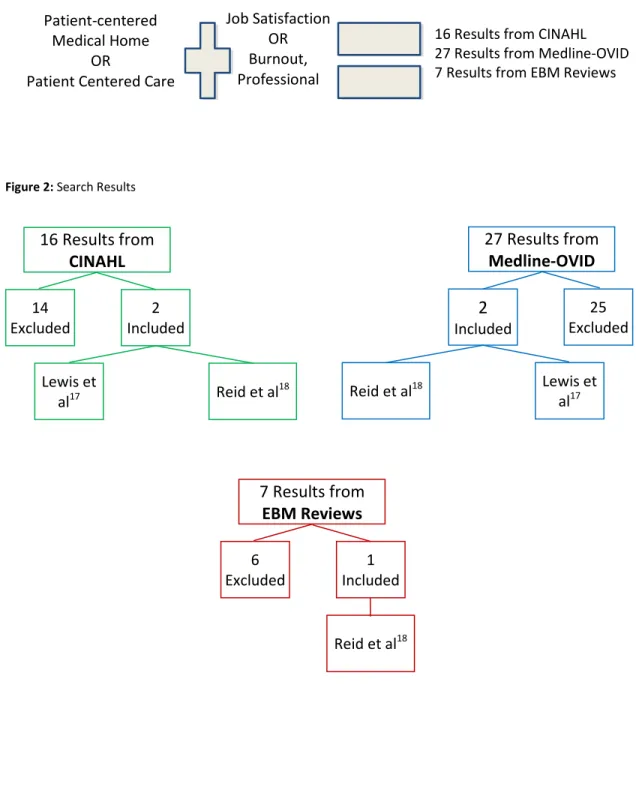
and burnout, professional. The references of relevant articles were screened for additional studies. See Figure 1.
Throughout this paper providers are defined as physicians, physician
assistants (PAs), and nurse practitioners (NPs). Other staff included in patient care are registered nurses (RNs), medical assistants (MAs), and licensed practical nurses (LPNs).
RESULTS
CINAHL yielded 16 articles for review. Of these 16 articles, only two satisfied the clinical question: Lewis et al17 and Reid et al.18 After eliminating 25 other
articles, the search on Medline-OVID also found Lewis et al17 and Reid et al.18 EBM
Reviews resulted in seven articles, one of which was a publication19 of earlier results
Reid et al18; the rest were excluded due to failure to meet inclusion criteria.
Using Web of Science the references in the selected papers and those which cited the selected papers were also analyzed. Lewis et al17 cited 30 articles and is
cited by two articles, none of which were included. Reid et al18 was cited by 102
articles and cited 26 articles, one of which was a prior publication19 of this study. In total, 210 articles were discovered and analyzed by reading the title and abstract. After elimination of unrelated articles and duplicates, only two articles were
10
burnout?”: Lewis et al17 and Reid et al.18 See Figure 2 for a summary of these
findings.
Lewis et al
Design—
This observational retrospective cohort study17 used aself-administered survey in 2010 to assess staff morale, job satisfaction, burnout, and respondents’ perceptions of PCMH characteristics at 65 safety net clinics in five states. The 65 clinics were chosen due to their participation in The Safety Net Medical Home Initiative, which was supported by the Commonwealth Fund. The Commonwealth Fund also funded this study. 17
PCMH characteristics were assessed through a scale of 0-100: access to care and communication with patients, communication with other providers, tracking data, care management, and quality improvements. This method was based on the 2008 National Committee for Quality Assurance PCMH standards and appears to be a valid was of measuring PCMH Characteristics. 17,21
Satisfaction was measured through participants’ response on a 5-point Likert-type scale (strongly disagree to strongly agree) to the statement, “Overall, I am satisfied with my current job.” 17
Burnout was not measured through a validated scale such as the Maslach Burnout Inventory, which is the industry standard. Instead it was measured through participants’ response to the statement, “Using your own definition of burnout, please check one”, with responses ranging from “I enjoy my work” to “I feel completely burnout out and often wonder if I can go on.” 17
Lewis et al17 used included control variables such as presence of an EMR,
work environment, whether the clinic reported provider or nursing shortages, and the years since the end of clinical training.17
Demographics—
Surveys were provided to 603 persons, of which 391 were medical providers. The provider response rate was 79.8%. There was a significant difference between nonresponders and responders by region and location(p=0.002). Lewis states that most nonresponsders were from Massachusetts and from city based clinics. Most responders were non-Hispanic white females physicians. A summary of the demographic data provided for this group can be found in Table 1.17
Results—
Lewis et al17 reported that job satisfaction and burnout responseswere strongly skewed to the positive end of the scales. First, 53.7% of respondents rated job satisfaction as very good, which was the 2nd highest option on the 5-point
Likert-type scale. On the other hand, 49.5% of respondents rated burnout as
”Occasionally I am under stress at work, but I don’t feel burned out”, the 2nd highest
option provided.17
Lewis et al17 found that the total PCMH score was associated with higher staff
morale but that the providers had less freedom from burnout as the PCMH score increased. Of the PCMH subscales, higher quality improvement correlated with higher moral and greater job satisfaction in staff and providers. However, the staff,
12
Reid et al
Design—
Reid et al18 used a prospective, two group before and afterevaluation of the PCMH pilot at Group Health, located in western Washington. They assessed outcomes at baseline, 12 months, and 24 months. Researchers compared the staff and providers at the PCMH clinic with the staff and providers at two other non-PCMH clinics which were chosen due to their similarities in size, Medicare enrollment, and leadership stability. In 2006, all staff at the PCMH and two control clinics were asked to complete an online survey using the Maslach Burnout
Inventory, Health Services version.13 The Maslach Burnout Inventory measures
burnout through three scales: emotional exhaustion, depersonalization (unfeeling and impersonal response toward recipients of one’s service), and personal
accomplishment; total scores are also evaluated.18,20 No mention of controlling
confounding factors was made. The PCMH characteristics were not assessed.18
Reid et al are investigators with the Group Health Research Institute in Washington, the same organization that is being studied as the PCMH.18
Demographics—
The sample size was 48 over the three years with response rates of 79%, 83%, and 71% respectively. No analysis on characteristics for nonresponders was published. The majority of the respondents were females aged <54. A summary of the demographic data for this study can be found in Table 2.18Results—
At 24-months the mean emotional exhaustion scores for the PCMH was significantly lower than the control clinics (mean 12.8 vs. 25.0; p<.01). The depersonalization scale also showed lower levels for the PCMH (mean 2.0 and 4.4;p=0.03). However, the last scale, personal accomplishment, was not statistically different between the PCMH and the controls. No information on the actual distribution of the results was provided.18
DISCUSSION
PCMHs are becoming the way to deal with our healthcare problems in the United States. Though it is important to know if it improves patient outcomes and decreases cost, it is also important to know the effect of PCMHs on providers’ satisfaction and burnout.
Lewis et al17 was the only one to study provider and staff satisfaction. They
found that PCMH’s increased both staff and provider satisfaction. However, when Lewis et al17 studied burnout, they found that while staff had increased freedom
from burnout, PCMHs actually decreased freedom from burnout for providers. This is an especially interesting finding when compared to Reid et al18 who found that
PCMHs increased freedom from burnout for providers and staff.
Limitations
Lewis et al17 and Reid et al18 both have limitations on generalization as they
studied a very select sample population. This enabled accurate between group comparisons but this meant that their results may not apply to any other population group. Lewis et al17 also has significant differences between their responders and
nonresponders, which may have adversely affected the results of the study. Reid et al18 didn’t address the differences between responding and nonresponding groups
14 392 which is adequate. However, Reid et al18 had a small sample size of 48
providers.
Lewis et al17 also had serious problems in the way that it assessed outcomes:
Maslach Burnout Inventory was not used and satisfaction was only assessed with one question. Lewis et al17 found their assessment of job satisfaction and burnout
was highly skewed, which may indicate that the question was not sensitive enough to reveal the satisfaction and burnout distribution that exists among the associated staff. This may also mean that there was no difference, however, it is unlikely that the majority of all providers are at the same level of satisfaction and burnout with their job.
Reid et al18 did use Maslach Burnout Inventory but didn’t assess PCMH
characteristics at all of the clinics and didn’t control for confounding factors, as Lewis et al17 did. Reid et al18 didn’t provide information on actual distribution of the
responses; however, a large difference was seen between baseline and intervention. This may indicate that the scale is sensitive enough to assess differences that exist.
Both studies17,18 used self-administered surveys, which have inherent flaws
due to recall bias and responder bias. Also, neither study mentioned if the results of the surveys were kept anonymous. As such, this may mean that participants may not have answered truthfully due to the chance peers, management, funders, etc. may be reviewing their answers.
Both studies17,18 were funded by the organization which they were studying.
This conflict of interest indicates that there is a strong possibility that negative results would not have been published.
GRADE
GRADE has four levels to represent the quality of evidence:
• High
• Moderate
• Low
• Very Low
To begin in this process the design of the study is initially assigned a level, with observational studies being given a Low rating and RCT given a High rating. From here five different categories will be assessed, with upgrades or downgrades being awarded based on the study’s ability to satisfy the requirements for each of the categories. Note: Once a study has been downgraded to a Very Low level, it cannot be upgraded.
The five categories that are being assessed are: 1. Limitations
2. Inconsistent Results 3. Indirectness of Evidence 4. Imprecision
5. Publication Bias
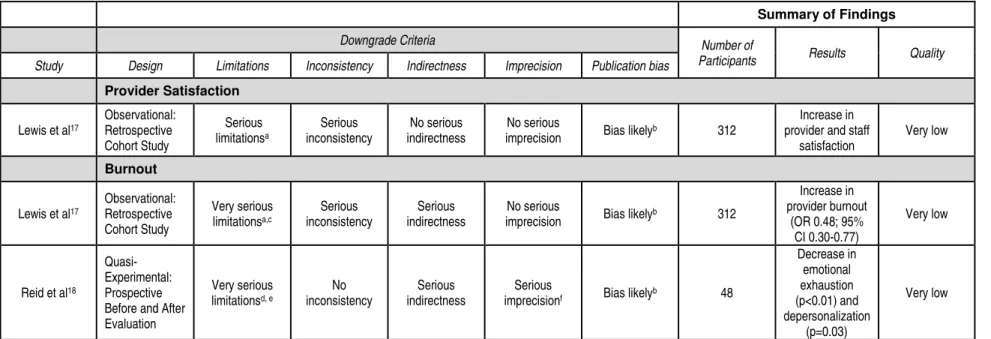
Both Lewis et al17 and Reid et al18 were given a grade of Very Low. A summary can be
found in Table 3.
CONCLUSION
Patient Centered Medical Homes are seen to be the panacea for the
healthcare problem. However important cost savings and patient outcomes are, we do need to remember that providers are an integral part in the system. Without their buy-in there’s no chance of success. Research on this topic is of low quality and is very limited with only one study assessing provider satisfaction and two studies
16 assessing provider burnout. Though it may appear that PCMH may decrease provider burnout, conflict in the research does exist. More research is needed as PCMHs become an industry standard in the coming years.
REFERENCES
1. Agency for Healthcare Research and Quality. Defining the PCMH.
http://pcmh.ahrq.gov/portal/server.pt/community/pcmh__home/1483/pc mh_defining_the_pcmh_v2. Accessed August 15, 2013.
2. Kilo CM, Wasson JH. Practice redesign and the patient-centered medical home: History, promises, and challenges. Health Aff. 2010;29(5):773-778.
3. Carrier E, Gourevitch MN, Shah NR. Medical homes: Challenges in translating theory into practice. Med Care. 2009;47(7):714-722.
4. Centers for Medicare and Medicaid Services. National health expenditure data. http://www.cms.gov/Research-Statistics-Data-and-Systems/Statistics-
Trends-and-Reports/NationalHealthExpendData/NationalHealthAccountsHistorical.html. Accessed August 15, 2013.
5. The World Bank. Health expenditure per capita.
http://data.worldbank.org/indicator/SH.XPD.PCAP?order=wbapi_data_value _2011+wbapi_data_value+wbapi_data_value-last&sort=desc. Accessed
August 15, 2013.
6. Central Intelligence Agency [US]. The world factbook.
18
7. Holt G, Richard MSE, MPH,M.A.B.E., D.Bioethics. Physician burnout: A serious concern for the medical profession. South Med J. 2013;106(5):297.
8. Krasner MS, Epstein RM, Beckman H, et al. Association of an educational program in mindful communication with burnout, empathy, and attitudes among primary care physicians. JAMA. 2009;302(12):1284-1293.
9. Shanafelt TD, Bradley KA, Wipf JE, Back AL. Burnout and self-reported patient care in an internal medicine residency program. Ann Intern Med.
2002;136(5):358-367.
10. Shanafelt TD, Sloan JA, Habermann TM. The well-being of physicians. Am J Med. 2003;114(6):513-519.
11. Shanafelt TD, Novotny P, Johnson ME, et al. The well-being and personal wellness promotion strategies of medical oncologists in the north central cancer treatment group. Oncology. 2005;68(1):23-32.
12. Spickard A,Jr, Gabbe SG, Christensen JF. Mid-career burnout in generalist and specialist physicians. JAMA. 2002;288(12):1447-1450.
13. Maslach C, Jackson SA, Leiter MP. Maslach burnout inventory manual. 3rd ed. Mountain View (CA): Consulting Psychologists Press; 1996.
14. Hirsch G. Physician career management: Organizational strategies for the 21st century. Physician Exec. 1999;25(2):30-35.
15. Kilfedder CJ, Power KG, Wells TJ. Burnout in psychiatric nursing. J Adv Nurs. 2001;34(3):383-396.
16. Ramirez AJ, Graham J, Richards MA, Cull A, Gregory WM. Mental health of hospital consultants: The effects of stress and satisfaction at work. Lancet. 1996;347(9003):724-728.
17. Lewis SE, Nocon RS, Tang H, et al. Patient-centered medical home characteristics and staff morale in safety net clinics. Arch Intern Med. 2012;172(1):23-31.
18. Reid RJ, Coleman K, Johnson EA, et al. The group health medical home at year two: Cost savings, higher patient satisfaction, and less burnout for providers.
Health Aff. 2010;29(5):835-843.
19. Reid RJ, Fishman PA, Yu O, et al. Patient-centered medical home demonstration: A prospective, quasi-experimental, before and after evaluation. Am J Manag Care. 2009;15(9):E71-E87.
20. Christina Maslach, Susan E. Jackson, Michael P. Leiter, Wilmar B. Schaufeli, & Richard L. Schwab. Maslach burnout inventory (MBI).
http://www.mindgarden.com/products/mbi.htm. Accessed September 1, 2013.
21. Safety Net Medical Home Initiative. Change Concepts Overview.
http://www.safetynetmedicalhome.org/change-concepts. Accessibility verified September 1, 2013.
20
Patient-centered Medical Home
OR
Patient Centered Care
Job Satisfaction OR Burnout, Professional
16 Results from CINAHL 27 Results from Medline-OVID 7 Results from EBM Reviews
Figure 2: Search Results
16 Results from CINAHL 14 Excluded 2 Included Lewis et al17 Reid et al 18 27 Results from Medline-OVID 25 Excluded 2 Included Lewis et al17 Reid et al18 7 Results from EBM Reviews 6 Excluded 1 Included Reid et al18
Table 1: Lewis et al17 Participant Characteristics Characteristics (%) Respondents (n=603) Female sex 78.3 Race/ethnicity White 71.8 Other 28.2 Provider/Staff Type Physician 33.5 NP/PA 19.1 RN 13.3 LPN/ MA 22.7 Other 11.4
Table 2: Reid et al18 Participant Characteristics
Baseline Survey 12-month Follow-up
Characteristics (%) PCMH Clinic (n=40) Control Clinic (n=64) PCMH Clinic (n=35) Control Clinic (n=47) Female sex 89.7 87.7 88.6 80.0 Age >54y 35.9 14.3 47.1 25.0 Physicians/PAs 30.8 16.1 31.4 25.5
Table 3: Characteristics and Summary of Reviewed Studies
Summary of Findings
Downgrade Criteria Number of
Participants Results Quality
Study Design Limitations Inconsistency Indirectness Imprecision Publication bias
Provider Satisfaction Lewis et al17 Observational: Retrospective Cohort Study Serious limitationsa Serious inconsistency No serious indirectness No serious
imprecision Bias likelyb 312
Increase in provider and staff
satisfaction Very low Burnout Lewis et al17 Observational: Retrospective Cohort Study Very serious limitationsa,c Serious inconsistency Serious indirectness No serious
imprecision Bias likelyb 312
Increase in provider burnout (OR 0.48; 95% CI 0.30-0.77) Very low Reid et al18 Quasi-Experimental: Prospective Before and After Evaluation Very serious limitationsd, e No inconsistency Serious indirectness Serious
imprecisionf Bias likelyb 48
Decrease in emotional exhaustion (p<0.01) and depersonalization (p=0.03) Very low
a High risk of bias since nonresponders differed significantly from respondents b Research was a self-assessment
c High risk of bias due to phrasing of burnout assessment scale and failure to use validated assessment tool d Failed to account for confounders, including measuring level of PCMH compliance of the clinic-
e Failed to delineate demographics between responders and nonresponders f Small sample size