Calhoun: The NPS Institutional Archive
Theses and Dissertations Thesis Collection
2011-12
Procurement integrity in contingency operations: a
case study of Army Contracting Officer corruption in
Operations Iraqi and enduring freedom utilizing
occupational fraud theory
Flint, Amanda H.
Monterey, California. Naval Postgraduate School
NAVAL
POSTGRADUATE
SCHOOL
MONTEREY, CALIFORNIA
MBA PROFESSIONAL REPORT
Procurement Integrity in Contingency Operations:
A Case Study of Army Contracting Officer
Corruption in Operations Iraqi and Enduring
Freedom Utilizing Occupational Fraud Theory
By: Amanda H. Flint,
December 2011
Advisors: Max V. Kidalov, and E. Cory Yoder
REPORT DOCUMENTATION PAGE Form Approved OMB No. 0704-0188
Public reporting burden for this collection of information is estimated to average 1 hour per response, including the time for reviewing instruction, searching existing data sources, gathering and maintaining the data needed, and completing and reviewing the collection of information. Send comments regarding this burden estimate or any other aspect of this collection of information, including suggestions for reducing this burden, to Washington headquarters Services, Directorate for Information Operations and Reports, 1215 Jefferson Davis Highway, Suite 1204, Arlington, VA 22202-4302, and to the Office of Management and Budget, Paperwork Reduction Project (0704-0188) Washington DC 20503.
1. AGENCY USE ONLY (Leave blank) 2. REPORT DATE December 2011
3. REPORT TYPE AND DATES COVERED MBA Professional Report
4. TITLE AND SUBTITLE Procurement Integrity in Contingency Operations: A Case Study of Army Contracting Officer Corruption in Operations Iraqi and Enduring Freedom Utilizing Occupational Fraud Theory
6. AUTHOR(S) Amanda H. Flint
5. FUNDING NUMBERS
7. PERFORMING ORGANIZATION NAME(S) AND ADDRESS(ES) Naval Postgraduate School
Monterey, CA 93943-5000
8. PERFORMING ORGANIZATION REPORT NUMBER
9. SPONSORING /MONITORING AGENCY NAME(S) AND ADDRESS(ES) N/A
10. SPONSORING/MONITORING AGENCY REPORT NUMBER
11. SUPPLEMENTARY NOTES The views expressed in this thesis are those of the author and do not reflect the official policy or position of the Department of Defense or the U.S. Government. IRB Protocol number ______N/A________.
12a. DISTRIBUTION / AVAILABILITY STATEMENT Approved for public release; distribution is unlimited
12b. DISTRIBUTION CODE A 13. ABSTRACT (maximum 200 words)
The purpose of this project is to analyze the conditions that enabled corruption of Army Contingency Contracting Officers (CCOs) during Operations Iraqi Freedom and Enduring Freedom (OIF/OEF) by applying occupational fraud theory, specifically the classic sociological/criminological Fraud Triangle model (Cressey, 1953), to determine its validity in a contingency operation. By examining the contracting environment in OIF and OEF and utilizing the conceptual framework of occupational fraud theory, I identify the distinctive situational elements of a contingency operation that influence an individual’s decision to commit fraud and thus affect the probability of fraud occurring in contingency operations. By analyzing the procurement fraud environment in OIF and OEF using an occupational fraud model, I provide the foundation for understanding why fraud occurs in the context of contingency operations with the intent of preventing future procurement integrity violations. Reducing instances of fraud directly impacts the appropriate utilization of taxpayer funding and the operational readiness of the warfighter, as well as enhances the reputation and standing of the Army CCO Corps.
15. NUMBER OF PAGES
97 14. SUBJECT TERMS Contingency Contracting, Fraud, Corruption, Occupational Fraud Theory,
Fraud Triangle, Operation Iraqi Freedom, Operation Enduring Freedom
16. PRICE CODE 17. SECURITY CLASSIFICATION OF REPORT Unclassified 18. SECURITY CLASSIFICATION OF THIS PAGE Unclassified 19. SECURITY CLASSIFICATION OF ABSTRACT Unclassified 20. LIMITATION OF ABSTRACT UU
NSN 7540-01-280-5500 Standard Form 298 (Rev. 2-89)
Approved for public release; distribution is unlimited
PROCUREMENT INTEGRITY IN CONTINGENCY OPERATIONS: A CASE STUDY OF ARMY CONTRACTING OFFICER CORRUPTION IN
OPERATIONS IRAQI AND ENDURING FREEDOM UTILIZING OCCUPATIONAL FRAUD THEORY
Amanda H. Flint, Major, United States Army
Submitted in partial fulfillment of the requirements for the degree of
MASTER OF BUSINESS ADMINISTRATION
from the
NAVAL POSTGRADUATE SCHOOL December 2011
Authors: _____________________________________ Amanda H. Flint
Approved by: _____________________________________ Max V. Kidalov, J.D., Lead Advisor
_____________________________________ E. Cory Yoder, Support Advisor
_____________________________________ William R. Gates, Dean
PROCUREMENT INTEGRITY IN CONTINGENCY OPERATIONS:
A CASE STUDY OF ARMY CONTRACTING OFFICER
CORRUPTION IN OPERATIONS IRAQI AND ENDURING
FREEDOM UTILIZING OCCUPATIONAL FRAUD THEORY
ABSTRACT
The purpose of this project is to analyze the conditions that enabled corruption of Army Contingency Contracting Officers (CCOs) during Operations Iraqi Freedom and Enduring Freedom (OIF/OEF) by applying occupational fraud theory, specifically the classic sociological/criminological Fraud Triangle model (Cressey, 1953), to determine its validity in a contingency operation. By examining the contracting environment in OIF and OEF and utilizing the conceptual framework of occupational fraud theory, I identify the distinctive situational elements of a contingency operation that influence an individual’s decision to commit fraud and thus affect the probability of fraud occurring in contingency operations. By analyzing the procurement fraud environment in OIF and OEF using an occupational fraud model, I provide the foundation for understanding why fraud occurs in the context of contingency operations with the intent of preventing future procurement integrity violations. Reducing instances of fraud directly impacts the appropriate utilization of taxpayer funding and the operational readiness of the warfighter, as well as enhances the reputation and standing of the Army CCO Corps.
TABLE OF CONTENTS
I. INTRODUCTION...1 A. BACKGROUND ...1 B. PURPOSE...3 C. RESEARCH QUESTION ...4 D. SCOPE ...4E. LIMITATIONS AND ASSUMPTIONS ...6
F. RESEARCH METHODOLOGY ...8
G. ORGANIZATION OF THE REPORT...9
H. SUMMARY ...10
II. OCCUPATIONAL FRAUD THEORY ...11
A. BACKGROUND ...11
B. CRESSEY’S FRAUD TRIANGLE ...13
1. Non-Shareable Financial Pressures...15
2. Opportunity ...16
3. Rationalization ...17
C. WOLFE AND HERMANSON’S FRAUD DIAMOND ...19
D. ALBRECHT’S FRAUD SCALE ...22
E. HOLLINGER AND CLARK...24
F. SUMMARY ...25
III. ANALYSIS OF THE CONTRACTING ENVIRONMENT UTILIZING OCCUPATIONAL FRAUD THEORY ...27
A. BACKGROUND ...27
1. Contingency Contracting ...27
2. Army CCO Corruption in OIF and OEF ...29
3. The DoD’s Contract Management Designation as High-Risk ...30
B. PROBLEMATIC DOD PROCUREMENT TRENDS PRIOR TO OIF/OEF ...33
1. Increasing Reliance on Contractors ...33
2. Insufficient Number of Trained Acquisition Personnel ...36
3. Increasing Complexity of Contract Actions ...37
4. Inadequate Audit and Investigative Assets...39
5. Institutional Challenges Specific to the Army...39
C. CHARACTERISTICS OF THE CONTINGENCY CONTRACTING ENVIRONMENT IN OIF/OEF CONDUCIVE TO FRAUD ...41
1. Environment Issues...41
a. Operational Tempo ...41
b. Pressure to Award Procurements Faster ...42
c. Cultural Norms Regarding Corruption...43
d. Less Sophisticated Local Business Practices/Contractors ....45
2. Procedural ...45
b. Cash-Based Business Practices ...46
c. Utilization of Manual Contracting Methods...47
3. Personnel Issues ...48
a. Deployment May Exacerbate Personal and Financial Hardships ...48
b. Insufficient Skills, Inadequate Staffing, and Rapid Personnel Turnover ...49
4. Control Mechanisms...50
a. Insufficient Internal Controls and Oversight ...50
b. Lack of Formal Investigative Procedures/Protocols and Resources...51
D. SUMMARY ...51
IV. CONCLUSION AND RECOMMENDATIONS...53
A. CONCLUSIONS ...53
1. Answer to Research Question ...55
B. RECOMMENDATIONS BASED ON OCCUPATIONAL FRAUD THEORY ...56
1. Internal Controls...57
a. Stricter Deployment and Warranting Procedures ...57
b. Proactive Fraud Auditing ...57
c. Deployable Automated Procurement System ...58
2. Creating a Culture of Honesty and Ethics...59
a. Personnel...59
b. Ethics Training ...60
c. Training For and By Senior Contracting Officials ...62
d. Assistance Program...62
e. Established Relationships With Investigative Agencies ...63
f. Expectation of Punishment ...63
g. Comprehensive Anti-Fraud Program ...64
C. SUMMARY ...65
APPENDIX A: ASSOCIATION OF CERTIFIED FRAUD EXAMINERS FRAUD CLASSIFICATION MODEL ...67
APPENDIX B: OCCUPATIONAL FRAUD RED FLAGS ...69
LIST OF REFERENCES ...71
LIST OF FIGURES
Figure 1. Fraud Triangle (From: Wells, 1997, p. 11)...15 Figure 2. Fraud Diamond (From: Wolfe & Hermanson, 2004, p. 38) ...20 Figure 3. Fraud Scale (From: Albrecht, Howe, & Romney, 1984, p. 6)...24 Figure 4. Evolution of Contracted Support in U.S. Military Operations (From:
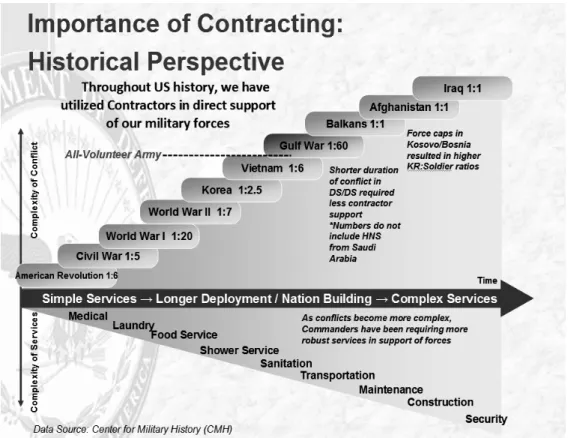
Thibault et al., 2009, p. 21)...35 Figure 5. DoD Acquisition Workforce Trends (From: Defense Acquisition
University, 2007, pp. 3–8) ...36 Figure 6. Cumulative Obligations on Contracts and Grants (in $ billions) Performed
in Iraq, Afghanistan, Bahrain, Kuwait, and Qatar (From: Thibault et al., 2011a, p. 6) ...42 Figure 7. Fraud Triangle for Army CCOs in OIF and OEF ...52 Figure 8. SIGIR Investigations: Criminal and Monetary Results (From: Special
Inspector General for Iraq Reconstruction, 2011, p. 117) ...54 Figure 9. Comparison of Organizational Fraud Approaches (After: Albrecht et al.,
LIST OF TABLES
Table 1. Army CCO Convictions (From: Special Inspector General for Iraq Reconstruction, 2011, pp. 142–146) ...29 Table 2. Year Areas Were Designated High-Risk (After: Government
Accountability Office, 2011a, p. 173) ...31 Table 3. OEF and OIF Related Reports and Testimonies (FY2003–2007) (From:
Department of Defense, Inspector General, 2008a, p. 3)...32 Table 4. Changes in the DoD’s Use of Service Contracts, Fiscal Years 1996 to
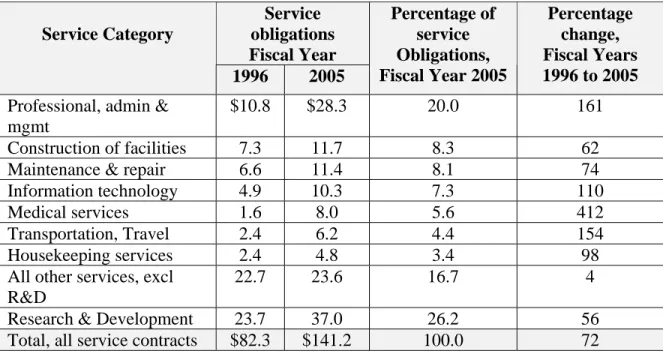
2005 (From: Abusive Practices in DoD Contracting, 2007, p. 15) ...38 Table 5. 2010 Corruption Perceptions Index (After: Transparency International,
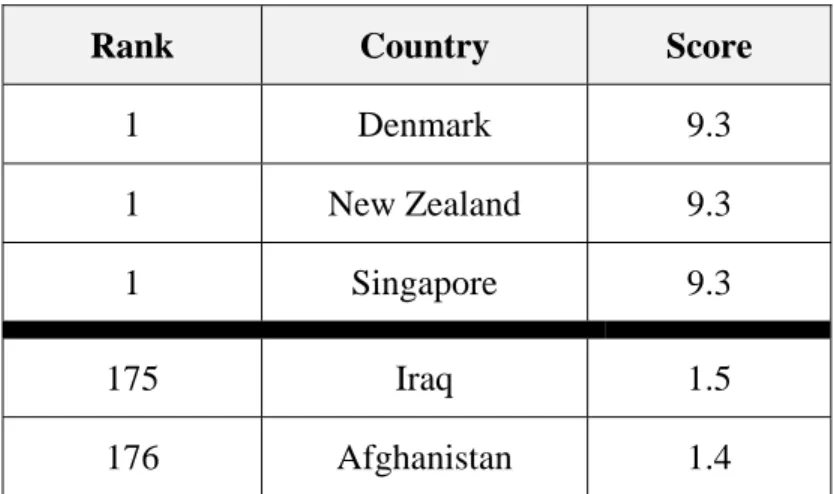
2011) ...44 Table 6. Deficiencies Identified by SIGIR During Contract Review, Iraq 2005
(From: Special Inspector General for Iraq Reconstruction, 2005, p. 7) ...48 Table 7. Status of Investigative Activities of Other U.S. Agencies, as of 9/30/2011
LIST OF ACRONYMS AND ABBREVIATIONS
ACC Army Contracting Command ACC Army Acquisition Corps
ACFE Association of Certified Fraud Examiners AFN Armed Forces Network
ASC American Society of Criminology
CCO Contingency contracting officer CENTCOM U.S. Central Command
CID Criminal Investigative Division CJCS Chairman of the Joint Chiefs of Staff
CWC Commission on Wartime Contracting
DBSAE Defense Business Systems Acquisition Executive DCIS Defense Criminal Investigative Services
DFARS Defense Federal Acquisition Regulation Supplement
DoD Department of Defense
DoDIG Department of Defense Inspector General DPAP Defense Procurement and Acquisition Policy
FAR Federal Acquisition Regulation
FBI Federal Bureau of Investigation
FERRET Forensic Evaluation, Research, Recovery and Enforcement Team FINCEN Financial Crimes Enforcement Network
GAO Government Accountability Office HQDA Headquarters, Department of the Army ICCTF International Contract Corruption Task Force JCC-I Joint Contracting Command–Iraq
JCC-I/A Joint Contracting Command–Iraq/Afghanistan MPFU Major Procurement Fraud Unit
MOS Military Occupational Specialty NATO North Atlantic Treaty Organization NCO Noncommissioned Officer
OEF Operation Enduring Freedom OIF Operation Iraqi Freedom
PD2 Procurement Desktop Defense
SAS Statement of Auditing Standards
SFC Sergeant First Class
SIGAR Special Inspector General for Afghanistan Reconstruction SIGIR Special Inspector General for Iraq Reconstruction
ACKNOWLEDGMENTS
I would like to acknowledge the outstanding support and expertise provided by my advisors, Professor Max V. Kidalov, J.D., and Professor E. Cory Yoder during this project.
I would also like to thank my family, especially my husband, for their patience and encouragement.
I. INTRODUCTION
In this chapter, I present the purpose, research question, and methodology for the analysis of the corruption of Army contracting officers in Operations Iraqi Freedom and Enduring Freedom through the application of occupational fraud theory. I also discuss this report’s scope and organization.
A. BACKGROUND
Army contingency contracting officers (CCOs) have been providing critical contracting support to forces in Iraq and Afghanistan for nearly a decade. They, along with other Department of Defense (DoD) contracting officers, enabled the obligation of more than $206 billion on contracts for equipment, supplies, and services from 2002 through 2011 in support of Operation Iraqi Freedom (OIF) and Operation Enduring Freedom (OEF) (Thibault et al., 2011b, p. 2). Unfortunately, a small but growing number of CCOs chose personal enrichment over public good and eclipsed the outstanding efforts and integrity of the majority of CCOs; in the process, this minority of Army CCOs broke the law, betrayed Army values1, and violated their country’s trust. Investigation and
conviction rates indicate that Army CCOs are involved in the commission of fraud by a significantly higher percentage in comparison to contracting officers in the other Services, despite being the minority of contracting personnel in theater (Gansler et al., 2007).
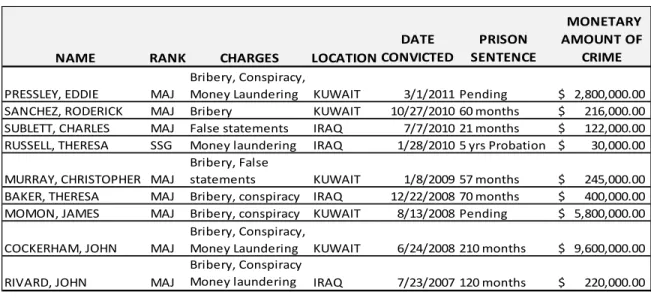
The most well-known case of CCO corruption in OIF is that of Major John Cockerham, an Army CCO who was sentenced to 17.5 years in jail after admitting to taking more than $9 million in bribes for awarding contracts at Camp Arifijan, Kuwait, in 2004 and 2005 (Department of Justice, 2009). More than a simple bribery case, Major Cockerham’s case involved a complex conspiracy that as of July 2011 involved 17 individuals who had pled or been found guilty, as well as four other individuals pending trial (Department of Justice, 2011). Of the 17 convicted, three individuals, in addition to
1 The seven core Army values are Loyalty, Duty, Respect, Selfless Service, Honor, Integrity, and Personal Courage (U.S. Army, 2011).
Cockerham, were Army CCOs (Majors Momon, Murray, and Pressley), while another (Major Davis) committed suicide after confessing to an Army investigator that she had accepted bribes (Schmitt & Glanz, 2007). A fifth CCO (Sergeant First Class [SFC] Evick) is currently awaiting trial. Although the dollar value and number of personnel involved in this case may represent an anomaly, Army CCO fraud commission is unfortunately too common.
Several years into operations in Iraq and Afghanistan, corruption in the Army CCO Corps joined other contract-related incidents (e.g., Abu-Ghraib, Nisoor Square),2
garnering media attention, causing public outrage, and sparking congressional interest. These high-profile events reflected fundamental vulnerabilities in the Army’s contracting system, many of which existed well before the commencement of operations in Iraq and Afghanistan, as documented in numerous government agencies’ reports (Government Accountability Office, 2011b; Commission on Army Acquisition and Program Management in Expeditionary Operations, 2007; Commission on Wartime Contracting, 2010). The scandals, however, compelled the federal government to acknowledge the systemic issues relating to contracting, specifically contingency contracting, and confront them.
An early initiative was the creation in 2008 of an independent and bipartisan commission to review contingency contracting and provide recommendations to Congress. Known as the Commission on Wartime Contracting (CWC) in Iraq and Afghanistan, it has issued several interim and special reports assessing contracting for reconstruction, logistics, and security, as well as documenting the extent of fraud, waste, and abuse. In its final report to Congress, released in August 2011, the CWC reported that between $10.3 and $18.5 billion has been lost to fraud associated with contracts in these operations (Thibault et al., 2011b, p. 90). This dollar amount represents 5% to 9% of the $206 billion spent thus far in contingency contracts in OIF and OEF.
2 Abu Ghraib: The Army utilized an existing Department of the Interior Blanket Purchase Agreement for Information Technology to sole-source its prisoner interrogation requirement, later determined out of scope (Department of the Interior, 2004); Nisoor Square: Blackwater contractor personnel performing private security are accused of killing 14 unarmed Iraqi civilians and wounding 18 others (Raghavan, 2007).
The staggering sums in the CWC report made national headlines, prompting renewed calls for increased oversight and regulatory reforms in federal contracting, specifically in contingency contracting. Senator Claire McCaskill, who, along with Senator Jim Webb, had championed the commission’s charter, called the findings “disgusting” and “shocking” (McCaskill, 2011). The extent of the fraud in OIF and OEF is certainly distressing and shameful, but is it surprising? The CWC implied otherwise when noting that its fraud estimate was consistent with the statistics the Association of Certified Fraud Examiners (ACFE) had reported. The ACFE, the world’s largest anti-fraud organization, has conducted numerous studies and surveys regarding the size and scope of occupational fraud, finding that the typical U.S. organization loses 7% of its revenues to fraud annually (Association of Certified Fraud Examiners, 2008). If the percentage of fraud in OIF and OEF is consistent with the general occupational fraud rate, then I hypothesize that classic occupational fraud theory can explain the occurrence of fraud in OIF and OEF and, by extrapolation, fraud by contracting personnel in a generic contingency operation.
B. PURPOSE
The purpose of this project is to analyze the conditions that enabled corruption of Army CCOs during OIF and OEF by applying occupational fraud theory, specifically the classic sociological/criminological Fraud Triangle model (Cressey, 1953), to determine its validity in a contingency operation. By examining the contracting environment in OIF and OEF and utilizing the conceptual framework of occupational fraud theory, I identify the distinctive situational elements of a contingency operation that influence an individual’s decision to commit fraud and thus affect the probability of fraud occurring in contingency operations.
By analyzing the procurement fraud environment in OIF and OEF using an occupational fraud model, I provide the foundation for understanding why fraud occurs in the context of contingency operations with the intent of preventing future procurement
integrity violations. Reducing instances of fraud directly impacts the appropriate utilization of taxpayer funding and the operational readiness of the warfighter, as well as enhances the reputation and standing of the Army CCO Corps.
C. RESEARCH QUESTION
The primary objective of this research project is to answer the following question: How does occupational fraud theory account for the corruption of Army CCOs in OIF and OEF? Understanding what motivates a CCO’s corrupt behavior in a contingency operation and identifying the enabling characteristics of the contracting environment is critical in preventing and deterring fraud in future contingency operations. Through a holistic analysis of CCO corruption in a contingency operation, the Army will be better postured to implement an effective and comprehensive anti-fraud program for its deployed contracting organizations.
D. SCOPE
I have limited this report to corruption, substantiated through criminal conviction for fraud, of deployed Army CCOs supporting operations in Iraq and Afghanistan. Inherent in the scope of this report is terminology that requires further definition. Fraud
is a generic term, and thus there are many definitions and classifications. In essence, however, fraud always entails deception or willful misrepresentation. In this report, I focus on occupational fraud, and specifically corruption, which is the most common fraud scheme. The ACFE defines occupational fraud as “the use of one’s occupation for personal enrichment through the deliberate misuse or misapplication of the employing organization’s resources or assets” (Association of Certified Fraud Examiners, 2008, p. 6). This definition is very broad and covers a wide range of activities, everything from stealing pens to sophisticated financial accounting schemes; this definition also applies to a variety of perpetrators, including employees, managers, and executives. Thus, the ACFE further classifies occupational fraud into three major categories: Asset misappropriations, corruption, and fraudulent statements. The Association of Certified Fraud Examiners (2008) defines corruption as
schemes in which fraudsters use their influence in business transactions in a way that violates their duty to their employers in order to obtain a benefit for themselves or someone else. For example, employees might receive or offer bribes, extort funds from third parties, or engage in conflicts of interest. (p. 10)
A complete breakdown of the ACFE’s Occupational Fraud and Abuse Classification System appears at Appendix A. The DoD (2003) defines fraud from its own perspective and provides additional examples in its guide for investigators, Criminal Investigations of Fraud Offenses:
Any intentional deception designed to deprive the United States unlawfully of something of value or to secure from the United States a benefit, privilege, allowance, or consideration to which he or she is not entitled. Such practices include
• Offering payment or accepting bribes or gratuities.
• Making false statements.
• Submitting false claims.
• Using false weights or measures.
• Evading or corrupting inspectors or other officials.
• Deceiving either by suppressing the truth or misrepresenting material fact.
• Adulterating or substituting materials.
• Falsifying records and books of accounts.
• Arranging for secret profits, kickbacks, or commissions or conspiring to use any of these devices.
• Conflict of interest cases, criminal irregularities, and the unauthorized disclosure of official information relating to procurement. (p. 7)
However, this definition encompasses fraud by both government employees and external parties (e.g., private contractors). Because in this report I focus on corruption, I am concerned solely with the government employee, the Army CCO, and thus I do not address the contractor participation in fraud.
For the purposes of this report, the term CCO refers to Army Acquisition Corps (AAC) military personnel, either active or reserve components, assigned to a position with the responsibility of awarding contracts and coded as a 51C, Contracting and
Industrial Management, one of five career specializations within the AAC. According to the Department of the Army’s (2010) pamphlet on officer career management, the 51C is assigned to provide contracting support worldwide to expeditionary operations throughout the entire spectrum of military operations. These officers will lead contingency contracting teams, contracting efforts for installations, military construction and weapon systems procurement offices. They execute contract awards and contract administration management and industrial management/oversight at contractor facilities worldwide. Officers coordinate with warfighters and program managers for requirement determination. These officers are responsible for making determinations on contracts awards and developing contracting support plans (p. 391). A CCO can also be a noncommissioned officer (NCO), performing the same function and with the same responsibilities as the 51C officer. The Army established the Military Occupational Specialty (MOS) 51C, Acquisition, Logistics, and Technology (AL&T) Contracting NCO, in December 2006 (United States Army, 2011b).3
The scope of this report comprises the contingency operations of OIF and OEF, which refer to U.S. military operations in Iraq and Afghanistan, respectively. I provide more information on contingency operations in Chapter III. Although OIF transitioned to Operation New Dawn on October 1, 2010, to mark the end of the U.S. forces’ combat operations in Iraq and to emphasize stability operations, I utilize the nomenclature of OIF throughout for continuity purposes. Some contracting support for OIF and OEF took place outside of Iraq and Afghanistan, notably in Kuwait. In this report, I include fraud by CCOs who were forward deployed to provide contracting support in OIF and OEF, even if they were not actually operating within the geographic boundaries of Iraq and Afghanistan.
E. LIMITATIONS AND ASSUMPTIONS
Inherent in the covert nature of fraud is that it is difficult to accurately identify and measure. Thus, although there have been numerous investigations and prosecutions
3 Prior to this date, MOS92 series (Logistics) NCOs were utilized to fill 51C positions, and contracting was not a permanent NCO career track.
of Army CCOs, the true extent of Army CCO fraud is unknown. Realistically, many instances may go undetected, thus preventing the Army from determining or definitively quantifying the true extent of CCO corruption. This limitation becomes even more pronounced considering the current constrained resource environment, which could limit investigation and prosecution, in addition to the obvious stake of corrupt parties to prevent their exposure. Despite the challenges associated with identifying Army CCOs as perpetrators of fraud and holding them accountable, numerous Army CCOs are serving prison sentences for their crimes. These cases, like that of Major Cockerham and his accomplices, represent the existence of corruption, which is one category of occupational fraud and which contributed to the potential loss of upwards of $18 billion in OIF and OEF. The fact that this fraud occurred in a contingency operation provides a unique element in the application of classic occupational fraud models to understanding why and how the fraud took place.
Although the models I utilize in this report have existed for decades and fraud examiners have adopted them as standard methodology, I do not claim that they are perfect tools; no model can adequately predict or explain every single occurrence of fraud. Additionally, I do not attempt to address every theory regarding occupational fraud. The field of research encompassing occupational fraud continues to evolve, and researchers have identified and will continue to identify weaknesses inherent in the existing models by conducting follow-on studies and proposing new models. Although there is not a one-size-fits-all approach to occupational fraud, my research objective is to determine how the classic Fraud Triangle model explains corruption of Army CCOs in OIF and OEF and, indirectly, other contingency operations.
I did not conduct any personal interviews with investigators or convicted fraudsters; instead, I relied on publicly available accounts of their cases, obtaining most of the data from government reports, publically available legal documents, and other media sources. The CCOs prosecuted for fraud offenses have, for the most part, kept the motivation for their actions private. It would be pure conjecture to attempt to provide motivations for the fraudsters in specific cases; therefore, in this report I suggest generalized motivations based on findings from previous occupational fraud research and
the conditions relevant to the cases. Some may contend that an in-depth analysis of the environment is unnecessary because fraud is solely the byproduct of greed. Although greed is certainly a factor in occupational fraud, it is too simplistic an explanation for the phenomenon of CCO corruption in OIF and OEF. Joseph Wells (1997), founder of the ACFE and a notable examiner and researcher of fraud, observed that greed as a motive for fraud is subjective, and in turn problematic, in terms of providing a metric to predict behavior. He concluded, “there is little we can say about greed as a motive that will help us detect or deter occupational fraud” (p. 514).
Although I focus on CCOs, other Army uniformed personnel committed the majority of fraud in OIF and OEF via their indirect involvement in the contracting process (i.e., acting as project purchasing officers, field ordering officers, and contracting officer representatives). Although committing fraud was a clear violation of their duty as government employees, the significant difference for the purposes of this report is that these individuals were not acquisition professionals, and procurement was not their primary duty; rather, they were tasked to perform additional duties by, and on behalf of, a non-contracting parent organization. I assume, however, that my findings are applicable to personnel in these positions to some degree, as well as to other Service and agency contracting officers to a much greater degree.
Similarly, although OIF and OEF are presented as case studies for the application of occupational fraud theory to explain the corruption of CCOs in contingency operations, I utilize these operations to allow for generalizations with any contingency operation. Although each contingency operation is unique based on mission, location, duration, and other operational dynamics, there are characteristics that are potentially present in a contingency operation that could affect an individual’s propensity to commit fraud based on a variety of perceived pressures, opportunities, and rationalizations.
F. RESEARCH METHODOLOGY
In my research for this project, I undertook a literature review of contingency contracting with a narrower focus on procurement fraud in contingency environments, specifically fraud that occurred in support of operations in Iraq and Afghanistan. In the
literature review, I include applicable government reports and testimony from the GAO, the DoD and special Inspectors General, the CWC, and the Commission on Army Acquisition and Program Management in Expeditionary Operations (commonly referred to as the Gansler Report). I obtained fraud case information and data regarding the number of ongoing investigations and prosecutions involving Army CCOs from the public records of the Department of Justice and supporting investigative agencies.
In the literature review, I also include an examination of occupational fraud theory, including the research of Sutherland (1949), Cressey (1953); Wolfe and Hermanson (2004); Albrecht, Howe, and Romney (1984); and Hollinger and Clark (1983). Occupational fraud theory provides the explanatory models enabling an understanding of the motivation(s) behind fraud in order to better assess organizational risk and identify effective prevention and detection mechanisms.
Starting from the data on CCO fraud commission provided by the Department of Justice and Special Inspector Generals and utilizing the framework provided by the occupational fraud models, I analyze the contracting environment prior to and during operations in Iraq and Afghanistan to identify elements that influenced pressures, opportunities, and rationalizations which led to Army CCO corruption. The Army’s Criminal Investigative Division’s (CID) Major Procurement Fraud Unit (MPFU) conducted an assessment of the contracting environment in Iraq over a several-month– long period in 2005 and identified various significant conditions that were conducive to fraud (Ethridge, Greenway, & Kilgore, 2007). Many of these elements are likely to exist in any contingency operation and therefore provide a relevant basis for the application of the fraud theory to account for CCO corruption.
G. ORGANIZATION OF THE REPORT
I have organized this report into four chapters. In Chapter I, Introduction, I provide a brief background regarding fraud in operations in Iraq and Afghanistan to establish that occupational fraud was a widespread and costly problem in OIF and OEF as contingency operations. I then present the research question and methodology for conducting the research, as well as identify the scope, limitations, and assumptions that
impact the research conclusions. In Chapter II, I present a consolidated review of occupational fraud theory and include prominent fraud models, notably Cressey’s Fraud Triangle, to provide the foundation for addressing the problem of fraud in contingencies. In Chapter III, I provide an overview of contingency contracting and then utilize the framework I presented in Chapter II to examine how the contracting environment prior to OIF and OEF, as well as the attributes of OIF and OEF as contingency operations, enabled fraud. In Chapter IV, I present the conclusions and propose areas for further research.
H. SUMMARY
In this chapter, I provided an overview of the body of the research of this report. I presented the research question, scope, and methodology of the research. Finally, I provided a general outline of the report.
In the next chapter, I provide the basic theoretical framework of occupational fraud by presenting notable research and the explanatory models originating from it. My overview of occupational fraud theory serves as an informed foundation for Chapter III, in which I analyze the contracting environment, both prior to and during OIF and OEF, to identify the characteristics of these recent contingency operations that enabled the corruption of U.S. Army CCOs. In order to do so, I present the various explanations of fraud causation, which are fundamental to understanding this corruption.
II.
OCCUPATIONAL FRAUD THEORY
In this chapter, I present an overview of occupational fraud theory from the conceptualization of the white-collar criminal to subsequent seminal research studies, from which the most widely accepted explanatory model of financially motivated crime, the Fraud Triangle, originated. In the majority of recent studies, researchers have focused on revisions and expansions of the Fraud Triangle in an attempt to provide a more comprehensive representation of occupational fraud in today’s complex and technological society.
A. BACKGROUND
Despite the enormous economic and social impact caused by occupational fraud, relatively little research in the area has been conducted (Wells, 1997). With a recent spate of financial crimes fresh in the public’s conscience, however, occupational fraud as a field of study has been garnering considerable attention. Theories are proving relevant in accounting for the commission of crimes making front-page news, ranging from Bernard Madoff’s investment fraud to insider trading by the hedge fund Galleon Group’s founder, Raj Rajaratnam. With the massive size and scope of potential fraud based on the highly networked, computerized, and global characteristics of financial systems today, understanding the enablers of fraud is more important than ever.
Occupational fraud, as a separate field of research, developed out of criminological and sociological studies in the early 1900s. Up to that time, most research regarding crime had focused on violent offenders, such as murderers and rapists. Research on financially motivated crime was minimal and limited primarily to theft and burglary. Edwin H. Sutherland, a sociologist and university professor, was one of the first to undertake a systematic study of financial crimes and fraud perpetrators. In doing so, Sutherland repudiated the commonly held theories of the early 20th century regarding the origins of criminal behavior: notably, that criminal behavior is caused by genetics, which
is exacerbated by environmental conditions like poverty. Sutherland (1983) proposed a contrary thesis that “social and personal pathologies are not an adequate explanation of criminal behavior” (p. 5).
Based on the research he conducted, much of it on the upper class and business elite, Sutherland concluded that criminal behavior is learned. This learning takes place through social interaction and communication with others and thus is largely dependent upon the environment. He postulated a hypothesis of differential association in which he described criminal behavior as
learned in association with those who define such criminal behavior favorably and in isolation from those who define it unfavorably, and that a person in an appropriate situation engages in such criminal behavior if and only if the weight of the favorable definitions exceeds the weight of the unfavorable definitions. (Sutherland, 1983, p. 240)
In the textbook Sutherland co-authored with Cressey and Luckenbill (1992),
Principles of Criminology, which remains standard course reading for criminology students to this day, Sutherland further expanded the theory of differential association by outlining its nine essential points:
• Criminal behavior is learned.
• Criminal behavior is learned while interacting with other persons in a process of communication.
• The principal part of the learning of criminal behavior occurs within intimate personal groups.
• When criminal behavior is learned, the learning includes techniques of committing the crime, which are sometimes very complicated, sometimes simple, and the specific direction of motives, drives, rationalizations, and attitudes.
• The specific direction of motives and drives is learned from definitions of the legal codes as favorable or unfavorable.
• A person becomes delinquent because of an excess of definitions favorable to violation of the law over definitions unfavorable to violation of the law.
• Differential associations may vary in frequency, duration, priority, and intensity.
• The process of learning criminal behavior by association with criminal and anti-criminal patterns involves all of the mechanisms that are involved in any other learning.
• Although criminal behavior is an expression of general needs and values, it is not explained by those needs and values, because non-criminal behavior is an expression of the same needs and values. (pp. 88–91)
In shifting the focus away from social and economic determinants (i.e., personal/family background and poverty/wealth levels), the theory of differential association represented a new paradigm in the field of criminology. In his research, Sutherland also provided an impetus for researchers to conduct additional studies of crimes that members of the upper echelons of society, as well as corporations, had committed. In fact, Sutherland is responsible for coining the term white-collar crime in 1939 (Wells, 1997, p. 9). In his book White Collar Crime, published 10 years later,4
Sutherland (1983) described the term “principally to refer to businessmen and executives” (p. 265). The term has since come to encompass virtually all economic and financial crimes.
The impact of Sutherland’s research on the field of criminology is far-reaching; the American Society of Criminology’s premier award recognizing exceptional contribution to theory or research is named in his honor, the Edwin H. Sutherland award (American Society of Criminology, 2011). Sutherland and his theory of differential association, with its focus on the “drives, rationalizations, and motives” (Wells, 1997, p. 9) of criminals, directly influenced subsequent research on occupational fraud. Much of the current literature in the area of occupational fraud is predicated on Sutherland’s groundbreaking studies of crimes businesspeople, managers, and corporations have committed.
B. CRESSEY’S FRAUD TRIANGLE
Perhaps unsurprisingly, one of the premier figures in the field of occupational fraud theory was a student of Sutherland’s, Donald R. Cressey. Upon his passing in 1987,
The New York Times lauded Cressey as one of the “nation’s leading experts on the
sociology of crime” and noted that he was the author of “several highly regarded books on the causes and prevention of crime” (“Prof. Donald R. Cressey,” 1987). Cressey incorporated Sutherland’s differential association theory while researching a wide variety of areas, including organized crime and criminal rehabilitation.
An early research undertaking, however, ultimately became a landmark study and generated the classic Fraud Triangle model for which Cressey is best known. While Sutherland focused on high-level corporate executives who committed fraud against the public or company shareholders, Cressey focused his efforts on low-level embezzlers, interviewing more than 200 inmates at Midwest prisons (Wells, 1997). He published his research findings in Other People’s Money: A Study in the Social Psychology of Embezzlement. In it, he referred to an embezzler as a trust violator, someone who had earned a position of trust in an organization but later violated this trust when exposed to a given pressure. Cressey’s (1953) hypothesis was that
trusted persons become trust violators when they conceive of themselves as having a financial problem that is non-shareable, are aware this problem can be secretly resolved by violation of the position of financial trust, and are able to apply to their own conduct in that situation verbalizations which enable them to adjust their conceptions of themselves as trusted persons with their conceptions of themselves as users of the entrusted funds or property. (p. 30)
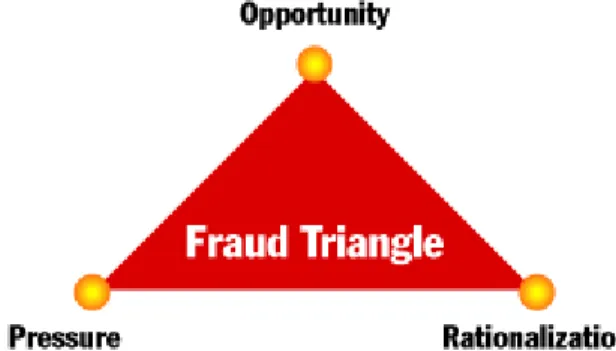
Central to this hypothesis are these three elements: the non-shareable financial problem or pressure that provides the incentive to act, the rationalization that enables an individual to believe the criminal act is justified, and the opportunity, including the skill and information, to commit the act. Over time, Cressey’s hypothesis became known as the Fraud Triangle, with each of the three elements representing a leg of the triangle, as shown in Figure 1.
Figure 1. Fraud Triangle (From: Wells, 1997, p. 11)
Importantly, Cressey (1953) believed that all three elements had to be present, a conjuncture of events, in order for the fraud to occur: “The absence of any one or all of the events in the process will preclude the criminal violation of financial trust, together with other information, that when the entire process takes place trust violation results” (p. 34).
1. Non-Shareable Financial Pressures
The first leg of the triangle, the non-shareable financial pressure, provides a critical differentiation in terms of the fraud commission relative to why an individual has not previously violated the trust of his or her employer. The existence of this pressure explains the responses of the research subjects—the inmates incarcerated for fraud offenses—when asked why they had refrained from fraud at an earlier time: They said, “There was no need for it like there was this time”; “The idea never entered my head”; and “I thought it was dishonest then, but this time it didn’t seem dishonest at first” (Cressey, 1953, p. 33). The pressure serves as a catalyst, of which Cressey (1953) identified six types:
• violation of ascribed obligations,
• problems resulting from personal failure,
• business reversals,
• physical isolation,
• status gaining, and
Violation of ascribed obligations refers to an individual’s inability to pay a debt, compounded by the feeling that revealing the situation would make it worse or lead to additional feelings of guilt and shame. Thus, the individual feels that he or she cannot admit his or her problem to another party, even one in a position to help. Frequently, this inability to ask for help has to do with the position of trust the individual holds, at work or home, which is accompanied by expectations from the organization (employer and employees), family (spouse and child), or society in general. Thus, as Cressey (1953) explained, “admission of the loss would amount to an admission of unworthiness” (p. 41). Problems resulting from personal failures can arise from gambling, drug use, credit card abuse, or poor investment decisions, as examples. The individual feels that the problem is a “consequence of his ‘own bad judgment,’ ‘own fault,’ or ‘own stupidity’ (Cressey, 1953, p. 42). Cressey differentiated the third type, business reversals, from personal failures to reflect an individual’s belief that business-related financial problems are beyond his or her control and are purely the result of external factors, such as poor market conditions or high interest rates. The fourth category, physical isolation, refers to an individual’s belief that no one can understand his or her problem or assist in solving it; this belief is independent of feelings of fear or shame that would preclude admission. An individual incurs problems related to status-gaining when he or she aspires to status or social standing, a keeping-up-with-the-Joneses mentality. The final category refers to problems associated with the employer-employee relationship. In these cases, an individual may feel that he or she is not being treated fairly, compensated appropriately, or appreciated for his or her contributions. The individual does not believe that he or she can share his or her feelings without retribution or negative impact. In all these categories of non-shareable pressures exists the motivation for the trust violation: embezzlement in Cressey’s research, but inclusive of other occupational fraud schemes as well.
2. Opportunity
According to Cressey, there are two prerequisites that make up the second leg of the triangle, perceived opportunity: the individual must possess general information, as well as the technical knowledge to execute the fraud secretly. The first part, general information, is basically the individual’s recognition that the trust can be violated (i.e.,
the individual recognizes his or her fiduciary capability to execute the fraud). These individuals recognize that their position provides the potential to alleviate their non-shareable problem. Technical knowledge is also often tied to the position; the same skills required to gain and keep the position can be used to commit the fraud. Cressey (1953) noted that “persons trained to carry on the routine duties of a position of trust have at the same time been trained at whatever skills are necessary for the violation of that position” (p. 82). Thus, in execution of his or her crime, an individual does not deviate much from his or her typical occupational routine (i.e., the one in which he or she is skilled). Cressey (1953) observed, “Accountants use checks which they have been entrusted to dispose of, sales clerks withhold receipts, bankers manipulate seldom-used accounts or withhold deposits, real estate men use deposits entrusted to them, and so on” (p. 84). It is not, however, until the opportunity and non-shareable problem are accompanied by rationalization, that an individual will commit fraud.
3. Rationalization
The third leg of the triangle is rationalization, or as Cressey (1953) also referred to it, the “vocabulary of adjustment” (p. 93). This is the process by which an individual convinces himself that the fraud being committed is “(a) non-criminal, (b) justified, or (c) as a part of a general irresponsibility for which he is not completely accountable” (Cressey, 1953, p. 93). This rationalization happens prior to the execution of the fraud and is part of the motivation, allowing the trust violator to frame his or her action in such a way as to make it acceptable behavior. The rationalizations are unique and dependent on the individual and the crime. Cressey, however, delineated three types of offenders with their own rationalizations: independent businesspeople, long-term violators, and absconders.
Common excuses that independent businesspeople who had misused client funds adopted include “(a) that they were merely borrowing the money which they converted, or (b) that the funds entrusted to them were really theirs” (Cressey, 1953, p. 102). These individuals have a much easier time justifying their actions by using the terminology of
money. For some businesspeople, committing fraud is made easier by the fact it is a rational extension of how their business is conducted. Additionally, because these individuals are still performing their normal, legitimate duties, they avoid seeing their act as criminal.
Long-term violators also incorporate the rationalization of borrowing, but because their crimes occur over extended periods, additional rationalizations are also common. Examples of supplemental rationalizations include that they embezzled “to keep their families from shame, disgrace, or poverty, that theirs was a case of ‘necessity,’ that their employers were cheating them and were dishonest, so that trust violation seemed justified” (Cressey, 1953, p. 114). Cressey noted that the long-term violators have difficulty justifying their actions as time goes on, as they start to think about the potential consequences of their actions and the possibility of a prison sentence or other penalties. Many ultimately acknowledge that all they had done was trade one non-shareable problem (the catalyst) for another (the embezzlement).
The final group of offenders is the absconders, those who take the money and run. Cressey found that physical isolation is a common theme among this type of offender. This group has fewer family ties and less meaningful group associations. They tend to be in positions of lower status (e.g., clerks or drivers) versus an executive or accountant. These characteristics influence the decision to flee but also affect the type of rationalizations that absconders utilize. The absconders justify their behavior by telling themselves they do not care what happens to them, that living honestly is impossible, and that the criminality intrinsic in all people had come out in them. While independent businesspeople keep working and convincing themselves that they are normal and it is the situation that is bad, the absconder believes it is himself that is bad, blaming a personal defect instead of an external situation. However, both are rationalizations for socially unacceptable behavior, just with different sources.
Regardless of the type of rationalization, Cressey found it occurs before the crime takes place versus afterwards. In fact, many offenders abandon their previously held rationalization after the act, finding that the more they engaged in the fraud, the easier it
becomes and the less necessary it becomes to provide a reason for doing so. Wells (1997) later cited this phenomenon as a hallmark of occupational fraud, noting that once an offender crosses the line, “the illegal acts become more or less continuous” (p. 17).
Sutherland’s and Cressey’s seminal efforts in occupational fraud research provide the foundation for what is known regarding the causal factors of fraud. Although Cressey himself did not refer to his hypothesis as the Fraud Triangle, his findings have become ingrained in both academia and the private sector. The auditing profession formally adopted the concept, which appears in the Statement of Auditing Standards (SAS) 99: Consideration of Fraud in a Financial Statement Audit, as follows:
Three conditions generally are present when fraud occurs. First, management or other employees have an incentive or are under pressure, which provides a reason to commit fraud. Second, circumstances exist— for example, the absence of controls, ineffective controls, or the ability of management to override controls—that provide an opportunity for a fraud to be perpetrated. Third, those involved are able to rationalize committing a fraudulent act. Some individuals possess an attitude, character, or set of ethical values that allow them to knowingly and intentionally commit a dishonest act. However, even otherwise honest individuals can commit fraud in an environment that imposes sufficient pressure on them. The greater the incentive or pressure, the more likely an individual will be able to rationalize the acceptability of committing fraud. (American Institute of CPAs, 2011, p. 170)
Cressey’s contribution to the study of fraud through the formulation of the Fraud Triangle, with its straightforward and easily understandable explanation of why fraud occurs and how good people make bad decisions, is virtually unmatched. Since its introduction more than 60 years ago, it has undergone modifications and expansions as researchers have identified weaknesses and conducted additional studies. Subsequent research findings have incrementally increased the collective knowledge regarding the perpetration of fraud.
C. WOLFE AND HERMANSON’S FRAUD DIAMOND
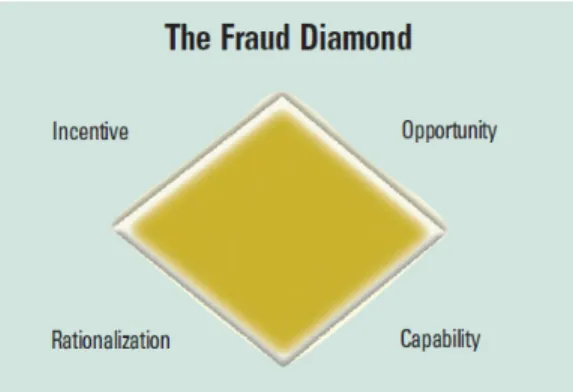
One later development was the inclusion of a fourth element, converting the Fraud Triangle into the Fraud Diamond (see Figure 2). In addition to incentive, opportunity, and rationalization, David T. Wolfe and Dana R. Hermanson, a CPA and
professor of accounting, respectively, added a fourth consideration: an individual’s capability. Wolfe and Hermanson (2004) believed that an individual’s personal traits and abilities, in addition to the other three factors, play a significant role in whether fraud occurs.
Figure 2. Fraud Diamond (From: Wolfe & Hermanson, 2004, p. 38)
Based on their extensive experience investigating fraud, Wolfe and Hermanson (2004) identified several essential personality traits regarding fraud commission, usually evident in fraud schemes that involve large sums of money or that take place over a prolonged period. The following are what Wolfe and Hermanson (2004) referred to as the components of capability:
• position/function,
• brains,
• confidence/ego,
• coercion skills,
• effective lying, and
• immunity to stress.
Clearly, not all these attributes are inherently bad. Being intelligent, confident, and persuasive are the characteristics that most likely contributed to the individual’s success in gaining a position of trust at the organization in the first place. It is when the individual decides to utilize these attributes against the company, being at the same time armed with the other capabilities, including the ability to lie effectively and deal with the stress of committing the fraud, that they become extremely dangerous and detrimental to
the organization. Recently discovered fraud schemes highlight perpetrators with the capabilities Wolfe and Hermanson described; Bernie Madoff serves as an excellent example. Wolfe and Hermanson (2004) contended that “today’s largest frauds are committed by intelligent, experienced, creative people, with a solid grasp of company controls and vulnerabilities” (p. 40).
While acknowledging overlap in the four areas (e.g., position as a capability also serves as opportunity), Wolfe and Hermanson contended that an individual’s capabilities should be evaluated as a separate element in an assessment of fraud risk. Additionally, they advised that assessing the capabilities of employees, particularly senior management, is critical and should not be a one-time effort. People can acquire professional capabilities and hone skills over time. Furthermore, internal processes and technologies are constantly changing, providing new opportunities for someone not previously recognized as a possessing the requisite characteristics to exploit. Wolfe and Hermanson (2004) provided specific recommendations for dealing with personal capability when assessing fraud risk: performing routine background checks; spending time with the person, both at and outside of the workplace; and paying attention to the little things, like someone who consistently takes shortcuts or cheats at sports (p. 39).
It is the Fraud Diamond’s inclusion of the personal characteristics that separates it from the Fraud Triangle, and its major contribution to the occupational fraud canon is its view of fraud opportunity that goes beyond purely environmental and situational dynamics. It clearly owes its origins to Cressey’s Fraud Triangle but is arguably a better explanatory model for certain types of fraud, such as financial statement fraud versus corruption or employee asset misappropriation. Another benefit associated with the Fraud Diamond is that capability is a more observable attribute than rationalization or pressure, which are attributes that an individual can keep private. In this manner, the Fraud Diamond enhances the Fraud Triangle by addressing a weakness of its predecessor. Although the Fraud Triangle is a theoretically sound model, brilliant in its simplicity, it is, by itself, an inadequate mechanism for deterring, preventing, and detecting fraud because two of its three elements (pressure and rationalization) are hidden.
D. ALBRECHT’S FRAUD SCALE
Another pioneer researcher in the field of occupational fraud was Steve Albrecht, who, along with colleagues Keith Howe and Marshall Romney, studied corporate fraud through surveying internal auditors of companies that had been victims of fraud. Their work culminated in the publication of Deterring Fraud: The Internal Auditor’s Perspective (1984). In one facet of the study, Albrecht, Howe, and Romney focused on the motivations of the fraud perpetrators; they provided the auditors with a list of 25 motivating factors to identify those most commonly dealt with. The following 10 are the most frequently cited factors:
• the condition of living beyond one’s means,
• an overwhelming desire for personal gain,
• a high personal debt,
• a close association with customers,
• the perception that pay was incommensurate with duties,
• a “wheeler–dealer” attitude,
• the condition of feeling challenged to beat the system,
• excessive gambling habits,
• undue family or peer pressure, and
• no recognition for job performance. (Albrecht, Howe, and Romney, 1984, p. 48)
Although many of these duplicated Cressey’s findings with regard to the non-shareable financial pressures, Albrecht, Howe, and Romney highlighted some interesting associations between the offenders and the characteristics of the fraud they committed. They observed that perpetrators of large frauds were more likely to use the funds to buy expensive houses and automobiles than perpetrators of small frauds. Another interesting finding was that those motivated by beating the system committed larger frauds.
In addition to identifying personal characteristics, Albrecht, Howe, and Romney also noted environmental conditions. I provide a complete list of both, referred to as Red Flags, in Appendix B. Albrecht, Romney, and Howe (1984) used the same methodology to identify the most prevalent environmental factors:
• placing too much trust in key employees,
• lacking proper procedures for authorization of transactions,
• inadequately disclosing personal investments and incomes,
• not separating authorization of transactions from the custody of related assets,
• lacking independent checks on performance,
• giving inadequate attention to details,
• not separating custody of assets from the accounting for those assets,
• not separating duties between accounting functions,
• lacking clear lines of authority and responsibility, and
• internal auditors not frequently reviewing the department.
These environmental conditions provide opportunity. Thus, in identifying personal characteristics, Albrecht, Howe, and Romney found the source of pressure in the environmental conditions and opportunity, as did Cressey. Similarly, Albrecht, Howe, and Romney (1984) concluded there are three elements involved in occupational fraud:
a situational pressure (a non-shareable financial pressure), a perceived opportunity to commit and conceal the dishonest act (a way to secretly resolve the dishonest act or the lack of deterrence by management), and some way to rationalize (verbalize) the act as either being inconsistent with one’s personal level of integrity or justifiable. (p. 5)
While incorporating pressure (although encompassing a wider range of what qualifies as a pressure) and opportunity, Albrecht, Howe, and Romney substituted personal integrity for rationalization. A benefit associated with the inclusion of integrity is that it can be a more easily observed feature than rationalization. This feature provides the same benefit that the capabilities element of the Fraud Diamond provides; and although an individual’s integrity certainly impacts his or her process of rationalization, rationalization is an internal process, whereas integrity has observable outputs. An individual’s commitment to ethical decision-making can be judged by observing both a person’s decisions and his or her decision-making process (Dominey, Fleming, Kranacher, & Riley, 2010).
Providing a model to explain the concept, Albrecht, Howe, and Romney introduced the Fraud Scale, as seen in Figure 3.
Figure 3. Fraud Scale (From: Albrecht, Howe, & Romney, 1984, p. 6)
The Fraud Scale illustrates how the interaction of the three criteria (pressure, opportunity, and integrity) determine the degree of fraud risk. If everything is balanced, then the fraud risk is neutral; but when personal integrity is low and situational pressures and perceived opportunities are high, fraud is more likely to occur. The Fraud Scale, like the Fraud Diamond, supports the Fraud Triangle and attempts to enhance it. While the Fraud Diamond amends the opportunity component of the Triangle, the Fraud Scale amends the rationalization component. Both models are therefore considered model extensions of the Fraud Triangle.
E. HOLLINGER AND CLARK
While Albrecht, Howe, and Romney surveyed auditors, Hollinger and Clark (1983) conducted a survey of 10,000 workers in the retail, hospital, and manufacturing sectors as part of their research regarding employee deviance, which the Department of Justice funded. Investigating the validity of multiple hypotheses, they concluded that employees steal primarily because of workplace conditions. Job dissatisfaction is the primary cause of employee theft. Although not necessarily a non-shareable financial
problem, Cressey did acknowledge employee dissatisfaction in the employer–employee relations as a problem in the pressure construct of the Fraud Triangle.
In addition to the relationship between job dissatisfaction and theft, Hollinger and Clark looked for correlations between other various attributes, including position and organizational controls. While confirming a direct relationship between an employee’s position and the level of the theft, they noted that because dissatisfaction was the primary motivator, the employee’s position only affected the method and amount of the theft after a decision to commit the crime had already been made.
Hollinger and Clark recommended that management pay attention to four aspects of policy development: (1) a clear understanding regarding theft behavior, (2) continuous dissemination of positive information reflective of the company’s policies, (3) enforcement of sanctions, and (4) publicizing the sanctions. Hollinger and Clark (1984) concluded that the most important policy implication
is that theft and workplace deviance are in large part a reflection of how management at all levels of the organization is perceived by the employee. Specifically, if the employee is permitted to conclude that his or her contribution to the workplace is not appreciated or that the organization does not seem to care about the theft of its property, we expect to find greater involvement. In conclusion, a lowered prevalence of employee theft may be one valuable consequence of a management team that is responsive to the current perceptions and attitudes of its workforce. (p. 146)
Although focused on employee theft, their conclusions are applicable to other forms of occupational fraud, including corruption. Although Hollinger and Clark did not create a new fraud model, and although they did not attempt to modify the Fraud Triangle model, their work regarding the employee theft motivation significantly impacted the field of occupational fraud. Most important, their research findings and recommendations impacted theories and practices regarding the best way for organizations to address employee deviance.
F. SUMMARY
In this chapter, I provided an overview of the evolution of occupational fraud theory and introduced the field’s conceptual models, including the benchmark model, the Fraud Triangle, and subsequent model extensions. I presented Sutherland’s study of
white-collar criminals and Cressey’s study of trust violators as seminal works in the field now known as occupational fraud. The Fraud Triangle represents a groundbreaking model in understanding how fraud occurs. Since its introduction more than 60 years ago, it has undergone revisions and expansions, including the insights provided by the Fraud Diamond and the Fraud Scale; nevertheless, the Fraud Triangle remains the standard framework for explaining the necessary conditions under which fraud occurs. Having established the critical tenets of occupational fraud theory, in which I have included a sufficient explanation of the fraud models, in the next chapter I operationalize the theory by applying the Fraud Triangle Model to the contracting environment and instances of Army CCO corruption in OIF and OEF.
III.
ANALYSIS OF THE CONTRACTING ENVIRONMENT
UTILIZING OCCUPATIONAL FRAUD THEORY
There is no kind of dishonesty into which otherwise good people more easily and frequently fall than that of defrauding the government
Benjamin Franklin in Poor Richard’s Almanac
A. BACKGROUND
In this chapter, I provide a brief overview of contingency contracting and Army CCO fraud in OIF and OEF, then address elements of the DoD’s contracting environment prior to these contingency operations that subsequently contributed to the Army’s fraud problems in theater. Next, I address the elements that created or stressed weaknesses in the OIF and OEF contingency contracting operation that contracting officers themselves exploited purposefully, or inadvertently allowed other contracting personnel the opportunity to do so. For both periods, prior to and during OIF and OEF, I approach the elements utilizing the construct of the Fraud Triangle model by examining how they could affect the pressures, opportunities, and rationalizations experienced by Army CCOs that ultimately could lead to a decision to commit fraud.
1. Contingency Contracting
A contingency is an event that requires the deployment of military forces in response to natural disasters, terrorist or subversive activities, collapse of law and order, political instability, or other military operations (Headquarters, Department of the Army [HQDA], 1999, p. 1-2). In accordance with 10 U.S.C. §101(a)(13), a declared contingency operation of the Department of Defense (DoD) may be
• Designated by the Secretary of Defense when members of the armed forces become involved in military actions against an enemy of the United States and/or
• Declared by the President or the Congress when members of the uniformed forces are called to active duty (a reserve component mobilization) under Title 10 U.S.C., or any provision of law during a declared war or national emergency. (Director, Defense Procurement and Acquisition Policy, 2010, p. 78)