MOBILE TELEPHONY FOR DEVELOPMENT IN
NIGERIA: DESIGNING MOBILE
TECHNOLOGY ENABLED APPLICATION IN
LOCAL LANGUAGES
Christine I. OFULUE, National Open University of Nigeria
[email protected]
, [email protected]
Tunde ADEGBOLA, African Languages Technology Initiative
[email protected]
Francis O. EGBOKHARE, University of Ibadan
[email protected]
Presented at the UNESCO Mobile Learning Week, Paris France 18 – 20 February 2013
Introduction
Nigeria, as one of E-9 countries faces the challenge of literacy development amidst a large population and a highly diverse large number of languages.
Low Language literacy levels: Limits in access to information and knowledge which in turn hinders development.
Exponential growth of mobile telephony provides opportunities for expanding access to information and knowledge
Objectives:
To bridge language literacy and diversity gaps by designing content in Nigerian languages for use on mobile platforms.
To provide opportunities for improving literacy levels and facilitate non-formal learning in Nigerian languages using mobile technology.
Selected languages:
English, Hausa, Yoruba, Igbo, Nigerian Pidgin
UNESCO Mobile Learning Week, Paris France 18- 20 February 2013
Strategy: Application of content design and technology to key
social/economic issues e.g. agriculture, health etc for populations
with literacy and linguistic profiles like Nigeria.
In the Agriculture sector, the GES scheme presents the project an
opportunity to provide content in a medium and language that
can impact literacy and knowledge levels, and enhance
farmers’
productivity significantly.
Literacy
is one of the important factors of growth in farm
productivity together with Research, extension, and infrastructure
(Mittal & Tripathi, 2009)
UNESCO Mobile Learning Week, Paris France 18- 20 February 2013
4
Background (2)
The project is exploiting Nigeria’s rapidly growing mobile
technology and infrastructure provisions for non-formal learning, in
this case, in the agriculture sector.
162.5 million people (World Bank, 2012) and over 100 million mobile
phone lines (NCC, 2012) presents an opportunity that cannot be ignored.
The project is leveraging on the deployment of the (GESS)
agriculture initiative by designing content for extension information.
25% of 1,500 mobile phone users surveyed, identified agriculture related
information as one of the mobile applications of interest (Pyramid, 2009).
UNESCO Mobile Learning Week, Paris France 18- 20 February 2013
*Data from the GES scheme
14 million Nigerians claim farming as their vocation (INEC data).
Coverage: Of 4.2 million farmers registered:
2 million had cell phones
1.8 million were reached through their cell phones
Adoption of technology: Out of 4.9 million transactions conducted
using English and Nigerian languages:
45% in Hausa 25% in English
17% in Yoruba 12% in Nigerian Pidgin 1% in Igbo
For extension information:
17% prefer to voice messages
83% prefer SMS (costs less than voice messages)
UNESCO Mobile Learning Week, Paris France 18- 20 February 2013
Content Design Process
Content Design and Technology.
Input:
Extension Information e.g. Preseason activity-Site Selection for
growing Rice
Task:
To structure the content into manageable segments that aid
learning for deployment on a mobile platform
Team:
Instructional designer, subject/extension expert,
language/translation expert, technology expert.
Language (pedagogy and translation)
Technology:
digitisation and deployment in SMS and Text to Speech
formats.
Testing:
Pre-digitisation, post-digitisation.
Feedback:
Assessment and Evaluation
UNESCO Mobile Learning Week, Paris France 18- 20 February 2013
Site selection
Input
Revised
1st SMS To select a Rice land 1st, choose a fertile land that is rich in mineral and has decay plants and animal material & is free from flooding issues.
118 characters
To select a rice land: 1st, choose a fertile land that contains manure and is free from uncontrolled
flooding. Loamy-clayey soil is best.
115 characters
2nd SMS 2nd, Rice grows in upland areas where rainfall is sufficient, river valleys of Fadama areas and on irrigated lands where water supply & distribution is controlled.
137 characters
2nd, rice grows in upland, river valleys of Fadama areas and
irrigated lands where water supply and distribution is controlled
107 characters
Feedback Question
The most suitable soil for growing rice is:
(a) Sandy-loam soil (b) Loam-clayey soil (c) Sandy soil
(d) Clayey soil
8
Technology: Narrow Domain
Synthesised Speech
UNESCO Mobile Learning Week, Paris France 18- 20 February 2013
9
SMS Input Synthesised Speech Output
Information in Multimedia
UNESCO Mobile Learning Week, Paris France 18- 20 February 2013
Conclusion
Issues
Functional (media) literacy among target group
Cost of providing service to the service provider and of accessing services by the farmer
Type of phone: cost and operational implications. Logistics of deployment on cell phones
Poor power supply in rural areas
Benefits:
Improved literacy levels (basic and functional)
Access to agro related information in farmers’ primary languages Potential economic benefits to small holder farmers
Ensures food security
Next steps: Scaling up content design for text and speech technology development in the various languages
UNESCO Mobile Learning Week, Paris France 18- 20 February 2013
THANK YOU FOR
LISTENING
UNESCO Mobile Learning Week, Paris France 18- 20 February 2013
12
for Listening
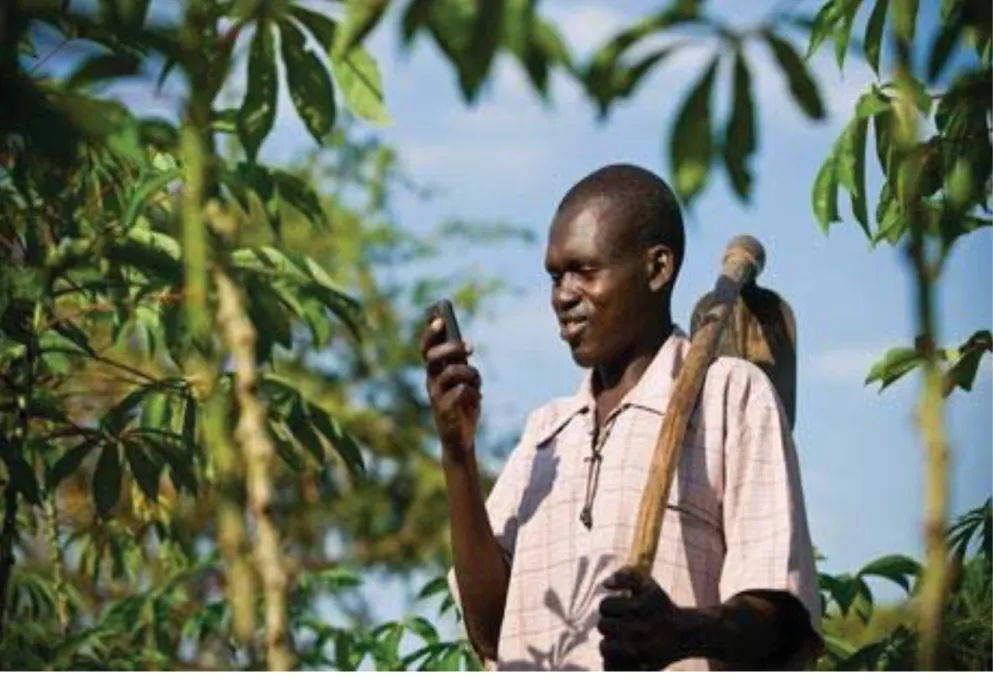
Figure 1: A happy farmer using his mobile phone. Photo credit: Guardian (cited in Oyeleye, 2012)
References
Adesina, A. (2013) Cell phones for Nigerian Farmers. Retrieved from www.businessdayonline.com
COL (2012). Lifelong Learning for Farmers. Commonwealth of Learning in Action. Canada: The Commonwealth of Learning. Retrieved from www.col.org/programmes/livlihoods&health
Growth Enhancement Support (2012) Case Study: Nigeria Fertilizer Value Chain. Nigeria: Cellulant.
FMARD Growth Enhancement Support Program (2012) GES 2012 Wet Season Farming Analytical Report. Nigeria:Federal Ministry Agriculture and Rural Development
Mittal, S. & Tripathi, G. (2009) Role of Mobile Phone Technology in Improving Small Farm Productivity, Agricultural Economics Research Review Vol. 22 pp 451-459.
Ofulue, C. I. (2010) Educational versus Functional Literacy: A study of attitudes of Mobile Phone Users to the acquisition of Basic ICT skills. In English and the Challenges of Literacy in the 21st Century. Proceedings of 22nd Annual Conference of
the Nigerian English Studies Association (NESA). pp. 64-73. Ile-Ife: Nigerian English Studies Association.
Ofulue, C. I. (2011) Literacy at a Distance in Multilingual Contexts: Issues and Challenges. International Review of Research in Open and Distance Learning (IRRODL) Vol. 12 (6) pp. 84 -101. http://www.irrodl.org
Oyeleye, 0. (2013) Agricultural transformation and rural development through mobile technology. Retrieved from
www.technologytimesng.com
Pyramid Research (2010) The Impact of Mobile Services in Nigeria. Abuja: Pyramid Research.
National Bureau of Statistics (2010). The National Literacy Survey. Retrieved from www.nigerianstat.gov.ng
The World Bank (2011). ICT in Agriculture: Connecting Smallholders to Knowledge, Network, and Institutions. Washington: The International Bank for Reconstruction and Development/World Bank. Retrieved from www.ictinagriculture.org/ictinag/
UNESCO Mobile Learning Week, Paris France 18- 20 February 2013