INTRODUCTION
How does a manmade satellite get into orbit? A satellite is launched by a rocket to a height (or altitude) at which Earth’s gravitational force keeps the satellite in orbit around Earth. A satellite, like the Moon, must travel at just the right speed to stay in Earth’s orbit. If the satel-lite moves too slowly, gravity might pull it back down to Earth. If the satellite moves too fast, it might escape Earth’s gravitational pull and zoom out into space.
In Lesson 14, you investigated the effects of surface gravity on weight. In this lesson, you will conduct four inquiries that focus on gravity and its effects on the orbits of moons and planets. What part does gravity play in keeping the plan-ets in orbit around the Sun? How do the moons stay in orbit around each planet? In this lesson, you will investigate these and other questions. You will also read to learn more about missions to Saturn, Uranus, and Neptune.
Gravity and Orbital Motion
OBJECTIVES FOR THIS LESSON
Analyze patterns in planetary motion. Observe the motion of a marble when acted upon by different forces.
Investigate the effect of a pulling force on the orbital period of a sphere. Relate the observed behavior of a marble and sphere to the motion of moons and planets.
Summarize, organize, and compare information about Saturn, Uranus, and Neptune.
What keeps a satellite orbiting in space? Gravity! Gravity also helps planets like Earth orbit the Sun.
NA TIONAL AERONAUTICS AND SP ACE ADMINISTRA TION/JET PROPULSION LABORA TOR Y
ware Explore the Planets with your class.
2.
Use what you learned fromExplore the Planetsto make general observations about the planets’ motion around the Sun. Record your ideas in your notebooks if instructed to do so by your teacher. Discuss your ideas with the class.3.
To get a better sense of how the planets’ orbits differ from each other, use the software Starry Night Enthusiast.Observe the orbits of the inner planets. Then observe the orbits of the outer planets. Record or discuss your observations as instructed.4.
Review the objectives of this lesson with your teacher. Discuss the Procedures and Safety Tips listed in each inquiry. A sum-mary of each procedure will be posted at each station.5.
Divide your notebook page into quadrants. Label the quadrants 15.1, 15.2, 15.3, and 15.4.6.
Complete all four inquiries in the order given to you by your teacher. Remember to return all of your equipment and its inquiry master to the plastic box or bag before moving on to the next station.1 working copy of Student Sheet 10.1c: Planetary Chart
3.
Let go of the marble. Discuss your obser-vations of the marble’s motion with your group. (Do not be concerned about the crater that the marble makes. The sand and flour keep the marble from moving once it lands in the box.) Compare your observations to your predictions.4.
Repeat Procedure Steps 1–3. Does the marble move the same way each time? Discuss your observations and record them in quadrant 15.1 in your notebook.5.
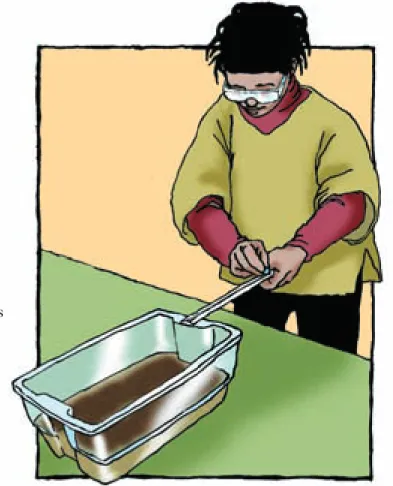
Use the ruler as a ramp to gently roll the marble into the plastic box, as shown in Figure 15.1. Keep the ruler nearly flat. Discuss your observations. How did the marble move once it left the ruler?Inquiry 15.1
Gravity’s Effect
on Objects in Motion
PROCEDURE
1.
Hold the marble 40 cm above the plastic box. With the marble in your hand, decide what two forces are acting on the marble. Are the forces balanced (both pulling equally) or unbalanced (one is pulling more than the other)? Discuss your ideas with your group.2.
What will happen if you release the mar-ble from your hand into the box? Discuss your predictions with your group.MATERIALS FOR INQUIRY 15.1 For you
1 pair of goggles For your group
1 copy of Inquiry Master 15.1: Gravity’s Effect on Objects in Motion
1 plastic box from Lesson 12 (filled with sand, flour, and cocoa)
1 large resealable bag containing the following: 1 metric ruler, 30 cm (12″)
1 marble
1 metric measuring tape
Figure 15.1 Roll the marble down the ruler into the plastic box.
SAFETY TIPS
Wear safety gog-gles at all times. Work in a well-ventilated area to minimize the level of dust in the air.
6.
Experiment by rolling the marble down the ruler at different speeds. Keep the ruler nearly flat. How does the marble move each time it leaves the ruler? If possible, measure the distance that your marble travels each time. Record your observations in your notebook.7.
Answer these questions in your notebook: A. What pulling force acts on the marble at all times?B. When you rolled the marble slowly, how did it move once it left the ruler?
C. How does the forward speed of the marble affect the motion of the marble once it leaves the ruler?
D. All planets that orbit the Sun are trav-eling forward due to inertia and falling toward the Sun due to gravity. Describe the path of something that has forward motion (like your marble) but is also being pulled down by gravity.
8.
Clean up. Return all materials to their original condition.MATERIALS FOR INQUIRY 15.2 For you
1 pair of goggles For your group
1 copy of Inquiry Master 15.2: Testing Balanced and Unbalanced Forces 1 plastic box (empty)
1 metal canning jar ring 1 marble
1 sheet of white paper
Inquiry 15.2
Testing Balanced
and Unbalanced Forces
PROCEDURE
1.
Place the white paper in the bottom of the plastic box. Put the metal ring on top of the paper with the lip up, as if you were putting the metal ring on a jar.2.
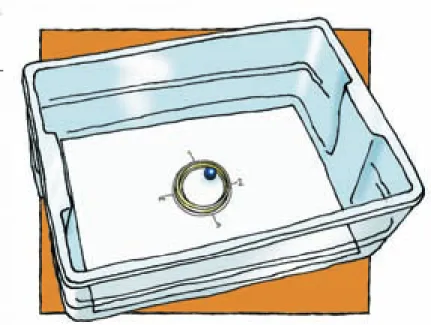
Trace an outline of the ring onto the paper. Remove the metal ring from the paper. Mark four points at equal distances around the circle. Number the marks 1 to 4 going clockwise, as shown in Figure 15.2.SAFETY TIP
Wear safety gog-gles at all times.
Figure 15.2 Mark the outline of the circle with 1, 2, 3, and 4 at quarter intervals.
3.
Place the metal ring on the circle, again with the lip up. Place the marble inside the metal ring. Without moving the metal ring, describe the motion of the marble. Record your observations in quadrant 15.2 in your notebook.4.
Use the ring to move the marble in cir-cles. Keep the ring on the paper at all times. Record your observations. Discuss with your group how the ring creates a force (called an “unbalanced force”) that influences the marble’s motion.5.
Make a prediction about what will happen if you lift the ring (remove the unbalanced force).6.
Move the marble in circles again, then lift the ring. What happens? In quadrant 15.2 in your notebook, describe the motion of the marble without the unbalanced force of the ring. Try this several times. Record your observations in both words and pic-tures. Use your numbered markings to pin-point the motion of the marble each time.7.
Answer these questions in your notebook: A. Describe the motion of the marble when an unbalanced force (the metal ring) influences it.B. Describe the motion of the marble when the unbalanced force is removed.
C. Suppose you lifted the ring when the clockwise orbiting marble was at the “1.” Draw the path the marble would take.
D. Suppose you lifted the ring when the clockwise orbiting marble was at the “4.” Draw the path the marble would take.
E. Like the marble, the planets move for-ward due to inertia and infor-ward due to an unbalanced force. Together, these forces cause the planets’ paths to curve. What is the unbalanced force that keeps the plan-ets in orbit? What would happen to the planets without this unbalanced force?
8.
Clean up. Return all materials to their original condition.MATERIALS FOR INQUIRY 15.3
For you
1 pair of goggles
For your group
1 copy of Inquiry Master 15.3: Observing Planetary Motion
1 Planetary Motion Model™
4 plastic boxes or boxes of the same height 1 large resealable plastic bag containing the
following:
1 yellow balloon, filled with water 1 metric ruler, 30 cm (12″) 1 marble
Inquiry 15.3
Observing Planetary Motion
PROCEDURE
1.
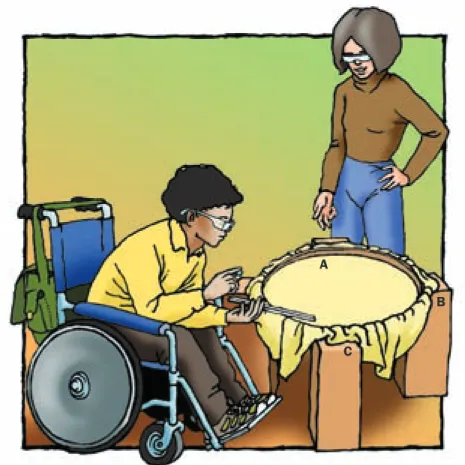
Check the setup of the Planetary Motion Model™. The lip of the hoop should be facing up to prevent the marble from falling off the latex sheet, as shown in Figure 15.3. Allow any extra sheeting to hang down under the hoop. Make sure the hoop rests on the edges of the boxes so they do not interfere with the marble once it is on the sheet.Figure 15.3 The Planetary Motion Model™ should be set up as shown. (A) Face the lip of the hoop up. (B) Hang the extra sheeting under the
3.
Hold the ruler as shown in Figure 15.3 so that it faces the edge of the hoop. Roll the marble onto the flat sheet. Observe the marble. Repeat this several times. Discuss your observations with your group. Record your results in quadrant 15.3 in your notebook.4.
Place the balloon in the center of the sheet. Let go of the balloon. Discuss what the balloon does to the sheet. Then roll the marble onto the sheet toward the edge of the hoop. Watch the balloon and marble carefully. What do you observe about the motion of the marble? What do you observe about the behavior of the balloon? Discuss and record your obser-vations with your group.2.
You will use your ruler as a ramp to roll the marble onto the latex sheet. Before you do, make a prediction about the path the marble will take on the sheet. Discuss your predictions with your group.A
B C
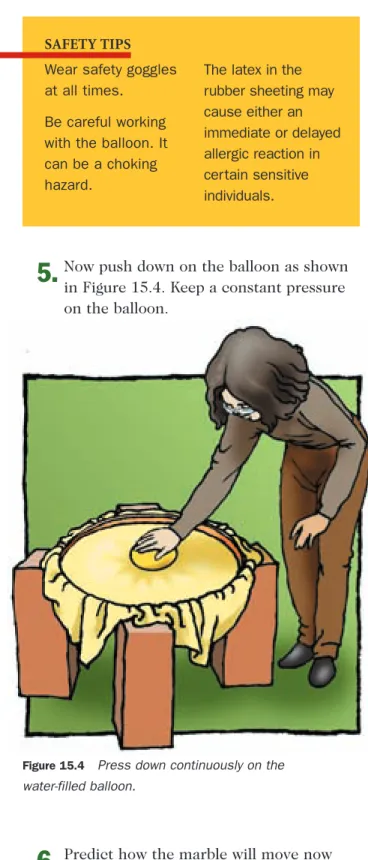
Figure 15.4 Press down continuously on the water-filled balloon.
6.
Predict how the marble will move now that the center of the sheet has more mass. Have one of your partners roll the marble onto the sheet as you keep pres-sure on the balloon. Discuss your obser-vations. Record your observations in words and pictures in your notebook.7.
Test the motion of the marble several times and observe its motion carefully. Let everyone take a turn. How does the motion of the marble change as it nears the balloon?8.
Now wobble the balloon very slightly as the marble orbits it. What happens? Try to use a gentle wobble on the balloon to keep the marble in motion. Discuss your observations. Then let go of the balloon. Does the balloon wobble on its own as the marble orbits it?9.
Answer these questions in your notebook: A. Describe how the marble moved when the mass in the center (the balloon) was not present.B. Describe how the marble moved when the mass in the center was present.
C. As the distance between the balloon and marble decreased, what happened to the marble’s speed?
D. Based on your observations, which planet do you think would have the fastest orbital speed? What evidence do you have to support your answer?
E. What force keeps the planets in their orbital paths around the Sun?
F. Read “Stars Wobble.” Why does a star’s “wobble” indicate that a planet is nearby?
10.
Clean up. Return all materials to their original condition.SAFETY TIPS
Wear safety goggles at all times.
Be careful working with the balloon. It can be a choking hazard.
The latex in the rubber sheeting may cause either an immediate or delayed allergic reaction in certain sensitive individuals.
5.
Now push down on the balloon as shown in Figure 15.4. Keep a constant pressure on the balloon.STARS WOBBLE
There are many stars like our Sun. Some of these other stars also may have planets that orbit them. Even though Earth-based astronomers may not have yet seen a planet orbiting another star, they know such orbiting planets exist. How do they know? Because when a planet orbits a star, it makes the star wobble. Astronomers can examine a star’s wobble and figure out how big, how massive, and how far away from its star the planet is. At the start of the new millennium, nearly 60 planets had been discovered by using the “wobble” method.
It all begins with gravity. Because of gravity, the Sun pulls on the planets, but it also means
MATERIALS FOR INQUIRY 15.4 For you
1 pair of goggles
For your group
1 copy of Inquiry Master 15.4: Investigating the Effect of Planetary Mass on a Moon’s Orbit
1 plastic box or large resealable plastic bag containing the following:
1 pre-assembled Moon Orbiter™ 25 large steel washers
1 student timer
SAFETY TIPS Wear safety gog-gles at all times. Do not swing the Moon Orbiter at other students. Make sure that
other students are not nearby when you swing the white sphere. Always swing the Moon Orbiter above your head.
that the planets pull on the Sun. (And moons and planets tug at each other.) An orbiting planet exerts a gravitational force that makes the star wobble in a tiny circular or oval path. The star’s wobbly path mirrors in miniature the planet’s orbit. It’s like two twirling dancers tugging each other in circles.
Scientists use powerful space-based tele-scopes that orbit Earth to look for wobbling stars. Since they are outside of Earth’s atmos-phere, these telescopes can see the stars more clearly than telescopes on Earth’s surface. Who knows? Someday scientists may use the wobble method to discover another solar system just like ours.
Inquiry 15.4
Investigating the Effect
of Planetary Mass
on a Moon’s Orbit
PROCEDURE
1.
Examine the Moon Orbiter™. Discuss with your group how you think the Moon Orbiter might work.2.
Move to an area in the classroom where no other groups are working. Check to see that all nylon knots are secured to the large white sphere.example, count the number of seconds it takes the sphere to orbit your hand 10 times. To get the orbital period, divide the number of seconds by 10.) Record your observations and data in quadrant 15.4 in your notebook.
3.
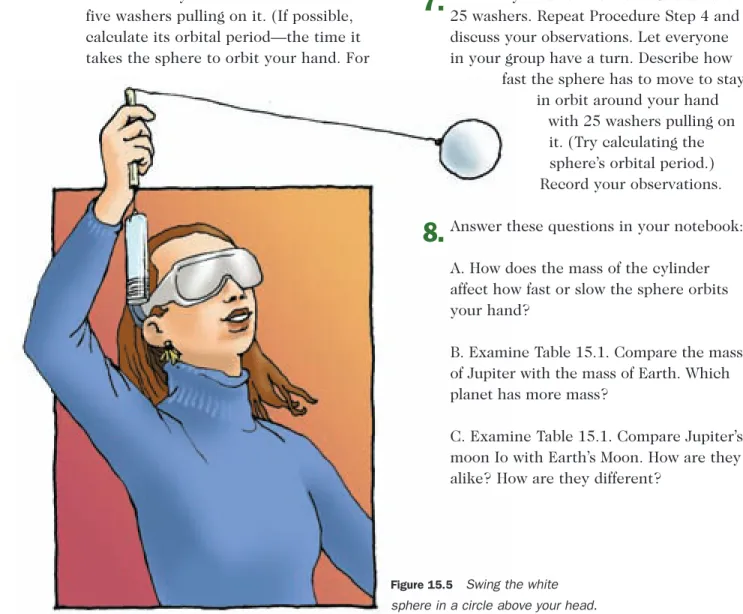
Hold the narrow plastic tubing of the Moon Orbiter in your hand like a handle. Practice holding the Moon Orbiter over your head and moving your hand in cir-cles to get the white sphere to orbit your hand. Use a steady and regular motion. When the sphere is in full orbit, the bottom of the tube should nearly touch the cylinder.4.
Increase the mass of the Moon Orbiter by adding five washers to the cylinder. Move your hand in circles over your head to get the white sphere to orbit your hand, as shown in Figure 15.5. Describe how fast the sphere has to move to stay in orbit around your hand with a mass of five washers pulling on it. (If possible, calculate its orbital period—the time it takes the sphere to orbit your hand. ForFigure 15.5 Swing the white sphere in a circle above your head.
5.
Let everyone in your group try to swing the Moon Orbiter. Remember, when the sphere is in full orbit, the tube should nearly touch the cylinder.6.
Predict what will happen if you increase the mass of the Moon Orbiter’s cylinder to 25 washers.7.
Fill the cylinder of the Moon Orbiter with 25 washers. Repeat Procedure Step 4 and discuss your observations. Let everyone in your group have a turn. Describe howfast the sphere has to move to stay in orbit around your hand
with 25 washers pulling on it. (Try calculating the sphere’s orbital period.) Record your observations.
8.
Answer these questions in your notebook: A. How does the mass of the cylinder affect how fast or slow the sphere orbits your hand?B. Examine Table 15.1. Compare the mass of Jupiter with the mass of Earth. Which planet has more mass?
C. Examine Table 15.1. Compare Jupiter’s moon Io with Earth’s Moon. How are they alike? How are they different?
D. Compare Io and the Moon. Which plan-etary satellite travels faster (has a greater orbital speed)? Given your results from the inquiry, why do you think this is?
E. Orbital period is the time it takes a revolving object to orbit a central object. Which planetary satellite has a shorter orbital period? What is the relationship between orbital speed and orbital period?
F. In Lesson 14, you learned the approxi-mate mass of each planet. How do you think scientists determine the mass of the planets?
REFLECTING ON WHAT YOU’VE DONE
1.
Share your answers to the inquiry ques-tions with the class.2.
Read “Heavy Thoughts.” In your note-book, answer the questions at the end of the reading selection.3.
With your class, return to the Question H folder for Lesson 1. Is there anything you would now change or add? Discuss your ideas with the class.4.
Return to your list of ideas about gravity from Lesson 14. What new information about gravity do you want to add to your list?5.
Read the “Mission” reading selections on Saturn, Uranus, and Neptune. Add any information about these planets to your working copy of Student Sheet 10.1c: Planetary Chart (and onto Student Sheet 10.1b: Planetary Brochure Outline if your Anchor Activity planet assigned during Lesson 10 was Saturn, Uranus, or Neptune).Table 15.1 Planetary Mass Versus Moon’s Orbital Period
Solar Approximate Distance Orbital Orbital
System Mass Diameter From Planet Speed Period
Body (kg) (km) (km) (km/sec) (days)
Jupiter 189,900 ×1022 142,984 Earth 597 ×1022 12,756
Io 9 ×10²² 3643 421,600 17 ∼2 days
Moon 7 ×10²² 3475 384,400 1 ∼27 days
9.
Clean up. Return all materials to their original condition.HEAVY THOUGHTS
Do you ever wonder why when you jump up, you always come back down? Or do
you ever wonder why the Moon keeps circling around Earth rather than drifting off into space? Throughout history, people have wondered about these things. Now we know that a property of the universe called “gravity” is responsible.
If you jump up, Earth’s gravity will pull you back down. Your gravity also pulls Earth toward you. The same thing happens between the Sun and the plan-ets, and between all the planets and their moons. Gravity guides the movements of everything on Earth, and all the objects in the sky.
Newton’s Apple
According to a well-known story, a 23-year-old English scientist named Isaac Newton was sitting under an apple tree one after-noon in 1666, when an apple hit him on the head. Newton began thinking about the force that pulled the apple from the tree.
A famous story says that Isaac Newton began thinking about gravity on our planet and in our universe after an apple fell from a tree and hit him on the head.
Newton concluded that the
not as strong as electromagnetic forces). He also determined that gravity affects apples falling from trees and holds planets and moons in their orbits. force we know as gravity must be an invisible
force, like the one you can feel when you place a magnet near a metal object (although gravity is
Gravity keeps the nine planets and their moons, and thousands of asteroids and comets, in orbit around the Sun.
Newton’s Law of Inertia
Newton wrote two famous laws about gravity: the Law of Inertia and the Law of Universal Gravitation. The Law of Inertia says that a body in motion tends to travel in a straight line unless it is disturbed by an unbalanced force. The Law of Inertia explains why you don’t keep rising when you jump up in the air. The unbal-anced force of gravity disturbs your motion and pulls you back down.
What is an unbalanced force?
If two individual forces are of equal magnitude (size) and opposite direction, then the forces are balanced. Think of the marble you held in your hand during Inquiry 15.1. One force—the Earth’s gravitational pull—exerts a downward force on the marble. The other force— your hand—pulls upward on the marble. The forces acting on the marble are bal-anced; as a result, the marble’s motion does not slow down or speed up. But if the two forces are not balanced, the mar-ble will change its speed or direction. If you let go of the marble, the unbalanced force of gravity disturbs the marble’s motion and the marble falls into the box. Unbalanced forces cause objects to accel-erate (change their speed or direction). The Law of Inertia governs the motion of the
planets and moons. If they weren’t affected by gravity, they would travel in straight lines and leave the solar system. The Sun’s gravity holds all the planets in orbit around it, and each planet’s gravity captures and holds its moon(s) in orbit.
Newton’s Law of Universal Gravitation From his experimental results, Newton formu-lated the Law of Universal Gravitation, which states that any two objects in the universe have gravity and will attract each other. Just how much those objects attract each other depends on two things—the mass of each object, and the distance between the objects.
The more mass a star—like our Sun—has, and the closer a planet is to that star, the greater the star’s ability to hold the planet in its orbit (Mercury is a perfect example). Planets with a lot of mass can probably hold more moons in their orbit (Jupiter is a good example).
Table 15.2 Orbital Velocity of Planets Approximate Orbital Distance from Planet Velocity (km/s) Sun (km)
Mercury 48 57,900,000 Venus 35 108,200,000 Earth 29 149,600,000 Mars 24 228,000,000 Jupiter 13 778,400,000 Saturn 9 1,426,700,000 Uranus 6 2,866,900,000 Neptune 5 4,486,100,000 Pluto 4 5,890,000,000 Mutual Attraction
An object with a large amount of mass can exert a huge gravitational pull even on objects that are quite distant and massive. The Sun’s gravita-tional pull is so enormous that it easily hangs onto Jupiter, which weighs two-and-a-half times as much as all the other planets combined. The Sun also exerts a gravitational hold over Pluto. But more amazingly, tiny Pluto exerts a gravita-tional pull on the Sun, even though they are more than 4.5 billion kilometers apart!
Like the end of a lasso that circles around the head of a cowboy, an orbiting planet is “tied” to the Sun by gravity. However, the farther a plan-et is from the Sun, the more slowly it travels in its orbit. The closer a planet is to the Sun, the faster it travels in its orbit. Mercury, the planet closest to the Sun, travels at about 48 km/s (kilometers per second). But Pluto is quite a different story. Look at Table 15.2: Orbital Velocity of Planets and compare the orbital velocity of the planets. Do you notice patterns in the data? If so, what are they?
The attraction between two objects decreases as the distance between them increases. The Sun’s pull on distant Pluto is much less than its pull on nearby Mercury. As a result, Pluto orbits the Sun at a much slower speed.
Newton and other scientists made important discoveries that describe how gravity works. These discoveries demonstrate that objects on Earth operate under the same principles as objects in space. Newton’s work will influence planetary science for centuries.
QUESTIONS
1. What force keeps the planets in their orbits around the Sun?
2. What would happen to the planets if there were no gravitational influences from the Sun?
3. Based on your classroom observations and the data in Table 15.2, how does an orbiting object’s velocity depend on its distance from the Sun?
4. Given what you have learned in your inves-tigations and in your reading, which planet should be able to hold the greatest number of moons in its planetary orbit?
The great mass of Jupiter helps it hold its many moons in orbit around the giant planet.
How Matter Affects Space
Is gravity a force, or is it something else? About 250 years after Newton, another genius started thinking about gravity. His name was Albert Einstein. Einstein’s theories changed the way we think about the universe.Einstein came to believe that gravity isn’t really a force, but simply the way that mat-ter affects space. According to Einstein, wherever there’s a chunk of matter—an apple, a person, a planet, or a star—space must curve around it. The bigger the matter, the more that space must curve. And when space curves, anything traveling through that space must follow those curves.
Space curves around matter, just like the surface of a rubber sheet curves when a heavy balloon rests on it.
Sun, small objects would become caught in the curved space around you!
Modeling Curved Space
Einstein believed that the more massive the object, the more space curved around it. Think back to your lab in which you placed a water-filled balloon in the center of a rub-ber sheet. The rubrub-ber sheet curved around the balloon. A marble placed on the sheet rolled toward the balloon, but not in a straight line. Instead, the marble followed the curves of the sheet and “orbited” the water-filled balloon in the center. The closer the marble got to the balloon in the center, the faster the marble rolled. Something similar happens with stars such as our Sun. Space curves around the star’s mass and keeps other objects, such as planets, “rolling” around them.
According to Einstein, the planets are caught in the curved space around the Sun. Our Moon is caught in the curved space around Earth. If you were far enough away from the gravitational force of Earth or the
Mission:
Saturn, Uranus,
and Neptune
What a mission! The twin spacecraft, Voyagers 1and 2, left Earth in the summer of 1977. Three years later, after its visit to Jupiter,
Voyager 1flew past Saturn and sped north toward the outer edge of the solar system, as planned. Voyager 2was supposed to take the same course. But the spacecraft was performing so well, scientists and engineers on Earth found it not only possible, but irresistible, to send it on to Uranus and Neptune for a closer look. An alignment of the outer planets like this would not occur again until the year 2157.
offer close-up views of the outer solar system. Saturn’s huge gravitational field would hurl
Voyager 2toward Uranus. A similar boost from Uranus would send Voyager 2to Neptune. This maneuver, called gravity assist, took decades off
Voyager’sflying time. (Unfortunately, the grand tour of the solar system conducted by Voyager
couldn’t include Pluto because Pluto’s orbit took it far from the spacecraft’s path.)
The remarkable journey of Voyager 2yielded many riches. NA TIONAL AERONAUTICS AND SP ACE ADMINISTRA TION/JET PROPULSION LABORA TOR Y Voyagerspacecraft
Saturn
Voyager 2gave us new insights into Saturn’s rings. The rings are like a necklace with 10,000 strands, and they proved to be more beautiful and strange than once thought.
Evidence indicates that Saturn’s rings formed from large moons that were shattered by impacts from comets and meteoroids. The result-ing ice and rock fragments—some as small as a speck of sand and others as large as houses—gath-ered in a broad plane around the planet. The rings themselves are very thin, but together they are 171,000 kilometers in width! NA TIONAL AERONAUTICS AND SP ACE ADMINISTRA TION/JET PROPULSION LABORA TOR Y
Mosaic of Saturn’s rings created from pictures taken on August 28, 1981, by Voyager 2.
Voyager 2showed a kind of war going on at Saturn—a gravitational tug of war between the planet, its many moons and moonlets, and the ring fragments. This struggle has caused variations in the thick-ness of the rings. Some particles are even rising above the ring band as if they are trying to escape.
NASA’s Voyager 1 took this photograph of Saturn on November 3, 1980, when the spacecraft was 13 million kilome-ters from the planet. Two bright cloud patterns are visible in the mid-northern hemisphere and several dark spoke-like features can be seen in the rings left of the planet. The moons Tethys and Dione appear as dots to the south
and southeast of Saturn.
The irregular shapes of Saturn’s eight smallest moons indicate that they, too, are fragments of larger bodies. Two of these small moons— Prometheus and Pandora—are located in one of Saturn’s many rings.
NA TIONAL AERONAUTICS AND SP ACE ADMINISTRA TION/JET PROPULSION
The rings of Uranus. Notice that Uranus is tilted 98 degrees on its axis.
SPACE TELESCOPE SCIENCE INSTITUTE, KENNETH SEIDELMANN, U.S. NAVAL OBSERVATORY, AND NATIONAL AERONAUTICS AND SPACE ADMINISTRATION
The Voyagercameras detected a few addi-tional rings around Uranus. They also showed that belts of fine dust surround the planet’s nine major rings.
Uranus
After its tug from Saturn’s gravitational field,
Voyager 2arrived at Uranus in 1986 where it discovered 10 new moons. With the moons already discovered by astronomers on Earth, the total number of moons was brought to 20. Scientists believed that there may be several more tiny satellites within the rings, and they were right!
This view of Uranus was acquired by Voyager 2 in January 1986. The greenish color of its atmosphere is due to methane and smog. Methane absorbs red light and reflects blue/green light.
NA TIONAL AERONAUTICS AND SP ACE ADMINISTRA TION/JET PROPULSION LABORA TOR Y
Voyager 2made another major discovery at Uranus. It turns out that the planet has a mag-netic field as strong as Earth’s. The cause of this field isn’t clear, but it’s shaped like a long corkscrew. And, according to Voyager’s mea-surements, it reaches 10 million kilometers behind the planet!
According to data, Uranian rings probably formed after Uranus. Particles that make up the rings may be remnants of a moon that was broken apart by a collision.
Voyager 2observed bright cirrus-like cloud cover in the region around the Great Dark Spot. The rapid changes in the clouds over 18 hours prove that Neptune’s weath-er is pweath-erhaps as dynamic as Earth’s. Neptune’s dark spot is no longer visible. Could this “storm” finally have ended? Neptune is true blue.
Neptune
Until the Voyagerencounter with Neptune in August 1989, scientists believed that the planet had arcs, or partial rings. But Voyagershowed that Neptune has complete rings with bright clumps. Voyageralso discovered six new moons, bringing Neptune’s total to eight.
NA TIONAL AERONAUTICS AND SP ACE ADMINISTRA TION/JET PROPULSION LABORA TOR Y
Voyager flew within 5000 kilometers of Neptune’s long, bright clouds, which resemble
AND SP ACE ADMINISTRA TION/JET PROPULSION LABORA TOR Y (continued)
Triton, Neptune’s largest moon, is one of the most fascinating satellites in the solar system. Images from Voyager 2revealed volcanoes spewing invisible nitrogen gas and dust particles cirrus clouds on Earth. Instruments aboard
Voyagermeasured winds up to 2000 kilometers an hour—the strongest winds on any planet.
NA TIONAL AERONAUTICS AND SP ACE ADMINISTRA TION/JET PROPULSION LABORA TOR Y/UNITED ST A TES GEOLOGICAL SUR VEY
several kilometers into the atmosphere! A partial view of Triton, Neptune’s largest moon.
In 1989, Voyager 2left Neptune and headed south onto a course that will take it, like
Voyager 1,to the edge of our solar system and beyond. The tireless spacecraft—fueled by the radioactive decay of plutonium—is expected to continue operating for another 25 years.
t *GUIFSFXFSFBOPDFBOCJHFOPVHIUPQMPQ4BUVSOJOUPUIFQMBOFU XPVMEGMPBUKVTUMJLFBOJDFCFSHEPFTPOQMBOFU&BSUI5IBUTCFDBVTF PG4BUVSOTMPXEFOTJUZ4BUVSOJTUIFPOMZQMBOFUUIBUJTMJHIUFSUIBO UIFTBNFWPMVNFPGXBUFS t 4BUVSOTXJOETSFBDILNIPVS 5IFTUSPOHFTUUPSOBEPFTPO &BSUIIBWFXJOETQFFETPGPOMZLNIPVS
Saturn: Quick Facts
Diameter 120,536 km
Average distance from the Sun 1.4 billion km
Mass 56,850 ×1022kg
Surface gravity (Earth = 1) 0.92
Average temperature –185 °C
Length of sidereal day 10.66 hours
Length of year 29.46 Earth years
Number of observed moons 30*
Relative size
Saturn atmosphere
Ring system Liquid hydrogen and helium outer mantle Rock and ice core Water ice, methane, ammonia, and other com-pounds (traces)Hydrogen (96.3%)
Helium (3.3%)
Did You Know?
t *GUIFSFXFSFBOPDFBOCJHFOPVHIUPQMPQ4BUVSOJOUPUIFQMBOFU XPVMEGMPBUKVTUMJLFBOJDFCFSHEPFTPOQMBOFU&BSUI5IBUTCFDBVTF PG4BUVSOTMPXEFOTJUZ4BUVSOJTUIFPOMZQMBOFUUIBUJTMJHIUFSUIBO UIFTBNFWPMVNFPGXBUFS t 4BUVSOTXJOETSFBDILNIPVS 5IFTUSPOHFTUUPSOBEPFTPO &BSUIIBWFXJOETQFFETPGPOMZLNIPVS
PLANETARY FACTS:
Saturn
Metallic hydrogen inner mantle Earth Saturn
Uranus: Quick Facts
Diameter 51,118 km
Average distance from the Sun 2.9 billion km
Mass 8683 ×1022kg
Surface gravity (Earth = 1) 0.89
Average temperature –200 °C
Length of sidereal day 17.24 hours
Length of year 84.01 Earth years
Number of observed moons 20*
Relative size
Uranus atmosphere
Did You Know?
tThe polesof Uranus are in the same position as the equatorson other planets. That’s because Uranus rotates on its side.
tIt takes nearly 21⁄2hours for light from the Sun to reach Uranus. (It only takes about eight minutes for the Sun’s light to reach Earth!)
Ring system
Gas and ice mantle
Solid rock core
Hydrogen (83%) Helium (15%) Methane and traces of other compounds (2%)
PLANETARY FACTS:
Uranus
Earth Uranus t /FQUVOFXBTOBNFEBGUFSUIFHPEPGUIFTFBQSPCBCMZCFDBVTFPGJUT CMVFDPMPS t /FQUVOFHJWFTPGGNPSFIFBUUIBOJUSFDFJWFTGSPNUIF4VO5IJT NFBOTJUQSPCBCMZIBTJUTPXOIFBUTPVSDF
t t
us
Neptune: Quick Facts
Diameter 49,528 km
Average distance from the Sun 4.5 billion km
Mass 10,240 ×1022kg
Surface gravity (Earth = 1) 1.12
Average temperature –225 °C
Length of sidereal day 16.11 hours
Length of year 164 Earth years
Number of observed moons 8*
Relative size
Neptune atmosphere
Did You Know?
t /FQUVOFXBTOBNFEBGUFSUIFHPEPGUIFTFBQSPCBCMZCFDBVTFPGJUT CMVFDPMPS
t /FQUVOFHJWFTPGGNPSFIFBUUIBOJUSFDFJWFTGSPNUIF4VO5IJT NFBOTJUQSPCBCMZIBTJUTPXOIFBUTPVSDF
Ring system Solid rock core Gas and ice mantle
Hydrogen (80%)
Helium (19%) Methane and traces of other compounds (0.5%)
PLANETARY FACTS:
Neptune
Earth