THE UNITED REPUBLIC OF TANZANIA
MINISTRY OF WATER
Water Sector Development
Programme
(2005 – 2025)
Consolidated Document
TABLE OF CONTENTS
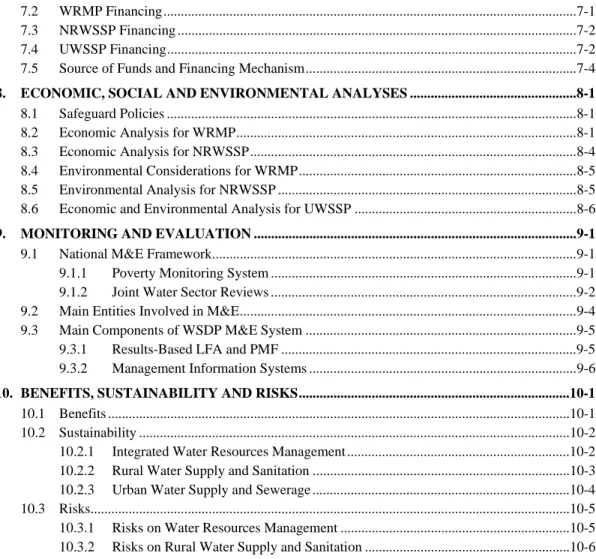
ACRONYMS AND ABBREVIATIONS ... v EXECUTIVE SUMMARY ...vii 1. INTRODUCTION ...1-1 1.1 Background...1-1 1.2 Country and Sector Overview...1-1 1.3 Policy Environment ...1-2 1.4 Sector Development Challenges ...1-4 1.4.1 Water Resources Management ...1-4 1.4.2 Rural Water Supply Service...1-4 1.4.3 Urban Water Supply and Sewerage Management...1-5 1.4.4 Limited Financing for Expansion and Improvement of Services ...1-5 1.4.5 Capacity Constraints ...1-5 1.4.6 Sanitation and Sewerage ...1-6 1.4.7 Stakeholder and Private Sector Participation ...1-6 1.4.8 Establishment and Strengthening of Executive Agencies...1-7 1.5 Scope of Programme ...1-7 1.5.1 Water Resources Management ...1-7 1.5.2 National Rural Water Supply and Sanitation Programme ...1-8 1.5.3 Urban Water Supply and Sewerage Programme ...1-11 1.6 Programme Consolidation Approach...1-11 2. STRATEGIC CONTEXT AND RATIONALE ...2-1
2.1 National Development Strategies...2-1 2.2 Status of the Water Sector...2-2 2.3 Water Sector Policy Reform ...2-3 2.4 The Adoption of a Sector-wide Approach to Planning ...2-5 2.5 National Water Sector Development Strategy...2-5 2.6 Related Sectoral Policies ...2-5 2.7 Lessons Learned ...2-7
2.7.1 A Strong Policy Platform...2-7 2.7.2 Institutional Reorganisation ...2-8 2.7.3 Supporting Legislation ...2-9 2.7.4 Decentralisation of Rural and Urban WSS...2-9 2.7.5 Human Resources Capacity Development ...2-10 2.7.6 Multi-sector Nature of Water Resources Management...2-10 2.7.7 Water Resources Monitoring ...2-11 2.7.8 Management of Trans-boundary Water Resources ...2-12 3. PROGRAMME DEVELOPMENT OBJECTIVES AND INDICATORS ...3-1
3.1 Water Sector Objectives...3-1 3.2 Programme Development Objectives ...3-2 3.2.1 Overall Programme Development Objective ...3-2 3.2.2 Water Resources Management Objectives ...3-2 3.2.3 National Rural Water Supply and Sanitation Objectives ...3-2 3.2.4 Urban Water and Sanitation Objectives ...3-5 3.2.5 Objectives of the Executive Agencies ...3-6 3.3 Logical Framework and Performance Indicators ...3-6 4. PROGRAMME COMPONENTS...4-1
4.1.1 Implementation Arrangements... 4-1 4.1.2 National Water Resources Reforms and Investments ... 4-2 4.1.3 Basin-Level Water Resource Reforms and Investments ... 4-5 4.1.4 National Cross-Sectoral Investment Programme... 4-11 4.2 The National Rural Water Supply and Sanitation Component... 4-12
4.2.1 Implementation Arrangements... 4-13 4.2.2 District Management Support ... 4-14 4.2.3 Rural Water Supply and Sanitation Services ... 4-14 4.2.4 Institutional Strengthening and Development ... 4-17 4.3 The Urban Water Supply and Sewerage Component ... 4-17
4.3.1 Implementation Arrangements... 4-17 4.3.2 Strengthening UWSA Operations ... 4-18 4.3.3 Fiscal Strengthening ... 4-19 4.3.4 Upgrading and Expansion of Water Supply Systems (2005-2010) ... 4-20 4.3.5 Requirements 2010-2020 ... 4-21 4.3.6 Development of Wastewater Facilities ... 4-22 4.4 Strengthening of MoW ... 4-22 4.5 Strengthening of the Executive Agencies ... 4-22 4.5.1 Drilling and Dam Construction Agency ... 4-23 4.5.2 Water Resources Institute... 4-23 4.5.3 Maji Central Stores... 4-23 5. INSTITUTIONAL ARRANGEMENTS ... 5-1
5.1 Current Water Sector Institutional Framework... 5-1 5.1.1 Institutional Framework for Water Resources Management... 5-1 5.1.2 Institutional Framework in Provision of Water Supply and Sanitation ... 5-2 5.2 The Transitional Institutional Framework ... 5-3 5.2.1 Transitional Institutional Framework for WRM... 5-3 5.2.2 Water Supply and Sanitation... 5-6 5.3 Future Institutional Framework... 5-9 5.3.1 Roles and Functions of Institutions in WRM ... 5-9 5.3.2 Roles and Functions of Institutions in WSS ... 5-11 6. INVESTMENT COSTS ... 6-1 6.1 WRMP Costs ... 6-2 6.1.1 Context... 6-2 6.1.2 Investment Costs ... 6-5 6.2 NRWSSP Costs ... 6-6 6.2.3 Context... 6-6 6.2.4 Investment Costs ... 6-6 6.3 UWSSP Costs ... 6-7 6.3.1 Context... 6-7 6.3.2 Investment Costs ... 6-7 6.4 MoW General Administration... 6-9 6.4.1 Context... 6-9 6.4.2 Investment Costs ... 6-9 6.5 Executive Agencies ... 6-9 6.5.1 Drilling and Dam Construction Agency ... 6-9 6.5.2 Water Resources Institute... 6-9 6.5.3 Maji Central Stores... 6-10 7. FINANCING ... 7-1
7.2 WRMP Financing...7-1 7.3 NRWSSP Financing ...7-2 7.4 UWSSP Financing...7-2 7.5 Source of Funds and Financing Mechanism...7-4 8. ECONOMIC, SOCIAL AND ENVIRONMENTAL ANALYSES ...8-1
8.1 Safeguard Policies ...8-1 8.2 Economic Analysis for WRMP...8-1 8.3 Economic Analysis for NRWSSP...8-4 8.4 Environmental Considerations for WRMP...8-5 8.5 Environmental Analysis for NRWSSP ...8-5 8.6 Economic and Environmental Analysis for UWSSP ...8-6 9. MONITORING AND EVALUATION ...9-1
9.1 National M&E Framework...9-1 9.1.1 Poverty Monitoring System ...9-1 9.1.2 Joint Water Sector Reviews ...9-2 9.2 Main Entities Involved in M&E...9-4 9.3 Main Components of WSDP M&E System ...9-5 9.3.1 Results-Based LFA and PMF ...9-5 9.3.2 Management Information Systems ...9-6 10. BENEFITS, SUSTAINABILITY AND RISKS...10-1
10.1 Benefits ...10-1 10.2 Sustainability ...10-2 10.2.1 Integrated Water Resources Management ...10-2 10.2.2 Rural Water Supply and Sanitation ...10-3 10.2.3 Urban Water Supply and Sewerage ...10-4 10.3 Risks...10-5 10.3.1 Risks on Water Resources Management ...10-5 10.3.2 Risks on Rural Water Supply and Sanitation ...10-6 10.3.3 Risks on Urban Water Supply and Sewerage services...10-6
ANNEX A: LFA and Results Framework...A-1 ANNEX B: Detailed Costs...B-1
1.Summary – Water Resources Management and Development Investment Plan (USD) ...B-1 2.Detailed Costing of WRM Investment Plan...B-3 3.Detailed NRWSSP Investment Requirements...B-17 4.UWSSP Capital Investment Requirements ...B-23 5.Summary of Financing Requirements (USD)...B-27 ANNEX C: Summary of Monitoring and Evaluation Responsibilities ...C-1 ANNEX D: Environmental and Social Management Framework (ESMF) ...D-1 ANNEX E: Resettlement Policy Framework...E-1 ANNEX F: WSDP Guidelines and Operational Manuals... F-1 ANNEX G: Key Reference Documents... G-1
List of Tables
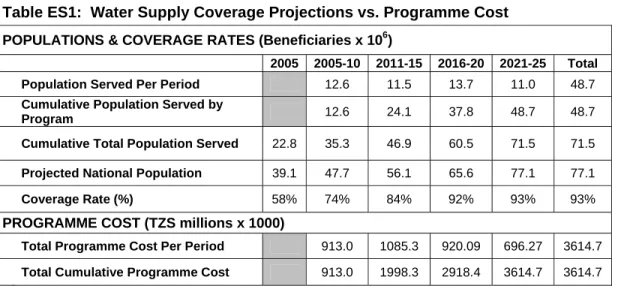
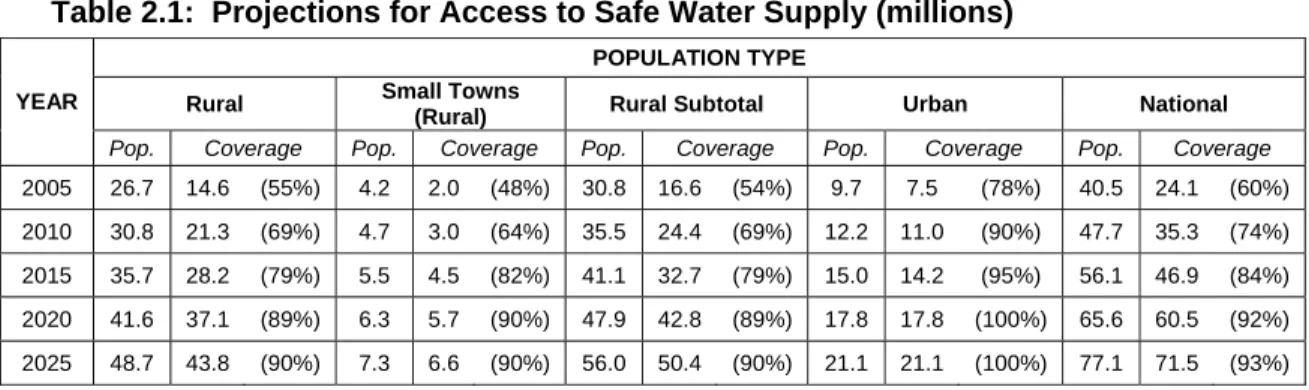
Table ES1: Water Supply Coverage Projections vs. Programme Cost ...xiv Table 2.1: Projections for Access to Safe Water Supply (millions) ...2-2
Table 3.1: WSDP Logical Framework ... 3-8 Table 4.1: Towns That Have Not Received Assistance (2005) ... 4-20 Table 4.2: Towns That Have Received Limited Assistance ... 4-20 Table 4.3: Towns That Have Received Substantial Assistance ... 4-21 Table 4.4: Towns with Ongoing Projects ... 4-21 Table 4.5: Towns that Require Major Water Supply Projects after 2010... 4-21 Table 5.1: Functions and Responsibilities of each Organisation in the Transitional Institutional
Framework... 5-4 Table 5.2: Transitional Functions and Responsibilities for Water Supply and Sanitation... 5-6 Table 5.3: Functions and Responsibilities for each Organisation in the Future WRM Institutional
Framework... 5-11 Table 5.4: Functions and Responsibilities of each Organisation in the Final Institutional Framework. 5-14 Table 6.1a: Summary WSDP Investment (TZS millions x 1,000) ... 6-4 Table 6.1b: Summary of Investment for MoW & Executive Agencies (TZS million x 1,000)... 6-5 Table 7.1: Financing Requirements (TZS millions x 1000) ... 7-3 Table 7.1b: Financing Requirements for MoW & Executive Agencies (TZS mill. x 1,000) ... 7-4 Table 9.1: Main Entities Involved in M&E... 9-5
List of Figures
Figure ES1: Water Supply Coverage vs. Programme Cost, 2005-2025...xv Figure 1.1: Linkage of WSDP with National Policies and Strategies ... 1-3 Figure 1.2: Population Projections for Access to Safe Water Supply (millions) ... 1-10 Figure 4.1: River Basins in Tanzania ... 4-6 Figure 5.2: Transitional Institutional Framework for Water Supply and Sanitation... 5-8 Figure 5.3: Future Institutional Framework for Water Resources Management... 5-10 Figure 5.4: Final Institutional Framework for Water Supply and Sanitation ... 5-13 Figure 9.1: Water Sector Dialogue Structure ... 9-2 Figure 9.2: Sector Information Flow ... 9-3
ACRONYMS AND ABBREVIATIONS
AfDB African Development Bank
ASDB Agricultural Sector Development Programme
BWB Basin Water Board
BWO Basin Water Office
CAPSTART Capacity Building Starter Activities CB&T Capacity Building and Training
CBO Community-based Organisation
CMSSS Community Management Support Services Section COWSO Community-Owned Water Supply Organisation
CWC Catchment Water Committee
DAWASA Dar es Salaam Water and Sewerage Authority
DBMS Database Management System
DC District Council
DGCG Donor Government Consultative Group DHS Demographic and Health Survey
DP Development Partner
DPG Development Partners’ Group
BWB Basin Water Board
DWR Division of Water Resources DWSS District Water Supply and Sanitation
DWSSP Dar es Salaam Water Supply and Sanitation Project DWST District Water and Sanitation Team
EAC East African Community
EIA Environmental Impact Assessment
EIRR Economic Internal Rate of Return
ESA External Support Agency
EU European Union
EWURA Energy and Water Utilities Regulatory Authority
FSP Facilitation Service Provider
GBS Government Budgetary System
GIS Geographic Information System
GNI Gross National Index
GoT Government of Tanzania HBS Household Budget Survey
HIV/AIDS Human Immunodeficiency Virus/Acquired Immunodeficiency Syndrome IEC Information, Education and Communication
IRBMP Integrated Reviver Basin Management Plan IWRM Integrated Water Resource Management
JAS Joint Assistance Strategy
KPI Key Performance Indicator
LFA Logical Framework Analysis
LGA Local Government Authority
LGRP Local Government Reform Programme M&E Monitoring and Evaluation
MDGs Millennium Development Goals MIS Management Information System
MKUKUTA Mkakati wa Kukuza Uchumi na Kuondoa Umaskini Tanzania MoE Ministry of the Environment
MoF Ministry of Finance
MoHSW Ministry of Health and Social Welfare
MoU Memorandum of Understanding
MoW Ministry of Water
NAWAPO National Water Policy, 2002 NBI Nile Basin Initiative
NEMC National Environment Management Council
NGOs Non-Governmental Organisation
NPRS National Poverty Reduction Strategy NPV Net Present Value
NRWSSP National Rural Water Supply and Sanitation Programme NSGRP National Strategy for Growth and Reduction of Poverty
NWB National Water Board
NWSDS National Water Sector Development Strategy O&M Operation and Maintenance OPSSS Operational Planning Support Services Section
PER/MTEF Performance Expenditure Review/Medium-Term Expenditure Framework PERWG Public Expenditure Review Working Group
PHDR Poverty and Human Development Reports
PMF Performance Monitoring Framework
PMMP Poverty Monitoring Master Plan
PMO-RALG Prime Minister’s Office – Regional Administration and Local Government
PMS Poverty Monitoring System
PRSP Poverty Reduction Strategy Paper
PRSTC Poverty Reduction Strategy Technical Committee
PS Permanent Secretary
RBMSIIP River Basin Management and Smallholder Irrigation Improvement Project RDP Rural Development Policy
RDPS Rural Development Policy and Strategy
RS Regional Secretariat
RWSD Rural Water Supply Division RWSS Rural Water Supply and Sanitation RWSSP Rural Water Supply and Sanitation Project RWST Regional Water and Sanitation Teams
SADC Southern African Development Community SWAp Sector-wide Approach to Planning
TA Technical Assistance
TAC Technical Advisory Committee
TAS Tanzanian Assistance Strategy
TSP Technical Service Provider
TSSS Technical Support Services Section
TWG Technical Working Group
TZS Tanzanian Shillings
UfW Unaccounted-for-Water
UN United Nations
USD United States Dollar
UWSA Urban Water and Sanitation Authority UWSS Urban Water Supply and Sewerage
UWSSP Urban Water Supply and Sewerage Programme WATSANs Water and Sanitation Committees
WRBWO Wami-Ruvu Basin Water Office WRM Water Resources Management
WRMP Water Resources Management Programme WSS Water Supply and Sanitation
WSSA Water Supply and Sanitation Authority WSDP Water Sector Development Programme
WTP Water Treatment Plant
WUA Water User Association
WUF Water User Fee
EXECUTIVE SUMMARY
1. The
Policy
Environment
Policy development for the water sector began with the first National Water Policy in 1991. It responded to the failure of providing adequate water supply and sanitation services despite major investments in the sector during the 1970s and ’80s. The National Water Policy was revised in 2002 (NAWAPO 2002) thus introducing reform elements of devolution, poverty alleviation and civil service reform. It was strongly influenced by national policy instruments that address issues of poverty and economic development, and incorporate water sector reforms as one of several related components which, when combined, offer a multi-sector approach to poverty reduction and economic growth.
Key policies such as the National Development Vision 2025 set the stage for the Poverty Reduction Strategy Paper (PRSP) and the Rural Development Policy (RDP), which were then supported by the Local Government and Public Sector Reforms. The comprehensive review of the PRSP led to the MKUKUTA (Mkakati wa Kukuza Uchumi na Kuondoa Umaskini) that sets operational goals and puts policy in a functional framework, which in the water sector is embodied in the National Water Sector Development Strategy (NWSDS) of 2005. The NWSDS sets out the strategy for NAWAPO implementation and in turn guides the formulation of the sub-sectoral investment programmes, as inputs into the Water Sector Development Programme (WSDP). The sector’s strategy is incorporated into three programmes: the National Rural Water Supply and Sanitation Programme (NRWSSP), the Urban Water and Sewerage Programme (UWSSP), and the Water Resources Management Programme (WRMP). The Water Sector Development Programme consolidates the three components using a Sector-wide Approach to Planning (SWAp).
The central policy instrument for all these programmes is the NAWAPO 2002. The key lesson learned from previous experience is that to achieve sustainability, water supply and sanitation facilities must be owned and managed locally by organisations that are both close to, and accountable to the consumer. NAWAPO recognizes financing of water resources management through application of Water User Fee (WUF), broadens stakeholders role in planning, operation and management in decision making, and promotes autonomy at the basin level. Experience shows that WRM functions in all the basins could in the long run be financed through WUF to meet the cost of regulatory functions at the basin level.
These principles are central to NAWAPO which embodies effective institutionalised linkages between key sector actors, including central government, local government, External Support Agencies (ESAs), the private sector, non-government organisations (NGOs), community-based organisations (CBOs), and the communities themselves. Under NAWAPO, the Government continues to provide the necessary technical and financial support, as well as coordination and regulation of water supply development activities. The private sector provides support to the communities in planning, design, construction and supply of materials, equipment, spare parts, and in some cases operations. The ESAs and NGOs provide financial and technical assistance and funding.
In partnership with ESAs and other key stakeholders, the Government has adopted a Sector-wide Approach to Planning (SWAp), based on community-demand orientation, decentralised management through local governments and dedicated water user entities or authorities, combined with central government facilitation and delivery of services by the private sector.
SWAp brings together the three sub-sectors—rural water supply, urban water supply and sewerage, and water resources management—under one comprehensive investment and regulatory regime. The SWAp is in direct response to the NAWAPO. June 2003 marked the start of a three-year transition period intended to: (i) lay the foundations for a SWAp; (ii) prepare the necessary investment plan; (iii) build service delivery and water resources management capacity at all levels; and (iv) establish the necessary regulatory framework for sustained delivery of water supply services country-wide.
2. Programme
Consolidation Approach
The WSDP is a consolidation of the three separate sub-sector programmes. These are: WRMDP, NRWSSP and UWSSP wherein detailed information can be found. The programme includes strengthening of the general administration of MoW as well as strengthening of three Executive Agencies (Drilling and Dam Construction Agency (DDCA), Water Resources Institute (WRI) and Maji Central Stores (MCS)) to effectively support the implementation of the WSDP.
The approach for consolidation of the sub-sector programmes followed a two-fold methodology. First, MoW prepared a draft consolidated document that puts together all the important programmatic implementation areas envisaged in the sub-sector. Secondly, the draft WSDP was presented at a stakeholders’ workshop for their comments. Using such an approach, one can conclude that the participation of stakeholders was high during the policy review, formulation of the NWSDS and sub-sector programmes. This will enhance the potential for sustainability of the WSDP during programme implementation, especially through the recently established joint MoW-DPG/water coordination and collaboration arrangements.
3. Programme
Objectives
Tanzania’s Development Vision 20251 aims at achieving an absence of abject poverty and attaining a high quality of life for all people by 2025. Water supply, sanitation and water resource management features prominently in the Development Vision. Access to safe water in rural areas is targeted as rising from 53% (2003) to 90% by 2025. Intrinsic to these overall targets, are the objectives of equity of access, water management capacity, proper maintenance of water and sanitation systems, use of environmentally sound technologies, and effective water tariffs, billing and revenue collection mechanisms.
In the shorter term, MKUKUTA2 commits Tanzania to achieving the Millennium Development Goals (MDGs) for access to safe water, sanitation and a sustainable environment, while also setting targets for 2010. These include an increased proportion of the rural population with access to clean and safe water from 53% in 2003 to 65% by 2010 for the rural population. It also calls for increased access to clean and safe water to the urban population to rise from 73% in 2003 to 90% by 2010.
The Water Sector Development Programme (WSDP) comprises three components, the Water Resources Management Programme (WRMP), the National Rural Water Supply and Sanitation Programme (NRWSSP) and the Urban Water and Sewerage Programme (UWSSP).
1
United Republic of Tanzania, (1999), “Development Vision 2025 for Tanzania”. Dar es Salaam.
2
Vice President’s Office (2005) “National Strategy for Growth and Reduction of Poverty” (NSGRP – MKUKUTA), Dar es Salaam, The United Republic of Tanzania.
The objectives for the Water Resources Management (WRM) component3 are to:
• develop a sound water resources management and development framework in all nine water basins, for optimising the utilisation of the water resources in a sustainable manner for the various competing uses;
• promote good governance of water resources through empowering water users, encouraging participatory and transparent decision-making, devolving ownership to the user level, and granting secure water rights with responsibilities to the water users, community groups, local government and Basin Boards; and
• strengthen the capacity of lake basin offices to address trans-boundary lake and lake basin issues.
The overall objective of the NRWSSP is improved quality and quantity of drinking water and sanitation services for the rural population sustained through improved district level capacity, effective local water user entities, private sector participation and good health/hygiene/sanitation practices. The NRWSSP includes both rural and all small town populations. By 2015 it will raise coverage of these populations from 53% and 49% of 2003 to 79% and 82% respectively. In doing so, it will meet the MDGs for the rural areas. Likewise it will raise coverage levels to 90% by 2025 in accordance with Vision 2025 goals. In all, it will provide services to an additional 34.5 million people by 2025.
The overall objective of the UWSSP is improved and sustained quality and quantity of drinking water and sewerage services for urban populations managed by financially autonomous and commercially viable Urban Water and Sanitation Authorities (UWSAs)/Water Supply and Sanitation Authorities (WSSAs) providing efficient and cost-effective services. The specific targets of the UWSSP include raising water supply service coverage from 74% (2005) to 90% in 2010, to 95% by 2015 to meet the MDGs and to 100% to meet Vision 2025 goals. The target for sewerage coverage is to increase from 17% (2003) to 30% by 2010. The target figures include water supply and sewerage service delivery in the city of Dar es Salaam.
The strategy4 for achieving these goals in the urban sector is to develop the existing UWSAs into bodies that are financially autonomous and commercially viable. In essence, the focus of the strategy is the commercialisation of the urban water authorities so that they are capable of efficient and cost-effective provision of services.
Implementation of the Programme will be supported by the Executive Agencies, which will be strengthened to improve their financial and commercial performance.
4. Institutional
Arrangements
The National Water Policy has prescribed new roles for different players in the provision of water supply and sanitation services. The policy guide in NAWAPO is based on six key principles, namely the Government’s role should be limited to coordination, policy and guideline formulation and overall sector regulation; implementation management and executive functions will be decentralised to the lowest appropriate level, while balancing consumer representation/participation with economies of scale; responsibility for regulation will be separated from the prioritisation and allocation of capital investment funds;
3
MoW (2006) “Water Resources Management Programme”, Dar es Salaam, February 2006.
4
MoW (2006) “National Urban Water Supply and Sewerage Strategic Programme – Strategy Report, Vol. 1”, Dar es Salaam.
autonomous entities will be established to manage water supply and sewerage services in urban areas; and community organisations will own and manage water supply schemes. This shift in policy direction calls for adoption of a more effective institutional framework for the provision of water and sanitation services to urban and rural population. Equally important, the institutional framework for water resources management will be streamlined to meet the challenges of effective integrated water resources management.
The current institutional framework for WRM falls short of meeting the challenges of effective management of the resources and in providing an adequate mechanism for effective consultation and consensus building, and participation of stakeholders in the planning, design, operations, and management decision-making process.
The lack of an effective institutional framework for management of water supply and sanitation services in rural areas has led to overlapping roles among the various institutions, inadequate co-ordination among the various agencies and inadequate communication and awareness building between these agencies and local organisations and water users.
Since establishing the 20 Urban Water and Sewerage Authorities, the Ministry of Water (MoW) has continued to play a major role in their organisation and management in accordance with a Memorandum of Understanding (MoU) and Operational Guidelines. While these interventions have been helpful in guiding the development and management of the Authorities in their formative years, they ultimately restrict the opportunities for the Basin Water Boards and management to provide leadership in the way the Authorities are managed.
Institutions will go through a transition phase in preparation for their final institutional frameworks. In accordance with the National Water Sector Development Strategy (NWSDS), two institutional frameworks are envisaged for the future. The first is the institutional framework for the provision of water and sanitation (WSS) services to both urban and rural areas and the second is the institutional framework for WRM.
The two transitional institutional frameworks will retain the existing successful institutions to assist in a smooth transition to the final institutional frameworks. For example, the transitional framework for the provision of WSS services will retain the existing UWSAs and Dar es Salaam Water and Sewerage Authority (DAWASA) during the transition period, whilst new WSSAs will be established on the basis of commercial viability in areas not currently covered by the existing UWSAs or DAWASA. The Energy and Water Utilities Regulatory Authority (EWURA) will remain as the regulatory body for all non community-owned organisations such as DAWASA, UWSAs and WSSAs.
The role of Central Government, through the Ministry responsible for Water, will be that of co-ordination, support and capacity building, monitoring and quality assurance, policy and guideline formulation, and regulation. The current responsibilities for the provision of water supply and sanitation services will need to be transferred to successor organisations. The Local Government Authorities (LGAs) will have responsibility for public service provision including water and sanitation in the future.
During the transition period, sector capacities will be developed and a review of relevant existing legislative provisions will be carried out to remove potential duplications and omissions, and enable effective implementation of the future institutional frameworks. It will also involve strengthening of the regulation and monitoring of service providers,
including situations where the private sector is involved in providing water supply and sanitation services; and raising awareness of the institutional framework among stakeholders, including communities.
The future WRM and WSS institutional frameworks will be based on the following principles:
1. Responsibility for the provision of water supply and sanitation services is to be held by local government authorities.
2. Clustering of water supply and sanitation services under the responsibility of adjacent local government authorities should be aimed at commercial viability. 3. Legal transfer of assets to water and sanitation entities should be done while
ensuring that communities are protected against confiscation and asset stripping. 4. Capital investment financing, and operational support through local government
should be separated from regulation and performance monitoring.
5. Tariffs should be linked to performance as part of the regulatory function. 6. Water basin offices should be transformed into autonomous bodies.
The future institutional framework for the WRM will incorporate new institutions to facilitate harmonious integration and participation of all stakeholders. These will be the National Water Board, Basin Water Boards, Catchments Water Committees and Water User Associations or Groups.
The future institutions for the provision of water supply and sanitation services are of three types: “Clustered” WSSAs; Service Providers; and Community-owned Water Supply Organisations (COWSOs). Regulation of the WSSAs and Service Providers will be by EWURA, while regulation of the COWSOs will be by the Ministry responsible for Water, through delegation to local authorities.
5. Programme
Components
The Water Sector Development Programme is designed under SWAp to address shortfalls in urban and rural water supply infrastructure, to improve water resource management primarily through upgrading the country’s nine Basin Water Offices (BWOs), and to strengthen the sector institutions and their capacities. A set of Operational Guidelines and Manuals have been prepared on a sub-sectors basis to guide the implementation process of sub-sector specific issues.
5.1 Water Resources Management
An important objective of the programme is to develop a sound water resources management and development framework in all nine Basins, and to promote good governance of water resources throughout Tanzania. Implementation will be with the active participation of all stakeholders at the national and basin levels through their respective boards.
The basin-level component is by far the most extensive of the WRM programme. Its main focus is the establishment and strengthening of the nine BWOs. In addition to support for the staffing and physical infrastructure of the BWOs, considerable attention is given to strengthening their capacity in water resources monitoring, assessment and enforcement. Other activities include: protection of important water sources; water demand management; strengthening legislation and enforcement; integrated water resources planning; trans-boundary water body management; and a variety of cross-cutting activities including
disaster management, public awareness, inter-agency networking and establishing a water resources management information system.
At the national level, MoW will be strengthened through recruitment and training of staff, provision of equipment, creation of a national water resources information centre, and technical collaboration on research, dialogue and information exchange with co-riparian states. Drought, flood and manmade disaster (chemical or petroleum spills) management capabilities will be strengthened. Early warning systems will be established. Also, a national communications and awareness programme will be developed as a cross sectoral activity to strengthen harmonisation and coordination of water resources plans and policies among key related sectors and stakeholders.
5.2 Rural Water Supply and Sanitation Services Provision
Twenty four (24) districts had a “head start” having begun implementation of the Rural Water Supply and Sanitation Projects through different initiatives. All districts have been included in the NRWSSP during 2006/2007; some already have begun construction and others are in the planning stage.
In the early years of the plan, higher rates of investment and coverage are allocated to those districts with lower coverage. Overall, projections for coverage meet the long-term 2025 target of 90% while the interim milestones of 2010 and 2015 are exceeded. This is due to the application of a measured and graduated rate of progress and expenditure resulting in coverage rates of 69% in 2010 and 79% in 2015 compared to the planned 65% and 74% targets respectively.
Construction will be relatively slow during the first two years while Regional Water Supply and Sanitation Teams (RWSTs) and District Water and Sanitation Teams (DWSTs) train, prepare, set up project management systems and gain experience in district-based water and sanitation programming. In subsequent years, each district will build its implementation capacity, averaging about 1.6 million new water users per year programme-wide. The pace of work will peak during 2016 to 2020 with an average of 1.9 million new beneficiaries per year.
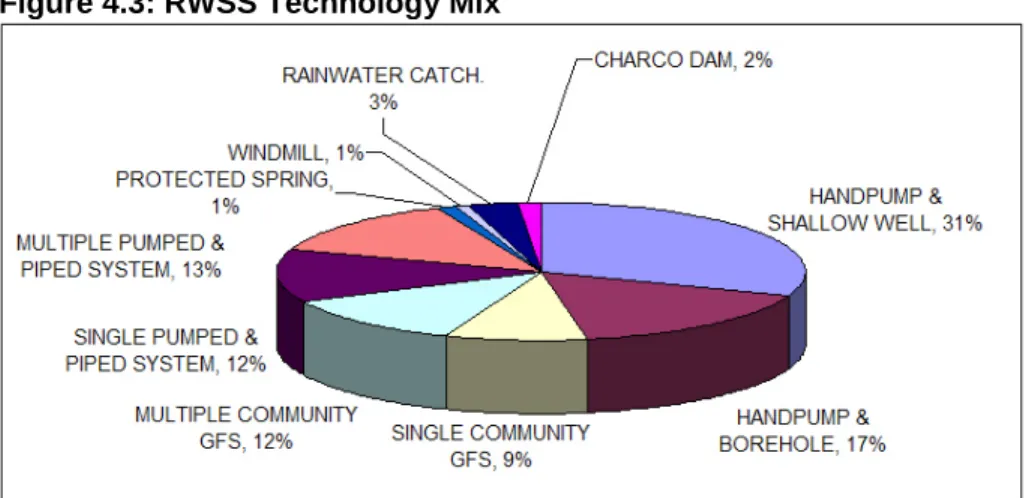
On the basis of the populations to be provided with new access to services, water supply coverage was disaggregated by technology type across the NRWSSP period (2005-2025). The above projections are the product of several determining factors at the district level, including the existing technology mix in the district; and the number and percentage of residents currently without access to a safe water supply. By 2025, the largest proportion (31%) is estimated to be served by shallow wells equipped with hand pumps, 25% by pumped-piped systems, 21% by gravity flow piped systems, and 17% by boreholes equipped with hand pumps. A limited number of locations will be served by protected springs, windmills, rainwater catchment or charco dams.
Sanitation promotion including latrine upgrading and hygiene improvements will be carried out in parallel with water supply programming. In this way, facilitation, training and promotion efforts reinforce one another.
5.3 Urban Water Supply and Sewerage
The UWSAs are to be transformed into WSSAs (Water Supply and Sanitation Authorities), which will be licensed and regulated by EWURA. Separating the regulatory, management and monitoring functions will enable Boards to concentrate on managing their Authorities as commercial entities, while the regulator will ensure efficiency and equity and Consumer Consultative Councils will protect the welfare of the community.
In the meantime, the UWSAs will be strengthened through improvements in demand forecasting, water sources assessment and planning, control over unaccounted-for-water, water quality management, network analysis, tariff setting and billing systems, control over operating costs and aging arrears, and the acquisition of investment funding.
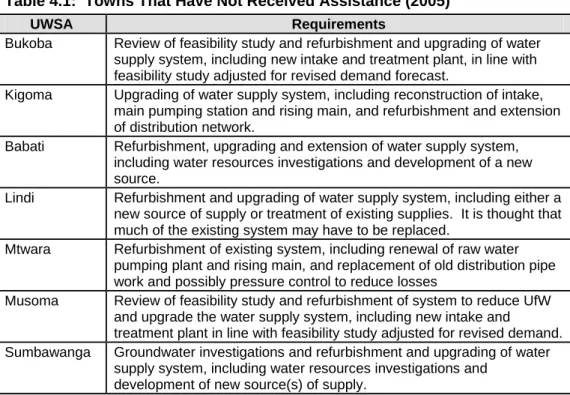
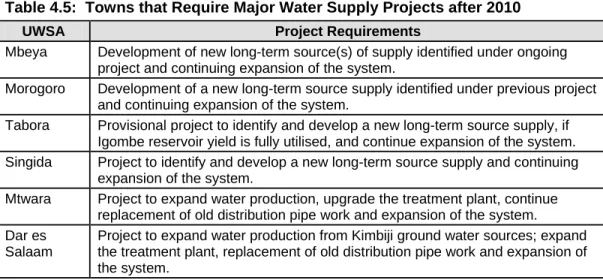
All existing 19 UWSAs including DAWASA need investment in infrastructure. While several authorities have ongoing or planned donor-funded projects, others are receiving little assistance other than government grants for small projects. Priority is given to towns that have not previously received significant donor funding and urgently require assistance to upgrade their water supply systems. Requirements include refurbishment, upgrading and extension to existing water supply systems including source development and in some cases treatment plants. In some towns, resource assessments are needed for improved planning of future water source development. Improved sewerage facilities will be needed in all towns as they increase in size and their water supply systems expand. Sanitation studies are recommended for most towns and are expected to recommend expansion of wastewater collection and treatment facilities for those towns that currently have sewerage networks and the development of limited wastewater collection and treatment facilities in towns that currently have no sewerage networks.
5.4 Safeguard Policies
The WSDP will trigger three safeguard policies, namely Environmental Assessment; Involuntary Resettlement; and International Waterways. The Environmental and Social Management Framework (ESMF) provides a strategic guide for the integration of environmental and social considerations in the planning and implementation of the WSDP activities including issues related to International Waterways. The Resettlement Policy Framework aims to protect impacts due to involuntary resettlement from implementation of the WSDP activities. The policy requires that the implementation of individual resettlement and compensation plans are a prerequisite for the implementation of Programme activities causing resettlement, thereby ensuring that resettlement compensation is in place.
6.
Costs and Financing
6.1 Costs
The total cost of the urban, rural and water resources management components of the Water Sector Development Programme is estimated at TZS 3,614,700 million (USD 2,891.76 million)5, to be invested over the 2005 – 2025 timeframe (Table 6.1a). In addition, strengthening of MoW cost is estimated at TZS 17,200 million (USD 13.76 million) while strengthening Executive Agencies is estimated at TZS 38,500 million (USD 30.83 million). The total investment cost is USD 44.59 million as shown in Table 6.1b.
5
The investment programme budgets are merged into a basic structure for comparative purposes. Three major investment categories were used: capital investment; management and operations support; and capacity development:
• Capital Investment (TZS 3,075,460 million / USD 2,460.37 million): The major portion of investment requirements is allocated to capital costs within all three programme components, including among other items: rural and urban water and sewerage systems; building construction and rehabilitation; office furniture, equipment and computers; vehicles; and technical equipment.
• Management and Operational Support (TZS 282,250 million / USD 225.80 million): These costs relate largely to district operational support under the NRWSSP and basin-level operational support under the WRMP (no such support is envisaged under the UWSSP), including: vehicle operations, travel expenses, staff salaries support, and other items.
• Capacity Development; TZS 84,860 million (USD 67.89 million): All three programme components include investment in capacity development of various kinds at district, basin, UWSA, regional and national levels.
A contingency of TZS 172,130 million (USD 137.70 million) has been included. Costs were also disaggregated into WSDP components.
The cost of the WRM component is estimated for the 2005 – 2025 period at TZS 333,370 million (USD 266.70 million). Of this, about 80% will be invested in basin-level activities, while the remainder is allocated to national and cross-sectoral activities by MoW.
The NRWSS component covers the 2005/06 – 2024/25 period, addressing the timeframe encompassed by Development Vision 2025. During this period, overall investment requirements to achieve the above objectives in rural water supply coverage are estimated at TZS 2,216,440 million (USD 1,773.15 million).
The Urban Water and Sewerage component calls for investments for the construction of physical works for individual UWSAs as well as investments for capacity building projects designed to strengthen the capacity of MoW and the UWSAs to operate, maintain and develop the urban water supply and sewerage systems. The Urban Water Supply and Sewerage (UWSS) investment requirements to 2020/21 total TZS 1,064,900 million (USD 851.92 million).
Table ES1: Water Supply Coverage Projections vs. Programme Cost
POPULATIONS & COVERAGE RATES (Beneficiaries x 106)
2005 2005-10 2011-15 2016-20 2021-25 Total Population Served Per Period 12.6 11.5 13.7 11.0 48.7
Cumulative Population Served by
Program 12.6 24.1 37.8 48.7 48.7
Cumulative Total Population Served 22.8 35.3 46.9 60.5 71.5 71.5
Projected National Population 39.1 47.7 56.1 65.6 77.1 77.1
Coverage Rate (%) 58% 74% 84% 92% 93% 93% PROGRAMME COST (TZS millions x 1000)
Total Programme Cost Per Period 913.0 1085.3 920.09 696.27 3614.7
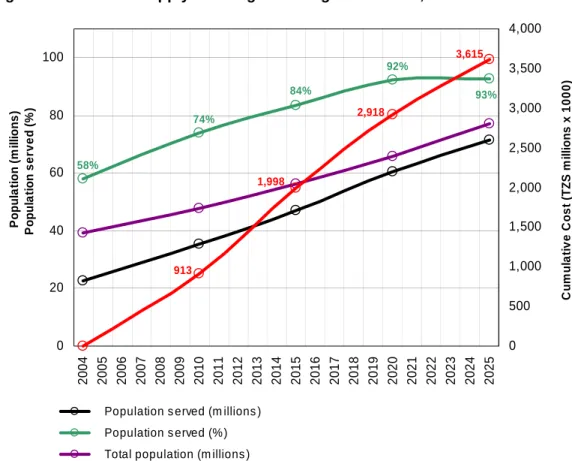
Water Supply Coverage vs. Programme Cost, 2005 - 2025 92% 84% 74% 58% 93% 2,918 1,998 913 3,615 0 20 40 60 80 100 200 4 200 5 200 6 200 7 200 8 200 9 201 0 201 1 201 2 201 3 201 4 201 5 201 6 201 7 201 8 201 9 202 0 202 1 202 2 202 3 202 4 202 5 0 500 1,000 1,500 2,000 2,500 3,000 3,500 4,000
Population s erved (m illions ) Population s erved (%) Total population (m illions )
Cum ulative Program m e cos t (TSH m illions x1000)
C u m u la ti v e C o s t ( T Z S m illio n s x 1 0 0 0 ) P o p u la ti o n ( m illi o n s ) P o p u la ti o n ser ved ( % ) 6.2 Financing
Estimates for the three programme components (WRMP, NRWSSP, UWSSP) over the 2005-2025 period indicate that a total of TZS 1,324,630 million (USD 1,059.71 million), which will be available from sources within Tanzania. These include government central budget allocations, rural, small towns and urban community contributions, water resource revenues, and NGO and donor funds, among others. Thus, to conduct the activities envisaged under the WSDP, external financing in the order of TZS 2,290,070 million (USD 1,832.0 million) will be required over the 2005 – 2025 period, excluding external financing required for strengthening the MoW general administration and Executive Agencies, which will require an additional USD 41.29 million.
In this context, the WRM investment plan suggests that water use revenues will grow from about TZS 661.0 million (USD 0.53 million) per annum in 2006 to approximately TZS 12,500 million (USD 10.00 million) per annum over a 10-year period. Government allocations to the WRM sector, estimated at TZS 2,740 million (USD 2.19 million) in 2006 are projected to grow to TZS 4,020 million (USD 3.22 million) by 2010. 6 Beyond this, periodic government allocations are assumed to be sufficient to meet the financing gap between water resource management costs and anticipated revenues. Thus the requirement for government allocations shall decrease beginning in 2016 as revenues increase over time. These assumptions result in external financing requirements of TZS 72,430 million (USD 57.94 million) over the 2005-2015 period.
6
WRMP February 2006, Table 8.4.
Government allocations for RWSS in 2005, 2006 and 2007 are assumed to grow from TZS 2,460 million (USD 1.97 million) in 2005 to TZS 7,800 million (USD 6.24 million) by 2007.7 Beyond this period government allocations are assumed to increase at 5% per annum. Rural communities are expected to contribute 5% to capital costs of the NRWSSP, totalling TZS 83,400 million (USD 66.72 million) each over the period.8
Other funding for RWSS from NGOs and external donors are estimated for this same period at TZS 21,252 million (USD 17.00 million) in 2005 to TZS 22,640 million (USD 18.11 million) by 2007. Beyond this period, donor funds are assumed to increase at 5% per annum. These assumptions result in an estimated TZS 927,900 million (USD 742.32 million) in available resources over the timeframe of the NRWSSP, or approximately 58% of the estimated total cost. Given this, the financing gap between available resources and estimated NRWSSP costs is estimated at TZS 1,288,540 million (USD 1,030.83 million) over the programme timeframe.
With regard to the Urban Water and Sewerage component, resources identified as likely to be available for capital projects were estimated at approximately TZS 135,820 million (USD 108.65 million) over the 2005 – 2020 period 9, or approximately 18% of programme costs. Necessary financing for urban water supply and sewerage improvements is therefore estimated at TZS 929,080 million (USD 743.30 million) over the programme timeframe.
6.3 Channelling of Funds
The main source of financing is the GoT complemented by resources from Development Partners. Funds from development partners will be channelled through MoF under the General budget support, and then will flow in two ways: first from MoF to programme implementers: namely the Basin Offices, LGAs, UWSAs and Executive Agencies. Secondly, financing of MoW’s monitoring activities will be channelled from MoF to the MoW. Accountability procedures including monitoring and reporting will be as specified in the Medium-term Expenditure Framework (MTEF) execution procedures, based on government public financial management acts and other programme implementation operational guidelines.
7. Monitoring
and Evaluation
The framework for the Monitoring and Evaluation (M&E) system for the WSDP takes into account the existing national framework for monitoring and evaluating progress in poverty alleviation, development and the water sector. This national framework includes a national Poverty Monitoring System (PMS), a Joint Assistance Strategy (JAS) M&E system and M&E systems used by Development Partners.
The JAS overall objective is to contribute to sustainable development and poverty reduction by consolidating and coordinating government efforts and Development Partners support. Development Partners (DPs) have recently set up a Development Partners’ Group – Water (DPG-Water) as a result of discussions concerning the JAS. A sector dialogue has begun. One of its functions is the monitoring and reporting on sector performance.
7 NRWSSP January 2006, Table 5.13 8 NRWSSP February 2006, Table 5.14 9
The structure for the water sector dialogue as put forth by DPG-Water is based on a High Level Forum, a Water Sector Working Group and several Technical Working Groups. Each has a specific role with regard to M&E of water sector developments, including the WSDP. The primary role for M&E in the WSDP rests with the MoW through the oversight Water Sector Working Group that will produce an Annual State of the Water Sector Report covering all aspects of the sector. This report will, together with Resources Tracking Studies and Technical and Financial Audits, form the basis of Joint Sector Reviews and input into the Annual MKUKUTA performance reviews.
Other key entities performing M&E activities for the WSDP will be: Basin Water Offices; Energy and Water Utilities Regulatory Authority (EWURA); UWSAs/WSSAs, RWSTs, local Governments Authorities and their District Water and Sanitation Teams.
The essential components of the M&E framework for the WSDP are: (i) the use of a results-based Logical Framework Analysis (LFA) and Performance Measurement Framework (PMF) and (ii) Management Information Systems (MISs).
A results-based management approach for monitoring and evaluation uses the LFA and associated PMF. A Baseline Study will be carried out at the start of the WSDP to obtain the necessary baseline data for the LFA and PMF. The Baseline Study will be a collaborative effort so information gathering will make efficient use of resources and so that information can be used by the various entities involved in M&E activities.
The final M&E system design will ensure that maximum use is made of existing data collection and monitoring systems such as the Household Budget Survey, Demographic and Health Survey and Population and Housing Census that are used as part of Tanzania’s Poverty Monitoring System.
One of the tools that will be used to monitor and evaluate the success of the WSDP will be Management Information Systems (MISs). MISs will be used to collect, store, analyse and disseminate information and data on the WSDP sub-projects. An MIS has already been successfully developed and is being tested for the NRWSSP in twelve districts, including all hardware, software and capacity building components.
This MIS is part of the planning, management and monitoring system, and incorporates the tracking of performance indicators for NRWSSP sub-projects. It includes an information storage database, systems for tracking sub-projects, and digitisation of documentation. Lessons learned from the NRWSSP MIS will be incorporated into the expansion of the MISs for the NRWSSP for all districts in Tanzania and for the development of MISs for other components of the WSDP, including the UWSSP and the WRM components.
1. INTRODUCTION
1.1 Background
Despite its importance to quality of life and development, water in Tanzania is a finite and vulnerable resource being poorly distributed in space, time, quantity and quality across the country. Tanzania faces a water security crisis in some parts of the country, as water demands exceed available resources. Water scarcity raises concerns over issues of its allocation, use, quality and availability. Competition for water is rising due to increased demands of irrigation and hydropower. Past uncoordinated water resources planning and management has resulted in conflicts between the energy and agriculture sectors, between use for production and environmental protection, between water supply and wastewater discharge and between upstream and downstream users.
Low water supply coverage impacts most severely on the poor. The poor make their own, often insufficient arrangements to meet their needs for basic survival. Most end up fetching water over long arduous distances; others are forced to pay high prices for small quantities of poor quality water.
Water plays a key role in Tanzania’s Development Vision10, which aims at achieving an absence of abject poverty by 2025. Its targets include the attainment of a quality of life that is socially desirable, economically viable and environmentally sustainable. To reach these goals, several achievements are called for including increased access to safe water to be raised to 90% by 2025. Subsumed are the objectives of equity of access, strengthening water management capacity, proper maintenance and use of environmentally sound technologies.
The later National Strategy for Growth and Poverty Reduction (MKUKUTA, 2005-2010)11 calls for reducing poverty through economic reform, targeted government resource allocations, accelerated rural economic development, and improved water supply, health and education services. Improved water supply (65% rural and 90% urban coverage by 2010) was identified as one of the top seven priority poverty reduction strategies.
Combined, these goals and the poverty they aim to mitigate represent enormous challenges to the Government and civil society in the years ahead. The goals provide an integrated framework for development that, for this sector, establishes guidelines for progress and ambitious but achievable targets to meet.
1.2 Country and Sector Overview
Located on Africa’s East coast, Tanzania has a mainland area of 945,000 sq km and a population of over 36 million of which three quarters live in rural areas. Although its annual GDP growth rate is substantial at 6.7% (2004), it has a Gross National Index (GNI) per capita of only USD 280 (2002) and a low Human Development Index of 40.712.
10
United Republic of Tanzania, (1999), “Development Vision 2025 for Tanzania”. Dar es Salaam. www.tzonline.org.
11
Vice President’s Office (2005) “National Strategy for Growth and Reduction of Poverty” (NSGRP – MKUKUTA), Dar es Salaam, The United Republic of Tanzania.
12
Tanzania is endowed with numerous and diverse water resources in the form of rivers, lakes, wetlands and aquifers. However, the reality is that severe and widespread water shortages exist in many areas both because of climate variability, uneven distribution of the resource in time and space, and inadequate management of the water resources. The variation is explained by differences in topography, rainfall pattern and climate. About one third of Tanzania receives less than 800mm of rainfall per annum and is considered as arid or semi arid.
The 5.4 million hectares of lakes and swamps represent 5.8% of the total land area. About 50% of the surface runoff water flows directly to the Indian Ocean. The other half consists of surface water drainage to the main internal drainage basins of lakes Rukwa, Bubu, Eyasi and Manyara and drainage to lakes Victoria, Tanganyika and Nyasa.
The ultimate responsibility for the provision of water supply and sanitation services rests with the MoW. However, different central and local government departments and organisations have mandates to be involved in the provision of these services. In particular, local government, be it at the city, municipal, town, district, or township authority level, has varying levels of responsibility for providing services, and the Ministry of Health and Social Welfare (MoH&SW) has an overall responsibility for protecting public health through ensuring the provision of adequate sanitation and hygiene education by the local authorities. Other ministries include the Prime Minister’s Office – Regional Administration and Local Government (PMO-RALG) and the Ministry of Finance (MoF), which have administrative and financial relations with Regional Administration and LGAs respectively.
The MoW holds overall responsibility for water resources management. However, a number of other departments and agencies manage water resources according to their own mandates and needs, their own legislative provisions, with little coordination and integration towards holistic basin-wide planning and management.
1.3 Policy
Environment
Policy development for the sector began with the first National Water Policy in 1991. It responded to the failure of providing adequate water supply and sanitation services despite major investments in the sector during the 1970s and ’80s. The later National Water Policy (NAWAPO 2002) introduced strong reform elements of devolution, poverty alleviation and civil service reform. It was strongly influenced by national policy instruments (see Figure 1.1) that address issues of poverty and economic development, and incorporate water sector reforms as one of several related components which when combined offer a multi-sector approach to poverty reduction and economic growth.
Figure 1.1: Linkage of WSDP with National Policies and Strategies
National Development Vision 2025
Poverty Reduction Strategy Paper (2000)
Local Government Reform Policy Paper (1998) Public Service Reform Programme (2000)
Rural Development Policy (2003)
National Strategy for Growth and Reduction of Poverty MKUKUTA 2005-2010 (2005)
National Water Policy (NAWAPO, 2002)
National Water Sector Development Strategy 2005-2015 (2005)
National Rural Water Supply and Sanitation Programme (2005) Urban Water and Sewerage Programme (2005)
Water Resources Management Programme (2006)
Water Sector Support Programme (2006)
Key policies such as the 1997 National Development Vision 2025 set the stage for the PRSP, and the RDP that were then supported by the Local Government and Public Sector Reforms. These led to the MKUKUTA, which sets operational goals and puts policy in a functional framework that, in the water sector is embodied in the National Water Sector Development Strategy of 2005. The sector strategy is incorporated into three sub-sector programmes: the WRMP, the NRWSSP, the Urban Water and Sewerage Strategic Programme (UWSSP), and the Water Resources Management Programme (WRMP). These are consolidated into a WSDP.
The central policy instrument for all these programmes is the NAWAPO 2002. The key lesson learned from previous experience is that to achieve sustainability, water supply and sanitation facilities must be owned and managed locally by organisations that are both close to, and accountable to the consumer. This can only be achieved if the responsible organisation at the community level is trained and empowered, and contributes meaningfully at all stages of planning, design, implementation and long-term maintenance and repair of the facility.
These principles are central to NAWAPO which embodies effective institutionalised linkages between key sector actors, including central government, local government, ESAs, the private sector, NGOs, CBOs, and the communities themselves. Under NAWAPO, the Government continues to provide the necessary technical and financial support, as well as coordination and regulation of water supply development activities. The private sector provides support to the communities in planning, design, construction and supply of materials, equipment and spare parts. The ESAs and NGOs provide financial and technical assistance and funding.
1.4 Sector
Development Challenges
1.4.1 Water Resources Management
Tanzania’s high economic growth masks some structural weaknesses related to the management of an essential natural endowment—water resources. Food security, energy security, environmental security, health security, industrial security, and social and economic security all hinge directly or indirectly on water security. In ensuring a secure and sustainable future for its people the Government of Tanzania (GoT) faces a complex water resources management and development challenge.
Water security remains an elusive goal in Tanzania, despite the fact that it is relatively well endowed with freshwater resources. Water insecurity is compounded by (a) inadequate investments in constructed water storage and other water resources infrastructure to buffer against the impact of droughts and floods (climate variability) and inadequate investments in pollution control; (b) investments in costly but unreliable infrastructure, and (c) inadequate investments in water resources management systems, institutions, and regulations, which has created a climate of poor governance and is contributing to water-use conflicts, threatening water sources and the destruction of natural storage capacities. While measurable progress has been made in achieving specific targets—especially in the delivery of services, such as increasing water supply coverage and hydropower generation capacity—the necessary institutional and legal reforms for water resources management have evolved very slowly. Water resources institutions are poorly resourced and poorly functioning. Huge infrastructure gaps—for water supply, for meeting energy demand and for food security needs—remain. Important lessons learned from recent projects have yet to be internalised and acute water resources governance problems persist. The concept of integrated water resources management adopted in the past decade is not uniformly understood, accepted, or properly supported.
1.4.2 Rural Water Supply Service
For a long time, the government has been the owner and operator of rural water supply systems. This has lead to a lack of commitment by communities to sustain their facilities. It has also lead to overlap of roles and inadequate coordination. The existing water supply
systems are unable to meet water demands. This has lead to the prevalence of water borne diseases and loss of productive time that is used to search for, collect and transport water. The provision of water service has been done without the active involvement and ownership of the beneficiaries, leading to unsustainable service delivery. Implementation of projects and programs is done through different approaches. This has resulted in overlaps of responsibilities and interventions that are not cost effective.
Operation and maintenance (O&M) of water supply schemes has not reached the level of full cost recovery, due to socio-economic conditions pertaining to the rural areas. Schemes operate only to recover operation and maintenance costs. For large schemes, government subsidy is still granted to offset electricity bills, chemicals and salaries. For handpump schemes, availability of spare parts at the district level is not certain because they are not fast moving items in the market. This has led to malfunctioning of some of the schemes.
1.4.3 Urban Water Supply and Sewerage Management
Under the Water Works Order of 1998, 20 UWSAs were established as “autonomous” bodies. They are now functional but challenged by many deficiencies. The most fundamental problem is that they do not yet fully exercise their autonomy. This is the case despite the fact that all UWSAs are implementing their Strategic Plans that give strategic direction towards full cost recovery. Boards are autonomous in decision-making and members are professional but have varying levels of skills and experiences. While blaming financial limitations for limited progress, the UWSAs are reluctant to raise tariffs to commercial levels.
Few authorities are replacing worn out equipment, and most depend on donor aid or grants from MoW for major refurbishments. Likewise, some UWSAs including DAWASA have rationalised their approach to maintaining and repairing distribution network. Due to inadequate leakage detection facilities, responses are only made to visible leaks.
Most of the UWSAs Finance departments have computerised billing systems and few are relying on manual systems. The average level of arrears in the UWSAs is high at around 19 months of billings, most being owed by households, but many also by institutional customers.
1.4.4 Limited Financing for Expansion and Improvement of Services
There are several concerns related to programme financing. (1) ESAs continue to prefer bilateral financing of individual projects under a myriad of policies and implementation arrangements instead of a more consolidated approach. Progress towards financial harmonisation and general budget support mechanisms is slow. (2) Budget sources and donor financing need to be substantially expanded to reach the MKUKUTA, MDG and Vision 2025 targets for water resources management and water supply and sanitation coverage. (3) Beneficiary communities are responding to their new roles, however there is still a commonly held belief that water should be free which, when combined with existing levels of poverty, reduces their ability and willingness to pay for services.
1.4.5 Capacity Constraints
NAWAPO introduced an entirely new approach to implementing water supply and sanitation and water resources management. Traditionally, the sector has been centrally
controlled and implemented. Under NAWAPO, consultations and planning starts from the grass roots; and implementation is at the most appropriate level, closest to the beneficiaries. User groups are not only responsible for operating, maintaining and sustaining the infrastructure they are also responsible for planning and managing it.
Under NAWAPO, the Rural Water and Sanitation sub-sector has successfully developed an implementation model for replication countrywide. Capacity gaps were anticipated and occurred at district and regional levels. Capacity building starter activities are underway to strengthen Regional Secretariats in training and support foci for DWSTs. Greater capacity building efforts are needed to strengthen the community, the facilitation service providers (FSPs) and the technical service providers (TSPs) who also are unfamiliar with NAWAPO and community based implementation methods.
1.4.6 Sanitation and Sewerage
Household budget (2001) surveys suggest that sanitation coverage (as measured by access to latrines) is as high as 90%. However, most latrines fail to meet MDG defined standards for sanitation. By MDG standards, coverage would be closer to 50%. Sanitation has failed to attract the required level of resources. When resources are available they are commonly spent on technology and subsidies instead of on the necessary promotion, planning and skills development within the community. Successful rural sanitation programming is rare in Tanzania and indeed across Africa. There are few implementation models to emulate. Tanzanian urban growth rates are among the highest in the world. With improved water supply and increasing population densities, even the smaller towns with populations of 50,000 and above are reaching the point whereby inadequate wastewater removal and treatment is constraining economic development. Sewerage and sewage treatment is often more expensive than water supply. Households and commercial establishments are reluctant to pay the cost of house connections and additional tariffs. Consequently, connection rates are slow even where sewer mains have been built and onsite disposal made illegal.
1.4.7 Stakeholder and Private Sector Participation
There are several issues and concerns surrounding the direct involvement of stakeholders and the private sector.
1. The WSDP opens new avenues for collaboration between sectors that have traditionally operated in isolation. Examples include the health, agriculture, forestry, and power sectors, and even local government itself. Substantial effort will be needed to ensure their active participation. Fortunately, devolution and NAWAPO policies offer real incentive and opportunities for participation and cooperation between sectors.
2. The private sector is actively participating in the water sector but is relatively weak (especially at the district level where it is most needed) and it is not familiar with the requirements of district implementation and community management. Greater effort and resources for capacity building and quality assurance in the private sector is needed.
3. Government retaining the role of decision-maker undermines real community involvement in project planning and ownership. The process of bottom up planning needs strengthening.
4. There is a natural bias for schemes to favour the more powerful and better off at the expense of the poor. Women and marginal groups are being left out of the decision making process.
5. Those entrusted to manage the newly established community water supply entities have little management experience which will likely result in conflicts at the community level.
1.4.8 Establishment and Strengthening of Executive Agencies
Under the Ministry of Water, three Executive Agencies were established. These were the Drilling and Dam Construction Agency (DDCA), the Water Resources Institute (WRI) and Maji Central Stores (MCS). The ultimate aim of the Agencies is to make them financially autonomous. The Agencies are not working at an optimum capacity due to dilapidated and outdated equipment, and inadequate management skills. The challenge is to strengthen the Agencies in order to make them sustainable. At present the three Agencies depend on government subsidy to carry out their operations.
1.5 Scope
of
Programme
The WSDP comprises three components under the SWAp framework: the Water Resources Management Programme (WRMP), the National Rural Water Supply and Sanitation Programme (NRWSSP) and The Urban Water Supply and Sewerage Programme (UWSSP). Funding is currently being sought for the first four years (2006-2010) of WSDP through the Government Budgetary System (GBS) and other agreed funding mechanisms that disaggregates the WSDP into three Support Blocks in accordance with the level at which they will function:
1. Local Government - Scaling up of Services Delivery to Meet MDGs;
2. Basin Level - Strengthening of Water Resources Management Governance; and 3. National Level - Support to Sector Institutional Strengthening and Capacity
Building.
This section provides a brief description of the Water Resources, and Rural and Urban components of the overall 2005-2025 WSDP. More detail on the scope of the components of the WSDP is provided in Section 4.
1.5.1 Water Resources Management
The objectives of the WRM component are to (1) develop a sound water resources management and development framework in all nine water basins, and (2) promote good governance of water resources through empowering the water users, encouraging participatory and transparent decision making, developing ownership to the user level, and granting secure water rights with responsibilities to the water users, community groups, local government and Basin Boards.
The main focus of this component is on the establishment and strengthening of the nine Basin Water Offices (BWOs). Apart from support for staffing and physical infrastructure of the BWOs, considerable attention is given to strengthening their capacity in water resources monitoring, assessment and enforcement. Other subcomponent activities include: water quality management and pollution control, protection of important water sources; water demand management; strengthening legislation and enforcement; integrated water resources planning; trans-boundary water management; and a variety of cross-cutting activities such
as disaster management, public awareness, inter-agency networking and establishing a water resources management information system. The programme will also implement priority infrastructure investments that may result in more secure water resources and promote conservation and protection of water resources.
1.5.2 National Rural Water Supply and Sanitation Programme
The NRWSSP has three main components:
1. Rolling out the district implementation model countrywide and providing district management support to:
a) create and strengthen DWSTs within local government enabling them to prepare district RWSS plans, and appraise RWSS sub-projects proposed by communities;
b) install a district RWSS funding mechanism to finance new and rehabilitated RWSS facilities;
c) build community capacities to properly maintain and operate their facilities; and d) promote hygiene, sanitation and HIV/AIDS mitigation and prevention.
2. Investment in community-based water and sanitation sub-projects:
Conditional grants are being allocated to WSS projects proposed by communities themselves for drilled wells, boreholes with hand pumps, piped systems using pumped water from boreholes or gravity fed water from springs, and latrines. The DWSTs employ local NGOs and firms as facilitation service providers (FSPs) and consultant engineers as technical service providers (TSPs) for design and construction supervision. A supply chain that includes private retail outlets is being established to distribute spare parts for hand pumps.
3. Institutional strengthening and development of a National Rural Water Supply and Sanitation Programme (NRWSSP):
a) a stakeholder consultative process;
b) technical assistance and support to project management;
c) a web-based MIS which will link all districts, track coverage, sub-project progress, and lessons learned, and;
d) restructuring RWSS institutions within MoW, and strengthening stakeholders: FSPs, TSPs, goods and services suppliers, Districts, Regional Secretariats and MoW.
The MoW manages the programme and provides technical staff and support to districts in establishing DWSTs, preparation of District Water Supply and Sanitation (DWSS) plans and establishing dedicated DWSS Funds. Participating communities provide cash contributions of at least 5% of sub-project capital cost and prepare facilities and management plans that emphasize financial and operational sustainability.
FSPs facilitate and strengthen village Water and Sanitation Committees (WATSANs), enabling them to plan their sub-projects, select their service levels and technologies and prepare applications for district support. DWSTs appraise community applications, enter into agreements with successful communities, provide technical designs, procure FSP, TSP and contractor services, and jointly supervise construction with the village WATSANs. The DWST is also responsible for continued monitoring and providing technical advice to the community to ensure long-term sustainability of the services. The FSPs and TSPs provide
technical designs, strengthen WATSANs, raise community awareness, and assist in putting mechanisms into place for the continued operation, maintenance, repair and management of the facilities, including the collection of fees and the management of funds.
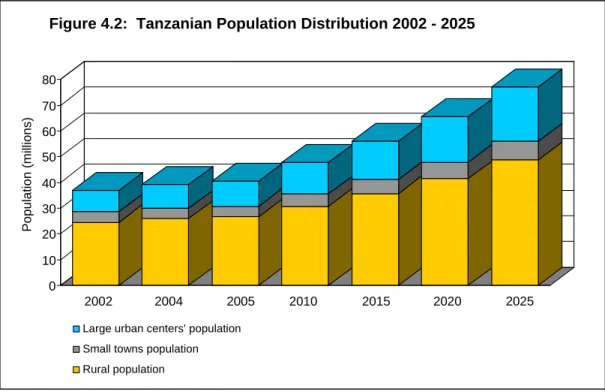
The overall objective of the NRWSSP is improved quality and quantity of drinking water and sanitation services for the rural population sustained through improved district level capacity, effective local water user entities, private sector participation and good health, hygiene, and sanitation practices. The NRWSSP includes both rural and all small town populations. By 2015 it will raise coverage of these populations from 53% and 49% of 2003 to 79% and 82% respectively (see Figure 1.2). In doing so, it will meet the MDGs for the rural areas. Likewise, it will raise both coverage levels to 90% by 2025 in accordance with Vision 2025 goals. In all, the NRWSSP will provide services to an additional 34.5 million people by 2025.