An Integrated Approach Based on Fuzzy Ahp and
Grey Relational Analysis for Heating Source Selection
Assoc. Prof. Arzu Organ
Res. Assist. Engin Yalçin
Pamukkale University, Business Administration, Turkey
Abstract
Decision making has always been difficult for enterprises in an extremely competitive environment. It is one of the toughest decisions to select heating source source. It is difficult to take into consideration factors such as quality of energy source, pollution degree of environment, attainability, sustainability. Due to this hardship, Multi criteria decision making method is beneficial for solving such kind of problems. Grey relational analysis and fuzzy AHP are efficient methods of multiple criteria decision making. In this paper, the best heating source source selection has been carried out by fuzzy AHP integrated grey relational analysis. In the phase of determining criteria weights is used by fuzzy AHP, while determining ranking of alternatives, grey relational analysis is used. The criteria used in this study are ecofriendly level, cost, attainability, calorific value and process ability. The alternatives used in this study are coal, natural gas, diesel and electricity. Out comes show that Grey Relatıonal Analysıs can be used successfully in the process of solving heating source selection problems
Keywords: Fuzzy AHP, Grey Relational Analysis, Heating Source
Introduction
Heating source takes the lead both in domestic and international domains as a strategic agenda item. Heating source firms have reached the most valuable and turnover. It is one of the most important priorities to supply nonstop, reliable and cheap heating sources in globalizing world. It has become one of the most important decisions for firms operating in foreign-dependent countries in terms of underground sources to select the most proper source in the production process. Managers should take into consideration many criteria such as the cost of heating source, availability, quality and pollution degree of heating source while deciding which
Decision making has become of utmost importance for firms in an extremely competitive environment. The solutions of decision-making problems have been seek for scientific ways not for intuitive ways as a result of development in science and technology. Decision-making is very tough when demanded aim is determined by many parameters and there are unique advantages for each alternative. Within this framework, there are many methods to overcome these hurdles (Kaya et al. 2008: 8).
Decision-making involves criteria and alternatives to choose. The criteria usually have different importance and the alternatives in turn differ in our preference for them on each criterion. To make such tradeoffs and choices we need a way to measure. Measuring needs a good understanding of methods of measurement and different scales of measurement (Saaty, 2004: 1). Decision analysis can be depicted as a way to propose mathematical, statistical and numerical methods to solve problems faced by the enterprises. Decision analysis techniques can be applied to many fields in enterprises such as human source management, operation management, financial management, material purchase (Organ, 2013: 252).
Multiple criteria decision-making is one of the most widely-used branch of decision analysis. At the same time, multiple criteria decision-making contains methods to help evaluate many criteria, classify and ranking of alternatives. Multiple criteria decision-making is divided into two as multi objective and multi attribute decision-making. Within this division, AHP, ELECTRE, PROMETHEE, TOPSIS, COPRAS and grey relational analysis can be set as example to multi attribute decision-making (Atıcı and Ulucan, 2009:164).
The choice of heating source is very critical for business. There are lots of criteria and alternatives when deciding to use a heating source for enterprises. That’s why managers go through a rough period while deciding which alternative is more preferable. This study aims to solve this difficult
decision by fuzzy AHP integrated grey relational analysis out of multiple
criteria decision-making methods.
Methodology
AHP and Fuzzy AHP
Analytic hierarchy process (AHP) is a decision-making model that aids in making decisions in our complex world. It is a three part process which includes identifying and organizing decision objectives, criteria, constraints and alternatives into a hierarchy; evaluating pairwise comparisons between the relevant elements at each level of the hierarchy; and the synthesis using the solution algorithm of the results of the pairwise comparisons over all the levels. Further the algorithm result gives the relative importance of alternative courses of action (Saaty, 1988: 110).
Analytic hierarchy process (AHP) has been widely used as a useful multiple criteria decision-making (MCDM) tool or a weight estimation technique in many areas such as selection, evaluation, planning and development, decision-making, forecasting, and so on. The traditional AHP requires crisp judgments. However, due to the complexity and uncertainty involved in real world decision problems, a decision maker (DM) may sometimes feel more confident to provide fuzzy judgments than crisp comparisons (Wang et al., 2008: 735).
There has been serious criticism about AHP method although it is a common method. Firstly AHP method doesn’t pay attention to available ambiguity with regard to decision and criteria. This influences the result substantially. There may be some changes in the ranking of alternatives when a worse alternative is added up to problem in AHP method. This case reveals that the results obtained by AHP method don’t guarantee true result every time. Triangular fuzzy numbers are used to fuzzify piecewise comparison matrix in fuzzy AHP. Triangular fuzzy numbers are used to determine the judgments of decision makers. After obtaining fuzzy performance, the aim is to get ultimate results (Organ and Kenger, 2012: 122).
Fuzzy AHP method can be considered as an advanced analytical technique introduced by Saaty’s AHP method to model unconstructed problems in various fields. Traditional AHP methods evaluate the judgments of decision maker, fuzziness, ambiguity despite its consistency with regard to handling both qualitative and quantitative criteria. Although the aim of AHP method is to reveal expert opinion traditional AHP methods still don’t reflect human thought style. Since the basis of priorities in AHP is perceptional judgments of decision maker, fuzzy AHP acquires better solution. That’s why many researchers are interested in fuzzy extension of AHP method, introduced by Saaty (Özdağoğlu, 2008: 17).
In our study, we applied to fuzzy AHP while determining weights. The steps of fuzzy AHP method are as follows (Hsieh et al., 2004: 576-577).
Step 1. Construct pairwise comparison matrices among all the criteria according to decision makers’ opinion.
𝑨� = 12 1 12 1 2 12 2 1 2 1 2 1 ... 1 ... 1 ... 1 / 1 ... . . . . . . . . . . . . ... 1 1 / 1 / ... 1 n n n n n n n n a a a a a a a a a a a a =
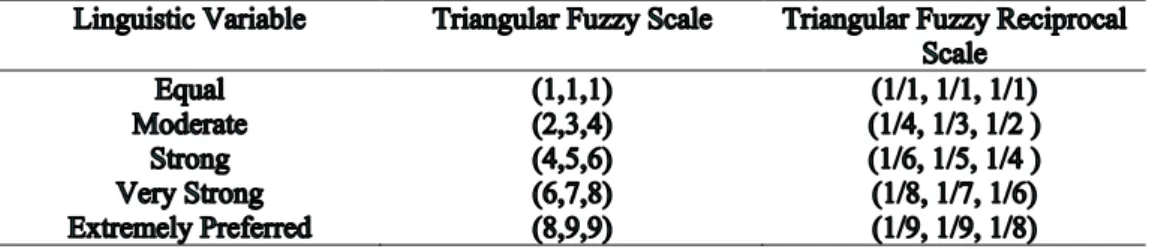
Decision maker used five scaled fuzzy comparison table while
evaluating criteria. As it can be seen in Table 1.
Table 1: The Linguistic Assessment Variables and its Corresponding Scale in Terms of Triangular Fuzzy Numbers
Step 2. Fuzzy geometric mean and fuzzy weights of each criterion are calculated using Equation (1) and (2).
1 1 ( ... ... )n i i ij in r = a ⊗ ⊗ ⊗a a (1) 1 1 [ .... ... ] i i i n w = ⊗ ⊕r r r⊕ ⊕r − (2)
Step 3. In the last step, Center of Area (COA) method is used to calculate Best Nonfuzzy Performance value (BNP).
BNPwi= ( ) ( ) 3 wi wi wi wi i U L M L L − ⊕ − ⊕ ; i=1,2,……,n (3)
Lwi, Mwi, Uwi values are triangular fuzzy numbers and respectively represent the lower, middle and upper values.
Grey Relational Analysis
Grey system theory was used by Deng (1982). The grey system is defined as a system of partial definition. The grey system theory is applied to solve partial information problems such as decision-making, weather prediction and military affairs (Liang et al, 2014: 9).
The fundamental definition of “greyness” is information being incomplete or unknown, thus an element from an incomplete message is
1 1 1 1 1
1,3,5, 7,9 criterion is relatively more important compared with 1,
criterion is less impo
1 ,3 ,5 , 7 ,9 rtant compared with j criterion
ij i j criterion a i j i − − − − − = =
considered to be of grey element. Grey relation means the measurements of changing relations between two systems or between two elements that occur in a system over time. The analysis method, which measures the relation among elements based on the degree of similarity or difference of development trends among these elements, is called “grey relation analysis” (Feng and Wang, 2000:136).
In grey relational analysis, black means that we have no information on the other hand white means that we have information. A grey system has a level of information between black and white (Sreenivasulu and Rao, 2012: 71). Some information is known and some information is unknown. GRA is used to convert multi-response optimization into a single response grey relational analysis (Jegan et al, 2012: 4008).
Grey relational analysis has become more and more important recently. There are lots of studies about this method recently. Some of these studies are as follows:
Peker and Baki (2011), applied this method to performance measurement of insurance sector. Özdemir and Deste (2009), applied it to automotive sector. Ecer (2013), evaluated performance of private banks in Turkey. Chan and Tong (2006) used this method for material selection, Lu and Wevers (2007) used this method to evaluate road traffic safety. Erden and Ceviz (2015), utilized this method for growth ratios evaluation.
The phases of GRA are as follows (Mehregan et al, 2012: 404-405, Zhai et all, 2009: 7072-7079, Ecer, 2013:176-177) :
Step 1. Construction of Decision Matrix
As in all multi-criteria decision-making problems, firstly decision matrix is constructed.
Step 2. Normalization of Decision Matrix
If the target value of original sequence is expected to be maximum, then the original sequence is normalized as follows:
* i ( ) min ( ) maxx ( ) min ( ) i i j i i j j x j x j x j x j − = − (4)
If the expectancy is that smaller values are better, the original sequence should be normalized as follows:
i * i maxx ( ) ( ) maxx ( ) min ( ) j i i j j j xi j x j x j − = − (5)
Step 3. Construction of Absolute Value Table
The absolute value between x0* and xi* is calculated as follows: ∆0i = x*0( )j −x*i( )j i= 1,2,…..,m (6)
j=1,2,…..,m
Step 4. Calculation of Grey Relational Coefficient
Grey relational coefficient is calculated to express the relationship between the ideal and actual normalized results and can be calculated as follows:
ɣ0i(j)= min max
0i( )j max ξ ξ ∆ + ∆ ∆ + ∆ (7) max ∆ = 0 max ( ) max i j i j ∆ (8) min ∆ = 0( ) minmin i i j j ∆ (9)
ξis distinguishing or identification coefficient.ξis generally used as 0.5.
Step 5. Calculation of Grey Relational Grade
After getting grey relational coefficient, we take the average of grey relational coefficient as the grey relational grade if all the criteria have equal importance. The grey relational grade is calculated is as follows:
Γ0i = 0 1 1 ( ) n i j j n
∑
= γ i =1,2,…..,m (10)However in real world, there can be different weights for the criteria. In this case, the grey relational grade is calculated is as follows:
Γ0i= 0 1 [ ( ). ( )] n i i j w j γ j =
∑
(11)where wi represents the normalized value of attribute j. Therefore, if a comparability sequence for an alternative gets the highest grey relational grade with the reference sequence, it means that a particular comparability sequence is more important than the other comparability sequences to the reference sequence it is the best alternative to be chosen (Mehregan et al, 2012: 404-405).
Application
An Integrated Approach Based On Fuzzy AHP And Grey Relational Analysis For Heating Source Selection
The aim of this study is to determine the most suitable heating source for a textile firm. As a heating source, this textile company has 4 different alternatives. These include Coal, Natural Gas, Diesel, and electricity. The criteria to be taken into account when choosing these alternatives are Cost, Attainability, Ecofriendly, Calorific Value and Processability. In this study, the best heating source selection for an enterprise is carried out with AHP integrated Grey Relational Analysis. The linguistic variables used to evaluate alternatives are given in Table 2.
Table 2. The Linguistic Variables Used to Evaluate Alternatives
Linguistic Variables Reciprocal Scale
Very Weak 1 Weak 3 Fair 5 Good 7 Very Good 9 Interval Values 2,4,6,8
Data set prepared according to expert opinion is given in Table 3.
Table 3. Data Set Prepared According to Expert Opinion
MAX MİN MAX MAX MAX
Eco friendly
level
Cost Attainability Calorific Value Processability Coal 1 9 9 7 5 Natural gas 7 8 8 5 7 Diesel 3 3 6 6 6 Electricity 9 7 7 3 3
Normalization is carried out by Equations (4) and (5). Normalized decision matrix is given in Table 4.
Table 4. Normalized Decision Matrix Eco
friendly level
Cost Attainability Calorific Value Processability Coal 0 0 1 1 0,5 Natural gas 0,75 0,16667 0,6667 0,5 1 Diesel 0,25 1 0 0,75 0,75 Electricity 1 0,3333 0,3333 0 0
After normalization, absolute value table is constructed by Equation (6). Absolute value table is given in Table 5.
Table 5. Absolute Value Table
Eco-friendly level
Cost Attainability Calorific Value Processability Coal 1 1 0 0 0,5 Natural gas 0,25 0,8333 0,3333 0,5 0 Diesel 0,75 0 1 0,25 0,25 Electricity 0 0,6667 0,6667 1 1
Then ∆maxand∆minare obtained as 1 and 0 respectively. ζ is regarded as 0.5 as generally used. Grey relational coefficient is calculated by Equation (7). Grey relational coefficient for each alternative is given in Table 6.
Table 6. Grey Relational Coefficient Eco
friendly level
Cost Attainability Calorific Value Processability Coal 0,3333 0,33333 1 1 0,5 Natural gas 0,6667 0,375 0,6 0,5 1 Diesel 0,4 1 0,33333 0,6667 0,666667 Electricity 1 0,4285 0,4285 0,333333 0,33333
In the next step grey relational grade is calculated by using weights obtained by fuzzy AHP.(The weights used at this stage have also been used
in (Organ and Yalçın 2016:51-61)1
.
Therefore weighting steps of fuzzy AHP are given as follows:
The fuzzy pairwise comparison matrix we get after expert evaluation is given in Table 7.
Table 7. The Fuzzy Pairwise Comparison
1Organ A. and Yalçın E.
(2016). The Energy Source Selection By Fuzzy Moora And Fuzzy AHP Method In A Textile Firm . In Arslan H. and Içbay M. (Ed.), Contemporary Approaches In Humanities, (pp.51-61), Frankfurt, Peter Lang Edition.
Ecofriendly level
Cost Attainability Calorific Value Processability Ecofriendly level 1,00 1,00 1,00 0,11 0,11 0,125 0,125 0,142 0,166 0,16 0,20 0,25 0,125 0,142 0,166 Cost 8,00 9,00 9,00 1,00 1,00 1,00 1,00 1,00 1,00 1,00 1,00 1,00 0,11 0,11 0,12 Attainability 6,00 7,00 8,00 1,00 1,00 1,00 1,00 1,00 1,00 4,00 5,00 6,00 1,00 1,000 1.000 Calorific Value 4,00 5,00 6,00 1,00 1,00 1,00 0,16 0,20 0,25 1,00 1,00 1,00 0,25 0,33 0,50 Processability 6,00 7,00 8,00 8,00 9,00 9,00 1,00 1,00 1,00 2,00 3,00 4,00 1,00 1,00 1,00
Fuzzy weights are obtained for each criteria using Equation (1). 1 r = (0,1940, 0,2135, 0,2437) 2 r = (0,974, 0,997, 1,015) 3 r = (1,888, 2,036, 2,168) 4 r =(0,693, 0,801, 0,944) 5 r = (2,491, 2,852, 3,103)
Criteria weights are calculated by using Equation (2).
1 W = (0,0259, 0,0309, 0,0390) 2 W = (0,1303, 0,1446, 0,1627) 3 W = (0,2525, 0,2950, 0,3475) 4 W = (0.0927, 0,1160, 0,1512) 5 W = (0,3326, 0,4133, 0,4972)
Best non-fuzzy performance values are obtained from defuzzifying fuzzy criteria weights with Center of Area (COA) method by using Equation (3). BNPw1 = 0,0320
BNPw2= 0,1459
BNPw3= 0,2984
BNPw4= 0,1200
BNPw5= 0,4146
In the next step grey relational grade is calculated by using weights obtained by fuzzy AHP. Grey relational grade is obtained by Equation (10) and grey relational grade and ranking of alternatives are given in Table 8.
Table 8. Grey Relational Grade and Ranking of Alternatives Eco
friendly level
Cost Attainability Calorific Value Processability Γ Ranking Coal 0.010661 0.048632 0.2983623 0.1200168 0.2073146 0.6849862 2 Natural gas 0.021322 0.054711 0.1790174 0.0600084 0.4146292 0.7296872 1 Diesel 0.012793 0.145895 0.0994541 0.0800112 0.2764195 0.614573 3 Electricity 0.031982 0.062527 0.1278695 0.0400056 0.1382097 0.4005937 4
According to ranking of alternatives, it is obtained that natural gas is first alternative, coal is the second, diesel is the third alternative, electricity is the last alternative.
Conclusion
Grey relational analysis has become more and more popular recently. Grey relational analysis reveals better results compared with other statistical methods. It also seems more proper compared with other multiple criteria decision-making methods as it is easy to use.
According to results of the study, natural gas is the best alternative for enterprise to use. Its eco-friendly level, affordability, attainability and processability enable it to take the lead. After natural gas, coal seems to be second suitable heating source for this enterprise. When we glimpse at the features of coal, it can be preferable due to being very affordable and attainable despite its low eco-friendly level. Diesel is the third alternative the enterprise can select. Diesel doesn’t seem wise for enterprise as it is costly and low eco-friendly. Electricity takes the last rank among alternatives. Despite its high eco-friendly level, it doesn’t seem logical to use due to its low calorific value and processability.
References:
Atici, K.B., and Ulucan, A. (2009). “Multi Criteria Decision Analysis Approaches In Energy Projects Evaluation Process and Turkey Applications”
Hacettepe University, Journal Of Economics And Administrative Sciences, Vol:27, pp.161-186.
Chan J., and Tong T. (2006) “Multi-criteria Material Selections and
End-of-Life Product Strategy: Grey Relational Analysis Approach”, Materials &
Design, Vol: 28, No: 5, pp.1539-1546.
Feng, Cheng-Min, and Wang, Rong-Tsu (2000). “Performance Evaluation
For Airlines Including The Consideration Of Financial Ratios”, Journal Of
Air Transport Management 6, pp.133-142
Ecer, F.(2013). “Türkiye’deki Özel Bankaların Finansal Performanslarının
Karşılaştırılması: 2008-2011 Dönemi” AİBÜ Sosyal Bilimler Enstitüsü
Dergisi, Vol: 13, Issue: 2, pp.171-189.
Erden, C., and Ceviz E. (2015). “Gri Sistem Teorisi Kullanılarak Türkiye’nin
Büyüme Oranı Faktörlerinin Analizi”, SAÜ Fen Bil. Dergisi, Vol: 19, Issue:
3, pp. 361-369.
Hsieh, T. Y., Lu, S. T., and Tzeng, G. H. (2004). “Fuzzy MCDM Approach for Planning and Design Tenders Selection in Public Office
Buildings”. International Journal of Project Management, Vol: 22 (7),
pp.573-584.
Jegan, T. C., Anand, M. D., and Ravindran, D. (2012). “Determination of Electro Discharge Machining Parameters in AISI202 Stainless Steel Using Grey Relational Analysis”. Procedia Engineering, Vol: 38, pp. 4005-4012.
Kaya, I., Kılınç M.S., and Çevikçan E., (2008). “Makine–Teçhizat Seçim
Probleminde Bulanık Karar Verme Süreci”, Mühendis ve Makine, Vol: 49,
Issue 579.
Liang, X., Wang, X., Shu, G., Wei, H., Tian, H., and Wang, X. (2015). “A Review and Selection of Engine Waste Heat Recovery Technologies Using
Analytic Hierarchy Process and Grey Relational Analysis”. International
Journal of Energy Research, Vol: 39(4), pp. 453-471.
Lu, M., and Wevers,,K. (2007). “Application of Grey Relational Analysis for Evaluating Road Traffic Safety Measures: Advanced Driver Assistance
Systems Against Infrastructure Redesign”, IET Intelligent Transport
Systems, Vol: 1, No: 1, pp. 3-14.
Mehregan, M. R., Jamporazmey, M., Hosseinzadeh, M. and Kazemi, A. (2012). “An Integrated Approach of Critical Success Factors (CSFs) and
Grey Relational Analysis for Ranking KM Systems”, Procedia-Social and
Behavioral Sciences, Vol: 41, pp. 402-409.
Organ, A. (2013). “Çok Kriterli Karar Verme Yöntemlerinden Bulanik
Promethee Yönteminin Konteynir Seçiminde Uygulanmasi”, Elektronik
Sosyal Bilimler Dergisi, Vol: 45(45), pp. 252-269.
Organ, A., and Kenger, M. D. (2012). “Bulanık Analitik Hiyerarşi Süreci ve
Mortgage Banka Kredisi Seçim Problemine Uygulanması”, Niğde
Üniversitesi Iktisadi Ve Idari Bilimler Fakültesi Dergisi, Vol:5(2), pp. 119-135.
Organ A., and Yalçın E. (2016). The Energy Source Selection By Fuzzy
Moora And Fuzzy AHP Method In A Textile Firm. In Arslan H. and Içbay M. (Ed.), Contemporary Approaches In Humanities, (pp.51-61), Frankfurt, Peter Lang Edition.
Özdağoğlu, A. (2008). “Bulanık Analitik Hiyerarşi Süreci Yönteminde
Duyarlılık Analizleri: Yeni Bir Alternatifin Eklenmesi-Enerji Kaynağının
Seçimi Üzerinde Bir Uygulama” Istanbul Ticaret Üniversitesi Fen Bilimleri
Dergisi, Vol:14, pp.15-34.
Özdemir A.I., and Deste M. (2009). “Gri İlişkisel Analiz ile Çok Kriterli
Tedarikçi Seçimi: Otomotiv Sektöründe bir Uygulama”, İstanbul
Üniversitesi İşletme Fakültesi Dergisi, Vol: 38, Issue: 2, pp. 147-156.
Peker I., and Baki B. (2011).”Gri İlişkisel Analiz Yöntemiyle Türk
Sigortacılık Sektöründe Performans Ölçümü”, International Journal of
Economic and Administrative Studies, Vol:7, pp. 1-18.
Saaty, T. L. (1988). “What is the Analytic Hierarchy Process?”, Mathematical Models For Decision Support, Springer, Berlin Heidelberg, pp. 109-121.
Saaty, T. L. (2004). “Decision-making -The Analytic Hierarchy and Network
Saaty, T.L. (2008). “Decision-Making With The Analytic Hierarchy Process”, International Journal Services Sciences, Vol: 1, pp. 83-98.
Sreenivasulu, R. and Rao, C. S. (2012). “Application of Grey Relational Analysis for Surface Roughness and Roundness Error in Drilling of Al 6061 Alloy”, International Journal of Lean Thinking, Vol: 3(2), pp.67-78.
Wang, Y. M., Luo, Y., and Hua, Z. (2008). “On the Extent Analysis Method
for Fuzzy AHP and Its Applications”, European Journal of Operational
Research, Vol: 186(2), pp. 735-747.
Zhai, Lian-Yin, Khoo,Li Pheng and Zhong,Zhao-Wei. (2009), “Design Concept Evaluation İn Product Development Using Rough Sets And Grey Relation Analysis”, Expert Systems with Applications, Volume 36, Issue 3, Part 2, April 2009, pp. 7072–7079