184
SMEs’ PROCESS MANAGEMENT DIFFERENCES WITHIN
VARIOUS BUSINESS SECTORS
Dalíková P., Doležalová V.
Abstract: World economy is continuously driven by changes that influenced also small and medium sized enterprises management. These business types represent the vast majority of economy all over the world and simultaneously, are the fundamental driving force for European Union economy. The current business trend is to be focused on planning and monitoring so called process management. The systematic approach is to make an organization’s workflow more effective, more efficient and more capable of adapting to a variable and unstable environment. The aim of the paper is to analytically describe process management in practice of small and medium sized enterprises in South Bohemia region in the Czech Republic within various business sectors. On the examined sample was performed quantitative-qualitative research funded by grant project GAJU 068/2010/S. The obtained data were statistically analysed within core business sectors. Furthermore, based on results were suggested certain advices for more effective process management.
Keywords: small and medium sized enterprises, process management, business sectors, effectivity
Introduction
There is no doubt that small and medium sized enterprises are currently driving the whole European economy. They are Europe and domestic largest employer and their prosperity is the main source of crisis-torn European economies recovery. Kotlárová [7] states, that share of small and medium sized enterprises within European Union represents more than 99% and provides more than 60% of working places. For the Czech Republic it is confirm by Report on the development of small and medium sized enterprises, which says that the share of small and medium sized enterprises was 99,84% in 2011 (1 066 787 entrepreneurs) from total number of enterprises operating in this area. The share of employees working in small and medium sized enterprises was 60,85% (1 865 000 employees) from total number of employees working in private sector in Czech Republic, as it states Ministry of industry and trade of the Czech Republic (2011).
The trend in today changing global environment is systematically going to managing processes. The vast majority of organizations are already using some elements of process management. Truneček [12] states the positive phenomena – obvious shift of Czech enterprises towards process oriented management. More than 60% of enterprises are focused on integrated process management instead of managing each process separately. Small and medium sized enterprises, which will
Pavlína Dalíková Msc., Vlasta Doležalová Msc., University of South Bohemia in České Budějovice, Faculty of Economics,
185 not change in a process driven organization, will be the exception rather than the rule in the near future. Economy is entering a period in which the processes will clearly dominate in the world of managing organizations [9, 13].
Process approach in managing organizations connects individual activities into completely closed and logical sequences; in other words, into the processes. In the management literature can be found various characteristics of business processes, but there is one of them which can be universally implemented in the management of each small and medium sized enterprise shown in figure 1. This classification comes directly from the primary focus of the organization. There are two kinds of processes; core processes and supporting processes. Core process can be defined as a key representative and architect of the organization’s main business area. According to important authors, core processes include mainly production, providing services, sales and marketing, financial management, human resource management and logistics. Common characteristic of all core processes is that they permeate throughout the whole organization. On the other hand, the main aim of the supporting processes is to directly support core processes. While the core processes are specific to each small and medium sized enterprise, according to its unique products or services, supporting processes are focused more generally. If necessary, these processes can be outsourced [1, 10, 6, 9].
Figure 1. Process management basic model Source: [3]
Burlton [4] compares processes to the knowledge economy “production lines”. They are becoming important and valuable assets for small and medium sized enterprises, as well as, human resources, technology or information. Only those process driven organizations, according to Carr and Johansson [5], can soon find out the way how to make all activities and operations more efficient.
186
Small and medium sized enterprises, which have the ability to manage their business processes, are able to satisfy their customers better and faster than other organizations still driving by function based management [11]. They offer higher quality products or services to the customers; furthermore, they can flexibly and quickly react to changes in economic environment. According to Bennis [2], organizations in the 21st century will survive only if they go through a self-renewal process. They have to increase their competitiveness and flexibly respond to the customers’ demands. The key factor of enterprise successful future is just a transition to a process driven organization.
Methodology
The aim of the paper is to analytically describe the process management within small and medium sized enterprises (SMEs) in terms of key processes, sub processes, indicators and their characteristics based on the differences between various business sectors in which the enterprises operate.
The presented results were obtained during the grant project GAJU 068/2010/S; within its framework was accomplished research (September 2010 – April 2011) by quantitative-qualitative method of questionnaire survey complemented by depth interviews in total 187 SMEs within different business sectors in South Bohemian region and adjacent areas. There were used simplified classification of business sectors: construction (28%) and production (48%) within secondary sector of economy (76%), furthermore, trade (12%) and service (12%) within tertiary sector of economy.
The structured questionnaire evaluates basic data dealing with process management in the surveyed enterprises. The key part brings the results presented in this paper, key processes, sub processes, indicators and their characteristics. Indicators were characterized through a five-grade scale of frequency of detection, current state, trend and significance for the enterprise. The obtained data were statistically processed and analyzed in Microsoft Excel 2010. The main part of results is based on comparison of relative frequencies within observed indicators and their characteristics with regard to the business sector in which the enterprise operates. Although, there were found more processes, sub processes and indicators, this paper is focused on four key processes; Marketing & Business, Production, Human Resource Management and Finance and theirs key sub processes and indicators. Process management of SMEs within different business sectors
Marketing & Business process
First process is represented a combination of two usually separate processes of marketing and business. Small and medium sized enterprises do not usually have resources required to manage these processes separately. Similarly, we can say that small and medium sized enterprises are not such keen on marketing and such
187 activities are processed on more informal level. Based on finding from praxes we have analysed these two processes as one.
Table 1. Key indicators of Marketing & Business process monitored within sub processes in surveyed SMEs according to their business sector affiliation (relative
frequency) Marketing & Business process
Sub process Market analysis Product sales Customers communication Indicator Competition Customers Volume
of sales Price policy Customer satisfaction Customer
needs Complaints Advertising
Construction 79% 86% 59% 81% 65%
Production 56% 55% 55% 58% 50% Trade 86% 74% 82% 74% 69%
Service 65% 65% 69% 61% 52% Source: own creation
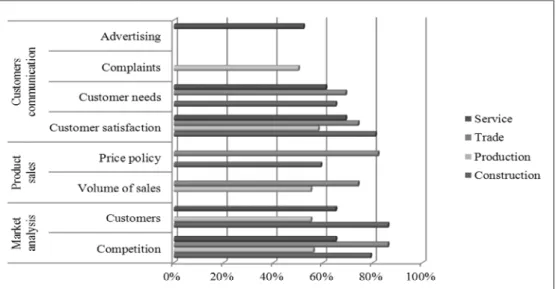
Within this process there were found out three main sub processes; market analysis, product sales, customers communication. Table 1 shows five main indicators (in total were analysed 23 indicators) within mentioned sub processes according to the different business sectors. Most of indicators are monitored continuously, although, within the sub process product sales are the indicators monitored monthly. Enterprises mostly perceive current value of indicators in this process as average to very good. The trend of indicators is increasing except a few cases where the trend is stagnating.
Figure 2. Key indicators of Marketing & Business process monitored within sub processes in surveyed SMEs according to their business sector affiliation
188
As we can see in figure 2, the most important indicators are customer satisfaction (followed by 60% to 80% of enterprises), apart from business sector trade, where is most important indicator competition (followed by 86% of enterprises). These indicators are mostly monitored continuously and enterprises perceived their current value as average.
Production process
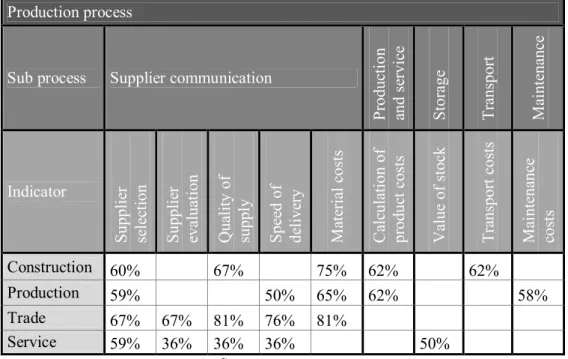
Process of production builds on wide range of sub processes. The most important are shown in table 2; supplier communication, production and service, storage, transport, maintenance. Figure 3 shows that there is one strong sub process and a lot of small ones. There were analysed in total 24 indicators, the key of them are shown in the table 2 and also in the figure 3. Indicators are also most often monitored continuously, apart from the sub process of storage where are indicators monitored usually monthly. Enterprises are satisfied with results of these indicators too. The construction sector predominantly shows increasing trend, overleaf stagnation is apparent within production sector.
It is obvious that the higher importance has the sub process supplier communication. Most important indicator within this sub process is material costs which is most followed indicator for enterprises in construction, production and trade sector. Enterprises involved in services are mostly oriented on indicator supplier selection.
Table 2. Key indicators of Production process monitored within sub processes in surveyed SMEs according to their business sector affiliation (relative frequency) Production process
Sub process Supplier communication
P roduc ti on and se rvi ce S tor age T ra ns por t M ai nt ena nc e Indicator S uppl ie r se le ct ion S uppl ie r eva lua ti on Q ua li ty of suppl y S p ee d of de li ve ry M at er ia l cos ts C al cul at ion of pr oduc t cos ts V al ue of s toc k T ra ns por t cos ts M ai nt ena nc e cos ts Construction 60% 67% 75% 62% 62% Production 59% 50% 65% 62% 58% Trade 67% 67% 81% 76% 81% Service 59% 36% 36% 36% 50%
189 Figure 3. Key indicators of Production process monitored within sub processes in
surveyed SMEs according to their business sector affiliation Source: own creation
Human Resource Management process
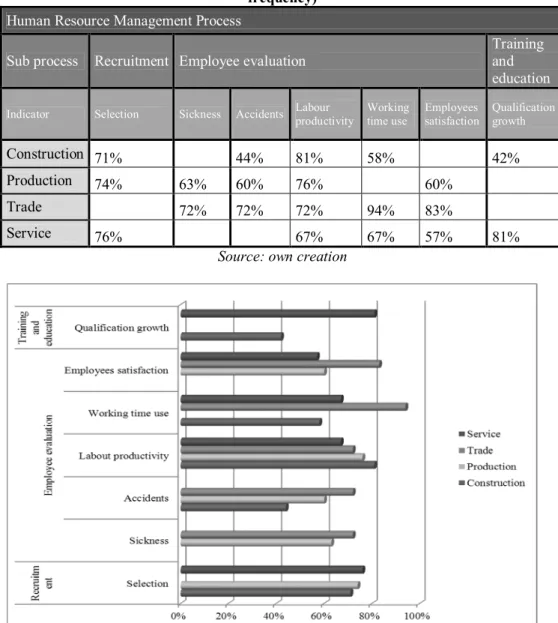
Human Resource Management replaced and extended term Personal process a few decades ago. Currently it represents one of the key parts of process management because it is essential part of the rest of processes. In the table 3 we can see three main sub processes; recruitment, employee evaluation and training and education. Overall there were examined 10 indicators and the most important are also visible in the figure 4.
The most important sub process for all sectors is the process of employee evaluation. One significant exception represents enterprises involved in service for which is very important sub process training and education. Compared with previous processes is more apparent stagnation within indicators in production sector and also in trade sector, on the other hand their current value is overall perceived as good. Enterprises involved in construction and service stated mostly increasing trend in these process.
It is obvious from table 3 that most important indicator is labour production especially within construction where is followed by 81% of enterprises. Its current state is satisfied and trend is increasing. Another important indicator is working time use and employee satisfaction especially in trade oriented enterprises where are followed by more than 90 %. On the other hand it is quite curious that
190
enterprises in this sector are not such interested in recruitment. Enterprises in the service sector are typical by high orientation on training and education in the point of view of the qualification growth.
Table 3. Key indicators of Human Resource Management process monitored within sub processes in surveyed SMEs according to their business sector affiliation (relative
frequency) Human Resource Management Process
Sub process Recruitment Employee evaluation
Training and education
Indicator Selection Sickness Accidents Labour
productivity Working time use Employees satisfaction Qualification growth Construction 71% 44% 81% 58% 42% Production 74% 63% 60% 76% 60% Trade 72% 72% 72% 94% 83% Service 76% 67% 67% 57% 81%
Source: own creation
Figure 4. Key indicators of Human Resource Management process monitored within sub processes in surveyed SMEs according to their business sector affiliation
Source: own creation Financial process
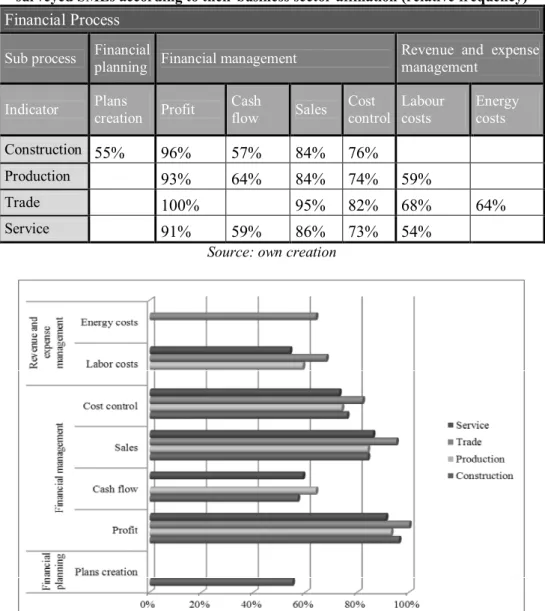
191 The last but for sure not the least is the process of finance. It is quite logical that this process attracts the most attention. Even though there are currently a lot of different path to profit and we have for example mentioned growing importance of human resource management, money are still the centrepiece of all business and therefore it is given more attention to them.
Tab. 4. Key indicators of Financial process monitored within sub processes in surveyed SMEs according to their business sector affiliation (relative frequency) Financial Process
Sub process Financial
planning Financial management
Revenue and expense management Indicator Plans creation Profit Cash flow Sales Cost control Labour costs Energy costs Construction 55% 96% 57% 84% 76% Production 93% 64% 84% 74% 59% Trade 100% 95% 82% 68% 64% Service 91% 59% 86% 73% 54%
Source: own creation
Figure 5. Key indicators of Financial process monitored within sub processes in surveyed SMEs according to their business sector affiliation
192
There were analysed overall six sub processes with 32 indicators, the most important are shown in the table 4 and the comparison is more visible graphically in the figure 5. Compared with previous indicators in this process are monitored most often monthly or weekly. Enterprises stated that current value of indicators in this process is mostly good and the trend is increasing except the enterprises involved in production. Financial planning is typical for construction companies. The factor which is common for all companies is importance of indicators in the sub process financial management especially profit, sales and cost control. These indicators are carefully followed by vast majority of examined enterprises.
Design of process management model for SMEs
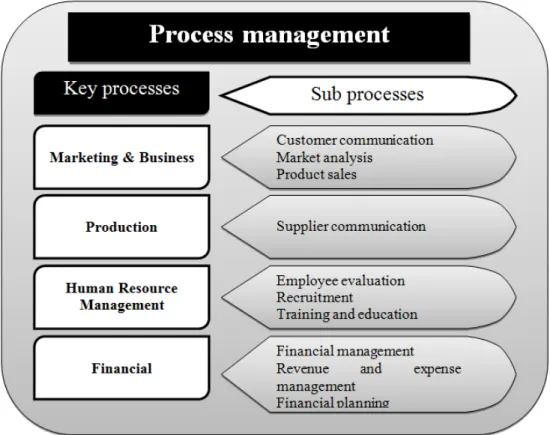
Based on the findings presented in the charter 3 there were designed process management model for SMEs of key processes and sub processes. The model is focused on core processes because of, as was mentioned in the introduction, specific processes are often more individual and it is difficult to present them on the general level.
Figure 6. Design of process management model for SMEs Source: own creation
193 The proposed model of process management (figure 6) contains of four key processes; marketing and business, production, human resource management and financial. Within each process there are a lot of possible sub processes. The model shows the key ones; for the marketing and business process there are sub processes customer communication, market analysis, product sales; for the production process there is sub process supplier communication; for the human resource management process there are sub processes employee evaluation, recruitment, training and education; and for the financial process there are sub processes financial management, revenue and expense management, financial planning. SMEs should be focused on these processes and sub processes in the meaning of specific and detailed description of these problematic within its business, to set appropriate objectives, strategies and most of all to set adequate measurement tools and overall controlling system. Useful indicators and its characteristics were already outlined in the previous chapter 3. Enterprises should be focused on these parts of its process management to use more of its possible advantages and so to create more valuable and sustainable business.
Summary
The aim of this paper was to analytically describe the process management within small and medium sized enterprises in terms of key processes, sub processes, indicators and their characteristics based on the differences between various business sectors in which the enterprises operate. There were find out four main processes; marketing and business, production, human resource management and financial. Within these processes were pointed out key sub processes with most important indicators and theirs characteristics with regards to differences between business sectors of construction, production, trade and service.
In conclusion, it is appropriate to summarize that the most important process is financial followed by production, human resource management and marketing and business. The process of marketing and business is most advanced and exploited in the sector of trade followed by construction, service and production. In the process of production there is the same order, which is quite curious because enterprises involved in production sector have less advanced this process in comparison to enterprises in other sectors. Human resource management process is most advanced and used in the sector of trade followed by construction. Enterprises from trade area has also dominant position in the financial process, where are followed by enterprises operating in production, construction and service.
Process management is overall most advanced within enterprises involved in trade followed by enterprises operate is construction, production and service. It is important to point out that the difference between process management in trade enterprise and enterprise offering services is very significant. This research will continue in more detailed analysis and proposed model. In the end it is high time to repeat that this research was funded under the grant project GAJU 068/2010/S – “Process management and possibilities of its implementation in SMEs”.
194
Reference
[1]. Becker J. et al., Process management: A Guide for the Design of Business Processes. 1. ed.Berlin: Springer. 2003, pp. 337.ISBN 3-540-43499-2
[2]. Bennis W. G., The 21st Century Organization: Reinventing Through Reengineering. 1. ed. San Francisco: Jossey-Bass. 1997, pp. 115. ISBN 978-07-879-0939-0
[3]. Braincourt GmbH. Business process management, 2012, [online] [cit. 2012-06-12]. Available from Internet: http://www.braincourt.com/Business-Process-Management.96.0.html.
[4]. Burlton R. T. Business Process Management: Profiting from process. 1. ed. Pennsylvania: Sams. 2001, pp. 416. ISBN 978-06-723-2063-7
[5]. Carr D. K. and H. J. Johansson 1995. Best practices in reengineering: what works and what doesn't in the reengineering process. 1. ed. New York: McGraw-Hill. 1995, pp. 235. ISBN 978-00-701-1224-7
[6]. Dědina J. and J. Odcházel. Management a moderní organizování firmy. 1. ed. Praha: Grada. 2007, pp. 328. ISBN 978-80-247-2149-1
[7]. Kotlárová R. Statistické údaje MSP, 2011,[online] [cit. 2012-10-14]. Availabe
from Internet:
http://www.sme-union.cz/wp- content/uploads/2011/08/Statistick%C3%A9-%C3%BAdaje-MSP-ke-sta%C5%BEen%C3%AD-za-textem.pdf
[8]. Ministerstvo průmyslu a obchodu /Ministry of industry and trade of the Czech Republic/. 2011. Zpráva o vývoji malého a středního podnikání a jeho podpoře v roce 2011, [online] [cit. 2012-10-14]. Available from Internet: http://www.mpo.cz/dokument105614.html
[9]. Šmída F. Zavádění a rozvoj procesního řízení ve firmě. 1. ed. Praha: Grada. 2007, pp. 293. ISBN 978-80-247-1679-4
[10]. Řepa V. Procesně řízená organizace. 1. ed. Praha: Grada. 2012, pp. 304. ISBN 978-80-247-4128-4
[11]. Smith H. and P. Fingar Business Process Management: The Third Wave. 1. ed. New York: Meghan-Kiffer Press. 2006, pp. 311. ISBN 978-09-296-5234-4 [12]. Truneček J. Management znalostí, 1. ed. Praha: C. H. Beck. 2004, pp.131.
ISBN 80-7179-884-3
[13]. Vodáček J. and O. Vodáčková. Malé a střední podniky: konkurence a aliance v EU. 1. ed. Praha: Management Press.2004, pp 192. ISBN 80-7264-099-6
195 RÓŻNICE W PROCESIE ZARZĄDZANIA MŚP W RÓŻNYCH SEKTORACH
GOSPODARKI
Streszczenie: Gospodarka światowa jest stale napędzana przez zmiany, które wpłynęły również na zarządzanie małymi i średnimi przedsiębiorstwami. Przedsiębiorstwa te stanowią zdecydowaną większość gospodarki na całym świecie, a jednocześnie, są podstawową siłą napędową dla gospodarki Unii Europejskiej. Aktualnym trendem jest koncentrowanie się na planowaniu i monitorowaniu procesu zarządzania tzw. zarządzaniu procesowym. W systematycznym podejściu do danej organizacji jest cel bardziej skutecznego przepływu pracy, bardziej wydajnej i zdolność przedsiębiorstwa do dostosowywania się do zmiennego i niestabilnego otoczenia. Celem artykułu jest analityczne opisanie procesu zarządzania w praktyce małych i średnich przedsiębiorstw w regionie South Bohemia w Czechach, w ramach różnych sektorów biznesu. W badanej próbie przeprowadzono badania ilościowo-jakościowe, finansowane przez dotacje projektów 068/2010/S GAJU. Uzyskane dane poddano analizie statystycznej w sektorach biznesowych. Ponadto, na podstawie wyników zaproponowano pewne rady w celu bardziej efektywnego zarządzania procesami.
中小型企業的流程管理業務各部門機構內部的分歧 摘要:世界經濟是由連續變化的影響也很小,中小型企業管理。這些業務類型的代 表絕大多數世界各地的經濟,同時,歐盟經濟的根本動力。目前的趨勢是集中在所 謂的流程管理規劃和監測的。系統的方法是讓一個組織的工作流程更有效,更高效 ,更能夠適應環境變量和不穩定的。紙張的目的是描述分析的流程管理在實踐中的 中小型企業在該地區的南波希米亞,在捷克共和國內各業務部門。定量定性檢測的 樣本進行研究資助的項目的贈款068/2010/S的小樹林。核心業務領域內所獲得的數據 進行統計分析。此外,結果的基礎上提出了若干建議,為更有效的過程管理。
![Figure 1. Process management basic model Source: [3]](https://thumb-us.123doks.com/thumbv2/123dok_us/617794.2574051/2.892.172.722.496.812/figure-process-management-basic-model-source.webp)