c
°SAIt 2003
Supplementi
High Performance Computing at INAF/OAPA
Fabio Reale
1Dipartimento di Scienze Fisiche & Astronomiche, Universit´a di Palermo, e-mail:
Abstract.The scientific group at INAF/OAPA has a long experience in modeling astrophysical plasmas and in high performance computing (HPC). During 2000, INAF/OAPA has acquired a HPC facility, entirely devoted to extensive numerical modeling, in particular of astrophysical plasmas.
Key words.HPC – Hydrodynamics
1. Introduction: The Experience
1.1. Numerical Modeling
The effort for modeling coronal plasmas by the scientific group at INAF/OAPA has been stimulated by the X and UV solar missions since Skylab in 1973 (Vaiana et al. 1973; Vaiana & Tucker 1974).
Solar X-ray observations have shown that the emitting solar corona mostly con-sists of independent and isolated closed structures, the loops, where plasma at mil-lion degrees is confined by the coronal mag-netic field. Fundamental questions to be an-swered then concern, first of all, the basic physics of the loop: what is the structure of the plasma inside them? why are they sta-ble on time scales longer than their char-acteristic cooling times? what is the dy-namics of the confined plasma? what is the heating source? Another interesting topic concerns, for instance, the investigation of
Send offprint requests to: F. Reale
Correspondence to: F. Reale, c/o
INAF/Osservatorio Astronomico di Palermo, Piazza Parlamento 1, 90134 Palermo
highly transient and intense X-ray events, the coronal flares, occurring mostly inside closed loops.
In order to study coronal structures and phenomena, we start from the considera-tion that plasma confined in coronal loops mostly behaves as a fluid which moves and efficiently transports energy along the mag-netic field lines. In such conditions, it is possible to describe the structure and evo-lution of the confined plasma by means of hydrodynamic models of compressible flu-ids, i.e. the solution of the equations of con-servation of mass, momentum and energy, including the effects of thermal pressure, thermal conduction, which is very efficient in coronal conditions, compressional viscos-ity, solar gravviscos-ity, radiative losses from opti-cally thin plasma, local energy input which heats the plasma to coronal temperatures.
Even describing the system with only one coordinate, the one along the loop mag-netic field lines, such models are often un-feasible for analytical treatment and re-quire a numerical approach to be tackled. The group at INAF/OAPA has therefore
developed a long experience in numerical hydrodynamic modeling. Hydrostatic loop modeling has been applied at first to derive scaling laws extended to loops higher than the pressure scale height and sustained by non-uniform heating (Serio et al. 1981), and then extensively to study the detailed structure of coronal loops and the diagnos-tics connected to solar and stellar X-ray ob-servations (Giampapa et al. 1985; Peres et al. 1994; Maggio & Peres 1996; Di Matteo et al. 1998; Reale & Peres 2000a; Reale 2002; Testa et al. 2002). Steady hydro-dynamic loop models have been applied to study the structure of siphon flows inside coronal loops (Orlando et al. 1995a,b) and the propagation of MHD Alfven waves in the solar wind (Orlando et al. 1996, 1997). Time-dependent hydrodynamic loop mod-els, and in particular the Palermo-Harvard code (Peres et al. 1982; Betta et al. 1997), have been applied to study the stability of coronal loops (Peres et al. 1982), their heating by microflares (Peres et al. 1993; Reale et al. 1994; Betta et al. 1999), their ignition (Reale et al. 2000b,c), the evo-lution of solar coronal flares (Peres et al. 1987; Serio et al. 1991; Jakimiec et al. 1992; Peres & Reale 1993a,b; Reale & Peres 1995; Reale et al. 1997; Betta et al. 2001), the diagnostics of stellar X-ray flares (Reale et al. 1988, 1993; Reale & Micela 1998).
The interest has also extended to study astrophysical systems with non-confined plasmas which cannot be described with 1-D models. The thermal stability of plas-mas in stratified atmospheres (Reale et al. 1991, 1994, 1996) has been stud-ied by means of 2-D time-dependent hy-drodynamic models, based on an im-proved Flux-Corrected-Transport (FCT) technique (Reale et al. 1990a), and on a time-splitted Alternating-Direction Implicit (ADI) numerical scheme to de-scribe thermal conduction (Reale 1995). Preliminary studies have been conducted on the interaction of SNR with the in-terstellar medium (Maggio et al. 1994; Orlando et al. 2002). The same 2-D model
has been applied to study the propagation of Coronal Mass Ejections (Ciaravella et al. 2001) and the evolution of flares trig-gered in a non-confined corona (Reale et al.
2002).
1.2. HPC experience
Many of the problems described above have required extensive numerical resources and high performace computing. A vector ver-sion of the Palermo-Harvard code has been executed on the Cray systems at CINECA (Bologna) (Reale et al. 1988). The group has also acquired pioneeristic experience on the development and optimization of parallel codes on Transputer networks for solving astrophysical problems, both based on PC’s in collaboration with IAIF/CNR (Palermo) (Reale et al. 1990b), and on self-standing Unix-based systems, and in particular a Meiko Computing Surface at INAF/OAPA (Reale 1990; Reale et al. 1992). Parallel codes have then been ported and tested for parallel efficiency on Unix-based general-purpose Local Area Networks (LAN), using Fortran codes and publicly available parallel libraries, such as Parallel Virtual Machine (PVM) (Reale et al. 1994b). A high level library for paral-lelization of Fortran programs tailored for domain-decomposition approach has been developed in-house (Reale et al. 1992). The 2-D FCT/ADI code has been also ported for efficient execution on the Cray T3E by means of the HPF parallel library (Reale & Bocchino 1999).
More recently, INAF/OAPA has had the opportunity to build up a HPC facility, named “Sistema di Calcolo per l’Astrofisica Numerica” (SCAN, Computing System for Numerical Astrophysics), and entirely de-voted to massive numerical computing in Astrophysics.
2. SCAN
2.1. The project and the hardware
selection
SCAN has been built in the framework of a proposal named ”High education in HPC and current Astrophysical problems” approved by Ministero dell’Universit´a e della Ricerca Scientifica e Tecnologica and funded by European Union in 1999.
The project involved essentially two phases:
– High education of young personnel, hired through specific selection proce-dures, and trained through study, ad-vanced research and technical managing activity.
– Hardware set up, including the settle-ment of a HPC system, selected through a competitive inquirement of special-ized firms, its installation and testing, and its production activity on specific numerical problems.
For the hardware selection, we have in-quired four firms, specialized for HPC sys-tems on the required scale-size: IBM, SUN, Compaq and SGI. The firms were asked to propose their best HPC system within a set of constraints and a given budget scale, and to perform a benchmark program on that system.
The constraints were to propose a self-standing and complete system, Unix-based, equipped with standard parallel software (e.g. HPF, MPI), maximized for comput-ing speed and with a RAM≥512 MB per processor.
The benchmark consisted in the execu-tion of the 2-D FCT hydrodynamic code described in section 1.1 on a specific astro-physical problem. The problem is the free propagation of a Coronal Mass Ejection (CME) expelled from the solar surface (Ciaravella et al. 2001). It is described the evolution for 500 s of an isothermal corona (1.5 MK) with an isobaric, dense and circular plasma blob, ejected upwards at 400 km/s from the low layers of the
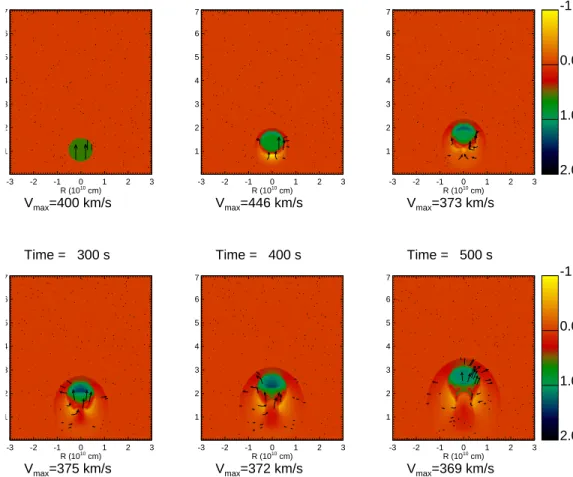
atmosphere and thermally insulated from the surrounding medium. The 2-D hydro-dynamic equations of conservation of mass, momentum and energy are solved on an 800×800 grid, without thermal conduction. The code version is written in F77 and parallelized with HPF (Reale & Bocchino 1999) for a total of ∼ 2.4×10¹¹ float-ing point operations. This benchmark prob-lem is a typical medium-size astrophysical plasma problem. The code parallelization is based on a plain domain-decomposition approach: each processor makes the identi-cal computations on a different slice (with the same size) of the geometrical domain. The FCT technique requires a limited ex-change of values at the boundaries of adja-cent slices (message-passing). For the given grid size, we expect a good scaling of the parallel performances for a medium-grain parallel system, with about ten processors. Fig.1 shows the evolution of the den-sity and of the velocity field throughout the 500 s of computations according to the benchmark problem. The density contrast over the unperturbed medium is shown, in order not to display the plasma gravi-tational stratification. It is clearly visible the upward propagation of the blob, ini-tially close to the lower layers of the at-mosphere. While it propagates, it expands adiabatically and a bow shock develops and propagates ahead of the blob. Over the 500 s time lapse the overall blob velocity has not have enough time to be reduced signif-icantly from the initial value by the gravi-tational braking.
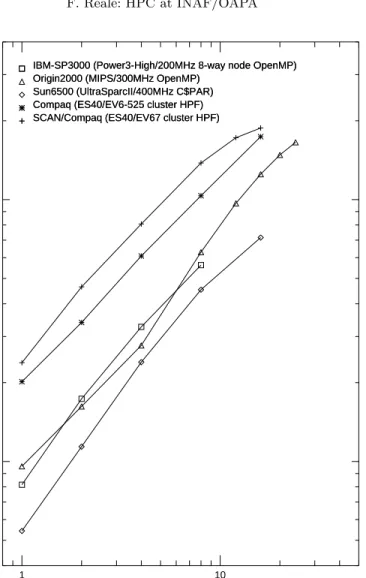
All firms have proposed one or more alternative systems and have accepted to execute the benchmark program, provid-ing results for different configurations and numbers of CPUs. Fig.2 shows the perfor-mances obtained with various systems pro-posed by the firms, in terms of speed in MFlops vs number of processors simulta-neously used.
After a careful evaluation of the bench-mark results and of the other aspects of the proposals of each firm, the administration of OAPA ended up to select the computing
-3 -2 -1 0 1 2 3 R (1010 cm) 1 2 3 4 5 6 7 Z (10 10 cm) Vmax=400 km/s Time = 0 s -3 -2 -1 0 1 2 3 R (1010 cm) 1 2 3 4 5 6 7 Vmax=446 km/s Time = 100 s 2.0 1.0 0.0 -1.0 -3 -2 -1 0 1 2 3 R (1010 cm) 1 2 3 4 5 6 7 Vmax=373 km/s Time = 200 s -3 -2 -1 0 1 2 3 R (1010 cm) 1 2 3 4 5 6 7 Z (10 10 cm) Vmax=375 km/s Time = 300 s -3 -2 -1 0 1 2 3 R (1010 cm) 1 2 3 4 5 6 7 Vmax=372 km/s Time = 400 s 2.0 1.0 0.0 -1.0 -3 -2 -1 0 1 2 3 R (1010 cm) 1 2 3 4 5 6 7 Vmax=369 km/s Time = 500 s
Fig. 1.Evolution of the density contrast (over the unperturbed atmosphere) of a blob of coronal plasma ejected upwards at 400 km/s from the solar surface computed with the 2-D FCT hydrodynamic code. This is the benchmark problem set up for the selection of a computing system tailored for the HPC program at INAF/OAPA. The arrows mark the velocity field, normalized to the maximum speed labelled under each frame.
1 10 Number of processors 100
1000
Speed (Effective MFlops)
SCAN/Compaq (ES40/EV67 cluster HPF) SCAN/Compaq (ES40/EV67 cluster HPF) Compaq (ES40/EV6-525 cluster HPF) Compaq (ES40/EV6-525 cluster HPF) Sun6500 (UltraSparcII/400MHz C$PAR) Sun6500 (UltraSparcII/400MHz C$PAR) Origin2000 (MIPS/300MHz OpenMP) Origin2000 (MIPS/300MHz OpenMP)
IBM-SP3000 (Power3-High/200MHz 8-way node OpenMP) IBM-SP3000 (Power3-High/200MHz 8-way node OpenMP)
Fig. 2. Performances of the benchmark problem obtained with the labelled computing systems for different numbers of processors. Each curve and symbol pertain to a com-puting system. Best performances (upper curve) are obtained with the actually selected Compaq Cluster equipped with EV67 processors.
system proposed by the Compaq firm for equipping SCAN. The system has been ac-quired and installed in Summer 2000, and after an initial period of tuning up and test-ing, it has been running for production con-tinuously.
2.2. Description
The HPC system at SCAN consists of a Unix-based COMPAQ HPC cluster, includ-ing four AlphaServers ES40, each with four EV67 (667 MHz) processors, for a total of 16 processors, interconnected with an effi-cient Memory Channel II device. With the newest versions of the operating system, it is a single-image system, i.e. all servers are
managed together and seen as a single com-puter by the operating system.
The present configuration of SCAN is shown in Fig.3. The HPC system is placed in a thermally and acustically insulated chamber inside a larger room which in-cludes several working places for computing personnel. The room is located in a sepa-rate section of INAF/OAPA including also the XACT (X-ray Astronomy Calibration and Testing) laboratory, distant ∼ 500 m from the main INAF/OAPA building.
The SCAN HPC system has its own LAN with several Linux PCs for direct con-nection to the mainframe. The SCAN LAN is connected to the INAF/OAPA LAN through a dedicated router and an opti-cal bridge realizes the physiopti-cal link between the SCAN/XACT building and the main INAF/OAPA building.
2.3. Scientific applications
The SCAN facility has already produced scientific results worth of publication on specialized journals. An extensive set of hydrodynamic simulations have been exe-cuted on the HPC system of SCAN in the framework of the study of the dynamics and diagnostics of flares occurring in non-confined coronae (Reale et al. 2002). The motivation for this modeling effort stems from the observation of stellar flares which are often much longer and more intense than typical solar flares. In such conditions it is legitimate to wonder whether the as-sumption of plasma confinement typically valid for solar flares still holds for such large scale stellar flares or not. A way to explore this question is to model hypothet-ical flares occurring in a non-confined at-mospheres and to derive characteristic sig-natures of non-confinement vs confinement. Non-confined flares have been modeled as triggered by a heating pulse as already done for confined flares. Is used the time-dependent 2-D FCT/ADI hydrodynamic code described in Sec. 1.1. Computations are done on an inhomogeneous but fixed numerical grid in cylindrical R-Z
coordi-nates. Preliminary simulations have been performed on the CRAY T3E at CINECA, and the bulk of an extensive set of produc-tion simulaproduc-tions on the SCAN HPC system. This set of simulations program aimed at the exploration of the space of the relevant physical parameters, i.e. the position, in-tensity and duration of the heating pulse, and the pressure of the unperturbed atmo-sphere.
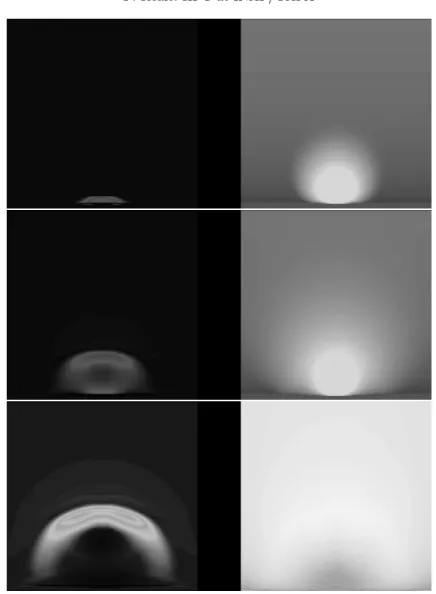
Fig. 4 shows an example of the com-puted evolution of the non-confined plasma subject to an intense heating pulse. At time t=0 the heating is abrutply switched on and a thermal conduction front im-mediately develops propagates isotropically from the heating site (at the center of the bright region in the upper right frame). This front hits against the dense chromo-sphere at the base of the corona, which is suddenly heated and expands upwards, determining the formation of a shell-like evaporation front, well visible in the mid-dle left panel. This hot density front de-termines the X-ray flare. As soon as the heating stops, at t = 50 s, the temperature suddenly drops but the density front still propagates for some time, as shown in the lower panels.
One result of this study is that, after the heating stops, the decay of the X-ray emission invariably occurs on very short time scales, few minutes, much shorter than those of observed stellar flares. This is mostly due to the very fast cooling of the plasma. This is a strong indication that large-size stellar flares still occur in con-fined plasma configurations.
More recently INAF/OAPA has started a collaboration with the ASCI/FLASH center, for extension and application of the advanced FLASH code to coronal plasma problems, as described in detail elsewhere in this issue (Orlando et al. 2002). In this context the group at INAF/OAPA has contributed to extend the FLASH code with modules for computing plasma thermal conduction, radiation from opti-cally thin plasma and the fractionation of ion species in non-equilibrium of
ion-Fig. 3.Actual configuration of the SCAN facility. The HPC system (upper right panel) is disposed in a thermally and acoustically insulated chamber (upper left panel) in turn located in a larger room containing several working places (lower panel).
ization. Preliminary applications of the FLASH code on coronal plasma problems at INAF/SCAN include the simulation of the initial phases of a soft X-ray flare and the interaction of a SNR shock front with a dense perturbation of the interstellar medium both including the effects of non-equilibrium of ionization.
3. Conclusions
OAPA/SCAN is a facility entirely de-voted to massive numerical computing. It is tailored and scaled for computing ef-ficiently plasma 2-D hydrodynamics, but it is a geneal-purpose system and can be safely applied to many other computational modeling projects. Numerical resources of SCAN are available to the INAF commu-nity.
Fig. 4.Three snapshots during the evolution of a flare occurring in a non-confined corona: slices of density (left), temperature (right) at time 10, 50 and 100 s since the beginning of the simulation.
Acknowledgements. Support by Ministero
dell’Istruzione, Universit`a e Ricerca, and by Agenzia Spaziale Italiana is acknowledged.
References
Betta, R. M., Peres, G., Serio, S., Reale, F., 1997, A&AS, 122, 585.
Betta, R., Reale, F., Peres, G., 1999, in Plasma Dynamics and Diagnostics
Betta, R., Peres, G., Reale, F., Serio, S., 2001, A&A, 380, 341. in the Solar Transition Region and Corona, ESA SP 446, 179
Ciaravella, A., Raymond, J.C., Reale, F., Strachan, L., Peres, G., 2001, ApJ, 557, 351.
Di Matteo, V., Reale, F., Peres, G., Golub, L. , 1998, A&A, 342, 563.
Giampapa, M.S., Golub, L., Peres, G., Serio, S., Vaiana, G.S., 1985, ApJ, 289, 203.
Jakimiec, J., Sylwester, B., Sylwester, J., et al. 1992, A&A, 253, 269
Maggio, A., Reale, F., Peres, G., Ciaravella, A., 1994, Comp. Phys. Comm., 81, 105 Maggio, A., Peres G., 1996, A&A, 306, 553. Orlando, S., Peres, G., Serio, S., 1995a,
A&A, 294, 861.
Orlando, S., Peres, G., Serio, S., 1995a, A&A, 300, 549.
Orlando, S., Lou, Y.-Q., Rosner, R., Peres, G., 1996, JGR, 101, 24443.
Orlando, S., Lou, Y.-Q., Rosner, R., Peres, G., 1996, JGR, 102, 24139.
Orlando, S., Peres, G., Reale, F., Rosner, R., Plewa, T., Siegel, A., this issue. Peres, G., Rosner, R., Serio, S., Vaiana, G.
S., 1982, ApJ, 252, 791.
Peres, G., Reale, F., Serio, S., Pallavicini, R., 1987, ApJ, 312, 895.
Peres G., Reale F., Serio S., 1993, in Physics of Solar and Coronae, J.L. Linsky, S. Serio (eds.), Kluwer Academic Pub., 151.
Peres, G., Reale, F., 1993, A&A, 566, 267. Peres, G., Reale, F., 1993, A&AL, 275, L13. Peres G., Reale F., Golub L. , 1994, ApJ
422, 412
Reale, F., Peres, G., Serio, S., Rosner, R., Schmitt, J.H.M.M., 1988, ApJ, 328, 256. Reale, F., Peres, G., Serio, S., 1990, Nuovo
Cimento B 105, 1235.
Reale, F., Brug`e, F., Peres, G., Fornili, S.L., Martorana, V., Serio, S., 1990b, Comp. Phys. Comm., 201, 60.
Reale, F., 1990, Parallel Computing, 16, 361.
Reale, F., Rosner, R., Malagoli, A., Peres, G., Serio, S., 1991, MNRAS, 251, 379. Reale, F., Barbera, M., Sciortino, S., 1992,
Comp. Phys. Comm. 72, 129
Reale, F., Serio, S., Peres, G., 1993, A&A, 272, 486.
Reale, F., Bocchino, F., Sciortino, S., 1994, Comp. Phys. Comm. 83, 130.
Reale, F., Serio, S., Peres, G., 1994, ApJ, 433, 811
Reale, F., 1995, Comp. Phys. Comm., 86, 13.
Reale, F., Peres, G., 1995, A&A, 299, 225. Reale, F., Peres, G., Serio, S., 1996, A&A,
316, 215
Reale, F., Micela, G., 1998, A&A, 334, 1028.
Reale, F., Betta, R., Peres, G., Serio, S., McTiernan, J., 1997, A&A, 325, 782 Reale, F., Bocchino, F., 1999, Proc. Fifth
European SGI/Cray MPP Workshop, BOLOGNA (Italy) - September 9-10, 1999, http://www.cineca.it/mpp-workshop/proceedings.htm
Reale, F., Peres, G., 2000, ApJL, 527, L45. Reale, F., 2002, ApJ, 580, 566.
Reale, F., Bocchino, F., Peres, G., 2002, A&A, 383, 952.
Reale, F., Peres, G., Serio, S., DeLuca, E.E., Golub, L., 2000, ApJ, 535, 412. Reale, F., Peres, G., Serio, S., Betta, R.,
DeLuca, E.E., Golub, L., 2000, ApJ, 535, 423.
Serio, S., Peres, G., Vaiana, G.S., Golub, L., Rosner, R., 1981, ApJ 243, 288. Serio, S., Reale, F., Jakimiec, J., Sylwester,
B., Sylwester, J., 1991, A&A, 241, 197. Testa, P., Peres, G., Reale, F., Orlando, S.,
2002, ApJ, 580, 1159.
Vaiana, G.S., Davis, J. M., Giacconi, R., Krieger, A.S., Silk, J.K., Timothy, A.F., Zombeck, M., 1973, ApJL, 185, L47 Vaiana, G.S., Tucker, W., 1974, in X-ray
Astronomy, eds. R. Giacconi, and H. Gursky, Dordrecht:Reidel