Health Professions Education 2 (2016) 130–137
Preparing foundation-year students for medical studies
in a problem-based learning environment: Students' perceptions
Xiangyun Du
a,b, Walid Massoud
c, Nadia Ali Al-Banna
d,
Ayad M. Al-Moslih
d, Marwan Farouk Abu-Hijleh
d, Hossam Hamdy
d, Farhan
Sachal Cyprian
d,na
College of Education, Qatar University, Doha, Qatar
b
Department of Learning and Philosophy, Aalborg University, Aalborg, Denmark
c
Qatar University Testing Center, Qatar University, Doha, Qatar
d
College of Medicine, Qatar University, Office 140, Doha 2713, Qatar
Received 23 June 2016; accepted 24 June 2016 Available online 28 June 2016
Abstract
Purpose: To contribute to thefield of preparing new students for their medical studies and to investigate how foundation-year medical students perceive the progression of appropriate learning skills for studying in a PBL medical curriculum via the support of a course aiming at facilitating students with these skills.
Methods: A 10-point scale online questionnaire consisting of 20 questions was used for data collection. 50 out of the 59 (19 males and 31 females) students responded and self-evaluated a list of learning skills according to the course objectives before and after the course. Cronbach's alpha was used to test for internal consistency and reliability of the collected data and Principal Component Exploratory Factor Analysis was performed. Pairedt-test was used to examine differences between pre- and post-analysis data. Results: The internal consistency of the questionnaire was sufficient. Factor analysis identified four factors: 1) Ability to search for, share, and present information, 2) Ability to develop learning tools and express opinions, 3) Ability to use diverse learning sources, and 4) Ability to participate in discussion and reflect. Overall improvement between pre- and post-test was high (2.38). Pairedt-tests showed significant improvements (po.001) for each of the 4 factors. The four factors together explained 60.7% percent of variance in the data.
Discussion: Students reported large improvements among learning skills required in a problem-based medical curriculum, and suggests that students in a premedical foundation year can benefit from a course aiming at preparing students for their future learning in a PBL environment. A shortcoming was considered the retrospective nature of the pretest, possibly biasing the results of the comparisons.
&2016 King Saud bin AbdulAziz University for Health Sciences. Production and Hosting by Elsevier B.V. This is an open access article under the CC BY-NC-ND license (http://creativecommons.org/licenses/by-nc-nd/4.0/).
Keywords:Foundation-year medical students; Learning skills; PBL; Students' perceptions
1. Introduction
Problem-based learning (PBL) pedagogy has been employed as an educational strategy and method in a growing number of medical universities worldwide www.elsevier.com/locate/hpe
http://dx.doi.org/10.1016/j.hpe.2016.06.001
2452-3011/&2016 King Saud bin AbdulAziz University for Health Sciences. Production and Hosting by Elsevier B.V. This is an open access article under the CC BY-NC-ND license (http://creativecommons.org/licenses/by-nc-nd/4.0/).
nCorresponding author.
since the late 1960s. The rationale behind implement-ing PBL includes not only its promotion of efficient knowledge acquisition, self-directed learning, partici-pation, critical thinking, self-reflection, and evaluation, but also many other skills and competencies that are necessary for success in the health professions. A rich body of literature1–9has documented the effectiveness and benefits of the PBL approach.
Nevertheless, the implementation of a PBL environ-ment cannot be taken for granted, it demands resources for physical facilities, faculty and students.10 To study in a PBL environment presupposes that students have not only a good understanding of the rationale of a constructivist approach to learning, but also the appro-priate learning strategies, attitudes, and skills that are relevant to PBL activities. In particular, certain things should be taken into consideration when introducing PBL to students who have less experience with a constructivist approach to learning and who have no prior experiences with PBL (for example, those who come directly from high schools where the study environment is mainly lecture-based). Firstly, students' conceptions of learning are influenced by their educa-tional experiences (learning environment, instruceduca-tional methods, etc.)11,12 which accordingly impacts their learning strategies and study approaches.13 Previous studies documented that second-year university stu-dents reported a higher level of understanding and acceptance of a constructivist approach to learning than first-year students, and students from a PBL curriculum reported a higher level of understanding and acceptance than students from a conventional lecture-based curri-culum.14 Secondly, constructivist learning environ-ments such as PBL are more demanding for learners than conventional lecture-based learning environments, in terms of interpersonal skills and the need to self-regulate knowledge construction.15 Students' levels of certain skills – for example, self-regulation – define their approaches to learning from problems16,17 there-fore, scaffolding and self-directed learning is consid-ered especially important for less mature learners at the beginning of their study in a PBL environment.5
It can, therefore be assumed that students can be better prepared for their future study in a PBL environment by experiencing the beneficial effects of PBL-related activities such as cooperative learning, self-regulation, and working on authentic problems as part of their learning process. In order to help students prepare for their medical study in PBL, certain aspects of the PBL model can be tailored to the developmental level of the learners, and indicators of self-directed learning – skills (such as planning one's own learning, developing and applying learning strategies, and
using learning resources appropriately)5can be developed through educational activities aiming to prepare students for PBL. Literature on preparing new students for their medical studies in PBL remains sparse. To our knowledge, one of the few studies reported was based on an educational activity using the team-based learning (TBL) method in Sharjah University.18Abdelkhalek and colleagues conducted a study to understand how students perceive a Medical Education Course in terms of providing them with the knowledge and skills required for their further study in a PBL environment.17 The study reported highly positive student experiences via a TBL method in preparation for PBL.
At Qatar University, PBL is employed as the major pedagogical approach in the newly established College of Medicine. In order to prepare students for their future studies in a PBL environment, an introductory course of Medical Education was developed based on inspiration from the work by Abdelkhalek and colleagues18 and provided during the fall semester of the 2015–2016 academic year. The course aims to support students in developing self-directed learning, personal development and learning how to learn in a PBL environment via experiential learning. Multiple pedagogical approaches were used in the design and delivery process of the course with taking the students' diverse cultural and educational backgrounds into consideration. The course aimed to provide students with opportunities to develop learning skills regarding how to do a literature search and develop confidence in giving an effective presentation; how to give and receive constructive feedback; how to develop an concept maps, reflection and educational portfolio. Choice of these emphases was based on overall program objectives as well as inspiration from literature. Concept mapping is well-used in undergraduate medical curricula as a tool not only to develop meta-cognitive strategies and reasoning skills19 but also to improve critical thinking19and meaningful learning.20In particular, it is considered a mutually complimentary tool within the PBL environment because the method of information gathering, hypothesis generation, and identification of learning issues allow for exposure to a broad range of knowledge needs.20Constructive feedback is an essential component of the student learning process in general and in particular, in clinical practice.21Portfolios are regarded to be very powerful tools to enhance and assess student reflective learning in medical studies.22,23
This study aims to gain better understanding of how the students experience the transition period of medical studies, and develop ideas of how to improve the future activities for preparing new students in medical education programs. Formulated research question is how do
students perceive the progression of their expected learn-ing skills through the support of the Medical Education Course? Empirical data for the study mainly come from an online questionnaire that allows students to self-evaluate their ability before and after the course. Inviting students to join this study is also an attempt to provide students with opportunities to reflect on one's own learning processes through the course and the first stage of their medical study.
2. Methods
2.1. Context
The medical program at QU is a 6-year competency-based, integrated, problem-based and community-based curriculum. Thefirst year study, which is addressed as foundation year in this paper, is primarily aimed to strengthen students' knowledge in basic science sub-jects such as human structure and function, chemistry, biochemistry, biostatistics in addition to English lan-guage. From year two tofive, students study in a PBL medical curriculum.
The program is divided into three phases: Phase I (Pre-medical ‘transitional’ – one year); Phase II (Pre-clerkship ‘integrated organ system units’ – 2½ years); and Phase III (Clerkship ‘Healthcare workplace-based training’ –2½ years).
Phase I (Year 1) is the interface between high school education and the student-centered integrated medical program. It introduces the students to foundations in human basic structure and function, medical education and life-long learning (the subject of current study), medical biochemistry, and basic biostatistics, in addi-tion to Core University and elective courses. Thesefirst year courses prepare students to the next Problem-Based Learning (PBL) body system units in Phase II.
The Medical Education Course has the following objectives:
Identify outcome competencies of health profes-sionals’education programs (“Medicine, Pharmacy, and Health Sciences”) and their roles and impact on healthcare practice in the 21st century. Recognize the importance of inter-professional learning and practice in modern healthcare systems. Modify the learning style of the students from superficial, rote learning to deep learning and critical thinking. Work and learn in small groups and recognize the educational value of TBL and PBL, and apply it within the learning context of health and wellness. Pursue his/her education in the next phase of studyequipped with important “study skills” and meta-cognition, e.g., Concept Maps, Reflective Portfolios, study plans, etc.
Recognize the spectrum of health and wellness concepts and the role of health professionals in maintaining and promoting health.The course included a variety of methods: lectures, group discussions, project work, and PBL sessions. Four faculty members were involved in course delivery.
The course had the following three phases:
1. Preparatory phase. The initial 8 weeks were used for introducing and preparing students for PBL-based medical curriculum, and to help them understand the importance of adopting PBL approach of learning. This was achieved through several mini workshops (2 h each) with the following main course themes: adult learning principles; information search/assimilation, concept mapping; presen-tation/microteaching skills; reflective and constructive feedback; self and peer evaluation; and portfolio develop-ment. Finally, small group learning in PBL environments was the main course theme.
Phase two:“Application of PBL”.
This phase extended over 6 weeks. All students were introduced to two health related problems: (a) ethics and professionalism and (b) obesity in adulthood. Each problem was studied over two sessions, one at the beginning of the week, and one at the end. Session one included both in- and out-of-class activities. In the class, each team read the problem and discussed possible explanations of the different cues, and identified learning objectives in a team. In each team, with 8–9 students, the tutorial session was led by one student“peer tutor”.10The “peer tutor” was responsible for facilitating “intra-group discussion”by asking questions, ensuring group progress, supervising time management and encouraging all team members to participate in the discussion. Problem analysis and identification of learning needs took, on average, about 45 min. During this period, the faculty tutor/ instructor observed group dynamics, guided the discussion and checked their progress. Students were responsible for developing the team's “learning needs/objectives”, and dividing the workload amongst team members. During the out-of-class activities, they were responsible individually and collectively for preparing for session two, by retriev-ing and assimilatretriev-ing information relevant to the team's identified“learning objectives,”and individually prepared
a concept map. The team met at least once in between the two sessions to review their progress, compare and exchange information, and review answers to the raised questions.
Afterwards, there was an inter-group “Application Activity”, where individual PBL teams discussed their PBL problems with other teams. Representatives gave presentations from each team. The presenters responded to questions and comments from students from other teams. This allowed students to “teach and learn” and have “inter-group discussion”activities, ending with a feedback session for both students and facilitators.
Phase three: “Students' assessment and course evaluation”.
It was important to design an assessment system matching the course objectives. Different formative and summative assessments were used; triple jump tests and individual student portfolios were used to assess their problem-solving skills and critical thinking. A mid-term and a final written examination, which included multiple-choice questions (MCQs) and short
answer questions (SAQs), assessed their knowledge related to health and wellness.
2.2. Participants
Fifty-nine high school graduates (40 female and 19 male students) were enrolled in the fall semester starting in September, of the 2015–2016 academic year. Among them 27 are Qataris and 32 are from 13 other countries. They just graduated from high schools, which were mostly based on lecture-based teaching methods. Students were admitted to the College of Medicine, based primarily on their academic achievements and English language profi -ciency. During the Medical Education Course, the 59 students were divided into two classes (29 and 30 students respectively). In each class, students were randomly divided into teams of 5–6 students.
2.3. Questionnaire
Design of the questionnaire was in line with the course objectives and activities, which focused on important Table 1
Explanatory factor analysis and correlations for the instrument.
Question Factor loadings itca ifcb
1 2 3 4 5
1 I am able to search and access information from scholarly sources (e.g. PubMed). .55 .61 .53 14 I feel comfortable making a presentation in public (e.g. in class). .82 .50 .67 16 I share the information I have searched for with other team members. .54 .66 .55
20 I feel comfortable making a presentation in a team. .85 .46 .68
8 I understand the educational value of a“concept map”. .82 .47 .58
9 I am able to develop a“concept map”. .75 .64 .77
17 I am able to orally express my opinions on certain topics effectively. .52 .70 .51 2 I am able to identify multiple sources for information related to my study. .50 .66 .58
10 I understand main learning principles. .67 .46 .54
11 Teaching my peers improves my learning. .56 .49 .54
18 I am able to express my opinions effectively in written form. .81 .47 .48 3 I am able to synthesize and summarize the information I have searched for in order to complete
the assignments.
.46 .73 .60
6 I am able to develop personal reflections. .67 .46 .62
7 I am able to develop academic reflections. .58 .72 .69
15 I actively participate in discussions in a team or class. .73 .38 .46
19 I am an independent learner. .70 .31 .43
12 I am able to positively receive peers’feedbacks. .90c .36 –
13 I am able to give constructive feedback to peers. .61c .64 –
4 A portfolio is a good way to document my academic progress. – – .18 –
5 I am able to develop an educational portfolio. – – .10 –
Eigen values 3.10 2.80 2.57 2.46 1.87
% of variance 17.20 15.54 14.29 13.68 1.39
Cronbach's Alpha .89
aCorrected Item-Total Correlation. bCorrected Item-Factor Correlation.
learning skills for students in order to maximize the benefits from PBL at the beginner level.
The online survey consisted of 20 questions in both pretest and posttest. The questions intended to have student self-reflect on changes in learning process at the end of the course, Student IDs were used to align responses to candidates’ demographic data, followed by coding before the analysis. Items were scored on a 10-point scale ranging from “totally disagree” (1) to “totally agree”(10).
A link to the questionnaire was sent to all the 59 students via emails at the end of the semester (end of December). Fifty out of the 59 (19 males and 31 females) students responded.
2.4. Data analysis
For both the pretest and the posttest, items were analyzed using the corrected item-total correlation between each item and the total score of the questionnaire. Items were omitted if corrected item total correlation was low (ro.30). Reliability of the data was assessed by calculating the questionnaire's internal consistency (Cronbach's alpha α). Construct validity was assessed by employing Principal Component Exploratory Factor Analysis (EFA) to explore whether, underlying the individual items there were latent factors that would indicate deeper characteristics that these items might have in common. The factor analysis was conducted using varimax rotation. A factor was included in thefinal report if its Eigen value was one or above one and omitted if it has less than two indicators (e.g., items). Mean scores were computed for both pretest and posttest as a whole and for each factor separately. Paired t-tests were used to explore the differences between the pretest and posttest mean scores. The SPSS (Statistical Package for Social Sciences) version 22 was used to perform the different statistical analyses.
3. Results
3.1. Reliability and construct validity of the questionnaire
We report here only the results of the analysis of the posttest, which served as the criterion for our comparison. The results of the pretest were however largely similar. Table 1 displays the main results. Analysis of the questionnaire revealed a low corrected item-total correlation for items 4 and 5 (learning from receiving peer feedbacks and giving constructive feedback to peers:r¼.18,r¼.10 respectively) and were therefore omitted from analysis. Cronbach's alpha for the rest of the questionnaire was high: .89. The EFA showed 5 significant factors. Factor 5 was deleted as it had less than 2 indicators. The total percent variance for rest of the factors was 60.7%, which indicates that the 4 factors are explaining 60.7% of variance found in the data. These 4 factors were termed as: 1) Ability to search for, share, and present information, 2) Ability to develop learning tools and express opinions, 3) Ability to use diverse learning sources, and 4) Ability to participate in discussion and reflect.
The items showed middle to high factors loadings (.46 to .73) on the 4 factors. The corrected item-total correla-tions were performed for the 16 items and for each factor item to examine the internal consistency of the final questionnaire and they were found to be high (.31 to .73) on the scale level and (.43 to .77) on the factor level.
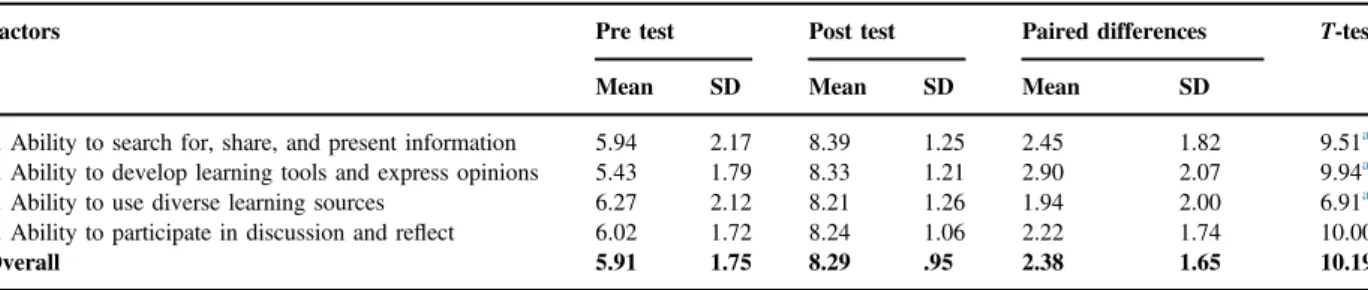
The mean difference between pre- and posttest overall and on the 4 factors ranged from 1.94 to 2.90. See Table 2. Paired t-tests showed significant differences (po.001) on the 4 factors and overall in favor of the post test. Overall improvement was relatively high (2.38). The highest improvement among the factors was found for the develop-learning-tools-and-express-opinions factor. The smallest improvement was found for the use-diverse-learning-sources factor. Table 2
Comparisons between pre and post tests (n¼50).
Factors Pre test Post test Paired differences T-test
Mean SD Mean SD Mean SD
1. Ability to search for, share, and present information 5.94 2.17 8.39 1.25 2.45 1.82 9.51a
2. Ability to develop learning tools and express opinions 5.43 1.79 8.33 1.21 2.90 2.07 9.94a
3. Ability to use diverse learning sources 6.27 2.12 8.21 1.26 1.94 2.00 6.91a
4. Ability to participate in discussion and reflect 6.02 1.72 8.24 1.06 2.22 1.74 10.00a
Overall 5.91 1.75 8.29 .95 2.38 1.65 10.19a
a
4. Discussion
This paper reportsfindings from thefirst semester of a study that aimed to report on medical students' experiences in the foundation year. A Medical Education Course was provided to help students develop a set of learning skills that are required in their later studies in a PBL curriculum. A questionnaire consisting of 20 questions was developed to invite students to report their level of mastery of these learning skills before and after the course.
First, the questionnaire developed in this study was found to be a reliable and valid tool as far as construct validity is concerned. The four factors identified by the factor analysis explained a large percentage of the variation in the data. Findings also demonstrate students' improve-ment on the set of learning skills according to the course objectives. They suggest a positive impact of the course on students' learning skills development, as seen from students' perspective. Among the four factors, items of utilizing learning tools (for example a concept map) and expressing one's opinions were identified as the areas of highest improvement. The factor identifying diverse learning sources showed the least improvement. These results are in line with the study by Abdelkhalek and colleagues18with regards to students' improvements during the foundation year with the help of the course. The results are also in line with the expectations of the course facilitators in that a big amount of efforts were made to help students improve these skills, in particular, in the aspects of practicing the utilizing learning tools and expressing their opinions. This suggests that students joining a PBL medical curriculum can benefit from facilitation activities such as the Medical Education Course that aimed at help students improve learning skills and prepare for further medical study.
Second, factor loadings identified particularly sig-nificant improvements for a few individual items. Improvements in using concept mapping can be seen as a positive sign of students' preparation for their studies in a PBL curriculum. The significant improve-ment may also be attributed to the use of this tool during the course of human structure and function, which students were taken at the same period of time. Making presentations was regarded by the course delivery faculty team as one of the essential abilities for university study and therefore special efforts were made to encourage students to practice this skill. The results as reported by the students are in line with the efforts made by the staff. Expressing one's opinion is also regarded as an important skill in a teamwork setting. However, despite the faculty efforts to support improvement in this area, student self-report only showed significant improvement in expressing opinions
in written form. Expressing opinions orally seemed to be difficult even after the training, indicating that this skill requires more time to be sufficiently developed. In addition, the improvement of expressing one's opinions in written form may also be attributed to written assignments in other courses that were taken in the same period such as a course on human structure and function.
Third, the standard deviations found reduced stu-dents' variation from the pre to the post-test, indicating that a bigger variation of students' self-reported skills in the pre-test than in the post-test. This again can be interpreted as a positive sign that the course helped students develop skills towards the common objectives. Alternatively, it may indicate a ceiling effect, since student judgments on the posttest were all quite high.
Fourth, thefifth factor, consisting of items 12 and 13 about receiving and giving feedback, although deleted due to limited items, represents an important aspect of the learning skills – learning from receiving peer feedback and giving constructive feedback to peers. In particular positively receiving peer's feedback was reported as most significantly improved in this study. Again, it is reasonable to consider that this skill is one that requires longer time for sufficient development. Helping students to learn to receive feedback positively and to give constructive feedback were regarded as important goals by the faculty team during the course, in that these skills would not only benefit students growth and motivation21,24 but also enhance self-reflection and peer learning in a group setting.25 Results in this study showing significant improvement of students' receiving and giving feedbacks can be associated with the use of the PBL method, since it is often used as a strategy to enhance peer feedback skills and at the same time to improve interpersonal and communication skills.26,27
In addition to aspects of peer feedback, the items on portfolio use (item 4 and 5) are also worth discussing. This method was also introduced to students during this course as a tool for reflection as well as an assessment method. However, previous studies reported that build-ing a portfolio is a demandbuild-ing and time-consumbuild-ing exercise,28 so that students tend to show initially negative attitudes and reservations29due to uncertainty feelings,22 frustration,30 and threat.31 Nevertheless, all these studies reported positive improvements of stu-dents' perceptions of portfolios over time. In this study, although the two items in relation to portfolios were deleted due to low correlations with the rest of the questionnaire, this can indicate that it may be
challenging for the foundation-year students to reach a deep understanding of the value of portfolios within the first semester. Based on the above-mentioned literature, we suggest that more support from faculty is needed to help students better understand and utilize portfolios as a learning tool.
4.1. Study limitations and further perspectives Although this study appears to document improve-ments in a number of learning skills among foundation-year students, it has a number of weaknesses that limit the generalizability of the results. First, administering the pretest retrospectively is of course a rather unique approach to measuring initial levels of skill mastery. The reason that we employed the pretest retrospectively is, that it is unlikely that beginning students are already conversant with concepts such as peer feedback, concept maps, or PubMed, and therefore cannot be expected to adequately respond to a questionnaire referring to such ideas. However, by administering the pretest after the training while requiring the students to assess their level of skill before the training, we have taken the risk that students artificially enlarged differences between their level of mastery before the course and afterwards. Perhaps short introductions to the concepts of interest before the course starts may provide a solution in a subsequent study. Further, we acknowledge the limitations associated with self-report questionnaires. This paper is only based on student self-evaluation of their learning skills, and the results can best be interpreted in conjunction with evidence from studies using direct observation, such as clinical examinations and faculty perceptions. In addition, the sample size in this study might also limit the general-izability of the results; however, we are limited to the number of students that are enrolled in the MD program of the newly established College of Medicine. Evaluation of the timing of introducing such a course at a later stage in accordance with candidates' maturity and assessing the impact of application of the learning from this course can be interesting.
In summary, the current study demonstrates students' self-reported improvements in a set of learning skills required in a PBL medical curriculum. We therefore conclude, with some reservations, that students in a premedical foundation year can benefit from a Medical Education Course aiming at preparing students for their future learning in a PBL environment. It is however essential to investigate long-term effects of such train-ing employtrain-ing multiple sources of information in future studies.
Ethical approval
The Ethics Committee of the College of Medicine, Qatar University, approved this medical education research.
Funding
None.
Other disclosures
There are no conflicts of interests.
References
1. Albanese MA, Mitchell S. Problem-based learning–a review of literature on its outcomes and implementation issues.Acad Med
1993;68(1):52–81.
2. Norman GR, Schmidt HG. The psychological basis of problem-based learning–a review of the evidence.Acad Med1992;67(9): 557–565.
3. Vernon DTA, Blake RL. Does problem-based learning work–a meta-analysis of evaluative research. Acad Med 1993;68(7): 550–563.
4. Norman GR, Schmidt HG. Effectiveness of problem-based learning curricula: theory, practice and paper darts.Med Educ
2000;34(9):721–728.
5. Hmelo-Silver CE. Problem-based learning: what and how do students learn?Educ Psychol Rev2004;16(3):235–266. 6. Hmelo-Silver CE, Chernobilsky E, Jordan R. Understanding
collaborative learning processes in new learning environments.
Instr Sci2008;36(5–6):409–430.
7. Schmidt HG, van der Molen HT, Winkel WWRT, Wijnen WHFW. Constructivist, problem-based learning does work: a meta-Analysis of curricular comparisons involving a single medical school.Educ Psychol2009;44(4):227–249.
8. Schmidt HG, Muijtjens AMM, Van der Vleuten CPM, Norman GR. Differential student attrition and differential exposure mask effects of problem-based learning in curriculum comparison studies.Acad Med2012;87(4):463–475.
9. Strobel J, van Barneveld A. When is PBL more effective? A meta-synthesis of meta-analysis comparing PBL to conventional classrooms.J Probl-Based Learn2009;3(1):44–58.
10. Maudsley G, Williams EMI, Taylor DCM. Problem-based learning at the receiving end: a 'mixed methods' study of junior medical students' perspectives.Adv Health Sci Educ2008;13(4): 435–451.
11. Tynjala P. Developing education students' conceptions of the learning process in different learning environments.Learn Instr
1997;7(3):277–292.
12. Hofer BK, Pintrich PR. The development of epistemological theories: beliefs about knowledge and knowing and their relation to learning.Rev Educ Res1997;67(1):88–140.
13. Entwistle NJ, Peterson ER. Conceptions of learning and knowl-edge in higher education: relationships with study behaviour and influences of learning environments. International. J Educ Res
14. Loyens SMM, Rikers RMJP, Schmidt HG. Students' conceptions of constructivist learning: a comparison between a traditional and a problem-based learning curriculum. Adv Health Sci Educ
2006;11(4):365–379.
15. Mamede S, Schmidt HG, Norman GR. Innovations in problem-based learning: what can we learn from recent studies? Adv Health Sci Educ2006;11(4):403–422.
16. Ertmer PA, Newby TJ, MacDougall M. Students' responses and approaches to case-based instruction: the role of reflective self-regulation.Am Educ Res J1996;33(3):719–752.
17. Evensen DH, Salisbury-Glennon JD, Glenn J. A qualitative study of six medical students in a problem-based curriculum: toward a situated model of self-regulation.J Educ Psychol2001;93(4):659–676. 18. Abdelkhalek N, Hussein A, Gibbs T, Hamdy H. Using
team-based learning to prepare medical students for future problem-based learning.Med Teacher2010;32(2):123–129.
19. Torre DM, Daley B, Stark-Schweitzer T, Siddartha S, Petkova J, Ziebert M. A qualitative evaluation of medical student learning with concept maps.Med Teacher2007;29(9–10):949–955. 20. Rendas AB, Fonseca M, Pinto PR. Toward meaningful learning
in undergraduate medical education using concept maps in a PBL pathophysiology course.Adv Physiol Educ2006;30(1):23–29. 21. Clynes MP, Raftery SEC. Feedback: an essential element of student
learning in clinical practice.Nurse Educ Pract2008;8(6):405–411. 22. Davis MH, Ponnamperuma GG, Ker JS. Student perceptions of a
portfolio assessment process.Med Educ2009;43(1):89–98. 23. Lonka K, Slotte V, Halttunen, M, et al. Portfolios as a learning
tool in obstetrics and gynaecology undergraduate training.Med Educ2001;35(12):1125–1130.
24. Harrison CJ, Konings KD, Molyneux A, Schuwirth LWT, Wass V, van der Vleuten CPM. Web-based feedback after summative assess-ment: how do students engage?Med Educ2013;47(7):734–744. 25. Fereday J, Muir-Cochrane E. The role of performance feedback
in the self-assessment of competence: a research study with nursing clinicians.Collegian2006;13(1):10–15.
26. Aspegren K. BEME guide no. 2: teaching and learning commu-nication skills in medicine–a review with quality grading of articles.Med Teacher1999;21(6):563–570.
27. Parmelee DX, DeStephen D, Borges NJ. Medical students' attitudes about team-based learning in a pre-clinical curriculum.
Med Educ Online2009;14. 1-1.
28. Stanton F, Grant J. Approaches to experiential learning, course delivery and validation in medicine. A background document.
Med Educ1999;33(4):282–297.
29. Elango S, Jutti RC, Lee LK. Portfolio as a learning tool: students' perspective.Ann Acad Med Singap2005;34(8):511–514.
30. Robinson MA.College Students' Attitudes Toward Portfolio Assess-ment as an Alternative to Traditional Tests. Tforum Paper, 2000. 31. Mathers NJ, Challis MC, Howe AC, Field NJ. Portfolios in
continuing medical education–effective and efficient?Med Educ
1999;33(7):521–530.
Xiangyun Duis a visiting professor at the College of Education, Qatar University, Doha, Qatar and a professor in the Department of Learning and Philosophy, Aalborg University, Aalborg, Denmark.
Walid Massoudis the head of Qatar University Testing Center, Qatar University, Doha, Qatar.
Nadia Ali Al-Banna is an assistant professor at the College of Medicine, Qatar University, Doha, Qatar.
Farhan Sachal Cyprianis an assistant professor at the College of Medicine, Qatar University, Doha, Qatar.
Ayad M. Al-Moslih, Lecturer of medical education and clinical skills at the College of Medicine, Qatar University, Doha, Qatar.
Marwan Farouk Abu-Hijleh is a professor and head of the Department of Basic Medical Sciences at the College of Medicine, Qatar University, Doha, Qatar.
Hossam Hamdyis a professor and the Associate Dean at the College of Medicine, Qatar University, Doha, Qatar.