R E S E A R C H A R T I C L E
Development and validation of an instrument to measure nurse
educator perceived confidence in clinical teaching
Van N.B. Nguyen, BN, MN, PhD
1|
Helen Forbes, RN, PhD
1|
Mohammadreza Mohebbi, PhD
2|
Maxine Duke, BAppS, M.Ed., PhD
11
School of Nursing and Midwifery, Deakin University, Geelong, Victoria, Australia 2
Biostatistics Unit, Deakin University, Geelong, Victoria, Australia
Correspondence
Van N.B. Nguyen, School of Nursing and Midwifery, Deakin University, 221 Burwood Highway, Burwood, VIC 3125, Australia. Email: [email protected];
Abstract
Teaching nursing in clinical environments is considered complex and multi‐faceted. Little is known about the role of the clinical nurse educator, specifically the challenges related to transi-tion from clinician, or in some cases, from newly‐graduated nurse to that of clinical nurse educa-tor, as occurs in developing countries. Confidence in the clinical educator role has been associated with successful transition and the development of role competence. There is currently no valid and reliable instrument to measure clinical nurse educator confidence. This study was conducted to develop and psychometrically test an instrument to measure perceived confidence among clinical nurse educators. A multi‐phase, multi‐setting survey design was used. A total of 468 surveys were distributed, and 363 were returned. Data were analyzed using exploratory and confirmatory factor analyses. The instrument was successfully tested and modified in phase 1, and factorial validity was subsequently confirmed in phase 2. There was strong evidence of internal consistency, reliability, content, and convergent validity of the Clinical Nurse Educator Skill Acquisition Assessment instrument. The resulting instrument is applicable in similar contexts due to its rigorous development and validation process.
K E Y W O R D S
clinical teaching, Clinical Nurse Educator Skill Acquisition Assessment, instrument development, nursing education, perceived confidence, Vietnam
1
|I N T R O D U C T I O N
Clinical education is central to nursing education. The goal of clinical education is to provide nursing students with opportunities to inte-grate theoretical knowledge into planning and implementation of patient care in the clinical setting. This means the opportunities for students to develop therapeutic communication skills, ethical decision making and the ability to socialize to the workplace environment and function as a healthcare team member (Davidson & Rourke, 2012; Halcomb, Peters, & McInnes, 2012). Clinical teaching can be stressful due to the dynamic and complex nature of the clinical nursing context (Gaberson & Oermann, 2010). Clinical nurse educators (CNE), there-fore, need to be prepared and supported to effectively facilitate student learning (Gaberson & Oermann, 2010). Despite this, it has
been reported that CNE often do not receive adequate preparation and support (Cangelosi, Crocker, & Sorrell, 2009; Cantwell, 2014; Heydari, Hosseini, & Moonaghi, 2015; Suplee, Gardner, & Jerome‐ D'Emilia, 2014). Empirical evidence indicates that insufficient prepara-tion can negatively affect preparedness for the clinical teaching role, confidence development in clinical teaching, and the quality of clinical teaching experience (Anibas, Brenner, & Zorn, 2009; Heydari et al., 2015; Manning & Neville, 2009).
Clinicians recruited to the role of CNE have been found to experi-ence difficulties, stress, and anxiety as they transition to their new role (Cangelosi et al., 2009; Manning & Neville, 2009). Although clinical expertise is considered important for CNE, that expert knowledge and skill might not always translate into clinical teaching expertise (Mann, 2013). Competence as a clinical educator has been inextricably
-This is an open access article under the terms of the Creative Commons Attribution‐NonCommercial‐NoDerivs License, which permits use and distribution in any
medium, provided the original work is properly cited, the use is non‐commercial and no modifications or adaptations are made.
© 2017 The Authors. Nursing & Health Sciences published by John Wiley & Sons Australia, Ltd. DOI: 10.1111/nhs.12373
linked to role confidence (Bentley & Pegram, 2003), and both are considered integral to effective clinical teaching (Heshmati‐Nabavi & Vanaki, 2010; Hou, Zhu, & Zheng, 2011). However, the development of competence and confidence in clinical teaching has not been explored. Likewise, activities that have been shown to influence confidence, such as recruitment strategies and preparation for the role, have not been investigated in developing countries. There is a general lack of literature investigating factors that hinder or facilitate educational skill acquisition, and this could affect role preparation of CNE. Most studies exploring issues related to clinical nursing education have been conducted in Western countries. There is a lack of knowledge related to CNE development of confidence and competence in clinical teaching in developing countries, particularly Vietnam where this study was conducted.
Nurse educators in Vietnam are, for the most part, either experi-enced nurses, or more commonly, recruited immediately following graduation from a 4 year bachelor degree (Sagar, 2000). Although Sagar's (2000) work was published 17 years ago, there has been little change to nurse educator recruitment models in Vietnam. In Western countries, clinical experience as a nurse is considered essential to the CNE role (McSharry, McGloin, Frizzell, & Winters‐O'Donnell, 2010; Miller, 2012). However, there is no published literature that describes the success or otherwise of recruitment models in some developing countries that rely on newly‐qualified nurses in the CNE role.
Currently, there is no existing instrument to measure perceived role confidence in teaching in clinical settings. In North America, Ramsburg and Childress (2012) developed the Nurse Education Skill Acquisition Assessment (NESAA) tool to measure the confidence of nurse educators in the classroom setting. This instrument was concep-tualized based on the Dreyfus Model of Skill Acquisition framework, incorporating 40 items and eight domains, in accordance with eight competency domains for nurse educators, described by the National League for Nursing (2005). The NESAA is reported to have high statis-tical reliability; however, the instrument is yet to be validated. There-fore, this study was conducted to adapt the NESAA for use in clinical settings and to psychometrically test the new instrument to measure perceived role confidence of CNE in clinical teaching.
2
|M E T H O D S
2.1
|Design
A multi‐setting survey design was used. A two phase structured approach was adopted to develop and validate the Clinical Nurse Educator Skill Acquisition Assessment (CNESAA) instrument guided by the model of Hair, Black, Babin, and Anderson (2010). Phase 1 included item identification, piloting, reliability, and validity establish-ment, including scale modification. Phase 2 aimed to confirm the factorial model of the instrument developed in phase 1 using a separate sample.
2.2
|Participants
Nurse educators in Vietnam who were employed by an institution and were engaged in teaching bachelor (4 year) and/or collegiate (3 year)
nursing students in hospital settings were recruited for this study. Only CNE teaching fundamental, medical, and/or surgical nursing were chosen. CNE teaching in clinical psychiatric, emergency, or end‐of‐life care were excluded to ensure homogeneity.
2.3
|Ethics approval
Ethics approval was granted by Deakin University Human Ethics Advisory Group Health (DU HEAG‐H 103_2014; Deakin University, Geelong, Vic., Australia). Permission to conduct research was also obtained from managers at the participating institutions in Vietnam.
2.4
|The instrument
The CNESAA instrument was adapted from the NESAA instrument with consent from the authors. Two items were omitted from the original 40 items of the NESAA instrument, as they were irrelevant to the clinical setting. The remaining 38 items were adapted to focus on educational activities of CNE. Five Likert‐point scale options were used: 1=low confidence, 2 = moderately low confidence, 3 = moderate confidence, 4 = moderately high confidence, and 5 = high confidence. The eight subscales in the original NESAA instrument were unchanged: (i) facilitate learning; (ii) facilitate learner development and socializa-tion; (iii) use assessment and evaluasocializa-tion; (iv) participate in curriculum design and program evaluation; (v) function as a change agent and leader; (vi) pursue continuous quality improvement of clinical teaching; (vii) engage in scholarship; and (viii) function within the educational environment. The main processes embedded in the two study phases are denoted in Figure 1.
2.5
|Face validity
The modified tool, CNESAA version 1, was translated into Vietnamese and back‐translated into English by two bilingual experts in nursing education to ensure the clarity of the language used. Both Vietnamese and English versions were reviewed by a panel of experts (excluding the research team). The panel included two Australian and two Vietnamese experts with 8–20 years of experience in nursing education and practice. The experts reviewed the instrument using four criteria: relevance, clarity, sufficiency, and appropriateness of every item individually and in relation to its subscale, and finally the item fit to the overall scale. Changes were made to the items based on the recommendations of the panel members. Face validity was established for the CNESAA version 2.
2.6
|Data collection
Data were collected using Web‐based and paper‐based cross‐ sectional surveys. The survey included demographic questions and the CNESAA instrument. In phase 1, the 38‐item CNESAA (version 2) was piloted with 138 Vietnamese CNEs between June and August 2014. In phase 2, the modified 24 item CNESAA instrument (version 4) was distributed to 330 CNEs between November 2014 and January 2015.
3
|R E S U L T S
3.1
|Phase 1
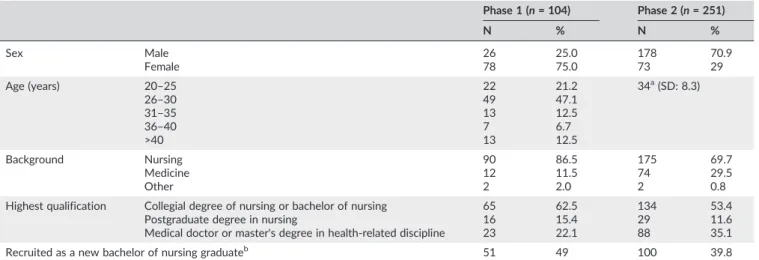
Five institutions from the three main geographic areas of Vietnam (north, center, and south) participated in phase 1. A total of 109 returned surveys accounted for a response rate of 78%. After data screening, cleaning, and removal of unengaged responses, 104 valid survey responses were retained. Participant demographic information is summarized in Table 1.
3.1.1
|Exploratory factor analysis
The six stage approach of Hair et al. (2010) was strictly adhered to during the exploratory factor analysis (EFA) process. An additional stage was included to modify and improve the CNESAA instrument.
Stage 1: Objectives of the factor analysis
The objectives of the EFA were to identify the dimensions underlying the dataset, to reduce the instrument's length, and to guide the instru-ment purification, if necessary, to establish construct validity.
Stage 2: Designing the factor analysis
The EFA was designed and conducted with the 38 item CNESAA instru-ment in the sample of 104 participants. Due to the nature of the Likert scale, the data are not perfectly normal, and thus, as recommended by Costello and Osborne (2005), the extraction method of principal axis factoring with Promax rotation was selected for the analysis.
Stage 3: Testing assumptions of the factor analysis
Bartlett's test of sphericity was significant (P< 0.05), demonstrating that the dataset was appropriate for the EFA. The measure of sampling FIGURE 1 Processes used to develop and validate the instrument. CNESAA, Clinical Nurse Educator Skill Acquisition Assessment; NESAA, Nurse Educator Skill Acquisition Assessment
adequacy value was 0.91 for the overall dataset, and ranged from 0.81 to 0.96 for each of the 38 items. These results indicate significant cor-relation among the variables and an appropriate sample to continue the analysis.
Stage 4: Deriving factors and assessing overall fit
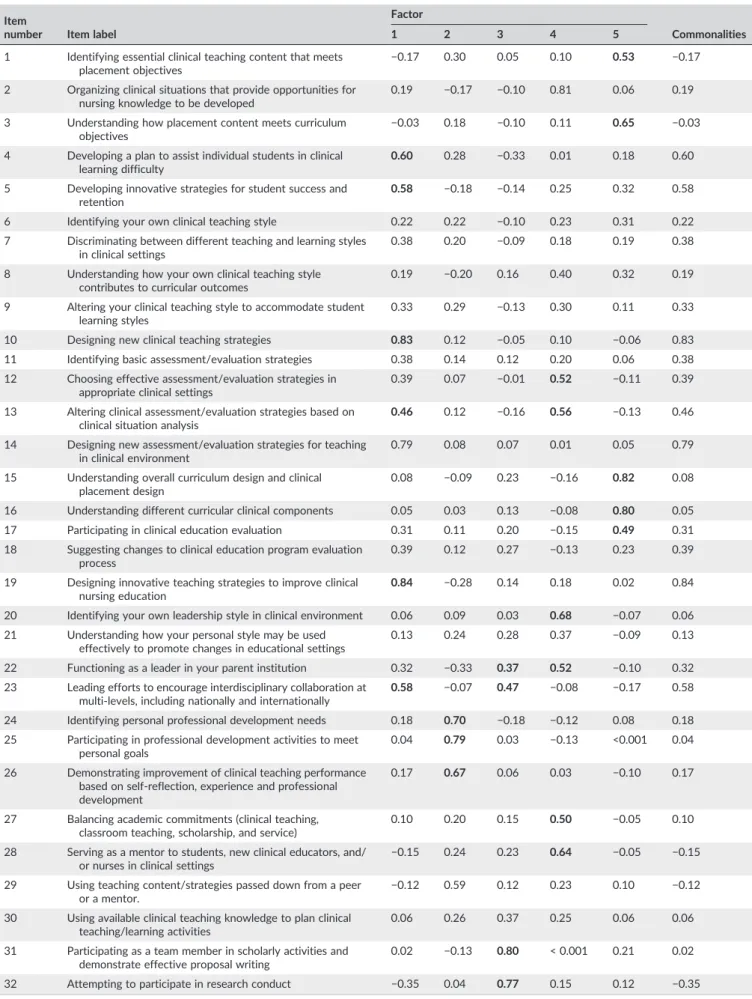
Principal axis factoring with Promax rotation was computed. Thelatent root(Eigenvalue >1),percentage of variance, andscree plotwere used as guidelines to select the optimum number of factors. The scree plot curve cuts off at five factors before starting the straight line (Figure 2). Five factors explained 68% of the variance in the dataset, manifesting the optimum model of five factors for the dataset. Of the 38 items, there were only 22 significant items loaded on five fac-tors (Table 2), demonstrating the need for modification to improve model fitness.
Stage 5: Interpreting factors and respecifying factorial model
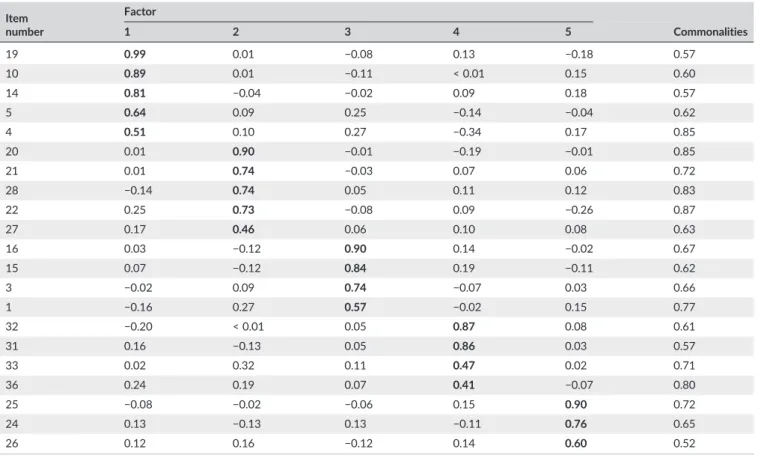
Items with low loadings (≤0.40) and cross‐loadings were removed one at a time. As a result of model respecification, a pattern matrix of 21 items grouped under five factors was extracted (Table 3).
Establishing construct validity
All loadings >0.50 represent a practical model, with high item–factor correlation to be considered a proper model for further use. The corre-lations between the five extracted factors were between 0.40 and 0.70 (Table 4), demonstrating the correlation, and at the same time, the difference of each factor in measuring each subscale of the CNESAA instrument. That is, convergent and discriminant validity of the 21 item model was established.
Factor labelling
Consideration of the statistical evidence and content relevance was taken into account in the factor labelling. The item with the highest loading from every factor became the guiding item in labelling the factor, which later formed a subscale of the CNESAA instrument. Items were reordered to assist the sensible flow of meaning. Three additional items with small factor loadings reflected important and relevant meanings in relation to the activities of CNE in clinical settings, and were therefore added into the scale. The CNESAA version 3 thus comprised 24 items.
Stage 6: Validation of the factor analysis
The stability of the factor structure was assessed to validate the factor analysis through an internal replication technique. Every step previ-ously completed was replicated in two separate subsets of the data (n1 = 69,n2 = 74) that were randomly split from the original pilot sample (n= 104). Seventy six percent (16 items) of the factor structure from sub‐dataset 1 (n1 = 69) and 85% (18 items) of sub‐dataset 2 (n2 = 74) resembled the pattern matrix extracted from the phase 1 sample (n = 104) (Table 3). Moreover, the three items that were additionally added in the labelling process (CNESAA version 3) also existed in the pattern matrix of the two sub‐datasets. Through these resemblances, the factor analysis was validated.
Cronbach's alpha was calculated to examine the internal consistency of the CNESAA instrument. Prior to the analysis, alpha coefficients varied from 0.83 to 0.90 for the eight subscales in the CNESAA version 1. After respecification, Cronbach alpha values TABLE 1 Demographic characteristics of the participants
Phase 1 (n= 104) Phase 2 (n= 251) N % N % Sex Male 26 25.0 178 70.9 Female 78 75.0 73 29 Age (years) 20–25 22 21.2 34a(SD: 8.3) 26–30 49 47.1 31–35 13 12.5 36–40 7 6.7 >40 13 12.5 Background Nursing 90 86.5 175 69.7 Medicine 12 11.5 74 29.5 Other 2 2.0 2 0.8
Highest qualification Collegial degree of nursing or bachelor of nursing 65 62.5 134 53.4
Postgraduate degree in nursing 16 15.4 29 11.6
Medical doctor or master's degree in health‐related discipline 23 22.1 88 35.1
Recruited as a new bachelor of nursing graduateb 51 49 100 39.8
a
Mean age.
bNo previous practice or teaching experience. Discrepancies in the total numbers displayed under higher qualifications and background reflect the number of nurse educators with background in nursing or medicine who also had postgraduate qualifications in other health‐related sciences. SD, standard deviation.
TABLE 2 Factor loadings for the exploratory factor analysis with Promax rotation of the Clinical Nurse Educator Skill Acquisition Assessment instrument (38 items)
Item
number Item label
Factor
Commonalities
1 2 3 4 5
1 Identifying essential clinical teaching content that meets placement objectives
−0.17 0.30 0.05 0.10 0.53 −0.17
2 Organizing clinical situations that provide opportunities for nursing knowledge to be developed
0.19 −0.17 −0.10 0.81 0.06 0.19
3 Understanding how placement content meets curriculum objectives
−0.03 0.18 −0.10 0.11 0.65 −0.03
4 Developing a plan to assist individual students in clinical learning difficulty
0.60 0.28 −0.33 0.01 0.18 0.60
5 Developing innovative strategies for student success and retention
0.58 −0.18 −0.14 0.25 0.32 0.58
6 Identifying your own clinical teaching style 0.22 0.22 −0.10 0.23 0.31 0.22
7 Discriminating between different teaching and learning styles in clinical settings
0.38 0.20 −0.09 0.18 0.19 0.38
8 Understanding how your own clinical teaching style contributes to curricular outcomes
0.19 −0.20 0.16 0.40 0.32 0.19
9 Altering your clinical teaching style to accommodate student learning styles
0.33 0.29 −0.13 0.30 0.11 0.33
10 Designing new clinical teaching strategies 0.83 0.12 −0.05 0.10 −0.06 0.83
11 Identifying basic assessment/evaluation strategies 0.38 0.14 0.12 0.20 0.06 0.38
12 Choosing effective assessment/evaluation strategies in appropriate clinical settings
0.39 0.07 −0.01 0.52 −0.11 0.39
13 Altering clinical assessment/evaluation strategies based on clinical situation analysis
0.46 0.12 −0.16 0.56 −0.13 0.46
14 Designing new assessment/evaluation strategies for teaching in clinical environment
0.79 0.08 0.07 0.01 0.05 0.79
15 Understanding overall curriculum design and clinical placement design
0.08 −0.09 0.23 −0.16 0.82 0.08
16 Understanding different curricular clinical components 0.05 0.03 0.13 −0.08 0.80 0.05
17 Participating in clinical education evaluation 0.31 0.11 0.20 −0.15 0.49 0.31
18 Suggesting changes to clinical education program evaluation process
0.39 0.12 0.27 −0.13 0.23 0.39
19 Designing innovative teaching strategies to improve clinical nursing education
0.84 −0.28 0.14 0.18 0.02 0.84
20 Identifying your own leadership style in clinical environment 0.06 0.09 0.03 0.68 −0.07 0.06 21 Understanding how your personal style may be used
effectively to promote changes in educational settings
0.13 0.24 0.28 0.37 −0.09 0.13
22 Functioning as a leader in your parent institution 0.32 −0.33 0.37 0.52 −0.10 0.32
23 Leading efforts to encourage interdisciplinary collaboration at multi‐levels, including nationally and internationally
0.58 −0.07 0.47 −0.08 −0.17 0.58
24 Identifying personal professional development needs 0.18 0.70 −0.18 −0.12 0.08 0.18
25 Participating in professional development activities to meet personal goals
0.04 0.79 0.03 −0.13 <0.001 0.04
26 Demonstrating improvement of clinical teaching performance based on self‐reflection, experience and professional development
0.17 0.67 0.06 0.03 −0.10 0.17
27 Balancing academic commitments (clinical teaching, classroom teaching, scholarship, and service)
0.10 0.20 0.15 0.50 −0.05 0.10
28 Serving as a mentor to students, new clinical educators, and/ or nurses in clinical settings
−0.15 0.24 0.23 0.64 −0.05 −0.15
29 Using teaching content/strategies passed down from a peer or a mentor.
−0.12 0.59 0.12 0.23 0.10 −0.12
30 Using available clinical teaching knowledge to plan clinical teaching/learning activities
0.06 0.26 0.37 0.25 0.06 0.06
31 Participating as a team member in scholarly activities and demonstrate effective proposal writing
0.02 −0.13 0.80 < 0.001 0.21 0.02
32 Attempting to participate in research conduct −0.35 0.04 0.77 0.15 0.12 −0.35
remained high: 0.83–0.92 for the five subscales and 0.95 for the over-all scale of the CNESAA version 3 (Table 5). All the item‐to‐total corre-lations exceeded 0.50. Inter‐item correlations were >0.30. According to Hair et al. (2010), these values are meritorious, demonstrating high reliability and consistency of the CNESAA instrument.
Stage 7: Scale modification for further use
Further modifications were made to enhance the quality of the CNESAA instrument. First, with the five answer options of the CNESAA version 1 (1 = low confidence, 2 = moderately low TABLE 2 (Continued)
Item
number Item label
Factor
Commonalities
1 2 3 4 5
33 Disseminating information to enhance clinical teaching skills
in nursing education −
0.01 0.21 0.57 0.11 0.06 −0.01
34 Determining your own professional goals −0.23 0.80 0.02 0.05 0.12 −0.23
35 Identifying social, economic, political, and institutional forces that influence higher education
0.06 0.51 0.39 −0.10 0.03 0.06
36 Developing networks, collaborations, and partnerships to enhance nursing's influence within academia and clinical settings
0.33 0.04 0.63 −0.14 0.03 0.33
37 Building organizational climate using respect, collegiality, professionalism, and caring
−0.03 0.57 0.08 0.19 0.05 −0.03
38 Advocating for nursing in the political arena 0.39 0.45 0.31 −0.17 −0.25 0.39
Note: Factor loadings >0.40 are in bold. Extraction method: principal axis factoring; rotation method: Promax with Kaiser normalization.
TABLE 4 Factor correlation matrix
Factor 1 2 3 4 5 1 1.00 0.45 0.57 0.64 0.56 2 0.45 1.00 0.48 0.57 0.45 3 0.57 0.48 1.00 0.59 0.57 4 0.64 0.57 0.59 1.00 0.64 5 0.56 0.45 0.57 0.64 1.00
Note: Extraction method: principal axis factoring; rotation method: Promax with Kaiser normalization.
TABLE 3 Factor loadings for the exploratory factor analysis with Promax rotation of the Clinical Nurse Educator Skill Acquisition Assessment instrument (21 items). Item number Factor Commonalities 1 2 3 4 5 19 0.99 0.01 −0.08 0.13 −0.18 0.57 10 0.89 0.01 −0.11 < 0.01 0.15 0.60 14 0.81 −0.04 −0.02 0.09 0.18 0.57 5 0.64 0.09 0.25 −0.14 −0.04 0.62 4 0.51 0.10 0.27 −0.34 0.17 0.85 20 0.01 0.90 −0.01 −0.19 −0.01 0.85 21 0.01 0.74 −0.03 0.07 0.06 0.72 28 −0.14 0.74 0.05 0.11 0.12 0.83 22 0.25 0.73 −0.08 0.09 −0.26 0.87 27 0.17 0.46 0.06 0.10 0.08 0.63 16 0.03 −0.12 0.90 0.14 −0.02 0.67 15 0.07 −0.12 0.84 0.19 −0.11 0.62 3 −0.02 0.09 0.74 −0.07 0.03 0.66 1 −0.16 0.27 0.57 −0.02 0.15 0.77 32 −0.20 < 0.01 0.05 0.87 0.08 0.61 31 0.16 −0.13 0.05 0.86 0.03 0.57 33 0.02 0.32 0.11 0.47 0.02 0.71 36 0.24 0.19 0.07 0.41 −0.07 0.80 25 −0.08 −0.02 −0.06 0.15 0.90 0.72 24 0.13 −0.13 0.13 −0.11 0.76 0.65 26 0.12 0.16 −0.12 0.14 0.60 0.52
TABLE 5 Reliabilit y o f the third version of the Clin ical Nurse Edu cator Skill Acqu isition A ssessm ent instrum ent (24 items) Item no. a Subscale a Corrected item ‐ total correlation Cronbach ' s alpha 1. Enhancing student learning b 0.92 19 Designing new teaching strategies to improve clinical nursing education 0.83 10 Designing learning opportunities to facilitate student socialization to clinical settings 0.87 5 (revised) Selecting appropriate teaching strategies to facilitate effective student learning 0.73 4 (revised) Developing a plan to assist students who have clinical learning difficulties 0.67 12 c Selecting assessment strategies that are effective and appropriate to different clinical situations 0.68 14 Using assessment and evaluation data to enhance the clinical teaching – learning process 0.87 2. Relating theory and practice 0.88 16 Understanding the links between different clinical placements within the course curriculum 0.82 15 Understanding overall curriculum design and clinical placement design 0.76 3 Understanding how placement content meets curriculum objectives 0.71 1 Identifying essential clinical teaching content that meets placement objectives 0.65 3. Engaging in scholarship 0.88 30 c Using evidence and clinical knowledge to plan clinical teaching – learning activities 0.69 31 (revised) Participating in scholarly activities as a team member 0.81 32 (revised) Designing and implementing research in the area of expertise 0.70 33 Disseminating information to enhance clinical teaching skills in nursing education 0.75 36 (revised) Collaborating to influence development of nursing within academic and clinical settings 0.65 4. Functioning as a leader 0.88 20 Identifying your own leadership style in clinical environments as a clinical nurse educator 0.69 28 Serving as a mentor to students, new clinical educators, and/or nurses in clinical settings 0.76 27 Balancing academic commitments (clinical teaching, classroom teaching, scholarship, and service) 0.71 37 c Building a climate of respect, collegiality, professionalism, courage, and caring within your institution and clinical settings 0.64 21 (revised) Promoting change in clinical nursing education 0.75 5. Participating in professional development 0.83 25 Participating in professional development activities to meet personal goals 0.76 24 Identifying personal professional development needs 0.68 26 Demonstrating improvement of clinical teaching performance based on self ‐ reflection, experience, and professional development 0.64 Total scale 0.95 Note: aSubscales (factors) and the items within subscales were reordered to facilitate the flow of meaning. bSubscale includes another newly ‐ added item: Providing timely and constructive feedback to students in clinical settings. cLow ‐ loading items re ‐ added.
confidence, 3 = moderate confidence, 4 = moderately high confidence, and 5 = high confidence), the responses concentrated into categories 3 (27.7%) and 4 (43.3%). The frequency of answers condensed into these two categories, suggesting that the spreading of the categories would help to further explore CNE perceived confidence in clinical teaching. An additional step was undertaken to obtain general feedback about the surveys from the managers of institutions and participants. The feedback was positive; however, confusion between label interpreta-tion and the wording of several items was reported. Consultainterpreta-tion with experts in biostatistics, psychometrics, and nursing education was sub-sequently sought. Consub-sequently, the format of the scale was shifted from a five point Likert scale to a 10 point numerical scale, labelled at two ends (0 = not confident at all and 9 = extremely confident). All 24 items were further revised, and minor rewording took place, resulting in the CNESAA version 4.
The CNESAA version 4 was translated and back‐translated by a bilingual nurse educator. Both Vietnamese and English versions were reviewed again for relevance, clarity, sufficiency, and appropriateness. As the CNESAA version 4 was confirmed by the expert panel, content validity was established.
3.2
|Phase 2
Of the 330 surveys distributed to CNE at 12 institutions, 254 were returned. Three unengaged surveys were omitted using the criterion of standard deviation <0.30. Minor missing data (<10%) relating to age, years of experience, and background were assessed case by case and replaced by the total mean score where appropriate. Data normal-ity of all items in part B was confirmed using histograms, normal probability plots, and Shapiro–Wilks and Kolmogorov–Smirnov tests. The demographic information of the 251 participants is presented in Table 1.
3.2.1
|Confirmatory factor analysis
The validation process continued by using confirmatory factor analysis (CFA) on a separate sample. The four step guideline of Hair et al. (2010) was used to guide the analysis and interpretation of the CFA results.
Stage 1: Defining individual constructs
The hypothesis to be tested was as follows: The factorial model of the CNESAA version 4 with 24 items and five constructs was fit in relation to the new sample collected in phase 2.
Stage 2: Developing the overall measurement model
The overall measurement model is specified in Figure 3.
Stage 3: Producing empirical results
The CFA was conducted in AMOS v.22.0 on the sample of 251. The model was specified with 58 free parameters that included 24 factor loadings, 10 factor covariances, and 24 error terms. The number of dis-tinct variance and covariance terms was 300 ([24 × 25]/2 = 300). The model was over‐identified, as the number of degrees of freedom (d.f.) (300–58 = 242) is greater than the number of parameter estimates (58). Model fitness was evaluated using the following as a guideline
(Hair et al., 2010; Hu & Bentler, 1999; Schreiber, Nora, Stage, Barlow, & King, 2006):χ2/d.f.: 0
‐3;P> 0.05 (P‐value can be significant even in case of perfect fit); comparative fit index (CFI): >0.90 (traditionally acceptable) and >0.95 (perfect fit); goodness of fit index (GFI): >0.95; adjusted goodness of fit index (AGFI): >0.80; and root mean square error of approximation (RMSEA): <0.05 (good) and 0.05–0.1 (moderate).
Stage 4: Assessing measurement model validity
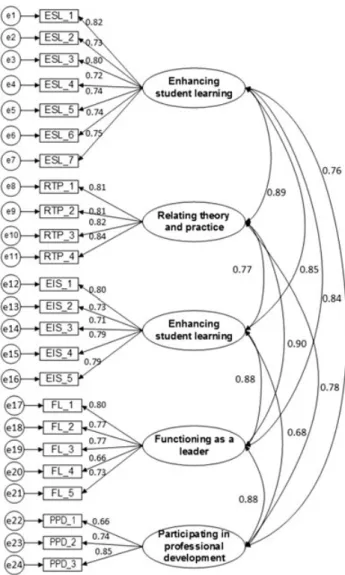
All the standard loadings were satisfactory. Of the 24 loadings, 23 were >0.70 and one was <0.70 (item 4 under the subscale“Functioning as a leader”[FL_4], loading = 0.66). A summary of the model fitness is reported in Figure 4, withχ2= 709.68, d.f. = 242, andP< 0.001. It was noted that the P‐value can be significant, even in the case of perfect fit (Hair et al., 2010; Lattin, Carroll, & Green, 2003). The index
χ2/d.f. was less than 3 and the RMSEA was in the range of a moderate fit. However, the other indices (GFI, AGFI, and CFI) were under the threshold of 0.90 for a good fit.
To improve the model fitness, co‐variances were added between variables within the same subscales while the model structure was FIGURE 3 Overall measurement model. EIS, engaging in scholarship; ESL, enhancing student learning; FL, functioning as a leader; PPD, participating in professional development; RTP, relating theory and practice
retained. CFA with additionally‐added co‐variances were repeated and examined until a trade‐off of model parsimony principal and acceptable level of model fit indices were exhibited withχ2/d.f. = 2.41, CFI = 0.92, GFI = 0.84, AGFI = 0.80, RMSEA = 0.07, and PCLOSE <0.001. Stan-dardized loadings of all items were relatively high, fluctuating from 0.66 to 0.85 (Figure 4). The standardized residuals from co‐variances were examined with no violation from model assumptions. Average variance extraction (AVE) for all five domains was 0.55–0.67. Con-struct reliabilities for all domains were high (0.80–0.90) (Table 6). In short, although the GFI value did not meet the standard criteria, the use of multiple indices found theχ2/d.f. and CFI to be at satisfactory levels, and so the fitness of the estimated model was considered acceptable.
Assessing construct validity
Standardized factor loadings, AVE, construct reliability (CR), maximum shared variance (MSV), and average shared squared variance (ASV)
used to establish construct validity for the estimated model. Stan-dardized factor loadings of all the items were substantially greater than 0.50, with most of the loadings >0.70. AVE and CR values for five domains were high (Table 6), demonstrating reliability and con-vergent validity of the model. Discriminant validity, however, was low, as AVE values were less than those for MSV and ASV (Table 6).
Although the model had an acceptable rather than a perfect fit, respecification of the model was not conducted to achieve a higher level of fitness. There were three reasons for this decision. First, the primary aim of the CFA was to test the appropriateness of the hypothesized model, not to seek a perfect model fit. Second, the CFA was conducted based on the results of a rigorous EFA and a strong theoretical foundation. According to Hair et al. (2010), modifications based merely on empirical CFA outputs should be avoided. Third, close examination of the standardized residual covari-ance matrix for the final model did not suggest any additional modification. In taking Kline's (2005) and Hair et al.'s (2010) recom-mendations into consideration, the model was further evaluated for its theoretical integrity in relation to the relevance, clarity, suffi-ciency, and appropriateness of every item and subscale to the overall model. This evaluation indicated that no further modification was required.
As the result of the CFA, the structure of the hypothesized model of the 24 item CNESAA instrument was confirmed. The reliability and convergent validity of the instrument were also reconfirmed, with high values for the CR (0.80–0.90), high standard loadings of all items on their factors (0.66–0.80), and AVE values >0.50 (0.55–0.67). That is, the whole process of factor analysis was confirmed, and the CNESAA instrument was fully validated.
4
|D I S C U S S I O N
Rigorous steps were undertaken to develop a new instrument from the platform of the NESAA instrument. The process of developing, testing, and validating the instrument was described in detail. According to (DeVon et al. (2007), the claims of content validity of published instruments have been criticized as lacking information regarding a specified method. In this paper, detailed description of all study procedures was provided to clearly explain every step of decision‐ making in designing and validating the CNESAA instrument. It is anticipated that the findings from this paper will assist with the use of the CNESAA instrument in similar settings.
FIGURE 4 Visual graphic of the estimated model. Model fit indices:
χ2/degrees of freedom = 2.36, CFI = .93, goodness of fit
index = 0.84, adjusted goodness of fit index = 0.80, root mean square error of approximation = 0.07, 90% confidence interval (0.07, 0.08), PCLOSE <0.001. EIS, engaging in scholarship; ESL, enhancing student learning; FL, functioning as a leader; PPD, participating in professional development; RTP, relating theory and practice
TABLE 6 Model validity
Domain CR AVE MSV ASV
1. Enhancing student learning 0.90 0.57 0.80 0.70 2. Relating theory and practice 0.89 0.67 0.81 0.70
3. Engaging in scholarship 0.88 0.59 0.77 0.64
4. Functioning as a leader 0.86 0.56 0.81 0.77
5. Participating in professional development 0.80 0.58 0.78 0.61 ASV, average shared squared variance; AVE, average variance extraction; CR, construct reliability; MSV, maximum shared variance.
Although factor analysis is commonly used in instrument‐ develop-ment research, it is more often practiced in EFA rather than in CFA, or in combination. According to Ferguson and Cox (1993), these two approaches are different in both statistics and methodologies. The EFA is best applied when the factorial theory is tentative and the researchers wish to explore the theoretical structure of the dataset and possibly reduce the number of items from a defined pool of items. In contrast, CFA is suitable when the conceptual ground is solid to allow a hypothesized model to be tested and confirmed (Ferguson & Cox, 1993; Hair et al., 2010). Despite the differences, the necessity to complete factor analysis after an EFA with a further step of CFA on a different sample is strongly recommended (Ferguson & Cox, 1993; Hair et al., 2010). Published research, however, does not often follow this critical recommendation (Ferguson & Cox, 1993; Watson & Thompson, 2006).
A systematic review by Watson and Thompson (2006) identified that the quality of the factor analyses was in doubt because of the lack of important detailed explanation of the procedures. Of the 100 articles published inJournal of Advanced Nursingduring 1982–2004, a complete solution of factor analysis was found in only 14 papers. In addition, the rigourous CFA technique to validate the factor analysis result was rarely used (Watson & Thompson, 2006). The combination of EFA and CFA was practiced in only one study, while the vast majority of the reviewed studies only employed the EFA technique (Watson & Thompson, 2006). The EFA method does not provide sufficient information to confirm the theoretical and statistical model of an instrument, and thus conclusions drawn based only on EFA are inadequate (Hair et al., 2010). Although the use of CFA in more recent instrument‐development studies appears to have increased, systemat-ically‐reviewed evidence of various instruments in nursing research still suggests insufficient empirical foundation, lack of robustness in establishing reliability (Elf, Nordin, Wijk, & McKee, 2017) and validity (Caro‐Bautista, Martín‐Santos, & Morales‐Asencio, 2014; Mooney, 2007), and limitations in reporting structural validity (Price, 2009). Watson and Thompson (2006) also highlight the importance of a qual-ity instrument‐development process in the contribution of high‐quality evidence necessary to improve nursing practice, education, and research. In this current study, the analysis was conducted in two phases using two separate samples, combining both EFA and CFA. The rigorous processes allowed a well‐grounded conclusion about the reliability and validity of the CNESAA instrument to facilitate future application of this instrument.
4.1
|Study limitations
This study has identified that the model fitness of the CNESAA version 4 is at an acceptable level. However, the aim of the CFA was to con-firm the structural model of the CNESAA instrument, rather than pur-sue a perfect fit. Discriminant validity of the CNESAA instrument through the CFA process is relatively low. Given that there is no existing gold standard in measuring CNE perceived confidence in clin-ical teaching, and that the CNESAA instrument was validated from the strong foundation of the EFA using rigorous procedures, the CNESAA is considered to be of high quality and valuable for future use.
4.2
|Study implications
The CNESAA version 4 is expected to be a useful instrument to inves-tigate factors affecting the development of confidence in the CNE role. The CNESAA instrument can also be used to evaluate the effective-ness of current preparation and support for newly‐recruited CNE. Evaluation results will help inform decision‐makers in the design of preparation programs for CNE, as well as to identify relevant strategies to effectively support CNE in their role. It is also recommended that researchers incorporate both EFA and CFA using separate samples in future instrument‐development studies to ensure rigor in the study processes.
5
|C O N C L U S I O N
CNE confidence is considered of paramount importance in effective clinical teaching and learning. Confidence is also closely associated with competence. However, there is currently no valid and reliable instrument to measure perceived confidence among CNE. In order to address the gap in the international literature, this study was con-ducted to develop and validate the instrument known as the CNESAA. The commencement of the structured method in the study conduct and the rigorous steps in the factor analysis provided strong evidence of the reliability and validity of the CNESAA instrument. The results demonstrated that the CNESAA instrument is suitable for potential use in clinical settings and in other similar contexts. The detailed description of the process to develop and validate the CNESAA instru-ment is also anticipated to provide helpful information for other authors in developing new instruments in the future.
A C K N O W L E D G M E N T S
We are thankful to Professor Lisa Ramsburg for permission to adapt her Nurse Education Skill Acquisition Assessment tool in the development of the Clinical Nurse Educator Skill Acquisition Assess-ment instruAssess-ment; the panel of experts: Associate Professor Nikki Phillips, Dr Lauren McTier, Deakin University; Ms Huyen Nguyen, Hanoi Medical College; Dr Thanh Tran, Pham Ngoc Thach University of Medicine; the clinical nurse educators for their participation; and the site champions for all their assistance.
C O N T R I B U T I O N S
Study design: V.N., M.D., H.F., and M.M. Data collection: V.N.
Data analysis: V.N. and M.M.
Manuscript writing and revisions for important intellectual content: V.N., M.D., H.F., and M.M.
O R C I D
Van N.B. Nguyen http://orcid.org/0000-0002-0982-2532
R E F E R E N C E S
Anibas, M., Brenner, G. H., & Zorn, C. R. (2009). Experiences described by novice teaching academic staff in baccalaureate nursing education: A focus on mentoring.Journal of Professional Nursing,25(4), 211–217.
Bentley, J., & Pegram, A. (2003). Achieving confidence and competence for lecturers in a practice context. Nurse Education in Practice, 3(3), 171–178.
Cangelosi, P. R., Crocker, S., & Sorrell, J. M. (2009). Expert to novice: Clini-cians learning new roles as clinical nurse educators.Nursing Education Perspectives,30(6), 367–371.
Cantwell, S. (2014). Role strain among transitioning nurse faculty: The impact of tenure‐track and years of teaching. (Ph.D.). Prescott Valley, AZ: Northcentral University.
Caro‐Bautista, J., Martín‐Santos, F. J., & Morales‐Asencio, J. M. (2014). Systematic review of the psychometric properties and theoretical grounding of instruments evaluating self‐care in people with type 2 diabetes mellitus.Journal of Advanced Nursing,70(6), 1209–1227. Costello, A. B., & Osborne, J. (2005). Best practices in exploratory factor
analysis: Four recommendations for getting the most from your analy-sis.Practical Assessment, Research and Evaluation,10(7), 1–9. Davidson, K. M., & Rourke, L. (2012). Surveying the orientation learning
needs of clinical nursing instructors. International Journal of Nursing Education Scholarship,9(1), 1–11.
DeVon, H. A., Block, M. E., Moyle‐Wright, P., Ernst, D. M., Hayden, S. J., Lazzara, D. J.,…Kostas‐Polston, E. (2007). A psychometric toolbox for testing validity and reliability. Journal of Nursing Scholarship, 35(2), 155–164. https://doi.org/10.1111/j.1547‐5069.2007.00161.x Elf, M., Nordin, S., Wijk, H., & McKee, K. J. (2017). A systematic review of
the psychometric properties of instruments for assessing the quality of the physical environment in healthcare.Journal of Advanced Nursing. https://doi.org/10.1111/jan.13281. [Epub ahead of print]
Ferguson, E., & Cox, T. (1993). Exploratory factor analysis: A users' guide. International Journal of Selection and Assessment,1(2), 84–94. Gaberson, K. B., & Oermann, M. H. (Eds) (2010).Clinical teaching strategies
in nursing(3nd ed.). New York, NY: Springer.
Hair, J. F., Black, W. C., Babin, B. J., & Anderson, R. E. (2010).Multivariate data analysis‐a global perspective(7th ed.). Upper Saddle River, NJ: Pearson.
Halcomb, E. J., Peters, K., & McInnes, S. (2012). Practice nurses experiences of mentoring undergraduate nursing students in an Australian general practice.Nurse Education Today,32(5), 524–528.
Heshmati‐Nabavi, F., & Vanaki, Z. (2010). Professional approach: The key feature of effective clinical educator in Iran.Nurse Education Today, 30(2), 163–168.
Heydari, A., Hosseini, S. M., & Moonaghi, H. K. (2015). Lived experiences of iranian novice nursing faculty in their professional roles.Global Journal of Health Science,7(6), 138–145.
Hou, X., Zhu, D., & Zheng, M. (2011). Clinical nursing faculty competence inventory‐development and psychometric testing.Journal of Advanced Nursing,67(5), 1109–1117.
Hu, L.‐T., & Bentler, P. M. (1999). Cutoff criteria for fit indexes in covariance structure analysis: Conventional criteria versus new alternatives. Struc-tural Equation Modeling,6(1), 1–55.
Kline, R. B. (2005).Principles and practice of structural equation modeling (2nd ed.). New York, NY: The Guildford Press.
Lattin, J. M., Carroll, J. D., & Green, P. E. (2003).Analyzing multivariate data. Pacific Grove, CA: Thomson Brooks/Cole.
Mann, C. (2013). Experience of adjunct novice clinical nursing faculty: An interpretive case study. (Ph.D.). Minneapolis, MN: Capella University.
Manning, L., & Neville, S. (2009). Work‐role transition: From staff nurse to clinical nurse educator.Nursing Praxis In New Zealand Inc, 25(2), 41–53.
McSharry, E., McGloin, H., Frizzell, A. M., & Winters‐O'Donnell, L. (2010). The role of the nurse lecturer in clinical practice in the Republic of Ireland.Nurse Education in Practice,10(4), 189–195.
Miller, S. (2012).Promoting quality in clinical placements: literature review and national stakeholder consultation. (978‐0‐9874701‐3‐3). Adelaide, SA: Health Workforce Australia.
Mooney, M. (2007). Professional socialization: The key to survival as a newly qualified nurse.International Journal of Nursing Practice, 13(2), 75–80.
National League for Nursing. (2005).Core competencies of nurse educators with task statements. Washington, DC: Author.
Price, S. L. (2009). Becoming a nurse: A meta‐study of early professional socialization and career choice in nursing.Journal of Advanced Nursing, 65(1), 11–19.
Ramsburg, L., & Childress, R. (2012). An initial investigation of the applicability of the Dreyfus skill acquisition model to the professional development of nurse educators.Nursing Education Perspectives,33(5), 312–316.
Sagar, P. L. (2000). The lived experience of Vietnamese nurses: A case study. (Ed.D.)., Columbia University, New York, NY.
Schreiber, J. B., Nora, A., Stage, F. K., Barlow, E. A., & King, J. (2006). Reporting structural equation modeling and confirmatory factor analysis results: A review.The Journal of Educational Research,99(6), 323–338.
Suplee, P. D., Gardner, M., & Jerome‐D'Emilia, B. (2014). Nursing faculty preparedness for clinical teaching. The Journal of Nursing Education, 53(3), S38–S41.
Watson, R., & Thompson, D. R. (2006). Use of factor analysis in journal of advanced nursing: Literature review. Journal of Advanced Nursing, 55(3), 330–341.
How to cite this article: Nguyen VNB, Forbes H, Mohebbi M, Duke M. Development and validation of an instrument to measure nurse educator perceived confidence in clinical teaching. Nurs Health Sci. 2017;1–11. https://doi.org/ 10.1111/nhs.12373