1
River Discharge Simulation Using Variable Parameter McCarthy–Muskingum and 1
Wavelet- Support Vector Machine Methods 2
Basant Yadav*1, Shashi Mathur2 3
1
Cranfield Water Science Institute, Cranfield University, 4
Cranfield MK43 0AL, UK 5
2
Department of Civil Engineering, Indian Institute of Technology Delhi, India 6
1*
Corresponding author email- [email protected] ; [email protected] 7
8
ABSTRACT 9
In this study an extended version of variable parameter McCarthy–Muskingum (VPMM) 10
method originally proposed by Perumal and Price (2013) was compared with the widely used 11
data based model namely support vector machine (SVM) and hybrid wavelet-support vector 12
machine (WA-SVM) to simulate the hourly discharge in Neckar River wherein significant 13
lateral flow contribution by intermediate catchment rainfall prevails during flood wave 14
movement. The discharge data from the year 1999 to 2002 has been used in this study. The 15
extended VPMM method has been used to simulate nine flood events of the year 2002 and 16
later the results were compared with SVM and WA-SVM models. The analysis of statistical 17
and graphical results suggest that the extended VPMM method was able to predict the flood 18
wave movement better than the SVM and WA-SVM models. A model complexity analysis 19
was also conducted which suggest that the two parameter based extended VPMM method has 20
less complexity than the three parameters based SVM and WA-SVM model. Further, the 21
model selection criteria also gives the highest values for VPMM in 7 out of 9 flood events. 22
The simulation of flood events suggested that both the approaches were able to capture the 23
underlying physics and reproduced the target value close to the observed hydrograph. 24
However, the VPMM models is slightly more efficient and accurate, than the SVM and WA-25
SVM model which are based only on the antecedent discharge data. The study captures the 26
Neural Computing and Applications, Available online 28 September 2018 DOI:10.1007/s00521-018-3745-1
Published by Springer. This is the Author Accepted Manuscript issued with: Creative Commons Attribution Non-Commercial License (CC:BY:NC 4.0). The final published version (version of record) is available online at DOI:10.1007/s00521-018-3745-1. Please refer to any applicable publisher terms of use.
2
current trend in the flood forecasting studies and showed the importance of both the 27
approaches (Physical and data based modeling). The analysis of the study suggested that 28
these approaches complements each other and can be used in accurate yet less computational 29
intensive flood forecasting. 30
31
Keywords- Flood forecasting, VPMM, SVM, Wavelet Transform 32
1. Introduction 33
Accurate forecasting of discharge is extremely important in flood management, reservoir 34
management and hydropower design. The accuracy in forecasting discharge depends on the 35
type of simulation model adopted and a review of literature shows that long term and short 36
term discharge forecasting models are being used extensively in various water management 37
problems such as flood control, drought management, water supply utilities operations, 38
irrigation supply management and sustainable development of water resources. In the last few 39
decades, researchers have proposed many models to improve the accuracy of discharge 40
forecasting. These models can be broadly classified as physically based, conceptual and data 41
driven models. A physically based model include as much of small-scale physics and natural 42
heterogeneity as is computationally possible by considering variables such as groundwater, 43
precipitation, evapotranspiration, initial soil moisture content and temperature (Loague and 44
Vander Kwaak, 2004). These can be further classified as hydraulic and hydrologic routing 45
methods. The hydrologic routing methods are widely used in the field practices since early 46
thirties and they have been developed essentially to overcome the tedious computations 47
involved in the hydraulic routing methods (Perumal et al., 2017). Among the many lumped 48
hydrological routing methods, the Muskingum method introduced by McCarthy (1938) is 49
well known in the literature (Chow et al., 1988). The Muskingum method was studied by 50
Ponce and Yevjevich (1978) resulting in the development of Variable Parameter Muskingum-51
3
Cunge (VPMC) method. However, the VPMC method was criticised for the mass 52
conservation problem (Perumal and Sahoo, 2008). To overcome this problem, Todini (2007) 53
revisited the original Muskingum-Cunge (MC) flood routing approach and suggested that the 54
error in mass conservation occurs due to the use of time variant parameters. Later, Price 55
(2009) proposed a nonlinear Muskingum method as an approximation of the one-dimensional 56
Saint-Venant equations and suggested a way out to include any uniformly distributed time-57
dependent lateral inflow along the river. Recently Perumal and Price (2013) proposed a fully 58
mass conservative approach to study the flood wave propagation in channels (without lateral 59
flow) named variable parameter Muskingum method based on the Saint-Venant equations. 60
Although, these methods successfully captured the flood wave movements and also tackled 61
the problem of mass conservation, the consideration of lateral flow along the river reach still 62
was the cause for erroneous river discharge prediction. A separate approach was suggested by 63
O’Donnell (1985) to include lateral flow in the Muskingum method assuming that the lateral 64
flow has the same form as the inflow hydrograph as pointed out by Perumal et al. (2001). 65
This concept was further studied by Karahan et al., (2014) using the approach of O’Donnell 66
(1985) to incorporate lateral flow and proposed a nonlinear Muskingum flood routing model. 67
This three parameter based semi-empirical Muskingum method has limitation about its 68
applicability to only those events which were similar to the observed past events. To 69
overcome this problem, Yadav et al., (2015) proposed an extended VPMM method 70
considering uniformly distributed lateral flow along the river reach. This study extended the 71
approach of Perumal and Price (2013) and successfully captured the significant amount of 72
lateral flow due to intervening catchment rainfall. Recently, Swain and Sahoo (2015) also 73
studied the fully mass conservative VPMM model and extended it to exclusively incorporate 74
the spatially and temporally distributed non-uniform lateral flow while routing the flood 75
events for compound river channel flows. 76
4
Although a physical method provide reasonable accuracy, their implementation and 77
calibration typically present various difficulties (Nayak et. al., 2007). Moreover, in situations 78
particularly in developing countries where the data about the processes to be modelled is 79
limited, physically based model cannot be built, or they are inadequate. A well-calibrated 80
conceptual model can also provide reasonable simulation accuracy, however, their uses are 81
limited, because entire physical process in the hydrologic cycle is mathematically formulated 82
in the conceptual models. Thus, they are composed of a large number of parameters making 83
the model very complicated and slow. This in turn leads to problems of over parameterization 84
(Beven, 2006) which may manifest itself in large prediction uncertainty (Uhlenbrook et al., 85
1999). In the last few decades, data driven techniques capable of handling large data sets 86
have been adopted while dealing with water resources problems. In forecasting of river 87
discharge, data-based hydrological methods are gaining popularity because they can be 88
developed very rapidly with requirement of minimal information (Yadav et al., 2016b). 89
Though they may lack the ability to provide a physical interpretation and insight into the 90
catchment processes, they are nevertheless able to forecast relatively accurate discharge 91
values (Adamowski and Sun, 2010). The lack of extensive data and cost of collection coupled 92
with inaccessibility of sites compels one to select models based on past recorded flow data 93
while simulating river flow variability (Kisi, 2008, Shiri and Kisi, 2010). Further, data-94
driven models that operate on an interrelationship between input-output data only without 95
capturing the complete dynamics of the system, may therefore be preferred in certain cases 96
(e.g., in contexts of limited data). 97
With the advent of computers and the availability of high computational facilities, 98
many researchers have employed data driven techniques while forecasting discharge (e.g., 99
Dawson and Wilby 1998; Sudheer et al. 2002; Shiri et al., 2012; Ghalkhani et al., 2013; 100
Badrzadeh et al., 2013; Rezaeianzadeh et al., 2014; Kasiviswanathan et al, 2016). Much 101
5
research has been carried out in the recent past on the use of artificial neural networks (ANN) 102
for discharge forecasting since it is reliable and promising and plethora of literature is 103
available with its applications. Study of hydrological processes using data based models 104
mainly depends on the time series of the considered process. The length of the time series is 105
also important as it captures the short term and long term trend of the process, which can also 106
help in accurate simulation and prediction of the future events. The neural network based 107
models were also used successfully for the trend analysis of time series (Maier and Dandy, 108
2000; Rafael et al., 2011; Lin et al., 2017). Similarly, Genetic programing (Koza, 1992) is 109
another data based approach which has been successfully applied to many studies in water 110
resources engineering problems. However, the most notable one was the support vector 111
machine (SVM), a kernel based technique based on the Vapnik–Chervonenkis (VC) theory 112
(Vapnik, 1995). The main advantage of this relatively new machine learning method is that it 113
not only possesses the strengths of ANN but is able to overcome the problems associated 114
with local minimum and network over fitting (ASCE Task Committee on Application of 115
Artificial Neural Networks in Hydrology, 2000). Further, despite the flexibility and 116
usefulness of data driven methods in modeling hydrological processes, they have some 117
drawbacks with highly non-stationary responses or seasonality (Cannas et al., 2006, Tiwari 118
and Chatterjee, 2010, Adamowski and Chan, 2011, Nourani et al., 2014). To handle such 119
problems a method called wavelet analysis (WA) has been used in various hydrological 120
studies. Sang (2013a) highlighted that the understanding of hydrologic series can be 121
improved from wavelet analysis. Recent application of wavelet analysis in hydrological 122
modeling (Kalteh, 2013, Suryanarayana et al., 2014, Agarwal et al., 2016, Yadav et al., 2017) 123
suggest that the WA approach provides a superior alternative to the data driven models and 124
can enhance the accuracy by developing the more detailed input–output combinations. In 125
light of the above facts, an attempt has been made herein to assess the abilities of the wavelet 126
6
based support vector machine to predict the discharge in a river reach where the lateral flow 127
is very significant. Further, we also intend to compare the two distinctively discharge 128
prediction approaches to suggest an accurate yet less complex discharge prediction method 129
for such a catchment conditions. The techniques were experimented on a 24.2 km stretch of 130
Neckar River between Rottweil and Oberndorf. 131
2. Methodology 132
2.1 Variable parameter McCarthy–Muskingum (VPMM) 133
The fully mass conservative VPMM was developed by Perumal and Price (2013). After a 134
decade of research, VPMM is capable to conserve volume absolutely and also follow the 135
heuristic assumption of the prism and wedge storage established by McCarthy (1938) in the 136
development of the classical Muskingum method. The method fundamentally makes use of a 137
parallel approach followed by Perumal (1994a, 1994b) in the development of the VPM 138
routing method. The VPMM method is developed from an approximation of the momentum 139
equation of the Saint-Venant equations. This approximation is applied directly to the one- 140
dimensional continuity equation of the Saint-Venant equations, leading to a fully 141
conservative routing method which has the same routing equation as the classical Muskingum 142
method proposed by McCarthy in (1938). The use of hydraulic principle in the development 143
of the VPMM method allow the characterization of the considered channel reach storage into 144
prism and wedge storage which complies with the heuristic assumption of McCarthy (1938) 145
who developed the Muskingum method. The equation derived in the VPMM method for the 146
travel time and weighting parameter is same as the classical Muskingum method and based 147
on the flow and channel characteristics. The equations governing the one-dimensional 148
unsteady flow in channels and rivers are given below (Perumal and Price (2013) as 149
7 0 t A x Q (1) 151 t y g x v g v x y S Sf o 1 (2) 152
The Eq. (1) and (2) represents the continuity and momentum equation, respectively. The 153
discharge at any section of the routing reach using the VPMM method can be obtained using 154
the equation as (Perumal and Price (2013) as 155 2 / 1 2 2 , 9 4 1 1 1 M M o M o M dy dR B P F x y S Q Q (3) 156
where, tis the time; xis the distance along the channel; yis the flow depth; vis the average 157
cross-sectional velocity; Ais the cross-sectional area; Qrepresents the discharge; g is the 158
acceleration due to gravity; Sfis the frictional slope; Sois the bed slope;
y x
is the 159longitudinal gradient of water profile;
v g v x
is the convective acceleration slope and 160
1 g v t
is the local acceleration slope; PM, BMandRM, respectively, represents the 161wetted perimeter, top width and hydraulic radius corresponding to flow depth ym. The 162
notation QMis the average discharge at the mid-section of the reach at any time and Qo,M is 163
the normal discharge at the midsection corresponding to flow depth ym andFMis the Froude 164
number. 165
The developed VPMM method was further modified to account lateral flow in flood 166
routing study using the similar approach suggested by O’Donnell (1985). Though, the 167
fundamental principle remains same, lateral flow was incorporated in a distributed form 168
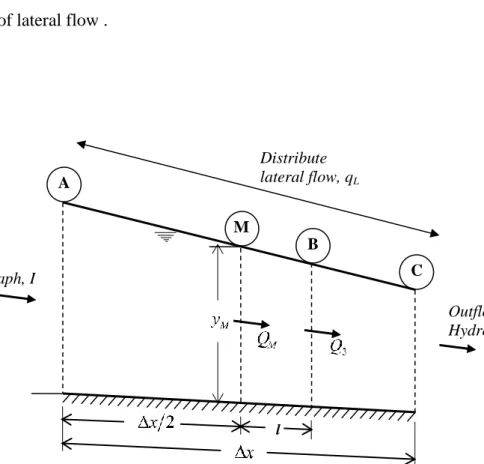
throughout the river stretch (Fig. 1). For the detailed explanation on the lateral flow 169
estimation approach readers can refer to Yadav et al., (2015). Accordingly, the lateral flow 170
8
hydrograph qLis assumed to have the similar shape as the inflow hydrograph and it is 171
supplied uniformly along the river stretch at each time interval. Hence, the original continuity 172
equation in the VPMM method is modified as 173 L q t A x Q (4) 174
where, qLis the lateral flow per unit length of the channel. 175
The contribution of lateral flow in the river stretch is assumed to be perpendicular to the 176
channel reach, hence the channel flow receives no or very negligible momentum. 177
Accordingly, in the modified VPMM method the momentum equation (Eq. (2)) remains 178
unaltered. The modified continuity equation and the original momentum equation were 179
further solved to account the uniformly distributed lateral flow and the approach arrived at 180
following (Yadav et al., 2015) as 181 Lavg j i j i j i j i CQ CQ CQ Cq Q11 1 1 2 3 1 4 (5) 182
The coefficientsC1,C2,C3,C4 and qLavg are expressed as 183
1
1 1 1 1 1 2 2 j j j j K t K t C 184
1
1 2 1 2 2 j j j j K t K t C 185
1
1 1 3 1 2 1 2 j j jj K t K t C 186
1
1 4 1 2 2 j j K t x t K C 187 2 , 1 ,j Lj L Lavg q q q 1889
Considering the shape of lateral flow hydrograph as same as the inflow hydrograph, the 189
lateral flow rate qL joining to the river stretch (discharge per unit length of the channel) is 190
obtained (Yadav et al., 2015) as 191 L V t I I q L N i L
1 (6) 192where, I is the inflow discharge at any time; L is the length of the river reach in meter; VLis 193
the volume of lateral flow . 194
195
196
Fig: 1. Concept diagram of VPMM method considering distributed lateral flow in river reach 197
(Yadav et al., 2015) 198
To calculate the discharge values at the downtream location, the VPMM method requires the 199
following data- Manning’s roughness value, Bed slope, River width (meter), Side slope and 200
Cross-sectional shape. The method also requires river dischrage data of the upstream gauging 201
station and rainfall data to calculate the lateral flow of the intervening catchment. As the 202 l Inflow Hydrograph, I Outflow Hydrograph, Q A C B M Distribute lateral flow, qL
10
VPMM method is a fully mass conservative, physically based method, it does not require any 203
calibration. The precipitation and discharge data of year 2002 was used in simulation of the 204
discharge at the downstream location. 205
206
2.2 Support vector machine 207
Vapnik et. al. (1995) proposed a kernel-based algorithm as support vector machine (SVM) 208
which has a function form like physical models, however, the level of complexity is to be 209
decided by the data used to train the model. The method was developed using the similar 210
principle like ANN, however by using a novel way to approximate various functions (i.e. 211
linear (LN), polynomial (PL), radial basis function (RBF), and sigmoid (SIG)) using the 212
method of structural risk minimization (opposite to the empirical risk minimization). A kernel 213
function is used to transform the data into higher dimensional feature space. The SRM 214
principle allows the method to have a good generalization ability for the unseen data. Let 215
x1,y1 ...,..., xn,yn
be assumed to be the given training data sets, wheren i R
x represents 216
the input sample space andyiRn for i1,...,l denotes respective target output, elements in 217
the training data set represented byl. Error tolerance level is fixed by a value of (errors < 218
). The linear regression in SVM is estimated by solving the equation (7) as 219
n i C w Minimize 0 2 2 1 (7) 220 Subject to
l i y b x w b x w y i i i i i i i i ,..., 1 , 0 , , 221wdenotes the normal vector, bis a bias, Crepresents a regularization constant, is the error 222
tolerance level of the function, and the , are slack variables. 223
11
The support vector machine have variety of kernel function (mathematical function) 224
and its selection based on the problem at hand, which in turn has a direct impact on the 225
accuracy of the model (Yao et al., 2008). Various studies suggest that the RBF has higher 226
generalization ability and produce more accurate results than the other kernel types (Harpham 227
and Dawson, 2006; Yang et al., 2009; Tehrany et al., 2015, Yadav et al., 2017). A study by 228
Tehrany et al., (2014) suggested that RBF may produce less accurate results in case of longer 229
range extrapolation. However, RBF as a kernel function for SVM used by many researchers 230
in the past (Yu et al., 2004; Choy and Chan, 2003; Suryanarayana et al., 2014; Yadav et al., 231
2016a, Yadav et al., 2017, Yadav et al., 2018) and has been found to be suitable for 232
simulation and prediction studies. RBF is defined as 233
2
exp , j i j i X X X X K (8) 234where Xi and Xj are vectors in the input space, such as the vectors of features computed 235
from training and testing. is defined by, 2
2 1
for which is the Gaussian noise level 236
of standard deviation. 237
The output of the SVM is critically dependent on the parameters such as regularization 238
constant
C insensitive loss function
, and parameter of radial basis function
. Trial and 239error procedure was used in the present study to optimize these parameters based on the 240
RMSE value. The trial continues by using different combinations of all three parameters till 241
the value of RMSE was minimized. Once the optimal parameters are obtained, the methods 242
requires time series of upstream and downstream gauging locations to simulate the discharge 243
values at the downstream location. The effect of lateral flow on the downstream discharge 244
values is automatically considered in the method as the lateral flow calculation is based on 245
the input and output discharge data. The time series data from the year 1999 to 2001 was used 246
for the training while the data from year 2002 was used for the testing. 247
12 248
2.3 Wavelet analysis 249
A wavelet analysis is based on Fourier analysis and was developed to analyze stationary and 250
non-stationary data. Wavelet decomposition is a technique used in case of non-periodic and 251
transient signals to extract the relevant time-frequency information by disintegrating the data 252
into low frequency and high frequency components. Wavelet decomposition breaks the signal 253
into low and high frequency components and utilizes the information hidden in the original 254
signal. The lower frequency components (approximation) are obtained using low pass filter 255
and captures the rapidly changing details of the signal. The higher frequency components 256
(details) are obtained using high pass filter to encompass the slowly changing features of the 257
signals. In this study, discrete wavelet transform (DWT) was used and the discharge time 258
series was decomposed into four resolution interval. Thus, some features of the subseries can 259
be seen more clearly than the original signal series. Though, DWT is able to decompose the 260
time series in many interval, it is important to note that higher number of resolution may also 261
slow down the computational speed. For each component a separate SVM model need to be 262
developed and the decomposed component may be given as the input for SVM. Later, the 263
output of the all the developed SVM (i.e. four in this case) will be summed to get the final 264
output in the form of recomposed time series. 265
There are two basic form of wavelet analysis, continuous wavelet transform (CWT) and 266
discrete wavelet transform (DWT). The continuous wavelet transform (CWT) of a signal x
t 267is defined as follows (Kalteh, 2013): 268
dt s t t x s s CWTx
1 , (9) 26913
where
t is the mother wavelet function;s represents the scale parameter, is the 270translation parameter. 271
The discrete wavelet transform (DWT) is defined as follows: 272
m m m n m a a n t a t /2 0 , (10) 273m and n is the resolution level and position which controls the scale and time; tis the time; 274
ais a specified fixed dilation step greater than 1; 0is the location parameter that must be 275
greater than zero. The term am/2 in the above equation normalizes the functions. 276
The two form of wavelet has been used in many studies, however it was observed that 277
the CWT is computationally costly and requires large number of data. On the other hand the 278
development and application of DWT is much simpler and easy to use (Adamowski and 279
Chan, 2011; Kalteh, 2013). Therefore, DWT has been used in this study where a father 280
wavelet function used for the extraction of low frequency components while the high 281
frequency component is extracted by using a complementary of the father wavelet, a mother 282
wavelet function. The decomposition of the data series is represented by the approximation 283
series Am and the detail seriesDm. Later, the both the approximation and detail series were 284
recomposed to get the final output of the model. 285
2.4. Evaluation criteria 286
The VPMM method was originally developed by Perumal and Price (2013) and further the 287
extended version considering the lateral flow was evaluated by Yadav et al., (2015). In the 288
flood forecasting study value of flood peak and its time of arrival is very important, hence in 289
this study three important evaluation criteria which is error in peak discharge (Qer), error in 290
time to peak (tQe) and error in volume (EVOL) are adopted. The criteria for error in volume 291
14
has different definition than the one proposed by Perumal and Price (2013) as in their method 292
the objective was to assess the error in mass conservation. However, in this study the lateral 293
inflow from the intervening catchment is very significant hence the mass reproduction at the 294
downstream location is bound to have higher value than the upstream location. Therefore, 295
this study evaluated the volume reproduction ability of the selected methods based on the 296
observed discharge at the downstream location. Further, the performance of VPMM, SVM 297
and WA-SVM was also evaluated using the statistical indicators like root mean square error 298
(RMSE), normalized mean square error (NMSE) and coefficient of determination (R2). The 299
aforementioned statistical indicator gives the interpretation about the overall reproduction 300
ability of the selected models, and may not provide the information that how the model 301
behaved throughout the flood event. Therefore, another evaluation criteria called absolute 302
average relative error (AARE) was adopted to assess the model performance at each 303
discharge ordinate. Furthermore, the performance of the selected methods was also evaluated 304
using graphical analysis where the closeness with which the proposed method reproduces the 305
benchmark solution, including the closeness of shape and size of the hydrograph, can be 306
measured using the Nash–Sutcliffe (NSE) efficiency criterion. The definition of RMSE, 307
NMSE, NSE and R2 can be found easily in the literature, however the definition for some of 308
the specific performance measures are given as follows: 309
Error in peak discharge (Qer) 310 100 1 o s er Q Q Q (11) 311
Relative error in time to peak (tQe) 312 Qo Qs Qe t t t (12) 313
15 Error in volume (EVOL)
314 100 1 1 1
N i oi N i si Q Q EVOL (13) 315 316 317Absolute average relative error (AARE) 318 100 1 1
N i si si oi Q Q Q N AARE (14) 319where Qerrepresents the percentage error in simulated peak discharge; Qsis the simulated 320
peak discharge of the flood event at the downstream location (m3/s); Qois the observed peak 321
discharge of the flood event at the downstream location (m3/s); tQe is the relative error in 322
time to peak of the simulated flood event (hr); tQstime to peak of the simulated flood event 323
(hr); tQotime to peak of the observed flood event (hr); EVOLis the error in volume is 324
simulated flood event (%);Qsiis the ith ordinate of the simulated flood event (m3/s); Qoiis the 325
ith ordinate of the observed flood event (m3/s) and Nis the total number of ordinates in the 326
flood event. 327
2.5 Evaluation of model complexity 328
The level of complexity of a specific model is tested using Akaike information criterion 329
(AIC) and model selection criteria (MSC). The most appropriate model based on the model 330
complexities is the one with the smallest values of the AIC and largest value of MSC. The 331
performance measures are also defined as; 332
16 p N i si oi Q N Q N AIC ln ( ) 2 1 2
(15) 333 N N Q Q Q Q MSC N p i si oi N i s oi 2 ) ( ) ( ln 1 1
(16) 334where Qsrepresents the average simulated discharge and Nprepresents the number of model 335
parameters. 336
337
3. Study area and data 338
The research work as a part of this study was mainly performed on a part of the Neckar River 339
basin (Fig.2). This region is situated in the South- Western part of Germany in the state of 340
Baden Württemberg. The river in the catchment is unaffected by large hydropower 341
generation plants and other such water management structures or navigational reasons, which 342
are the most common reasons influencing the runoff characteristics of the catchment area. 343
The study area of this research is characterised by strong differences in altitude between the 344
foothills of the Black Forest in the west, the valley of the Neckar in the centre and once again 345
the steep ascent to the Schwäbische Alb in the east. The catchment consists of lots of narrow 346
valleys. There is a wide variety of vegetation in the study catchment. In the western part of 347
the catchment the soil is acidic and poor in minerals which supports only Spruce, fir and 348
beech trees. The same forest is also found in the sandy soil of Keuper. The pasture, meadows, 349
fruits, vines, ash tress, elm and lime trees are also found in the smaller pockets. The study 350
was conducted between the two initial observation stations Rottweil and Oberndorf on the 351
Neckar River. Distance between two stations is 24.2 km. The intermediate drainage area 352
between two stations is 235 km2 which is around 34 % of the total drainage area of Oberndorf 353
17
gauging station. The hourly amounts of precipitation used in the VPMM for the period from 354
1999 to 2002 are obtained from 3 precipitation stations which are distributed in and around 355
the catchment area. The data based modeling (SVM and WA-SVM) is based only on the 356
discharge time series from 1999 to 2002 (Fig. 3) which was provided by the University of 357
Stuttgart, Germany. The description of the study area is partly based on the description of 358
Das (2006) and CCHYDRO (1999).The discharge time series from 1999-2001 was used for 359
the training and, nine flood events from the year 2002 are selected for the comparative 360
analysis of the selected methods. The event selection was completely random but keeping in 361
mind that the peak discharge value should be high and lateral flow contribution must be more 362
than 10% in all events. The parameters for the application of extended VPMM were taken 363
from the study of Yadav et al., (2015). 364
365
Fig.2 Neckar catchment (IWS, Stuttgart) 366
18 367
Fig. 3 Time series at Rottweil (upstream) and Oberndorf (downstream) gauging stations 368
4. Results and discussions 369
4.1 Flood Routing Using VPMM, SVM and WA-SVM 370
The extended VPMM method and its parameters were obtained from the study conducted by 371
Yadav et al., (2015) for the same river stretch. The VPMM method under consideration has 372
only two parameters K and θ which depends on the cross sectional information and the flow 373
characteristics. The routing reach information such as bed slope and Manning’s roughness 374
value were obtained from the study reports of the Neckar river catchment, But the bed width 375
and side slope of the cross section (Table 1) of the channel reach is optimized by the ROPE 376
algorithm (Singh, 2008, Yadav et al., 2015). To avoid the influence of lateral inflow on the 377
parameter optimization process the flood event with a minimum lateral flow among the 9 378
events is considered for the analysis. The data based model namely SVM and WA-SVM were 379
developed using LIBSVM toolbox (Chang et al. 2011) to predict the discharge at the 380
downstream location. The Radial Basis Function was adopted as kernel function for SVM 381
and its parameters C and γ were obtained using a trial and error procedure where the trial 382
19
continues till the value of RMSE was minimized. Later, the SVM model was suitability 383
coupled with wavelet analysis (WA) which decomposes the input discharge time series using 384
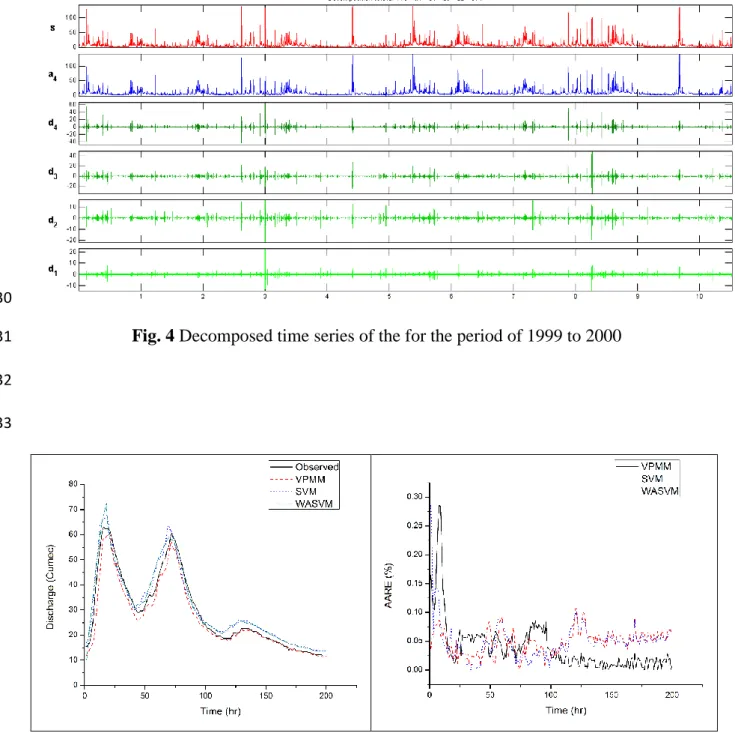
DWT into approximation and detailed time series (Fig. 4). The parameters for SVM and WA-385
SVM has been presented in Table 2. After the model calibration (VPMM) or training (SVM, 386
WA-SVM) they were used to predict the discharge hydrograph of 9 flood events of the year 387
2002. 388
Table 1. Parameters for the development of VPMM method 389
Parameter Value
Manning’s roughness Bed slope
River width (meter) Side slope Cross-sectional shape 0.035 0.0034 8.417 1.035 Trapezoidal 390
Table 2. Optimal SVM and WA-SVM parameters for various decomposition series 391
Model Decomposed series best C best
SVM 3.104 0.0412 WA-SVM Approximation series 42 0.0611 D1 series 3 0.0412 D2 series 3 0.0712 D3 series 7 0.0912 D4 series 9 0.0812 392
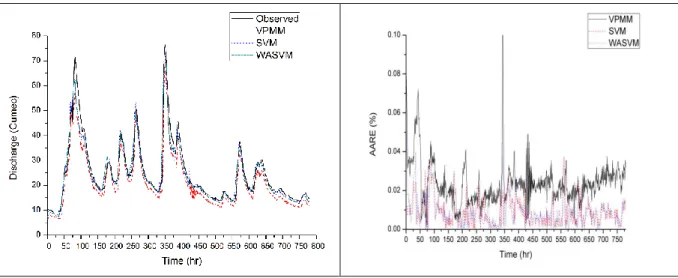
Table 3 presents the statistical analysis of the simulated hydrograph obtained by VPMM, 393
SVM and WA-SVM. The VPMM reproduced 7 out of 9 flood events with highest accuracy, 394
where the error measures like NMSE, RMSE values ranges between 0.018 to 0.083 and 1.471 395
20
(m3/s) to 4.301 (m3/s), respectively. Similarly the values for R2 and NSE ranges between 396
0.968 to 0.997 and 0.872 to 0.982, respectively. In case of SVM, the values obtained for 397
NMSE and RMSE were significantly high for most of the flood events and ranges between 398
0.046 to 0.176 and 2.932 (m3/s) to 5.918 (m3/s), respectively. The fitness criteria (R2 and 399
NSE) also follows the similar trend like error measures and ranges between 0.831 to 0.966 400
and 0.822 to 0.954, respectively. The inclusion of wavelet analysis has definitely improved 401
the accuracy of SVM and outperforms it in all flood events except 1, 3 and 9. Though, it is 402
evident from the statistical analysis that the VPMM method shows superiority over SVM and 403
WA-SVM, the reproduction of the downstream hydrographs for all the flood events by the 404
data based models are very close to the observed hydrographs. This argument is well 405
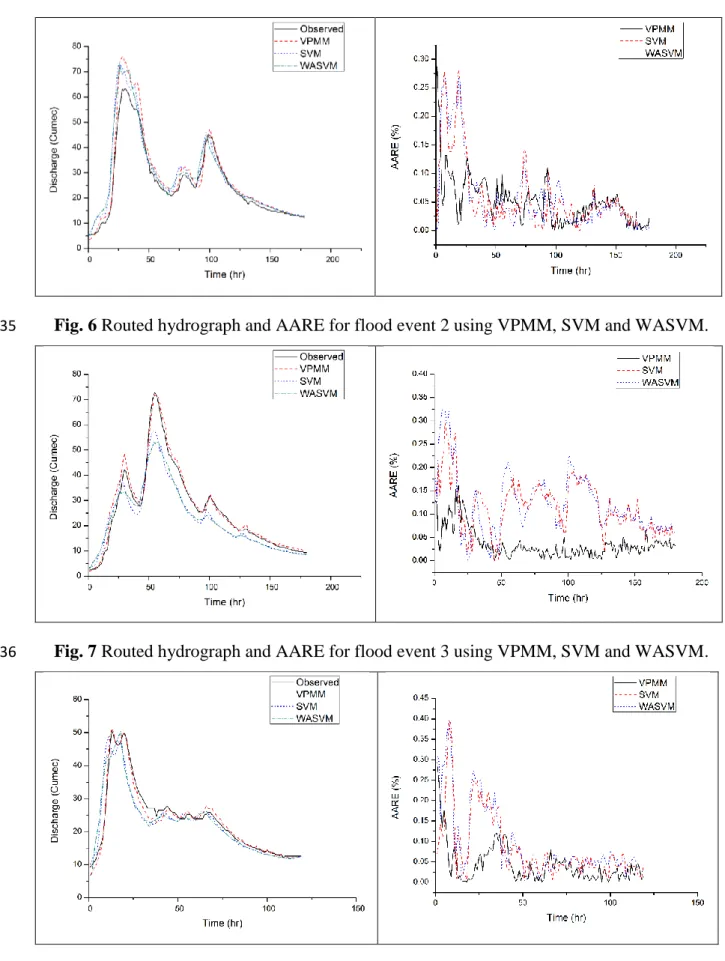
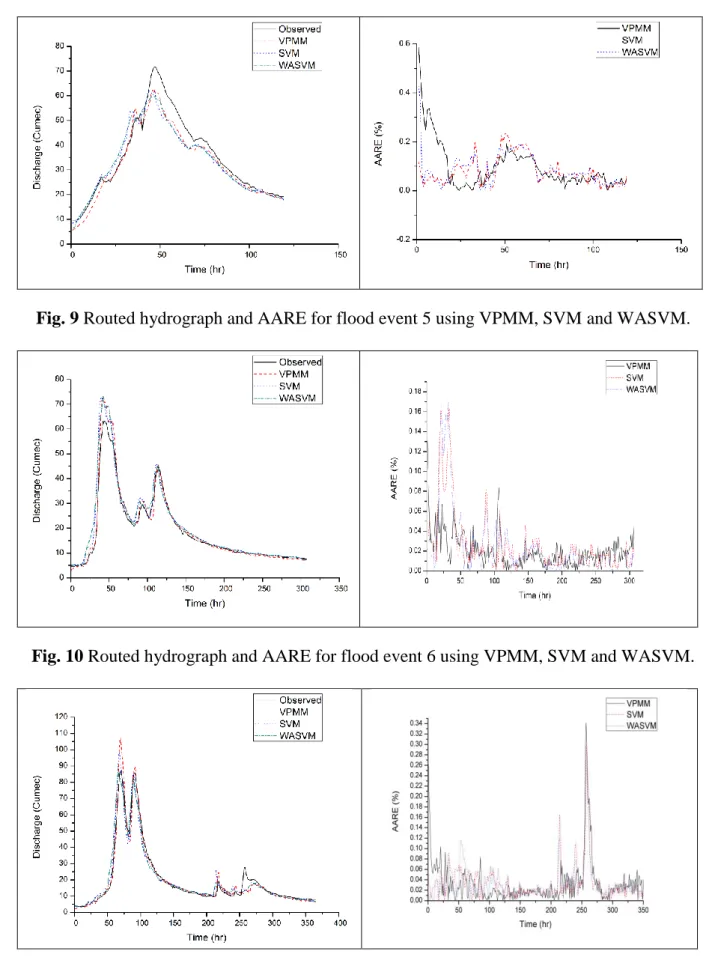
supported by the graphical representation of the observed and simulated hydrographs by 406
VPMM, SVM and WA-SVM (Fig. 5-13). It is also evident from these figures that the 407
absolute average relative error (AARE) of VPMM is very low. The AARE of SVM and WA-408
SVM is significantly higher than the VPMM, however WA-SVM shows relatively less error 409
than the SVM. These figures reveal that, under significant lateral flow conditions, the rising 410
limb, recession limb, and the peaks of the event-based flood hydrographs are all most well-411
reproduced by the VPMM, SVM and WA-SVM model. 412
Table. 3 Performance of VPMM, SVM and WA-SVM during the discharge prediction at the 413
Oberndorf gauging station 414
Flood event Method NMSE R2 RMSE (m3/s) NSE
1 VPMM 0.028 0.984 3.421 0.948 SVM 0.049 0.966 3.316 0.951 WASVM 0.052 0.962 3.434 0.948 2 VPMM 0.083 0.980 4.197 0.916 SVM 0.130 0.922 5.244 0.869 WASVM 0.118 0.928 5.009 0.881 3 VPMM 0.018 0.987 2.195 0.982 SVM 0.129 0.948 5.918 0.870
21 WASVM 0.145 0.943 6.261 0.855 4 VPMM 0.020 0.981 1.471 0.979 SVM 0.176 0.831 4.356 0.822 WASVM 0.175 0.835 4.345 0.823 5 VPMM 0.071 0.968 4.301 0.928 SVM 0.106 0.919 5.254 0.893 WASVM 0.099 0.926 5.061 0.901 6 VPMM 0.030 0.987 2.415 0.970 SVM 0.081 0.951 4.005 0.919 WASVM 0.069 0.958 3.694 0.931 7 VPMM 0.035 0.970 3.579 0.965 SVM 0.046 0.954 4.106 0.954 WASVM 0.046 0.954 4.093 0.954 8 VPMM 0.128 0.976 4.545 0.872 SVM 0.053 0.953 2.932 0.947 WASVM 0.053 0.955 2.920 0.947 9 VPMM 0.015 0.997 1.469 0.985 SVM 0.062 0.964 3.011 0.938 WASVM 0.070 0.955 3.191 0.929 415 416
Further analysis of the results indicates that the VPMM model works well in both the cases of 417
single or multi-peak peak flood events, however, data based models simulates the multi-peak 418
flood events (Events 1 and 8) better than VPMM. The reason for such outcome can be 419
attributed to the fact that the data based model performance primarily depends on the data 420
length. In case of flood event 8, the discharge time series length is around 800 hrs with 421
multiple peaks, which allowed the model to learn such occurrence properly. The study 422
suggest that, if the data based models are fed with sufficient length of discharge time series 423
data which encompass the variability in nature, they can simulate the discharge process with 424
reasonable accuracy. On the other hand, the reduction in accuracy of VPMM for these flood 425
events derives from the uncertainty in estimating the lateral flow which, mainly depends on 426
the initial soil moisture conditions. The spatial and temporal variability of soil moisture 427
22
content can have significant impact on the lateral flow estimation which in turn will reflect in 428
the simulation accuracy of the VPMM. 429
430
Fig. 4 Decomposed time series of the for the period of 1999 to 2000 431
432 433
Fig. 5 Routed hydrograph and AARE for flood event 1 using VPMM, SVM and WASVM. 434
23
Fig. 6 Routed hydrograph and AARE for flood event 2 using VPMM, SVM and WASVM. 435
Fig. 7 Routed hydrograph and AARE for flood event 3 using VPMM, SVM and WASVM. 436
Fig. 8 Routed hydrograph and AARE for flood event 4 using VPMM, SVM and WASVM. 437
24
Fig. 9 Routed hydrograph and AARE for flood event 5 using VPMM, SVM and WASVM. 438
Fig. 10 Routed hydrograph and AARE for flood event 6 using VPMM, SVM and WASVM. 439
Fig. 11 Routed hydrograph and AARE for flood event 7 using VPMM, SVM and WASVM. 440
25
Fig. 12 Routed hydrograph and AARE for flood event 8 using VPMM, SVM and WASVM. 441
Fig. 13 Routed hydrograph and AARE for flood event 9 using VPMM, SVM and WASVM. 442
443
Further, considered methods in this study were also evaluated using the original criteria used 444
for the development of VPMM. The percentage error in the peak discharge (Qerin %), the 445
error in the time-to-peak discharge (tQein hr), and the percentage error in the volume (EVOL 446
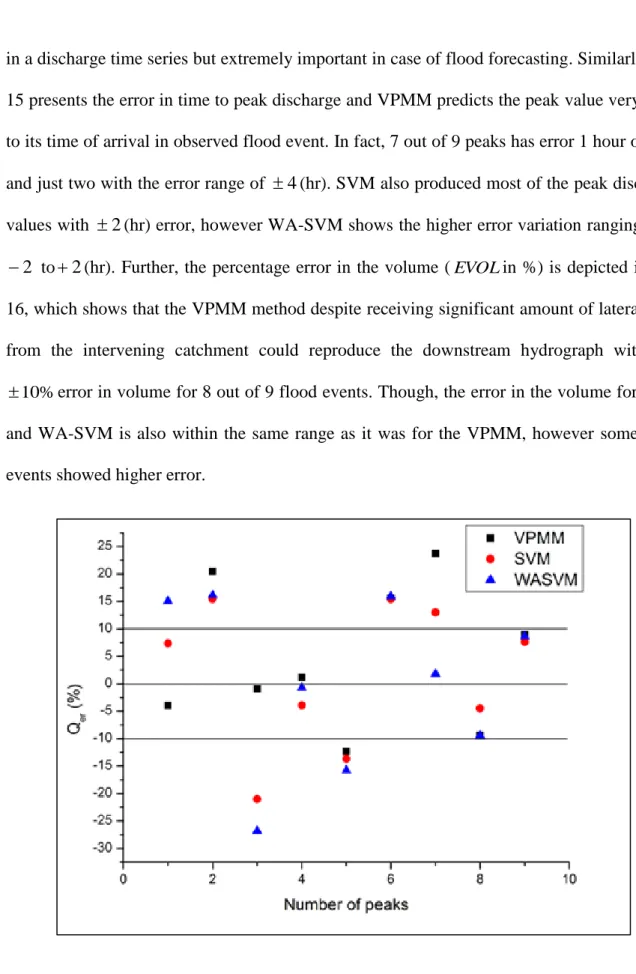
in %) for all the 9 flood events has been depicted in Figs. 14, 15 and 16. It is evident from the 447
Fig. 14 that the VPMM method predicts most of the peak values (5 out of 9) within 10%
448
error and just 2 above the 20% error. However, in case of SVM and WA-SVM Qeris well 449
above the 10%range for most of the flood events. Which suggest that the data based 450
models may requires more training to predict such high discharge values which comes rarely 451
26
in a discharge time series but extremely important in case of flood forecasting. Similarly, Fig. 452
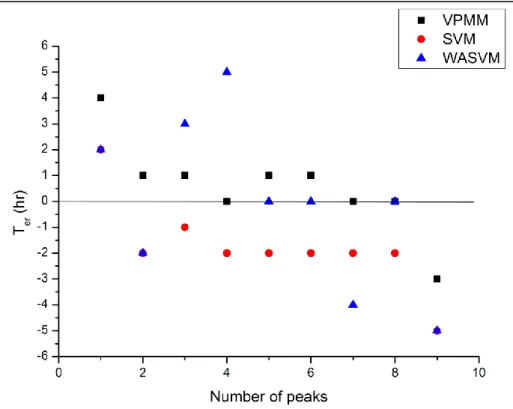
15 presents the error in time to peak discharge and VPMM predicts the peak value very close 453
to its time of arrival in observed flood event. In fact, 7 out of 9 peaks has error 1 hour or less, 454
and just two with the error range of 4(hr). SVM also produced most of the peak discharge 455
values with 2(hr) error, however WA-SVM shows the higher error variation ranging from 456
2
to2(hr). Further, the percentage error in the volume (EVOLin %) is depicted in Fig. 457
16, which shows that the VPMM method despite receiving significant amount of lateral flow 458
from the intervening catchment could reproduce the downstream hydrograph with just 459
% 10
error in volume for 8 out of 9 flood events. Though, the error in the volume for SVM 460
and WA-SVM is also within the same range as it was for the VPMM, however some flood 461
events showed higher error. 462
463 464
Fig. 14 Error in peak discharge prediction while using VPMM, SVM and WASVM 465
27 466
Fig. 15 Error in time to peak discharge prediction while using VPMM, SVM and WASVM 467
468
Fig. 16 variation of error in volume while using VPMM, SVM and WASVM 469
470
4.2 Level of Complexity in VPMM, SVM amd WA-SVM 471
28
The method under consideration were also evaluated to assess the level of complexity while 472
desgining the model for discharge prediction. Table 4 presents the model complexity analysis 473
of VPMM, SVM and WA-SVM based on the number of parameter each model requires to be 474
tuned while designing the model for a specific application. The VPMM method has only two 475
parameters that is K and θ while the SVM has three parameters namely regularization 476
constant (C), insensitive loss function (ε), and parameter of radial basis function (γ). It is 477
evident from the table that the Akaike information criterion (AIC) is lowest while using 478
VPMM, in comparison to SVM and WASVM for most of the flood events. Similarly the 479
model selection criteria (MSC) value is highest for 8 out of 9 flood events when VPMM is 480
used, however it decreased significantly for SVM and WA-SVM. 481
482
Table 4. Akaike information criterion (AIC) and model selection criteria (MSC) for VPMM, 483 SVM and WA-SVM 484 Flood Event AIC MSC VPMM SVM WA-SVM VPMM SVM WA-SVM 1 1555.64 1545.19 1559.21 -0.02 -0.030 -0.030 2 1437.02 1518.28 1501.94 -0.022 -3.203 -5.220 3 1221.69 1580.78 1601.07 -0.022 0.233 -4.822 4 664.62 924.92 924.34 -0.033 -0.391 -2.030 5 919.94 969.57 960.66 -0.033 -0.805 -4.307 6 2303.60 2616.07 2566.52 -0.013 -0.610 -3.529 7 3088.30 3190.54 3188.27 -0.011 -0.040 -2.250 8 7560.23 6878.02 6871.93 -0.005 1.348 -2.286 9 1789.87 2192.25 2224.57 -0.014 -0.889 -3.288 485 486 5. Conclusion 487
29
In this study two approaches were used to predict the downstream discharge of Neckar River 488
in which VPMM is a physically based method and the SVM is data based method. Further, 489
wavelet analysis was also used to develop a hybrid WA-SVM model. The study was 490
conducted using 9 flood events from the year 2002 which is characterised of having 491
significant lateral flow joining from the intervening catchment, which in general is difficult to 492
model due to its spatial and temporal variability. Based on the analysis of statistical and 493
graphical results, it is inferred that the extended physically based variable parameter 494
Muskingum routing method (VPMM) is more robust and reliable than the data based models 495
like SVM and WA-SVM, when used to predict the discharge in a river reach with significant 496
lateral flow joining between the upstream and downstream gauging stations. However, it is 497
also evident from the analysis that the data based models successfully captured the flood 498
wave moment phenomenon and were able to map the process even with lateral flow, hence 499
reproduced the discharge hydrograph close to the observed hydrograph at the downstream 500
location. Further, based on the Akaike information criterion (AIC) and model selection 501
criteria (MSC), it can be concluded that the VPMM model is relatively less complex than the 502
SVM and WA-SVM. Lastly, it can be summarised that the physically based extended VPMM 503
method can predict the discharge hydrograph better than the data based mode, however, in 504
case of multi-peak flood events with sufficient discharge data, the later performed better than 505 VPMM method. 506 507 Acknowledgement 508
The author thankfully acknowledge the support and motivation provided by Prof. M. 509
Perumal. The necessary data to conduct this study was provided by TU Stuttgart, Germany. 510
The financial support to conduct this study was provided by IIT Delhi, India. 511
512
Conflict of Interest Statement 513
30
We confirm that this manuscript has not been published elsewhere and is not under 514
consideration by another journal. All the authors have approved the manuscript and agree 515
with the submission to Neural Computing and Applications Journal. The financial support 516
was provided by IIT Delhi. The authors have no conflict of interest to declare. 517
References 518
Adamowski, J., & Sun, K., 2010. Development of a coupled wavelet transform and neural 519
network method for flow forecasting of non-perennial rivers in semi-arid watersheds. Journal 520
of Hydrology, 390(1), 85-91. 521
522
Adamowski, J., & Chan, H. F., 2011. A wavelet neural network conjunction model for 523
groundwater level forecasting. Journal of Hydrology, 407(1), 28-40. 524
525
ASCE Task Committee on Application of Artificial Neural Networks in Hydrology, 2000. 526
527
Agarwal, A., Maheswaran, R., Kurths, J., & Khosa, R. 2016. Wavelet Spectrum and self-528
organizing maps-based approach for hydrologic regionalization-a case study in the western 529
United States. Water Resources Management, 30(12), 4399-4413. 530
531
Badrzadeh, H., Sarukkalige, R., & Jayawardena, A. W., 2013. Impact of multi-resolution 532
analysis of artificial intelligence models inputs on multi-step ahead river flow forecasting. 533
Journal of Hydrology, 507, 75-85. 534
535
Beven, K., 2006. A manifesto for the equifinality thesis. Journal of hydrology, 320(1), 18-36. 536
CC-HYDRO, 1999. Impact of Climate Change on River Basin Hydrology under Different 537
Climatic Conditions, March 1999. Universität Stuttgart, Germany. 538
539
Borges, R. V., Garcez, A. D. A., & Lamb, L. C., 2011. Learning and representing temporal 540
knowledge in recurrent networks. IEEE Transactions on Neural Networks, 22(12), 2409-541
2421. 542
31
Cannas, B., Fanni, A., See, L., & Sias, G., 2006. Data preprocessing for river flow forecasting 544
using neural networks: wavelet transforms and data partitioning. Physis and Chemistry of the 545
Earth 31 (18), 1164–1171. 546
547
Chang C. C., & Lin C. J., 2011. LIBSVM: a library for support vector machines. ACM Trans. 548
Intell. Syst. Technol. 2 (3) 27. 549
550
Chow, V.T., Maidment, D.R., & Mays, L.W., 1988. Applied Hydrology. McGraw-Hill, New 551
York. 552
553
Choy K., & Chan C., 2003. Modelling of river discharges and rainfall using radial basis 554
function networks based on support vector regression, Int. Journal of System Science, 34 (1) 555
763–773 556
557
Das, T., 2006. The Impact of Spatial Variability of Precipitation on the Predictive 558
Uncertainty of Hydrological Models, Ph.D. Dissertation No. 154, University of Stuttgart. 559
560
Dawson C.W., & Wilby R., 1998. An artificial neural network approach to rainfall–runoff 561
modeling. Hydrological Sciences Journal, 43 (1), pp. 47–66. 562
563
Ghalkhani, H., Golian, S., Saghafian, B., Farokhnia, A., & Shamseldin, A., 2013. Application 564
of surrogate artificial intelligent models for real‐time flood routing. Water and Environment 565
Journal, 27(4), 535-548. 566
567
Harpham, C., & Dawson, C. W., 2006. The effect of different basis functions on a radial basis 568
function network for time series prediction: a comparative study. Neurocomputing, 69(16), 569
2161-2170. 570
571
Kalteh, A. M., 2013. Monthly River flow forecasting using artificial neural network and 572
support vector regression models coupled with wavelet transform. Computers & 573
Geosciences, 54, 1-8. 574
575
Karahan, H., Gurarslan, G., & Geem, Z. W., 2015. A new nonlinear Muskingum flood 576
routing model incorporating lateral flow. Engineering Optimization, 47(6), 737-749. 577
32 578
Kasiviswanathan, K. S., He, J., Sudheer, K. P., & Tay, J. H., 2016. Potential application of 579
wavelet neural network ensemble to forecast streamflow for flood management. Journal of 580
Hydrology, 536, 161-173 581
582
Kisi, O., 2008. River flow forecasting and estimation using different artificial neural network 583
techniques. Hydrological Research, 39 (1), 27–40. 584
585
Koza, J. R., 1992. Genetic programming: on the programming of computers by means of 586
natural selection (Vol. 1). MIT press. 587
588
Lin, T., Guo, T., & Aberer, K., 2017. Hybrid neural networks for learning the trend in time 589
series. In Proceedings of the Twenty-Sixth International Joint Conference on Artificial 590
Intelligence, IJCAI-17 (pp. 2273-2279). 591
592
Loague, K., & VanderKwaak, J. E., 2004. Physics‐based hydrologic response simulation: 593
Platinum bridge, 1958 Edsel, or useful tool. Hydrological Processes, 18(15), 2949-2956. 594
Maier, H. R., & Dandy, G. C., 2000. Neural networks for the prediction and forecasting of 595
water resources variables: a review of modelling issues and applications. Environmental 596
modelling & software, 15(1), 101-124. 597
598
McCarthy, G.T., 1938. The unit hydrograph and flood routing. In: Conference of North 599
Atlantic Div., U.S. Army Corps of Engineers. 600
601
Nourani, V., Baghanam, A. H., Adamowski, J., & Kisi, O., 2014. Applications of hybrid 602
wavelet–Artificial Intelligence models in hydrology: A review. Journal of Hydrology, 514, 603
358-377. 604
605
O’Donnell, T., 1985. A direct three-parameter Muskingum procedure incorporating lateral 606
inflow. Hydrological Science Journal. 30 (4), 479–496. 607
608
Nayak, P. C., Sudheer, K. P., & Jain, S. K., 2007. Rainfall‐runoff modeling through hybrid 609
intelligent system. Water Resources Research, 43(7). 610
33
Perumal, M., 1994a. Hydrodynamic derivation of a variable parameter Muskingum method: 612
1. Theory and solution procedure. Hydrological sciences journal, 39(5), 431-442. 613
614
Perumal, M., 1994b. Hydrodynamic derivation of a variable parameter Muskingum method: 615
2. Verification. Hydrological sciences journal, 39(5), 443-458. 616
617
Perumal, M., O’Connell, P.E., & Ranga Raju, K.G., 2001. Field applications of a variable 618
parameter Muskingum method. Journal of Hydraulic Engineering. 6 (3), 1084-0699/01/0003-619
0196-0207. 620
621
Perumal, M., & Sahoo, B., 2008. Volume conservation controversy of the variable parameter 622
Muskingum–Cunge method. Journal of Hydraulic Engineering, 134(4), 475-485. 623
624
Perumal, M., & Price, R.K., 2013. A fully volume conservative variable parameter 625
McCarthy-Muskingum method: theory and Verification. Journal of Hydrology. 502, 89–102. 626
627
Perumal, M., Tayfur, G., Rao, C. M., & Gurarslan, G., 2017. Evaluation of a physically based 628
quasi-linear and a conceptually based nonlinear Muskingum methods. Journal of 629
Hydrology, 546, 437-449. 630
631
Ponce, V. M., & Yevjevich, V., 1978. Muskingum-Cunge method with variable parameters. 632
Journal of the Hydraulics Division, 104(12), 1663-1667. 633
634
Price, R. K., 2009. Volume-conservative nonlinear flood routing. Journal of Hydraulic 635
Engineering, 135(10), 838-845. 636
637
Rezaeianzadeh, M., Tabari, H., Yazdi, A. A., Isik, S., & Kalin, L., 2014. Flood flow 638
forecasting using ANN, ANFIS and regression models. Neural Computing and Applications, 639
25(1), 25-37. 640
641
Sang, Y. F., 2013. A review on the applications of wavelet transform in hydrology time series 642
analysis. Atmospheric research, 122, 8-15. 643
34
Shiri, J., & Kisi, O., 2010. Short-term and long-term streamflow forecasting using a wavelet 645
and neuro-fuzzy conjunction model. Journal of hydrology, 394(3), 486-493. 646
647
Shiri, J., Kişi, Ö., Makarynskyy, O., Shiri, A. A., & Nikoofar, B., 2012. Forecasting daily 648
stream flows using artificial intelligence approaches. ISH Journal of Hydraulic Engineering, 649
18(3), 204-214. 650
651
Singh, S.K., 2008. Robust Parameter Estimation in Gauged and Ungauged Basins, Ph.D. 652
dissertation No. 198, University of Stuttgart. 653
654
Sudheer, K. P., Gosain, A. K., & Ramasastri, K. S., 2002. A data-driven algorithm for 655
constructing artificial neural network rainfall–runoff models. Hydrological Processes, 16, 656
1325–1330. 657
658
Suryanarayana, C., Sudheer, C., Mahammood, V., & Panigrahi, B. K., 2014. An integrated 659
wavelet-support vector machine for groundwater level prediction in Visakhapatnam, India. 660
Neurocomputing, 145, 324-335. 661
662
Swain, R., & Sahoo, B., 2015. Variable parameter McCarthy–Muskingum flow transport 663
model for compound channels accounting for distributed non-uniform lateral flow. Journal of 664
Hydrology, 530, 698-715. 665
666
Tehrany, M. S., Pradhan, B., & Jebur, M. N., 2014. Flood susceptibility mapping using a 667
novel ensemble weights-of-evidence and support vector machine models in GIS. Journal of 668
Hydrology, 512, 332-343. 669
670
Tehrany, M. S., Pradhan, B., Mansor, S., & Ahmad, N., 2015. Flood susceptibility 671
assessment using GIS-based support vector machine model with different kernel 672
types. Catena, 125, 91-101. 673
674
Tiwari, M.K., & Chatterjee, C., 2010. Development of an accurate and reliable hourly flood 675
forecasting model using wavelet–bootstrap–ANN (WBANN) hybrid approach. Journal of 676
Hydrology 1 (394), 458–470. 677
35 678
Todini, E., 2007. A mass conservative and water storage consistent variable parameter 679
Muskingum-Cunge approach. Hydrology and Earth System Sciences Discussions, 4(3), 1549-680
1592. 681
682
Uhlenbrook, S., Seibert, J., Leibundgut, C., & Rodhe, A., 1999. Prediction uncertainty of 683
conceptual rainfall–runoff models caused by problems to identify model parameters and 684
structure. Hydrological Sciences Journal 44, 779–798. 685
686
Vapnik, V. N., 1995. The Nature of Statistical Learning Theory. Springer-Verlag, New York, 687
USA. 314 p. 688
689
Yadav, B., Mathur, S., & Yadav, B. K. 2018. Data-based modelling approach for variable 690
density flow and solute transport simulation in a coastal aquifer. Hydrological Sciences 691
Journal, 1-17. 692
693
Yadav, B., & Eliza, K., 2017. A hybrid wavelet-support vector machine model for prediction 694
of Lake water level fluctuations using hydro-meteorological data. Measurement, 103, 294-695
301. 696
697
Yadav, B., Ch, S., Mathur, S., & Adamowski, J., 2016a. Estimation of in-situ bioremediation 698
system cost using a hybrid Extreme Learning Machine (ELM)-particle swarm optimization 699
approach. Journal of Hydrology, 543, 373-385. 700
701
Yadav, B., Ch, S., Mathur, S., & Adamowski, J. 2016b. Discharge forecasting using an online 702
sequential extreme learning machine (OS-ELM) model: a case study in Neckar River, 703
Germany. Measurement, 92, 433-445. 704
705
Yadav, B., Perumal, M., & Bardossy, A., 2015. Variable parameter McCarthy–Muskingum 706
routing method considering lateral flow. Journal of Hydrology, 523, 489-499. 707
708
Yao, X., Tham, L., & Dai, F., 2008. Landslide susceptibility mapping based on support 709
vector machine: a case study on natural slopes of Hong Kong, China. Geomorphology 101, 710
572–582. 711
36 712
Yang, J., L., Y., Tian, Y., Duan, L., & Gao, W. Group-sensitive multiple kernel learning for 713
object categorization. In ICCV, 2009. 714
715
Yu X., Liong S., & Babovic V., 2004. EC-SVM approach for real-time hydrologic 716
forecasting. Journal of Hydroinformatics, 6 (3) 209–223. 717