www.sensirion.com Version 2 – December 2011 1/12
Datasheet STS21
Temperature Sensor IC
Fully calibrated
Digital output, I
2C interface
Low power consumption
Excellent long term stability
DFN type package – reflow solderable
Dimensions
Figure 1 Drawing of STS21 sensor package, dimensions are given in mm (1mm = 0.039inch), tolerances are ±0.1mm. The die pad (center pad) is internally connected to VSS. The NC pads must be left floating. VSS = GND, SDA = DATA. Numbering of E/O pads starts at lower right corner (indicated by notch in die pad) and goes clockwise (compare Table 2).
Sensor Chip
STS21 features a generation 4C CMOSens® chip. Besides the band gap temperature sensor, the chip contains an amplifier, A/D converter, OTP memory and a digital processing unit.
Material Contents
While the sensor itself is made of Silicon the sensors‟ housing consists of a plated Cu lead-frame and green epoxy-based mold compound. The device is fully RoHS and WEEE compliant, e.g. free of Pb, Cd and Hg.
Additional Information and Evaluation Kits
Additional information such as Application Notes is available from the web page www.sensirion.com. For more
information please contact Sensirion via
For STS21 two Evaluation Kits are available: EK-H4, a four-channel device with Viewer Software, that also serves for data-logging, and a simple EK-H5 directly connecting one sensor via USB port to a computer.
1.0 1.0 2.4 0.3 0.4 1. 5 0.4 0. 75 1.1 0.2 SCL SDA NC NC VSS VDD Bottom View
S
T
S
2
1
D
0
A
C
4
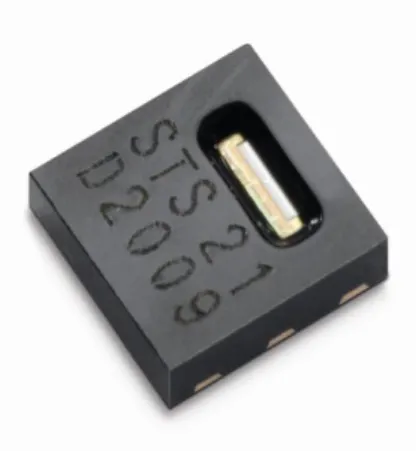
3.0 2.2 0.8 typ 1. 4 ty p 3.0 0.3 typ 2. 0 ty p Product SummarySTS21, the new temperature sensor of Sensirion is about to set new standards in terms of size and intelligence: Embedded in a reflow solderable Dual Flat No leads (DFN) package of 3 x 3mm foot print and 1.1mm height it provides calibrated, linearized signals in digital, I2C format.
Using the same CMOSens® technology as Sensirion‟s successful and industry proven SHT2x humidity and temperature sensors, the STS21 offers superior performance and reliability. The ±0.2°C temperature specification allows for implementation of the STS21 in applications with high demands on temperature accuracy.
Every sensor is individually calibrated and tested. Lot identification is printed on the sensor and an electronic identification code is stored on the chip – which can be read out by command. Furthermore, the resolution of STS21 can be changed by command (11bit up to 14bit), low battery can be detected and a checksum helps to improve communication reliability.
With made improvements and the miniaturization of the sensor the performance-to-price ratio has been improved – and eventually, any device should benefit from the cutting edge energy saving operation mode.
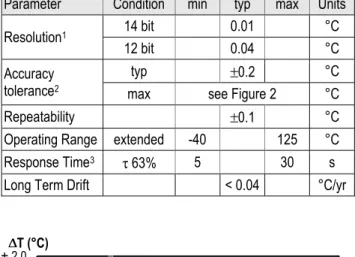
Temperature Specification
Parameter Condition min typ max Units
Resolution1 14 bit 0.01 °C
12 bit 0.04 °C
Accuracy tolerance2
typ 0.2 °C
max see Figure 2 °C
Repeatability 0.1 °C
Operating Range extended -40 125 °C
Response Time3 63% 5 30 s
Long Term Drift < 0.04 °C/yr
± 0.0 ± 0.5 ± 1.0 ± 1.5 ± 2.0 -40 -20 0 20 40 60 80 100 120 Temperature (°C) T (°C) maximal tolerance typical tolerance
Figure 2 Typical and maximal tolerance for temperature sensor in °C
1Default measurement resolution is 14bit. It can be reduced to 13bit, 12bit or
11bit by command to user register.
2Accuracies are tested at Outgoing Quality Control at 25°C and 3.0V. Values
exclude long term drift.
3Response time depends on heat conductivity of sensor substrate.
Electrical Specification
Parameter Conditions min typ max Units
Supply Voltage, VDD 2.1 3.0 3.6 V
Supply Current, IDD4 sleep mode 0.15 0.4 µA
measuring 200 300 330 µA
Power Dissipation4
sleep mode 0.5 1.2 µW
measuring 0.6 0.9 1.0 mW
average 11bit 8.6 µW
Communication digital 2-wire interface, I2C protocol
Table 1 Electrical specification. For absolute maximum values see Section 4.1 of Users Guide.
Packaging Information
Sensor Type Packaging Quantity Order Number STS21
Tape & Reel 400 1-100811-01 Tape & Reel 1500 1-100812-01 Tape & Reel 5000 1-100832-01
This datasheet is subject to change and may be amended without prior notice.
4Min and max values of Supply Current and Power Dissipation are based on
fixed VDD = 3.0V and T<60°C. The average value is based on one 11bit measurement per second.
www.sensirion.com Version 2 – December 2011 3/12
Users Guide STS21
1
Extended Specification
1.1 Electrical Specification
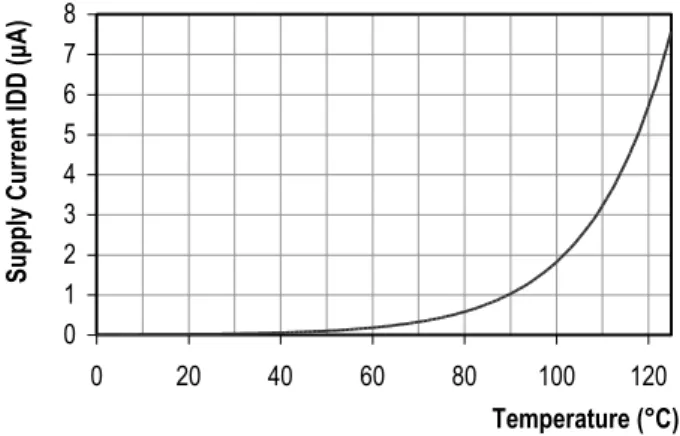
Current consumption as given in Table 1 is dependent on temperature and supply voltage VDD. For estimations on energy consumption of the sensor Figures 3 and 4 may be consulted. Please note that values given in these Figures are of typical nature and the variance is considerable.
0 1 2 3 4 5 6 7 8 0 20 40 60 80 100 120 Temperature (°C) Su pp ly C ur ren t I D D (μ A )
Figure 3 Typical dependency of supply current (sleep mode) versus temperature at VDD = 3.0V. Please note that the variance of these data can be above ±25% of displayed value.
6 8 10 12 14 16 18 20 2.1 2.3 2.5 2.7 2.9 3.1 3.3 3.5 Supply Voltage (VDD) S upp ly C ur re nt ID D (nA )
Figure 4 Typical dependency of supply current (sleep mode) versus supply voltage at 25°C. Please note that deviations may be up to ±50% of displayed value. Values at 60°C scale with a factor of about 15 (compare Table 1).
2
Application Information
2.1 Soldering Instructions
The DFN’s die pad (centre pad) and perimeter I/O pads
are fabricated from a planar copper lead-frame by over-molding leaving the die pad and I/O pads exposed for mechanical and electrical connection. Both the I/O pads and die pad should be soldered to the PCB. In order to prevent oxidation and optimize soldering, the bottom side of the sensor pads is plated with Ni/Pd/Au.
On the PCB the I/O lands5should be 0.2mm longer than the package I/O pads. Inward corners may be rounded to match the I/O pad shape. The I/O land width should match the DFN-package I/O-pads width 1:1 and the land for the die pad should match 1:1 with the DFN package – see Figure 5.
The solder mask6 design for the land pattern preferably is of type Non-Solder Mask Defined (NSMD) with solder mask openings larger than metal pads. For NSMD pads, the solder mask opening should be about 120μm to 150μm larger than the pad size, providing a 60μm to 75μm design clearance between the copper pad and solder mask. Rounded portions of package pads should have a matching rounded solder mask-opening shape to minimize the risk of solder bridging. For the actual pad dimensions, each pad on the PCB should have its own solder mask opening with a web of solder mask between adjacent pads.
Figure 5 Recommended metal land pattern for STS21. Values in mm. Die pad (centre pad) may be left floating or be connected to ground, NC pads shall be left floating. The outer dotted line represents the outer dimension of the DFN package.
For solder paste printing a laser-cut, stainless steel stencil with electro-polished trapezoidal walls and with 0.125mm stencil thickness is recommended. For the I/O pads the stencil apertures should be 0.1mm longer than PCB pads and positioned with 0.1mm offset away from the centre of
5 The land pattern is understood to be the metal layer on the PCB, onto which
the DFN pads are soldered to.
6 The solder mask is understood to be the insulating layer on top of the PCB
covering the connecting lines.
1.0 1.0 0.3 0. 4 1. 5 0.4 0. 7 0. 2 0. 2 2.4
the package. The die pad aperture should cover about 70 – 90% of the pad area – say up to 1.4mm x 2.3mm centered on the thermal land area. It can also be split in two openings.
Due to the low mounted height of the DFN, “no clean” type 3 solder paste7 is recommended as well as Nitrogen purge during reflow.
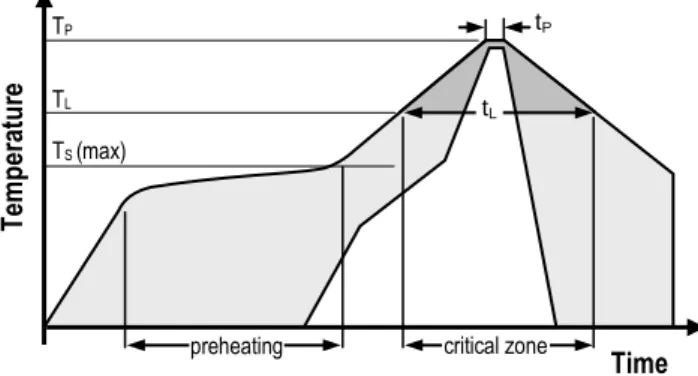
Figure 6 Soldering profile according to JEDEC standard. TP <=
260°C and tP < 30sec for Pb-free assembly. TL < 220°C and tL <
150sec. Ramp-up/down speeds shall be < 5°C/sec.
It is important to note that the diced edge or side faces of the I/O pads may oxidise over time, therefore a solder fillet may or may not form. Hence there is no guarantee for solder joint fillet heights of any kind.
For soldering STS21, standard reflow soldering ovens may be used. The sensor is qualified to withstand soldering profile according to IPC/JEDEC J-STD-020 with peak temperatures at 260°C during up to 30sec for Pb-free assembly in IR/Convection reflow ovens (see Figure 6). For manual soldering contact time must be limited to 5 seconds at up to 350°C.
2.2 Storage Conditions and Handling Instructions Moisture Sensitivity Level (MSL) is 1, according to IPC/JEDEC J-STD-020. At the same time, it is recommended to further process the sensors within 1 year after date of delivery.
During storage, temperature shall be in the range of 10°C – 50°C.
2.3 Temperature Effects
If the sensor shares a PCB with electronic components that produce heat it should be mounted in a way that prevents heat transfer or keeps it as low as possible. Measures to reduce heat transfer can be ventilation, reduction of copper layers between the sensor and the rest of the PCB or milling a slit into the PCB around the sensor – see Figure 7.
7 Solder types are related to the solder particle size in the paste: Type 3 covers
the size range of 25 – 45 µm (powder type 42).
Furthermore, there are self-heating effects in case the measurement frequency is too high. To keep self heating below 0.1°C, STS21 should not be active for more than 10% of the time – e.g. maximum two measurements per second at 14bit accuracy shall be made.
Figure 7 Top view of example of mounted STS21 with slits milled into PCB to minimize heat transfer.
2.4 Light
The STS21 is not light sensitive. Prolonged direct exposure to sunshine or strong UV radiation may age the sensor.
2.5 Wiring Considerations and Signal Integrity Carrying the SCL and SDA signal parallel and in close proximity (e.g. in wires) for more than 10cm may result in cross talk and loss of communication. This may be resolved by routing VDD and/or VSS between the two SDA signals and/or using shielded cables. Furthermore, slowing down SCL frequency will possibly improve signal integrity. Power supply pins (VDD, VSS) must be decoupled with a 100nF capacitor – see next Section.
3
Interface Specifications
Pin Name Comment
1 SDA Serial Data, bidirectional 2 VSS Ground
5 VDD Supply Voltage
6 SCL Serial Clock, bidirectional 3,4 NC Not Connected
Table 2 STS21 pin assignment, NC remain floating (top view) 3.1 Power Pins (VDD, VSS)
The supply voltage of STS21 must be in the range of 2.1 – 3.6V, recommended supply voltage is 3.0V. Power supply pins Supply Voltage (VDD) and Ground (VSS) must be decoupled with a 100nF capacitor, that shall be placed as close to the sensor as possible – see Figure 8.
3.2 Serial clock (SCL)
SCL is used to synchronize the communication between microcontroller (MCU) and the sensor. Since the interface
Tem per at ur e Time tP TP TL TS (max) tL
preheating critical zone
1 6
5 2
Datasheet STS21
www.sensirion.com Version 2 – December 2011 5/12
consists of fully static logic there is no minimum SCL frequency.
3.3 Serial SDA (SDA)
The SDA pin is used to transfer data in and out of the sensor. For sending a command to the sensor, SDA is valid on the rising edge of SCL and must remain stable while SCL is high. After the falling edge of SCL the SDA value may be changed. For safe communication SDA shall be valid tSU and tHD before the rising and after the falling edge of SCL, respectively – see Figure 9. For reading data from the sensor, SDA is valid tVD after SCL has gone low and remains valid until the next falling edge of SCL.
Figure 8 Typical application circuit, including pull-up resistors RP and decoupling of VDD and VSS by a capacitor.
To avoid signal contention the micro-controller unit (MCU) must only drive SDA and SCL low. External pull-up resistors (e.g. 10kΩ), are required to pull the signal high. For the choice of resistor size please take bus capacity requirements into account (compare Table 5). It should be noted that pull-up resistors may be included in I/O circuits of MCUs. See Table 4 and Table 5 for detailed I/O characteristic of the sensor.
4
Electrical Characteristics
4.1 Absolute Maximum Ratings
The electrical characteristics of STS21 are defined in Table 1. The absolute maximum ratings as given in Table 3 are stress ratings only and give additional information. Functional operation of the device at these conditions is not implied. Exposure to absolute maximum rating conditions for extended periods may affect the sensor reliability (e.g. hot carrier degradation, oxide breakdown).
Parameter min max Units
VDD to VSS -0.3 5 V
Digital I/O Pins (SDA, SCL)
to VSS -0.3 VDD + 0.3 V
Input Current on any Pin -100 100 mA
Table 3 Electrical absolute maximum ratings
ESD immunity is qualified according to JEDEC JESD22-A114 method (Human Body Model at 4kV), JEDEC JESD22-A115 method (Machine Model 200V) and ESDA ESD-STM5.3.1-1999 and AEC-Q100-011 (Charged Device Model, 750V corner pins, 500V other pins). Latch-up immunity is provided at a force current of 100mA with Tamb = 125°C according to JEDEC JESD78. For exposure beyond named limits the sensor needs additional protection circuit.
4.2 Input / Output Characteristics
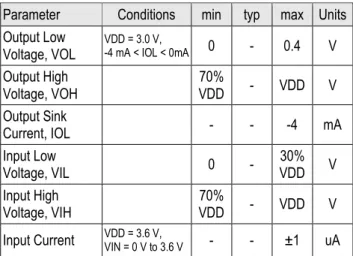
The electrical characteristics such as power consumption, low and high level input and output voltages depend on the supply voltage. For proper communication with the sensor it is essential to make sure that signal design is strictly within the limits given in Table 4 & 5 and Figure 9.
Parameter Conditions min typ max Units
Output Low
Voltage, VOL VDD = 3.0 V, -4 mA < IOL < 0mA 0 - 0.4 V Output High Voltage, VOH 70% VDD - VDD V Output Sink Current, IOL - - -4 mA Input Low Voltage, VIL 0 - 30% VDD V Input High Voltage, VIH VDD 70% - VDD V
Input Current VDD = 3.6 V, VIN = 0 V to 3.6 V - - ±1 uA
Table 4 DC characteristics of digital input/output pads. VDD = 2.1V to 3.6V, T = -40°C to 125°C, unless otherwise noted.
Figure 9 Timing Diagram for Digital Input/Output Pads, abbreviations are explained in Table 5. SDA directions are seen from the sensor. Bold SDA line is controlled by the sensor, plain SDA line is controlled by the micro-controller. Note that SDA valid read time is triggered by falling edge of anterior toggle.
SCL 30%70% tSCLL 1/fSCL tSCLH tR tF SDA 70%30% tSU tHD
SDA valid read
DATA IN
tR
SDA 70%30%
DATA OUT
tVD tF
SDA valid write
SDA SCL GND VDD MCU (master) RP RP SCL OUT SDA OUT SDA IN SCL IN C = 10 0n F STS21 (slave)
Parameter min typ max Units
SCL frequency, fSCL 0 - 0.4 MHz
SCL High Time, tSCLH 0.6 - - µs
SCL Low Time, tSCLL 1.3 - - µs
SDA Set-Up Time, tSU 100 - - ns
SDA Hold Time, tHD 0 - 900 ns
SDA Valid Time, tVD 0 - 400 ns
SCL/SDA Fall Time, tF 0 - 100 ns
SCL/SDA Rise Time, tR 0 - 300 ns
Capacitive Load on Bus Line, CB 0 - 400 pF
Table 5 Timing specifications of digital input/output pads for I2C
fast mode. Entities are displayed in Figure 9. VDD = 2.1V to 3.6V, T = -40°C to 125°C, unless otherwise noted. For further information regarding timing, please refer to
http://www.standardics.nxp.com/support/i2c/.
5
Communication with Sensor
STS21 communicates with I2C protocol. For information on I2C beyond the information in the following Sections please refer to the following website:
http://www.standardics.nxp.com/support/i2c/.
Please note that all sensors are set to the same I2C address, as defined in Section 5.3. 8
Furthermore, please note, that Sensirion provides an exemplary sample code for SHT21 sensors on its home page – compare www.sensirion.com/SHT21. This sample code can be used for STS21 sensors with minor adjustments (I2C address, no RH measurement).
5.1 Start Up Sensor
As a first step, the sensor is powered up to the chosen supply voltage VDD (between 2.1V and 3.6V). After power-up, the sensor needs at most 15ms, while SCL is high, for reaching idle state, i.e. to be ready accepting commands from the master (MCU). Current consumption during start up is 350µA maximum. Whenever the sensor is powered up, but not performing a measurement or communicating, it is automatically in sleep mode (idle state).
5.2 Start / Stop Sequence
Each transmission sequence begins with Start condition (S) and ends with Stop condition (P) as displayed in Figure 10 and Figure 11.
8 For sensors with alternative I2C address please contact Sensirion via
Figure 10 Transmission Start condition (S) - a high to low transition on the SDA line while SCL is high. The Start condition is a unique state on the bus created by the master, indicating to the slaves the beginning of a transmission sequence (bus is considered busy after a Start).
Figure 11 Transmission Stop condition (P) - a low to high transition on the SDA line while SCL is high. The Stop condition is a unique state on the bus created by the master, indicating to the slaves the end of a transmission sequence (bus is considered free after a Stop).
5.3 Sending a Command
After sending the Start condition, the subsequent I2C header consists of the 7-bit I2C device address „1001‟010‟ and an SDA direction bit (Read R: „1‟, Write W: „0‟). The sensor indicates the proper reception of a byte by pulling the SDA pin low (ACK bit) after the falling edge of the 8th SCL clock. After the issue of a measurement command, the MCU must wait for the measurement to complete. The basic commands are summarized in Table 6. Hold master
or no hold master modes are explained in the next Section.
Command Comment Code
Trigger T measurement hold master 1110‟0011 Trigger T measurement no hold master 1111‟0011
Write user register 1110‟0110
Read user register 1110‟0111
Soft reset 1111‟1110
Table 6 Basic command set, T stands for temperature 5.4 Hold / No Hold Master Mode
There are two different operation modes to communicate with the sensor: Hold Master mode or No Hold Master
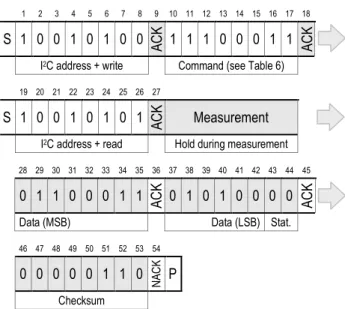
mode. In the first case the SCL line is blocked (controlled by sensor) during measurement process while in the latter case the SCL line remains open for other communication while the sensor is processing the measurement. No hold master mode allows for processing other I2C communication tasks on a bus while the sensor is measuring. A communication sequence of the two modes is displayed in Figure 12 and Figure 13, respectively.
SDA SCL 30%70% 70% 30% SDA SCL 30%70% 70% 30%
Datasheet STS21
www.sensirion.com Version 2 – December 2011 7/12
In the hold master mode, the STS21 pulls down the SCL line while measuring to force the master into a wait state. By releasing the SCL line the sensor indicates that internal processing is terminated and that transmission may be continued.
1 2 3 4 5 6 7 8 9 10 11 12 13 14 15 16 17 18
S 1 0 0 1 0 1 0 0 ACK 1 1 1 0 0 0 1 1 ACK
I2C address + write Command (see Table 6)
19 20 21 22 23 24 25 26 27
S 1 0 0 1 0 1 0 1 ACK Measurement
I2C address + read Hold during measurement
28 29 30 31 32 33 34 35 36 37 38 39 40 41 42 43 44 45
0 1 1 0 0 0 1 1 ACK 0 1 0 1 0 0 0 0 ACK
Data (MSB) Data (LSB) Stat.
46 47 48 49 50 51 52 53 54 0 0 0 0 0 1 1 0 N AC K P Checksum
Figure 12 Hold master communication sequence – grey blocks are controlled by STS21. Bit 45 may be changed to NACK followed by Stop condition (P) to omit checksum transmission. In no hold master mode, the MCU has to poll for the termination of the internal processing of the sensor. This is done by sending a Start condition followed by the I2C header (1001‟0101) as shown in Figure 13. If the internal processing is finished, the sensor acknowledges the poll of the MCU and data can be read by the MCU. If the measurement processing is not finished the sensor answers no ACK bit and the Start condition plus header byte must be issued once more.
For both modes, since the maximum resolution of a measurement is 14 bit, the two least significant bits (LSBs, bits 43 and 44) are used for transmitting status information. Bit 1 of the two LSBs indicates the measurement type („0‟: temperature). Bit 0 is currently not assigned.
In the examples given in Figure 12 and Figure 13 the sensor output is ST = „0110‟0011‟0101‟0000‟. For the calculation of physical values Status Bits must be set to „0‟ – see Chapter 6.
The maximum duration for measurements depends on the type of measurement and resolution chosen – values are displayed in Table 7. Maximum values shall be chosen for the communication planning of the MCU.
Please note: I2C communication allows for repeated Start conditions (S) without closing prior sequence with Stop condition (P) – compare Figure 12, Figure
13
and Figure18. Still, any sequence with adjacent Start condition may alternatively be closed with a Stop condition.
1 2 3 4 5 6 7 8 9 10 11 12 13 14 15 16 17 18
S 1 0 0 1 0 1 0 0 ACK 1 1 1 1 0 0 1 1 ACK
I2C address + write Command (see Table 6)
19 20 21 22 23 24 25 26 27
Measurement S 1 0 0 1 0 1 0 1
N
AC
K
measuring I2C address + read
19 20 21 22 23 24 25 26 27
Measurement S 1 0 0 1 0 1 0 1 ACK
continue measuring I2C address + read
28 29 30 31 32 33 34 35 36 37 38 39 40 41 42 43 44 45
0 1 1 0 0 0 1 1 ACK 0 1 0 1 0 0 0 0 ACK
Data (MSB) Data (LSB) Stat.
46 47 48 49 50 51 52 53 54 0 0 0 0 0 1 1 0 N AC K P Checksum
Figure 13 No Hold master communication sequence – grey blocks are controlled by STS21. If measurement is not completed upon “read” command, sensor does not provide ACK on bit 27 (more of these iterations are possible). If bit 45 is changed to NACK followed by Stop condition (P) checksum transmission is omitted.
Resolution T typ T max Units
14 bit 66 85 ms
13 bit 33 43 ms
12 Bit 17 22 ms
11 bit 9 11 ms
Table 7 Measurement times for T measurements at different resolutions. Typical values are recommended for calculating energy consumption while maximum values shall be applied for calculating waiting times in communication.
5.5 Soft Reset
This command (see Table 6) is used for rebooting the sensor system without switching the power off and on again. Upon reception of this command, the sensor system reinitializes and starts operation according to the default settings – with the exception of the heater bit in the user register (see Sect. 5.6). The soft reset takes less than 15ms.
1 2 3 4 5 6 7 8 9 10 11 12 13 14 15 16 17 18
S 1 0 0 1 0 1 0 0 ACK 1 1 1 1 1 1 1 0 ACK P
I2C address + write Soft Reset
5.6 User Register
The content of User Register is described in Table 8. Please note that reserved bits must not be changed and default values of respective reserved bits may change over time without prior notice. Therefore, for any writing to the User Register, default values of reserved bits must be read first. Thereafter, the full User Register string is composed of respective default values of reserved bits and the remainder of accessible bits optionally with default or non-default values.
Bit # Bits Description / Coding Default
7, 0 2 Measurement resolution „00‟ 14 bit „01‟ 12 bit „10‟ 13 bit „11‟ 11 bit „00‟
6 1 Status: End of battery9
„0‟: VDD > 2.25V „1‟: VDD < 2.25V
„0‟
3, 4, 5 3 Reserved
2 1 Enable on-chip heater „0‟
1 1 Disable OTP Reload „1‟
Table 8 User Register. Threshold value for End of Battery signal may vary by ±0.1V. Reserved bits must not be changed. “OTP reload” = „0‟ loads default settings after each time a measurement command is issued.
The end of battery alert is activated when the battery power falls below 2.25V.
OTP Reload is a safety feature and loads the entire OTP settings to the register, with the exception of the heater bit, before every measurement. This feature is disabled per default and is not recommended for use. Please use Soft Reset instead – it contains OTP Reload.
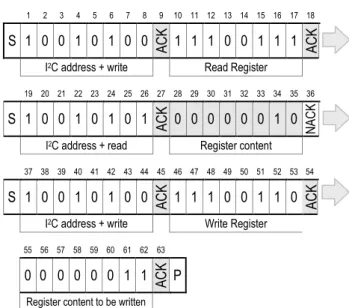
An example for I2C communication reading and writing the User Register is given in Figure 15.
5.7 CRC Checksum
STS21 provides a CRC-8 checksum for error detection. The polynomial used is x8 + x5 + x4 +1. For more details and implementation please refer to the application note “CRC Checksum Calculation for SHT2x”.
5.8 Serial Number
STS21 provides an electronic identification code. For instructions on how to read the identification code please refer to the Application Note “Electronic Identification Code” – to be downloaded from the web page www.sensirion.com/SHT21.
9 This status bit is updated after each measurement
1 2 3 4 5 6 7 8 9 10 11 12 13 14 15 16 17 18
S 1 0 0 1 0 1 0 0 ACK 1 1 1 0 0 1 1 1 ACK
I2C address + write Read Register
19 20 21 22 23 24 25 26 27 28 29 30 31 32 33 34 35 36
S 1 0 0 1 0 1 0 1 ACK 0 0 0 0 0 0 1 0
N
AC
K
I2C address + read Register content
37 38 39 40 41 42 43 44 45 46 47 48 49 50 51 52 53 54
S 1 0 0 1 0 1 0 0 ACK 1 1 1 0 0 1 1 0 ACK
I2C address + write Write Register
55 56 57 58 59 60 61 62 63
0 0 0 0 0 0 1 1 ACK P
Register content to be written
Figure 15 Read and write register sequence – grey blocks are controlled by STS21. In this example, the resolution is set to 12bit.
6
Conversion of Signal Output
Default resolution is set to 14 bit temperature reading. Measured data are transferred in two byte packages, i.e. in frames of 8 bit length where the most significant bit (MSB) is transferred first (left aligned). Each byte is followed by an acknowledge bit. The two status bits, the last bits of LSB, must be set to „0‟ before calculating physical values. In the example of Figure 12 and Figure 13, the transferred 16 bit temperature data is „0110‟0011‟0101‟0000‟ = 25424.
6.1 Temperature Conversion
The temperature T is calculated by inserting temperature signal output ST into the following formula (result in °C), no matter which resolution is chosen:
16T
2
S
175.72
46.85
T
7
Environmental Stability
The SHT2x sensor series were tested based on AEC-Q100 Rev. G qualification test method where applicable. Sensor specifications are tested to prevail under the AEC-Q100 temperature grade 2 test conditions listed in Table 910.
Datasheet STS21
www.sensirion.com Version 2 – December 2011 9/12
Environment Standard Results11
HTOL 125°C, 408 hours Within
specifications TC -50°C - 125°C, 1000 cycles Within
specifications UHST 130°C / 85%RH / ≈2.3bar, 96h Within
specifications THB 85°C / 85%RH, 1000h Within specifications ESD immunity HBM 4kV, MM 200V, CDM 750V/500V (corner/other pins) Qualified Latch-up force current of ±100mA with
Tamb = 125°C
Qualified
Table 9 Performed qualification test series. HTOL = High Temperature Operating Lifetime, TC = Temperature Cycles, UHST = Unbiased Highly accelerated Stress Test, THB = Temperature Humidity Biased. For details on ESD see Sect. 4.1. Sensor performance under other test conditions cannot be guaranteed and is not part of the sensor specifications. Especially, no guarantee can be given for sensor performance in the field or for customer‟s specific application.
If sensors are qualified for reliability and behavior in extreme conditions, please make sure that they experience same conditions as the reference sensor. It should be taken into account that response times in assemblies may be longer, hence enough dwell time for the measurement shall be granted. For detailed information please consult Application Note “Testing Guide”.
8
Packaging
8.1
Packaging Type
STS21 sensors are provided in DFN packaging (in analogy with QFN packaging). DFN stands for Dual Flat No leads.
The sensor chip is mounted to a lead frame made of Cu and plated with Ni/Pd/Au. Chip and lead frame are over molded by green epoxy-based mold compound. Please note that side walls of sensors are diced and hence lead frame at diced edge is not covered with respective protective coating. The total weight of the sensor is 25mg. 8.2 Sockets
For testing of STS21 sensors sockets, such as from
Plastronics, part number 10LQ50S13030 are
recommended (see e.g. www.locknest.com).
11 According to accuracy and long term drift specification given on Page 2.
8.3 Traceability Information
All STS21 are laser marked with an alphanumeric, five-digit code on the sensor – see Figure 16.
The marking on the sensor consists of two lines with five digits each. The first line denotes the sensor type (STS21). The first digit of the second line defines the output mode (D = digital, Sensibus and I2C, P = PWM, S = SDM). The second digit defines the manufacturing year (0 = 2010, 1 = 2011, etc.). The last three digits represent an alphanumeric tracking code. That code can be decoded by Sensirion only and allows for tracking on batch level through production, calibration and testing – and will be provided upon justified request.
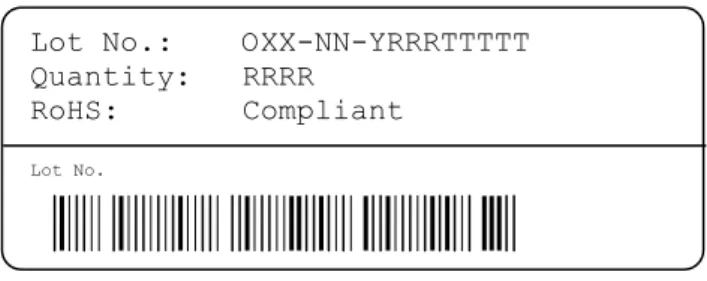
Figure 16 Laser marking on STS21. For details see text. Reels are also labeled, as displayed in Figure 17 and Figure 18, and give additional traceability information.
Figure 17 First label on reel: O = Output mode (D = Digital), XX = Sensor Type (21 for STS21), NN = product revision no., Y = last digit of year, RRR = number of sensors on reel divided by 10 (200 for 2000 units), TTTTT = Traceability Code.
Figure 18 Second label on reel: For Device Type and Part Order Number (See Packaging Information on page 2), Delivery Date (also Date Code) is date of packaging of sensors (DD = day, MM = month, YYYY = year), CCCC = Sensirion order number.
STS21
D0AC4
Device Type: 1-100PPP-NN
Description: Temperature Sensor STSxx
Part Order No. 1-100PPP-NN or Customer Number
Date of Delivery: DD.MM.YYYY
Order Code: 46CCCC / 0
Lot No.: OXX-NN-YRRRTTTTT
Quantity: RRRR
RoHS: Compliant
8.4 Shipping Package
STS21 are provided in tape & reel shipment packaging, sealed into antistatic ESD bags. Standard packaging sizes are 400, 1500 and 5000 units per reel. For STS21, each reel contains 440mm (55 pockets) header tape and 200mm (25 pockets) trailer tape.
The drawing of the packaging tapes with sensor orientation is shown in Figure 19. The reels are provided in sealed antistatic bags.
Figure 19 Sketch of packaging tape and sensor orientation. Header tape is to the right and trailer tape to the left on this sketch. 8.0 2.0 4.0 0.3 1.3 R0.3 MAX R0.25 Ø0.15 MIN Ø0.15 MIN 3.3 0.25 3. 3 1. 75 5. 5 12 .0
Datasheet STS21
www.sensirion.com Version 2 – December 2011 11/12
Revision History
Date Version Page(s) Changes
April 2011 0.3 all New preliminary release (based on SHT21 data sheet)
10 June 2011 0.4 2 Quantity of 5000 pcs. added to packaging information
15 July 2011 1 - Initial Release
December 2011 2 1, 2, 4, 6-8 Average power dissipation value, tolerance of threshold value for low battery signal, minor text adaptations and corrections.
Important Notices Warning, Personal Injury Do not use this product as safety or emergency stop devices or in
any other application where failure of the product could result in personal injury. Do not use this product for applications other than its intended and authorized use. Before installing, handling, using or servicing this product, please consult the data sheet and application notes. Failure to comply with these instructions could result in death or serious injury.
If the Buyer shall purchase or use SENSIRION products for any unintended or unauthorized application, Buyer shall defend, indemnify and hold harmless SENSIRION and its officers, employees, subsidiaries, affiliates and distributors against all claims, costs, damages and expenses, and reasonable attorney fees arising out of, directly or indirectly, any claim of personal injury or death associated with such unintended or unauthorized use, even if SENSIRION shall be allegedly negligent with respect to the design or the manufacture of the product.
ESD Precautions
The inherent design of this component causes it to be sensitive to electrostatic discharge (ESD). To prevent ESD-induced damage and/or degradation, take customary and statutory ESD precautions when handling this product.
See application note “ESD, Latchup and EMC” for more information. Warranty
SENSIRION warrants solely to the original purchaser of this product for a period of 12 months (one year) from the date of delivery that this product shall be of the quality, material and workmanship defined in SENSIRION‟s published specifications of the product. Within such period, if proven to be defective, SENSIRION shall repair and/or replace this product, in SENSIRION‟s discretion, free of charge to the Buyer, provided that:
notice in writing describing the defects shall be given to SENSIRION within fourteen (14) days after their appearance;
such defects shall be found, to SENSIRION‟s reasonable satisfaction, to have arisen from SENSIRION‟s faulty design, material, or workmanship;
the defective product shall be returned to SENSIRION‟s factory at the Buyer‟s expense; and
the warranty period for any repaired or replaced product shall be limited to the unexpired portion of the original period.
This warranty does not apply to any equipment which has not been installed and used within the specifications recommended by SENSIRION for the intended and proper use of the equipment. EXCEPT FOR THE WARRANTIES EXPRESSLY SET FORTH HEREIN, SENSIRION MAKES NO WARRANTIES, EITHER EXPRESS OR IMPLIED, WITH RESPECT TO THE PRODUCT. ANY AND ALL WARRANTIES, INCLUDING WITHOUT LIMITATION, WARRANTIES OF MERCHANTABILITY OR FITNESS FOR A PARTICULAR PURPOSE, ARE EXPRESSLY EXCLUDED AND DECLINED. SENSIRION is only liable for defects of this product arising under the conditions of operation provided for in the data sheet and proper use of the goods. SENSIRION explicitly disclaims all warranties, express or implied, for any period during which the goods are operated or stored not in accordance with the technical specifications.
SENSIRION does not assume any liability arising out of any application or use of any product or circuit and specifically disclaims any and all liability, including without limitation consequential or incidental damages. All operating parameters, including without limitation recommended parameters, must be validated for each customer‟s applications by customer‟s technical experts. Recommended parameters can and do vary in different applications.
SENSIRION reserves the right, without further notice, (i) to change the product specifications and/or the information in this document and (ii) to improve reliability, functions and design of this product.
Copyright© 2011, by SENSIRION.
CMOSens® is a trademark of Sensirion
All rights reserved
Headquarters and Subsidiaries
SENSIRION AG Laubisruetistr. 50 CH-8712 Staefa ZH Switzerland phone: +41 44 306 40 00 fax: +41 44 306 40 30 [email protected] www.sensirion.com
Sensirion Inc., USA phone: +1 805 409 4900
[email protected] www.sensirion.com
Sensirion Japan Co. Ltd. phone: +81 3 3444 4940
[email protected] www.sensirion.co.jp
Sensirion Korea Co. Ltd. phone: +82 31 345 0031 3
[email protected] www.sensirion.co.kr
Sensirion China Co. Ltd. phone: +86 755 8252 1501 [email protected] www.sensirion.com.cn Sensirion AG (Germany) phone: +41 44 927 11 66 [email protected]