No 164
Banking risk and regulation: Does one size fit all?
Jeroen Klomp and Jakob de Haan
CPB Discussion Paper
No 164
December 2010
Banking risk and regulation: Does one size fit all?
Jeroen Klomp and Jakob de Haan
2
CPB Netherlands Bureau for Economic Policy Analysis Van Stolkweg 14
P.O. Box 80510
2508 GM The Hague, the Netherlands
Telephone +31 70 338 33 80
Telefax +31 70 338 33 50
Internet www.cpb.nl
3
Abstract in English
Using data for more than 200 banks from 21 OECD countries for the period 2002 to 2008, we examine the impact of bank regulation and supervision on banking risk. Supervisory control, and regulations on capital and market entry have a significant impact on 'capital and asset risk', while supervisory control and regulations on activities restrictions, private monitoring, market entry, and liquidity, have a significant effect on 'liquidity and market risk'. However, quantile regressions suggest that the effect of regulation and supervision differs across banks: most indicators of bank regulation and supervision do not have a significant effect on low-risk banks, while they do affect high-risk banks.
Key words: Financial soundness, bank regulation and supervision, banking risk, quantile regression:
JEL code: E44, G2
Abstract in Dutch
Gebruik makend van data voor meer dan 200 banken uit 21 OECD landen voor de periode 2002 tot 2008 onderzoeken we het effect van bankregulering en supervisie op bankrisico. Supervisie en regulering van kapitaal en van toegang tot markten hebben een significant effect op
‘kapitaal- en asset risico’, terwijl supervisie en regulering van activititeitsrestricties, private monitoring, markttoegang en liquiditeit een significant effect hebben op ‘liquiditeits- en marktrisico’. Quantile regressies suggereren dat het effect van regulering en supervisie verschilt per bank: de meeste indicatoren van bankregulering en supervisie hebben geen significant effect op banken met een laag risico, terwijl ze wel effect hebben op banken met een hoog risico.
Steekwoorden: Financial soundness, bankregulering en supervisie, bankrisico, quantile regressies
1
Banking risk and regulation: Does one size fit all?
Jeroen Klomp
Wageningen University, The Netherlands
CPB Netherlands Bureau for Economic Policy Analysis, The Netherlands.
Jakob de Haan*
De Nederlandsche Bank, The Netherlands University of Groningen, The Netherlands
CESifo, Munich, Germany
This version, November 2010
Abstract
Using data for more than 200 banks from 21 OECD countries for the period 2002 to 2008, we examine the impact of bank regulation and supervision on banking risk. Su-pervisory control, and regulations on capital and market entry have a significant impact on 'capital and asset risk', while supervisory control and regulations on activities restric-tions, private monitoring, market entry, and liquidity, have a significant effect on 'li-quidity and market risk'. However, quantile regressions suggest that the effect of regula-tion and supervision differs across banks: most indicators of bank regularegula-tion and super-vision do not have a significant effect on low-risk banks, while they do affect high-risk banks.
Keywords: Financial soundness, bank regulation and supervision, banking risk, quan-tile regression
JEL Codes: E44, G2.
* Corresponding author: Jakob de Haan, De Nederlandsche Bank, P.O. Box 98, 1000 AB Amsterdam,
2
1. Introduction
The world wide financial crisis following the failure of Lehman Brothers in September 2008 has highlighted the importance of adequate banking regulation and supervision. The G20 recently approved a package of proposals of the Basel Committee on Banking Supervision to strengthen global capital and liquidity regulations in order to promote a more resilient banking sector.1
In view of its importance, it is quite remarkable that only a limited number of studies have examined the impact of bank regulation and supervision on bank fragility.2 This probably reflects the difficulty to measure bank regulation and supervision. Essen-tially two sources of information have been used to construct proxies for bank regula-tion and supervision.
Some studies use an index measuring the extent to which countries adhere to the Core Principles for Effective Bank Supervision as issued by the Basel Committee on Banking Supervision (BCPs). A good example is the study by Demirgüç-Kunt et al. (2008) who find a positive relationship between financial soundness and the overall index of BCP compliance, but this result is sensitive to controlling for the institutional quality of the country and to the exclusion of outliers.3 More recently, Demirgüç-Kunt and Detragiache (2010) have explored whether BCP compliance affects bank soundness as proxied by the Z-score, defined as the number of standard deviations by which bank returns have to fall to exhaust bank equity. Using data for 3,000 banks from 86 coun-tries, they do not find support for the hypothesis that better compliance with BCPs re-sults in sounder banks.
Compliance with the BCPs is mostly classified information. Furthermore, the BCP compliance indicator may be weakly associated with bank soundness, because it
1
See http://www.bis.org/press/p091217.htm.
2
Earlier theoretical work includes Blum (1999) and Calem and Rob (1999).
3
Also some older papers have used information on BCP compliance to study bank performance. Using a sample of 25 countries, Sundararajan et al. (2001) report that BCP compliance is not a significant deter-minant of bank soundness. Podpiera (2006) extends the sample to 65 countries covering the period 1998– 2002 and finds that better BCP compliance lowers non-performing loans. Das et al. (2005) relate bank soundness to a broader concept of regulatory governance, which encompasses both compliance with the BCPs and with standards and codes for monetary and financial policies. They report that better regulatory governance is associated with sounder banks, particularly in countries with better institutions.
3
proxies for the overall quality of the institutional and macroeconomic environment (Demirgüç-Kunt et al., 2008).
Alternatively, a few studies - including the present one - employ the World Bank survey on supervision to construct measures of bank regulation and supervision. In sev-eral surveys, Barth et al. (2004; 2008) collected detailed and comprehensive information on bank regulation and supervision for more than 107 countries between 1999 and 2008. Barth et al. (2004) analyze the effect of different dimensions of bank regulation and supervision on bank stability using an earlier version of the survey dataset. Their findings suggest that policies that induce accurate information disclosure and (incen-tives for) private sector corporate control of banks work best to promote banking sector stability. Also Pasiouaris et al. (2006) use this survey to construct indicators of bank regulation and supervision. Employing bank level data from 71 countries and 857 banks, they find that various dimensions of bank regulation and supervision have a sig-nificant impact on bank ratings.
Various studies on the impact of bank regulation and supervision on bank soundness use country-level data (cf. Barth et al., 2004 and Beck et al., 2006).4 In con-trast, we focus on the riskiness of individual banks. Our study is certainly not the first examining the impact of bank regulation and supervision using bank-level data (see, for instance, González, 2005; Demirgüç-Kunt et al., 2008; Fonseca and González, 2010). However, while most of these studies focus on one indicator of risk, we apply factor analysis to 25 indicators of banking risk to come up with our preferred measures of risk. Furthermore, most previous studies use panel models in which it is assumed that the effect of regulation and supervision on banking risk is homogenous. But in view of the heterogeneity of the banks and countries included, this assumption may be questioned (Pesaran et al., 1996; Pesaran et al., 2005). Indeed, Delis et al. (2009) report that the effect of capital regulation on risk taking by banks is heterogeneous across countries, while Beatty and Gron (2001) find that capital regulation has a significant effect on
4
Demirgüç-Kunt and Detragiache (2010) also calculate aggregate Z-scores at the country level to try to capture the stability of the system as a whole rather than that of individual banks, but also this measure of soundness is not significantly related to overall BCP compliance.
4
low-capital banks but not on other banks.5 Likewise, Hanson et al. (2008) show that neglecting heterogeneity in banking risk may lead to inconsistent estimation results. We therefore use a multilevel quantile regression model to estimate the relationship between bank regulation and supervision and banking risk. This approach, proposed by Koenker and Bassett (1978), allows us to derive different parameter estimates for various condi-tional quantiles of the risk distribution.
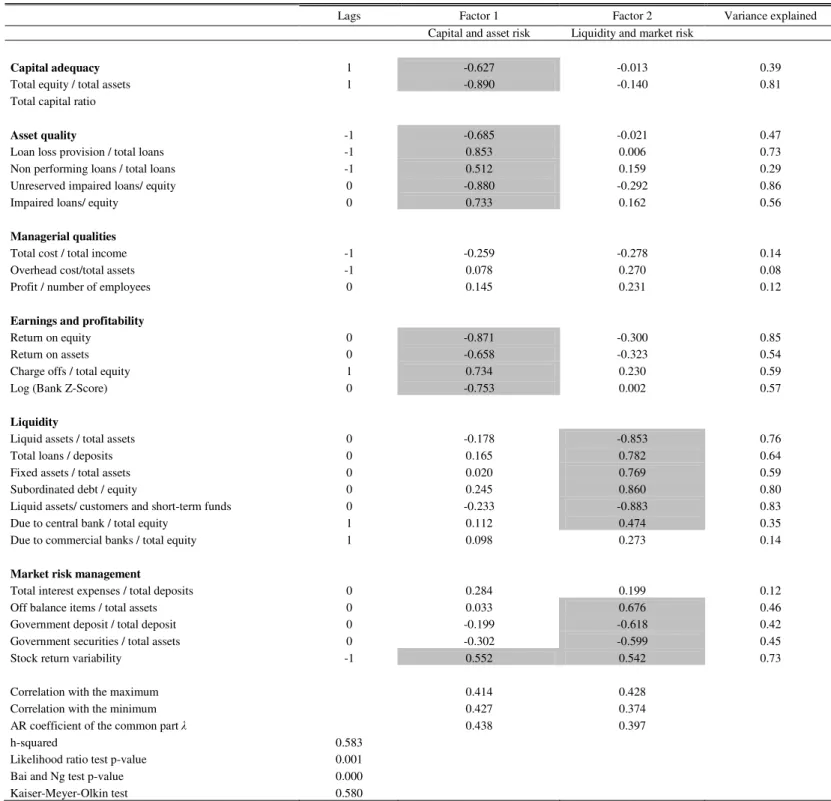
We apply a three-stage approach to examine how different dimensions of bank regulation and supervision affect banking risk. In the first stage, we apply dynamic fac-tor analysis to 25 indicafac-tors of banking risk and examine whether risk is multidimen-sional. For this purpose, we use Bankscope data for more than 200 banks in 21 OECD countries for the period 2002 to 2008. It turns out that two factors capture most of the variance of the various indicators of banking risk, which we label 'capital and asset risk' and 'liquidity and market risk'.
In the second stage, we use the data of Barth et al. (2004; 2008) to compute our proxies for bank regulation and supervision. Following Pasiouaris et al. (2006), we con-struct seven measures: 1) capital regulations; 2) regulations on private monitoring; 3) regulations on activities restrictions; 4) supervisory control; 5) deposit insurer’s power; 6) liquidity regulations, and 7) market entry regulations, respectively.
Finally, we examine to what extent the impact of bank regulation and supervi-sion differs across the risk distribution of banks using quantile regressupervi-sions. In order to estimate the impact of regulation and supervision on our measures of banking risk, we take a long list of potential control variables into account as suggested by previous stud-ies. Using the general-to-specific approach we decide on the specification of our model. We find that, on average, supervisory control, capital regulations, and market entry reg-ulations affect 'capital and asset risk', while, on average, supervisory control, and regu-lations on activities restrictions, private monitoring, market entry, and liquidity affect 'liquidity and market risk'. Most importantly, however, our results also suggest that our measures of bank regulation and supervision do not have a uniform impact on banking
5
A serious drawback of the studies of Delis et al. (2009) and Beatty and Gron (2001) is that the indicator of risk is chosen in a rather arbitrary way.
5
risk. While our measures of bank regulation and supervision do not have much effect on low-risk banks, they have a highly significant effect on high-risk banks.
The remainder of the paper is structured as follows. The next section describes the data and methodology used. Section 3 presents the results for the effect of bank reg-ulation and supervision on banking risk, while section 4 contains the sensitivity analy-sis. The final section discusses our results and concludes.
2. Data and methodology
2.1 Factor analysis: banking risk
Studies that examine bank behaviour usually employ a one-dimensional risk indicator, like the share of non-performing loans, return on equity, the Z-factor, capital ratios, or credit ratings. However, it is questionable whether these indicators fully capture bank-ing risk. For instance, Bou-Said and Saucier (2003) argue that risk indicators based on balance sheet data systematically underestimate risk. According to Gaganis et al. (2006) and Agoraki et al. (2010), indicators on asset quality, capitalization and market structure are more informative as an indicator of banking risk compared to indicators of profit-ability, efficiency and management qualities. This suggests that banking risk is multi-dimensional. Furthermore, most indicators based on balance sheet data contain some measurement error due to, for example, different calculation methods or on- and off balance issues (Zhao et al., 2009).
We use proxies for the International Monetary Fund (IMF)’s core set of Finan-cial Soundness Indicators or CAMEL indicators—i.e., capital adequacy, asset quality, earnings and profitability, and liquidity (IMF, 2000). There is broad agreement in the empirical literature that the CAMEL indicators are useful in grading banks in terms of their financial vulnerability. Supervisors often use (combinations of) these indicators to come up with an assessment of a bank’s soundness. However, there is no clear agree-ment in the literature on how exactly to combine the various CAMEL indicators. We therefore apply Dynamic Factor Analysis (DFA) to 25 CAMEL indicators for 219
6
banks in 21 OECD countries for the period 2002 to 2008.6 Factor analysis is a statistical data reduction technique used to explain variability among observed random variables in terms of fewer unobserved random variables called factors.7
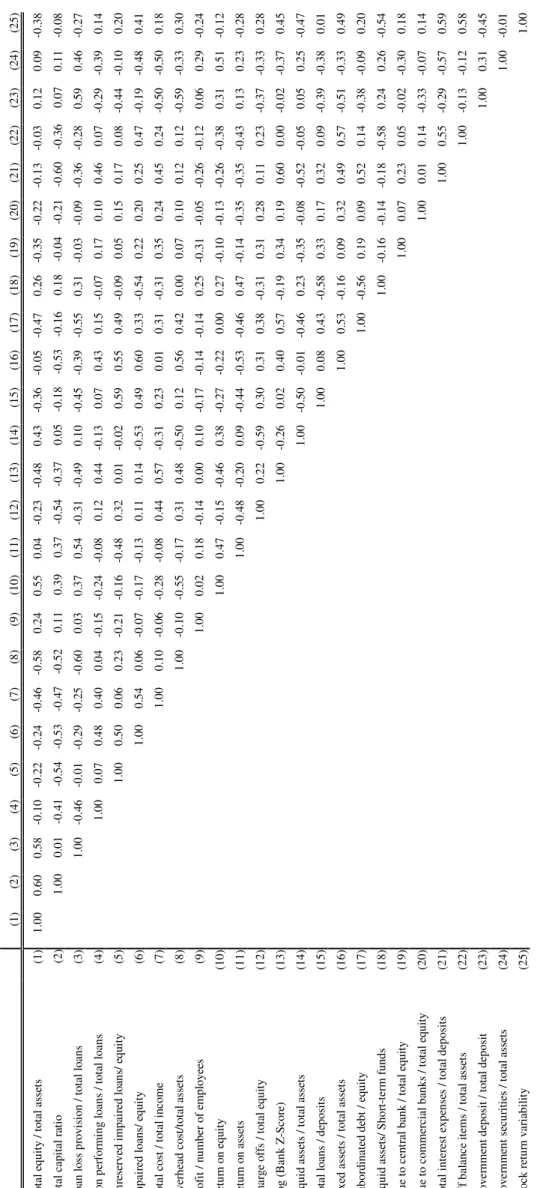
The commercial banks included in our sample are chosen mainly on the basis of data availability: we only include banks for which we have more than 75 percent of the data on the risk indicators used. For a few banks in our sample, some indicators are not available for all years. Overall, we have less than 15 percent missing observations. In order not to lose valuable information, we applied the EM algorithm of Dempster et al. (1977) to compute the missing observations. The variables used are shown in Table 1.8 The data is taken from Bankscope of Bureau van Dijk and Thomson Datastream. Table A2 in the Appendix shows the correlation matrix of the indicators used.
We divided the 25 indicators of bank risk in categories following the IMF (2000). The first group consists of indicators of capital adequacy. According to the IMF (2000), capital adequacy ultimately determines the robustness of financial institutions to shocks to their balance sheets. We measure capital adequacy using the ratio between total equity and total assets, and the total capital ratio (cf. Poghosyan and Čihák, 2009).
The second group consists of risk variables related to asset quality. We proxy asset quality by (1) the ratio of loan loss provisions and total loans, (2) the ratio of non-performing loans and total loans, (3) the ratio of unreserved impaired loans and equity, and (4) the ratio of impaired loans and equity. An increasing non-performing loans ratio signals a deterioration of the quality of the credit portfolio, which may affect the finan-cial soundness of the bank. It is often helpful to supplement this information with in-formation on non-performing loans net of provisions, and the ratio of provisions plus interest suspension on impaired loans to total loans—particularly, if impaired loans
6
The study by West (1985) is a first attempt to estimate banking risk using factor analysis. West con-cludes that banking risk is multidimensional and that each dimension is highly correlated with one of the CAMEL categories.
7
Cf. Lattin et al. (2003), Wansbeek and Meijer (2000) and Stock and Watson (2002). An appendix to this paper that is available upon request contains an extensive description of the dynamic factor analysis methodology.
8
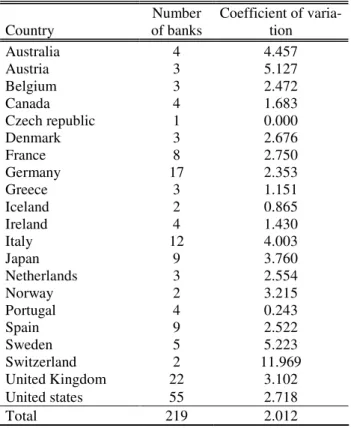
Table A1 in the appendix shows the distribution of the banks included in our sample across countries. The included banks are very diverse as is illustrated by the coefficient of variation of the total assets of the banks included.
7
have not yet been classified as non-performing (Poghosyan and Čihák, 2009; Shehzad et
al., 2010; IMF, 2000).
The third group of variables consists of indicators referring to managerial quali-ties. A high ratio of expenses to total revenues may indicate that financial institutions are not operating efficiently due to management deficiencies. We proxy managerial quality by three indicators: the ratio of total costs and total income, the ratio of overhead costs and total assets, and profits per employee.
The fourth group consists of risk indicators related to the profitability of a bank. Declining trends in profit indicators may signal problems regarding the sustainability of financial institutions. On the other hand, unusually high profits may signal excessive risk-taking. Our first proxy is the ratio of profits and average capital, which reflects the average return investors get from holding bank capital. The ratio has to be interpreted with caution, since a high (low) ratio may indicate both high (low) profitability as well as low (high) capitalization. As an alternative, we use the return on assets, which is commonly used to assess the risk of a financial institution (Shehzad et al., 2010). Next, we include the Z-score, which is the number of standard deviations below the mean by which returns would have to fall to wipe out bank equity. Finally, we use the ratio be-tween charge offs and total earnings as proxy for profitability.
The fifth group of variables consists of indicators of liquidity and leverage. As the case of Northern Rock has shown, insufficient liquidity may threaten the survival of a bank, notably so in case of severe maturity mismatches. A high leverage ratio may also indicate riskiness. We proxy liquidity and leverage by the following ratios: liquid assets to total assets, total loans to deposits, fixed assets to total assets, subordinated debt to equity, and liquid assets to short-term funds, debt due to the central bank, and debt due to other commercial banks.
Additional to the categories as distinguished by the IMF, we include a category related to market risk, i.e., the risk that the value of a portfolio will decrease due to price changes. According to the IMF (2000), banks are increasingly involved in diversified operations, all of which involve one or more aspects of market risk. A high share of
8
investments in volatile assets may signal a high vulnerability to fluctuations in the mar-ket value of those assets. Also some off-balance sheet items may have marmar-ket risk.
The correlation between the different indicators ranges between -0.60 and 0.89 and we therefore consider them as imperfect measures of banking risk. One problem is that some indicators are of an ex ante nature (e.g., loan ratios) while others are ex post
variables (e.g., capital and equity ratios). Whereas ex ante variables indicate a possible future risk, ex post variables indicate the presence of a risk. As a solution, we have es-timated various factor models with changing lags and leads (with a maximum of two years) and compare the models on the basis of different information criteria and the likelihood ratio statistics (cf. Klomp and De Haan, 2009). The various factor models are highly correlated with a correlation coefficient ranging between 0.81 and 0.89.9 The chosen lag lengths are shown in Table 1.
[Insert Table 1 here]
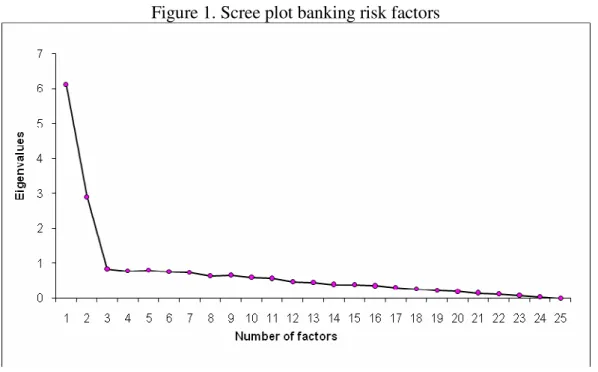
The next step is to decide on the number of factors to represent banking risk. There is no ‘optimal’ criterion for deciding on the proper number of factors. According to the so-called Kaiser criterion, all factors with eigenvalues below one should be dropped. Alternatively, the Cattell scree test, which is a graphical method in which the eigenvalues are plotted on the vertical axis and the factors on the horizontal axis, can be used. This test suggests to select the number of factors that corresponds to the point after which the remaining factors decline in approximately a linear fashion, and to retain only the factors above the elbow. Finally, information criteria, such as the information criterion proposed by Bai and Ng (2002), can be used.
According to both the Kaiser rule and the scree plot, banking risk can be repre-sented as a two dimensional construct (see Figure 1). The two-factor model is highly significant: the p-value of the likelihood ratio test is 0.001. Also the Bai and Ng
9
9
mation criterion suggests a two-factor model. We therefore decided that the two-factor model is appropriate to represent banking risk.
[Insert Figure 1 here]
Table 1 presents the loading of the various indicators and the variance of the indicators explained by the two-factor model. About sixty percent of the variance is explained by the two factors, while about forty percent of the total variance is unique, i.e., unex-plained.
We use oblimin rotation, which minimizes the correlation between columns of the factor loadings matrix, to interpret the factors. In the first factor, variables on capital adequacy and asset quality score high so we call this factor 'capital and asset risk'. In the second factor, variables related to market risk and liquidity risk score high so we call this factor 'liquidity and market risk'. The correlation between the two factors is only 0.28, suggesting that both factors measure a different dimension of banking risk.
The risk factors have a low degree of persistence as shown by the low correla-tion of the median score with the maximum or minimum score of the two factors (see Table 1). This is confirmed by the AR coefficient of the common part, which is signifi-cant but lower than 0.5. Figure 2 presents a comparative analysis of the two dimensions of banking risk. We find that both types of risk are accumulating over time. On average, the 'capital and asset risk' indicator is about 3.17, while the 'liquidity and market risk' indicator is about 2.42. However, there are large differences between banks as illus-trated by the standard deviation of the two risk measures (2.45 for 'asset and capital risk' and 2.12 for 'liquidity and market risk').
[Insert Figure 2 here]
To check the validity of our indicators, we first compare them with the average credit default swap premium over the period 2002 to 2008. A credit default swap is an insur-ance contract against the default risk of bank. The premium of a credit default swap
10
depends on the probability that the default risk materializes. The correlation between the credit default premium and 'capital and asset risk' is about 0.51 (p=0.000), while the correlation between the credit default premium and 'liquidity and market risk' is about 0.36 (p=0.001).
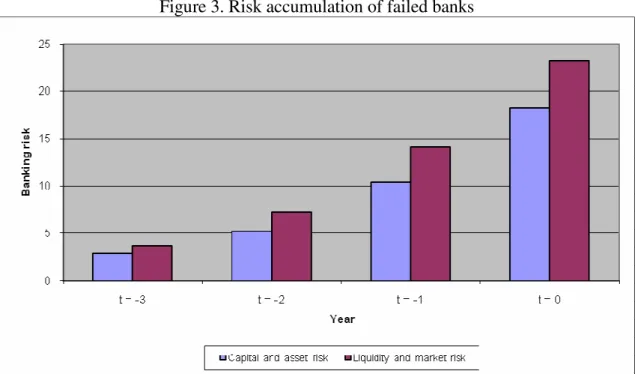
As a second step, Figure 3 shows the risks of banks, which drop from our sample (at t = 4) due to failure. The results show that, compared to Figure 2, these banks accu-mulated more risk. On average, the level of risk of institutions that failed is about six times larger than the average risk in our sample. Figure 3 also shows that 'liquidity and market risk' increases faster than 'capital and asset risk', suggesting that banks may first encounter liquidity problems which pass-through to capital and asset problems, for ex-ample, due to fire sales.
[Insert Figure 3 here]
As a robustness check, we re-estimated the factor analysis differentiating be-tween banks for which we have data for the full sample period and banks that disappear over time due to a failure, a merger or acquisition. We find that the factor loadings on the risk indicators are somewhat higher in the latter sample. However, the results for the two samples do not show large differences compared to the results presented above (re-sults are available upon request).10
2.2 Factor analysis: bank regulation and supervision
We use the survey data of Barth et al. (2004; 2008) to compute proxies for bank regula-tion and supervision. The survey consists of 175 quesregula-tions. Following Pasiouaris et al. (2006), we classified these questions into seven groups: 1) capital regulations; 2) regula-tions on private monitoring; 3) regularegula-tions on activities restricregula-tions; 4) supervisory con-trol; 5) deposit insurer’s power; 6) liquidity regulations, and 7) market entry regulations. In constructing our regulation variables, we use principle component analysis, which
10
The analysis shown in section 4 has also been done with these alternative factor models. The results (available upon request) are in line with those reported.
11
produces a factor score with mean zero and standard deviation one. An advantage of this method is that individual questions are not equally weighted.11 The one-dimensional factors explain between 70 and 85 percent of the total variance of the ques-tions included (results are available upon request).
The first measure refers to capital regulations and takes various issues into ac-count, like: can regulatory capital include borrowed funds, are the sources verified by the regulatory or supervisory authorities, are risk elements and value losses considered in calculating regulatory capital? Fernandez and González (2005) find that stringent capital requirements reduce banking risk. Similarly, Barth et al. (2004) indicate that more stringent capital requirements are associated with fewer non-performing loans.
The second dimension refers to regulations on private monitoring. This variable measures the degree of information that is released to officials and the public, and re-quirements concerning auditing and credit ratings. Fernandez and González (2005) and Barth et al. (2004) conclude that regulations that encourage and facilitate private moni-toring of banks increase financial soundness, as they lower moral hazard created by information asymmetries.
The third measure captures regulations on activity restrictions. Due to moral hazard, banks may increase risk if they are allowed a broad range of activities (Boyd et al. 1993). However, the empirical results of Barth et al. (2004) indicate the opposite: restricting bank activities is negatively associated with bank stability and increases the probability of a banking crisis. In contrast, Demirgüç-Kunt and Huizinga (2009) find that banking strategies that rely prominently on generating non-interest income or at-tracting non-deposit funding create financial instability.
The fourth dimension represents the ability of supervisors to exercise power and to get involved in banking decisions. This variable is related to the supervisor's power in terms of prompt corrective action, declaring insolvency, and restructuring. Strong su-pervisory control can prevent managers from engaging in excessive risk-taking
11
We also simply summed the individual zero/one answers. This method gives equal weight to each of the questions in constructing the regulatory variables. However, the results are very similar to those re-ported and are available upon request.
12
iour. Barth et al. (2004) do not confirm the hypothesis that there is a significant relation-ship between banking risk and official supervisory power, but Fernandez and González (2005) report that in countries with low accounting and auditing requirements more supervisory control appears to reduce risk.
The fifth measure covers deposit insurance and the power of the deposit insurer. According to Demirgüç-Kunt and Detragiache (2002), a deposit insurance system influ-ences bank soundness in two opposite ways. On the one hand, bank runs are less likely to occur when deposits are insured. On the other hand, a deposit insurance system pro-vides banks incentives to engage in more risk-taking. Barth et al. (2004) and Demirgüç-Kunt and Detragiache (2002) provide evidence that an explicit deposit insurance scheme tends to increase the probability of banking crises. The adverse impact of de-posit insurance tends to increase the more extensive the coverage of the scheme. Fur-thermore, the negative impact is stronger for schemes funded by the government rather than the private sector (cf. Demirgüç-Kunt and Kane, 2002).
The sixth regulatory dimension refers to liquidity regulations. Wagner (2008) finds that an increase in the homogeneity of banks’ balance sheets decreases the finan-cial soundness due to the joint exposure to liquidity problems in other banks at the in-terbank market caused by, for example, fire sales.
The final regulatory dimension reflects the ease with which the domestic bank-ing market can be entered. Competition might improve the vulnerability of the bankbank-ing sector to adverse shocks (Besanko and Thakor, 1992; Cordella and Yeyati, 2002). In-creased competition may also increase risk-taking behaviour of banks as it erodes the quasi-monopoly rents granted by the government charters and the value of the charters. Barth et al. (2004) indicate that barriers to foreign-bank entry are positively associated with bank fragility. Likewise, Beck et al. (2006) report that that banking systems where a large fraction of entry applications are denied and where regulations restrict banks from engaging in non-loan activities face a higher probability of a systemic crisis.
The correlation matrix in Table 2 shows that the correlation between the seven measures of bank regulation and supervision ranges between -0.12 and 0.37 indicating that the various measures capture different dimensions of the regulatory framework.
13
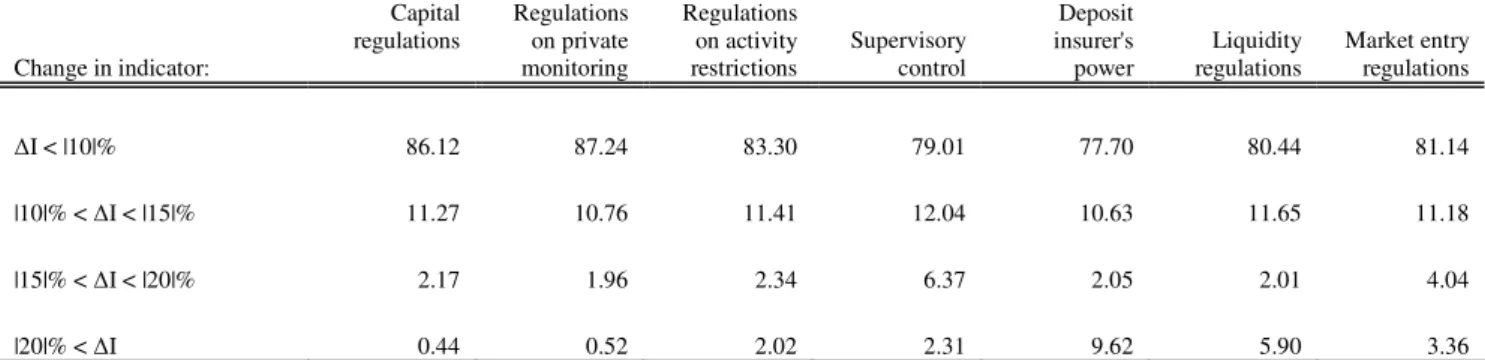
Table 3 categorizes the countries according to the difference between the maxi-mum and minimaxi-mum factor scores. Table 3 illustrates that the regulatory dimensions are quite constant. In most cases more than 80 percent of the countries have a difference between the maximum and minimum score of less than 10 percent. Due to the limited fluctuations over time of our indicators of banking regulation and supervision, the prob-ability that reverse causality (i.e. banking risk affects bank regulation and supervision) drives our findings seems limited.
[Insert Table 2 and Table 3 here]
2.3 Empirical model
In this section, we develop our model to examine the relationship between risk-taking by banks and bank regulation and supervision. As we include a large number of banks from different countries, our sample is very well suited to test whether our measures of banking regulation and supervision have a homogeneous impact on our proxies for banking risk. We use quantile regressions, as introduced by Koenker and Basset (1978), which is a generalization of median regression analysis to other quantiles.12 The median regression fits a regression line through all observations by minimizing the sum of abso-lute errors, i.e., it estimates the median of the conditional distribution. The τ-th quantile
of the conditional distribution is estimated by minimizing:
(Y X )
τ
φ − β (1)
with respect to β, where φτ( )u =u(τ −I u( <0)). This function can be interpreted as the inclination of bank riskiness (Y), which is dependent on observed variables (X) and a random error term (u). The conditional quantile function can be formally ex-pressed as:
12
See Koenker and Hallock (2001) for an extensive survey of quantile regressions in the economic litera-ture.
14 ' ( | ) ( ) i Y i i Q = τ x =xβ τ (2)
Estimating a whole set of quantile functions provides a richer description of the hetero-geneous relation between bank regulation and supervision and bank soundness. While standard regression estimators (like OLS) are not robust to modest departures from normality, quantile regression results are robust to outliers and distributions with heavy tails.13 Furthermore, the quantile regression approach avoids the restrictive assumption that the error terms are identically distributed at all points of the conditional distribu-tion. By allowing for parameter heterogeneity, the quantile regression approach is suit-able to explore how bank risk is related to our proxies for bank regulation and supervi-sion at different locations of the banking risk distribution.
As the risk of banks located in the same country may not be independent from one another, we use a multilevel model, which is a particular regression technique that is designed to take into account the hierarchical structure of data (Raudenbush and Bryk, 1987)14. The baseline quantile regression is given by:
t j t i t jt pijt p kijt ijt jt kijt ijt BR RI BR Z RI Qτ ( | )=ατ +θτ −1+βτ −1+γτ −1+η +ε, +ε , (3)
where BRkijt is the risk indicator of type k ('capital and asset risk and 'liquidity and
mar-ket risk') for bank i in country j at time t. We include the lagged dependent variable to control for autoregressive tendencies. Zpijt-1 is a vector of (lagged) control variables
con-taining p elements, while RI is a vector containing the measures of (lagged) bank regu-lation and supervision outlined above. The parameter ηt captures time fixed effects. The
13
The Jarque-Bera test for normality suggests that normality is rejected at the usual probability levels for both our proxies for bank risk. The p-value for 'capital and asset risk' is 0.08 and the p-value for 'liquidity and market risk' is 0.04. The non-normality of the distribution can also be illustrated that more than 30 percent of the observations are not in the non-outlier range of 2 times the standard deviation from the mean.
14
Alternatively one can use time fixed effects, country fixed effects and bank fixed effects. However, this decreases the number of degrees of freedom drastically.
15
final two terms are error terms measured on bank level i and country level j, respec-tively. The regression is estimated for τ-quantiles, where τ is the 25th, 50th, 75th, and 95th
quantile.15 We estimated the model on 'capital and asset risk' and 'liquidity and market risk' simultaneously using a system of two equations.
We include control variables suggested by previous studies. First, we control for macroeconomic factors: inflation, economic growth, depreciation of the exchange rate, external debt, current account balance, and shocks to the terms of trade (see also Beck et al., 2006). Adverse shocks affecting the economy will increase the instability of the financial system, for example, by affecting the solvency of borrowers, by increasing uncertainty, or by unexpected and excessive exposure to foreign exchange risk.16 We also include GDP per capita to control for differences in economic development.
According to Demirgüç-Kunt and Detragiache (1998), high short-term real in-terest rates affect bank balance sheets adversely if banks cannot increase their lending rates quickly enough and hence increase banking risk. Furthermore, Calvo et al. (1993) conclude that capital flows are sensitive to changes in the level of the world interest rate. Large capital inflows and capital flight may affect the stability of the financial sec-tor. Frankel (1999) argues that since the 1990s international private capital inflows have rapidly increased, raising financial vulnerability and the transmission of financial crises. To test whether banking sector risk is related to sudden capital outflows or changes in the foreign exchange reserves, we include the interest rate differential17, net financial
flows, and the ratio of M2 to foreign exchange reserves.
The government surplus as a percentage of GDP affects the financial room to manoeuvre of a government for intervening in a banking crisis through recapitalization and nationalization operations. According to Laeven and Valencia (2008), in about 85 percent of the banking crises the government had to recapitalize a bank, while in more than 57 percent of the crises the government even had to nationalize some banks.
15
We also estimated the regression for the 5th and 10th quantile. However, none of the measures of bank regulation and supervision are significant due to the small number of observations in these quantiles.
16
Goldstein et al. (2000) find that overvaluation of the real exchange rate is the key determinant of a financial crises.
17
Defined as the difference of the real interest rate of a country and the world interest rate. The world interest rate is defined as the average interest rate in the United States, Germany and Japan.
16
Keefer (1999) and Jo (2006) argue that not only the economic situation matters for financial soundness but also the political environment of a country. Keefer (1999) finds that the determinants of financial soundness are substantially different in countries with many checks and balances compared to countries with fewer checks and balances. Countries lacking a sound legal system and good governance might have more financial system problems due to corruption or inefficient enforcement of law and government ineffectiveness (Demirgüç-Kunt and Detragiache, 1998; La Porta et al., 1998; Levine, 1998; Barth et al., 2004; Fernandez and González, 2005). To capture this, we include a measure based on the first principal component of indicators of the control of corrup-tion, bureaucratic quality, rule of law, and democratic accountability of the International Country Risk Guide (2006).
Next, we include a measure to capture financial liberalization. Improperly im-plemented financial liberalization is likely to cause banking crises as financial institu-tions are allowed more opportunities for risk-taking in a liberalized financial market (Kaminsky and Reinhart, 1999). We proxy financial liberalization by including the first principal component of the indicators of credit controls, interest rate controls, capital account restrictions, and security market policy taken from Abiad et al. (2008).
In addition, we add a variable to check whether globalization affects the risk tak-ing behaviour of a bank (source: Dreher, 2006). This effect can be positive or negative, depending on the correlation with foreign financial shocks. If the correlation is positive, globalization will decrease the financial soundness, but when the correlation is negative globalization can have a smoothing effect on financial markets.
Finally, we control for concentration as De Nicolo et al. (2004) find that highly concentrated banking systems exhibit higher levels of systemic risk. In contrast, Beck et al. (2006) report that banking crises are less likely in more concentrated banking sys-tems.
We also include bank-level control variables. First, Berle and Means (1933) ar-gue that that ownership concentration improves financial soundness. Shezhad et al. (2010) and Laeven and Levine (2009) find that ownership concentration significantly affects loan quality and bank capitalization. We include a dummy variable taking the
17
value one if a bank has a shareholder who owns more than 25 percent of the bank con-cerned. We also include a dummy reflecting whether the government owns more than 50 percent of the stocks of a bank. Caprio and Martinez Peria (2001) and La Porta et al. (2002) find that government ownership is significantly associated with increases in bank fragility. We also include a dummy reflecting whether a bank is foreign owned. We include the natural logarithm of real total assets to control for the size of a bank. Finally, we include the number of subsidiaries as a proxy for diversification and business fran-chise power.
Table A3 in the appendix provides an overview of all variables, their definition as well as their source, while Table A4 presents a correlation matrix. All economic ex-planatory variables are lagged to avoid simultaneity and endogenity problems. The lag structure is determined by the Akaike Information Criterion. We also include the lagged 'capital and asset risk' measure as an explanatory variable in the 'liquidity and market risk' regression and vice versa.
Before we proceed, we have to deal with the potential endogeneity of bank regu-lation and supervision. Barth et al. (2004) argue that bank reguregu-lation and supervision is affected by the general policy stance of the government and reflects national differences in legal and political systems (see also Demirgüç-Kunt and Detragiache, 2010). To check for potential endogeneity of bank regulation and supervision, we use a 2SLS in-strumental regression model. We include a number of inin-strumental variables. First, we use the economic freedom index of the Fraser Institute and the ratio of total government spending to GDP, which both measure the involvement of the government in the eco-nomic process.18 Second, we include a political ideology indicator, which measures the policy preferences of the government on a scale from -1 (full leftwing) to +1 (full rightwing); source: Beck et al. (2001). Third, we take up a measure of central bank in-dependence, which measures differences in the independence of monetary policy mak-ers across countries, following the method of Klomp and De Haan (2010) and using the data of Arnone et al. (2007) and Acemoglu et al. (2008). These variables do not directly
18
18
impact risk-taking by banks. This is also reflected in the correlation between these vari-ables and our measures of banking risking, which is about zero. We estimate the quan-tile regressions using the methodology proposed by Chernozhukov and Hansen (2006, 2008) and Galvao (2009) by including also the lagged regressors as instruments to re-duce the bias associated with dynamic quantile regressions.
We check the validity of our instruments by the Amemiya-Lee-Newey mini-mum chi-square test under the null hypothesis that the used group of instruments is val-id, i.e., they are uncorrelated with the error term in the equation. We cannot reject the null hypothesis, indicating that our set of instruments is valid. Next, we apply the Wald test of exogeneity under the null hypothesis that the instrumented variables are exoge-nous. The results suggest that our bank regulation and supervision measures are not endogenous.
3. Empirical results
This section presents the estimation results on the effect of bank regulation and supervi-sion on our proxies for banking risk using quantile regressupervi-sions.
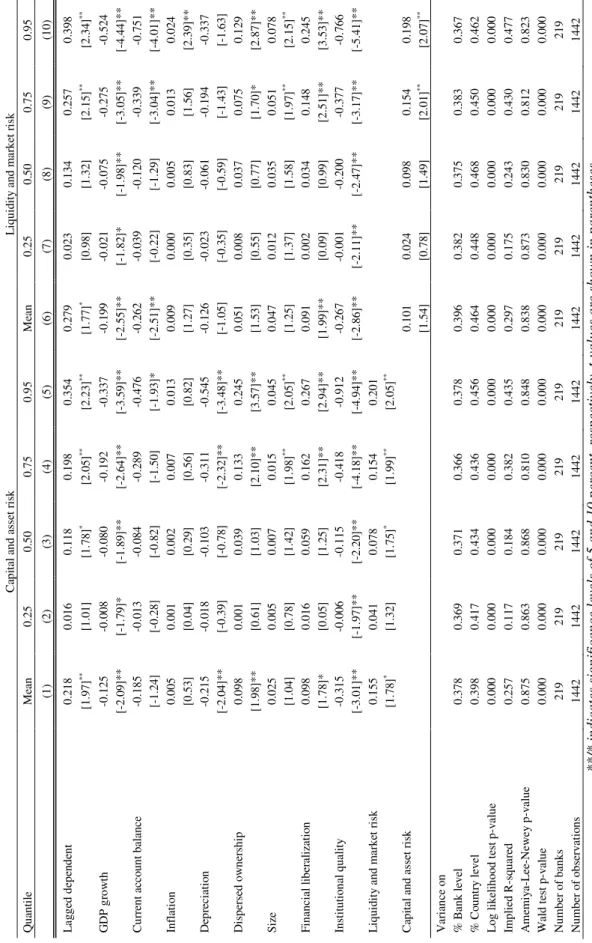
We formulate our baseline model using the general-to-specific approach. That is, we estimate a model including all control variables as outlined in the previous section, but without including our proxies for bank regulation and supervision. Next, we drop the least significant variable and estimate the model again. We repeat this procedure until only variables that are significant at a 10 percent level remain in at least one quan-tile (see Hendry, 1993). In view of the unequal distribution of the number of banks within a country, we cluster the Huber-White standard errors to obtain consistent stan-dard errors.19 Because our measures for bank regulation and supervision are estimated, we use bootstrapping to obtain consistent standard errors.
About 40 percent of the total variance in banking risk can be attributed to the variance at the country level. This implies that there is risk dependence within a country and that it is appropriate to use a multilevel model. Table 4 reports the estimated
19
For example, our sample contains 41 banks from the United States, while it only contains 2 banks from Denmark and Portugal.
19
ginal effects evaluated at the mean, which can be interpreted as elasticities, of the de-terminants of banking risk. Our results suggest that, on average, economic growth re-duces banking risk, while financial liberalization increases banking risk. In contrast, inflation and size are not significant in the mean regressions. Next, a current account deficit increases 'liquidity and market risk', while currency deprecation decreases and dispersed ownership increases 'capital and asset risk'. Finally, we find that better institu-tional quality decreases both types of risk over the entire condiinstitu-tional risk distribution. This confirms the results of Demirgüç-Kunt and Detragiache (1998) and Fernandez and González (2005) that corruption and bureaucracy increase the risk-taking behaviour of banks.
Table 4 also shows that the marginal effect of the control variables differs sig-nificantly across quantiles. For instance, the results indicate that dispersed ownership increases the risk-taking behaviour of banks with the highest risk. One explanation for this result is that it is caused by the free-riding behaviour of small shareholders. No sin-gle shareholder has the incentive to monitor bank management, because his personal cost will exceed the benefits. Likewise, the relative size of a bank significantly increases the riskiness of high-risk banks. Furthermore, financial liberalization has a positive ef-fect on banking risk for banks in the right tail of the risk distribution. Finally, we find that for the more riskier quantiles, 'liquidity and market risk' has an effect on 'capital and asset risk' and vice versa.
[Insert Table 4 here]
Next, we include our proxies for bank regulation and supervision in our baseline model. In Table 5 we report the total effect of these measures. That is, we report the sum of the direct effect of a measure and its indirect effect through the effect on the other type of risk. The share of the indirect effect to the total effect ranges between zero and 20 per-cent.20 This implies that regulation and supervision have the largest impact on banking
20
20
risk through their direct effect. The extent to which banking regulation and supervision has a heterogeneous impact can be illustrated by the standard deviation of the coeffi-cients which are reported in columns (6) and (12).
We first add our measure for capital regulation. The results show that, on aver-age, this type of regulation significantly decreases 'capital and asset' risk. If the level of capital regulation increases by one percent, 'capital and asset' risk decreases by 0.4 per-cent. However, the results also show that the impact is not uniform across quantiles. This confirms the results of Beatty and Gron (2001) and Delis et al. (2009). Capital reg-ulations are most effective for banks with high levels of 'capital and asset' risk.
Next, we include our proxy for regulations on private monitoring. The results indicate that these regulations decrease 'liquidity and market' risk, notably so for high-risk banks. This confirms the results of Barth et al. (2004). Regulations on private moni-toring do not affect 'capital and asset risk'.
Regulations on activities restrictions on average reduce 'liquidity and market risk', but again the effect is only significant for high-risk banks. This dimension of bank regulation and supervision also affects 'capital and asset' risk of high-risk banks.
In contrast to other dimensions of bank regulation and supervision, supervisory control significantly affects both types of risk for all banks. However, the effect is larger for riskier banks.
We do not find any effect of regulations on deposit insurance on the level of banking risk. Apparently, the opposing effects of a deposit insurance scheme on bank-ing risk cancel out.
The impact of liquidity regulations is also heterogeneous: although significant in the mean regression, they especially decrease ‘liquidity and market’ risk of high-risk banks.
Finally, market entry regulations reduce both types of risk, but again the effects are strongest for high-risk banks.
21
To sum up, we find that, on average, supervisory control, and regulations on capital and market entry have a significant impact on 'capital and asset risk', while supervisory con-trol and regulations on activities restrictions, private monitoring, market entry, and li-quidity, have a significant effect on 'liquidity and market risk'. However, quantile re-gressions suggest that the effect of regulation and supervision differs across banks: most indicators of bank regulation and supervision do not have a significant effect on low-risk banks, while they do affect high-low-risk banks.
4. Sensitivity analysis
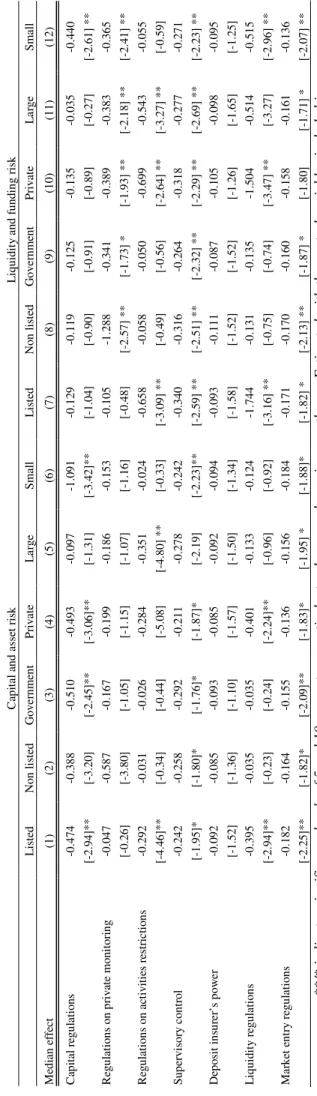
It is possible that the effect of bank regulation and supervision differs across various types of banks. For instance, Laeven and Levine (2009) argue that the same regulations may have different effects on bank risk-taking behaviour depending on the ownership structure of a bank. As a robustness check, we therefore split our sample as follows: listed vs. non-listed banks, and banks with public vs. banks with private ownership. An-other possibility is that regulation has a different effect on banks that differ in terms of their size. Therefore, we also split our sample into small and large banks.21
The first two columns of Table 6 show the results for listed vs. non-listed banks. We find that the effects of regulations on liquidity and activity restrictions are higher for listed banks, while the effect of regulations on private monitoring is significantly higher for non-listed banks.
In columns (3) and (4) of Table 6 we divide the sample into banks where the government owes more than fifty percent of the shares and banks that are privately held. The results indicate that restrictions on liquidity and activity have a stronger effect on risks of private banks.
In the final two columns of Table 6, we divide the total sample in banks with a total asset value of more 300 billion US dollar and banks with a total asset value below
21
The results for the quantiles of the various sample splits show a similar pattern as in Table 5. This im-plies that most regulatory proxies have the largest impact on high-risk banks (results are available upon request).
22
300 billion US dollar.22 The results in Table 6 indicate that regulations on activity re-strictions have the largest impact on large banks, while capital regulations have the largest effect on small banks.
In conclusion: our sensitivity results indicate that the effect of bank regulation and supervision on banking risk is not conditional only on the riskiness of a bank, but also on the ownership structure and the size of the bank.
[Insert Table 6 here]
5. Conclusions
The world wide financial crisis has led to renewed attempts to enhance bank regulation and supervision. Previous research has come up with mixed results concerning the ef-fectiveness of bank regulation and supervision in reducing banking risk. There are three major issues that have to be dealt with in examining the relationship between bank regu-lation and supervision and banking risk. First, there is no generally accepted definition of banking risk. As a solution, we apply factor analysis on 25 indicators of banking risk and examine whether risk is multidimensional. Using information for more than 200 banks in 21 OECD countries for the period 2002 to 2008, we conclude that two factors capture most of the variance of the various indicators of bank risk, which we label 'capi-tal and asset risk' and 'liquidity and market risk'. Second, bank regulation and supervi-sion is a multi-faceted concept as well. We have constructed seven measures of bank regulation and supervision, applying principal component analysis to the data of Barth et al., 2004; 2008). Finally, it is not clear whether the relationship between bank regula-tion and supervision and bank risk is homogeneous across banks. To deal with this is-sue, we have used quantile regressions; the quantiles are determined on the basis of the riskiness of the banks.
We find that supervisory control, capital regulations, and market entry regula-tions have a significant effect on 'capital and asset risk', while supervisory control and
22
23
regulations on activity restrictions, private monitoring, market entry restrictions, and liquidity have a significant effect on 'liquidity and market risk'. Our most important finding, however, is that the impact of bank regulation and supervision on banking risk is not uniform. Our results suggest that regulation and supervision do not have much effect on low-risk banks, while most of our measures for the various dimensions of bank regulation and supervision do have a highly significant effect on high-risk banks. In addition, our sensitivity analysis suggests that the effect of bank regulation and supervi-sion also depends on the ownership structure and the size of a bank.
Acknowledgements
We like to thank participants in seminars at the Chinese Academy of Sciences (Beijing) and the Essex Business School for their comments on a previous version of this paper.
24
References
Abiad, A., Detragiache, E., Tressel, T., 2008. A new database of financial reforms. IMF Working Paper 08/266.
Acemoglu, D, Johnson, S., Querubin, P., Robinson, J., 2008, When does policy reform work? The case of central bank independence. NBER Working Paper 14033. Agoraki, M., Delis, M., and Pasiouras, F., 2010. Regulations, competition and bank
risk-taking in transition countries. Journal of Financial Stability, forthcoming. Arnone, M., Laurens, B., Segalotto, J., Sommer, M., 2007, Central bank autonomy:
Lessons from Global Trends, IMF Working Paper 07/88. Bankscope (2009). Bureau van Dijk.
Barth, J., Caprio, G., Levine, R., 2004. Bank regulation and supervision: what works best? Journal of Financial intermediation 13, 205-248.
Barth, J., Caprio, G., Levine, R., 2008. Bank regulations are changing: for better or worse? World Bank Policy Research Working Paper 4646.
Beck, T., Clarke, G., Groff, A., Keefer, P., Walsh, P., 2001. New tools in comparative political economy: The database of political institutions. World Bank Economic Review 15, 165-176, Update 2005.
Beck, T., Demirgüç-Kunt, A., Levine, R., 2006. Bank concentration, competition, and crises: First results. Journal of Banking and Finance 30(5), 1581-1603.
Beatty A., Gron, A., 2001. Capital, portfolio, and growth: Bank behavior under risk-based capital guidelines. Journal of Financial Services Research 20, 5–31.
Berle, A., Means, C., 1933. The Modern Corporation and Private Property (Macmillian, New York).
Besanko, D., Thakor, A., 1992. Banking deregulation: Allocational consequence of re-laxing entry barriers. Journal of Banking and Finance 16, 909–932.
Blum, J., 1999. Do capital adequacy requirements reduce risks in banking? Journal of Banking and Finance 23, 755–771.
Bou-Said, M., Saucier, P., 2003. Liquidity, solvency and efficiency? An empirical anal-ysis of the Japanese banks’ distress’. Paper prepared for the 20th Symposium on Banking and Monetary Economics, June 2003, University of Birmingham.
25
Boyd, J., Graham, S., Hewitt, R. 1993. Bank holding company mergers with nonbank financial firms: Effects on the risk of failure. Journal of Banking and Finance 17, 43–63.
Calem, P., Rob, R., 1999. The impact of capital-based regulation on bank risk-taking. Journal of Financial Intermediation 8, 317–352.
Calvo, G., Leiderman, L., Reinhart, C., 1993. Capital inflows and real exchange rate appreciation in Latin America: The role of external factors. IMF Staff Papers 40, 108-151.
Caprio, G., Martinez Peria, A., 2001. Avoiding disaster: Policies to reduce the risk of banking crises. In Cardoso, E., Galal, A. (eds.), Monetary policy and exchange rate regimes: Options for the Middle East, 193-227, The Egyptian Center for Eco-nomic Studies, Cairo, Egypt.
Chernozhukov, V., and Hansen, C., 2006. Instrumental Quantile Regression Inference for Structural and Treatment Effects Models. Journal of Econometrics 132, 491– 525.
Chernozhukov, V., and Hansen, C., 2008. Instrumental Variable Quantile Regression: A Robust Inference Approach. Journal of Econometrics 142, 379–398.
Cordella T., Yeyati, E., 2002. Financial opening, deposit insurance, and risk in a model of banking competition. European Economic Review 46, 471–485.
Das, U.S., Iossifov, P., Podpiera, R., Rozkhov, D., 2005. Quality of financial policies and financial system stress. IMF Working Paper 05/173.
Datastream, 2009. Thomson Datastream.
Delis, M., Tran, K., Tsionas, E., 2009. Quantifying and explaining parameter heteroge-neity in the capital regulation-bank risk nexus. MPRA paper 18526.
Demirgüç-Kunt, A., Detragiache, E., 1998. The determinants of banking crises in de-veloping and developed countries. IMF Staff Papers 45, 81-109.
Demirgüç-Kunt, A., Detragiache, E., 2002. Does deposit insurance increase banking system stability? An empirical investigation. Journal of Monetary Economics 49, 1373–1406.
26
Demirgüç-Kunt, A., Detragiache, E., 2010. Basel core principles and bank soundness: Does compliance matter? Journal of Financial Stability, forthcoming.
Demirgüç-Kunt, A. Detragiache, E., Tressel, T., 2008. Banking on the principles: Com-pliance with Basel Core Principles and Bank Soundness. Journal of Financial In-termediation 17, 511-542.
Demirgüç-Kunt, A., Huizinga, H., 2009. Bank activity and funding strategies: The im-pact on risk and return. CentER Discussion paper 2009-09.
Demirgüç-Kunt, A., Kane E., 2002. Deposit insurance around the world: Where does it work? Journal of Economic Perspectives 16,175–195.
Dempster, A, Laird, N., Rubin, D., 1977. Maximum likelihood from incomplete data via the EM algorithm. Royal Statistical Society 39, 1-38.
De Nicolo, G., Bartholomew, P., Zaman, J., Zephirin, M., 2004. Bank consolidation, internationalization, and conglomeration: Trends and implications for financial risk. Financial Markets, Institutions, and Instruments 13, 173–217
Dreher, A., 2006. Does globalization affect growth? Evidence from a new index on globalization. Applied Economics 38, 1091-1110.
Fernandez, A., González, F., 2005. How accounting and auditing systems can counter-act risk-shifting of safety nets in banking: Some international evidence. Journal of Financial Stability 1, 466–500.
Fonseca, A.R., González, F., 2010. How bank capital buffers vary across countries: The influence of cost of deposits, market power and bank regulation. Journal of Bank-ing and Finance 34, 892–902.
Frankel, J., 1999. Preventing banking crises. In Caprio, G., Hunter, C., Kaufman, G., Leipsiger, D. (eds.), Preventing bank crises: Lessons from recent global bank fail-ures, pp. 3-12, World Bank Publications, Washington DC.
Gaganis, C., Pasiouras, F., and Zopounidis, 2006. A multicriteria decision framework for measuring banks’ soundness around the world. Journal of Multi-Criteria Deci-sion Analysis 14, 103-111.
Galvao, A., 2009. Quantile Regression for Dynamic Panel Data with Fixed Effects. Mimeo.
27
Goldstein, M., Kaminsky, G., Reinhart, C., 2000. Assessing financial vulnerability. Pe-terson Institute, Washington DC.
González, F., 2005. Bank regulation and risk-taking incentives: an international com-parison of bank risk. Journal of Banking and Finance 29, 1153-1184.
Hanson, S., Pesaran, M., Scheurman, T., 2008. Firm heterogeneity and credit risk diver-sification. Journal of Empirical Finance 15, 583-612.
Hendry, D., 1993. Econometrics, Alchemy or Science? Essays in Econometric Method-ology, Blackwell Publishers, Oxford, UK.
IMF, 2000. Macroprudential indicators of financial system soundness. Occasional Paper 192, Washington DC..
International Country Risk Guide, 2006, International Country Risk Guide, PRS Group. New York.
Jo, J., 2006, The link between domestic political institutions and Asian financial crisis. Asian Perspective 50(2), 127-145.
Kaminsky, G., Reinhart, C., 1999. The twin crises: The causes of banking and balance-of-payment problems. American Economic Review 89, 473-500.
Keefer, P., 1999, When do special interests run rampant? Disentangling the role of elec-tions, incomplete information and checks and balances in banking crises, World Bank Policy Research Working Paper No. 2543, Washington DC.
Klomp, J., De Haan, J. 2009. Central bank independence and financial instability. Jour-nal of Financial Stability 5, 321-338.
Klomp, J., De Haan, J. 2010. Central bank independence and inflation revisited. Public Choice 144, 445-457.
Koenker, R., Bassett, G., 1978. Regression quantiles. Econometrica 46, 33-50.
Koenker, R., Hallock, K., 2001. Quantile regression. Journal of Economic Perspectives 15, 143-156.
Laeven, L., and Levine, R., 2009. Bank governance, regulation and risk taking. Journal of Financial Economics, 93, 259-275.
28
Laeven, L., Valencia, F.V. 2008. Systemic banking crises: A new database. IMF Work-ing Paper 08/224.
La Porta, R., Lopez-de-Silanes, F., Shleifer, A.,Vishny, R., 1998. Law and finance. Journal of Political Economy 106, 1113–1155.
La Porta, R., Lopez-de-Silanes, F., Shleifer, A., 2002. Government ownership of com-mercial banks. Journal of Finance 57, 265–301.
Lattin, J., Carroll, D., Green P., 2003. Analyzing multivariate data. Duxbury Press. Pa-cific Grove, CA, Brooks/Cole.
Levine, R., 1998. The legal environment, banks and long-term economic growth. Jour-nal of Money, Credit, and Banking 30, 596–613.
Pesaran, M., Smith, R., 1m, K., 1996. Dynamic linear models for heterogenous panels. Chapter 8 in L. Matyas and P. Sevestre, (eds.), The Econometrics of Panel Data: A Handbook of the Theory With Applications (Kluwer Academic Publishers, Dordrecht), 45-195.
Pesaran, M., Scheurmann, T., Treutler, B., 2005. The Role of Industry, Geography and Firm Heterogeneity in Credit Risk Diversification, IEPR Working Paper 05.25, University of Southern California.
Pasiouras, F., Gaganis, C., Zopoundis, C., 2006. The impact of bank regulations, super-vision, market structure, and bank characteristics on individual bank ratings: A cross-country analysis. Review of Quantitative Finance and Accounting 27, 403-438.
Podpiera, R., 2006. Does compliance with Basel Core Principles bring any measurable benefits? IMF Staff Papers 53, 306-325.
Poghosyan, T., Čihák, M., 2009. Distress in European Banks: An Analysis Based on a
New Data Set. IMF Working Paper 09/9.
Raudenbush, S., Bryk, A., 1987. Examining correlates of diversity. Journal of Educa-tional and Behavioral Statistics, 12, 241-269.
Shehzad, C.T., De Haan, J., Scholtens, L.J.R., 2010. The impact of bank ownership concentration on impaired loans and capital adequacy. Journal of Banking and Fi-nance 34, 399-408.
29
Sundararajan, V., Marston, D., Basu, R., 2001. Financial system standards and financial stability—The case of Basel Core Principles. IMF Working Paper 01/62.
Stock, J., Watson, M., 2002. Forecasting using principal components from a large num-ber of predictors. Journal of the American Statistical Association 97, 1167-1179. Wagner, W., 2008. The homogenization of the financial system and financial crises.
Journal of Financial Intermediation 17, 330-356.
Wansbeek, T., Meijer, E., 2000. Measurement error and latent variables in economet-rics. North Holland, Amsterdam.
West, C., 1985. A factor analytic approach to bank condition. Journal of Banking and Finance 9, 253-266.
Zhao, H., Sinha, A., Ge, W., 2009. Effects of feature construction on classification per-formance: An empirical study in bank failure prediction. Expert Systems with Applications 36, 2633-2644.
30
Table 1. Dynamic factor analysis banking risk
Lags Factor 1 Factor 2 Variance explained Capital and asset risk Liquidity and market risk
Capital adequacy 1 -0.627 -0.013 0.39
Total equity / total assets 1 -0.890 -0.140 0.81 Total capital ratio
Asset quality -1 -0.685 -0.021 0.47
Loan loss provision / total loans -1 0.853 0.006 0.73 Non performing loans / total loans -1 0.512 0.159 0.29 Unreserved impaired loans/ equity 0 -0.880 -0.292 0.86 Impaired loans/ equity 0 0.733 0.162 0.56
Managerial qualities
Total cost / total income -1 -0.259 -0.278 0.14 Overhead cost/total assets -1 0.078 0.270 0.08 Profit / number of employees 0 0.145 0.231 0.12
Earnings and profitability
Return on equity 0 -0.871 -0.300 0.85 Return on assets 0 -0.658 -0.323 0.54 Charge offs / total equity 1 0.734 0.230 0.59 Log (Bank Z-Score) 0 -0.753 0.002 0.57
Liquidity
Liquid assets / total assets 0 -0.178 -0.853 0.76 Total loans / deposits 0 0.165 0.782 0.64 Fixed assets / total assets 0 0.020 0.769 0.59 Subordinated debt / equity 0 0.245 0.860 0.80 Liquid assets/ customers and short-term funds 0 -0.233 -0.883 0.83 Due to central bank / total equity 1 0.112 0.474 0.35 Due to commercial banks / total equity 1 0.098 0.273 0.14
Market risk management
Total interest expenses / total deposits 0 0.284 0.199 0.12 Off balance items / total assets 0 0.033 0.676 0.46 Government deposit / total deposit 0 -0.199 -0.618 0.42 Government securities / total assets 0 -0.302 -0.599 0.45 Stock return variability -1 0.552 0.542 0.73 Correlation with the maximum 0.414 0.428
Correlation with the minimum 0.427 0.374 AR coefficient of the common part λ 0.438 0.397
h-squared 0.583
Likelihood ratio test p-value 0.001 Bai and Ng test p-value 0.000
Kaiser-Meyer-Olkin test 0.580 * For some banks the stock return is not available. We used the credit default premium variability for these banks, which is highly correlated with stock return variability. All data come from Bankscope, except stock return variability, which is taken from Data-stream. The shaded loadings are above 0.4, indicating that these indicators are relevant in capturing this type of risk.
31
Table 2. Correlation matrix: bank regulation and supervision variables
(1) (2) (3) (4) (5) (6) (7) Capital regulations (1) 1.00 -0.12 -0.04 -0.05 -0.09 -0.12 0.01 Regulations on private monitoring (2 1.00 0.17 0.08 0.12 0.22 0.22 Regulations on activity restrictions (3) 1.00 0.23 0.08 0.37 0.12 Supervisory control (4) 1.00 -0.09 -0.12 0.18 Deposit insurer’s power (5) 1.00 -0.05 -0.04 Liquidity regulations (6) 1.00 0.13 Market entry regulations (7) 1.00
Table 3. Changes in bank regulation and supervision
Change in indicator: Capital regulations Regulations on private monitoring Regulations on activity restrictions Supervisory control Deposit insurer's power Liquidity regulations Market entry regulations ∆I < |10|% 86.12 87.24 83.30 79.01 77.70 80.44 81.14 |10|% < ∆I < |15|% 11.27 10.76 11.41 12.04 10.63 11.65 11.18 |15|% < ∆I < |20|% 2.17 1.96 2.34 6.37 2.05 2.01 4.04 |20|% < ∆I 0.44 0.52 2.02 2.31 9.62 5.90 3.36
The table shows the share of countries in the individual categories. The categories are based on the x% percent absolute change between the maximum and minimum score of a country in a particular regula-tory dimension.