Community Pharmacy Security
Resource Guide (2015)
A companion document to
Page 1 of 44 1040-PPP74_ResourceGuide_2015.2.docx September 02,2015
PPP-74
T
ABLE OFC
ONTENTS1.0 Foreword ... 3
2.0 How to use the Guide ... 3
2.1 Disclaimer ... 3
2.2 Acknowledgement ... 4
2.3 Feedback ... 4
3.0 Implementation Timeline ... 4
4.0 Definitions ... 5
5.0 Policy Statements and Clarifications ... 7
5.1 Policies and Procedures ... 7
5.2 Training ... 8
5.3 Compliance ... 8
5.4 Notifying the College of Non-Cooperation ... 9
5.5 Reporting an Incident ... 10
5.6 Security Equipment ... 14
5.6.1 Safe ... 15
5.6.2 Cameras ... 16
5.6.3 Monitored Alarm Systems ... 18
5.6.4 Security Barriers ... 19
5.6.5 Motion Sensors ... 20
5.7 Signage ... 20
5.8 Inventory Control ... 22
5.9 Emergency Response Kit ... 23
5.10 Incident Review ... 23
5.11 Pharmacy Security Evaluation ... 24
Appendix A: Professional Practice Policy-74 ... 25
Appendix B: Relevant Legislation ... 29
Page 2 of 44 1040-PPP74_ResourceGuide_2015.2.docx September 02,2015
PPP-74
Appendix D: Situational Crime Prevention Tool ... 35
Appendix E: Camera Systems Reference ... 36
Appendix F: Emergency Security Kit Example ... 37
Appendix G: Declaration Forms ... 38
Appendix H: Additional Resources ... 42
Page 3 of 44 1040-PPP74_ResourceGuide_2015.2.docx September 02,2015
PPP-74
1.0
F
OREWORDIn response to the increasing number of pharmacy robberies in British Columbia, in both frequency and severity, the College Board has determined that a higher level of security measures are required in community pharmacies to protect the public as well as pharmacy employees. When a robbery occurs pharmacy employees are put at risk of physical and psychological harm. The public becomes vulnerable to identity theft as well their safety becomes compromised as the stolen drugs are sold illicitly on the streets.
In 2013, the Board established a Robbery Prevention Working Group (RPWG) to develop
security requirements to prevent robbery and break and enter in community pharmacies in BC. The RPWG was tasked with providing recommendations to the Board regarding pharmacy security standards, policies, and/or bylaws.
The working group met four times between September 2013 and February 2015. During which time, the RPWG drafted a security policy entitled Professional Practice Policy-74 Community Pharmacy Security (PPP-74) (Appendix A) which outlines the minimum security requirements for community pharmacies in BC. In drafting the policy, the working group was cognizant of the differences in community pharmacy premises and focused on ensuring that only the minimum requirements were listed that would be feasible to implement at all pharmacy premises while at the same time aiming to achieve the goal of decreasing robbery and break and enter occurrences. The policy supplements existing applicable legislation (Appendix B). PPP-74 was approved by the Board at their February 2015 Board meeting with an implementation date of September 15, 2015 to allow for transition.
In order to effectively implement the requirements, it is highly recommended that all pharmacies contact a security specialist for assistance.
2.0
H
OW TO USE THEG
UIDEThis guide is a companion to Professional Practice Policy-74 Community Pharmacy Security (PPP-74). The intention of the guide is to provide pharmacy owners, directors, managers and registrants with further detail and clarity, as well as useful tools and resources to assist in the implementation of the policy.
2.1 Disclaimer
This document is not intended to cover all possible security measures or scenarios. It is highly recommended that all pharmacy owners and directors contact a security specialist for
Page 4 of 44 1040-PPP74_ResourceGuide_2015.2.docx September 02,2015
PPP-74
2.2 Acknowledgement
The development of PPP-74 and this Guide involved a collaborative and consultative process with input and feedback gathered from the volunteer members of the RPWG, and the support of the Vancouver Police Department (VPD). The RPWG was composed of registrants, corporate and health authority representatives, and representatives from the VPD. Feedback was also sought from security and privacy experts as well as academia.
The College of Pharmacists of BC would like to sincerely thank each of these individuals and organizations for their invaluable feedback and expertise in the creation of PPP-74 and the companion resource guide.
2.3 Feedback
Questions and comments about this guide are welcome and can be sent to: College of Pharmacists of British Columbia Telephone:
200 – 1765 West 8th Avenue 604-733-2440 or 800-663-1940
Vancouver, BC V6J 5C6 Facsimile:
Web site: www.bcpharmacists.org 604-733-2493 or 800-377-8129 E-mail: [email protected]
3.0
I
MPLEMENTATIONT
IMELINEEffective September 15, 2015.
All necessary requirements set out in PPP-74 must have been implemented, unless otherwise stated.
Page 5 of 44 1040-PPP74_ResourceGuide_2015.2.docx September 02,2015
PPP-74
4.0
D
EFINITIONS“Community Pharmacy” (PODSA bylaws)
Means a pharmacy licensed to sell or dispense drugs to the public.
(Note: this includes telepharmacy remote sites.)
“Dispensary” (PODSA bylaws)
Means the area of a community pharmacy that contains Schedule I and II drugs.
“High Definition” (PPP-74)
Means a resolution that is substantially higher than that of standard definition therefore resulting in images that are sharper and have greater picture detail.
“Narcotic and Controlled Drugs” (PPP-74)
Means Schedule 1A drugs (Triplicate/Duplicate Prescription Program) for the purposes of this policy.
“Pharmacy” (PODSA)
Means the area of a premise licensed under PODSA where drugs or devices may be: a. stored, or
b. dispensed or sold to the public.
“Safe” (PPP-74)
Means a strong, heavy metal “box” equipped with a time-delay lock, used for storing narcotics and controlled drugs.
“Security Barriers” (PPP-74)
Means a physical barrier, such as securely locked grillwork/gate, that provides an additional layer of security and deters and prevents:
1. Unauthorized access and disclosure (which includes sight) of all patient and personal health information including but not limited to:
Page 6 of 44 1040-PPP74_ResourceGuide_2015.2.docx September 02,2015
PPP-74
Filled prescriptions waiting to be picked up, and/or
Labels, patient profiles, and any other personal health information documents waiting for disposal.
2. Unauthorized access, including but not limited to:
Computer hard drives,
All Schedule I, II and III drugs.
“Targeted narcotic and controlled drugs” (PPP74)
Means Schedule 1A drugs for the purpose of this policy.
“100% of the premise”
Means the community pharmacy licensed premise that includes the dispensary plus the professional products area (25’).
Page 7 of 44 1040-PPP74_ResourceGuide_2015.2.docx September 02,2015
PPP-74
5.0
P
OLICYS
TATEMENTS ANDC
LARIFICATIONS5.1 Policies and Procedures
Policy Statement:
All pharmacy owner(s) and director(s) must:
Ensure that written policies and procedures are developed, implemented and maintained to establish pharmacy security requirements for the prevention of robbery and break and enter.
o The policies and procedures must incorporate the following minimum requirements (…)
Ensure that critical stress debriefing and stress counseling are offered as soon as possible following an incident.
Clarification
Policies and procedures should incorporate all elements of PPP-74 and outline responsibilities and accountabilities for each requirement and be included in the pharmacy’s policy and procedure document.
A sample list of resources for critical stress debriefing is available in Appendix C.
Employers should check with Worksafe BC regarding recent amendments to their legislation. The College is advised that the BC Workers Compensation Amendment Act, 2011 (WCAA)
https://www.leg.bc.ca/39th4th/3rd_read/gov14-3.htm outlines that a worker who experiences a mental disorder as a reaction to “one or more traumatic events arising out of and in the course of the worker’s employment” or which is “predominantly caused by a significant work-related stressor, or a cumulative series of significant work-work-related stressors” may be eligible for compensation under the WCAA.
Page 8 of 44 1040-PPP74_ResourceGuide_2015.2.docx September 02,2015
PPP-74
5.2 Training
Policy Statement:
The pharmacy manager must:
Ensure that existing staff and new hires undergo training on the above mentioned policies and procedures, PPP-74, and the Community Pharmacy Security Resource Guide and are retrained on a minimum yearly basis to maintain knowledge.
Clarification
Staff training is critical from a preventative perspective and also in the event of a robbery, should one occur. Training should incorporate formal training and ongoing maintenance of skills for the staff. Training should include: (a) operation of security-relevant equipment, such as security cameras, alarms, safes, etc., (b) what to do in the event of a robbery and (c) how to handle potential precursors to robbery (the presence of suspicious customers and fishing style phone calls).
5.3 Compliance
Policy Statement:
Notify the pharmacy owner(s) and director(s) immediately if the minimum
requirements are not being met and take immediate action to ensure compliance with this policy.
Clarification
If any of the security equipment is not functioning properly or there has been a breach of policy, the manager must make the owners and directors aware and ensure appropriate action is taken to resolve the issue(s).
Page 9 of 44 1040-PPP74_ResourceGuide_2015.2.docx September 02,2015
PPP-74
5.4 Notifying the College of Non-Cooperation
Policy Statement:
Notify the CPBC Complaints Resolution Department as soon as possible via the complaints line 778-330-0967 of non-cooperation of the pharmacy owner(s) and director(s) with this policy.
Clarification
If the manager has taken steps to address any deficiencies and is not able to comply with this policy due to non-cooperation of the owner(s) or director(s), then the manager must report this to the College as soon as possible.
Page 10 of 44 1040-PPP74_ResourceGuide_2015.2.docx September 02,2015
PPP-74
5.5 Reporting an Incident
Policy Statement:
Notify the College Registrar within 24 hours of an occurrence (via e-Services portal) of any of the following:
o Robbery (armed/unarmed) or attempted robbery o Break and enter
o Forgery o Theft
o Drug loss (unexplained or adulterated)
Note: If the pharmacy manager is not available, notification can be delegated by the pharmacy manager to a CPBC registrant.
Clarification
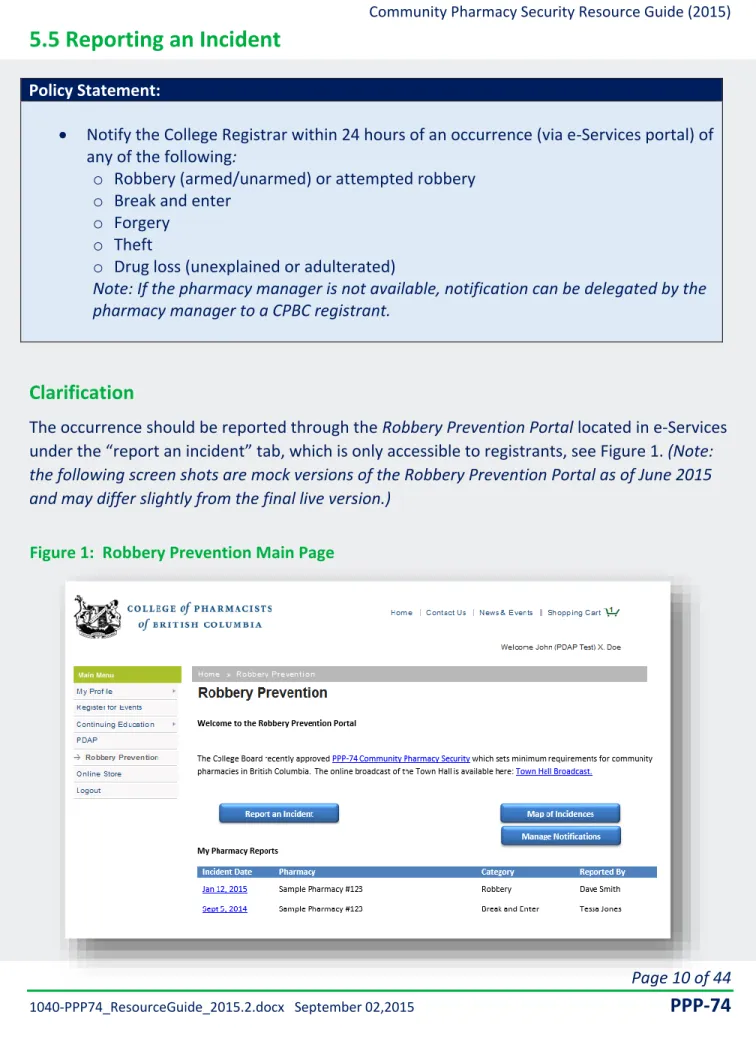
The occurrence should be reported through the Robbery Prevention Portal located in e-Services under the “report an incident” tab, which is only accessible to registrants, see Figure 1. (Note: the following screen shots are mock versions of the Robbery Prevention Portal as of June 2015 and may differ slightly from the final live version.)
Page 11 of 44 1040-PPP74_ResourceGuide_2015.2.docx September 02,2015
PPP-74
Policy Statement:
Notify the College Registrar (via e-Services portal) of the name and count of the top 5 (by quantity) targeted narcotic and controlled drugs that were taken or diverted within 24 hours of an occurrence.
Clarification
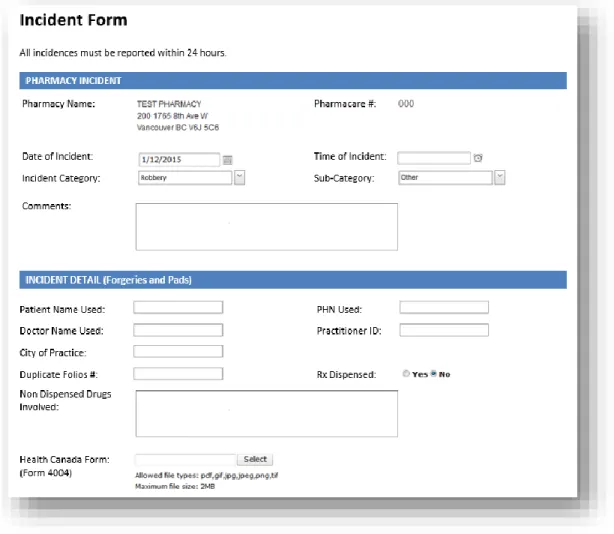
In the Robbery Prevention Portal on e-Services click on the “report an incident” tab. Registrants are then prompted to complete an online Incident Form shown in Figure 2.
Page 12 of 44 1040-PPP74_ResourceGuide_2015.2.docx September 02,2015
PPP-74
The online Incident Form will provide a drop down menu and search functions to assist in reporting the narcotic and controlled drugs stolen, see Figure 3.
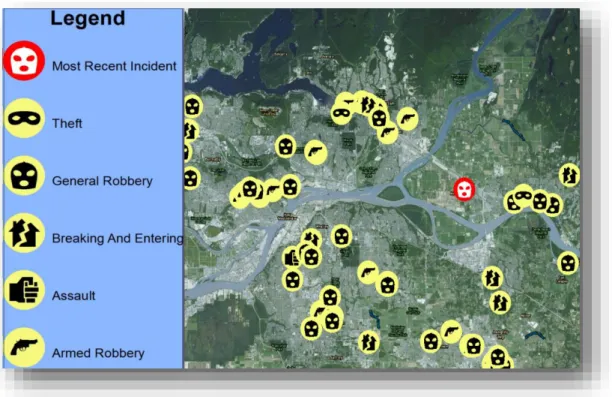
Once the information is entered into the online Incident Form, it will automatically populate a “robbery map”, see Figure 4. This map will only be available to registrants via the Robbery Prevention Portal. It will provide real-time information regarding pharmacy crime as noted in the legend. This information will be available in addition to the usual fanouts sent to pharmacy managers through PharmaNet. Details regarding the crime can be found on the map, which will also highlight crime trends so that registrants can be well informed and take any necessary precautions.
Page 13 of 44 1040-PPP74_ResourceGuide_2015.2.docx September 02,2015
PPP-74
Policy Statement:
Provide the College Registrar (via e-Services portal) a copy of the Health Canada report (Form HC 4010 or HC 4004) that provides the complete inventory of drugs (including the drug count) that were taken or diverted within 10 days of an occurrence.
Clarification
When the applicable Health Canada form (
http://www.hc-sc.gc.ca/hc-ps/substancontrol/substan/compli-conform/loss-perte/index-eng.php) has been completed, a copy of the form should be uploaded through the robbery prevention portal via the online
Incident Form to the section outlined in Figure 5.
Page 14 of 44 1040-PPP74_ResourceGuide_2015.2.docx September 02,2015
PPP-74
5.6 Security Equipment
The requirements of sections 1, 2 and 3 of PPP-74 have been established to reduce the
attractiveness, or harden the target, of pharmacies for robbery, break and enter, drug diversion and privacy breaches. The requirements have been informed by the experience of law
enforcement, security experts, researchers in crime prevention, privacy experts, as well as by pharmacy professionals.
The recommendations are driven by Situational Crime Prevention which is a preventative approach to reducing opportunities of crime, including the circumstances that allow particular types of crime. With the requirements of PPP-74, the College aims to make robbery, break and enter and drug diversion less appealing, and thus protect pharmacy professionals and the public. The policy requires layers of security to be implemented.
Experts advise that camera systems, motion detectors, and alarms alone are not security barriers. They assist in alerting authorities and owners to a potential crime in progress, and
Page 15 of 44 1040-PPP74_ResourceGuide_2015.2.docx September 02,2015
PPP-74
cameras assist with investigations after the incident. Criminals factor in response times of law enforcement after an alarm is triggered. They are slowed down by physical security barriers such as high security locks on the front store doors, barrier gates around the pharmacy, and an actual safe. Therefore the criminal will either not commit the crime at a site with several layers of security, or the criminal may be caught at the scene of the crime given the additional time to break through the layers of security. The more barriers a criminal must face, the greater the psychological deterrent. A useful tool to better understand situational crime prevention, can be found in Appendix D.
5.6.1 Safe
Policy Statement:
1. Security Equipment
The following security equipment must be installed and maintained in good working order:
A. Safe (for storage of narcotic and controlled drugs) that must: 1. have a time-delay lock(s) set at a minimum of 5 minutes 2. be secured in place
Clarification
The safe must be an actual metal safe, not a “narcotics cabinet” and must be securely anchored in place, preferably to the floor.
Security experts have advised that as a minimum Underwriters Laboratories of Canada (ULC) rating of Class 1 is preferable but is dependent on many factors that may ultimately impact a pharmacy’s choice of safe.
Time-delay lock
The safe must be locked at all times with a time-delay lock set at a minimum of 5 minutes, and known to the public to be locked except when items are being placed into or removed from the safe. It is never appropriate for the safe to be left open; this would defeat the purpose of the time-delay lock security measure. Owners and directors must ensure that policies and
Page 16 of 44 1040-PPP74_ResourceGuide_2015.2.docx September 02,2015
PPP-74
Storage of narcotic and controlled drugsNarcotic and controlled drugs (the “drugs”), defined as Schedule 1A - Triplicate/Duplicate Prescription Program for the purposes of this policy, must be stored in the metal safe at all times. Schedule 1A can be viewed at
http://www.bclaws.ca/civix/document/id/complete/statreg/9_98.
Alternate Requirement:
If narcotic and controlled drugs are NEVER stocked or dispensed at the pharmacy, a safe is not required and the following alternate requirements must be met:
1. The pharmacy owner(s)/director(s) and the pharmacy manager must sign a College provided declaration confirming narcotic and controlled drugs are never stocked or
dispensed at the pharmacy and that they understand non-compliance with this declaration may result in referral to the Inquiry Committee, and
2. The pharmacy must display signage indicating that there are no narcotic or controlled drugs on the premises, to be provided by the College (see p.19-20 of this Guide),
3. In the event that the terms of the declaration in 1 above are no longer valid, the
owner(s)/director(s) must notify the Registrar immediately and take action in advance to ensure a safe is installed consistent with section 1(A) of PPP-74.
5.6.2 Cameras
Policy Statement:
B. High Definition (HD) Security Camera System that must:
1. have date/time stamp images, which must be archived and available for a minimum of 30 days 2. be checked daily for proper operation
Note:
The requirements under 1(B) apply to all new installations and renovations from September 15, 2015 onward. All existing systems will be
grandparented under this policy to allow a transition period until September 15, 2020, at which time these requirements must be met. A policy must be established on video surveillance
consistent with the Office of the Information & Privacy Commissioner for British Columbia: https://www.oipc.bc.ca/
Further to
B(2):
Policies and procedures must be established that clearly identify responsibility and accountability for this check.Page 17 of 44 1040-PPP74_ResourceGuide_2015.2.docx September 02,2015
PPP-74
Clarification
For the purposes of this policy, “high definition” was used as a term to ensure that cameras were installed that provided clarity of image. This is important to ensure that images captured are sufficient to enable law enforcement to identify the criminals. In order to identify a person, specific individual features must be distinguishable. The term was defined in this generic way as it was acknowledged that technology changes quickly and the policy needs to be flexible. Experts advise that camera systems are rated on frame rates per second and resolution. The higher the frame rate and resolution the better for detection and identification.
A helpful reference on this topic is located in Appendix E.
Cameras and Privacy
As per the British Columbia Personal Information Protection Act (“PIPA”) pharmacies are required to post visible and clear signage informing customers that the premises is monitored by cameras (see p.17-18 of this Guide). Reasonable security measures and policies must be in place to protect personal information recorded by such systems from unauthorized access, disclosure, use or destruction. These include policies and measures restricting access to staff and others on a need to know basis and retention, and destruction policies for recorded images.
Guidance on the use of cameras, including security arrangements and policies, can be found at:
https://www.oipc.bc.ca/guidance-documents/1453
Question
I purchased and installed a CCTV system last year in my pharmacy – it would not be considered high definition – do I have to install a new system by September 15, 2015?
Answer
No, you would not. PPP-74 allows for pharmacies to transition to HD
systems by September 15, 2020, or at such time as your current system needs replacing, whichever is sooner.
Page 18 of 44 1040-PPP74_ResourceGuide_2015.2.docx September 02,2015
PPP-74
5.6.3 Monitored Alarm SystemsPolicy Statement:
C. Monitored alarm systems: 1. Premise
a. Where the pharmacy comprises 100% of the total premises, there must be alarms at all windows and doors.
b. Where the pharmacy does not comprise 100% of the total premises, the dispensary must be independently alarmed from the rest of the premises
Clarification
Independent alarms are required for the dispensary when:
1. No pharmacist (full registration category) is present, AND
2. The premise is accessible to non-registrants during or after regular store hours.
Alternate Requirement:
Independent alarms for the dispensary are optional,when: 1. A pharmacist is present at all times, AND
2. The pharmacy owner(s)/director(s) and the pharmacy manager sign a College provided declaration (Appendix G) confirming (a) above and that they understand non-compliance with this declaration may result in referral to the Inquiry Committee. 3. In the event that the terms of the declaration in (b) are no longer valid, the
owner(s)/director(s) must notify the Registrar immediately and take action in advance to ensure alarms are installed consistent with section 1(C) of PPP-74.
Page 19 of 44 1040-PPP74_ResourceGuide_2015.2.docx September 02,2015
PPP-74
Alarm CodePolicy Statement:
2. Alarm code
a. Only the registrant staff can possess the alarm code
b. Alarm code held on premises for emergency access is permitted providing that:
o The alarm code is securely stored with the store manager o Each access is reported to the pharmacy manager immediately o Each access is documented
5.6.4 Security Barriers
Policy Statement:
D. Security barriers
a. Where the pharmacy does not comprise 100% of the total premises, the dispensary must have security barriers preventing access to the dispensary during hours when the pharmacy is closed.
b. Only the registrant staff can possess the key
c. Key held on premises for emergency access is permitted providing that: o The key is securely stored with the store manager
o Each access is reported to the pharmacy manager immediately o Each access is documented
Clarification
1. Security barriers are required when:
a. No pharmacist (full registration category) is present, AND
b. The premise is accessible to non-registrants during or after regular store hours. 2. Security barriers are highly recommended as an additional layer of security, but are
optional,when:
a. A pharmacist is present at all times, AND
b. The pharmacy owner(s)/director(s) and the pharmacy manager sign a College
provided declaration confirming (a) above and that they understand non-compliance with this declaration may result in referral to the Inquiry Committee.
Page 20 of 44 1040-PPP74_ResourceGuide_2015.2.docx September 02,2015
PPP-74
c. In the event that the terms of the declaration in (b) are no longer valid, the
owner(s)/director(s) must notify the Registrar immediately and take action in advance to ensure barriers are installed consistent with section 1(D) of PPP-74.
5.6.5 Motion Sensors
Policy Statement:
E. Motion sensors to detect movement in dispensary
Clarification
Security experts recommend that 360 degree motion detectors are installed on the ceiling as wall mounted motion detectors are vulnerable to blind spots.
5.7 Signage
Policy Statement:
2. Pharmacy Signage
The pharmacymust display highly visible signage, including any signage provided by the College, which identifies the following information:
A video surveillance system is used in the pharmacy
Limited targeted drugs are on site
Narcotics are stored in a time-delay lock safe
Clarification
Signage identifying that a video surveillance system is in use is required by PIPA. Community pharmacies are responsible for compliance with this Act. A sample sign is provided below:
Page 21 of 44 1040-PPP74_ResourceGuide_2015.2.docx September 02,2015
PPP-74
The College provides signs to all licensed community pharmacies in the province that state “limited targeted drugs are on site” and “narcotics are stored in a time-delay lock safe”. The signs must be posted at all external entrances to the premise as well as at the dispensary counter. This will provide a consistent province-wide message to criminals that additional layers of security are in place and therefore act as a deterrent. It is critical that all pharmacies are compliant with this requirement to ensure that their pharmacy does not become a “soft target”. In addition, all new pharmacies will be sent the signs at the time of licensure approval.
Alternate Requirement:
Signage is not required indicating that limited targeted drugs are on site and that narcotics are stored in a time-delay lock safe when the following alternate requirements are met:
1. Narcotics and controlled drugs are NEVER stocked and dispensed at the pharmacy and, a. The pharmacy displays the College provided sign that indicates as such, and b. The pharmacy owner(s)/director(s) and the pharmacy manager sign a College
provided declaration (Appendix G) confirming (a) above and that they
understand non-compliance with this declaration may result in referral to the Inquiry Committee, and
c. In the event that the terms of the declaration in (b) is no longer valid, the owner(s)/director(s) must notify the Registrar immediately and take action in advance to ensure that the appropriate signage is in place regarding time-delay lock safe and limited targeted drugs.
OR
2. The pharmacy has no external signage identifying it as a pharmacy and, a. The pharmacy is never open to the public, and
ATTENTION
THIS AREA MAY BE MONITORED BY VIDEO SURVEILLANCE CAMERAS (VSC)
The personal information collected by the use of the VSC at this site is collected under the authority of PIPA (Section 4-12). This information is used for the purpose of reducing crime and loss prevention at this site.
Any questions about this collection can be directed to the Director of Security at:
(604) 123-1234
1234 Generic Road, Vancouver [email protected]
If your pharmacy never stocks narcotic and controlled drugs, and you have met the alternate requirement of the safe, the College will provide you with signs that are specific to your situation.
Page 22 of 44 1040-PPP74_ResourceGuide_2015.2.docx September 02,2015
PPP-74
b. The pharmacy owner(s)/director(s) and the pharmacy manager sign a College provided declaration confirming (a) above and that they understand
non-compliance with this declaration may result in referral to the Inquiry Committee, and
c. In the event that the terms of the declaration in (b) is no longer valid, the owner(s)/director(s) must notify the Registrar immediately and take action in advance to ensure that the appropriate signage is in place regarding time-delay lock safe and limited targeted drugs.
5.8 Inventory Control
Policy Statement:
3. Inventory Control
A minimum amount of targeted narcotic and controlled drugs must be kept in the dispensary at all times. “Minimum” is defined as the amount of narcotic and controlled drugs stocked on site based on the next available delivery and on pharmacy needs.
Clarification
Excessive stock of targeted narcotic and controlled drugs makes pharmacies vulnerable to diversion and theft. It is important that pharmacy managers ensure that only minimal amounts are kept on site at any one time. Policies and procedures must be established that clearly outline ordering procedures and accountabilities and alignment with PPP-65 – Narcotic Counts and Reconciliations.
Consideration should be given to developing policies for dealing with new prescriptions for narcotics, or “fishing” calls regarding onsite stock levels. This type of policy could direct staff members to ask standard questions regarding patients’ names, care card numbers, their prescribing doctors information etc. In addition, policy could be developed to limit the volume of narcotics that any single patient can collect at one time, or to order their prescriptions in advance, or delay between initially placing an order and filling the prescription.
Page 23 of 44 1040-PPP74_ResourceGuide_2015.2.docx September 02,2015
PPP-74
5.9 Emergency Response Kit
Policy Statement:
4. Emergency Response Kit
Pharmacies must have an emergency response kit that provides a step-by-step guide on what to do in the event of a robbery or break and enter and it must be available to all pharmacy staff.
Clarification
A sample of content for an emergency response kit can be found in Appendix F.
5.10 Incident Review
Policy Statement:
5. Incident Review
A review of security incident(s) must be conducted on an annual basis to determine security concerns and/or activity trends.
Clarification
Policies and procedures should be in place regarding a privacy breach response plan consistent with the HPA Section 79. The plan should include notification of affected individuals and other health care providers in appropriate cases. It should also include notification in such cases to the College and the Office of the Information and Privacy Commissioner of British Columbia. A guide to creating your own privacy breach response plan, which is recommended, can be found at: https://www.oipc.bc.ca/guidance-documents/1428.
A checklist for responding to a privacy breach can be found at:
Page 24 of 44 1040-PPP74_ResourceGuide_2015.2.docx September 02,2015
PPP-74
5.11 Pharmacy Security Evaluation
Policy Statement:
6. Pharmacy Security Evaluation
A pharmacy security evaluation must be completed on an annual basis to identify areas of risk and improvements.
Page 25 of 44 1040-PPP74_ResourceGuide_2015.2.docx September 02,2015
PPP-74
A
PPENDIXA:
P
ROFESSIONALP
RACTICEP
OLICY-74
POLICY CATEGORY:
PROFESSIONAL PRACTICE POLICY-74
POLICY FOCUS:
Community Pharmacy Security
POLICY STATEMENT(S):
All pharmacy owner(s) and director(s) must:
Ensure that written policies and procedures are developed, implemented and
maintained to establish pharmacy security requirements for the prevention of robbery and break and enter.
o The policies and procedures must incorporate the following minimum requirements as set out below.
Ensure that critical stress debriefing and stress counseling are offered as soon as possible following an incident.
The pharmacy manager must:
Ensure that existing staff and new hires undergo training on the above mentioned policies and procedures, PPP-74, and the Community Pharmacy Security Resource Guide and are retrained on a minimum yearly basis to maintain knowledge.
Notify the pharmacy owner(s) and director(s) immediately if the minimum
requirements are not being met and take immediate action to ensure compliance with this policy.
Notify the College Registrar within 24 hours of an occurrence (via e-Services portal) of any of the following:
o Robbery (armed/unarmed) or attempted robbery o Break and enter
o Forgery o Theft
o Drug loss (unexplained or adulterated)
Note: If the pharmacy manager is not available, notification can be delegated by the pharmacy manager to a CPBC registrant.
Notify the College Registrar (via e-Services portal) of the name and count of the top 5 (by quantity) targeted narcotic and controlled drugs that were taken or diverted within 24 hours of an occurrence.
Page 26 of 44 1040-PPP74_ResourceGuide_2015.2.docx September 02,2015
PPP-74
Provide the College Registrar (via e-Services portal) a copy of the Health Canada report(Form HC 4010 or HC 4004) that provides the complete inventory of drugs (including the drug count) that were taken or diverted within 10 days of an occurrence.
Notify the CPBC Complaints Resolution Department as soon as possible via the complaints line 778-330-0967 of non-cooperation of the pharmacy owner(s) and director(s) with this policy.
1. Security Equipment
The following security equipment must be installed and maintained in good working order:
A. Safe (for storage of narcotic and controlled drugs) that must: 1. have a time-delay lock(s) set at a minimum of 5 minutes 2. be secured in place
B. High Definition (HD) Security Camera System that must:
1. have date/time stamp images, which must be archived and available for a minimum of 30 days
2. be checked daily for proper operation
Note:
The requirements under 1(B) apply to all new installations and renovations from September 15, 2015 onward. All existing systems will be grandparented under this policy to allow a transition period until September 15, 2020, at which time these requirements must be met.
A policy must be established on video surveillance consistent with the Office of the Information & Privacy Commissioner for British Columbia: https://www.oipc.bc.ca/
C. Monitored alarm systems: 1. Premise
a. Where the pharmacy comprises 100% of the total premises, there must be alarms at all windows and doors.
b. Where the pharmacy does not comprise 100% of the total premises, the dispensary must be independently alarmed from the rest of the premises. 2. Alarm code
a. Only the registrant staff can possess the alarm code
b. Alarm code held on premises for emergency access is permitted providing that:
o The alarm code is securely stored with the store manager o Each access is reported to the pharmacy manager immediately o Each access is documented
Page 27 of 44 1040-PPP74_ResourceGuide_2015.2.docx September 02,2015
PPP-74
D. Security barriers
a. Where the pharmacy does not comprise 100% of the total premises, the dispensary must have security barriers preventing access to the dispensary during hours when the pharmacy is closed.
b. Only the registrant staff can possess the key
c. Key held on premises for emergency access is permitted providing that: o The key is securely stored with the store manager
o Each access is reported to the pharmacy manager immediately o Each access is documented
E. Motion sensors to detect movement in dispensary 2. Pharmacy Signage
The pharmacymust display highly visible signage, including any signage provided by the College, which identifies the following information:
A video surveillance system is used in the pharmacy
Limited targeted drugs are on site
Narcotics are stored in a time-delay lock safe 3. Inventory Control
A minimum amount of targeted narcotic and controlled drugs must be kept in the dispensary at all times. “Minimum” is defined as the amount of narcotic and controlled drugs stocked on site based on the next available delivery and on pharmacy needs. 4. Emergency Response Kit
Pharmacies must have an emergency response kit that provides a step-by-step guide on what to do in the event of a robbery or break and enter and it must be available to all pharmacy staff.
5. Incident Review
A review of security incident(s) must be conducted on an annual basis to determine security concerns and/or activity trends.
6. Pharmacy Security Evaluation
A pharmacy security evaluation must be completed on an annual basis to identify areas of risk and improvements.
Page 28 of 44 1040-PPP74_ResourceGuide_2015.2.docx September 02,2015
PPP-74
IMPLEMENTATION TIMELINEEffective September 15, 2015
All necessary requirements set out in this policy must have been implemented, unless otherwise stated.
BACKGROUND:
Statistics Canada reported a 3 percent decline in national robbery rates from 2010 -2011. In British Columbia, there was little change in the number of pharmacy robberies and break and enters from 2011-2012; however, law enforcement reported a 200 percent increase in the Lower Mainland alone from 2012-2013.
The rate of pharmacy robberies continued to increase through 2014. Experts anticipate that this trend won’t change until BC pharmacies implement adequate security measures to prevent robbery and break and enter. The risk of robbery and break and enter presents a growing concern for the safety and security of pharmacy staff and the public.
In 2014, the College Board established a working group to develop pharmacy security requirements to prevent robbery and break and enter in BC pharmacies. Once the process began, the working group expanded the scope of development to include forgery, theft, and loss, as it was recognized that these were also areas of increasing risk and frequency in recent years. The working group was tasked with providing recommendations to the Board regarding pharmacy security standards, policies, and/or bylaws.
Page 29 of 44 1040-PPP74_ResourceGuide_2015.2.docx September 02,2015
PPP-74
A
PPENDIXB:
R
ELEVANTL
EGISLATIONLegislation Relevant Sections
Benzodiazepines and Other Targeted Substances
Regulations (SOR/2000-217)1
Security and Reporting Loss or Theft
7. (1) The following persons must take any steps that are necessary to ensure the security of a targeted substance in their possession and any licence or permit in their possession with respect to a targeted substance and must, not later than 10 days after discovery, report to the Minister any loss or theft of a targeted substance or of a licence or permit:
(b) a pharmacist Food and Drug
Regulations (C.R.C., c. 870)2
Division 3: Pharmacists
G.03.012 A pharmacist shall take all reasonable steps that are necessary to protect controlled drugs on his premises or under his control against loss or theft.
G.03.013 A pharmacist shall report to the Minister any loss or theft of a controlled drug within 10 days of his discovery thereof.
HPA Bylaws3 74. Storage of Personal Information
A registrant must ensure that all records pertaining to his or her practice, and containing personal information about patients are safely and securely stored
(a) at the pharmacy, or (b) off site.
77. Protection of Personal Information
(1) A registrant must protect personal information about patients by making reasonable security arrangements against such risks as unauthorized access, collection, use, disclosure or disposal.
(2) A registrant must take reasonable measures to ensure that a third party, including a volunteer, employee or contractor of the registrant, or a limited pharmacist does not access, collect, use, disclose, store or dispose of personal information about patients except in accordance with this Part.
79. Remedying a Breach of Security
A registrant must take appropriate measures to remedy any unauthorized access, use, disclosure or disposal of personal information about patients under this Part as soon as possible after the breach is discovered, including
(a) taking steps to recover the personal information or to ensure its disposal if it cannot be recovered,
(b) taking steps to ensure that any remaining personal information is secured, (c) notifying 1http://laws-lois.justice.gc.ca/eng/regulations/SOR-2000-217/index.html 2 http://laws-lois.justice.gc.ca/eng/regulations/c.r.c.,_c._870/index.html 3 http://library.bcpharmacists.org/D-Legislation_Standards/D-2_Provincial_Legislation/5076-HPA_Bylaws.pdf
Page 30 of 44 1040-PPP74_ResourceGuide_2015.2.docx September 02,2015
PPP-74
(i) anyone affected by the unauthorized access including patients and other health care providers,
(ii) the college, and
(iii) law enforcement officials, if criminal action may have contributed to the unauthorized action, and
(d) modifying existing security arrangements to prevent a re-occurrence of the unauthorized access.
Narcotics Control Regulations (C.R.C., c. 1041)4
Pharmacists
42. A pharmacist shall report to the Minister any loss or theft of a narcotic within 10 days of his discovery thereof.
43. A pharmacist shall take all reasonable steps that are necessary to protect narcotics on his premises or under his control against loss or theft.
Personal
Information and Protection Act (PIPA)5
S.34 Protection of Personal Information
An organization must protect personal information in its custody or under its control by making reasonable security arrangements to prevent unauthorized access, collection, use, disclosure, copying, modification or disposal or similar risks.
Pharmacy Operations and Drug Scheduling Act (PODSA)6
Part 4 — Bylaws and Drug Schedules Board bylaws
21 (1) The board may make bylaws respecting the following:
(a) the collection, retention, maintenance, correction, protection, use and disclosure of prescription information and patient records including information and records intended for the purpose of prescribed
information management technology under the Pharmaceutical Services Act;
(d) the requirements for the licensing and operation of a pharmacy, including, but not limited to,
(ii) the physical requirements for premises,
(iii) the maintenance and disposal of records, including patient records and records concerning drug inventory, purchases and transfers,
(iv) the equipment and things to be used in the operation of a pharmacy, and
(v) the name, signage and other forms of public identification of the pharmacy;
(e) the requirements for the dispensing, sale, storage or disposal of a drug or device listed or included by reference in the drug schedules; (g) the responsibilities of managers of pharmacies, owners of pharmacies or directors of corporations that own pharmacies;
4http://laws-lois.justice.gc.ca/eng/regulations/C.R.C.,_c._1041/FullText.html
5 http://www.bclaws.ca/Recon/document/ID/freeside/00_03063_01
6http://www.bclaws.ca/civix/document/id/complete/statreg/03077_01
Page 31 of 44 1040-PPP74_ResourceGuide_2015.2.docx September 02,2015
PPP-74
PODSA Bylaws7 Part 1 - All PharmaciesResponsibilities of Pharmacy Managers, Owners and Directors 3 (2) A manager must do all of the following:
(j) ensure appropriate security and storage of all Schedule I, II, and III drugs and controlled drug substances for all aspects of pharmacy practice including operation of the pharmacy without a registrant present;
(n) ensure that confidentiality is maintained with respect to all pharmacy and patient records in accordance with all applicable legislation;
(o) make reasonable security arrangements in respect of unauthorized access, collection, use, disclosure or disposal of personal information kept on the pharmacy premises;
(s) ensure that appropriate security is in place for the premises generally; 3 (4) Owners and directors must comply with subsection (2) (j), (n), (o), and (s). PART II – Community Pharmacies
Community Pharmacy Manager – Quality Management
10. A community pharmacy’s manager must develop, document and implement an ongoing quality management program that
(a) maintains and enforces policies and procedures to comply with all legislation applicable to the operation of a community pharmacy, (b) monitors staff performance, equipment, facilities and adherence to the Community Pharmacy Standards of Practice, and
(c) includes a process for reporting, documenting and following up on known, alleged and suspected errors, incidents and discrepancies. Operation without a Pharmacist
12.(1) Except as provided in subsection (2), a community pharmacy must not be open to the public unless a full pharmacist is present.
(2) A community pharmacy that does not have a telepharmacy remote site licence may operate without a full pharmacist present if all the following requirements are met:
(a) the registrar is notified of the hours during which a full pharmacist is not present;
(b) a security system prevents the public, pharmacy assistants and other non-pharmacy staff from accessing the dispensary, the professional service area and the professional products area;
(c) a pharmacy technician is present and ensures that the pharmacy is not open to the public;
(d) Schedule I, II, and III drugs and controlled drug substances in a secure storage area are inaccessible to pharmacy assistants, other
non-pharmacy staff and the public;
(e) dispensed prescriptions waiting for pickup may be kept outside the dispensary if they are inaccessible, secure and invisible to the public and the requirements of section 12 of the Community Pharmacy Standards of
7
http://library.bcpharmacists.org/D-Legislation_Standards/D-2_Provincial_Legislation/5082-PODSA_Bylaws.pdf
Page 32 of 44 1040-PPP74_ResourceGuide_2015.2.docx September 02,2015
PPP-74
Practice have been met;
(f) the hours when a full pharmacist is on duty are posted. Note: This is not intended to be an all-inclusive list.
Page 33 of 44 1040-PPP74_ResourceGuide_2015.2.docx September 02,2015
PPP-74
POLICY CATEGORY: PROFESSIONAL PRACTICE POLICY-5
POLICY FOCUS: Pharmacy Security
POLICY STATEMENT(S):
1. Each pharmacy manager must create and document pharmacy security policies and procedures which demonstrate compliance with existing bylaws regarding patient record confidentiality and drug inventory security.
2. The following procedures must be followed when the store premises are occupied by non-registrant staff after normal hours of operation:
(a) All dispensary area access points will be protected by locked doors, grillwork or similar secure barriers. (For emergency access, a key may be stored on the premises in a sealed envelope, provided that the pharmacy manager is notified each time emergency access to the dispensary is made.)
(b) The dispensary area will be protected by an alarm system separate from the balance of the premises, and only the registrant staff may possess the alarm code. (For emergency access, the alarm code may be stored on the premises in a sealed envelope, provided that the pharmacy manager is notified each time emergency access to the dispensary is made.)
(c) If the dispensary area is not protected by locked doors or similar barriers at all entry points or if it is not protected by a separate alarm system, a system must be
established to prevent access to the dispensary area without the knowledge and consent of the pharmacy manager.
BACKGROUND:
The above policy statement is supplemental to PODSA Bylaw 12.
First approved: 13 Jun 1997 PPP-5
Revised: 20 Jun 2003 / 15 Apr 2011 Reaffirmed: 27 Mar 2009
Page 34 of 44 1040-PPP74_ResourceGuide_2015.2.docx September 02,2015
PPP-74
A
PPENDIXC:
R
ESOURCES FORC
RITICALS
TRESSD
EBRIEFINGBelow are organizations which offer services related to critical incidents; which could be additional to employer provided assistance.
Justice Institute of British Columbia
Critical Incident Stress Management Program
This 14-day (7 credit) program is designed for frontline and management staff that support and assist individuals in coping with the immediate consequences of crime and trauma.
http://tinyurl.com/ojwahuq
Vancouver Police Department
Victim Services
Provides crime victims, witnesses, and their family members with professional, supportive and timely assistance, to lessen the impact of crime and trauma. Referrals to victim services are typically made by the officer on scene; however, individuals can self-refer to the program by contacting the Victim Services Unit. Staff are able to assist victims by providing emotional support, information and referrals, and assistance with Victim Impact Statements and Crime Victim Assistance forms. Provides services in the following areas:
- Emotional Support, - General Information,
- Justice Related Information, and - Other services.
http://vancouver.ca/police/crime-prevention/victim-services/index.html
VictimLink BC
VictimLink BC is a toll-free, confidential, multilingual telephone service available across BC and Yukon 24 hours a day, 7 days a week at 1-800-563-0808. It provides information and referral services to all victims of crime and immediate crisis support. VictimLink BC provides service in more than 110 languages, including 17 North American aboriginal languages. VictimLink BC is TTY accessible. Call TTY at 604-875-0885; to call collect, please call the Telus Relay Service at 711. Text at 604-836-6381. Email [email protected]
http://www.victimlinkbc.ca/
WorkSafe BC
Critical Incident Response Program
Provides critical incident intervention to workers and employers who have experienced a traumatic event in the workplace. The goal is to reduce the distress experienced immediately following an event and to prevent the development of further, more serious difficulties. Service can be provided up to three weeks from the date of the critical incident. The program is a free, confidential, and voluntary. It does not address labour relations issues or concerns regarding safety at the worksite.
http://www.worksafebc.com/claims/serious_injury_fatal/critical_incident_response/default.asp
BC Pharmacy Association
Pharmacist Program
Provides access to three one-hour counseling sessions in the aftermath of a critical incident or work-related traumatic event (e.g., robbery, assault, or direct threat). This is a confidential and voluntary service, and free to members.
Page 35 of 44 1040-PPP74_ResourceGuide_2015.2.docx September 02,2015
PPP-74
A
PPENDIXD:
S
ITUATIONALC
RIMEP
REVENTIONT
OOLSituational Crime Prevention is a preventative approach to crime, focused on reducing opportunities of crime, including a focus on the circumstances that allow particular types of crime. The Center for Problem-Oriented Policing (POP) has developed a tool, 25 Techniques of Situational Crime Prevention, to help the public better understand ways that they can prevent crime.
The tool is not specifically tailored to pharmacy crime, but provides insightful information. It can be viewed at: http://www.popcenter.org/25techniques/
Page 36 of 44 1040-PPP74_ResourceGuide_2015.2.docx September 02,2015
PPP-74
A
PPENDIXE:
C
AMERAS
YSTEMSR
EFERENCEThe Scientific Working Group Imaging Technology (SWGIT) was an expert group from the United States initiated in the 1990s at the request of the Federal Bureau of Investigation (FBI). SWGIT was developed in order to provide guidance and standards for imaging technology, including image quality and storage, as it was increasingly being used in the criminal justice system.
SWGIT developed the document Recommendations and Guidelines for Using Closed-Circuit Television Security Systems in Commercial Institutions. This document provides in-depth information for the use of closed-circuit television (CCTV) security systems in commercial institutions, such as banks, convenience stores and other facilities. It can be viewed here:
Page 37 of 44 1040-PPP74_ResourceGuide_2015.2.docx September 02,2015
PPP-74
A
PPENDIXF:
E
MERGENCYS
ECURITYK
ITE
XAMPLEBelow is an example of a step-by-step guide on what to do in the event of a robbery or break and enter. 1. One set of Emergency Security Instruction Cards
Card 1: Instructions
1. Pick up the telephone and call 911. 2. Give your store’s street address.
3. Tell the dispatcher, “I have just been robbed.”
4. Stay on the line and answer questions from the dispatcher.
When instructions have been completed, turn to the next card in the Robbery Kit.
Card 2: Instructions
1. Lock the entrance door. If possible, try not to let any customers leave or enter until the police have arrived. If a customer must leave,
2. get his/her name, address, home and work phone numbers.
3. Place the “We are closed temporarily due to an Emergency” sign on the entrance door When instructions have been completed, turn to the next card in the Robbery Kit.
Card 3: Instructions
1. Preserve the crime scene. Cover any glass, doors, fixtures, drawers, etc., which may have been touched by the robber(s), with a drop cloth in order to preserve fingerprints.
When instructions have been completed, turn to the next card in the Robbery Kit.
Card 4: Instructions
1. Distribute “Suspect Description” forms to anyone witnessing the robbery with instructions that they are to complete it before discussing their observations with anyone else.
2. Fill in the blanks on the form and give them to police when they arrive
When instructions have been completed, turn to the next card in the Robbery Kit.
Card 5: Instructions
1. Refer all inquiries from the news media to the manager of the store. If asked for amount of the loss, by anyone other than police, just state that you do not have that information.
2. Don’t give out names of employees or other witnesses. You could inadvertently place them in danger.
2. Temporary Closure Sign(s)
"We are temporarily closed due to an emergency."
3. Armed Robbery Questionnaire
Ensure that a sufficient number copies of the questionnaire with pens are available in the emergency kit for all staff and customers.
Page 38 of 44 1040-PPP74_ResourceGuide_2015.2.docx September 02,2015
PPP-74
A
PPENDIXG:
D
ECLARATIONF
ORMSSafe Declaration
NO NARCOTICS AND CONTROLLED DRUGS ON-SITE DECLARATION
I, ____________________________, the _______________________ (position title) of ______________________________ (legal pharmacy name), declare that,
1. Narcotic and controlled drugs are never stocked or dispensed at the above identified pharmacy, and I understand that non-compliance with this declaration may result in referral to the Inquiry Committee of the College of Pharmacists of BC.
2. College signage indicating that there are no narcotics or controlled drugs on the premise will be displayed.
3. In the event that the terms of the declaration above are no longer valid, I will notify the Registrar immediately and take action in advance to ensure a safe is installed consistent with section 1(A) of Professional Practice Policy-74 Community Pharmacy Security.
___________________ _________________________ Date (MM/DD/YYYY) Signature
Page 39 of 44 1040-PPP74_ResourceGuide_2015.2.docx September 02,2015
PPP-74
Monitored Alarm Declaration
MONITORED ALARM DECLARATION
I, ____________________________, the _______________________ (position title) of ______________________________ (legal pharmacy name) declare that,
1. A pharmacist is present at all times when the above identified premise is accessible to any non-registrants, and
2. I understand that non-compliance with this declaration may result in referral to the Inquiry Committee of the College of Pharmacists of BC.
3. In the event that the terms of the declaration above are no longer valid, I will notify the Registrar immediately and take action in advance to ensure alarms are installed consistent with section 1(C) of Professional Practice Policy-74 Community Pharmacy Security.
_____________________ _________________________
Page 40 of 44 1040-PPP74_ResourceGuide_2015.2.docx September 02,2015
PPP-74
Security Barrier Declaration
SECURITY BARRIER DECLARATION
I, _________________________, the _________________________ (position title) of ___________________________ (legal pharmacy name) declare that,
1. A pharmacist is present at all times when the above identified premise is accessible to any non-registrants, and
2. I understand that non-compliance with this declaration may result in referral to the Inquiry Committee at the College of Pharmacists of BC.
3. In the event that the terms of the declaration above are no longer valid, I will notify the Registrar immediately and take action in advance to ensure security barriers are installed consistent with section 1(D) of Professional Practice Policy-74 Community Pharmacy Security.
______________________ ______________________
Page 41 of 44 1040-PPP74_ResourceGuide_2015.2.docx September 02,2015
PPP-74
Signage Declaration
SIGNAGE DECLARATION
I, _________________________, the _________________________ (position title) of ___________________________ (legal pharmacy name) declare that,
1. Narcotics and controlled drugs are never stocked or dispensed at the pharmacy and/or,
2.
a. The pharmacy has no external signage identifying it as a pharmacy, and
b. The pharmacy is never open to the public.
3. I understand that non-compliance with this declaration may result in referral to the Inquiry Committee at the College of Pharmacists of BC.
4. In the event that the terms of the declaration above are no longer valid, I will notify the Registrar immediately and take action in advance to ensure that the appropriate signage is in place regarding time-delay lock safe and limited targeted drugs consistent with section 5.7(2) of Professional Practice Policy-74 Community Pharmacy Security.
______________________ ______________________
Page 42 of 44 1040-PPP74_ResourceGuide_2015.2.docx September 02,2015
PPP-74
A
PPENDIXH:
A
DDITIONALR
ESOURCESNote: These resources are not tailored to pharmacy, but provide useful information.
College of Pharmacists of BC. (2015, April). Town Hall of Robbery Prevention: Keeping our Communities Safe. Presented at the Town Hall held by the College of Pharmacists of BC at the Morris J. Wosk Centre for Dialogue. Available through e-Services.
Connor, Shawn. (2015, January 27). Common-sense measures the most effective for preventing home burglaries. The Vancouver Sun. Retrieved from
http://www.vancouversun.com/story_print.html?id=10763342&sponsor=
Farrell, Graham. Tseloni, Andromachi. Tilley, Nick. (2011). The effectiveness of vehicle security devices and their role in the crime drop. Criminology & Criminal Justice, 11(1), pp. 21-35. Guerette, Rob T., Bowers, Kate J. (2009). Assessing the extent of crime displacement and diffusion of benefits: a review of situational crime prevention evaluations. American Society of Criminology, 47(4), pp.1331-1368.
Health Canada, Government of Canada. (1999). Directive on Physical Security Requirements for Controlled Substances. Retrieved from, http://www.hc-sc.gc.ca/hc-ps/pubs/precurs/dealers-distrib/phys_securit_directive/index-eng.php#c1
Tseloni, Andromachi, et al. (2014). The effectiveness of burglary security devices. Security Journal, pp. 1-19.
Page 43 of 44 1040-PPP74_ResourceGuide_2015.2.docx September 02,2015
PPP-74
A
PPENDIXI:
G
ENERALI
NFORMATION ABOUTP
ROTECTINGP
ERSONALI
NFORMATIONGeneral information about legal obligations to protect personal information
1. The privacy practices of all pharmacies are regulated under the British Columbia Personal Information Protection Act (“PIPA”). In addition, Part VII of the College’s HPA bylaws contain privacy requirements that apply to all registrants.
2. PIPA requires organizations to implement reasonable security arrangements to safeguard personal information from unauthorized access, disclosure, use or destruction. College bylaws require this as well. Personal Health Information is very sensitive, intimate information. The security measures to protect it must take this into account; greater protection is expected than for less sensitive personal information.
3. In case a privacy breach occurs, including through a robbery, a breach response plan must be in place including notification of affected individuals in appropriate cases. It should also include notification in such cases of the College and the Office of the Information and Privacy Commissioner of British Columbia.
4. A guide to creating a privacy breach response plan can be found here:
https://www.oipc.bc.ca/guidance-documents/1428.
5. A checklist for responding to a privacy breach can be found here:
https://www.oipc.bc.ca/media/15062/oipc_privacy_breach_checklist.pdf.
Specific requirements for protecting patient information
1. In light of the statutory requirement to protect personal information, the College expects patient prescription information, and other personal information, to be protected from unauthorized access, disclosure, use or destruction.
2. Patient records that are in paper form must be stored in a secure manner. Secure storage requires physical barriers to separate patient records from areas of the pharmacy that may be accessible to staff who are not permitted access, members of the public and intruders. These barriers can include secure locked storage cabinets and security screens or barriers keeping storage separate from the remainder of the pharmacy.
3. An added measure is the use of security video recording, often called CCTV. The College expects that, if CCTV is in use, its presence will be made known to staff and members of the public through visible and clear signage. The College also expects that reasonable security measures and policies will be in place to protect personal information recorded by such systems from unauthorized access, disclosure, use or destruction. These include policies and
Page 44 of 44 1040-PPP74_ResourceGuide_2015.2.docx September 02,2015
PPP-74
measures restricting access to staff and others on a need to know basis and retention and destruction policies for recorded images.
4. Guidance on the use of CCTV, including security arrangements and policies, can be found here: https://www.oipc.bc.ca/guidance-documents/1453.
5. Electronic patient records in systems other than PharmaNet must be protected by
reasonable security arrangements that are robust against internal or external misuse and attack and that evolve, after regular review, as threats and risks evolve.
6. Guidance on securing personal information can be found here:
https://www.oipc.bc.ca/guidance-documents/1439
7. Reasonable security arrangements include administrative controls that ensure that only pharmacy staff with a true need to have access to patient information have user
permissions for the system. The College is of the view that only registrants, including pharmacy technicians, should have such access. Monitors should not be visible to the public.
8. Such systems should also be protected by strong password requirements (with regular enforced changes), timed log-out for users who have not used the system for a set period after log-in, and protection against external intrusion (including through firewalls, logical server separation and encryption).