Calhoun: The NPS Institutional Archive
Theses and Dissertations Thesis Collection
2012-09
Emergent Social Software Platforms for the Sharing
of and Collaboration on Criminal Information and Intelligence
Alexander, Richard A.
Monterey, California. Naval Postgraduate School
NAVAL
POSTGRADUATE
SCHOOL
MONTEREY, CALIFORNIA
THESIS
Approved for public release; distribution is unlimited EMERGENT SOCIAL SOFTWARE PLATFORMS FOR
SHARING AND COLLABORATION ON CRIMINAL INFORMATION AND INTELLIGENCE
by
Richard A. Alexander September 2012
Thesis Advisor: Rodrigo Nieto Gómez
REPORT DOCUMENTATION PAGE Form Approved OMB No. 0704-0188
Public reporting burden for this collection of information is estimated to average 1 hour per response, including the time for reviewing instruction, searching existing data sources, gathering and maintaining the data needed, and completing and reviewing the collection of information. Send comments regarding this burden estimate or any other aspect of this collection of information, including suggestions for reducing this burden, to Washington headquarters Services, Directorate for Information Operations and Reports, 1215 Jefferson Davis Highway, Suite 1204, Arlington, VA 22202-4302, and to the Office of Management and Budget, Paperwork Reduction Project (0704-0188) Washington DC 20503.
1. AGENCY USE ONLY (Leave blank) 2. REPORT DATE September 2012
3. REPORT TYPE AND DATES COVERED Master’s Thesis
4. TITLE AND SUBTITLE Emergent Social Software Platforms for the Sharing of and Collaboration on Criminal Information and Intelligence 6. AUTHOR(S) Richard A. Alexander
5. FUNDING NUMBERS
7. PERFORMING ORGANIZATION NAME(S) AND ADDRESS(ES) Naval Postgraduate School
Monterey, CA 93943-5000
8. PERFORMING ORGANIZATION REPORT NUMBER
9. SPONSORING /MONITORING AGENCY NAME(S) AND ADDRESS(ES) N/A
10. SPONSORING/MONITORING AGENCY REPORT NUMBER
11. SUPPLEMENTARY NOTES The views expressed in this thesis are those of the author and do not reflect the official policy or position of the Department of Defense or the U.S. Government. IRB Protocol number ______N/A______.
12a. DISTRIBUTION / AVAILABILITY STATEMENT Approved for public release; distribution is unlimited
12b. DISTRIBUTION CODE A 13. ABSTRACT (maximum 200 words)
Information sharing and collaboration between federal, state, and local agencies has been repeatedly stressed as a part of the national security strategy. The emphasis has been on inter-agency communication and has largely left unaddressed the need for internal information systems improvements.
This thesis will examine how Web 2.0 technology as part of an emergent social software platform (ESSP) can be used to improve intra-agency law enforcement criminal information sharing and collaboration. Challenges in implementing these technologies were also examined. Two case studies were conducted to examine current applications of Web 2.0 technologies in secure environments. The hypothesis was that ESSPs have the potential of revolutionizing policing by providing personnel with an advanced means of information sharing and collaboration. The resulting data and information will benefit internal and external intelligence activities.
Human-computer interfaces that provide ease of use along with a structure that is mission focused will aid in implementation of an ESSP. Integration with current systems and mobility are also important. However, implementing an ESSP is not simply a technical issue, but a cultural one. For any ESSP to be successful, a culture that values the free and efficient flow of information over traditional hierarchical systems is needed.
15. NUMBER OF PAGES
147 14. SUBJECT TERMS Social media, social intranet, social collaboration, knowledge management,
data, big data, information, intelligence, intelligence-led policing, emergent social software platform, sharing, living intelligence, emergent intelligence, Intelink, CopBook, Intellipedia
16. PRICE CODE 17. SECURITY CLASSIFICATION OF REPORT Unclassified 18. SECURITY CLASSIFICATION OF THIS PAGE Unclassified 19. SECURITY CLASSIFICATION OF ABSTRACT Unclassified 20. LIMITATION OF ABSTRACT UU
NSN 7540-01-280-5500 Standard Form 298 (Rev. 2-89)
Approved for public release; distribution is unlimited
EMERGENT SOCIAL SOFTWARE PLATFORMS FOR THE SHARING OF AND COLLABORATION ON CRIMINAL INFORMATION AND
INTELLIGENCE
Richard A. Alexander
Captain, Tulsa (Oklahoma) Police Department B.A., University of Oklahoma, 1995
Submitted in partial fulfillment of the requirements for the degree of
MASTER OF ARTS IN SECURITY STUDIES (HOMELAND SECURITY AND DEFENSE)
from the
NAVAL POSTGRADUATE SCHOOL September 2012
Author: Richard A. Alexander
Approved by: Rodrigo Nieto Gómez Thesis Advisor
Lauren Wollman Second Reader
Daniel Moran
ABSTRACT
Information sharing and collaboration between federal, state, and local agencies has been repeatedly stressed as a part of the national security strategy. The emphasis has been on inter-agency communication and has largely left unaddressed the need for internal information systems improvements.
This thesis will examine how Web 2.0 technology as part of an emergent social software platform (ESSP) can be used to improve intra-agency law enforcement criminal information sharing and collaboration. Challenges in implementing these technologies were also examined. Two case studies were conducted to examine current applications of Web 2.0 technologies in secure environments. The hypothesis was that ESSPs have the potential of revolutionizing policing by providing personnel with an advanced means of information sharing and collaboration. The resulting data and information will benefit internal and external intelligence activities.
Human-computer interfaces that provide ease of use along with a structure that is mission focused will aid in implementation of an ESSP. Integration with current systems and mobility are also important. However, implementing an ESSP is not simply a technical issue, but a cultural one. For any ESSP to be successful, a culture that values the free and efficient flow of information over traditional hierarchical systems is needed.
TABLE OF CONTENTS
I. INTRODUCTION...1
A. PROBLEM SPACE ...1
B. CHALLENGES TO ADAPTATION OF NEW TECHNOLOGY...8
1. Culture ...8
2. Current Technology Acceptance ...10
3. Legal and Privacy Issues ...12
C. HYPOTHESIS/TENTATIVE SOLUTION...13
D. RESEARCH QUESTION ...14
E. SIGNIFICANCE OF RESEARCH ...14
II. LITERATURE REVIEW ...17
A. CURRENT RESEARCH ON COLLABORATIVE SOFTWARE ...17
B. WEB 2.0 ...19
C. KNOWLEDGE MANAGEMENT ...22
III. RESEARCH METHODOLOGY ...29
A. SAMPLE DATA...29
B. DATA COLLECTION ...30
C. DATA ANALYSIS ...30
IV. EMERGENT SOCIAL SOFTWARE PLATFORMS...33
A. WEB 2.0/ESSP COMPONENTS...37
1. Profile/Portal Pages ...37
2. Really Simple Syndication (RSS)...37
3. Wikis...38
4. Blogs/Micro-blogs ...38
5. Social Bookmarking/Tagging...39
B. HIERARCHY...40
C. WEB 2.0 AND ESSP IMPACT ON INFORMATION SHARING AND COLLABORATION...41 D. NETWORK ASPECTS ...43 E. BIG DATA...44 V. INTELLIGENCE...51 A. INTELLIGENCE DEFINED...52 B. DECONSTRUCTING INTELLIGENCE ...54 1. Criminal Intelligence ...55
2. National Security Intelligence...58
3. Homeland Enforcement Intelligence...59
C. LEGAL AND PRIVACY ISSUES...60
1. Criminal Intelligence Systems Operating Policies (28 CFR Part 23) ...61
2. The Privacy Act of 1974 (5 U.S.C. § 442a)...64
4. Planning for the Inevitable...66
D. EMERGENT INTELLIGENCE ...67
VI. IMPLEMENTATION OF A DISRUPTIVE INNOVATION...71
A. TECHNOLOGY ADOPTION CYCLE...72
B. DISRUPTIVE INNOVATIONS ...74
C. ADOPTION CONSIDERATIONS...77
D. THE NEXT STEPS...82
VII. CURRENT PRACTICES AND CASE STUDIES ...85
A. CURRENT PRACTICES (TULSA POLICE DEPARTMENT)...85
B. CASE STUDIES...88
1. Redlands California Police Department ...89
a. Overview ...89
b. Web 2.0 Applications...90
c. Structure ...91
d. Current Usage/Application ...93
e. Security and Legal Concerns...94
f. Implementation ...95 g. Future ...96 2. Intelink ...96 a. Overview ...96 b. Web 2.0 Applications...97 c. Structure ...98 d. Current Usage/Application ...103
e. Security and Legal Concerns...104
f. Future ...105
C. ANALYSIS ...106
1. Redlands Police Department...106
2. Intelink ...109
VIII. RECOMMENDATIONS AND CONCLUSIONS...113
A. RECOMMENDATIONS...113
B. CONCLUSIONS ...116
C. FUTURE RESEARCH...119
BIBLIOGRAPHY ...121
LIST OF FIGURES
Figure 1. Example of a Crime Bulletin ...11
Figure 2. Hype Cycle/Technology Adoption Life Cycle ...74
Figure 3. Web 2.0 Productivity Impact ...75
Figure 4. Hierarchical Information Flow ...85
Figure 5. Criminal Information Dissemination ...86
Figure 6. Information and Feedback Flow ...88
Figure 7. Information Transfer Methods...88
Figure 8. CopBook Overview Page...91
Figure 9. RPD/CopBook Basic Layout ...93
Figure 10. Intelink Basic Layout...99
Figure 11. Intelink Beta Portal ...100
LIST OF TABLES
LIST OF ACRONYMS AND ABBREVIATIONS
CIA Central Intelligence Agency
CRIS Criminal Records Information Systems CFR Code of Federal Regulations
DNI-U Director of National Intelligence - Unclassified ESSP Emergent Social Software Platform
FBI Federal Bureau of Investigation FOUO For Official Use Only
IACP International Association of Chiefs of Police IIR Institute for Intergovernmental Research
LEIU Association of Law Enforcement Intelligence Units NCISP National Criminal Information Sharing Plan
RPD Redlands (CA) Police Department
SAR Suspicious Activity Report
SQL Standard Query Language TALC Technology Adoption Life Cycle TPD Tulsa (OK) Police Department
ACKNOWLEDGMENTS
I felt that being selected for the NPS CHDS program was one of the top honors of my career, even before I fully realized what an incredible opportunity it had afforded me to study with some of the brightest and most dedicated homeland security leaders from across the nation. It has been a humbling experience, and I am honored to be a part of it.
I would like to thank the NPS CHDS staff and professors for their unfailing support, encouragement and enthusiasm throughout the program. Dr. Christopher Bellavita is an epitome of a great leader. Dr. Richard Bergin was essential in helping me shape my thesis. I would also like to thank my advisor, Dr. Rodrigo Nieto Gómez and Second Reader, Dr. Lauren Wollman for their guidance and support. Dr. Gomez’s enthusiasm, wisdom, and vision have been truly inspiring.
I owe a special thank you to Chief Mark Garcia, Dr. Travis Taniguchi, and Sgt. Rachel Tolber of the Redlands (CA) Police Department. Their leadership in the use of social media in policing is blazing the path for the rest of the nation’s law enforcement.
I would also like to thank Chief Jordan of the Tulsa Police Department, and the City of Tulsa for allowing me to participate in this endeavor. I appreciate Major Julie Harris’s support and patience for those times when I was away from the office, and for when I was consumed by thoughts of paper deadlines, theses, and a variety of homeland security topics. I also want to thank my fellow officers who took up the slack while I was gone.
I want to recognize my parents, Jimmy and Connie Alexander. Their lessons on the value of perseverance and hard work, not to mention their love, have made all the difference.
This paper is dedicated to my absolutely incredible wife, Jamie, as well as my children Garrett and Riley. Without their undying love, support, and patience this paper would not have been possible. Words are not enough to express the extent of my gratitude.
I. INTRODUCTION
The individual, however intelligent and knowledgeable, can no longer do all the thinking. The organization needs to consider the contribution of all individuals in it, and the effect of their interactions on strategy.
-Kees van der Heijden, The Art of Strategic Conversation The only irreplaceable capital an organization possesses is the knowledge and ability of its people. The productivity of that capital depends on how effectively people share their competence with those who can use it.
-Andrew Carnegie, 1835–1919
A. PROBLEM SPACE
Policing is knowledge an intensive endeavor. The actions of police officers and support staff are dependent on knowledge including goals and objectives, available resources, criminal activity, law, etc.1 Due to a post-9/11 focus on terrorism
investigations and intelligence functions as part of the law enforcement mission, there has been an ongoing emphasis on increasing knowledge sharing between local, state, and federal law enforcement agencies. The intelligence community recognizes the importance of streamlining information sharing between these agencies as a key factor in improving their ability to prevent future terrorist attacks. The U.S. law enforcement community has seen great strides in improving interagency sharing environments, such as fusion centers, and in sharing resources online through systems, such as the DOJ’s LEO.gov (Law Enforcement Online) website, and the DHS LLIS.gov (Lessons Learned Information Sharing) website. However, these and other similar resources are focused on interagency knowledge sharing and have limited value in improving intra-agency communication.
An assumption inherent in the approach of many guiding documents for the intelligence community is that information sharing within individual agencies is effective and that field personnel, detectives, and supervisors have the tools needed to contribute
1 Paul M. Collier, “Policing and the Intelligent Application of Knowledge,” Public Money & Management 26, no. 2 (Apr 2006, 2006), 109–116.
optimally to intelligence functions and terrorism investigations. Documents such as the
National Security Strategy2, National Criminal Intelligence Sharing Plan3 and Fusion Center Guidelines: Developing and Sharing Information and Intelligence in a New Era4
emphasize information sharing and networking between federal, state, local and tribal law enforcement agencies, as well as with other public safety agencies and the private sector. This focus is due in part to the national scope of the documents, which necessarily addresses broad based strategies. However, there is a general lack of discussion surrounding the need to improve intra-agency information sharing as well. An exception to this is the well-documented pre-9/11 information sharing barriers within the FBI that were the result of efforts to keep foreign intelligence and domestic criminal investigations separate.5 The FBI’s failed virtual case file system also demonstrates the difficulties of
developing information sharing capabilities within a single agency.
In municipal law enforcement, a large percentage of officers work in patrol, an assignment that is largely an independent process involving working alone in patrol cars for the majority of their shift. This type of working environment increases the importance of technology applications for communications.6 The tools used by law enforcement for
internal information sharing have changed little in the past decade and have not kept up with the rapid changes in technology that have opened up new opportunities in communication. Email and archaic document management systems are the main methods for sharing information internally. Other systems currently used for internal information sharing are generally limited to paper distribution, records management systems, and the
2 National Security Strategy (Washington: White House, 2010].
http://www.whitehouse.gov/sites/default/files/rss_viewer/national_security_strategy.pdf. 3 National Criminal Intelligence Sharing Plan U.S. Department of Justice, 2005. www.it.ojp.gov/documents/ncisp/.
4 Fusion Center Guideline: Developing and Sharing Information and Intelligence in A New Era (Washington, D.C.: Dept. of Justice, Office of Justice Programs, Bureau of Justice Assistance, 2006).
5 National Commission on Terrorist Attacks Upon the United States, The 9/11 Commission Report: Final Report of the National Commission on Terrorist Attacks upon the United States. (New York: Norton, 2004).
6 Roslin Viprakasit Hauck, “Should They Share or Not? An Investigation on the Use of Communication and Knowledge Sharing Technology in a Police Organization.” (The University of Arizona), 44.
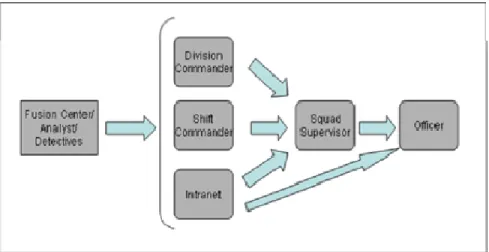
occasional chief’s blog. With many of these systems, the top managers decide what information employees need to know and then provide it. Reports are created and sent into the criminal records systems, often to never be seen or heard from again. Arrests are made, but the outcome of the prosecution may never be known. Officers learn valuable lessons but are hindered in their ability to share the information outside of a classroom environment or limited interactions with other individual officers.
Each of these established systems represents vertical structures of hierarchical communication that increases knowledge flow time and reduces the ability to share knowledge among large groups of people. In addition, these systems do not provide digital knowledge repositories that would be accessible to all levels of the organizations and enable the future use of this knowledge. Improvements facilitating the flow of knowledge in law enforcement would increase the ability of officers to share information and knowledge within and between squads, shifts, and divisions to enable action based on the knowledge provided. Nissen in Harnessing Knowledge Dynamics refers to this process as knowing or knowledge in action.7 Disseminating intelligence bulletins, as an
example, does not have any impact, if there is no knowing as demonstrated by the actions taken by officers. Currently, feedback processes to determine the level of knowing through the action being taken by officers are also limited.
Communication systems regularly used in policing do not facilitate the capture of information within an organization. A string of emails that result in a novel solution to a problem are not likely to be captured for future reference. While email provides a means to share explicit knowledge, email systems do not allow for the sharing of the knowledge beyond the immediate recipients. Though many law enforcement agencies have moved beyond codification based on paper documentation, the structures used for the sharing of information have not changed to take full advantage of the capabilities of current technologies. Instead of having paper files scattered in offices throughout the department, the majority of information possessed by the agency is stored in digital file folders with organizational methods as varied as the individual users. Each unit has their own set of
7 Mark E. Nissen, Harnessing Knowledge Dynamics: Principled Organizational Knowing & Learning (Hershey PA: IRM Press, 2006), 23.
digital files full of information that is usually unavailable to other areas of the department. As employees transfer and retire, the information that has been captured runs the risk of being lost in a sea of digital files and folders, or simply deleted.
Systems and processes used by the majority of the nation’s police departments do not provide sufficient means for personnel to take full advantage of intelligence products, or to share and collaborate on effective practices and crime reduction efforts. Information and knowledge sharing among officers and supervisors on a problem plaguing a neighborhood is often limited to the squad room and conversations over lunch. When sharing does occur, the information and lessons learned are rarely stored and made available for future use. Currently, limited means of information and knowledge storage, and transfer results in a diminished capacity to connect the dots. Connections between sets of information resulting in knowledge that could have allowed for breakthroughs in terrorism investigations may not be made. Crimes that have a terrorism nexus may go unsolved.
Contrast the systems being used by police with those now freely available to the general public. Twitter allows the sharing of tweets (micro-blogs) at the user’s whim. Hashtags help users categorize tweets for easy access. Blogs allow for knowledge sharing on topics of importance to the writer. Facebook provides the ability for users to create pages to allow those granted access to view the activities of a user. Wikis allow for collaborative work on documents. Information and knowledge can be stored and transferred at an unprecedented rate thorough the use of these tools, yet, they remain unavailable to police for internal communication. Businesses are finding that employees now desire the same level of functionality of technology within the work environment as are available in the consumer market.8
These tools, collectively referred to as “Web 2.0,” also enable the creation of additional sources of valuable information for “big data” and new opportunities for data mining. Organizations are using information garnered from big data to innovate, to
8 Jeff Cummings, Anne P. Massey, and V. Ramesh, “Proceedings of the 27th ACM International Conference on Design of Communication - SIGDOC '09; Web 2.0 Proclivity,” 2009), 259.
increase growth, and to improve productivity.9 As software is developed to mine,
process, organize, and interpret the mountains of new data being created daily, the importance of big data will grow exponentially.
If law enforcement agencies are to keep up with these changes in the community in which they serve, officers must also be able to exchange and interact with information and knowledge at the same rate as public consumers. Intranet systems need to be transformed into Emergent Social Software Platforms (ESSPs) where information and knowledge can easily be stored, transferred and collaborated on with minimal effort. Rather than act as conduits for prepackaged information, intranets need to be living environments that provide the ability to add, update, and change information as it evolves. Open employee-to-employee information sharing, where all employees are empowered to be information collectors, as well as information consumers, is needed to reduce the stove piping of information.10 The end purpose is to improve efficiency in law
enforcement. Unlike in manufacturing or other businesses, improved efficiency in the case of law enforcement means a quicker recognition of threats, increased awareness of ever changing crime trends, quicker identification and apprehension of suspects, improved recognition of organized crime and its connections, and an overall safer community.
Crime bulletins are regularly disseminated throughout the department. They are posted online, emailed—sometimes multiple times to the same user, and printed out. Officers and staff have access to the information, but there is no collaboration or coordination on actions suggested by the bulletin. An officer looking at a bulletin on a wanted subject may simply dismiss it other than for informational purposes, as opposed to taking action on it. If it has been a day or two since the bulletin has been sent out, it is easy to assume that another officer has already run down the leads, so following up on it would be a waste of time. Another assumption may be that if it were good information, someone would have already picked the suspect up. If an officer does follow up on
9 James Manyika et al., “Big Data: The Next Frontier for Innovation, Competition and Productivity,” McKinsey Global Institute, May (2011), 6–8.
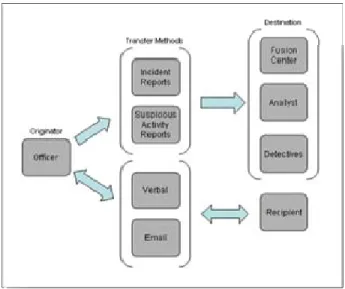
bulletin only to find the suspect is now driving a different vehicle, or has moved from a known residence, the newly acquired information may not be shared with others. An officer on another shift may follow up on the bulletin only to learn the same new information, again. The flow of this information, described in detail later, is disjointed. Feedback mechanisms are generally limited to one-way communications between the originator and the source of the information. Others that may be interested in updates may not be copied on an email. Direct communication, such as phone calls or conversations, stand little chance of ensuring the information is provided to all interested parties.
In other cases, information obtained is not shared due to the small amount of new information, concerns about a source’s reliability, or due to the need for a formal report to be created. As part of their time management, officers must decide if the new item of information is of enough value to warrant a field interview report.11 If the information is
shared, it may take hours to days before an updated bulletin is sent out with the new information. Meanwhile, an officer working a different area may have another piece of information, such a location where the suspect likes to hang out. Had the new vehicle information been combined with a likely hangout, the suspect may have been caught. This scenario plays out multiple times a day. Traditional systems were not sufficient to capture this type of information. Fortunately, new social medial tools used within an ESSP may provide an answer.
A current challenge law enforcement agencies face is that although access to data, information, and knowledge has increased exponentially, the means of sharing administrative, operational, and criminal information in a way that allows the user to derive meaning and value from the data has not kept up with this increase. Users are lost in a sea of big data resulting in information overload and, ironically, an inability to easily share information and collaborate with other users.
11 Otherwise known as a Suspicious Activity Report. These are structured reports used to capture information on activity of a suspicious nature.
Much of the knowledge possessed by officers is not captured due to the perceived unfriendliness of existing systems.12 Some of the concern is due to human-computer
interaction issues, such as antiquated graphical user interfaces. In many departments, Standard Query Language (SQL) is needed to access certain types of data. The data is often stored across multiple databases, each sometimes requiring a separate logon and search. Another factor is the lack of structures to informally share information. Current information systems were not developed for the purpose of making it easy for the individual user to contribute information outside of a formal processes and structures, such as is the case with the creation of reports and manuals.
Years ago, the sharing of large quantities of rapidly changing information was impractical due to the reliance on paper based codification. With the advent of digital records, codification options have increased, but systems for efficient sharing of this information still lag behind. Individually generated information and knowledge codification outside of these formal structures is limited to word documents and similar files stored in individually managed digital file folders. Shared file folders can be difficult to navigate and to locate the information being sought. This leaves a significant amount of information that is not being codified and stored in readily accessible means, despite their potential value in informing day-to-day patrol and investigations, as well as in aiding in tactical and strategic planning. Put another way, there are few mechanisms in place to incorporate individual memory into the collective or organizational memory.13
Collective memory contributes to big data. By incorporating individual memory and making it available as part of big data, extensive information and knowledge can be derived from the individual and made available to future employees to help further organizational goals. Failing to capture individual memory greatly limits the potential ability of individually possessed information and knowledge to impact the organizational activities.
12 Collier, Policing and the Intelligent Application of Knowledge, 109–116, 112.
13 Maryam Alavi and Dorothy E. Leidner, “Knowledge Management Systems: Issues, Challenges, and Benefits,” Communications of the AIS 1, no. 2es (1999), 1, 118.
In addition, the actual means for information sharing between individuals is extremely limited. Information sharing can only be successful if the systems used to store the information are readily accessible and easy to use.14 In today’s culture, with so much
information as close as your smart phone, “readily accessible” denotes immediate access to information when it is needed, not when it is convenient to provide it. Squad meetings, a traditional means of knowledge and information sharing, have not changed much over the past decades. A knowledge-sharing environment that is available for a brief time per shift provides very limited opportunities for the exchange of knowledge. What is needed in today’s world of rapidly changing information is living information and intelligence.
B. CHALLENGES TO ADAPTATION OF NEW TECHNOLOGY
Issues with law enforcement information sharing are centered on an over reliance on outdated modes of communication. There are a variety of reasons that law enforcement is reliant on these systems for information sharing and collaboration. Of course, implementation cost is one factor, but with the prevalence of open source tools available on the Internet, the cost factor clearly is not insurmountable. In addition, the move to updated information sharing systems could potentially result in cost savings through increased efficiencies in information sharing, and resulting improvements in work products. The primary issues that are likely to pose the most formidable challenges to the use of social media by law enforcement agencies are that of culture, technology, and privacy and legal concerns.
1. Culture
Hierarchical cultures of communication will likely be the biggest barrier to overcome. Many of the commonly used communication tools are often limited by the hierarchical structures in which they are used. In order to upload a report into the records management system, a supervisor must approve the report. To post an item on the intranet, it must first go through a person with the authority to post it. To send an email to
14 Brian Lehaney et al., Beyond Knowledge Management (Hershey, PA: Idea Group Pub., an imprint of Idea Group, 2004), 22.
the entire department; staff must first approve it. These restrictions are primarily by design. Traditional hierarchical styles of leadership require careful review of communications prior to information being passed up the chain of command. For reports, a review prior to storage in the system is important to ensure accuracy and completeness. Sending an email to everyone who could potentially have an interest in its contents would quickly overwhelm inboxes. While there are well-established practical reasons for some of the limitations, the end result is that the flow of information is limited by a series of stovepipes. These systems of structured internal knowledge were not designed to facilitate informal internal knowledge.
Codification efforts within police departments often fail due in part to a cultural history that favors word-of-mouth communication and avoids the addition of increased amounts of paperwork.15 A personalization strategy of knowledge management, as
opposed to a codification strategy, is often favored by officers due to its focus on person-to-person transfers of knowledge consistent with a long history of sharing knowledge.
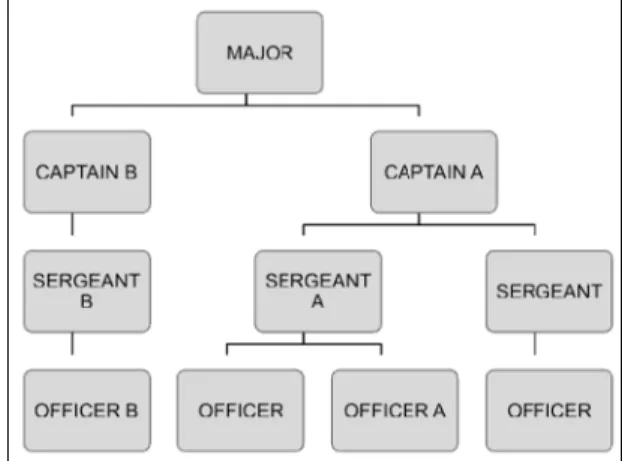
The development of police departments was based on a hierarchical military model that valued discipline and order over information sharing and collaboration. As the old adage goes, information is power. Control over information provided a means of exerting power over officers under a supervisor’s command. Those that possess information often filter and channel it for short-term personal benefits.16 To this day,
control over the dissemination of information is valued as an indicator of the information holder’s power and prestige. When a police officer’s evaluation was primarily based on the number of tickets written and arrests made, the need for information sharing was of less importance.
With the advent of CompStat, intelligence-led policing, and predictive policing, the need for information sharing and collaboration has grown well beyond the capabilities of traditional hierarchical means of communication. Changing the tools will not change
15 T. Dave Chavez, Michael R. Pendleton, and Jim Bueerman, “Knowledge Management in Policing,” U.S. Dept. of Justice, Office of Community Oriented Policing Services, 40.
16 Donella H. Meadows, Thinking in System: A Primer (White River Junction, Vermont: Chelsea Green Publ, 2010), Kindle location 3266 of 4207.
communication styles unless leaders within the traditional hierarchical systems of police agencies are able to adapt to the new technology.
2. Current Technology Acceptance
Innovators within a police agency may find resistance to new technologies due to overall satisfaction with current information systems. Officers and staff may not recognize how current technologies restrain them from operating at peak efficiency. Maintaining the status quo of current systems including email, static intranets, and traditional squad meetings may be deemed as sufficient for officer needs.
Email is a commonly used means of communication but is limited in its ability to transfer information and knowledge to those not specifically included in the email dissemination group. An email discussion resulting in new information regarding a particular crime bulletin will not be included on the intranet page where the crime bulletin is posted. Though phones and email are effective at transferring information between the two officers in this example, they do not include storage mechanisms that permit outside access to the information. Others in the chain of command, or on other shifts, may have a need for the information but will not have access to it.
Intranets, as a means of information dissemination, area positive moves forward but often still lack many modern capabilities available to the general public. The current Tulsa Police Department intranet, as an example, includes blogs and document storage, but it lacks any means of lateral transfer of, or of personalized access to, information and knowledge. It also lacks a means of easily transferring knowledge from one officer to another. Put another way, common intranets provide improvements in human-computer interactions, but they come up short when it comes to improving human-computer-human interfaces. Current police intranet systems are designed primarily to push prepackaged information that changes little over time, short of the originator republishing an update.
For example, detectives and analyst often create crime bulletins to update officers on crime trends and wanted suspects. The bulletin may include a description of the incident(s), suspect vehicle descriptions, and suspect information including photos if available. An example is shown in Figure 1. These crime bulletins are published in a PDF
format and sent out by email to select recipients, and posted on the intranet. In some cases, they are also printed and distributed at squad meetings. If an officer seeing the bulletin recognizes the suspect shown in it, this is information that would clearly be of value to all officers. However, if the bulletin needs updated on a Friday night, it may well be Monday morning before the update is posted online.
Figure 1. Example of a Crime Bulletin
In the meantime, the bulletin is outdated and effectively dead, in that no updates based on new information or action taken will be available until the creator of the document is able to make the update and redisseminate. Information sharing is treated as a process that must be limited and controlled rather than encouraged. One similarity in these systems is that it is incumbent on the user to seek out the information, or hope that it is emailed to them, in order to benefit the user. There is no means for the user to establish a pull type system, meaning a system where the user can customize the information being provided based on the individual’s needs and interest areas.
Squad meetings, email, and intranets, are forms of information silos. The term “information silos” in this context refers to systems that lack of means of sharing information between the disparate systems. Information provided at a squad meeting, in
an email conversation, or on an intranet page, may not result in effective sharing between these systems, or even among the individual systems—e.g., information shared between individual officers at one squad meeting, more often than not, will not be shared at the next shift’s squad meeting since no codification occurs. Most importantly, the knowledge possessed by individual employees will not be readily accessible to others once that employee transfers to another shift or division, or retires. All the knowledge the employee has developed over the years related to their experience in a particular beat or squad will be gone, unless systems are present to allow the codification of that knowledge and are used by that employee.17
Currently, piecemeal improvements are often made without sufficient respect to the end product that is desired. Contrary to intent, these systems could actually reduce communication through increasing complexity, or simply fail due to a lack of an overreaching implementation plan.
3. Legal and Privacy Issues
Additional areas that must be addressed in discussions concerning increasing information sharing within an organization, as well as with other organizations, is the legal and privacy issues that apply to law enforcement issues. There is a prevalent concern in law enforcement that the use of social media applications to share criminal information and intelligence, even in a secure internal environment, may violate existing federal and state statutes. The laws usually referenced are Title 28 of the Code of Federal Regulations, part 23 (28 CFR Part 23), and the 1976 Privacy Act. Due to the importance and complexity of these statutes and their appropriate application, Chapter V will be dedicated to coverage of this issue. A key part of this discussion will revolve around the issue and definition of intelligence. To understand the laws that impact information and intelligence sharing, there must be a clear understanding of what the terms of information and intelligence actually mean. The handling of intelligence information within federal data systems is strictly regulated and controlled. The same regulations apply to state and local systems that received certain federal grant funding. Other state and local systems
voluntarily adopt 28 CFR Part 23 as a nationally recognized guideline for the responsible handling of intelligence. The question that then follows is, when does information and knowledge become classified as “intelligence?” Academic literature, books on intelligence, and 28 CFR Part 23 have differing interpretations. The issue is further clouded due to 28 CFR Part 23 having been published in 1980 with revisions made in 1993.18 This regulation was not designed to address the sharing of information over the
Internet or within the context of social media and ESSPs. Needless to say, this complicates information sharing efforts that either are required to or choose to follow this regulation.
C. HYPOTHESIS/TENTATIVE SOLUTION
The author’s hypothesis is that an Emergent Social Software Platform (ESSP), which allows for open, secure discussions by officers, staff, detectives, and other authorized personnel, may greatly improve the ability of police departments to communicate in order to effectively fight crime and address other community concerns. This hypothetical system would be based on currently existing tools, and implemented and operated in a manner that takes into account the cultural, technological, and legal concerns. The system could also be used to capture the experience and knowledge of officers used to address a wide variety of issues. Another key element of this system would be the integration of the currently disparate storage and information resources currently being used. An ideal system would greatly simplify person-to-person communication and human-computer interaction by incorporating elements of email, records management systems, intranets, document management software, and a variety of information sources. Further efficiency would be gained by the removal of communication intermediaries that slow down or prevent the free flow of information.
There seems to be belief in law enforcement, as in other organizations, that if you gather enough data, answers to ongoing problems will manifest themselves and provide self-evident paths for future action. The reality is that data is of limited value to most
patrol officers and detectives without the context provided by information and knowledge. Even then,the existence of information and knowledge within an agency has little to no value, if it is not accessible to the users. As accessibly increases, so does the value.19 A caveat to this is that large amounts of information and data, so called “big
data” may prove to be of significant value to analysts and planners.
Though one system may not be able to address all the problems with how information is currently shared and collaborated, ESSPs may provide a solution that addresses many of the issues. A crucial need at this time is a vision to work towards that would meet the communication and knowledge management needs of officers.
D. RESEARCH QUESTION
Primary question:
How can Web 2.0 technology and emergent social software platforms be used to improve intra-agency law enforcement criminal information sharing?
This leads to a secondary question:
What are the challenges in implementing emergent social software platform criminal information sharing in a policing environment?
After gathering data on how Web 2.0 technology and emergent social software platforms are being used for information storage and transfer, and how they are being applied internally in private and government environments, the methods that are found to be successful will be used to develop recommendations for their implementation and use in a law enforcement environment.
E. SIGNIFICANCE OF RESEARCH
Historically, policing has been primarily a reactive process. Traditional measures of success included arrest data, the number of tickets written, response time to calls, etc. With the advent of CompStat and Intelligence-led policing, there has been an increasing
19 Thomas H. Davenport and Laurence Prusak, Working Knowledge: How Organizations Manage What They Know (Boston, Mass: Harvard Business School Press, 1998), 18.
focus on the reduction of crime through proactive efforts.20 This change is bringing
knowledge management, information sharing, and collaboration to the forefront of policing. While an individual’s access to data and related analysis is an essential element needed to address crime issues, the actual practice of policing is not a solitary practice. Though police staff provides goals and objectives, and resources, it is the communication in and between squads, analysts, detectives, supervisors and other personnel that has the biggest potential to positively impact crime reduction efforts. Drapeau and Wells describe this process within an agency as inward sharing; otherwise described as intra-institutional sharing or the sharing of information within a department.21 Inward sharing
has the potential to reduce the knowledge gaps that exists between officers in the field, detectives, analyst, and staff. Emergent Social Software Platforms (ESSPs) expands the ability between employees for inward sharing and offer the potential to improve human-computer interactions to increase access the value of data.
20 Collier, Policing and the Intelligent Application of Knowledge, 109–116, 110.
21 Mark Drapeau and Linton Wells, “Social Software and National Security an Initial Net Assessment,” Center for Technology and National Security Policy, National Defense University, www.dtic.mil/cgi-bin/GetTRDoc?AD=ADA497525, 7.
II. LITERATURE
REVIEW
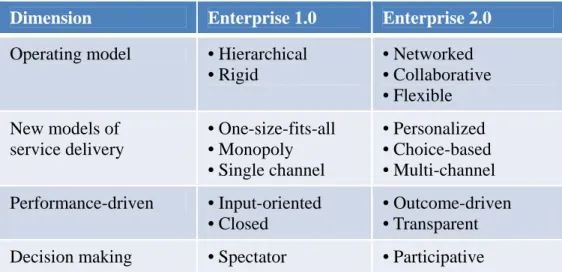
One of the challenges of research into Web 2.0 social media as applied to social intranets is the limited research in this area. Use of social media as an internal communication tool is less documented in contrast to the more common application of Web 2.0 technologies in social media designed to interact with the general public. In this context, Web 2.0 can also be referred to as Enterprise 2.0 and Government 2.0.
Web 2.0 includes concepts such as social networking, micro-blogs, wikis, RSS feeds, and media sharing, among others. Research on integrating Web 2.0 technologies in corporate environments, let alone internal law enforcement environments, is limited. Most of the research this researcher has found focuses on the use of these technologies as a marketing tool or as a tool for improving communication and interaction with the public. Even though research on Web 2.0 implementation in policing may be lacking, the research on core concepts behind it is not. These include network structures, intelligence processes, knowledge management, and information sharing.
A. CURRENT RESEARCH ON COLLABORATIVE SOFTWARE
One first step in researching how technology can be used in the intelligence process to improve information sharing and collaboration is to observe how the technology is currently being used. Organizations examined included private industry, intelligence agencies, and other governmental agencies.
A 2001 paper entitled Building an Infrastructure for Law Enforcement Information Sharing and Collaboration: Design Issues and Challenges delves into the basic problems law enforcement personnel face when attempting to gather information. The authors address the need for a single user interface or portal that allows officer direct access to the vast amount of information that is currently available.22 The authors also recognize the need to filter the information, so that the information relevant to the user is available and not lost in an ocean of data. The creation of information monitoring
22 Michael Chau et al., “Building an Infrastructure for Law Enforcement Information Sharing and Collaboration: Design Issues and Challenges,”
systems and personalization tools is recommended. Their research shows that searches used for information access could be improved through data mining and machine learning techniques.23 Though this paper is somewhat dated, most of the problems described still exist in law enforcement today, and the insights provided are still relevant. One of the advantages of today’s perspective is that we can readily find examples of data mining and improved search functions, as well as other social media tools in commercial applications used by companies such as Amazon, Google, and Facebook.
Shortly after the events of 9/11, the Defense Advanced Research Projects Agency (DARPA) created a program with the objectives of developing “a technology architecture and infrastructure to support collaboration, analytical reasoning and information sharing between analysts in different agencies and organizations…”24 This program has a broad focus intending to address federal, state, and local authorities, but the research also has direct application to internal sharing applications. A 2004 DARPA research paper discusses the need for collaborative applications in the intelligence environment. Current information sharing structures are designed for large environments where broad scale information sharing is needed. Such centralized structures do not facilitate collaboration among small teams. The systems were not designed for sharing or collaboration and do not provide the mechanism needed in today’s quickly changing environment. The primary use of these systems, intended or otherwise, is their use as an information silo or document repository.25
The researchers also cover “edge-based technology.” The term applies to information that is created and stored on the “edge” of a noncentralized network. Contrary to traditional systems, these emergent edge-based systems are not geared towards broad information storage or dissemination. The article goes on to discuss how organizations can increase productivity by implementing web-based technology, methods
23 Hsinchun Chen et al., “COPLINK: Managing Law Enforcement Data and Knowledge,” Communications- ACM 46 (2003), 28–34.
24 Margaret Arney, Brad Cohen, Brad Medairy, and Booz Allen Hamilton, “Impact of Advanced Collaborative Architectures on Intelligence Analysis” 2004), 3176.
and processes that already exist within the intelligence community.26 The authors’ conclusion is that “an advanced collaborative architecture creates an extremely powerful and flexible collaborative system.” This system can be used to not only increase the creation of internal collaborative efforts but also those with other organizations.27
Current research on other collaborative software was often limited to a few articles or web pages on the topics. Though often focused on single software applications, the articles and other nonacademic sources provide a general idea of the state of current and future software and applications. Additional research is needed on how these programs are increasing collaboration and aiding agencies in their efforts to achieve their goals and objectives.
B. WEB 2.0
There is no shortage on research and publications on Web 2.0 technologies. A paper by Kaplan and Haenlein provides an in-depth discussion of social media concepts. The authors provide distinct definitions of the terminology and elements involved.28 This is unusual in that many authors seem cautious in establishing concise definitions, which is probably due in part to the rapidly changing aspect of the terms and technologies. Web 2.0 is also referred to as social media, Enterprise 2.0 (in the corporate environment), and Government 2.0. In the Kaplan and Haenlein definition, the term of social media is limited to publically available websites. This places government and enterprise efforts at improving collaboration within the internal work environment under the umbrella of Web 2.0 rather than the more specific concept of social media. Understanding the differences between the two should help to focus future research. Despite this, the technologies used by Web 2.0 and social media are often used interchangeably and can be difficult to distinguish. Nissen uses the term “groupware” to describe tools that support knowledge
26 Margaret Arney, Brad Cohen, Brad Medairy, and Booz Allen Hamilton, “Impact of Advanced Collaborative Architectures on Intelligence Analysis” 2004), 3178–3179.
27 Ibid.
28 Andreas M. Kaplan and Michael Haenlein, “Users of the World, Unite! The Challenges and Opportunities of Social Media,” Business Horizons 53, no. 1 (2, 2010), 59–68.
work. He gives the examples of email, chat, and discussion boards, all of which fall under the Web 2.0 umbrella. According to Nissen, groupware includes infrastructure tools that are used to provide support for knowledge work. Groupware facilitates the creations and management of data, information, and knowledge. These tools can be especially valuable in environments where face-to-face communication is impractical. 29 Nissen distinguishes
web portals and search engines from other technology infrastructure. He credits these additional tools as providing a higher level of contribution to knowledge management. A knowledge management program that provides infrastructure and more advanced tools, such as web portals, may improve the transfer of knowledge, but interpersonal interaction is still the central to knowledge transfer.
The 2008 article Change Your World or the World Will Change You provides an introduction to Web 2.0 in the context of government agencies.30 While very brief in its approach, the article provides a general understanding of how Web 2.0 can be used to improve government services and operations. What is Web 2.0? provides a thorough introduction to Web 2.0 concepts geared towards the business environment.31
In his paper, The Wiki and the Blog: Toward a Complex Adaptive Intelligence Community, Andrus writes about the need for Web 2.0 technology to be integrated into the intelligence environment. He uses Complexity Theory to provide a framework under which the intelligence community can adapt to a continuously changing environment.32 Web 2.0 tools, such as wikis and blogs, can be used to bring about the changes needed. While Andrus does not specifically address the intelligence cycle, he writes about the crucial role feedback technologies play in an intelligence framework based on the
29 Nissen, Harnessing Knowledge Dynamics: Principled Organizational Knowing & Learning, 23. 30 Paul Macmillan, Andrew Medd, and Peter Hughes, “Change Your World or the World Will Change You “ Deloitte,
http://www.deloitte.com/view/en_EC/ec/792ebd7690794210VgnVCM100000ba42f00aRCRD.htm. 31 Tim O'Reilly, “What is Web 2.0?” O'Reilly Media.
32 D. Calvin Andrus, “Toward a Complex Adaptive Intelligence Community — Central Intelligence Agency “
Complexity Theory.33 Feedback, also referred to as evaluation, is a key step in the intelligence cycle. Though Andrus stresses the importance of the role of feedback technologies, he does not provide substantial detail on these particular technologies. Andrus makes a particularly interesting prediction that once wikis and blogs are fully integrated into intelligence community operations, “the nature of Intelligence will change forever.” 34 This paper is a key source of information on the use of Web 2.0 for improving intelligence, and it is believed to have inspired the CIA version of the wiki, Intellipedia. 35
The authors of the paper Web 2.0 Proclivity: Understanding How Personal Use Influences Organizational Adoption researched the connection between the uses of Web 2.0 in a user’s personal life and how the usage affects the success or failure of organization Web 2.0 adoption. This is a crucial concept to consider due to its impact on technology adoption efforts. Ideas abound about how to improve intelligence operations, but more often than not fall short when it comes to implementation. The research involved submitting 4,500 surveys to employees of a Midwestern company. Not surprisingly, the researchers found that there is a positive relation between a user’s personal use of Web 2.0 technologies and their adoption of those technologies in a corporate environment.36 The study also found that executive support for Web 2.0 implementation was found to have little impact on a user’s likelihood of adopting the technology.37 It suggests that a bottom up approach may be needed to ensure the successful adoption of Web 2.0 technologies. The study did not address how adopting Web 2.0 technologies impacted the company.
Research into general Web 2.0 concepts is comprehensive. Additional research on how Complexity Theory applies to Web 2.0 may prove to be beneficial. Specifically,
33 D. Calvin Andrus, “Toward a Complex Adaptive Intelligence Community — Central Intelligence Agency “
https://www.cia.gov/library/center-for-the-study-of-intelligence/csi-publications/csi-studies/studies/vol49no3/html_files/Wik_and_ Blog_7.htm, 12.
34 Wikipedia contributors, “Intellipedia,” Wikipedia, en.wikipedia.org/wiki/Intellipedia. 35 Ibid.
36 Cummings, Massey, and Ramesh, Proceedings of the 27th ACM International Conference on Design of Communication - SIGDOC '09; Web 2.0 Proclivity , 257, 262.
applying the Cynefin Framework along with Complexity Theory may help in understanding how Web 2.0 applications can help sort through complex communication.38
C. KNOWLEDGE MANAGEMENT
As part of the research, this researcher examined how elements of knowledge management, can be improved through the use of Web 2.0. Knowledge management involves four basic processes that include creating, storing/retrieving, transferring, and applying knowledge.39 Although this paper is focused on the areas of information sharing
and collaboration, a general discussion of knowledge management literature is also needed to provide clarity to the terms being used. Any system that facilitates communication to include information and knowledge sharing is in fact a type of knowledge management system.
Lee and Lan define knowledge management as “a process of creating intangible assets from the combination of knowledge and experience provided by the individuals or knowledge workers within the organization or system.”40 Knowledge management has
traditionally focused on the storage of knowledge in a central knowledge repository and accessibility. Contemporary knowledge management has shifted focus to a conversational approach that emphasizes integration and collaboration.41
Plenty of evidence demonstrates that knowledge management can both benefit from the adoption of Web 2.0 technologies. As with the previously mentioned DARPA study, a 2007 paper by Lee and Lan addresses the limitations and future of current information, or knowledge management, processes. While knowledge management has traditionally focused on the collection of knowledge in a central repository, the
38 Cynefin is a theoretical model used to describe problems, situations and systems.
39 Maryam Alavi and Dorothy E. Leidner, “Review: Knowledge Management and Knowledge Management Systems: Conceptual Foundations and Research Issues,” MIS Quarterly 25, no. 1 (2001), 107–136, 113.
40 Maria R. Lee and Yi-Chen Lan, “From Web 2.0 to Conversational Knowledge Management: Towards Collaborative Intelligence,” Journal of Entrepreneurship Research 2, no. 2 (2007), 47–62, 51.
integration of it with Web 2.0 technologies allows for the creation of knowledge networks. These knowledge networks foster the creation of dynamic knowledge and collective intelligence.The authors identified a “pressing need to identify the current state of organizations or community groups pursuing collaborative intelligence.” 42
The terms information and knowledge are sometimes used interchangeably, which can create confusion. This is further complicated by the use the term of “knowledge management” that is used to describe processes that include information and data, as well as knowledge itself. Davenport and Prusak emphasize the importance of making clear distinctions between the terms.43
The knowledge hierarchy is a tool that can be used to conceptualize data, information, and knowledge. Knowledge lies at the top of the hierarchy and is differentiated by the highest level of actionability while having the lowest abundance. The definition of knowledge, as provided by Nissen, is information combined with data “that enables direct action.”44 Knowledge is also said to be highly contextualized
information as shaped by individual interpretation and experience.45 A dictionary
definition of knowledge is “something that may be known; information.”46
Some researchers take a more constrained view of knowledge by labeling it with the quality that it exists only in the realm of the mind. Once the knowledge is articulated and made explicit, it becomes information.47 Others describe it as both a state of mind
and an object by positing that it originates and is applied in the mind but can be codified into documents and digital storage mediums, as well as in organizational routines,
42 Maria R. Lee and Yi-Chen Lan, “From Web 2.0 to Conversational Knowledge Management: Towards Collaborative Intelligence,” Journal of Entrepreneurship Research 2, no. 2 (2007), 47–62.
43 Davenport and Prusak, Working Knowledge: How Organizations Manage What They Know. 44 Nissen, Harnessing Knowledge Dynamics: Principled Organizational Knowing & Learning, 250. 45 Kowta Sita Nirmala Kumaraswamy and C. M Chitale., “Collaborative Knowledge Sharing Strategy to Enhance Organizational Learning,” J.Manage.Dev.Journal of Management Development 31, no. 3 (2012), 308–322.
46 “Knowledge,” Dictionary.com, http://dictionary.reference.com/browse/knowledge?s=t. 47 Alavi and Leidner, Review: Knowledge Management and Knowledge Management Systems: Conceptual Foundations and Research Issues, 107–136, 108.
processes, practices, and norms.48 Knowledge can be categorized as personalized
information, a state of mind, an object, a process, access to information, and capability.49
Conversely, information is defined as that which “provides meaning and context for action..”50 Davenport and Prusak refer to it as “data that makes a difference” by
providing relevance and purpose to data.51 Information lies between data and knowledge
in the hierarchy. Information has a lower abundance but greater actionability than data.52
Data, defined as “a set of discrete objective facts about events,”,” lies at the lowest level and is differentiated from the other levels in the hierarchy by being in the greatest abundance and having the lowest actionability. 5354 Data’s primary importance
is that it provides the building blocks needed for the creation of information. It is important to understand what data does not do. Data does not provide any judgment, interpretation, or basis for action. 55 Data without the application of knowledge and
information is of limited value.
Nissen points out that each of the hierarchical levels is interrelated, with far more complexity than indicated by the simple hierarchy. For instance he notes, “Knowledge without data is insufficient for action.”56 Nissen also notes the difference between
knowing and knowledge. Knowing refers to knowledge in action. Without the application of knowledge, to include data and information, there is no knowing, and hence, there is a knowledge gap that exists between knowledge and knowing. In these situations, even
48 Davenport and Prusak, Working Knowledge: How Organizations Manage What They Know, 5. 49 Alavi and Leidner, Review: Knowledge Management and Knowledge Management Systems: Conceptual Foundations and Research Issues, 107–136, 111.
50 Nissen, Harnessing Knowledge Dynamics: Principled Organizational Knowing & Learning, 49. 51 Davenport and Prusak, Working Knowledge: How Organizations Manage What They Know, 3. 52 Nissen, Harnessing Knowledge Dynamics: Principled Organizational Knowing & Learning, 49. 53 Davenport and Prusak, Working Knowledge: How Organizations Manage What They Know, 2. 54 Nissen, Harnessing Knowledge Dynamics: Principled Organizational Knowing & Learning, 49. 55 Davenport and Prusak, Working Knowledge: How Organizations Manage What They Know, 2. 56 Nissen, Harnessing Knowledge Dynamics: Principled Organizational Knowing & Learning, 21.
though the organization may possess the knowledge needed to prevent mistakes, without the application of this knowledge, there may be no knowing, and hence, a repetition of the mistakes.57
Regardless of the amount of latent knowledge in storage, without investment in the tools and systems needed to apply this knowledge, the full value of the knowledge cannot be realized.58 Vast amounts of knowledge, if not accessible and available in the
appropriate context, have little more value than information or even data. Systems are needed, in part, to facilitate the transfer and sharing of knowledge in a way that has meaning to the user. Web 2.0 technologies address only one aspect of knowledge transfer. The U.S. Army defines knowledge transfer as “The movement of knowledge— including knowledge based on one’s expertise or judgment, from one person to another.”59 Knowledge transfer consists of two components, the transmission of
information and the absorption of the information.60 Web 2.0 is ideally suited to facilitate
the transmission of information. However, knowledge transfer also involves the absorption of knowledge by the intended audience. Simply making information available does not guarantee that it will be absorbed, much less acted upon. There are a number of reasons why the user may not absorb information. These include a human-computer interfaces, organizational cultural barriers, and relevance, among others.61 Ensuring
absorption is a complicate matter that relies heavily upon the culture in which the Web 2.0 technology is implemented.
The terms “transfer” and “sharing” can be difficult to distinguish. Knowledge sharing has been defined as “a set of behaviors that involves the exchange of information
57 Nissen, Harnessing Knowledge Dynamics: Principled Organizational Knowing & Learning, 71– 74.
58 Ibid., 75.
59 Knowledge TransferTthrough People, United States Strategic Command Knowledge Transfer Office, 2009), 12, 5.
60 Davenport and Prusak, Working Knowledge: How Organizations Manage What They Know, 101. 61 Ibid.
or provision of assistance to others.”62 Another definition is “inducing knowledge to flow
between different people or organizations.”63 Nissen defines knowledge transfer as
simply, “sharing knowledge locally” but differentiates it as a subset of knowledge sharing that he associates with tacit knowledge and broad organizational reach.64 In contrast,
Davenport and Prusak use the term knowledge transfer in a broader sense that includes knowledge sharing.65 Lehaney, et al., forgoes the term of knowledge transfer all together
and uses the term of knowledge sharing.66 In some writing, the term of sharing seems to
take on a more personal context emphasizing individual interactions. The differences between the terms of sharing and transfer are subtle enough to be of little significance to this paper.
Regardless of terminology, the transfer and sharing of knowledge in an unstructured format is vital to an agencies success. An essential element of knowledge management is to facilitate the transfer of knowledge and information through specific strategies that encourage spontaneous exchanges.67 While Web 2.0 tools may capture
knowledge, if one takes the view that knowledge is primarily a product of the mind, Web 2.0 is essentially a tool for sharing information. For the purpose of this paper, the term “information” is be used to describe objects, usually text, that are used to give meaning and relevance to data.
ESSPs provide potential virtual meeting areas for information transfer, whether or not the information shared is transformed into knowledge will be based on the perspective and actions of the individual user. For this reason, this paper primarily focuses on information, but the close relationship of information and knowledge may
62 Brian D. Janz and Pattarawan Prasarnphanich, “Understanding the Antecedents of Effective Knowledge Management: The Importance of a Knowledge-Centered Culture,” Decision Sciences 34, no. 2 (2003), 351–384.
63 Nissen, Harnessing Knowledge Dynamics: Principled Organizational Knowing & Learning, 255. 64 Ibid.
65 Davenport and Prusak, Working Knowledge: How Organizations Manage What They Know. 66 Lehaney et al., Beyond Knowledge Management.